Cloud Computing Seminar On By Aniket Saxena
Cloud Computing Service Models:   SaaS,Paas,Iaas Deployment Models:  Private, Community, Public,Hybrid Architecture Issues Conclusion What to Discuss?
What the  Cloud Computing  is?
First from the beginning when mainframes were predicted to be the future of computing. Mainframes and large scale machines were built and used, and in some circumstances are used similarly today. The trend, however, turned from bigger and more expensive, to smaller and more affordable commodity PCs and servers. Cloud computing refers to the many different types of services and applications being delivered in the internet cloud, and the fact that, in many cases, the devices used to access these services and applications do not require any special applications.
On-Demand Self -Service Centralized Service Resource pooling Consumption-Based Billing Rapid Elasticity   Characteristics
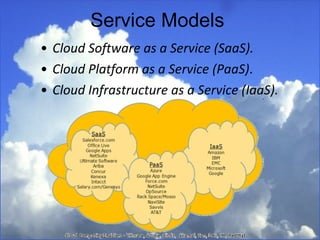
Cloud Software as a Service (SaaS). Cloud Platform as a Service (PaaS) .  Cloud Infrastructure as a Service (IaaS).   Service Models
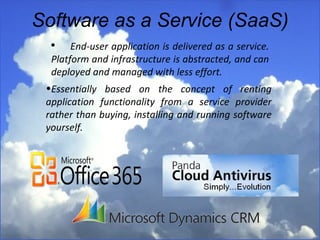
Software as a Service (SaaS) Essentially based on the concept of renting application functionality from a service provider rather than buying, installing and running software yourself.  End-user application is delivered as a service. Platform and infrastructure is abstracted, and can deployed and managed with less effort.
Platform as a Service (PaaS) . Platform as a service (PaaS), which is all about providing, a platform in the cloud, upon which applications can be developed and executed. Google, Salesforce.com (with Force.com), and Microsoft (with Azure) exist in this space. Facilities provided include things like database management, security, workflow management, application serving, and so on.
Infrastructure as a Service (IaaS). The proposition here is the offering of computing power on demand. Physical infrastructure is abstracted to provide computing,  storage, and networking as a service, avoiding the expense and need for dedicated systems. Consumers control and manage the systems in terms of the operating systems, applications, storage, and network connectivity, but do not themselves control the cloud infrastructure.
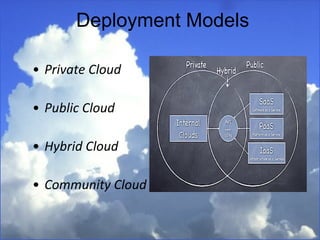
Private Cloud Public Cloud Hybrid Cloud Community Cloud Deployment Models
Private Cloud Also referred to as internal cloud or on-premise cloud, the cloud infrastructure that is managed and operated for one organization only, primarily to maintain a consistent level of control over security, privacy, and governance.   Essential characteristics of a private cloud typically include: Heterogeneous infrastructure  Customized and tailored policies  Dedicated resources In-house infrastructure End-to-end control
Public Cloud Also known as external cloud or multi-tenant cloud, this model essentially represents a cloud environment that is openly accessible. It generally provides an IT infrastructure in a third-party physical data center that can be utilized to deliver services without having to be concerned with the underlying technical complexities.  Essential characteristics of a public cloud typically include: homogeneous infrastructure common policies  shared resources and multi-tenant  leased or rented infrastructure;  economies of scale
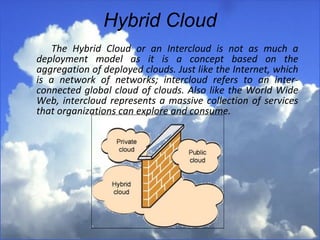
Hybrid Cloud The Hybrid Cloud or an Intercloud is not as much a deployment model as it is a concept based on the aggregation of deployed clouds. Just like the Internet, which is a network of networks; intercloud refers to an inter-connected global cloud of clouds. Also like the World Wide Web, intercloud represents a massive collection of services that organizations can explore and consume.
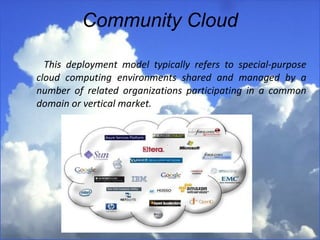
Community Cloud This deployment model typically refers to special-purpose cloud computing environments shared and managed by a number of related organizations participating in a common domain or vertical market.
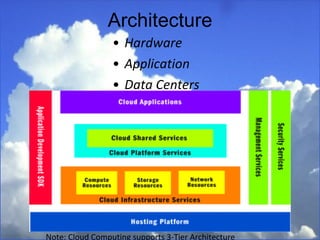
Hardware Application Data Centers Architecture Note: Cloud Computing supports 3-Tier Architecture
Issues In Cloud Computing Data Security Data Portability  Reliability  Ownership  Legal Issues
Conclusion Cloud computing is the next big wave in computing. It has many benefits, like better hardware management, since all the computers are the same and run the same hardware. It also provides for better and easier management of data security, since all the data is located on a central server, so administrators can control who has and doesn't have access to the files.  I hope you have learned a lot about cloud computing and the bright future it has in the coming years. To Be Continued…..
References http://www.s-consult.com/2009/08/04/what-is-saas-cloud-computing-paas-and-iaas/ http://www.microsoft.com/en-in/cloud/default.aspx?qstr=CR_SCC=200017675 http://www.exforsys.com/tutorials/cloud-computing/cloud-computing-architecture.html http://i.msdn.microsoft.com/dd727504.fig01%28en-us%29.gif http://www.labnol.org/internet/cloud-computing-legal-issues/14120/ http://www.nist.gov/itl/cloud/upload/cloud-def-v15.pdf
Questions? Thank You All !

Cloud Computing

  • 1.
    Cloud Computing SeminarOn By Aniket Saxena
  • 2.
    Cloud Computing ServiceModels: SaaS,Paas,Iaas Deployment Models: Private, Community, Public,Hybrid Architecture Issues Conclusion What to Discuss?
  • 3.
    What the Cloud Computing is?
  • 4.
    First from thebeginning when mainframes were predicted to be the future of computing. Mainframes and large scale machines were built and used, and in some circumstances are used similarly today. The trend, however, turned from bigger and more expensive, to smaller and more affordable commodity PCs and servers. Cloud computing refers to the many different types of services and applications being delivered in the internet cloud, and the fact that, in many cases, the devices used to access these services and applications do not require any special applications.
  • 5.
    On-Demand Self -ServiceCentralized Service Resource pooling Consumption-Based Billing Rapid Elasticity Characteristics
  • 6.
    Cloud Software asa Service (SaaS). Cloud Platform as a Service (PaaS) . Cloud Infrastructure as a Service (IaaS). Service Models
  • 7.
    Software as aService (SaaS) Essentially based on the concept of renting application functionality from a service provider rather than buying, installing and running software yourself. End-user application is delivered as a service. Platform and infrastructure is abstracted, and can deployed and managed with less effort.
  • 8.
    Platform as aService (PaaS) . Platform as a service (PaaS), which is all about providing, a platform in the cloud, upon which applications can be developed and executed. Google, Salesforce.com (with Force.com), and Microsoft (with Azure) exist in this space. Facilities provided include things like database management, security, workflow management, application serving, and so on.
  • 9.
    Infrastructure as aService (IaaS). The proposition here is the offering of computing power on demand. Physical infrastructure is abstracted to provide computing, storage, and networking as a service, avoiding the expense and need for dedicated systems. Consumers control and manage the systems in terms of the operating systems, applications, storage, and network connectivity, but do not themselves control the cloud infrastructure.
  • 10.
    Private Cloud PublicCloud Hybrid Cloud Community Cloud Deployment Models
  • 11.
    Private Cloud Alsoreferred to as internal cloud or on-premise cloud, the cloud infrastructure that is managed and operated for one organization only, primarily to maintain a consistent level of control over security, privacy, and governance. Essential characteristics of a private cloud typically include: Heterogeneous infrastructure Customized and tailored policies Dedicated resources In-house infrastructure End-to-end control
  • 12.
    Public Cloud Alsoknown as external cloud or multi-tenant cloud, this model essentially represents a cloud environment that is openly accessible. It generally provides an IT infrastructure in a third-party physical data center that can be utilized to deliver services without having to be concerned with the underlying technical complexities. Essential characteristics of a public cloud typically include: homogeneous infrastructure common policies shared resources and multi-tenant leased or rented infrastructure; economies of scale
  • 13.
    Hybrid Cloud TheHybrid Cloud or an Intercloud is not as much a deployment model as it is a concept based on the aggregation of deployed clouds. Just like the Internet, which is a network of networks; intercloud refers to an inter-connected global cloud of clouds. Also like the World Wide Web, intercloud represents a massive collection of services that organizations can explore and consume.
  • 14.
    Community Cloud Thisdeployment model typically refers to special-purpose cloud computing environments shared and managed by a number of related organizations participating in a common domain or vertical market.
  • 15.
    Hardware Application DataCenters Architecture Note: Cloud Computing supports 3-Tier Architecture
  • 16.
    Issues In CloudComputing Data Security Data Portability Reliability Ownership Legal Issues
  • 17.
    Conclusion Cloud computingis the next big wave in computing. It has many benefits, like better hardware management, since all the computers are the same and run the same hardware. It also provides for better and easier management of data security, since all the data is located on a central server, so administrators can control who has and doesn't have access to the files. I hope you have learned a lot about cloud computing and the bright future it has in the coming years. To Be Continued…..
  • 18.
    References http://www.s-consult.com/2009/08/04/what-is-saas-cloud-computing-paas-and-iaas/ http://www.microsoft.com/en-in/cloud/default.aspx?qstr=CR_SCC=200017675http://www.exforsys.com/tutorials/cloud-computing/cloud-computing-architecture.html http://i.msdn.microsoft.com/dd727504.fig01%28en-us%29.gif http://www.labnol.org/internet/cloud-computing-legal-issues/14120/ http://www.nist.gov/itl/cloud/upload/cloud-def-v15.pdf
  • 19.