Motivation for cloud computing
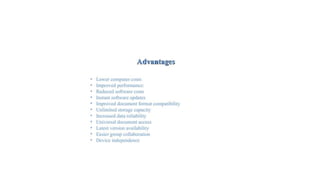
• Increse in the flexibility of storage
• Easily recover the data
• Easily access to the data
• Secure and protected
• No maintenance required
Characteristics of Cloud Computing
• There are basically 5 essential characteristics of Cloud Computing.
• On-demand self-services:
The Cloud computing services does not require any human administrators, user themselves are able to
provision, monitor and manage computing resources as needed.
• Broad network access:
The Computing services are generally provided over standard networks and heterogeneous devices.

• Rapid elasticity:
The Computing services should have IT resources that are able to scale out and in quickly and on as needed
basis. Whenever the user require services it is provided to him and it is scale out as soon as its requirement
gets over.
• Resource pooling:
The IT resource (e.g., networks, servers, storage, applications, and services) present are shared across
multiple applications and occupant in an uncommitted manner. Multiple clients are provided service from a
same physical resource.
• Measured service:
The resource utilization is tracked for each application and occupant, it will provide both the user and the
resource provider with an account of what has been used. This is done for various reasons like monitoring
billing and effective use of resource.
Basic Principle of Cloud Computing:
• Federation: A cloud computing environment must be capable of providing
federated service providers which means that, these providers, must be
capable of collaborating and resource sharing at any point irrespective of
their type. This is usually needed when an organization extends its
computing paradigm from the private to the public cloud. Moreover, This
federation must be kept transparent so that the virtual application can be
used on all the sites. This makes the application be handled remotely and
allows it to migrate from one site to another. Apart from this, the
federation must be carried out in a secure and independent way.
• Independence: The user of cloud computing services must be independent
of the provider’s specific tool and the type of service. According to this
principle, a user must be allowed the required virtual resource irrespective
of the type of provider. Moreover, it is the responsibility of service
providers to handle infrastructure while hiding confidential information.
Basic Principle of Cloud Computing:
• Isolation: According to this principle, a service provider must ensure the user with
respect to the isolation of their data from others. Even the data in the same cloud must
be separated from different users and therefore should not be accessed.
• Elasticity: The user of cloud computing must be provided with ease of accessing and
releasing the resources as required. This is typically referred to as elasticity. The rules
associated with elasticity must be included within the contract made between
consumers and services providers.
• Business Orientation: To develop a more efficient computing environment, an efficient
platform must be developed before the applications are included in the cloud. This
typically ensures the quality of services and assist SLA (Service-Level-Agreement).
• Trust: To build a successful cloud computing environment, one of the major factors is
trust between consumers and service providers. Therefore, effective mechanisms must
be included to develop a trustworthy computing environment.
Deployment Models
• The cloud deployment model identifies the specific type of cloud
environment based on ownership, scale, and access, as well as the
cloud’s nature and purpose. The location of the servers you’re
utilizing and who controls them are defined by a cloud deployment
model. It specifies how your cloud infrastructure will look, what you
can change, and whether you will be given services or will have to
create everything yourself. Relationships between the infrastructure
and your users are also defined by cloud deployment types.
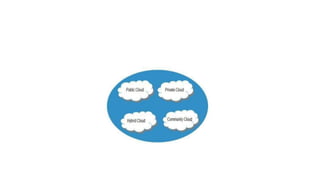
Different types of cloud computing deployment models are:
• Public cloud
• Private cloud
• Hybrid cloud
• Community cloud
Public Cloud
• The public cloud makes it possible for anybody to access systems and services. The public cloud may be less
secure as it is open for everyone. The public cloud is one in which cloud infrastructure services are provided
over the internet to the general people or major industry groups. The infrastructure in this cloud model is
owned by the entity that delivers the cloud services, not by the consumer. It is a type of cloud hosting that
allows customers and users to easily access systems and services. This form of cloud computing is an
excellent example of cloud hosting, in which service providers supply services to a variety of customers. In
this arrangement, storage backup and retrieval services are given for free, as a subscription, or on a per-use
basis. Example: Google App Engine etc.
• Advantages of the public cloud model:
• Minimal Investment: Because it is a pay-per-use service, there is no substantial upfront fee, making it
excellent for enterprises that require immediate access to resources.
• No setup cost: The entire infrastructure is fully subsidized by the cloud service providers, thus there is no
need to set up any hardware.
• Infrastructure Management is not required: Using the public cloud does not necessitate infrastructure
management.
• No maintenance: The maintenance work is done by the service provider (Not users).
• Dynamic Scalability: To fulfill your company’s needs, on-demand resources are accessible.
Private Cloud
• The private cloud deployment model is the exact opposite of the public cloud deployment model. It’s a one-
on-one environment for a single user (customer). There is no need to share your hardware with anyone
else. The distinction between private and public cloud is in how you handle all of the hardware. It is also
called the “internal cloud” & it refers to the ability to access systems and services within a given border or
organization. The cloud platform is implemented in a cloud-based secure environment that is protected by
powerful firewalls and under the supervision of an organization’s IT department.
The private cloud gives the greater flexibility of control over cloud resources.
• Advantages of the private cloud model:
• Better Control: You are the sole owner of the property. You gain complete command over service
integration, IT operations, policies, and user behavior.
• Data Security and Privacy: It’s suitable for storing corporate information to which only authorized staff have
access. By segmenting resources within the same infrastructure, improved access and security can be
achieved.
• Supports Legacy Systems: This approach is designed to work with legacy systems that are unable to access
the public cloud.
• Customization: Unlike a public cloud deployment, a private cloud allows a company to tailor its solution to
meet its specific needs.
Hybrid cloud
• By bridging the public and private worlds with a layer of proprietary
software, hybrid cloud computing gives the best of both worlds. With
a hybrid solution, you may host the app in a safe environment while
taking advantage of the public cloud’s cost savings. Organizations can
move data and applications between different clouds using a
combination of two or more cloud deployment methods, depending
on their needs.
Advantages of the hybrid cloud model:
• Flexibility and control: Businesses with more flexibility can design
personalized solutions that meet their particular needs.
• Cost: Because public clouds provide for scalability, you’ll only be
responsible for paying for the extra capacity if you require it.
• Security: Because data is properly separated, the chances of data
theft by attackers are considerably reduced.
Community cloud
• It allows systems and services to be accessible by a group of organizations. It is a
distributed system that is created by integrating the services of different clouds to
address the specific needs of a community, industry, or business. The
infrastructure of the community could be shared between the organization
which has shared concerns or tasks. It is generally managed by a third party or by
the combination of one or more organizations in the community.
• Advantages of the community cloud model:
• Cost Effective: It is cost-effective because the cloud is shared by
multiple organizations or communities.
• Security: Community cloud provides better security.
• Shared resources: It allows you to share resources, infrastructure, etc. with
multiple organizations.
• Collaboration and data sharing: It is suitable for both collaboration and data
sharing.
CC UNIT-2.pptx
CC UNIT-2.pptx
CC UNIT-2.pptx
CC UNIT-2.pptx

CC UNIT-2.pptx

  • 23.
    Motivation for cloudcomputing • Increse in the flexibility of storage • Easily recover the data • Easily access to the data • Secure and protected • No maintenance required
  • 24.
    Characteristics of CloudComputing • There are basically 5 essential characteristics of Cloud Computing. • On-demand self-services: The Cloud computing services does not require any human administrators, user themselves are able to provision, monitor and manage computing resources as needed. • Broad network access: The Computing services are generally provided over standard networks and heterogeneous devices. • Rapid elasticity: The Computing services should have IT resources that are able to scale out and in quickly and on as needed basis. Whenever the user require services it is provided to him and it is scale out as soon as its requirement gets over. • Resource pooling: The IT resource (e.g., networks, servers, storage, applications, and services) present are shared across multiple applications and occupant in an uncommitted manner. Multiple clients are provided service from a same physical resource. • Measured service: The resource utilization is tracked for each application and occupant, it will provide both the user and the resource provider with an account of what has been used. This is done for various reasons like monitoring billing and effective use of resource.
  • 25.
    Basic Principle ofCloud Computing: • Federation: A cloud computing environment must be capable of providing federated service providers which means that, these providers, must be capable of collaborating and resource sharing at any point irrespective of their type. This is usually needed when an organization extends its computing paradigm from the private to the public cloud. Moreover, This federation must be kept transparent so that the virtual application can be used on all the sites. This makes the application be handled remotely and allows it to migrate from one site to another. Apart from this, the federation must be carried out in a secure and independent way. • Independence: The user of cloud computing services must be independent of the provider’s specific tool and the type of service. According to this principle, a user must be allowed the required virtual resource irrespective of the type of provider. Moreover, it is the responsibility of service providers to handle infrastructure while hiding confidential information.
  • 26.
    Basic Principle ofCloud Computing: • Isolation: According to this principle, a service provider must ensure the user with respect to the isolation of their data from others. Even the data in the same cloud must be separated from different users and therefore should not be accessed. • Elasticity: The user of cloud computing must be provided with ease of accessing and releasing the resources as required. This is typically referred to as elasticity. The rules associated with elasticity must be included within the contract made between consumers and services providers. • Business Orientation: To develop a more efficient computing environment, an efficient platform must be developed before the applications are included in the cloud. This typically ensures the quality of services and assist SLA (Service-Level-Agreement). • Trust: To build a successful cloud computing environment, one of the major factors is trust between consumers and service providers. Therefore, effective mechanisms must be included to develop a trustworthy computing environment.
  • 27.
    Deployment Models • Thecloud deployment model identifies the specific type of cloud environment based on ownership, scale, and access, as well as the cloud’s nature and purpose. The location of the servers you’re utilizing and who controls them are defined by a cloud deployment model. It specifies how your cloud infrastructure will look, what you can change, and whether you will be given services or will have to create everything yourself. Relationships between the infrastructure and your users are also defined by cloud deployment types.
  • 28.
    Different types ofcloud computing deployment models are: • Public cloud • Private cloud • Hybrid cloud • Community cloud
  • 29.
    Public Cloud • Thepublic cloud makes it possible for anybody to access systems and services. The public cloud may be less secure as it is open for everyone. The public cloud is one in which cloud infrastructure services are provided over the internet to the general people or major industry groups. The infrastructure in this cloud model is owned by the entity that delivers the cloud services, not by the consumer. It is a type of cloud hosting that allows customers and users to easily access systems and services. This form of cloud computing is an excellent example of cloud hosting, in which service providers supply services to a variety of customers. In this arrangement, storage backup and retrieval services are given for free, as a subscription, or on a per-use basis. Example: Google App Engine etc. • Advantages of the public cloud model: • Minimal Investment: Because it is a pay-per-use service, there is no substantial upfront fee, making it excellent for enterprises that require immediate access to resources. • No setup cost: The entire infrastructure is fully subsidized by the cloud service providers, thus there is no need to set up any hardware. • Infrastructure Management is not required: Using the public cloud does not necessitate infrastructure management. • No maintenance: The maintenance work is done by the service provider (Not users). • Dynamic Scalability: To fulfill your company’s needs, on-demand resources are accessible.
  • 30.
    Private Cloud • Theprivate cloud deployment model is the exact opposite of the public cloud deployment model. It’s a one- on-one environment for a single user (customer). There is no need to share your hardware with anyone else. The distinction between private and public cloud is in how you handle all of the hardware. It is also called the “internal cloud” & it refers to the ability to access systems and services within a given border or organization. The cloud platform is implemented in a cloud-based secure environment that is protected by powerful firewalls and under the supervision of an organization’s IT department. The private cloud gives the greater flexibility of control over cloud resources. • Advantages of the private cloud model: • Better Control: You are the sole owner of the property. You gain complete command over service integration, IT operations, policies, and user behavior. • Data Security and Privacy: It’s suitable for storing corporate information to which only authorized staff have access. By segmenting resources within the same infrastructure, improved access and security can be achieved. • Supports Legacy Systems: This approach is designed to work with legacy systems that are unable to access the public cloud. • Customization: Unlike a public cloud deployment, a private cloud allows a company to tailor its solution to meet its specific needs.
  • 31.
    Hybrid cloud • Bybridging the public and private worlds with a layer of proprietary software, hybrid cloud computing gives the best of both worlds. With a hybrid solution, you may host the app in a safe environment while taking advantage of the public cloud’s cost savings. Organizations can move data and applications between different clouds using a combination of two or more cloud deployment methods, depending on their needs.
  • 32.
    Advantages of thehybrid cloud model: • Flexibility and control: Businesses with more flexibility can design personalized solutions that meet their particular needs. • Cost: Because public clouds provide for scalability, you’ll only be responsible for paying for the extra capacity if you require it. • Security: Because data is properly separated, the chances of data theft by attackers are considerably reduced.
  • 33.
    Community cloud • Itallows systems and services to be accessible by a group of organizations. It is a distributed system that is created by integrating the services of different clouds to address the specific needs of a community, industry, or business. The infrastructure of the community could be shared between the organization which has shared concerns or tasks. It is generally managed by a third party or by the combination of one or more organizations in the community. • Advantages of the community cloud model: • Cost Effective: It is cost-effective because the cloud is shared by multiple organizations or communities. • Security: Community cloud provides better security. • Shared resources: It allows you to share resources, infrastructure, etc. with multiple organizations. • Collaboration and data sharing: It is suitable for both collaboration and data sharing.