A Cyber Security Model in
Cloud Computing
Environments
Guided By: Presented By:
Name Name
Content
 Cloud Computing
 Cyber Security
 Cyber Security in Cloud Computing
 Mean Failure Cost
 Security Requirements
 System Focus
 Security Threats
 Supporting Cloud Computing Business Model
 Conclusion
Cloud Computing
 Cloud Computing is using the Internet to access
someone else’s software running on someone else’s
hardware in someone else’s data center.
 Cloud Architecture includes:
 Cloud Service Model
 Cloud Deployment Model
 Essential Characteristics of Cloud
Cloud Computing
 Cloud Service Model
 IaaS (Infrastructure as a Service)
 PaaS (Platform as a Service)
 SaaS (Software as a Service)
 Cloud Deployment Model
 Public Cloud
 Private Cloud
 Community Cloud
 Hybrid Cloud
 Essential Characteristic of Cloud
 On demand self service
 Broad Network Access
 Resource Pooling
 Rapid Elasticity
 Measured Service
Cyber Security
 Cyber Security is the collection of tools, policies,
security concepts, security safeguards, guidelines, risk
management approaches, actions, training, best
practices assurance & technologies that can be used
to protect the cyber environment & organization and
user’s assets.
 Provides measures to be taken to protect a computer
or computer system against unauthorized access or
attack when connected to Internet.
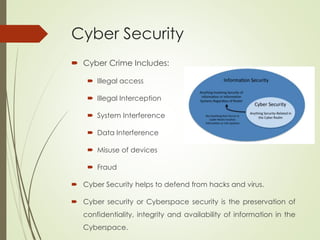
Cyber Security
 Cyber Crime Includes:
 Illegal access
 Illegal Interception
 System Interference
 Data Interference
 Misuse of devices
 Fraud
 Cyber Security helps to defend from hacks and virus.
 Cyber security or Cyberspace security is the preservation of
confidentiality, integrity and availability of information in the
Cyberspace.
Cyber Security in Cloud
Computing
 Today all Individual & Organizations are moving
towards cloud computing that has a direct impact on
cyber security.
 It's a threat that's only getting bigger, the risk of
hackers stealing data has grown exponentially.
Mean Failure Cost
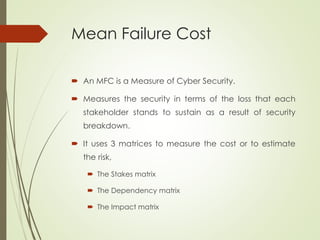
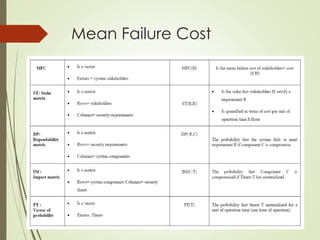
 An MFC is a Measure of Cyber Security.
 Measures the security in terms of the loss that each
stakeholder stands to sustain as a result of security
breakdown.
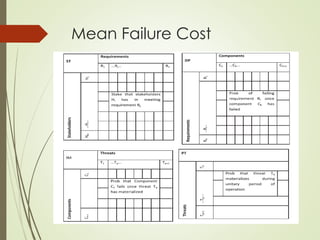
 It uses 3 matrices to measure the cost or to estimate
the risk,
 The Stakes matrix
 The Dependency matrix
 The Impact matrix
Mean Failure Cost
Mean Failure Cost
Mean Failure Cost
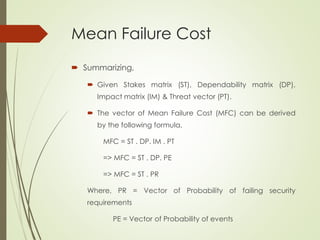
 Summarizing,
 Given Stakes matrix (ST), Dependability matrix (DP),
Impact matrix (IM) & Threat vector (PT).
 The vector of Mean Failure Cost (MFC) can be derived
by the following formula,
MFC = ST . DP. IM . PT
=> MFC = ST . DP. PE
=> MFC = ST . PR
Where, PR = Vector of Probability of failing security
requirements
PE = Vector of Probability of events
Security Requirements
 Stakeholder focus  Security Requirements
 Three class of stakeholders in cloud computing can be
considered,
 The Service Provider
 The Corporate/ Organizational Subscribers
 The Individual Subscribers
 Three important pillars of Cloud Security S/W
assurance,
 Availability
 Integrity
 Confidentiality
Security Requirements
 Availability
 Critical Data
 Archival Data
 Integrity
 Critical Data
 Archival Data
 Confidentiality
 Highly Classified Data
 Proprietary Data
 Public Data
System Focus
 Cloud Computing System focuses on two parts,
 The Front End (Components)
 The Back End (Services)
 Front End is,
 The Client side &
 The Applications required to access the cloud system.
 Back End is,
 Cloud Section of the System with various services & servers,
data storages, s/w and physical/ virtual computers.
 Cost is optimized by virtualization technique in cloud
computing paradigm.
Security Threats
 Virtualization causes major security risks.
 It’s a s/w layer that emulates h/w to increase utilization
and it ensures different instances are running on the
same physical machine are isolated from each-other.
 Therefore cloud computing system in threaten by
many types of attacks, which includes:
 Security Threats originating from the host (hypervisor)
 Security Threats originating between the customer & the
datacenter
 Security Threats originating from the virtual machines
Security Threats
 Security Threats originating from the host (hypervisor),
 Monitoring virtual machines from host
 Virtual machine modification
 Threats on communications between virtual machines
and host
 Placement of malicious VM images on physical systems
Security Threats
 Security Threats originating between the customer &
the datacenter,
 Flooding attacks
 Denial of service (DoS)
 Data loss or leakage
 Malicious insiders
 Account, service and traffic hijacking
 Abuse and nefarious use of cloud computing
 Insecure application programing interfaces
Security Threats
 Security Threats originating from the virtual machines,
 Monitoring VMs from other VMs
 Virtual machine mobility
 Threats on communications between virtual machines
Supporting Cloud
Computing Business Model
 The security cost model enables us to rationalized
security related decision making. For example,
 Pricing Security Upgrade
 Judging the cost effectiveness security enhancement
Conclusion
 Cloud computing does not offer absolute security.
 But we can measure security by offering quantitative
model that quantify the risks on the basis of analysis.
 The proposed matric offers:
 Security in economic term, enabling stakeholder to
quantify risks.
 Depending on the stakes security value changes
 The value of MFC security matric reflects the
heterogeneity of the security requirements.
~~~THANK
YOU~~~

Cloud with Cyber Security

  • 1.
    A Cyber SecurityModel in Cloud Computing Environments Guided By: Presented By: Name Name
  • 2.
    Content  Cloud Computing Cyber Security  Cyber Security in Cloud Computing  Mean Failure Cost  Security Requirements  System Focus  Security Threats  Supporting Cloud Computing Business Model  Conclusion
  • 3.
    Cloud Computing  CloudComputing is using the Internet to access someone else’s software running on someone else’s hardware in someone else’s data center.  Cloud Architecture includes:  Cloud Service Model  Cloud Deployment Model  Essential Characteristics of Cloud
  • 4.
    Cloud Computing  CloudService Model  IaaS (Infrastructure as a Service)  PaaS (Platform as a Service)  SaaS (Software as a Service)  Cloud Deployment Model  Public Cloud  Private Cloud  Community Cloud  Hybrid Cloud  Essential Characteristic of Cloud  On demand self service  Broad Network Access  Resource Pooling  Rapid Elasticity  Measured Service
  • 5.
    Cyber Security  CyberSecurity is the collection of tools, policies, security concepts, security safeguards, guidelines, risk management approaches, actions, training, best practices assurance & technologies that can be used to protect the cyber environment & organization and user’s assets.  Provides measures to be taken to protect a computer or computer system against unauthorized access or attack when connected to Internet.
  • 6.
    Cyber Security  CyberCrime Includes:  Illegal access  Illegal Interception  System Interference  Data Interference  Misuse of devices  Fraud  Cyber Security helps to defend from hacks and virus.  Cyber security or Cyberspace security is the preservation of confidentiality, integrity and availability of information in the Cyberspace.
  • 7.
    Cyber Security inCloud Computing  Today all Individual & Organizations are moving towards cloud computing that has a direct impact on cyber security.  It's a threat that's only getting bigger, the risk of hackers stealing data has grown exponentially.
  • 8.
    Mean Failure Cost An MFC is a Measure of Cyber Security.  Measures the security in terms of the loss that each stakeholder stands to sustain as a result of security breakdown.  It uses 3 matrices to measure the cost or to estimate the risk,  The Stakes matrix  The Dependency matrix  The Impact matrix
  • 9.
  • 10.
  • 11.
    Mean Failure Cost Summarizing,  Given Stakes matrix (ST), Dependability matrix (DP), Impact matrix (IM) & Threat vector (PT).  The vector of Mean Failure Cost (MFC) can be derived by the following formula, MFC = ST . DP. IM . PT => MFC = ST . DP. PE => MFC = ST . PR Where, PR = Vector of Probability of failing security requirements PE = Vector of Probability of events
  • 12.
    Security Requirements  Stakeholderfocus  Security Requirements  Three class of stakeholders in cloud computing can be considered,  The Service Provider  The Corporate/ Organizational Subscribers  The Individual Subscribers  Three important pillars of Cloud Security S/W assurance,  Availability  Integrity  Confidentiality
  • 13.
    Security Requirements  Availability Critical Data  Archival Data  Integrity  Critical Data  Archival Data  Confidentiality  Highly Classified Data  Proprietary Data  Public Data
  • 14.
    System Focus  CloudComputing System focuses on two parts,  The Front End (Components)  The Back End (Services)  Front End is,  The Client side &  The Applications required to access the cloud system.  Back End is,  Cloud Section of the System with various services & servers, data storages, s/w and physical/ virtual computers.  Cost is optimized by virtualization technique in cloud computing paradigm.
  • 15.
    Security Threats  Virtualizationcauses major security risks.  It’s a s/w layer that emulates h/w to increase utilization and it ensures different instances are running on the same physical machine are isolated from each-other.  Therefore cloud computing system in threaten by many types of attacks, which includes:  Security Threats originating from the host (hypervisor)  Security Threats originating between the customer & the datacenter  Security Threats originating from the virtual machines
  • 16.
    Security Threats  SecurityThreats originating from the host (hypervisor),  Monitoring virtual machines from host  Virtual machine modification  Threats on communications between virtual machines and host  Placement of malicious VM images on physical systems
  • 17.
    Security Threats  SecurityThreats originating between the customer & the datacenter,  Flooding attacks  Denial of service (DoS)  Data loss or leakage  Malicious insiders  Account, service and traffic hijacking  Abuse and nefarious use of cloud computing  Insecure application programing interfaces
  • 18.
    Security Threats  SecurityThreats originating from the virtual machines,  Monitoring VMs from other VMs  Virtual machine mobility  Threats on communications between virtual machines
  • 19.
    Supporting Cloud Computing BusinessModel  The security cost model enables us to rationalized security related decision making. For example,  Pricing Security Upgrade  Judging the cost effectiveness security enhancement
  • 20.
    Conclusion  Cloud computingdoes not offer absolute security.  But we can measure security by offering quantitative model that quantify the risks on the basis of analysis.  The proposed matric offers:  Security in economic term, enabling stakeholder to quantify risks.  Depending on the stakes security value changes  The value of MFC security matric reflects the heterogeneity of the security requirements.
  • 21.