SECURITY THREATS
ON CLOUD
COMPUTING
VULNERABILITIES
REZA PAHLAVA
STMIK RAHARJA
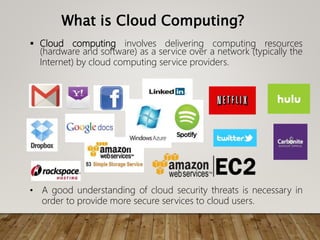
What is Cloud Computing?
 Cloud computing involves delivering computing resources
(hardware and software) as a service over a network (typically the
Internet) by cloud computing service providers.
• A good understanding of cloud security threats is necessary in
order to provide more secure services to cloud users.
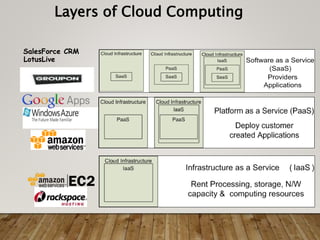
CLOUD SERVICE MODELS
Cloud computing includes three layers:
• System layer: known as Infrastructure-as-a-Service (IaaS)
• Platform layer: known as Platform-as-a-Service (PaaS)
• Application layer: known as Software-as-a-Service (SaaS)
Layers of Cloud Computing
SalesForce CRM
LotusLive
TAXONOMY OF CLOUD SECURITY THREATS
• SaaS, PaaS, and IaaS also disclose information security issues and
risks of cloud computing systems.
• Hackers might abuse the forceful computing capability provided
by clouds.
• Data loss is an important security risk of cloud models.
• Traditional network attack strategies can be applied to harass
three layers of cloud systems.
Abuse Use of Cloud Computational
Resources
• Previously, hackers used multiple computers or a botnet to produce
a great amount of computing power in order to conduct cyber-
attacks.
• Now, powerful computing infrastructure could be easily created
using a simple registration process in a cloud computing service
provider.
• Brute force attack
• Denial of Service attack
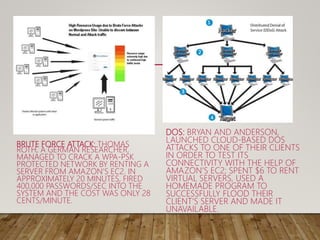
BRUTE FORCE ATTACK: THOMAS
ROTH, A GERMAN RESEARCHER,
MANAGED TO CRACK A WPA-PSK
PROTECTED NETWORK BY RENTING A
SERVER FROM AMAZON’S EC2. IN
APPROXIMATELY 20 MINUTES, FIRED
400,000 PASSWORDS/SEC INTO THE
SYSTEM AND THE COST WAS ONLY 28
CENTS/MINUTE.
DOS: BRYAN AND ANDERSON,
LAUNCHED CLOUD-BASED DOS
ATTACKS TO ONE OF THEIR CLIENTS
IN ORDER TO TEST ITS
CONNECTIVITY WITH THE HELP OF
AMAZON’S EC2; SPENT $6 TO RENT
VIRTUAL SERVERS, USED A
HOMEMADE PROGRAM TO
SUCCESSFULLY FLOOD THEIR
CLIENT'S SERVER AND MADE IT
UNAVAILABLE.
Data Breaches
Malicious Insider:
• insiders who exploit cloud vulnerabilities gaining unauthorized
access to confidential data or carry out attacks against its own
employer’s IT infrastructure
Online Cyber Theft:
• sensitive data stored on clouds have become an attractive target to
online cyber theft.
• Incidents such as Zappos, LinkedIn, Sony Playstation
Cloud Security Attacks
• Malware Injection Attacks:
• hackers exploit vulnerabilities of a web application and embed
malicious codes into it changing the course of its normal
execution. The two common forms are SQL injection attack
and cross-site scripting attack.
• Wrapping Attack:
• use XML signature wrapping (or XML rewriting) to exploit a
weakness when web servers validate signed requests. An
attacker is able to change the content of the signed part
without invalidating the signature.
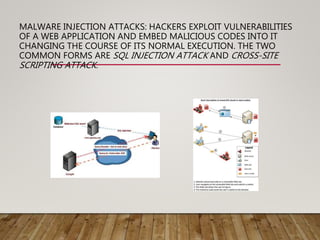
MALWARE INJECTION ATTACKS: HACKERS EXPLOIT VULNERABILITIES
OF A WEB APPLICATION AND EMBED MALICIOUS CODES INTO IT
CHANGING THE COURSE OF ITS NORMAL EXECUTION. THE TWO
COMMON FORMS ARE SQL INJECTION ATTACK AND CROSS-SITE
SCRIPTING ATTACK.
COUNTERMEASURES
• Security Policy Enhancement: avoid weak registration systems,
credit card fraud monitoring, and block of public black lists could
be applied.
• Access Management: continuous monitoring of physical
computing systems, restricting traffic access to the data using
firewalls and intrusion detection systems, and controlling access to
cloud applications and data using SAML and XACML.
• Data Protection: data loss prevention systems, anomalous
behavior pattern detection tools, format preserving and encryption
tools, user behavior profiling, decoy technology, and authentication
and authorization.
• Security Techniques Implementation: for malware injection
use FAT system; also store a hash value on the original service
instance’s image file and perform integrity check. For XML signature
wrapping attacks, use XML Schema Hardening techniques i.e. a
subset of XPath, called FastXPath.
CONCLUSIONS AND FUTURE WORK
• Cloud Computing is in continual development, while people enjoy
the benefits cloud computing brings, security in clouds is a key
challenge.
• Much vulnerability in clouds still exists and hackers continue to
exploit these security holes.
• this paper has examined the security vulnerabilities in clouds from
three perspectives), included related real world exploits, and
introduced countermeasures to those security breaches.
• In the future, further efforts in studying cloud security risks and the
countermeasures to cloud security breaches must continue.

Security on Cloud Computing

  • 1.
  • 2.
    What is CloudComputing?  Cloud computing involves delivering computing resources (hardware and software) as a service over a network (typically the Internet) by cloud computing service providers. • A good understanding of cloud security threats is necessary in order to provide more secure services to cloud users.
  • 3.
    CLOUD SERVICE MODELS Cloudcomputing includes three layers: • System layer: known as Infrastructure-as-a-Service (IaaS) • Platform layer: known as Platform-as-a-Service (PaaS) • Application layer: known as Software-as-a-Service (SaaS)
  • 4.
    Layers of CloudComputing SalesForce CRM LotusLive
  • 5.
    TAXONOMY OF CLOUDSECURITY THREATS • SaaS, PaaS, and IaaS also disclose information security issues and risks of cloud computing systems. • Hackers might abuse the forceful computing capability provided by clouds. • Data loss is an important security risk of cloud models. • Traditional network attack strategies can be applied to harass three layers of cloud systems.
  • 6.
    Abuse Use ofCloud Computational Resources • Previously, hackers used multiple computers or a botnet to produce a great amount of computing power in order to conduct cyber- attacks. • Now, powerful computing infrastructure could be easily created using a simple registration process in a cloud computing service provider. • Brute force attack • Denial of Service attack
  • 7.
    BRUTE FORCE ATTACK:THOMAS ROTH, A GERMAN RESEARCHER, MANAGED TO CRACK A WPA-PSK PROTECTED NETWORK BY RENTING A SERVER FROM AMAZON’S EC2. IN APPROXIMATELY 20 MINUTES, FIRED 400,000 PASSWORDS/SEC INTO THE SYSTEM AND THE COST WAS ONLY 28 CENTS/MINUTE. DOS: BRYAN AND ANDERSON, LAUNCHED CLOUD-BASED DOS ATTACKS TO ONE OF THEIR CLIENTS IN ORDER TO TEST ITS CONNECTIVITY WITH THE HELP OF AMAZON’S EC2; SPENT $6 TO RENT VIRTUAL SERVERS, USED A HOMEMADE PROGRAM TO SUCCESSFULLY FLOOD THEIR CLIENT'S SERVER AND MADE IT UNAVAILABLE.
  • 8.
    Data Breaches Malicious Insider: •insiders who exploit cloud vulnerabilities gaining unauthorized access to confidential data or carry out attacks against its own employer’s IT infrastructure Online Cyber Theft: • sensitive data stored on clouds have become an attractive target to online cyber theft. • Incidents such as Zappos, LinkedIn, Sony Playstation
  • 9.
    Cloud Security Attacks •Malware Injection Attacks: • hackers exploit vulnerabilities of a web application and embed malicious codes into it changing the course of its normal execution. The two common forms are SQL injection attack and cross-site scripting attack. • Wrapping Attack: • use XML signature wrapping (or XML rewriting) to exploit a weakness when web servers validate signed requests. An attacker is able to change the content of the signed part without invalidating the signature.
  • 10.
    MALWARE INJECTION ATTACKS:HACKERS EXPLOIT VULNERABILITIES OF A WEB APPLICATION AND EMBED MALICIOUS CODES INTO IT CHANGING THE COURSE OF ITS NORMAL EXECUTION. THE TWO COMMON FORMS ARE SQL INJECTION ATTACK AND CROSS-SITE SCRIPTING ATTACK.
  • 11.
    COUNTERMEASURES • Security PolicyEnhancement: avoid weak registration systems, credit card fraud monitoring, and block of public black lists could be applied. • Access Management: continuous monitoring of physical computing systems, restricting traffic access to the data using firewalls and intrusion detection systems, and controlling access to cloud applications and data using SAML and XACML. • Data Protection: data loss prevention systems, anomalous behavior pattern detection tools, format preserving and encryption tools, user behavior profiling, decoy technology, and authentication and authorization. • Security Techniques Implementation: for malware injection use FAT system; also store a hash value on the original service instance’s image file and perform integrity check. For XML signature wrapping attacks, use XML Schema Hardening techniques i.e. a subset of XPath, called FastXPath.
  • 12.
    CONCLUSIONS AND FUTUREWORK • Cloud Computing is in continual development, while people enjoy the benefits cloud computing brings, security in clouds is a key challenge. • Much vulnerability in clouds still exists and hackers continue to exploit these security holes. • this paper has examined the security vulnerabilities in clouds from three perspectives), included related real world exploits, and introduced countermeasures to those security breaches. • In the future, further efforts in studying cloud security risks and the countermeasures to cloud security breaches must continue.