i
IMPRESSION/CLOSED DIE
FORGING
Research Report: Material Processing Method
APRIL 4, 2014
MAAE 3700
Name: Theo Ridley
St. No.: 100832131
ii
Summary
iii
Table of Contents
Summary _____________________________________________________________________________ ii
List of Figures _________________________________________________________________________iv
List of Tables __________________________________________________________________________iv
1.0 Main Processes _________________________________________________________________ 1
1.1 Overview _____________________________________________________________________ 1
1.2 Die Impressions ______________________________________________________________ 1
1.3 Flashing Design_______________________________________________________________ 3
1.4 Lubrication ___________________________________________________________________ 4
2.0 Production Materials____________________________________________________________ 6
2.1 Part Shape____________________________________________________________________ 6
2.2 Die Tolerance_________________________________________________________________ 7
2.3 Hot vs Cold Forging __________________________________________________________ 9
3.0 Material Properties of Forged Metal____________________________________________10
3.1 Grain Flow by Manufacturing Method________________________________________10
3.2 Grain Flow by Orentation ____________________________________________________11
3.3 Defects ______________________________________________________________________12
4.0 Forging Products _________________________________________________________________13
4.1 Connecting Rod ________________________________________________________________13
4.2 Crankshaft _____________________________________________________________________14
4.0 Glossary________________________________________________________________________15
References ___________________________________________________________________________17
iv
List of Figures
Figure 1: Example of Fuller and Edger Impressions7
________________________________________________________________2
Figure 2: Simple Bender Impression7
_________________________________________________________________________________2
Figure 3: Die Block with Common Impressions2
_____________________________________________________________________2
Figure 4: Flash Land Shape4
___________________________________________________________________________________________3
Figure 5: Trimmer Die for Connecting Rod8
_________________________________________________________________________4
Figure 6: Comparison of Friction vs No Friction in Upsetting6
_____________________________________________________4
Figure 7: Differing Types of Forging Lubrication6
___________________________________________________________________5
Figure 8: General Part Shapes for Three Types1
_____________________________________________________________________8
Figure 9: Inner Die Dimensions4
______________________________________________________________________________________8
Figure 10: Deformation of Billet in Axisymmetric Die3
______________________________________________________________9
Figure 11: Comparison of Grain Flow in Bent Bars5
________________________________________________________________10
Figure 12: Grain Flow based on Workpiece Orientation7
__________________________________________________________11
Figure 13:Cold Shut due to Poor Die Radii7
_________________________________________________________________________12
Figure 14: Connecting Rod Forging Steps3
__________________________________________________________________________14
Figure 15:Crankshaft Produced in Impression Forging7
____________________________________________________________15
List of Tables
Table 1: Shape Groups for Closed Die Forging4
_____________________________________________________________________7
List of Symbols
v
1
1.0 Main Processes
In closed die forging, the main process is carried out by hammering or pressing a
billet into a die shape. The design of the hammer/press is constrained by the
amount of force and pressure required to forge the part. The shape of the dies is
designed such that metal can reach every corner of the part without creating
defects.
1.1 Overview
There are two different methods within closed die forging, which are
distinguished only by their use of flash. Flash is excess metal that is pushed
out into flash gutters as the billet is fully compressed. A closed die using
flash is referred to as impression die forging, while not using flash is closed
die forging in its basic form.
When no flash is used, it is very important that the volume of the forging
billet is equal to that of the die shape. If this condition is not met, metal will
be pushed out of the die and it will be unable to close.
In order for a part to be forged without defects, it often must be pressed in
many intermediate steps to ensure proper grain flow. This requires
intermediate dies, which are referred to as “impressions.”
1.2 Die Impressions
Die impressions are used to move metal mass around and shape the part
before the final die in order to improve metal flow and prevent the
formation of defects.
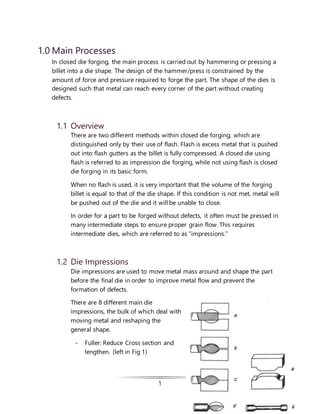
There are 8 different main die
impressions, the bulk of which deal with
moving metal and reshaping the
general shape.
- Fuller: Reduce Cross section and
lengthen. (left in Fig 1)
2
- Edger: Redistribute and proportion stock. (Right in Fig 1)
- Roller: Rounds stock through multiple presses while stock is rotated.
- Flattener: Widens metal to cover the next impression
- Splitter: Separates metal for
forging of forked parts.
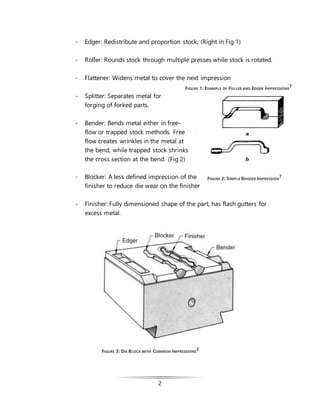
- Bender: Bends metal either in free-
flow or trapped stock methods. Free
flow creates wrinkles in the metal at
the bend, while trapped stock shrinks
the cross section at the bend. (Fig 2)
- Blocker: A less defined impression of the
finisher to reduce die wear on the finisher
- Finisher: Fully dimensioned shape of the part, has flash gutters for
excess metal.
FIGURE 3: DIE BLOCK WITH COMMON IMPRESSIONS
2
FIGURE 1: EXAMPLE OF FULLER AND EDGER IMPRESSIONS
7
FIGURE 2: SIMPLE BENDER IMPRESSION
7
3
Once the stock has moved through these steps, the flashing must be
removed for the part to be complete.
1.3 Flashing Design
In order to create a partin impression die forging, the flash gutters must be
designed to allow metal to flow to all points within the die. If higher
pressures are required within the die, the resistance to flow must be higher.
The equation for resistance to flow within a flash gutter is shown by
Equation I,
𝑝𝑓𝑙 = 2𝜇 ∙ 𝑘 𝑓 ∙
𝑤
𝑠
Equation 1,
with Pfl being resistance to flow (N/mm^2), µ being coefficient of friction
between the die and metal, w being the flash land width (mm), s being flash
land height (mm), and kf the yield strength of the metal after casting4
.This
shows that w/s is a controlling factor.
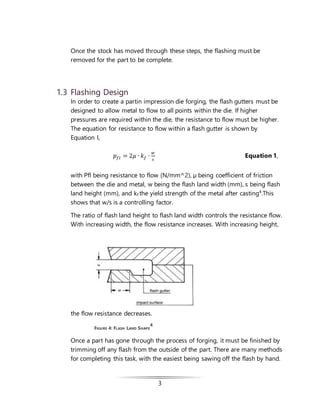
The ratio of flash land height to flash land width controls the resistance flow.
With increasing width, the flow resistance increases. With increasing height,
the flow resistance decreases.
FIGURE 4: FLASH LAND SHAPE
4
Once a part has gone through the process of forging, it must be finished by
trimming off any flash from the outside of the part. There are many methods
for completing this task, with the easiest being sawing off the flash by hand.
4
Trimming flash by hand is only used for small orders, and a faster approach
is used for large quantities. In this case, a flash trimmer die is used.
Flash trimming can be done hot or cold. For most metals, cold is sufficient
and is more desirable as it can be done at any time after forging. Cold
trimming is done below 150˚C(300˚F).3
Hot trimming is usually performed only on metals with high tensile strength
(above 690MPA). This is performed at above cold trimming temperatures
but can be much hotter, especially for ferrous alloys.
Flash design is important because of the existence of friction within dies,
which can be limited by lubrication.
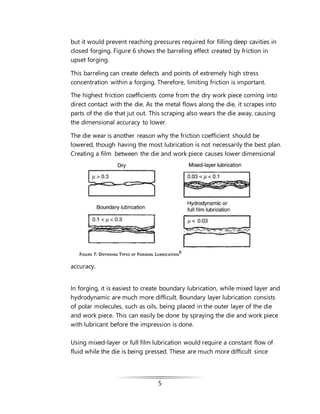
1.4 Friction and Lubrication
Not having friction would make the entire forging process much simpler,
FIGURE 5: TRIMMER DIE FOR CONNECTING ROD
8
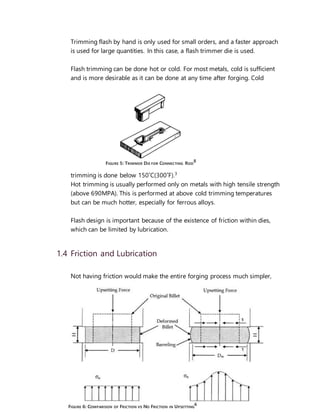
FIGURE 6: COMPARISON OF FRICTION VS NO FRICTION IN UPSETTING
6
5
but it would prevent reaching pressures required for filling deep cavities in
closed forging. Figure 6 shows the barreling effect created by friction in
upset forging.
This barreling can create defects and points of extremely high stress
concentration within a forging. Therefore, limiting friction is important.
The highest friction coefficients come from the dry work piece coming into
direct contact with the die. As the metal flows along the die, it scrapes into
parts of the die that jut out. This scraping also wears the die away, causing
the dimensional accuracy to lower.
The die wear is another reason why the friction coefficient should be
lowered, though having the most lubrication is not necessarily the best plan.
Creating a film between the die and work piece causes lower dimensional
accuracy.
In forging, it is easiest to create boundary lubrication, while mixed layer and
hydrodynamic are much more difficult. Boundary layer lubrication consists
of polar molecules, such as oils, being placed in the outer layer of the die
and work piece. This can easily be done by spraying the die and work piece
with lubricant before the impression is done.
Using mixed-layer or full film lubrication would require a constant flow of
fluid while the die is being pressed. These are much more difficult since
FIGURE 7: DIFFERING TYPES OF FORGING LUBRICATION
6
6
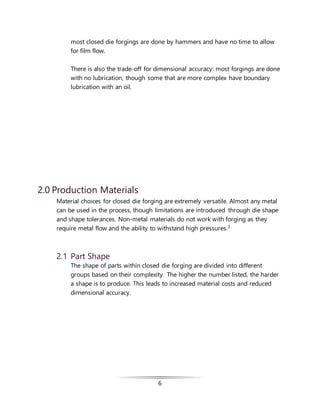
most closed die forgings are done by hammers and have no time to allow
for film flow.
There is also the trade-off for dimensional accuracy: most forgings are done
with no lubrication, though some that are more complex have boundary
lubrication with an oil.
2.0 Production Materials
Material choices for closed die forging are extremely versatile. Almost any metal
can be used in the process, though limitations are introduced through die shape
and shape tolerances. Non-metal materials do not work with forging as they
require metal flow and the ability to withstand high pressures.3
2.1 Part Shape
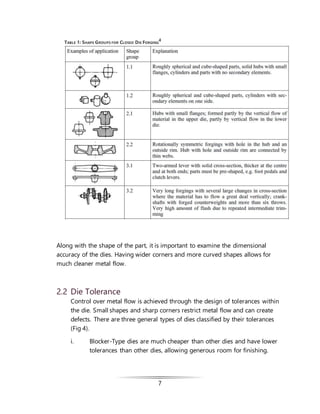
The shape of parts within closed die forging are divided into different
groups based on their complexity. The higher the number listed, the harder
a shape is to produce. This leads to increased material costs and reduced
dimensional accuracy.
7
Along with the shape of the part, it is important to examine the dimensional
accuracy of the dies. Having wider corners and more curved shapes allows for
much cleaner metal flow.
2.2 Die Tolerance
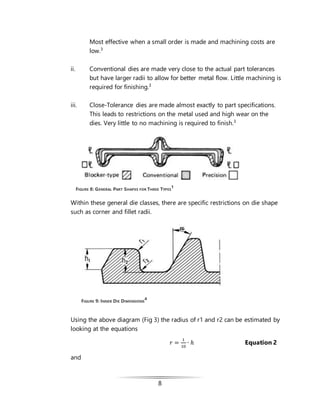
Control over metal flow is achieved through the design of tolerances within
the die. Small shapes and sharp corners restrict metal flow and can create
defects. There are three general types of dies classified by their tolerances
(Fig 4).
i. Blocker-Type dies are much cheaper than other dies and have lower
tolerances than other dies, allowing generous room for finishing.
TABLE 1: SHAPE GROUPS FOR CLOSED DIE FORGING
4
8
Most effective when a small order is made and machining costs are
low.3
ii. Conventional dies are made very close to the actual part tolerances
but have larger radii to allow for better metal flow. Little machining is
required for finishing.3
iii. Close-Tolerance dies are made almost exactly to part specifications.
This leads to restrictions on the metal used and high wear on the
dies. Very little to no machining is required to finish.3
Within these general die classes, there are specific restrictions on die shape
such as corner and fillet radii.
Using the above diagram (Fig 3) the radius of r1 and r2 can be estimated by
looking at the equations
𝑟 =
1
10
∙ ℎ Equation 2
and
FIGURE 9: INNER DIE DIMENSIONS
4
FIGURE 8: GENERAL PART SHAPES FOR THREE TYPES
1
9
𝑟 =
1
20
∙ ℎ Equation 3
with the first equation being for h<100mm and the second
120mm<h<250mm.
2.3 Hot vs Cold Forging
Closed die forgings can be produced in hot or cold forging. Though most
forged products are from hot forging, cold forging can be used to make
stronger products.
The difference can be shown by examining a cylindrical billet undergoing
frictionless upsetting during hot and cold forging using the Hollomon
equation
𝜎𝑡 = 𝐾 [ln (
𝐴 𝑜
𝐴1
)]
𝑛
Equation 3
where σt is true stress(or flow stress), Ao is the original cross sectional area,
A1 is the area after deformation, K is the material strength constant, and n
is the strain hardening exponent.5
This works with the fact that a material
with a higher strain hardening exponent n will strain harden quickly while
FIGURE 10: DEFORMATION OF BILLET IN AXISYMMETRIC DIE
3
10
the softer areas around it deform.2
Using the diagram in Figure 6 it is possible to show the different areas of
deformation in forging processes.
When looking at the hot upsetting of a cylinder you must examine in terms
of strain rate, as the effects of recrystallization start to compete against
strain hardening. The equation of true stress in hot working
𝜎𝑡 = 𝐶 (
𝑣
ℎ
)
𝑚
𝐴 Equation 4
where σt is true stress, C is strain rate strength constant, m is the strain rate
sensitivity exponent, v is the velocity of the die, h is the instantaneous height of
the cylinder, and A is the instantaneous area of the cylinder.
This shows a very similar relationship as in cold deformation, only that when
in hot deformation the amount of strain hardening is much lower due to the
effects of recrystallization.
3.0 Material Properties of Forged Metal
Forged products have very different material properties from their cast and
machined counterparts. This is due mostly to the flow of grains produced during
the forging process. It is also due to strain hardening in the most deformed areas
of the metal.
3.1 Grain Flow by Manufacturing Method
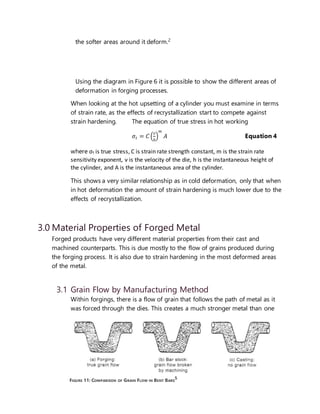
Within forgings, there is a flow of grain that follows the path of metal as it
was forced through the dies. This creates a much stronger metal than one
FIGURE 11: COMPARISON OF GRAIN FLOW IN BENT BARS
5
11
with a constant grain flow or no grain flow at all.1, 3, 4, and 5
It can be shown in Figure 6 that a bent bar manufactured through forging
has a grain flow that follows the shape of the bar throughout, thus resisting
forces that would act against the shape. The machined bar however has a
grain that is constant throughout the shape, creating weaker and stronger
portions of the bar. In a cast version of the bar, there is no real grain flow
due to an equiaxed grain structure.
In conclusion, forging can produce much stronger materials than other
methods due to the creation of grain flow. The grain flow can be assisted by
die impression steps to gain the strongest flow possible.
At low temperatures, the friction at the die surface causes the grains to stay
in place while the rest deform. This friction makes a grain flow that adheres
to the shape of the forging. When forged at higher temperatures, the
friction on the die is lower and grains are constantly recrystallizing. From
these effects, the grain flow is much less defined and imparts less strength
to the finished part.
3.2 Grain Flow by Orientation
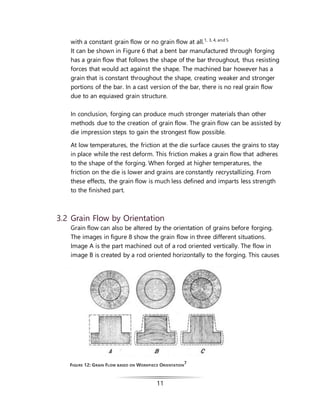
Grain flow can also be altered by the orientation of grains before forging.
The images in figure 8 show the grain flow in three different situations.
Image A is the part machined out of a rod oriented vertically. The flow in
image B is created by a rod oriented horizontally to the forging. This causes
FIGURE 12: GRAIN FLOW BASED ON WORKPIECE ORIENTATION
7
12
the flow to follow in the same path through forging. In image C the rod is
vertical and forged.
While forging can add a grain flow that strengthens the metal, it cannot
alter the original orientation of the grains. Hence it is important to align the
grains in the direction that imparts the most strength. The best option is
determined by what the part’s intended purpose is.
3.3 Defects
Defects within forging can appear due to many factors:
A: Cold Shuts
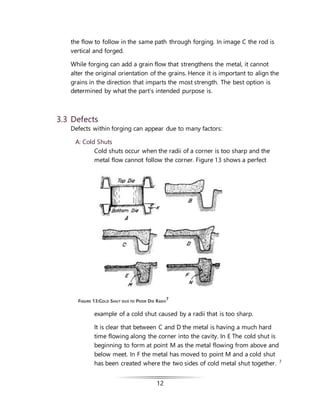
Cold shuts occur when the radii of a corner is too sharp and the
metal flow cannot follow the corner. Figure 13 shows a perfect
example of a cold shut caused by a radii that is too sharp.
It is clear that between C and D the metal is having a much hard
time flowing along the corner into the cavity. In E The cold shut is
beginning to form at point M as the metal flowing from above and
below meet. In F the metal has moved to point M and a cold shut
has been created where the two sides of cold metal shut together. 7
FIGURE 13:COLD SHUT DUE TO POOR DIE RADII
7
13
B: Cracks
Cracks are caused by much more material than needed being
closed into a finisher impression. For instance, if a large billet is
placed directly into the finisher.
They are created after the die cavities fill. Because there is still a
large amount of metal to be pushed through the die, the metal that
has already filled the die is pushed out. This creates cracks where
the cooled metal folds over on the new metal.
C: Laps
When a blocker impression moves too little material to the webs
between bigger impressions, the material in the web can be pushed
by the other material to fill up the web. This causes it to fold over
on itself as it is pushed. This creates laps periodically along the
entire web.7
D: Buckling
If a stock is chosen that is much taller than it is wide, it can buckle
under the force of forging instead of just flowing down and out.
The entire billet can fold over on itself and ruin the forging.7
4.0 Forging Products
Most products of metal manufacturing in this day have at least one step involving
closed die forging. Some of the most prominent of these are Connecting
Rods and Crankshafts for engines.
4.1 Connecting Rod
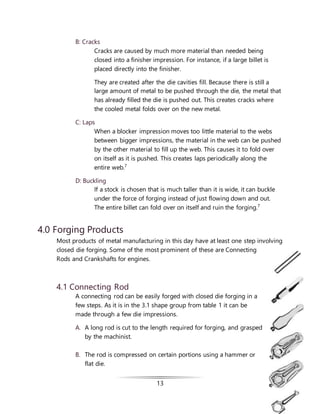
A connecting rod can be easily forged with closed die forging in a
few steps. As it is in the 3.1 shape group from table 1 it can be
made through a few die impressions.
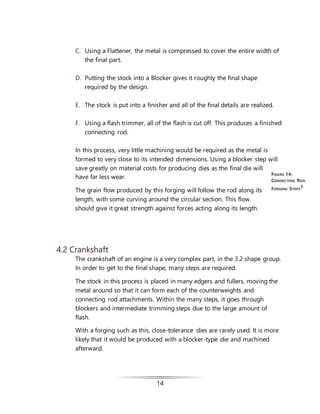
A. A long rod is cut to the length required for forging, and grasped
by the machinist.
B. The rod is compressed on certain portions using a hammer or
flat die.
14
C. Using a Flattener, the metal is compressed to cover the entire width of
the final part.
D. Putting the stock into a Blocker gives it roughly the final shape
required by the design.
E. The stock is put into a finisher and all of the final details are realized.
F. Using a flash trimmer, all of the flash is cut off. This produces a finished
connecting rod.
In this process, very little machining would be required as the metal is
formed to very close to its intended dimensions. Using a blocker step will
save greatly on material costs for producing dies as the final die will
have far less wear.
The grain flow produced by this forging will follow the rod along its
length, with some curving around the circular section. This flow
should give it great strength against forces acting along its length.
4.2 Crankshaft
The crankshaft of an engine is a very complex part, in the 3.2 shape group.
In order to get to the final shape, many steps are required.
The stock in this process is placed in many edgers and fullers, moving the
metal around so that it can form each of the counterweights and
connecting rod attachments. Within the many steps, it goes through
blockers and intermediate trimming steps due to the large amount of
flash.
With a forging such as this, close-tolerance dies are rarely used. It is more
likely that it would be produced with a blocker-type die and machined
afterward.
FIGURE 14:
CONNECTING ROD
FORGING STEPS
3
15
It is possible to form the entire crankshaft through machining though
there is great material waste and costs associated with that method. Using
the forging method also creates a stronger crankshaft due to the grain
flow created through the rod.
Due to the large number of steps, recrystallization dominates hot casting
of crankshafts. This causes the grain flow to be a mixture between a flow
following the shape of casting and an equiaxed grain structure.
4.0 Glossary
FIGURE 15:CRANKSHAFT PRODUCED IN IMPRESSION FORGING
7
16
17
References
[1] J.A.Rossow, "Closed Die Forgings," ASM Handbook, vol. 1, no. 10, p. 337–357, 1990.
[2] R. Shivpuri, "Dies and Die Materials for Hot Forging," ASM Handbook, vol. 14A, pp.
47-61, 2005.
[3] A. K. Khare, "Forming and Forging," ASM Handbook, vol. 14A, p. 111–118, 2005.
[4] H. Tschaetsch, "Impression-Die Forging (Closed-Die Forging)," in Metal Forming
Practice: Processes - Machines - Tools, Dresden, Springer, 2006, pp. 123-139.
[5] J. Beddoes, "4.3 Forging," in Principles of Metal Manufacturing Processes,
Burlington,MA, Elsevier Butterworth-Heinemann, 1999, pp. 103-115.
[6] T. Altan, G. Ngaile and G. Shen, "Friction & Lubrication," in Cold and Hot Forging
Fundamentals and Apllications, Materials Park, ASM International, 2005, pp. 67-74.
[7] W. Naujoks and D. C. Fabel, "Forging Practice," in Forging Handbook, Cleveland, OH,
American Society for Metals, 1939, pp. 106-205.
[8] W. Naujoks and D. C. Fabel, "Forge Dies and Tools," in Forging Handbook, Cleveland,
OH, American Society for Metals, 1939, pp. 87-105.

Closed Die Forging Report_revisionsEve

  • 1.
    i IMPRESSION/CLOSED DIE FORGING Research Report:Material Processing Method APRIL 4, 2014 MAAE 3700 Name: Theo Ridley St. No.: 100832131
  • 2.
  • 3.
    iii Table of Contents Summary_____________________________________________________________________________ ii List of Figures _________________________________________________________________________iv List of Tables __________________________________________________________________________iv 1.0 Main Processes _________________________________________________________________ 1 1.1 Overview _____________________________________________________________________ 1 1.2 Die Impressions ______________________________________________________________ 1 1.3 Flashing Design_______________________________________________________________ 3 1.4 Lubrication ___________________________________________________________________ 4 2.0 Production Materials____________________________________________________________ 6 2.1 Part Shape____________________________________________________________________ 6 2.2 Die Tolerance_________________________________________________________________ 7 2.3 Hot vs Cold Forging __________________________________________________________ 9 3.0 Material Properties of Forged Metal____________________________________________10 3.1 Grain Flow by Manufacturing Method________________________________________10 3.2 Grain Flow by Orentation ____________________________________________________11 3.3 Defects ______________________________________________________________________12 4.0 Forging Products _________________________________________________________________13 4.1 Connecting Rod ________________________________________________________________13 4.2 Crankshaft _____________________________________________________________________14 4.0 Glossary________________________________________________________________________15 References ___________________________________________________________________________17
  • 4.
    iv List of Figures Figure1: Example of Fuller and Edger Impressions7 ________________________________________________________________2 Figure 2: Simple Bender Impression7 _________________________________________________________________________________2 Figure 3: Die Block with Common Impressions2 _____________________________________________________________________2 Figure 4: Flash Land Shape4 ___________________________________________________________________________________________3 Figure 5: Trimmer Die for Connecting Rod8 _________________________________________________________________________4 Figure 6: Comparison of Friction vs No Friction in Upsetting6 _____________________________________________________4 Figure 7: Differing Types of Forging Lubrication6 ___________________________________________________________________5 Figure 8: General Part Shapes for Three Types1 _____________________________________________________________________8 Figure 9: Inner Die Dimensions4 ______________________________________________________________________________________8 Figure 10: Deformation of Billet in Axisymmetric Die3 ______________________________________________________________9 Figure 11: Comparison of Grain Flow in Bent Bars5 ________________________________________________________________10 Figure 12: Grain Flow based on Workpiece Orientation7 __________________________________________________________11 Figure 13:Cold Shut due to Poor Die Radii7 _________________________________________________________________________12 Figure 14: Connecting Rod Forging Steps3 __________________________________________________________________________14 Figure 15:Crankshaft Produced in Impression Forging7 ____________________________________________________________15 List of Tables Table 1: Shape Groups for Closed Die Forging4 _____________________________________________________________________7 List of Symbols
  • 5.
  • 6.
    1 1.0 Main Processes Inclosed die forging, the main process is carried out by hammering or pressing a billet into a die shape. The design of the hammer/press is constrained by the amount of force and pressure required to forge the part. The shape of the dies is designed such that metal can reach every corner of the part without creating defects. 1.1 Overview There are two different methods within closed die forging, which are distinguished only by their use of flash. Flash is excess metal that is pushed out into flash gutters as the billet is fully compressed. A closed die using flash is referred to as impression die forging, while not using flash is closed die forging in its basic form. When no flash is used, it is very important that the volume of the forging billet is equal to that of the die shape. If this condition is not met, metal will be pushed out of the die and it will be unable to close. In order for a part to be forged without defects, it often must be pressed in many intermediate steps to ensure proper grain flow. This requires intermediate dies, which are referred to as “impressions.” 1.2 Die Impressions Die impressions are used to move metal mass around and shape the part before the final die in order to improve metal flow and prevent the formation of defects. There are 8 different main die impressions, the bulk of which deal with moving metal and reshaping the general shape. - Fuller: Reduce Cross section and lengthen. (left in Fig 1)
  • 7.
    2 - Edger: Redistributeand proportion stock. (Right in Fig 1) - Roller: Rounds stock through multiple presses while stock is rotated. - Flattener: Widens metal to cover the next impression - Splitter: Separates metal for forging of forked parts. - Bender: Bends metal either in free- flow or trapped stock methods. Free flow creates wrinkles in the metal at the bend, while trapped stock shrinks the cross section at the bend. (Fig 2) - Blocker: A less defined impression of the finisher to reduce die wear on the finisher - Finisher: Fully dimensioned shape of the part, has flash gutters for excess metal. FIGURE 3: DIE BLOCK WITH COMMON IMPRESSIONS 2 FIGURE 1: EXAMPLE OF FULLER AND EDGER IMPRESSIONS 7 FIGURE 2: SIMPLE BENDER IMPRESSION 7
  • 8.
    3 Once the stockhas moved through these steps, the flashing must be removed for the part to be complete. 1.3 Flashing Design In order to create a partin impression die forging, the flash gutters must be designed to allow metal to flow to all points within the die. If higher pressures are required within the die, the resistance to flow must be higher. The equation for resistance to flow within a flash gutter is shown by Equation I, 𝑝𝑓𝑙 = 2𝜇 ∙ 𝑘 𝑓 ∙ 𝑤 𝑠 Equation 1, with Pfl being resistance to flow (N/mm^2), µ being coefficient of friction between the die and metal, w being the flash land width (mm), s being flash land height (mm), and kf the yield strength of the metal after casting4 .This shows that w/s is a controlling factor. The ratio of flash land height to flash land width controls the resistance flow. With increasing width, the flow resistance increases. With increasing height, the flow resistance decreases. FIGURE 4: FLASH LAND SHAPE 4 Once a part has gone through the process of forging, it must be finished by trimming off any flash from the outside of the part. There are many methods for completing this task, with the easiest being sawing off the flash by hand.
  • 9.
    4 Trimming flash byhand is only used for small orders, and a faster approach is used for large quantities. In this case, a flash trimmer die is used. Flash trimming can be done hot or cold. For most metals, cold is sufficient and is more desirable as it can be done at any time after forging. Cold trimming is done below 150˚C(300˚F).3 Hot trimming is usually performed only on metals with high tensile strength (above 690MPA). This is performed at above cold trimming temperatures but can be much hotter, especially for ferrous alloys. Flash design is important because of the existence of friction within dies, which can be limited by lubrication. 1.4 Friction and Lubrication Not having friction would make the entire forging process much simpler, FIGURE 5: TRIMMER DIE FOR CONNECTING ROD 8 FIGURE 6: COMPARISON OF FRICTION VS NO FRICTION IN UPSETTING 6
  • 10.
    5 but it wouldprevent reaching pressures required for filling deep cavities in closed forging. Figure 6 shows the barreling effect created by friction in upset forging. This barreling can create defects and points of extremely high stress concentration within a forging. Therefore, limiting friction is important. The highest friction coefficients come from the dry work piece coming into direct contact with the die. As the metal flows along the die, it scrapes into parts of the die that jut out. This scraping also wears the die away, causing the dimensional accuracy to lower. The die wear is another reason why the friction coefficient should be lowered, though having the most lubrication is not necessarily the best plan. Creating a film between the die and work piece causes lower dimensional accuracy. In forging, it is easiest to create boundary lubrication, while mixed layer and hydrodynamic are much more difficult. Boundary layer lubrication consists of polar molecules, such as oils, being placed in the outer layer of the die and work piece. This can easily be done by spraying the die and work piece with lubricant before the impression is done. Using mixed-layer or full film lubrication would require a constant flow of fluid while the die is being pressed. These are much more difficult since FIGURE 7: DIFFERING TYPES OF FORGING LUBRICATION 6
  • 11.
    6 most closed dieforgings are done by hammers and have no time to allow for film flow. There is also the trade-off for dimensional accuracy: most forgings are done with no lubrication, though some that are more complex have boundary lubrication with an oil. 2.0 Production Materials Material choices for closed die forging are extremely versatile. Almost any metal can be used in the process, though limitations are introduced through die shape and shape tolerances. Non-metal materials do not work with forging as they require metal flow and the ability to withstand high pressures.3 2.1 Part Shape The shape of parts within closed die forging are divided into different groups based on their complexity. The higher the number listed, the harder a shape is to produce. This leads to increased material costs and reduced dimensional accuracy.
  • 12.
    7 Along with theshape of the part, it is important to examine the dimensional accuracy of the dies. Having wider corners and more curved shapes allows for much cleaner metal flow. 2.2 Die Tolerance Control over metal flow is achieved through the design of tolerances within the die. Small shapes and sharp corners restrict metal flow and can create defects. There are three general types of dies classified by their tolerances (Fig 4). i. Blocker-Type dies are much cheaper than other dies and have lower tolerances than other dies, allowing generous room for finishing. TABLE 1: SHAPE GROUPS FOR CLOSED DIE FORGING 4
  • 13.
    8 Most effective whena small order is made and machining costs are low.3 ii. Conventional dies are made very close to the actual part tolerances but have larger radii to allow for better metal flow. Little machining is required for finishing.3 iii. Close-Tolerance dies are made almost exactly to part specifications. This leads to restrictions on the metal used and high wear on the dies. Very little to no machining is required to finish.3 Within these general die classes, there are specific restrictions on die shape such as corner and fillet radii. Using the above diagram (Fig 3) the radius of r1 and r2 can be estimated by looking at the equations 𝑟 = 1 10 ∙ ℎ Equation 2 and FIGURE 9: INNER DIE DIMENSIONS 4 FIGURE 8: GENERAL PART SHAPES FOR THREE TYPES 1
  • 14.
    9 𝑟 = 1 20 ∙ ℎEquation 3 with the first equation being for h<100mm and the second 120mm<h<250mm. 2.3 Hot vs Cold Forging Closed die forgings can be produced in hot or cold forging. Though most forged products are from hot forging, cold forging can be used to make stronger products. The difference can be shown by examining a cylindrical billet undergoing frictionless upsetting during hot and cold forging using the Hollomon equation 𝜎𝑡 = 𝐾 [ln ( 𝐴 𝑜 𝐴1 )] 𝑛 Equation 3 where σt is true stress(or flow stress), Ao is the original cross sectional area, A1 is the area after deformation, K is the material strength constant, and n is the strain hardening exponent.5 This works with the fact that a material with a higher strain hardening exponent n will strain harden quickly while FIGURE 10: DEFORMATION OF BILLET IN AXISYMMETRIC DIE 3
  • 15.
    10 the softer areasaround it deform.2 Using the diagram in Figure 6 it is possible to show the different areas of deformation in forging processes. When looking at the hot upsetting of a cylinder you must examine in terms of strain rate, as the effects of recrystallization start to compete against strain hardening. The equation of true stress in hot working 𝜎𝑡 = 𝐶 ( 𝑣 ℎ ) 𝑚 𝐴 Equation 4 where σt is true stress, C is strain rate strength constant, m is the strain rate sensitivity exponent, v is the velocity of the die, h is the instantaneous height of the cylinder, and A is the instantaneous area of the cylinder. This shows a very similar relationship as in cold deformation, only that when in hot deformation the amount of strain hardening is much lower due to the effects of recrystallization. 3.0 Material Properties of Forged Metal Forged products have very different material properties from their cast and machined counterparts. This is due mostly to the flow of grains produced during the forging process. It is also due to strain hardening in the most deformed areas of the metal. 3.1 Grain Flow by Manufacturing Method Within forgings, there is a flow of grain that follows the path of metal as it was forced through the dies. This creates a much stronger metal than one FIGURE 11: COMPARISON OF GRAIN FLOW IN BENT BARS 5
  • 16.
    11 with a constantgrain flow or no grain flow at all.1, 3, 4, and 5 It can be shown in Figure 6 that a bent bar manufactured through forging has a grain flow that follows the shape of the bar throughout, thus resisting forces that would act against the shape. The machined bar however has a grain that is constant throughout the shape, creating weaker and stronger portions of the bar. In a cast version of the bar, there is no real grain flow due to an equiaxed grain structure. In conclusion, forging can produce much stronger materials than other methods due to the creation of grain flow. The grain flow can be assisted by die impression steps to gain the strongest flow possible. At low temperatures, the friction at the die surface causes the grains to stay in place while the rest deform. This friction makes a grain flow that adheres to the shape of the forging. When forged at higher temperatures, the friction on the die is lower and grains are constantly recrystallizing. From these effects, the grain flow is much less defined and imparts less strength to the finished part. 3.2 Grain Flow by Orientation Grain flow can also be altered by the orientation of grains before forging. The images in figure 8 show the grain flow in three different situations. Image A is the part machined out of a rod oriented vertically. The flow in image B is created by a rod oriented horizontally to the forging. This causes FIGURE 12: GRAIN FLOW BASED ON WORKPIECE ORIENTATION 7
  • 17.
    12 the flow tofollow in the same path through forging. In image C the rod is vertical and forged. While forging can add a grain flow that strengthens the metal, it cannot alter the original orientation of the grains. Hence it is important to align the grains in the direction that imparts the most strength. The best option is determined by what the part’s intended purpose is. 3.3 Defects Defects within forging can appear due to many factors: A: Cold Shuts Cold shuts occur when the radii of a corner is too sharp and the metal flow cannot follow the corner. Figure 13 shows a perfect example of a cold shut caused by a radii that is too sharp. It is clear that between C and D the metal is having a much hard time flowing along the corner into the cavity. In E The cold shut is beginning to form at point M as the metal flowing from above and below meet. In F the metal has moved to point M and a cold shut has been created where the two sides of cold metal shut together. 7 FIGURE 13:COLD SHUT DUE TO POOR DIE RADII 7
  • 18.
    13 B: Cracks Cracks arecaused by much more material than needed being closed into a finisher impression. For instance, if a large billet is placed directly into the finisher. They are created after the die cavities fill. Because there is still a large amount of metal to be pushed through the die, the metal that has already filled the die is pushed out. This creates cracks where the cooled metal folds over on the new metal. C: Laps When a blocker impression moves too little material to the webs between bigger impressions, the material in the web can be pushed by the other material to fill up the web. This causes it to fold over on itself as it is pushed. This creates laps periodically along the entire web.7 D: Buckling If a stock is chosen that is much taller than it is wide, it can buckle under the force of forging instead of just flowing down and out. The entire billet can fold over on itself and ruin the forging.7 4.0 Forging Products Most products of metal manufacturing in this day have at least one step involving closed die forging. Some of the most prominent of these are Connecting Rods and Crankshafts for engines. 4.1 Connecting Rod A connecting rod can be easily forged with closed die forging in a few steps. As it is in the 3.1 shape group from table 1 it can be made through a few die impressions. A. A long rod is cut to the length required for forging, and grasped by the machinist. B. The rod is compressed on certain portions using a hammer or flat die.
  • 19.
    14 C. Using aFlattener, the metal is compressed to cover the entire width of the final part. D. Putting the stock into a Blocker gives it roughly the final shape required by the design. E. The stock is put into a finisher and all of the final details are realized. F. Using a flash trimmer, all of the flash is cut off. This produces a finished connecting rod. In this process, very little machining would be required as the metal is formed to very close to its intended dimensions. Using a blocker step will save greatly on material costs for producing dies as the final die will have far less wear. The grain flow produced by this forging will follow the rod along its length, with some curving around the circular section. This flow should give it great strength against forces acting along its length. 4.2 Crankshaft The crankshaft of an engine is a very complex part, in the 3.2 shape group. In order to get to the final shape, many steps are required. The stock in this process is placed in many edgers and fullers, moving the metal around so that it can form each of the counterweights and connecting rod attachments. Within the many steps, it goes through blockers and intermediate trimming steps due to the large amount of flash. With a forging such as this, close-tolerance dies are rarely used. It is more likely that it would be produced with a blocker-type die and machined afterward. FIGURE 14: CONNECTING ROD FORGING STEPS 3
  • 20.
    15 It is possibleto form the entire crankshaft through machining though there is great material waste and costs associated with that method. Using the forging method also creates a stronger crankshaft due to the grain flow created through the rod. Due to the large number of steps, recrystallization dominates hot casting of crankshafts. This causes the grain flow to be a mixture between a flow following the shape of casting and an equiaxed grain structure. 4.0 Glossary FIGURE 15:CRANKSHAFT PRODUCED IN IMPRESSION FORGING 7
  • 21.
  • 22.
    17 References [1] J.A.Rossow, "ClosedDie Forgings," ASM Handbook, vol. 1, no. 10, p. 337–357, 1990. [2] R. Shivpuri, "Dies and Die Materials for Hot Forging," ASM Handbook, vol. 14A, pp. 47-61, 2005. [3] A. K. Khare, "Forming and Forging," ASM Handbook, vol. 14A, p. 111–118, 2005. [4] H. Tschaetsch, "Impression-Die Forging (Closed-Die Forging)," in Metal Forming Practice: Processes - Machines - Tools, Dresden, Springer, 2006, pp. 123-139. [5] J. Beddoes, "4.3 Forging," in Principles of Metal Manufacturing Processes, Burlington,MA, Elsevier Butterworth-Heinemann, 1999, pp. 103-115. [6] T. Altan, G. Ngaile and G. Shen, "Friction & Lubrication," in Cold and Hot Forging Fundamentals and Apllications, Materials Park, ASM International, 2005, pp. 67-74. [7] W. Naujoks and D. C. Fabel, "Forging Practice," in Forging Handbook, Cleveland, OH, American Society for Metals, 1939, pp. 106-205. [8] W. Naujoks and D. C. Fabel, "Forge Dies and Tools," in Forging Handbook, Cleveland, OH, American Society for Metals, 1939, pp. 87-105.