Chapter 7 - 1
Learning outcome
To describe edge and screw dislocation motion from an atomic perspective.
To describe how plastic deformation occurs by the motion of edge and screw dislocations in
response to applied shear stress.
To define slip system and cite one example; relate the number of slip systems to the material
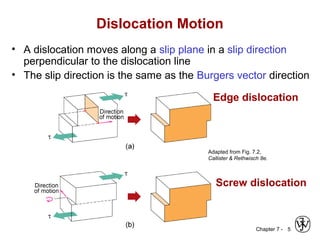
properties.
To describe how the grain structure of a polycrystalline metal is altered when it is plastically
deformed.
To explain how grain boundaries impede dislocation motion and why a metal having small grains
is stronger than one having large grains.
To describe and explain solid-solution strengthening for substitutional impurity atoms in terms of
lattice strain interactions with dislocations.
To describe and explain the phenomenon of strain hardening or cold working in terms of
dislocations and strain field interactions.
To describe and explain the phenomenon of grain size reduction in terms of dislocations and
strain field interactions.
To describe recrystallisation in terms of both the alteration of microstructure and mechanical
characteristics of the material.
To describe the phenomenon of grain growth from both macroscopic and atomic perspective.
To apply the Schmid Law to solve for critical resolved shear stress in a single crystal slip process.
Chapter 7 - 2
ISSUES TO ADDRESS...
• Why are the number of dislocations present
greatest in metals?
• How are strength and dislocation motion related?
• Why does heating alter strength and other properties?
Chapter 7 - 3
Dislocations & Materials Classes
• Covalent Ceramics
(Si, diamond): Motion difficult
- directional (angular) bonding
• Ionic Ceramics (NaCl):
Motion difficult
- need to avoid nearest
neighbors of like sign (- and +)
+ + + +
+++
+ + + +
- - -
----
- - -
• Metals (Cu, Al):
Dislocation motion easiest
- non-directional bonding
- close-packed directions
for slip
electron cloud
ion cores
+
+
+
+
+++++++
+ + + + + +
+++++++
Chapter 7 - 4
Dislocation Motion
Dislocation motion & plastic deformation
• Metals - plastic deformation occurs by slip – an edge
dislocation (extra half-plane of atoms) slides over
adjacent plane half-planes of atoms.
• If dislocations can't move,
plastic deformation doesn't occur!
Adapted from Fig. 7.1,
Callister & Rethwisch 8e.
Chapter 7 - 5
Dislocation Motion
• A dislocation moves along a slip plane in a slip direction
perpendicular to the dislocation line
• The slip direction is the same as the Burgers vector direction
Edge dislocation
Screw dislocation
Adapted from Fig. 7.2,
Callister & Rethwisch 8e.
Chapter 7 - 6
Slip System
– Slip plane - plane on which easiest slippage occurs
• Highest planar densities (and large interplanar spacings)
– Slip directions - directions of movement
• Highest linear densities
Deformation Mechanisms
Adapted from Fig.
7.6, Callister &
Rethwisch 8e.
– FCC Slip occurs on {111} planes (close-packed) in
<110>
directions (close-packed)
=> total of 12 slip systems in FCC– For BCC & HCP there are other slip systems.
Chapter 7 - 7
Stress and Dislocation Motion
• Resolved shear stress, τR
– results from applied tensile stresses
slip plane
normal, ns
Resolved shear
stress: τR =Fs/As
slip
direction
AS
τR
τR
FS
slip
direction
Relation between
σ and τR
τR =FS /AS
Fcos λ A/cos φ
λ
F
FS
φnS
AS
A
Applied tensile
stress: = F/Aσ
slip
direction
F
A
F
φλσ=τ coscosR
Chapter 7 - 8
• Condition for dislocation motion: CRSSτ>τR
• Ease of dislocation motion depends
on crystallographic orientation
10-4
GPa to 10-2
GPa
typically
φλσ=τ coscosR
Critical Resolved Shear Stress
τ maximum at λ = φ = 45º
τR = 0
λ= 90°
σ
τR = σ/2
λ= 45°
φ = 45°
σ
τR = 0
φ= 90°
σ
Chapter 7 - 9
Single Crystal Slip
Adapted from Fig. 7.8,
Callister & Rethwisch 8e.
Adapted from Fig.
7.9, Callister &
Rethwisch 8e.
Chapter 7 - 10
Ex: Deformation of single crystal
So the applied stress of 45 MPa will not cause the
crystal to yield.
τ=σcos λcos φ
σ=45 MPa
λ = 35°
φ = 60°
τcrss = 20.7 MPa
a) Will the single crystal yield?
b) If not, what stress is needed?
σ = 45 MPa
Adapted from
Fig. 7.7,
Callister &
Rethwisch 8e.
MPa7.20MPa4.18
)41.0(MPa)45(
)60)(cos35cos(MPa)45(
crss =τ<=τ
=
=τ 
Chapter 7 - 11
Ex: Deformation of single crystal
What stress is necessary (i.e., what is the
yield stress, σy)?
)41.0(coscosMPa7.20 yycrss σ=φλσ==τ
MPa0.55
41.0
MPa0.72
coscos
crss
y ==
φλ
τ
=σ∴
MPa5.50y =σ≥σ
So for deformation to occur the applied stress must
be greater than or equal to the yield stress
Chapter 7 - 12
Adapted from Fig.
7.10, Callister &
Rethwisch 8e.
(Fig. 7.10 is
courtesy of C.
Brady, National
Bureau of
Standards [now the
National Institute of
Standards and
Technology,
Gaithersburg, MD].)
Slip Motion in Polycrystals
σ
300 µm
• Polycrystals stronger than
single crystals – grain
boundaries are barriers
to dislocation motion.
• Slip planes & directions
(λ, φ) change from one
grain to another.
• τR will vary from one
grain to another.
• The grain with the
largest τR yields first.
• Other (less favorably
oriented) grains
yield later.
Chapter 7 - 13
• Can be induced by rolling a polycrystalline metal
- before rolling
235 µm
- after rolling
- anisotropic
since rolling affects grain
orientation and shape.
rolling direction
Adapted from Fig. 7.11,
Callister & Rethwisch 8e.
(Fig. 7.11 is from W.G. Moffatt,
G.W. Pearsall, and J. Wulff,
The Structure and Properties
of Materials, Vol. I, Structure,
p. 140, John Wiley and Sons,
New York, 1964.)
Anisotropy in σy
- isotropic
since grains are
equiaxed &
randomly oriented.
Chapter 7 - 14
side view
1. Cylinder of
tantalum
machined
from a
rolled plate:
rollingdirection
2. Fire cylinder
at a target.
• The noncircular end view shows
anisotropic deformation of rolled material.
end
view
3. Deformed
cylinder
plate
thickness
direction
Photos courtesy
of G.T. Gray III,
Los Alamos
National Labs.
Used with
permission.
Anisotropy in Deformation
Chapter 7 - 15
Four Strategies for Strengthening:
1: Reduce Grain Size
• Grain boundaries are
barriers to slip.
• Barrier "strength"
increases with
Increasing angle of
misorientation.
• Smaller grain size:
more barriers to slip.
• Hall-Petch Equation:
21/
yoyield dk −
+σ=σ
Adapted from Fig. 7.14, Callister & Rethwisch
8e. (Fig. 7.14 is from A Textbook of Materials
Technology, by Van Vlack, Pearson
Education, Inc., Upper Saddle River, NJ.)
Chapter 7 - 16
Four Strategies for Strengthening:
2: Form Solid Solutions
• Smaller substitutional
impurity
Impurity generates local stress at A
and B that opposes dislocation
motion to the right.
A
B
• Larger substitutional
impurity
Impurity generates local stress at C
and D that opposes dislocation
motion to the right.
C
D
• Impurity atoms distort the lattice & generate lattice strains.
• These strains can act as barriers to dislocation motion.
Chapter 7 - 17
Lattice Strains Around Dislocations
Adapted from Fig. 7.4,
Callister & Rethwisch 8e.
Chapter 7 - 18
Strengthening by Solid
Solution Alloying
• Small impurities tend to concentrate at dislocations
(regions of compressive strains) - partial cancellation of
dislocation compressive strains and impurity atom tensile strains
• Reduce mobility of dislocations and increase strength
Adapted from Fig. 7.17,
Callister & Rethwisch 8e.
Chapter 7 - 19
Strengthening by Solid
Solution Alloying
• Large impurities tend to concentrate at
dislocations (regions of tensile strains)
Adapted from Fig. 7.18,
Callister & Rethwisch 8e.
Chapter 7 -
VMSE Solid-Solution Strengthening Tutorial
20
Chapter 7 - 21
Ex: Solid Solution
Strengthening in Copper
• Tensile strength & yield strength increase with wt% Ni.
• Empirical relation:
• Alloying increases σy and TS.
2/1
~ Cyσ
Adapted from Fig.
7.16(a) and (b),
Callister &
Rethwisch 8e.
Tensilestrength(MPa)
wt.% Ni, (Concentration C)
200
300
400
0 10 20 30 40 50
Yieldstrength(MPa) wt.%Ni, (Concentration C)
60
120
180
0 10 20 30 40 50
Chapter 7 - 22
• Hard precipitates are difficult to shear.
Ex: Ceramics in metals (SiC in Iron or Aluminum).
• Result:
S
~y
1
σ
Four Strategies for Strengthening:
3: Precipitation Strengthening
Large shear stress needed
to move dislocation toward
precipitate and shear it.
Dislocation
“advances” but
precipitates act as
“pinning” sites with
S.spacing
Side View
precipitate
Top View
Slipped part of slip plane
Unslipped part of slip plane
S spacing
Chapter 7 - 23
• Internal wing structure on Boeing 767
• Aluminum is strengthened with precipitates formed
by alloying.
Adapted from Fig. 11.26,
Callister & Rethwisch 8e.
(Fig. 11.26 is courtesy of
G.H. Narayanan and A.G.
Miller, Boeing
Commercial Airplane
Company.)
1.5µm
Application:
Precipitation Strengthening
Adapted from chapter-
opening photograph,
Chapter 11, Callister &
Rethwisch 3e. (courtesy
of G.H. Narayanan and
A.G. Miller, Boeing
Commercial Airplane
Company.)
Chapter 7 - 24
Four Strategies for Strengthening:
4: Cold Work (Strain Hardening)
• Deformation at room temperature (for most metals).
• Common forming operations reduce the cross-sectional
area:
Adapted from Fig.
11.8, Callister &
Rethwisch 8e.
-Forging
Ao Ad
force
die
blank
force-Drawing
tensile
force
Ao
Addie
die
-Extrusion
ram billet
container
container
force
die holder
die
Ao
Adextrusion
100x%
o
do
A
AA
CW
−
=
-Rolling
roll
Ao
Ad
roll
Chapter 7 - 25
• Dislocation structure in Ti after cold working.
• Dislocations entangle
with one another
during cold work.
• Dislocation motion
becomes more difficult.
Fig. 4.6, Callister &
Rethwisch 8e.
(Fig. 4.6 is courtesy
of M.R. Plichta,
Michigan
Technological
University.)
Dislocation Structures Change
During Cold Working
Chapter 7 - 26
Dislocation Density Increases
During Cold Working
Dislocation density =
– Carefully grown single crystals
 ca. 103
mm-2
– Deforming sample increases density
 109
-1010
mm-2
– Heat treatment reduces density
 105
-106
mm-2
• Yield stress increases as ρd increases:
total dislocation length
unit volume
Chapter 7 - 27
Lattice Strain Interactions
Between Dislocations
Adapted from Fig.
7.5, Callister &
Rethwisch 8e.
Chapter 7 - 28
Impact of Cold Work
Adapted from Fig. 7.20,
Callister & Rethwisch 8e.
• Yield strength (σy) increases.
• Tensile strength (TS) increases.
• Ductility (%EL or %AR) decreases.
As cold work is increased
low carbon steel
Chapter 7 -
• What are the values of yield strength, tensile strength &
ductility after cold working Cu?
100x
4
44%CW
2
22
o
do
D
DD
π
π
−
π
=
Mechanical Property Alterations
Due to Cold Working
Do = 15.2 mm
Cold
Work
Dd = 12.2 mm
Copper
%6.35100x
mm)2.15(
mm)2.12(mm)2.15(
CW%
2
22
=
−
=
100x
2
22
o
do
D
DD −
=
29
Chapter 7 -
Mechanical Property Alterations
Due to Cold Working
% Cold Work
100
300
500
700
Cu
200 40 60
σy = 300 MPa
300 MPa
% Cold Work
200
Cu
0
400
600
800
20 40 60
% Cold Work
20
40
60
20 40 6000
Cu
340 MPa
TS = 340 MPa
7%
%EL = 7%
• What are the values of yield strength, tensile strength &
ductility for Cu for %CW = 35.6%?
yieldstrength(MPa)
tensilestrength(MPa)
ductility(%EL)
30
Adapted from Fig. 7.19, Callister & Rethwisch 8e. (Fig. 7.19 is adapted from Metals Handbook: Properties
and Selection: Iron and Steels, Vol. 1, 9th ed., B. Bardes (Ed.), American Society for Metals, 1978, p. 226;
and Metals Handbook: Properties and Selection: Nonferrous Alloys and Pure Metals, Vol. 2, 9th ed., H.
Baker (Managing Ed.), American Society for Metals, 1979, p. 276 and 327.)
Chapter 7 - 31
• 1 hour treatment at Tanneal...
decreases TS and increases %EL.
• Effects of cold work are nullified!
Adapted from Fig. 7.22, Callister & Rethwisch
8e. (Fig. 7.22 is adapted from G. Sachs and
K.R. van Horn, Practical Metallurgy, Applied
Metallurgy, and the Industrial Processing of
Ferrous and Nonferrous Metals and Alloys,
American Society for Metals, 1940, p. 139.)
Effect of Heat Treating After Cold Workingtensilestrength(MPa)
ductility(%EL)
tensile strength
ductility
Recovery
Recrystallization
Grain Growth
600
300
400
500
60
50
40
30
20
annealing temperature (ºC)
200100 300 400 500 600 700 • Three Annealing stages:
1. Recovery
2. Recrystallization
3. Grain Growth
Chapter 7 - 32
Three Stages During Heat Treatment:
1. Recovery
• Scenario 1
Results from
diffusion
• Scenario 2
4. opposite dislocations
meet and annihilate
Dislocations
annihilate
and form
a perfect
atomic
plane.
extra half-plane
of atoms
extra half-plane
of atoms
atoms
diffuse
to regions
of tension
2. grey atoms leave by
vacancy diffusion
allowing disl. to “climb”
τR
1. dislocation blocked;
can’t move to the right
Obstacle dislocation
3. “Climbed” disl. can now
move on new slip plane
Reduction of dislocation density by annihilation.
Chapter 7 - 33
Adapted from
Fig. 7.21(a),(b),
Callister &
Rethwisch 8e.
(Fig. 7.21(a),(b)
are courtesy of
J.E. Burke,
General Electric
Company.)
33% cold
worked
brass
New crystals
nucleate after
3 sec. at 580°C.
0.6 mm 0.6 mm
Three Stages During Heat Treatment:
2. Recrystallization
• New grains are formed that:
-- have low dislocation densities
-- are small in size
-- consume and replace parent cold-worked grains.
Chapter 7 - 34
• All cold-worked grains are eventually consumed/replaced.
Adapted from
Fig. 7.21(c),(d),
Callister &
Rethwisch 8e.
(Fig. 7.21(c),(d)
are courtesy of
J.E. Burke,
General Electric
Company.)
After 4
seconds
After 8
seconds
0.6 mm0.6 mm
As Recrystallization Continues…
Chapter 7 - 35
Adapted from
Fig. 7.21(d),(e),
Callister &
Rethwisch 8e.
(Fig. 7.21(d),(e)
are courtesy of
J.E. Burke,
General Electric
Company.)
Three Stages During Heat Treatment:
3. Grain Growth
• At longer times, average grain size increases.
After 8 s,
580ºC
After 15 min,
580ºC
0.6 mm 0.6 mm
• Empirical Relation:
Ktdd n
o
n
=−
elapsed time
coefficient dependent
on material and T.
grain diam.
at time t.
exponent typ. ~ 2
-- Small grains shrink (and ultimately disappear)
-- Large grains continue to grow
Chapter 7 - 36
TR
Adapted from Fig. 7.22,
Callister & Rethwisch 8e.
TR = recrystallization
temperature
º
Chapter 7 - 37
Recrystallization Temperature
TR = recrystallization temperature = temperature
at which recrystallization just reaches
completion in 1 h.
0.3Tm < TR < 0.6Tm
For a specific metal/alloy, TR depends on:
• %CW -- TR decreases with increasing %CW
• Purity of metal -- TR decreases with
increasing purity
Chapter 7 - 38
Diameter Reduction Procedure -
Problem
A cylindrical rod of brass originally 10 mm (0.39 in) in
diameter is to be cold worked by drawing. The
circular cross section will be maintained during
deformation. A cold-worked tensile strength in excess
of 380 MPa (55,000 psi) and a ductility of at least 15
%EL are desired. Furthermore, the final diameter
must be 7.5 mm (0.30 in). Explain how this may be
accomplished.
Chapter 7 - 39
Diameter Reduction Procedure -
Solution
What are the consequences of directly drawing
to the final diameter?
%8.43100x
10
5.7
1100x
4
4
1
1001100x%CW
2
2
2
=














−=








π
π
−=






−=




 −
=
o
f
o
f
o
fo
D
D
x
A
A
A
AA
Do= 10 mm
Brass
Cold
Work
Df = 7.5 mm
Chapter 7 -
Adapted from Fig. 7.19,
Callister & Rethwisch 8e.
40
Diameter Reduction Procedure –
Solution (Cont.)
• For %CW = 43.8%
540420
σy = 420 MPa
– TS = 540 MPa > 380 MPa
6
– %EL = 6 < 15
• This doesn’t satisfy criteria… what other options are possible?
Chapter 7 - 41
Diameter Reduction Procedure –
Solution (cont.)
Adapted from Fig. 7.19,
Callister & Rethwisch 8e.
380
12
15
27
For %EL > 15
For TS > 380 MPa > 12 %CW
< 27 %CW
∴ our working range is limited to 12 < %CW < 27
Chapter 7 - 42
Diameter Reduction Procedure –
Solution (cont.)
Cold work, then anneal, then cold work again
• For objective we need a cold work of 12 < %CW < 27
– We’ll use 20 %CW
• Diameter after first cold work stage (but before 2nd
cold work stage) is calculated as follows:
100
%CW
11001%CW
2
02
2
2
2
02
2
2 =−⇒








−=
D
D
x
D
D ff
5.0
02
2
100
%CW
1 





−=
D
Df 5.0
2
02
100
%CW
1 





−
= fD
D
⇒
mm39.8
100
20
1mm5.7
5.0
021 =





−== DDfIntermediate diameter =
Chapter 7 - 43
Diameter Reduction Procedure –
Summary
Stage 1: Cold work – reduce diameter from 10 mm to 8.39 mm
Stage 2: Heat treat (allow recrystallization)
Stage 3: Cold work – reduce diameter from 8.39 mm to 7.5 mm
Therefore, all criteria satisfied
20100
49.8
5.7
1%CW
2
2 =














−= x
24%
MPa400
MPa340
=
=
=σ
EL
TS
y
⇒
6.29100
mm10
mm39.8
1%CW
2
1 =














−= x
Fig 7.19
Chapter 7 - 44
Cold Working vs. Hot Working
• Hot working  deformation above TR
• Cold working  deformation below TR
Chapter 7 -
Grain Size Influences Properties
• Metals having small grains – relatively strong
and tough at low temperatures
• Metals having large grains – good creep
resistance at relatively high temperatures
Chapter 7 - 46
• Dislocations are observed primarily in metals
and alloys.
• Strength is increased by making dislocation
motion difficult.
Summary
• Strength of metals may be increased by:
-- decreasing grain size
-- solid solution strengthening
-- precipitate hardening
-- cold working
• A cold-worked metal that is heat treated may experience
recovery, recrystallization, and grain growth – its properties
will be altered.
Chapter 7 - 47
Core Problems:
Self-help Problems:
ANNOUNCEMENTS
Reading:

Ch07[1]

  • 1.
    Chapter 7 -1 Learning outcome To describe edge and screw dislocation motion from an atomic perspective. To describe how plastic deformation occurs by the motion of edge and screw dislocations in response to applied shear stress. To define slip system and cite one example; relate the number of slip systems to the material properties. To describe how the grain structure of a polycrystalline metal is altered when it is plastically deformed. To explain how grain boundaries impede dislocation motion and why a metal having small grains is stronger than one having large grains. To describe and explain solid-solution strengthening for substitutional impurity atoms in terms of lattice strain interactions with dislocations. To describe and explain the phenomenon of strain hardening or cold working in terms of dislocations and strain field interactions. To describe and explain the phenomenon of grain size reduction in terms of dislocations and strain field interactions. To describe recrystallisation in terms of both the alteration of microstructure and mechanical characteristics of the material. To describe the phenomenon of grain growth from both macroscopic and atomic perspective. To apply the Schmid Law to solve for critical resolved shear stress in a single crystal slip process.
  • 2.
    Chapter 7 -2 ISSUES TO ADDRESS... • Why are the number of dislocations present greatest in metals? • How are strength and dislocation motion related? • Why does heating alter strength and other properties?
  • 3.
    Chapter 7 -3 Dislocations & Materials Classes • Covalent Ceramics (Si, diamond): Motion difficult - directional (angular) bonding • Ionic Ceramics (NaCl): Motion difficult - need to avoid nearest neighbors of like sign (- and +) + + + + +++ + + + + - - - ---- - - - • Metals (Cu, Al): Dislocation motion easiest - non-directional bonding - close-packed directions for slip electron cloud ion cores + + + + +++++++ + + + + + + +++++++
  • 4.
    Chapter 7 -4 Dislocation Motion Dislocation motion & plastic deformation • Metals - plastic deformation occurs by slip – an edge dislocation (extra half-plane of atoms) slides over adjacent plane half-planes of atoms. • If dislocations can't move, plastic deformation doesn't occur! Adapted from Fig. 7.1, Callister & Rethwisch 8e.
  • 5.
    Chapter 7 -5 Dislocation Motion • A dislocation moves along a slip plane in a slip direction perpendicular to the dislocation line • The slip direction is the same as the Burgers vector direction Edge dislocation Screw dislocation Adapted from Fig. 7.2, Callister & Rethwisch 8e.
  • 6.
    Chapter 7 -6 Slip System – Slip plane - plane on which easiest slippage occurs • Highest planar densities (and large interplanar spacings) – Slip directions - directions of movement • Highest linear densities Deformation Mechanisms Adapted from Fig. 7.6, Callister & Rethwisch 8e. – FCC Slip occurs on {111} planes (close-packed) in <110> directions (close-packed) => total of 12 slip systems in FCC– For BCC & HCP there are other slip systems.
  • 7.
    Chapter 7 -7 Stress and Dislocation Motion • Resolved shear stress, τR – results from applied tensile stresses slip plane normal, ns Resolved shear stress: τR =Fs/As slip direction AS τR τR FS slip direction Relation between σ and τR τR =FS /AS Fcos λ A/cos φ λ F FS φnS AS A Applied tensile stress: = F/Aσ slip direction F A F φλσ=τ coscosR
  • 8.
    Chapter 7 -8 • Condition for dislocation motion: CRSSτ>τR • Ease of dislocation motion depends on crystallographic orientation 10-4 GPa to 10-2 GPa typically φλσ=τ coscosR Critical Resolved Shear Stress τ maximum at λ = φ = 45º τR = 0 λ= 90° σ τR = σ/2 λ= 45° φ = 45° σ τR = 0 φ= 90° σ
  • 9.
    Chapter 7 -9 Single Crystal Slip Adapted from Fig. 7.8, Callister & Rethwisch 8e. Adapted from Fig. 7.9, Callister & Rethwisch 8e.
  • 10.
    Chapter 7 -10 Ex: Deformation of single crystal So the applied stress of 45 MPa will not cause the crystal to yield. τ=σcos λcos φ σ=45 MPa λ = 35° φ = 60° τcrss = 20.7 MPa a) Will the single crystal yield? b) If not, what stress is needed? σ = 45 MPa Adapted from Fig. 7.7, Callister & Rethwisch 8e. MPa7.20MPa4.18 )41.0(MPa)45( )60)(cos35cos(MPa)45( crss =τ<=τ = =τ 
  • 11.
    Chapter 7 -11 Ex: Deformation of single crystal What stress is necessary (i.e., what is the yield stress, σy)? )41.0(coscosMPa7.20 yycrss σ=φλσ==τ MPa0.55 41.0 MPa0.72 coscos crss y == φλ τ =σ∴ MPa5.50y =σ≥σ So for deformation to occur the applied stress must be greater than or equal to the yield stress
  • 12.
    Chapter 7 -12 Adapted from Fig. 7.10, Callister & Rethwisch 8e. (Fig. 7.10 is courtesy of C. Brady, National Bureau of Standards [now the National Institute of Standards and Technology, Gaithersburg, MD].) Slip Motion in Polycrystals σ 300 µm • Polycrystals stronger than single crystals – grain boundaries are barriers to dislocation motion. • Slip planes & directions (λ, φ) change from one grain to another. • τR will vary from one grain to another. • The grain with the largest τR yields first. • Other (less favorably oriented) grains yield later.
  • 13.
    Chapter 7 -13 • Can be induced by rolling a polycrystalline metal - before rolling 235 µm - after rolling - anisotropic since rolling affects grain orientation and shape. rolling direction Adapted from Fig. 7.11, Callister & Rethwisch 8e. (Fig. 7.11 is from W.G. Moffatt, G.W. Pearsall, and J. Wulff, The Structure and Properties of Materials, Vol. I, Structure, p. 140, John Wiley and Sons, New York, 1964.) Anisotropy in σy - isotropic since grains are equiaxed & randomly oriented.
  • 14.
    Chapter 7 -14 side view 1. Cylinder of tantalum machined from a rolled plate: rollingdirection 2. Fire cylinder at a target. • The noncircular end view shows anisotropic deformation of rolled material. end view 3. Deformed cylinder plate thickness direction Photos courtesy of G.T. Gray III, Los Alamos National Labs. Used with permission. Anisotropy in Deformation
  • 15.
    Chapter 7 -15 Four Strategies for Strengthening: 1: Reduce Grain Size • Grain boundaries are barriers to slip. • Barrier "strength" increases with Increasing angle of misorientation. • Smaller grain size: more barriers to slip. • Hall-Petch Equation: 21/ yoyield dk − +σ=σ Adapted from Fig. 7.14, Callister & Rethwisch 8e. (Fig. 7.14 is from A Textbook of Materials Technology, by Van Vlack, Pearson Education, Inc., Upper Saddle River, NJ.)
  • 16.
    Chapter 7 -16 Four Strategies for Strengthening: 2: Form Solid Solutions • Smaller substitutional impurity Impurity generates local stress at A and B that opposes dislocation motion to the right. A B • Larger substitutional impurity Impurity generates local stress at C and D that opposes dislocation motion to the right. C D • Impurity atoms distort the lattice & generate lattice strains. • These strains can act as barriers to dislocation motion.
  • 17.
    Chapter 7 -17 Lattice Strains Around Dislocations Adapted from Fig. 7.4, Callister & Rethwisch 8e.
  • 18.
    Chapter 7 -18 Strengthening by Solid Solution Alloying • Small impurities tend to concentrate at dislocations (regions of compressive strains) - partial cancellation of dislocation compressive strains and impurity atom tensile strains • Reduce mobility of dislocations and increase strength Adapted from Fig. 7.17, Callister & Rethwisch 8e.
  • 19.
    Chapter 7 -19 Strengthening by Solid Solution Alloying • Large impurities tend to concentrate at dislocations (regions of tensile strains) Adapted from Fig. 7.18, Callister & Rethwisch 8e.
  • 20.
    Chapter 7 - VMSESolid-Solution Strengthening Tutorial 20
  • 21.
    Chapter 7 -21 Ex: Solid Solution Strengthening in Copper • Tensile strength & yield strength increase with wt% Ni. • Empirical relation: • Alloying increases σy and TS. 2/1 ~ Cyσ Adapted from Fig. 7.16(a) and (b), Callister & Rethwisch 8e. Tensilestrength(MPa) wt.% Ni, (Concentration C) 200 300 400 0 10 20 30 40 50 Yieldstrength(MPa) wt.%Ni, (Concentration C) 60 120 180 0 10 20 30 40 50
  • 22.
    Chapter 7 -22 • Hard precipitates are difficult to shear. Ex: Ceramics in metals (SiC in Iron or Aluminum). • Result: S ~y 1 σ Four Strategies for Strengthening: 3: Precipitation Strengthening Large shear stress needed to move dislocation toward precipitate and shear it. Dislocation “advances” but precipitates act as “pinning” sites with S.spacing Side View precipitate Top View Slipped part of slip plane Unslipped part of slip plane S spacing
  • 23.
    Chapter 7 -23 • Internal wing structure on Boeing 767 • Aluminum is strengthened with precipitates formed by alloying. Adapted from Fig. 11.26, Callister & Rethwisch 8e. (Fig. 11.26 is courtesy of G.H. Narayanan and A.G. Miller, Boeing Commercial Airplane Company.) 1.5µm Application: Precipitation Strengthening Adapted from chapter- opening photograph, Chapter 11, Callister & Rethwisch 3e. (courtesy of G.H. Narayanan and A.G. Miller, Boeing Commercial Airplane Company.)
  • 24.
    Chapter 7 -24 Four Strategies for Strengthening: 4: Cold Work (Strain Hardening) • Deformation at room temperature (for most metals). • Common forming operations reduce the cross-sectional area: Adapted from Fig. 11.8, Callister & Rethwisch 8e. -Forging Ao Ad force die blank force-Drawing tensile force Ao Addie die -Extrusion ram billet container container force die holder die Ao Adextrusion 100x% o do A AA CW − = -Rolling roll Ao Ad roll
  • 25.
    Chapter 7 -25 • Dislocation structure in Ti after cold working. • Dislocations entangle with one another during cold work. • Dislocation motion becomes more difficult. Fig. 4.6, Callister & Rethwisch 8e. (Fig. 4.6 is courtesy of M.R. Plichta, Michigan Technological University.) Dislocation Structures Change During Cold Working
  • 26.
    Chapter 7 -26 Dislocation Density Increases During Cold Working Dislocation density = – Carefully grown single crystals  ca. 103 mm-2 – Deforming sample increases density  109 -1010 mm-2 – Heat treatment reduces density  105 -106 mm-2 • Yield stress increases as ρd increases: total dislocation length unit volume
  • 27.
    Chapter 7 -27 Lattice Strain Interactions Between Dislocations Adapted from Fig. 7.5, Callister & Rethwisch 8e.
  • 28.
    Chapter 7 -28 Impact of Cold Work Adapted from Fig. 7.20, Callister & Rethwisch 8e. • Yield strength (σy) increases. • Tensile strength (TS) increases. • Ductility (%EL or %AR) decreases. As cold work is increased low carbon steel
  • 29.
    Chapter 7 - •What are the values of yield strength, tensile strength & ductility after cold working Cu? 100x 4 44%CW 2 22 o do D DD π π − π = Mechanical Property Alterations Due to Cold Working Do = 15.2 mm Cold Work Dd = 12.2 mm Copper %6.35100x mm)2.15( mm)2.12(mm)2.15( CW% 2 22 = − = 100x 2 22 o do D DD − = 29
  • 30.
    Chapter 7 - MechanicalProperty Alterations Due to Cold Working % Cold Work 100 300 500 700 Cu 200 40 60 σy = 300 MPa 300 MPa % Cold Work 200 Cu 0 400 600 800 20 40 60 % Cold Work 20 40 60 20 40 6000 Cu 340 MPa TS = 340 MPa 7% %EL = 7% • What are the values of yield strength, tensile strength & ductility for Cu for %CW = 35.6%? yieldstrength(MPa) tensilestrength(MPa) ductility(%EL) 30 Adapted from Fig. 7.19, Callister & Rethwisch 8e. (Fig. 7.19 is adapted from Metals Handbook: Properties and Selection: Iron and Steels, Vol. 1, 9th ed., B. Bardes (Ed.), American Society for Metals, 1978, p. 226; and Metals Handbook: Properties and Selection: Nonferrous Alloys and Pure Metals, Vol. 2, 9th ed., H. Baker (Managing Ed.), American Society for Metals, 1979, p. 276 and 327.)
  • 31.
    Chapter 7 -31 • 1 hour treatment at Tanneal... decreases TS and increases %EL. • Effects of cold work are nullified! Adapted from Fig. 7.22, Callister & Rethwisch 8e. (Fig. 7.22 is adapted from G. Sachs and K.R. van Horn, Practical Metallurgy, Applied Metallurgy, and the Industrial Processing of Ferrous and Nonferrous Metals and Alloys, American Society for Metals, 1940, p. 139.) Effect of Heat Treating After Cold Workingtensilestrength(MPa) ductility(%EL) tensile strength ductility Recovery Recrystallization Grain Growth 600 300 400 500 60 50 40 30 20 annealing temperature (ºC) 200100 300 400 500 600 700 • Three Annealing stages: 1. Recovery 2. Recrystallization 3. Grain Growth
  • 32.
    Chapter 7 -32 Three Stages During Heat Treatment: 1. Recovery • Scenario 1 Results from diffusion • Scenario 2 4. opposite dislocations meet and annihilate Dislocations annihilate and form a perfect atomic plane. extra half-plane of atoms extra half-plane of atoms atoms diffuse to regions of tension 2. grey atoms leave by vacancy diffusion allowing disl. to “climb” τR 1. dislocation blocked; can’t move to the right Obstacle dislocation 3. “Climbed” disl. can now move on new slip plane Reduction of dislocation density by annihilation.
  • 33.
    Chapter 7 -33 Adapted from Fig. 7.21(a),(b), Callister & Rethwisch 8e. (Fig. 7.21(a),(b) are courtesy of J.E. Burke, General Electric Company.) 33% cold worked brass New crystals nucleate after 3 sec. at 580°C. 0.6 mm 0.6 mm Three Stages During Heat Treatment: 2. Recrystallization • New grains are formed that: -- have low dislocation densities -- are small in size -- consume and replace parent cold-worked grains.
  • 34.
    Chapter 7 -34 • All cold-worked grains are eventually consumed/replaced. Adapted from Fig. 7.21(c),(d), Callister & Rethwisch 8e. (Fig. 7.21(c),(d) are courtesy of J.E. Burke, General Electric Company.) After 4 seconds After 8 seconds 0.6 mm0.6 mm As Recrystallization Continues…
  • 35.
    Chapter 7 -35 Adapted from Fig. 7.21(d),(e), Callister & Rethwisch 8e. (Fig. 7.21(d),(e) are courtesy of J.E. Burke, General Electric Company.) Three Stages During Heat Treatment: 3. Grain Growth • At longer times, average grain size increases. After 8 s, 580ºC After 15 min, 580ºC 0.6 mm 0.6 mm • Empirical Relation: Ktdd n o n =− elapsed time coefficient dependent on material and T. grain diam. at time t. exponent typ. ~ 2 -- Small grains shrink (and ultimately disappear) -- Large grains continue to grow
  • 36.
    Chapter 7 -36 TR Adapted from Fig. 7.22, Callister & Rethwisch 8e. TR = recrystallization temperature º
  • 37.
    Chapter 7 -37 Recrystallization Temperature TR = recrystallization temperature = temperature at which recrystallization just reaches completion in 1 h. 0.3Tm < TR < 0.6Tm For a specific metal/alloy, TR depends on: • %CW -- TR decreases with increasing %CW • Purity of metal -- TR decreases with increasing purity
  • 38.
    Chapter 7 -38 Diameter Reduction Procedure - Problem A cylindrical rod of brass originally 10 mm (0.39 in) in diameter is to be cold worked by drawing. The circular cross section will be maintained during deformation. A cold-worked tensile strength in excess of 380 MPa (55,000 psi) and a ductility of at least 15 %EL are desired. Furthermore, the final diameter must be 7.5 mm (0.30 in). Explain how this may be accomplished.
  • 39.
    Chapter 7 -39 Diameter Reduction Procedure - Solution What are the consequences of directly drawing to the final diameter? %8.43100x 10 5.7 1100x 4 4 1 1001100x%CW 2 2 2 =               −=         π π −=       −=      − = o f o f o fo D D x A A A AA Do= 10 mm Brass Cold Work Df = 7.5 mm
  • 40.
    Chapter 7 - Adaptedfrom Fig. 7.19, Callister & Rethwisch 8e. 40 Diameter Reduction Procedure – Solution (Cont.) • For %CW = 43.8% 540420 σy = 420 MPa – TS = 540 MPa > 380 MPa 6 – %EL = 6 < 15 • This doesn’t satisfy criteria… what other options are possible?
  • 41.
    Chapter 7 -41 Diameter Reduction Procedure – Solution (cont.) Adapted from Fig. 7.19, Callister & Rethwisch 8e. 380 12 15 27 For %EL > 15 For TS > 380 MPa > 12 %CW < 27 %CW ∴ our working range is limited to 12 < %CW < 27
  • 42.
    Chapter 7 -42 Diameter Reduction Procedure – Solution (cont.) Cold work, then anneal, then cold work again • For objective we need a cold work of 12 < %CW < 27 – We’ll use 20 %CW • Diameter after first cold work stage (but before 2nd cold work stage) is calculated as follows: 100 %CW 11001%CW 2 02 2 2 2 02 2 2 =−⇒         −= D D x D D ff 5.0 02 2 100 %CW 1       −= D Df 5.0 2 02 100 %CW 1       − = fD D ⇒ mm39.8 100 20 1mm5.7 5.0 021 =      −== DDfIntermediate diameter =
  • 43.
    Chapter 7 -43 Diameter Reduction Procedure – Summary Stage 1: Cold work – reduce diameter from 10 mm to 8.39 mm Stage 2: Heat treat (allow recrystallization) Stage 3: Cold work – reduce diameter from 8.39 mm to 7.5 mm Therefore, all criteria satisfied 20100 49.8 5.7 1%CW 2 2 =               −= x 24% MPa400 MPa340 = = =σ EL TS y ⇒ 6.29100 mm10 mm39.8 1%CW 2 1 =               −= x Fig 7.19
  • 44.
    Chapter 7 -44 Cold Working vs. Hot Working • Hot working  deformation above TR • Cold working  deformation below TR
  • 45.
    Chapter 7 - GrainSize Influences Properties • Metals having small grains – relatively strong and tough at low temperatures • Metals having large grains – good creep resistance at relatively high temperatures
  • 46.
    Chapter 7 -46 • Dislocations are observed primarily in metals and alloys. • Strength is increased by making dislocation motion difficult. Summary • Strength of metals may be increased by: -- decreasing grain size -- solid solution strengthening -- precipitate hardening -- cold working • A cold-worked metal that is heat treated may experience recovery, recrystallization, and grain growth – its properties will be altered.
  • 47.
    Chapter 7 -47 Core Problems: Self-help Problems: ANNOUNCEMENTS Reading:

Editor's Notes

  • #5 So we saw that above the yield stress plastic deformation occurs. But how? In a perfect single crystal for this to occur every bond connecting tow planes would have to break at once! Large energy requirement Now rather than entire plane of bonds needing to be broken at once, only the bonds along dislocation line are broken at once.
  • #18 Don’t move past one another – hardens material
  • #27 Again it propagates through til reaches the edge
  • #43 So after the cold draw &amp; anneal D02=0.335m