MODULE OBJECTIVES
After the completion of this module, student should be able to:
 Explain the tapping process
 Identify the tap types.
 Explain the tapping.
 Use the tapping tools to create a tap.
INTRODUCTION
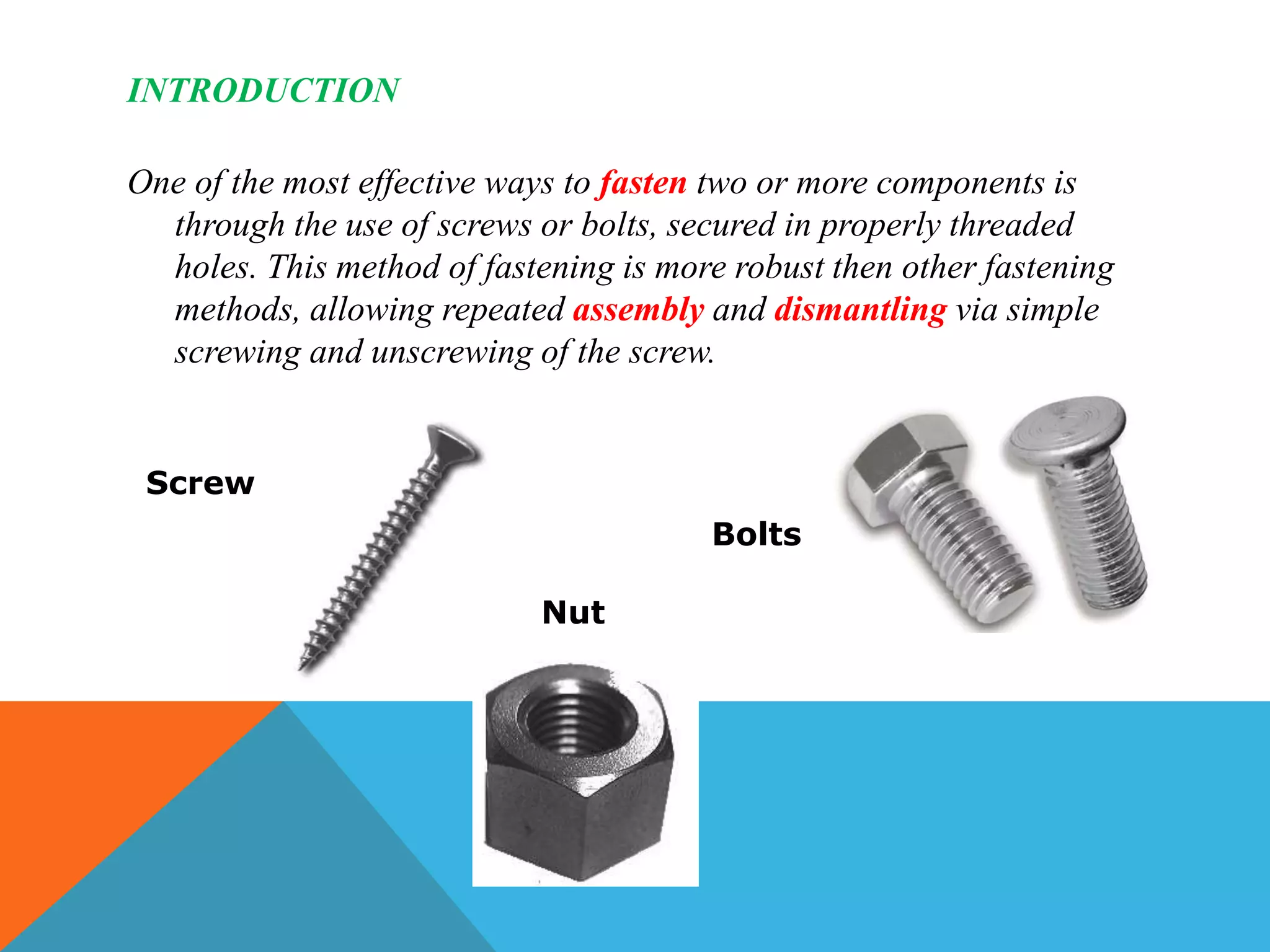
One of the most effective ways to fasten two or more components is
through the use of screws or bolts, secured in properly threaded
holes. This method of fastening is more robust then other fastening
methods, allowing repeated assembly and dismantling via simple
screwing and unscrewing of the screw.
Screw
Bolts
Nut
TAPPING
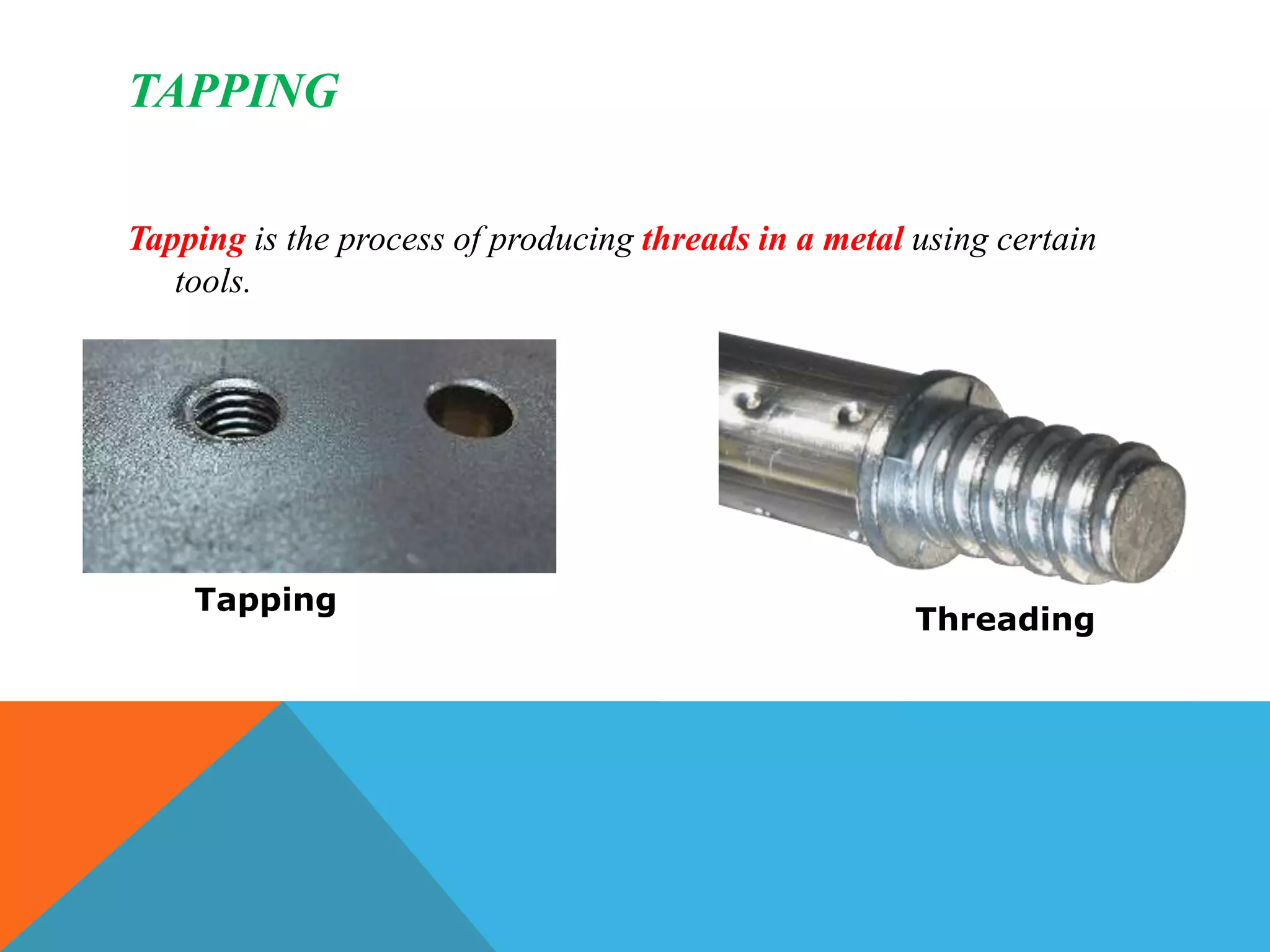
Tapping is the process of producing threads in a metal using certain
tools.
Tapping
Threading
HAND THREADING SAFETY
 Chips produced by hand threading are sharp and should be cleaned
by using a brush or piece of cloth.
 Do not use compressed air to remove the metal chips.
 Newly-cut external threads are very sharp. Again use a brush or
cloth to clean them.
 Wash your hands after using cutting fluids or oils.
 Have cuts treated by a qualified person.
 Be sure the die is clamped firmly in the die stock. If not, it can fall
from the holder and cause injury.
 Broken tap have very sharp edges and are very dangerous. An extra
care should be taken in dealing with broken taps.
THREADS STANDARDS
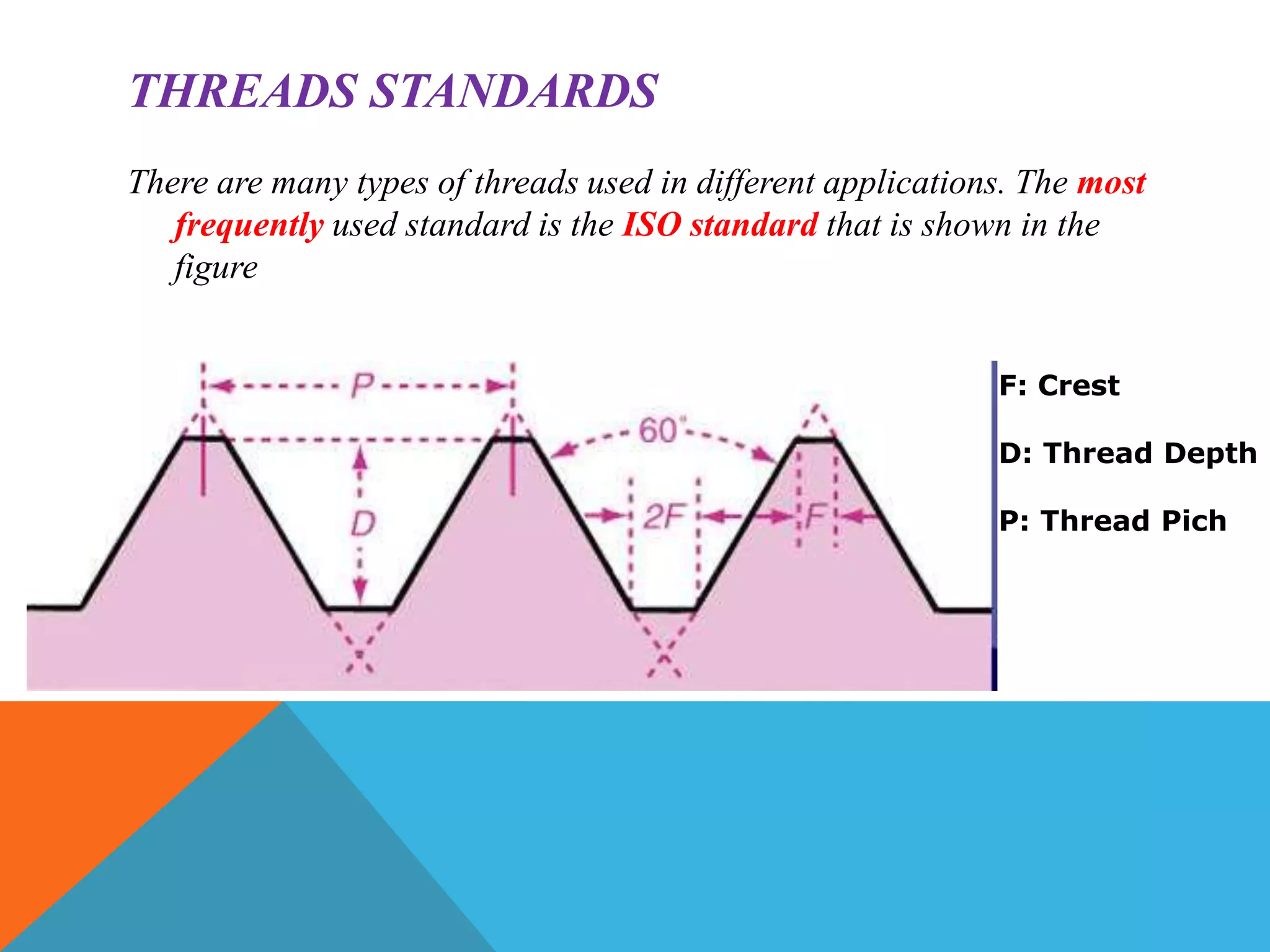
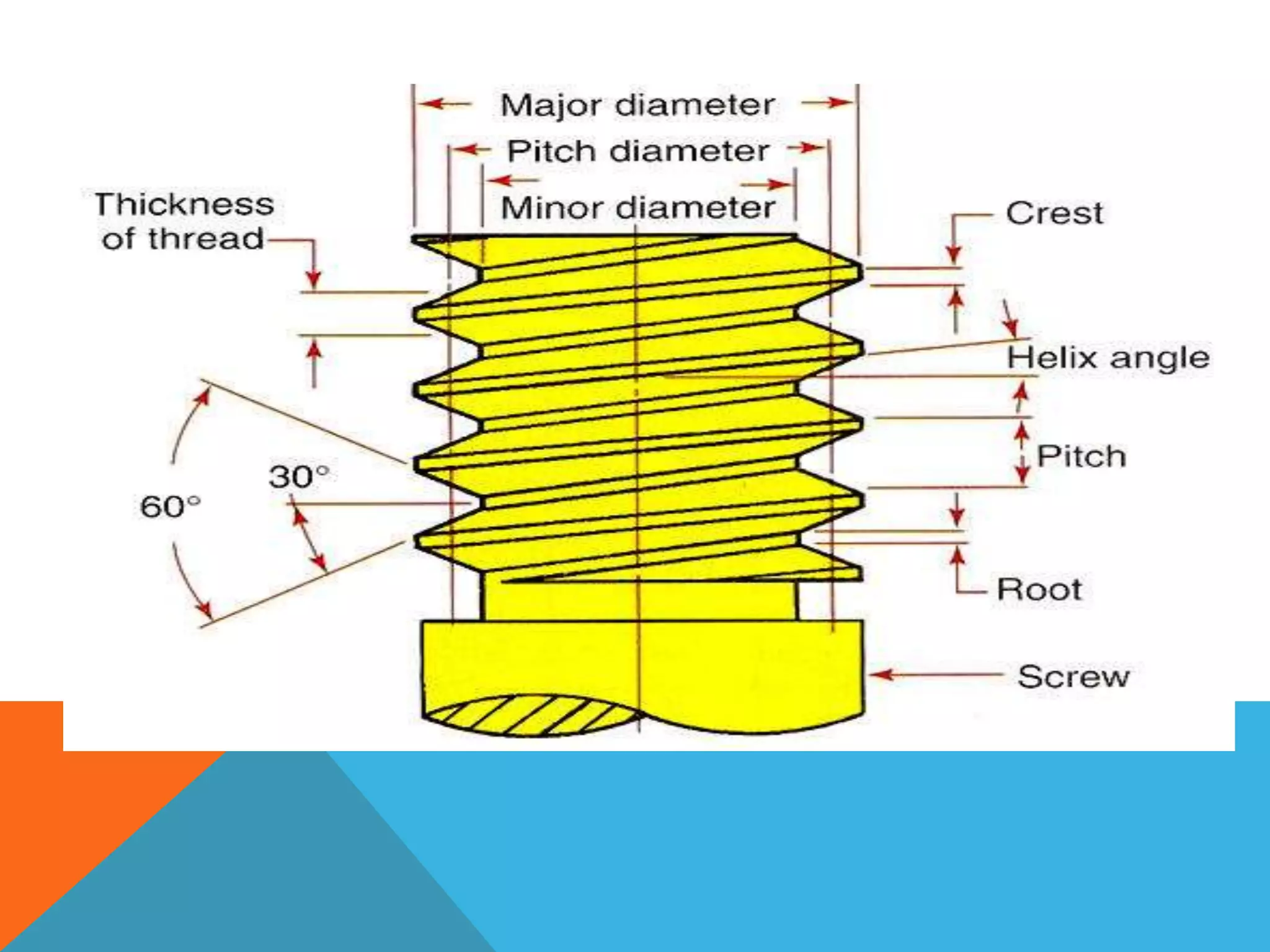
There are many types of threads used in different applications. The most
frequently used standard is the ISO standard that is shown in the
figure
F: Crest
D: Thread Depth
P: Thread Pich
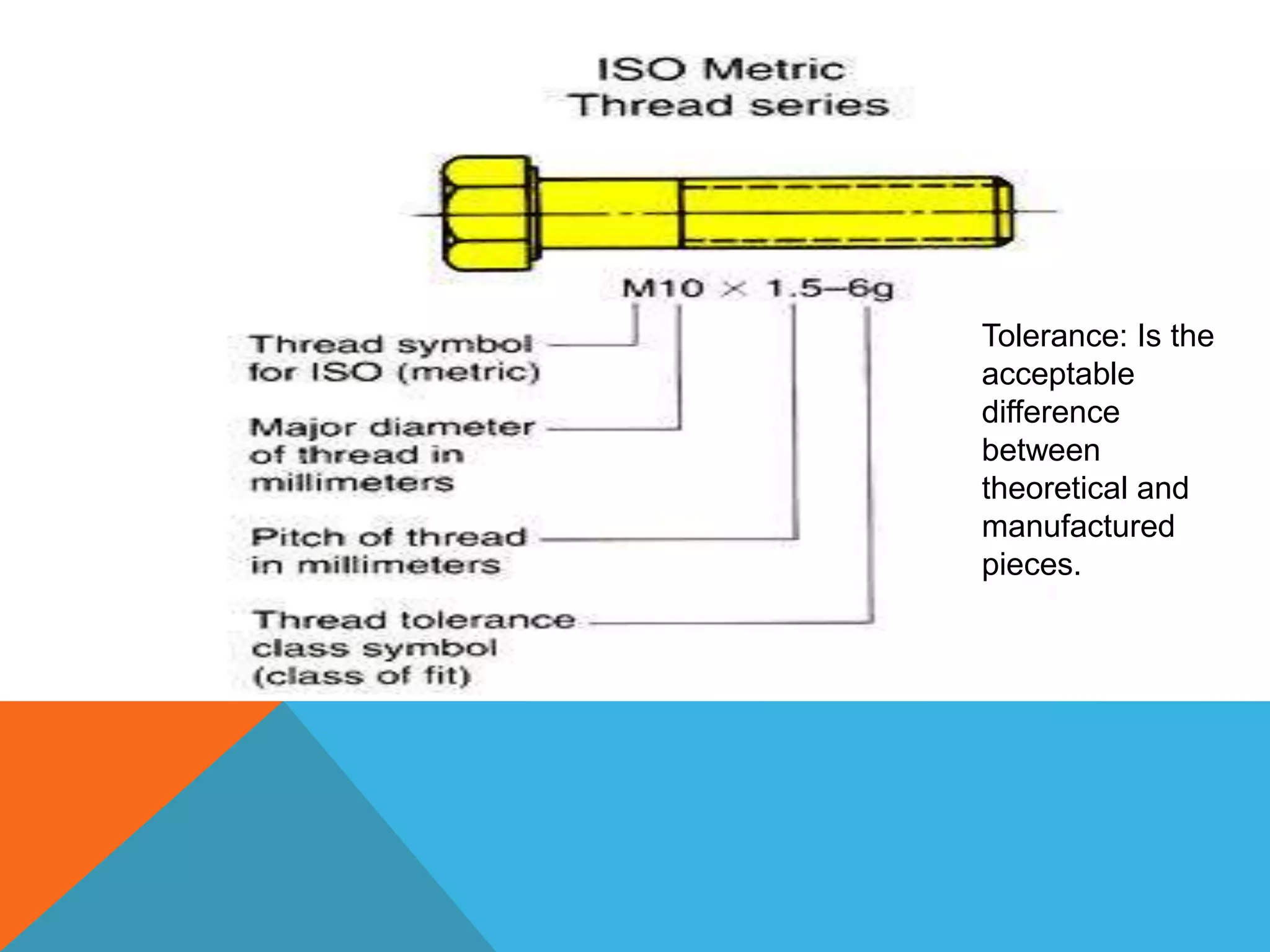
Tolerance: Is the
acceptable
difference
between
theoretical and
manufactured
pieces.
TAPS TYPES
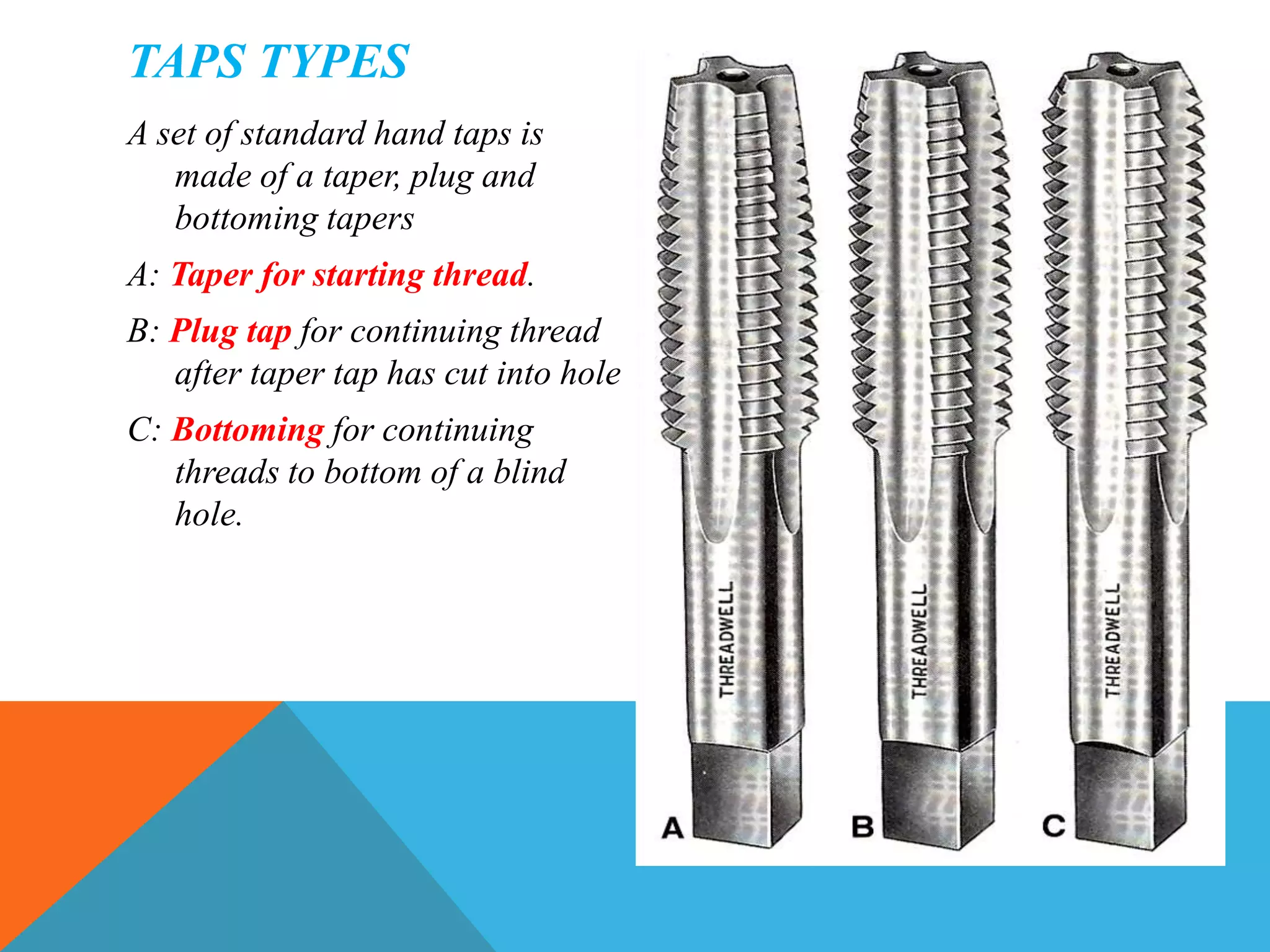
A set of standard hand taps is
made of a taper, plug and
bottoming tapers
A: Taper for starting thread.
B: Plug tap for continuing thread
after taper tap has cut into hole
C: Bottoming for continuing
threads to bottom of a blind
hole.
TAP TYPES
Threads are started with a taper tap.
Then the plug tap is used after the taper tap has cut threads as far into
the hole as possible.
Finally threads are cut to the bottom of a blind hole (one that does not
go through the part) with a bottoming tap. It is necessary to use the
full set of taps, only when a blind hole is to be made.
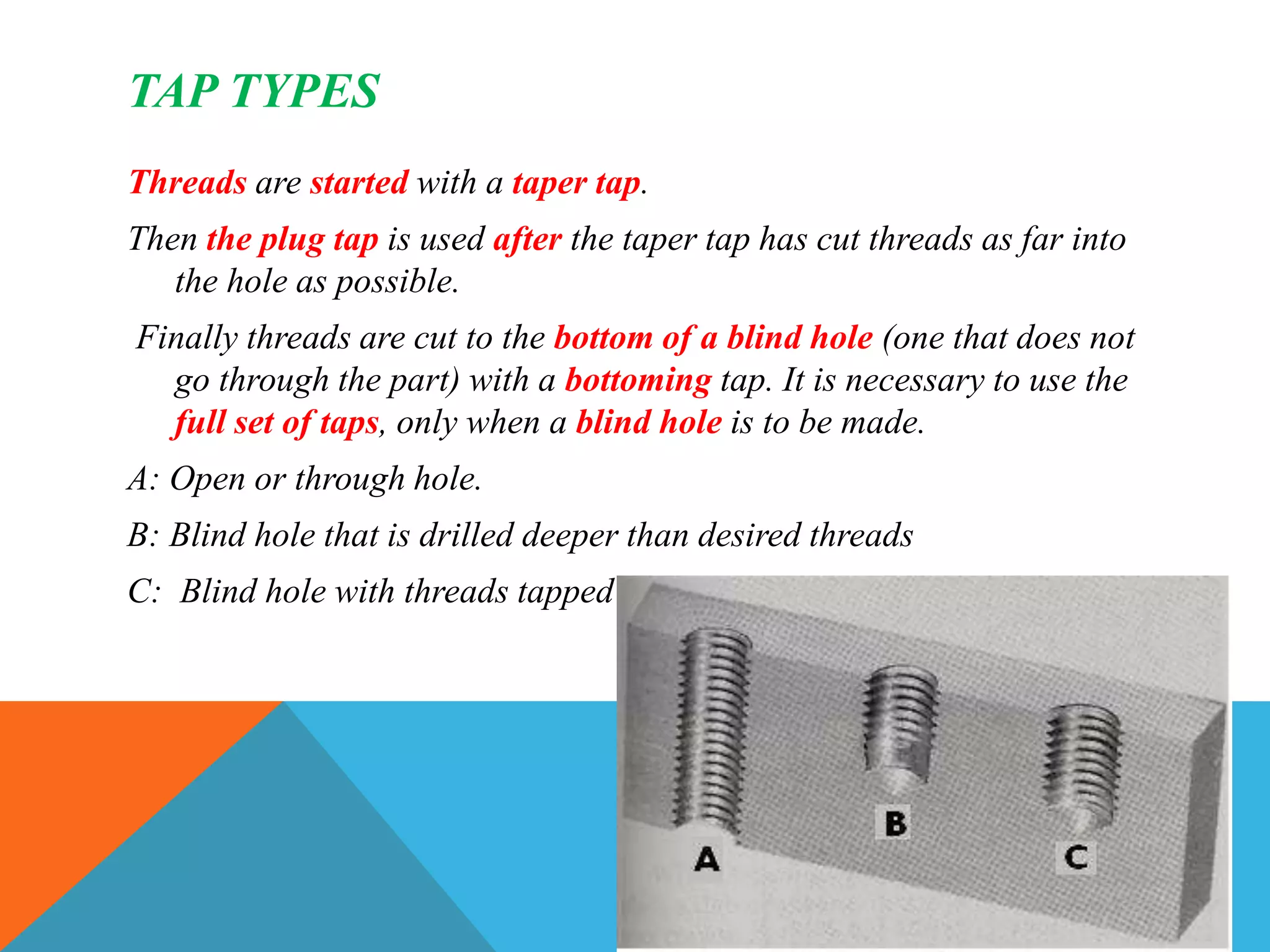
A: Open or through hole.
B: Blind hole that is drilled deeper than desired threads
C: Blind hole with threads tapped to bottom.
TAP DRILL
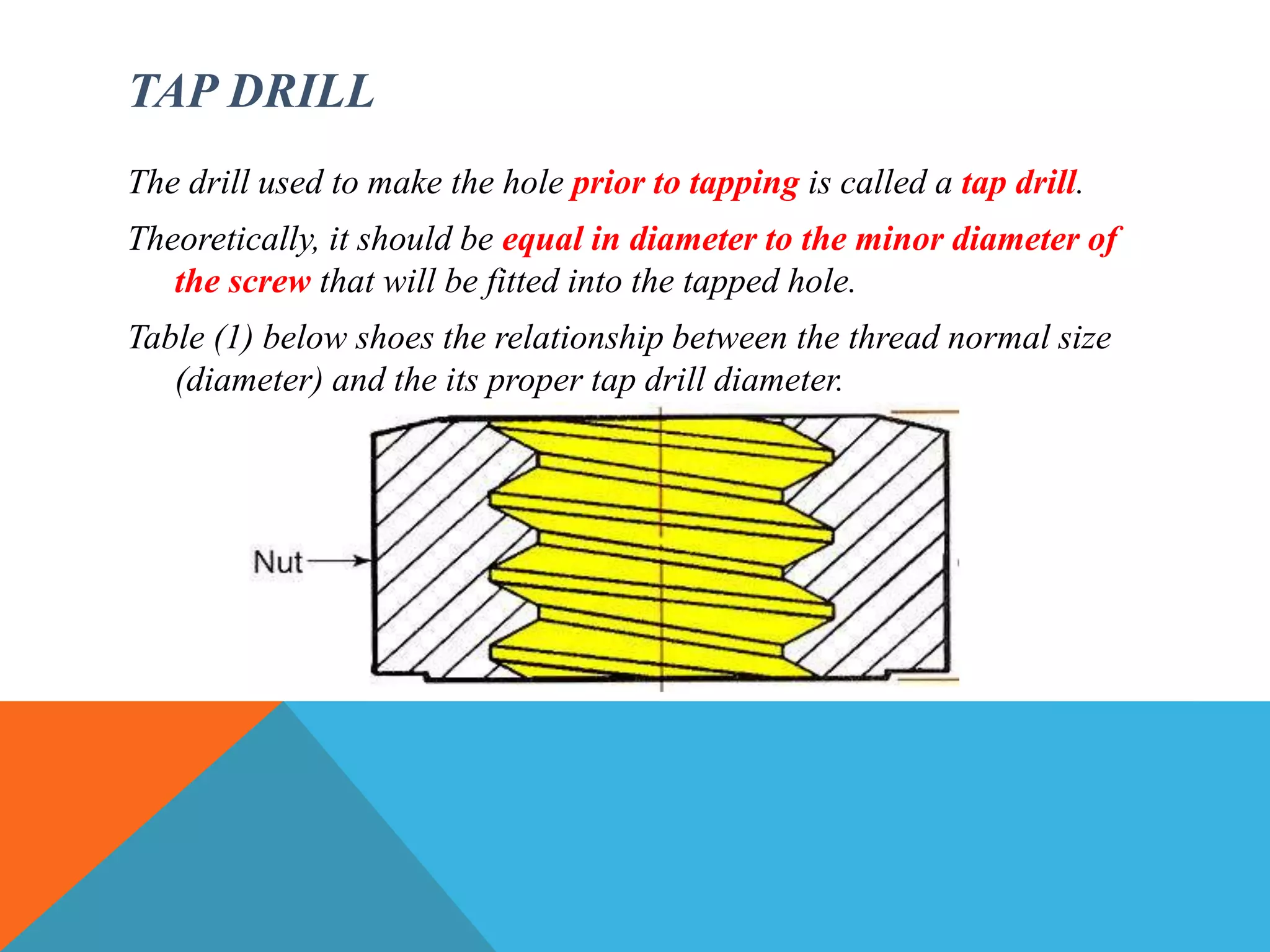
The drill used to make the hole prior to tapping is called a tap drill.
Theoretically, it should be equal in diameter to the minor diameter of
the screw that will be fitted into the tapped hole.
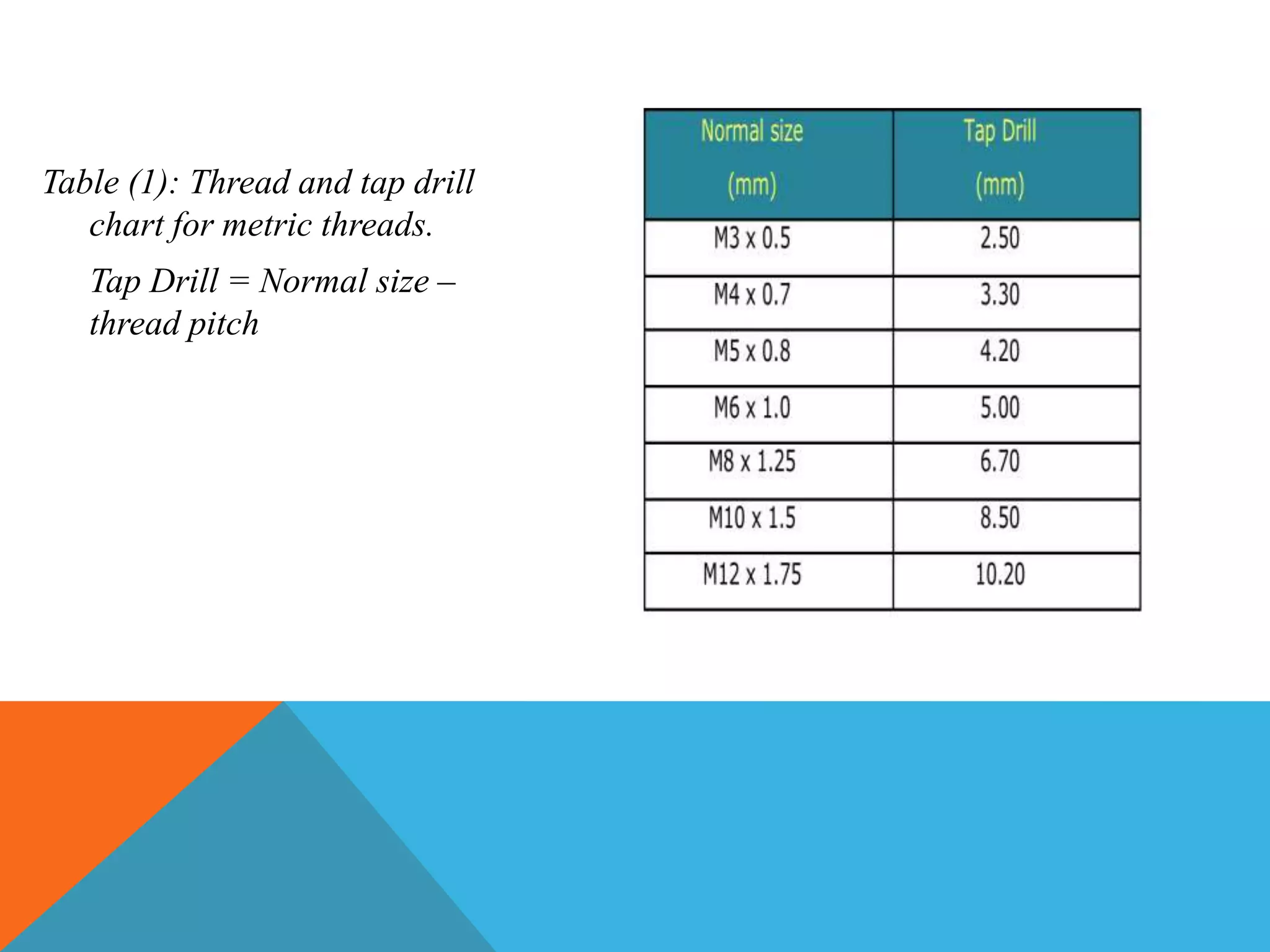
Table (1) below shoes the relationship between the thread normal size
(diameter) and the its proper tap drill diameter.
Table (1): Thread and tap drill
chart for metric threads.
Tap Drill = Normal size –
thread pitch
TAP WRENCH
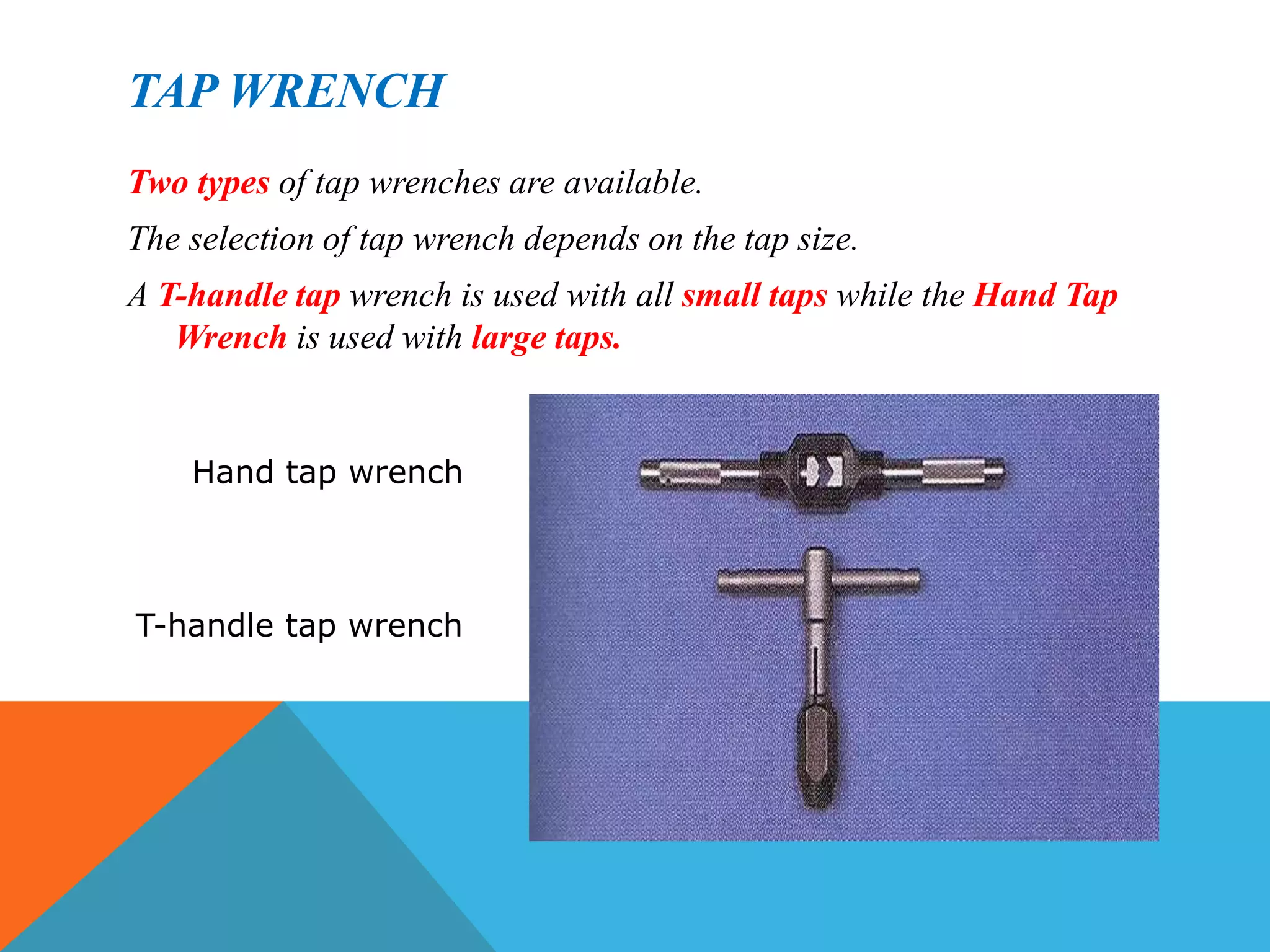
Two types of tap wrenches are available.
The selection of tap wrench depends on the tap size.
A T-handle tap wrench is used with all small taps while the Hand Tap
Wrench is used with large taps.
Hand tap wrench
T-handle tap wrench
CARE IN TAPPING
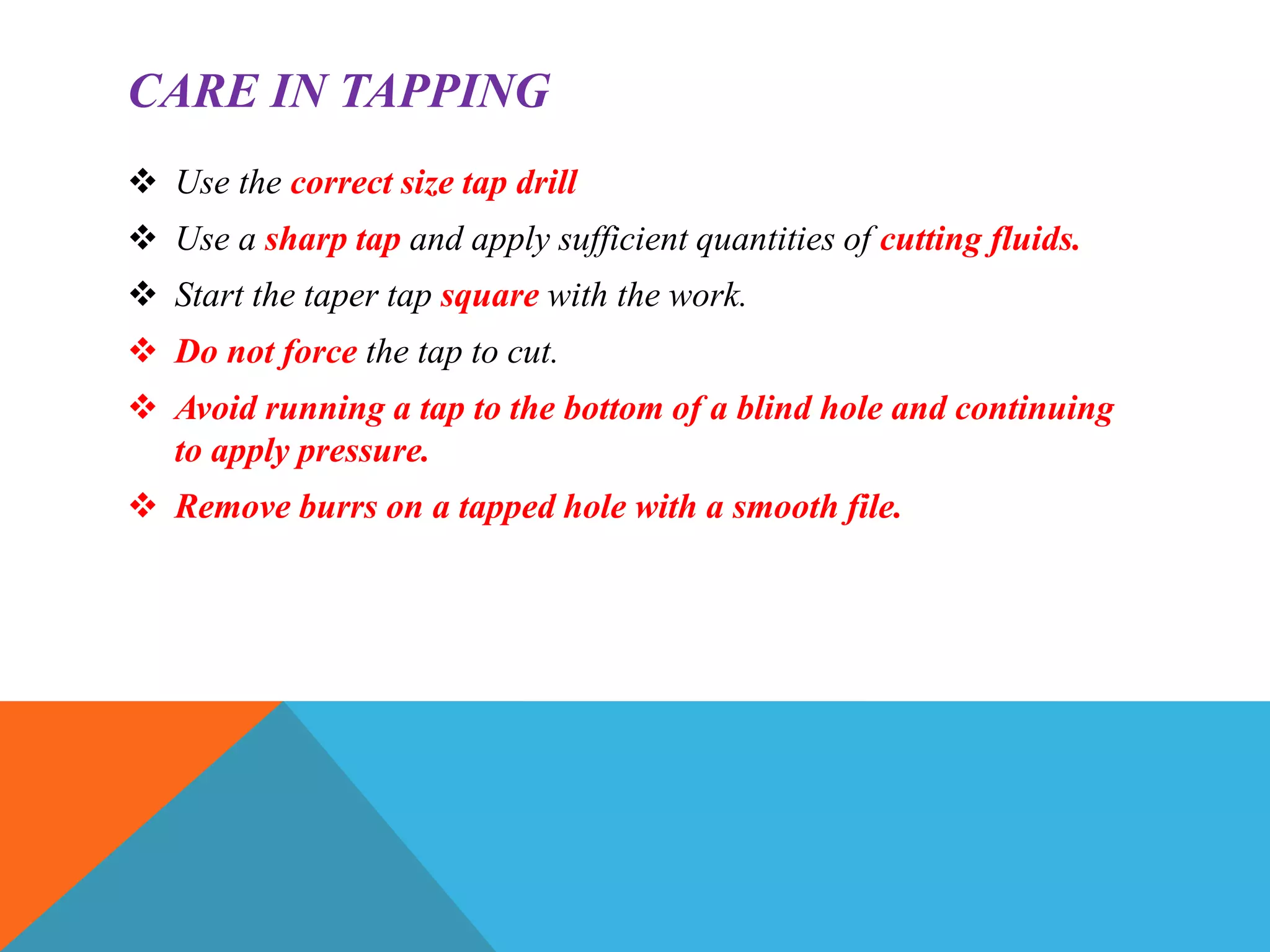
 Use the correct size tap drill
 Use a sharp tap and apply sufficient quantities of cutting fluids.
 Start the taper tap square with the work.
 Do not force the tap to cut.
 Avoid running a tap to the bottom of a blind hole and continuing
to apply pressure.
 Remove burrs on a tapped hole with a smooth file.
DRILLING
Drilling is the operation of producing circular hole in the work-piece by
using a rotating cutter called DRILL.
The machine used for drilling is called drilling machine.
The drilling operation can also be accomplished in lathe, in which the
drill is held in tailstock and the work is held by the chuck.
The most common drill used is the twist drill.
DRILL MATERIALS
The two most common types are
1. HSS drill
- Low cost
2. Carbide- tipped drills
- high production and in CNC machines
Other types are
Solid Carbide drill, TiN coated drills, carbide coated masonry drills,
parabolic drills, split point drill
TOOL HOLDING DEVICES
The different methods used for holding drill in a drill spindle are
 By directly fitting in the spindle hole.
 By using drill sleeve
 By using drill socket
 By using drill chuck
Drilling operations:-Operations that can be performed in a drilling machine
are
 Drilling
 Reaming
 Boring
 Counter boring
 Countersinking
 Tapping

Tapping and Drilling

  • 2.
    MODULE OBJECTIVES After thecompletion of this module, student should be able to:  Explain the tapping process  Identify the tap types.  Explain the tapping.  Use the tapping tools to create a tap.
  • 3.
    INTRODUCTION One of themost effective ways to fasten two or more components is through the use of screws or bolts, secured in properly threaded holes. This method of fastening is more robust then other fastening methods, allowing repeated assembly and dismantling via simple screwing and unscrewing of the screw. Screw Bolts Nut
  • 4.
    TAPPING Tapping is theprocess of producing threads in a metal using certain tools. Tapping Threading
  • 5.
    HAND THREADING SAFETY Chips produced by hand threading are sharp and should be cleaned by using a brush or piece of cloth.  Do not use compressed air to remove the metal chips.  Newly-cut external threads are very sharp. Again use a brush or cloth to clean them.  Wash your hands after using cutting fluids or oils.  Have cuts treated by a qualified person.  Be sure the die is clamped firmly in the die stock. If not, it can fall from the holder and cause injury.  Broken tap have very sharp edges and are very dangerous. An extra care should be taken in dealing with broken taps.
  • 6.
    THREADS STANDARDS There aremany types of threads used in different applications. The most frequently used standard is the ISO standard that is shown in the figure F: Crest D: Thread Depth P: Thread Pich
  • 7.
  • 8.
    TAPS TYPES A setof standard hand taps is made of a taper, plug and bottoming tapers A: Taper for starting thread. B: Plug tap for continuing thread after taper tap has cut into hole C: Bottoming for continuing threads to bottom of a blind hole.
  • 9.
    TAP TYPES Threads arestarted with a taper tap. Then the plug tap is used after the taper tap has cut threads as far into the hole as possible. Finally threads are cut to the bottom of a blind hole (one that does not go through the part) with a bottoming tap. It is necessary to use the full set of taps, only when a blind hole is to be made. A: Open or through hole. B: Blind hole that is drilled deeper than desired threads C: Blind hole with threads tapped to bottom.
  • 10.
    TAP DRILL The drillused to make the hole prior to tapping is called a tap drill. Theoretically, it should be equal in diameter to the minor diameter of the screw that will be fitted into the tapped hole. Table (1) below shoes the relationship between the thread normal size (diameter) and the its proper tap drill diameter.
  • 12.
    Table (1): Threadand tap drill chart for metric threads. Tap Drill = Normal size – thread pitch
  • 13.
    TAP WRENCH Two typesof tap wrenches are available. The selection of tap wrench depends on the tap size. A T-handle tap wrench is used with all small taps while the Hand Tap Wrench is used with large taps. Hand tap wrench T-handle tap wrench
  • 14.
    CARE IN TAPPING Use the correct size tap drill  Use a sharp tap and apply sufficient quantities of cutting fluids.  Start the taper tap square with the work.  Do not force the tap to cut.  Avoid running a tap to the bottom of a blind hole and continuing to apply pressure.  Remove burrs on a tapped hole with a smooth file.
  • 15.
    DRILLING Drilling is theoperation of producing circular hole in the work-piece by using a rotating cutter called DRILL. The machine used for drilling is called drilling machine. The drilling operation can also be accomplished in lathe, in which the drill is held in tailstock and the work is held by the chuck. The most common drill used is the twist drill.
  • 16.
    DRILL MATERIALS The twomost common types are 1. HSS drill - Low cost 2. Carbide- tipped drills - high production and in CNC machines Other types are Solid Carbide drill, TiN coated drills, carbide coated masonry drills, parabolic drills, split point drill
  • 17.
    TOOL HOLDING DEVICES Thedifferent methods used for holding drill in a drill spindle are  By directly fitting in the spindle hole.  By using drill sleeve  By using drill socket  By using drill chuck Drilling operations:-Operations that can be performed in a drilling machine are  Drilling  Reaming  Boring  Counter boring  Countersinking  Tapping

Editor's Notes

  • #9 A: tapered from the end approximately 6 threads and used to start a thread easily B: tapered for approximately 3 threads and used to thread a hole going through a work piece. C: not tapered but chamfered from the end for one thread