Dr. Sirisha
1st year PG
CLINICAL TRIALS
DEFINITION
• It is a prospective ethically designed investigation in human
subjects to discover/verify/compare the results of two or more
therapeutic measures /drugs.
• WHO definition: Prospectively assigned human participants to
one or more health related interventions to evaluate the effects on
health outcome.
DEFINITIONS
RANDOMIZATION:
Each study subject is randomly assigned to receive
either the study treatment or a control.
PLACEBO:
Pharmacologically inert substance given to please the
subjects
BLIND:
 If the study is single blind, the subjects involved in the
study do not know which study treatment they receive.
 If the study is double- blind, the researchers also do not
know which treatment is being given to any given subject.
 This 'blinding' helps in preventing biases.
TYPES OF CLINICAL TRIALS
Treatment trials
Prevention trials
Diagnostic trials
Screening trials
Quality of life trials
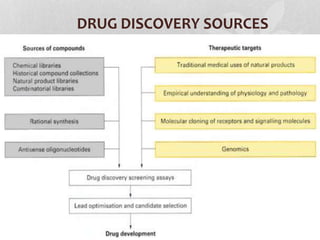
DRUG DISCOVERY SOURCES
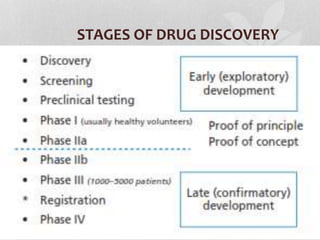
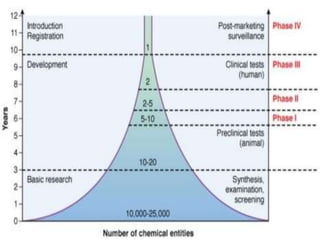
STAGES OF DRUG DISCOVERY
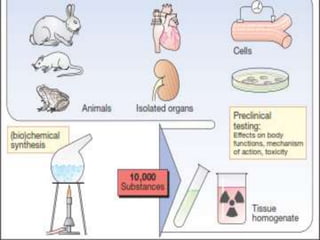
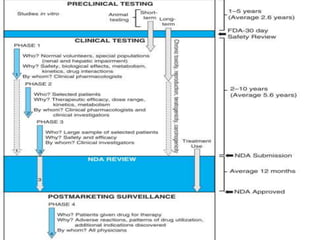
PRE-CLINICAL TRIALS
The testing on animals to expose the pharmacological profile
of a prospective drug is called pre-clinical trials.
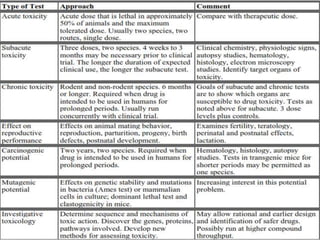
The major kinds of information expected from preclinical
toxicity studies are
(1) acute toxicity—effects of large single doses; (LD50)
(2) Sub acute and chronic toxicity—effects of multiple doses,
which are especially important if the drug is intended for
prolonged use in humans
PRE-CLINICAL TRIALS
(3) effects on reproductive functions, including teratogenicity and
postnatal development;
(4) carcinogenicity;
(5) mutagenicity.
(6) Pharmaco dynamics
(7) Pharmaco kinetics
(8) Assessment of safety index
PRE-CLINICAL TRIALS
Tests:
 Screening tests
 Tests on isolated organs
 Tests on bacterial culture
 Tests on animal models of human diseases
Importance of pre clinical trials
• Triparanol is a drug that lowers the concentration of cholesterol in
plasma.
• It was marketed in the USA in 1959. In 1962, the Food and Drug
Administration (FDA) received a tip-off and undertook an
unannounced inspection. This revealed that toxicology data
demonstrating cataract formation in rats and dogs had been
falsified.
• Triparanol was withdrawn, but some of the patients who had been
taking it for a year or longer also developed cataracts
ETHICS
The U.S. National Institutes of Health notes seven ethical
requirements that must be met before a clinical trial can begin.
These include
• social value,
• scientific validity,
• fair and objective selection of subjects,
• informed consent,
ETHICS
• favourable ratio of risks to benefits,
• approval and oversight by an independent/ institutional
review board (IRB),
• respect for human subjects.
LEGAL ISSUES
• Informed consent
• Institutional review board
• Medical insurance
• confidentiality
INFORMED CONSENT FORM
• Voluntary
• Explained in simple nontechnical, native language
• Comprehensive information regarding the trials like
• Benefit of new therapy over existing ones
• Alternative treatments available
• All possible adverse reactions
• Freedom to withdraw from the trial
Clinical trials must have
a) Good laboratory practice
b) Good clinical practice
c) Good manufacturing practice
d) Good documentation practice
e) Good regulatory practice
IND(Investigational New Drug)
The IND includes
 (1) information on the composition and source of the drug
(2) manufacturing information,
(3) all data from animal studies,
(4) clinical plans and protocols,
(5) the names and credentials of physicians who will conduct the
clinical trials.
DRUG REGULATORY AGENCY
A clinical trial can begin only when drug regulatory authority
approves for the conduct
Ex: Food and drug administration(FDA)
Central Standard Drug Control Organization (CDSCO)
Drug Controller General of India(DCGI)
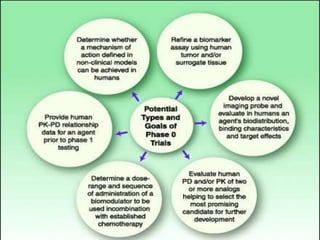
PHASE 0 / EXPLORATORY IND STUDIES
• MICRODOSING:
Extremely low, nonpharmacologically active doses of a
drug are used to define the agent’s pharmacokinetic profile in
humans.
• DEFINITION:
Microdosing means use of ‘less than 1/100 of the dose
calculated to yield a pharmacological effect of the test
substance to a maximum dose of <100 micrograms and a
maximum micro dose of <30 nanomoles for protein products.
• FEATURES:
limited number of subjects(10-15)
limited dosing duration(<=7 days)
evaluates pharmacodynamic and pharmacokinetic properties
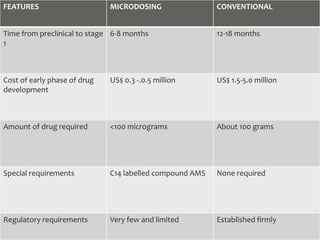
FEATURES MICRODOSING CONVENTIONAL
Time from preclinical to stage
1
6-8 months 12-18 months
Cost of early phase of drug
development
US$ 0.3 -.0.5 million US$ 1.5-5.0 million
Amount of drug required <100 micrograms About 100 grams
Special requirements C14 labelled compound AMS None required
Regulatory requirements Very few and limited Established firmly
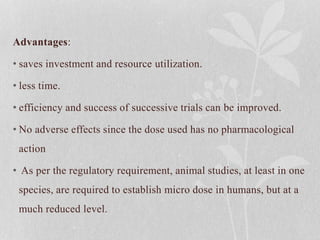
Advantages:
• saves investment and resource utilization.
• less time.
• efficiency and success of successive trials can be improved.
• No adverse effects since the dose used has no pharmacological
action
• As per the regulatory requirement, animal studies, at least in one
species, are required to establish micro dose in humans, but at a
much reduced level.
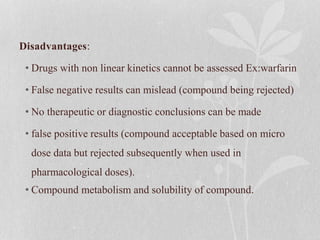
Disadvantages:
• Drugs with non linear kinetics cannot be assessed Ex:warfarin
• False negative results can mislead (compound being rejected)
• No therapeutic or diagnostic conclusions can be made
• false positive results (compound acceptable based on micro
dose data but rejected subsequently when used in
pharmacological doses).
• Compound metabolism and solubility of compound.
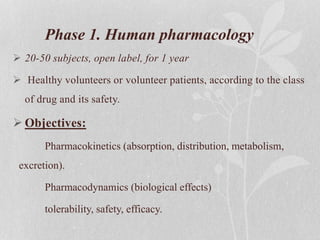
Phase 1. Human pharmacology
 20-50 subjects, open label, for 1 year
 Healthy volunteers or volunteer patients, according to the class
of drug and its safety.
 Objectives:
Pharmacokinetics (absorption, distribution, metabolism,
excretion).
Pharmacodynamics (biological effects)
tolerability, safety, efficacy.
Phase 2. Therapeutic exploration
 50-300 subjects, open label, 2-3years
 Patients.
 Trials with inclusion and exclusion criteria
 Primary and surrogate end points
 Objectives:
Pharmacokinetics and pharmacodynamic dose-ranging
Therapeutic efficacy
• Phase 2a/ Early Phase
• 200 patients
• Single blind
• Potential therapeutic benefits
and side effects
• Phase 2b/ Late Phase
• 400 patients
• Double blind
• Potential therapeutic benefits
and side effects
Phase 3. Therapeutic confirmation
 Randomised, double blind, multi-centric controlled trials; 250-
1000+
 Cross over design
 Patients
 Objectives:
Efficacy on a substantial scale; safety;
comparision with existing drugs.
Drug interactions
Guidelines for use of drug
NEW DRUG APPLICATION
• If phase 3 results meet expectations, application is made for
permission to market the new agent.
• Marketing approval requires submission of a New Drug
Application (NDA) to the DRA.
• The application contains, often in hundreds of volumes, full
reports of all preclinical and clinical data pertaining to the drug
under review, package inserts.
• median standard approval time was 12.9 months.
Phase 4. Therapeutic use
 2000-10000+, post-licensing studies
 Periodic Safety Update Report(PSUR)
 Objectives:
Surveillance for safety and efficacy
uncommon and long term adverse effects
marketing studies
pharmacoeconomic studies.
additional indications
Phase 5. Therapeutic effectiveness
• The focus of Phase V studies, or "effectiveness" research, is on
determining whether "the therapeutic effect is realized in day-
to-day clinical practice".
• Generally, Phase V research is considered "field research" or
"community-based research" and is designed to test
generalization of the intervention to a larger sample and under
typical and somewhat variable clinical contexts.
PHASE 5
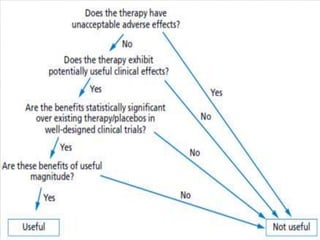
• A central question for Phase V research is whether the effects are
similar to those found in efficacy studies and to determine who
benefits from the treatment.
• It is during this phase of research that questions concerning the
cost-benefit ratio of the intervention can be addressed.
CRITICAL PATH INITIATIVE
• In 2004, a white paper, now known as the Critical Path Initiative
(CPI), is given by FDA that called attention to an alarming
decline in the number of innovative medical products being
submitted for FDA approval.
• This led to the new concept of adaptive phase clinical trials
ADAPTIVE PHASE CLINICAL TRIALS
• Study that includes a prospectively planned opportunity for
modification of one or more specified aspects of the study design
and hypotheses based on analysis of data (usually interim data)
from subjects in the study.
• The purpose is to make clinical trials more flexible, efficient and
fast. Due to the level of flexibility involved, these trial designs
are also termed as “flexible designs.”
NON INFERIORITY CLINICAL TRIALS
• Non-inferiority clinical trials aim to demonstrate that the test
product is no worse than the comparator by more than a
prespecified small amount. This amount is known as the non-
inferiority margin (M), or delta (Δ).
Clinical trials

Clinical trials

  • 1.
    Dr. Sirisha 1st yearPG CLINICAL TRIALS
  • 2.
    DEFINITION • It isa prospective ethically designed investigation in human subjects to discover/verify/compare the results of two or more therapeutic measures /drugs. • WHO definition: Prospectively assigned human participants to one or more health related interventions to evaluate the effects on health outcome.
  • 3.
    DEFINITIONS RANDOMIZATION: Each study subjectis randomly assigned to receive either the study treatment or a control. PLACEBO: Pharmacologically inert substance given to please the subjects
  • 4.
    BLIND:  If thestudy is single blind, the subjects involved in the study do not know which study treatment they receive.  If the study is double- blind, the researchers also do not know which treatment is being given to any given subject.  This 'blinding' helps in preventing biases.
  • 5.
    TYPES OF CLINICALTRIALS Treatment trials Prevention trials Diagnostic trials Screening trials Quality of life trials
  • 6.
  • 7.
    STAGES OF DRUGDISCOVERY
  • 8.
    PRE-CLINICAL TRIALS The testingon animals to expose the pharmacological profile of a prospective drug is called pre-clinical trials. The major kinds of information expected from preclinical toxicity studies are (1) acute toxicity—effects of large single doses; (LD50) (2) Sub acute and chronic toxicity—effects of multiple doses, which are especially important if the drug is intended for prolonged use in humans
  • 9.
    PRE-CLINICAL TRIALS (3) effectson reproductive functions, including teratogenicity and postnatal development; (4) carcinogenicity; (5) mutagenicity. (6) Pharmaco dynamics (7) Pharmaco kinetics (8) Assessment of safety index
  • 10.
    PRE-CLINICAL TRIALS Tests:  Screeningtests  Tests on isolated organs  Tests on bacterial culture  Tests on animal models of human diseases
  • 12.
    Importance of preclinical trials • Triparanol is a drug that lowers the concentration of cholesterol in plasma. • It was marketed in the USA in 1959. In 1962, the Food and Drug Administration (FDA) received a tip-off and undertook an unannounced inspection. This revealed that toxicology data demonstrating cataract formation in rats and dogs had been falsified. • Triparanol was withdrawn, but some of the patients who had been taking it for a year or longer also developed cataracts
  • 14.
    ETHICS The U.S. NationalInstitutes of Health notes seven ethical requirements that must be met before a clinical trial can begin. These include • social value, • scientific validity, • fair and objective selection of subjects, • informed consent,
  • 15.
    ETHICS • favourable ratioof risks to benefits, • approval and oversight by an independent/ institutional review board (IRB), • respect for human subjects.
  • 16.
    LEGAL ISSUES • Informedconsent • Institutional review board • Medical insurance • confidentiality
  • 17.
    INFORMED CONSENT FORM •Voluntary • Explained in simple nontechnical, native language • Comprehensive information regarding the trials like • Benefit of new therapy over existing ones • Alternative treatments available • All possible adverse reactions • Freedom to withdraw from the trial
  • 18.
    Clinical trials musthave a) Good laboratory practice b) Good clinical practice c) Good manufacturing practice d) Good documentation practice e) Good regulatory practice
  • 19.
    IND(Investigational New Drug) TheIND includes  (1) information on the composition and source of the drug (2) manufacturing information, (3) all data from animal studies, (4) clinical plans and protocols, (5) the names and credentials of physicians who will conduct the clinical trials.
  • 20.
    DRUG REGULATORY AGENCY Aclinical trial can begin only when drug regulatory authority approves for the conduct Ex: Food and drug administration(FDA) Central Standard Drug Control Organization (CDSCO) Drug Controller General of India(DCGI)
  • 22.
    PHASE 0 /EXPLORATORY IND STUDIES • MICRODOSING: Extremely low, nonpharmacologically active doses of a drug are used to define the agent’s pharmacokinetic profile in humans. • DEFINITION: Microdosing means use of ‘less than 1/100 of the dose calculated to yield a pharmacological effect of the test substance to a maximum dose of <100 micrograms and a maximum micro dose of <30 nanomoles for protein products.
  • 23.
    • FEATURES: limited numberof subjects(10-15) limited dosing duration(<=7 days) evaluates pharmacodynamic and pharmacokinetic properties
  • 25.
    FEATURES MICRODOSING CONVENTIONAL Timefrom preclinical to stage 1 6-8 months 12-18 months Cost of early phase of drug development US$ 0.3 -.0.5 million US$ 1.5-5.0 million Amount of drug required <100 micrograms About 100 grams Special requirements C14 labelled compound AMS None required Regulatory requirements Very few and limited Established firmly
  • 26.
    Advantages: • saves investmentand resource utilization. • less time. • efficiency and success of successive trials can be improved. • No adverse effects since the dose used has no pharmacological action • As per the regulatory requirement, animal studies, at least in one species, are required to establish micro dose in humans, but at a much reduced level.
  • 27.
    Disadvantages: • Drugs withnon linear kinetics cannot be assessed Ex:warfarin • False negative results can mislead (compound being rejected) • No therapeutic or diagnostic conclusions can be made • false positive results (compound acceptable based on micro dose data but rejected subsequently when used in pharmacological doses). • Compound metabolism and solubility of compound.
  • 28.
    Phase 1. Humanpharmacology  20-50 subjects, open label, for 1 year  Healthy volunteers or volunteer patients, according to the class of drug and its safety.  Objectives: Pharmacokinetics (absorption, distribution, metabolism, excretion). Pharmacodynamics (biological effects) tolerability, safety, efficacy.
  • 29.
    Phase 2. Therapeuticexploration  50-300 subjects, open label, 2-3years  Patients.  Trials with inclusion and exclusion criteria  Primary and surrogate end points  Objectives: Pharmacokinetics and pharmacodynamic dose-ranging Therapeutic efficacy
  • 30.
    • Phase 2a/Early Phase • 200 patients • Single blind • Potential therapeutic benefits and side effects • Phase 2b/ Late Phase • 400 patients • Double blind • Potential therapeutic benefits and side effects
  • 31.
    Phase 3. Therapeuticconfirmation  Randomised, double blind, multi-centric controlled trials; 250- 1000+  Cross over design  Patients  Objectives: Efficacy on a substantial scale; safety; comparision with existing drugs. Drug interactions Guidelines for use of drug
  • 32.
    NEW DRUG APPLICATION •If phase 3 results meet expectations, application is made for permission to market the new agent. • Marketing approval requires submission of a New Drug Application (NDA) to the DRA. • The application contains, often in hundreds of volumes, full reports of all preclinical and clinical data pertaining to the drug under review, package inserts. • median standard approval time was 12.9 months.
  • 33.
    Phase 4. Therapeuticuse  2000-10000+, post-licensing studies  Periodic Safety Update Report(PSUR)  Objectives: Surveillance for safety and efficacy uncommon and long term adverse effects marketing studies pharmacoeconomic studies. additional indications
  • 35.
    Phase 5. Therapeuticeffectiveness • The focus of Phase V studies, or "effectiveness" research, is on determining whether "the therapeutic effect is realized in day- to-day clinical practice". • Generally, Phase V research is considered "field research" or "community-based research" and is designed to test generalization of the intervention to a larger sample and under typical and somewhat variable clinical contexts.
  • 37.
    PHASE 5 • Acentral question for Phase V research is whether the effects are similar to those found in efficacy studies and to determine who benefits from the treatment. • It is during this phase of research that questions concerning the cost-benefit ratio of the intervention can be addressed.
  • 38.
    CRITICAL PATH INITIATIVE •In 2004, a white paper, now known as the Critical Path Initiative (CPI), is given by FDA that called attention to an alarming decline in the number of innovative medical products being submitted for FDA approval. • This led to the new concept of adaptive phase clinical trials
  • 39.
    ADAPTIVE PHASE CLINICALTRIALS • Study that includes a prospectively planned opportunity for modification of one or more specified aspects of the study design and hypotheses based on analysis of data (usually interim data) from subjects in the study. • The purpose is to make clinical trials more flexible, efficient and fast. Due to the level of flexibility involved, these trial designs are also termed as “flexible designs.”
  • 40.
    NON INFERIORITY CLINICALTRIALS • Non-inferiority clinical trials aim to demonstrate that the test product is no worse than the comparator by more than a prespecified small amount. This amount is known as the non- inferiority margin (M), or delta (Δ).