Krupanidhi College of Pharmacy, Bangalore
Definition
2
 Clinical trials are prospective biomedical or
behavioral research studies on human
subjects that are designed to answer specific
questions about biomedical or behavioral
interventions (novel vaccines, drugs,
treatments, functional foods, dietary
supplements, devices or new ways of using
known interventions), generating safety
and efficacy data
WHO Definiton
3
 Any research study that prospectively assigns
human participants or groups of humans to
one or more health related measures obtained
in patients or participants, including
pharmacokinetic measures and adverse
events
Objectives of Clinical Trials
4
 To diagnose or detect disease
 To treat an existing disorder
 To prevent disease or early death
 To change behaviour, habits or other lifestyle
factors
Types of Clinical Trials
5
 Treatment Trials
 Prevention Trials
 Diagnostic Trials
 Screening Trials
 Quality of life trials
Phases of Clinical Trials
6
Phase 0:
7
 Studies conducted before the traditional phase 1
studies
 It is also called as the Exploratory IND studies
 Helps to take the go Vs no-go decision-making
 10-15 number of subjects
 Limited dosing duration (<7 days)
 Microdosing is done (1/100 th dose of the
pharmacological effect)
 No therapeutic or diagnostic intent
 Only to study pharmacokinetic and
pharmacodynamic characteristics
Phase I:
8
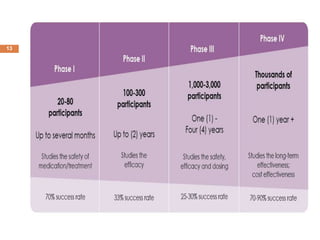
 Phase I trials are the first stage of testing in
human subjects
 A small group of 20–100 healthy volunteers is
taken
 This phase is designed to assess the safety
(pharmacovigilance),
tolerability, pharmacokinetics,
and pharmacodynamics of a drug
Phase II:
9
 Once a dose or range of doses is determined,
the next goal is to evaluate whether the drug
has any biological activity or effect
 Phase II trials are performed on larger groups
(100-300) and are designed to assess how
well the drug works, as well as to continue
Phase I safety assessments in a larger group
of volunteers and patients
10
 Phase II studies are sometimes divided into
Phase IIA and Phase IIB.
 Phase IIA is specifically designed to assess
dosing requirements (how much drug should
be given).
 Phase IIB is specifically designed to study
efficacy (how well the drug works at the
prescribed dose(s))
 When the development process for a new drug
fails, this usually occurs during Phase II trials
when the drug is discovered not to work as
planned, or to have toxic effects
Phase III:
11
 This phase is designed to assess the
effectiveness of the new intervention and,
thereby, its value in clinical practice
 Phase III studies are randomized
controlled multicenter trials on large patient
groups (300–3,000 or more depending upon
the disease/medical condition studied)
 Because of their size and comparatively long
duration, Phase III trials are the most
expensive, time-consuming and difficult trials
to design and run
Phase IV:
12
 Phase IV trial is also known as postmarketing
surveillance Trial
 Phase IV trials involve the safety surveillance
(pharmacovigilance) and ongoing technical
support of a drug after it receives permission
to be sold
 The safety surveillance is designed to detect
any rare or long-term adverse effects over a
much larger patient population and longer time
period than was possible during the Phase I-III
clinical trials
13
Importance of Clinical Trials
14
 The purpose of clinical trials is research, so the
studies follow strict scientific standards. These
standards protect patients and help produce
reliable study results.
 Clinical trials are one of the final stages of a long
and careful research process. The process often
begins in a laboratory (lab), where scientists first
develop and test new ideas.
 If an approach seems promising, the next step
may involve animal testing. This shows how the
approach affects a living body and whether it's
harmful. However, an approach that works well in
the lab or animals doesn't always work well in
people. Thus, research in humans is needed.
15

Clinical trial

  • 1.
    Krupanidhi College ofPharmacy, Bangalore
  • 2.
    Definition 2  Clinical trialsare prospective biomedical or behavioral research studies on human subjects that are designed to answer specific questions about biomedical or behavioral interventions (novel vaccines, drugs, treatments, functional foods, dietary supplements, devices or new ways of using known interventions), generating safety and efficacy data
  • 3.
    WHO Definiton 3  Anyresearch study that prospectively assigns human participants or groups of humans to one or more health related measures obtained in patients or participants, including pharmacokinetic measures and adverse events
  • 4.
    Objectives of ClinicalTrials 4  To diagnose or detect disease  To treat an existing disorder  To prevent disease or early death  To change behaviour, habits or other lifestyle factors
  • 5.
    Types of ClinicalTrials 5  Treatment Trials  Prevention Trials  Diagnostic Trials  Screening Trials  Quality of life trials
  • 6.
  • 7.
    Phase 0: 7  Studiesconducted before the traditional phase 1 studies  It is also called as the Exploratory IND studies  Helps to take the go Vs no-go decision-making  10-15 number of subjects  Limited dosing duration (<7 days)  Microdosing is done (1/100 th dose of the pharmacological effect)  No therapeutic or diagnostic intent  Only to study pharmacokinetic and pharmacodynamic characteristics
  • 8.
    Phase I: 8  PhaseI trials are the first stage of testing in human subjects  A small group of 20–100 healthy volunteers is taken  This phase is designed to assess the safety (pharmacovigilance), tolerability, pharmacokinetics, and pharmacodynamics of a drug
  • 9.
    Phase II: 9  Oncea dose or range of doses is determined, the next goal is to evaluate whether the drug has any biological activity or effect  Phase II trials are performed on larger groups (100-300) and are designed to assess how well the drug works, as well as to continue Phase I safety assessments in a larger group of volunteers and patients
  • 10.
    10  Phase IIstudies are sometimes divided into Phase IIA and Phase IIB.  Phase IIA is specifically designed to assess dosing requirements (how much drug should be given).  Phase IIB is specifically designed to study efficacy (how well the drug works at the prescribed dose(s))  When the development process for a new drug fails, this usually occurs during Phase II trials when the drug is discovered not to work as planned, or to have toxic effects
  • 11.
    Phase III: 11  Thisphase is designed to assess the effectiveness of the new intervention and, thereby, its value in clinical practice  Phase III studies are randomized controlled multicenter trials on large patient groups (300–3,000 or more depending upon the disease/medical condition studied)  Because of their size and comparatively long duration, Phase III trials are the most expensive, time-consuming and difficult trials to design and run
  • 12.
    Phase IV: 12  PhaseIV trial is also known as postmarketing surveillance Trial  Phase IV trials involve the safety surveillance (pharmacovigilance) and ongoing technical support of a drug after it receives permission to be sold  The safety surveillance is designed to detect any rare or long-term adverse effects over a much larger patient population and longer time period than was possible during the Phase I-III clinical trials
  • 13.
  • 14.
    Importance of ClinicalTrials 14  The purpose of clinical trials is research, so the studies follow strict scientific standards. These standards protect patients and help produce reliable study results.  Clinical trials are one of the final stages of a long and careful research process. The process often begins in a laboratory (lab), where scientists first develop and test new ideas.  If an approach seems promising, the next step may involve animal testing. This shows how the approach affects a living body and whether it's harmful. However, an approach that works well in the lab or animals doesn't always work well in people. Thus, research in humans is needed.
  • 15.