Clinical Trials
1
Topics to be discussed
 Clinical Trials- Definition, Importance of trials
 Role of clinical trials in clinical product development
 Different types of clinical trials and their phases
 Design of clinical trials
 Data management in clinical trials
 Clinical trials protocols
2
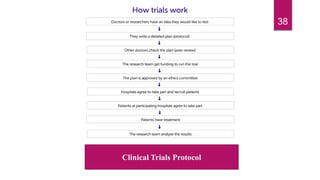
 How Clinical trials work
 Approval process of clinical trials
 How clinical trials are funded?
 Registration of Clinical trials
 Why is trial registration important?
3
Clinical Trials
Definition, Importance of trials
4
What exactly are clinical trials
 Clinical Trials are scientific investigation that examine and evaluate safety and
efficacy of different therapies in human subjects.
 Meinert (1986) defined that a clinical trial is a research activity that involves
administration of a test treatment to some experiment unit in order to evaluate
the test treatment.
 Pianttadosi (1997) simply defined a clinical trials as an experimental testing
of medical treatment on human subjects.
5
 The code of Federal Regulations (CFR) defines a clinical trials as a clinical
investigation of drug that is administered, dispensed or use involving one and
more human subjects.
 Three important key words in these definitions of clinical trials are
Experimental unit, Treatment, and evaluation of treatment.
6
Three important key words
 Experimental unit
An experimental unit is usually referred to a as a subject from a targeted
population under study.
For example, the intended population could be patients with certain disease at certain
stages or healthy human subjects.
 Treatments
In clinical trials, treatment can be placebo or any combination of new
chemical entity (drug), a new diet, a surgical procedure, a diagnostic test, a
medical device, a health education program or no treatment
7
 Evaluation
In addition to traditional evaluation of effectiveness and safety of test
treatment.
Clinical trials are also designed to assess quality of life, pharmacogenomics and
pharmacoeconimcs such as cost minimization, cost-effectiveness, and cost benefit
analysis to human subjects associated with the treatment under study.
8
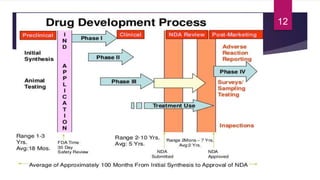
Role of clinical trials in Drug development
process
9
Important Terms
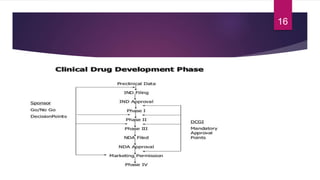
 Investigational new drug (IND) a new drug, new antibiotic drug or biological
drug that is used in clinical investigation.
 Institutional review board (IRB) A committee of physicians, statisticians,
researchers, community advocates and others that ensures that a clinical trial is
ethical and that the rights of study participants are protected.
10
 New drug Application (NDA): An application submitted by the manufacturer of
a drug to the FDA- after clinical trials have been completed- for a license to
market the drug for a specified indication.
 Application IND: IND stands for investigational new drug application, which is
the part of process to get approval from FDA for marketing a new prescription
drug.
11
12
Types of Clinical Trials
13
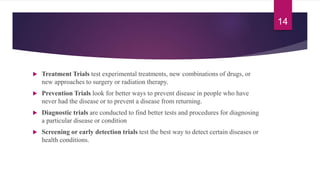
 Treatment Trials test experimental treatments, new combinations of drugs, or
new approaches to surgery or radiation therapy.
 Prevention Trials look for better ways to prevent disease in people who have
never had the disease or to prevent a disease from returning.
 Diagnostic trials are conducted to find better tests and procedures for diagnosing
a particular disease or condition
 Screening or early detection trials test the best way to detect certain diseases or
health conditions.
14
Phases of Clinical Phases
15
16
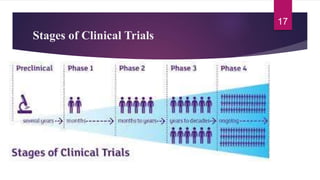
Stages of Clinical Trials
17
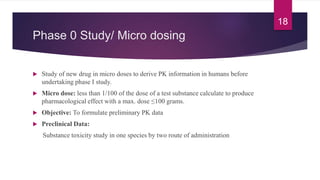
Phase 0 Study/ Micro dosing
 Study of new drug in micro doses to derive PK information in humans before
undertaking phase I study.
 Micro dose: less than 1/100 of the dose of a test substance calculate to produce
pharmacological effect with a max. dose ≤100 grams.
 Objective: To formulate preliminary PK data
 Preclinical Data:
Substance toxicity study in one species by two route of administration
18
 Advantages
less chances of adverse event
Short duration
Less no. of volunteers
Reduced cost of development
Reduced drug development time
19
 Limitations
Study based on PK, no efficacy and safety
Agents having different kinetics characteristics between micro dose and full
doses are not evaluated
The laboratory parameters are very limited and expensive.
20
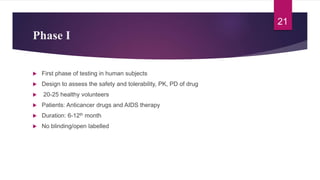
Phase I
 First phase of testing in human subjects
 Design to assess the safety and tolerability, PK, PD of drug
 20-25 healthy volunteers
 Patients: Anticancer drugs and AIDS therapy
 Duration: 6-12th month
 No blinding/open labelled
21
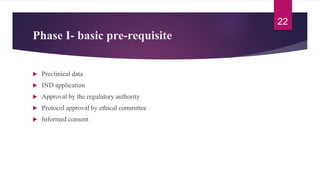
Phase I- basic pre-requisite
 Preclinical data
 IND application
 Approval by the regulatory authority
 Protocol approval by ethical committee
 Informed consent
22
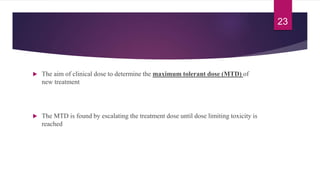
 The aim of clinical dose to determine the maximum tolerant dose (MTD) of
new treatment
 The MTD is found by escalating the treatment dose until dose limiting toxicity is
reached
23
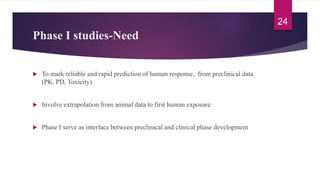
Phase I studies-Need
 To mark reliable and rapid prediction of human response, from preclinical data
(PK, PD, Toxicity)
 Involve extrapolation from animal data to first human exposure
 Phase I serve as interface between preclinical and clinical phase development
24
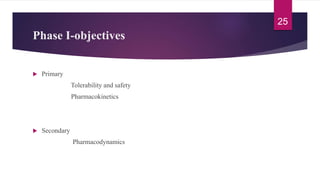
Phase I-objectives
 Primary
Tolerability and safety
Pharmacokinetics
 Secondary
Pharmacodynamics
25
 Limitation
Trials restrict to homogenous subjects
Performance extrapolated to heterogeneous market place
26
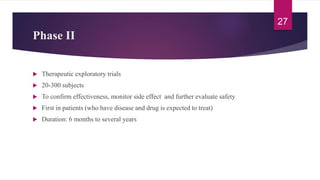
Phase II
 Therapeutic exploratory trials
 20-300 subjects
 To confirm effectiveness, monitor side effect and further evaluate safety
 First in patients (who have disease and drug is expected to treat)
 Duration: 6 months to several years
27
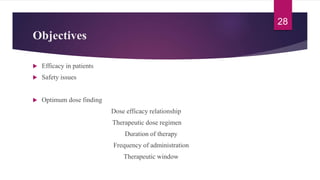
Objectives
 Efficacy in patients
 Safety issues
 Optimum dose finding
Dose efficacy relationship
Therapeutic dose regimen
Duration of therapy
Frequency of administration
Therapeutic window
28
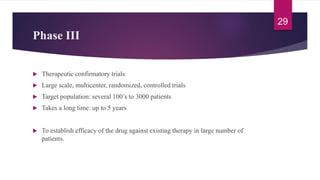
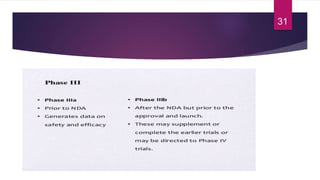
Phase III
 Therapeutic confirmatory trials
 Large scale, multicenter, randomized, controlled trials
 Target population: several 100’s to 3000 patients
 Takes a long time: up to 5 years
 To establish efficacy of the drug against existing therapy in large number of
patients.
29
Objectives
 To assess overall and relative therapeutic value of the new drug efficacy and
safety.
 To determine optimal dosage schedule for use in general
 The dosage schedule in C.T should be as close as possible to its anticipated
clinical trials
 Long term clinical safety studies
Chronic toxicity
Reproductive toxicity
Carcinogenicity
30
31
New Drug Application
 Formal proposal for FDA to establish
Drug is safe and effective
Benefit outweighs the risk
Proposed labeling is appropriate
 NDA contains all the information gathered during preclinical phase to phase III
 NDA can be thousands of pages long and can take 2-3 years from FDA to review
32
Phase IV
 Done after drug has been marketed (Post marketing surveillance)
 No fixed duration/ patient population
 Studies continue to collect data about effects in various populations and side
effect for long term use
 These are primarily observation and non-experimental in nature
33
 It helps to detect rare ADRs and drug interaction
 Also to explore new use for drugs
 Periodic safety update reports
To be submitted by the manufacturer every 6 months for 2 years and then
annually for next 2 years after marketing approval.
 Harmful effects discovered may result in a drug being no longer sold or restricted
to certain uses. For example, zantac
34
Objectives
 Confirm the safety and efficacy profile in large populations during practice
 Detect the unknown and rare adverse drug reactions
 Evaluation of over doses
 Identification of new indications
 Dose refinements: evaluation of new formulation, dosages and durations of
treatment
 Evaluation of different age groups/ types of patients
35
 Comparative benefit-risk assessment
 Benefit-cost assessment during usage in community
 Quality of life assessment
36
How Clinical Trials work
37
38
Clinical Trials Protocol
Approval Process of Clinical Trials
1) Peer review
2) Ethical approval
3) Trial authorization
4) Hospital approval
39
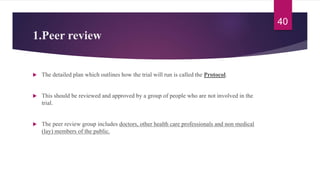
1.Peer review
 The detailed plan which outlines how the trial will run is called the Protocol.
 This should be reviewed and approved by a group of people who are not involved in the
trial.
 The peer review group includes doctors, other health care professionals and non medical
(lay) members of the public.
40
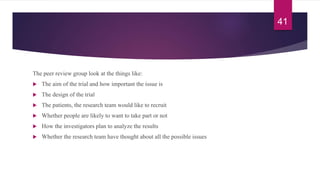
The peer review group look at the things like:
 The aim of the trial and how important the issue is
 The design of the trial
 The patients, the research team would like to recruit
 Whether people are likely to want to take part or not
 How the investigators plan to analyze the results
 Whether the research team have thought about all the possible issues
41
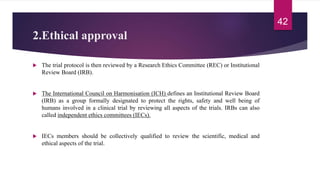
2.Ethical approval
 The trial protocol is then reviewed by a Research Ethics Committee (REC) or Institutional
Review Board (IRB).
 The International Council on Harmonisation (ICH) defines an Institutional Review Board
(IRB) as a group formally designated to protect the rights, safety and well being of
humans involved in a clinical trial by reviewing all aspects of the trials. IRBs can also
called independent ethics committees (IECs).
 IECs members should be collectively qualified to review the scientific, medical and
ethical aspects of the trial.
42
 An IRBs/IECs should have at least five members with varying backgrounds
 At least one member must represent a non-scientific area (a lay member)
 At least one member must not be affiliated with the institution or trial site (an
independent member)
 Competent members who are able to review and evaluate the science, medical
aspects and ethics of the proposed trial.
43
2.Ethical approval
They look at things like:
 The aim of the trial and how important the issue is for patients
 How the research team plan to recruit people
 Whether the likely benefits are greater than the possible risks
 Whether it’s been peer reviewed
The committee then decides if the trial is safe and ethical to do, and whether it can
go ahead or not.
44
3. Trial Authorization and approval
organization:
 A clinical trial authorized by the Regulatory Authority
 It must be conducted in accordance with guidelines for Good Clinical Practice (GCP) as
may from time to time be determined by the Authority.
 In UK, all clinical trials of medicines and studies on medical devices also need to be
authorized by an organization called the Medicines and Healthcare Products
Regulatory Agency (MHRA).
45
4. Hospital Approval:
 Each hospital that wants to take part in the trial has to get approval from their
NHS Research and Development (R and D) department. This is called site
specific assessment (SSA).
 This assessment makes sure that the hospital has the staff, time, equipment and
expertise to carry out the trial safely.
 The R and D department also look at other trials already running at the hospital.
They may not want to run two trials recruiting similar patients.
46
4. Hospital Approval:
 For example, once the R and D department has given permission for the hospital to run the
trial, the trial team will arrange training for the hospital staff.
 This could be online or in person and should include anyone involved with the trial
including doctors, research nurses, pharmacists and radiographers.
 Once everyone is familiar with the trial and all the approvals are in place, they can start
recruiting patients.
47
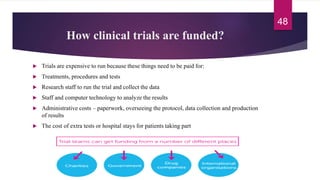
How clinical trials are funded?
 Trials are expensive to run because these things need to be paid for:
 Treatments, procedures and tests
 Research staff to run the trial and collect the data
 Staff and computer technology to analyze the results
 Administrative costs – paperwork, overseeing the protocol, data collection and production
of results
 The cost of extra tests or hospital stays for patients taking part
48
Registration of Clinical trials
 The registration of all clinical trials is a scientific, ethical and moral
responsibility.
 The World Medical Association of Helsinki states that “Every research study
involving human subjects must be registered in a publicly accessible databases
before recruitment of the first subject.”
49
 The Food and Drug Administration Amendments Act of 2007(also called
FDAAA) was passed on September 27, 2007.
 This law requires that the Responsible party” must register and reports results for
certain clinical trials of drugs, biologics and devices that are subject to FDA
regulation.
 Responsible party is defined as the sponsor of an applicable clinical trials.
 A clinical trial sponsor is an individual, institution, company or organization that
takes the responsibility to initiate, manage and finance a clinical trial.
50
How trails are registered
 Sponsor can register clinical studies on clinicaltrials.gov via a web-based data
entry system called Protocol Registration and Results system (PRS).
 The 8-digit clinical trial number is assigned by the clinicaltrials.gov website after
the registration.
 The centers for Medicare and Medicaid services (CMS) uses this number to
identify all items and services provided to beneficiaries during their participation
in a qualified clinical study.
 Yet trial registration in Pakistan is low, one reason being absence of national
clinical trial registry
51
Why is Trial Registration Important?
The registration of all interventional trials is considered to be a scientific, ethical and
moral responsibility because:
 There is a need to ensure that decisions about health care are informed by all of the
available evidence
 Improving awareness of similar or identical trials will make it possible for researchers
and funding agencies to avoid unnecessary duplication
 Describing clinical trials in progress can make it easier to identify gaps in clinical
trials research
 Enabling researchers and health care practitioners to identify trials in which they may
have an interest could result in more effective collaboration among researchers.
52
References:
 Day, S. J., & Altman, D. G. (2000). Blinding in clinical trials and other
studies. Bmj, 321(7259), 504.
 Chalmers, T. C., Celano, P., Sacks, H. S., & Smith Jr, H. (1983). Bias in treatment
assignment in controlled clinical trials. New England Journal of Medicine, 309(22), 1358-
1361.
 https://www.cancerresearchuk.org/about-cancer/find-a-clinical-trial/how-clinical-trials-
are-planned-and-organised/how-clinical-trials-are-approved#ethica
 www.who.int/ethics/Ethics_basic-concepts_ENG.pdf
 Clinicaltrials.gov
 Who.int/ictrp/trial_reg/en/
53

Clinical Trials.pptx

  • 1.
  • 2.
    Topics to bediscussed  Clinical Trials- Definition, Importance of trials  Role of clinical trials in clinical product development  Different types of clinical trials and their phases  Design of clinical trials  Data management in clinical trials  Clinical trials protocols 2
  • 3.
     How Clinicaltrials work  Approval process of clinical trials  How clinical trials are funded?  Registration of Clinical trials  Why is trial registration important? 3
  • 4.
  • 5.
    What exactly areclinical trials  Clinical Trials are scientific investigation that examine and evaluate safety and efficacy of different therapies in human subjects.  Meinert (1986) defined that a clinical trial is a research activity that involves administration of a test treatment to some experiment unit in order to evaluate the test treatment.  Pianttadosi (1997) simply defined a clinical trials as an experimental testing of medical treatment on human subjects. 5
  • 6.
     The codeof Federal Regulations (CFR) defines a clinical trials as a clinical investigation of drug that is administered, dispensed or use involving one and more human subjects.  Three important key words in these definitions of clinical trials are Experimental unit, Treatment, and evaluation of treatment. 6
  • 7.
    Three important keywords  Experimental unit An experimental unit is usually referred to a as a subject from a targeted population under study. For example, the intended population could be patients with certain disease at certain stages or healthy human subjects.  Treatments In clinical trials, treatment can be placebo or any combination of new chemical entity (drug), a new diet, a surgical procedure, a diagnostic test, a medical device, a health education program or no treatment 7
  • 8.
     Evaluation In additionto traditional evaluation of effectiveness and safety of test treatment. Clinical trials are also designed to assess quality of life, pharmacogenomics and pharmacoeconimcs such as cost minimization, cost-effectiveness, and cost benefit analysis to human subjects associated with the treatment under study. 8
  • 9.
    Role of clinicaltrials in Drug development process 9
  • 10.
    Important Terms  Investigationalnew drug (IND) a new drug, new antibiotic drug or biological drug that is used in clinical investigation.  Institutional review board (IRB) A committee of physicians, statisticians, researchers, community advocates and others that ensures that a clinical trial is ethical and that the rights of study participants are protected. 10
  • 11.
     New drugApplication (NDA): An application submitted by the manufacturer of a drug to the FDA- after clinical trials have been completed- for a license to market the drug for a specified indication.  Application IND: IND stands for investigational new drug application, which is the part of process to get approval from FDA for marketing a new prescription drug. 11
  • 12.
  • 13.
  • 14.
     Treatment Trialstest experimental treatments, new combinations of drugs, or new approaches to surgery or radiation therapy.  Prevention Trials look for better ways to prevent disease in people who have never had the disease or to prevent a disease from returning.  Diagnostic trials are conducted to find better tests and procedures for diagnosing a particular disease or condition  Screening or early detection trials test the best way to detect certain diseases or health conditions. 14
  • 15.
  • 16.
  • 17.
  • 18.
    Phase 0 Study/Micro dosing  Study of new drug in micro doses to derive PK information in humans before undertaking phase I study.  Micro dose: less than 1/100 of the dose of a test substance calculate to produce pharmacological effect with a max. dose ≤100 grams.  Objective: To formulate preliminary PK data  Preclinical Data: Substance toxicity study in one species by two route of administration 18
  • 19.
     Advantages less chancesof adverse event Short duration Less no. of volunteers Reduced cost of development Reduced drug development time 19
  • 20.
     Limitations Study basedon PK, no efficacy and safety Agents having different kinetics characteristics between micro dose and full doses are not evaluated The laboratory parameters are very limited and expensive. 20
  • 21.
    Phase I  Firstphase of testing in human subjects  Design to assess the safety and tolerability, PK, PD of drug  20-25 healthy volunteers  Patients: Anticancer drugs and AIDS therapy  Duration: 6-12th month  No blinding/open labelled 21
  • 22.
    Phase I- basicpre-requisite  Preclinical data  IND application  Approval by the regulatory authority  Protocol approval by ethical committee  Informed consent 22
  • 23.
     The aimof clinical dose to determine the maximum tolerant dose (MTD) of new treatment  The MTD is found by escalating the treatment dose until dose limiting toxicity is reached 23
  • 24.
    Phase I studies-Need To mark reliable and rapid prediction of human response, from preclinical data (PK, PD, Toxicity)  Involve extrapolation from animal data to first human exposure  Phase I serve as interface between preclinical and clinical phase development 24
  • 25.
    Phase I-objectives  Primary Tolerabilityand safety Pharmacokinetics  Secondary Pharmacodynamics 25
  • 26.
     Limitation Trials restrictto homogenous subjects Performance extrapolated to heterogeneous market place 26
  • 27.
    Phase II  Therapeuticexploratory trials  20-300 subjects  To confirm effectiveness, monitor side effect and further evaluate safety  First in patients (who have disease and drug is expected to treat)  Duration: 6 months to several years 27
  • 28.
    Objectives  Efficacy inpatients  Safety issues  Optimum dose finding Dose efficacy relationship Therapeutic dose regimen Duration of therapy Frequency of administration Therapeutic window 28
  • 29.
    Phase III  Therapeuticconfirmatory trials  Large scale, multicenter, randomized, controlled trials  Target population: several 100’s to 3000 patients  Takes a long time: up to 5 years  To establish efficacy of the drug against existing therapy in large number of patients. 29
  • 30.
    Objectives  To assessoverall and relative therapeutic value of the new drug efficacy and safety.  To determine optimal dosage schedule for use in general  The dosage schedule in C.T should be as close as possible to its anticipated clinical trials  Long term clinical safety studies Chronic toxicity Reproductive toxicity Carcinogenicity 30
  • 31.
  • 32.
    New Drug Application Formal proposal for FDA to establish Drug is safe and effective Benefit outweighs the risk Proposed labeling is appropriate  NDA contains all the information gathered during preclinical phase to phase III  NDA can be thousands of pages long and can take 2-3 years from FDA to review 32
  • 33.
    Phase IV  Doneafter drug has been marketed (Post marketing surveillance)  No fixed duration/ patient population  Studies continue to collect data about effects in various populations and side effect for long term use  These are primarily observation and non-experimental in nature 33
  • 34.
     It helpsto detect rare ADRs and drug interaction  Also to explore new use for drugs  Periodic safety update reports To be submitted by the manufacturer every 6 months for 2 years and then annually for next 2 years after marketing approval.  Harmful effects discovered may result in a drug being no longer sold or restricted to certain uses. For example, zantac 34
  • 35.
    Objectives  Confirm thesafety and efficacy profile in large populations during practice  Detect the unknown and rare adverse drug reactions  Evaluation of over doses  Identification of new indications  Dose refinements: evaluation of new formulation, dosages and durations of treatment  Evaluation of different age groups/ types of patients 35
  • 36.
     Comparative benefit-riskassessment  Benefit-cost assessment during usage in community  Quality of life assessment 36
  • 37.
  • 38.
  • 39.
    Approval Process ofClinical Trials 1) Peer review 2) Ethical approval 3) Trial authorization 4) Hospital approval 39
  • 40.
    1.Peer review  Thedetailed plan which outlines how the trial will run is called the Protocol.  This should be reviewed and approved by a group of people who are not involved in the trial.  The peer review group includes doctors, other health care professionals and non medical (lay) members of the public. 40
  • 41.
    The peer reviewgroup look at the things like:  The aim of the trial and how important the issue is  The design of the trial  The patients, the research team would like to recruit  Whether people are likely to want to take part or not  How the investigators plan to analyze the results  Whether the research team have thought about all the possible issues 41
  • 42.
    2.Ethical approval  Thetrial protocol is then reviewed by a Research Ethics Committee (REC) or Institutional Review Board (IRB).  The International Council on Harmonisation (ICH) defines an Institutional Review Board (IRB) as a group formally designated to protect the rights, safety and well being of humans involved in a clinical trial by reviewing all aspects of the trials. IRBs can also called independent ethics committees (IECs).  IECs members should be collectively qualified to review the scientific, medical and ethical aspects of the trial. 42
  • 43.
     An IRBs/IECsshould have at least five members with varying backgrounds  At least one member must represent a non-scientific area (a lay member)  At least one member must not be affiliated with the institution or trial site (an independent member)  Competent members who are able to review and evaluate the science, medical aspects and ethics of the proposed trial. 43
  • 44.
    2.Ethical approval They lookat things like:  The aim of the trial and how important the issue is for patients  How the research team plan to recruit people  Whether the likely benefits are greater than the possible risks  Whether it’s been peer reviewed The committee then decides if the trial is safe and ethical to do, and whether it can go ahead or not. 44
  • 45.
    3. Trial Authorizationand approval organization:  A clinical trial authorized by the Regulatory Authority  It must be conducted in accordance with guidelines for Good Clinical Practice (GCP) as may from time to time be determined by the Authority.  In UK, all clinical trials of medicines and studies on medical devices also need to be authorized by an organization called the Medicines and Healthcare Products Regulatory Agency (MHRA). 45
  • 46.
    4. Hospital Approval: Each hospital that wants to take part in the trial has to get approval from their NHS Research and Development (R and D) department. This is called site specific assessment (SSA).  This assessment makes sure that the hospital has the staff, time, equipment and expertise to carry out the trial safely.  The R and D department also look at other trials already running at the hospital. They may not want to run two trials recruiting similar patients. 46
  • 47.
    4. Hospital Approval: For example, once the R and D department has given permission for the hospital to run the trial, the trial team will arrange training for the hospital staff.  This could be online or in person and should include anyone involved with the trial including doctors, research nurses, pharmacists and radiographers.  Once everyone is familiar with the trial and all the approvals are in place, they can start recruiting patients. 47
  • 48.
    How clinical trialsare funded?  Trials are expensive to run because these things need to be paid for:  Treatments, procedures and tests  Research staff to run the trial and collect the data  Staff and computer technology to analyze the results  Administrative costs – paperwork, overseeing the protocol, data collection and production of results  The cost of extra tests or hospital stays for patients taking part 48
  • 49.
    Registration of Clinicaltrials  The registration of all clinical trials is a scientific, ethical and moral responsibility.  The World Medical Association of Helsinki states that “Every research study involving human subjects must be registered in a publicly accessible databases before recruitment of the first subject.” 49
  • 50.
     The Foodand Drug Administration Amendments Act of 2007(also called FDAAA) was passed on September 27, 2007.  This law requires that the Responsible party” must register and reports results for certain clinical trials of drugs, biologics and devices that are subject to FDA regulation.  Responsible party is defined as the sponsor of an applicable clinical trials.  A clinical trial sponsor is an individual, institution, company or organization that takes the responsibility to initiate, manage and finance a clinical trial. 50
  • 51.
    How trails areregistered  Sponsor can register clinical studies on clinicaltrials.gov via a web-based data entry system called Protocol Registration and Results system (PRS).  The 8-digit clinical trial number is assigned by the clinicaltrials.gov website after the registration.  The centers for Medicare and Medicaid services (CMS) uses this number to identify all items and services provided to beneficiaries during their participation in a qualified clinical study.  Yet trial registration in Pakistan is low, one reason being absence of national clinical trial registry 51
  • 52.
    Why is TrialRegistration Important? The registration of all interventional trials is considered to be a scientific, ethical and moral responsibility because:  There is a need to ensure that decisions about health care are informed by all of the available evidence  Improving awareness of similar or identical trials will make it possible for researchers and funding agencies to avoid unnecessary duplication  Describing clinical trials in progress can make it easier to identify gaps in clinical trials research  Enabling researchers and health care practitioners to identify trials in which they may have an interest could result in more effective collaboration among researchers. 52
  • 53.
    References:  Day, S.J., & Altman, D. G. (2000). Blinding in clinical trials and other studies. Bmj, 321(7259), 504.  Chalmers, T. C., Celano, P., Sacks, H. S., & Smith Jr, H. (1983). Bias in treatment assignment in controlled clinical trials. New England Journal of Medicine, 309(22), 1358- 1361.  https://www.cancerresearchuk.org/about-cancer/find-a-clinical-trial/how-clinical-trials- are-planned-and-organised/how-clinical-trials-are-approved#ethica  www.who.int/ethics/Ethics_basic-concepts_ENG.pdf  Clinicaltrials.gov  Who.int/ictrp/trial_reg/en/ 53