

Good Clinical
Practice (GCP)
Dr Anubhav Agrawal
Resident, KGMU
Introduction
01
02
05
03
06
07
Synopsis
Milestones in evolution
Responsibilities of
Investigator and Monitor
Objectives and
Principles
Clinical Trial Protocol
Informed Consent process
04 08
Ethics Committee Conclusion
Good Clinical Practice
Good Clinical Practice (GCP) is an international ethical
and scientific quality standard for designing, conducting,
recording and reporting of Clinical Trials.
Introduction
• GCP is a set of guidelines for how clinical trials should be carried out.
• It ensures that the data and trial results are reliable and truthful.
• GCP also protects trial participants' rights, integrity, and confidentiality.
• It covers everything from trial design to data analysis and reporting.
• Following GCP helps to maintain the credibility and accuracy of clinical
research.
Evolution of GCP Guidelines
1947
The Nuremberg
Code
10 points code, set the
standard for human
experiment
1962
Kefauver-Harris
Amendment
Voluntary Consent and
Drug approval became
mandatory
1979
The Belmont
Report
Drafted by the commission
formed under the National
Research Act of 1974
1990
International
Conference/Council for
Harmonization (ICH)
formed in 1990, during European
Federation of Pharmaceutical Industries and
Associations EFPIA meeting in Brussels
GCP
Objectives and Principles
Objectives
Objective 1
To protect the rights of human subjects
participating in clinical trials
To ensure the scientific validity and
credibility of the data collected in human
clinical studies.
Objective 2
04
02
03
01
More economical use of human, animal and
material resources.
Objective 3
Objective 4
To provide an unified standard for the European Union, Japan
and the United States to facilitate the mutual acceptance of the
clinical data by the regulatory authorities in these jurisdictions
ICH GCP E6
● The 1st guideline for good clinical practice (ICH E6 R1) was published in
1996.
● The guidelines are very detailed and categorized into several sections.
● There are 12 core principles for ICH GCP.
● It ensures safety, rights and wellbeing.
● Integrated addendum to ICH E6(R1):guideline for good clinical practice
E6(R2) was published on 2016.
● ICH Harmonized guideline good clinical practice (GCP) E6(R3) was
published on may 2023.
● R3 is the latest revision of ICH E6.
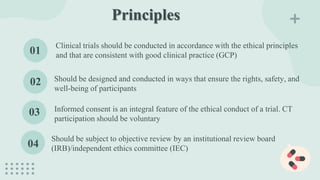
Clinical trials should be conducted in accordance with the ethical principles
and that are consistent with good clinical practice (GCP)
01
02
03
Principles
Should be designed and conducted in ways that ensure the rights, safety, and
well-being of participants
Informed consent is an integral feature of the ethical conduct of a trial. CT
participation should be voluntary
04
Should be subject to objective review by an institutional review board
(IRB)/independent ethics committee (IEC)
05
06
07
Clinical trials should be scientifically sound for their intended purpose, &
based on robust & current scientific knowledge & approaches
Should be designed and conducted by qualified individuals
Quality should be built into the scientific & operational design &
conduct of CTs
08 Processes, measures and approaches should be implemented in a way that
is proportionate to the risks to participants
09
10
11
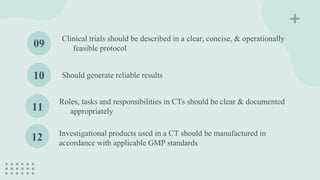
Clinical trials should be described in a clear, concise, & operationally
feasible protocol
Should generate reliable results
Roles, tasks and responsibilities in CTs should be clear & documented
appropriately
12 Investigational products used in a CT should be manufactured in
accordance with applicable GMP standards
Ethics
Committee
The INSTITUTIONAL REVIEW
BOARD/INDEPENDENT ETHICS
COMMITTEE (IRB/IEC) is responsible for the
ethical review of the trial.
Responsibilites
To protect the dignity, rights and well being of
research participants.
To ensure that universal ethical values and
international scientific standards are followed.
To assist in the development and the education of a research
community responsive to local health care requirements
COMPOSITION
● Chairperson
● 1-2 basic medical scientists (preferably one pharmacologists).
● 1-2 clinicians from various Institutes
● One legal expert or retired judge
● One social scientist / representative of non-governmental voluntary
agency
● One philosopher / ethicist
● One lay person from the community
● Member Secretary
Sponsor
- A sponsor, whether an individual, company, or
institution, is responsible for initiating, managing,
and/or financing a clinical study.
- If an investigator independently initiates and takes full
responsibility for a trial, they automatically become the
sponsor.
Investigator
An investigator oversees the study at the trial site, ensuring
ethical conduct and compliance with regulations to protect
participants' rights, health, and well-being.
The Principal Investigator coordinates multiple investigators
at different sites, serving as the main point of contact to ensure
effective communication and collaboration for research
objectives.
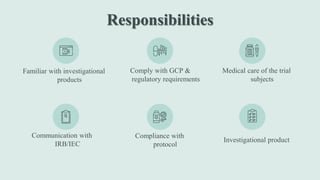
Responsibilities
Familiar with investigational
products
Comply with GCP &
regulatory requirements
Medical care of the trial
subjects
Communication with
IRB/IEC
Compliance with
protocol
Investigational product
Clinical trial
Protocol
The protocol is a document that describes how a clinical trial
will be conducted:
• The objectives,
• Design,
• Methodology,
• Statistical considerations,
• organization of a clinical trial,
and ensures the safety of the trial subjects and integrity of the
data collected.
AIMS OF PROTOCOL
● To raise the question to be researched and clarify its importance.
● To collect existing knowledge and discuss the efforts of other researchers who have worked on the
related questions (Literature review).
● To formulate a hypothesis and objectives.
● To clarify ethical considerations.
● To suggest the methodology required for solving the question and achieving the objectives.
● To discuss the requirements and limitations in achieving the objectives.
Key benefits
Allows the researcher to plan and review the
project’s steps.
Serves as a guide throughout the research
02
03
01
Enforces time and budget estimates
Informed Consent
• A process in which patients are given important information,
including possible risks and benefits, about a medical procedure or
treatment, genetic testing, or a clinical trial.
• This is to help them decide if they want to be treated, tested, or
take part in the trial.
• Informed consent is crucial in research as it ensures individuals
have an informed choice about whether to participate in a research
study.
Before the clinical phase of the trial commences
01
02
03
Essential documents
During the clinical conduct of the trial
After completion or termination of the trial
The various documents are grouped in three sections according to the stage of
the trial during which they will normally be generated:
Before the clinical phase
● Investigator's brochure
• Signed protocol and amendments, if any, and sample case report form (CRF)
• Information given to trial subject-informed consent form
• Financial aspects of the trial
• INSURANCE STATEMENT (where required)
• Signed agreement between involved parties,
E.G.:- Investigator/institution and sponsor
• Dated, documented approval/favorable opinion of institutional review board (IRB) /independent ethics
committee (IEC)
• Institutional review board / independent ethics committee composition
During the clinical conduct
-Investigator's brochure updates
-Any revision to:
● Protocol/amendment and CRF
● Informed consent form
● - Any other written information provided to subjects
● - Advertisement for subject recruitment
-Dated, documented approval / favorable opinion of institutional review board (IRB)/independent ethics
committee (IEC) of the following:
● Protocol amendment
● Revision of:
● Informed consent form
● Any other written information to be provided to the subject advertisement for subject recruitment
● Any other documents given approval/favorable opinion
● Continuing review of trial
- Regulatory authority authorisations/approvals / notifications
- Curriculum vitae for new investigator and/or sub-investigator
After completion
• Investigational product accountability at site
• Documentation of investigational product destruction
• Completed subject identification code list
• Audit certificate
• Final trial close-out monitoring report
• Treatment allocation and decoding documentation
• Final report by investigator to IRB/IEC where required, and where applicable, to the regulatory
authority
• Clinical study report
Conclusion
● Good Clinical Practice (GCP) is an international, ethical, scientific and quality standard
for the conduct of trials that involve human participants.
● ICH GCP E6 is a comprehensive document, and it's essential for all parties involved in
clinical trials, including investigators, sponsors, and regulatory authorities, to be familiar
with its principles and guidelines.
● Adherence to ICH GCP E6 helps ensure the integrity, reliability, and ethical conduct of
clinical trials, ultimately contributing to the safety and well-being of study participants
and the validity of trial results.
References
 https://www.ema.europa.eu/en/documents/scientific-guideline/ich-e6-r1-guideline-
good-clinical-practice_en.pdf
 https://www.fda.gov/regulatory-information/search-fda-guidance-documents/e6r2-good-
clinical-practice-integrated-addendum-ich-e6r1
 https://database.ich.org/sites/default/files/ICH_E6%28R3%29_DraftGuideline_2023_05
19.pdf
Clinical Trails day
Thank you
20th may 1747, Where it all began!

Good Clinical Practice (GCP) .

  • 1.
    Good Clinical Practice (GCP) DrAnubhav Agrawal Resident, KGMU
  • 2.
    Introduction 01 02 05 03 06 07 Synopsis Milestones in evolution Responsibilitiesof Investigator and Monitor Objectives and Principles Clinical Trial Protocol Informed Consent process 04 08 Ethics Committee Conclusion
  • 3.
    Good Clinical Practice GoodClinical Practice (GCP) is an international ethical and scientific quality standard for designing, conducting, recording and reporting of Clinical Trials.
  • 4.
    Introduction • GCP isa set of guidelines for how clinical trials should be carried out. • It ensures that the data and trial results are reliable and truthful. • GCP also protects trial participants' rights, integrity, and confidentiality. • It covers everything from trial design to data analysis and reporting. • Following GCP helps to maintain the credibility and accuracy of clinical research.
  • 5.
    Evolution of GCPGuidelines 1947 The Nuremberg Code 10 points code, set the standard for human experiment 1962 Kefauver-Harris Amendment Voluntary Consent and Drug approval became mandatory 1979 The Belmont Report Drafted by the commission formed under the National Research Act of 1974 1990 International Conference/Council for Harmonization (ICH) formed in 1990, during European Federation of Pharmaceutical Industries and Associations EFPIA meeting in Brussels
  • 6.
  • 7.
    Objectives Objective 1 To protectthe rights of human subjects participating in clinical trials To ensure the scientific validity and credibility of the data collected in human clinical studies. Objective 2 04 02 03 01 More economical use of human, animal and material resources. Objective 3 Objective 4 To provide an unified standard for the European Union, Japan and the United States to facilitate the mutual acceptance of the clinical data by the regulatory authorities in these jurisdictions
  • 8.
    ICH GCP E6 ●The 1st guideline for good clinical practice (ICH E6 R1) was published in 1996. ● The guidelines are very detailed and categorized into several sections. ● There are 12 core principles for ICH GCP. ● It ensures safety, rights and wellbeing. ● Integrated addendum to ICH E6(R1):guideline for good clinical practice E6(R2) was published on 2016. ● ICH Harmonized guideline good clinical practice (GCP) E6(R3) was published on may 2023. ● R3 is the latest revision of ICH E6.
  • 9.
    Clinical trials shouldbe conducted in accordance with the ethical principles and that are consistent with good clinical practice (GCP) 01 02 03 Principles Should be designed and conducted in ways that ensure the rights, safety, and well-being of participants Informed consent is an integral feature of the ethical conduct of a trial. CT participation should be voluntary 04 Should be subject to objective review by an institutional review board (IRB)/independent ethics committee (IEC)
  • 10.
    05 06 07 Clinical trials shouldbe scientifically sound for their intended purpose, & based on robust & current scientific knowledge & approaches Should be designed and conducted by qualified individuals Quality should be built into the scientific & operational design & conduct of CTs 08 Processes, measures and approaches should be implemented in a way that is proportionate to the risks to participants
  • 11.
    09 10 11 Clinical trials shouldbe described in a clear, concise, & operationally feasible protocol Should generate reliable results Roles, tasks and responsibilities in CTs should be clear & documented appropriately 12 Investigational products used in a CT should be manufactured in accordance with applicable GMP standards
  • 12.
    Ethics Committee The INSTITUTIONAL REVIEW BOARD/INDEPENDENTETHICS COMMITTEE (IRB/IEC) is responsible for the ethical review of the trial.
  • 13.
    Responsibilites To protect thedignity, rights and well being of research participants. To ensure that universal ethical values and international scientific standards are followed. To assist in the development and the education of a research community responsive to local health care requirements
  • 14.
    COMPOSITION ● Chairperson ● 1-2basic medical scientists (preferably one pharmacologists). ● 1-2 clinicians from various Institutes ● One legal expert or retired judge ● One social scientist / representative of non-governmental voluntary agency ● One philosopher / ethicist ● One lay person from the community ● Member Secretary
  • 15.
    Sponsor - A sponsor,whether an individual, company, or institution, is responsible for initiating, managing, and/or financing a clinical study. - If an investigator independently initiates and takes full responsibility for a trial, they automatically become the sponsor.
  • 16.
    Investigator An investigator overseesthe study at the trial site, ensuring ethical conduct and compliance with regulations to protect participants' rights, health, and well-being. The Principal Investigator coordinates multiple investigators at different sites, serving as the main point of contact to ensure effective communication and collaboration for research objectives.
  • 17.
    Responsibilities Familiar with investigational products Complywith GCP & regulatory requirements Medical care of the trial subjects Communication with IRB/IEC Compliance with protocol Investigational product
  • 18.
    Clinical trial Protocol The protocolis a document that describes how a clinical trial will be conducted: • The objectives, • Design, • Methodology, • Statistical considerations, • organization of a clinical trial, and ensures the safety of the trial subjects and integrity of the data collected.
  • 19.
    AIMS OF PROTOCOL ●To raise the question to be researched and clarify its importance. ● To collect existing knowledge and discuss the efforts of other researchers who have worked on the related questions (Literature review). ● To formulate a hypothesis and objectives. ● To clarify ethical considerations. ● To suggest the methodology required for solving the question and achieving the objectives. ● To discuss the requirements and limitations in achieving the objectives.
  • 20.
    Key benefits Allows theresearcher to plan and review the project’s steps. Serves as a guide throughout the research 02 03 01 Enforces time and budget estimates
  • 21.
    Informed Consent • Aprocess in which patients are given important information, including possible risks and benefits, about a medical procedure or treatment, genetic testing, or a clinical trial. • This is to help them decide if they want to be treated, tested, or take part in the trial. • Informed consent is crucial in research as it ensures individuals have an informed choice about whether to participate in a research study.
  • 22.
    Before the clinicalphase of the trial commences 01 02 03 Essential documents During the clinical conduct of the trial After completion or termination of the trial The various documents are grouped in three sections according to the stage of the trial during which they will normally be generated:
  • 23.
    Before the clinicalphase ● Investigator's brochure • Signed protocol and amendments, if any, and sample case report form (CRF) • Information given to trial subject-informed consent form • Financial aspects of the trial • INSURANCE STATEMENT (where required) • Signed agreement between involved parties, E.G.:- Investigator/institution and sponsor • Dated, documented approval/favorable opinion of institutional review board (IRB) /independent ethics committee (IEC) • Institutional review board / independent ethics committee composition
  • 24.
    During the clinicalconduct -Investigator's brochure updates -Any revision to: ● Protocol/amendment and CRF ● Informed consent form ● - Any other written information provided to subjects ● - Advertisement for subject recruitment -Dated, documented approval / favorable opinion of institutional review board (IRB)/independent ethics committee (IEC) of the following: ● Protocol amendment ● Revision of: ● Informed consent form ● Any other written information to be provided to the subject advertisement for subject recruitment ● Any other documents given approval/favorable opinion ● Continuing review of trial - Regulatory authority authorisations/approvals / notifications - Curriculum vitae for new investigator and/or sub-investigator
  • 25.
    After completion • Investigationalproduct accountability at site • Documentation of investigational product destruction • Completed subject identification code list • Audit certificate • Final trial close-out monitoring report • Treatment allocation and decoding documentation • Final report by investigator to IRB/IEC where required, and where applicable, to the regulatory authority • Clinical study report
  • 26.
    Conclusion ● Good ClinicalPractice (GCP) is an international, ethical, scientific and quality standard for the conduct of trials that involve human participants. ● ICH GCP E6 is a comprehensive document, and it's essential for all parties involved in clinical trials, including investigators, sponsors, and regulatory authorities, to be familiar with its principles and guidelines. ● Adherence to ICH GCP E6 helps ensure the integrity, reliability, and ethical conduct of clinical trials, ultimately contributing to the safety and well-being of study participants and the validity of trial results.
  • 27.
  • 28.
    Clinical Trails day Thankyou 20th may 1747, Where it all began!