Overview
• History
• Definition
• Regulatory bodies
• In silico and in vitro trials
• Pre clinical trials
• Phases of clinical trials
• Types of clinical trials
History
• James Lind, Scottish physician
• First ever clinical trial
• Group of sailors – suffering
from Scurvy
• Vinegar to cider
• Citrus fruits
• Discovered Vitamin C can cure scurvy
Definition
• Clinical trials mean a systematic study of a new
drug ( therapy protocols, devices ) in human
subjects to generate data for discovering or
verifying the clinical claims or pharmacological
and adverse effects with an aim to determine
the safety and efficacy of drugs in question
Regulatory bodies
• U.S.A – Food and drug administration
• U.K – Committee on safety of medicine
• Japan – Ministry of health labor and welfare
• India – Drugs controller general, Govt.of India
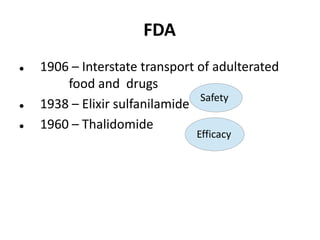
FDA
 1906 – Interstate transport of adulterated
food and drugs
 1938 – Elixir sulfanilamide
 1960 – Thalidomide
Safety
Efficacy
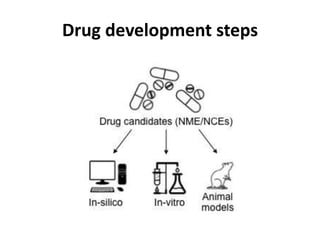
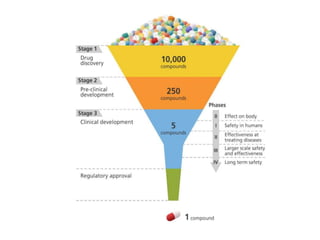
Drug development steps
In silico
• Simulator software available
• Predict mechanism, metabolism, distribution
• Expected to contribute in reduction of animal
use
• Disadvantage: applicable only to those areas
which are well understood. Also hepatotoxicity
neurotoxicity can not be predicted
In vitro
• Isolated cells, tissues and organs
• The National disease research institute- 130
types of tissues for >50 types of disease
• E.g.: monoclonal antibodies – cultured cells
• Limitation: not available for all the tissues
Normal systemic pharmacokinetic
profile (ADME) is absent.
PRE CLINICAL
 Non human
• - Lab
• - Animal (rats, rabbits, etc.)
 Pharmacological studies: to know
 Biological activity
 Mechanism of action
 Selectivity and specificity
 Drug metabolism
• Toxicity – Acute toxicity
Sub acute toxicity
Chronic toxicity
Including effects on reproduction,
teratogenicity, carcinogenicity and
mutagenicity.
PHASES
 Phase 0: Pharmacodynamic (PD) and
pharmacokinetics (PK)
 Phase 1: Screening for safety
 Phase 2: Efficacy of the drug
 Phase 3: Final confirmation of safety and
efficacy
 Phase 4: Post marketing surveillance
 Phase 5: Translational research
• U.S FDA in 2006
• Speed up development of promising drugs
• Go / no go decision
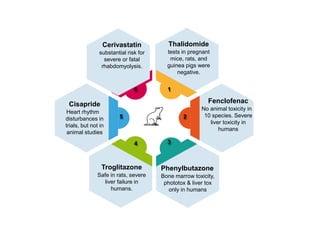
Thalidomide
tests in pregnant
mice, rats, and
guinea pigs were
negative.
Cerivastatin
substantial risk for
severe or fatal
rhabdomyolysis.
16
Fenclofenac
No animal toxicity in
10 species. Severe
liver toxicity in
humans
Cisapride
Heart rhythm
disturbances in
trials, but not in
animal studies
5 2
34
Troglitazone
Safe in rats, severe
liver failure in
humans.
Phenylbutazone
Bone marrow toxicity,
phototox & liver tox
only in humans
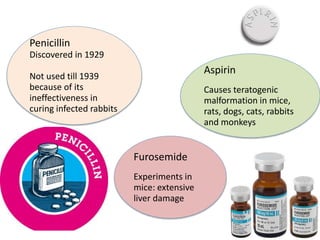
Penicillin
Discovered in 1929
Not used till 1939
because of its
ineffectiveness in
curing infected rabbits
Furosemide
Experiments in
mice: extensive
liver damage
Aspirin
Causes teratogenic
malformation in mice,
rats, dogs, cats, rabbits
and monkeys
Phase 0 or microdose
• Microdosing :
• Less than 1/100th of the dose calculated to
yield a pharmacological effect of the test
substance based on primary
pharmacodynamic data obtained from in vitro
and in vivo (typically doses in or below the low
microgram range) and at a maximum dose of
<100microgram
Objectives of microdosing study
 To clarify bioavailability and PK profiles
 To clarify metabolic profiles
 To obtain information on tissue distribution
18
Basic features
 First-in-human trial conducted prior to
traditional Phase 1 study
 Small number of subjects (≈10-15)
 Limited drug exposure
 Low, non-toxic doses (<100mcg)
 Short duration (≈ ≤7 days)
 No therapeutic intent
 Eliminate bad agents early (rapid clearance,
poor bioavailability, fails to reach target)
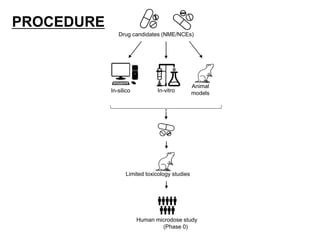
Drug candidates (NME/NCEs)
Animal
modelsIn-vitroIn-silico
Limited toxicology studies
Human microdose study
(Phase 0)
PROCEDURE
• Plasma / urine / biopsy sample serially
collected
• Sample analyzed for parent drug and
metabolite
• Microdose -> micro plasma drug concentration
• Extremely sensitive analytical methods
required
2
1
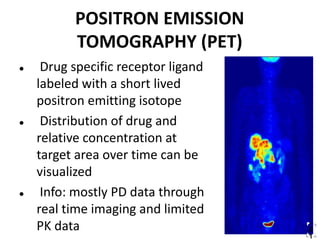
POSITRON EMISSION
TOMOGRAPHY (PET)
 Drug specific receptor ligand
labeled with a short lived
positron emitting isotope
 Distribution of drug and
relative concentration at
target area over time can be
visualized
 Info: mostly PD data through
real time imaging and limited
PK data
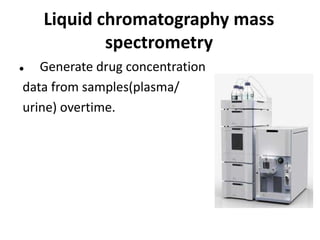
Liquid chromatography mass
spectrometry
 Generate drug concentration
data from samples(plasma/
urine) overtime.
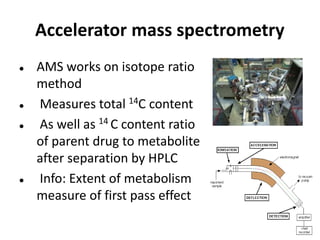
Accelerator mass spectrometry
 AMS works on isotope ratio
method
 Measures total 14C content
 As well as 14 C content ratio
of parent drug to metabolite
after separation by HPLC
 Info: Extent of metabolism
measure of first pass effect
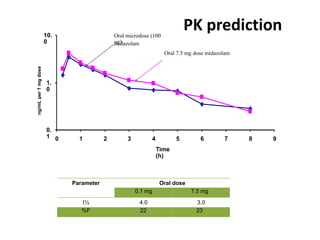
10.
0
Oral microdose (100
ug)
1.
0
0.
1 0 1 2 3 4 5 6 7 8 9
Time
(h)
ng/mLper1mgdose
midazolam
Oral 7.5 mg dose midazolam
Parameter Oral dose
t½ 4.0 3.0
%F 22 23
0.1 mg 7.5 mg
PK prediction
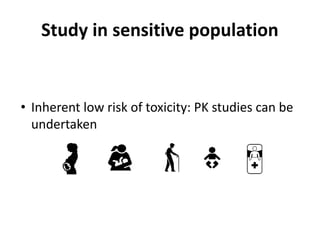
Study in sensitive population
• Inherent low risk of toxicity: PK studies can be
undertaken
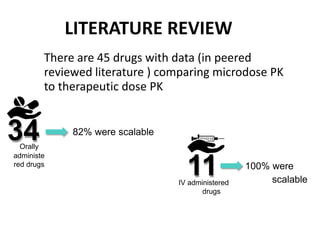
34 82% were scalable
Orally
administe
red drugs
11 100% were
scalableIV administered
drugs
LITERATURE REVIEW
There are 45 drugs with data (in peered
reviewed literature ) comparing microdose PK
to therapeutic dose PK
PHASE 1
 Volunteers ( healthy and unhealthy) (10-100)
 Safety , tolerance
 Types
• - Single ascending dose studies
• - Multiple ascending dose studies
• - Food effect assessments
Single ascending dose studies
(SAD)
• SAD those in which small groups (3) of subjects are
given a single dose of the drug while they are
observed and tested for a period of time.
• If no adverse effects, dose is escalated with 3 new
healthy subjects
• If toxicity is observed then 3 more subjects are
given the same dose and if found toxic, the previous
dose is considered as max. tolerated dose (MTD).
Multiple ascending dose (MAD)
• MAD are conducted to understand the
pharmacokinetics and pharmacodynamics of
multiple doses of the drug.
• A group of patients receives multiple low doses of
the drug
• Samples (of blood, and other fluids) are collected at
various time points
How the drug is processed within the body- analyzed
Food effect studies
• Volunteers are given 2 identical doses of the drug
on different occasion, one while fasting and
another after being fed
PHASE 2
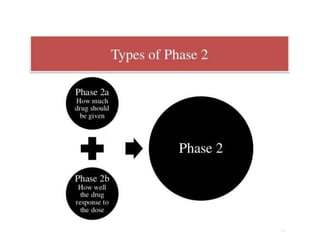
 First time in patients with target disease
 100-300 subjects
 Phase 2A (IIA)
• - Assess dosing requirements
 Phase 2B (IIB)
• - Study efficacy
 Study design – case series, RCT
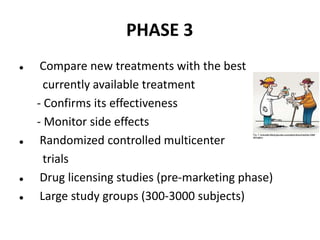
PHASE 3
 Compare new treatments with the best
currently available treatment
- Confirms its effectiveness
- Monitor side effects
 Randomized controlled multicenter
trials
 Drug licensing studies (pre-marketing phase)
 Large study groups (300-3000 subjects)
• Phase IIIA
- conducted prior to regulatory submission
of a new drug application.
• Phase IIIB
- after submission, but before approval the
new drug.
PHASE 4
 Post marketing surveillance
 Safety surveillance
 Rare or long term adverse effects over a
much larger patient population
 Harmful effects discovered by phase IV
trials may result in a drug being no longer
sold, or restricted to certain rules.
• E.g.: Rofecoxib
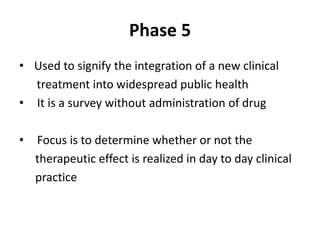
Phase 5
• Used to signify the integration of a new clinical
treatment into widespread public health
• It is a survey without administration of drug
• Focus is to determine whether or not the
therapeutic effect is realized in day to day clinical
practice
• To seek additional marketing claims for
-new formulation
-new indication
-new combination
Some example
• Phenytoin sodium / lactose
• Phenytoin uses
• Methyldopa + diuretic combination
Basic features
• No dosing
• No patient monitoring
• Main focus – new therapy
• All reported use
• Research on data collected
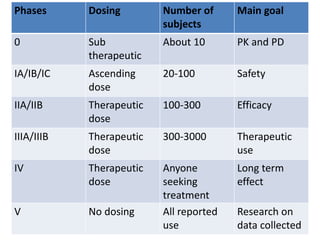
Phases Dosing Number of
subjects
Main goal
0 Sub
therapeutic
About 10 PK and PD
IA/IB/IC Ascending
dose
20-100 Safety
IIA/IIB Therapeutic
dose
100-300 Efficacy
IIIA/IIIB Therapeutic
dose
300-3000 Therapeutic
use
IV Therapeutic
dose
Anyone
seeking
treatment
Long term
effect
V No dosing All reported
use
Research on
data collected
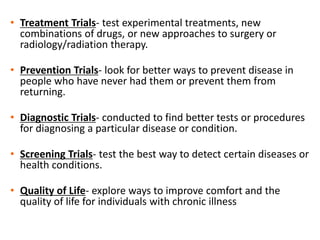
• Treatment Trials- test experimental treatments, new
combinations of drugs, or new approaches to surgery or
radiology/radiation therapy.
• Prevention Trials- look for better ways to prevent disease in
people who have never had them or prevent them from
returning.
• Diagnostic Trials- conducted to find better tests or procedures
for diagnosing a particular disease or condition.
• Screening Trials- test the best way to detect certain diseases or
health conditions.
• Quality of Life- explore ways to improve comfort and the
quality of life for individuals with chronic illness
THANK YOU

Clinical trials

  • 2.
    Overview • History • Definition •Regulatory bodies • In silico and in vitro trials • Pre clinical trials • Phases of clinical trials • Types of clinical trials
  • 3.
    History • James Lind,Scottish physician • First ever clinical trial • Group of sailors – suffering from Scurvy • Vinegar to cider • Citrus fruits • Discovered Vitamin C can cure scurvy
  • 4.
    Definition • Clinical trialsmean a systematic study of a new drug ( therapy protocols, devices ) in human subjects to generate data for discovering or verifying the clinical claims or pharmacological and adverse effects with an aim to determine the safety and efficacy of drugs in question
  • 5.
    Regulatory bodies • U.S.A– Food and drug administration • U.K – Committee on safety of medicine • Japan – Ministry of health labor and welfare • India – Drugs controller general, Govt.of India
  • 6.
    FDA  1906 –Interstate transport of adulterated food and drugs  1938 – Elixir sulfanilamide  1960 – Thalidomide Safety Efficacy
  • 7.
  • 8.
    In silico • Simulatorsoftware available • Predict mechanism, metabolism, distribution • Expected to contribute in reduction of animal use • Disadvantage: applicable only to those areas which are well understood. Also hepatotoxicity neurotoxicity can not be predicted
  • 9.
    In vitro • Isolatedcells, tissues and organs • The National disease research institute- 130 types of tissues for >50 types of disease • E.g.: monoclonal antibodies – cultured cells • Limitation: not available for all the tissues Normal systemic pharmacokinetic profile (ADME) is absent.
  • 10.
    PRE CLINICAL  Nonhuman • - Lab • - Animal (rats, rabbits, etc.)  Pharmacological studies: to know  Biological activity  Mechanism of action  Selectivity and specificity  Drug metabolism
  • 11.
    • Toxicity –Acute toxicity Sub acute toxicity Chronic toxicity Including effects on reproduction, teratogenicity, carcinogenicity and mutagenicity.
  • 12.
    PHASES  Phase 0:Pharmacodynamic (PD) and pharmacokinetics (PK)  Phase 1: Screening for safety  Phase 2: Efficacy of the drug  Phase 3: Final confirmation of safety and efficacy  Phase 4: Post marketing surveillance  Phase 5: Translational research
  • 14.
    • U.S FDAin 2006 • Speed up development of promising drugs • Go / no go decision
  • 15.
    Thalidomide tests in pregnant mice,rats, and guinea pigs were negative. Cerivastatin substantial risk for severe or fatal rhabdomyolysis. 16 Fenclofenac No animal toxicity in 10 species. Severe liver toxicity in humans Cisapride Heart rhythm disturbances in trials, but not in animal studies 5 2 34 Troglitazone Safe in rats, severe liver failure in humans. Phenylbutazone Bone marrow toxicity, phototox & liver tox only in humans
  • 16.
    Penicillin Discovered in 1929 Notused till 1939 because of its ineffectiveness in curing infected rabbits Furosemide Experiments in mice: extensive liver damage Aspirin Causes teratogenic malformation in mice, rats, dogs, cats, rabbits and monkeys
  • 17.
    Phase 0 ormicrodose • Microdosing : • Less than 1/100th of the dose calculated to yield a pharmacological effect of the test substance based on primary pharmacodynamic data obtained from in vitro and in vivo (typically doses in or below the low microgram range) and at a maximum dose of <100microgram
  • 18.
    Objectives of microdosingstudy  To clarify bioavailability and PK profiles  To clarify metabolic profiles  To obtain information on tissue distribution 18
  • 19.
    Basic features  First-in-humantrial conducted prior to traditional Phase 1 study  Small number of subjects (≈10-15)  Limited drug exposure  Low, non-toxic doses (<100mcg)  Short duration (≈ ≤7 days)  No therapeutic intent  Eliminate bad agents early (rapid clearance, poor bioavailability, fails to reach target)
  • 20.
    Drug candidates (NME/NCEs) Animal modelsIn-vitroIn-silico Limitedtoxicology studies Human microdose study (Phase 0) PROCEDURE
  • 21.
    • Plasma /urine / biopsy sample serially collected • Sample analyzed for parent drug and metabolite • Microdose -> micro plasma drug concentration • Extremely sensitive analytical methods required
  • 22.
    2 1 POSITRON EMISSION TOMOGRAPHY (PET) Drug specific receptor ligand labeled with a short lived positron emitting isotope  Distribution of drug and relative concentration at target area over time can be visualized  Info: mostly PD data through real time imaging and limited PK data
  • 23.
    Liquid chromatography mass spectrometry Generate drug concentration data from samples(plasma/ urine) overtime.
  • 24.
    Accelerator mass spectrometry AMS works on isotope ratio method  Measures total 14C content  As well as 14 C content ratio of parent drug to metabolite after separation by HPLC  Info: Extent of metabolism measure of first pass effect
  • 25.
    10. 0 Oral microdose (100 ug) 1. 0 0. 10 1 2 3 4 5 6 7 8 9 Time (h) ng/mLper1mgdose midazolam Oral 7.5 mg dose midazolam Parameter Oral dose t½ 4.0 3.0 %F 22 23 0.1 mg 7.5 mg PK prediction
  • 26.
    Study in sensitivepopulation • Inherent low risk of toxicity: PK studies can be undertaken
  • 27.
    34 82% werescalable Orally administe red drugs 11 100% were scalableIV administered drugs LITERATURE REVIEW There are 45 drugs with data (in peered reviewed literature ) comparing microdose PK to therapeutic dose PK
  • 28.
    PHASE 1  Volunteers( healthy and unhealthy) (10-100)  Safety , tolerance  Types • - Single ascending dose studies • - Multiple ascending dose studies • - Food effect assessments
  • 29.
    Single ascending dosestudies (SAD) • SAD those in which small groups (3) of subjects are given a single dose of the drug while they are observed and tested for a period of time. • If no adverse effects, dose is escalated with 3 new healthy subjects • If toxicity is observed then 3 more subjects are given the same dose and if found toxic, the previous dose is considered as max. tolerated dose (MTD).
  • 30.
    Multiple ascending dose(MAD) • MAD are conducted to understand the pharmacokinetics and pharmacodynamics of multiple doses of the drug. • A group of patients receives multiple low doses of the drug • Samples (of blood, and other fluids) are collected at various time points How the drug is processed within the body- analyzed
  • 31.
    Food effect studies •Volunteers are given 2 identical doses of the drug on different occasion, one while fasting and another after being fed
  • 32.
    PHASE 2  Firsttime in patients with target disease  100-300 subjects  Phase 2A (IIA) • - Assess dosing requirements  Phase 2B (IIB) • - Study efficacy  Study design – case series, RCT
  • 34.
    PHASE 3  Comparenew treatments with the best currently available treatment - Confirms its effectiveness - Monitor side effects  Randomized controlled multicenter trials  Drug licensing studies (pre-marketing phase)  Large study groups (300-3000 subjects)
  • 35.
    • Phase IIIA -conducted prior to regulatory submission of a new drug application. • Phase IIIB - after submission, but before approval the new drug.
  • 36.
    PHASE 4  Postmarketing surveillance  Safety surveillance  Rare or long term adverse effects over a much larger patient population  Harmful effects discovered by phase IV trials may result in a drug being no longer sold, or restricted to certain rules. • E.g.: Rofecoxib
  • 37.
    Phase 5 • Usedto signify the integration of a new clinical treatment into widespread public health • It is a survey without administration of drug • Focus is to determine whether or not the therapeutic effect is realized in day to day clinical practice
  • 38.
    • To seekadditional marketing claims for -new formulation -new indication -new combination Some example • Phenytoin sodium / lactose • Phenytoin uses • Methyldopa + diuretic combination
  • 39.
    Basic features • Nodosing • No patient monitoring • Main focus – new therapy • All reported use • Research on data collected
  • 40.
    Phases Dosing Numberof subjects Main goal 0 Sub therapeutic About 10 PK and PD IA/IB/IC Ascending dose 20-100 Safety IIA/IIB Therapeutic dose 100-300 Efficacy IIIA/IIIB Therapeutic dose 300-3000 Therapeutic use IV Therapeutic dose Anyone seeking treatment Long term effect V No dosing All reported use Research on data collected
  • 41.
    • Treatment Trials-test experimental treatments, new combinations of drugs, or new approaches to surgery or radiology/radiation therapy. • Prevention Trials- look for better ways to prevent disease in people who have never had them or prevent them from returning. • Diagnostic Trials- conducted to find better tests or procedures for diagnosing a particular disease or condition. • Screening Trials- test the best way to detect certain diseases or health conditions. • Quality of Life- explore ways to improve comfort and the quality of life for individuals with chronic illness
  • 42.