

COURSE INSTRUCTOR: DR. PAMELA MARINDA
PhD IN DISASTER MANAGEMENT AND
HUMANITARIAN ASSISTANCE

PRESENTED
BY
JACK ONYISI ABEBE




According to FEWS-NET, food security is a
condition in which a population has physical,
social and economic access to sufficient, safe
and nutritious foods over a given period to
meet dietary needs and preferences for an
active life.
A food secure population can meet its
consumption needs during the given
consumption period by using strategies that
do not compromise future food security






Food insecurity is therefore the inverse of
food security:
A condition in which a population does not
have access to sufficient, safe and nutritious
food over a given period to meet dietary
needs and preferences for an active life.
Possible causes are insufficient food
availability, insufficient food access and
inadequate food utilization.







There are four dimensions of food security
that determine the level at which a
community is placed in relation to
vulnerability to hunger;
Food availability
Food accessibility
Stability
Utilization/nutrition








About a third of Kenya’s population estimated at 40
millions are food and nutrition insecure.
Food and nutrition insecurity is closely linked to poverty.
Falling food production in Kenya implies that Kenya is
nationally food insecure in terms of staple cereal
production as well as processed foods.
Currently over 10 million people in Kenya suffer from
chronic food insecurity and poor nutrition, and between
two and four million people require emergency food
assistance at any given time.
Nearly 30% of Kenya’s children are classified as
undernourished, and micronutrient deficiencies are
widespread. (Draft Sessional Paper of 2008 on Food Security:
National Food Security and Nutrition Policy July 2008).



A growing problem of food and nutrition insecurity in
Kenya is linked to agricultural production. About 80 per
cent of Kenya’s population live in the rural areas where
agriculture dominates.


Kenya’s past food policies have had limited success
in addressing food and nutrition insecurity.

Questions:
 What is Kenya’s food situation for the period 2005
– 2012?
 What factors contributed to food insecurity in
this period?
 What is the role and response of various
stakeholders to food crises in Kenya?
 (4) What recommendations do you give on the
discursive questions above?


Document analysis: various policy and research
documents and reports on agriculture, food
security and nutrition were analysed.

Organisation of this paper:
 Section 1:- a discussion of the food situation in
Kenya for the period 2005 to 2012
 Section 2:- a discussion of the causes of food
insecurity during the aforementioned period;
 Section 3: Stakeholders involved in responding to
food crises in Kenya
 Section 4: Conclusion and Recommendations








Food security: ...nearly all households have adequate access to
sufficient food to maintain an active and healthy life, without
depending on humanitarian assistance. This means that there is
adequate food available; that households have adequate
resources to obtain sufficient food; and that they are healthy
enough to receive the nutritional value of the food. (Famine
Early Warning Systems Network-FEWs NET).
Food availability: refers to the physical existence of food, either
from own production or from the markets. At national level, food
availability is a combination of domestic food production,
domestic food stocks, commercial food imports and food aid.
Food access: is ensured when all households and individuals
within those households have sufficient resources to obtain
appropriate foods for a nutritious diet. It is dependent on the
level of household resources – capital, labour and knowledge –
and on their prices.
Nutritional value: has to do with having adequate food of
sufficient diversity to meet nutrient needs.








Kenya has the largest and most diversified
economy in the East African region, with an
estimated 2008 GDP of $31 billion.
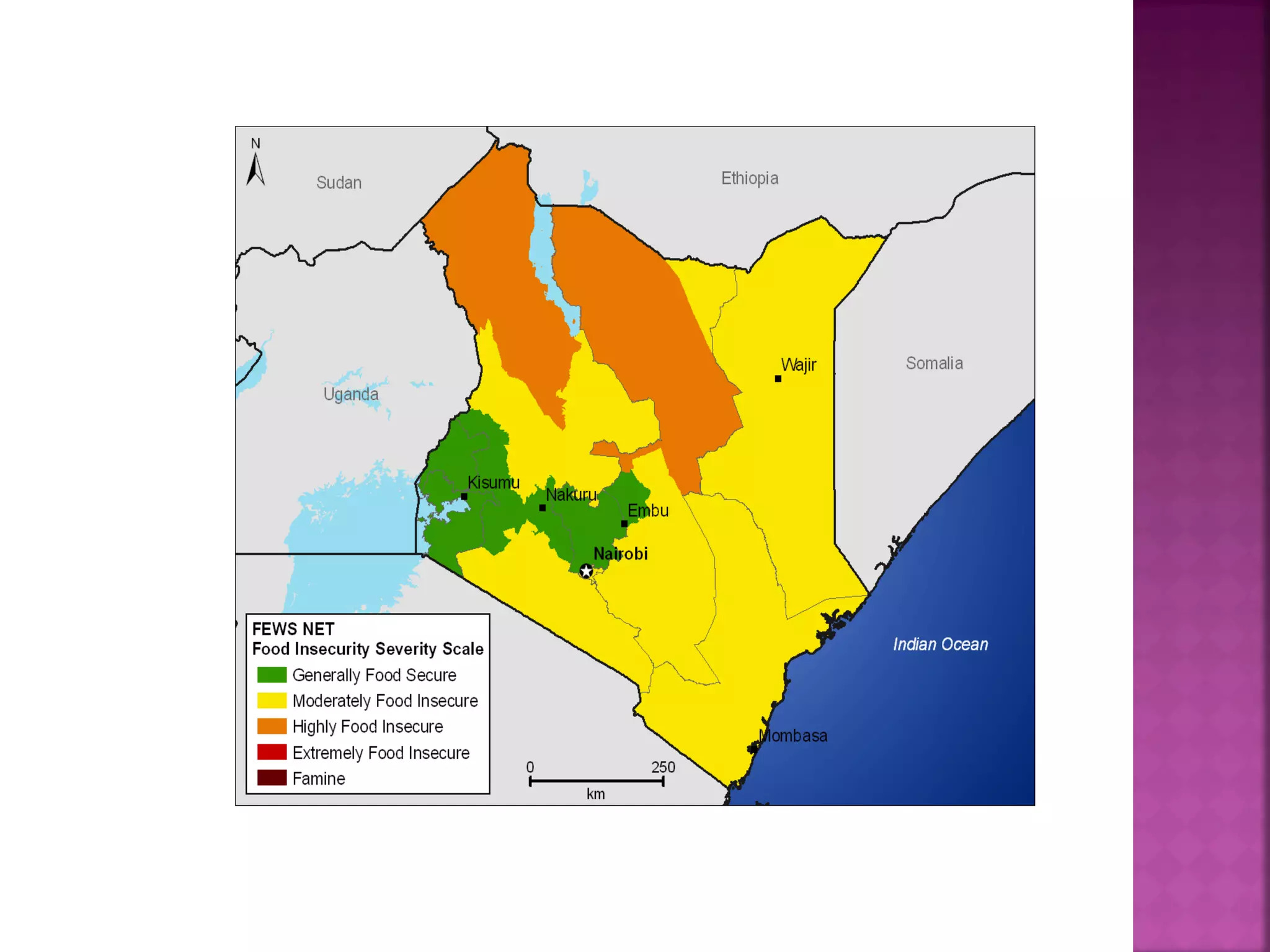
Food security improved across the country:
pastoral areas, Western and Rift Valley
highlands.
Over the years, Kenya Government has strived to
achieve national, household and individual food
security throughout the country. The success in
this effort has been mixed. The economic review
of agriculture 2007 indicates that 51% of the
Kenyan population lack access to adequate food.
But future prospects remain unclear: aflatoxine
infection about 200,000MT (50% of harvest),
average long rains maize output.


However, prospects for long rains maize crop are
favourable due to an expansion in area put to
maize in response to favourable pre‐planting
producer prices, reduced input prices, and an
expected good long rains season.



Poorer farmers to suffer substantial income
losses government purchase.



Other areas likely to experience a decline in
food security in the near and medium term are
the flood‐affected areas in the Coastal,
Lakeshore and pastoral areas






The agriculture sector accounted for roughly
24 percent of Kenya’s GDP in 2007 and 70
percent of the country’s labor force.
The sector is dominated by production of a
few commodities categorized as cash crops
(tea, coffee, and horticulture), food crops
(maize, wheat, and rice) for local
consumption, and livestock.
However, an often‐conflicting set of policy
objectives, coupled with confusion in policy
and regulatory implementation, hinders the
sector’s progress.




Kenya’s long‐term goal of food self‐
sufficiency (producing everything consumed
in the country) remains unmet.
Frequent droughts precipitate requests for
donor‐provided food aid to mitigate the
ravages of famine, especially in the arid and
semi‐ arid regions populated largely by
livestock‐based pastoral tribes.




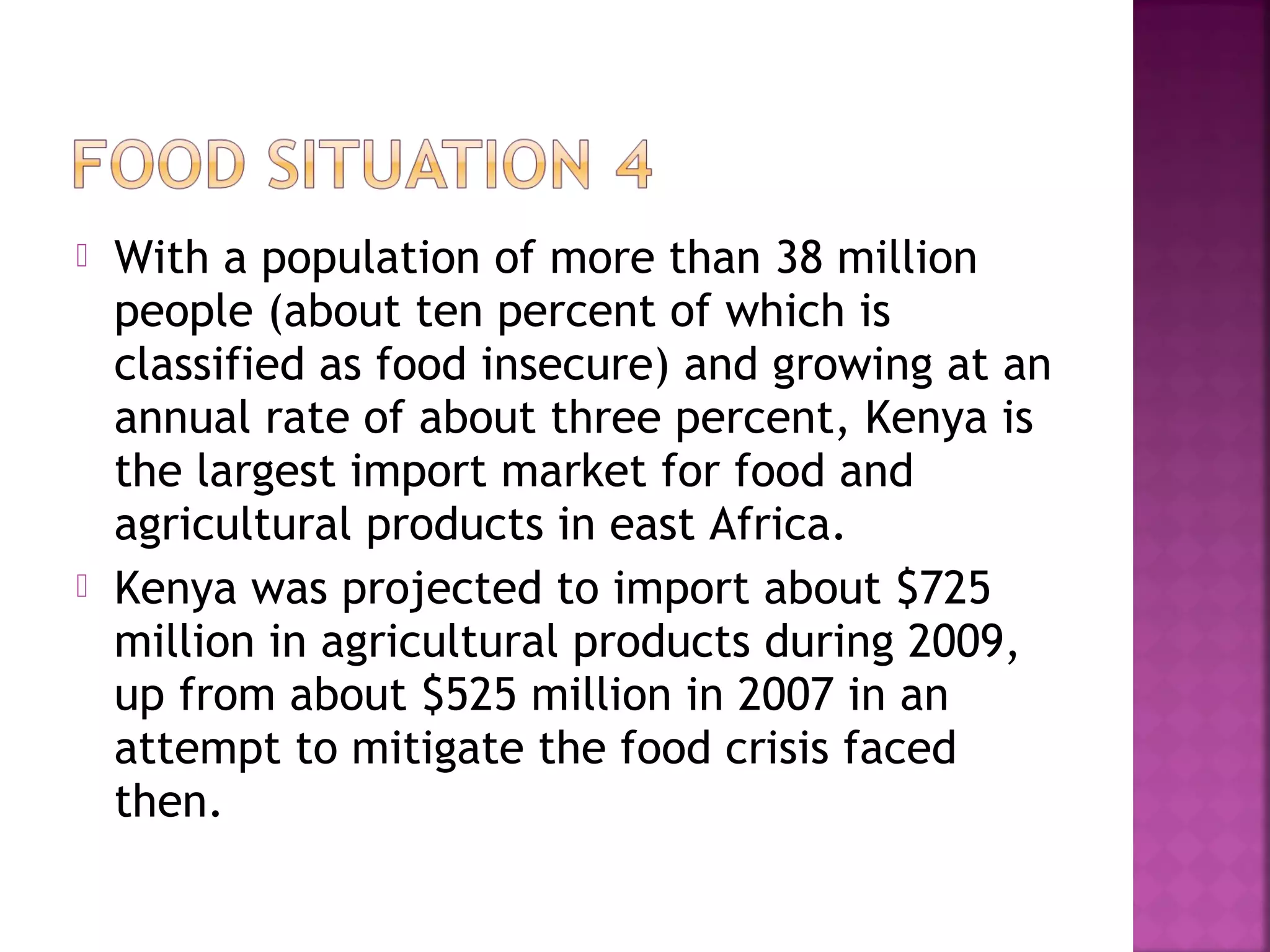
With a population of more than 38 million
people (about ten percent of which is
classified as food insecure) and growing at an
annual rate of about three percent, Kenya is
the largest import market for food and
agricultural products in east Africa.
Kenya was projected to import about $725
million in agricultural products during 2009,
up from about $525 million in 2007 in an
attempt to mitigate the food crisis faced
then.










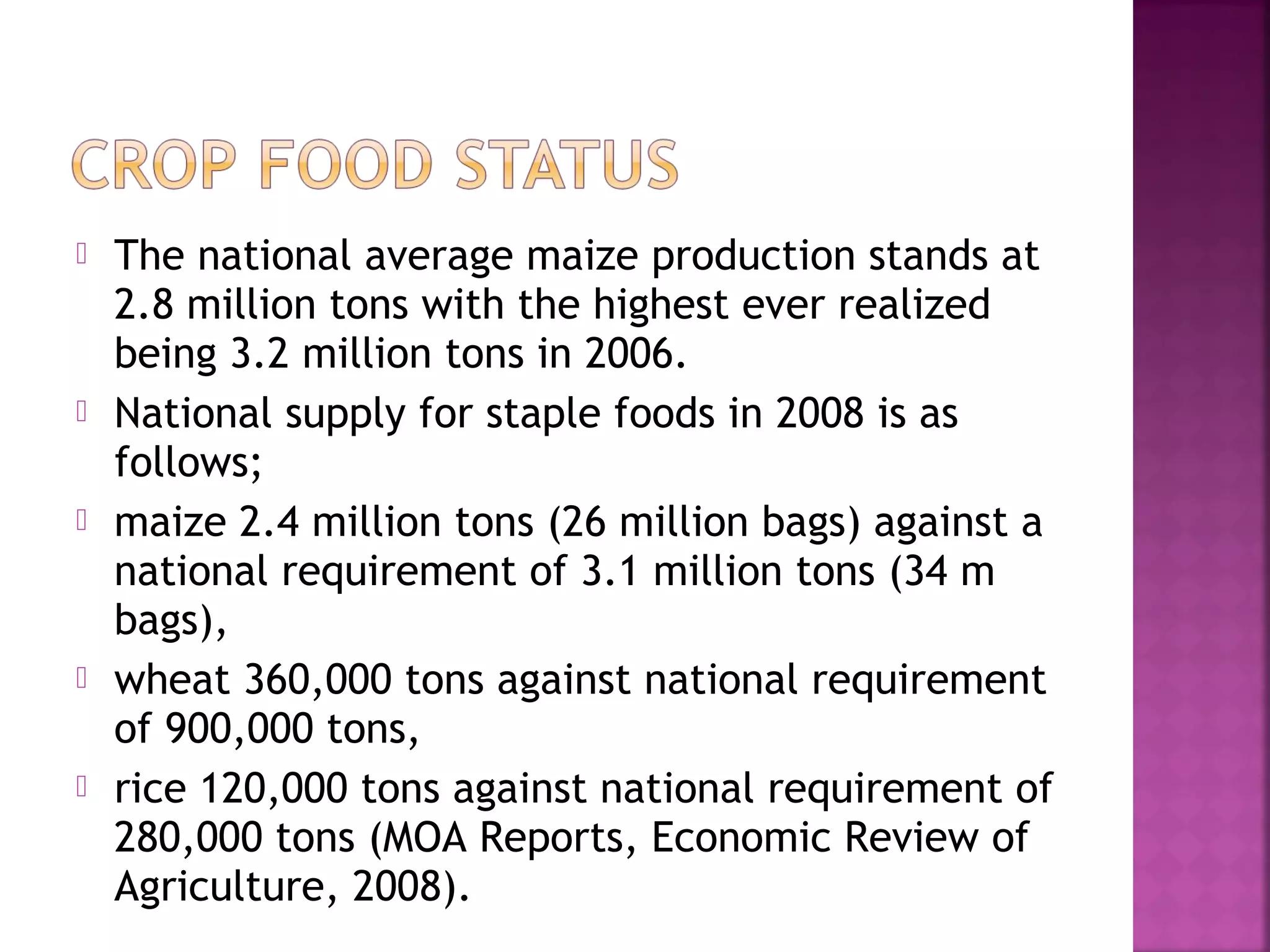
The national average maize production stands at
2.8 million tons with the highest ever realized
being 3.2 million tons in 2006.
National supply for staple foods in 2008 is as
follows;
maize 2.4 million tons (26 million bags) against a
national requirement of 3.1 million tons (34 m
bags),
wheat 360,000 tons against national requirement
of 900,000 tons,
rice 120,000 tons against national requirement of
280,000 tons (MOA Reports, Economic Review of
Agriculture, 2008).







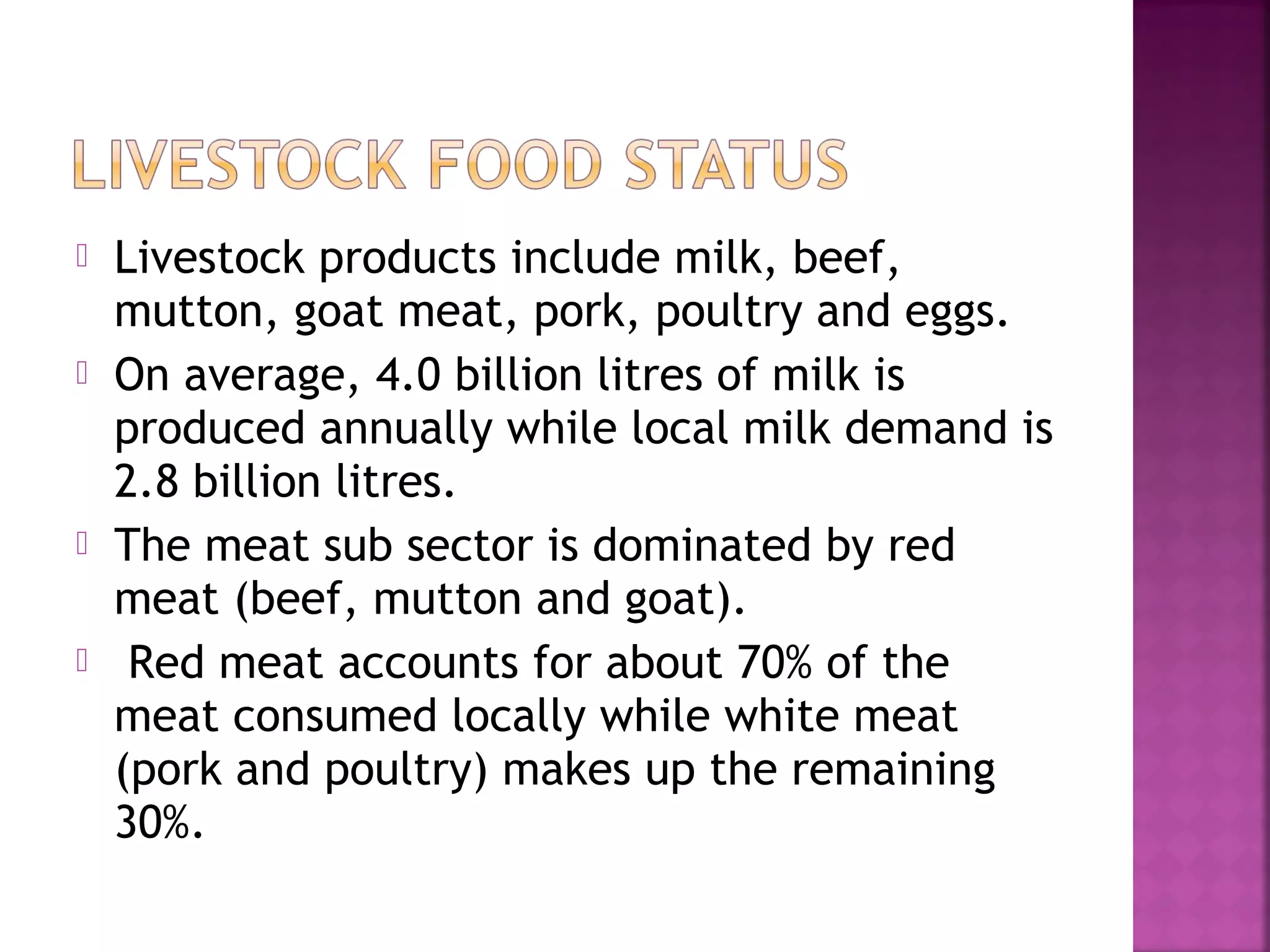
Livestock products include milk, beef,
mutton, goat meat, pork, poultry and eggs.
On average, 4.0 billion litres of milk is
produced annually while local milk demand is
2.8 billion litres.
The meat sub sector is dominated by red
meat (beef, mutton and goat).
Red meat accounts for about 70% of the
meat consumed locally while white meat
(pork and poultry) makes up the remaining
30%.


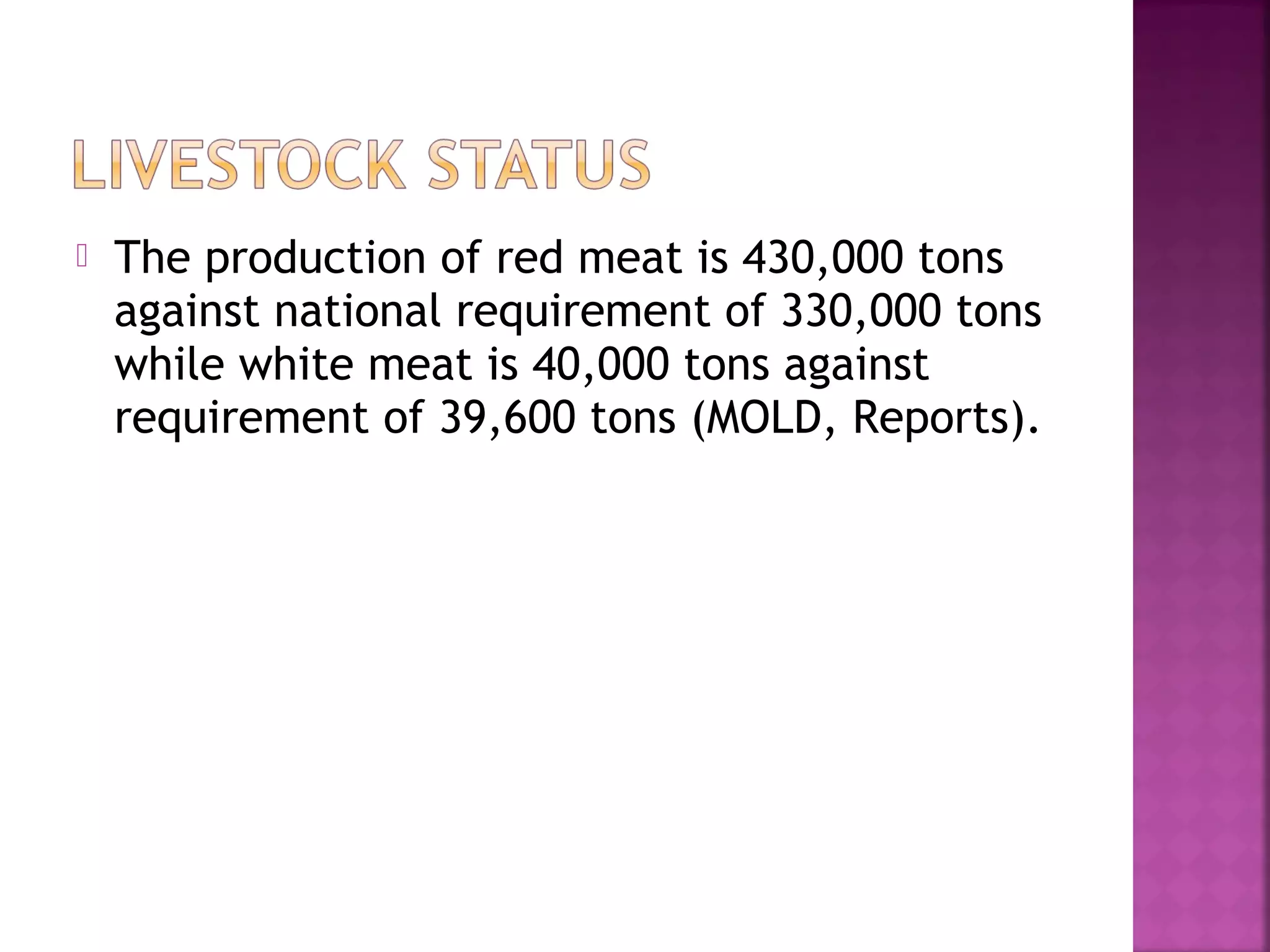
The production of red meat is 430,000 tons
against national requirement of 330,000 tons
while white meat is 40,000 tons against
requirement of 39,600 tons (MOLD, Reports).
The policy causes of food insecurity
Kenya’s

food policy since
independence has therefore been
centred on improving domestic supply
of basic foodstuffs, mainly grain
crops.
Policy Issues
Policy

failures in areas of agricultural pricing,
marketing of both inputs and output, distribution
and extension have introduced inefficiencies and
lowered agricultural production and the ability to
cope with drought conditions (Nyangito 1999).
Further, a poor implementation record by the
government has lowered the incentives to produce
by farmers.


Poverty- The poor including the urban poor,
poor pastoralists, poor in drought prune
zones, resource poor households have been
described as the most vulnerable to food
insecurity because they have a low
purchasing power.




Gender- United Nations (1998) observed that
gender disparities systematically disadvantaged
women with regard to overall economic status as
well as access to basic services. Women have
been considered as one of the food insecure
vulnerable groups (Kenya Food Security Steering
Group 2000).
HIV/ AIDS- It has been shown that Aids has
adverse effects on agriculture including loss of
skilled and unskilled labor supply, decline in
labor productivity and loss of remittance income
due to aids.




Livestock raiding (cattle rustling)- Livestock
raiding affects food security in the pastoral
districts of Rift Valley, Eastern and North Eastern
provinces. The worst affected districts are the
Samburu, Turkana, West Pokot, Isiolo, Wajir,
Marakwet, Keiyo and Garissa (FEWS Kenya, 1998;
FEWS Kenya, 1999).
Poor economic performance- Kenyan economy
has performed poorly till recent years. The
population that lives below poverty line bares
the most shock of a poorly performing economy
due their vulnerability and low resilience.






Drought cycles seem to have shortened to
every 2-3 years instead of 5-7 years in the
past.
The effect of climate change and global
warming is posing great danger to
agricultural productivity.
This has been aggravated by population
pressure in high potential areas pushing
human settlement to water catchment areas
and also cultivation of the fragile ASALs
(Nyariki D.M., 2007).




Political conflicts especially in food
producing areas have also tended to reduce
farming activity even long after the conflict
has been resolved.
Insecurity in the neighboring countries that
play a key role in food supplies during
drought periods in Kenya.






KM and Information Systems- It limits the
capacity of governments to formulate
appropriate policies and programmes that
address the problem of food insecurity.
Knowledge enhancement services, early warning
systems and management information systems
underpin all other efforts to address food
security.
Access to Infrastructure- The poor state of
development and maintenance of roads and
transport, energy sources and
telecommunications in the marginal areas of
Kenya makes it difficult for these areas to
become integrated into the national and regional
economy.




The Kenya Food Security Steering Group
(KFSSG) is a sub-committee of the Kenya
Food Security Meeting (KFSM) and is made up
of representatives from NGOs, UN agencies,
donors and Kenya Government (GoK).
KFSSG acts as a technical think-tank and
advisory body to all stakeholders on issues of
drought management and food security. It
plays a central role in both guiding the KFSM
and informing on decisions taken, organizes
multi-sectoral rapid assessments during
emergencies.


National Cereals and Produce Board
The Board procures, stores and maintains a
Strategic Grain Reserve (SGR) stock of up to
four million bags on behalf of the
Government to be used for food security.



National Drought Management AuthorityReviews all coordination structures on a periodic
basis and makes appropriate adjustments to
them in line with a) the national mandate of the
Authority; b) the provisions in the Constitution;
and c) an evaluation of their performance,
including feedback from stakeholders


Ministry of Agriculture- The mandate of the
Ministry of Agriculture is to promote and
facilitate production of food and agricultural
raw materials for food security and incomes;
advance agro-based industries and
agricultural exports; and enhance sustainable
use of land resources as a basis for
agricultural enterprises.








World Food Programme- WFP's unique network
of food security analysts works closely with
national governments, UN partners and NGOs.
Their work informs the policies and programmes
that WFP and its partners adopt in order to fight
hunger in different circumstances.

NGOs and the Civil Society- NGOs now
attempt to intervene to protect small
farmers from eviction, indigenous people
from losing traditional lands and fishing
grounds, and segments of the population
from discriminatory food supply schemes.




House Holds- Households have the role of
contributing to food security through their
own initiatives and efforts of poverty
alleviation and economic growth.
FAO- It is mandated to achieving food
security for all - to make sure people have
regular access to enough high-quality food to
lead active, healthy lives.








Kenya Food Security Meeting (KFSM): Established and
housed in the Office of the President, responsible for food
security monitoring and for advising on emergency
response.
Inter-ministerial Coordinating Committee on Food and
Nutrition (ICCFN): Housed in the Ministry of Planning and
National Development responsible mainly for nutrition
issues in development planning.
The Agricultural Sector Coordinating Unit (ASCU):
Responsible for coordination of reforms among agricultural
sector ministries as provided for by SRA.
National Food Safety Coordinating Committee (NFSCC):
Responsible for increasing awareness and advising on food
safety and quality related issues








An all-inclusive Food Security & Nutrition Policy,
once finalized, will ensure full participation of
all stakeholders in Food Security activities.
Food and nutrition security improved across
livelihood mainly due to good rains.
The Government needs to undertake deliberate
and targeted investment in irrigation, especially
for the Arid and Semi Arid Lands, in order to
increase food production. Together with the
Ministry of Water
Some evidence illustrating that homestead food
production makes a significant contribution to
food security and incomes.
END
Questions are
Welcome
THANK YOU

KENYA’S FOOD SECURITY, CAUSES AND STAKEHOLDERS IN FOOD SECURITY

  • 1.
    COURSE INSTRUCTOR: DR.PAMELA MARINDA PhD IN DISASTER MANAGEMENT AND HUMANITARIAN ASSISTANCE PRESENTED BY JACK ONYISI ABEBE
  • 2.
      According to FEWS-NET,food security is a condition in which a population has physical, social and economic access to sufficient, safe and nutritious foods over a given period to meet dietary needs and preferences for an active life. A food secure population can meet its consumption needs during the given consumption period by using strategies that do not compromise future food security
  • 3.
       Food insecurity istherefore the inverse of food security: A condition in which a population does not have access to sufficient, safe and nutritious food over a given period to meet dietary needs and preferences for an active life. Possible causes are insufficient food availability, insufficient food access and inadequate food utilization.
  • 4.
         There are fourdimensions of food security that determine the level at which a community is placed in relation to vulnerability to hunger; Food availability Food accessibility Stability Utilization/nutrition
  • 5.
         About a thirdof Kenya’s population estimated at 40 millions are food and nutrition insecure. Food and nutrition insecurity is closely linked to poverty. Falling food production in Kenya implies that Kenya is nationally food insecure in terms of staple cereal production as well as processed foods. Currently over 10 million people in Kenya suffer from chronic food insecurity and poor nutrition, and between two and four million people require emergency food assistance at any given time. Nearly 30% of Kenya’s children are classified as undernourished, and micronutrient deficiencies are widespread. (Draft Sessional Paper of 2008 on Food Security: National Food Security and Nutrition Policy July 2008).  A growing problem of food and nutrition insecurity in Kenya is linked to agricultural production. About 80 per cent of Kenya’s population live in the rural areas where agriculture dominates.
  • 6.
     Kenya’s past foodpolicies have had limited success in addressing food and nutrition insecurity. Questions:  What is Kenya’s food situation for the period 2005 – 2012?  What factors contributed to food insecurity in this period?  What is the role and response of various stakeholders to food crises in Kenya?  (4) What recommendations do you give on the discursive questions above?
  • 7.
     Document analysis: variouspolicy and research documents and reports on agriculture, food security and nutrition were analysed. Organisation of this paper:  Section 1:- a discussion of the food situation in Kenya for the period 2005 to 2012  Section 2:- a discussion of the causes of food insecurity during the aforementioned period;  Section 3: Stakeholders involved in responding to food crises in Kenya  Section 4: Conclusion and Recommendations
  • 8.
        Food security: ...nearlyall households have adequate access to sufficient food to maintain an active and healthy life, without depending on humanitarian assistance. This means that there is adequate food available; that households have adequate resources to obtain sufficient food; and that they are healthy enough to receive the nutritional value of the food. (Famine Early Warning Systems Network-FEWs NET). Food availability: refers to the physical existence of food, either from own production or from the markets. At national level, food availability is a combination of domestic food production, domestic food stocks, commercial food imports and food aid. Food access: is ensured when all households and individuals within those households have sufficient resources to obtain appropriate foods for a nutritious diet. It is dependent on the level of household resources – capital, labour and knowledge – and on their prices. Nutritional value: has to do with having adequate food of sufficient diversity to meet nutrient needs.
  • 9.
        Kenya has thelargest and most diversified economy in the East African region, with an estimated 2008 GDP of $31 billion. Food security improved across the country: pastoral areas, Western and Rift Valley highlands. Over the years, Kenya Government has strived to achieve national, household and individual food security throughout the country. The success in this effort has been mixed. The economic review of agriculture 2007 indicates that 51% of the Kenyan population lack access to adequate food. But future prospects remain unclear: aflatoxine infection about 200,000MT (50% of harvest), average long rains maize output.
  • 10.
     However, prospects forlong rains maize crop are favourable due to an expansion in area put to maize in response to favourable pre‐planting producer prices, reduced input prices, and an expected good long rains season.  Poorer farmers to suffer substantial income losses government purchase.  Other areas likely to experience a decline in food security in the near and medium term are the flood‐affected areas in the Coastal, Lakeshore and pastoral areas
  • 12.
       The agriculture sectoraccounted for roughly 24 percent of Kenya’s GDP in 2007 and 70 percent of the country’s labor force. The sector is dominated by production of a few commodities categorized as cash crops (tea, coffee, and horticulture), food crops (maize, wheat, and rice) for local consumption, and livestock. However, an often‐conflicting set of policy objectives, coupled with confusion in policy and regulatory implementation, hinders the sector’s progress.
  • 13.
      Kenya’s long‐term goalof food self‐ sufficiency (producing everything consumed in the country) remains unmet. Frequent droughts precipitate requests for donor‐provided food aid to mitigate the ravages of famine, especially in the arid and semi‐ arid regions populated largely by livestock‐based pastoral tribes.
  • 14.
      With a populationof more than 38 million people (about ten percent of which is classified as food insecure) and growing at an annual rate of about three percent, Kenya is the largest import market for food and agricultural products in east Africa. Kenya was projected to import about $725 million in agricultural products during 2009, up from about $525 million in 2007 in an attempt to mitigate the food crisis faced then.
  • 15.
         The national averagemaize production stands at 2.8 million tons with the highest ever realized being 3.2 million tons in 2006. National supply for staple foods in 2008 is as follows; maize 2.4 million tons (26 million bags) against a national requirement of 3.1 million tons (34 m bags), wheat 360,000 tons against national requirement of 900,000 tons, rice 120,000 tons against national requirement of 280,000 tons (MOA Reports, Economic Review of Agriculture, 2008).
  • 16.
        Livestock products includemilk, beef, mutton, goat meat, pork, poultry and eggs. On average, 4.0 billion litres of milk is produced annually while local milk demand is 2.8 billion litres. The meat sub sector is dominated by red meat (beef, mutton and goat). Red meat accounts for about 70% of the meat consumed locally while white meat (pork and poultry) makes up the remaining 30%.
  • 17.
     The production ofred meat is 430,000 tons against national requirement of 330,000 tons while white meat is 40,000 tons against requirement of 39,600 tons (MOLD, Reports).
  • 18.
    The policy causesof food insecurity Kenya’s food policy since independence has therefore been centred on improving domestic supply of basic foodstuffs, mainly grain crops.
  • 19.
    Policy Issues Policy failures inareas of agricultural pricing, marketing of both inputs and output, distribution and extension have introduced inefficiencies and lowered agricultural production and the ability to cope with drought conditions (Nyangito 1999). Further, a poor implementation record by the government has lowered the incentives to produce by farmers.
  • 20.
     Poverty- The poorincluding the urban poor, poor pastoralists, poor in drought prune zones, resource poor households have been described as the most vulnerable to food insecurity because they have a low purchasing power.
  • 21.
      Gender- United Nations(1998) observed that gender disparities systematically disadvantaged women with regard to overall economic status as well as access to basic services. Women have been considered as one of the food insecure vulnerable groups (Kenya Food Security Steering Group 2000). HIV/ AIDS- It has been shown that Aids has adverse effects on agriculture including loss of skilled and unskilled labor supply, decline in labor productivity and loss of remittance income due to aids.
  • 22.
      Livestock raiding (cattlerustling)- Livestock raiding affects food security in the pastoral districts of Rift Valley, Eastern and North Eastern provinces. The worst affected districts are the Samburu, Turkana, West Pokot, Isiolo, Wajir, Marakwet, Keiyo and Garissa (FEWS Kenya, 1998; FEWS Kenya, 1999). Poor economic performance- Kenyan economy has performed poorly till recent years. The population that lives below poverty line bares the most shock of a poorly performing economy due their vulnerability and low resilience.
  • 23.
       Drought cycles seemto have shortened to every 2-3 years instead of 5-7 years in the past. The effect of climate change and global warming is posing great danger to agricultural productivity. This has been aggravated by population pressure in high potential areas pushing human settlement to water catchment areas and also cultivation of the fragile ASALs (Nyariki D.M., 2007).
  • 24.
      Political conflicts especiallyin food producing areas have also tended to reduce farming activity even long after the conflict has been resolved. Insecurity in the neighboring countries that play a key role in food supplies during drought periods in Kenya.
  • 25.
       KM and InformationSystems- It limits the capacity of governments to formulate appropriate policies and programmes that address the problem of food insecurity. Knowledge enhancement services, early warning systems and management information systems underpin all other efforts to address food security. Access to Infrastructure- The poor state of development and maintenance of roads and transport, energy sources and telecommunications in the marginal areas of Kenya makes it difficult for these areas to become integrated into the national and regional economy.
  • 26.
      The Kenya FoodSecurity Steering Group (KFSSG) is a sub-committee of the Kenya Food Security Meeting (KFSM) and is made up of representatives from NGOs, UN agencies, donors and Kenya Government (GoK). KFSSG acts as a technical think-tank and advisory body to all stakeholders on issues of drought management and food security. It plays a central role in both guiding the KFSM and informing on decisions taken, organizes multi-sectoral rapid assessments during emergencies.
  • 27.
     National Cereals andProduce Board The Board procures, stores and maintains a Strategic Grain Reserve (SGR) stock of up to four million bags on behalf of the Government to be used for food security.  National Drought Management AuthorityReviews all coordination structures on a periodic basis and makes appropriate adjustments to them in line with a) the national mandate of the Authority; b) the provisions in the Constitution; and c) an evaluation of their performance, including feedback from stakeholders
  • 28.
     Ministry of Agriculture-The mandate of the Ministry of Agriculture is to promote and facilitate production of food and agricultural raw materials for food security and incomes; advance agro-based industries and agricultural exports; and enhance sustainable use of land resources as a basis for agricultural enterprises.
  • 29.
        World Food Programme-WFP's unique network of food security analysts works closely with national governments, UN partners and NGOs. Their work informs the policies and programmes that WFP and its partners adopt in order to fight hunger in different circumstances. NGOs and the Civil Society- NGOs now attempt to intervene to protect small farmers from eviction, indigenous people from losing traditional lands and fishing grounds, and segments of the population from discriminatory food supply schemes.
  • 30.
      House Holds- Householdshave the role of contributing to food security through their own initiatives and efforts of poverty alleviation and economic growth. FAO- It is mandated to achieving food security for all - to make sure people have regular access to enough high-quality food to lead active, healthy lives.
  • 31.
        Kenya Food SecurityMeeting (KFSM): Established and housed in the Office of the President, responsible for food security monitoring and for advising on emergency response. Inter-ministerial Coordinating Committee on Food and Nutrition (ICCFN): Housed in the Ministry of Planning and National Development responsible mainly for nutrition issues in development planning. The Agricultural Sector Coordinating Unit (ASCU): Responsible for coordination of reforms among agricultural sector ministries as provided for by SRA. National Food Safety Coordinating Committee (NFSCC): Responsible for increasing awareness and advising on food safety and quality related issues
  • 32.
        An all-inclusive FoodSecurity & Nutrition Policy, once finalized, will ensure full participation of all stakeholders in Food Security activities. Food and nutrition security improved across livelihood mainly due to good rains. The Government needs to undertake deliberate and targeted investment in irrigation, especially for the Arid and Semi Arid Lands, in order to increase food production. Together with the Ministry of Water Some evidence illustrating that homestead food production makes a significant contribution to food security and incomes.
  • 33.