Climate Change, Climate scenarios (RCPs,
GCM) and Uncertainties
Mukhtar Ahmed
mukhtar.ahmed@slu.se
ahmadmukhtar@uaar.edu.pk
1
Outline…………..
• Climate Change
• Temperature
• Rainfall
• Solar radiation
• Elevated CO2
• Extreme events
• Effective Climate Risk Management requires ?
• IPCC
• Representative Concentration Pathways (RCPs)
• RCP2.6
• RCP4.5
• RCP6
• RCP8.5
• GCM
• Uncertainties in Climate Model
• Calibration approaches
• Summary
2
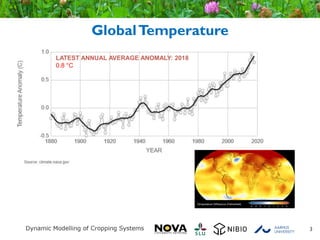
GlobalTemperature
3
LATEST ANNUAL AVERAGE ANOMALY: 2018
0.8 °C
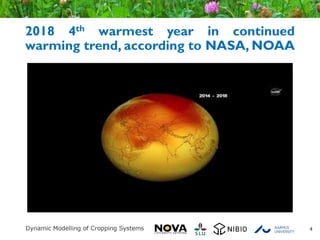
2018 4th warmest year in continued
warming trend, according to NASA, NOAA
4
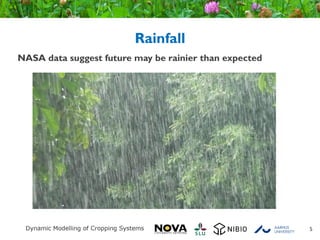
Rainfall
NASA data suggest future may be rainier than expected
5
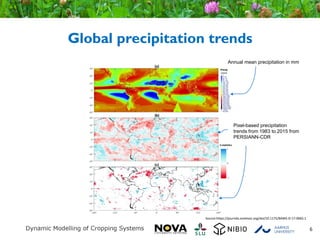
Global precipitation trends
6
Annual mean precipitation in mm
Pixel-based precipitation
trends from 1983 to 2015 from
PERSIANN-CDR
Source:https://journals.ametsoc.org/doi/10.1175/BAMS-D-17-0065.1
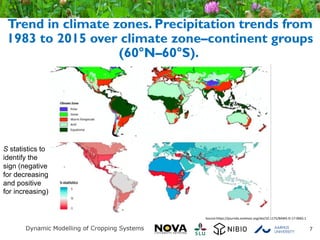
Trend in climate zones. Precipitation trends from
1983 to 2015 over climate zone–continent groups
(60°N–60°S).
7
S statistics to
identify the
sign (negative
for decreasing
and positive
for increasing)
Source:https://journals.ametsoc.org/doi/10.1175/BAMS-D-17-0065.1
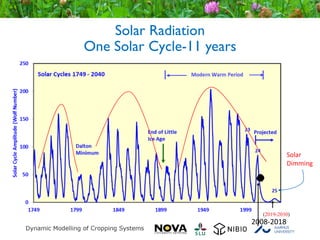
Solar Radiation
One Solar Cycle-11 years
(2019-2030)
2008-2018
Solar
Dimming
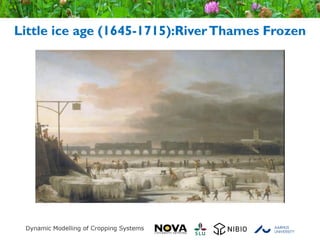
Little ice age (1645-1715):RiverThames Frozen
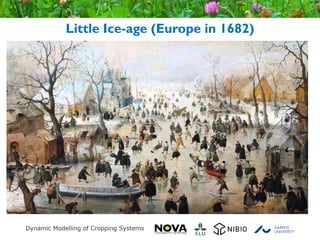
Little Ice-age (Europe in 1682)
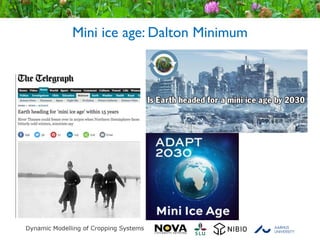
Mini ice age: Dalton Minimum
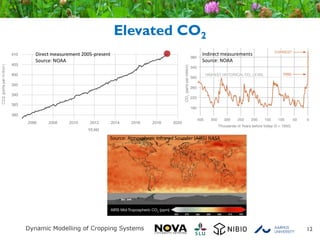
Elevated CO2
12
Direct measurement 2005-present
Source: NOAA
Indirect measurements
Source: NOAA
Source: Atmospheric Infrared Sounder (AIRS) NASA
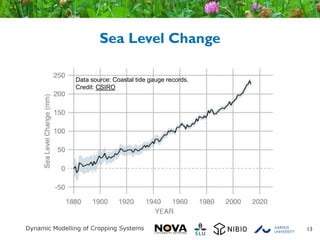
Sea Level Change
13
Data source: Coastal tide gauge records.
Credit: CSIRO
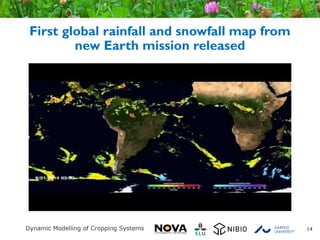
First global rainfall and snowfall map from
new Earth mission released
14
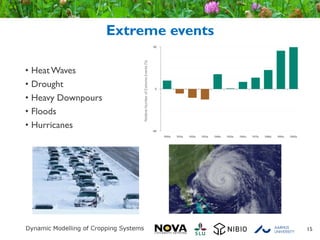
Extreme events
• HeatWaves
• Drought
• Heavy Downpours
• Floods
• Hurricanes
15
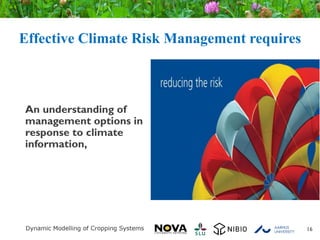
Effective Climate Risk Management requires
An understanding of
management options in
response to climate
information,
16
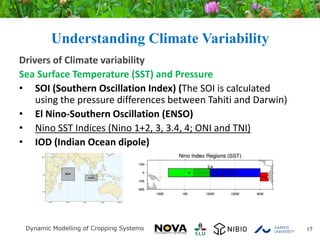
Understanding Climate Variability
Drivers of Climate variability
Sea Surface Temperature (SST) and Pressure
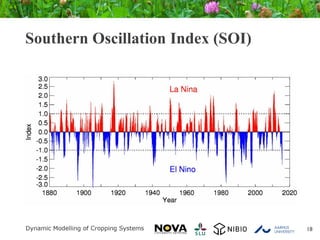
• SOI (Southern Oscillation Index) (The SOI is calculated
using the pressure differences between Tahiti and Darwin)
• El Nino-Southern Oscillation (ENSO)
• Nino SST Indices (Nino 1+2, 3, 3.4, 4; ONI and TNI)
• IOD (Indian Ocean dipole)
17
Southern Oscillation Index (SOI)
18
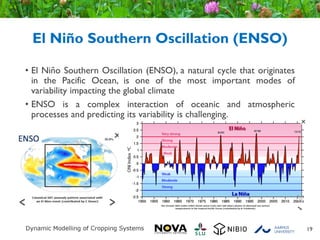
El Niño Southern Oscillation (ENSO)
• El Niño Southern Oscillation (ENSO), a natural cycle that originates
in the Pacific Ocean, is one of the most important modes of
variability impacting the global climate
• ENSO is a complex interaction of oceanic and atmospheric
processes and predicting its variability is challenging.
19
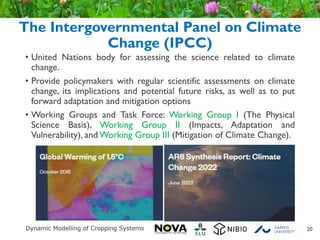
The Intergovernmental Panel on Climate
Change (IPCC)
• United Nations body for assessing the science related to climate
change.
• Provide policymakers with regular scientific assessments on climate
change, its implications and potential future risks, as well as to put
forward adaptation and mitigation options
• Working Groups and Task Force: Working Group I (The Physical
Science Basis), Working Group II (Impacts, Adaptation and
Vulnerability), and Working Group III (Mitigation of Climate Change).
20
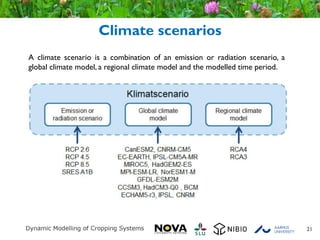
Climate scenarios
21
A climate scenario is a combination of an emission or radiation scenario, a
global climate model, a regional climate model and the modelled time period.
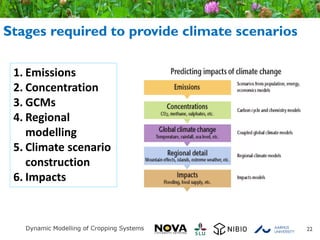
Stages required to provide climate scenarios
22
1. Emissions
2. Concentration
3. GCMs
4. Regional
modelling
5. Climate scenario
construction
6. Impacts
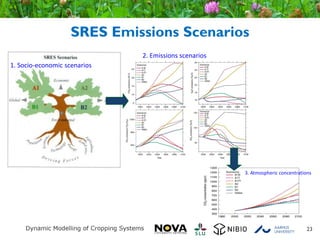
SRES Emissions Scenarios
23
1. Socio-economic scenarios
2. Emissions scenarios
3. Atmospheric concentrations
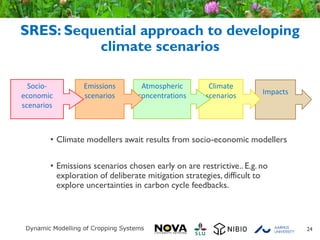
SRES: Sequential approach to developing
climate scenarios
24
Impacts
Climate
scenarios
Atmospheric
concentrations
Emissions
scenarios
Socio-
economic
scenarios
• Climate modellers await results from socio-economic modellers
• Emissions scenarios chosen early on are restrictive.. E.g. no
exploration of deliberate mitigation strategies, difficult to
explore uncertainties in carbon cycle feedbacks.
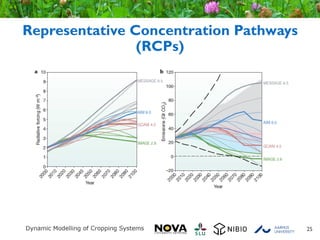
Representative Concentration Pathways
(RCPs)
25
Representative Concentration Pathways
(RCPs)
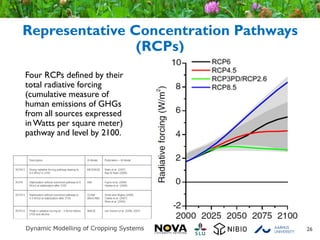
Four RCPs defined by their
total radiative forcing
(cumulative measure of
human emissions of GHGs
from all sources expressed
inWatts per square meter)
pathway and level by 2100.
26
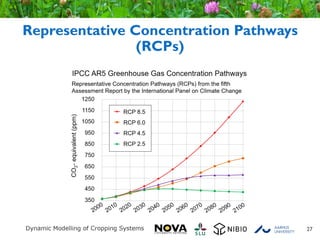
Representative Concentration Pathways
(RCPs)
27
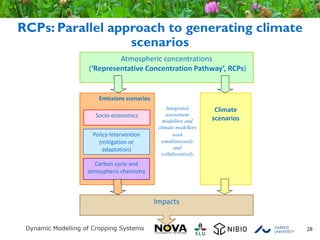
RCPs: Parallel approach to generating climate
scenarios
28
Impacts
Emissions scenarios
Atmospheric concentrations
(‘Representative Concentration Pathway’, RCPs)
Climate
scenarios
Integrated
assessment
modellers and
climate modellers
work
simultaneously
and
collaboratively
Socio-economics
Policy Intervention
(mitigation or
adaptation)
Carbon cycle and
atmospheric chemistry
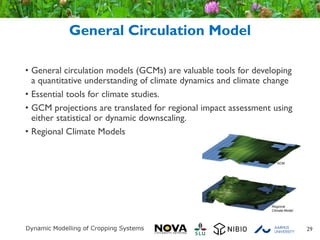
General Circulation Model
• General circulation models (GCMs) are valuable tools for developing
a quantitative understanding of climate dynamics and climate change
• Essential tools for climate studies.
• GCM projections are translated for regional impact assessment using
either statistical or dynamic downscaling.
• Regional Climate Models
29
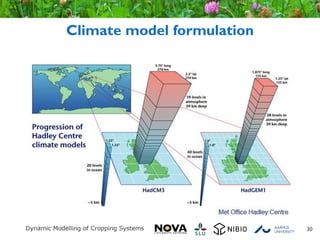
Climate model formulation
30
© Crown copyright Met Office
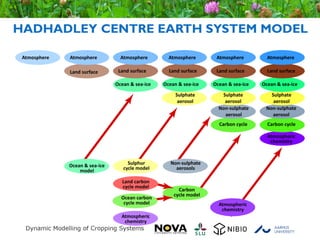
Atmosphere Atmosphere Atmosphere Atmosphere Atmosphere Atmosphere
Land surfaceLand surfaceLand surfaceLand surfaceLand surface
Ocean & sea-ice Ocean & sea-ice Ocean & sea-ice Ocean & sea-ice
Sulphate
aerosol
Sulphate
aerosol
Sulphate
aerosol
Non-sulphate
aerosol
Non-sulphate
aerosol
Carbon cycle Carbon cycle
Atmospheric
chemistry
Ocean & sea-ice
model
Sulphur
cycle model
Non-sulphate
aerosols
Carbon
cycle model
Land carbon
cycle model
Ocean carbon
cycle model
Atmospheric
chemistry
Atmospheric
chemistry
Off-line
model
development
Strengthening colours
denote improvements
in models
HADHADLEY CENTRE EARTH SYSTEM MODEL
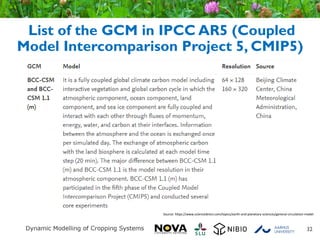
List of the GCM in IPCC AR5 (Coupled
Model Intercomparison Project 5, CMIP5)
32
Source: https://www.sciencedirect.com/topics/earth-and-planetary-sciences/general-circulation-model
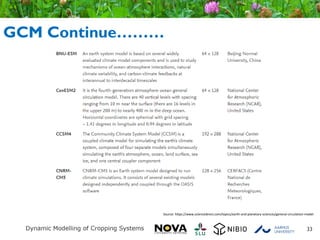
33
Source: https://www.sciencedirect.com/topics/earth-and-planetary-sciences/general-circulation-model
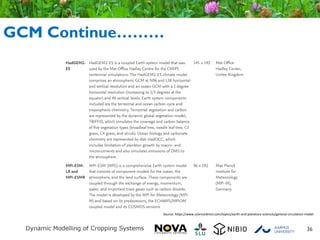
GCM Continue………
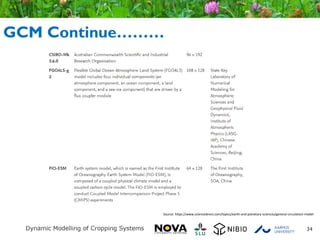
34
Source: https://www.sciencedirect.com/topics/earth-and-planetary-sciences/general-circulation-model
GCM Continue………
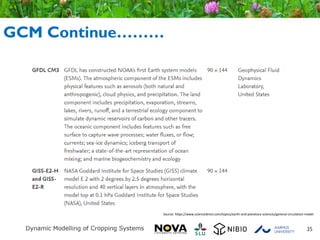
35
Source: https://www.sciencedirect.com/topics/earth-and-planetary-sciences/general-circulation-model
GCM Continue………
36
Source: https://www.sciencedirect.com/topics/earth-and-planetary-sciences/general-circulation-model
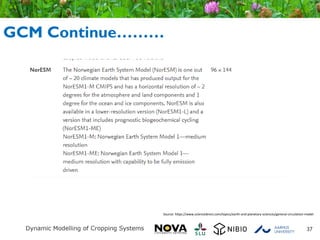
GCM Continue………
37
Source: https://www.sciencedirect.com/topics/earth-and-planetary-sciences/general-circulation-model
GCM Continue………
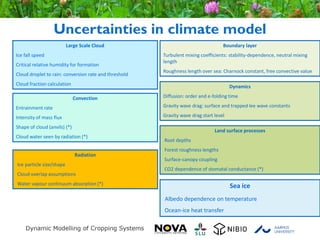
Uncertainties in climate model
Large Scale Cloud
Ice fall speed
Critical relative humidity for formation
Cloud droplet to rain: conversion rate and threshold
Cloud fraction calculation
Convection
Entrainment rate
Intensity of mass flux
Shape of cloud (anvils) (*)
Cloud water seen by radiation (*)
Radiation
Ice particle size/shape
Cloud overlap assumptions
Water vapour continuum absorption (*)
Boundary layer
Turbulent mixing coefficients: stability-dependence, neutral mixing
length
Roughness length over sea: Charnock constant, free convective value
Dynamics
Diffusion: order and e-folding time
Gravity wave drag: surface and trapped lee wave constants
Gravity wave drag start level
Land surface processes
Root depths
Forest roughness lengths
Surface-canopy coupling
CO2 dependence of stomatal conductance (*)
Sea ice
Albedo dependence on temperature
Ocean-ice heat transfer
© Crown copyright Met Office
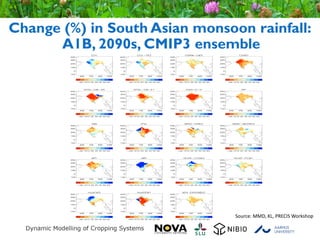
Change (%) in South Asian monsoon rainfall:
A1B, 2090s, CMIP3 ensemble
Change (%) in South Asian monsoon rainfall:
A1B, 2090s, CMIP3 ensemble
Source: MMD, KL, PRECIS Workshop
40
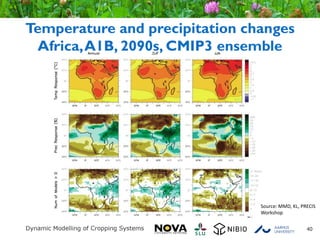
Temperature and precipitation changes
Africa,A1B, 2090s, CMIP3 ensemble
Source: MMD, KL, PRECIS
Workshop
© Crown copyright Met Office
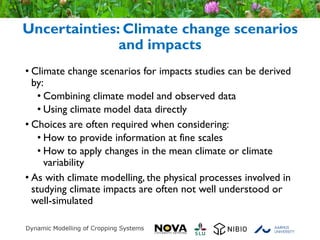
Uncertainties: Climate change scenarios
and impacts
• Climate change scenarios for impacts studies can be derived
by:
• Combining climate model and observed data
• Using climate model data directly
• Choices are often required when considering:
• How to provide information at fine scales
• How to apply changes in the mean climate or climate
variability
• As with climate modelling, the physical processes involved in
studying climate impacts are often not well understood or
well-simulated
© Crown copyright Met Office
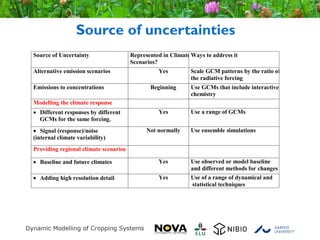
Source of uncertainties
Source of Uncertainty Represented in Climate
Scenarios?
Ways to address it
Alternative emission scenarios Yes Scale GCM patterns by the ratio of
the radiative forcing
Emissions to concentrations Beginning Use GCMs that include interactive
chemistry
Modelling the climate response
• Different responses by different
GCMs for the same forcing.
Yes Use a range of GCMs
• Signal (response)/noise
(internal climate variability)
Not normally Use ensemble simulations
Providing regional climate scenarios
• Baseline and future climates Yes Use observed or model baseline
and different methods for changes
• Adding high resolution detail Yes Use of a range of dynamical and
statistical techniques
© Crown copyright Met Office
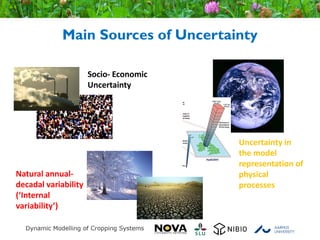
Main Sources of Uncertainty
Socio- Economic
Uncertainty
Uncertainty in
the model
representation of
physical
processes
Natural annual-
decadal variability
(‘Internal
variability’)
© Crown copyright Met Office
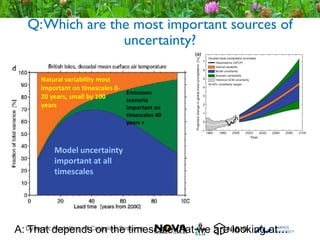
Q:Which are the most important sources of
uncertainty?
A: That depends on the timescale that we are looking at…
Natural variability most
important on timescales 0-
20 years, small by 100
years
Emissions
scenario
important on
timescales 40
years +
Model uncertainty
important at all
timescales
Calibration approaches
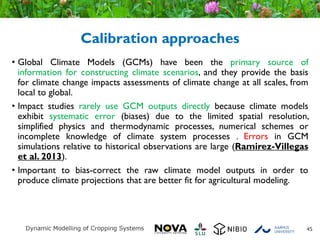
• Global Climate Models (GCMs) have been the primary source of
information for constructing climate scenarios, and they provide the basis
for climate change impacts assessments of climate change at all scales, from
local to global.
• Impact studies rarely use GCM outputs directly because climate models
exhibit systematic error (biases) due to the limited spatial resolution,
simplified physics and thermodynamic processes, numerical schemes or
incomplete knowledge of climate system processes . Errors in GCM
simulations relative to historical observations are large (Ramirez-Villegas
et al. 2013).
• Important to bias-correct the raw climate model outputs in order to
produce climate projections that are better fit for agricultural modeling.
45
Calibration approaches
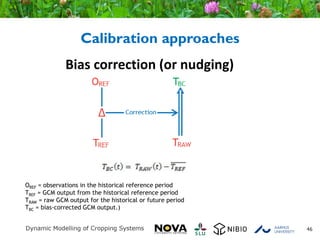
46
OREF = observations in the historical reference period
TREF = GCM output from the historical reference period
TRAW = raw GCM output for the historical or future period
TBC = bias-corrected GCM output.)
Bias correction (or nudging)
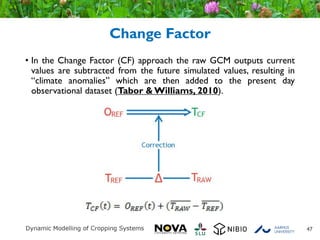
Change Factor
• In the Change Factor (CF) approach the raw GCM outputs current
values are subtracted from the future simulated values, resulting in
“climate anomalies” which are then added to the present day
observational dataset (Tabor & Williams, 2010).
47
Quantile Mapping
• The above-described methods work well for more non-stochastic
variables (i.e. temperature). A more sophisticated approach for bias-
correcting more stochastic variables (e.g. precipitation and solar
radiation) is needed.
• GCM outputs are known to have a "drizzle problem", that is, too
many low-magnitude rain events as compared to observations
• Quantile Mapping (QM) approach with the qmap library written for
R statistical software (Gudmundsson, 2014; Gudmundsson et al.,
2012).
48
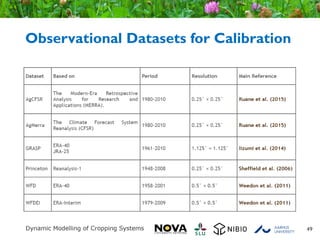
Observational Datasets for Calibration
49
© Crown copyright Met Office
To summarise
•Understanding of climate variability is utmost
important for designing adaptation and mitigation
strategies
•GCMs are best option but ensemble approach
should be used
•There are many uncertainties which need to be
taken into account when assessing climate change
(and its impact) over a region
51
This Photo by Unknown Author is licensed under CC BY-SA-NC

Climate scenarios

  • 1.
    Climate Change, Climatescenarios (RCPs, GCM) and Uncertainties Mukhtar Ahmed mukhtar.ahmed@slu.se ahmadmukhtar@uaar.edu.pk 1
  • 2.
    Outline………….. • Climate Change •Temperature • Rainfall • Solar radiation • Elevated CO2 • Extreme events • Effective Climate Risk Management requires ? • IPCC • Representative Concentration Pathways (RCPs) • RCP2.6 • RCP4.5 • RCP6 • RCP8.5 • GCM • Uncertainties in Climate Model • Calibration approaches • Summary 2
  • 3.
  • 4.
    2018 4th warmestyear in continued warming trend, according to NASA, NOAA 4
  • 5.
    Rainfall NASA data suggestfuture may be rainier than expected 5
  • 6.
    Global precipitation trends 6 Annualmean precipitation in mm Pixel-based precipitation trends from 1983 to 2015 from PERSIANN-CDR Source:https://journals.ametsoc.org/doi/10.1175/BAMS-D-17-0065.1
  • 7.
    Trend in climatezones. Precipitation trends from 1983 to 2015 over climate zone–continent groups (60°N–60°S). 7 S statistics to identify the sign (negative for decreasing and positive for increasing) Source:https://journals.ametsoc.org/doi/10.1175/BAMS-D-17-0065.1
  • 8.
    Solar Radiation One SolarCycle-11 years (2019-2030) 2008-2018 Solar Dimming
  • 9.
    Little ice age(1645-1715):RiverThames Frozen
  • 10.
  • 11.
    Mini ice age:Dalton Minimum
  • 12.
    Elevated CO2 12 Direct measurement2005-present Source: NOAA Indirect measurements Source: NOAA Source: Atmospheric Infrared Sounder (AIRS) NASA
  • 13.
    Sea Level Change 13 Datasource: Coastal tide gauge records. Credit: CSIRO
  • 14.
    First global rainfalland snowfall map from new Earth mission released 14
  • 15.
    Extreme events • HeatWaves •Drought • Heavy Downpours • Floods • Hurricanes 15
  • 16.
    Effective Climate RiskManagement requires An understanding of management options in response to climate information, 16
  • 17.
    Understanding Climate Variability Driversof Climate variability Sea Surface Temperature (SST) and Pressure • SOI (Southern Oscillation Index) (The SOI is calculated using the pressure differences between Tahiti and Darwin) • El Nino-Southern Oscillation (ENSO) • Nino SST Indices (Nino 1+2, 3, 3.4, 4; ONI and TNI) • IOD (Indian Ocean dipole) 17
  • 18.
  • 19.
    El Niño SouthernOscillation (ENSO) • El Niño Southern Oscillation (ENSO), a natural cycle that originates in the Pacific Ocean, is one of the most important modes of variability impacting the global climate • ENSO is a complex interaction of oceanic and atmospheric processes and predicting its variability is challenging. 19
  • 20.
    The Intergovernmental Panelon Climate Change (IPCC) • United Nations body for assessing the science related to climate change. • Provide policymakers with regular scientific assessments on climate change, its implications and potential future risks, as well as to put forward adaptation and mitigation options • Working Groups and Task Force: Working Group I (The Physical Science Basis), Working Group II (Impacts, Adaptation and Vulnerability), and Working Group III (Mitigation of Climate Change). 20
  • 21.
    Climate scenarios 21 A climatescenario is a combination of an emission or radiation scenario, a global climate model, a regional climate model and the modelled time period.
  • 22.
    Stages required toprovide climate scenarios 22 1. Emissions 2. Concentration 3. GCMs 4. Regional modelling 5. Climate scenario construction 6. Impacts
  • 23.
    SRES Emissions Scenarios 23 1.Socio-economic scenarios 2. Emissions scenarios 3. Atmospheric concentrations
  • 24.
    SRES: Sequential approachto developing climate scenarios 24 Impacts Climate scenarios Atmospheric concentrations Emissions scenarios Socio- economic scenarios • Climate modellers await results from socio-economic modellers • Emissions scenarios chosen early on are restrictive.. E.g. no exploration of deliberate mitigation strategies, difficult to explore uncertainties in carbon cycle feedbacks.
  • 25.
  • 26.
    Representative Concentration Pathways (RCPs) FourRCPs defined by their total radiative forcing (cumulative measure of human emissions of GHGs from all sources expressed inWatts per square meter) pathway and level by 2100. 26
  • 27.
  • 28.
    RCPs: Parallel approachto generating climate scenarios 28 Impacts Emissions scenarios Atmospheric concentrations (‘Representative Concentration Pathway’, RCPs) Climate scenarios Integrated assessment modellers and climate modellers work simultaneously and collaboratively Socio-economics Policy Intervention (mitigation or adaptation) Carbon cycle and atmospheric chemistry
  • 29.
    General Circulation Model •General circulation models (GCMs) are valuable tools for developing a quantitative understanding of climate dynamics and climate change • Essential tools for climate studies. • GCM projections are translated for regional impact assessment using either statistical or dynamic downscaling. • Regional Climate Models 29
  • 30.
  • 31.
    © Crown copyrightMet Office Atmosphere Atmosphere Atmosphere Atmosphere Atmosphere Atmosphere Land surfaceLand surfaceLand surfaceLand surfaceLand surface Ocean & sea-ice Ocean & sea-ice Ocean & sea-ice Ocean & sea-ice Sulphate aerosol Sulphate aerosol Sulphate aerosol Non-sulphate aerosol Non-sulphate aerosol Carbon cycle Carbon cycle Atmospheric chemistry Ocean & sea-ice model Sulphur cycle model Non-sulphate aerosols Carbon cycle model Land carbon cycle model Ocean carbon cycle model Atmospheric chemistry Atmospheric chemistry Off-line model development Strengthening colours denote improvements in models HADHADLEY CENTRE EARTH SYSTEM MODEL
  • 32.
    List of theGCM in IPCC AR5 (Coupled Model Intercomparison Project 5, CMIP5) 32 Source: https://www.sciencedirect.com/topics/earth-and-planetary-sciences/general-circulation-model
  • 33.
  • 34.
  • 35.
  • 36.
  • 37.
  • 38.
    Uncertainties in climatemodel Large Scale Cloud Ice fall speed Critical relative humidity for formation Cloud droplet to rain: conversion rate and threshold Cloud fraction calculation Convection Entrainment rate Intensity of mass flux Shape of cloud (anvils) (*) Cloud water seen by radiation (*) Radiation Ice particle size/shape Cloud overlap assumptions Water vapour continuum absorption (*) Boundary layer Turbulent mixing coefficients: stability-dependence, neutral mixing length Roughness length over sea: Charnock constant, free convective value Dynamics Diffusion: order and e-folding time Gravity wave drag: surface and trapped lee wave constants Gravity wave drag start level Land surface processes Root depths Forest roughness lengths Surface-canopy coupling CO2 dependence of stomatal conductance (*) Sea ice Albedo dependence on temperature Ocean-ice heat transfer
  • 39.
    © Crown copyrightMet Office Change (%) in South Asian monsoon rainfall: A1B, 2090s, CMIP3 ensemble Change (%) in South Asian monsoon rainfall: A1B, 2090s, CMIP3 ensemble Source: MMD, KL, PRECIS Workshop
  • 40.
    40 Temperature and precipitationchanges Africa,A1B, 2090s, CMIP3 ensemble Source: MMD, KL, PRECIS Workshop
  • 41.
    © Crown copyrightMet Office Uncertainties: Climate change scenarios and impacts • Climate change scenarios for impacts studies can be derived by: • Combining climate model and observed data • Using climate model data directly • Choices are often required when considering: • How to provide information at fine scales • How to apply changes in the mean climate or climate variability • As with climate modelling, the physical processes involved in studying climate impacts are often not well understood or well-simulated
  • 42.
    © Crown copyrightMet Office Source of uncertainties Source of Uncertainty Represented in Climate Scenarios? Ways to address it Alternative emission scenarios Yes Scale GCM patterns by the ratio of the radiative forcing Emissions to concentrations Beginning Use GCMs that include interactive chemistry Modelling the climate response • Different responses by different GCMs for the same forcing. Yes Use a range of GCMs • Signal (response)/noise (internal climate variability) Not normally Use ensemble simulations Providing regional climate scenarios • Baseline and future climates Yes Use observed or model baseline and different methods for changes • Adding high resolution detail Yes Use of a range of dynamical and statistical techniques
  • 43.
    © Crown copyrightMet Office Main Sources of Uncertainty Socio- Economic Uncertainty Uncertainty in the model representation of physical processes Natural annual- decadal variability (‘Internal variability’)
  • 44.
    © Crown copyrightMet Office Q:Which are the most important sources of uncertainty? A: That depends on the timescale that we are looking at… Natural variability most important on timescales 0- 20 years, small by 100 years Emissions scenario important on timescales 40 years + Model uncertainty important at all timescales
  • 45.
    Calibration approaches • GlobalClimate Models (GCMs) have been the primary source of information for constructing climate scenarios, and they provide the basis for climate change impacts assessments of climate change at all scales, from local to global. • Impact studies rarely use GCM outputs directly because climate models exhibit systematic error (biases) due to the limited spatial resolution, simplified physics and thermodynamic processes, numerical schemes or incomplete knowledge of climate system processes . Errors in GCM simulations relative to historical observations are large (Ramirez-Villegas et al. 2013). • Important to bias-correct the raw climate model outputs in order to produce climate projections that are better fit for agricultural modeling. 45
  • 46.
    Calibration approaches 46 OREF =observations in the historical reference period TREF = GCM output from the historical reference period TRAW = raw GCM output for the historical or future period TBC = bias-corrected GCM output.) Bias correction (or nudging)
  • 47.
    Change Factor • Inthe Change Factor (CF) approach the raw GCM outputs current values are subtracted from the future simulated values, resulting in “climate anomalies” which are then added to the present day observational dataset (Tabor & Williams, 2010). 47
  • 48.
    Quantile Mapping • Theabove-described methods work well for more non-stochastic variables (i.e. temperature). A more sophisticated approach for bias- correcting more stochastic variables (e.g. precipitation and solar radiation) is needed. • GCM outputs are known to have a "drizzle problem", that is, too many low-magnitude rain events as compared to observations • Quantile Mapping (QM) approach with the qmap library written for R statistical software (Gudmundsson, 2014; Gudmundsson et al., 2012). 48
  • 49.
  • 50.
    © Crown copyrightMet Office To summarise •Understanding of climate variability is utmost important for designing adaptation and mitigation strategies •GCMs are best option but ensemble approach should be used •There are many uncertainties which need to be taken into account when assessing climate change (and its impact) over a region
  • 51.
    51 This Photo byUnknown Author is licensed under CC BY-SA-NC