
“WST 500” 
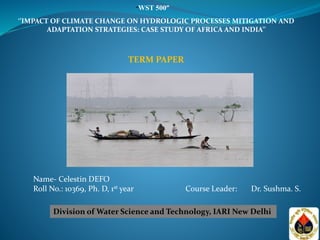
‘’IMPACT OF CLIMATE CHANGE ON HYDROLOGIC PROCESSES MITIGATION AND 
ADAPTATION STRATEGIES: CASE STUDY OF AFRICA AND INDIA’’ 
TERM PAPER 
Name- Celestin DEFO 
Roll No.: 10369, Ph. D, 1st year Course Leader: Dr. Sushma. S. 
Division of Water Science and Technology, IARI New Delhi
Content 
Introduction: what is Climate Change? 
Climate Change status in Africa 
Climate Change in India 
Mitigation strategies of Climate Change 
Adaptation strategies to Climate Change in Africa and 
India
Introduction 
‘’Global warming is for real. Every scientist knows that now, and 
we are on our way to the destruction of every species on earth, if 
we don't pay attention and reverse our course’’. Theodore C. Sorensen; 
Global warming is the ‘talk of the town’ in this century, with its 
detrimental effects already being brought to limelight by the recurring 
events of massive floods, annihilating droughts and ravaging cyclones 
throughout the globe ; 
Before embarking on a detailed analysis of Global warming and its 
impacts on climate, we should first know what climate, green house 
effect and global warming actually mean.
Introduction 
The climate is defined as’ the general or average weather 
conditions of a certain region, including temperature, 
rainfall, and wind’. 
The earth’s climate is most affected by latitude, the tilt of 
the Earth's axis, the movements of the Earth's wind belts, 
and the difference in temperatures of land and sea, and 
topography. 
Human activity, especially relating to actions relating to 
the depletion of the ozone layer, is also an important factor.
Introduction 
GREEN HOUSE EFFECT 
Green House effect is the phenomenon whereby the earth's 
atmosphere traps solar radiation, and is mediated by the 
presence in the atmosphere of gases such as carbon dioxide, 
water vapor, and methane that allow incoming sunlight to pass 
through, but absorb the heat radiated back from the earth's 
surface. 
Thus the Green house gases (GHGs) provide a blanketing effect in the 
lower strata of the earth’s atmosphere, and this blanketing effect is 
being enhanced because of the human activities like burning of fossil 
fuels etc.
Introduction 
EFFECT OF GLOBAL WARMING ON THE EARTH’S CLIMATE 
Detailed researches of climatic events of the past 150 years have 
revealed that the temperatures have risen all over the globe, with 
the warming occurring in two phases. 
The first phase was from 1919 to 1940, with an average 
temperature gain of 0.35°C, and the second phase was from 1970 
to the present, exhibiting temperature gains of 0.55°C. 
Records show that the past 25 years have been the warmest time 
of the past 5 centuries. The global warming has resulted in the 
warming of the oceans, rising of the sea levels, melting of 
glaciers, and diminished snow cover in the Northern 
Hemisphere.
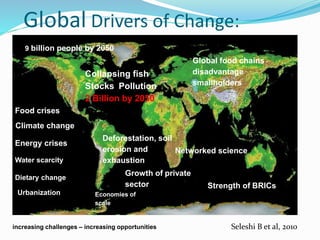
Global Drivers of Change: 
9 billion people by 2050 
Food crises 
Climate change 
Energy crises 
Water scarcity 
Dietary change 
Urbanization 
Collapsing fish 
Stocks Pollution 
2 Billion by 2050 
Global food chains 
disadvantage 
smallholders 
Networked science 
Strength of BRICs 
Deforestation, soil 
erosion and 
exhaustion 
Growth of private 
sector 
Economies of 
scale 
increasing challenges – increasing opportunities Seleshi B et al, 2010
Global Drivers of Change: 
In general, climate changes prior to the Industrial Revolution in the 
1700s can be explained by natural causes, such as: 
changes in solar energy, volcanic eruptions, and natural changes in 
greenhouse gas (GHG) concentrations. 
Recent climate changes, cannot be explained by natural causes alone. 
But, by the human activities such as the production of GHG can very 
likely explain most of that warming. 
GHG (Green House Gas) are: CO2, CH4 and N2O
Climate change in Africa 
The six warmest years on record in Africa have occurred 
within the last 20 years and the average temperature rose 
approximately 0.5 °C during the 20th century. 
In addition, the continent has seen a decrease in rainfall 
over large parts of the Sahel and Southern Africa, and an 
increase in parts of East and Central Africa. 
The number of weather-related disasters, droughts and 
floods, has doubled in Africa over the last 25 years, and 
Africa has higher mortality rates from droughts than any 
other region.
Climate change in Africa 
Projection of the ricks of global warming in Africa 
While the exact nature of the changes in temperature, 
precipitation, and extreme events is relatively known, there is 
agreement about the general trends. 
Global mean surface temperature is projected to increase 
between 1.5 °C (2.7°F) and 6 °C (10.8°F) by 2100. Sea levels are 
projected to rise by 15 to 95 centimeters (6 to 37 inches) by 2100. 
Climate change scenarios for Africa indicate future warming 
across the continent ranging from 0.2°C (0.36°F) per decade (low 
scenario) to more than 0.5°C (0.9°F) per decade (high scenario) 
(Hulme Desanker and Magadza 2001).
Climate change in Africa 
These years climatic variation manifests itself as extreme weather variations, such as 
floods and droughts. These events are increasing in magnitude and frequency over the 
years. The mean annual rainfall has been decreasing over the decades: 
Many countries, including Botswana, Burkina Faso, Chad, Ethiopia, Kenya, Mauritania 
and Mozambique, experience drought at regular intervals. 
The 1997-98 El Niño floods caused heavy damage to roads, buildings, bridges, railway 
lines and other property including schools. 
Incidences of epidemic diseases such as malaria increased during this period. This is 
related to improved conditions for mosquito breeding; mosquitoes transmit many 
viruses, over 100 of which are known to infect humans, including malaria, dengue, yellow 
fever and severe and sometimes fatal encephalitis and dengue haemorrhagic fever 
(Akhtar and others 2001). Cholera, which is transmitted by water or food, could aggravate 
health problems in many parts of the world including Africa. 
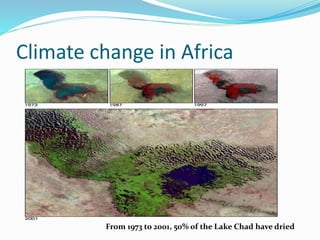
Lake Chad has already decreased in size by about 50% in the last 40 years.
Climate change in Africa 
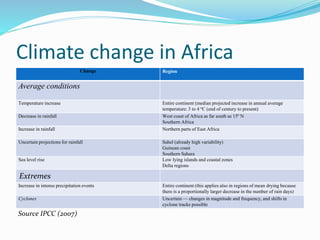
Change Region 
Average conditions 
Temperature increase Entire continent (median projected increase in annual average 
temperature: 3 to 4 ºC (end of century to present) 
Decrease in rainfall West coast of Africa as far south as 15º N 
Southern Africa 
Increase in rainfall Northern parts of East Africa 
Uncertain projections for rainfall Sahel (already high variability) 
Guinean coast 
Southern Sahara 
Sea level rise Low lying islands and coastal zones 
Delta regions 
Extremes 
Increase in intense precipitation events Entire continent (this applies also in regions of mean drying because 
there is a proportionally larger decrease in the number of rain days) 
Cyclones Uncertain — changes in magnitude and frequency, and shifts in 
cyclone tracks possible 
Source IPCC (2007)
Climate change in Africa 
From 1973 to 2001, 50% of the Lake Chad have dried
Climate change in Africa 
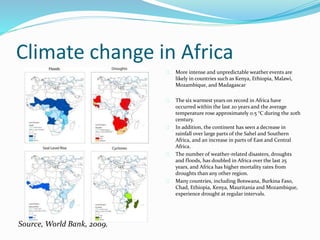
More intense and unpredictable weather events are 
likely in countries such as Kenya, Ethiopia, Malawi, 
Mozambique, and Madagascar 
The six warmest years on record in Africa have 
occurred within the last 20 years and the average 
temperature rose approximately 0.5 °C during the 20th 
century. 
In addition, the continent has seen a decrease in 
rainfall over large parts of the Sahel and Southern 
Africa, and an increase in parts of East and Central 
Africa. 
The number of weather-related disasters, droughts 
and floods, has doubled in Africa over the last 25 
years, and Africa has higher mortality rates from 
droughts than any other region. 
Many countries, including Botswana, Burkina Faso, 
Chad, Ethiopia, Kenya, Mauritania and Mozambique, 
experience drought at regular intervals. 
Source, World Bank, 2009.
Climate Change in India 
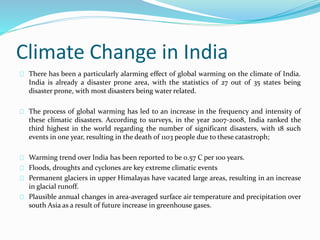
There has been a particularly alarming effect of global warming on the climate of India. 
India is already a disaster prone area, with the statistics of 27 out of 35 states being 
disaster prone, with most disasters being water related. 
The process of global warming has led to an increase in the frequency and intensity of 
these climatic disasters. According to surveys, in the year 2007-2008, India ranked the 
third highest in the world regarding the number of significant disasters, with 18 such 
events in one year, resulting in the death of 1103 people due to these catastroph; 
Warming trend over India has been reported to be 0.57 C per 100 years. 
Floods, droughts and cyclones are key extreme climatic events 
Permanent glaciers in upper Himalayas have vacated large areas, resulting in an increase 
in glacial runoff. 
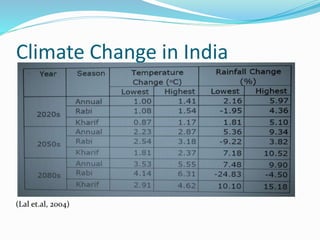
Plausible annual changes in area-averaged surface air temperature and precipitation over 
south Asia as a result of future increase in greenhouse gases.
Climate Change in India 
(Lal et.al, 2004)
Climate Change in India 
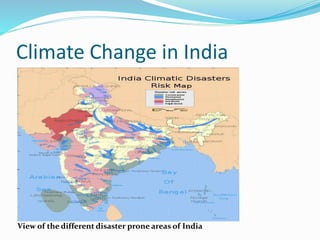
View of the different disaster prone areas of India
Climate Change in India 
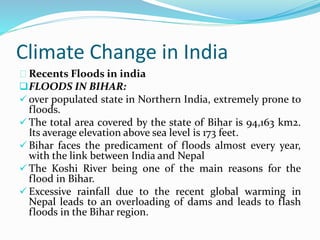
Recents Floods in india 
FLOODS IN BIHAR: 
 over populated state in Northern India, extremely prone to 
floods. 
 The total area covered by the state of Bihar is 94,163 km2. 
Its average elevation above sea level is 173 feet. 
 Bihar faces the predicament of floods almost every year, 
with the link between India and Nepal 
 The Koshi River being one of the main reasons for the 
flood in Bihar. 
 Excessive rainfall due to the recent global warming in 
Nepal leads to an overloading of dams and leads to flash 
floods in the Bihar region.
Climate Change in India 
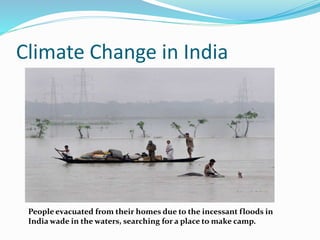
People evacuated from their homes due to the incessant floods in 
India wade in the waters, searching for a place to make camp.
Climate Change in India 
2005: MAHARASHTRA FLOOD: a major climatic catastrophe 
occurred in the state of Maharashtra in the form of massive floorings, leading to a death 
toll of 5000 people. The areas of Mumbai, Chiplun, Khed, Kalyan, Ratnagiri and Raigad 
were completely flooded 
2007 SOUTH ASIAN FLOODS: global warming finally triggered a flood 
formation that was so devastating, that it annihilated the entire South Asian region, destroying large zones in India, 
Pakistan, Nepal, Bhutan and Bangladesh. It’s most devastating effects were observed in South India, where it lasted for 
more than 15 days, killing more than 2000 people and affecting another 30 million. 
2009 INDIAN FLOODS: The most affected states were Karnataka, 
Orissa, Kerala, Gujarat and North-East Indian states, with over 200 people reported dead, 
and a million homes destroyed
Climate Change in India 
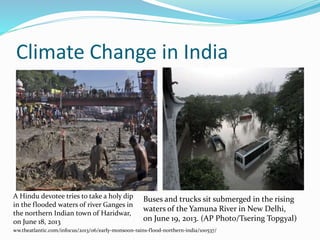
A Hindu devotee tries to take a holy dip 
in the flooded waters of river Ganges in 
the northern Indian town of Haridwar, 
on June 18, 2013 
Buses and trucks sit submerged in the rising 
waters of the Yamuna River in New Delhi, 
on June 19, 2013. (AP Photo/Tsering Topgyal) 
ww.theatlantic.com/infocus/2013/06/early-monsoon-rains-flood-northern-india/100537/
Climate Change in India 
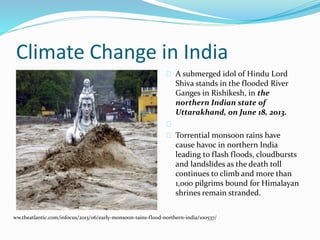
A submerged idol of Hindu Lord 
Shiva stands in the flooded River 
Ganges in Rishikesh, in the 
northern Indian state of 
Uttarakhand, on June 18, 2013. 
Torrential monsoon rains have 
cause havoc in northern India 
leading to flash floods, cloudbursts 
and landslides as the death toll 
continues to climb and more than 
1,000 pilgrims bound for Himalayan 
shrines remain stranded. 
ww.theatlantic.com/infocus/2013/06/early-monsoon-rains-flood-northern-india/100537/
Climate Change in India 
2010 LADAKH FLOODS: On 6th August 2010, Leh and many other 
villages of the Ladakh range were drowned by a downpour that killed at least 255 people 
2011 INDIAN FLOODS: The 2011 surge of severe precipitation affected 
India savagely, with surging flood waters in Northern and Eastern India affecting 
more than 10 million people as the swollen rivers washed away roads and towns, 
particularly in the states ofWest Bengal, Bihar, Kerala and Assam. 
2012 NORTHERN INDIAN FLOODS: The year 2012 is also 
included in the continuous chain of years of floods in India. In Assam, at least 27 people 
died and 900,000 were forced to evacuate their homes as monsoon rains. Uttarakhand, 
Himachal Pradesh and Jammu
Climate Change in India 
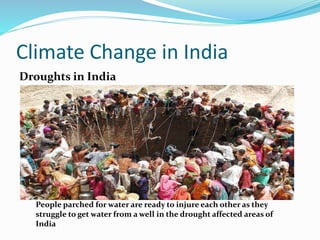
Droughts in India 
People parched for water are ready to injure each other as they 
struggle to get water from a well in the drought affected areas of 
India
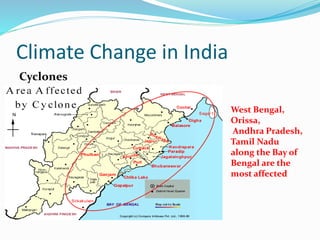
Cyclones 
West Bengal, 
Orissa, 
Andhra Pradesh, 
Tamil Nadu 
along the Bay of 
Bengal are the 
most affected 
Climate Change in India
Mitigation Strategies 
Many options of mitigating the atmospheric concentration of CO2 by 2050 at 
approximately 550 ppm. Have been indicated by some authors. 
C sequestrations in terrestrial ecosystems with renewable biomass constitute a 
major C sink. 
Forests, forestery and agriculture offer many benefict to the mitigation 
strategies of climate change
Mitigation Strategies 
1. Forests 
 The global forests cover 3952 million ha, or 30% of the earth’s land area of 
which about 95% are natural forests and 5% are plantations (FAO, 2005) 
 Tropical and subtropical forests comprise 56% of the world’s forests, while 
temperate and boreal forests accounts account for 44%. Forests are capable of 
mitigating large amount of carbon dioxide. 
 Presently, the net rate of C sequestration in forest ecosystems (other than those 
being deforested) is 1.7 to 0.5 Pg Cyr-1. 
 the forest sector has a biophysical mitigation potential of 5.4 PgCyr-1 on 
average up until 2050
Mitigation Strategies 
2 Agroforestry 
 An attractive and promising option for sequestering carbon on 
agricultural lands while leaving the bulk of the land for agricultural 
production, 
 Agroforestry plays vital roles in mitigation of atmospheric 
accumulation of GHGs, 
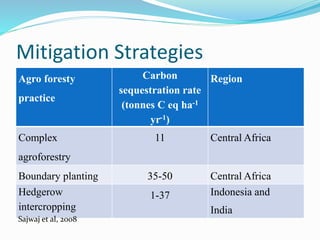
 Carbon sequestration rates are very encouraging for complex 
agroforestry, boundary planting, hedgerow intercropping, and home 
gardens.
Mitigation Strategies 
Agro foresty 
practice 
Carbon 
sequestration rate 
(tonnes C eq ha-1 
yr-1) 
Region 
Complex 
agroforestry 
11 Central Africa 
Boundary planting 35-50 Central Africa 
Hedgerow 
1-37 Indonesia and 
intercropping 
India 
Sajwaj et al, 2008
Mitigation Strategies 
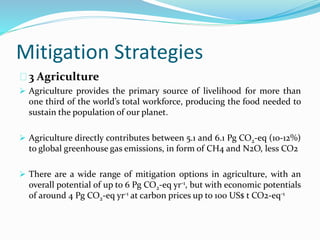
3 Agriculture 
 Agriculture provides the primary source of livelihood for more than 
one third of the world’s total workforce, producing the food needed to 
sustain the population of our planet. 
 Agriculture directly contributes between 5.1 and 6.1 Pg CO2-eq (10-12%) 
to global greenhouse gas emissions, in form of CH4 and N2O, less CO2 
 There are a wide range of mitigation options in agriculture, with an 
overall potential of up to 6 Pg CO2-eq yr-1, but with economic potentials 
of around 4 Pg CO2-eq yr-1 at carbon prices up to 100 US$ t CO2-eq-1
Mitigation Strategies 
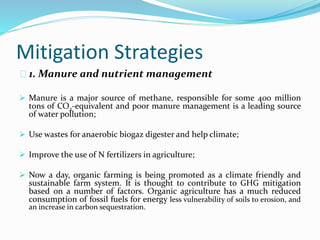
1. Manure and nutrient management 
 Manure is a major source of methane, responsible for some 400 million 
tons of CO2-equivalent and poor manure management is a leading source 
of water pollution; 
 Use wastes for anaerobic biogaz digester and help climate; 
 Improve the use of N fertilizers in agriculture; 
 Now a day, organic farming is being promoted as a climate friendly and 
sustainable farm system. It is thought to contribute to GHG mitigation 
based on a number of factors. Organic agriculture has a much reduced 
consumption of fossil fuels for energy less vulnerability of soils to erosion, and 
an increase in carbon sequestration.
Mitigation Strategies 
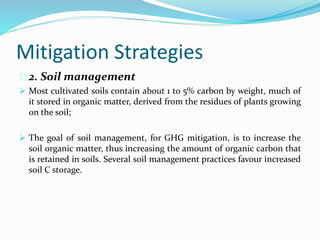
2. Soil management 
 Most cultivated soils contain about 1 to 5% carbon by weight, much of 
it stored in organic matter, derived from the residues of plants growing 
on the soil; 
 The goal of soil management, for GHG mitigation, is to increase the 
soil organic matter, thus increasing the amount of organic carbon that 
is retained in soils. Several soil management practices favour increased 
soil C storage.
Mitigation Strategies 
3. Livestock management 
 An annual emission from livestock is about 7.1 billion tons (including 
2.5 billion tons from clearing land for the animals, accounting for about 
14.5 percent of emissions from human activities; 
 Animal nutrition has the potential to reduce urine and manure N 
content, which will result in lower N2O emissions. Through breeding 
programmes, substantial progress has been made in reducing CH4 
emissions per litre of milk produced or per kilogram of meat.
Mitigation Strategies 
4. Energy management 
 A wide range of materials have been proposed for use, including grain, crop 
residue, cellulosic crops (e.g. switch grass, sugarcane) and various tree 
species. 
 These products can be burned directly, but often are processed further to 
generate liquid fuels such as ethanol or diesel fuel; 
 These fuels release CO2 when burned, but this CO2 is of recent 
atmospheric origin (via photosynthesis) and displaces CO2 which 
otherwise would have come from fossil C; 
 According to the U.S. Environmental Protection Agency, the use of ethanol 
blended with gasoline can reduce motor vehicle emissions of carbon 
monoxide by 25% to 30% and also reduce ozone levels that contribute to 
urban smog.
Adapting to Climate Change 
Adaptation measures are a series of policies that reduce the 
vulnerability of natural systems, human population and 
economies to climate stresses and climate change (Duwing et al 
1997). This can be achieved through: 
Institutional Arrangements 
Warning and Prevention of Floods 
Management of Droughts 
Adaptation in agriculcure
Adapting to Climate Change 
Improving Institutional Capacity 
Integrated planning for extreme climatic events at all 
levels 
Modern unified legislation for disaster management 
Comprehensive, robust and accessible database 
National network of all knowledge-based institutions 
Introduction of weather-indexed insurance 
Provision of adequate financial support for 
adaptation/ vulnerability reduction schemes
Adapting to Climate Change 
Development and Management of Water Resources 
Enhance water storage capacity, 
Conduct strategic analysis of NRLP and 
implement the inevitable 
Improved design standards in disaster prone 
areas 
Enhance water productivity at all levels 
Invigorate the traditional institutions at local 
levels 
Promote private partnership in critical functions
Adapting to Climate Change 
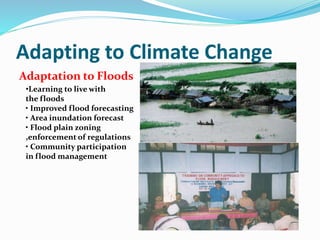
Adaptation to Floods 
•Learning to live with 
the floods 
• Improved flood forecasting 
• Area inundation forecast 
• Flood plain zoning 
,enforcement of regulations 
• Community participation 
in flood management
Adapting to Climate Change 
Drought management is still 
an ad-hoc and empirical famine intervention for providing instant 
relief to prevent starvation. 
Vulnerability mapping, 
community involvement; 
prevention, mitigation and 
quick response, use of modern 
tools and and procedures of 
imonitoring, impact documentation and capacity building is not 
yet fully in place
Adapting to Climate Change 
Comprehensive, decentralized system of drought declaration and 
management 
Vulnerability-level based system of drought response 
Shift in favor of robust and integrated system of 
livelihood opportunities 
Water harvesting at local, community and strategic level as a strategic 
intervention for mediating drought impacts
Adapting to Climate Change 
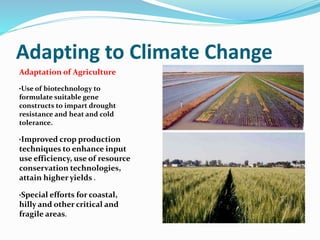
Adaptation of Agriculture 
•Use of biotechnology to 
formulate suitable gene 
constructs to impart drought 
resistance and heat and cold 
tolerance. 
•Improved crop production 
techniques to enhance input 
use efficiency, use of resource 
conservation technologies, 
attain higher yields . 
•Special efforts for coastal, 
hilly and other critical and 
fragile areas.
THANK YOU

Climate change

  • 1.
    “WST 500” ‘’IMPACTOF CLIMATE CHANGE ON HYDROLOGIC PROCESSES MITIGATION AND ADAPTATION STRATEGIES: CASE STUDY OF AFRICA AND INDIA’’ TERM PAPER Name- Celestin DEFO Roll No.: 10369, Ph. D, 1st year Course Leader: Dr. Sushma. S. Division of Water Science and Technology, IARI New Delhi
  • 2.
    Content Introduction: whatis Climate Change? Climate Change status in Africa Climate Change in India Mitigation strategies of Climate Change Adaptation strategies to Climate Change in Africa and India
  • 3.
    Introduction ‘’Global warmingis for real. Every scientist knows that now, and we are on our way to the destruction of every species on earth, if we don't pay attention and reverse our course’’. Theodore C. Sorensen; Global warming is the ‘talk of the town’ in this century, with its detrimental effects already being brought to limelight by the recurring events of massive floods, annihilating droughts and ravaging cyclones throughout the globe ; Before embarking on a detailed analysis of Global warming and its impacts on climate, we should first know what climate, green house effect and global warming actually mean.
  • 4.
    Introduction The climateis defined as’ the general or average weather conditions of a certain region, including temperature, rainfall, and wind’. The earth’s climate is most affected by latitude, the tilt of the Earth's axis, the movements of the Earth's wind belts, and the difference in temperatures of land and sea, and topography. Human activity, especially relating to actions relating to the depletion of the ozone layer, is also an important factor.
  • 5.
    Introduction GREEN HOUSEEFFECT Green House effect is the phenomenon whereby the earth's atmosphere traps solar radiation, and is mediated by the presence in the atmosphere of gases such as carbon dioxide, water vapor, and methane that allow incoming sunlight to pass through, but absorb the heat radiated back from the earth's surface. Thus the Green house gases (GHGs) provide a blanketing effect in the lower strata of the earth’s atmosphere, and this blanketing effect is being enhanced because of the human activities like burning of fossil fuels etc.
  • 6.
    Introduction EFFECT OFGLOBAL WARMING ON THE EARTH’S CLIMATE Detailed researches of climatic events of the past 150 years have revealed that the temperatures have risen all over the globe, with the warming occurring in two phases. The first phase was from 1919 to 1940, with an average temperature gain of 0.35°C, and the second phase was from 1970 to the present, exhibiting temperature gains of 0.55°C. Records show that the past 25 years have been the warmest time of the past 5 centuries. The global warming has resulted in the warming of the oceans, rising of the sea levels, melting of glaciers, and diminished snow cover in the Northern Hemisphere.
  • 7.
    Global Drivers ofChange: 9 billion people by 2050 Food crises Climate change Energy crises Water scarcity Dietary change Urbanization Collapsing fish Stocks Pollution 2 Billion by 2050 Global food chains disadvantage smallholders Networked science Strength of BRICs Deforestation, soil erosion and exhaustion Growth of private sector Economies of scale increasing challenges – increasing opportunities Seleshi B et al, 2010
  • 8.
    Global Drivers ofChange: In general, climate changes prior to the Industrial Revolution in the 1700s can be explained by natural causes, such as: changes in solar energy, volcanic eruptions, and natural changes in greenhouse gas (GHG) concentrations. Recent climate changes, cannot be explained by natural causes alone. But, by the human activities such as the production of GHG can very likely explain most of that warming. GHG (Green House Gas) are: CO2, CH4 and N2O
  • 9.
    Climate change inAfrica The six warmest years on record in Africa have occurred within the last 20 years and the average temperature rose approximately 0.5 °C during the 20th century. In addition, the continent has seen a decrease in rainfall over large parts of the Sahel and Southern Africa, and an increase in parts of East and Central Africa. The number of weather-related disasters, droughts and floods, has doubled in Africa over the last 25 years, and Africa has higher mortality rates from droughts than any other region.
  • 10.
    Climate change inAfrica Projection of the ricks of global warming in Africa While the exact nature of the changes in temperature, precipitation, and extreme events is relatively known, there is agreement about the general trends. Global mean surface temperature is projected to increase between 1.5 °C (2.7°F) and 6 °C (10.8°F) by 2100. Sea levels are projected to rise by 15 to 95 centimeters (6 to 37 inches) by 2100. Climate change scenarios for Africa indicate future warming across the continent ranging from 0.2°C (0.36°F) per decade (low scenario) to more than 0.5°C (0.9°F) per decade (high scenario) (Hulme Desanker and Magadza 2001).
  • 11.
    Climate change inAfrica These years climatic variation manifests itself as extreme weather variations, such as floods and droughts. These events are increasing in magnitude and frequency over the years. The mean annual rainfall has been decreasing over the decades: Many countries, including Botswana, Burkina Faso, Chad, Ethiopia, Kenya, Mauritania and Mozambique, experience drought at regular intervals. The 1997-98 El Niño floods caused heavy damage to roads, buildings, bridges, railway lines and other property including schools. Incidences of epidemic diseases such as malaria increased during this period. This is related to improved conditions for mosquito breeding; mosquitoes transmit many viruses, over 100 of which are known to infect humans, including malaria, dengue, yellow fever and severe and sometimes fatal encephalitis and dengue haemorrhagic fever (Akhtar and others 2001). Cholera, which is transmitted by water or food, could aggravate health problems in many parts of the world including Africa. Lake Chad has already decreased in size by about 50% in the last 40 years.
  • 12.
    Climate change inAfrica Change Region Average conditions Temperature increase Entire continent (median projected increase in annual average temperature: 3 to 4 ºC (end of century to present) Decrease in rainfall West coast of Africa as far south as 15º N Southern Africa Increase in rainfall Northern parts of East Africa Uncertain projections for rainfall Sahel (already high variability) Guinean coast Southern Sahara Sea level rise Low lying islands and coastal zones Delta regions Extremes Increase in intense precipitation events Entire continent (this applies also in regions of mean drying because there is a proportionally larger decrease in the number of rain days) Cyclones Uncertain — changes in magnitude and frequency, and shifts in cyclone tracks possible Source IPCC (2007)
  • 13.
    Climate change inAfrica From 1973 to 2001, 50% of the Lake Chad have dried
  • 14.
    Climate change inAfrica More intense and unpredictable weather events are likely in countries such as Kenya, Ethiopia, Malawi, Mozambique, and Madagascar The six warmest years on record in Africa have occurred within the last 20 years and the average temperature rose approximately 0.5 °C during the 20th century. In addition, the continent has seen a decrease in rainfall over large parts of the Sahel and Southern Africa, and an increase in parts of East and Central Africa. The number of weather-related disasters, droughts and floods, has doubled in Africa over the last 25 years, and Africa has higher mortality rates from droughts than any other region. Many countries, including Botswana, Burkina Faso, Chad, Ethiopia, Kenya, Mauritania and Mozambique, experience drought at regular intervals. Source, World Bank, 2009.
  • 15.
    Climate Change inIndia There has been a particularly alarming effect of global warming on the climate of India. India is already a disaster prone area, with the statistics of 27 out of 35 states being disaster prone, with most disasters being water related. The process of global warming has led to an increase in the frequency and intensity of these climatic disasters. According to surveys, in the year 2007-2008, India ranked the third highest in the world regarding the number of significant disasters, with 18 such events in one year, resulting in the death of 1103 people due to these catastroph; Warming trend over India has been reported to be 0.57 C per 100 years. Floods, droughts and cyclones are key extreme climatic events Permanent glaciers in upper Himalayas have vacated large areas, resulting in an increase in glacial runoff. Plausible annual changes in area-averaged surface air temperature and precipitation over south Asia as a result of future increase in greenhouse gases.
  • 16.
    Climate Change inIndia (Lal et.al, 2004)
  • 17.
    Climate Change inIndia View of the different disaster prone areas of India
  • 18.
    Climate Change inIndia Recents Floods in india FLOODS IN BIHAR:  over populated state in Northern India, extremely prone to floods.  The total area covered by the state of Bihar is 94,163 km2. Its average elevation above sea level is 173 feet.  Bihar faces the predicament of floods almost every year, with the link between India and Nepal  The Koshi River being one of the main reasons for the flood in Bihar.  Excessive rainfall due to the recent global warming in Nepal leads to an overloading of dams and leads to flash floods in the Bihar region.
  • 19.
    Climate Change inIndia People evacuated from their homes due to the incessant floods in India wade in the waters, searching for a place to make camp.
  • 20.
    Climate Change inIndia 2005: MAHARASHTRA FLOOD: a major climatic catastrophe occurred in the state of Maharashtra in the form of massive floorings, leading to a death toll of 5000 people. The areas of Mumbai, Chiplun, Khed, Kalyan, Ratnagiri and Raigad were completely flooded 2007 SOUTH ASIAN FLOODS: global warming finally triggered a flood formation that was so devastating, that it annihilated the entire South Asian region, destroying large zones in India, Pakistan, Nepal, Bhutan and Bangladesh. It’s most devastating effects were observed in South India, where it lasted for more than 15 days, killing more than 2000 people and affecting another 30 million. 2009 INDIAN FLOODS: The most affected states were Karnataka, Orissa, Kerala, Gujarat and North-East Indian states, with over 200 people reported dead, and a million homes destroyed
  • 21.
    Climate Change inIndia A Hindu devotee tries to take a holy dip in the flooded waters of river Ganges in the northern Indian town of Haridwar, on June 18, 2013 Buses and trucks sit submerged in the rising waters of the Yamuna River in New Delhi, on June 19, 2013. (AP Photo/Tsering Topgyal) ww.theatlantic.com/infocus/2013/06/early-monsoon-rains-flood-northern-india/100537/
  • 22.
    Climate Change inIndia A submerged idol of Hindu Lord Shiva stands in the flooded River Ganges in Rishikesh, in the northern Indian state of Uttarakhand, on June 18, 2013. Torrential monsoon rains have cause havoc in northern India leading to flash floods, cloudbursts and landslides as the death toll continues to climb and more than 1,000 pilgrims bound for Himalayan shrines remain stranded. ww.theatlantic.com/infocus/2013/06/early-monsoon-rains-flood-northern-india/100537/
  • 23.
    Climate Change inIndia 2010 LADAKH FLOODS: On 6th August 2010, Leh and many other villages of the Ladakh range were drowned by a downpour that killed at least 255 people 2011 INDIAN FLOODS: The 2011 surge of severe precipitation affected India savagely, with surging flood waters in Northern and Eastern India affecting more than 10 million people as the swollen rivers washed away roads and towns, particularly in the states ofWest Bengal, Bihar, Kerala and Assam. 2012 NORTHERN INDIAN FLOODS: The year 2012 is also included in the continuous chain of years of floods in India. In Assam, at least 27 people died and 900,000 were forced to evacuate their homes as monsoon rains. Uttarakhand, Himachal Pradesh and Jammu
  • 24.
    Climate Change inIndia Droughts in India People parched for water are ready to injure each other as they struggle to get water from a well in the drought affected areas of India
  • 25.
    Cyclones West Bengal, Orissa, Andhra Pradesh, Tamil Nadu along the Bay of Bengal are the most affected Climate Change in India
  • 26.
    Mitigation Strategies Manyoptions of mitigating the atmospheric concentration of CO2 by 2050 at approximately 550 ppm. Have been indicated by some authors. C sequestrations in terrestrial ecosystems with renewable biomass constitute a major C sink. Forests, forestery and agriculture offer many benefict to the mitigation strategies of climate change
  • 27.
    Mitigation Strategies 1.Forests  The global forests cover 3952 million ha, or 30% of the earth’s land area of which about 95% are natural forests and 5% are plantations (FAO, 2005)  Tropical and subtropical forests comprise 56% of the world’s forests, while temperate and boreal forests accounts account for 44%. Forests are capable of mitigating large amount of carbon dioxide.  Presently, the net rate of C sequestration in forest ecosystems (other than those being deforested) is 1.7 to 0.5 Pg Cyr-1.  the forest sector has a biophysical mitigation potential of 5.4 PgCyr-1 on average up until 2050
  • 28.
    Mitigation Strategies 2Agroforestry  An attractive and promising option for sequestering carbon on agricultural lands while leaving the bulk of the land for agricultural production,  Agroforestry plays vital roles in mitigation of atmospheric accumulation of GHGs,  Carbon sequestration rates are very encouraging for complex agroforestry, boundary planting, hedgerow intercropping, and home gardens.
  • 29.
    Mitigation Strategies Agroforesty practice Carbon sequestration rate (tonnes C eq ha-1 yr-1) Region Complex agroforestry 11 Central Africa Boundary planting 35-50 Central Africa Hedgerow 1-37 Indonesia and intercropping India Sajwaj et al, 2008
  • 30.
    Mitigation Strategies 3Agriculture  Agriculture provides the primary source of livelihood for more than one third of the world’s total workforce, producing the food needed to sustain the population of our planet.  Agriculture directly contributes between 5.1 and 6.1 Pg CO2-eq (10-12%) to global greenhouse gas emissions, in form of CH4 and N2O, less CO2  There are a wide range of mitigation options in agriculture, with an overall potential of up to 6 Pg CO2-eq yr-1, but with economic potentials of around 4 Pg CO2-eq yr-1 at carbon prices up to 100 US$ t CO2-eq-1
  • 31.
    Mitigation Strategies 1.Manure and nutrient management  Manure is a major source of methane, responsible for some 400 million tons of CO2-equivalent and poor manure management is a leading source of water pollution;  Use wastes for anaerobic biogaz digester and help climate;  Improve the use of N fertilizers in agriculture;  Now a day, organic farming is being promoted as a climate friendly and sustainable farm system. It is thought to contribute to GHG mitigation based on a number of factors. Organic agriculture has a much reduced consumption of fossil fuels for energy less vulnerability of soils to erosion, and an increase in carbon sequestration.
  • 32.
    Mitigation Strategies 2.Soil management  Most cultivated soils contain about 1 to 5% carbon by weight, much of it stored in organic matter, derived from the residues of plants growing on the soil;  The goal of soil management, for GHG mitigation, is to increase the soil organic matter, thus increasing the amount of organic carbon that is retained in soils. Several soil management practices favour increased soil C storage.
  • 33.
    Mitigation Strategies 3.Livestock management  An annual emission from livestock is about 7.1 billion tons (including 2.5 billion tons from clearing land for the animals, accounting for about 14.5 percent of emissions from human activities;  Animal nutrition has the potential to reduce urine and manure N content, which will result in lower N2O emissions. Through breeding programmes, substantial progress has been made in reducing CH4 emissions per litre of milk produced or per kilogram of meat.
  • 34.
    Mitigation Strategies 4.Energy management  A wide range of materials have been proposed for use, including grain, crop residue, cellulosic crops (e.g. switch grass, sugarcane) and various tree species.  These products can be burned directly, but often are processed further to generate liquid fuels such as ethanol or diesel fuel;  These fuels release CO2 when burned, but this CO2 is of recent atmospheric origin (via photosynthesis) and displaces CO2 which otherwise would have come from fossil C;  According to the U.S. Environmental Protection Agency, the use of ethanol blended with gasoline can reduce motor vehicle emissions of carbon monoxide by 25% to 30% and also reduce ozone levels that contribute to urban smog.
  • 35.
    Adapting to ClimateChange Adaptation measures are a series of policies that reduce the vulnerability of natural systems, human population and economies to climate stresses and climate change (Duwing et al 1997). This can be achieved through: Institutional Arrangements Warning and Prevention of Floods Management of Droughts Adaptation in agriculcure
  • 36.
    Adapting to ClimateChange Improving Institutional Capacity Integrated planning for extreme climatic events at all levels Modern unified legislation for disaster management Comprehensive, robust and accessible database National network of all knowledge-based institutions Introduction of weather-indexed insurance Provision of adequate financial support for adaptation/ vulnerability reduction schemes
  • 37.
    Adapting to ClimateChange Development and Management of Water Resources Enhance water storage capacity, Conduct strategic analysis of NRLP and implement the inevitable Improved design standards in disaster prone areas Enhance water productivity at all levels Invigorate the traditional institutions at local levels Promote private partnership in critical functions
  • 38.
    Adapting to ClimateChange Adaptation to Floods •Learning to live with the floods • Improved flood forecasting • Area inundation forecast • Flood plain zoning ,enforcement of regulations • Community participation in flood management
  • 39.
    Adapting to ClimateChange Drought management is still an ad-hoc and empirical famine intervention for providing instant relief to prevent starvation. Vulnerability mapping, community involvement; prevention, mitigation and quick response, use of modern tools and and procedures of imonitoring, impact documentation and capacity building is not yet fully in place
  • 40.
    Adapting to ClimateChange Comprehensive, decentralized system of drought declaration and management Vulnerability-level based system of drought response Shift in favor of robust and integrated system of livelihood opportunities Water harvesting at local, community and strategic level as a strategic intervention for mediating drought impacts
  • 41.
    Adapting to ClimateChange Adaptation of Agriculture •Use of biotechnology to formulate suitable gene constructs to impart drought resistance and heat and cold tolerance. •Improved crop production techniques to enhance input use efficiency, use of resource conservation technologies, attain higher yields . •Special efforts for coastal, hilly and other critical and fragile areas.
  • 42.