Climate Change Mitigation
Various Mitigation Strategies of
Climate Change
Prepared By
Roksana Aftab Ruhi
Department of Agriculture
Noakhali Science and Technology University
Noakhali,Chittagong,Bangladesh.
Climate Change Mitigation
Introduction
Climate change is one of the most pervasive and threatening issues of
our time, with far-reaching impacts in the twenty-first century.Earth's
climate is always changing. There have been times when Earth's
climate has been warmer than it is now. There have been times when it
has been cooler. These times can last thousands or millions of
years.Climate change is expected to have unprecedented implication on
where people can settle, grow food, build cities, and rely on functioning
ecosystems for the services they provide. In many places, temperature
changes and sea-level rise are already putting ecosystems under stress
and affecting human well-being.
UN Environment takes a multifaceted approach towards climate
change mitigation in its efforts to help countries move towards climate-
resilient and low emissions strategies. The effects of climate change
have reached a point where the emphasis has moved from proof of its
existence to policies of mitigation.
April 2014 the IPCC released “Climate Change 2014: Mitigation of
Climate Change,” which lays out ways to limit or reverse harmful
trends in greenhouse-gas emissions. The need for international
cooperation and especially a price on carbon are central to the report,
but it also highlights the importance of direct actions at every level.
Many of the suggestions are “actionable” by state and local authorities,
businesses and individuals.
Climate Change Mitigation
Climate
Climate is the statistics of weather over long periods of time. It is
measured by assessing the patterns of variation in temperature,
humidity, atmospheric pressure, wind, precipitation, atmospheric
particle count and other meteorological variables in a given region
over long periods of time.
Climate Change
Climate change, periodic modification of Earth’s climate brought about
as a result of changes in the atmosphere as well as interactions between
the atmosphere and various other geologic, chemical, biological, and
geographic factors within the Earth system.
The Fourth Assessment Report released in 2007, by the
Intergovernmental Panel on Climate Change (IPCC) stated that “there
is new and stronger evidence that most of the warming observed over
the last 50 years is attributable to human activities".
Climate change may refer to a change in average weather conditions,
or in the time variation of weather within the context of longer-term
average conditions.
Mitigation
Mitigation can mean using new technologies and renewable energies,
making older equipment more energy efficient, or changing
management practices or consumer behaviour . It can be as complex as
a plan for a new city, or as a simple as improvements to a cook stove
design. Efforts underway around the world range from high-tech
subway systems to bicycling paths and walkways.
Climate Change Mitigation
Climate Change Mitigation refers to efforts to reduce or prevent
emission of greenhouse gases.It is any action taken to permanently
eliminate or reduce the long-term risk and hazards of climate change
to human life, property.
The International Panel on Climate Change (IPCC) defines mitigation
as: “An anthropogenic intervention to reduce the sources or enhance
the sinks of greenhouse gases."
Climate Change Mitigation Strategy
Climate change involves complex interactions between climatic,
environmental, economic, political, institutional, social, and
technological processes. It cannot be addressed or comprehended in
isolation of broader societal goals (such as equity or sustainable
development), or other existing or probable future sources of stress.
In the United Nations Framework Convention on Climate Change
(UNFCCC) three conditions are made explicit when working towards
the goal of greenhouse gas stabilization in the atmosphere:
1. That it should take place within a time-frame sufficient to allow
ecosystems to adapt naturally to climate change;
2. That food production is not threatened and;
3. That economic development should proceed in a sustainable manner
Climate Change Mitigation
To eliminate or reduce the risk of climate change to human life and
property, both policy instruments and technology must be used in the
context of sustainable development.
Some regional agreements with mitigation implications – many
agreements were not primarily focussed on climate change
mitigation, but have achieved emission reductions as an added
benefit.
Causes of Climate Change
 Many of the causes of climate change are external to the Earth
system. Others are part of the Earth system but external to the
atmosphere. Still others involve interactions between the
atmosphere and other components of the Earth system and are
collectively described as feedbacks within the Earth system.
Feedbacks are among the most recently discovered and
challenging causal factors to study. Nevertheless, these factors
are increasingly recognized as playing fundamental roles in
climate variation.
Climate Change Mitigation
The most important mechanisms are described in this section
 Solar variability

The luminosity, or brightness, of the Sun has been increasing steadily
since its formation. This phenomenon is important to Earth’s climate,
because the Sun provides the energy to drive atmospheric
circulation and constitutes the input for Earth’s heat budget. Low solar
luminosity during Precambrian time underlies the faint young
Sun paradox, described in the section Climates of early Earth.
Radiative energy from the Sun is variable at very small timescales,
owing to solar storms and other disturbances.

The Sun as imaged in extreme ultraviolet light by the Earth-orbiting
Solar and Heliospheric
 Volcanic activity
Volcanic activity can influence climate in a number of ways at
different timescales. Individual volcanic eruptions can release large
quantities of sulfur dioxide and other aerosols into the stratosphere,
Climate Change Mitigation
reducing atmospheric transparency and thus the amount of solar
radiation reaching Earth’s surface and troposphere.
A recent example is the 1991 eruption in the Philippines of Mount
Pinatubo, which had measurable influences on atmospheric circulation
and heat budgets. The 1815 eruption of Mount Tambora on
the island of Sumbawa had more dramatic consequences, as
the spring and summer of the following year (1816, known as “the year
without a summer”) were unusually cold over much of the world. New
England and Europe experienced snowfalls and frosts throughout the
summer of 1816.

A column of gas and ash rising from Mount Pinatubo in the
Philippines on June 12, 1991, just days … David H. Harlow/ U.S
.Geological Survey.
 Tectonic activity
Tectonic movements of Earth’s crust have had profound effects on
climate at timescales of millions to tens of millions of years. These
movements have changed the shape, size, position, and elevation of the
continental masses as well as the bathymetry of the oceans.
Topographic and bathymetric changes in turn have had strong effects
on the circulation of both the atmosphere and the oceans.
Climate Change Mitigation
Tectonic activity also influences atmospheric chemistry, particularly
carbon dioxide concentrations. Carbon dioxide is emitted
from volcanoes and vents in rift zones and subduction zones.
Variations in the rate of spreading in rift zones and the degree of
volcanic activity near plate margins have influenced atmospheric
carbon dioxide concentrations throughout Earth’s history.
 Orbital variations
The orbital geometry of Earth is affected in predictable ways by the
gravitational influences of other planets in the solar system. orbital
variations cause changes in the latitudinal and seasonal distribution of
solar radiation, which in turn drive a number of climate variations.
Orbital variations play major roles in pacing glacial-interglacial and
monsoonal patterns. Their influences have been identified in climatic
changes over much of the Phanerozoic.
 Greenhouse gases
Greenhouse gases are gas molecules that have the property of
absorbing infrared radiation (net heat energy) emitted from Earth’s
surface and reradiating it back to Earth’s surface, thus contributing to
the phenomenon known as the greenhouse effect. Carbon
dioxide, methane, and water vapour are the most important
greenhouse gases, and they have a profound effect on the energy budget
of the Earth system despite making up only a fraction of all
atmospheric gases. Concentrations of greenhouse gases have varied
substantially during Earth’s history, and these variations have driven
substantial climate changes at a wide range of timescales.
Climate Change Mitigation
 Human activities
Recognition of global climate change as an environmental issue has
drawn attention to the climatic impact of human activities. Most of
this attention has focused on carbon dioxide emission via fossil-fuel
combustion and deforestation. Human activities also yield releases of
other greenhouse gases.
The conversion of vegetation by deforestation, afforestation,
and agriculture, is receiving mounting attention as a further source of
climate change. It is becoming increasingly clear that human impacts
on vegetation cover can have local, regional, and even global effects on
climate.
Tropical forests and deforestation in the early 21st century
Climate Change Mitigation
Impact of Climate Change
Climate change and global warming are already beginning to
transform life on Earth, the impacts of climate change threaten to
catastrophically damage our world.
Higher Temperatures
Earth’s temperatures in 2015 were the hottest ever recorded (source:
NASA).Because a change of even 1 degree Fahrenheit – which may
sound small – can upset the delicate balance of ecosystems, and affect
plants and animals that inhabit them.
Changing Landscapes and Wildlife Habitat
Rising temperatures and changing patterns of precipitation are
changing where plants grow, and in the case of our oceans, encouraging
the proliferation of species that impact native ocean habitat. As
landscapes and habitats literally shift, wildlife must quickly adjust.
Experts predict that one-fourth of Earth’s species will be headed for
extinction by 2050 if the warming trend continues at its current rate.
Rising Seas
As ocean waters warm, they expand, causing sea-levels to rise. Melting
glaciers compound the problem by dumping even more fresh water into
the oceans. Rising seas threaten to inundate low-lying areas and
islands, threaten dense coastal populations, erode shorelines, damage
property and destroy ecosystems.
Climate Change Mitigation
Increased Risk of Storms, Droughts, and Floods
Climate change is intensifying drought, storms, and floods around the
world. Where nature has been destroyed by development, communities
are at risk from these intensified climate patterns.
Communities at Risk
In the U.S. alone, half of its residents live within 50 miles of the coast.
Worldwide, approximately 100 million people live within three feet of
sea level. Sea level rise associated with climate change could displace
tens of millions of people in low-lying areas – especially in developing
countries. Inhabitants of some small island countries that rest barely
above the existing sea level are already abandoning their islands, some
of the world’s first climate change refugees.
Economic Impact
The true economic impact of climate change is hard to predict. But it’s
safe to say that many key economic sectors – from fishing to energy to
water utilities – will feel long-term impacts of climate change. From
warming seas, which encourage proliferation of non-native species
that impact fishing industries, to rising temperatures, which impact
energy usage around the world, our shifting global climate will force
many industries to move quickly to adapt to change.
Mitigation Strategies to Climate Change
There are so many strategies are created by different countries policy
makers and international organisations. Some of them included in their
national policy statement and some are globally used .A range of policy
instruments is available to mitigate climate change including carbon
taxes, emissions trading, regulation, information measures,
Climate Change Mitigation
government provision of goods and services, and voluntary
agreements. Appropriate criteria for assessing these instruments
include: economic efficiency, cost effectiveness, distributional impact,
and institutional, political, and administrative feasibility.
 Greenhouse gas concentrations and stabilization
One of the issues often discussed in relation to climate change
mitigation strategy is the stabilization of greenhouse gas
concentrations in the atmosphere. The United Nations Framework
Convention on Climate Change (UNFCCC) has the ultimate objective
of preventing "dangerous" anthropogenic (i.e., human) interference of
the climate system. As is stated in Article 2 of the Convention, this
requires that greenhouse gas (GHG) concentrations are stabilized in the
atmosphere at a level where ecosystems can adapt naturally to climate
change, food production is not threatened, and economic
development can proceed in a sustainable fashion.[20]There is a
difference between stabilizing CO2emissions and stabilizing
atmospheric concentrations of CO2. Stabilizing emissions of CO2 at
current levels would not lead to a stabilization in the atmospheric
concentration of CO2. In the absence of policies to mitigate climate
change, GHG emissions could rise significantly over the 21st century.
Climate Change Mitigation
Numerous assessments have considered how atmospheric GHG
concentrations could be stabilized. The lower the desired stabilization
level, the sooner global GHG emissions must peak and decline.[33] GHG
concentrations are unlikely to stabilize this century without major
policy changes.
Projected carbon dioxide emissions and atmospheric concentrations
over the 21st century for reference and mitigation scenarios
 Energy consumption by power source
To create lasting climate change mitigation, the replacement of high
carbon emission intensity power sources, such as conventional fossil
fuels—oil, coal and natural gas—with low-carbon power sources is
required. At the core of most proposals is the reduction of greenhouse
Climate Change Mitigation
gas (GHG) emissions through reducing energy waste and switching
to low-carbon power sources of energy. Increased use of electricity
generation for meeting the future transportation load is primarily
fossil-fuel based mostly natural gas, followed by coalbut could also be
met through nuclear, tidal, hydroelectric and other sources.
A range of energy technologies may contribute to climate change
mitigation strategies include nuclear power and renewable
energy sources such as biomass, hydroelectricity, wind power, solar
power, geothermal power, ocean energy, and; the use of carbon sinks,
and carbon capture and storage etc.
 Renewable energy
Renewable energy is derived from natural processes that are
replenished constantly. In its various forms, it derives directly from the
Climate Change Mitigation
sun, or from heat generated deep wthin the earth. Climate change
concernsand the need to reduce carbon emissions are driving
increasing growth in the renewable energy industries. Low-carbon
renewable energy replaces conventional fossil fuels in three main
areas: power generation, hot water/ space heating, and transport fuels.
The worldwide growth of renewable energy is shown by the green line.
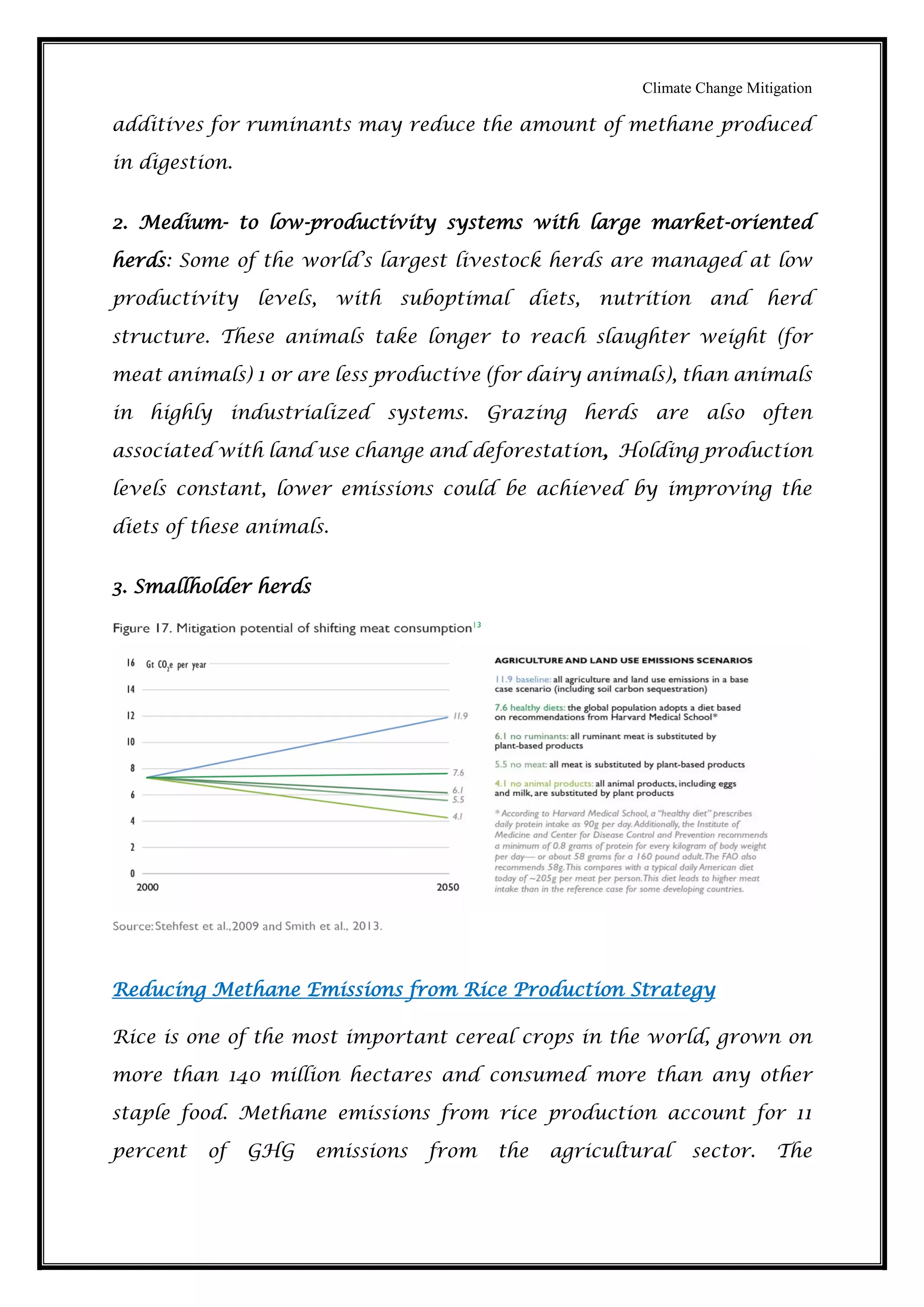
 Carbon capture and storage
Carbon capture and storage (CCS) is a method to mitigate climate
change by capturing carbon dioxide (CO2) from large point sources such
as power plants and subsequently storing it away safely instead of
releasing it into the atmosphere. The IPCC estimates that the costs of
halting global warming would double without CCS. The International
Energy Agency says CCS is "the most important single new technology
for CO2 savings" in power generation and industry.Though it requires
up to 40% more energy to run a CCS coal power plant than a regular
coal plant, CCS could potentially capture about 90% of all the carbon
emitted by the plant.
 Non-CO2 greenhouse gases
Climate Change Mitigation
CO2 is not the only GHG relevant to mitigation,[209] and governments
have acted to regulate the emissions of other GHGs emitted by human
activities (anthropogenic GHGs). The emissions caps agreed to by most
developed countries under the Kyoto Protocol regulate the emissions of
almost all the anthropogenic GHGs.[210] These gases are
CO2, methane (CH4), nitrous oxide (N2O),the hydro fluorocarbons (HFC),
per fluorocarbons (PFC), and Sulfur Hexa fluoride (SF6).Stabilizing the
atmospheric concentrations of the different anthropogenic GHGs
requires an understanding of their different physical properties.
Reducing the amount of waste methane produced in the first place and
moving away from use of gas as a fuel source will have a greater
beneficial impact, as might other approaches to productive use of
otherwise-wasted methane.
Another physical property of the anthropogenic GHGs relevant to
mitigation is the different abilities of the gases to trap heat (in the form
of infrared radiation). A measure for this physical property is
the global warming potential (GWP), and is used in the Kyoto Protocol.
Although not designed for this purpose, the Montreal Protocol has
probably benefited climate change mitigation efforts. The Montreal
Protocol is an international treaty that has successfully reduced
emissions of ozone-depleting substances (for example, CFCs), which are
also greenhouse gases.
 Governmental Strategies
Many countries, both developing and developed, are aiming to use
cleaner technologies (World Bank, 2010, p. 192).Use of these technologies
aids mitigation and could result in substantial reductions in
CO2emissions. Policies include targets for emissions reductions,
increased use of renewable energy, and increased energy efficiency. It
Climate Change Mitigation
is often argued that the results of climate change are more damaging
in poor nations, where infrastructures are weak and few social services
exist.
Kyoto Protocol
The main current international agreement on combating climate
change is the Kyoto Protocol, which came into force on 16 February
2005. The Kyoto Protocol is an amendment to the United Nations
Framework Convention on Climate Change (UNFCCC). Countries that
have ratified this protocol have committed to reduce their emissions
of carbon dioxide and five other greenhouse gases, or engage
in emissions trading if they maintain or increase emissions of these
gases.
Temperature targets
Actions to mitigate climate change are sometimes based on the goal of
achieving a particular temperature target. One of the targets that has
been suggested is to limit the future increase in global mean
temperature (global warming) to below 2 °C, relative to the pre-
industrial level.
 Non-governmental Strategies
While many of the proposed strategies of mitigating climate change
require governmental funding, legislation and regulatory action,
individuals play a part in the mitigation effort.
Climate Change Mitigation
 Strategy by Sector
Transportation
Transportation emissions account for roughly 1/4 of emissions
worldwide. Modern energy-efficient technologies, such as plug-in
hybrid electric vehicles and carbon-neutral synthetic gasoline & Jet
fuel may also help to reduce the consumption of petroleum, land use
changes and emissions of carbon dioxide. Utilizing rail transport,
especially electric rail, over the far less efficient air transport and truck
transport significantly reduces emissions.
Urban planning
Effective urban planning to reduce sprawl aims to decrease Vehicle
Miles Travelled (VMT), lowering emissions from transportation.
Personal cars are extremely inefficient at moving passengers,
while public transport and bicycles are many times more efficient (as
is the simplest form of human transportation, walking). All of these are
encouraged by urban/community planning and are an effective way
to reduce greenhouse gas emissions.
Building design
New buildings can be constructed using passive solar building
design, low-energy building, or zero-energy building techniques,
using renewable heat sources. Existing buildings can be made more
efficient through the use of insulation, high-efficiency appliances
(particularly hot water heaters and furnaces), double- or triple-glazed
gas-filled windows, external window shades, and building orientation
and siting. In addition to designing buildings which are more energy-
Climate Change Mitigation
efficient to heat, it is possible to design buildings that are more energy-
efficient to cool by using lighter-coloured.
Population
Various organizations promote population control as a means for
mitigating global warming. Proposed strategy include improving
access to family planning and reproductive health care and
information, reducing natalistic politics, public education about the
consequences of continued population growth, and improving access of
women to education and economic opportunities.
Forestry and other Land Uses
 The land uses account for the equivalent of 10 to 12 giga tons of CO2
per year, approximately 25% of anthropogenic emissions. These
primarily result from deforestation, agriculture and livestock. With
a reduction in deforestation, increasing restoration of forests and
the widespread adoption of sustainable cropland and grazing
management techniques, it is possible that this sector could become
a net CO2 sink before 2100.
 “The most cost‐effective mitigation options in forestry are
afforestation, sustainable forest management and reducing
deforestation, with large differences in their relative importance
across regions. In agriculture, the most cost‐effective mitigation
options are cropland management, grazing land management, and
restoration of organic soils.”
Strategies for Mitigating Climate Change on Agriculture
To be widely applied, mitigation strategies must ensure that yields are
not harmed and must also be cost-effective. Additionally, strategies
Climate Change Mitigation
that support the resilience of the agricultural sector to a changing
climate are more likely to be readily embraced by farmers and policy
makers alike. Mitigation potential in the agricultural sector through a
combination of emissions reduction, sequestration of carbon in
agricultural systems, and major shifts in consumption patterns. These
levels of mitigation would make the agricultural sector roughly GHG
neutral.
Intensification strategies
They lead to a reduction in absolute emissions only if production is held
constant. They do, however, necessarily reduce emissions per unit of
output. However, the implications of intensification are complex and
incentives for intensification process need to be carefully evaluated to
avoid perverse or opposite effects.
Reducing Emission from Enteric Fermentation Strategy
Enteric fermentation is responsible for over 40 percent of direct
agricultural emissions. Beef and dairy cattle account for roughly two-
thirds of all emissions from enteric fermentation. The world’s ruminant
herds can be roughly broken into three categories, each with different
mitigation strategies.
1. Industrialized livestock production: Most livestock production
systems in highly developed countries have already optimized the diet
and nutrition of animals and already have state of the art management
practices for health and reproduction. There is little that can be done
to improve the productivity of these herds, under current breeding and
nutrition technology. However, it may still be possible to reduce their
GHG emission levels. A number of promising diet supplements and
Climate Change Mitigation
additives for ruminants may reduce the amount of methane produced
in digestion.
2. Medium- to low-productivity systems with large market-oriented
herds: Some of the world’s largest livestock herds are managed at low
productivity levels, with suboptimal diets, nutrition and herd
structure. These animals take longer to reach slaughter weight (for
meat animals) 1 or are less productive (for dairy animals), than animals
in highly industrialized systems. Grazing herds are also often
associated with land use change and deforestation, Holding production
levels constant, lower emissions could be achieved by improving the
diets of these animals.
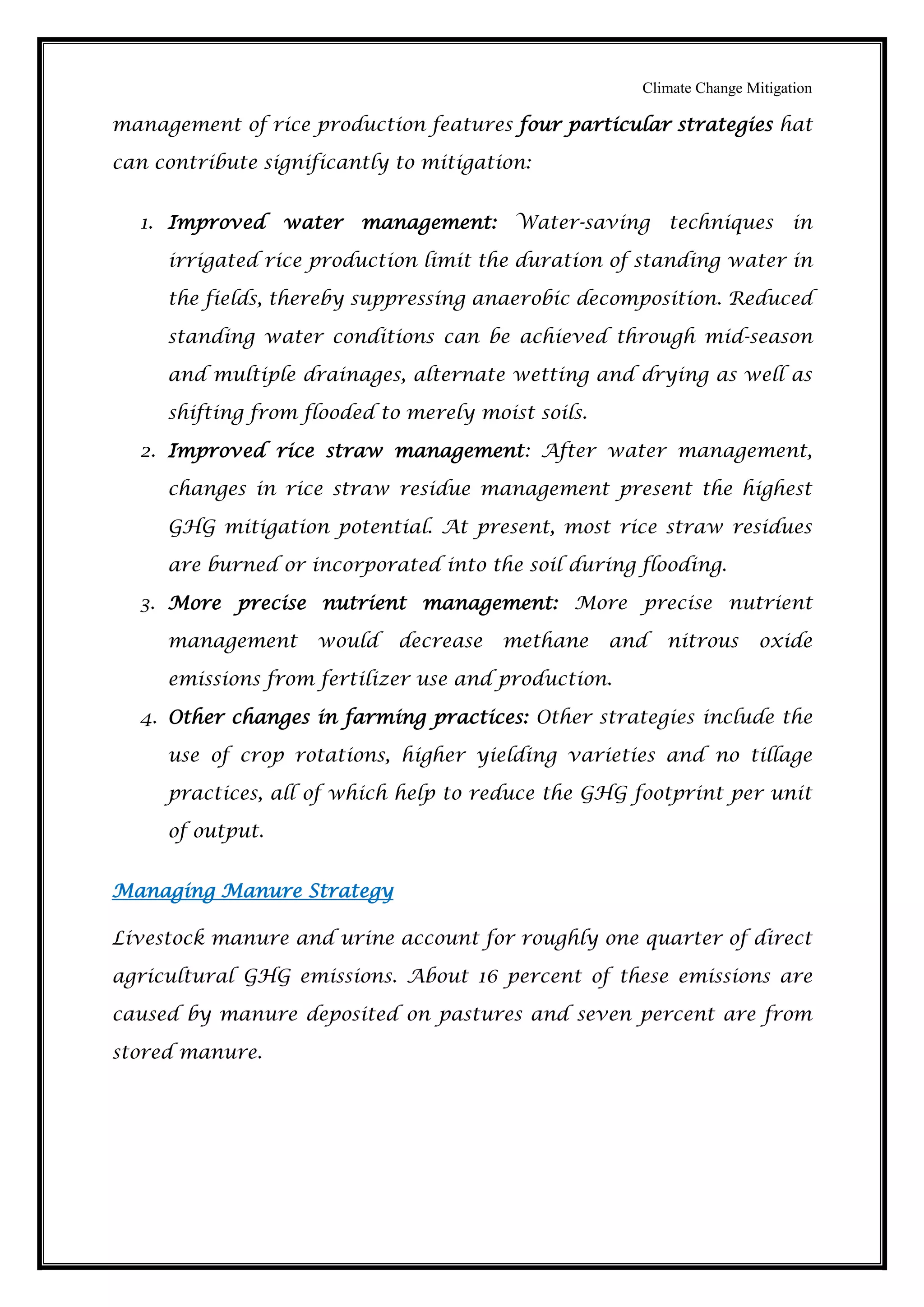
3. Smallholder herds
Reducing Methane Emissions from Rice Production Strategy
Rice is one of the most important cereal crops in the world, grown on
more than 140 million hectares and consumed more than any other
staple food. Methane emissions from rice production account for 11
percent of GHG emissions from the agricultural sector. The
Climate Change Mitigation
management of rice production features four particular strategies hat
can contribute significantly to mitigation:
1. Improved water management: Water-saving techniques in
irrigated rice production limit the duration of standing water in
the fields, thereby suppressing anaerobic decomposition. Reduced
standing water conditions can be achieved through mid-season
and multiple drainages, alternate wetting and drying as well as
shifting from flooded to merely moist soils.
2. Improved rice straw management: After water management,
changes in rice straw residue management present the highest
GHG mitigation potential. At present, most rice straw residues
are burned or incorporated into the soil during flooding.
3. More precise nutrient management: More precise nutrient
management would decrease methane and nitrous oxide
emissions from fertilizer use and production.
4. Other changes in farming practices: Other strategies include the
use of crop rotations, higher yielding varieties and no tillage
practices, all of which help to reduce the GHG footprint per unit
of output.
Managing Manure Strategy
Livestock manure and urine account for roughly one quarter of direct
agricultural GHG emissions. About 16 percent of these emissions are
caused by manure deposited on pastures and seven percent are from
stored manure.
Climate Change Mitigation
There are three primary approaches to emissions reduction for stored
manure:
1. More efficient use of manure as an energy or crop nutrient
source:If designed properly, better management of manure can
reduce the need for synthetic fertilizers, displace fossil fuels,
create profitable products for producers, and increase the
productivity of croplands and pastures. One of the most popular
mitigation practices for stored manure is methane, or anaerobic,
digesters. Digesters can turn the methane from manure slurry
into either electricity or natural gas, for use on-site or for sale to
local utilities.
2. Storage and handling practices: Emissions from stored manure
can be greatly reduced through a number of simple storage and
handling practices. Such practices include reducing storage time
covering the manure, avoiding straw/hay beddingand using
housing and waste management systems that enable better
handling of manure.
3. Diet changes: Changing the diet of livestock can affect the volume
and composition of manure, helping to reduce the emissions.
Practices include balancing dietary proteins, tannin supplements,
and other feed additives. Balancing dietary proteins is a reliable
strategy, but more research is needed on the efficacy of other feed
additives.
4. Shift to diversified farming systems.
Climate Change Mitigation
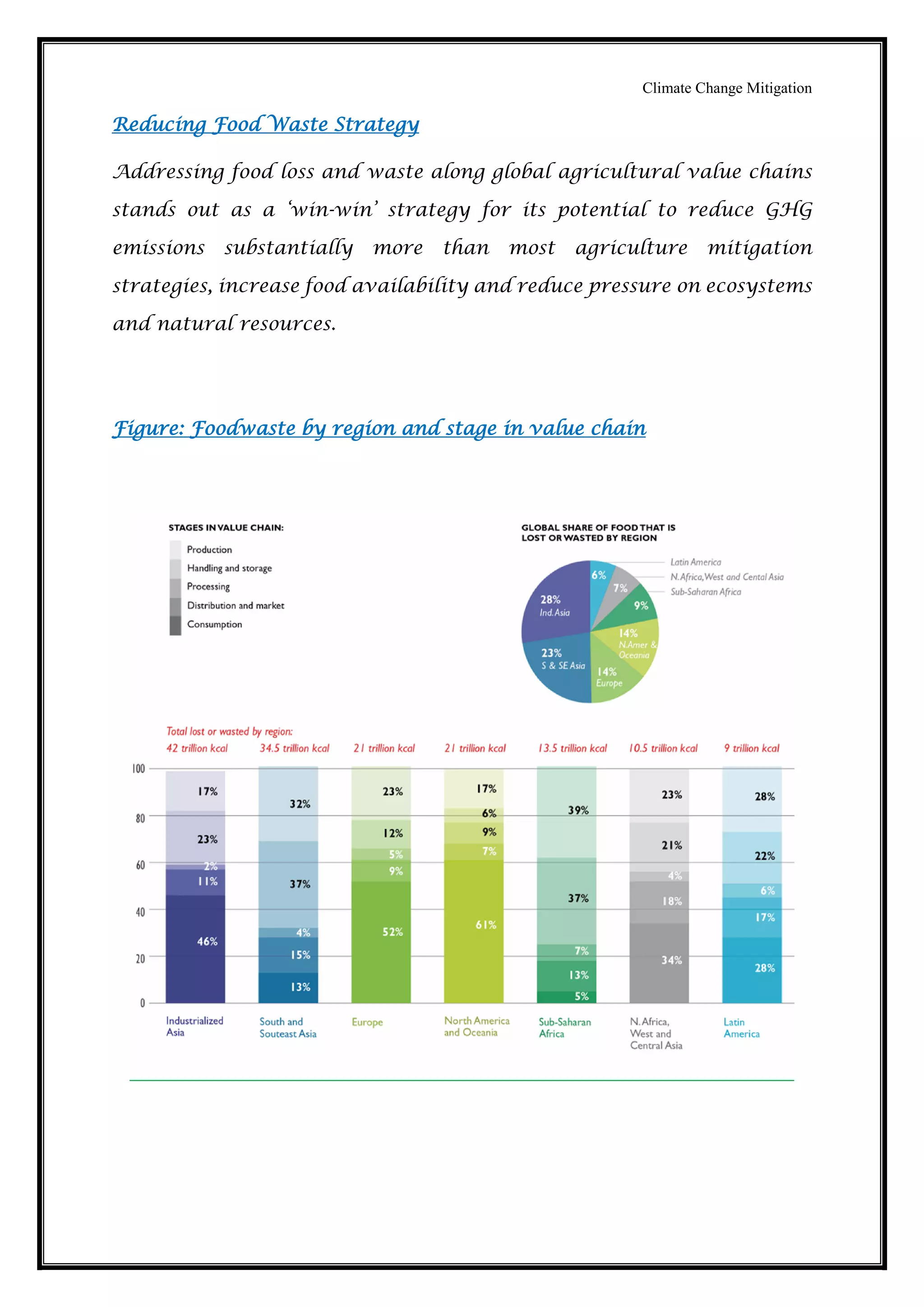
Reducing Food Waste Strategy
Addressing food loss and waste along global agricultural value chains
stands out as a ‘win-win’ strategy for its potential to reduce GHG
emissions substantially more than most agriculture mitigation
strategies, increase food availability and reduce pressure on ecosystems
and natural resources.
Figure: Foodwaste by region and stage in value chain
Climate Change Mitigation
Other Mitigation Strategies Sector
 Enhance international incentives for climate change action
 GHG emissions from agricultural sources
 .International finance for agricultural programs.
Conclusion
Economic tools can be useful in designing climate change mitigation
policies." "While the limitations of economics and social welfare
analysis, including cost–benefit analysis, are widely documented,
economics nevertheless provides useful tools for assessing the pros and
cons of taking, or not taking, action on climate change mitigation, as
well as of adaptation measures, in achieving competing societal goals.
Understanding these pros and cons can help in making policy decisions
on climate change mitigation and can influence the actions taken by
countries, institutions and individuals.
“Bringing down emissions of
greenhouse gases asks a good
deal of people, not least that
they accept the science of
climate change. It requires them
to make sacrifices today so that
future generations will suffer
less, and to weigh the needs of
people who are living far away. ”
— The Economist, 28 November 2015[
Climate Change Mitigation
Summary
At the global level, it is essential for all the countries to express a robust
and firm commitment to confront the issue of global warming. Climate
change is in fact a global problem and as such requires suitable actions
from the international community. Countries all over the world should
work together and provide support in sharing experiences,
technologies, talent and resources to lower greenhouse gas emissions
and ultimately reducing the threat of climate change in the planet.
The strategy has to be both credible and flexible. Credibility is essential
because no strategy, no matter how well designed, will elicit the
required behavioural responses if people lack confidence that it will be
carried through. Flexibility is also needed, because uncertainty
margins about both the economic and environmental results of any
strategy remain large, so that mid-term corrections to any strategy will
almost certainly be required. Building-in from the start such a capacity
to make periodic corrections would reduce risks of deadlock that might
arise if all changes had to be negotiated along the way. There is no doubt
some element of trade-off between credibility which requires clear
targets and flexibility, which requires the capacity to adjust them.
Combining strongly-anchored long-term objectives with rolling shorter-
term commitment periods may be one way of balancing this trade-off.
Finally, the strategy needs to be put into place urgently. The
illustrative mitigation reference scenario considered in this booklet
suggests that even under an ambitious abatement strategy, the
required implicit price of carbon emissions is relatively modest over the
next 10 to 15 years. This creates a “breathing space”, but this breathing
space will be used productively only if the strategy provides an
immediate and clear signal for the longer term.

Climate change mitigation

  • 1.
    Climate Change Mitigation VariousMitigation Strategies of Climate Change Prepared By Roksana Aftab Ruhi Department of Agriculture Noakhali Science and Technology University Noakhali,Chittagong,Bangladesh.
  • 2.
    Climate Change Mitigation Introduction Climatechange is one of the most pervasive and threatening issues of our time, with far-reaching impacts in the twenty-first century.Earth's climate is always changing. There have been times when Earth's climate has been warmer than it is now. There have been times when it has been cooler. These times can last thousands or millions of years.Climate change is expected to have unprecedented implication on where people can settle, grow food, build cities, and rely on functioning ecosystems for the services they provide. In many places, temperature changes and sea-level rise are already putting ecosystems under stress and affecting human well-being. UN Environment takes a multifaceted approach towards climate change mitigation in its efforts to help countries move towards climate- resilient and low emissions strategies. The effects of climate change have reached a point where the emphasis has moved from proof of its existence to policies of mitigation. April 2014 the IPCC released “Climate Change 2014: Mitigation of Climate Change,” which lays out ways to limit or reverse harmful trends in greenhouse-gas emissions. The need for international cooperation and especially a price on carbon are central to the report, but it also highlights the importance of direct actions at every level. Many of the suggestions are “actionable” by state and local authorities, businesses and individuals.
  • 3.
    Climate Change Mitigation Climate Climateis the statistics of weather over long periods of time. It is measured by assessing the patterns of variation in temperature, humidity, atmospheric pressure, wind, precipitation, atmospheric particle count and other meteorological variables in a given region over long periods of time. Climate Change Climate change, periodic modification of Earth’s climate brought about as a result of changes in the atmosphere as well as interactions between the atmosphere and various other geologic, chemical, biological, and geographic factors within the Earth system. The Fourth Assessment Report released in 2007, by the Intergovernmental Panel on Climate Change (IPCC) stated that “there is new and stronger evidence that most of the warming observed over the last 50 years is attributable to human activities". Climate change may refer to a change in average weather conditions, or in the time variation of weather within the context of longer-term average conditions. Mitigation Mitigation can mean using new technologies and renewable energies, making older equipment more energy efficient, or changing management practices or consumer behaviour . It can be as complex as a plan for a new city, or as a simple as improvements to a cook stove design. Efforts underway around the world range from high-tech subway systems to bicycling paths and walkways.
  • 4.
    Climate Change Mitigation ClimateChange Mitigation Climate Change Mitigation refers to efforts to reduce or prevent emission of greenhouse gases.It is any action taken to permanently eliminate or reduce the long-term risk and hazards of climate change to human life, property. The International Panel on Climate Change (IPCC) defines mitigation as: “An anthropogenic intervention to reduce the sources or enhance the sinks of greenhouse gases." Climate Change Mitigation Strategy Climate change involves complex interactions between climatic, environmental, economic, political, institutional, social, and technological processes. It cannot be addressed or comprehended in isolation of broader societal goals (such as equity or sustainable development), or other existing or probable future sources of stress. In the United Nations Framework Convention on Climate Change (UNFCCC) three conditions are made explicit when working towards the goal of greenhouse gas stabilization in the atmosphere: 1. That it should take place within a time-frame sufficient to allow ecosystems to adapt naturally to climate change; 2. That food production is not threatened and; 3. That economic development should proceed in a sustainable manner
  • 5.
    Climate Change Mitigation Toeliminate or reduce the risk of climate change to human life and property, both policy instruments and technology must be used in the context of sustainable development. Some regional agreements with mitigation implications – many agreements were not primarily focussed on climate change mitigation, but have achieved emission reductions as an added benefit. Causes of Climate Change  Many of the causes of climate change are external to the Earth system. Others are part of the Earth system but external to the atmosphere. Still others involve interactions between the atmosphere and other components of the Earth system and are collectively described as feedbacks within the Earth system. Feedbacks are among the most recently discovered and challenging causal factors to study. Nevertheless, these factors are increasingly recognized as playing fundamental roles in climate variation.
  • 6.
    Climate Change Mitigation Themost important mechanisms are described in this section  Solar variability  The luminosity, or brightness, of the Sun has been increasing steadily since its formation. This phenomenon is important to Earth’s climate, because the Sun provides the energy to drive atmospheric circulation and constitutes the input for Earth’s heat budget. Low solar luminosity during Precambrian time underlies the faint young Sun paradox, described in the section Climates of early Earth. Radiative energy from the Sun is variable at very small timescales, owing to solar storms and other disturbances.  The Sun as imaged in extreme ultraviolet light by the Earth-orbiting Solar and Heliospheric  Volcanic activity Volcanic activity can influence climate in a number of ways at different timescales. Individual volcanic eruptions can release large quantities of sulfur dioxide and other aerosols into the stratosphere,
  • 7.
    Climate Change Mitigation reducingatmospheric transparency and thus the amount of solar radiation reaching Earth’s surface and troposphere. A recent example is the 1991 eruption in the Philippines of Mount Pinatubo, which had measurable influences on atmospheric circulation and heat budgets. The 1815 eruption of Mount Tambora on the island of Sumbawa had more dramatic consequences, as the spring and summer of the following year (1816, known as “the year without a summer”) were unusually cold over much of the world. New England and Europe experienced snowfalls and frosts throughout the summer of 1816.  A column of gas and ash rising from Mount Pinatubo in the Philippines on June 12, 1991, just days … David H. Harlow/ U.S .Geological Survey.  Tectonic activity Tectonic movements of Earth’s crust have had profound effects on climate at timescales of millions to tens of millions of years. These movements have changed the shape, size, position, and elevation of the continental masses as well as the bathymetry of the oceans. Topographic and bathymetric changes in turn have had strong effects on the circulation of both the atmosphere and the oceans.
  • 8.
    Climate Change Mitigation Tectonicactivity also influences atmospheric chemistry, particularly carbon dioxide concentrations. Carbon dioxide is emitted from volcanoes and vents in rift zones and subduction zones. Variations in the rate of spreading in rift zones and the degree of volcanic activity near plate margins have influenced atmospheric carbon dioxide concentrations throughout Earth’s history.  Orbital variations The orbital geometry of Earth is affected in predictable ways by the gravitational influences of other planets in the solar system. orbital variations cause changes in the latitudinal and seasonal distribution of solar radiation, which in turn drive a number of climate variations. Orbital variations play major roles in pacing glacial-interglacial and monsoonal patterns. Their influences have been identified in climatic changes over much of the Phanerozoic.  Greenhouse gases Greenhouse gases are gas molecules that have the property of absorbing infrared radiation (net heat energy) emitted from Earth’s surface and reradiating it back to Earth’s surface, thus contributing to the phenomenon known as the greenhouse effect. Carbon dioxide, methane, and water vapour are the most important greenhouse gases, and they have a profound effect on the energy budget of the Earth system despite making up only a fraction of all atmospheric gases. Concentrations of greenhouse gases have varied substantially during Earth’s history, and these variations have driven substantial climate changes at a wide range of timescales.
  • 9.
    Climate Change Mitigation Human activities Recognition of global climate change as an environmental issue has drawn attention to the climatic impact of human activities. Most of this attention has focused on carbon dioxide emission via fossil-fuel combustion and deforestation. Human activities also yield releases of other greenhouse gases. The conversion of vegetation by deforestation, afforestation, and agriculture, is receiving mounting attention as a further source of climate change. It is becoming increasingly clear that human impacts on vegetation cover can have local, regional, and even global effects on climate. Tropical forests and deforestation in the early 21st century
  • 10.
    Climate Change Mitigation Impactof Climate Change Climate change and global warming are already beginning to transform life on Earth, the impacts of climate change threaten to catastrophically damage our world. Higher Temperatures Earth’s temperatures in 2015 were the hottest ever recorded (source: NASA).Because a change of even 1 degree Fahrenheit – which may sound small – can upset the delicate balance of ecosystems, and affect plants and animals that inhabit them. Changing Landscapes and Wildlife Habitat Rising temperatures and changing patterns of precipitation are changing where plants grow, and in the case of our oceans, encouraging the proliferation of species that impact native ocean habitat. As landscapes and habitats literally shift, wildlife must quickly adjust. Experts predict that one-fourth of Earth’s species will be headed for extinction by 2050 if the warming trend continues at its current rate. Rising Seas As ocean waters warm, they expand, causing sea-levels to rise. Melting glaciers compound the problem by dumping even more fresh water into the oceans. Rising seas threaten to inundate low-lying areas and islands, threaten dense coastal populations, erode shorelines, damage property and destroy ecosystems.
  • 11.
    Climate Change Mitigation IncreasedRisk of Storms, Droughts, and Floods Climate change is intensifying drought, storms, and floods around the world. Where nature has been destroyed by development, communities are at risk from these intensified climate patterns. Communities at Risk In the U.S. alone, half of its residents live within 50 miles of the coast. Worldwide, approximately 100 million people live within three feet of sea level. Sea level rise associated with climate change could displace tens of millions of people in low-lying areas – especially in developing countries. Inhabitants of some small island countries that rest barely above the existing sea level are already abandoning their islands, some of the world’s first climate change refugees. Economic Impact The true economic impact of climate change is hard to predict. But it’s safe to say that many key economic sectors – from fishing to energy to water utilities – will feel long-term impacts of climate change. From warming seas, which encourage proliferation of non-native species that impact fishing industries, to rising temperatures, which impact energy usage around the world, our shifting global climate will force many industries to move quickly to adapt to change. Mitigation Strategies to Climate Change There are so many strategies are created by different countries policy makers and international organisations. Some of them included in their national policy statement and some are globally used .A range of policy instruments is available to mitigate climate change including carbon taxes, emissions trading, regulation, information measures,
  • 12.
    Climate Change Mitigation governmentprovision of goods and services, and voluntary agreements. Appropriate criteria for assessing these instruments include: economic efficiency, cost effectiveness, distributional impact, and institutional, political, and administrative feasibility.  Greenhouse gas concentrations and stabilization One of the issues often discussed in relation to climate change mitigation strategy is the stabilization of greenhouse gas concentrations in the atmosphere. The United Nations Framework Convention on Climate Change (UNFCCC) has the ultimate objective of preventing "dangerous" anthropogenic (i.e., human) interference of the climate system. As is stated in Article 2 of the Convention, this requires that greenhouse gas (GHG) concentrations are stabilized in the atmosphere at a level where ecosystems can adapt naturally to climate change, food production is not threatened, and economic development can proceed in a sustainable fashion.[20]There is a difference between stabilizing CO2emissions and stabilizing atmospheric concentrations of CO2. Stabilizing emissions of CO2 at current levels would not lead to a stabilization in the atmospheric concentration of CO2. In the absence of policies to mitigate climate change, GHG emissions could rise significantly over the 21st century.
  • 13.
    Climate Change Mitigation Numerousassessments have considered how atmospheric GHG concentrations could be stabilized. The lower the desired stabilization level, the sooner global GHG emissions must peak and decline.[33] GHG concentrations are unlikely to stabilize this century without major policy changes. Projected carbon dioxide emissions and atmospheric concentrations over the 21st century for reference and mitigation scenarios  Energy consumption by power source To create lasting climate change mitigation, the replacement of high carbon emission intensity power sources, such as conventional fossil fuels—oil, coal and natural gas—with low-carbon power sources is required. At the core of most proposals is the reduction of greenhouse
  • 14.
    Climate Change Mitigation gas(GHG) emissions through reducing energy waste and switching to low-carbon power sources of energy. Increased use of electricity generation for meeting the future transportation load is primarily fossil-fuel based mostly natural gas, followed by coalbut could also be met through nuclear, tidal, hydroelectric and other sources. A range of energy technologies may contribute to climate change mitigation strategies include nuclear power and renewable energy sources such as biomass, hydroelectricity, wind power, solar power, geothermal power, ocean energy, and; the use of carbon sinks, and carbon capture and storage etc.  Renewable energy Renewable energy is derived from natural processes that are replenished constantly. In its various forms, it derives directly from the
  • 15.
    Climate Change Mitigation sun,or from heat generated deep wthin the earth. Climate change concernsand the need to reduce carbon emissions are driving increasing growth in the renewable energy industries. Low-carbon renewable energy replaces conventional fossil fuels in three main areas: power generation, hot water/ space heating, and transport fuels. The worldwide growth of renewable energy is shown by the green line.  Carbon capture and storage Carbon capture and storage (CCS) is a method to mitigate climate change by capturing carbon dioxide (CO2) from large point sources such as power plants and subsequently storing it away safely instead of releasing it into the atmosphere. The IPCC estimates that the costs of halting global warming would double without CCS. The International Energy Agency says CCS is "the most important single new technology for CO2 savings" in power generation and industry.Though it requires up to 40% more energy to run a CCS coal power plant than a regular coal plant, CCS could potentially capture about 90% of all the carbon emitted by the plant.  Non-CO2 greenhouse gases
  • 16.
    Climate Change Mitigation CO2is not the only GHG relevant to mitigation,[209] and governments have acted to regulate the emissions of other GHGs emitted by human activities (anthropogenic GHGs). The emissions caps agreed to by most developed countries under the Kyoto Protocol regulate the emissions of almost all the anthropogenic GHGs.[210] These gases are CO2, methane (CH4), nitrous oxide (N2O),the hydro fluorocarbons (HFC), per fluorocarbons (PFC), and Sulfur Hexa fluoride (SF6).Stabilizing the atmospheric concentrations of the different anthropogenic GHGs requires an understanding of their different physical properties. Reducing the amount of waste methane produced in the first place and moving away from use of gas as a fuel source will have a greater beneficial impact, as might other approaches to productive use of otherwise-wasted methane. Another physical property of the anthropogenic GHGs relevant to mitigation is the different abilities of the gases to trap heat (in the form of infrared radiation). A measure for this physical property is the global warming potential (GWP), and is used in the Kyoto Protocol. Although not designed for this purpose, the Montreal Protocol has probably benefited climate change mitigation efforts. The Montreal Protocol is an international treaty that has successfully reduced emissions of ozone-depleting substances (for example, CFCs), which are also greenhouse gases.  Governmental Strategies Many countries, both developing and developed, are aiming to use cleaner technologies (World Bank, 2010, p. 192).Use of these technologies aids mitigation and could result in substantial reductions in CO2emissions. Policies include targets for emissions reductions, increased use of renewable energy, and increased energy efficiency. It
  • 17.
    Climate Change Mitigation isoften argued that the results of climate change are more damaging in poor nations, where infrastructures are weak and few social services exist. Kyoto Protocol The main current international agreement on combating climate change is the Kyoto Protocol, which came into force on 16 February 2005. The Kyoto Protocol is an amendment to the United Nations Framework Convention on Climate Change (UNFCCC). Countries that have ratified this protocol have committed to reduce their emissions of carbon dioxide and five other greenhouse gases, or engage in emissions trading if they maintain or increase emissions of these gases. Temperature targets Actions to mitigate climate change are sometimes based on the goal of achieving a particular temperature target. One of the targets that has been suggested is to limit the future increase in global mean temperature (global warming) to below 2 °C, relative to the pre- industrial level.  Non-governmental Strategies While many of the proposed strategies of mitigating climate change require governmental funding, legislation and regulatory action, individuals play a part in the mitigation effort.
  • 18.
    Climate Change Mitigation Strategy by Sector Transportation Transportation emissions account for roughly 1/4 of emissions worldwide. Modern energy-efficient technologies, such as plug-in hybrid electric vehicles and carbon-neutral synthetic gasoline & Jet fuel may also help to reduce the consumption of petroleum, land use changes and emissions of carbon dioxide. Utilizing rail transport, especially electric rail, over the far less efficient air transport and truck transport significantly reduces emissions. Urban planning Effective urban planning to reduce sprawl aims to decrease Vehicle Miles Travelled (VMT), lowering emissions from transportation. Personal cars are extremely inefficient at moving passengers, while public transport and bicycles are many times more efficient (as is the simplest form of human transportation, walking). All of these are encouraged by urban/community planning and are an effective way to reduce greenhouse gas emissions. Building design New buildings can be constructed using passive solar building design, low-energy building, or zero-energy building techniques, using renewable heat sources. Existing buildings can be made more efficient through the use of insulation, high-efficiency appliances (particularly hot water heaters and furnaces), double- or triple-glazed gas-filled windows, external window shades, and building orientation and siting. In addition to designing buildings which are more energy-
  • 19.
    Climate Change Mitigation efficientto heat, it is possible to design buildings that are more energy- efficient to cool by using lighter-coloured. Population Various organizations promote population control as a means for mitigating global warming. Proposed strategy include improving access to family planning and reproductive health care and information, reducing natalistic politics, public education about the consequences of continued population growth, and improving access of women to education and economic opportunities. Forestry and other Land Uses  The land uses account for the equivalent of 10 to 12 giga tons of CO2 per year, approximately 25% of anthropogenic emissions. These primarily result from deforestation, agriculture and livestock. With a reduction in deforestation, increasing restoration of forests and the widespread adoption of sustainable cropland and grazing management techniques, it is possible that this sector could become a net CO2 sink before 2100.  “The most cost‐effective mitigation options in forestry are afforestation, sustainable forest management and reducing deforestation, with large differences in their relative importance across regions. In agriculture, the most cost‐effective mitigation options are cropland management, grazing land management, and restoration of organic soils.” Strategies for Mitigating Climate Change on Agriculture To be widely applied, mitigation strategies must ensure that yields are not harmed and must also be cost-effective. Additionally, strategies
  • 20.
    Climate Change Mitigation thatsupport the resilience of the agricultural sector to a changing climate are more likely to be readily embraced by farmers and policy makers alike. Mitigation potential in the agricultural sector through a combination of emissions reduction, sequestration of carbon in agricultural systems, and major shifts in consumption patterns. These levels of mitigation would make the agricultural sector roughly GHG neutral. Intensification strategies They lead to a reduction in absolute emissions only if production is held constant. They do, however, necessarily reduce emissions per unit of output. However, the implications of intensification are complex and incentives for intensification process need to be carefully evaluated to avoid perverse or opposite effects. Reducing Emission from Enteric Fermentation Strategy Enteric fermentation is responsible for over 40 percent of direct agricultural emissions. Beef and dairy cattle account for roughly two- thirds of all emissions from enteric fermentation. The world’s ruminant herds can be roughly broken into three categories, each with different mitigation strategies. 1. Industrialized livestock production: Most livestock production systems in highly developed countries have already optimized the diet and nutrition of animals and already have state of the art management practices for health and reproduction. There is little that can be done to improve the productivity of these herds, under current breeding and nutrition technology. However, it may still be possible to reduce their GHG emission levels. A number of promising diet supplements and
  • 21.
    Climate Change Mitigation additivesfor ruminants may reduce the amount of methane produced in digestion. 2. Medium- to low-productivity systems with large market-oriented herds: Some of the world’s largest livestock herds are managed at low productivity levels, with suboptimal diets, nutrition and herd structure. These animals take longer to reach slaughter weight (for meat animals) 1 or are less productive (for dairy animals), than animals in highly industrialized systems. Grazing herds are also often associated with land use change and deforestation, Holding production levels constant, lower emissions could be achieved by improving the diets of these animals. 3. Smallholder herds Reducing Methane Emissions from Rice Production Strategy Rice is one of the most important cereal crops in the world, grown on more than 140 million hectares and consumed more than any other staple food. Methane emissions from rice production account for 11 percent of GHG emissions from the agricultural sector. The
  • 22.
    Climate Change Mitigation managementof rice production features four particular strategies hat can contribute significantly to mitigation: 1. Improved water management: Water-saving techniques in irrigated rice production limit the duration of standing water in the fields, thereby suppressing anaerobic decomposition. Reduced standing water conditions can be achieved through mid-season and multiple drainages, alternate wetting and drying as well as shifting from flooded to merely moist soils. 2. Improved rice straw management: After water management, changes in rice straw residue management present the highest GHG mitigation potential. At present, most rice straw residues are burned or incorporated into the soil during flooding. 3. More precise nutrient management: More precise nutrient management would decrease methane and nitrous oxide emissions from fertilizer use and production. 4. Other changes in farming practices: Other strategies include the use of crop rotations, higher yielding varieties and no tillage practices, all of which help to reduce the GHG footprint per unit of output. Managing Manure Strategy Livestock manure and urine account for roughly one quarter of direct agricultural GHG emissions. About 16 percent of these emissions are caused by manure deposited on pastures and seven percent are from stored manure.
  • 23.
    Climate Change Mitigation Thereare three primary approaches to emissions reduction for stored manure: 1. More efficient use of manure as an energy or crop nutrient source:If designed properly, better management of manure can reduce the need for synthetic fertilizers, displace fossil fuels, create profitable products for producers, and increase the productivity of croplands and pastures. One of the most popular mitigation practices for stored manure is methane, or anaerobic, digesters. Digesters can turn the methane from manure slurry into either electricity or natural gas, for use on-site or for sale to local utilities. 2. Storage and handling practices: Emissions from stored manure can be greatly reduced through a number of simple storage and handling practices. Such practices include reducing storage time covering the manure, avoiding straw/hay beddingand using housing and waste management systems that enable better handling of manure. 3. Diet changes: Changing the diet of livestock can affect the volume and composition of manure, helping to reduce the emissions. Practices include balancing dietary proteins, tannin supplements, and other feed additives. Balancing dietary proteins is a reliable strategy, but more research is needed on the efficacy of other feed additives. 4. Shift to diversified farming systems.
  • 24.
    Climate Change Mitigation ReducingFood Waste Strategy Addressing food loss and waste along global agricultural value chains stands out as a ‘win-win’ strategy for its potential to reduce GHG emissions substantially more than most agriculture mitigation strategies, increase food availability and reduce pressure on ecosystems and natural resources. Figure: Foodwaste by region and stage in value chain
  • 25.
    Climate Change Mitigation OtherMitigation Strategies Sector  Enhance international incentives for climate change action  GHG emissions from agricultural sources  .International finance for agricultural programs. Conclusion Economic tools can be useful in designing climate change mitigation policies." "While the limitations of economics and social welfare analysis, including cost–benefit analysis, are widely documented, economics nevertheless provides useful tools for assessing the pros and cons of taking, or not taking, action on climate change mitigation, as well as of adaptation measures, in achieving competing societal goals. Understanding these pros and cons can help in making policy decisions on climate change mitigation and can influence the actions taken by countries, institutions and individuals. “Bringing down emissions of greenhouse gases asks a good deal of people, not least that they accept the science of climate change. It requires them to make sacrifices today so that future generations will suffer less, and to weigh the needs of people who are living far away. ” — The Economist, 28 November 2015[
  • 26.
    Climate Change Mitigation Summary Atthe global level, it is essential for all the countries to express a robust and firm commitment to confront the issue of global warming. Climate change is in fact a global problem and as such requires suitable actions from the international community. Countries all over the world should work together and provide support in sharing experiences, technologies, talent and resources to lower greenhouse gas emissions and ultimately reducing the threat of climate change in the planet. The strategy has to be both credible and flexible. Credibility is essential because no strategy, no matter how well designed, will elicit the required behavioural responses if people lack confidence that it will be carried through. Flexibility is also needed, because uncertainty margins about both the economic and environmental results of any strategy remain large, so that mid-term corrections to any strategy will almost certainly be required. Building-in from the start such a capacity to make periodic corrections would reduce risks of deadlock that might arise if all changes had to be negotiated along the way. There is no doubt some element of trade-off between credibility which requires clear targets and flexibility, which requires the capacity to adjust them. Combining strongly-anchored long-term objectives with rolling shorter- term commitment periods may be one way of balancing this trade-off. Finally, the strategy needs to be put into place urgently. The illustrative mitigation reference scenario considered in this booklet suggests that even under an ambitious abatement strategy, the required implicit price of carbon emissions is relatively modest over the next 10 to 15 years. This creates a “breathing space”, but this breathing space will be used productively only if the strategy provides an immediate and clear signal for the longer term.