Africa faces many challenges –
poverty, a high disease burden, rapid
population growth, food insecurity,
and limited water access. Climate
change is likely to drive the majority
of the population into destitution, as
assets are lost and resources are
diverted to deal with emergencies,
instead of being used for development.
Historically, the earth has experienced
periods of cooling and warming, with
mean temperatures remaining relatively
stable. These changes were due to the
energy balance between land, sea and
atmosphere.
However, human activities such as burning
fossil fuels and deforestation have
contributed to the increase in greenhouse
gases (GHG) in the atmosphere. These
trap much of the heat that would
otherwise escape from the earth, leading
to a generally warmer world. This will
potentially have many serious impacts:
An increase in average temperatures
estimated to be between 1.8 and 4.0o
C
by 2100.
Snow melt in the Polar Regions,
resulting in sea level rise that may
displace populations and destroy the
infrastructure in low lying coastal areas.
Changes in rainfall amounts and
distribution, leading to an increased
frequency and intensity of extreme
climatic events, such as floods and
drought.
Dry areas are expected to even get drier.
Food insecurity
Sub-Saharan Africa is currently the most
food-insecure region in the world. Climate
change could aggravate the situation
further unless adequate measures are put
in place. Some areas may become too hot
for certain crops or animals; it may rain
too little or too much to allow farming; the
breakout of climate sensitive diseases,
such as Rift Valley fever, could seriously
affect livestock production.
With drier areas projected to get even
drier, producing food using irrigation may
not be possible, as there will be no water.
At the other extreme, flooding could
destroy the infrastructure used to store or
transport food from production areas to
markets. This may act as a disincentive
for farmers who could produce more
food, potentially contributing to even
lower food production.
Dealing with the impacts of climate
change requires measures that will
minimise losses or take advantage of the
opportunities presented – referred to as
adaptation. In this first issue of Joto Afrika,
we present six articles about how people
are being affected by climate change, and
how they are adapting. From these, it is
clear that everybody has a role to play.
The public must understand the
challenges and adjust their ways of life,
for example, testing and adopting
suitable crop and animal varieties that
are fast maturing, drought and disease
resistant/tolerant.
Because of the uncertainty about future
climatic conditions, diversifying crop and
livestock production is sensible to avoid
total losses in case of climatic extremes.
The international community and
government agencies could help to
generate new information on what the
future will be like, and what could be
done beyond individual actions.
Equally important is the need for
governments and development
partners to mainstream climate change
in development plans; otherwise, they
will continue to respond to emergencies,
rather than taking actions to avoid these.
Victor Orindi
International Development Research
Centre, Nairobi, Kenya
orindi@hotmail.com
Climate change and
the threat to African
food security
CONTENTS
Editorial 1
What causes climate change? 2
Inform, involve, adapt in Benin 3
Food insecurity in Kenya 4
Long-range forecasts in
West Africa 5
Farmers adapt in Limpopo Basin 6
Livestock and climate change 7
Food production in Ethiopia 8
About Joto Afrika
Joto Afrika is a new series of printed
briefings and online resources about
adapting to climate change in sub-Saharan
Africa. The series will help people understand
the issues, constraints and opportunities that
poor people face in adapting to climate
change and escaping poverty.
Joto Afrika is Swahili; it can be loosely
translated to mean ‘Africa is feeling the heat’.
Future issues will focus on: managing water
resources; climate change and human
health; and climate change and pastoralists.
Please tell us what you think about this first
issue of Joto Afrika and what you would like
to read about in future issues – contact
details are on page 8.
joto
adapting to climate
change in AfricaIssue 1 July 2009
afrika
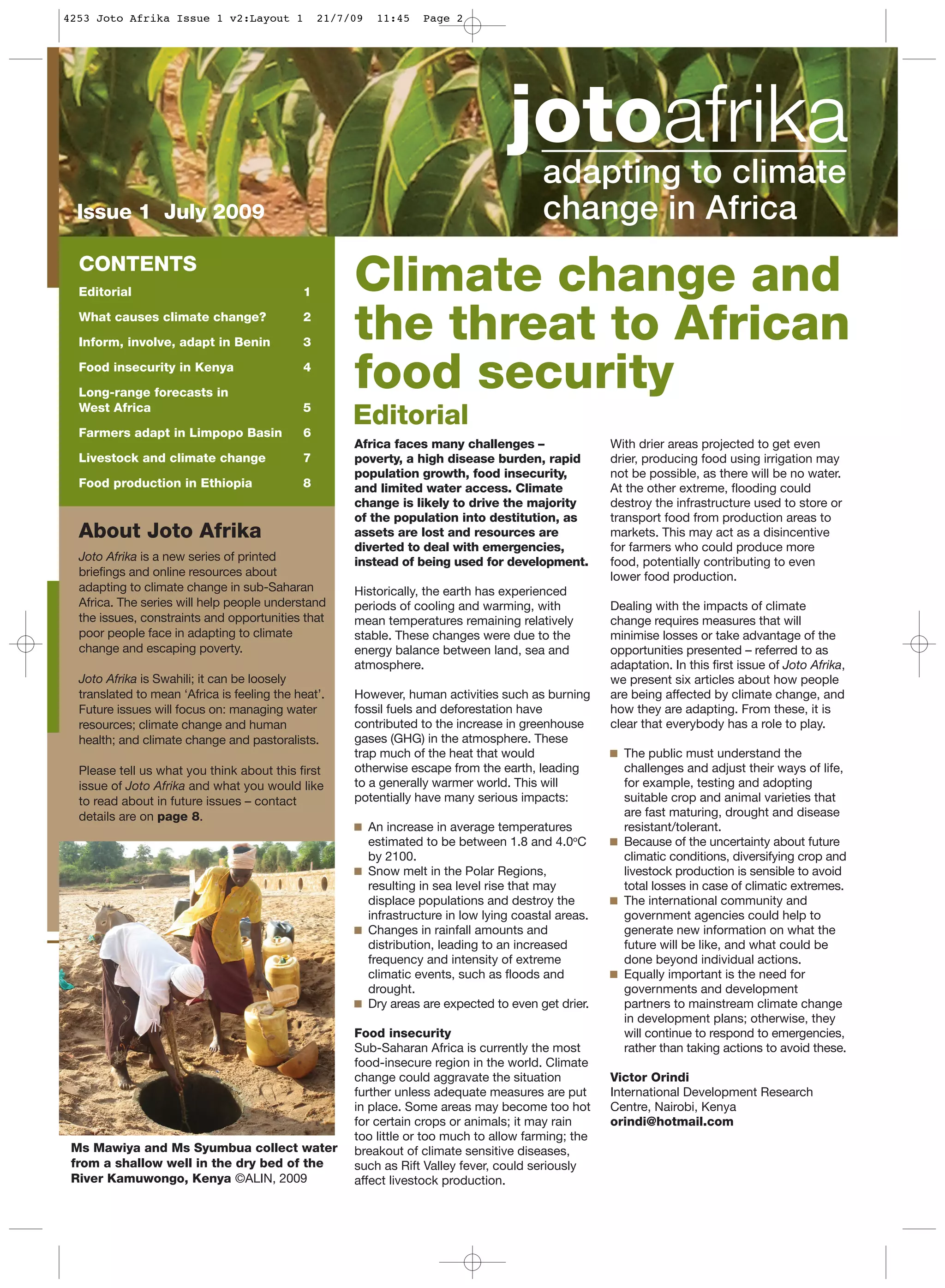
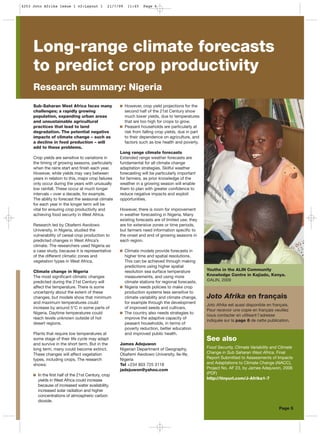
Ms Mawiya and Ms Syumbua collect water
from a shallow well in the dry bed of the
River Kamuwongo, Kenya ©ALIN, 2009
Editorial
4253 Joto Afrika Issue 1 v2:Layout 1 21/7/09 11:45 Page 2
The world’s climate is getting hotter.
The 20th Century was the warmest
the world has seen in 1,000 years,
and the 1980s and 1990s were the
hottest decades on record.
Increasing temperatures have several
effects on our planet’s weather systems,
including changes to wind patterns, the
amount and distribution of precipitation,
and the type and frequency of severe
weather events, such as hurricanes and
storms.
The cause of climate change
There is significant scientific evidence that
the accelerated warming of the earth
experienced over the past 50 years has
been caused by an increase in greenhouse
gas (GHG) emissions, particularly carbon
dioxide. As GHGs accumulate in the
atmosphere, they trap the sun’s heat that
is reflected from the earth, and which
would normally exit into space. This is
known as the greenhouse effect.
Much of this increase in GHGs is the result
of human activities.
Burning fossil fuels such as coal, gas
and oil releases carbon dioxide that has
been ‘locked up’ since these fuels were
formed.
Deforestation for timber or to clear land
for farming, and the subsequent burning
of wood, release carbon into the
atmosphere that would otherwise be
stored in the trees.
Many agricultural activities release
GHGs. For example, methane is
released by livestock during enteric
fermentation (which takes place in the
digestive systems of ruminant animals),
and nitrous oxide is used to make many
fertilisers.
These activities have increased
dramatically in recent years, as countries
burn fuels to power their economies and
clear their forests to give way for
settlements and farming. The rapidly rising
global population is also increasing the
demand for farmland and livestock
products. This means GHG emissions are
likely to continue to rise.
Evidence of climate change in Africa
Africa is the continent most vulnerable to
the impacts of change because
widespread poverty and low levels of
technical development limit adaptation
capabilities. There is considerable
evidence that climate change is already
affecting Africa’s people and its
environment.
Africa’s six warmest years on record
have all occurred since 1987.
Lake Chad has shrunk from 26,000
square kilometres in the 1960s to just
1,500 in 2000.
The ice caps on Africa’s highest
mountains are receding; Mount Kenya
has lost 92 percent of its glaciers in the
last 100 years.
The impacts of climate change are
predicted to affect the livelihoods of
Africans in many ways.
By 2020, between 75 and 250 million
people are predicted to be exposed to
increased water stress due to climate
change.
By 2020, yields from rain-fed agriculture
in some countries could be reduced by
up to 50 percent, increasing food
insecurity and hunger.
By 2080, an increase of 5 to 8 percent
of arid and semi-arid land in Africa is
projected.
Climate change is likely to affect the
distribution patterns of infectious
diseases; for example, there is likely to
be an increase in mosquitos which
spread dengue and yellow fever.
Sea levels are projected to rise by
around 25cm by 2050; Africa’s coastal
areas are already experiencing
environmental problems including
coastal erosion, flooding and
subsidence.
What causes
climate change?
See also
Fourth Assessment Report, Summary for
Policymakers, The Intergovernmental Panel
on Climate Change (IPCC), 2007
http://tinyurl.com/J-Afrika1-1
Fighting Climate Change: Human Solidarity
in a Divided World, Human Development
Report 2007/2008, United Nations
Development Programme, 2008
http://tinyurl.com/J-Afrika1-2
Africa - Up in Smoke 2, New Economics
Foundation (nef): London, edited by John
MaGrath, 2006 (PDF)
http://tinyurl.com/J-Afrika1-3
The maximum temperature in Kericho, in
Kenya’s Rift Valley Province, has increased
by 3.5°C during the past 20 years.
Source: Africa - Up in Smoke 2, 2007
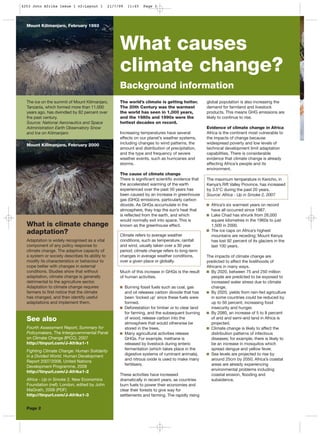
Mount Kilimanjaro, February 1993
Mount Kilimanjaro, February 2000
The ice on the summit of Mount Kilimanjaro,
Tanzania, which formed more than 11,000
years ago, has dwindled by 82 percent over
the past century.
Source: National Aeronautics and Space
Administration Earth Observatory Snow
and Ice on Kilimanjaro
Climate refers to average weather
conditions, such as temperature, rainfall
and wind, usually taken over a 30 year
period; climate change refers to long-term
changes in average weather conditions,
over a given place or globally.
What is climate change
adaptation?
Adaptation is widely recognised as a vital
component of any policy response to
climate change. The adaptive capacity of
a system or society describes its ability to
modify its characteristics or behaviour to
cope better with changes in external
conditions. Studies show that without
adaptation, climate change is generally
detrimental to the agriculture sector.
Adaptation to climate change requires
farmers to first notice that the climate
has changed, and then identify useful
adaptations and implement them.
Background information
Page 2
4253 Joto Afrika Issue 1 v2:Layout 1 21/7/09 11:45 Page 3
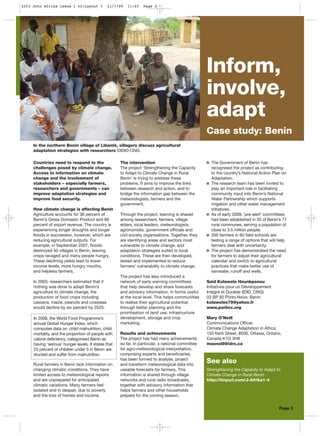
In the northern Benin village of Libanté, villagers discuss agricultural
adaptation strategies with researchers ©IDID-ONG
Countries need to respond to the
challenges posed by climate change.
Access to information on climate
change and the involvement of
stakeholders – especially farmers,
researchers and governments – can
improve adaptation strategies and
improve food security.
How climate change is affecting Benin
Agriculture accounts for 36 percent of
Benin’s Gross Domestic Product and 88
percent of export revenue. The country is
experiencing longer droughts and longer
floods in succession, however, which are
reducing agricultural outputs. For
example, in September 2007, floods
destroyed 50 villages in Benin, leaving
crops ravaged and many people hungry.
These declining yields lead to lower
income levels, more hungry mouths,
and helpless farmers.
In 2003, researchers estimated that if
nothing was done to adapt Benin’s
agriculture to climate change, the
production of food crops including
cassava, maize, peanuts and cowpeas
would decline by six percent by 2025.
Rural farmers in Benin lack information on
changing climatic conditions. They have
limited access to meteorological reports
and are unprepared for anticipated
climatic variations. Many farmers feel
isolated and in despair, due to poverty
and the loss of homes and income.
The intervention
The project ‘Strengthening the Capacity
to Adapt to Climate Change in Rural
Benin’ is trying to address these
problems. It aims to improve the links
between research and action, and to
bridge the information gap between the
meteorologists, farmers and the
government.
Through the project, learning is shared
among researchers, farmers, village
elders, local leaders, meteorologists,
agronomists, government officials and
civil society organisations. Together, they
are identifying areas and sectors most
vulnerable to climate change, and
adaptation strategies suited to local
conditions. These are then developed,
tested and implemented to reduce
farmers’ vulnerability to climate change.
The project has also introduced a
network of early warning committees
that help develop and share forecasts
and advisory information, in forms useful
at the local level. This helps communities
to realise their agricultural potential
through better planning and the
prioritisation of land use, infrastructure
development, storage and crop
marketing.
Results and achievements
The project has had many achievements
so far. In particular, a national committee
for agro-meteorological interpretation,
comprising experts and beneficiaries,
has been formed to analyse, project
and transform meteorological data into
useable forecasts for farmers. This
information is shared through village
networks and rural radio broadcasts,
together with advisory information that
helps farmers and other households
prepare for the coming season.
In 2008, the World Food Programme’s
annual Global Hunger Index, which
computes data on child malnutrition, child
mortality, and the proportion of people with
calorie deficiency, categorised Benin as
having ‘serious’ hunger levels. It states that
23 percent of children under 5 in Benin are
stunted and suffer from malnutrition.
The Government of Benin has
recognised the project as contributing
to the country’s National Action Plan on
Adaptation.
The research team has been invited to
play an important role in facilitating
community input into Benin’s National
Water Partnership which supports
irrigation and other water management
initiatives.
As of early 2009, ’pre-alert’ committees
had been established in 35 of Benin’s 77
rural communes, serving a population of
close to 3.5 million people.
300 farmers in 60 field schools are
testing a range of options that will help
farmers deal with uncertainty.
The project has demonstrated the need
for farmers to adjust their agricultural
calendar and switch to agricultural
practices that make better use of
rainwater, runoff and wells.
Said Kolawole Hounkponou
Initiatives pour un Développement
Intégré et Durable (IDID_ONG)
03 BP 92 Porto-Novo, Benin
kolawoles79@yahoo.fr
www.parbcc.org
Mary O’Neill
Communications Officer,
Climate Change Adaptation in Africa,
150 Kent Street, 8500, Ottawa, Ontario,
Canada K1G 3H9
maoneill@idrc.ca
See also
Strengthening the Capacity to Adapt to
Climate Change in Rural Benin
http://tinyurl.com/J-Afrika1-4
Inform,
involve,
adapt
Case study: Benin
Page 3
4253 Joto Afrika Issue 1 v2:Layout 1 21/7/09 11:45 Page 4
Since 2006, the rains in Kenya’s
Central Highlands have become less
reliable. The March and April rains
arrive late, and the season is much
shorter; in 2008, there were only four
days of rain. The seasonal rivers that
provide water for irrigation, livestock
and domestic uses have mostly dried
up, leading to water and food
shortages.
In Kyuso village, many crops have failed
due to the lack of rain. Even millet, which is
drought resistant and most common crop,
failed in 2008. Livestock farmers suffer
because there is not enough pasture or
water for all their animals. But they are
reluctant to sell animals; prices have been
very low since 2008.
Imported food
In 2005, farmers sold their surplus produce
to National Cereals Board (NCB) in Kyuso,
and at local markets; millet was sold for
17 Kenyan shillings (Ksh) per kilogramme
(kg). But local crop failure means people
now have to buy food at very high prices.
A one kg bag of maize flour cost 20 Ksh
in July 2008; by March 2009, the price
had increased to 70 Ksh.
This increase is due to the extended
drought and the political turmoil in
Kenya in early 2008.
Most of the imported maize in Kyuso
comes from South Africa, which makes
it more expensive.
In March 2009, the NCB was selling over
500 bags of maize each day to around 300
households (they are not permitted to sell
millet). This is rationed to ensure supplies
do not run out, but even if the supply were
to improve, very poor people would still
find it unaffordable.
Declining production, and the limited
access and affordability of imported food,
mean food security has declined, with
many impacts. Some people have to walk
over 20 kilometres to buy grain and
livestock keepers trek even further in
search of fodder and water for their
animals. This means they have less time
for other work, reducing opportunities to
earn an income.
Farmer adaptations
Many farmers are struggling to adapt.
Joseph Meithya Kasawla, a 57 year old
farmer from Kyuso, believes that people
think only traditional crops such as maize
grow in the region. These no longer thrive
with poor rains, but many farmers are
unaware that crops such as cowpeas
would survive better in the drier conditions.
Farmers also lack seeds – a critical farming
input. However, some farmers are adapting
by switching to fruit crops, particularly
mangoes (see box, right).
The experiences in Kyuso are relevant to
other areas facing similar challenges:
Farmers need information about
switching to drought-tolerant and fast-
maturing crops, and access to seeds.
It is important to promote water
harvesting and demonstrate different
farming techniques.
The storage of grain during bumper
harvests can provide food in poor
seasons; processing this surplus can
also add value and avoid wastage.
Grain distribution centres, markets and
local farmers can all improve the supply
of seeds of promising cereal crops, so
that people take advantage of the good
seasons when they occur.
More information
Joseph Musili Mwangangi
ALIN Community Knowledge Centre,
PO Box 30-90401, Kyuso, Kenya
Tel +254 725089865
This case study is based upon evidence
collected during an ALIN field visit in
March 2009.
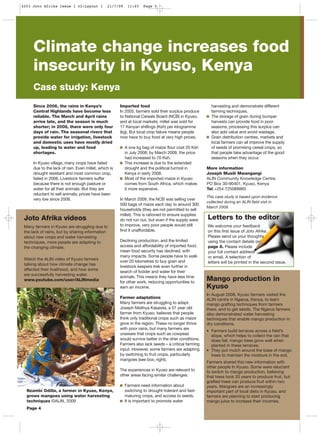
Mango production in
Kyuso
In August 2008, Kyuso farmers visited the
ALIN centre in Ngarua, Kenya, to learn
mango grafting techniques from farmers
there, and to get seeds. The Ngarua farmers
also demonstrated water harvesting
techniques that enable mango production in
dry conditions.
• Farmers build terraces across a field’s
slope, which helps to collect the rain that
does fall; mango trees grow well when
planted in these terraces.
• They put mulch around the base of mango
trees to maintain the moisture in the soil.
Farmers shared this new information with
other people In Kyuso. Some were reluctant
to switch to mango production, believing
that trees took 20 years to produce fruit, but
grafted trees can produce fruit within two
years. Mangoes are an increasingly
important part of local diets in Kyuso, and
farmers are planning to start producing
mango juice to increase their incomes.
Joto Afrika videos
Many farmers in Kyuso are struggling due to
the lack of rains, but by sharing information
about new crops and water harvesting
techniques, more people are adapting to
the changing climate.
Watch the ALIN video of Kyuso farmers
talking about how climate change has
affected their livelihood, and how some
are successfully harvesting water.
www.youtube.com/user/ALINmedia
Climate change increases food
insecurity in Kyuso, Kenya
Case study: Kenya
Letters to the editor
We welcome your feedback
on this first issue of Joto Afrika.
Please send us your thoughts
using the contact details on
page 8. Please include
your full contact address
or email. A selection of
letters will be printed in the second issue.
Nzambi Odilla, a farmer in Kyuso, Kenya,
grows mangoes using water harvesting
techniques ©ALIN, 2009
Page 4
4253 Joto Afrika Issue 1 v2:Layout 1 21/7/09 11:45 Page 5
Sub-Saharan West Africa faces many
challenges; a rapidly growing
population, expanding urban areas
and unsustainable agricultural
practices that lead to land
degradation. The potential negative
impacts of climate change – such as
a decline in food production – will
add to these problems.
Crop yields are sensitive to variations in
the timing of growing seasons, particularly
when the rains start and finish each year.
However, while yields may vary between
years in relation to this, major crop failures
only occur during the years with unusually
low rainfall. These occur at much longer
intervals – over a decade, for example.
The ability to forecast the seasonal climate
for each year in the longer term will be
vital for ensuring crop productivity and
achieving food security in West Africa.
Research led by Obafemi Awolowo
University, in Nigeria, studied the
vulnerability of cereal crop production to
predicted changes in West Africa’s
climate. The researchers used Nigeria as
a case study, because it is representative
of the different climatic zones and
vegetation types in West Africa.
Climate change in Nigeria
The most significant climatic changes
predicted during the 21st Century will
affect the temperature. There is some
uncertainty about the extent of these
changes, but models show that minimum
and maximum temperatures could
increase by around 5°C in some parts of
Nigeria. Daytime temperatures could
reach levels unknown outside of hot
desert regions.
Plants that require low temperatures at
some stage of their life cycle may adapt
and survive in the short term. But in the
long term, many could become extinct.
These changes will affect vegetation
types, including crops. The research
shows:
In the first half of the 21st Century, crop
yields in West Africa could increase
because of increased water availability,
increased solar radiation and higher
concentrations of atmospheric carbon
dioxide.
However, crop yield projections for the
second half of the 21st Century show
much lower yields, due to temperatures
that are too high for crops to grow.
Peasant households are particularly at
risk from falling crop yields, due in part
to their dependence on agriculture, and
factors such as low health and poverty.
Long range climate forecasts
Extended range weather forecasts are
fundamental for all climate change
adaptation strategies. Skilful weather
forecasting will be particularly important
for farmers, as prior knowledge of the
weather in a growing season will enable
them to plan with greater confidence to
reduce negative impacts and exploit
opportunities.
However, there is room for improvement
in weather forecasting in Nigeria. Many
existing forecasts are of limited use; they
are for extensive zones or time periods,
but farmers need information specific to
the onset and end of growing seasons in
each region.
Climate models provide forecasts in
higher time and spatial resolutions.
This can be achieved through making
predictions using higher spatial
resolution sea surface temperature
measurements, and using more
climate stations for regional forecasts.
Nigeria needs policies to make crop
production systems less sensitive to
climate variability and climate change,
for example through the development
of improved seeds and cultivars.
The country also needs strategies to
improve the adaptive capacity of
peasant households, in terms of
poverty reduction, better education
and improved public health.
James Adejuwon
Nigerian Department of Geography,
Obafemi Awolowo University, Ile-Ife,
Nigeria
Tel +234 803 725 3118
jadejuwon@yahoo.com
Research summary: Nigeria
See also
Food Security, Climate Variability and Climate
Change in Sub Saharan West Africa, Final
Report Submitted to Assessments of Impacts
and Adaptations to Climate Change (AIACC),
Project No. AF 23, by James Adejuwon, 2006
(PDF)
http://tinyurl.com/J-Afrika1-7
Page 5
Long-range climate forecasts
to predict crop productivity
Youths in the ALIN Community
Knowledge Centre in Kajiado, Kenya.
©ALIN, 2009
Joto Afrika en français
Joto Afrika est aussi disponible en français.
Pour recevoir une copie en français veuillez
nous contacter en utilisant l'adresse
indiquée sur la page 8 de cette publication.
4253 Joto Afrika Issue 1 v2:Layout 1 21/7/09 11:45 Page 6
When climate change affects
agricultural production in a region,
it can have serious implications for
local food security. In Limpopo Basin,
South Africa, farmers have devised
several mechanisms to adapt to
climate change.
The Limpopo is one of the major river
systems in southern Africa, draining an
area of 415,500 km2
. The Limpopo Basin
contains both large commercial
agricultural farms and small-scale
agricultural holdings. Activities range from
dry farming to intensive irrigation, livestock
production and game farming. Crops
grown include cotton, grain sorghum,
tobacco and citrus fruits.
Rainfall is traditionally variable from year
to year, but 2005-2008 were very dry
years. There is a noticeable decrease in
rainfall during winter, and temperatures
have increased in recent years. These
changes are affecting food security in the
basin.
In 2006, southern Africa faced a
shortfall of 2.18 million metric tonnes of
maize, the region’s main staple food.
Since 2007, erratic rainfall has further
increased food shortages, as droughts
have damaged and destroyed maize
crops.
According to the Southern African
Development Community, people in
southern Africa lacked more than
4 million metric tonnes of maize in
2007/2008.
The Climate Systems Analysis Group
predicts that maize yields in Zimbabwe
and South Africa’s Limpopo Province
will decrease by approximately 9 percent
between now and 2045 due to climate
change.
Farmer adaptations
Rural farmers are likely to bear the brunt
of the adverse impacts of climate change.
The extent of these impacts depends on
their adaptation responses.
A study by the International Food Policy
Research Institute examines farmers’
perceptions of climate change, how these
correspond with climate data, and how
farmers are adapting. This analysis was
based on data collected from 794 farm
households in the Limpopo River Basin
during the farming season 2004–2005.
Overall, farmers’ perceptions that the
climate is changing correspond with
the climate data.
However, only 30 percent of farmers
have adjusted their farming practices
to account for the impacts of climate
change.
Farmers’ main adaptation strategies are
switching to more drought tolerant
crops, such as millet, and switching to
different varieties of the same crop,
such as more drought tolerant maize.
They are also changing planting dates,
increasing irrigation, building water-
harvesting schemes, changing the
amount of land under cultivation, and
buying livestock feed supplements.
Factors influencing adaptation
Several factors enhance farmers’ adaptive
capacity: household size; farming
experience; wealth; access to credit;
access to water; tenure rights; off-farm
activities; access to extension, and;
perceptions of soil fertility. Farmers cited
a lack of access to credit as the main
factor inhibiting adaptation.
The government should create policies in
response to these findings:
Farmers should have access to
affordable credit to increase their ability
to change production strategies.
Policymakers should reconsider irrigation
investment needs; this will allow farmers
increased control over water.
To promote efficient water use, policies
should emphasise pricing reforms and
clearly defined property rights, as well
as strengthening farm level managerial
capacity of efficient irrigation.
The implementation of land reforms has
increased the number of new farmers,
who do not have the skills and
information gathered by experienced
farmers; there is a great need to
increase farmers’ access to extension
services in South Africa.
More information
International Food Policy Research
Institute, 2033 K Street, NW, Washington,
DC 20006-1002, USA
Tel +1 202 862 5600
Fax +1 202 467 4439
ifpri@cgiar.org
Farmers adapt
in the Limpopo
Basin
Research summary: South Africa
Page 6
See also
Understanding Farmers' Perceptions and
Adaptations to Climate Change and
Variability, IFPRI Discussion Paper 00849,
by Glwadys Aymone Gbetibouo, 2009 (PDF)
http://tinyurl.com/J-Afrika1-8
Subscribe to Joto
Afrika
Organisations and individuals in Africa can
receive a free printed copy of the briefings.
Each issue will also be available on the ALIN
website and by email. You can subscribe by
writing, emailing or sending an SMS
(see page 8). Please include your name,
organisation, and full postal address.
You can also subscribe and send feedback
via SMS - text +254 7170 32322 and
start with the word Joto
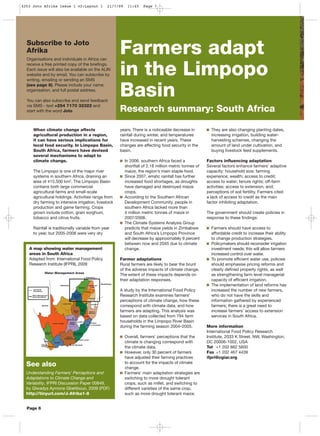
A map showing water management
areas in South Africa
Adapted from: International Food Policy
Research Institute (IFPRI), 2009
4253 Joto Afrika Issue 1 v2:Layout 1 21/7/09 11:45 Page 7
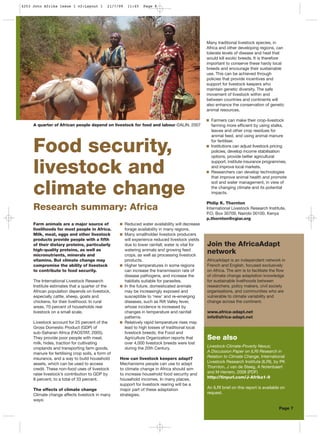
Farm animals are a major source of
livelihoods for most people in Africa.
Milk, meat, eggs and other livestock
products provide people with a fifth
of their dietary proteins, particularly
high-quality proteins, as well as
micronutrients, minerals and
vitamins. But climate change may
compromise the ability of livestock
to contribute to food security.
The International Livestock Research
Institute estimates that a quarter of the
African population depends on livestock,
especially cattle, sheep, goats and
chickens, for their livelihood. In rural
areas, 70 percent of households rear
livestock on a small scale.
Livestock account for 25 percent of the
Gross Domestic Product (GDP) of
sub-Saharan Africa (FAOSTAT, 2005).
They provide poor people with meat,
milk, hides, traction for cultivating
croplands and transporting farm goods,
manure for fertilising crop soils, a form of
insurance, and a way to build household
assets, which can be used to access
credit. These non-food uses of livestock
raise livestock’s contribution to GDP by
8 percent, to a total of 33 percent.
The effects of climate change
Climate change affects livestock in many
ways:
Reduced water availability will decrease
forage availability in many regions.
Many smallholder livestock producers
will experience reduced livestock yields
due to lower rainfall; water is vital for
watering animals and growing feed
crops, as well as processing livestock
products.
Higher temperatures in some regions
can increase the transmission rate of
disease pathogens, and increase the
habitats suitable for parasites.
In the future, domesticated animals
may be increasingly exposed and
susceptible to ‘new’ and re-emerging
diseases, such as Rift Valley fever,
whose incidence is increased by
changes in temperature and rainfall
patterns.
Relatively rapid temperature rises may
lead to high losses of traditional local
livestock breeds; the Food and
Agriculture Organization reports that
over 4,000 livestock breeds were lost
during the 20th Century.
How can livestock keepers adapt?
Mechanisms people can use to adapt
to climate change in Africa should aim
to increase household food security and
household incomes. In many places,
support for livestock rearing will be a
major part of these adaptation
strategies.
Many traditional livestock species, in
Africa and other developing regions, can
tolerate levels of disease and heat that
would kill exotic breeds. It is therefore
important to conserve these hardy local
breeds and encourage their sustainable
use. This can be achieved through
policies that provide incentives and
support for livestock keepers who
maintain genetic diversity. The safe
movement of livestock within and
between countries and continents will
also enhance the conservation of genetic
animal resources.
Farmers can make their crop-livestock
farming more efficient by using stalks,
leaves and other crop residues for
animal feed, and using animal manure
for fertiliser.
Institutions can adjust livestock pricing
policies, develop income stabilisation
options, provide better agricultural
support, institute insurance programmes,
and improve local markets.
Researchers can develop technologies
that improve animal health and promote
soil and water management, in view of
the changing climate and its potential
impacts.
Philip K. Thornton
International Livestock Research Institute,
P.O. Box 30709, Nairobi 00100, Kenya
p.thornton@cgiar.org
Join the AfricaAdapt
network
AfricaAdapt is an independent network in
French and English, focused exclusively
on Africa. The aim is to facilitate the flow
of climate change adaptation knowledge
for sustainable livelihoods between
researchers, policy makers, civil society
organisations, and communities who are
vulnerable to climate variability and
change across the continent.
www.africa-adapt.net
info@africa-adapt.net
See also
Livestock-Climate-Poverty Nexus;
A Discussion Paper on ILRI Research in
Relation to Climate Change, International
Livestock Research Institute (ILRI), by PK
Thornton, J van de Steeg, A Notenbaert
and M Herrero, 2008 (PDF)
http://tinyurl.com/J-Afrika1-9
An ILRI brief on this report is available on
request.
Page 7
Food security,
livestock and
climate change
Research summary: Africa
A quarter of African people depend on livestock for food and labour ©ALIN, 2007
4253 Joto Afrika Issue 1 v2:Layout 1 21/7/09 11:45 Page 8
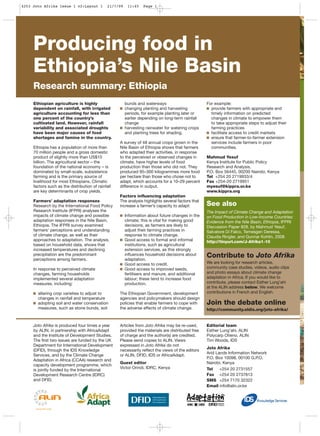
Ethiopian agriculture is highly
dependent on rainfall, with irrigated
agriculture accounting for less than
one percent of the country’s
cultivated land. However, rainfall
variability and associated droughts
have been major causes of food
shortages and famine in the country.
Ethiopia has a population of more than
70 million people and a gross domestic
product of slightly more than US$10
billion. The agricultural sector – the
foundation of the national economy – is
dominated by small-scale, subsistence
farming and is the primary source of
livelihood for most Ethiopians. Climatic
factors such as the distribution of rainfall
are key determinants of crop yields.
Farmers’ adaptation responses
Research by the International Food Policy
Research Institute (IFPRI) analyses the
impacts of climate change and possible
adaptation responses in the Nile Basin,
Ethiopia. The IFPRI survey examined
farmers’ perceptions and understanding
of climate change, as well as their
approaches to adaptation. The analysis,
based on household data, shows that
increased temperatures and declining
precipitation are the predominant
perceptions among farmers.
In response to perceived climate
changes, farming households
implemented several adaptation
measures, including:
altering crop varieties to adjust to
changes in rainfall and temperature
adopting soil and water conservation
measures, such as stone bunds, soil
bunds and waterways
changing planting and harvesting
periods, for example planting later or
earlier depending on long-term rainfall
change
harvesting rainwater for watering crops
and planting trees for shading.
A survey of 48 annual crops grown in the
Nile Basin of Ethiopia shows that farmers
who adapted their activities, in response
to the perceived or observed changes in
climate, have higher levels of food
production than those who did not. They
produced 95–300 kilogrammes more food
per hectare than those who chose not to
adapt, which accounts for a 10–29 percent
difference in output.
Factors influencing adaptation
The analysis highlights several factors that
increase a farmer’s capacity to adapt:
Information about future changes in the
climate; this is vital for making good
decisions, as farmers are likely to
adjust their farming practices in
response to climate change.
Good access to formal and informal
institutions, such as agricultural
extension services, as this strongly
influences household decisions about
adaptation.
Good access to credit.
Good access to improved seeds,
fertilisers and manure, and additional
labour; these tend to increase food
production.
The Ethiopian Government, development
agencies and policymakers should design
policies that enable farmers to cope with
the adverse effects of climate change.
For example:
provide farmers with appropriate and
timely information on predicted
changes in climate to empower them
to take appropriate steps to adjust their
farming practices
facilitate access to credit markets
ensure that farmer-to-farmer extension
services include farmers in poor
communities.
Mahmud Yesuf
Kenya Institute for Public Policy
Research and Analysis,
P.O. Box 56445, 00200 Nairobi, Kenya
Tel +254 20 2719933/4
Fax +254-20 2719951
myesuf@kippra.or.ke
www.kippra.org
See also
The Impact of Climate Change and Adaptation
on Food Production in Low-Income Countries:
Evidence from the Nile Basin, Ethiopia, IFPRI
Discussion Paper 828, by Mahmud Yesuf,
Salvatore Di Falco, Temesgen Deressa,
Claudia Ringler, and Gunnar Kohlin, 2008
http://tinyurl.com/J-Afrika1-10
Producing food in
Ethiopia’s Nile Basin
Research summary: Ethiopia
Joto Afrika is produced four times a year
by ALIN, in partnership with AfricaAdapt
and the Institute of Development Studies.
The first two issues are funded by the UK
Department for International Development
(DFID), through the IDS Knowledge
Services, and by the Climate Change
Adaptation in Africa (CCAA) research and
capacity development programme, which
is jointly funded by the International
Development Research Centre (IDRC)
and DFID.
Articles from Joto Afrika may be re-used,
provided the materials are distributed free
of charge and the author(s) are credited.
Please send copies to ALIN. Views
expressed in Joto Afrika do not
necessarily reflect the views of the editors
or ALIN, DFID, IDS or AfricaAdapt.
Guest editor
Victor Orindi, IDRC, Kenya
Editorial team
Esther Lung’ahi, ALIN
Polycarp Otieno, ALIN
Tim Woods, IDS
Joto Afrika
Arid Lands Information Network
P.O. Box 10098, 00100 G.P.O.
Nairobi, Kenya
Tel +254 20 2731557
Fax +254 20 2737813
SMS +254 7170 32322
Email info@alin.or.ke
Contribute to Joto Afrika
We are looking for research articles,
community case studies, videos, audio clips
and photo essays about climate change
adaptation in Africa. If you would like to
contribute, please contact Esther Lung’ahi
at the ALIN address below. We welcome
contributions in French and English.
Join the debate online
http://community.eldis.org/joto-afrika/
4253 Joto Afrika Issue 1 v2:Layout 1 21/7/09 11:45 Page 1

Joto afrika 001 issue 01

  • 1.
    Africa faces manychallenges – poverty, a high disease burden, rapid population growth, food insecurity, and limited water access. Climate change is likely to drive the majority of the population into destitution, as assets are lost and resources are diverted to deal with emergencies, instead of being used for development. Historically, the earth has experienced periods of cooling and warming, with mean temperatures remaining relatively stable. These changes were due to the energy balance between land, sea and atmosphere. However, human activities such as burning fossil fuels and deforestation have contributed to the increase in greenhouse gases (GHG) in the atmosphere. These trap much of the heat that would otherwise escape from the earth, leading to a generally warmer world. This will potentially have many serious impacts: An increase in average temperatures estimated to be between 1.8 and 4.0o C by 2100. Snow melt in the Polar Regions, resulting in sea level rise that may displace populations and destroy the infrastructure in low lying coastal areas. Changes in rainfall amounts and distribution, leading to an increased frequency and intensity of extreme climatic events, such as floods and drought. Dry areas are expected to even get drier. Food insecurity Sub-Saharan Africa is currently the most food-insecure region in the world. Climate change could aggravate the situation further unless adequate measures are put in place. Some areas may become too hot for certain crops or animals; it may rain too little or too much to allow farming; the breakout of climate sensitive diseases, such as Rift Valley fever, could seriously affect livestock production. With drier areas projected to get even drier, producing food using irrigation may not be possible, as there will be no water. At the other extreme, flooding could destroy the infrastructure used to store or transport food from production areas to markets. This may act as a disincentive for farmers who could produce more food, potentially contributing to even lower food production. Dealing with the impacts of climate change requires measures that will minimise losses or take advantage of the opportunities presented – referred to as adaptation. In this first issue of Joto Afrika, we present six articles about how people are being affected by climate change, and how they are adapting. From these, it is clear that everybody has a role to play. The public must understand the challenges and adjust their ways of life, for example, testing and adopting suitable crop and animal varieties that are fast maturing, drought and disease resistant/tolerant. Because of the uncertainty about future climatic conditions, diversifying crop and livestock production is sensible to avoid total losses in case of climatic extremes. The international community and government agencies could help to generate new information on what the future will be like, and what could be done beyond individual actions. Equally important is the need for governments and development partners to mainstream climate change in development plans; otherwise, they will continue to respond to emergencies, rather than taking actions to avoid these. Victor Orindi International Development Research Centre, Nairobi, Kenya orindi@hotmail.com Climate change and the threat to African food security CONTENTS Editorial 1 What causes climate change? 2 Inform, involve, adapt in Benin 3 Food insecurity in Kenya 4 Long-range forecasts in West Africa 5 Farmers adapt in Limpopo Basin 6 Livestock and climate change 7 Food production in Ethiopia 8 About Joto Afrika Joto Afrika is a new series of printed briefings and online resources about adapting to climate change in sub-Saharan Africa. The series will help people understand the issues, constraints and opportunities that poor people face in adapting to climate change and escaping poverty. Joto Afrika is Swahili; it can be loosely translated to mean ‘Africa is feeling the heat’. Future issues will focus on: managing water resources; climate change and human health; and climate change and pastoralists. Please tell us what you think about this first issue of Joto Afrika and what you would like to read about in future issues – contact details are on page 8. joto adapting to climate change in AfricaIssue 1 July 2009 afrika Ms Mawiya and Ms Syumbua collect water from a shallow well in the dry bed of the River Kamuwongo, Kenya ©ALIN, 2009 Editorial 4253 Joto Afrika Issue 1 v2:Layout 1 21/7/09 11:45 Page 2
  • 2.
    The world’s climateis getting hotter. The 20th Century was the warmest the world has seen in 1,000 years, and the 1980s and 1990s were the hottest decades on record. Increasing temperatures have several effects on our planet’s weather systems, including changes to wind patterns, the amount and distribution of precipitation, and the type and frequency of severe weather events, such as hurricanes and storms. The cause of climate change There is significant scientific evidence that the accelerated warming of the earth experienced over the past 50 years has been caused by an increase in greenhouse gas (GHG) emissions, particularly carbon dioxide. As GHGs accumulate in the atmosphere, they trap the sun’s heat that is reflected from the earth, and which would normally exit into space. This is known as the greenhouse effect. Much of this increase in GHGs is the result of human activities. Burning fossil fuels such as coal, gas and oil releases carbon dioxide that has been ‘locked up’ since these fuels were formed. Deforestation for timber or to clear land for farming, and the subsequent burning of wood, release carbon into the atmosphere that would otherwise be stored in the trees. Many agricultural activities release GHGs. For example, methane is released by livestock during enteric fermentation (which takes place in the digestive systems of ruminant animals), and nitrous oxide is used to make many fertilisers. These activities have increased dramatically in recent years, as countries burn fuels to power their economies and clear their forests to give way for settlements and farming. The rapidly rising global population is also increasing the demand for farmland and livestock products. This means GHG emissions are likely to continue to rise. Evidence of climate change in Africa Africa is the continent most vulnerable to the impacts of change because widespread poverty and low levels of technical development limit adaptation capabilities. There is considerable evidence that climate change is already affecting Africa’s people and its environment. Africa’s six warmest years on record have all occurred since 1987. Lake Chad has shrunk from 26,000 square kilometres in the 1960s to just 1,500 in 2000. The ice caps on Africa’s highest mountains are receding; Mount Kenya has lost 92 percent of its glaciers in the last 100 years. The impacts of climate change are predicted to affect the livelihoods of Africans in many ways. By 2020, between 75 and 250 million people are predicted to be exposed to increased water stress due to climate change. By 2020, yields from rain-fed agriculture in some countries could be reduced by up to 50 percent, increasing food insecurity and hunger. By 2080, an increase of 5 to 8 percent of arid and semi-arid land in Africa is projected. Climate change is likely to affect the distribution patterns of infectious diseases; for example, there is likely to be an increase in mosquitos which spread dengue and yellow fever. Sea levels are projected to rise by around 25cm by 2050; Africa’s coastal areas are already experiencing environmental problems including coastal erosion, flooding and subsidence. What causes climate change? See also Fourth Assessment Report, Summary for Policymakers, The Intergovernmental Panel on Climate Change (IPCC), 2007 http://tinyurl.com/J-Afrika1-1 Fighting Climate Change: Human Solidarity in a Divided World, Human Development Report 2007/2008, United Nations Development Programme, 2008 http://tinyurl.com/J-Afrika1-2 Africa - Up in Smoke 2, New Economics Foundation (nef): London, edited by John MaGrath, 2006 (PDF) http://tinyurl.com/J-Afrika1-3 The maximum temperature in Kericho, in Kenya’s Rift Valley Province, has increased by 3.5°C during the past 20 years. Source: Africa - Up in Smoke 2, 2007 Mount Kilimanjaro, February 1993 Mount Kilimanjaro, February 2000 The ice on the summit of Mount Kilimanjaro, Tanzania, which formed more than 11,000 years ago, has dwindled by 82 percent over the past century. Source: National Aeronautics and Space Administration Earth Observatory Snow and Ice on Kilimanjaro Climate refers to average weather conditions, such as temperature, rainfall and wind, usually taken over a 30 year period; climate change refers to long-term changes in average weather conditions, over a given place or globally. What is climate change adaptation? Adaptation is widely recognised as a vital component of any policy response to climate change. The adaptive capacity of a system or society describes its ability to modify its characteristics or behaviour to cope better with changes in external conditions. Studies show that without adaptation, climate change is generally detrimental to the agriculture sector. Adaptation to climate change requires farmers to first notice that the climate has changed, and then identify useful adaptations and implement them. Background information Page 2 4253 Joto Afrika Issue 1 v2:Layout 1 21/7/09 11:45 Page 3
  • 3.
    In the northernBenin village of Libanté, villagers discuss agricultural adaptation strategies with researchers ©IDID-ONG Countries need to respond to the challenges posed by climate change. Access to information on climate change and the involvement of stakeholders – especially farmers, researchers and governments – can improve adaptation strategies and improve food security. How climate change is affecting Benin Agriculture accounts for 36 percent of Benin’s Gross Domestic Product and 88 percent of export revenue. The country is experiencing longer droughts and longer floods in succession, however, which are reducing agricultural outputs. For example, in September 2007, floods destroyed 50 villages in Benin, leaving crops ravaged and many people hungry. These declining yields lead to lower income levels, more hungry mouths, and helpless farmers. In 2003, researchers estimated that if nothing was done to adapt Benin’s agriculture to climate change, the production of food crops including cassava, maize, peanuts and cowpeas would decline by six percent by 2025. Rural farmers in Benin lack information on changing climatic conditions. They have limited access to meteorological reports and are unprepared for anticipated climatic variations. Many farmers feel isolated and in despair, due to poverty and the loss of homes and income. The intervention The project ‘Strengthening the Capacity to Adapt to Climate Change in Rural Benin’ is trying to address these problems. It aims to improve the links between research and action, and to bridge the information gap between the meteorologists, farmers and the government. Through the project, learning is shared among researchers, farmers, village elders, local leaders, meteorologists, agronomists, government officials and civil society organisations. Together, they are identifying areas and sectors most vulnerable to climate change, and adaptation strategies suited to local conditions. These are then developed, tested and implemented to reduce farmers’ vulnerability to climate change. The project has also introduced a network of early warning committees that help develop and share forecasts and advisory information, in forms useful at the local level. This helps communities to realise their agricultural potential through better planning and the prioritisation of land use, infrastructure development, storage and crop marketing. Results and achievements The project has had many achievements so far. In particular, a national committee for agro-meteorological interpretation, comprising experts and beneficiaries, has been formed to analyse, project and transform meteorological data into useable forecasts for farmers. This information is shared through village networks and rural radio broadcasts, together with advisory information that helps farmers and other households prepare for the coming season. In 2008, the World Food Programme’s annual Global Hunger Index, which computes data on child malnutrition, child mortality, and the proportion of people with calorie deficiency, categorised Benin as having ‘serious’ hunger levels. It states that 23 percent of children under 5 in Benin are stunted and suffer from malnutrition. The Government of Benin has recognised the project as contributing to the country’s National Action Plan on Adaptation. The research team has been invited to play an important role in facilitating community input into Benin’s National Water Partnership which supports irrigation and other water management initiatives. As of early 2009, ’pre-alert’ committees had been established in 35 of Benin’s 77 rural communes, serving a population of close to 3.5 million people. 300 farmers in 60 field schools are testing a range of options that will help farmers deal with uncertainty. The project has demonstrated the need for farmers to adjust their agricultural calendar and switch to agricultural practices that make better use of rainwater, runoff and wells. Said Kolawole Hounkponou Initiatives pour un Développement Intégré et Durable (IDID_ONG) 03 BP 92 Porto-Novo, Benin kolawoles79@yahoo.fr www.parbcc.org Mary O’Neill Communications Officer, Climate Change Adaptation in Africa, 150 Kent Street, 8500, Ottawa, Ontario, Canada K1G 3H9 maoneill@idrc.ca See also Strengthening the Capacity to Adapt to Climate Change in Rural Benin http://tinyurl.com/J-Afrika1-4 Inform, involve, adapt Case study: Benin Page 3 4253 Joto Afrika Issue 1 v2:Layout 1 21/7/09 11:45 Page 4
  • 4.
    Since 2006, therains in Kenya’s Central Highlands have become less reliable. The March and April rains arrive late, and the season is much shorter; in 2008, there were only four days of rain. The seasonal rivers that provide water for irrigation, livestock and domestic uses have mostly dried up, leading to water and food shortages. In Kyuso village, many crops have failed due to the lack of rain. Even millet, which is drought resistant and most common crop, failed in 2008. Livestock farmers suffer because there is not enough pasture or water for all their animals. But they are reluctant to sell animals; prices have been very low since 2008. Imported food In 2005, farmers sold their surplus produce to National Cereals Board (NCB) in Kyuso, and at local markets; millet was sold for 17 Kenyan shillings (Ksh) per kilogramme (kg). But local crop failure means people now have to buy food at very high prices. A one kg bag of maize flour cost 20 Ksh in July 2008; by March 2009, the price had increased to 70 Ksh. This increase is due to the extended drought and the political turmoil in Kenya in early 2008. Most of the imported maize in Kyuso comes from South Africa, which makes it more expensive. In March 2009, the NCB was selling over 500 bags of maize each day to around 300 households (they are not permitted to sell millet). This is rationed to ensure supplies do not run out, but even if the supply were to improve, very poor people would still find it unaffordable. Declining production, and the limited access and affordability of imported food, mean food security has declined, with many impacts. Some people have to walk over 20 kilometres to buy grain and livestock keepers trek even further in search of fodder and water for their animals. This means they have less time for other work, reducing opportunities to earn an income. Farmer adaptations Many farmers are struggling to adapt. Joseph Meithya Kasawla, a 57 year old farmer from Kyuso, believes that people think only traditional crops such as maize grow in the region. These no longer thrive with poor rains, but many farmers are unaware that crops such as cowpeas would survive better in the drier conditions. Farmers also lack seeds – a critical farming input. However, some farmers are adapting by switching to fruit crops, particularly mangoes (see box, right). The experiences in Kyuso are relevant to other areas facing similar challenges: Farmers need information about switching to drought-tolerant and fast- maturing crops, and access to seeds. It is important to promote water harvesting and demonstrate different farming techniques. The storage of grain during bumper harvests can provide food in poor seasons; processing this surplus can also add value and avoid wastage. Grain distribution centres, markets and local farmers can all improve the supply of seeds of promising cereal crops, so that people take advantage of the good seasons when they occur. More information Joseph Musili Mwangangi ALIN Community Knowledge Centre, PO Box 30-90401, Kyuso, Kenya Tel +254 725089865 This case study is based upon evidence collected during an ALIN field visit in March 2009. Mango production in Kyuso In August 2008, Kyuso farmers visited the ALIN centre in Ngarua, Kenya, to learn mango grafting techniques from farmers there, and to get seeds. The Ngarua farmers also demonstrated water harvesting techniques that enable mango production in dry conditions. • Farmers build terraces across a field’s slope, which helps to collect the rain that does fall; mango trees grow well when planted in these terraces. • They put mulch around the base of mango trees to maintain the moisture in the soil. Farmers shared this new information with other people In Kyuso. Some were reluctant to switch to mango production, believing that trees took 20 years to produce fruit, but grafted trees can produce fruit within two years. Mangoes are an increasingly important part of local diets in Kyuso, and farmers are planning to start producing mango juice to increase their incomes. Joto Afrika videos Many farmers in Kyuso are struggling due to the lack of rains, but by sharing information about new crops and water harvesting techniques, more people are adapting to the changing climate. Watch the ALIN video of Kyuso farmers talking about how climate change has affected their livelihood, and how some are successfully harvesting water. www.youtube.com/user/ALINmedia Climate change increases food insecurity in Kyuso, Kenya Case study: Kenya Letters to the editor We welcome your feedback on this first issue of Joto Afrika. Please send us your thoughts using the contact details on page 8. Please include your full contact address or email. A selection of letters will be printed in the second issue. Nzambi Odilla, a farmer in Kyuso, Kenya, grows mangoes using water harvesting techniques ©ALIN, 2009 Page 4 4253 Joto Afrika Issue 1 v2:Layout 1 21/7/09 11:45 Page 5
  • 5.
    Sub-Saharan West Africafaces many challenges; a rapidly growing population, expanding urban areas and unsustainable agricultural practices that lead to land degradation. The potential negative impacts of climate change – such as a decline in food production – will add to these problems. Crop yields are sensitive to variations in the timing of growing seasons, particularly when the rains start and finish each year. However, while yields may vary between years in relation to this, major crop failures only occur during the years with unusually low rainfall. These occur at much longer intervals – over a decade, for example. The ability to forecast the seasonal climate for each year in the longer term will be vital for ensuring crop productivity and achieving food security in West Africa. Research led by Obafemi Awolowo University, in Nigeria, studied the vulnerability of cereal crop production to predicted changes in West Africa’s climate. The researchers used Nigeria as a case study, because it is representative of the different climatic zones and vegetation types in West Africa. Climate change in Nigeria The most significant climatic changes predicted during the 21st Century will affect the temperature. There is some uncertainty about the extent of these changes, but models show that minimum and maximum temperatures could increase by around 5°C in some parts of Nigeria. Daytime temperatures could reach levels unknown outside of hot desert regions. Plants that require low temperatures at some stage of their life cycle may adapt and survive in the short term. But in the long term, many could become extinct. These changes will affect vegetation types, including crops. The research shows: In the first half of the 21st Century, crop yields in West Africa could increase because of increased water availability, increased solar radiation and higher concentrations of atmospheric carbon dioxide. However, crop yield projections for the second half of the 21st Century show much lower yields, due to temperatures that are too high for crops to grow. Peasant households are particularly at risk from falling crop yields, due in part to their dependence on agriculture, and factors such as low health and poverty. Long range climate forecasts Extended range weather forecasts are fundamental for all climate change adaptation strategies. Skilful weather forecasting will be particularly important for farmers, as prior knowledge of the weather in a growing season will enable them to plan with greater confidence to reduce negative impacts and exploit opportunities. However, there is room for improvement in weather forecasting in Nigeria. Many existing forecasts are of limited use; they are for extensive zones or time periods, but farmers need information specific to the onset and end of growing seasons in each region. Climate models provide forecasts in higher time and spatial resolutions. This can be achieved through making predictions using higher spatial resolution sea surface temperature measurements, and using more climate stations for regional forecasts. Nigeria needs policies to make crop production systems less sensitive to climate variability and climate change, for example through the development of improved seeds and cultivars. The country also needs strategies to improve the adaptive capacity of peasant households, in terms of poverty reduction, better education and improved public health. James Adejuwon Nigerian Department of Geography, Obafemi Awolowo University, Ile-Ife, Nigeria Tel +234 803 725 3118 jadejuwon@yahoo.com Research summary: Nigeria See also Food Security, Climate Variability and Climate Change in Sub Saharan West Africa, Final Report Submitted to Assessments of Impacts and Adaptations to Climate Change (AIACC), Project No. AF 23, by James Adejuwon, 2006 (PDF) http://tinyurl.com/J-Afrika1-7 Page 5 Long-range climate forecasts to predict crop productivity Youths in the ALIN Community Knowledge Centre in Kajiado, Kenya. ©ALIN, 2009 Joto Afrika en français Joto Afrika est aussi disponible en français. Pour recevoir une copie en français veuillez nous contacter en utilisant l'adresse indiquée sur la page 8 de cette publication. 4253 Joto Afrika Issue 1 v2:Layout 1 21/7/09 11:45 Page 6
  • 6.
    When climate changeaffects agricultural production in a region, it can have serious implications for local food security. In Limpopo Basin, South Africa, farmers have devised several mechanisms to adapt to climate change. The Limpopo is one of the major river systems in southern Africa, draining an area of 415,500 km2 . The Limpopo Basin contains both large commercial agricultural farms and small-scale agricultural holdings. Activities range from dry farming to intensive irrigation, livestock production and game farming. Crops grown include cotton, grain sorghum, tobacco and citrus fruits. Rainfall is traditionally variable from year to year, but 2005-2008 were very dry years. There is a noticeable decrease in rainfall during winter, and temperatures have increased in recent years. These changes are affecting food security in the basin. In 2006, southern Africa faced a shortfall of 2.18 million metric tonnes of maize, the region’s main staple food. Since 2007, erratic rainfall has further increased food shortages, as droughts have damaged and destroyed maize crops. According to the Southern African Development Community, people in southern Africa lacked more than 4 million metric tonnes of maize in 2007/2008. The Climate Systems Analysis Group predicts that maize yields in Zimbabwe and South Africa’s Limpopo Province will decrease by approximately 9 percent between now and 2045 due to climate change. Farmer adaptations Rural farmers are likely to bear the brunt of the adverse impacts of climate change. The extent of these impacts depends on their adaptation responses. A study by the International Food Policy Research Institute examines farmers’ perceptions of climate change, how these correspond with climate data, and how farmers are adapting. This analysis was based on data collected from 794 farm households in the Limpopo River Basin during the farming season 2004–2005. Overall, farmers’ perceptions that the climate is changing correspond with the climate data. However, only 30 percent of farmers have adjusted their farming practices to account for the impacts of climate change. Farmers’ main adaptation strategies are switching to more drought tolerant crops, such as millet, and switching to different varieties of the same crop, such as more drought tolerant maize. They are also changing planting dates, increasing irrigation, building water- harvesting schemes, changing the amount of land under cultivation, and buying livestock feed supplements. Factors influencing adaptation Several factors enhance farmers’ adaptive capacity: household size; farming experience; wealth; access to credit; access to water; tenure rights; off-farm activities; access to extension, and; perceptions of soil fertility. Farmers cited a lack of access to credit as the main factor inhibiting adaptation. The government should create policies in response to these findings: Farmers should have access to affordable credit to increase their ability to change production strategies. Policymakers should reconsider irrigation investment needs; this will allow farmers increased control over water. To promote efficient water use, policies should emphasise pricing reforms and clearly defined property rights, as well as strengthening farm level managerial capacity of efficient irrigation. The implementation of land reforms has increased the number of new farmers, who do not have the skills and information gathered by experienced farmers; there is a great need to increase farmers’ access to extension services in South Africa. More information International Food Policy Research Institute, 2033 K Street, NW, Washington, DC 20006-1002, USA Tel +1 202 862 5600 Fax +1 202 467 4439 ifpri@cgiar.org Farmers adapt in the Limpopo Basin Research summary: South Africa Page 6 See also Understanding Farmers' Perceptions and Adaptations to Climate Change and Variability, IFPRI Discussion Paper 00849, by Glwadys Aymone Gbetibouo, 2009 (PDF) http://tinyurl.com/J-Afrika1-8 Subscribe to Joto Afrika Organisations and individuals in Africa can receive a free printed copy of the briefings. Each issue will also be available on the ALIN website and by email. You can subscribe by writing, emailing or sending an SMS (see page 8). Please include your name, organisation, and full postal address. You can also subscribe and send feedback via SMS - text +254 7170 32322 and start with the word Joto A map showing water management areas in South Africa Adapted from: International Food Policy Research Institute (IFPRI), 2009 4253 Joto Afrika Issue 1 v2:Layout 1 21/7/09 11:45 Page 7
  • 7.
    Farm animals area major source of livelihoods for most people in Africa. Milk, meat, eggs and other livestock products provide people with a fifth of their dietary proteins, particularly high-quality proteins, as well as micronutrients, minerals and vitamins. But climate change may compromise the ability of livestock to contribute to food security. The International Livestock Research Institute estimates that a quarter of the African population depends on livestock, especially cattle, sheep, goats and chickens, for their livelihood. In rural areas, 70 percent of households rear livestock on a small scale. Livestock account for 25 percent of the Gross Domestic Product (GDP) of sub-Saharan Africa (FAOSTAT, 2005). They provide poor people with meat, milk, hides, traction for cultivating croplands and transporting farm goods, manure for fertilising crop soils, a form of insurance, and a way to build household assets, which can be used to access credit. These non-food uses of livestock raise livestock’s contribution to GDP by 8 percent, to a total of 33 percent. The effects of climate change Climate change affects livestock in many ways: Reduced water availability will decrease forage availability in many regions. Many smallholder livestock producers will experience reduced livestock yields due to lower rainfall; water is vital for watering animals and growing feed crops, as well as processing livestock products. Higher temperatures in some regions can increase the transmission rate of disease pathogens, and increase the habitats suitable for parasites. In the future, domesticated animals may be increasingly exposed and susceptible to ‘new’ and re-emerging diseases, such as Rift Valley fever, whose incidence is increased by changes in temperature and rainfall patterns. Relatively rapid temperature rises may lead to high losses of traditional local livestock breeds; the Food and Agriculture Organization reports that over 4,000 livestock breeds were lost during the 20th Century. How can livestock keepers adapt? Mechanisms people can use to adapt to climate change in Africa should aim to increase household food security and household incomes. In many places, support for livestock rearing will be a major part of these adaptation strategies. Many traditional livestock species, in Africa and other developing regions, can tolerate levels of disease and heat that would kill exotic breeds. It is therefore important to conserve these hardy local breeds and encourage their sustainable use. This can be achieved through policies that provide incentives and support for livestock keepers who maintain genetic diversity. The safe movement of livestock within and between countries and continents will also enhance the conservation of genetic animal resources. Farmers can make their crop-livestock farming more efficient by using stalks, leaves and other crop residues for animal feed, and using animal manure for fertiliser. Institutions can adjust livestock pricing policies, develop income stabilisation options, provide better agricultural support, institute insurance programmes, and improve local markets. Researchers can develop technologies that improve animal health and promote soil and water management, in view of the changing climate and its potential impacts. Philip K. Thornton International Livestock Research Institute, P.O. Box 30709, Nairobi 00100, Kenya p.thornton@cgiar.org Join the AfricaAdapt network AfricaAdapt is an independent network in French and English, focused exclusively on Africa. The aim is to facilitate the flow of climate change adaptation knowledge for sustainable livelihoods between researchers, policy makers, civil society organisations, and communities who are vulnerable to climate variability and change across the continent. www.africa-adapt.net info@africa-adapt.net See also Livestock-Climate-Poverty Nexus; A Discussion Paper on ILRI Research in Relation to Climate Change, International Livestock Research Institute (ILRI), by PK Thornton, J van de Steeg, A Notenbaert and M Herrero, 2008 (PDF) http://tinyurl.com/J-Afrika1-9 An ILRI brief on this report is available on request. Page 7 Food security, livestock and climate change Research summary: Africa A quarter of African people depend on livestock for food and labour ©ALIN, 2007 4253 Joto Afrika Issue 1 v2:Layout 1 21/7/09 11:45 Page 8
  • 8.
    Ethiopian agriculture ishighly dependent on rainfall, with irrigated agriculture accounting for less than one percent of the country’s cultivated land. However, rainfall variability and associated droughts have been major causes of food shortages and famine in the country. Ethiopia has a population of more than 70 million people and a gross domestic product of slightly more than US$10 billion. The agricultural sector – the foundation of the national economy – is dominated by small-scale, subsistence farming and is the primary source of livelihood for most Ethiopians. Climatic factors such as the distribution of rainfall are key determinants of crop yields. Farmers’ adaptation responses Research by the International Food Policy Research Institute (IFPRI) analyses the impacts of climate change and possible adaptation responses in the Nile Basin, Ethiopia. The IFPRI survey examined farmers’ perceptions and understanding of climate change, as well as their approaches to adaptation. The analysis, based on household data, shows that increased temperatures and declining precipitation are the predominant perceptions among farmers. In response to perceived climate changes, farming households implemented several adaptation measures, including: altering crop varieties to adjust to changes in rainfall and temperature adopting soil and water conservation measures, such as stone bunds, soil bunds and waterways changing planting and harvesting periods, for example planting later or earlier depending on long-term rainfall change harvesting rainwater for watering crops and planting trees for shading. A survey of 48 annual crops grown in the Nile Basin of Ethiopia shows that farmers who adapted their activities, in response to the perceived or observed changes in climate, have higher levels of food production than those who did not. They produced 95–300 kilogrammes more food per hectare than those who chose not to adapt, which accounts for a 10–29 percent difference in output. Factors influencing adaptation The analysis highlights several factors that increase a farmer’s capacity to adapt: Information about future changes in the climate; this is vital for making good decisions, as farmers are likely to adjust their farming practices in response to climate change. Good access to formal and informal institutions, such as agricultural extension services, as this strongly influences household decisions about adaptation. Good access to credit. Good access to improved seeds, fertilisers and manure, and additional labour; these tend to increase food production. The Ethiopian Government, development agencies and policymakers should design policies that enable farmers to cope with the adverse effects of climate change. For example: provide farmers with appropriate and timely information on predicted changes in climate to empower them to take appropriate steps to adjust their farming practices facilitate access to credit markets ensure that farmer-to-farmer extension services include farmers in poor communities. Mahmud Yesuf Kenya Institute for Public Policy Research and Analysis, P.O. Box 56445, 00200 Nairobi, Kenya Tel +254 20 2719933/4 Fax +254-20 2719951 myesuf@kippra.or.ke www.kippra.org See also The Impact of Climate Change and Adaptation on Food Production in Low-Income Countries: Evidence from the Nile Basin, Ethiopia, IFPRI Discussion Paper 828, by Mahmud Yesuf, Salvatore Di Falco, Temesgen Deressa, Claudia Ringler, and Gunnar Kohlin, 2008 http://tinyurl.com/J-Afrika1-10 Producing food in Ethiopia’s Nile Basin Research summary: Ethiopia Joto Afrika is produced four times a year by ALIN, in partnership with AfricaAdapt and the Institute of Development Studies. The first two issues are funded by the UK Department for International Development (DFID), through the IDS Knowledge Services, and by the Climate Change Adaptation in Africa (CCAA) research and capacity development programme, which is jointly funded by the International Development Research Centre (IDRC) and DFID. Articles from Joto Afrika may be re-used, provided the materials are distributed free of charge and the author(s) are credited. Please send copies to ALIN. Views expressed in Joto Afrika do not necessarily reflect the views of the editors or ALIN, DFID, IDS or AfricaAdapt. Guest editor Victor Orindi, IDRC, Kenya Editorial team Esther Lung’ahi, ALIN Polycarp Otieno, ALIN Tim Woods, IDS Joto Afrika Arid Lands Information Network P.O. Box 10098, 00100 G.P.O. Nairobi, Kenya Tel +254 20 2731557 Fax +254 20 2737813 SMS +254 7170 32322 Email info@alin.or.ke Contribute to Joto Afrika We are looking for research articles, community case studies, videos, audio clips and photo essays about climate change adaptation in Africa. If you would like to contribute, please contact Esther Lung’ahi at the ALIN address below. We welcome contributions in French and English. Join the debate online http://community.eldis.org/joto-afrika/ 4253 Joto Afrika Issue 1 v2:Layout 1 21/7/09 11:45 Page 1