Climate
change
By Federico Penic
What is it?
•   Climate change is a significant
    and lasting change in the
    statistical distribution
    of weather patterns over periods
    ranging from decades to millions
    of years. It may be a change in
    average weather conditions, or in
    the distribution of weather around
    the average conditions. Climate
    change is caused by factors that
    include oceanic processes,
     variations in solar
    radiation received by Earth, plate
    tectonics and volcanic eruptions,
    and human-induced alterations of
    the natural world; these latter
    effects are currently
    causing global warming, and
    "climate change”.
Causes
• The global increase in
  demand and energy
  consumption and
  industrial activity,
  transport, agriculture and
  deforestation, have led to
  an increase in emissions
  of CO2 and methane, the
  main greenhouse gas
  causing climate change.
Effects
•   According to the IPCC (International
    Panel of Experts on Climate Change),
    the global warming of the Earth is
    already a fact that is occurring, and will
    produce serious consequences on the
    climate, atmosphere and biodiversity:
    increasing the average temperature of
    the Earth in this century between 1 and
    3.5 degrees, reduced ice caps at the
    poles, sea level rise and flooding of
    low lying areas and islands, increasing
    desertification, disappearance of flora
    and fauna in ecosystems, shortages
    water and atmospheric instabilities
    (hurricanes, fires, etc..), side effects of
    human catastrophes (spread of famine
    and disease, etc..).
Solutions
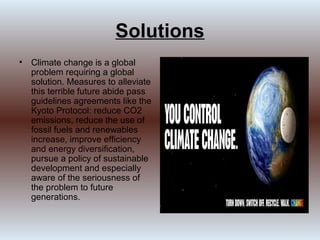
• Climate change is a global
  problem requiring a global
  solution. Measures to alleviate
  this terrible future abide pass
  guidelines agreements like the
  Kyoto Protocol: reduce CO2
  emissions, reduce the use of
  fossil fuels and renewables
  increase, improve efficiency
  and energy diversification,
  pursue a policy of sustainable
  development and especially
  aware of the seriousness of
  the problem to future
  generations.
What is global warming?
•   Global warming is the rise in the
    average temperature of Earth's
    atmosphere and oceans since the
    late 19th century and its projected
    continuation. Since the early 20th
    century, Earth's mean surface
    temperature has increased by
    about 0.8 °C (1.4 °F), with about
    two-thirds of the increase
    occurring since 1980. Warming of
    the climate system is unequivocal,
    and scientists are more than 90%
    certain that it is primarily caused
    by increasing concentrations
    of greenhouse gases produced by
    human activities such as the
    burning of fossil
    fuels and deforestation.
What is greenhouse effect?
•   The greenhouse effect is a process by
    which thermal radiation from a planetary
    surface is absorbed by
    atmospheric greenhouse gases, and is re-
    radiated in all directions. Since part of this
    re-radiation is back towards the surface and
    the lower atmosphere, it results in an
    elevation of the average surface
    temperature above what it would be in the
    absence of the gases.Solar radiation at the
    frequencies of visible light largely passes
    through the atmosphere to warm the
    planetary surface, which then emits this
    energy at the lower frequencies
    of infrared thermal radiation. Infrared
    radiation is absorbed by greenhouse gases,
    which in turn re-radiate much of the energy
    to the surface and lower atmosphere. The
    mechanism is named after the effect of
    solar radiation passing through glass and
    warming a greenhouse, but the way it
    retains heat is fundamentally different as a
    greenhouse works by reducing airflow,
    isolating the warm air inside the structure so
    that heat is not lost by convection.
Climate change in America
•   Latin America is especially vulnerable
    to climate change because of its
    geography. First, most of Mexico and
    Central America is within the hurricane
    belt, which now acts more strongly and
    volatility as a result of global warming.
    Second, the low coastal areas of Latin
    America - including its many islands
    and several urban areas in the region -
    will be threatened by rising sea levels
    induced by global warming. Third,
    much of the urban and agricultural
    activities in South America depends on
    water that comes from the Andean
    glaciers, which are also affected by
    being dangerously warming. All this
    threatens the sustainability of the
    region's populations and economies
    and, in particular, the main source of
    low-carbon energy in the region -
    hydropower.
Climate change in Asia
• Asia is undoubtedly one
  of the regions most
  vulnerable to the
  consequences of climate
  change. In 2007, 75% of
  people who died as a
  result of a natural disaster
  and lived in this area for
  the past three years the
  number of natural
  emergencies in that
  continent grew from 50 to
  200 per year.
Climate change in Europe
• The average temperature
  in Europe has increased
  in the last 100 years 0.95
  degrees Celsius, which
  means a 35% higher than
  the average warming of
  the planet (0.7 degrees).
  The greatest warming
  has been recorded in the
  Iberian Peninsula,
  northwest Russia and
  some Arctic regions. The
  75% of alpine glaciers, if
  the trend continues, it will
  have thawed in 2050.
Climate change in Africa
• Increasing deforestation
  in Africa has much of the
  blame for the frequent
  droughts and floods in the
  east of the continent each
  year suffering the effects
  of climate change and the
  threat that hangs over the
  plant and animal species
  in danger of extinction are
  in the area. The area of ​
  glaciers in the Africa has
  decreased by nearly 550
  acres in one hundred
  years.
Climate change in Oceania
•   Climate change has become a major issue
    in Australia due to drastic climate events since the
    turn of the 21st century that have focused
    government and public attention. Rainfall in
    Australia has increased slightly over the past
    century, although there is little or no trend in rainfall
    in northeast and southwest Australia. Water
    sources in the South Eastern areas of Australia
    have depleted due to increasing population in urban
    areas (rising demand) coupled with climate change
    factors such as persistent prolonged drought
    (diminishing supply). At the same
    time, Australia continues to have the highest per
    capita greenhouse gas emissions.The federal
    government and all state governments (New South
    Wales, Victoria, Queensland, South
    Australia, Western Australia, Tasmania, Northern
    Territories and Australian Capital Territory) have
    explicitly recognised that climate change is being
    caused by greenhouse gas emissions, in conformity
    with the scientific opinion on climate change.
    Sectors of the population are actively campaigning
    against new coal mines and coal fired power
    stations because of their concern about the effects
    of global warming on Australia. There is expected
    to be a net benefit to Australia of stabilising
    greenhouse gases in the atmosphere at 450ppm
    CO2 eq.
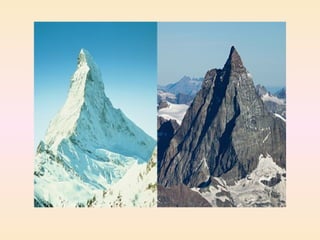
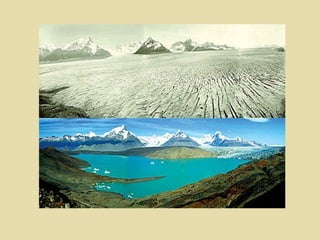
Here are some photos of
   Climate Change
   Then and Now
Thanks for watching the video.


• By Federico Penic

Federico_clim_ch-evidence

  • 1.
  • 2.
    What is it? • Climate change is a significant and lasting change in the statistical distribution of weather patterns over periods ranging from decades to millions of years. It may be a change in average weather conditions, or in the distribution of weather around the average conditions. Climate change is caused by factors that include oceanic processes, variations in solar radiation received by Earth, plate tectonics and volcanic eruptions, and human-induced alterations of the natural world; these latter effects are currently causing global warming, and "climate change”.
  • 3.
    Causes • The globalincrease in demand and energy consumption and industrial activity, transport, agriculture and deforestation, have led to an increase in emissions of CO2 and methane, the main greenhouse gas causing climate change.
  • 4.
    Effects • According to the IPCC (International Panel of Experts on Climate Change), the global warming of the Earth is already a fact that is occurring, and will produce serious consequences on the climate, atmosphere and biodiversity: increasing the average temperature of the Earth in this century between 1 and 3.5 degrees, reduced ice caps at the poles, sea level rise and flooding of low lying areas and islands, increasing desertification, disappearance of flora and fauna in ecosystems, shortages water and atmospheric instabilities (hurricanes, fires, etc..), side effects of human catastrophes (spread of famine and disease, etc..).
  • 5.
    Solutions • Climate changeis a global problem requiring a global solution. Measures to alleviate this terrible future abide pass guidelines agreements like the Kyoto Protocol: reduce CO2 emissions, reduce the use of fossil fuels and renewables increase, improve efficiency and energy diversification, pursue a policy of sustainable development and especially aware of the seriousness of the problem to future generations.
  • 6.
    What is globalwarming? • Global warming is the rise in the average temperature of Earth's atmosphere and oceans since the late 19th century and its projected continuation. Since the early 20th century, Earth's mean surface temperature has increased by about 0.8 °C (1.4 °F), with about two-thirds of the increase occurring since 1980. Warming of the climate system is unequivocal, and scientists are more than 90% certain that it is primarily caused by increasing concentrations of greenhouse gases produced by human activities such as the burning of fossil fuels and deforestation.
  • 7.
    What is greenhouseeffect? • The greenhouse effect is a process by which thermal radiation from a planetary surface is absorbed by atmospheric greenhouse gases, and is re- radiated in all directions. Since part of this re-radiation is back towards the surface and the lower atmosphere, it results in an elevation of the average surface temperature above what it would be in the absence of the gases.Solar radiation at the frequencies of visible light largely passes through the atmosphere to warm the planetary surface, which then emits this energy at the lower frequencies of infrared thermal radiation. Infrared radiation is absorbed by greenhouse gases, which in turn re-radiate much of the energy to the surface and lower atmosphere. The mechanism is named after the effect of solar radiation passing through glass and warming a greenhouse, but the way it retains heat is fundamentally different as a greenhouse works by reducing airflow, isolating the warm air inside the structure so that heat is not lost by convection.
  • 8.
    Climate change inAmerica • Latin America is especially vulnerable to climate change because of its geography. First, most of Mexico and Central America is within the hurricane belt, which now acts more strongly and volatility as a result of global warming. Second, the low coastal areas of Latin America - including its many islands and several urban areas in the region - will be threatened by rising sea levels induced by global warming. Third, much of the urban and agricultural activities in South America depends on water that comes from the Andean glaciers, which are also affected by being dangerously warming. All this threatens the sustainability of the region's populations and economies and, in particular, the main source of low-carbon energy in the region - hydropower.
  • 9.
    Climate change inAsia • Asia is undoubtedly one of the regions most vulnerable to the consequences of climate change. In 2007, 75% of people who died as a result of a natural disaster and lived in this area for the past three years the number of natural emergencies in that continent grew from 50 to 200 per year.
  • 10.
    Climate change inEurope • The average temperature in Europe has increased in the last 100 years 0.95 degrees Celsius, which means a 35% higher than the average warming of the planet (0.7 degrees). The greatest warming has been recorded in the Iberian Peninsula, northwest Russia and some Arctic regions. The 75% of alpine glaciers, if the trend continues, it will have thawed in 2050.
  • 11.
    Climate change inAfrica • Increasing deforestation in Africa has much of the blame for the frequent droughts and floods in the east of the continent each year suffering the effects of climate change and the threat that hangs over the plant and animal species in danger of extinction are in the area. The area of ​ glaciers in the Africa has decreased by nearly 550 acres in one hundred years.
  • 12.
    Climate change inOceania • Climate change has become a major issue in Australia due to drastic climate events since the turn of the 21st century that have focused government and public attention. Rainfall in Australia has increased slightly over the past century, although there is little or no trend in rainfall in northeast and southwest Australia. Water sources in the South Eastern areas of Australia have depleted due to increasing population in urban areas (rising demand) coupled with climate change factors such as persistent prolonged drought (diminishing supply). At the same time, Australia continues to have the highest per capita greenhouse gas emissions.The federal government and all state governments (New South Wales, Victoria, Queensland, South Australia, Western Australia, Tasmania, Northern Territories and Australian Capital Territory) have explicitly recognised that climate change is being caused by greenhouse gas emissions, in conformity with the scientific opinion on climate change. Sectors of the population are actively campaigning against new coal mines and coal fired power stations because of their concern about the effects of global warming on Australia. There is expected to be a net benefit to Australia of stabilising greenhouse gases in the atmosphere at 450ppm CO2 eq.
  • 13.
    Here are somephotos of Climate Change Then and Now
  • 24.
    Thanks for watchingthe video. • By Federico Penic