Climate Change
ENVIRONMENTAL ISSUES
enxemamk@gmail.com
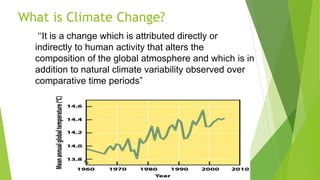
What is Climate Change?
‘‘It is a change which is attributed directly or
indirectly to human activity that alters the
composition of the global atmosphere and which is in
addition to natural climate variability observed over
comparative time periods”
GREENHOUSE GASES
such as carbon dioxide (CO2) absorb heat
(infrared radiation) emitted from Earth’s surface.
Increases in the atmospheric concentrations of these
gases cause Earth to warm by trapping more of this heat.
Human activities—especially the burning of
fossil fuels since the start of the Industrial
Revolution—have increased atmospheric CO2
concentrations by about 40%, with more than
half the increase occurring since 1970.
Since 1900, the global average surface
temperature has increased by about 0.8 °C
(1.4 °F). This has been accompanied by
warming of the ocean, a rise in sea level, a
strong decline in Arctic sea ice, and many
other associated climate effects.
CAUSES
NATURAL CAUSES
 Volcanic Eruptions.
 Emissions of methane from animal wastes, a
greenhouse gas.
 Earth naturally has a cycle of climate change that
occurs every 40, 000 years.
 the sun’s solar energy output is changing and
naturally increases Earth’s average temperature by
about 1ºC every century.
 Earth’s orbit and tilt alter in relation to the sun,
which changes solar energy output.
CAUSES
HUMAN CAUSES
 Greenhouse gases
 Deforestation
 Coal mining
 Burning of fossil fuels
 Industrial processes
 Agriculture
 Over-population
EFFECTS
 Rise in Sea level.
 Heavy Rainfall.
 Extreme Drought.
 Decline in Crop Productivity.
 Ecosystems are changing.
 Rise in Temperature.
 Carbon dioxide acidifies sea water.
 Damaged crops due to sudden climate change and
floods.
 Longer summers can disrupt animal habitation.
 Increased number of heat-related illnesses and
deaths.
DEALING
with G lo b al C limate C hange
To avoid the worst of climate change, CO2 levels must be
stabilized at 550ppm
50% higher than current levels
-Two ways to attempt to manage climate change
 Mitigation
Focuses on limiting greenhouse gas emissions to
moderate global climate change
 Adaptation
Focuses on learning to live with to the
environmental changes and societal consequences
brought about by global climate change
Mitigation
 Locate/invent alternative fuels to
fossil fuels.
 Increase efficiency of cars and trucks.
 Sequestering carbon before it is
emitted.
 Plant and Maintain trees to naturally
sequester carbon.
Adaptation
 Rising sea levels and coastal populations:
-Move inland
-Construct dikes and levees
 Adapt to shifting agricultural zones
THANKS…
ANY QUESTION?

Climate change

  • 1.
  • 2.
    What is ClimateChange? ‘‘It is a change which is attributed directly or indirectly to human activity that alters the composition of the global atmosphere and which is in addition to natural climate variability observed over comparative time periods”
  • 3.
    GREENHOUSE GASES such ascarbon dioxide (CO2) absorb heat (infrared radiation) emitted from Earth’s surface. Increases in the atmospheric concentrations of these gases cause Earth to warm by trapping more of this heat.
  • 4.
    Human activities—especially theburning of fossil fuels since the start of the Industrial Revolution—have increased atmospheric CO2 concentrations by about 40%, with more than half the increase occurring since 1970. Since 1900, the global average surface temperature has increased by about 0.8 °C (1.4 °F). This has been accompanied by warming of the ocean, a rise in sea level, a strong decline in Arctic sea ice, and many other associated climate effects.
  • 5.
    CAUSES NATURAL CAUSES  VolcanicEruptions.  Emissions of methane from animal wastes, a greenhouse gas.  Earth naturally has a cycle of climate change that occurs every 40, 000 years.  the sun’s solar energy output is changing and naturally increases Earth’s average temperature by about 1ºC every century.  Earth’s orbit and tilt alter in relation to the sun, which changes solar energy output.
  • 6.
    CAUSES HUMAN CAUSES  Greenhousegases  Deforestation  Coal mining  Burning of fossil fuels  Industrial processes  Agriculture  Over-population
  • 7.
    EFFECTS  Rise inSea level.  Heavy Rainfall.  Extreme Drought.  Decline in Crop Productivity.  Ecosystems are changing.  Rise in Temperature.  Carbon dioxide acidifies sea water.  Damaged crops due to sudden climate change and floods.  Longer summers can disrupt animal habitation.  Increased number of heat-related illnesses and deaths.
  • 8.
    DEALING with G lob al C limate C hange To avoid the worst of climate change, CO2 levels must be stabilized at 550ppm 50% higher than current levels -Two ways to attempt to manage climate change  Mitigation Focuses on limiting greenhouse gas emissions to moderate global climate change  Adaptation Focuses on learning to live with to the environmental changes and societal consequences brought about by global climate change
  • 9.
    Mitigation  Locate/invent alternativefuels to fossil fuels.  Increase efficiency of cars and trucks.  Sequestering carbon before it is emitted.  Plant and Maintain trees to naturally sequester carbon.
  • 10.
    Adaptation  Rising sealevels and coastal populations: -Move inland -Construct dikes and levees  Adapt to shifting agricultural zones
  • 11.
  • 12.