Dr V.RAMKUMAR 
CONSULTANT 
DENTAL&FACIOMAXILLARY SURGEON 
REG:NO -4118 TAMILNADU- INDAI(ASIA)
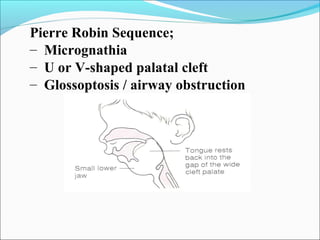
Pierre Robin Sequence; 
– Micrognathia 
– U or V-shaped palatal cleft 
– Glossoptosis / airway obstruction
Causes of 
Isolated Cleft Lip +/- palate 
Multifactorial 
environmental + genetic factors - 
positive family history in 26% cases 
Known Teratogens 
-specific drugs, i.e. phenytoin, methotrexate, 
sodium valproate, alcohol, cigarette smoking, 
pesticides(dioxin)
Syndromic Cleft Lip +/- Palate 
400 syndromes associated with CLP 
Chromosomal anomalies 
-trisomy 13(Patau), 18(Edwards), 21(Downs), 
velocardiofacial (22q11) 
Inherited Syndromes - 
Sticklers(AD) - 
Treacher Collins(AD) - 
Van der Woude(AD) 
Non inherited syndromes 
-Pierre Robin Sequence (50%have a syndrome- 
Sticklers/22q11)
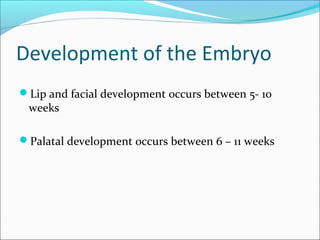
Development of the Embryo 
Lip and facial development occurs between 5- 10 
weeks 
Palatal development occurs between 6 – 11 weeks
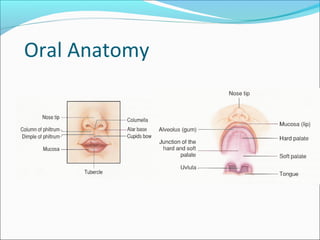
Oral Anatomy
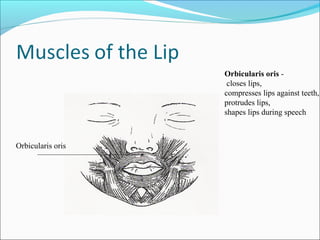
Orbicularis oris 
Orbicularis oris - 
closes lips, 
compresses lips against teeth, 
protrudes lips, 
shapes lips during speech
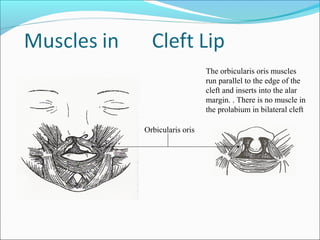
Orbicularis oris 
The orbicularis oris muscles 
run parallel to the edge of the 
cleft and inserts into the alar 
margin. . There is no muscle in 
the prolabium in bilateral cleft
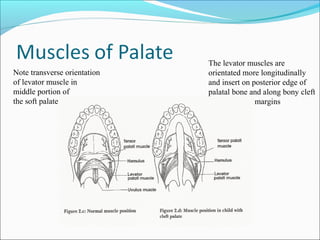
Note transverse orientation 
of levator muscle in 
middle portion of 
the soft palate 
The levator muscles are 
orientated more longitudinally 
and insert on posterior edge of 
palatal bone and along bony cleft 
margins
The family’s journey
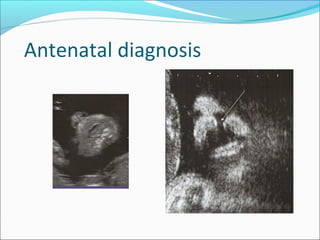
Antenatal diagnosis
Nurse will contact within 24hours 
Provide information / support 
Pre/post repair photographs 
Develop feeding plan 
On going support for family
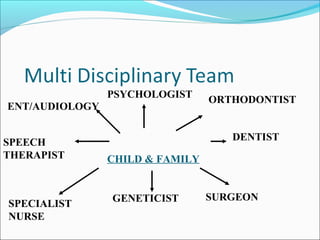
PSYCHOLOGIST 
CHILD & FAMILY 
SPEECH 
THERAPIST 
SPECIALIST 
NURSE 
ORTHODONTIST 
DENTIST 
GENETICIST 
ENT/AUDIOLOGY 
SURGEON
Birth 
Nurse will visit within 24hours 
Provide information / support 
Feeding assessment and advice 
Pre/post repair photographs 
On going support for family
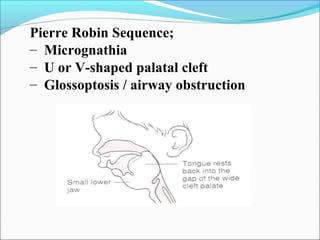
Pierre Robin Sequence; 
– Micrognathia 
– U or V-shaped palatal cleft 
– Glossoptosis / airway obstruction
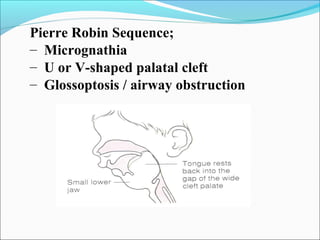
Pierre Robin Sequence; 
– Micrognathia 
– U or V-shaped palatal cleft 
– Glossoptosis / airway obstruction
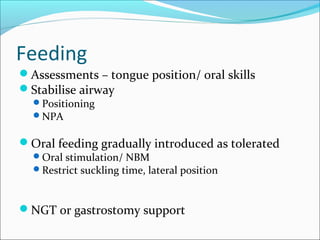
Feeding 
Assessments – tongue position/ oral skills 
Stabilise airway 
Positioning 
NPA 
Oral feeding gradually introduced as tolerated 
Oral stimulation/ NBM 
Restrict suckling time, lateral position 
NGT or gastrostomy support
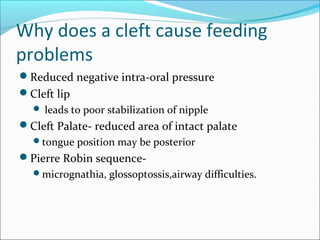
Why does a cleft cause feeding 
problems 
Reduced negative intra-oral pressure 
Cleft lip 
 leads to poor stabilization of nipple 
Cleft Palate- reduced area of intact palate 
tongue position may be posterior 
Pierre Robin sequence- 
micrognathia, glossoptossis,airway difficulties.
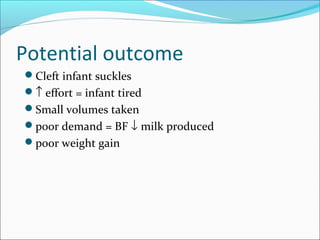
Potential outcome 
Cleft infant suckles 
­ effort = infant tired 
Small volumes taken 
poor demand = BF ¯ milk produced 
poor weight gain
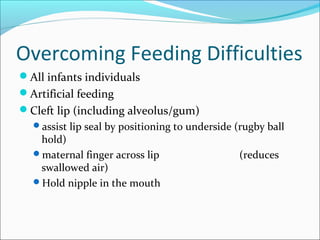
Overcoming Feeding Difficulties 
All infants individuals 
Artificial feeding 
Cleft lip (including alveolus/gum) 
assist lip seal by positioning to underside (rugby ball 
hold) 
maternal finger across lip (reduces 
swallowed air) 
Hold nipple in the mouth
Exaggerated latch technique 
as much breast in mouth as possible 
practice when breast is soft 
Vary positions to empty all lobes 
Encourage milk flow 
Breast compression
Assisted feeding 
Soft squeezable bottle 
Orthodontic teat 
Upright position 
Position teat into non-cleft side
RULE OF TEN(10) 
IO –WEEKS OLD 
IO – POUNDS OF WEIGHT 
IO- GRAMS OF HAEMOGLOBIN
Primary 
Surgical Repair 
Isolated Cleft Lip 
3-4 months 
Isolated Cleft Palate 
Hard +/or Soft Palate 
8-9 months 
Cleft Lip and Palate 
Lip and 
vomer flap 3-4 months 
Soft palate 
8-9 months
Secondary Surgery 
Speech surgery - (Pre school) 
Velopharyngeal insufficiency 
Alveolar bone graft - (8-10 years) 
Boney union of alveolus 
Orthognathic surgery - (Adult) 
Malocclusion / aesthetic
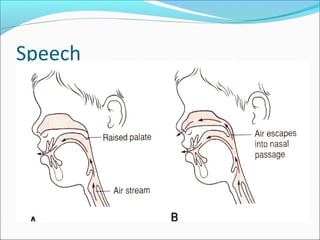
Speech
Speech sounds 
Articulation – production of sounds 
Intelligibility 
Resonance – balance of air in oral/nasal cavity- hyper 
or hyponasality 
Often structural problems 
Raised soft palate for ‘p f t s/sh k b v d z g’ 
Lowered soft palate for ‘m n ng’
Why are children prone to Otitis 
Media? 
Eustachian tube half adult length 
Allows reflux from nasopharynx 
Supine feeding position aggravates reflux 
Otitis Media with effusion (OME) 
poor middle ear ventilation 
 Negative pressure causes fluid builds up unilateral or 
bilateral 
grommets
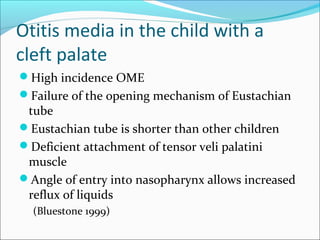
Otitis media in the child with a 
cleft palate 
High incidence OME 
Failure of the opening mechanism of Eustachian 
tube 
Eustachian tube is shorter than other children 
Deficient attachment of tensor veli palatini 
muscle 
Angle of entry into nasopharynx allows increased 
reflux of liquids 
(Bluestone 1999)
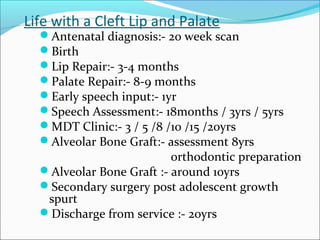
Life with a Cleft Lip and Palate 
Antenatal diagnosis:- 20 week scan 
Birth 
Lip Repair:- 3-4 months 
Palate Repair:- 8-9 months 
Early speech input:- 1yr 
Speech Assessment:- 18months / 3yrs / 5yrs 
MDT Clinic:- 3 / 5 /8 /10 /15 /20yrs 
Alveolar Bone Graft:- assessment 8yrs 
orthodontic preparation 
Alveolar Bone Graft :- around 10yrs 
Secondary surgery post adolescent growth 
spurt 
Discharge from service :- 20yrs
 Thank you

Cleft lip and palate ppt

  • 1.
    Dr V.RAMKUMAR CONSULTANT DENTAL&FACIOMAXILLARY SURGEON REG:NO -4118 TAMILNADU- INDAI(ASIA)
  • 3.
    Pierre Robin Sequence; – Micrognathia – U or V-shaped palatal cleft – Glossoptosis / airway obstruction
  • 4.
    Causes of IsolatedCleft Lip +/- palate Multifactorial environmental + genetic factors - positive family history in 26% cases Known Teratogens -specific drugs, i.e. phenytoin, methotrexate, sodium valproate, alcohol, cigarette smoking, pesticides(dioxin)
  • 5.
    Syndromic Cleft Lip+/- Palate 400 syndromes associated with CLP Chromosomal anomalies -trisomy 13(Patau), 18(Edwards), 21(Downs), velocardiofacial (22q11) Inherited Syndromes - Sticklers(AD) - Treacher Collins(AD) - Van der Woude(AD) Non inherited syndromes -Pierre Robin Sequence (50%have a syndrome- Sticklers/22q11)
  • 6.
    Development of theEmbryo Lip and facial development occurs between 5- 10 weeks Palatal development occurs between 6 – 11 weeks
  • 7.
  • 8.
    Orbicularis oris Orbicularisoris - closes lips, compresses lips against teeth, protrudes lips, shapes lips during speech
  • 9.
    Orbicularis oris Theorbicularis oris muscles run parallel to the edge of the cleft and inserts into the alar margin. . There is no muscle in the prolabium in bilateral cleft
  • 10.
    Note transverse orientation of levator muscle in middle portion of the soft palate The levator muscles are orientated more longitudinally and insert on posterior edge of palatal bone and along bony cleft margins
  • 11.
  • 12.
  • 13.
    Nurse will contactwithin 24hours Provide information / support Pre/post repair photographs Develop feeding plan On going support for family
  • 14.
    PSYCHOLOGIST CHILD &FAMILY SPEECH THERAPIST SPECIALIST NURSE ORTHODONTIST DENTIST GENETICIST ENT/AUDIOLOGY SURGEON
  • 15.
    Birth Nurse willvisit within 24hours Provide information / support Feeding assessment and advice Pre/post repair photographs On going support for family
  • 16.
    Pierre Robin Sequence; – Micrognathia – U or V-shaped palatal cleft – Glossoptosis / airway obstruction
  • 17.
    Pierre Robin Sequence; – Micrognathia – U or V-shaped palatal cleft – Glossoptosis / airway obstruction
  • 18.
    Feeding Assessments –tongue position/ oral skills Stabilise airway Positioning NPA Oral feeding gradually introduced as tolerated Oral stimulation/ NBM Restrict suckling time, lateral position NGT or gastrostomy support
  • 19.
    Why does acleft cause feeding problems Reduced negative intra-oral pressure Cleft lip  leads to poor stabilization of nipple Cleft Palate- reduced area of intact palate tongue position may be posterior Pierre Robin sequence- micrognathia, glossoptossis,airway difficulties.
  • 20.
    Potential outcome Cleftinfant suckles ­ effort = infant tired Small volumes taken poor demand = BF ¯ milk produced poor weight gain
  • 21.
    Overcoming Feeding Difficulties All infants individuals Artificial feeding Cleft lip (including alveolus/gum) assist lip seal by positioning to underside (rugby ball hold) maternal finger across lip (reduces swallowed air) Hold nipple in the mouth
  • 22.
    Exaggerated latch technique as much breast in mouth as possible practice when breast is soft Vary positions to empty all lobes Encourage milk flow Breast compression
  • 23.
    Assisted feeding Softsqueezable bottle Orthodontic teat Upright position Position teat into non-cleft side
  • 24.
    RULE OF TEN(10) IO –WEEKS OLD IO – POUNDS OF WEIGHT IO- GRAMS OF HAEMOGLOBIN
  • 25.
    Primary Surgical Repair Isolated Cleft Lip 3-4 months Isolated Cleft Palate Hard +/or Soft Palate 8-9 months Cleft Lip and Palate Lip and vomer flap 3-4 months Soft palate 8-9 months
  • 26.
    Secondary Surgery Speechsurgery - (Pre school) Velopharyngeal insufficiency Alveolar bone graft - (8-10 years) Boney union of alveolus Orthognathic surgery - (Adult) Malocclusion / aesthetic
  • 27.
  • 28.
    Speech sounds Articulation– production of sounds Intelligibility Resonance – balance of air in oral/nasal cavity- hyper or hyponasality Often structural problems Raised soft palate for ‘p f t s/sh k b v d z g’ Lowered soft palate for ‘m n ng’
  • 29.
    Why are childrenprone to Otitis Media? Eustachian tube half adult length Allows reflux from nasopharynx Supine feeding position aggravates reflux Otitis Media with effusion (OME) poor middle ear ventilation  Negative pressure causes fluid builds up unilateral or bilateral grommets
  • 30.
    Otitis media inthe child with a cleft palate High incidence OME Failure of the opening mechanism of Eustachian tube Eustachian tube is shorter than other children Deficient attachment of tensor veli palatini muscle Angle of entry into nasopharynx allows increased reflux of liquids (Bluestone 1999)
  • 31.
    Life with aCleft Lip and Palate Antenatal diagnosis:- 20 week scan Birth Lip Repair:- 3-4 months Palate Repair:- 8-9 months Early speech input:- 1yr Speech Assessment:- 18months / 3yrs / 5yrs MDT Clinic:- 3 / 5 /8 /10 /15 /20yrs Alveolar Bone Graft:- assessment 8yrs orthodontic preparation Alveolar Bone Graft :- around 10yrs Secondary surgery post adolescent growth spurt Discharge from service :- 20yrs
  • 32.

Editor's Notes

  • #11 Muscles of soft palate are divided in the midline Orientation changed from horizontal to oblique (or even vertical along medial margin of palatal cleft Attachment of muscles to hard palate are also abnormal Surgery releases entire muscular complex of soft palate, to create palatal sling in normal horizontal position. Implication of cleft palate Difficult to generate adequate negative intra-oral pressure for sucking Difficult to stabilise nipple or teat in oral cavity Difficult to completely separate nasal from oral cavity, causing nasal regurgitation and articulation difficulty with speech