
Management of cleft lip and
palate
Role of pedodontist in the management of cleft lip and palate
Contents
• Introduction
• History
• Definition
• Classification
• Prevalence
• Theories
• Etiology
• Development of palate
• Clinical features
• Parental attitude
• Management
• Treatment plan
INTRODUCTION
• Congenital abnormal space or gap in the upper lip, alveolus and palate
• Most common congenital deformity at birth
• Earlier numerous misbelieves associated with cleft
• Problems are cosmetic, dental, speech, swallowing, hearing, facial growth, emotional
HISTORY
• Believed due to solar eclipse ,bad omen.
• Pare –obturators in 1561
• Le monnier-1st surgical repair of cleft palate 1764
• American cleft palate association-1943
Definition
Cleft lip: congenital deformity of the upper lip that varies from a notching to a complete
division of lip,any degree of clefting can occur.
Cleft palate: a congentital split of palate that may extend to uvula,soft palate and into hard
palate,the lip may or maynot involve in the cleft of the palate
Obturator: a plastic ,acrylic appliance usually removable used to cover a cleft or a fistula in
the hard palate or help to achieve velopharyngeal closure in order to promote clear speech
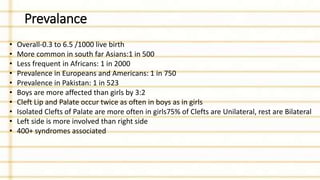
Prevalance
• Overall-0.3 to 6.5 /1000 live birth
• More common in south far Asians:1 in 500
• Less frequent in Africans: 1 in 2000
• Prevalence in Europeans and Americans: 1 in 750
• Prevalence in Pakistan: 1 in 523
• Boys are more affected than girls by 3:2
• Cleft Lip and Palate occur twice as often in boys as in girls
• Isolated Clefts of Palate are more often in girls75% of Clefts are Unilateral, rest are Bilateral
• Left side is more involved than right side
• 400+ syndromes associated
Etiology
• Hereditary
• enviornment: rubella virus etc
• Mutant gene: mendelian inheritance
• Chromosomal: trisomy 21
• Increased maternal age
• Decreased blood supply to nasomax region
• Decreased folic acid and vit A
• Multifactorial
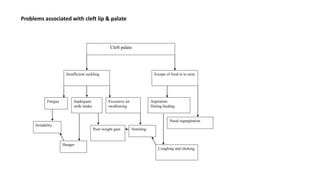
Cleft palate
Insufficient suckling Escape of food in to nose
Fatigue Inadequate
milk intake
Excessive air
swallowing
Aspiration
During feeding
Nasal regurgitation
Irritability
Hunger
Poor weight gain Vomiting
Coughing and choking
Problems associated with cleft lip & palate
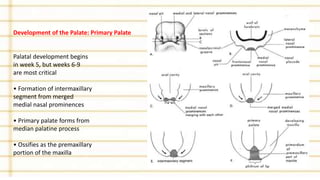
Development of the Palate: Primary Palate
Palatal development begins
in week 5, but weeks 6-9
are most critical
• Formation of intermaxillary
segment from merged
medial nasal prominences
• Primary palate forms from
median palatine process
• Ossifies as the premaxillary
portion of the maxilla
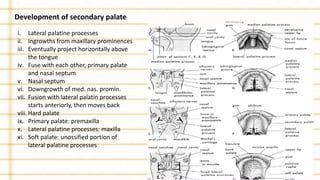
Development of secondary palate
i. Lateral palatine processes
ii. Ingrowths from maxillary prominences
iii. Eventually project horizontally above
the tongue
iv. Fuse with each other, primary palate
and nasal septum
v. Nasal septum
vi. Downgrowth of med. nas. promin.
vii. Fusion with lateral palatin processes
starts anteriorly, then moves back
viii. Hard palate
ix. Primary palate: premaxilla
x. Lateral palatine processes: maxilla
xi. Soft palate: unossified portion of
lateral palatine processes
Theories
• Dursy his hypothesis: failure of fusion b/n median nasal and maxillary process
• Veau’s hypothesis: failure of ingrowth of mesoderm b/n 2 palatal shelf
• Non-fusion of shelves
• Alterations in palatal forces
• Fusion of shelves with subsequent break down
• Excessive tongue resistance
• excessive head width
• Failure of tongue to drop down
• Inclusion of cyst pathology
Classification
• Davis and Ritchie
• Veau’s classification
• Foghanderson
• Kernahans and starks
• American cleft palate association
• Karnahan’s y striped Classification
• Millard’s Modification of Karnahan’s Classifcation
• Pfiefer classification
• Tessier classification
Based on embryology
Graphic method
of recording
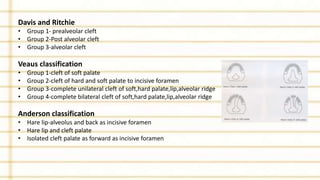
Davis and Ritchie
• Group 1- prealveolar cleft
• Group 2-Post alveolar cleft
• Group 3-alveolar cleft
Veaus classification
• Group 1-cleft of soft palate
• Group 2-cleft of hard and soft palate to incisive foramen
• Group 3-complete unilateral cleft of soft,hard palate,lip,alveolar ridge
• Group 4-complete bilateral cleft of soft,hard palate,lip,alveolar ridge
Anderson classification
• Hare lip-alveolus and back as incisive foramen
• Hare lip and cleft palate
• Isolated cleft palate as forward as incisive foramen
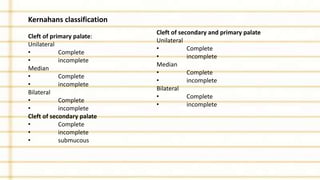
Kernahans classification
Cleft of primary palate:
Unilateral
• Complete
• incomplete
Median
• Complete
• incomplete
Bilateral
• Complete
• incomplete
Cleft of secondary palate
• Complete
• incomplete
• submucous
Cleft of secondary and primary palate
Unilateral
• Complete
• incomplete
Median
• Complete
• incomplete
Bilateral
• Complete
• incomplete
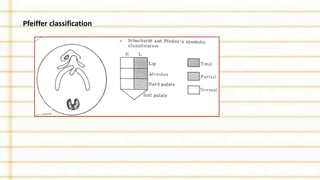
Pfeiffer classification
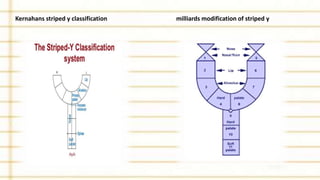
Kernahans striped y classification milliards modification of striped y
American cleft palate association
Cleft of prepalate
Cleft lip
• Unilateral
• Bilateral
• Median
• Prolabium
• Congenital scar
Cleft of alveolar process:
• Unilateral
• Bilateral
• Median
Cleft of prepalate:
• Prepalate protrusion
• Prepalate rotation
• Prepalate arrest
Cleft of palate:
Cleft of soft palate:extent palatal shortness
Submucous cleft
Cleft of hard palate:
Extent:vomer attachment
Syndromes associated
Autosominal dominant:
• Vander woude syndrome
• EEC syndrome
• Larsen syndrome
Autosomal recessive:
• Conradi syndrome
• Mekels syndrome
• Orofacial digital syndrome type 2
• Fryns syndrome
X linked
• Orofacial digital syndrome type 1
• Isolated x linked cleft palate with ankyloglossia
chromosomal
• Trisomy 13
• Trisomy 18
Non mendelian
• Pierre robin sequence
• Clefting with congenital heart disease
Clinical features
• Common finding-natal neonatal teeth (cleft palate)
• absent lateral incisor
• missing premolar
• supernumerary teeth
• ectopic lateral incisor
• Palatal eruption of per. Canine
• Anomalies like enamel hypoplasia, microdontia,macrodontia,fused teeth
• over bite
• Lateral facial profile
• protruberance and mobile premaxilla in infants
• Bilateral cleft
• Posterior cross bite in u/b cleft palate
• Rotated per.incisor
• Premature loss deficiency of alveolar bone
Hearing loss :
• Hearing loss and middle ear disease
• Otitis media- early , in 1st month of life
• Prolonged middle ear effusion →permanent damage to the middle ear
Speech difficulties :
• Retardation of consonant sounds (p, b , t, d, k, g)
• Hindrance to early vocabulary development.
• Hyper nasality – cleft of SP
• Hearing problems contribute
Nasal deformities :
• Cleft extending to floor of nose- alar cartilage flared,
• Columella pulled to non cleft side
• Lack of underlying bone support - ↑ problem
• Surgical corrections- deferred until all other procedures are completed - as correction of alv clefts, max
skeletal retrusion - alter osseous foundation of nose.
Parental attitudes
Weatcher 1959
• Child appearance
• Request for immediate surgery
• Speech development
• feeding
• Reaction of the spouse
• Action of siblings
• Reaction and family and friends
• Intellectual development
• Financial problems
• Recurrence of the defect in other unborn children
DIET
• Milk , cooled boiled water- suitably safe drinks
• Training beaker, cup – at 6 months
• Weaning foods/drinks – sugar free, avoidance of pacifiers
TOOTH BRUSHING
• Potential area for plaque around teeth, cleft region.
• After upper lip surgery- how to lift it, stretching lip carefully
• sliding an index finger along labial gingiva without any damage to scar
• Small size head ideal – lack of sulcus depth, awkward tooth position
• Interspaced tooth brush- crowding, bilateral clefts with upper anterior retroclined
• low fluoridated toothpaste(600ppm) - Below 6 yrs
• High risk caries pts- 1000ppm
• Twice daily brushing
USE OF FLUORIDE
Fluoride supplements
1. fluoride content local water supply
2. likelihood of compliance
3. caries experience of pts and other family
members Fluoride varnish, 5% NaF
MANAGEMENT OF NEONATE
2 kinds of problems
a) hazards affecting the child - neonatal respiratory obstruction
b) feeding difficulties
NEONATAL RESPIRATORY OBSTRUCTION
• Most babies- no problems
• Infants born - very small & post displaced
• mandible, tongue falling backwards →severe potentially lethal obstrucn to airway.
• Ex : Pierre robin syndrome.
MANAGEMENT :
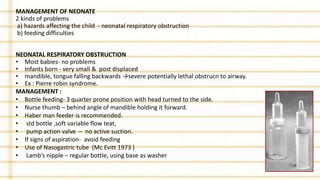
• Bottle feeding- 3 quarter prone position with head turned to the side.
• Nurse thumb – behind angle of mandible holding it forward.
• Haber man feeder is recommended.
• std bottle ,soft variable flow teat,
• pump action valve – no active suction.
• If signs of aspiration- avoid feeding
• Use of Nasogastric tube (Mc Evitt 1973 )
• Lamb’s nipple – regular bottle, using base as washer
Feeding
• Breast feeding should be encouraged
• Feeding by bottle rather than spoon – encouraged, biting action of lower lip , jaw function , development
• Nostrils – cleaned.
• Lips- well lubricated with Vaseline
• If orthopedic splint worn – remove before feeding, clean it , place it , then feed
• Tapes – checked for dry, cleaned firmly attached to elasto plast base on cheeks
• Splints- foundation plaster removed only when it is soiled, with olive oil
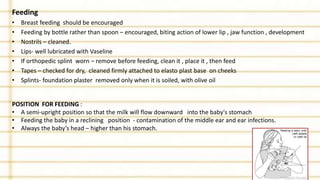
POSITION FOR FEEDING :
• A semi-upright position so that the milk will flow downward into the baby's stomach
• Feeding the baby in a reclining position - contamination of the middle ear and ear infections.
• Always the baby’s head – higher than his stomach.
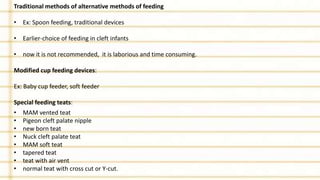
Traditional methods of alternative methods of feeding
• Ex: Spoon feeding, traditional devices
• Earlier-choice of feeding in cleft infants
• now it is not recommended, it is laborious and time consuming.
Modified cup feeding devices:
Ex: Baby cup feeder, soft feeder
Special feeding teats:
• MAM vented teat
• Pigeon cleft palate nipple
• new born teat
• Nuck cleft palate teat
• MAM soft teat
• tapered teat
• teat with air vent
• normal teat with cross cut or Y-cut.
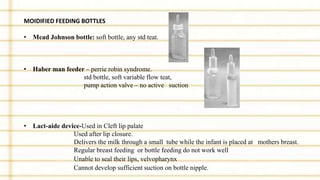
MOIDIFIED FEEDING BOTTLES
• Mead Johnson bottle: soft bottle, any std teat.
• Haber man feeder – perrie robin syndrome.
std bottle, soft variable flow teat,
pump action valve – no active suction
• Lact-aide device-Used in Cleft lip palate
Used after lip closure.
Delivers the milk through a small tube while the infant is placed at mothers breast.
Regular breast feeding or bottle feeding do not work well
Unable to seal their lips, velvopharynx
Cannot develop sufficient suction on bottle nipple.
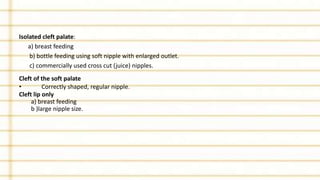
Isolated cleft palate:
a) breast feeding
b) bottle feeding using soft nipple with enlarged outlet.
c) commercially used cross cut (juice) nipples.
Cleft of the soft palate
• Correctly shaped, regular nipple.
Cleft lip only
a) breast feeding
b )large nipple size.
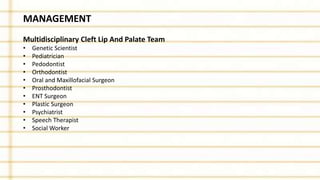
MANAGEMENT
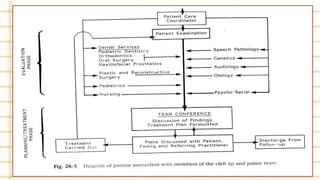
Multidisciplinary Cleft Lip And Palate Team
• Genetic Scientist
• Pediatrician
• Pedodontist
• Orthodontist
• Oral and Maxillofacial Surgeon
• Prosthodontist
• ENT Surgeon
• Plastic Surgeon
• Psychiatrist
• Speech Therapist
• Social Worker
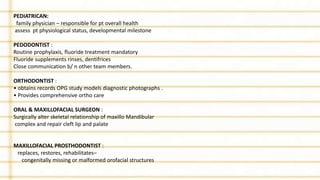
PEDIATRICAN:
family physician – responsible for pt overall health
assess pt physiological status, developmental milestone
PEDODONTIST :
Routine prophylaxis, fluoride treatment mandatory
Fluoride supplements rinses, dentifrices
Close communication b/ n other team members.
ORTHODONTIST :
• obtains records OPG study models diagnostic photographs .
• Provides comprehensive ortho care
ORAL & MAXILLOFACIAL SURGEON :
Surgically alter skeletal relationship of maxillo Mandibular
complex and repair cleft lip and palate
MAXILLOFACIAL PROSTHODONTIST :
replaces, restores, rehabilitates–
congenitally missing or malformed orofacial structures
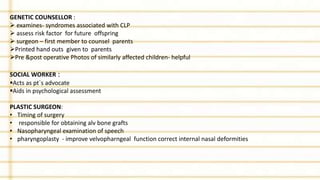
GENETIC COUNSELLOR :
 examines- syndromes associated with CLP
 assess risk factor for future offspring
 surgeon – first member to counsel parents
Printed hand outs given to parents
Pre &post operative Photos of similarly affected children- helpful
SOCIAL WORKER :
Acts as pt`s advocate
Aids in psychological assessment
PLASTIC SURGEON:
• Timing of surgery
• responsible for obtaining alv bone grafts
• Nasopharyngeal examination of speech
• pharyngoplasty - improve velvopharngeal function correct internal nasal deformities
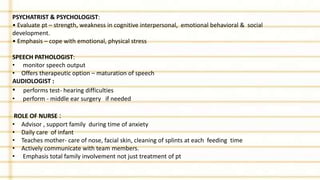
PSYCHATRIST & PSYCHOLOGIST:
• Evaluate pt – strength, weakness in cognitive interpersonal, emotional behavioral & social
development.
• Emphasis – cope with emotional, physical stress
SPEECH PATHOLOGIST:
• monitor speech output
• Offers therapeutic option – maturation of speech
AUDIOLOGIST :
• performs test- hearing difficulties
• perform - middle ear surgery if needed
ROLE OF NURSE :
• Advisor , support family during time of anxiety
• Daily care of infant
• Teaches mother- care of nose, facial skin, cleaning of splints at each feeding time
• Actively communicate with team members.
• Emphasis total family involvement not just treatment of pt
Treatment plan
Stage 1:Maxillary orthopedic stage
• Birth to 18 months
• Management of CLP- immediate attention of new born.
• Feeding problems- difficult to maintain adequate nutrition .
• Numerous prosthetic devices.
• Mc Neil (1950) devised , Intra oral maxillary obturator
• Plates pumps and nipples
INTRA ORAL MAXILLARY OBTURATOR :
• Provides a false palate,
• reducing feeding difficulties in infants
• preventing arch collapse
• Mold the cleft segments into approximation before primary alveolar bone grafting.
• create sufficient –ve pressure, which allow adequate sucking of milk.
Instructions to parents:
• Recall the pt after 2 days.
• Appliance – approximate 3 month until the time of initial lip closure
Clinical management of initial obturator therapy (birth to 3 months).
• appliance positioned in the infant’s mouth
• excessive pressure areas identified by acrylic resin are identified
• Donot impinge on resin
• Parents instructed on placement and removal of the appliance and its daily cleaning.
• infants are usually seen for adjustments 2 days after initial appliance delivery
• Monthly observations scheduled.
• In most cases, this appliance will serve until the time of initial lip closure at approximately 3 months of age.
• The major advantage of the obturator during this stage of treatment is to enhance the child’s ability to
obtain nourishment.
• Initial obturator therapy::
birth to 3 months
obturators used
appliance cleaned before and after feed
• Presurgical orthopedics:
birth to 5 months
Aims achieve upper arch that conforms to lower arch
Premaxillary retraction tape required in case of anteriorly placed premaxilla
• Surgical lip closure :
3 to 9 month
Best time for lip closure
Rule of 10
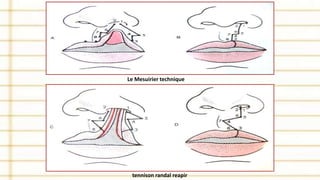
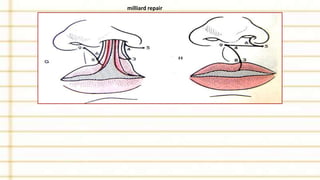
types of lip repair are- milliard repair
tennison randal reapir
veau repair
rose Thompson repair
Le Mesuirier technique
• Surgical plate repair:
10-18 months
time of palatal repair
Repair done early-good esthetics
Rule of Ten
• Primary repair- appx 10 weeks
• weighs 10 pounds
• hemoglobin of at least 10 grams
• white count of no higher than
10,000
• at least 10 weeks of age
Le Mesuirier technique
tennison randal reapir
milliard repair
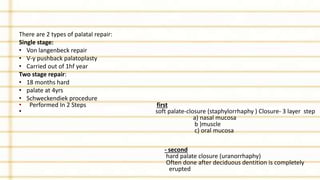
There are 2 types of palatal repair:
Single stage:
• Von langenbeck repair
• V-y pushback palatoplasty
• Carried out of 1hf year
Two stage repair:
• 18 months hard
• palate at 4yrs
• Schweckendiek procedure
• Performed In 2 Steps first
• soft palate-closure (staphylorrhaphy ) Closure- 3 layer step
a) nasal mucosa
b )muscle
c) oral mucosa
- second
hard palate closure (uranorrhaphy)
Often done after deciduous dentition is completely
erupted
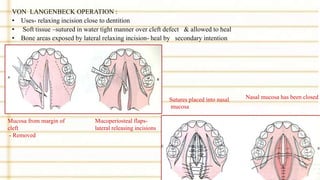
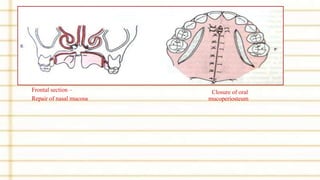
VON LANGENBECK OPERATION :
• Uses- relaxing incision close to dentition
• Soft tissue –sutured in water tight manner over cleft defect & allowed to heal
• Bone areas exposed by lateral relaxing incision- heal by secondary intention
Mucosa from margin of
cleft
- Removed
Mucoperiosteal flaps-
lateral releasing incisions
Sutures placed into nasal
mucosa
Nasal mucosa has been closed
Frontal section –
Repair of nasal mucosa
Closure of oral
mucoperiosteum
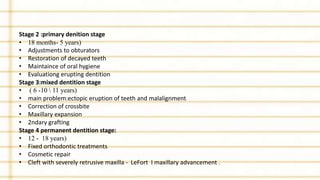
Stage 2 :primary denition stage
• 18 months- 5 years)
• Adjustments to obturators
• Restoration of decayed teeth
• Maintaince of oral hygiene
• Evaluationg erupting dentition
Stage 3:mixed dentition stage
• ( 6 -10  11 years)
• main problem:ectopic eruption of teeth and malalignment
• Correction of crossbite
• Maxillary expansion
• 2ndary grafting
Stage 4 permanent dentition stage:
• 12 - 18 years)
• Fixed orthodontic treatments
• Cosmetic repair
• Cleft with severely retrusive maxilla - LeFort I maxillary advancement .
Reference
Textbook of pedodontics Nikhil marwah
macdonalds
shoba tandon
Cleft lip and palate

Cleft lip and palate

  • 1.
    Management of cleftlip and palate Role of pedodontist in the management of cleft lip and palate
  • 2.
    Contents • Introduction • History •Definition • Classification • Prevalence • Theories • Etiology • Development of palate • Clinical features • Parental attitude • Management • Treatment plan
  • 3.
    INTRODUCTION • Congenital abnormalspace or gap in the upper lip, alveolus and palate • Most common congenital deformity at birth • Earlier numerous misbelieves associated with cleft • Problems are cosmetic, dental, speech, swallowing, hearing, facial growth, emotional HISTORY • Believed due to solar eclipse ,bad omen. • Pare –obturators in 1561 • Le monnier-1st surgical repair of cleft palate 1764 • American cleft palate association-1943
  • 4.
    Definition Cleft lip: congenitaldeformity of the upper lip that varies from a notching to a complete division of lip,any degree of clefting can occur. Cleft palate: a congentital split of palate that may extend to uvula,soft palate and into hard palate,the lip may or maynot involve in the cleft of the palate Obturator: a plastic ,acrylic appliance usually removable used to cover a cleft or a fistula in the hard palate or help to achieve velopharyngeal closure in order to promote clear speech
  • 5.
    Prevalance • Overall-0.3 to6.5 /1000 live birth • More common in south far Asians:1 in 500 • Less frequent in Africans: 1 in 2000 • Prevalence in Europeans and Americans: 1 in 750 • Prevalence in Pakistan: 1 in 523 • Boys are more affected than girls by 3:2 • Cleft Lip and Palate occur twice as often in boys as in girls • Isolated Clefts of Palate are more often in girls75% of Clefts are Unilateral, rest are Bilateral • Left side is more involved than right side • 400+ syndromes associated
  • 6.
    Etiology • Hereditary • enviornment:rubella virus etc • Mutant gene: mendelian inheritance • Chromosomal: trisomy 21 • Increased maternal age • Decreased blood supply to nasomax region • Decreased folic acid and vit A • Multifactorial
  • 7.
    Cleft palate Insufficient sucklingEscape of food in to nose Fatigue Inadequate milk intake Excessive air swallowing Aspiration During feeding Nasal regurgitation Irritability Hunger Poor weight gain Vomiting Coughing and choking Problems associated with cleft lip & palate
  • 8.
    Development of thePalate: Primary Palate Palatal development begins in week 5, but weeks 6-9 are most critical • Formation of intermaxillary segment from merged medial nasal prominences • Primary palate forms from median palatine process • Ossifies as the premaxillary portion of the maxilla
  • 9.
    Development of secondarypalate i. Lateral palatine processes ii. Ingrowths from maxillary prominences iii. Eventually project horizontally above the tongue iv. Fuse with each other, primary palate and nasal septum v. Nasal septum vi. Downgrowth of med. nas. promin. vii. Fusion with lateral palatin processes starts anteriorly, then moves back viii. Hard palate ix. Primary palate: premaxilla x. Lateral palatine processes: maxilla xi. Soft palate: unossified portion of lateral palatine processes
  • 10.
    Theories • Dursy hishypothesis: failure of fusion b/n median nasal and maxillary process • Veau’s hypothesis: failure of ingrowth of mesoderm b/n 2 palatal shelf • Non-fusion of shelves • Alterations in palatal forces • Fusion of shelves with subsequent break down • Excessive tongue resistance • excessive head width • Failure of tongue to drop down • Inclusion of cyst pathology
  • 11.
    Classification • Davis andRitchie • Veau’s classification • Foghanderson • Kernahans and starks • American cleft palate association • Karnahan’s y striped Classification • Millard’s Modification of Karnahan’s Classifcation • Pfiefer classification • Tessier classification Based on embryology Graphic method of recording
  • 12.
    Davis and Ritchie •Group 1- prealveolar cleft • Group 2-Post alveolar cleft • Group 3-alveolar cleft Veaus classification • Group 1-cleft of soft palate • Group 2-cleft of hard and soft palate to incisive foramen • Group 3-complete unilateral cleft of soft,hard palate,lip,alveolar ridge • Group 4-complete bilateral cleft of soft,hard palate,lip,alveolar ridge Anderson classification • Hare lip-alveolus and back as incisive foramen • Hare lip and cleft palate • Isolated cleft palate as forward as incisive foramen
  • 13.
    Kernahans classification Cleft ofprimary palate: Unilateral • Complete • incomplete Median • Complete • incomplete Bilateral • Complete • incomplete Cleft of secondary palate • Complete • incomplete • submucous Cleft of secondary and primary palate Unilateral • Complete • incomplete Median • Complete • incomplete Bilateral • Complete • incomplete
  • 14.
  • 15.
    Kernahans striped yclassification milliards modification of striped y
  • 16.
    American cleft palateassociation Cleft of prepalate Cleft lip • Unilateral • Bilateral • Median • Prolabium • Congenital scar Cleft of alveolar process: • Unilateral • Bilateral • Median Cleft of prepalate: • Prepalate protrusion • Prepalate rotation • Prepalate arrest Cleft of palate: Cleft of soft palate:extent palatal shortness Submucous cleft Cleft of hard palate: Extent:vomer attachment
  • 17.
    Syndromes associated Autosominal dominant: •Vander woude syndrome • EEC syndrome • Larsen syndrome Autosomal recessive: • Conradi syndrome • Mekels syndrome • Orofacial digital syndrome type 2 • Fryns syndrome X linked • Orofacial digital syndrome type 1 • Isolated x linked cleft palate with ankyloglossia chromosomal • Trisomy 13 • Trisomy 18 Non mendelian • Pierre robin sequence • Clefting with congenital heart disease
  • 18.
    Clinical features • Commonfinding-natal neonatal teeth (cleft palate) • absent lateral incisor • missing premolar • supernumerary teeth • ectopic lateral incisor • Palatal eruption of per. Canine • Anomalies like enamel hypoplasia, microdontia,macrodontia,fused teeth • over bite • Lateral facial profile • protruberance and mobile premaxilla in infants • Bilateral cleft • Posterior cross bite in u/b cleft palate • Rotated per.incisor • Premature loss deficiency of alveolar bone
  • 19.
    Hearing loss : •Hearing loss and middle ear disease • Otitis media- early , in 1st month of life • Prolonged middle ear effusion →permanent damage to the middle ear Speech difficulties : • Retardation of consonant sounds (p, b , t, d, k, g) • Hindrance to early vocabulary development. • Hyper nasality – cleft of SP • Hearing problems contribute Nasal deformities : • Cleft extending to floor of nose- alar cartilage flared, • Columella pulled to non cleft side • Lack of underlying bone support - ↑ problem • Surgical corrections- deferred until all other procedures are completed - as correction of alv clefts, max skeletal retrusion - alter osseous foundation of nose.
  • 20.
    Parental attitudes Weatcher 1959 •Child appearance • Request for immediate surgery • Speech development • feeding • Reaction of the spouse • Action of siblings • Reaction and family and friends • Intellectual development • Financial problems • Recurrence of the defect in other unborn children
  • 21.
    DIET • Milk ,cooled boiled water- suitably safe drinks • Training beaker, cup – at 6 months • Weaning foods/drinks – sugar free, avoidance of pacifiers TOOTH BRUSHING • Potential area for plaque around teeth, cleft region. • After upper lip surgery- how to lift it, stretching lip carefully • sliding an index finger along labial gingiva without any damage to scar • Small size head ideal – lack of sulcus depth, awkward tooth position • Interspaced tooth brush- crowding, bilateral clefts with upper anterior retroclined • low fluoridated toothpaste(600ppm) - Below 6 yrs • High risk caries pts- 1000ppm • Twice daily brushing USE OF FLUORIDE Fluoride supplements 1. fluoride content local water supply 2. likelihood of compliance 3. caries experience of pts and other family members Fluoride varnish, 5% NaF
  • 22.
    MANAGEMENT OF NEONATE 2kinds of problems a) hazards affecting the child - neonatal respiratory obstruction b) feeding difficulties NEONATAL RESPIRATORY OBSTRUCTION • Most babies- no problems • Infants born - very small & post displaced • mandible, tongue falling backwards →severe potentially lethal obstrucn to airway. • Ex : Pierre robin syndrome. MANAGEMENT : • Bottle feeding- 3 quarter prone position with head turned to the side. • Nurse thumb – behind angle of mandible holding it forward. • Haber man feeder is recommended. • std bottle ,soft variable flow teat, • pump action valve – no active suction. • If signs of aspiration- avoid feeding • Use of Nasogastric tube (Mc Evitt 1973 ) • Lamb’s nipple – regular bottle, using base as washer
  • 23.
    Feeding • Breast feedingshould be encouraged • Feeding by bottle rather than spoon – encouraged, biting action of lower lip , jaw function , development • Nostrils – cleaned. • Lips- well lubricated with Vaseline • If orthopedic splint worn – remove before feeding, clean it , place it , then feed • Tapes – checked for dry, cleaned firmly attached to elasto plast base on cheeks • Splints- foundation plaster removed only when it is soiled, with olive oil POSITION FOR FEEDING : • A semi-upright position so that the milk will flow downward into the baby's stomach • Feeding the baby in a reclining position - contamination of the middle ear and ear infections. • Always the baby’s head – higher than his stomach.
  • 24.
    Traditional methods ofalternative methods of feeding • Ex: Spoon feeding, traditional devices • Earlier-choice of feeding in cleft infants • now it is not recommended, it is laborious and time consuming. Modified cup feeding devices: Ex: Baby cup feeder, soft feeder Special feeding teats: • MAM vented teat • Pigeon cleft palate nipple • new born teat • Nuck cleft palate teat • MAM soft teat • tapered teat • teat with air vent • normal teat with cross cut or Y-cut.
  • 25.
    MOIDIFIED FEEDING BOTTLES •Mead Johnson bottle: soft bottle, any std teat. • Haber man feeder – perrie robin syndrome. std bottle, soft variable flow teat, pump action valve – no active suction • Lact-aide device-Used in Cleft lip palate Used after lip closure. Delivers the milk through a small tube while the infant is placed at mothers breast. Regular breast feeding or bottle feeding do not work well Unable to seal their lips, velvopharynx Cannot develop sufficient suction on bottle nipple.
  • 26.
    Isolated cleft palate: a)breast feeding b) bottle feeding using soft nipple with enlarged outlet. c) commercially used cross cut (juice) nipples. Cleft of the soft palate • Correctly shaped, regular nipple. Cleft lip only a) breast feeding b )large nipple size.
  • 27.
    MANAGEMENT Multidisciplinary Cleft LipAnd Palate Team • Genetic Scientist • Pediatrician • Pedodontist • Orthodontist • Oral and Maxillofacial Surgeon • Prosthodontist • ENT Surgeon • Plastic Surgeon • Psychiatrist • Speech Therapist • Social Worker
  • 28.
    PEDIATRICAN: family physician –responsible for pt overall health assess pt physiological status, developmental milestone PEDODONTIST : Routine prophylaxis, fluoride treatment mandatory Fluoride supplements rinses, dentifrices Close communication b/ n other team members. ORTHODONTIST : • obtains records OPG study models diagnostic photographs . • Provides comprehensive ortho care ORAL & MAXILLOFACIAL SURGEON : Surgically alter skeletal relationship of maxillo Mandibular complex and repair cleft lip and palate MAXILLOFACIAL PROSTHODONTIST : replaces, restores, rehabilitates– congenitally missing or malformed orofacial structures
  • 29.
    GENETIC COUNSELLOR : examines- syndromes associated with CLP  assess risk factor for future offspring  surgeon – first member to counsel parents Printed hand outs given to parents Pre &post operative Photos of similarly affected children- helpful SOCIAL WORKER : Acts as pt`s advocate Aids in psychological assessment PLASTIC SURGEON: • Timing of surgery • responsible for obtaining alv bone grafts • Nasopharyngeal examination of speech • pharyngoplasty - improve velvopharngeal function correct internal nasal deformities
  • 30.
    PSYCHATRIST & PSYCHOLOGIST: •Evaluate pt – strength, weakness in cognitive interpersonal, emotional behavioral & social development. • Emphasis – cope with emotional, physical stress SPEECH PATHOLOGIST: • monitor speech output • Offers therapeutic option – maturation of speech AUDIOLOGIST : • performs test- hearing difficulties • perform - middle ear surgery if needed ROLE OF NURSE : • Advisor , support family during time of anxiety • Daily care of infant • Teaches mother- care of nose, facial skin, cleaning of splints at each feeding time • Actively communicate with team members. • Emphasis total family involvement not just treatment of pt
  • 32.
    Treatment plan Stage 1:Maxillaryorthopedic stage • Birth to 18 months • Management of CLP- immediate attention of new born. • Feeding problems- difficult to maintain adequate nutrition . • Numerous prosthetic devices. • Mc Neil (1950) devised , Intra oral maxillary obturator • Plates pumps and nipples
  • 33.
    INTRA ORAL MAXILLARYOBTURATOR : • Provides a false palate, • reducing feeding difficulties in infants • preventing arch collapse • Mold the cleft segments into approximation before primary alveolar bone grafting. • create sufficient –ve pressure, which allow adequate sucking of milk. Instructions to parents: • Recall the pt after 2 days. • Appliance – approximate 3 month until the time of initial lip closure
  • 34.
    Clinical management ofinitial obturator therapy (birth to 3 months). • appliance positioned in the infant’s mouth • excessive pressure areas identified by acrylic resin are identified • Donot impinge on resin • Parents instructed on placement and removal of the appliance and its daily cleaning. • infants are usually seen for adjustments 2 days after initial appliance delivery • Monthly observations scheduled. • In most cases, this appliance will serve until the time of initial lip closure at approximately 3 months of age. • The major advantage of the obturator during this stage of treatment is to enhance the child’s ability to obtain nourishment.
  • 35.
    • Initial obturatortherapy:: birth to 3 months obturators used appliance cleaned before and after feed • Presurgical orthopedics: birth to 5 months Aims achieve upper arch that conforms to lower arch Premaxillary retraction tape required in case of anteriorly placed premaxilla • Surgical lip closure : 3 to 9 month Best time for lip closure Rule of 10 types of lip repair are- milliard repair tennison randal reapir veau repair rose Thompson repair Le Mesuirier technique • Surgical plate repair: 10-18 months time of palatal repair Repair done early-good esthetics Rule of Ten • Primary repair- appx 10 weeks • weighs 10 pounds • hemoglobin of at least 10 grams • white count of no higher than 10,000 • at least 10 weeks of age
  • 36.
  • 37.
  • 38.
    There are 2types of palatal repair: Single stage: • Von langenbeck repair • V-y pushback palatoplasty • Carried out of 1hf year Two stage repair: • 18 months hard • palate at 4yrs • Schweckendiek procedure • Performed In 2 Steps first • soft palate-closure (staphylorrhaphy ) Closure- 3 layer step a) nasal mucosa b )muscle c) oral mucosa - second hard palate closure (uranorrhaphy) Often done after deciduous dentition is completely erupted
  • 39.
    VON LANGENBECK OPERATION: • Uses- relaxing incision close to dentition • Soft tissue –sutured in water tight manner over cleft defect & allowed to heal • Bone areas exposed by lateral relaxing incision- heal by secondary intention Mucosa from margin of cleft - Removed Mucoperiosteal flaps- lateral releasing incisions Sutures placed into nasal mucosa Nasal mucosa has been closed
  • 40.
    Frontal section – Repairof nasal mucosa Closure of oral mucoperiosteum
  • 41.
    Stage 2 :primarydenition stage • 18 months- 5 years) • Adjustments to obturators • Restoration of decayed teeth • Maintaince of oral hygiene • Evaluationg erupting dentition Stage 3:mixed dentition stage • ( 6 -10 11 years) • main problem:ectopic eruption of teeth and malalignment • Correction of crossbite • Maxillary expansion • 2ndary grafting Stage 4 permanent dentition stage: • 12 - 18 years) • Fixed orthodontic treatments • Cosmetic repair • Cleft with severely retrusive maxilla - LeFort I maxillary advancement .
  • 43.
    Reference Textbook of pedodonticsNikhil marwah macdonalds shoba tandon