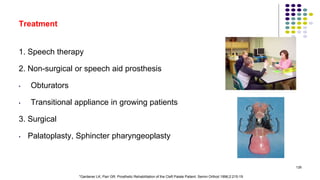
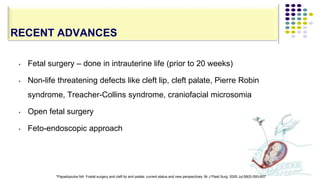
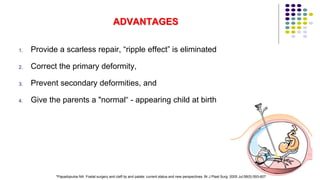
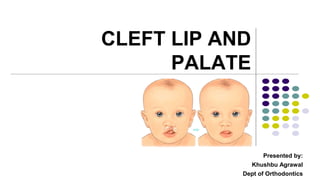
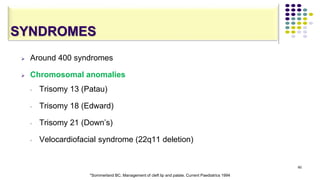
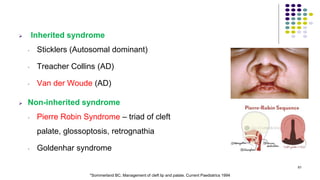
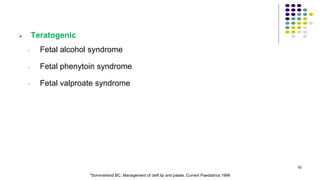
This document provides an overview of cleft lip and palate, including:
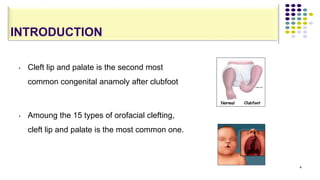
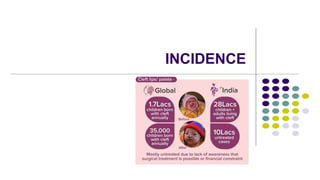
- The incidence of cleft lip and palate is approximately 1 in 600 births worldwide. It is the second most common birth defect.
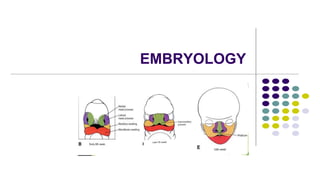
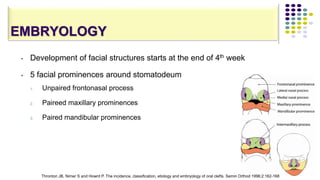
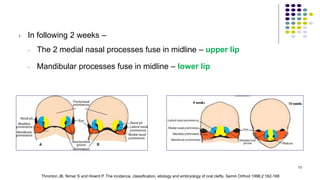
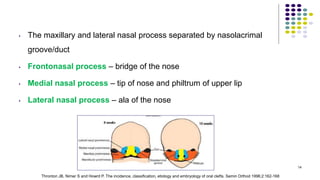
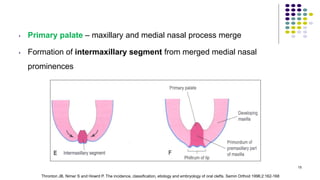
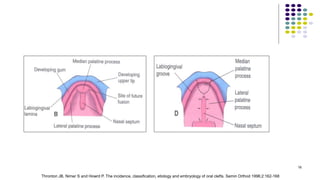
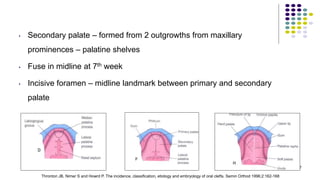
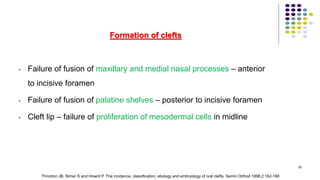
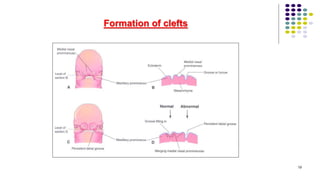
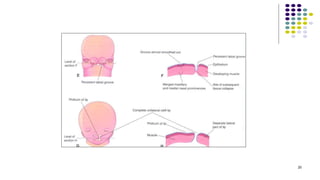
- The embryology of facial development and how failures in processes like fusion of the medial nasal processes can result in clefting.
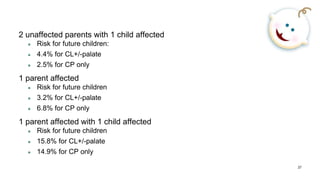
- Cleft lip and palate have multifactorial etiology involving both genetic and environmental factors. Risk is increased with positive family history or exposure to teratogens.
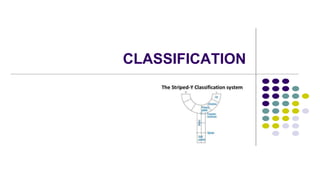
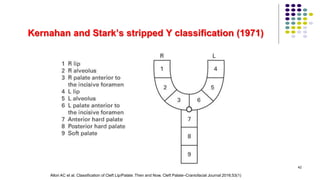
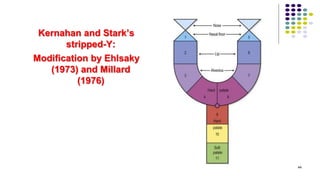
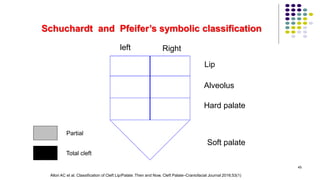
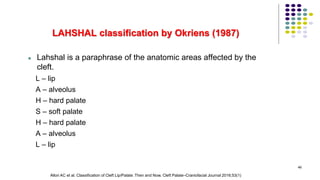
- Classification systems have evolved over time but still categorize clefts as involving the lip, palate, or both, and as unilateral or bilateral. The Victor Veau system from 1931 remains influential


![1] Genetic
• Genetic disorders are classified into 4 groups
1. Chromosomal
2. Single gene
3. Multifactorial – oral clefts
4. Mitochondrial
25
John B. Thornton, Sue Nim Paul S. Howard. The incidence, classification, etiology and embryology of oral clefts. Semin Orthod 1996;2:162-168](https://image.slidesharecdn.com/cleftlipandpalateslideshare-170811174308/85/Cleft-lip-and-palate-slideshare-25-320.jpg)
![2] Multifactorial because:
1) Chances increases if more than one family member if affected
2) More the severity, greater the chances of recurrence in sibling
3) Higher risk if affected individual is of less affected sex
4) Risk decreases in remotely related individuals
5) Consanguinity increases the rate because of sharing of genes
26
John B. Thornton, Sue Nim Paul S. Howard. The incidence, classification, etiology and embryology of oral clefts. Semin Orthod 1996;2:162-168](https://image.slidesharecdn.com/cleftlipandpalateslideshare-170811174308/85/Cleft-lip-and-palate-slideshare-26-320.jpg)
![3] Environmental factors
• Maternal smoking or tobacco exposure
• Viral infections
• Poor nutrition
• Certain Medicinal drugs
• Teratogens like:
Rubella virus, Cortisone/ steroids, Mercaptopurine,
Methotrexate, Valium, Dilantin
28
Peter Mosby et al. Cleft Lip and Palate. Lancet 2009; 374: 1773–85](https://image.slidesharecdn.com/cleftlipandpalateslideshare-170811174308/85/Cleft-lip-and-palate-slideshare-28-320.jpg)
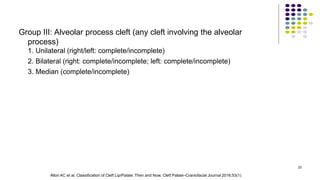
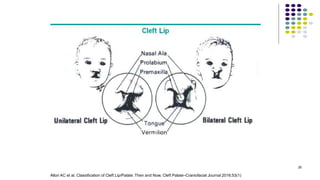
![Victor Veau’s classification (1931)
A] Cleft lip
Class I : U/L notching of vermillion border, not extending into the lip.
Class II : cleft extending into the lip, but not including the floor of the nose.
Class III: extending into the floor of the nose.
Class IV: any b/l cleft of the lip, whether incomplete or complete.
34
Allori AC et al. Classification of Cleft Lip/Palate: Then and Now. Cleft Palate–Craniofacial Journal 2016;53(1)](https://image.slidesharecdn.com/cleftlipandpalateslideshare-170811174308/85/Cleft-lip-and-palate-slideshare-34-320.jpg)
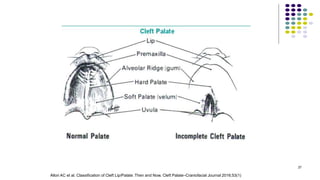
![B] Cleft palate
Class I : soft palate
Class II : soft/hard palate extending no further than incisive foramen.
Class III: complete unilateral cleft, extending from uvula to incisive
foramen, then deviating to one side
Class IV: two clefts extending forward from the incisive foramen into the
alveolus.
36
Allori AC et al. Classification of Cleft Lip/Palate: Then and Now. Cleft Palate–Craniofacial Journal 2016;53(1)](https://image.slidesharecdn.com/cleftlipandpalateslideshare-170811174308/85/Cleft-lip-and-palate-slideshare-36-320.jpg)
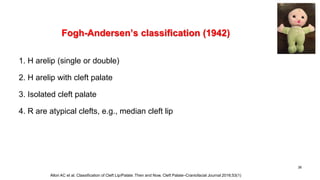

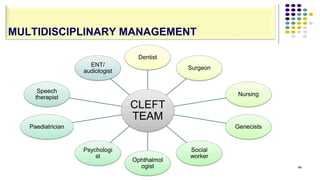
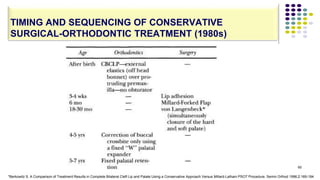
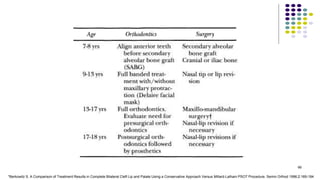
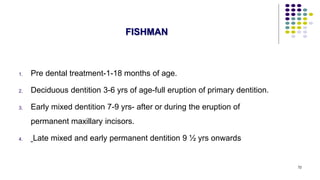
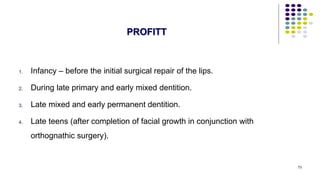
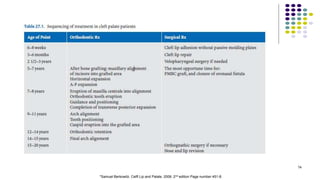
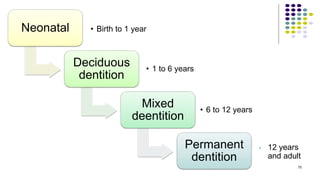
![CLEFT LIP REPAIR
88
• Goal: improve facial aesthetics by restoring nasal and lip contour
• Timing: 3 to 6 months
• Millards “RULE OF TEN”
[term coined by Wilhelmmesen and Musgrave in 1969]
• 10 weeks (age)
• 10 pounds (weight)
• 10 gm/dl (Hb)](https://image.slidesharecdn.com/cleftlipandpalateslideshare-170811174308/85/Cleft-lip-and-palate-slideshare-88-320.jpg)
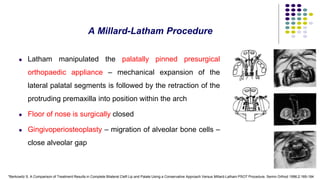
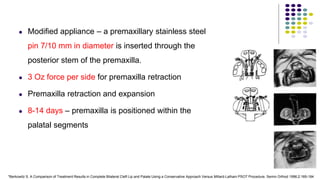
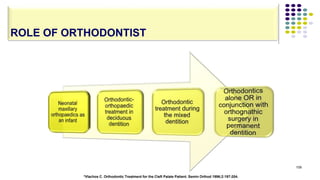
![A] NEONATAL MAXILLARY ORTHOPAEDICS
• McNeil (1950)s – Father of presurgical orthopaedics
• Rationale – realignment of collapsed segments
• Active or passive orthopaedic appliances
110
*Vlachos C. Orthodontic Treatment for the Cleft Palate Patient. Semin Orthod 1996;2:197-204.](https://image.slidesharecdn.com/cleftlipandpalateslideshare-170811174308/85/Cleft-lip-and-palate-slideshare-110-320.jpg)
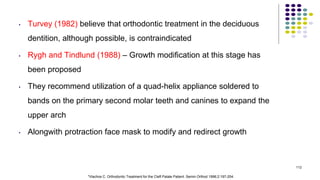
![B] ORTHODONTIC-ORTHOPAEDIC TREATMENT IN DECIDUOUS
DENTITION
• Problems in deciduous dentition:
- Delay in eruption in vicinity of cleft
- Malformed or congenitally missing lateral incisor
- Anterior or posterior buccal crossbite
- Functional shift
111
*Vlachos C. Orthodontic Treatment for the Cleft Palate Patient. Semin Orthod 1996;2:197-204](https://image.slidesharecdn.com/cleftlipandpalateslideshare-170811174308/85/Cleft-lip-and-palate-slideshare-111-320.jpg)
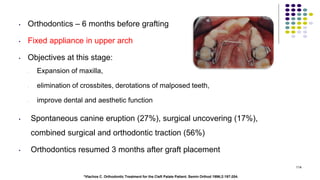
![C] ORTHODONTIC TREATMENT DURING THE MIXED DENTITION
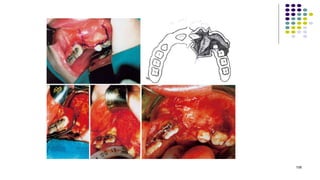
• Bone grafting:
• 5 to 6 years of age
• After 8 to 9 years of age
• Radiographically, after root of unerupted canine is half or one-third developed.
113
*Vlachos C. Orthodontic Treatment for the Cleft Palate Patient. Semin Orthod 1996;2:197-204](https://image.slidesharecdn.com/cleftlipandpalateslideshare-170811174308/85/Cleft-lip-and-palate-slideshare-113-320.jpg)
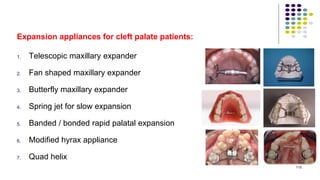
![D] ORTHODONTIC TREATMENT DURING THE PERMANENT
DENTITION
• Decision – orthodontics alone OR orthodontic combined with
orthognathic surgery
• Ross (1987) – 25% require surgery
• 3 consecutive cephalogram, 6 months apart showing no change in
length of mandible can be used
117
*Vlachos C. Orthodontic Treatment for the Cleft Palate Patient. Semin Orthod 1996;2:197-204.](https://image.slidesharecdn.com/cleftlipandpalateslideshare-170811174308/85/Cleft-lip-and-palate-slideshare-117-320.jpg)