Basic
Microbiology
Ahmad Thanin
What are Microbes?
•They have existed on this planet for over 3 billion years and are essential for humans to live and function.
•Pathogens are microbes that cause disease—but not all microbes are pathogens.
•Many microbes are normal human flora.
•Inside the human body, there are 10 trillion human cells and 100 trillion bacteria, protozoa, and fungal cells.
•When these microbes appear in parts of the body where they do not belong, they can cause infection.
Microbes are everywhere.
•Organisms are classified into seven main categories: kingdom, phylum, class, order, family, genus and species.
•Many microorganisms are known by their family, genus and species.
•For example, bacteria are named by their genus and species, such as Escherichia coli, Staphylococcus aureus, and
Mycobacterium tuberculosis.
•Some families of bacteria are known pathogens in health care, such as the Enterobacteriaceae family.
Microbes are categorized according to their biological classification (also called biological
taxonomy).
Microbes can be divided into five categories.
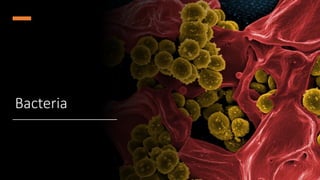
Bacteria
•Unicellular (single cell), no nucleus
•Largely harmless (normal flora)
•Different growth characteristics with and without oxygen
•Named by Genus and Species, such as Escherichia coli, Staphylococcus aureus and Mycobacterium tuberculosis
Characteristics:
•Visible with ordinary light and magnification (microscope)
•Gram staining, Culture, other specialized laboratory tests
How to identify:
•Methicillin-resistant Staphylococcus aureus (MRSA)
•Neisseria meningitidis
•Opportunistic Pathogens—usually do not cause disease but take advantage of abnormal circumstances, such as a
weakened immune system, and cause disease
Examples of pathogens:
•Antibiotics
Treatment:
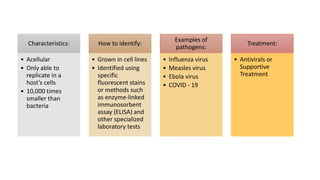
Viruses
Characteristics:
• Acellular
• Only able to
replicate in a
host’s cells
• 10,000 times
smaller than
bacteria
How to identify:
• Grown in cell lines
• Identified using
specific
fluorescent stains
or methods such
as enzyme-linked
immunosorbent
assay (ELISA) and
other specialized
laboratory tests
Examples of
pathogens:
• Influenza virus
• Measles virus
• Ebola virus
• COVID - 19
Treatment:
• Antivirals or
Supportive
Treatment
Fungi
Characteristics:
Unicellular and
multicellular
Most fungi are not
dangerous (yeast,
mould, mushrooms),
but some can be
harmful to health
How to
identify:
Culture and special
Stains and other
specialized laboratory
tests
Example of
pathogens:
Candida albicans
Aspergillus
Treatment:
Antifungals
Parasites
Characteristics:
• Organisms that
live on or in a host
organism and get
their food at the
expense of the
host
• Unicellular or
Multicellular
How to identify:
• Microscopes,
Blood Tests and
other specialized
laboratory tests
Example of
pathogens:
• Malaria
(Plasmodium)
• Guinea-Worm
Disease
(Dracunculus
Medinensis)
• Cryptosporidiosis
Diarrheal Disease
(Cryptosporidium)
Treatment:
• Antiparasitics
Prions
Characteristics:
• Defective
proteins that
misfold
• Some evidence
of transmission
due to failure to
remove prions
from reusable
devices
How to identify:
• Brain biopsy or
autopsy (Tissue
sample under
microscope)
and other
specialized
laboratory tests
Example of
pathogens:
• Creutzfeldt-
Jakob Disease
(CJD)
Treatment:
• Supportive
therapy only; no
treatment has
been identified
How do Bacteria cause
infection?
As we have just learnt, most bacteria are important parts of the normal human flora.
They help us do such things as digest our food. However,
when these bacteria appear in parts of the body where they do not belong, they can cause
infection.
• For example, bacteria normally found in the gastrointestinal tract could cause a urinary tract infection (UTI) if they are
introduced to the bladder or kidneys.
• Closed areas, such as bladders, joints, and the bloodstream, are sterile areas of the body.
• That means these parts of the body are meant to be free from bacteria or any other living microorganism.
• When microbes enter these parts of the body, disease and infection can occur.
What is an infection?
The skin, mucous membranes, gastric juices, and blood
are part of the body’s defense system.
• These parts of the body protect against disease-causing pathogens.
• An infection occurs when a disease-causing organism (a pathogen)
enters a host and multiplies.
There are different outcomes for a patient after
exposure to a disease-causing pathogen.
Exposure
• Many different types of exposure can occur.
• Exposure can occur in the community or in a health care setting
• for example, being pricked by a used needle.
Infection
• Even after exposure, there are many factors that determine whether the pathogen will cause an infection.
• It is possible that no infection will occur, even after exposure.
• A pathogen can be present in a host without causing signs or symptoms of disease. This is called a subclinical
infection or colonization.
• If a pathogen enters a host and causes signs and symptoms of disease, this is a clinical infection.
Outcomes
• For subclinical infections, there are a number of outcomes.
• If the pathogen has colonized, this means it is present in the body but does not cause disease (carrier state).
• The immune system can mount a response, which in some cases leads to production of antibodies against the
pathogen (immunity).
• However, even if the immune system mounts a response and creates antibodies, reinfection is possible.
How is an infection
diagnosed?
• Signs and symptoms
• When the body detects an infection, the immune
system reacts to fight it. Signs and symptoms of an
infection depend on the pathogen.
• The following list of symptoms are indications that the
body is fighting an infection:
• Fever
• Pain
• Redness
• Swelling
• Fluid Drainage
Laboratory Diagnosis
Laboratory testing is not strictly required to diagnose an infection—but
identifying the specific pathogen can help guide antibiotic treatment
and inform what, if any, Infection Prevention and Control (IPC)
interventions may be required to help reduce or prevent the spread of
infection to other susceptible hosts.
In those facilities without lab access, clinicians should refer to their
national treatment guidelines to determine how to choose a suitable
antimicrobial treatment.
In clinical labs, the microbiology section usually identifies and
characterizes microorganisms. The first step in identifying bacteria is
the Gram stain.
What is a Gram
Stain Test?
• In a Gram stain test, a sample is placed
on a slide and dyed with chemicals.
• Depending on how the bacteria
reacts to the stain, the test can
determine whether the bacteria is
Gram-positive or Gram-negative.
• The Gram stain takes less than an hour
to perform.
• The result of this test can help
clinicians quickly decide which
antibiotic to choose.
A Gram-Positive
• Result indicates that the bacteria has a very thick outer
layer (cell wall) with additional proteins (peptidoglycan).
• Gram-positive cells appear purple under the microscope.
• Examples of Gram-positive bacteria are
• Staphylococcus,
• Enterococcus and
• Streptococcus.
A Gram-Negative Stain
• Means that the bacteria does not have an extra layer in the
cell wall.
• Gram-negative cells appear pink under the microscope.
• Examples of Gram-negative bacteria are
• E coli,
• Klebsiella pneumoniae,
• Pseudomonas aeruginosa and
• the Acinetobacter species.
What is a
culture?
Microorganisms that have been grown in a Petri dish using a
special growth media are referred to as a culture.
The time it takes a culture to grow depends on how long it
takes the microorganisms to grow.
Some microorganisms grow within hours; others take days to
grow.
Microorganisms look different from each other when
cultured.
A trained laboratory technician can identify a bacteria genus,
and sometimes species, based on what the culture looks like.
Some laboratory equipment is advanced enough to automate
the process of culturing bacteria.
How can testing
determine
Antimicrobial
Resistance (AMR)?
Antimicrobial susceptibility testing (AST)
consists of both manual and automatic tests
that use colonies from cultures to determine
whether a microbe is susceptible or resistant
to drugs.
These complex procedures take 2—3 days to
be processed by trained microbiologists.
How is a Bacterial
Infection Treated?
•There are many different kinds of antibiotics.
•Some antibiotics are capable of killing many kinds of bacteria.
•These antibiotics are classified as broad-spectrum.
•Broad-spectrum antibiotics are a good choice when the agent of infection is
unknown, because there is a high likelihood that the antibiotic will be effective.
•However, because they are so good at killing, broad-spectrum antibiotics also
kill the normal flora that are beneficial to us.
•In addition, they are more likely to lead to selection of resistant organisms.
•Some examples of broad-spectrum antibiotics are chloramphenicol,
tetracycline, ciprofloxacin, cotrimoxazole, and amoxicillin/clavulanate
imipenem.
Antibiotics
•These antibiotics are classified as narrow-spectrum. Vancomycin, penicillin, and
linezolid are examples of antibiotics that will kill Gram-positive bacteria, but not
Gram-negative bacteria.
•On the other hand, aztreonam and colistin will kill Gram-negative bacteria, but
not Gram-positive bacteria. Narrow-spectrum antibiotics protect our normal
flora and are less likely than broad-spectrum antibiotics to lead to AMR.
Other antibiotics act only against limited types of bacteria.
What is AMR?
AMR occurs when a microorganism develops protection against an antimicrobial drug.
Microorganisms replicate very quickly.
• E. coli, for example, can double in quantity in about 40 minutes.
• During replication of genetic material, microorganisms can insert and delete certain portions of their genetic
material.
• They can also pick up extra genetic material that helps them protect themselves against drugs meant to kill them.
• Due to the rapid way in which microorganisms replicate, AMR can develop quickly.
Resistant microorganisms can place more of a burden on the health care system.
• These highly resistant organisms increase the risk of morbidity, mortality, and disability in patients.
• They can increase a patient’s length of stay or cause complications that may require admission to an intensive
care unit (ICU).
• They can also increase the financial burden on patients, who then must purchase more expensive antibiotics to
treat multidrug-resistant organisms (MDROs—see below).
What are MDROs?
When microorganisms become resistant to more than one drug, they are called multidrug-
resistant organisms, or MDROs.
• Laboratory tests are needed to determine if a microorganism is resistant to the drug designed to treat it.
• In the health care and public health fields, AMR is concerning because it means the microorganism is evolving.
• For clinicians, this could mean few or no treatment options.
Some MDROs are caused by the overuse and misuse of antibiotics; this includes
• administering antibiotics when they are not needed or recommending that they be taken for longer than necessary.
It is increasingly important to identify and sustain systems and strategies that manage the risk
of MDROs in your facility.
• When MDROs are discovered by laboratory tests, the physician and the IPC team should be alerted.
• Examples of MDROs commonly found in the health care setting include multidrug-resistant Klebsiella spp. and
Acinetobacter spp.
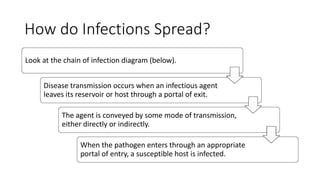
How do Infections Spread?
Look at the chain of infection diagram (below).
Disease transmission occurs when an infectious agent
leaves its reservoir or host through a portal of exit.
The agent is conveyed by some mode of transmission,
either directly or indirectly.
When the pathogen enters through an appropriate
portal of entry, a susceptible host is infected.
IPC and Microbiology
The IPC team is the health facility’s line of defense against the spread
of health care-associated infections (HAI) and AMR.
• Having a basic understanding of microbiology will allow you to make better decisions
regarding which interventions to implement in your facility.
Here are some considerations you may need to make as an IPC person:
• Does my facility have, or have access to, a laboratory?
• What is the quality and capacity of the laboratory, if available?
• Are the standardized definitions and methods consistent?
Thank you
Ahmad Thanin

Basic Microbiology.

  • 1.
  • 2.
    What are Microbes? •Theyhave existed on this planet for over 3 billion years and are essential for humans to live and function. •Pathogens are microbes that cause disease—but not all microbes are pathogens. •Many microbes are normal human flora. •Inside the human body, there are 10 trillion human cells and 100 trillion bacteria, protozoa, and fungal cells. •When these microbes appear in parts of the body where they do not belong, they can cause infection. Microbes are everywhere. •Organisms are classified into seven main categories: kingdom, phylum, class, order, family, genus and species. •Many microorganisms are known by their family, genus and species. •For example, bacteria are named by their genus and species, such as Escherichia coli, Staphylococcus aureus, and Mycobacterium tuberculosis. •Some families of bacteria are known pathogens in health care, such as the Enterobacteriaceae family. Microbes are categorized according to their biological classification (also called biological taxonomy). Microbes can be divided into five categories.
  • 3.
  • 4.
    •Unicellular (single cell),no nucleus •Largely harmless (normal flora) •Different growth characteristics with and without oxygen •Named by Genus and Species, such as Escherichia coli, Staphylococcus aureus and Mycobacterium tuberculosis Characteristics: •Visible with ordinary light and magnification (microscope) •Gram staining, Culture, other specialized laboratory tests How to identify: •Methicillin-resistant Staphylococcus aureus (MRSA) •Neisseria meningitidis •Opportunistic Pathogens—usually do not cause disease but take advantage of abnormal circumstances, such as a weakened immune system, and cause disease Examples of pathogens: •Antibiotics Treatment:
  • 5.
  • 6.
    Characteristics: • Acellular • Onlyable to replicate in a host’s cells • 10,000 times smaller than bacteria How to identify: • Grown in cell lines • Identified using specific fluorescent stains or methods such as enzyme-linked immunosorbent assay (ELISA) and other specialized laboratory tests Examples of pathogens: • Influenza virus • Measles virus • Ebola virus • COVID - 19 Treatment: • Antivirals or Supportive Treatment
  • 7.
  • 8.
    Characteristics: Unicellular and multicellular Most fungiare not dangerous (yeast, mould, mushrooms), but some can be harmful to health How to identify: Culture and special Stains and other specialized laboratory tests Example of pathogens: Candida albicans Aspergillus Treatment: Antifungals
  • 9.
  • 10.
    Characteristics: • Organisms that liveon or in a host organism and get their food at the expense of the host • Unicellular or Multicellular How to identify: • Microscopes, Blood Tests and other specialized laboratory tests Example of pathogens: • Malaria (Plasmodium) • Guinea-Worm Disease (Dracunculus Medinensis) • Cryptosporidiosis Diarrheal Disease (Cryptosporidium) Treatment: • Antiparasitics
  • 11.
  • 12.
    Characteristics: • Defective proteins that misfold •Some evidence of transmission due to failure to remove prions from reusable devices How to identify: • Brain biopsy or autopsy (Tissue sample under microscope) and other specialized laboratory tests Example of pathogens: • Creutzfeldt- Jakob Disease (CJD) Treatment: • Supportive therapy only; no treatment has been identified
  • 13.
    How do Bacteriacause infection? As we have just learnt, most bacteria are important parts of the normal human flora. They help us do such things as digest our food. However, when these bacteria appear in parts of the body where they do not belong, they can cause infection. • For example, bacteria normally found in the gastrointestinal tract could cause a urinary tract infection (UTI) if they are introduced to the bladder or kidneys. • Closed areas, such as bladders, joints, and the bloodstream, are sterile areas of the body. • That means these parts of the body are meant to be free from bacteria or any other living microorganism. • When microbes enter these parts of the body, disease and infection can occur.
  • 14.
    What is aninfection? The skin, mucous membranes, gastric juices, and blood are part of the body’s defense system. • These parts of the body protect against disease-causing pathogens. • An infection occurs when a disease-causing organism (a pathogen) enters a host and multiplies. There are different outcomes for a patient after exposure to a disease-causing pathogen.
  • 16.
    Exposure • Many differenttypes of exposure can occur. • Exposure can occur in the community or in a health care setting • for example, being pricked by a used needle. Infection • Even after exposure, there are many factors that determine whether the pathogen will cause an infection. • It is possible that no infection will occur, even after exposure. • A pathogen can be present in a host without causing signs or symptoms of disease. This is called a subclinical infection or colonization. • If a pathogen enters a host and causes signs and symptoms of disease, this is a clinical infection. Outcomes • For subclinical infections, there are a number of outcomes. • If the pathogen has colonized, this means it is present in the body but does not cause disease (carrier state). • The immune system can mount a response, which in some cases leads to production of antibodies against the pathogen (immunity). • However, even if the immune system mounts a response and creates antibodies, reinfection is possible.
  • 17.
    How is aninfection diagnosed? • Signs and symptoms • When the body detects an infection, the immune system reacts to fight it. Signs and symptoms of an infection depend on the pathogen. • The following list of symptoms are indications that the body is fighting an infection: • Fever • Pain • Redness • Swelling • Fluid Drainage
  • 18.
    Laboratory Diagnosis Laboratory testingis not strictly required to diagnose an infection—but identifying the specific pathogen can help guide antibiotic treatment and inform what, if any, Infection Prevention and Control (IPC) interventions may be required to help reduce or prevent the spread of infection to other susceptible hosts. In those facilities without lab access, clinicians should refer to their national treatment guidelines to determine how to choose a suitable antimicrobial treatment. In clinical labs, the microbiology section usually identifies and characterizes microorganisms. The first step in identifying bacteria is the Gram stain.
  • 19.
    What is aGram Stain Test? • In a Gram stain test, a sample is placed on a slide and dyed with chemicals. • Depending on how the bacteria reacts to the stain, the test can determine whether the bacteria is Gram-positive or Gram-negative. • The Gram stain takes less than an hour to perform. • The result of this test can help clinicians quickly decide which antibiotic to choose.
  • 20.
    A Gram-Positive • Resultindicates that the bacteria has a very thick outer layer (cell wall) with additional proteins (peptidoglycan). • Gram-positive cells appear purple under the microscope. • Examples of Gram-positive bacteria are • Staphylococcus, • Enterococcus and • Streptococcus.
  • 21.
    A Gram-Negative Stain •Means that the bacteria does not have an extra layer in the cell wall. • Gram-negative cells appear pink under the microscope. • Examples of Gram-negative bacteria are • E coli, • Klebsiella pneumoniae, • Pseudomonas aeruginosa and • the Acinetobacter species.
  • 22.
    What is a culture? Microorganismsthat have been grown in a Petri dish using a special growth media are referred to as a culture. The time it takes a culture to grow depends on how long it takes the microorganisms to grow. Some microorganisms grow within hours; others take days to grow. Microorganisms look different from each other when cultured. A trained laboratory technician can identify a bacteria genus, and sometimes species, based on what the culture looks like. Some laboratory equipment is advanced enough to automate the process of culturing bacteria.
  • 23.
    How can testing determine Antimicrobial Resistance(AMR)? Antimicrobial susceptibility testing (AST) consists of both manual and automatic tests that use colonies from cultures to determine whether a microbe is susceptible or resistant to drugs. These complex procedures take 2—3 days to be processed by trained microbiologists.
  • 24.
    How is aBacterial Infection Treated? •There are many different kinds of antibiotics. •Some antibiotics are capable of killing many kinds of bacteria. •These antibiotics are classified as broad-spectrum. •Broad-spectrum antibiotics are a good choice when the agent of infection is unknown, because there is a high likelihood that the antibiotic will be effective. •However, because they are so good at killing, broad-spectrum antibiotics also kill the normal flora that are beneficial to us. •In addition, they are more likely to lead to selection of resistant organisms. •Some examples of broad-spectrum antibiotics are chloramphenicol, tetracycline, ciprofloxacin, cotrimoxazole, and amoxicillin/clavulanate imipenem. Antibiotics •These antibiotics are classified as narrow-spectrum. Vancomycin, penicillin, and linezolid are examples of antibiotics that will kill Gram-positive bacteria, but not Gram-negative bacteria. •On the other hand, aztreonam and colistin will kill Gram-negative bacteria, but not Gram-positive bacteria. Narrow-spectrum antibiotics protect our normal flora and are less likely than broad-spectrum antibiotics to lead to AMR. Other antibiotics act only against limited types of bacteria.
  • 25.
    What is AMR? AMRoccurs when a microorganism develops protection against an antimicrobial drug. Microorganisms replicate very quickly. • E. coli, for example, can double in quantity in about 40 minutes. • During replication of genetic material, microorganisms can insert and delete certain portions of their genetic material. • They can also pick up extra genetic material that helps them protect themselves against drugs meant to kill them. • Due to the rapid way in which microorganisms replicate, AMR can develop quickly. Resistant microorganisms can place more of a burden on the health care system. • These highly resistant organisms increase the risk of morbidity, mortality, and disability in patients. • They can increase a patient’s length of stay or cause complications that may require admission to an intensive care unit (ICU). • They can also increase the financial burden on patients, who then must purchase more expensive antibiotics to treat multidrug-resistant organisms (MDROs—see below).
  • 27.
    What are MDROs? Whenmicroorganisms become resistant to more than one drug, they are called multidrug- resistant organisms, or MDROs. • Laboratory tests are needed to determine if a microorganism is resistant to the drug designed to treat it. • In the health care and public health fields, AMR is concerning because it means the microorganism is evolving. • For clinicians, this could mean few or no treatment options. Some MDROs are caused by the overuse and misuse of antibiotics; this includes • administering antibiotics when they are not needed or recommending that they be taken for longer than necessary. It is increasingly important to identify and sustain systems and strategies that manage the risk of MDROs in your facility. • When MDROs are discovered by laboratory tests, the physician and the IPC team should be alerted. • Examples of MDROs commonly found in the health care setting include multidrug-resistant Klebsiella spp. and Acinetobacter spp.
  • 28.
    How do InfectionsSpread? Look at the chain of infection diagram (below). Disease transmission occurs when an infectious agent leaves its reservoir or host through a portal of exit. The agent is conveyed by some mode of transmission, either directly or indirectly. When the pathogen enters through an appropriate portal of entry, a susceptible host is infected.
  • 30.
    IPC and Microbiology TheIPC team is the health facility’s line of defense against the spread of health care-associated infections (HAI) and AMR. • Having a basic understanding of microbiology will allow you to make better decisions regarding which interventions to implement in your facility. Here are some considerations you may need to make as an IPC person: • Does my facility have, or have access to, a laboratory? • What is the quality and capacity of the laboratory, if available? • Are the standardized definitions and methods consistent?
  • 31.