Principles of Standard
Precautions
Outline
 Definition of Standard precautions
 Hand hygiene
 Use of personal protective equipments
 Instrument reprocessing
 Aseptic techniques
 Environmental cleaning and disinfection
 Waste management
Standard precautions
 Routine infection control precautions that
should apply to ALL patients, in ALL
healthcare settings.
 Designed to facilitate SAFE medical
procedures.
 Protect patients as well as the healthcare
workers.
Standard Precautions
 Hand hygiene
 Use of personal protective equipments
 Instrument reprocessing
 Aseptic techniques
 Environmental cleaning and disinfection
 Waste management
Hand Hygiene
and Use of PPE
 Of particular importance when providing care for patients
with acute respiratory illness
 Will be discussed in details later
Instrument reprocessing
Instrument Reprocessing
 Processing instruments used in healthcare make them
safe for reuse
 Single use items should be disposed off
 Never reprocess single use items
Decontamination
Removal of contamination:
A vague term meaning sterilisation,
disinfection or cleaning as appropriate
Sterile
 Absence of all microbial life
 This can not be a partial definition.
“Nearly sterile”is a definition without
meaning; it means “not sterile”
Disinfected
 More complex, more subjective definition than
“sterile”
 A practical definition is
“The removal or destruction of all microbes
except bacterial spores”
Clean
This is even less well-defined than “disinfected”
 “Absence of extraneous organic
contamination”
 “Removal of all material that is not part
of the item”
but to what extent?
Infection: difficult
Infection: easy
Intact skin
Intact mucous membrane
Broken skin or mucous membrane
Foreign body implant (fully enclosed)
Foreign body from outside to inside
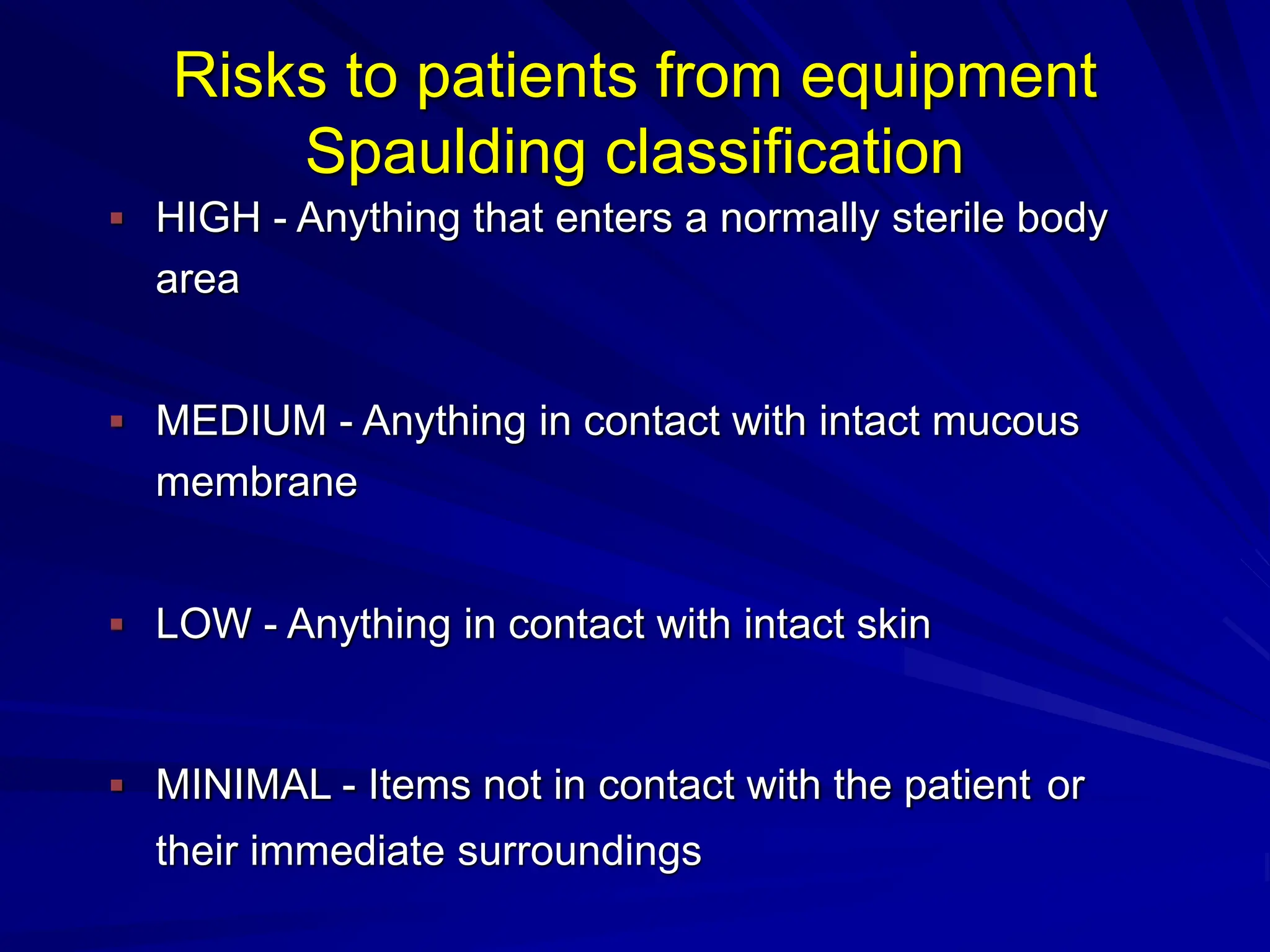
Risks to patients from equipment
Spaulding classification
 HIGH - Anything that enters a normally sterile body
area
 MEDIUM - Anything in contact with intact mucous
membrane
 LOW - Anything in contact with intact skin
 MINIMAL - Items not in contact with the patient or
their immediate surroundings
Decontamination of equipment
 HIGH – Sterilised
 MEDIUM - Sterilised, heat disinfected, chemical
disinfected only if thermo-labile.
 LOW - Cleaned; disinfected if heavily or highly
susceptible patient
 MINIMAL - Cleaning
Aseptic techniques
Aseptic techniques
 Aseptic means "without microorganisms."
 Aseptic technique refers to practices that help reduce
the risk of post procedure infections in clients by
decreasing the likelihood that microorganisms will enter
the body during clinical procedures.
 Some of these practices are also designed to reduce
service providers' risk of exposure to potentially
infectious blood and tissues during clinical procedures
These include:
 Handwashing
 Surgical scrub
 Using barriers (surgical attire)
 Client prep (preparing a client for clinical procedures)
 Maintaining a sterile field
 Using safe operative technique (making small
incisions, avoiding trauma to tissue and surrounding
structures, and controlling bleeding)
 Maintaining a safer environment
Aseptic techniques
What is required to establish a good
aseptic procedure?
 Think before you act
 Plan what you are going to do
 Which order you are going to do it in
 Make sure you have everything you need close at hand
 Understand the procedure
 Carry out and COMPLETE the procedure before doing
something else!
Environmental cleaning
Definition
General cleaning of environmental
surfaces and to the maintenance of
cleanliness in a health care facility.
It is the physical removal of organic
materials such as soil and dirt, followed
by complete drying.
Environmental Cleaning
 Removes all visible dirt.
 Reduces the bioburden (the number of germs present),
so disinfection or sterilization can be more effective
 Reduces pyrogens present in dead organisms.
 enhance both the safety and quality of patient care
 when absent can lead to clusters of Hospital-acquired
infections.
 Facility looks appealing and improves the morale of staff
and patients.
General Guidelines for Cleaning
 Warm water and detergent removes 80% of
microorganisms. The majority of these microorganisms are
skin flora and spores.
 Minimizes the scattering of dust and dirt.
– A damp cloth or wet mop should be used for surfaces
– Vacuum cleaner can be used for dust removal (!filters!)
 Cleaning begins from the least soiled area to the most
soiled area (toilets and soiled storage areas) and from top to
bottom.
 The use of friction or scrubbing action is the most
effective way to remove dirt and microorganisms.
 Cleaning solutions should be changed frequently. If a
disinfectant is used it is less likely to kill infectious
microorganisms if it is heavily soiled.
 Cleaning of environmental surfaces should be performed
by using separate buckets. One for detergent and the
other for plain water. The procedure starts by wiping or
scrubbing with detergent, followed by rinsing with water,
and drying at the end.
General Guidelines for Cleaning
 Reusable equipment (e.g., bed, chairs) is not used for the
care of another patient until it has been cleaned.
 Cleaning supplies must be kept dry and stored properly.
Reusable cleaning supplies should be washed and
disinfected after use
 If disinfectant is used, make up the disinfectant solution
separately, use as directed by the label.
 Note: Disinfectants are NOT recommended for routine
General Guidelines for Cleaning
Protective Clothing for Cleaning
Workers should always
wear gloves, shoes that
cover the toes. If there is
a potential for splashing
or for splattering, they
may need additional
protection such as an
impermeable apron,
mask, and protective
eyewear.
Hospital Environment
 Low-Risk Areas:
 Waiting Rooms, Administrative Areas. These areas are usually
not contaminated with blood or body fluids or microorganisms
 Intermediate Risk Areas:
 Patient Wards. These are areas used for the care of patients
who are not obviously infectious and not highly susceptible.
 High Risk Areas:
– These are special care areas (e.g., isolation wards, intensive
therapy units, operating room, dialysis unit).
Frequency of Cleaning
 Low-risk clinical areas: Once daily and whenever
needed.
 Intermediate-risk areas: At least twice daily, and
whenever needed, e.g. after visits. Immediate removal of
organic material.
 High-risk areas: more frequent, cleaned between each
patient and thoroughly at the end of the day. Disinfectants
may be used as needed.
Hospital Laundry
 All linen should be sent to the hospital laundry
 Collect used linen in fluid resistant bags with
considerable size
 No need to double bag from isolation rooms
 If wet, fold wet areas to the inside
 Bag racks are ideal so linen is not held next to body, and
work load is reduced, keeps linen off floor
 Assume all used linen is contaminated no need for color
coding
Cleaning Policies and Schedules
 Cleaning policy should be developed by the head nurse
in accordance with hospital policies
 Should be posted to where all cleaning staff
 It should take into consideration immediate cleaning after
any organic contamination e.g. blood spills
Cleaning up Body Fluid Spills
 Always wear gloves, such as disposable or heavy duty
gloves.
 If the spill is small: wipe it with a disposable cloth and
then disinfect the surface area of the spill with another
disposable cloth that has been saturated with a
disinfectant (100-200 PPM chlorine solution).
 If the spill is large: place a disposable paper or cloth
towel over the spill to soak up the fluid. pick up the towel,
dispose into a bag to be disposed as biological waste
and then soak the area with non-diluted chlorine). Leave
it for considerable time then dry the surface.
Ineffective Methods
 Fumigation
 Ultraviolet lights
Waste management
DEFINITIONS
 Health-care waste
All waste from health care activities
 Hazardous health-care waste
10 - 25% is hazardous
Hazardous healthcare waste
Infectious
 Anatomic waste
 Lab waste
 Sharps
Pharmaceutical
Chemo, expired
medications
Other Chemicals
 Heavy metals
 Pesticides
 Pressurized containers
Radioactive waste
Steps of Medical-Waste
Management
Infectious waste and sharps
 Sorting should be at point of generation
 Non-hazardous waste should disposed as
regular waste
 Highly infectious waste (from laboratories)
should be autoclaved before disposal.
 All sharps should be disposed in safety boxes
 Control access to syringes and medical
equipment to prevent re-use. Segregate,
Incinerate, encapsulate and bury.
 Blood can be disposed of in municipal
sanitary sewers that undergo treatment
Thank you

5 Care of hospital equipment (decontamination process.ppt

  • 1.
  • 2.
    Outline  Definition ofStandard precautions  Hand hygiene  Use of personal protective equipments  Instrument reprocessing  Aseptic techniques  Environmental cleaning and disinfection  Waste management
  • 3.
    Standard precautions  Routineinfection control precautions that should apply to ALL patients, in ALL healthcare settings.  Designed to facilitate SAFE medical procedures.  Protect patients as well as the healthcare workers.
  • 4.
    Standard Precautions  Handhygiene  Use of personal protective equipments  Instrument reprocessing  Aseptic techniques  Environmental cleaning and disinfection  Waste management
  • 5.
    Hand Hygiene and Useof PPE  Of particular importance when providing care for patients with acute respiratory illness  Will be discussed in details later
  • 6.
  • 7.
    Instrument Reprocessing  Processinginstruments used in healthcare make them safe for reuse  Single use items should be disposed off  Never reprocess single use items
  • 8.
    Decontamination Removal of contamination: Avague term meaning sterilisation, disinfection or cleaning as appropriate
  • 9.
    Sterile  Absence ofall microbial life  This can not be a partial definition. “Nearly sterile”is a definition without meaning; it means “not sterile”
  • 10.
    Disinfected  More complex,more subjective definition than “sterile”  A practical definition is “The removal or destruction of all microbes except bacterial spores”
  • 11.
    Clean This is evenless well-defined than “disinfected”  “Absence of extraneous organic contamination”  “Removal of all material that is not part of the item” but to what extent?
  • 12.
    Infection: difficult Infection: easy Intactskin Intact mucous membrane Broken skin or mucous membrane Foreign body implant (fully enclosed) Foreign body from outside to inside
  • 13.
    Risks to patientsfrom equipment Spaulding classification  HIGH - Anything that enters a normally sterile body area  MEDIUM - Anything in contact with intact mucous membrane  LOW - Anything in contact with intact skin  MINIMAL - Items not in contact with the patient or their immediate surroundings
  • 14.
    Decontamination of equipment HIGH – Sterilised  MEDIUM - Sterilised, heat disinfected, chemical disinfected only if thermo-labile.  LOW - Cleaned; disinfected if heavily or highly susceptible patient  MINIMAL - Cleaning
  • 15.
  • 16.
    Aseptic techniques  Asepticmeans "without microorganisms."  Aseptic technique refers to practices that help reduce the risk of post procedure infections in clients by decreasing the likelihood that microorganisms will enter the body during clinical procedures.  Some of these practices are also designed to reduce service providers' risk of exposure to potentially infectious blood and tissues during clinical procedures
  • 17.
    These include:  Handwashing Surgical scrub  Using barriers (surgical attire)  Client prep (preparing a client for clinical procedures)  Maintaining a sterile field  Using safe operative technique (making small incisions, avoiding trauma to tissue and surrounding structures, and controlling bleeding)  Maintaining a safer environment Aseptic techniques
  • 18.
    What is requiredto establish a good aseptic procedure?  Think before you act  Plan what you are going to do  Which order you are going to do it in  Make sure you have everything you need close at hand  Understand the procedure  Carry out and COMPLETE the procedure before doing something else!
  • 19.
  • 20.
    Definition General cleaning ofenvironmental surfaces and to the maintenance of cleanliness in a health care facility. It is the physical removal of organic materials such as soil and dirt, followed by complete drying.
  • 21.
    Environmental Cleaning  Removesall visible dirt.  Reduces the bioburden (the number of germs present), so disinfection or sterilization can be more effective  Reduces pyrogens present in dead organisms.  enhance both the safety and quality of patient care  when absent can lead to clusters of Hospital-acquired infections.  Facility looks appealing and improves the morale of staff and patients.
  • 22.
    General Guidelines forCleaning  Warm water and detergent removes 80% of microorganisms. The majority of these microorganisms are skin flora and spores.  Minimizes the scattering of dust and dirt. – A damp cloth or wet mop should be used for surfaces – Vacuum cleaner can be used for dust removal (!filters!)  Cleaning begins from the least soiled area to the most soiled area (toilets and soiled storage areas) and from top to bottom.
  • 23.
     The useof friction or scrubbing action is the most effective way to remove dirt and microorganisms.  Cleaning solutions should be changed frequently. If a disinfectant is used it is less likely to kill infectious microorganisms if it is heavily soiled.  Cleaning of environmental surfaces should be performed by using separate buckets. One for detergent and the other for plain water. The procedure starts by wiping or scrubbing with detergent, followed by rinsing with water, and drying at the end. General Guidelines for Cleaning
  • 24.
     Reusable equipment(e.g., bed, chairs) is not used for the care of another patient until it has been cleaned.  Cleaning supplies must be kept dry and stored properly. Reusable cleaning supplies should be washed and disinfected after use  If disinfectant is used, make up the disinfectant solution separately, use as directed by the label.  Note: Disinfectants are NOT recommended for routine General Guidelines for Cleaning
  • 25.
    Protective Clothing forCleaning Workers should always wear gloves, shoes that cover the toes. If there is a potential for splashing or for splattering, they may need additional protection such as an impermeable apron, mask, and protective eyewear.
  • 26.
    Hospital Environment  Low-RiskAreas:  Waiting Rooms, Administrative Areas. These areas are usually not contaminated with blood or body fluids or microorganisms  Intermediate Risk Areas:  Patient Wards. These are areas used for the care of patients who are not obviously infectious and not highly susceptible.  High Risk Areas: – These are special care areas (e.g., isolation wards, intensive therapy units, operating room, dialysis unit).
  • 27.
    Frequency of Cleaning Low-risk clinical areas: Once daily and whenever needed.  Intermediate-risk areas: At least twice daily, and whenever needed, e.g. after visits. Immediate removal of organic material.  High-risk areas: more frequent, cleaned between each patient and thoroughly at the end of the day. Disinfectants may be used as needed.
  • 28.
    Hospital Laundry  Alllinen should be sent to the hospital laundry  Collect used linen in fluid resistant bags with considerable size  No need to double bag from isolation rooms  If wet, fold wet areas to the inside  Bag racks are ideal so linen is not held next to body, and work load is reduced, keeps linen off floor  Assume all used linen is contaminated no need for color coding
  • 29.
    Cleaning Policies andSchedules  Cleaning policy should be developed by the head nurse in accordance with hospital policies  Should be posted to where all cleaning staff  It should take into consideration immediate cleaning after any organic contamination e.g. blood spills
  • 30.
    Cleaning up BodyFluid Spills  Always wear gloves, such as disposable or heavy duty gloves.  If the spill is small: wipe it with a disposable cloth and then disinfect the surface area of the spill with another disposable cloth that has been saturated with a disinfectant (100-200 PPM chlorine solution).  If the spill is large: place a disposable paper or cloth towel over the spill to soak up the fluid. pick up the towel, dispose into a bag to be disposed as biological waste and then soak the area with non-diluted chlorine). Leave it for considerable time then dry the surface.
  • 31.
  • 32.
  • 33.
    DEFINITIONS  Health-care waste Allwaste from health care activities  Hazardous health-care waste 10 - 25% is hazardous
  • 34.
    Hazardous healthcare waste Infectious Anatomic waste  Lab waste  Sharps Pharmaceutical Chemo, expired medications Other Chemicals  Heavy metals  Pesticides  Pressurized containers Radioactive waste
  • 35.
  • 36.
    Infectious waste andsharps  Sorting should be at point of generation  Non-hazardous waste should disposed as regular waste  Highly infectious waste (from laboratories) should be autoclaved before disposal.  All sharps should be disposed in safety boxes  Control access to syringes and medical equipment to prevent re-use. Segregate, Incinerate, encapsulate and bury.  Blood can be disposed of in municipal sanitary sewers that undergo treatment
  • 37.