OBJECTIVE OF LECTURE
• What is clause?
• Difference between clause and sentence?
• Types of clauses:-
1) Independent clause
2) Dependent clause
 Adjective clause
 Noun clause
 Adverbial clause and its classifications
3) Coordinate clause
4) Conditional clause
CLAUSE
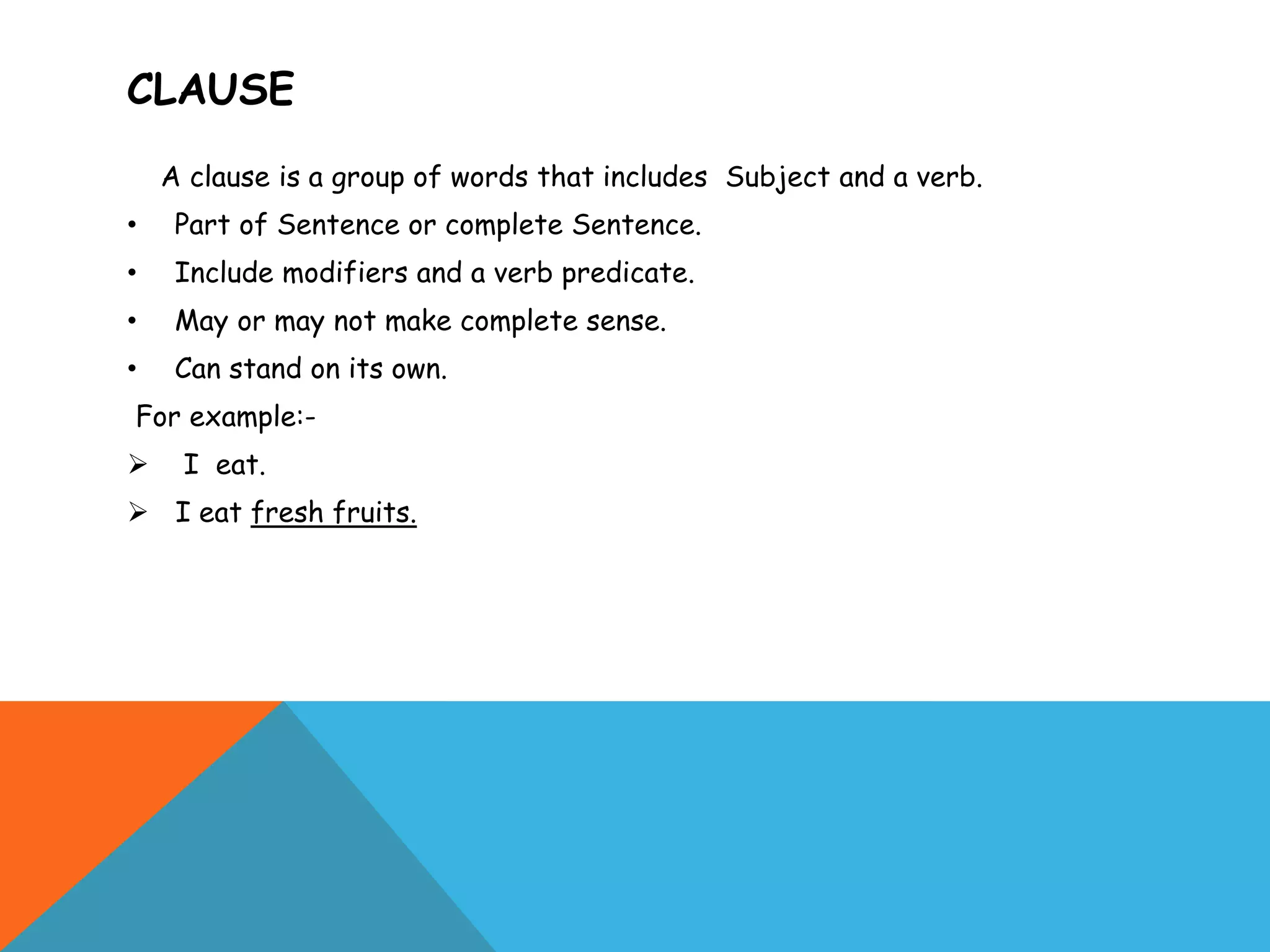
A clause is a group of words that includes Subject and a verb.
• Part of Sentence or complete Sentence.
• Include modifiers and a verb predicate.
• May or may not make complete sense.
• Can stand on its own.
For example:-
 I eat.
 I eat fresh fruits.
CLAUSE AND SENTENCE
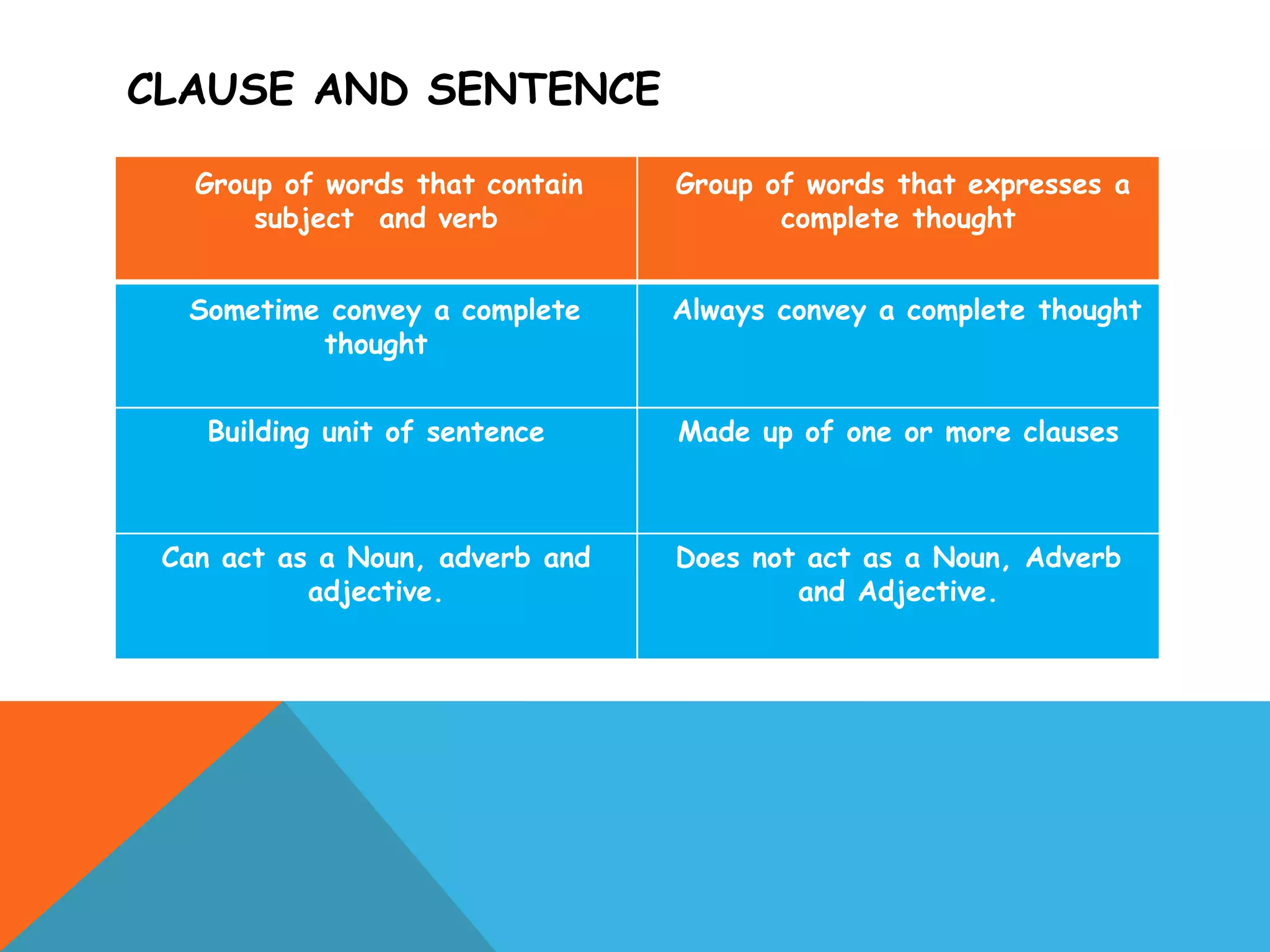
Group of words that contain
subject and verb
Group of words that expresses a
complete thought
Sometime convey a complete
thought
Always convey a complete thought
Building unit of sentence Made up of one or more clauses
Can act as a Noun, adverb and
adjective.
Does not act as a Noun, Adverb
and Adjective.
TYPES OF CLAUSES
 Independent clause ( main clause):-
An independent clause can express a complete thought, in such a way
that it stand alone in a sentence.
For example:-
• When it rains, the daffodils bow their heads.
• I have something important to say, before I speak.
• I am not tidying the dishes unless Sana helps.
 DEPENDENT CLAUSE ( SUBORDINATE)
• Dependent clause include a subject and a verb. But they do not express a
complete thought.
• They add more information to an independent clause to clarify meaning.
• It can’t stand alone.
For example:-
 My auntie who lives in Australia was bitten by a snake.
 I am not tidying the dishes unless Ahmed helps.
 Do you know the butcher who went to court on Saturday?
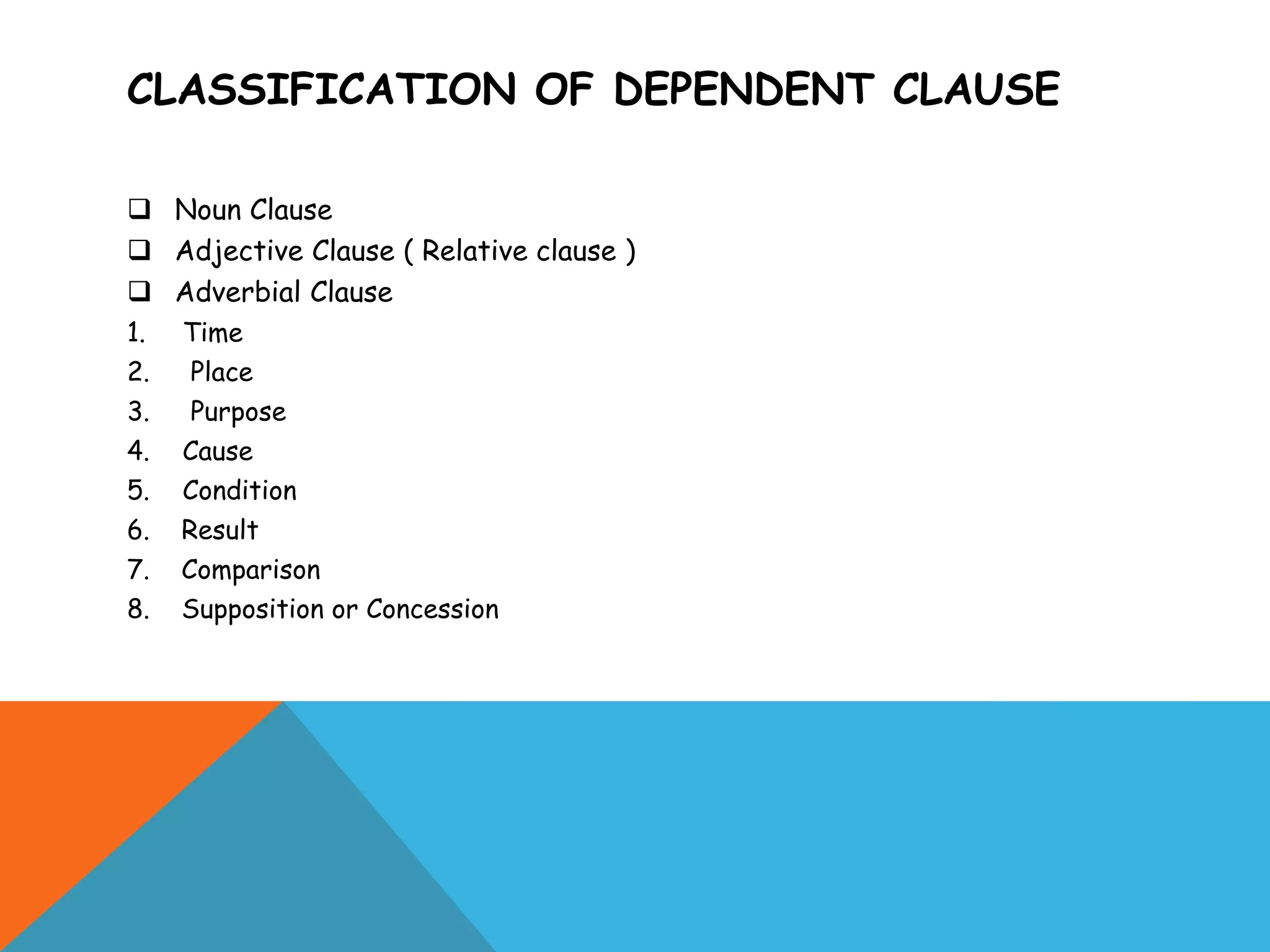
CLASSIFICATION OF DEPENDENT CLAUSE
 Noun Clause
 Adjective Clause ( Relative clause )
 Adverbial Clause
1. Time
2. Place
3. Purpose
4. Cause
5. Condition
6. Result
7. Comparison
8. Supposition or Concession
NOUN CLAUSE ( NOMINAL)
A noun clause is a dependent clause that acts as a noun.
Begin with i.e how, that, what, whatever, when, where, whether, which etc.
For example:-
• I remember what you said yesterday.
• I thought what she wore was so stylish.
ADJECTIVE CLAUSE (RELATIVE)
An adjective clause is a type of dependent clause that acts as an
adjective in the sentence.
Begin with one of the following words: whom, that, which, where, when etc.
For example:-
• The boy whom you saw at the store committed a robbery.
• Fruit that is grown organically is expensive.
ADVERBIAL CLAUSE
An adverbial clause is a type of dependent clause that acts as an adverb
in the sentence.
For example:-
• He literally stitched mail sacks until his fingers bled.
• If you pay your bills, you will have a good credit score.
CLASSIFICATION OF ADVERBIAL CLAUSE
Adverb Clause of time:-
Adverb Clauses of time are introduced by the Subordinating
Conjunctions whenever, while, after, before, since, as, etc.
For example:-
• When you have finished your work you may go home.
• I will do it when I think fit.
CONTINUE…
Adverb clause of place:-
Adverb Clauses of Place are introduced by the Subordinating
Conjunctions where and whereas etc.
For example:-
• I have put it where I can find it again.
• They can stay where they are.
CONTINUE…
Adverb clause of purpose:-
Adverb clauses of purpose are introduced by the subordinating
conjunctions so that, in order that and lest.
For example:-
• I will give you a map so that you can find the way.
• We eat so that we may live.
CONTINUE…
Adverb clause of Reason:-
Adverb Clauses of Cause or Reason are introduced by the Subordinating
conjunctions because, as, since, that.
For example:-
• Because I like you, I shall help you.
• I did it because I wanted to.
CONTINUE…
Adverb Clause of condition:-
Adverb Clauses of Condition are introduced by the Subordinating
Conjunctions if, whether, unless.
For example:-
• If I like it, I shall buy it. Come if you wish to.
• If it rains we shall stay at home.
CONTINUE…
Adverb clause of Result or Consequence:-
Adverb Clauses of Result or Consequence are introduced by the
Subordinating Conjunction so or such etc.
For example:-
• They fought so bravely that the enemies were driven off.
• He is such a good man that all respect him.
CONTINUE…
Adverb clause of Comparison:-
Adverb Clauses of Comparison of Degree or manner are introduced by the
Subordinating Conjunction than, or by etc.
For example:-
• He is older than he looks.
• He is as stupid as he is lazy.
CONTINUE…
Adverb clause of Supposition:-
Adverb Clauses of Supposition are introduced by the Subordinating
Conjunctions though, although, even if etc.
For example:-
• Though I am poor I am honest.
• Even if it rains I shall come.
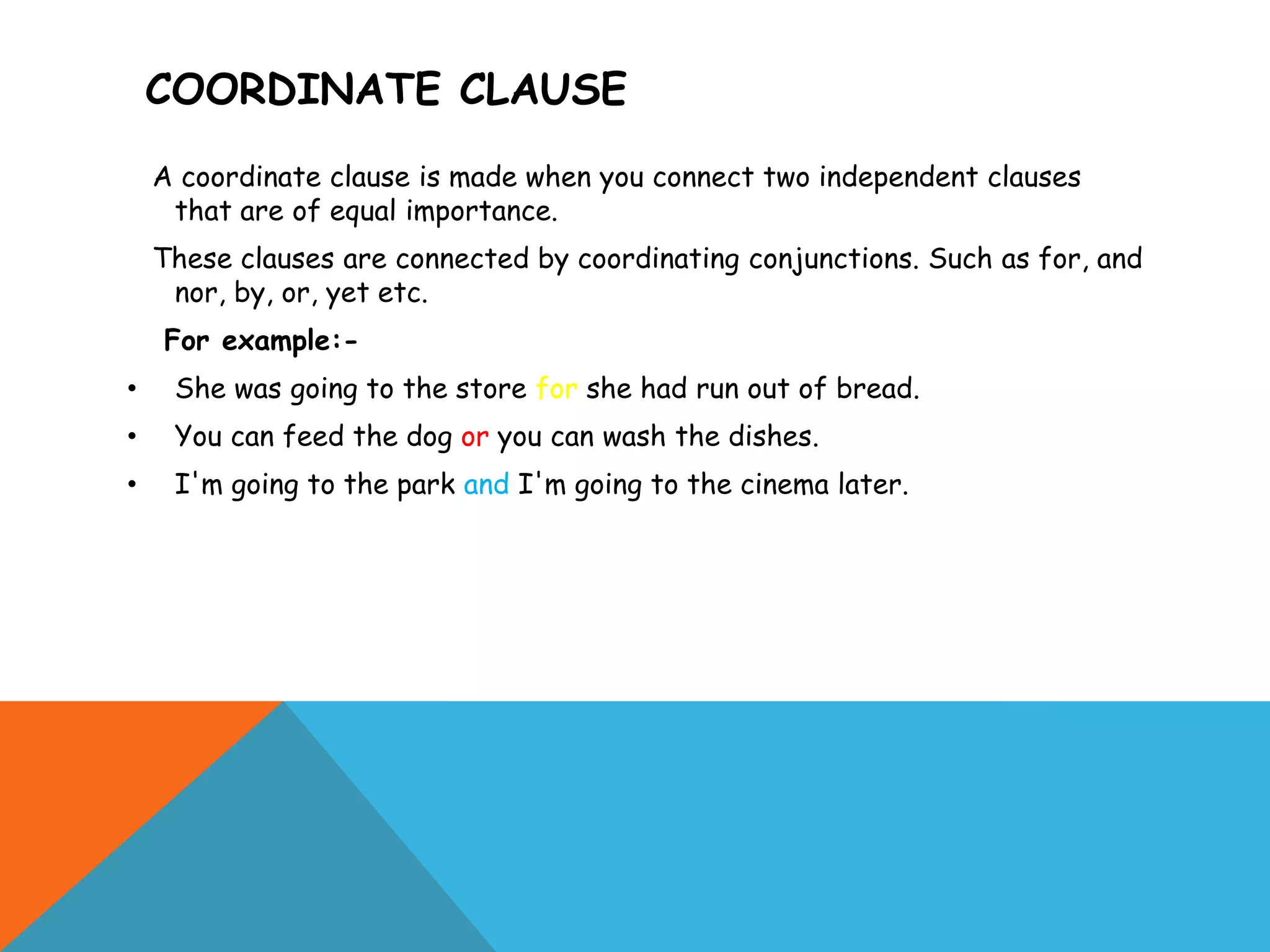
COORDINATE CLAUSE
A coordinate clause is made when you connect two independent clauses
that are of equal importance.
These clauses are connected by coordinating conjunctions. Such as for, and
nor, by, or, yet etc.
For example:-
• She was going to the store for she had run out of bread.
• You can feed the dog or you can wash the dishes.
• I'm going to the park and I'm going to the cinema later.
CONDITIONAL CLAUSE
A conditional clause is one that usually begins with if or unless and describes
something that is possible or probable.
For example:-
• If it looks like rain, a simple shelter can be made out of a plastic sheet.
[conditional clause] [main clause]
• I'll be home tomorrow, unless the plane's delayed for hours.
[conditional clause] [main clause]
Clauses and its Types ( English Ppt).pptx

Clauses and its Types ( English Ppt).pptx

  • 2.
    OBJECTIVE OF LECTURE •What is clause? • Difference between clause and sentence? • Types of clauses:- 1) Independent clause 2) Dependent clause  Adjective clause  Noun clause  Adverbial clause and its classifications 3) Coordinate clause 4) Conditional clause
  • 3.
    CLAUSE A clause isa group of words that includes Subject and a verb. • Part of Sentence or complete Sentence. • Include modifiers and a verb predicate. • May or may not make complete sense. • Can stand on its own. For example:-  I eat.  I eat fresh fruits.
  • 4.
    CLAUSE AND SENTENCE Groupof words that contain subject and verb Group of words that expresses a complete thought Sometime convey a complete thought Always convey a complete thought Building unit of sentence Made up of one or more clauses Can act as a Noun, adverb and adjective. Does not act as a Noun, Adverb and Adjective.
  • 5.
    TYPES OF CLAUSES Independent clause ( main clause):- An independent clause can express a complete thought, in such a way that it stand alone in a sentence. For example:- • When it rains, the daffodils bow their heads. • I have something important to say, before I speak. • I am not tidying the dishes unless Sana helps.
  • 6.
     DEPENDENT CLAUSE( SUBORDINATE) • Dependent clause include a subject and a verb. But they do not express a complete thought. • They add more information to an independent clause to clarify meaning. • It can’t stand alone. For example:-  My auntie who lives in Australia was bitten by a snake.  I am not tidying the dishes unless Ahmed helps.  Do you know the butcher who went to court on Saturday?
  • 7.
    CLASSIFICATION OF DEPENDENTCLAUSE  Noun Clause  Adjective Clause ( Relative clause )  Adverbial Clause 1. Time 2. Place 3. Purpose 4. Cause 5. Condition 6. Result 7. Comparison 8. Supposition or Concession
  • 8.
    NOUN CLAUSE (NOMINAL) A noun clause is a dependent clause that acts as a noun. Begin with i.e how, that, what, whatever, when, where, whether, which etc. For example:- • I remember what you said yesterday. • I thought what she wore was so stylish.
  • 9.
    ADJECTIVE CLAUSE (RELATIVE) Anadjective clause is a type of dependent clause that acts as an adjective in the sentence. Begin with one of the following words: whom, that, which, where, when etc. For example:- • The boy whom you saw at the store committed a robbery. • Fruit that is grown organically is expensive.
  • 10.
    ADVERBIAL CLAUSE An adverbialclause is a type of dependent clause that acts as an adverb in the sentence. For example:- • He literally stitched mail sacks until his fingers bled. • If you pay your bills, you will have a good credit score.
  • 11.
    CLASSIFICATION OF ADVERBIALCLAUSE Adverb Clause of time:- Adverb Clauses of time are introduced by the Subordinating Conjunctions whenever, while, after, before, since, as, etc. For example:- • When you have finished your work you may go home. • I will do it when I think fit.
  • 12.
    CONTINUE… Adverb clause ofplace:- Adverb Clauses of Place are introduced by the Subordinating Conjunctions where and whereas etc. For example:- • I have put it where I can find it again. • They can stay where they are.
  • 13.
    CONTINUE… Adverb clause ofpurpose:- Adverb clauses of purpose are introduced by the subordinating conjunctions so that, in order that and lest. For example:- • I will give you a map so that you can find the way. • We eat so that we may live.
  • 14.
    CONTINUE… Adverb clause ofReason:- Adverb Clauses of Cause or Reason are introduced by the Subordinating conjunctions because, as, since, that. For example:- • Because I like you, I shall help you. • I did it because I wanted to.
  • 15.
    CONTINUE… Adverb Clause ofcondition:- Adverb Clauses of Condition are introduced by the Subordinating Conjunctions if, whether, unless. For example:- • If I like it, I shall buy it. Come if you wish to. • If it rains we shall stay at home.
  • 16.
    CONTINUE… Adverb clause ofResult or Consequence:- Adverb Clauses of Result or Consequence are introduced by the Subordinating Conjunction so or such etc. For example:- • They fought so bravely that the enemies were driven off. • He is such a good man that all respect him.
  • 17.
    CONTINUE… Adverb clause ofComparison:- Adverb Clauses of Comparison of Degree or manner are introduced by the Subordinating Conjunction than, or by etc. For example:- • He is older than he looks. • He is as stupid as he is lazy.
  • 18.
    CONTINUE… Adverb clause ofSupposition:- Adverb Clauses of Supposition are introduced by the Subordinating Conjunctions though, although, even if etc. For example:- • Though I am poor I am honest. • Even if it rains I shall come.
  • 19.
    COORDINATE CLAUSE A coordinateclause is made when you connect two independent clauses that are of equal importance. These clauses are connected by coordinating conjunctions. Such as for, and nor, by, or, yet etc. For example:- • She was going to the store for she had run out of bread. • You can feed the dog or you can wash the dishes. • I'm going to the park and I'm going to the cinema later.
  • 20.
    CONDITIONAL CLAUSE A conditionalclause is one that usually begins with if or unless and describes something that is possible or probable. For example:- • If it looks like rain, a simple shelter can be made out of a plastic sheet. [conditional clause] [main clause] • I'll be home tomorrow, unless the plane's delayed for hours. [conditional clause] [main clause]

Editor's Notes

  • #5 A clause has subject and predicate , like sentence, but sentence has always has complete thought, where as clause might be incomplete. Sentence consist of several clauses. Every sentence have at least one independent clause in it but not every clause is sentence because a dependent clause does not make complete thought--- it is dependent upon an independent clause .