C L A U S E
S
B Y
M U H A M M A D A B D U L L A H
R O L L #
2 2 0 11 5 1 6 - 1 0 0
Introduction
A clause is a group of words that includes a subject and a
verb
It may form part of a sentence or it may be a complete sentence
in itself
For example:
The dog barks when the postman arrives
2/1/20XX 2
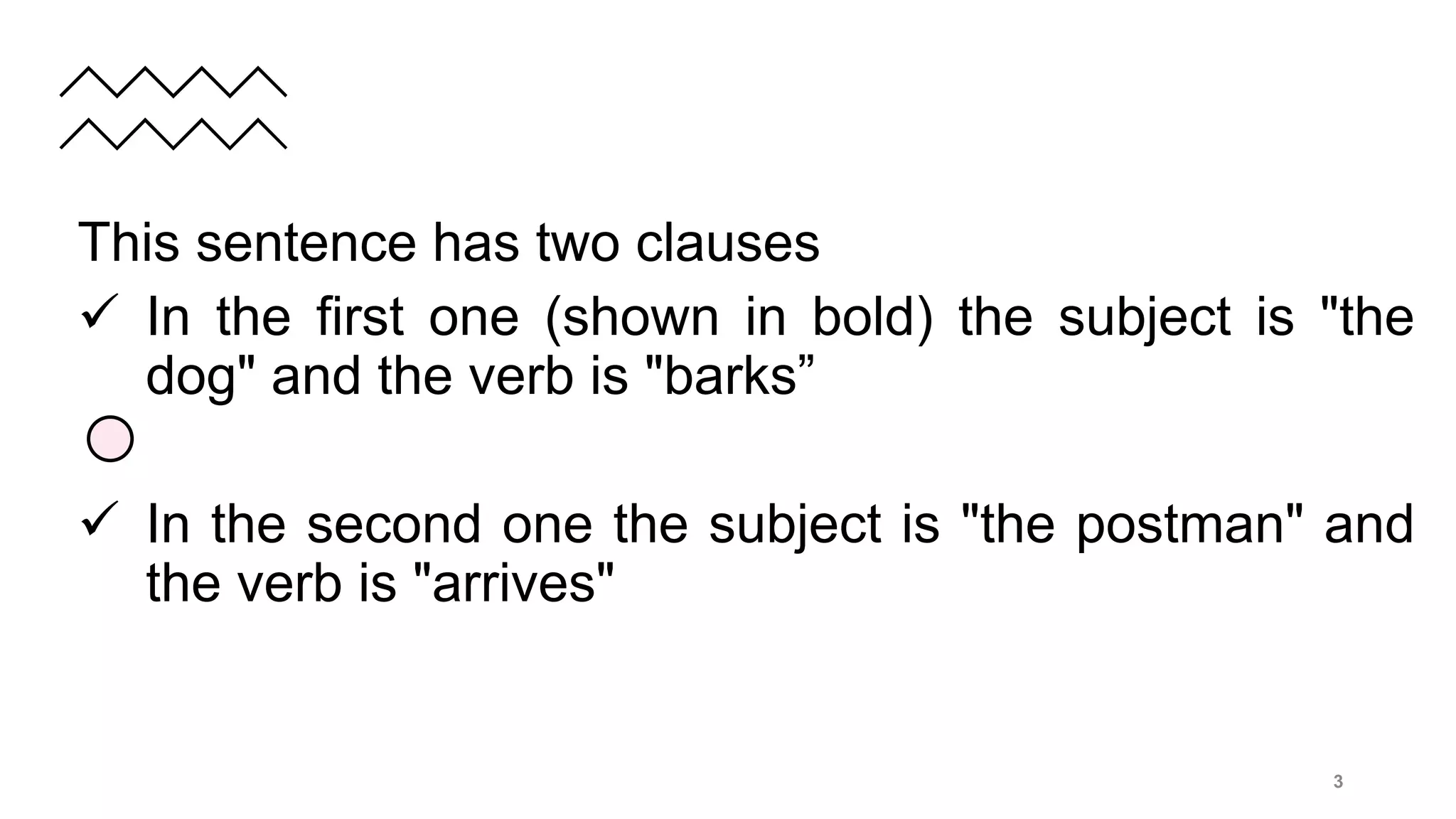
This sentence has two clauses
 In the first one (shown in bold) the subject is "the
dog" and the verb is "barks”
 In the second one the subject is "the postman" and
the verb is "arrives"
3
M A I N
T Y P E S
O F
C L A U S E
S 1. Dependent clause
2. Independent clause
M O R E
T Y P E S O F
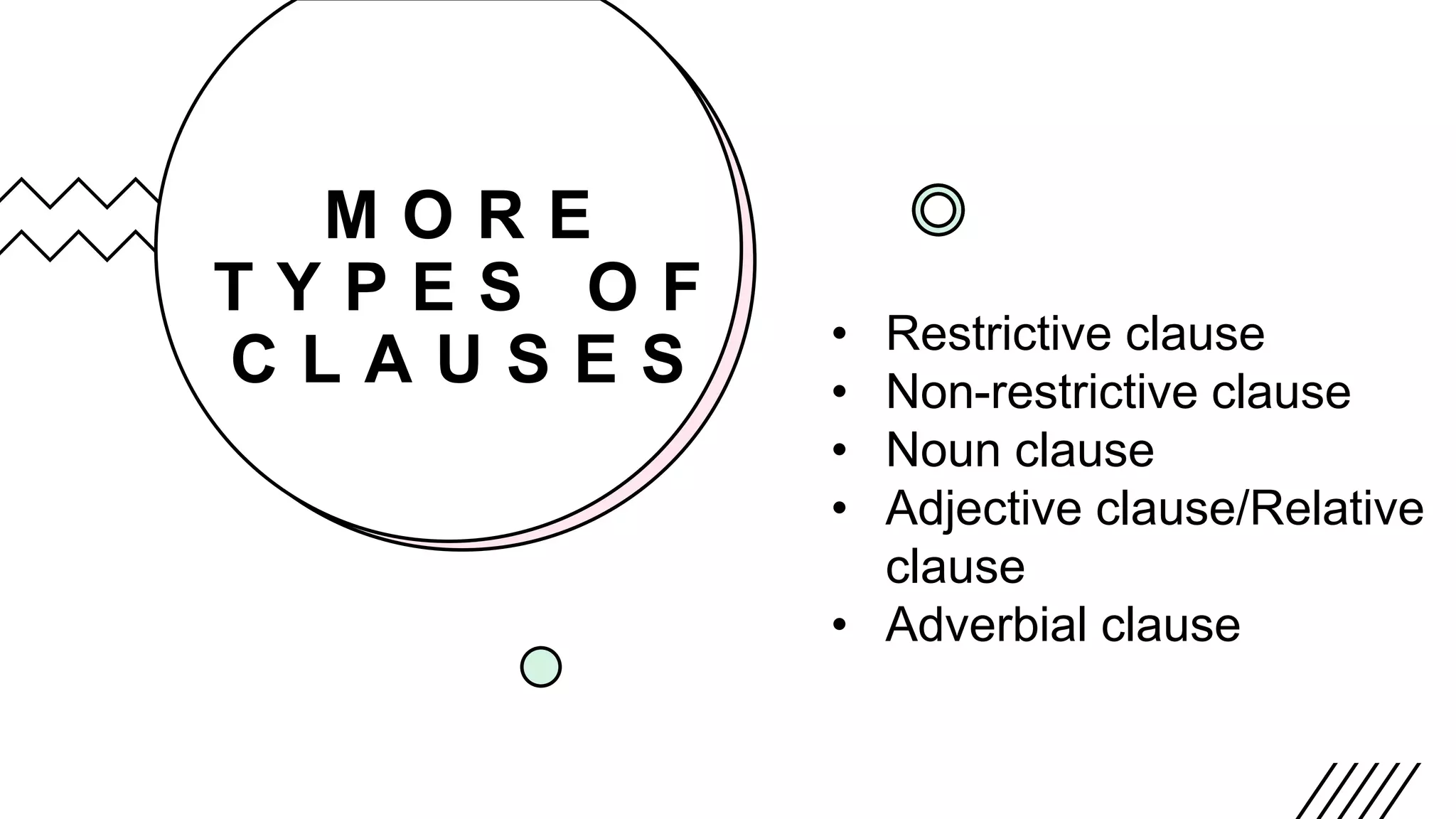
C L A U S E S • Restrictive clause
• Non-restrictive clause
• Noun clause
• Adjective clause/Relative
clause
• Adverbial clause
 Independent or Main Clause expresses the complete idea or a
thought
• It has a subject and verb and can stand alone as a sentence
Examples
i.I saw a man he was crying
ii.He is crying but nobody actions
iii.He is a wise man
The bold part of the sentence conveys the complete sense and is
called main clause 6
1–Independent Clause
(Main Clause)
Coordinators of
Independent Clause
And
but
yet
so
or etc.
These words are used to join the clauses
Dependent or subordinate clause is that clause which
cannot express the complete meaning
 It depends upon independent clause to give a complete
meaning
Example
The villagers lived happily until the wolves appeared
• "Until the wolves appeared" is an example of a
dependent clause
• It cannot stand alone as a sentence
• "The villagers lived happily" is the main clause in this
sentence 8
2–Dependent Clause
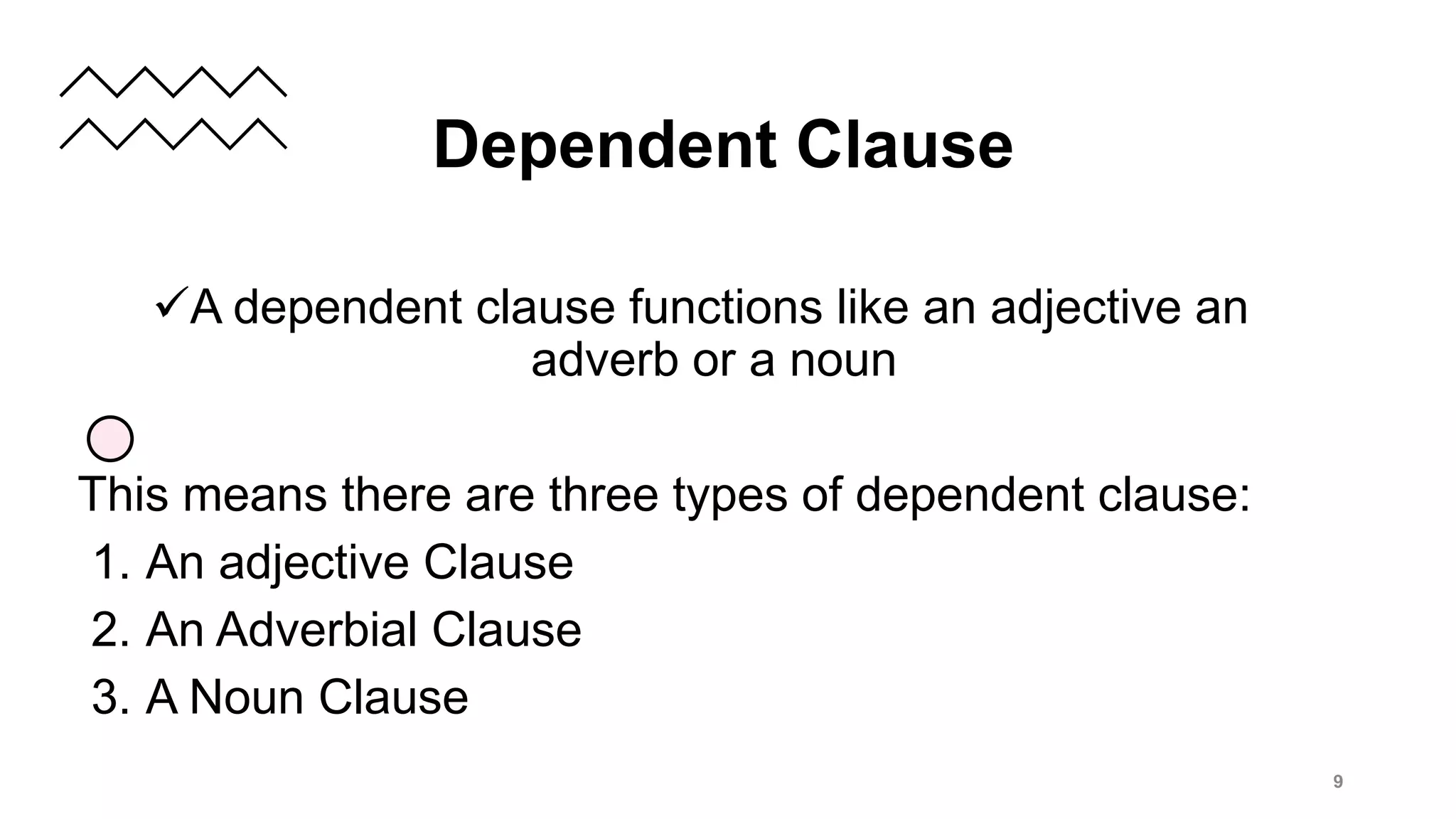
A dependent clause functions like an adjective an
adverb or a noun
This means there are three types of dependent clause:
1. An adjective Clause
2. An Adverbial Clause
3. A Noun Clause
9
Dependent Clause
1. Noun Clause–
A noun clause is a type of dependent clause that acts as a noun in the
sentence
• It has a subject+ verb
• However, it can’t stand alone as a complete thought
Example
I remember what you said yesterday
In above sentence “what you said yesterday” functions as noun
10
Dependent Clause
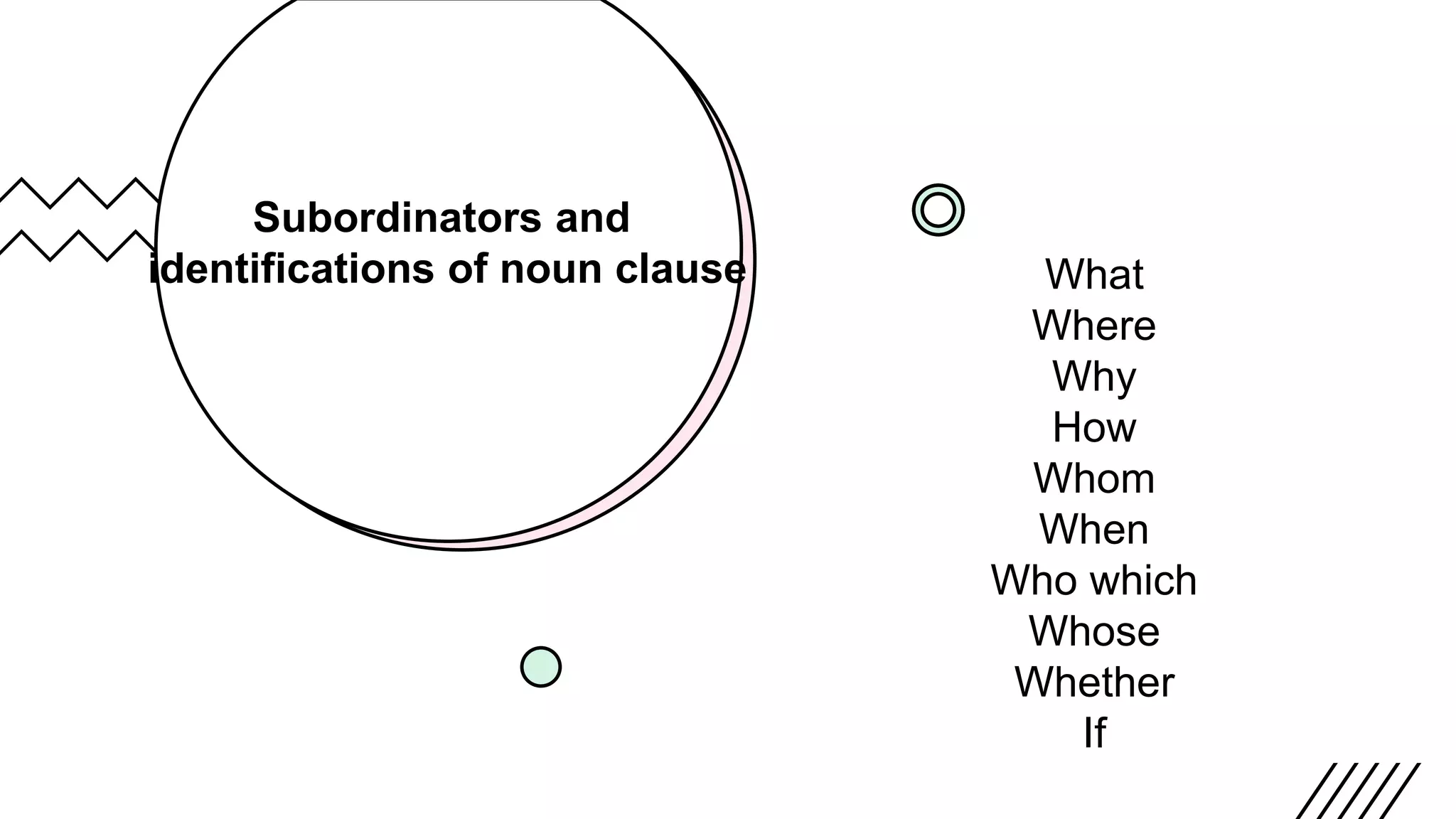
Subordinators and
identifications of noun clause What
Where
Why
How
Whom
When
Who which
Whose
Whether
If
2. Adjective Clause
Adjective clause is a type of dependent clause that acts as an adjective
in the sentence
• It always has a subject-verb
• However, it can’t stand alone as a complete thought
Example
He wears a shirt which looks nice.
In above sentence “which looks nice” is an adjective clause
12
Dependent Clause
• An adjective clause always begins with relative pronoun
• Adjective clauses can be restrictive and non-restrictive:
i. Restrictive Clause
A restrictive clause limits the meaning of preceding noun or pronoun
Example
The student in the class who studied a lot pass the examination
ii. Non-restrictive Clause
Non-restrictive clause tells us something about preceding noun or pronoun but
does not limit the meaning of preceding noun or pronoun
Example
The student in the class attended all the lectures pass the exam
13
Dependent Clause
Subordinators and
identifications of adjective
clause
who
whom
which
whose
where
when
3. Adverb Clause
Adverb clause is a type of dependent clause that acts as an adverb
in the sentence
• It always has a subject and verb
• It cannot stand alone as a complete thought
Examples
Do not go before he comes
He takes medicine because he is ill
15
Dependent Clause
• It also describes the main situation in terms of time, frequency,
cause and effect, condition etc.
i. Adverb clause in a time
It frequently starts with when, before, after, until, as soon as, since
Example
When he won the money, he decided to buy a car
16
Dependent Clause
ii. Adverb clause in a place
It shows the place in the sentence and starts with where, wherever
Example
She drove wherever she wanted
iii. Adverb clause in a cause
It shows some cause of action
It starts with because, as, since
Example
She got a parking ticket because she parked illegally
17
Dependent Clause
T H A N K
Y o u 
18

CLAUSES.pptx

  • 1.
    C L AU S E S B Y M U H A M M A D A B D U L L A H R O L L # 2 2 0 11 5 1 6 - 1 0 0
  • 2.
    Introduction A clause isa group of words that includes a subject and a verb It may form part of a sentence or it may be a complete sentence in itself For example: The dog barks when the postman arrives 2/1/20XX 2
  • 3.
    This sentence hastwo clauses  In the first one (shown in bold) the subject is "the dog" and the verb is "barks”  In the second one the subject is "the postman" and the verb is "arrives" 3
  • 4.
    M A IN T Y P E S O F C L A U S E S 1. Dependent clause 2. Independent clause
  • 5.
    M O RE T Y P E S O F C L A U S E S • Restrictive clause • Non-restrictive clause • Noun clause • Adjective clause/Relative clause • Adverbial clause
  • 6.
     Independent orMain Clause expresses the complete idea or a thought • It has a subject and verb and can stand alone as a sentence Examples i.I saw a man he was crying ii.He is crying but nobody actions iii.He is a wise man The bold part of the sentence conveys the complete sense and is called main clause 6 1–Independent Clause (Main Clause)
  • 7.
    Coordinators of Independent Clause And but yet so oretc. These words are used to join the clauses
  • 8.
    Dependent or subordinateclause is that clause which cannot express the complete meaning  It depends upon independent clause to give a complete meaning Example The villagers lived happily until the wolves appeared • "Until the wolves appeared" is an example of a dependent clause • It cannot stand alone as a sentence • "The villagers lived happily" is the main clause in this sentence 8 2–Dependent Clause
  • 9.
    A dependent clausefunctions like an adjective an adverb or a noun This means there are three types of dependent clause: 1. An adjective Clause 2. An Adverbial Clause 3. A Noun Clause 9 Dependent Clause
  • 10.
    1. Noun Clause– Anoun clause is a type of dependent clause that acts as a noun in the sentence • It has a subject+ verb • However, it can’t stand alone as a complete thought Example I remember what you said yesterday In above sentence “what you said yesterday” functions as noun 10 Dependent Clause
  • 11.
    Subordinators and identifications ofnoun clause What Where Why How Whom When Who which Whose Whether If
  • 12.
    2. Adjective Clause Adjectiveclause is a type of dependent clause that acts as an adjective in the sentence • It always has a subject-verb • However, it can’t stand alone as a complete thought Example He wears a shirt which looks nice. In above sentence “which looks nice” is an adjective clause 12 Dependent Clause
  • 13.
    • An adjectiveclause always begins with relative pronoun • Adjective clauses can be restrictive and non-restrictive: i. Restrictive Clause A restrictive clause limits the meaning of preceding noun or pronoun Example The student in the class who studied a lot pass the examination ii. Non-restrictive Clause Non-restrictive clause tells us something about preceding noun or pronoun but does not limit the meaning of preceding noun or pronoun Example The student in the class attended all the lectures pass the exam 13 Dependent Clause
  • 14.
    Subordinators and identifications ofadjective clause who whom which whose where when
  • 15.
    3. Adverb Clause Adverbclause is a type of dependent clause that acts as an adverb in the sentence • It always has a subject and verb • It cannot stand alone as a complete thought Examples Do not go before he comes He takes medicine because he is ill 15 Dependent Clause
  • 16.
    • It alsodescribes the main situation in terms of time, frequency, cause and effect, condition etc. i. Adverb clause in a time It frequently starts with when, before, after, until, as soon as, since Example When he won the money, he decided to buy a car 16 Dependent Clause
  • 17.
    ii. Adverb clausein a place It shows the place in the sentence and starts with where, wherever Example She drove wherever she wanted iii. Adverb clause in a cause It shows some cause of action It starts with because, as, since Example She got a parking ticket because she parked illegally 17 Dependent Clause
  • 18.
    T H AN K Y o u  18