Clause
1. Definition
• A clause is a group of words that contains a subject and a predicate (verb).
• Unlike a phrase, a clause can express a complete idea (independent clause) or a
partial idea (dependent clause).
• 📌 Examples:
• She is reading a book. (independent clause)
• because she is tired (dependent clause)
Types of clause
• 2. Main Types
• 2.1. Independent Clause
• Can stand alone as a complete sentence.
• Expresses a complete thought.
• Examples:
• I like English.
• He plays football every weekend.
• 2.2. Dependent Clause (Subordinate Clause)
• Cannot stand alone; it must be attached to an independent clause.
• Introduced by subordinating conjunctions (because, if, although), relative pronouns
(who, which, that), or wh-words (what, why, how).
• Subtypes:
1.Noun Clause:
1. Functions as a noun (subject, object, complement).
2. Introduced by that, if, whether, what, why, how, who, etc.
3. Examples:
1. What you said is true. (subject)
2. I don’t know whether she will come. (object)
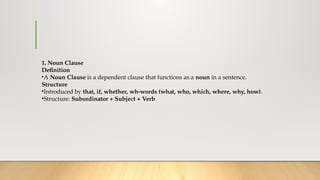
1. Noun Clause
Definition
•A Noun Clause is a dependent clause that functions as a noun in a sentence.
Structure
•Introduced by that, if, whether, wh-words (what, who, which, where, why, how).
•Structure: Subordinator + Subject + Verb
Usage
• A noun clause can act as:
1. Subject:
1. What you said is true.
2. That she passed the exam surprised everyone.
2. Object of a verb:
1. I don’t know what he wants.
2. She asked whether he would join.
3. Object of a preposition:
1. I’m not responsible for what you did.
4. Complement of a subject or object:
1. The truth is that he lied.
2. My question is whether we can trust him.
• Special Notes
• “That” in noun clauses can often be omitted:
• I think (that) she is right.
• Noun clauses are always dependent → cannot stand alone.
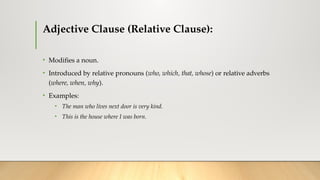
Adjective Clause (Relative Clause):
• Modifies a noun.
• Introduced by relative pronouns (who, which, that, whose) or relative adverbs
(where, when, why).
• Examples:
• The man who lives next door is very kind.
• This is the house where I was born.
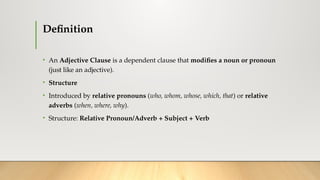
Definition
• An Adjective Clause is a dependent clause that modifies a noun or pronoun
(just like an adjective).
• Structure
• Introduced by relative pronouns (who, whom, whose, which, that) or relative
adverbs (when, where, why).
• Structure: Relative Pronoun/Adverb + Subject + Verb
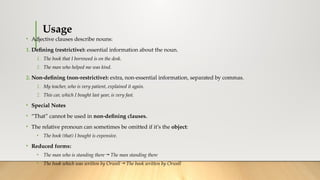
Usage
• Adjective clauses describe nouns:
1. Defining (restrictive): essential information about the noun.
1. The book that I borrowed is on the desk.
2. The man who helped me was kind.
2. Non-defining (non-restrictive): extra, non-essential information, separated by commas.
1. My teacher, who is very patient, explained it again.
2. This car, which I bought last year, is very fast.
• Special Notes
• “That” cannot be used in non-defining clauses.
• The relative pronoun can sometimes be omitted if it’s the object:
• The book (that) I bought is expensive.
• Reduced forms:
• The man who is standing there → The man standing there
• The book which was written by Orwell → The book written by Orwell
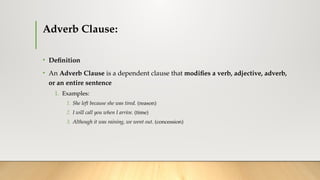
Adverb Clause:
• Definition
• An Adverb Clause is a dependent clause that modifies a verb, adjective, adverb,
or an entire sentence
1. Examples:
1. She left because she was tired. (reason)
2. I will call you when I arrive. (time)
3. Although it was raining, we went out. (concession)
Usage
Adverb clauses can express:
1. Time:
1. I will call you when I arrive.
2. Stay here until the rain stops.
2. Cause/Reason:
1. She left because she was tired.
3. Condition:
1. If it rains, we will cancel the picnic.
4. Contrast/Concession:
1. Although it was raining, we went out.
5. Purpose/Result:
1. He spoke loudly so that everyone could hear.
6. Comparison:
1. She sings better than he does.
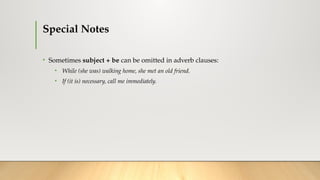
Special Notes
• Sometimes subject + be can be omitted in adverb clauses:
• While (she was) walking home, she met an old friend.
• If (it is) necessary, call me immediately.
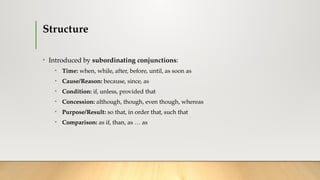
Structure
• Introduced by subordinating conjunctions:
• Time: when, while, after, before, until, as soon as
• Cause/Reason: because, since, as
• Condition: if, unless, provided that
• Concession: although, though, even though, whereas
• Purpose/Result: so that, in order that, such that
• Comparison: as if, than, as … as
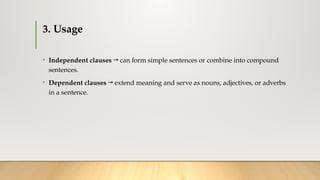
3. Usage
• Independent clauses → can form simple sentences or combine into compound
sentences.
• Dependent clauses → extend meaning and serve as nouns, adjectives, or adverbs
in a sentence.
4. Special Cases
1. Reduced clauses:
1. A shortened form of a dependent clause.
2. Examples:
1. The man who is standing there → The man standing there
2. When he was asked, he answered → When asked, he answered
2. Elliptical clauses:
1. Omit understood elements.
2. Example: If (you are) tired, take a rest.
3. Non-finite clauses (with non-finite verbs):
1. Infinitive clause: To be honest, …
2. Gerund clause: Seeing is believing.
3. Participle clause: Walking down the street, she saw an old friend.
Basic stress rules.pptxasdakjlasdjlsadk;skdw

Basic stress rules.pptxasdakjlasdjlsadk;skdw

  • 1.
  • 2.
    1. Definition • Aclause is a group of words that contains a subject and a predicate (verb). • Unlike a phrase, a clause can express a complete idea (independent clause) or a partial idea (dependent clause). • 📌 Examples: • She is reading a book. (independent clause) • because she is tired (dependent clause)
  • 3.
    Types of clause •2. Main Types • 2.1. Independent Clause • Can stand alone as a complete sentence. • Expresses a complete thought. • Examples: • I like English. • He plays football every weekend.
  • 4.
    • 2.2. DependentClause (Subordinate Clause) • Cannot stand alone; it must be attached to an independent clause. • Introduced by subordinating conjunctions (because, if, although), relative pronouns (who, which, that), or wh-words (what, why, how).
  • 5.
    • Subtypes: 1.Noun Clause: 1.Functions as a noun (subject, object, complement). 2. Introduced by that, if, whether, what, why, how, who, etc. 3. Examples: 1. What you said is true. (subject) 2. I don’t know whether she will come. (object)
  • 6.
    1. Noun Clause Definition •ANoun Clause is a dependent clause that functions as a noun in a sentence. Structure •Introduced by that, if, whether, wh-words (what, who, which, where, why, how). •Structure: Subordinator + Subject + Verb
  • 7.
    Usage • A nounclause can act as: 1. Subject: 1. What you said is true. 2. That she passed the exam surprised everyone. 2. Object of a verb: 1. I don’t know what he wants. 2. She asked whether he would join. 3. Object of a preposition: 1. I’m not responsible for what you did. 4. Complement of a subject or object: 1. The truth is that he lied. 2. My question is whether we can trust him. • Special Notes • “That” in noun clauses can often be omitted: • I think (that) she is right. • Noun clauses are always dependent → cannot stand alone.
  • 8.
    Adjective Clause (RelativeClause): • Modifies a noun. • Introduced by relative pronouns (who, which, that, whose) or relative adverbs (where, when, why). • Examples: • The man who lives next door is very kind. • This is the house where I was born.
  • 9.
    Definition • An AdjectiveClause is a dependent clause that modifies a noun or pronoun (just like an adjective). • Structure • Introduced by relative pronouns (who, whom, whose, which, that) or relative adverbs (when, where, why). • Structure: Relative Pronoun/Adverb + Subject + Verb
  • 10.
    Usage • Adjective clausesdescribe nouns: 1. Defining (restrictive): essential information about the noun. 1. The book that I borrowed is on the desk. 2. The man who helped me was kind. 2. Non-defining (non-restrictive): extra, non-essential information, separated by commas. 1. My teacher, who is very patient, explained it again. 2. This car, which I bought last year, is very fast. • Special Notes • “That” cannot be used in non-defining clauses. • The relative pronoun can sometimes be omitted if it’s the object: • The book (that) I bought is expensive. • Reduced forms: • The man who is standing there → The man standing there • The book which was written by Orwell → The book written by Orwell
  • 11.
    Adverb Clause: • Definition •An Adverb Clause is a dependent clause that modifies a verb, adjective, adverb, or an entire sentence 1. Examples: 1. She left because she was tired. (reason) 2. I will call you when I arrive. (time) 3. Although it was raining, we went out. (concession)
  • 12.
    Usage Adverb clauses canexpress: 1. Time: 1. I will call you when I arrive. 2. Stay here until the rain stops. 2. Cause/Reason: 1. She left because she was tired. 3. Condition: 1. If it rains, we will cancel the picnic. 4. Contrast/Concession: 1. Although it was raining, we went out. 5. Purpose/Result: 1. He spoke loudly so that everyone could hear. 6. Comparison: 1. She sings better than he does.
  • 13.
    Special Notes • Sometimessubject + be can be omitted in adverb clauses: • While (she was) walking home, she met an old friend. • If (it is) necessary, call me immediately.
  • 14.
    Structure • Introduced bysubordinating conjunctions: • Time: when, while, after, before, until, as soon as • Cause/Reason: because, since, as • Condition: if, unless, provided that • Concession: although, though, even though, whereas • Purpose/Result: so that, in order that, such that • Comparison: as if, than, as … as
  • 15.
    3. Usage • Independentclauses → can form simple sentences or combine into compound sentences. • Dependent clauses → extend meaning and serve as nouns, adjectives, or adverbs in a sentence.
  • 16.
    4. Special Cases 1.Reduced clauses: 1. A shortened form of a dependent clause. 2. Examples: 1. The man who is standing there → The man standing there 2. When he was asked, he answered → When asked, he answered 2. Elliptical clauses: 1. Omit understood elements. 2. Example: If (you are) tired, take a rest. 3. Non-finite clauses (with non-finite verbs): 1. Infinitive clause: To be honest, … 2. Gerund clause: Seeing is believing. 3. Participle clause: Walking down the street, she saw an old friend.