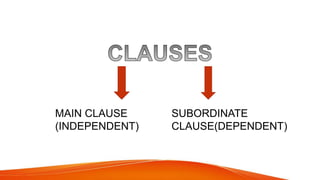
SUBORDINATE
CLAUSE(DEPENDENT)
MAIN CLAUSE
(INDEPENDENT)
• Main clause( independent clause) is a group of words
that contains a subject and verb and expresses a
complete thought. An independent clause is a sentence.
eg:Jim studied in the Sweet Shop for his chemistry quiz.
• A subordinate clause (dependent clause) is a group of
words that contains a subject and verb but does not
express a complete thought.Dependent clauses are the
building blocks of sentences.Dependent clauses MUST
be joined to another clause
eg: Because he injured his foot
•
eg: 1)Jim read the book;he really enjoyed the book.
(two independent clauses are joined together with semicoln ; )
2)Because I forgot my homework, I got sent home.
(dependent clause is joined with an independent clause with the help of
'because')
CO ORDINATING CLAUSE
• An independent clause that is connected to another one
of equal importance, often with a conjunction such as
‘and’, ‘but’, or ‘or’.
• For example in the sentence ‘He died and she married
again’ there are two coordinate clauses.
They are 'he died, she married again.
Coordination joins sentences with related and equal ideas,
whereas subordination joins sentences with related but
unequal ideas.
There are three kinds of
subordinate clauses:
noun clause
Relative
clause
Adverbial
clause
A noun clause is a dependent clause that acts as
a noun. Noun clauses begin with words such as
how, that, what, whatever, when, where, whether,
which, whichever, who, whoever, whom,
whomever, and why.
Noun clauses typically have a verb and a subject,
but they cannot express a complete thought in a
sentence.
Examples of Noun clause
1. that I am a hard worker.
That I am a hard worker is a noun clause. It contains the subject I
and the verb am.)
2. whichever audience you perform for
(Whichever audience you perform for is a noun clause. It
contains the subject you and the verb perform. )
3 when we get hungry.
( When we get hungry is a noun clause. It contains the subject
we and the verb get. )
• A relative clause is a specific type of subordinate
clause that adapts, describes or modifies a noun.
Relative clauses add information to sentences by
using a relative pronoun such as who, that or
which.
• They add information to sentences by using a
relative pronoun such as who, that , which whose
,whom etc
• A notebook is a computer which can be carried
around.
(which can be carried around.is a relative clause.it contains the
relative pronoun which. and verb is carried)
• I won't eat in a restaurant
(whose cooks smoke is a relative clause.it contains the relative
pronoun whose and verb is smoke)
• An adverbial clause is a dependent clause that functions
as an adverb. That is, the entire clause modifies a verb,
an adjective, or another adverb.
• Its role is to show place, time, condition, degree, and so
on, by answering questions like “where?”; “when?”;
“how?”; and “why?”
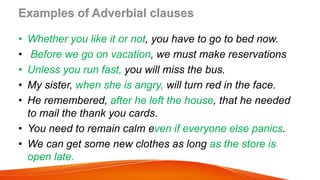
Examples of Adverbial clauses
• Whether you like it or not, you have to go to bed now.
• Before we go on vacation, we must make reservations
• Unless you run fast, you will miss the bus.
• My sister, when she is angry, will turn red in the face.
• He remembered, after he left the house, that he needed
to mail the thank you cards.
• You need to remain calm even if everyone else panics.
• We can get some new clothes as long as the store is
open late.
Clauses

Clauses

  • 3.
  • 4.
    • Main clause(independent clause) is a group of words that contains a subject and verb and expresses a complete thought. An independent clause is a sentence. eg:Jim studied in the Sweet Shop for his chemistry quiz. • A subordinate clause (dependent clause) is a group of words that contains a subject and verb but does not express a complete thought.Dependent clauses are the building blocks of sentences.Dependent clauses MUST be joined to another clause eg: Because he injured his foot
  • 5.
    • eg: 1)Jim readthe book;he really enjoyed the book. (two independent clauses are joined together with semicoln ; ) 2)Because I forgot my homework, I got sent home. (dependent clause is joined with an independent clause with the help of 'because')
  • 6.
    CO ORDINATING CLAUSE •An independent clause that is connected to another one of equal importance, often with a conjunction such as ‘and’, ‘but’, or ‘or’. • For example in the sentence ‘He died and she married again’ there are two coordinate clauses. They are 'he died, she married again. Coordination joins sentences with related and equal ideas, whereas subordination joins sentences with related but unequal ideas.
  • 7.
    There are threekinds of subordinate clauses: noun clause Relative clause Adverbial clause
  • 8.
    A noun clauseis a dependent clause that acts as a noun. Noun clauses begin with words such as how, that, what, whatever, when, where, whether, which, whichever, who, whoever, whom, whomever, and why. Noun clauses typically have a verb and a subject, but they cannot express a complete thought in a sentence.
  • 9.
    Examples of Nounclause 1. that I am a hard worker. That I am a hard worker is a noun clause. It contains the subject I and the verb am.) 2. whichever audience you perform for (Whichever audience you perform for is a noun clause. It contains the subject you and the verb perform. ) 3 when we get hungry. ( When we get hungry is a noun clause. It contains the subject we and the verb get. )
  • 10.
    • A relativeclause is a specific type of subordinate clause that adapts, describes or modifies a noun. Relative clauses add information to sentences by using a relative pronoun such as who, that or which. • They add information to sentences by using a relative pronoun such as who, that , which whose ,whom etc
  • 11.
    • A notebookis a computer which can be carried around. (which can be carried around.is a relative clause.it contains the relative pronoun which. and verb is carried) • I won't eat in a restaurant (whose cooks smoke is a relative clause.it contains the relative pronoun whose and verb is smoke)
  • 12.
    • An adverbialclause is a dependent clause that functions as an adverb. That is, the entire clause modifies a verb, an adjective, or another adverb. • Its role is to show place, time, condition, degree, and so on, by answering questions like “where?”; “when?”; “how?”; and “why?”
  • 13.
    Examples of Adverbialclauses • Whether you like it or not, you have to go to bed now. • Before we go on vacation, we must make reservations • Unless you run fast, you will miss the bus. • My sister, when she is angry, will turn red in the face. • He remembered, after he left the house, that he needed to mail the thank you cards. • You need to remain calm even if everyone else panics. • We can get some new clothes as long as the store is open late.