
Applying Choice
Theory to Classroom
Management
By Patrick Jackson
• Studies show that there is a strong relationship between
classroom management and student achievement, and the
most important factors which affect student learning are
classroom management (Wang, Haertel, & Walberg, 1994)
and teacher behaviors (Fidler, 2002; Wright, Horn, & Sanders,
1997).
• What is the first word that comes to mind when you hear the
term classroom management?
• Discipline? Control? Order?
• A common misconception about classroom management is
that it is synonymous with discipline.
• Effective managers organize their classrooms so that they
avoid most behavior issues, limiting the concerns about
discipline.
• Try to visualize your effectively managed classroom. What
does it look like?
• A productive learning environment can often be noisy because
learning in of itself is not a passive activity. To learn, one must
talk, share, discover, experiment, and question, all of which
can create noise.
Goals of Effective Classroom
Management
• Sometimes, teachers believe that the goal of classroom
management is to keep their classes under “control” and
maintain a well-behaved classroom.
• Weinstein and Evertson (2006) explain that classroom
management has two goals: creating an environment for
academic learning and creating and environment for social-
emotional learning. A classroom that promotes both types of
learning is a well-managed classroom.
The goal of classroom
management should not be to
control students behavior but
more to improve student
learning.
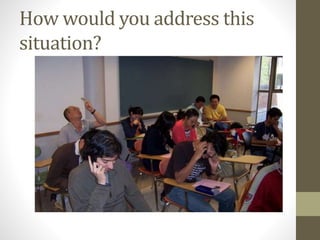
How would you address this
situation?
• Most teachers would stop teaching and call out the student
that is misbehaving. But if we look at this situation through
the lens of student learning, we see a different perspective.
• The student was interrupting his or her own learning by
playing with the object, but the teacher interrupted the
learning of all students by stopping the lesson to deal with the
situation.
• A more effective management strategy would be for the
teacher to continue to teach, walk over to the student and
take the object and place it on the student’s desk.
• Or, by simply continuing to teach and simply walking closer to
the student may cause the behavior to stop. The goal for this
strategy is to redirect the student back to the lesson in a
manner that doesn’t interrupt all students’ learning.
Behaviors are a form of
communication .
• What could the student playing with the cell phone possibly
be communicating?
• When students misbehave, become distracted, have difficulty
handing in assignments on time, or experience any other
common difficulty in the classroom, they communicate to
teachers that some element of the experience is not working
for them.
• Teachers must be acutely aware of the diverse backgrounds
and needs of the students and develop management
strategies that are responsive and respectful of these
differences.
Classroom management
should be used to create safe
and respectful classroom
environments. To do so, we as
professionals, need to respect
diversity, develop
relationships, and recognize
behaviors as a form of
communication.
Creating Relationships
• Perhaps the most important rule of classroom management is
to develop a strong relationship with each student.
• In Marzano and Marzano’s (2003) analysis of more than 100
studies, they found that teachers who had positive
relationships with their students had 31% fewer discipline
problems and rule violations over the course of the semester
than teachers who did not have positive relationships.
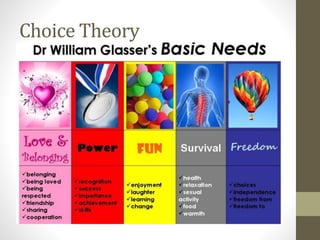
Choice Theory
Survival
• Consistent classroom procedures and routines provide a sense
of order and security and developing behavior guidelines that
emphasize safety and respect
• Common routines and procedures include: arrival/entering
the classroom, attendance, submitting classwork and
homework, transitions between classroom activities, missed
classes, participation in class discussions, and cooperative
learning groups.
Love and Belonging
• Conducting regular class meetings to build relationships, solve
problems, and model appropriate choices address the need to
feel loved and a sense of belonging
Power
• Giving students power and a voice in class further motivates
them to behave well and meet classroom expectations.
• Provide opportunities for students to respond through
response cards, choral responding, and peer tutoring. All of
these increase student engagement while providing
immediate academic feedback for students.
• Solicit student input regarding classroom rules and
expectations or gather feedback regarding interests empower
students to feel a sense of ownership for the classroom and its
policies and procedures.
Freedom
• Provide opportunities for students to choose the type of
assignment or performance task they want to complete to
demonstrate their understanding
Fun
• Creating a fun and engaging classroom environment directly
affects classroom management simply because when students
are invested and enthusiastic about learning, management
issues are minimal
• Make learning engaging and real world applicable
• Develop lessons that meet the learning needs of students:
When students are either too challenged or not challenged
enough, problems can occur
• No cookie cutter classroom management system exists. Most
strategies come from years of experience and research that
looks at eliminating undesirable behaviors.
• Teachers must demonstrate their love and passion for the
material as well as communicate why it is important for
students to learn the material. And, perhaps most importantly,
communicate that they will help every student succeed.
References
• Akalin, S., & Sucuoglu, B. (2015). Effects of Classroom
Management Intervention Based on Teacher Training and
Performance Feedback on Outcomes of Teacher-Student
Dyads in Inclusive Classrooms. Educational Sciences: Theory &
Practice, 15(3), 739-758. doi:10.12738/estp.2015.3.2543
• Eisenman, G., Edwards, S., & Cushman, C. A. (2015). Bringing
Reality to Classroom Management in Teacher Education.
Professional Educator, 39(1), 1-12.
• Garrett, T. F. (2015). Misconceptions and Goals of Classroom
Management. Education Digest, 80(5), 45.
• Sayeski, K. L., & Brown, M. R. (2014). Developing a Classroom
Management Plan Using a Tiered Approach. Teaching
Exceptional Children, 47(2), 119-127.
doi:10.1177/0040059914553208

Classroom management presentation patrick jackson

  • 1.
    Applying Choice Theory toClassroom Management By Patrick Jackson
  • 2.
    • Studies showthat there is a strong relationship between classroom management and student achievement, and the most important factors which affect student learning are classroom management (Wang, Haertel, & Walberg, 1994) and teacher behaviors (Fidler, 2002; Wright, Horn, & Sanders, 1997).
  • 3.
    • What isthe first word that comes to mind when you hear the term classroom management? • Discipline? Control? Order? • A common misconception about classroom management is that it is synonymous with discipline. • Effective managers organize their classrooms so that they avoid most behavior issues, limiting the concerns about discipline.
  • 4.
    • Try tovisualize your effectively managed classroom. What does it look like? • A productive learning environment can often be noisy because learning in of itself is not a passive activity. To learn, one must talk, share, discover, experiment, and question, all of which can create noise.
  • 5.
    Goals of EffectiveClassroom Management • Sometimes, teachers believe that the goal of classroom management is to keep their classes under “control” and maintain a well-behaved classroom. • Weinstein and Evertson (2006) explain that classroom management has two goals: creating an environment for academic learning and creating and environment for social- emotional learning. A classroom that promotes both types of learning is a well-managed classroom.
  • 6.
    The goal ofclassroom management should not be to control students behavior but more to improve student learning.
  • 7.
    How would youaddress this situation?
  • 8.
    • Most teacherswould stop teaching and call out the student that is misbehaving. But if we look at this situation through the lens of student learning, we see a different perspective. • The student was interrupting his or her own learning by playing with the object, but the teacher interrupted the learning of all students by stopping the lesson to deal with the situation. • A more effective management strategy would be for the teacher to continue to teach, walk over to the student and take the object and place it on the student’s desk. • Or, by simply continuing to teach and simply walking closer to the student may cause the behavior to stop. The goal for this strategy is to redirect the student back to the lesson in a manner that doesn’t interrupt all students’ learning.
  • 9.
    Behaviors are aform of communication . • What could the student playing with the cell phone possibly be communicating? • When students misbehave, become distracted, have difficulty handing in assignments on time, or experience any other common difficulty in the classroom, they communicate to teachers that some element of the experience is not working for them. • Teachers must be acutely aware of the diverse backgrounds and needs of the students and develop management strategies that are responsive and respectful of these differences.
  • 10.
    Classroom management should beused to create safe and respectful classroom environments. To do so, we as professionals, need to respect diversity, develop relationships, and recognize behaviors as a form of communication.
  • 11.
    Creating Relationships • Perhapsthe most important rule of classroom management is to develop a strong relationship with each student. • In Marzano and Marzano’s (2003) analysis of more than 100 studies, they found that teachers who had positive relationships with their students had 31% fewer discipline problems and rule violations over the course of the semester than teachers who did not have positive relationships.
  • 12.
  • 13.
    Survival • Consistent classroomprocedures and routines provide a sense of order and security and developing behavior guidelines that emphasize safety and respect • Common routines and procedures include: arrival/entering the classroom, attendance, submitting classwork and homework, transitions between classroom activities, missed classes, participation in class discussions, and cooperative learning groups.
  • 14.
    Love and Belonging •Conducting regular class meetings to build relationships, solve problems, and model appropriate choices address the need to feel loved and a sense of belonging
  • 15.
    Power • Giving studentspower and a voice in class further motivates them to behave well and meet classroom expectations. • Provide opportunities for students to respond through response cards, choral responding, and peer tutoring. All of these increase student engagement while providing immediate academic feedback for students. • Solicit student input regarding classroom rules and expectations or gather feedback regarding interests empower students to feel a sense of ownership for the classroom and its policies and procedures.
  • 16.
    Freedom • Provide opportunitiesfor students to choose the type of assignment or performance task they want to complete to demonstrate their understanding
  • 17.
    Fun • Creating afun and engaging classroom environment directly affects classroom management simply because when students are invested and enthusiastic about learning, management issues are minimal • Make learning engaging and real world applicable • Develop lessons that meet the learning needs of students: When students are either too challenged or not challenged enough, problems can occur
  • 18.
    • No cookiecutter classroom management system exists. Most strategies come from years of experience and research that looks at eliminating undesirable behaviors. • Teachers must demonstrate their love and passion for the material as well as communicate why it is important for students to learn the material. And, perhaps most importantly, communicate that they will help every student succeed.
  • 19.
    References • Akalin, S.,& Sucuoglu, B. (2015). Effects of Classroom Management Intervention Based on Teacher Training and Performance Feedback on Outcomes of Teacher-Student Dyads in Inclusive Classrooms. Educational Sciences: Theory & Practice, 15(3), 739-758. doi:10.12738/estp.2015.3.2543 • Eisenman, G., Edwards, S., & Cushman, C. A. (2015). Bringing Reality to Classroom Management in Teacher Education. Professional Educator, 39(1), 1-12. • Garrett, T. F. (2015). Misconceptions and Goals of Classroom Management. Education Digest, 80(5), 45. • Sayeski, K. L., & Brown, M. R. (2014). Developing a Classroom Management Plan Using a Tiered Approach. Teaching Exceptional Children, 47(2), 119-127. doi:10.1177/0040059914553208