Classroom
Management
BY – Jagobahasa Teacher Academy
Warm up
Introduction :
Name Game
Please introduce yourself with an action.
https://www.youtube.com/watch?v=Pd8_pZ2wHo8 (reference)
 Objectives of workshop
 Definition and goal of Classroom management
 Strategies and guidelines for good
classroom management
Agenda
Identify things you can do before and when the
class starts to help or facilitate learning.
Discuss the components of classroom
management.
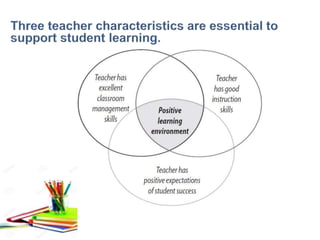
To create a positive learning environment in the
classroom.
Develop strategies and guidelines for good
classroom management.
Objectives
Studies show that there is a strong relationship
between classroom management and student
achievement, and the most important factors
which affect student learning are classroom
management and teachers’ behaviour.
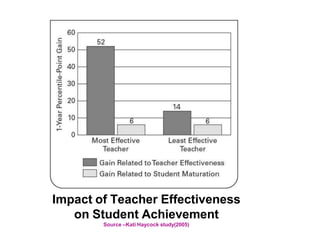
Impact of Teacher Effectiveness
on Student Achievement
Source –Kati Haycock study(2005)
 What is the first word that comes to mind
when you hear the term classroom
management?
Discipline? Control? Order?
A common misconception about classroom
management is that it is synonymous
with discipline.
 Classroom management can be defined
as a set of strategies that a teacher
creates and maintains in order to
establish effective learning environment
and promote positive students behaviour
in classroom.
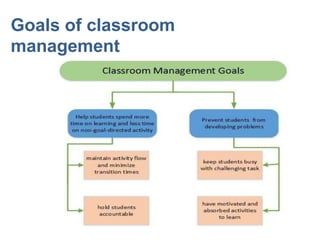
Goals of classroom
management
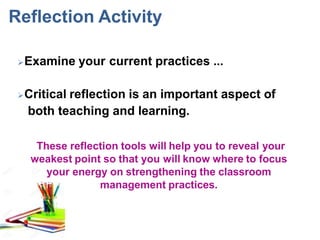
Reflection Activity
Examine your current practices ...
Critical reflection is an important aspect of
both teaching and learning.
These reflection tools will help you to reveal your
weakest point so that you will know where to focus
your energy on strengthening the classroom
management practices.
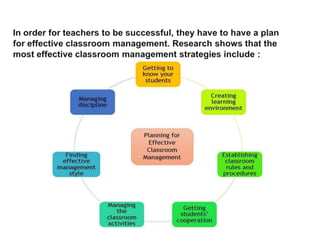
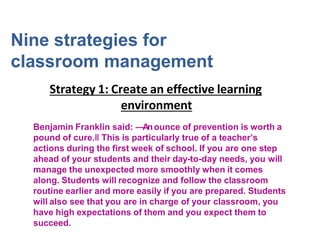
Nine strategies for
classroom management
Strategy 1: Create an effective learning
environment
Benjamin Franklin said: ―Anounce of prevention is worth a
pound of cure.‖ This is particularly true of a teacher’s
actions during the first week of school. If you are one step
ahead of your students and their day-to-day needs, you will
manage the unexpected more smoothly when it comes
along. Students will recognize and follow the classroom
routine earlier and more easily if you are prepared. Students
will also see that you are in charge of your classroom, you
have high expectations of them and you expect them to
succeed.
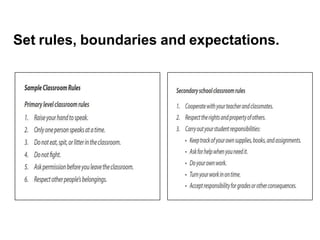
Set rules, boundaries and expectations.
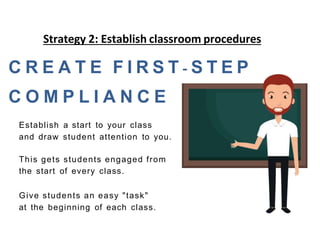
C R E A T E F I R S T - S T E P
C O M P L I A N C E
Establish a start to your class
and draw student attention to you.
This gets students engaged from
the start of every class.
Give students an easy "task"
at the beginning of each class.
Strategy 2: Establish classroom procedures
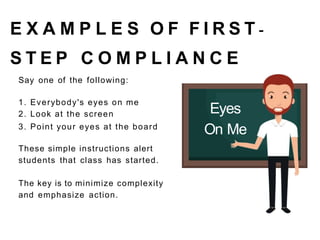
E X A M P L E S O F F I R S T -
S T E P C O M P L I A N C E
Say one of the following:
1. Everybody's eyes on me
2. Look at the screen
3. Point your eyes at the board
These simple instructions alert
students that class has started.
The key is to minimize complexity
and emphasize action.
Eyes
On Me
Classroom procedures communicate how to do daily
activities.
Teach and model procedures until they are routine.
For example
 Have students sit at their desks or in their groups.
 Have everyone get out the materials needed.
 Make sure all eyes are on you—use nonverbal cues.
 Test understanding by asking students, ―Whatis the
first step?‖or ―Whatare you supposed to do now?‖
 Work the first few questions or problems as a class
and have students record the answer(s).
 Walk around the classroom until you are sure all
students are on task.
Focus on building relationships- use QCT.
Strategy 3: Create a motivational environment
Encourage initiative-Promote growth mindset and use
variety into your lessons.
 Demonstrate consistently that you believe all students
will learn. For example, use short positive words to
praise good work and behaviour (e.g., great idea,
fantastic, good job, sensational, super).
 Create an attractive, enriched environment. Get
students involved by asking them to decorate their
own classroom. Use student work to decorate when
possible, to validate the work and to show examples of
good work.
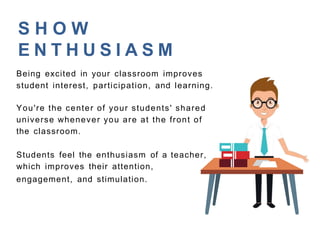
S H O W
E N T H U S I A S M
Being excited in your classroom improves
student interest, participation, and learning.
You're the center of your students' shared
universe whenever you are at the front of
the classroom.
Students feel the enthusiasm of a teacher,
which improves their attention,
engagement, and stimulation.
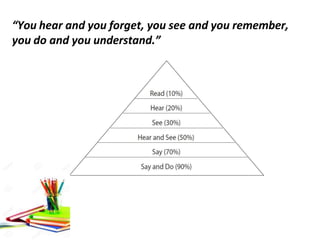
“You hear and you forget, you see and you remember,
you do and you understand.”
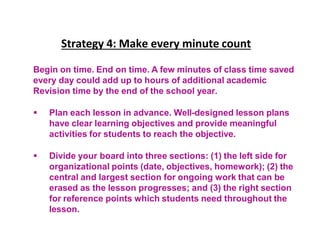
Strategy 4: Make every minute count
Begin on time. End on time. A few minutes of class time saved
every day could add up to hours of additional academic
Revision time by the end of the school year.
 Plan each lesson in advance. Well-designed lesson plans
have clear learning objectives and provide meaningful
activities for students to reach the objective.
 Divide your board into three sections: (1) the left side for
organizational points (date, objectives, homework); (2) the
central and largest section for ongoing work that can be
erased as the lesson progresses; and (3) the right section
for reference points which students need throughout the
lesson.
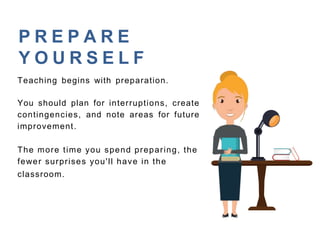
P R E P A R E
Y O U R S E L F
Teaching begins with preparation.
You should plan for interruptions, create
contingencies, and note areas for future
improvement.
The more time you spend preparing, the
fewer surprises you'll have in the
classroom.
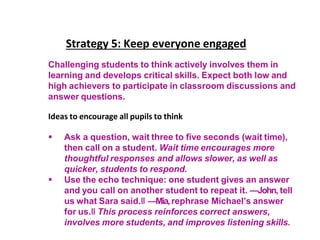
Strategy 5: Keep everyone engaged
Challenging students to think actively involves them in
learning and develops critical skills. Expect both low and
high achievers to participate in classroom discussions and
answer questions.
Ideas to encourage all pupils to think
 Ask a question, wait three to five seconds (wait time),
then call on a student. Wait time encourages more
thoughtful responses and allows slower, as well as
quicker, students to respond.
 Use the echo technique: one student gives an answer
and you call on another student to repeat it. ―John, tell
us what Sara said.‖ ―Mia,rephrase Michael’s answer
for us.‖ This process reinforces correct answers,
involves more students, and improves listening skills.
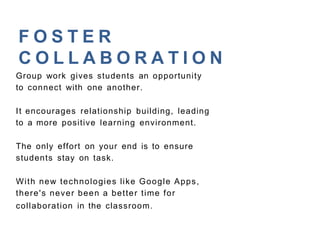
F O S T E R
C O L L A B O R A T I O N
Group work gives students an opportunity
to connect with one another.
It encourages relationship building, leading
to a more positive learning environment.
The only effort on your end is to ensure
students stay on task.
With new technologies like Google Apps,
there's never been a better time for
collaboration in the classroom.
Strategy 6: Master Transition
Transitions are key to a successful
classroom. Most teachers change gears 1-2
times each class.
That change is a crucial moment. Losing
student engagement is more likely to
happen during a transition.
Thankfully it's easy to transition with 5
simple steps.
H O W T O T R A N S I T I O N
S M O O T H L Y
5 Steps for Transitioning:
1. Signal for attention
2. Say "in a moment"
3. Give directions
4. . Say "go"
5. . Observe
Strategy 7: Practice Follow Through
For your students to respect you, they need
to respect your word.
They need to trust that you will follow-
through on what you say.
This produces happy students and
reinforces qualities like honesty and trust.
Your classroom will be a place of kept
promises and potential, keeping students
motivated.
Strategy 8: Remember To Play
American high school students are more
stressed than adults.
And when students are stressed, their
ability to learn is impaired.
Have a 5 minute break each class period to
help give your students a break so they can
learn better.
H O W T O R E D U C E
S T R E S S I N T H E
C L A S S R O O M
You can reduce stress in the classroom by:
1. Making jokes and encouraging laughter
2. Fostering creativity
3. Recognizing student accomplishments
4. Gesturing to encourage engagement
5. Staying positive
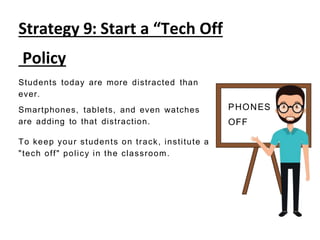
Strategy 9: Start a “Tech Off
Policy
Students today are more distracted than
ever.
Smartphones, tablets, and even watches
are adding to that distraction.
To keep your students on track, institute a
"tech off" policy in the classroom.
PHONES
OFF
L E A R N
M O R E . . .
To learn more about how to better
manage your classroom, read the
full article:
8 Wildly Successful Classroom
Management Strategies for 2018
Positive Note
―Any classroom has the potential to become a
well-managed,
smoothly running classroom. A good class can
become a great class
if the teacher has solid, consistent classroom
management skills.
No one is born with management skills; they
are learned.’’
Classroom Management for Teaching Adults.pptx

Classroom Management for Teaching Adults.pptx

  • 1.
  • 2.
    Warm up Introduction : NameGame Please introduce yourself with an action. https://www.youtube.com/watch?v=Pd8_pZ2wHo8 (reference)
  • 3.
     Objectives ofworkshop  Definition and goal of Classroom management  Strategies and guidelines for good classroom management Agenda
  • 4.
    Identify things youcan do before and when the class starts to help or facilitate learning. Discuss the components of classroom management. To create a positive learning environment in the classroom. Develop strategies and guidelines for good classroom management. Objectives
  • 5.
    Studies show thatthere is a strong relationship between classroom management and student achievement, and the most important factors which affect student learning are classroom management and teachers’ behaviour.
  • 6.
    Impact of TeacherEffectiveness on Student Achievement Source –Kati Haycock study(2005)
  • 7.
     What isthe first word that comes to mind when you hear the term classroom management? Discipline? Control? Order? A common misconception about classroom management is that it is synonymous with discipline.
  • 8.
     Classroom managementcan be defined as a set of strategies that a teacher creates and maintains in order to establish effective learning environment and promote positive students behaviour in classroom.
  • 9.
  • 11.
    Reflection Activity Examine yourcurrent practices ... Critical reflection is an important aspect of both teaching and learning. These reflection tools will help you to reveal your weakest point so that you will know where to focus your energy on strengthening the classroom management practices.
  • 13.
    Nine strategies for classroommanagement Strategy 1: Create an effective learning environment Benjamin Franklin said: ―Anounce of prevention is worth a pound of cure.‖ This is particularly true of a teacher’s actions during the first week of school. If you are one step ahead of your students and their day-to-day needs, you will manage the unexpected more smoothly when it comes along. Students will recognize and follow the classroom routine earlier and more easily if you are prepared. Students will also see that you are in charge of your classroom, you have high expectations of them and you expect them to succeed.
  • 14.
    Set rules, boundariesand expectations.
  • 15.
    C R EA T E F I R S T - S T E P C O M P L I A N C E Establish a start to your class and draw student attention to you. This gets students engaged from the start of every class. Give students an easy "task" at the beginning of each class. Strategy 2: Establish classroom procedures
  • 16.
    E X AM P L E S O F F I R S T - S T E P C O M P L I A N C E Say one of the following: 1. Everybody's eyes on me 2. Look at the screen 3. Point your eyes at the board These simple instructions alert students that class has started. The key is to minimize complexity and emphasize action. Eyes On Me
  • 17.
    Classroom procedures communicatehow to do daily activities. Teach and model procedures until they are routine. For example  Have students sit at their desks or in their groups.  Have everyone get out the materials needed.  Make sure all eyes are on you—use nonverbal cues.  Test understanding by asking students, ―Whatis the first step?‖or ―Whatare you supposed to do now?‖  Work the first few questions or problems as a class and have students record the answer(s).  Walk around the classroom until you are sure all students are on task. Focus on building relationships- use QCT.
  • 18.
    Strategy 3: Createa motivational environment Encourage initiative-Promote growth mindset and use variety into your lessons.  Demonstrate consistently that you believe all students will learn. For example, use short positive words to praise good work and behaviour (e.g., great idea, fantastic, good job, sensational, super).  Create an attractive, enriched environment. Get students involved by asking them to decorate their own classroom. Use student work to decorate when possible, to validate the work and to show examples of good work.
  • 19.
    S H OW E N T H U S I A S M Being excited in your classroom improves student interest, participation, and learning. You're the center of your students' shared universe whenever you are at the front of the classroom. Students feel the enthusiasm of a teacher, which improves their attention, engagement, and stimulation.
  • 20.
    “You hear andyou forget, you see and you remember, you do and you understand.”
  • 21.
    Strategy 4: Makeevery minute count Begin on time. End on time. A few minutes of class time saved every day could add up to hours of additional academic Revision time by the end of the school year.  Plan each lesson in advance. Well-designed lesson plans have clear learning objectives and provide meaningful activities for students to reach the objective.  Divide your board into three sections: (1) the left side for organizational points (date, objectives, homework); (2) the central and largest section for ongoing work that can be erased as the lesson progresses; and (3) the right section for reference points which students need throughout the lesson.
  • 22.
    P R EP A R E Y O U R S E L F Teaching begins with preparation. You should plan for interruptions, create contingencies, and note areas for future improvement. The more time you spend preparing, the fewer surprises you'll have in the classroom.
  • 23.
    Strategy 5: Keepeveryone engaged Challenging students to think actively involves them in learning and develops critical skills. Expect both low and high achievers to participate in classroom discussions and answer questions. Ideas to encourage all pupils to think  Ask a question, wait three to five seconds (wait time), then call on a student. Wait time encourages more thoughtful responses and allows slower, as well as quicker, students to respond.  Use the echo technique: one student gives an answer and you call on another student to repeat it. ―John, tell us what Sara said.‖ ―Mia,rephrase Michael’s answer for us.‖ This process reinforces correct answers, involves more students, and improves listening skills.
  • 24.
    F O ST E R C O L L A B O R A T I O N Group work gives students an opportunity to connect with one another. It encourages relationship building, leading to a more positive learning environment. The only effort on your end is to ensure students stay on task. With new technologies like Google Apps, there's never been a better time for collaboration in the classroom.
  • 25.
    Strategy 6: MasterTransition Transitions are key to a successful classroom. Most teachers change gears 1-2 times each class. That change is a crucial moment. Losing student engagement is more likely to happen during a transition. Thankfully it's easy to transition with 5 simple steps.
  • 26.
    H O WT O T R A N S I T I O N S M O O T H L Y 5 Steps for Transitioning: 1. Signal for attention 2. Say "in a moment" 3. Give directions 4. . Say "go" 5. . Observe
  • 27.
    Strategy 7: PracticeFollow Through For your students to respect you, they need to respect your word. They need to trust that you will follow- through on what you say. This produces happy students and reinforces qualities like honesty and trust. Your classroom will be a place of kept promises and potential, keeping students motivated.
  • 28.
    Strategy 8: RememberTo Play American high school students are more stressed than adults. And when students are stressed, their ability to learn is impaired. Have a 5 minute break each class period to help give your students a break so they can learn better.
  • 29.
    H O WT O R E D U C E S T R E S S I N T H E C L A S S R O O M You can reduce stress in the classroom by: 1. Making jokes and encouraging laughter 2. Fostering creativity 3. Recognizing student accomplishments 4. Gesturing to encourage engagement 5. Staying positive
  • 30.
    Strategy 9: Starta “Tech Off Policy Students today are more distracted than ever. Smartphones, tablets, and even watches are adding to that distraction. To keep your students on track, institute a "tech off" policy in the classroom. PHONES OFF
  • 31.
    L E AR N M O R E . . . To learn more about how to better manage your classroom, read the full article: 8 Wildly Successful Classroom Management Strategies for 2018
  • 32.
    Positive Note ―Any classroomhas the potential to become a well-managed, smoothly running classroom. A good class can become a great class if the teacher has solid, consistent classroom management skills. No one is born with management skills; they are learned.’’