
Antwuan Stinson, Ed. D. 
Assistant Professor of Secondary Education 
Curriculum & Instruction 
Alabama State University 
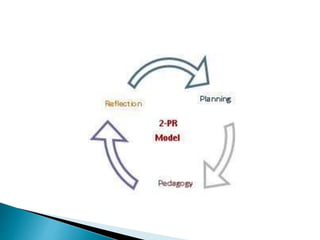
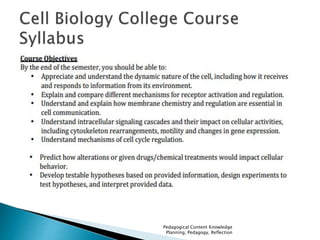
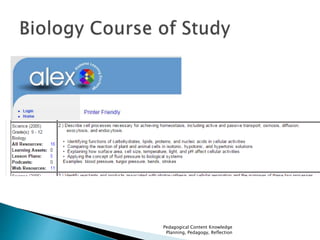
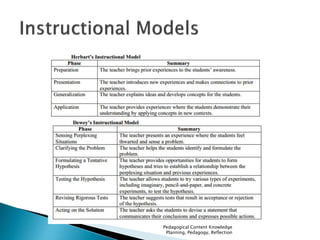
Pedagogical Content Knowledge 
Planning, Pedagogy, Reflection
To be prepared for the future, our students 
need a more advanced set of skills. 
Employers are seeking college graduates with 
the capacity to think about problems in new 
ways, design their own solutions, and 
collaborate and communicate in multicultural 
settings. By 2018, 63 percent of all U.S. job 
openings will require at least some college 
coursework. 
Pedagogical Content Knowledge 
Planning, Pedagogy, Reflection
Moreover, today’s students will become the 
next generation of leaders and citizens. 
They’ll face complex environmental and 
social problems, like climate change and 
global poverty. To meet those challenges, 
they’ll need to be able to work together and 
think analytically. As Albert Einstein said, “We 
can’t solve problems by using the same kind 
of thinking we used when we created them.” 
Pedagogical Content Knowledge 
Planning, Pedagogy, Reflection
 Impact schools are demonstrating that 
students who are engaged in deeper learning 
are more motivated and take ownership of 
their education 
 Impact schools are teaching students 
knowledge and to recall facts, but also how to 
apply what they know to real-world 
situations. 
Pedagogical Content Knowledge 
Planning, Pedagogy, Reflection
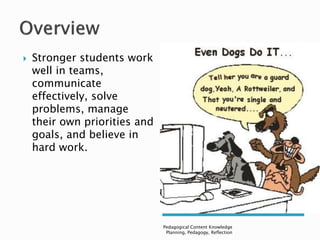
 Stronger students work 
well in teams, 
communicate 
effectively, solve 
problems, manage 
their own priorities and 
goals, and believe in 
hard work. 
Pedagogical Content Knowledge 
Planning, Pedagogy, Reflection
 In the early 1990s, a team of researchers 
decided to follow about 40 volunteer families 
— some poor, some middle class, some rich 
— during the first three years of their new 
children's lives. Every month, the researchers 
recorded an hour of sound from the families' 
homes. Later in the lab, the team listened 
back and painstakingly tallied up the total 
number of words spoken in each household. 
Pedagogical Content Knowledge 
Planning, Pedagogy, Reflection
 What they found came to be known as the 
"word gap." 
 It turned out, by the age of 3, children born 
into low-income families heard roughly 30 
million fewer words than their more affluent 
peers. 
 Research since then has revealed that the 
"word gap" factors into a compounding 
achievement gap between the poor and the 
better-off in school and life. 
Pedagogical Content Knowledge 
Planning, Pedagogy, Reflection
Pedagogical Content Knowledge 
Planning, Pedagogy, Reflection
Pedagogical Content Knowledge 
Planning, Pedagogy, Reflection
Pedagogical Content Knowledge 
Planning, Pedagogy, Reflection
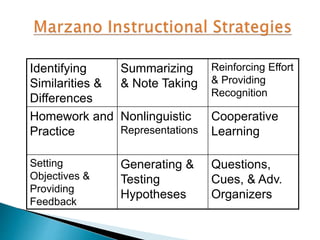
Identifying 
Similarities & 
Differences 
Summarizing 
& Note Taking 
Reinforcing Effort 
& Providing 
Recognition 
Homework and 
Practice 
Nonlinguistic 
Representations 
Cooperative 
Learning 
Setting 
Objectives & 
Providing 
Feedback 
Generating & 
Testing 
Hypotheses 
Questions, 
Cues, & Adv. 
Organizers
Course Objective 
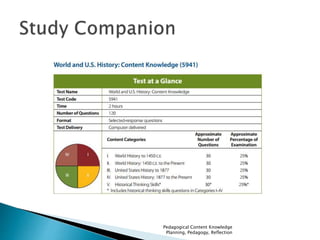
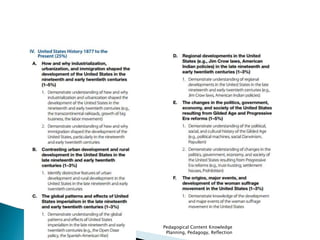
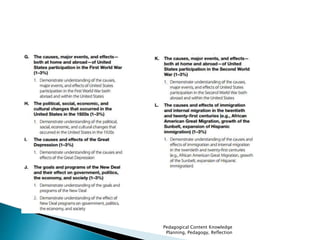
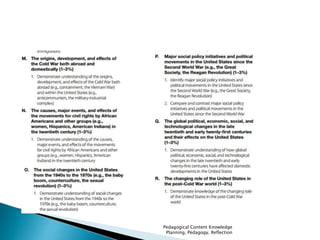
 This survey course introduces students to 
major topics in modern American history, 
with special attention on subjects such as 
Reconstruction, the closing of the frontier, 
immigration, suffrage, industrialization, 
twentieth-century world wars and global 
depressions, the Cold War, civil rights, 
ecology, Vietnam, and the Watergate era and 
the rise of modern American partisanship. 
Pedagogical Content Knowledge 
Planning, Pedagogy, Reflection
Pedagogical Content Knowledge 
Planning, Pedagogy, Reflection
Pedagogical Content Knowledge 
Planning, Pedagogy, Reflection
Pedagogical Content Knowledge 
Planning, Pedagogy, Reflection
Pedagogical Content Knowledge 
Planning, Pedagogy, Reflection
Pedagogical Content Knowledge 
Planning, Pedagogy, Reflection
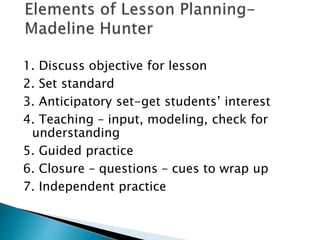
1. Discuss objective for lesson 
2. Set standard 
3. Anticipatory set-get students’ interest 
4. Teaching – input, modeling, check for 
understanding 
5. Guided practice 
6. Closure – questions – cues to wrap up 
7. Independent practice
Pedagogical Content Knowledge 
Planning, Pedagogy, Reflection
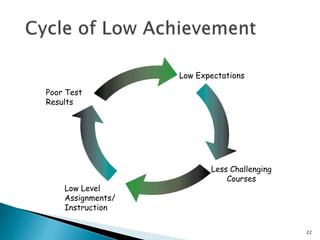
22 
Low Expectations 
Poor Test 
Results 
Low Level 
Assignments/ 
Instruction 
Less Challenging 
Courses
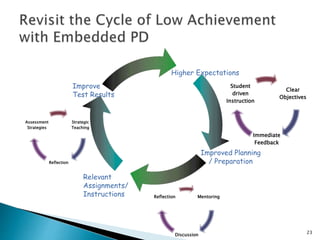
23 
Higher Expectations 
Improve 
Test Results 
Relevant 
Assignments/ 
Instructions 
Student 
driven 
Instruction 
Improved Planning 
/ Preparation 
Clear 
Objectives 
Immediate 
Feedback 
Mentoring 
Reflection 
Discussion 
Strategic 
Teaching 
Reflection 
Assessment 
Strategies
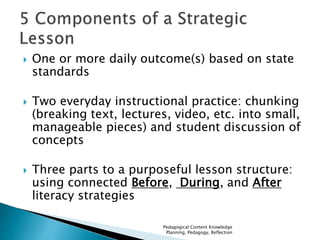
 One or more daily outcome(s) based on state 
standards 
 Two everyday instructional practice: chunking 
(breaking text, lectures, video, etc. into small, 
manageable pieces) and student discussion of 
concepts 
 Three parts to a purposeful lesson structure: 
using connected Before, During, and After 
literacy strategies 
Pedagogical Content Knowledge 
Planning, Pedagogy, Reflection
 Four steps to explicit instruction: “I Do”, “We 
Do”, Y’all Do”, and “You Do” 
 Five component of active literacy: talk, write, 
investigate, read, and listen (T.W.I.R.L.) 
Pedagogical Content Knowledge 
Planning, Pedagogy, Reflection
 Lower level questions are those at the level 
remembering, understanding and lower 
level application levels of the taxonomy 
 Usually questions at the lower levels are 
appropriate for: 
◦ Evaluating students’ preparation and 
comprehension 
◦ Diagnosing students’ strengths and weaknesses 
◦ Reviewing and/or summarizing content
 Higher level questions are those requiring 
complex application, analysis, evaluation or 
creation skills 
 Questions at higher levels of the taxonomy 
are usually most appropriate for: 
◦ Encouraging students to think more deeply and 
critically 
◦ Problem solving 
◦ Encouraging discussions 
◦ Stimulating students to seek information on their 
own
Pedagogical Content Knowledge 
Planning, Pedagogy, Reflection
Pedagogical Content Knowledge 
Planning, Pedagogy, Reflection
Pedagogical Content Knowledge 
Planning, Pedagogy, Reflection
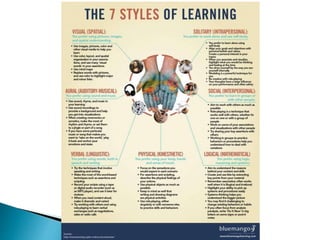
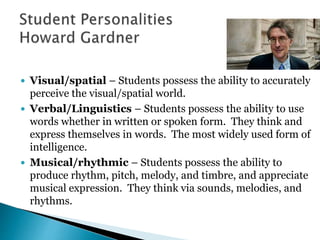
 Visual/spatial – Students possess the ability to accurately 
perceive the visual/spatial world. 
 Verbal/Linguistics – Students possess the ability to use 
words whether in written or spoken form. They think and 
express themselves in words. The most widely used form of 
intelligence. 
 Musical/rhythmic – Students possess the ability to 
produce rhythm, pitch, melody, and timbre, and appreciate 
musical expression. They think via sounds, melodies, and 
rhythms.
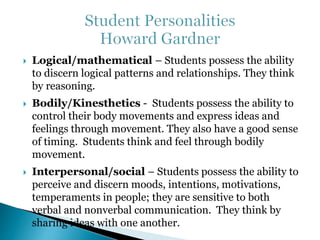
 Logical/mathematical – Students possess the ability 
to discern logical patterns and relationships. They think 
by reasoning. 
 Bodily/Kinesthetics - Students possess the ability to 
control their body movements and express ideas and 
feelings through movement. They also have a good sense 
of timing. Students think and feel through bodily 
movement. 
 Interpersonal/social – Students possess the ability to 
perceive and discern moods, intentions, motivations, 
temperaments in people; they are sensitive to both 
verbal and nonverbal communication. They think by 
sharing ideas with one another.
Student Personalities 
Howard Gardner 
 Intrapersonal/introspective – Students possess self-knowledge 
and self-awareness, and the ability to express 
themselves. They understand their own emotive states. 
They think inside themselves. 
 Naturalist/physical world – Students possess the 
ability to observe, categorize, and analyze nature and 
their environment. They think through organization 
themes.
 10 Hands: After you ask a question in class, 
wait for at least 10 students to raise their 
hands before you call on someone to share 
their answer. Too often, we call on the 
students who raise their hands first. Tell your 
students you want to give everyone time to 
think and process the question, therefore 
you’re going to wait until at least 10 hands 
are raised. 
Pedagogical Content Knowledge 
Planning, Pedagogy, Reflection
 Collaborative Real Time Writing Prompt: If you 
have access to Google Docs or another shared 
writing platform, give students a writing prompt 
or a question to think about. Post it on the 
Google Doc and give all students real-time 
access to the document. During class, allow 
students time to think and write together. Watch 
the document come to life. You can also 
consider projecting their document on the screen 
so everyone can see how ideas transform and 
grow with more time to think. 
Pedagogical Content Knowledge 
Planning, Pedagogy, Reflection
 Read, Record, Reflect, & Review: During class, assign 
a reading. The reading could be a section of a 
chapter, an excerpt from a journal article, a chart or 
diagram to analyze, or a creative piece of work. Any 
type of reading task will work. Ask students to read 
it and record any interesting points, relevant quotes, 
or confusing information. They may record it in their 
notes, on a worksheet, on a computer screen, on the 
board, etc. It doesn’t matter how they record it as 
long as they document what they see, think, or 
feel. This process makes learning visible, and that’s 
what we want to encourage them to do. Give them 
time to go back and review the reading and make 
additional notes. 
Pedagogical Content Knowledge 
Planning, Pedagogy, Reflection
 You could end this activity by asking them to 
choose only one or two notes to discuss as a 
class, or you could do a follow up activity 
with their notes that allows everyone to share 
their ideas. The point of this reflective 
activity is to guide students through reading 
for critical analysis, not just for 
comprehension. Slowing down and giving 
them time to do all four parts of reading, 
recording, reflecting, and reviewing 
encourages them to re-read and to think. 
Pedagogical Content Knowledge 
Planning, Pedagogy, Reflection
Pedagogical Content Knowledge 
Planning, Pedagogy, Reflection
We can support students’ information processing by 
supplementing auditory information with visual clues. 
When we can provide students with multi-sensory 
experiences observing and communicating, it helps all 
students, especially emerging readers and English 
language learners. Instructions should be given using a 
variety of visual or aural support materials: 
 drawings, diagrams, and pictures to support the spoken 
word 
 written instructions on word cards or SmartBoard along 
with verbal instructions 
 set-up examples to supplement written lab instructions 
 audiotaped instructions alongside written directions 
 pictures with words in stages of lab procedures that 
students can sequence 
http://www.learnnc.org/lp/pages/7079?style=print 
Pedagogical Content Knowledge 
Planning, Pedagogy, Reflection
 Limit traditional vocabulary 
instruction. Traditional science vocabulary 
instruction, in which words are taught in 
isolation, is not conducive to conceptual 
development. 
 Pair students with peers during reading. 
 Use active voice when introducing or 
discussing concepts. Students understand 
active voice better than passive voice. 
“Animals use oxygen,” for example, rather 
than “Oxygen is used by animals.” 
Pedagogical Content Knowledge 
Planning, Pedagogy, Reflection
Encourage “instruction talk” brainstorming. Provide 
students with opportunities to brainstorm ideas 
about science and encourage them to wonder 
and talk about the natural world. For example, 
teachers can help students learn about the 
process of science classification. Provide 
students with sets of objects with varying 
features like buttons or dried beans and ask 
students to work in small groups and discuss 
properties for grouping the objects. When groups 
share their categories with each other, students 
have an opportunity to experience conversations. 
Pedagogical Content Knowledge 
Planning, Pedagogy, Reflection
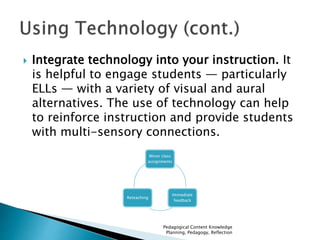
 Integrate technology into your instruction. It 
is helpful to engage students — particularly 
ELLs — with a variety of visual and aural 
alternatives. The use of technology can help 
to reinforce instruction and provide students 
with multi-sensory connections. 
Minor class 
assignments 
Immediate 
feedback 
Pedagogical Content Knowledge 
Planning, Pedagogy, Reflection 
Reteaching
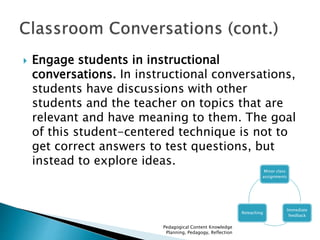
 Engage students in instructional 
conversations. In instructional conversations, 
students have discussions with other 
students and the teacher on topics that are 
relevant and have meaning to them. The goal 
of this student-centered technique is not to 
get correct answers to test questions, but 
instead to explore ideas. 
Pedagogical Content Knowledge 
Planning, Pedagogy, Reflection 
Minor class 
assignments 
Immediate 
feedback 
Reteaching
 Work with students to identify the different 
meanings and applications of words with 
multiple meanings. 
 Words with multiple meanings can be 
confusing for students 
 Provide experiences that show abstract 
concepts are drawn from and applied to the 
everyday world 
http://www.tolerance.org/supplement/five-standards- 
effective-pedagogy 
Pedagogical Content Knowledge 
Planning, Pedagogy, Reflection
 Use direct instruction of word learning 
strategies, including structural analysis. In 
structural analysis, students examine the 
component parts of a word — e.g. the root 
word, suffix, and prefix — to determine the 
word’s meaning. Teaching students this 
strategy can empower them to decode 
unfamiliar words. 
Pedagogical Content Knowledge 
Planning, Pedagogy, Reflection
Pedagogical Content Knowledge 
Planning, Pedagogy, Reflection
 Begins activities with what students already 
know from home, community, and school. 
 Designs instructional activities that are 
meaningful to students in terms of local 
community norms and knowledge. 
 Acquires knowledge of local norms and 
knowledge by talking to students, parents or 
family members, community members, and by 
reading pertinent documents. 
 Assists students to connect and apply their 
learning to home and community. 
Pedagogical Content Knowledge 
Planning, Pedagogy, Reflection
 Plans jointly with students to design community-based 
learning activities 
 Provides opportunities for parents or families to 
participate in classroom instructional activities. 
 Varies activities to include students’ preferences, 
from collective and cooperative to individual and 
competitive. 
 Varies styles of conversation and participation to 
include students’ cultural preferences, such as 
co-narration, call-and-response, and choral, 
among others. 
Pedagogical Content Knowledge 
Planning, Pedagogy, Reflection
 Arrange the classroom to accommodate 
conversation between the teacher and a small 
group of students on a regular and frequent 
basis. 
 Set clear academic goal that guides conversation 
with students. 
 Ensure that student talk occurs at higher rates 
than teacher talk. 
 Guide conversation to include students’ views, 
judgments, and rationales using text evidence 
and other substantive support. 
Pedagogical Content Knowledge 
Planning, Pedagogy, Reflection
 Ensure that all students are included in the 
conversation according to their preferences 
 Listen carefully to assess levels of students’ 
understanding. 
 Assist students’ learning throughout the 
conversation by questioning, restating, 
praising, encouraging, etc. 
Pedagogical Content Knowledge 
Planning, Pedagogy, Reflection
Pedagogical Content Knowledge 
Planning, Pedagogy, Reflection
 An effective teacher chooses a strategy to fit 
a particular situation. By remaining flexible 
and observant, we can determine which 
strategy may be most effective. 
 http://www.naeyc.org/dap/10-effective-dap- 
teaching-strategies 
Pedagogical Content Knowledge 
Planning, Pedagogy, Reflection
 Acknowledge what children do or say. Let 
children know that we have noticed by giving 
positive attention, sometimes through 
comments, sometimes through just sitting 
nearby and observing. 
 Encourage persistence and effort rather than 
just praising and evaluating what the child 
has done. 
 Give specific feedback rather than general 
comments. 
Pedagogical Content Knowledge 
Planning, Pedagogy, Reflection
 Demonstrate the correct way to do 
something. 
 Ask questions that provoke higher order 
thinking. 
 Provide information, directly giving children 
facts, verbal labels, and other information. 
20 Instructional Strategies for Success 
http://www.oswego.org/files/5/20is.pdf 
Pedagogical Content Knowledge 
Planning, Pedagogy, Reflection
Pedagogical Content Knowledge 
Planning, Pedagogy, Reflection

Classroom instruction

  • 1.
    Antwuan Stinson, Ed.D. Assistant Professor of Secondary Education Curriculum & Instruction Alabama State University Pedagogical Content Knowledge Planning, Pedagogy, Reflection
  • 2.
    To be preparedfor the future, our students need a more advanced set of skills. Employers are seeking college graduates with the capacity to think about problems in new ways, design their own solutions, and collaborate and communicate in multicultural settings. By 2018, 63 percent of all U.S. job openings will require at least some college coursework. Pedagogical Content Knowledge Planning, Pedagogy, Reflection
  • 3.
    Moreover, today’s studentswill become the next generation of leaders and citizens. They’ll face complex environmental and social problems, like climate change and global poverty. To meet those challenges, they’ll need to be able to work together and think analytically. As Albert Einstein said, “We can’t solve problems by using the same kind of thinking we used when we created them.” Pedagogical Content Knowledge Planning, Pedagogy, Reflection
  • 4.
     Impact schoolsare demonstrating that students who are engaged in deeper learning are more motivated and take ownership of their education  Impact schools are teaching students knowledge and to recall facts, but also how to apply what they know to real-world situations. Pedagogical Content Knowledge Planning, Pedagogy, Reflection
  • 5.
     Stronger studentswork well in teams, communicate effectively, solve problems, manage their own priorities and goals, and believe in hard work. Pedagogical Content Knowledge Planning, Pedagogy, Reflection
  • 6.
     In theearly 1990s, a team of researchers decided to follow about 40 volunteer families — some poor, some middle class, some rich — during the first three years of their new children's lives. Every month, the researchers recorded an hour of sound from the families' homes. Later in the lab, the team listened back and painstakingly tallied up the total number of words spoken in each household. Pedagogical Content Knowledge Planning, Pedagogy, Reflection
  • 7.
     What theyfound came to be known as the "word gap."  It turned out, by the age of 3, children born into low-income families heard roughly 30 million fewer words than their more affluent peers.  Research since then has revealed that the "word gap" factors into a compounding achievement gap between the poor and the better-off in school and life. Pedagogical Content Knowledge Planning, Pedagogy, Reflection
  • 9.
    Pedagogical Content Knowledge Planning, Pedagogy, Reflection
  • 10.
    Pedagogical Content Knowledge Planning, Pedagogy, Reflection
  • 11.
    Pedagogical Content Knowledge Planning, Pedagogy, Reflection
  • 12.
    Identifying Similarities & Differences Summarizing & Note Taking Reinforcing Effort & Providing Recognition Homework and Practice Nonlinguistic Representations Cooperative Learning Setting Objectives & Providing Feedback Generating & Testing Hypotheses Questions, Cues, & Adv. Organizers
  • 14.
    Course Objective This survey course introduces students to major topics in modern American history, with special attention on subjects such as Reconstruction, the closing of the frontier, immigration, suffrage, industrialization, twentieth-century world wars and global depressions, the Cold War, civil rights, ecology, Vietnam, and the Watergate era and the rise of modern American partisanship. Pedagogical Content Knowledge Planning, Pedagogy, Reflection
  • 15.
    Pedagogical Content Knowledge Planning, Pedagogy, Reflection
  • 16.
    Pedagogical Content Knowledge Planning, Pedagogy, Reflection
  • 17.
    Pedagogical Content Knowledge Planning, Pedagogy, Reflection
  • 18.
    Pedagogical Content Knowledge Planning, Pedagogy, Reflection
  • 19.
    Pedagogical Content Knowledge Planning, Pedagogy, Reflection
  • 20.
    1. Discuss objectivefor lesson 2. Set standard 3. Anticipatory set-get students’ interest 4. Teaching – input, modeling, check for understanding 5. Guided practice 6. Closure – questions – cues to wrap up 7. Independent practice
  • 21.
    Pedagogical Content Knowledge Planning, Pedagogy, Reflection
  • 22.
    22 Low Expectations Poor Test Results Low Level Assignments/ Instruction Less Challenging Courses
  • 23.
    23 Higher Expectations Improve Test Results Relevant Assignments/ Instructions Student driven Instruction Improved Planning / Preparation Clear Objectives Immediate Feedback Mentoring Reflection Discussion Strategic Teaching Reflection Assessment Strategies
  • 24.
     One ormore daily outcome(s) based on state standards  Two everyday instructional practice: chunking (breaking text, lectures, video, etc. into small, manageable pieces) and student discussion of concepts  Three parts to a purposeful lesson structure: using connected Before, During, and After literacy strategies Pedagogical Content Knowledge Planning, Pedagogy, Reflection
  • 25.
     Four stepsto explicit instruction: “I Do”, “We Do”, Y’all Do”, and “You Do”  Five component of active literacy: talk, write, investigate, read, and listen (T.W.I.R.L.) Pedagogical Content Knowledge Planning, Pedagogy, Reflection
  • 26.
     Lower levelquestions are those at the level remembering, understanding and lower level application levels of the taxonomy  Usually questions at the lower levels are appropriate for: ◦ Evaluating students’ preparation and comprehension ◦ Diagnosing students’ strengths and weaknesses ◦ Reviewing and/or summarizing content
  • 27.
     Higher levelquestions are those requiring complex application, analysis, evaluation or creation skills  Questions at higher levels of the taxonomy are usually most appropriate for: ◦ Encouraging students to think more deeply and critically ◦ Problem solving ◦ Encouraging discussions ◦ Stimulating students to seek information on their own
  • 28.
    Pedagogical Content Knowledge Planning, Pedagogy, Reflection
  • 29.
    Pedagogical Content Knowledge Planning, Pedagogy, Reflection
  • 30.
    Pedagogical Content Knowledge Planning, Pedagogy, Reflection
  • 31.
     Visual/spatial –Students possess the ability to accurately perceive the visual/spatial world.  Verbal/Linguistics – Students possess the ability to use words whether in written or spoken form. They think and express themselves in words. The most widely used form of intelligence.  Musical/rhythmic – Students possess the ability to produce rhythm, pitch, melody, and timbre, and appreciate musical expression. They think via sounds, melodies, and rhythms.
  • 32.
     Logical/mathematical –Students possess the ability to discern logical patterns and relationships. They think by reasoning.  Bodily/Kinesthetics - Students possess the ability to control their body movements and express ideas and feelings through movement. They also have a good sense of timing. Students think and feel through bodily movement.  Interpersonal/social – Students possess the ability to perceive and discern moods, intentions, motivations, temperaments in people; they are sensitive to both verbal and nonverbal communication. They think by sharing ideas with one another.
  • 33.
    Student Personalities HowardGardner  Intrapersonal/introspective – Students possess self-knowledge and self-awareness, and the ability to express themselves. They understand their own emotive states. They think inside themselves.  Naturalist/physical world – Students possess the ability to observe, categorize, and analyze nature and their environment. They think through organization themes.
  • 34.
     10 Hands:After you ask a question in class, wait for at least 10 students to raise their hands before you call on someone to share their answer. Too often, we call on the students who raise their hands first. Tell your students you want to give everyone time to think and process the question, therefore you’re going to wait until at least 10 hands are raised. Pedagogical Content Knowledge Planning, Pedagogy, Reflection
  • 35.
     Collaborative RealTime Writing Prompt: If you have access to Google Docs or another shared writing platform, give students a writing prompt or a question to think about. Post it on the Google Doc and give all students real-time access to the document. During class, allow students time to think and write together. Watch the document come to life. You can also consider projecting their document on the screen so everyone can see how ideas transform and grow with more time to think. Pedagogical Content Knowledge Planning, Pedagogy, Reflection
  • 36.
     Read, Record,Reflect, & Review: During class, assign a reading. The reading could be a section of a chapter, an excerpt from a journal article, a chart or diagram to analyze, or a creative piece of work. Any type of reading task will work. Ask students to read it and record any interesting points, relevant quotes, or confusing information. They may record it in their notes, on a worksheet, on a computer screen, on the board, etc. It doesn’t matter how they record it as long as they document what they see, think, or feel. This process makes learning visible, and that’s what we want to encourage them to do. Give them time to go back and review the reading and make additional notes. Pedagogical Content Knowledge Planning, Pedagogy, Reflection
  • 37.
     You couldend this activity by asking them to choose only one or two notes to discuss as a class, or you could do a follow up activity with their notes that allows everyone to share their ideas. The point of this reflective activity is to guide students through reading for critical analysis, not just for comprehension. Slowing down and giving them time to do all four parts of reading, recording, reflecting, and reviewing encourages them to re-read and to think. Pedagogical Content Knowledge Planning, Pedagogy, Reflection
  • 38.
    Pedagogical Content Knowledge Planning, Pedagogy, Reflection
  • 39.
    We can supportstudents’ information processing by supplementing auditory information with visual clues. When we can provide students with multi-sensory experiences observing and communicating, it helps all students, especially emerging readers and English language learners. Instructions should be given using a variety of visual or aural support materials:  drawings, diagrams, and pictures to support the spoken word  written instructions on word cards or SmartBoard along with verbal instructions  set-up examples to supplement written lab instructions  audiotaped instructions alongside written directions  pictures with words in stages of lab procedures that students can sequence http://www.learnnc.org/lp/pages/7079?style=print Pedagogical Content Knowledge Planning, Pedagogy, Reflection
  • 40.
     Limit traditionalvocabulary instruction. Traditional science vocabulary instruction, in which words are taught in isolation, is not conducive to conceptual development.  Pair students with peers during reading.  Use active voice when introducing or discussing concepts. Students understand active voice better than passive voice. “Animals use oxygen,” for example, rather than “Oxygen is used by animals.” Pedagogical Content Knowledge Planning, Pedagogy, Reflection
  • 41.
    Encourage “instruction talk”brainstorming. Provide students with opportunities to brainstorm ideas about science and encourage them to wonder and talk about the natural world. For example, teachers can help students learn about the process of science classification. Provide students with sets of objects with varying features like buttons or dried beans and ask students to work in small groups and discuss properties for grouping the objects. When groups share their categories with each other, students have an opportunity to experience conversations. Pedagogical Content Knowledge Planning, Pedagogy, Reflection
  • 42.
     Integrate technologyinto your instruction. It is helpful to engage students — particularly ELLs — with a variety of visual and aural alternatives. The use of technology can help to reinforce instruction and provide students with multi-sensory connections. Minor class assignments Immediate feedback Pedagogical Content Knowledge Planning, Pedagogy, Reflection Reteaching
  • 43.
     Engage studentsin instructional conversations. In instructional conversations, students have discussions with other students and the teacher on topics that are relevant and have meaning to them. The goal of this student-centered technique is not to get correct answers to test questions, but instead to explore ideas. Pedagogical Content Knowledge Planning, Pedagogy, Reflection Minor class assignments Immediate feedback Reteaching
  • 44.
     Work withstudents to identify the different meanings and applications of words with multiple meanings.  Words with multiple meanings can be confusing for students  Provide experiences that show abstract concepts are drawn from and applied to the everyday world http://www.tolerance.org/supplement/five-standards- effective-pedagogy Pedagogical Content Knowledge Planning, Pedagogy, Reflection
  • 45.
     Use directinstruction of word learning strategies, including structural analysis. In structural analysis, students examine the component parts of a word — e.g. the root word, suffix, and prefix — to determine the word’s meaning. Teaching students this strategy can empower them to decode unfamiliar words. Pedagogical Content Knowledge Planning, Pedagogy, Reflection
  • 46.
    Pedagogical Content Knowledge Planning, Pedagogy, Reflection
  • 47.
     Begins activitieswith what students already know from home, community, and school.  Designs instructional activities that are meaningful to students in terms of local community norms and knowledge.  Acquires knowledge of local norms and knowledge by talking to students, parents or family members, community members, and by reading pertinent documents.  Assists students to connect and apply their learning to home and community. Pedagogical Content Knowledge Planning, Pedagogy, Reflection
  • 48.
     Plans jointlywith students to design community-based learning activities  Provides opportunities for parents or families to participate in classroom instructional activities.  Varies activities to include students’ preferences, from collective and cooperative to individual and competitive.  Varies styles of conversation and participation to include students’ cultural preferences, such as co-narration, call-and-response, and choral, among others. Pedagogical Content Knowledge Planning, Pedagogy, Reflection
  • 49.
     Arrange theclassroom to accommodate conversation between the teacher and a small group of students on a regular and frequent basis.  Set clear academic goal that guides conversation with students.  Ensure that student talk occurs at higher rates than teacher talk.  Guide conversation to include students’ views, judgments, and rationales using text evidence and other substantive support. Pedagogical Content Knowledge Planning, Pedagogy, Reflection
  • 50.
     Ensure thatall students are included in the conversation according to their preferences  Listen carefully to assess levels of students’ understanding.  Assist students’ learning throughout the conversation by questioning, restating, praising, encouraging, etc. Pedagogical Content Knowledge Planning, Pedagogy, Reflection
  • 51.
    Pedagogical Content Knowledge Planning, Pedagogy, Reflection
  • 52.
     An effectiveteacher chooses a strategy to fit a particular situation. By remaining flexible and observant, we can determine which strategy may be most effective.  http://www.naeyc.org/dap/10-effective-dap- teaching-strategies Pedagogical Content Knowledge Planning, Pedagogy, Reflection
  • 53.
     Acknowledge whatchildren do or say. Let children know that we have noticed by giving positive attention, sometimes through comments, sometimes through just sitting nearby and observing.  Encourage persistence and effort rather than just praising and evaluating what the child has done.  Give specific feedback rather than general comments. Pedagogical Content Knowledge Planning, Pedagogy, Reflection
  • 54.
     Demonstrate thecorrect way to do something.  Ask questions that provoke higher order thinking.  Provide information, directly giving children facts, verbal labels, and other information. 20 Instructional Strategies for Success http://www.oswego.org/files/5/20is.pdf Pedagogical Content Knowledge Planning, Pedagogy, Reflection
  • 55.
    Pedagogical Content Knowledge Planning, Pedagogy, Reflection