CATHERINE T. AÑANO (Presenter)
EVALUATION OF
CLASSROOM
INSTRUCTION
Types of Evaluation
CATHERINE T. AÑANO (Presenter)
Formative Evaluation
Summative Evaluation
Types of Evaluation
CATHERINE T. AÑANO (Presenter)
Formative Evaluation
- used to determine the effectiveness of
the delivery of instruction that will serve
as the basis for improvement
- benchmarking for professional growth
(Marczely, 2001)
Types of Evaluation
CATHERINE T. AÑANO (Presenter)
Summative Evaluation
- used for making administrative
decisions (promotion, hiring, merit pay,
grant of tenure, reassignment, and
even dismissal)
CATHERINE T. AÑANO (Presenter)
Why Do We Need To Evaluate
Classroom Instruction?
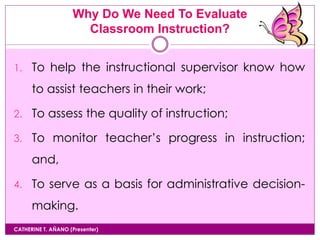
Why Do We Need To Evaluate
Classroom Instruction?
CATHERINE T. AÑANO (Presenter)
1. To help the instructional supervisor know how
to assist teachers in their work;
2. To assess the quality of instruction;
3. To monitor teacher’s progress in instruction;
and,
4. To serve as a basis for administrative decision-
making.
Dimensions of Effective
Teaching
CATHERINE T. AÑANO (Presenter)
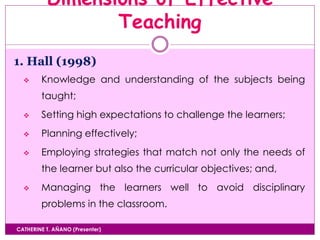
1. Hall (1998)
 Knowledge and understanding of the subjects being
taught;
 Setting high expectations to challenge the learners;
 Planning effectively;
 Employing strategies that match not only the needs of
the learner but also the curricular objectives; and,
 Managing the learners well to avoid disciplinary
problems in the classroom.
Dimensions of Effective
Teaching
CATHERINE T. AÑANO (Presenter)
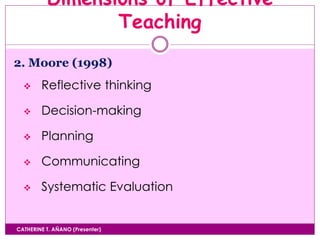
2. Moore (1998)
 Reflective thinking
 Decision-making
 Planning
 Communicating
 Systematic Evaluation
Dimensions of Effective
Teaching
CATHERINE T. AÑANO (Presenter)
3. Eggen and Kauchak (2001)
 Analyzing
 Synthesizing
 Evaluating
 Problem-solving
Reyes, 2002
CATHERINE T. AÑANO (Presenter)
A CONTINUUM MODEL OF
“ART AND SCIENCE”
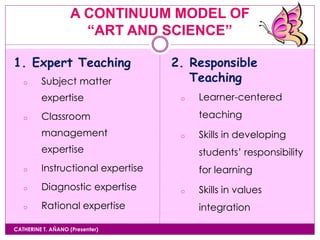
A CONTINUUM MODEL OF
“ART AND SCIENCE”
CATHERINE T. AÑANO (Presenter)
1. Expert Teaching
o Subject matter
expertise
o Classroom
management
expertise
o Instructional expertise
o Diagnostic expertise
o Rational expertise
2. Responsible
Teaching
o Learner-centered
teaching
o Skills in developing
students’ responsibility
for learning
o Skills in values
integration
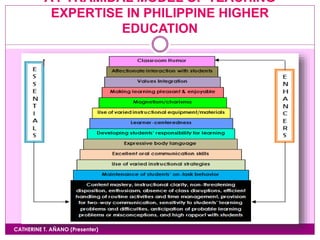
A PYRAMIDAL MODEL OF TEACHING
EXPERTISE IN PHILIPPINE HIGHER
EDUCATION
CATHERINE T. AÑANO (Presenter)
CATEGORIES FOR EVALUATION
CATHERINE T. AÑANO (Presenter)
1. Content-related
2. Instruction-related
3. Climate-related
4. Classroom management-related
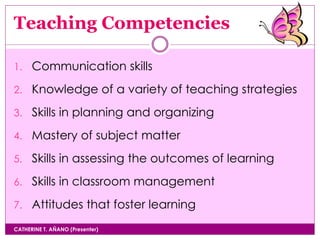
Teaching Competencies
CATHERINE T. AÑANO (Presenter)
1. Communication skills
2. Knowledge of a variety of teaching strategies
3. Skills in planning and organizing
4. Mastery of subject matter
5. Skills in assessing the outcomes of learning
6. Skills in classroom management
7. Attitudes that foster learning
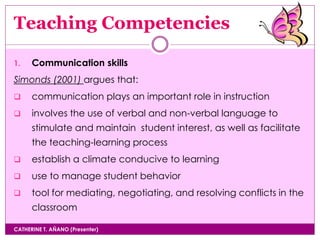
Teaching Competencies
CATHERINE T. AÑANO (Presenter)
1. Communication skills
Simonds (2001) argues that:
 communication plays an important role in instruction
 involves the use of verbal and non-verbal language to
stimulate and maintain student interest, as well as facilitate
the teaching-learning process
 establish a climate conducive to learning
 use to manage student behavior
 tool for mediating, negotiating, and resolving conflicts in the
classroom
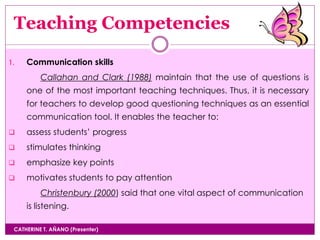
Teaching Competencies
CATHERINE T. AÑANO (Presenter)
1. Communication skills
Callahan and Clark (1988) maintain that the use of questions is
one of the most important teaching techniques. Thus, it is necessary
for teachers to develop good questioning techniques as an essential
communication tool. It enables the teacher to:
 assess students’ progress
 stimulates thinking
 emphasize key points
 motivates students to pay attention
Christenbury (2000) said that one vital aspect of communication
is listening.
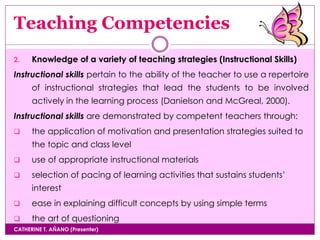
Teaching Competencies
CATHERINE T. AÑANO (Presenter)
2. Knowledge of a variety of teaching strategies (Instructional Skills)
Instructional skills pertain to the ability of the teacher to use a repertoire
of instructional strategies that lead the students to be involved
actively in the learning process (Danielson and McGreal, 2000).
Instructional skills are demonstrated by competent teachers through:
 the application of motivation and presentation strategies suited to
the topic and class level
 use of appropriate instructional materials
 selection of pacing of learning activities that sustains students’
interest
 ease in explaining difficult concepts by using simple terms
 the art of questioning
Teaching Competencies
CATHERINE T. AÑANO (Presenter)
3. Skills in planning and organizing (planning)
 The organization of content, materials, and
methods of classroom instruction requires careful
planning.
4. Mastery of subject matter (content)
 Teachers are expected to be expert on the
subject matter being taught
 Teachers should be well-versed about the topic
under discussion
 A common reminder to teachers is to make sure
that s/he is not only one chapter ahead of the
students but several books ahead, instead.
Teaching Competencies
CATHERINE T. AÑANO (Presenter)
4. Skills in assessing the outcomes of learning
(evaluation of learning)
 The teacher can use the evaluation results to
determine whether the concepts and skills
emphasized during instruction were
understood or not.
 Evaluation results can be used as bases for
improving instruction through further
clarification, additional explanation, or
sometimes re-teaching.
Teaching Competencies
CATHERINE T. AÑANO (Presenter)
5. Skills in classroom management (classroom
discipline)
According to Kounin instructional
management (California State University,
Chico, 2005), classroom management
includes all of the things a teacher does in
pursuit of two important objectives:
 To foster student involvement and
cooperation in all classroom activities
 To establish a productive working environment
in the classroom
Teaching Competencies
CATHERINE T. AÑANO (Presenter)
6. Attitudes that foster/promote learning
(personality)
Suggested attitudes and behaviors of the
teachers that promote learning, and create
proper climate in the classroom:
 High expectations
 Enthusiasm
 Concern for children
 Openness to student inquiry
 Fairness
 Humor
 Sensitivity to the needs and concerns of students
 Decisiveness
CATHERINE T. AÑANO (Presenter)
Sources:
Book:
Bago, A. L. (2008). Supervision of Instruction (The Philippine Perspective).
Quezon City: C & E Publishing, Inc.
Website:
Copia, J. S. (2011). Scribd, Inc. Retrieved July 11, 2012, from Scribd, Inc.
Website: http://www.scribd.com/doc/60641943/CHAPTER-4-Evaluation-of-
Classroom-Instruction-Joy

Evaluation of classroom instruction

  • 1.
    CATHERINE T. AÑANO(Presenter) EVALUATION OF CLASSROOM INSTRUCTION
  • 2.
    Types of Evaluation CATHERINET. AÑANO (Presenter) Formative Evaluation Summative Evaluation
  • 3.
    Types of Evaluation CATHERINET. AÑANO (Presenter) Formative Evaluation - used to determine the effectiveness of the delivery of instruction that will serve as the basis for improvement - benchmarking for professional growth (Marczely, 2001)
  • 4.
    Types of Evaluation CATHERINET. AÑANO (Presenter) Summative Evaluation - used for making administrative decisions (promotion, hiring, merit pay, grant of tenure, reassignment, and even dismissal)
  • 5.
    CATHERINE T. AÑANO(Presenter) Why Do We Need To Evaluate Classroom Instruction?
  • 6.
    Why Do WeNeed To Evaluate Classroom Instruction? CATHERINE T. AÑANO (Presenter) 1. To help the instructional supervisor know how to assist teachers in their work; 2. To assess the quality of instruction; 3. To monitor teacher’s progress in instruction; and, 4. To serve as a basis for administrative decision- making.
  • 7.
    Dimensions of Effective Teaching CATHERINET. AÑANO (Presenter) 1. Hall (1998)  Knowledge and understanding of the subjects being taught;  Setting high expectations to challenge the learners;  Planning effectively;  Employing strategies that match not only the needs of the learner but also the curricular objectives; and,  Managing the learners well to avoid disciplinary problems in the classroom.
  • 8.
    Dimensions of Effective Teaching CATHERINET. AÑANO (Presenter) 2. Moore (1998)  Reflective thinking  Decision-making  Planning  Communicating  Systematic Evaluation
  • 9.
    Dimensions of Effective Teaching CATHERINET. AÑANO (Presenter) 3. Eggen and Kauchak (2001)  Analyzing  Synthesizing  Evaluating  Problem-solving
  • 10.
    Reyes, 2002 CATHERINE T.AÑANO (Presenter) A CONTINUUM MODEL OF “ART AND SCIENCE”
  • 11.
    A CONTINUUM MODELOF “ART AND SCIENCE” CATHERINE T. AÑANO (Presenter) 1. Expert Teaching o Subject matter expertise o Classroom management expertise o Instructional expertise o Diagnostic expertise o Rational expertise 2. Responsible Teaching o Learner-centered teaching o Skills in developing students’ responsibility for learning o Skills in values integration
  • 12.
    A PYRAMIDAL MODELOF TEACHING EXPERTISE IN PHILIPPINE HIGHER EDUCATION CATHERINE T. AÑANO (Presenter)
  • 13.
    CATEGORIES FOR EVALUATION CATHERINET. AÑANO (Presenter) 1. Content-related 2. Instruction-related 3. Climate-related 4. Classroom management-related
  • 14.
    Teaching Competencies CATHERINE T.AÑANO (Presenter) 1. Communication skills 2. Knowledge of a variety of teaching strategies 3. Skills in planning and organizing 4. Mastery of subject matter 5. Skills in assessing the outcomes of learning 6. Skills in classroom management 7. Attitudes that foster learning
  • 15.
    Teaching Competencies CATHERINE T.AÑANO (Presenter) 1. Communication skills Simonds (2001) argues that:  communication plays an important role in instruction  involves the use of verbal and non-verbal language to stimulate and maintain student interest, as well as facilitate the teaching-learning process  establish a climate conducive to learning  use to manage student behavior  tool for mediating, negotiating, and resolving conflicts in the classroom
  • 16.
    Teaching Competencies CATHERINE T.AÑANO (Presenter) 1. Communication skills Callahan and Clark (1988) maintain that the use of questions is one of the most important teaching techniques. Thus, it is necessary for teachers to develop good questioning techniques as an essential communication tool. It enables the teacher to:  assess students’ progress  stimulates thinking  emphasize key points  motivates students to pay attention Christenbury (2000) said that one vital aspect of communication is listening.
  • 17.
    Teaching Competencies CATHERINE T.AÑANO (Presenter) 2. Knowledge of a variety of teaching strategies (Instructional Skills) Instructional skills pertain to the ability of the teacher to use a repertoire of instructional strategies that lead the students to be involved actively in the learning process (Danielson and McGreal, 2000). Instructional skills are demonstrated by competent teachers through:  the application of motivation and presentation strategies suited to the topic and class level  use of appropriate instructional materials  selection of pacing of learning activities that sustains students’ interest  ease in explaining difficult concepts by using simple terms  the art of questioning
  • 18.
    Teaching Competencies CATHERINE T.AÑANO (Presenter) 3. Skills in planning and organizing (planning)  The organization of content, materials, and methods of classroom instruction requires careful planning. 4. Mastery of subject matter (content)  Teachers are expected to be expert on the subject matter being taught  Teachers should be well-versed about the topic under discussion  A common reminder to teachers is to make sure that s/he is not only one chapter ahead of the students but several books ahead, instead.
  • 19.
    Teaching Competencies CATHERINE T.AÑANO (Presenter) 4. Skills in assessing the outcomes of learning (evaluation of learning)  The teacher can use the evaluation results to determine whether the concepts and skills emphasized during instruction were understood or not.  Evaluation results can be used as bases for improving instruction through further clarification, additional explanation, or sometimes re-teaching.
  • 20.
    Teaching Competencies CATHERINE T.AÑANO (Presenter) 5. Skills in classroom management (classroom discipline) According to Kounin instructional management (California State University, Chico, 2005), classroom management includes all of the things a teacher does in pursuit of two important objectives:  To foster student involvement and cooperation in all classroom activities  To establish a productive working environment in the classroom
  • 21.
    Teaching Competencies CATHERINE T.AÑANO (Presenter) 6. Attitudes that foster/promote learning (personality) Suggested attitudes and behaviors of the teachers that promote learning, and create proper climate in the classroom:  High expectations  Enthusiasm  Concern for children  Openness to student inquiry  Fairness  Humor  Sensitivity to the needs and concerns of students  Decisiveness
  • 22.
    CATHERINE T. AÑANO(Presenter) Sources: Book: Bago, A. L. (2008). Supervision of Instruction (The Philippine Perspective). Quezon City: C & E Publishing, Inc. Website: Copia, J. S. (2011). Scribd, Inc. Retrieved July 11, 2012, from Scribd, Inc. Website: http://www.scribd.com/doc/60641943/CHAPTER-4-Evaluation-of- Classroom-Instruction-Joy