1|
Endings….
for your lessons
Colleen Young
2|
What makes a
good ending to a
lesson?
Have you planned the end of your lesson to:
Help you confirm that learning has taken place?
Identify any misconceptions?
Help you decide what you and your students need to do
next?
What was
important?
What do you
want to stick?
3|
On the following slides, images
and/or text provide hyperlinks
to the resources
4|
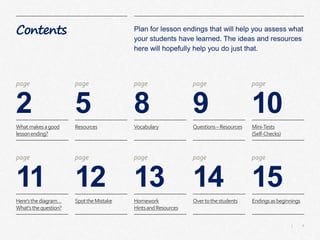
Contents
2
Plan for lesson endings that will help you assess what
your students have learned. The ideas and resources
here will hopefully help you do just that.
5 8 9 10
page page page page page
11 12 13 14 15
page page page page page
Whatmakesagood
lessonending?
Resources Vocabulary Questions–Resources Mini-Tests
(Self-Checks)
Here’sthediagram…
What’sthequestion?
SpottheMistake Homework
HintsandResources
Overtothestudents Endingsasbeginnings
5|
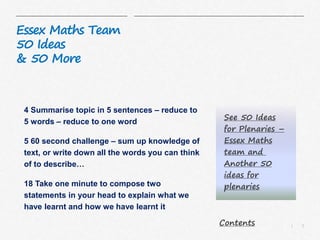
Essex Maths Team
50 Ideas
& 50 More
4 Summarise topic in 5 sentences – reduce to
5 words – reduce to one word
5 60 second challenge – sum up knowledge of
text, or write down all the words you can think
of to describe…
18 Take one minute to compose two
statements in your head to explain what we
have learnt and how we have learnt it
See 50 Ideas
for Plenaries –
Essex Maths
team and
Another 50
ideas for
plenaries
Contents
6|
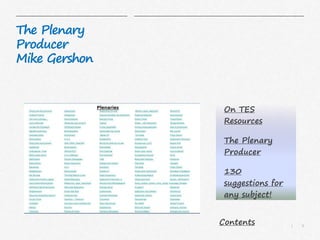
The Plenary
Producer
Mike Gershon
4 Summarise topic in 5 sentences – reduce to
5 words – reduce to one word
5 60 second challenge – sum up knowledge of
text, or write down all the words you can think
of to describe…
18 Take one minute to compose two
statements in your head to explain what we
have learnt and how we have learnt it
On TES
Resources
The Plenary
Producer
130
suggestions for
any subject!
Contents
7|
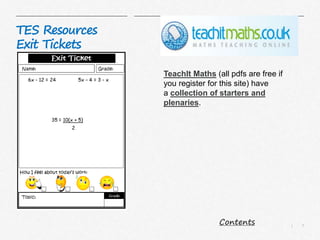
TES Resources
Exit Tickets
TeachIt Maths (all pdfs are free if
you register for this site) have
a collection of starters and
plenaries.
Contents
8|
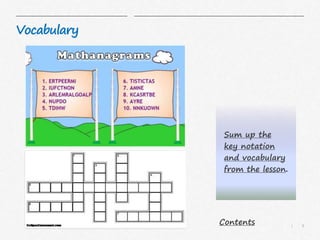
Vocabulary
Sum up the
key notation
and vocabulary
from the lesson.
Contents
9|
Questions
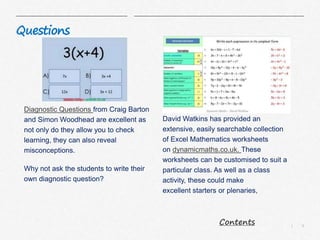
Diagnostic Questions from Craig Barton
and Simon Woodhead are excellent as
not only do they allow you to check
learning, they can also reveal
misconceptions.
Why not ask the students to write their
own diagnostic question?
David Watkins has provided an
extensive, easily searchable collection
of Excel Mathematics worksheets
on dynamicmaths.co.uk. These
worksheets can be customised to suit a
particular class. As well as a class
activity, these could make
excellent starters or plenaries,
Contents
10|
Mini-Tests
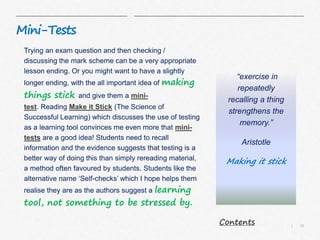
Trying an exam question and then checking /
discussing the mark scheme can be a very appropriate
lesson ending. Or you might want to have a slightly
longer ending, with the all important idea of making
things stick and give them a mini-
test. Reading Make it Stick (The Science of
Successful Learning) which discusses the use of testing
as a learning tool convinces me even more that mini-
tests are a good idea! Students need to recall
information and the evidence suggests that testing is a
better way of doing this than simply rereading material,
a method often favoured by students. Students like the
alternative name ‘Self-checks’ which I hope helps them
realise they are as the authors suggest a learning
tool, not something to be stressed by.
“exercise in
repeatedly
recalling a thing
strengthens the
memory.”
Aristotle
Making it stick
Contents
11|
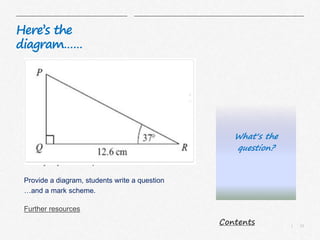
Here’s the
diagram……
Have you planned the end of your lesson to:
Help you confirm that learning has taken place?
Identify any misconceptions?
Provide a diagram, students write a question
…and a mark scheme.
Further resources
What‘s the
question?
Contents
12|
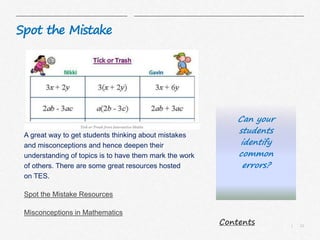
Spot the Mistake
A great way to get students thinking about mistakes
and misconceptions and hence deepen their
understanding of topics is to have them mark the work
of others. There are some great resources hosted
on TES.
Spot the Mistake Resources
Misconceptions in Mathematics
Can your
students
identify
common
errors?
Contents
13|
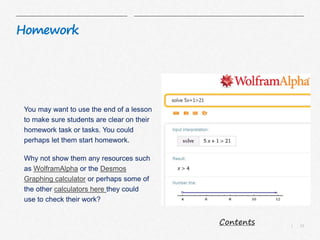
Homework
You may want to use the end of a lesson
to make sure students are clear on their
homework task or tasks. You could
perhaps let them start homework.
Why not show them any resources such
as WolframAlpha or the Desmos
Graphing calculator or perhaps some of
the other calculators here they could
use to check their work?
Contents
14|
Over to the
students
Perhaps hand over to a student or students to
summarise the main points of the lesson. This could be
planned ahead if you wish.
For a novel plenary – plan ahead with a student – let
them know they will be giving a vote of thanks for the
lesson! This can include what has been learned and
refer to any members of the class, perhaps comment
on someone who asked a great question for example.
This can work really well and the lesson may well end
with everybody clapping!
Thank You!
Contents
15|
Endings as
beginnings
Why not end the lesson by explaining what you wish
them to start working on the minute they come into the
room for the next lesson.
On the subject of calm starts to lessons
..see Bell Work
And so many starters also make good endings!
What next?
Contents
16|
Colleen Young
https://twitter.com/ColleenYoung
Mathematics, Learning & Technology
Mathematics for Students

Endings mathematics lessons

  • 1.
  • 2.
    2| What makes a goodending to a lesson? Have you planned the end of your lesson to: Help you confirm that learning has taken place? Identify any misconceptions? Help you decide what you and your students need to do next? What was important? What do you want to stick?
  • 3.
    3| On the followingslides, images and/or text provide hyperlinks to the resources
  • 4.
    4| Contents 2 Plan for lessonendings that will help you assess what your students have learned. The ideas and resources here will hopefully help you do just that. 5 8 9 10 page page page page page 11 12 13 14 15 page page page page page Whatmakesagood lessonending? Resources Vocabulary Questions–Resources Mini-Tests (Self-Checks) Here’sthediagram… What’sthequestion? SpottheMistake Homework HintsandResources Overtothestudents Endingsasbeginnings
  • 5.
    5| Essex Maths Team 50Ideas & 50 More 4 Summarise topic in 5 sentences – reduce to 5 words – reduce to one word 5 60 second challenge – sum up knowledge of text, or write down all the words you can think of to describe… 18 Take one minute to compose two statements in your head to explain what we have learnt and how we have learnt it See 50 Ideas for Plenaries – Essex Maths team and Another 50 ideas for plenaries Contents
  • 6.
    6| The Plenary Producer Mike Gershon 4Summarise topic in 5 sentences – reduce to 5 words – reduce to one word 5 60 second challenge – sum up knowledge of text, or write down all the words you can think of to describe… 18 Take one minute to compose two statements in your head to explain what we have learnt and how we have learnt it On TES Resources The Plenary Producer 130 suggestions for any subject! Contents
  • 7.
    7| TES Resources Exit Tickets TeachItMaths (all pdfs are free if you register for this site) have a collection of starters and plenaries. Contents
  • 8.
    8| Vocabulary Sum up the keynotation and vocabulary from the lesson. Contents
  • 9.
    9| Questions Diagnostic Questions fromCraig Barton and Simon Woodhead are excellent as not only do they allow you to check learning, they can also reveal misconceptions. Why not ask the students to write their own diagnostic question? David Watkins has provided an extensive, easily searchable collection of Excel Mathematics worksheets on dynamicmaths.co.uk. These worksheets can be customised to suit a particular class. As well as a class activity, these could make excellent starters or plenaries, Contents
  • 10.
    10| Mini-Tests Trying an examquestion and then checking / discussing the mark scheme can be a very appropriate lesson ending. Or you might want to have a slightly longer ending, with the all important idea of making things stick and give them a mini- test. Reading Make it Stick (The Science of Successful Learning) which discusses the use of testing as a learning tool convinces me even more that mini- tests are a good idea! Students need to recall information and the evidence suggests that testing is a better way of doing this than simply rereading material, a method often favoured by students. Students like the alternative name ‘Self-checks’ which I hope helps them realise they are as the authors suggest a learning tool, not something to be stressed by. “exercise in repeatedly recalling a thing strengthens the memory.” Aristotle Making it stick Contents
  • 11.
    11| Here’s the diagram…… Have youplanned the end of your lesson to: Help you confirm that learning has taken place? Identify any misconceptions? Provide a diagram, students write a question …and a mark scheme. Further resources What‘s the question? Contents
  • 12.
    12| Spot the Mistake Agreat way to get students thinking about mistakes and misconceptions and hence deepen their understanding of topics is to have them mark the work of others. There are some great resources hosted on TES. Spot the Mistake Resources Misconceptions in Mathematics Can your students identify common errors? Contents
  • 13.
    13| Homework You may wantto use the end of a lesson to make sure students are clear on their homework task or tasks. You could perhaps let them start homework. Why not show them any resources such as WolframAlpha or the Desmos Graphing calculator or perhaps some of the other calculators here they could use to check their work? Contents
  • 14.
    14| Over to the students Perhapshand over to a student or students to summarise the main points of the lesson. This could be planned ahead if you wish. For a novel plenary – plan ahead with a student – let them know they will be giving a vote of thanks for the lesson! This can include what has been learned and refer to any members of the class, perhaps comment on someone who asked a great question for example. This can work really well and the lesson may well end with everybody clapping! Thank You! Contents
  • 15.
    15| Endings as beginnings Why notend the lesson by explaining what you wish them to start working on the minute they come into the room for the next lesson. On the subject of calm starts to lessons ..see Bell Work And so many starters also make good endings! What next? Contents
  • 16.