





Creative teaching
Prepared by; Ghada Salem
Cambridge TESOL DELTA holder,
RELO/US Embassy Mentor trainer
Inspired by,
DR. Stephen Bax
Classroom based assessment
Agenda
Assessment, evaluation and testing.
What is assessment ? Why is it important?
What are the types of assessment?
 What is classroom based assessment
(CBA)?
Why is CBA ineffective?
 How can we make CBA more effective
more creative?
Discuss with your team!! (HO1)
Testing , Evaluation&
assessment
Testing
 Testing is regarded as “a tool of
assessment which has a certain objective”
McNamara,
 (types of tests? HO 2/ types of tasks HO3)
What is evaluation?
 “Evaluation is judging the
effectiveness of the overall course or
program, rather than the progress of
individual learner” Thornbury
(2006:18)
What is assessment?
“broader than testing; the teacher is looking
at progress over time in a variety of contexts”
(Law, 1995:5)
 “ The different ways of collecting
information about the learners’ progress and
achievement” Thornbury Scott (2006: 18)
Why do we assess learners?
1)To provide information required or
expected by the institution, parents or
other institution (such as a prospective
college or university)
2) To aid the teachers in understanding
the effectiveness of the course or their
teaching.
3) To provide feedback for the learner
which may then have an impact on their
learning,
Why do we assess learners?
 To monitor and aid learners’ progress
and provide individualized help.
 To provide learners with evidence on
their progress and enhance
motivation.
 To monitor the teacher’s performance
and plan for future work.
 To provide information for parents,
colleagues, and school authorities.
“paraphrased from Iannonnou”
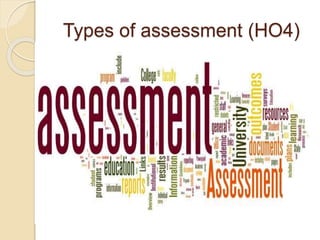
Types of assessment (HO4)
Classroom based
assessment(CBA)
 What is CBA?
 Administering informal assessments
on a regular basis throughout the
school year that provide useful
information which can help teachers to
identify the individual strengths and
weaknesses of each learner and most
importantly, guide the next steps in
instructions.
Classroom based assessment
(CBA)
How does it happen?
 ‘noticing’
 observing
 checking
 testing
 All teachers do CBA all the time… but…
Assessment tasks (HO5)
The problem with CBA
“All too often, classroom tests are
given, the results reported to
students, and instruction remains
unchanged…”
(Genessee and Upshur 1996:258)
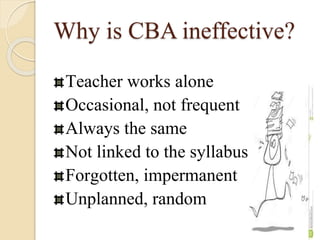
Why is CBA ineffective?
Teacher works alone
Occasional, not frequent
Always the same
Not linked to the syllabus
Forgotten, impermanent
Unplanned, random
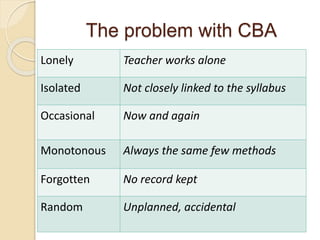
The problem with CBA
Lonely Teacher works alone
Isolated Not closely linked to the syllabus
Occasional Now and again
Monotonous Always the same few methods
Forgotten No record kept
Random Unplanned, accidental
We are failing ……
 … to assess fully
 …to link teaching, learning and
assessment together
 to link classroom assessment to our
learning aims
 To help weak students who need special
attention.
 …to close the circle
What are the solutions?
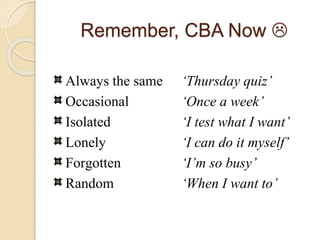
Remember, CBA Now 
Always the same ‘Thursday quiz’
Occasional ‘Once a week’
Isolated ‘I test what I want’
Lonely ‘I can do it myself’
Forgotten ‘I’m so busy’
Random ‘When I want to’
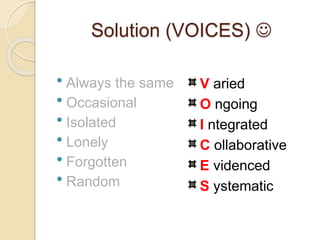
Solution (VOICES) 
 Always the same
 Occasional
 Isolated
 Lonely
 Forgotten
 Random
V aried
O ngoing
I ntegrated
C ollaborative
E videnced
S ystematic
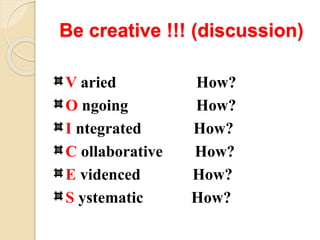
Be creative !!! (discussion)
V aried How?
O ngoing How?
I ntegrated How?
C ollaborative How?
E videnced How?
S ystematic How?
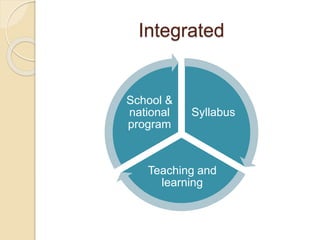
Integrated
Syllabus
Teaching and
learning
School &
national
program
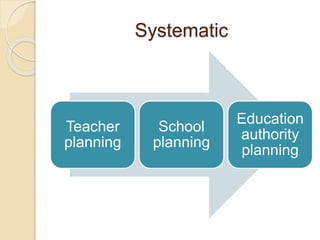
Systematic
Teacher
planning
School
planning
Education
authority
planning
Summary
 Creative
 Communal (share)
 Remember the VOICES acronym
 In particular - think about integration
 Remember that change in education is
a slow process – so be patient!
Last but not least
Stay focused & be the change that you
want to see 
Thank you
Ghada

Classroom Based Assessment

  • 1.
    Creative teaching Prepared by;Ghada Salem Cambridge TESOL DELTA holder, RELO/US Embassy Mentor trainer Inspired by, DR. Stephen Bax
  • 2.
  • 3.
    Agenda Assessment, evaluation andtesting. What is assessment ? Why is it important? What are the types of assessment?  What is classroom based assessment (CBA)? Why is CBA ineffective?  How can we make CBA more effective more creative?
  • 4.
    Discuss with yourteam!! (HO1)
  • 5.
  • 6.
    Testing  Testing isregarded as “a tool of assessment which has a certain objective” McNamara,  (types of tests? HO 2/ types of tasks HO3)
  • 7.
    What is evaluation? “Evaluation is judging the effectiveness of the overall course or program, rather than the progress of individual learner” Thornbury (2006:18)
  • 8.
    What is assessment? “broaderthan testing; the teacher is looking at progress over time in a variety of contexts” (Law, 1995:5)  “ The different ways of collecting information about the learners’ progress and achievement” Thornbury Scott (2006: 18)
  • 10.
    Why do weassess learners? 1)To provide information required or expected by the institution, parents or other institution (such as a prospective college or university) 2) To aid the teachers in understanding the effectiveness of the course or their teaching. 3) To provide feedback for the learner which may then have an impact on their learning,
  • 11.
    Why do weassess learners?  To monitor and aid learners’ progress and provide individualized help.  To provide learners with evidence on their progress and enhance motivation.  To monitor the teacher’s performance and plan for future work.  To provide information for parents, colleagues, and school authorities. “paraphrased from Iannonnou”
  • 12.
  • 13.
    Classroom based assessment(CBA)  Whatis CBA?  Administering informal assessments on a regular basis throughout the school year that provide useful information which can help teachers to identify the individual strengths and weaknesses of each learner and most importantly, guide the next steps in instructions.
  • 14.
    Classroom based assessment (CBA) Howdoes it happen?  ‘noticing’  observing  checking  testing  All teachers do CBA all the time… but…
  • 15.
  • 16.
    The problem withCBA “All too often, classroom tests are given, the results reported to students, and instruction remains unchanged…” (Genessee and Upshur 1996:258)
  • 17.
    Why is CBAineffective? Teacher works alone Occasional, not frequent Always the same Not linked to the syllabus Forgotten, impermanent Unplanned, random
  • 18.
    The problem withCBA Lonely Teacher works alone Isolated Not closely linked to the syllabus Occasional Now and again Monotonous Always the same few methods Forgotten No record kept Random Unplanned, accidental
  • 19.
    We are failing……  … to assess fully  …to link teaching, learning and assessment together  to link classroom assessment to our learning aims  To help weak students who need special attention.  …to close the circle
  • 20.
    What are thesolutions?
  • 21.
    Remember, CBA Now Always the same ‘Thursday quiz’ Occasional ‘Once a week’ Isolated ‘I test what I want’ Lonely ‘I can do it myself’ Forgotten ‘I’m so busy’ Random ‘When I want to’
  • 22.
    Solution (VOICES)  Always the same  Occasional  Isolated  Lonely  Forgotten  Random V aried O ngoing I ntegrated C ollaborative E videnced S ystematic
  • 23.
    Be creative !!!(discussion) V aried How? O ngoing How? I ntegrated How? C ollaborative How? E videnced How? S ystematic How?
  • 24.
  • 25.
  • 26.
    Summary  Creative  Communal(share)  Remember the VOICES acronym  In particular - think about integration  Remember that change in education is a slow process – so be patient!
  • 27.
  • 28.
    Stay focused &be the change that you want to see  Thank you Ghada