DEFINITION
Cognitivism isa theory in psychology that focuses on
how the mind receives, processes, organizes, stores
and retrieves information.
Proposed by Jean Piaget
Derived from Latin word, 'cognoscere' , meaning
knowing and information.
3.
Schemas and processof information
storage
Mental structures or cognitive frameworks that guide the encoding of
new information and facilitate its integration into existing knowledge
structures.
The information storage can be of several stages:
Initially processed in Short Term Memory where it is temporarily held
and actively worked on.
Effective encoding happens when meaningful associations occur in
short term memory and it is transferred to Long Term Memory.
The organized information in long term memory forms cognitive
structures called schema.
4.
Cognitive map
Thecognitive map represents the sum of all the learning
that have been encountered so far. When the learner
learns new things , cognitive map are redrawn.
It is a mental picture or representation that a person
creates in their mind to understand, organize and
remember information about places, relationships or
concepts.
5.
Example
Cognitive map-Knowingthe route from your home to school without
needing directions.
Schema -Consider how a young child develop a schema for a horse. They
know that a horse is large and has hair, four legs, and a tail. When the child
encounters a cow, they might initially call it a horse. Once the child is told
that it is a cow, they will modify their existing schema and create a
schema for a cow.
Explanation
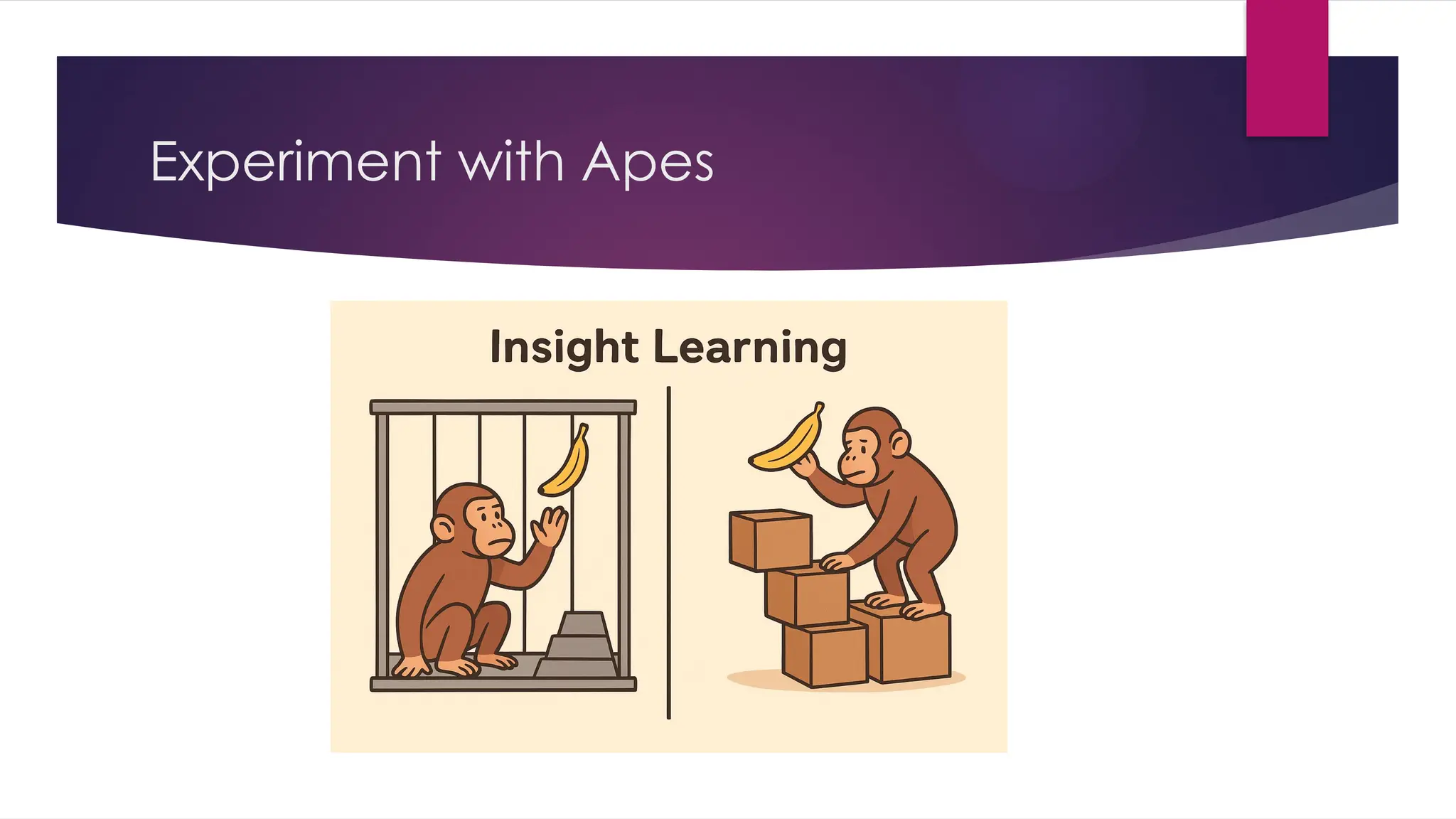
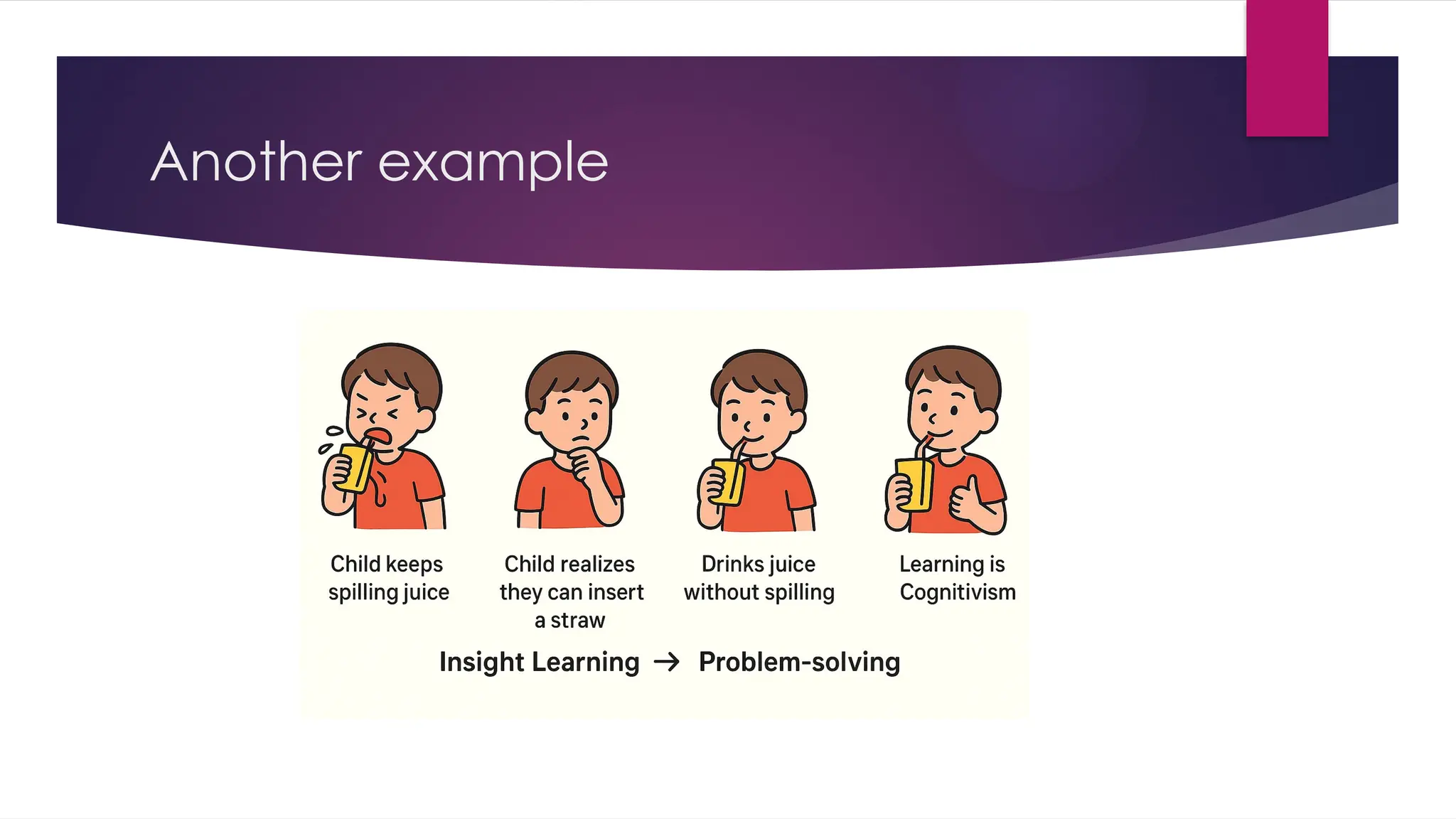
Conducted byWolfgang Köhler, a Gestalt psychologist.
Setup: A chimpanzee (Sultan) placed in a cage with a banana out of reach and sticks/boxes inside.
Initial attempts: Jumping and reaching failed.
Sudden solution: Chimp joined sticks or stacked boxes to reach the banana.
Significance: Proved that learning is not just trial-and-error (behaviorism) but also involves thinking, problem-solving, and cognition.
Contribution: Strong evidence supporting cognitivism in learning theory.
8.
Role of teachersand learners
Teachers – facilitators of learning , design activities to
stimulate cognitive processes , provide guidance.
Learners – critical thinking , reflection, metacognition.
Major Contributors ofCognitivism
Jean Piaget – Known for cognitive development theory
Lev Vygotsky - Zone of Proximal Development
Jerome Bruner - Discovery learning, Scaffolding.
David Ausubel - Meaningful verbal learning.
Noam Chomsky- Language Acquisition Device, innate
ability for language learning
11.
Important works
JeanPiaget -'The Language and Thought of the child'(1923),The Child's
conception of the world(1929)
Lev Vygotsky – Thought and Language (1934),Mind in Society(1978)
Jerome Bruner- The Process of Education (1960), Toward a Theory of
Instruction(1966)
David Ausubel – Educational Psychology(1968),The Psychology of
Meaningful Verbal Learning(1963)
Noam Chomsky-Syntactic Structures(1957 )Aspects of the Theory of
Syntax(1965)
12.
Advantages
Promotes Metacognition
Supporting long term retention
Encourages active learning
Improves problem solving skills
Focus on understanding
Applicable across subjects
13.
Limitations
Ignores emotionsand motivation in learning.
Overemphasis on the mind.
Difficult to apply directly in real classroom situations.
Neglects cultural and individual differences in thinking.
Gives less importance to practice and observable behavior.