JOT2 – LEARNING
THEORIES
Student: Doni Dorak
ID: 000307557
Mentor: Sarah Black
Dear Principal Skinner,
I received your observation notes on my classroom.
It is true; I vary my lessons to fit different learners and
different objectives.
Per your request, I have created a brief tutorial to
share with other teachers, and an example of one of my
one lesson units delivered according to three of the
major learning theories.
The end goals are as follows:
1. Teachers can explain the three learning theories.
2. Teachers can identify these theories and adapt a
lesson to the one that best meets their instructional
setting and goals.
Sincerely,
Doni Dorak
Essential Questions
• What are the three major
learning theories and how to
identify one in a lesson plan?
• What types of objectives and
learners best align to the
three theories?
• How can a lesson plan be
adapted to a learning
theory?
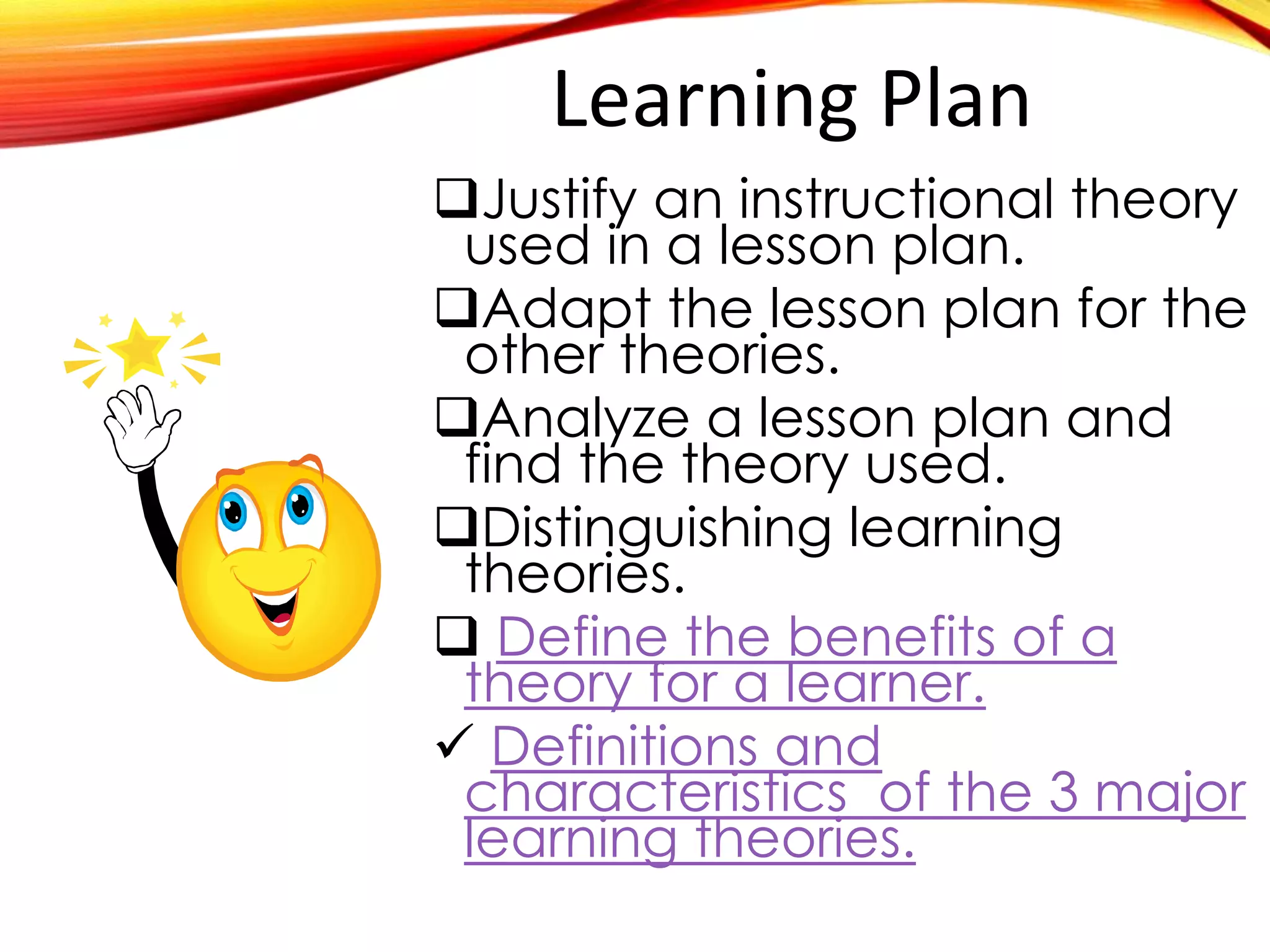
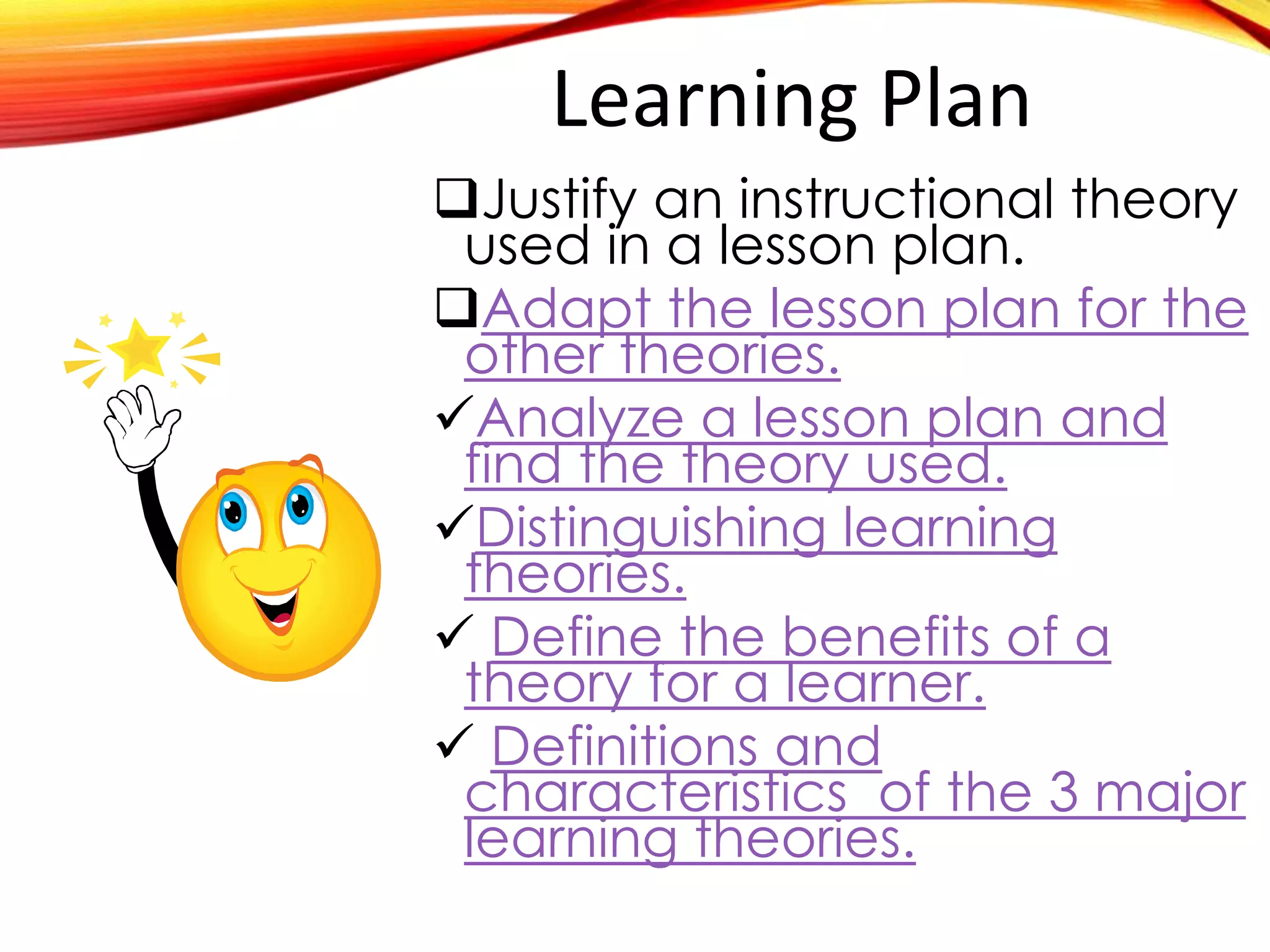
Learning Plan
Justify an instructional theory
used in a specific lesson plan.
Adapt the lesson plan for the
other theories.
Analyze a lesson plan and
find the theory used.
Distinguishing learning
theories.
 Define the benefits of a
theory for a learner.

Definitions and characteristics
Learning Theories
Constructivism, Cognitivism, Behaviorism
Task A
Behaviorism
• Keyword – Drill and kill
• Purpose- elicit the correct answer
from the student by presenting the
learner with a correct stimulus.
(Ertmer, 2008)
• Fathers – Pavlov, Skinner, Thorndike
(Bigge, 1999, table 1.1)
• Example: Memorizing multiplication
tables. 1x1= 1 and 1x2 = 2
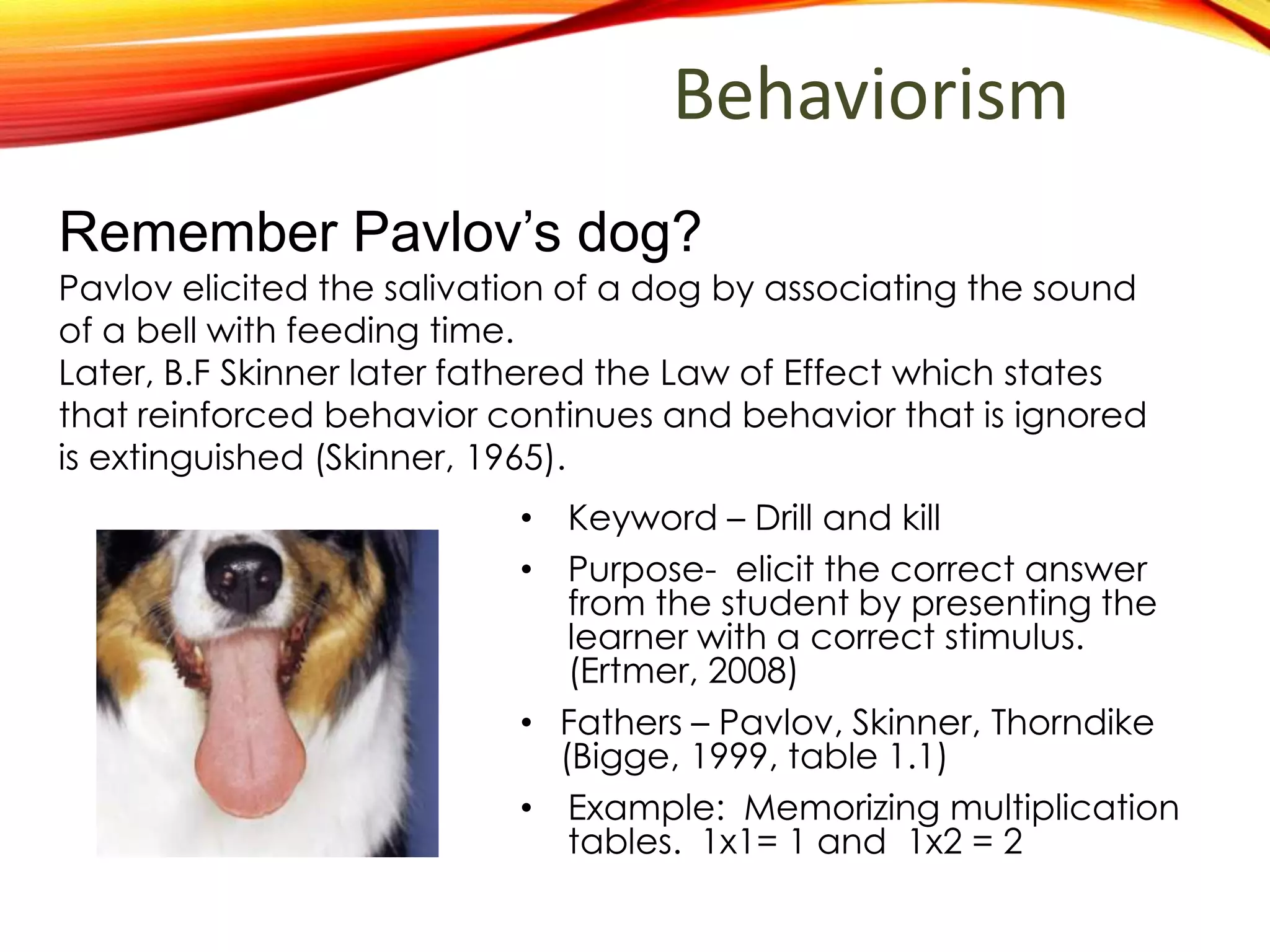
Remember Pavlov’s dog?
Pavlov elicited the salivation of a dog by associating the sound
of a bell with feeding time.
Later, B.F Skinner later fathered the Law of Effect which states
that reinforced behavior continues and behavior that is
ignored is extinguished (Skinner, 1965).
Cognitivism
• Keyword – Patterns and Insights
• Purpose- To help students
construct mental models that
improve retention and facilitate
transference.
• Fathers – Herbart, Gestalt
psychology (Bigge, 1999, table
1.1)
• Example: If any number times 1
equals itself, then dog(1)=dog.
(Bigge, 1999, p.84)
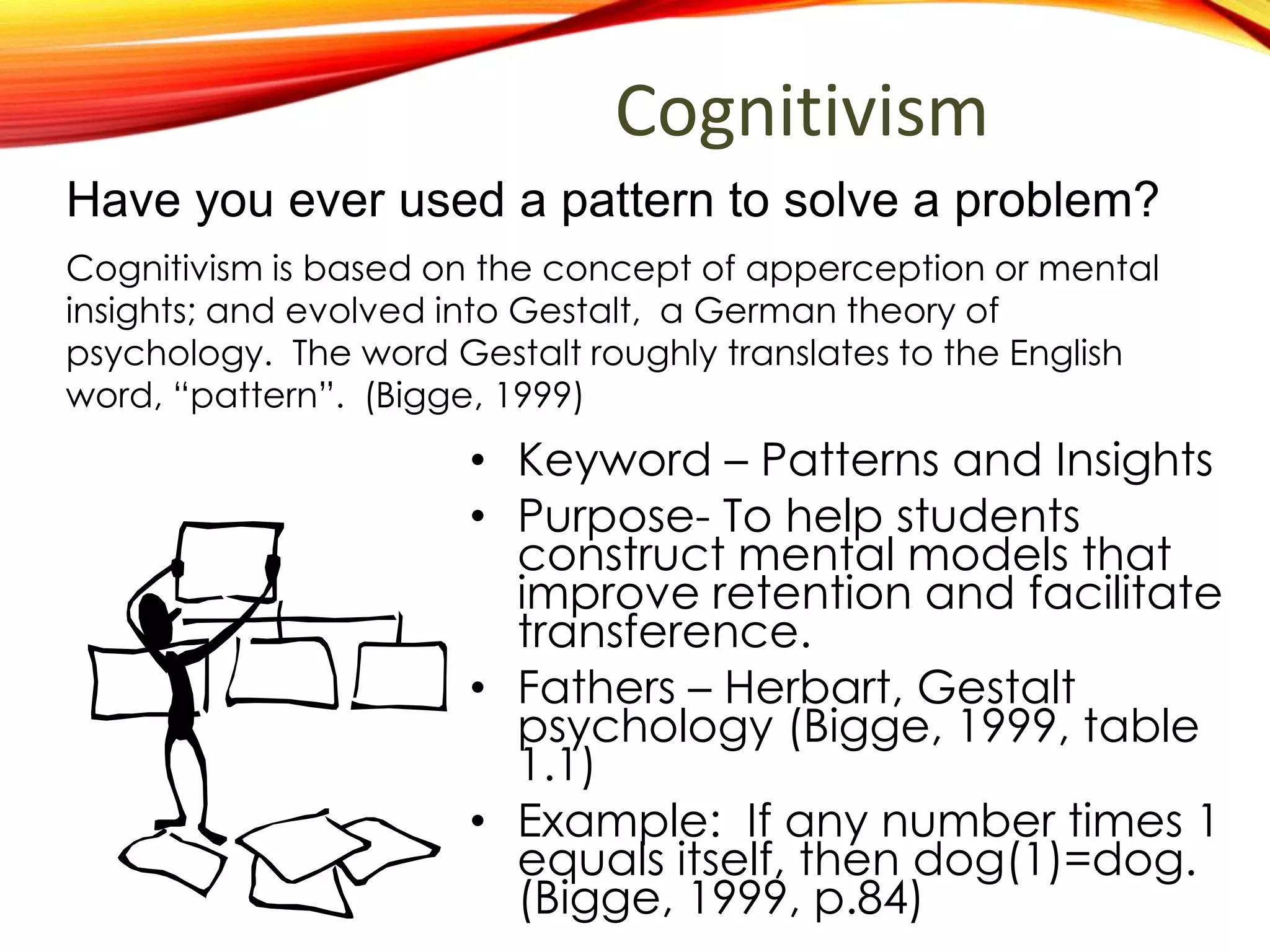
Have you ever used a pattern to solve a problem?
Cognitivism is based on the concept of apperception or
mental insights; and evolved into Gestalt, a German theory of
psychology. The word Gestalt roughly translates to the English
word, “pattern”. (Bigge, 1999)
Constructivism
• Keyword – Scaffolding and
applications
• Purpose- to strengthen
competency through application
of knowledge.
• Fathers – Vygotsky, Piaget, Bruner
(Bigge, 1999, table 1.1)
• Example: There are 22 students in
class, and each has 1 pencil. How
many pencils do the students
have altogether?
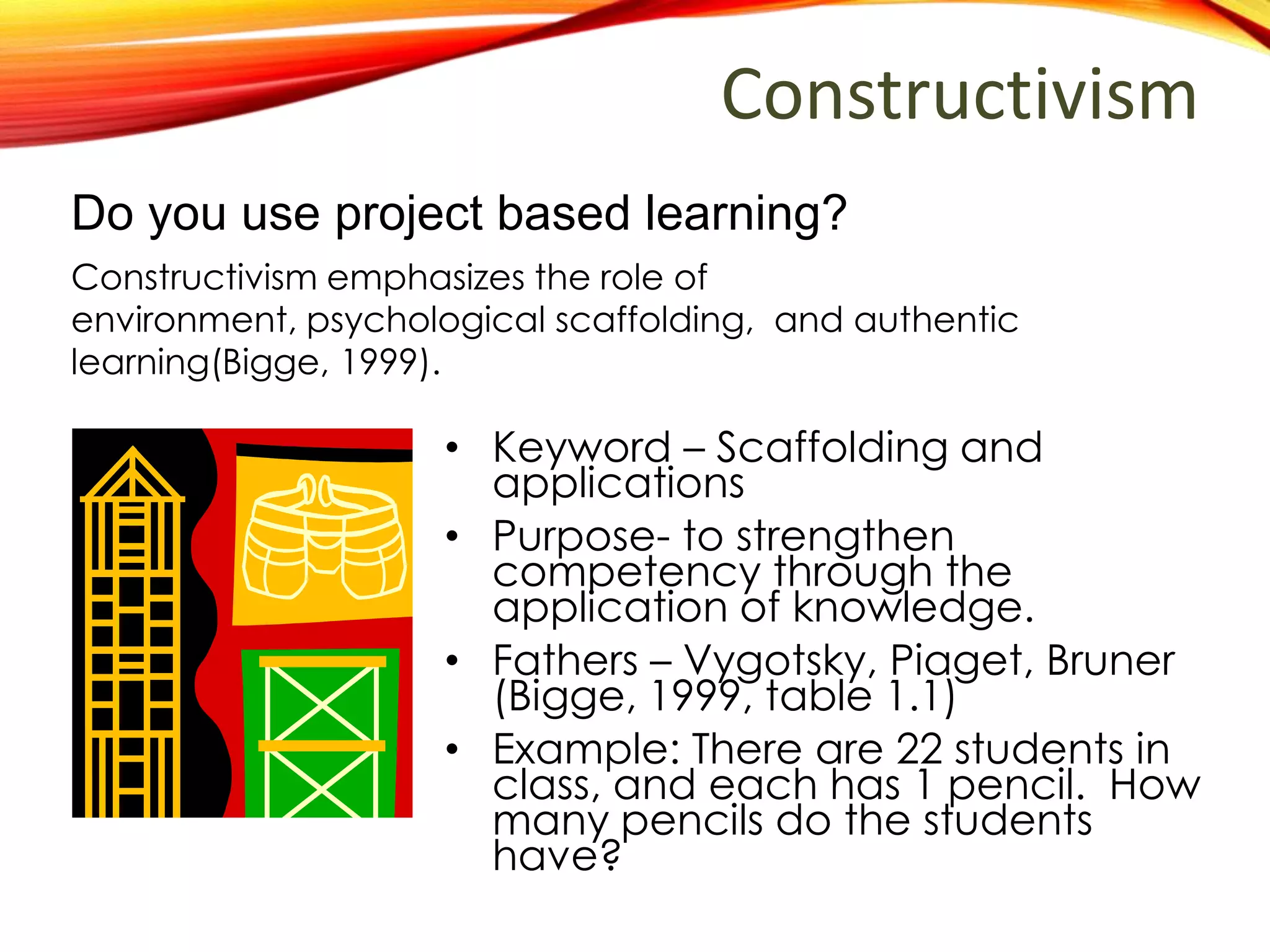
Do you use project based learning?
Constructivism emphasizes the role of environment,
psychological scaffolding, and authentic learning through
knowledge application (Bigge, 1999).
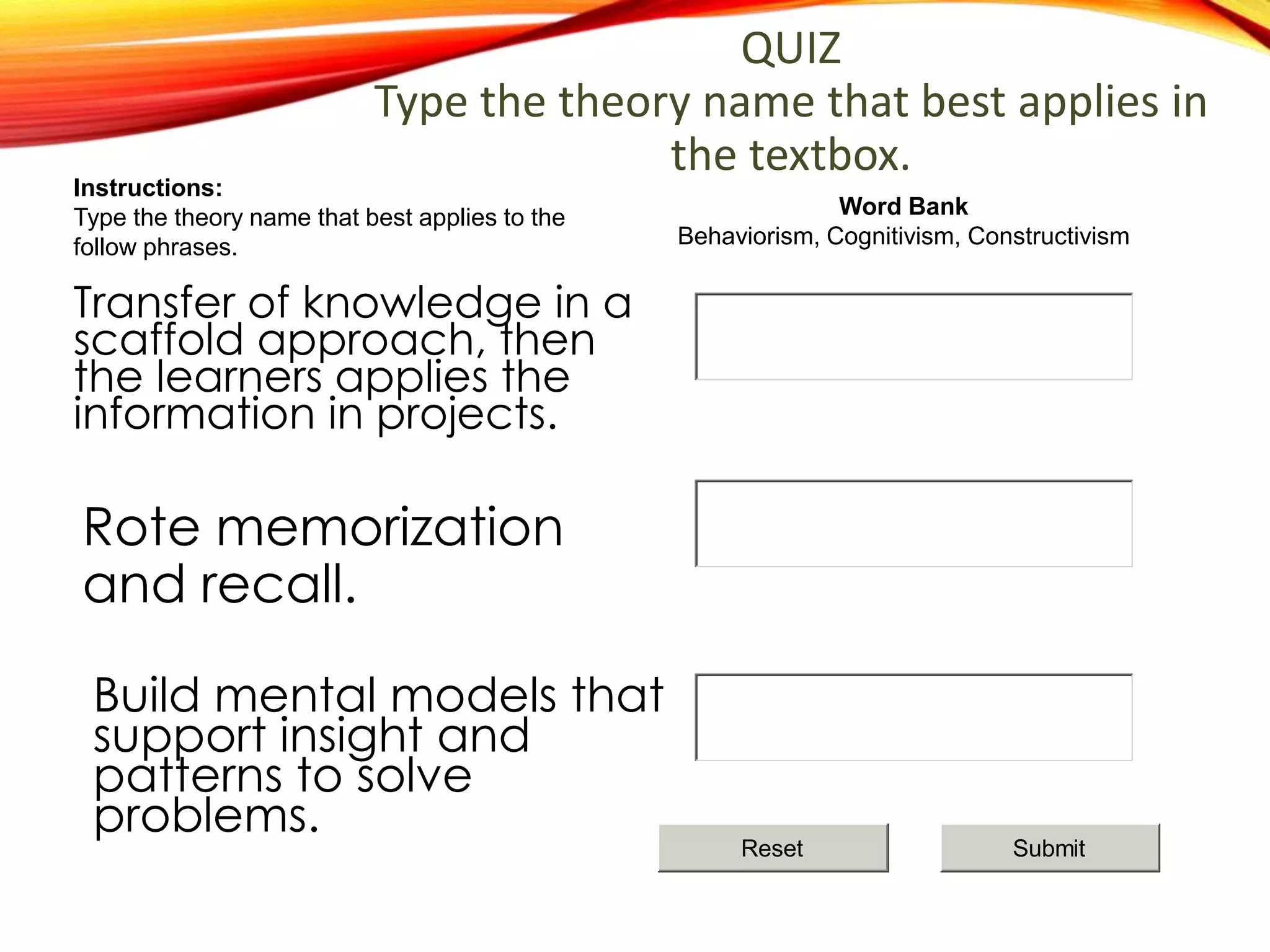
Rote memorization
and recall.
Build mental models that
support insight and
patterns to solve
problems.
Transfer of knowledge in a
scaffold approach, then
the learners applies the
information in projects.
QUIZ
Type the theory name that best applies in
the textbox.
Word Bank
Behaviorism, Cognitivism, Constructivism
Instructions:
Type the theory name that best applies to the
follow phrases.
SubmitReset
Learning Plan
Justify an instructional theory
used in a specific lesson plan.
Adapt the lesson plan for the
other theories.
Analyze a lesson plan and
find the theory used.
Distinguishing learning
theories.

Define the benefits of a theory

Definitions and characteristics
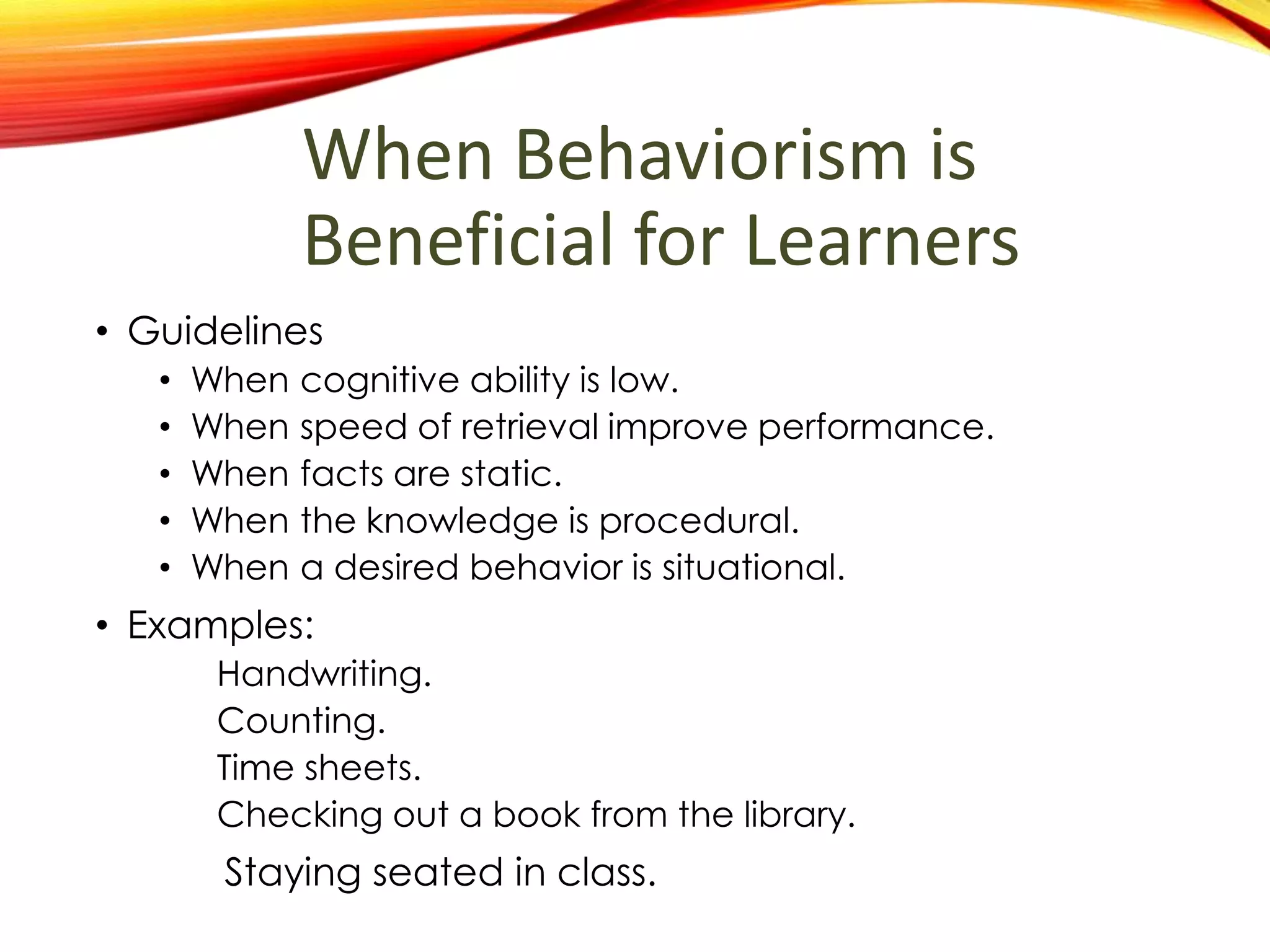
When Behaviorism is
Beneficial for Learners
• Guidelines
• When cognition is low or is not required.
• When speed and repetition improve performance.
• When facts are static.
• When the knowledge is procedural or arbitrary.
• Examples:
Handwriting.
Counting.
Time sheets.
Checking out a book from the library.
Staying seated in class.
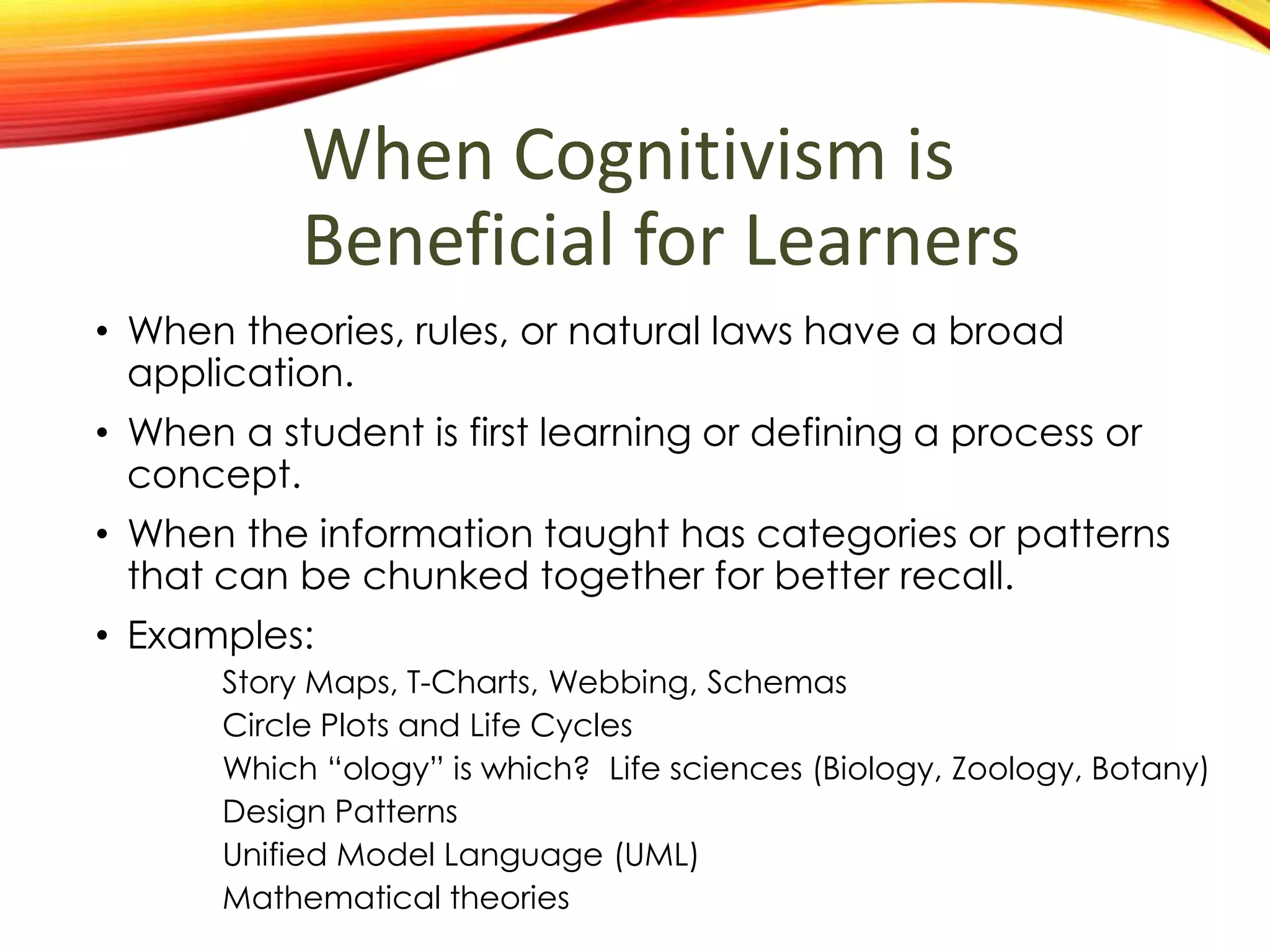
When Cognitivism is
Beneficial for Learners
• When theories, rules, or natural laws have a broad
application.
• When a student is first learning or defining a process or
concept.
• When the information being taught has categories or
patterns that can be chunked together for better
recall.
• Examples:
Story Maps, T-Charts, Webbing, Schemas
Circle Plots and Life Cycles
Design Patterns
Unified Model Language (UML)
Mathematical theories
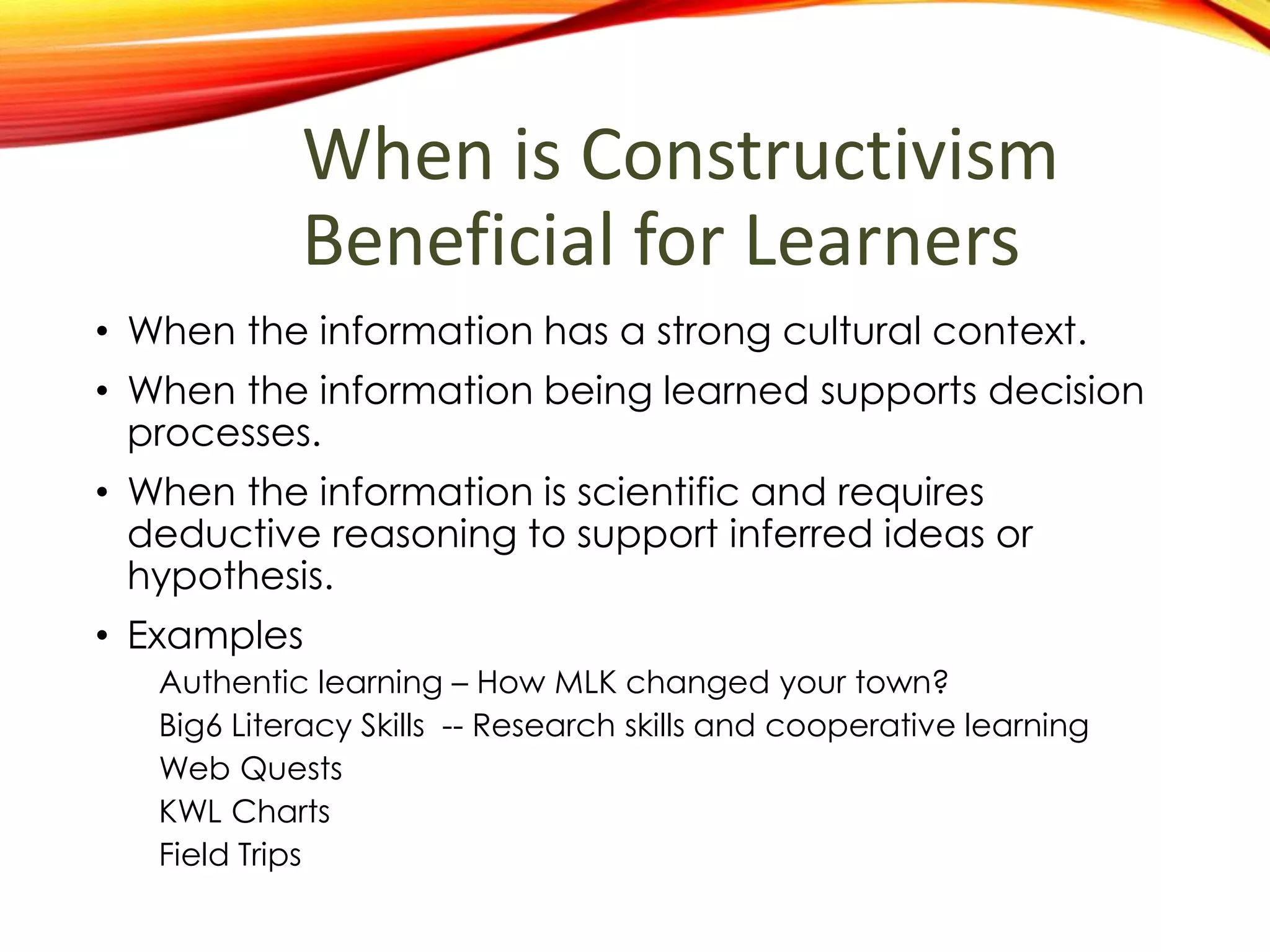
When is Constructivism
Beneficial for Learners
• When the information is being learned is has a strong
cultural context.
• When the information being learned supports decision
processes.
• When the information is scientific and requires
deductive reasoning to support inferred ideas or
hypothesis.
• Examples
Authentic learning – How MLK changed your town?
Big6 Literacy Skills -- Research skills and cooperative learning
Web Quests
KWL Charts
Field Trips
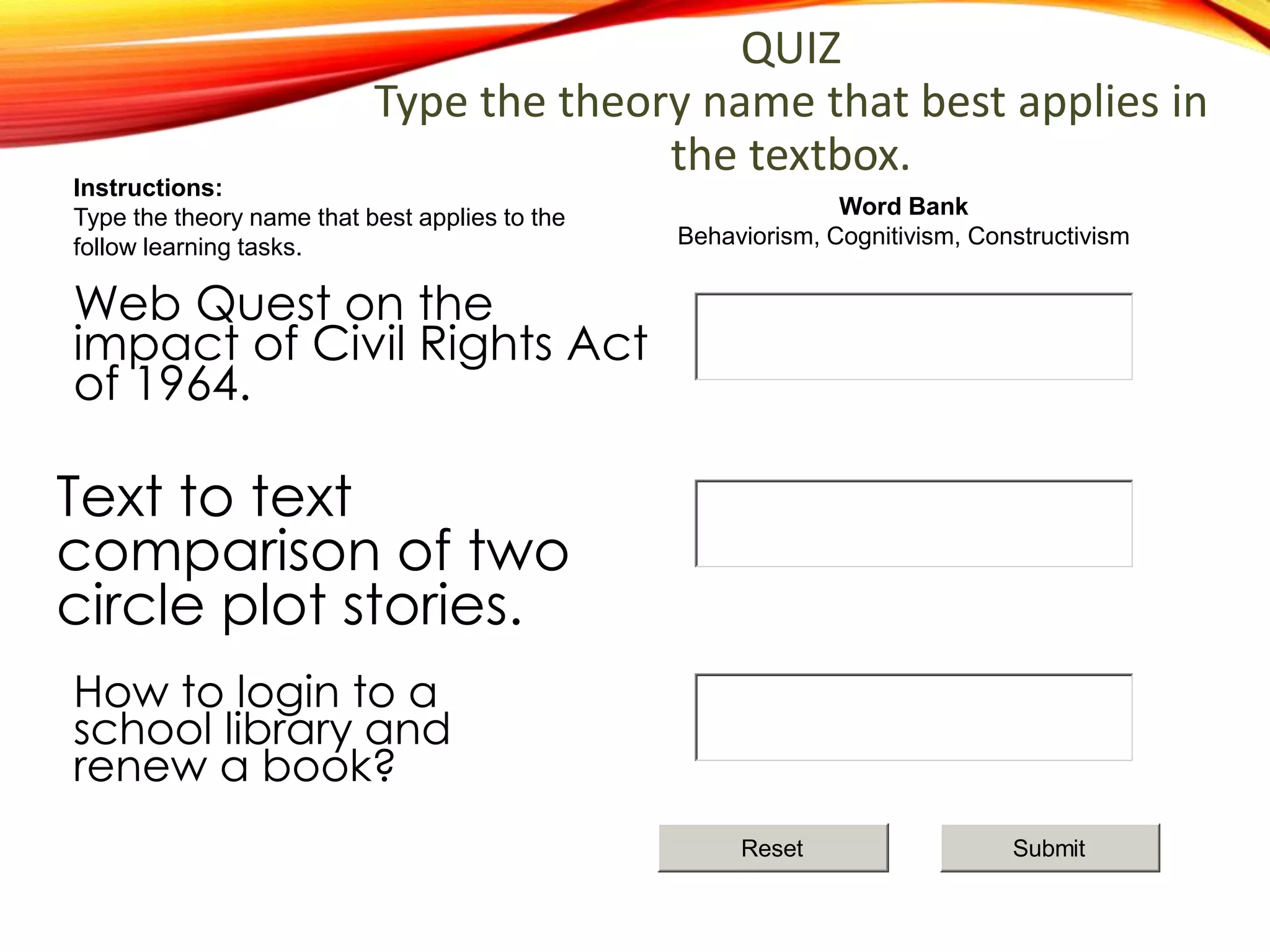
How to login to a
school library and
renew a book?
Text to text
comparison of two
circle plot stories.
Web Quest on the
impact of Civil Rights Act
of 1964.
QUIZ
Type the theory name that best applies in
the textbox.
Word Bank
Behaviorism, Cognitivism, Constructivism
Instructions:
Type the theory name that best applies to the
follow learning tasks.
SubmitReset
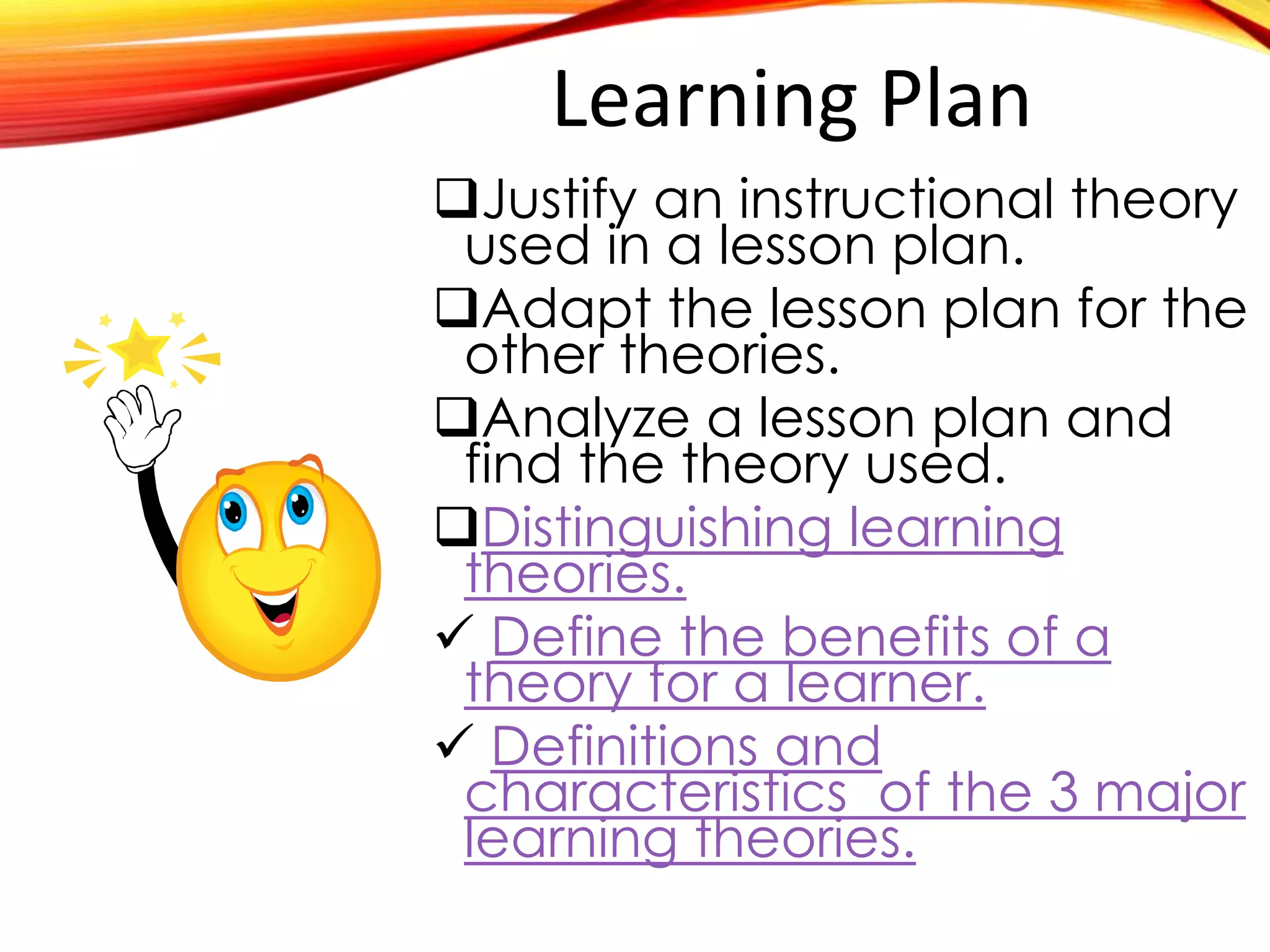
Learning Plan
Justify an instructional theory
used in a specific lesson plan.
Adapt the lesson plan for the
other theories.
Analyze a lesson plan and
find the theory used.
Distinguishing learning theories

Define the benefits of a theory

Definitions and characteristics
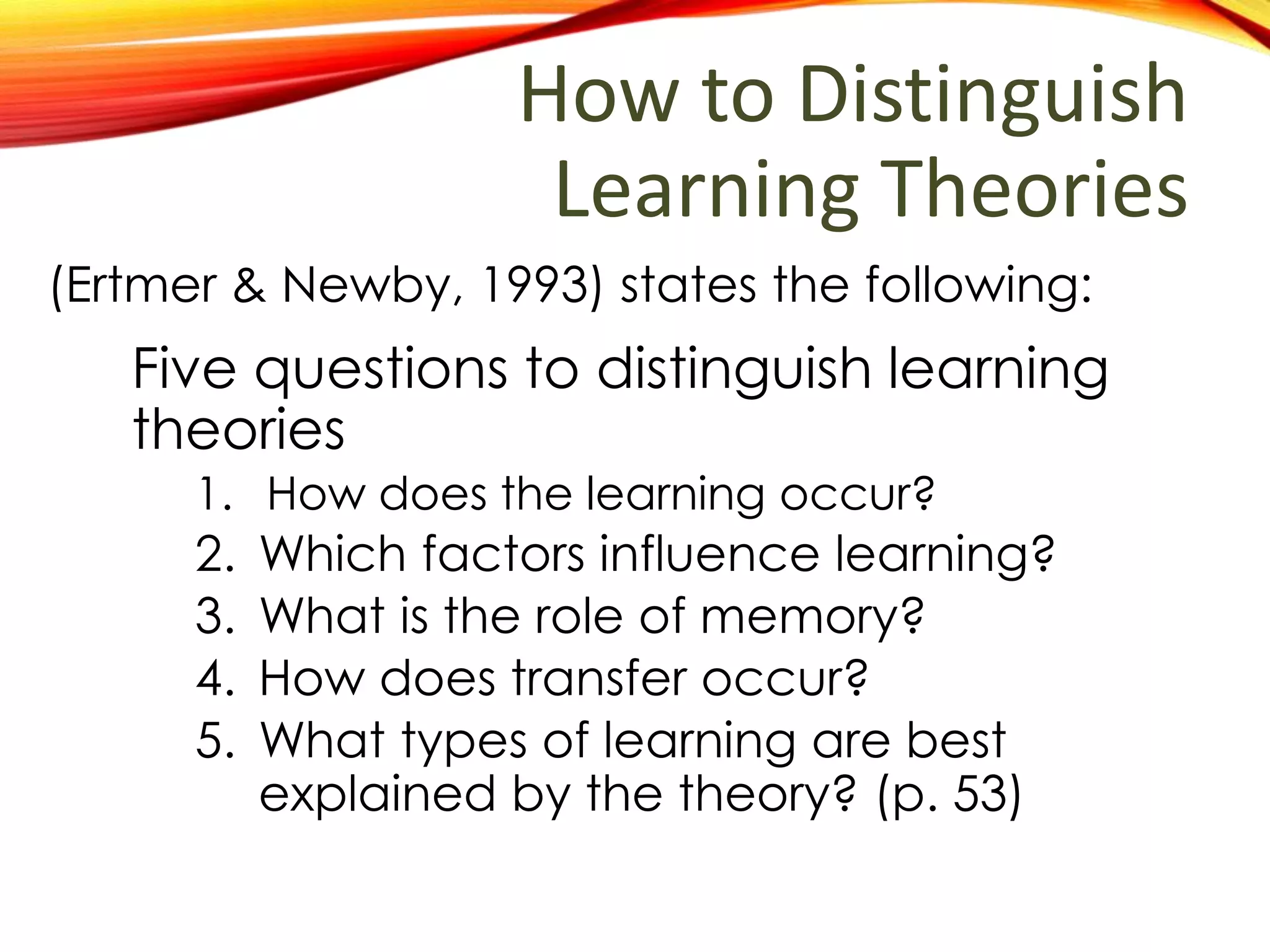
How to Distinguish
Learning Theories
Five questions to distinguish learning
theories
1. How does the learning occur?
2. Which factors influence learning?
3. What is the role of memory?
4. How does transfer occur?
5. What types of learning are best
explained by the theory? (p. 53)
(Ertmer & Newby, 1993) states the following:
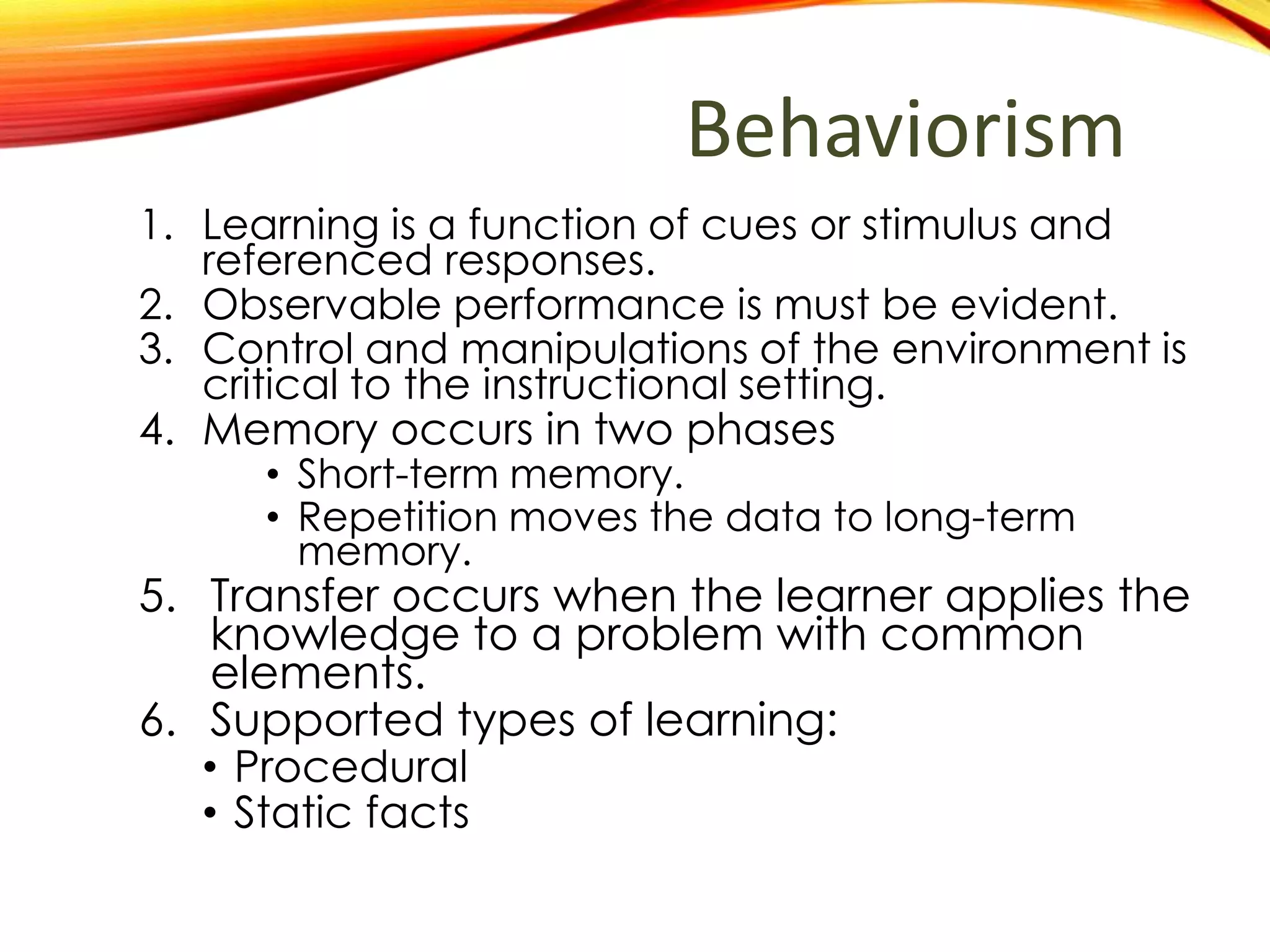
Behaviorism
1. Learning is a function of cues or stimulus and
referenced responses.
2. Observable performance is must be evident.
3. Control and manipulations of the environment is
critical to the instructional setting.
4. Memory occurs in two phases
• Information is learned placed in short-term
memory.
• Practice causes the knowledge to placed in
long-term memory.
1. Transfer occurs when the learner applies the
knowledge to problem with common
elements.
2. Types of learning that are best supported:
• Procedural
• Static facts
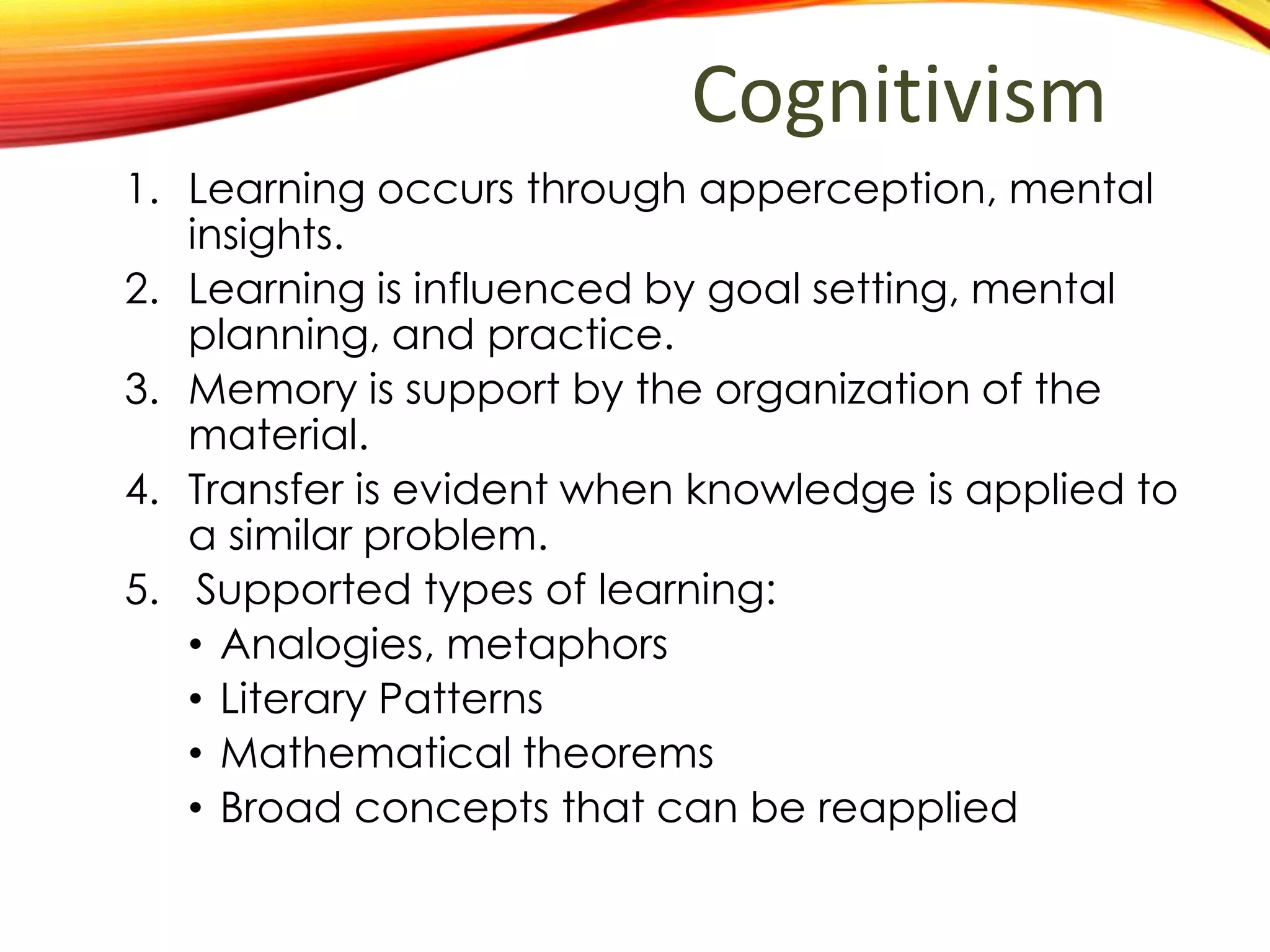
Cognitivism
1. Learning is process of organizing information into
conceptualized models.
2. Learning is influenced by goal setting, mental
planning, and practice.
3. Memory is support by the organization of the
material.
4. Transfer is evident when knowledge is applied to
a similarly constructed problem.
5. Types of learning that are best supported:
• Analogies, metaphors
• Literary Patterns
• Mathematical theorems
• Broad concepts that can be reapplied
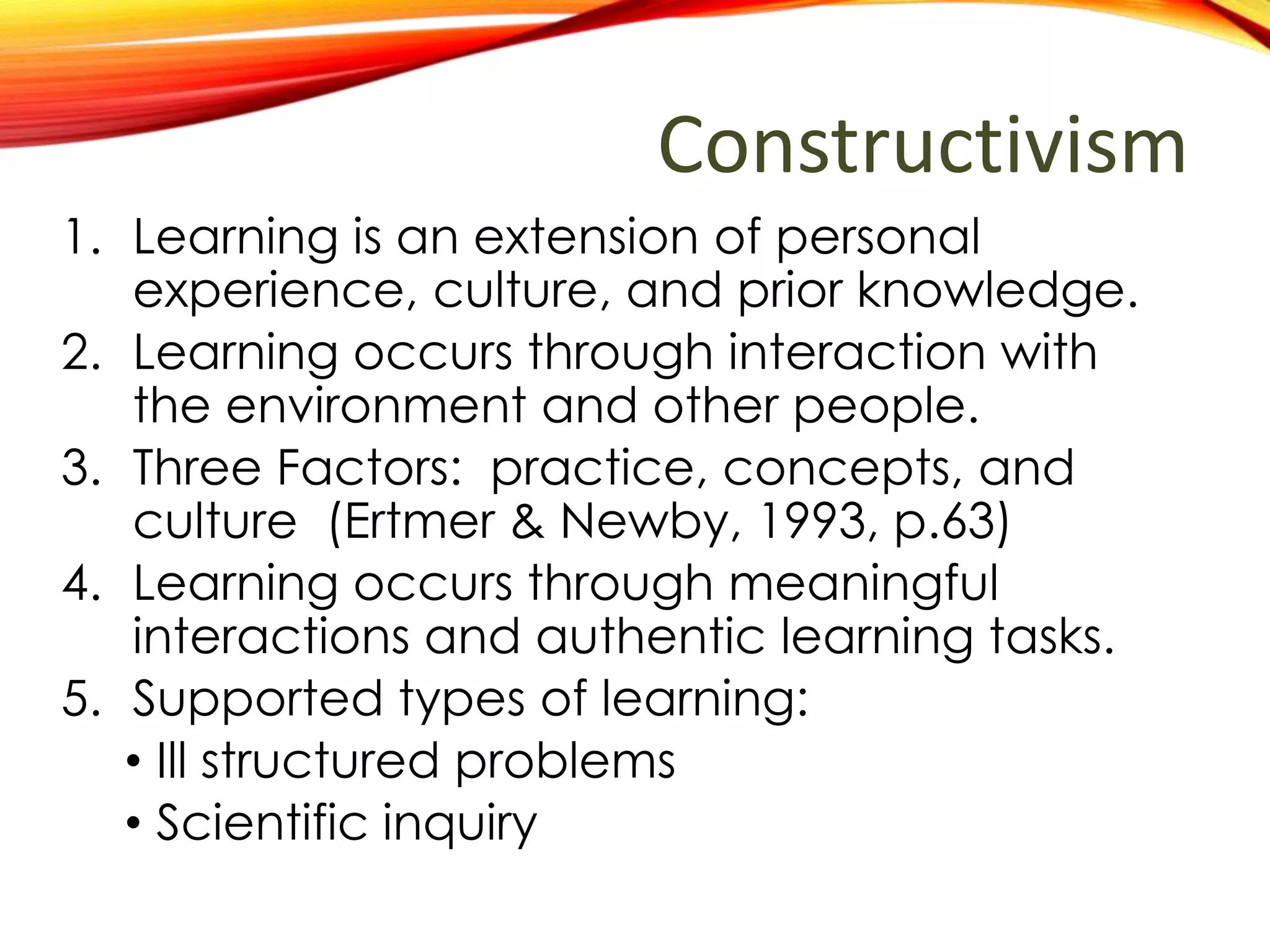
Constructivism
1. Learning is an extension of personal
experience, culture, and prior knowledge.
2. Learning occurs through interaction with
environment and other people.
3. Three Factors: practice, concepts, and
culture (Ertmer & Newby, 1993, p.63)
4. Learning occurs through meaningful
interactions and authentic learning tasks.
5. What types of learning are best explained
by the theory?
• Ill structured problems
• Scientific inquiry
Learning Plan
Justify an instructional theory
used in a specific lesson plan.
Adapt the lesson plan for the
other theories.
Analyze a lesson plan and find
Distinguishing learning theories

Define the benefits of a theory

Definitions and characteristics
Learning Theory Used in
Lesson Plan
Task B
Overview of the Lesson PlanGoal: Improve reading comprehension using
curriculum designated story, the Mexican folktale,
Half-Chicken.
• Objectives ( Starting at page 42 in the document)
• Learner activates the SQR3 method of study.
• Learner uses word mapping to insure he
understands the vocabulary of the story.
• Learner recognizes “Cause and Effect” in different
texts.
• Learner can summarize and retell the story in his
own words.
How does the
learning occur in this plan?
• The learning occurs by teaching
conceptualized models using graphical
organizers and mnemonics.
• The student uses word maps to insure he fully
understands the vocabulary words in the context
of the introductory story, The Mouse and the Lion.
The vocabulary overlaps the two stories.
• The student uses a SQR3 response sheet to guide
the process.
• The student creates a cause and effect chart for
both stories, but the teacher models the first.
• The student uses a graphical organizer to
summarize and rewrite the story.
What factors influence
learning in this plan?
• The factors influencing learning are
teacher demonstrations and the
organization of the information.
• Tasks are centered on improving
comprehension through the use of models and
patterns.
• Graphical organization and Mnemonics
• Strengthen vocabulary
• Recognize Cause and Effect
• Teach comprehension study skills
• Demonstration followed by application
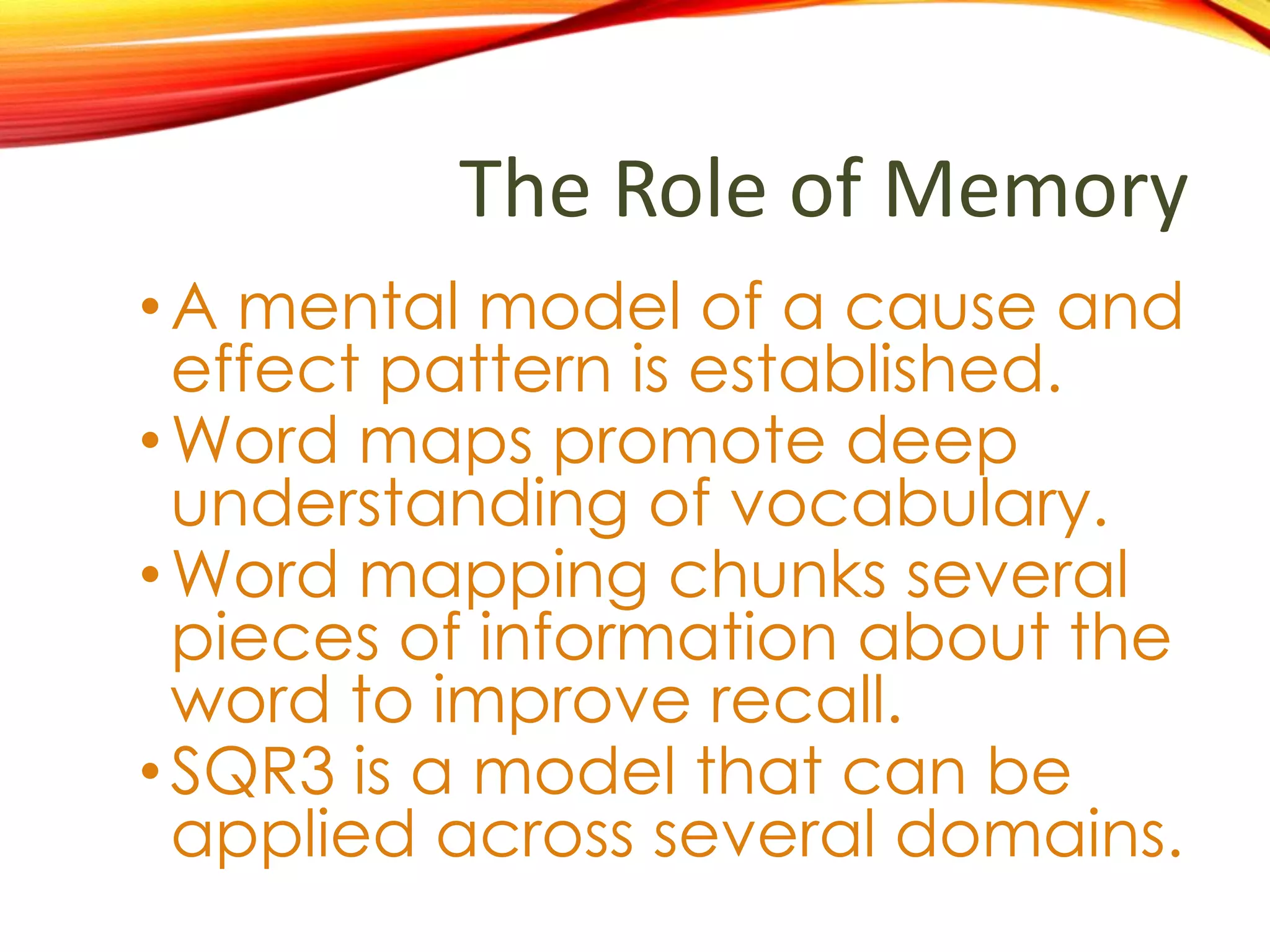
What is the role of
memory in this plan?
•Organization is central to
signaling the information from
the learner.
•Use of graphical organizers.
•Use of mnemonics to teach an
approach to study.
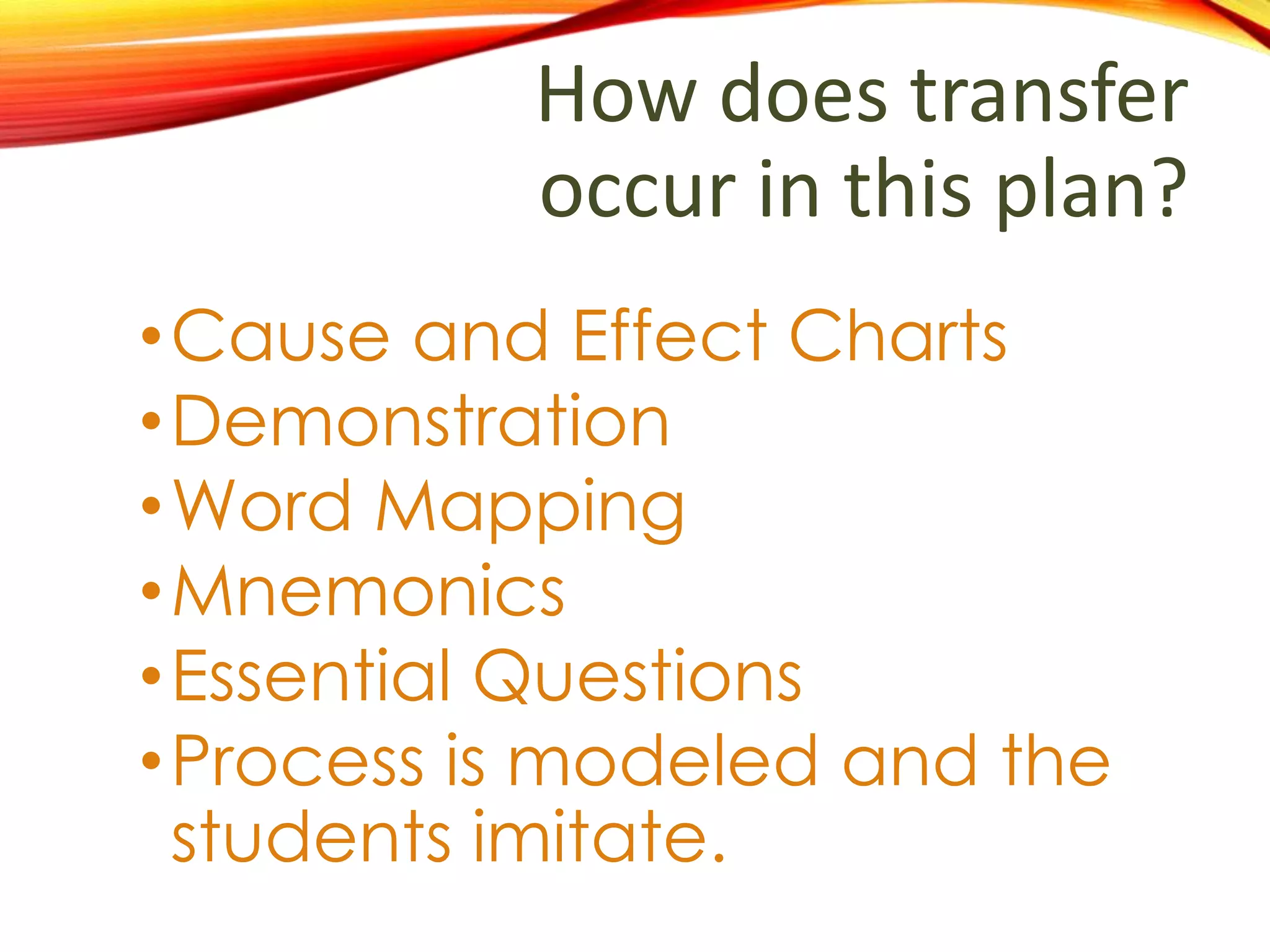
How does transfer
occur in this plan?
•Knowledge and application of
cause and effect are evident
one context and applied to
another.
• Using the story, The Mouse and
Lion, the teacher demonstrates
key concepts using models;
afterwards, the students apply
the ideas to the story, Half
Chicken.
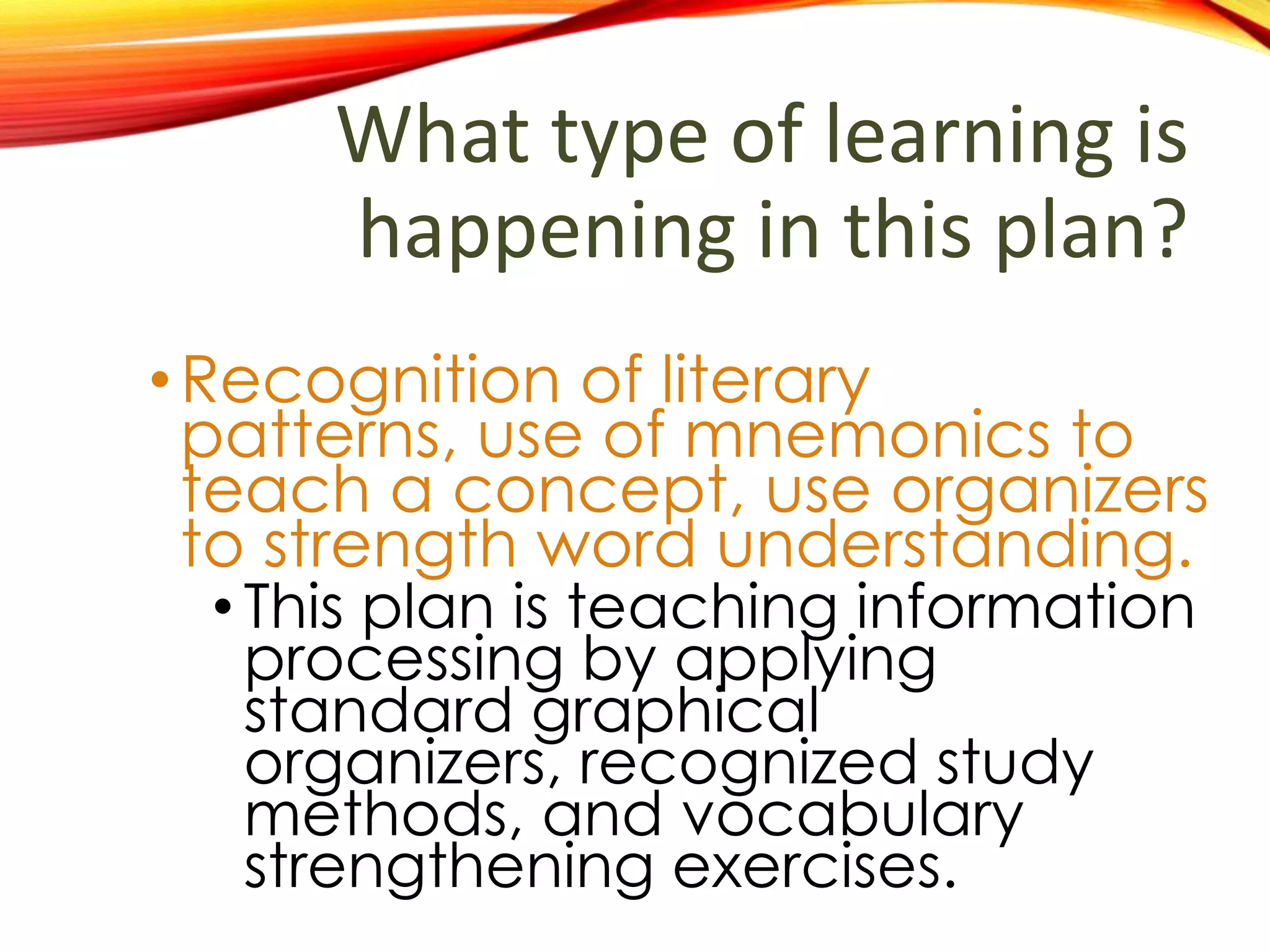
What type of learning is
happening in this plan?
•Recognition of literary patterns,
use of mnemonics to teach a
concept, use organizers to
strength word understanding.
• This plan is teaching information
processing by applying
standard graphical organizers,
recognized study methods, and
vocabulary strengthening
exercises.
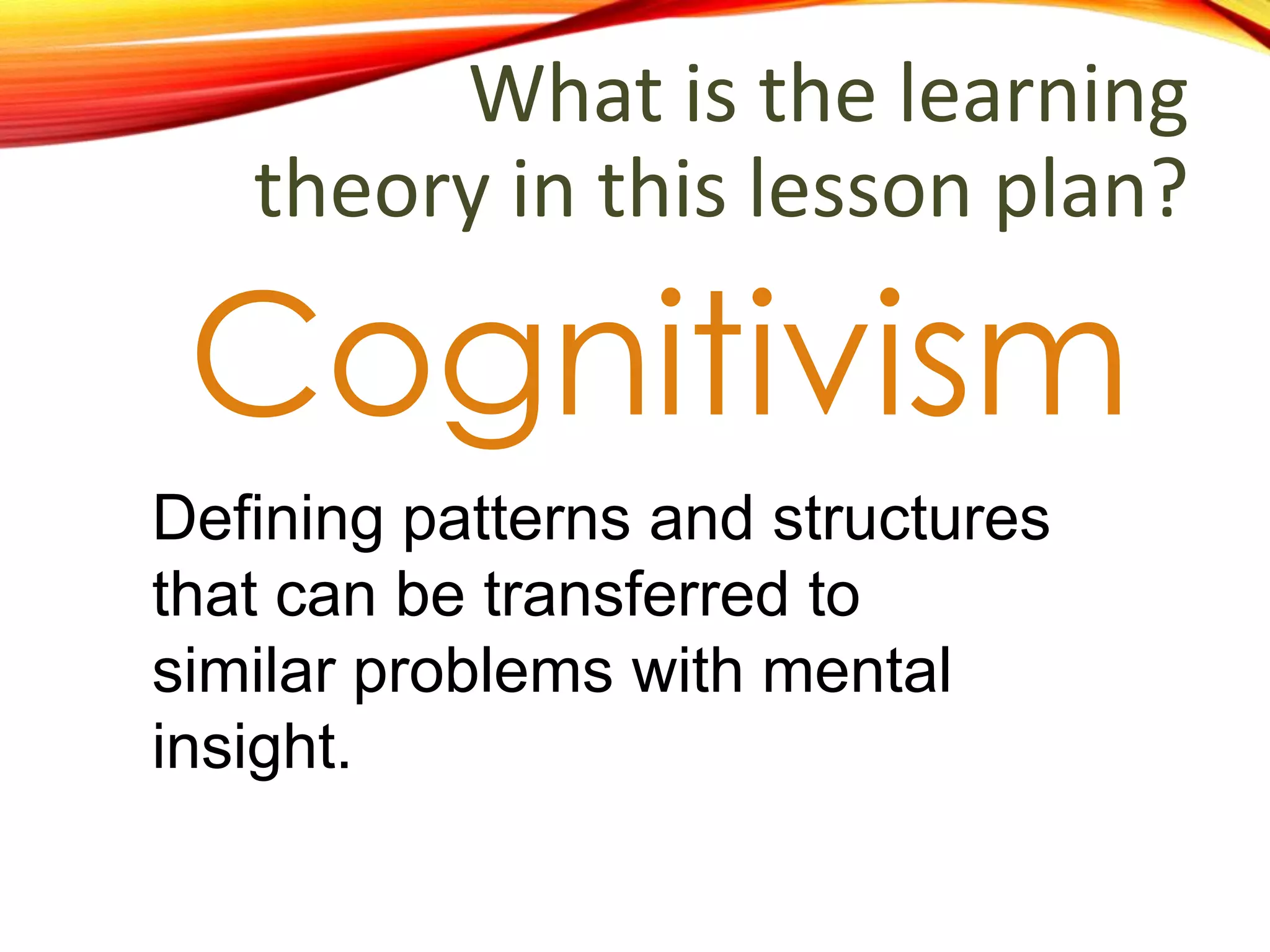
What is the learning
theory in this lesson plan?
Cognitivism
Defining patterns and structures
that can be transferred to
similar problems with mental
insight.
Learning Plan
Justify an instructional theory
used in a specific lesson plan.
Adapt the lesson plan for the o
Analyze a lesson plan and find
Distinguishing learning theories

Define the benefits of a theory

Definitions and characteristics
Adaptation of Lesson Plan
Task C
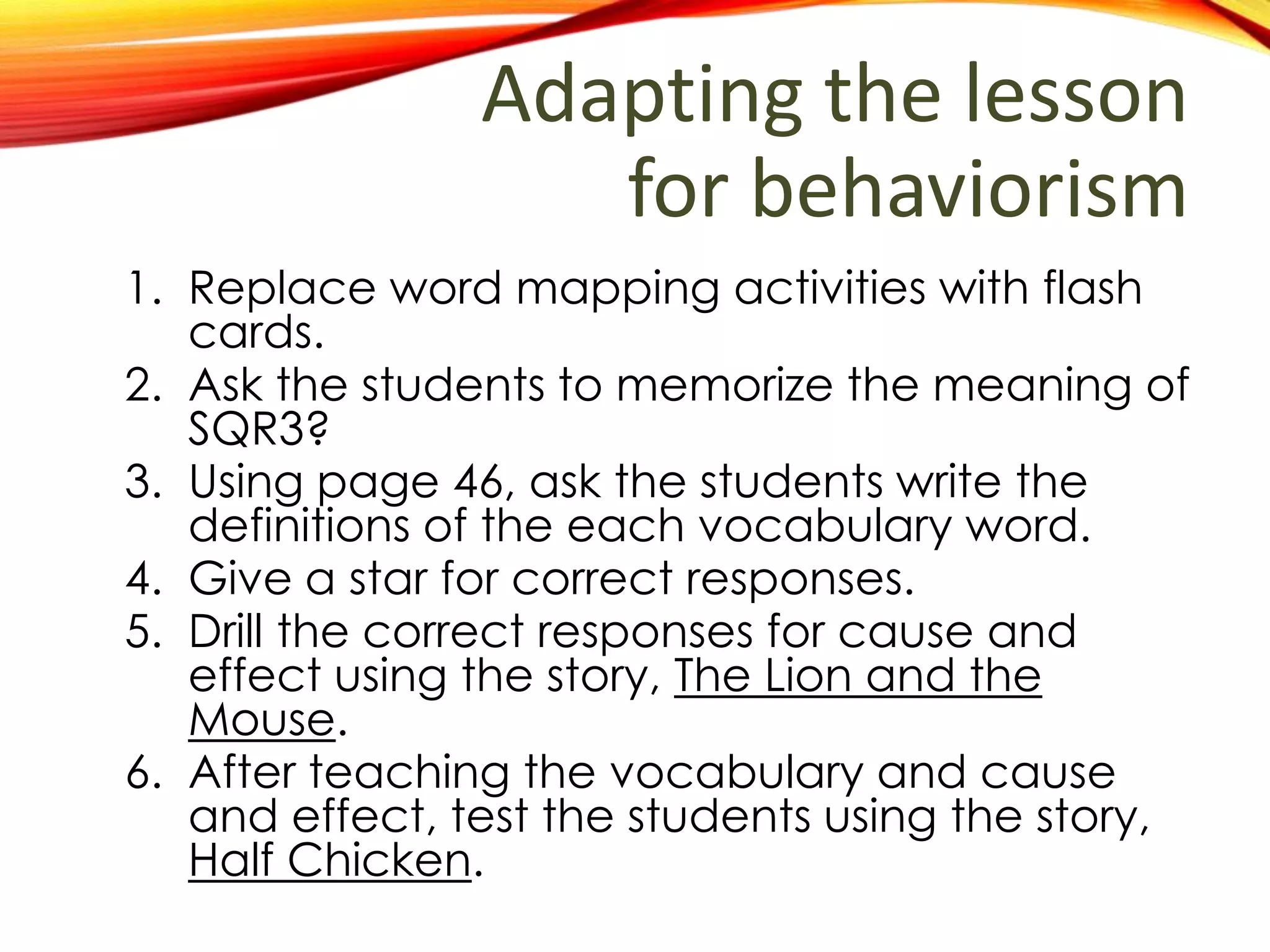
Adapting the lesson
for behaviorism
1. Replace word mapping activities with flash
cards.
2. Ask the students to memorize the meaning of
SQR3?
3. Using page 46, ask the students write the
definitions of the each vocabulary word.
4. Give a star for correct responses.
5. Drill the correct responses for cause and
effect using the story, The Lion and the
Mouse.
6. After teaching the vocabulary and cause
and effect, test the students using the story,
Half Chicken.
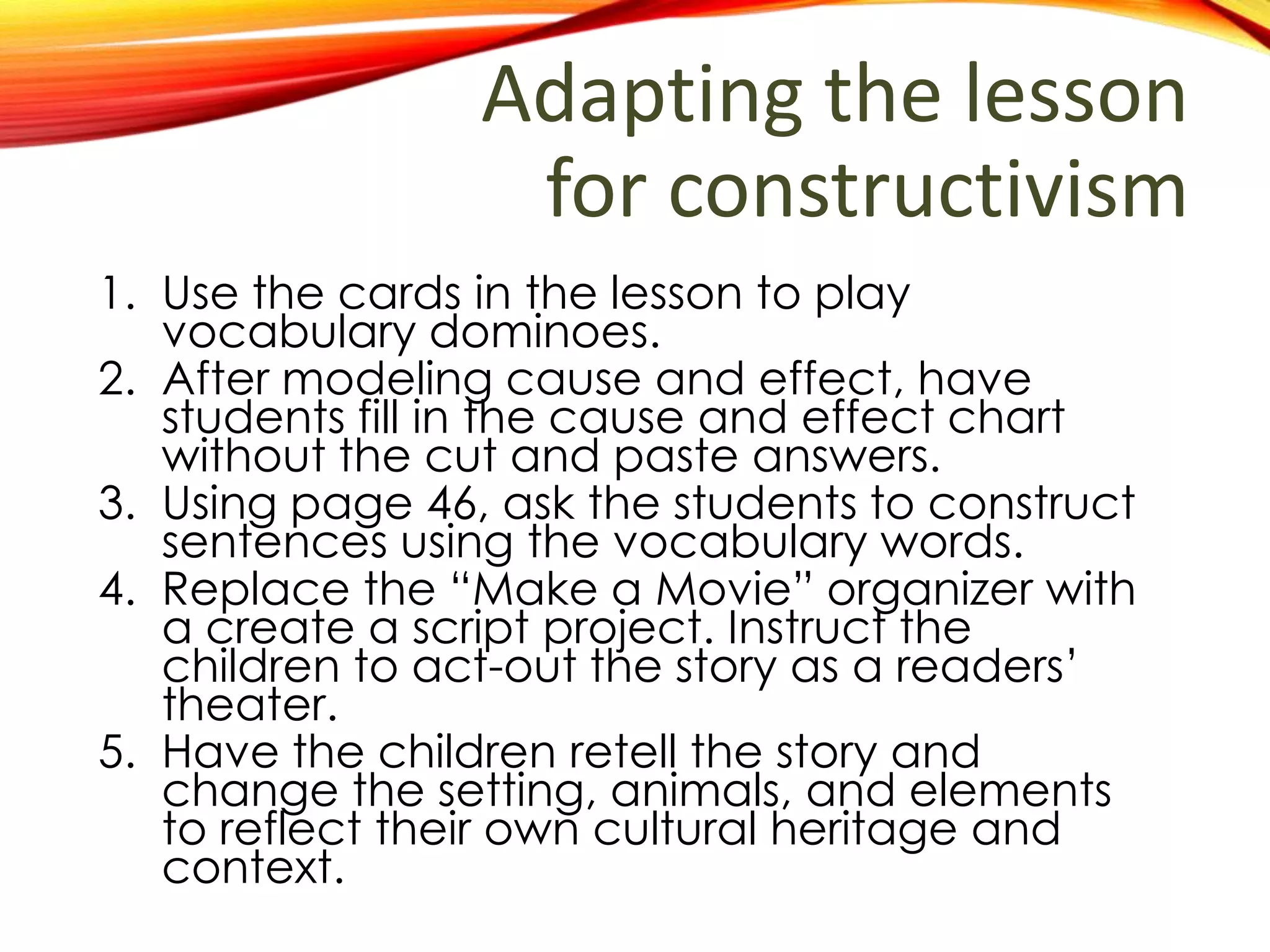
Adapting the lesson
for constructivism
1. Use the cards in the lesson to play
vocabulary dominoes.
2. After modeling cause and effect, have
students fill in the cause and effect chart
without the cut and paste answers.
3. Using page 46, ask the students to construct
sentences using the vocabulary words.
4. Replace the “Make a Movie” activity with a
create a script activity. Instruct the children
to act-out the story as a readers’ theater.
5. Have the children retell the story and
change the setting, animals, and elements
to reflect their own cultural heritage and
context.
Learning Plan
Justify an instructional theory u
Adapt the lesson plan for the o
Analyze a lesson plan and find
Distinguishing learning theories

Define the benefits of a theory

Definitions and characteristics
Lesson Plan Discussion
Task D
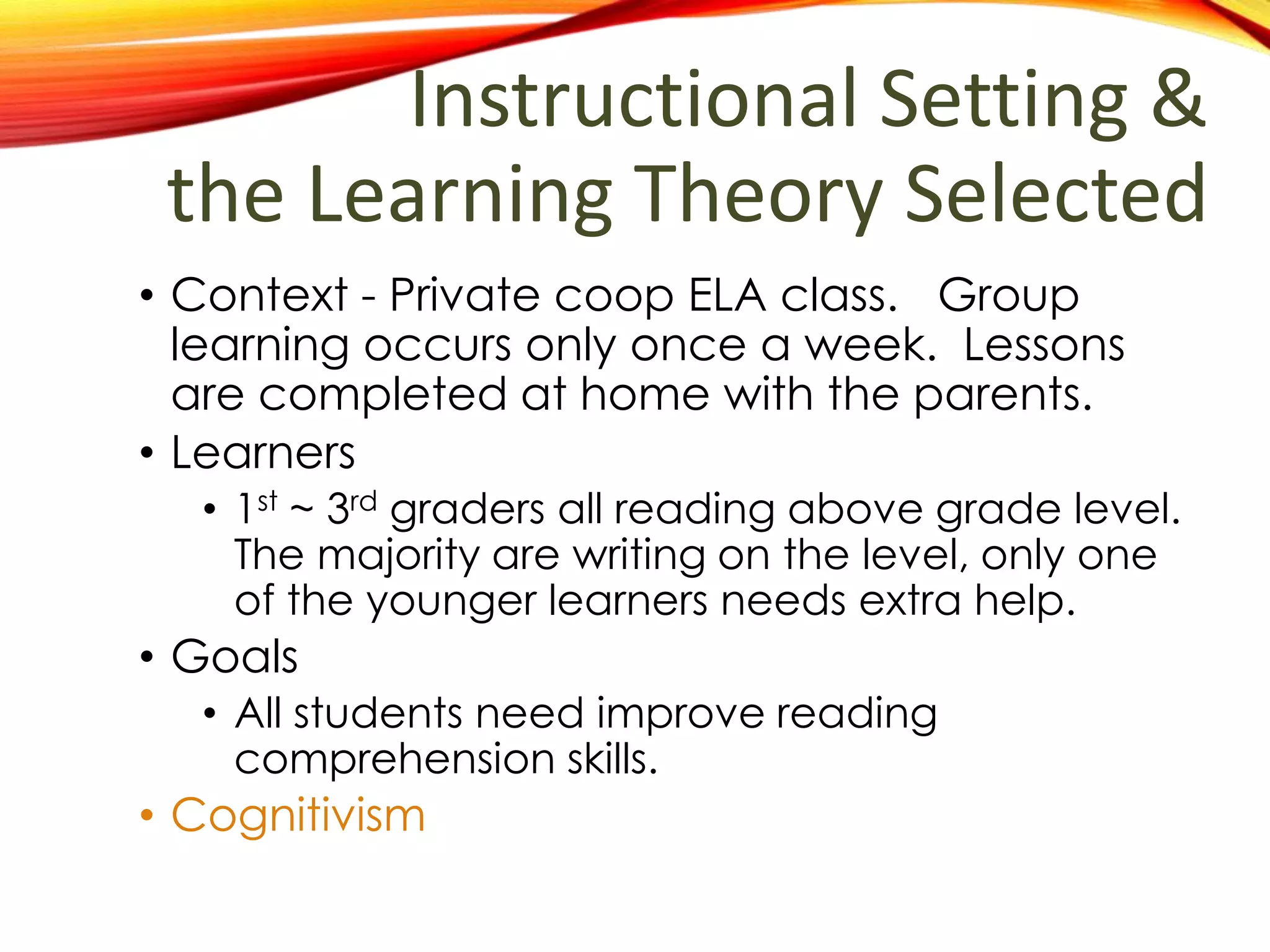
Instructional Setting &
the Learning Theory Selected
• Context - Private coop ELA class. Group
learning occurs only once a week. Lessons
are completed at home with the parents.
• Learners
• 1st
~ 3rd
graders all reading above grade level.
The majority are writing on the level, only one
of the younger learners needs extra help.
• Goals
• All students need improve reading
comprehension skills.
• Cognitivism
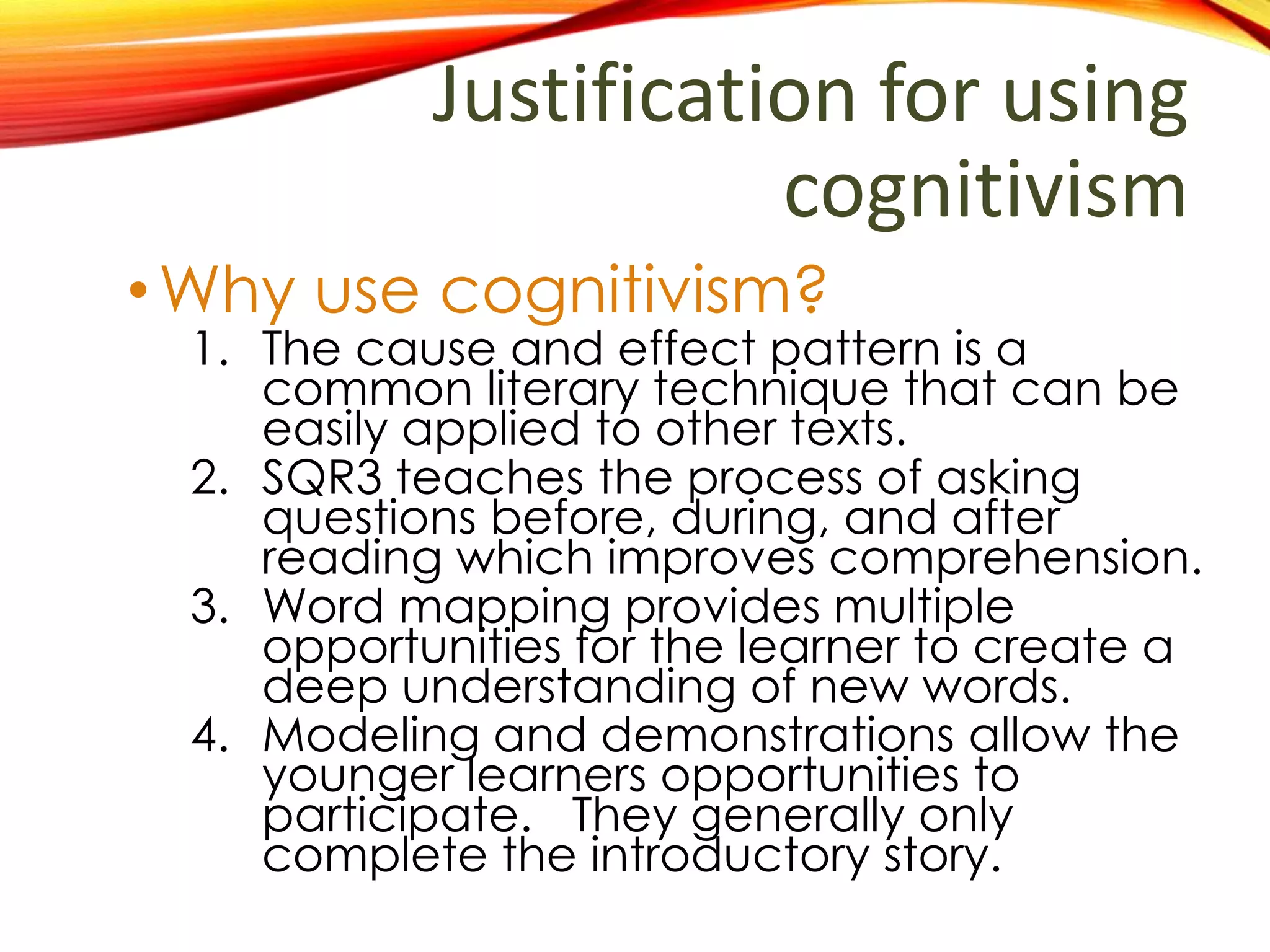
Justification for using
cognitivism
•Why use cognitivism?
1. Cause and effect is a common literary
technique that can be easily applied to
other texts.
2. SQR3 teaches the process of asking
questions before, during, and after
reading which improves comprehension.
3. Word mapping provides multiple
opportunities for the learner to create a
deep understanding of new words.
4. Modeling and demonstrations allow the
younger learners opportunities to
successfully participate. They generally
only complete the introductory story.
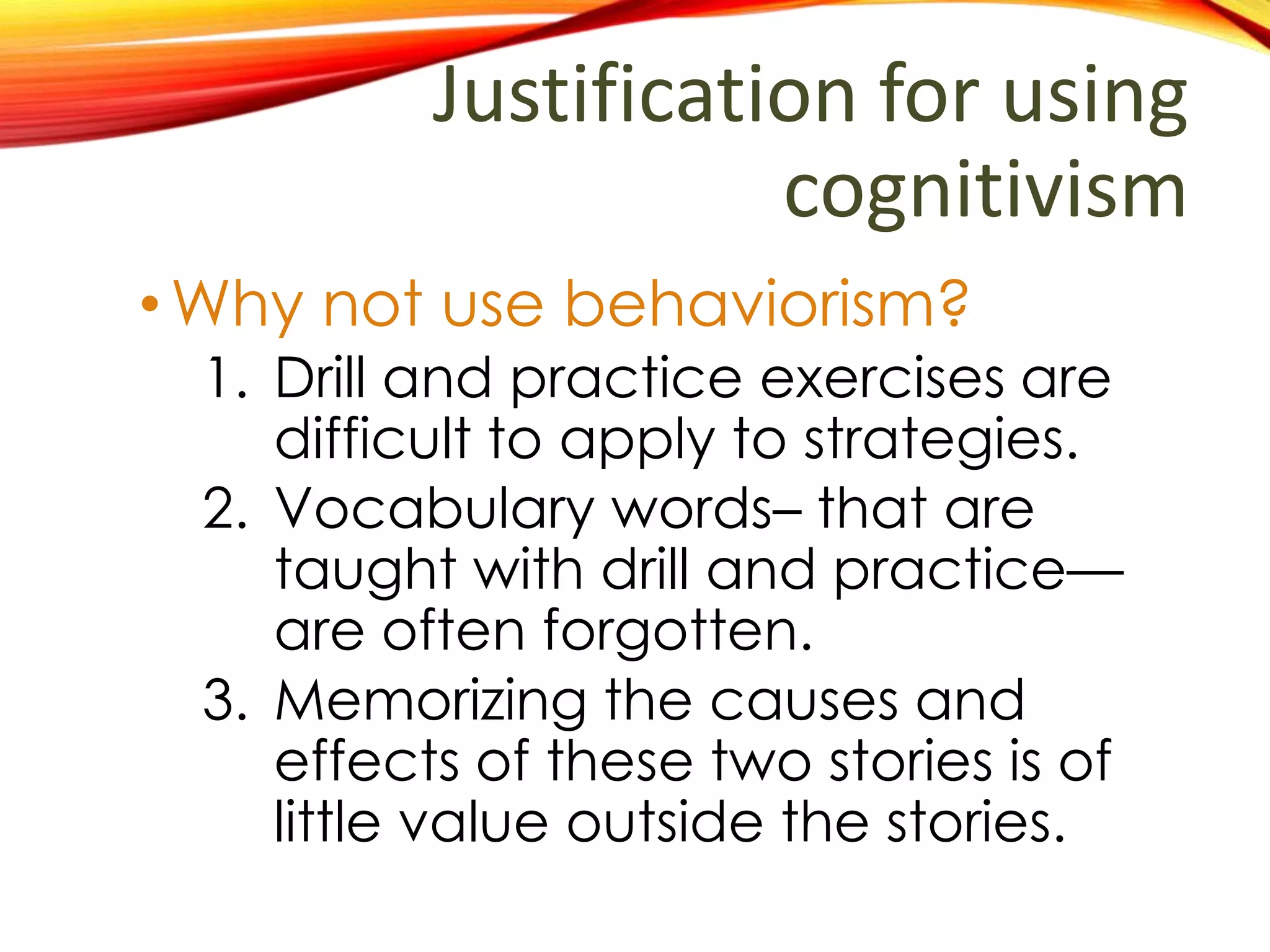
Justification for using
cognitivism
•Why not use behaviorism?
1. Drill and practice exercises is
difficult to apply strategies.
2. Vocabulary taught with drill and
practice is quickly forgotten
when not used.
3. Memorizing the causes and
effects of these two stories is of
little value outside the stories.
Justification for using
cognitivism
•Why not use constructivism?
1. Constructivism was strong option
for this unit; however, it cognitivism
better aligned to the CCSS stated
goals for grade 2.
2. Writing a performing readers
theater may overwhelm some of
the younger learners.
Congratulations !
Justify an instructional theory
used in a specific lesson plan.
Adapt the lesson plan to
each of the three theories.
Analyze a lesson plan by
each of the theories.
Distinguishing learning
theories.
 Define the benefits of a
theory for a learner.
 Definitions and
characteristics of the 3 major
learning theories.
Dear Principal Skinner,
Thank you for allowing me to explain how I use learning
theories in my lessons. I am flattered that you have asked
me to present, again, at in-service.
This month’s topic is the use of the theories of design.
The goals for this month’s topic are as follows:
1. To understand how theories of design can support
lesson plan creation.
2. To know the strengths and weakness of three primary
design theories.
Sincerely,
Doni Dorak
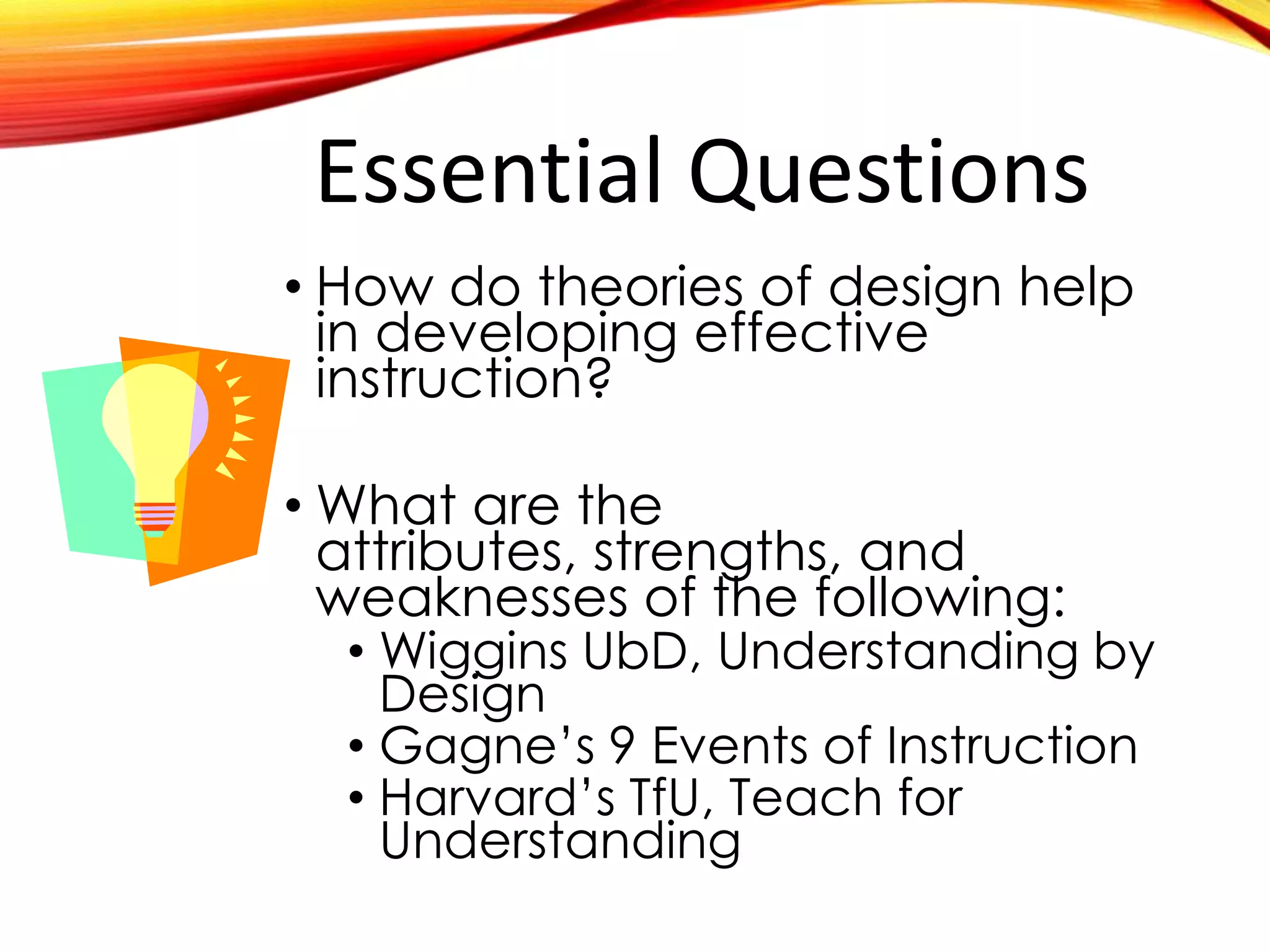
Essential Questions
• How do theories of design help
in developing effective
instruction?
• What are the attributes,
strengths, and weaknesses of
the following:
• Wiggins UbD, Understanding by
Design
• Gagne’s 9 Events of Instruction
• Harvard’s TfU, Teach for
Understanding
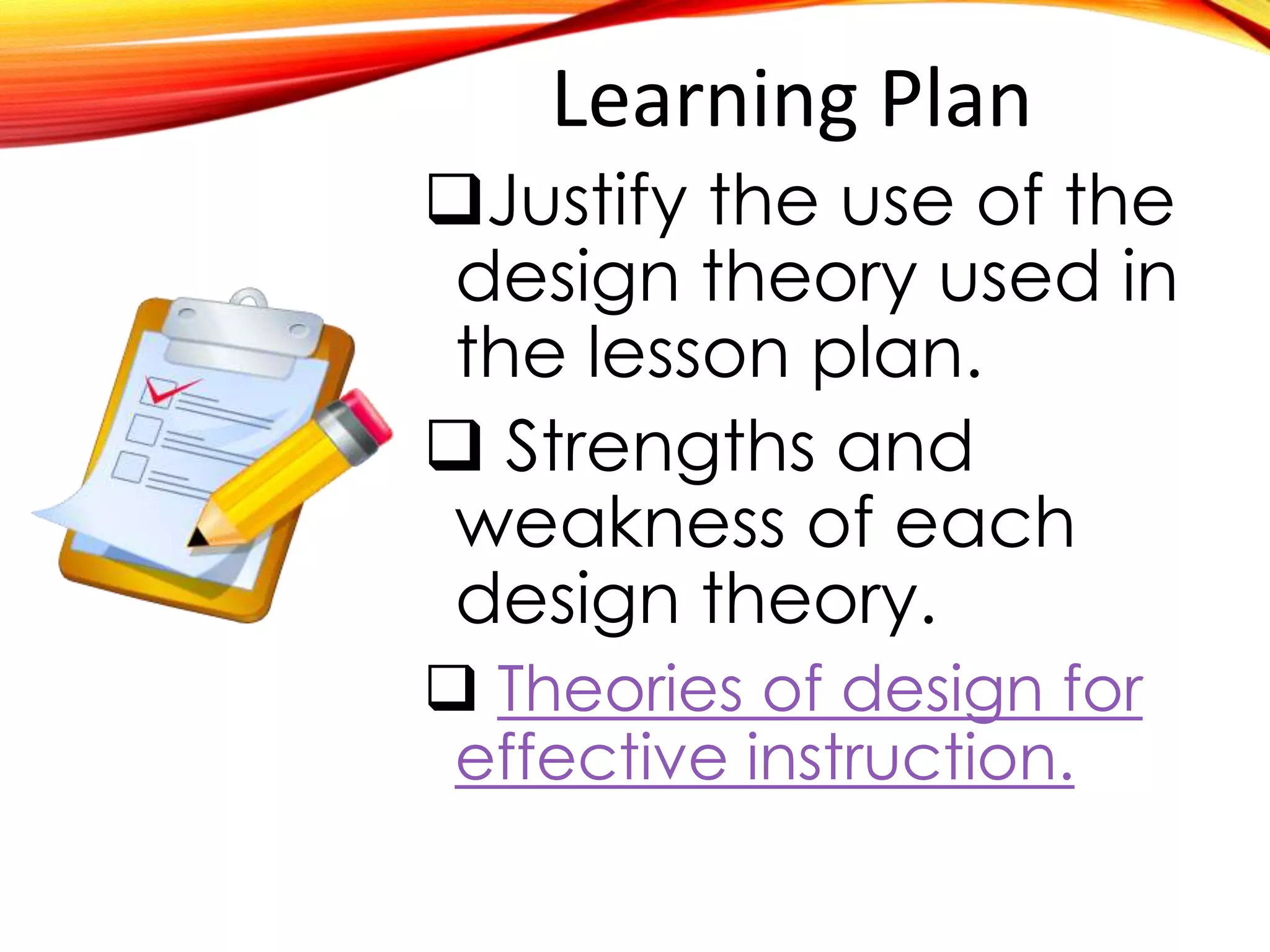
Learning Plan
Justify the use of the
design theory used in
the lesson plan.
 Strengths and
weakness of each
design theory.
 Theories of design for
effective instruction.
Effective Instruction
Through the Use of Design
Theories
Task E
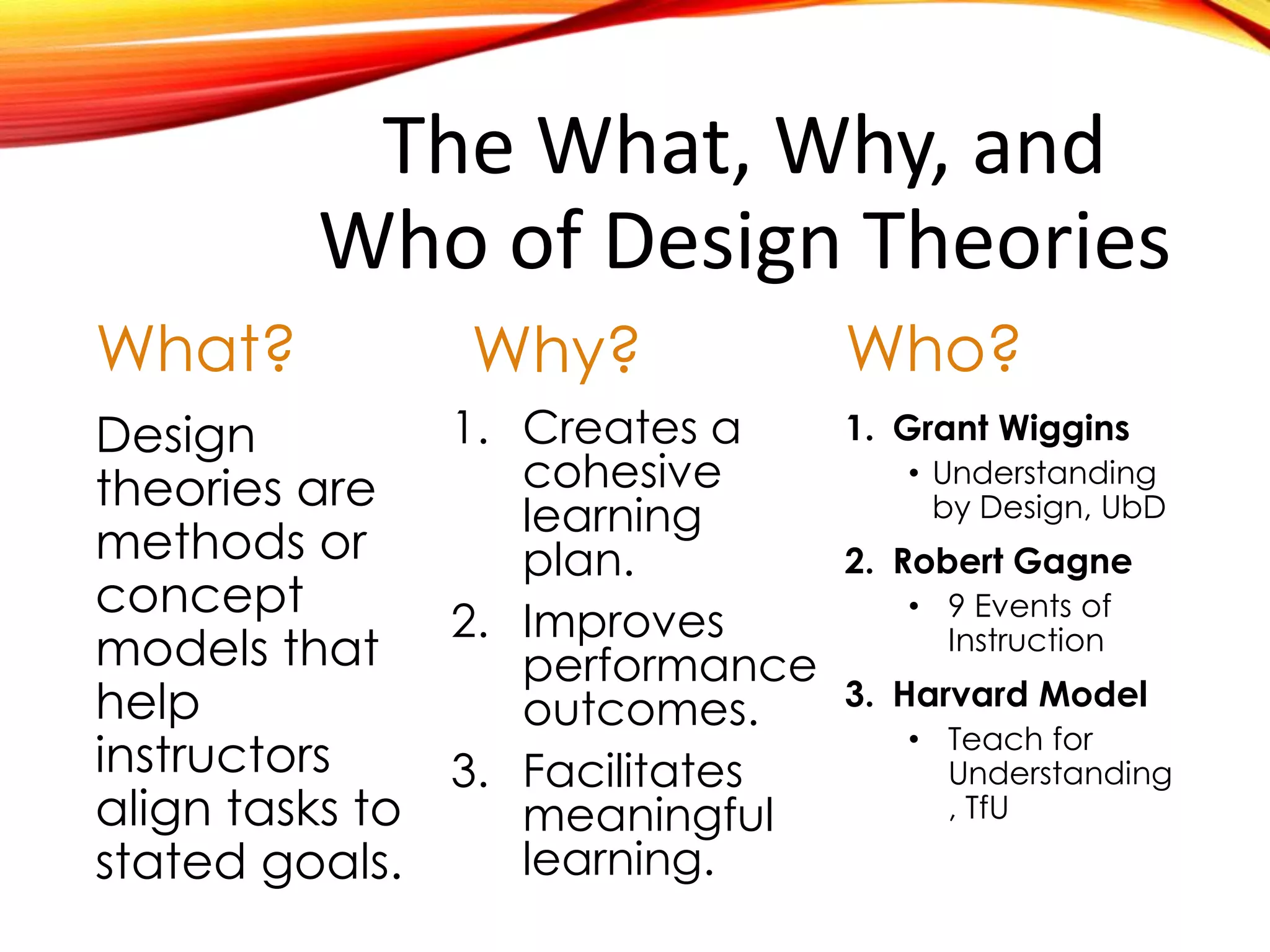
The What, Why, and
Who of Design Theories
What?
Design
theories are
methods or
concept
models that
help
instructors
align tasks to
stated goals.
Why?
1. Creates a
cohesive
learning
plan.
2. Improves
performance
outcomes.
3. Facilitates
meaningful
learning.
Who?
1. Grant Wiggins
• Understanding
by Design, UbD
1. Robert Gagne
• 9 Events of
Instruction
1. Harvard Model
• Teach for
Understanding,
TfU
“
”
Have you ever worked very
hard on a lesson unit and
been frustrated with end
result, or endured a class and
quickly forgot the material?
Please jot down a brief narrative on this experience.
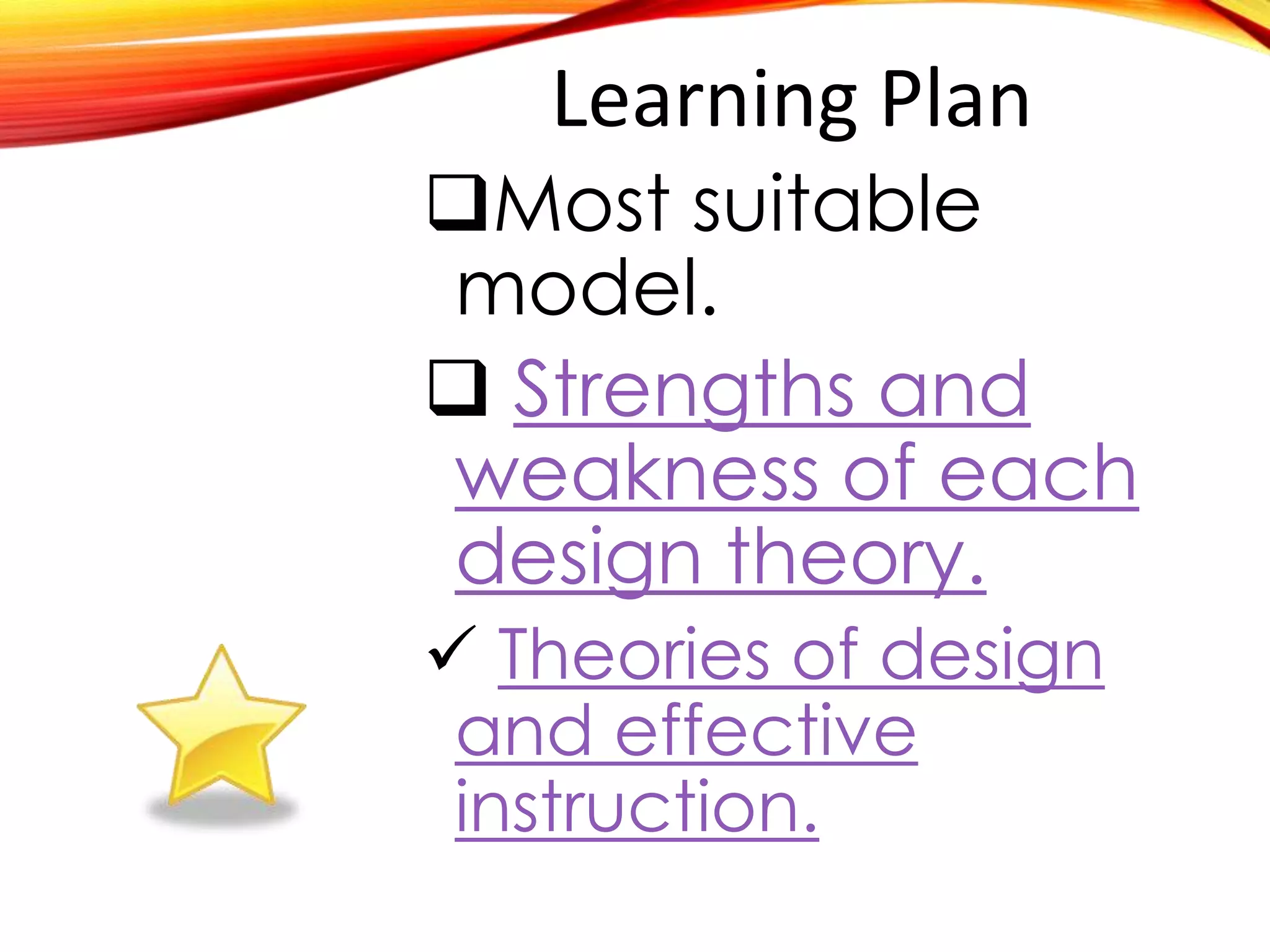
Learning Plan
Most suitable
model.
 Strengths and
weakness of each
design theory.
 Theories of design
and effective
instruction.
Design Theories Overview
Task F
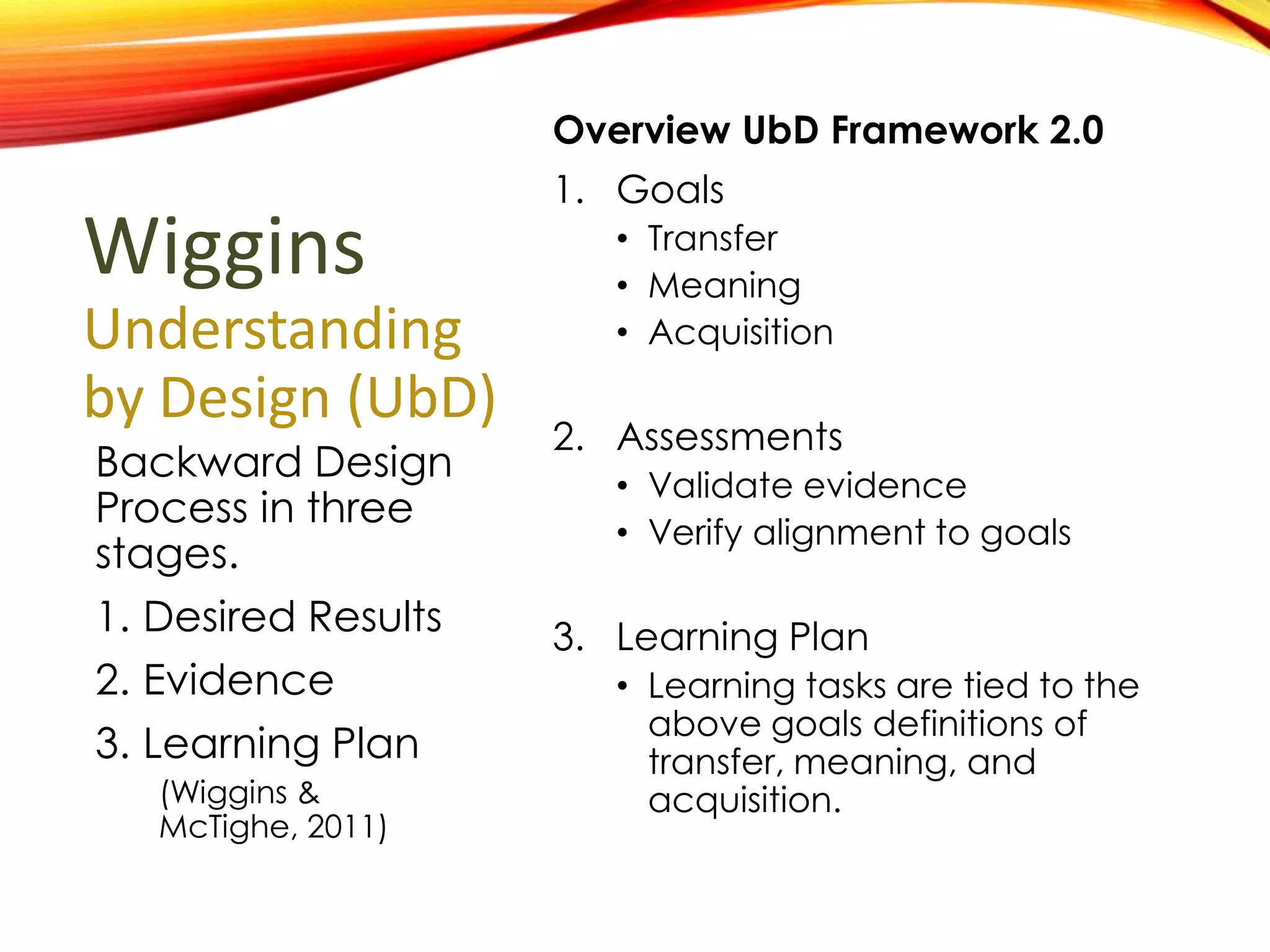
Wiggins
Understanding
by Design (UbD)
Backward Design
Process in three
stages.
1.Desired Results
2.Evidence
3.Learning Plan
(Wiggins & McTighe,
2011)
Overview UbD Framework 2.0
1.Goals
• Transfer
• Meaning
• Acquisition
1.Assessments
• Validate evidence
• Verify alignment to goals
1.Learning Plan
• Learning tasks are tied to the
above goals definitions of
transfer, meaning, and
acquisition.
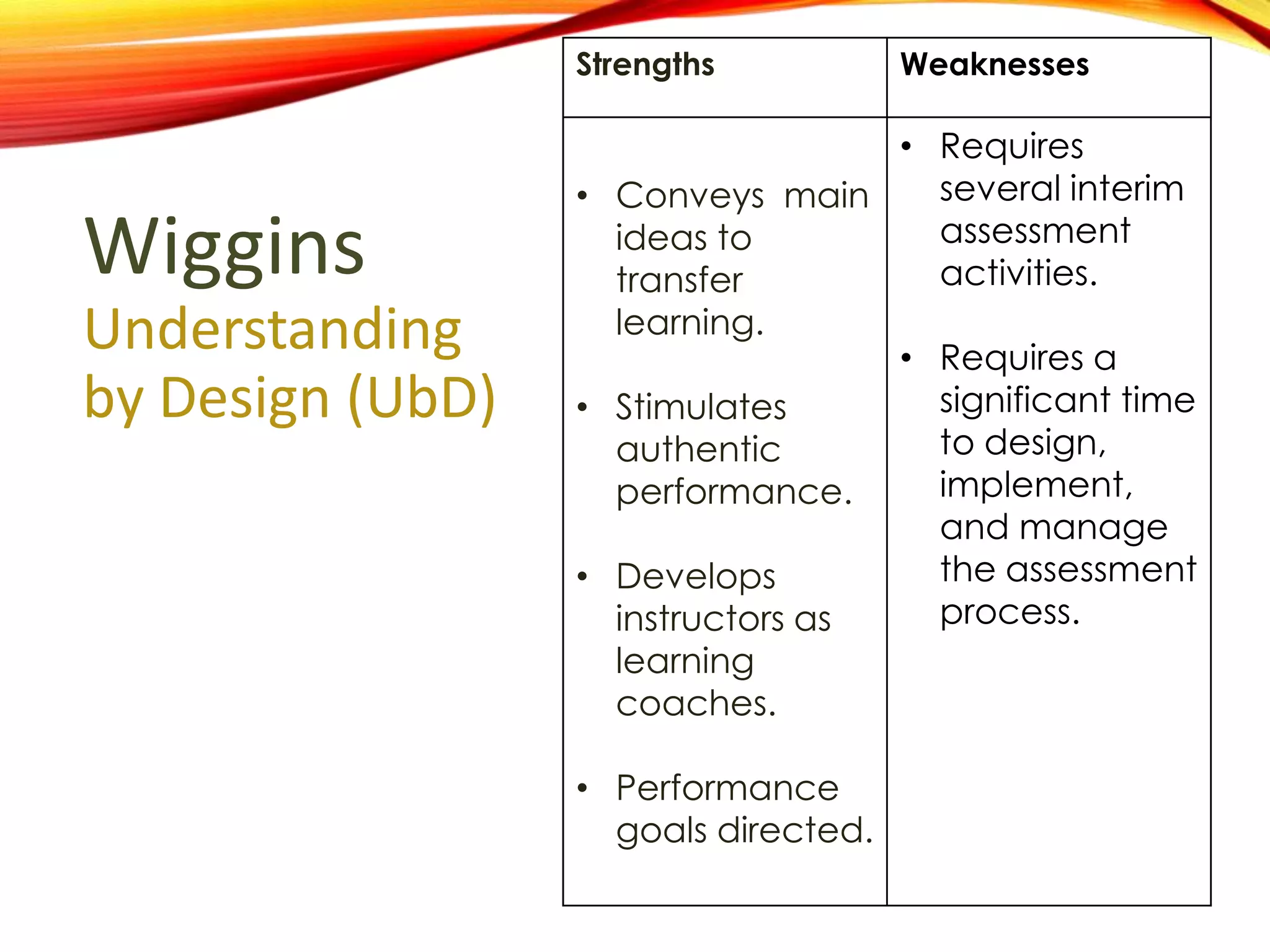
Wiggins
Understanding
by Design (UbD)
Strengths Weaknesses
• Conveys main
ideas to
transfer
learning.
• Stimulates
authentic
performance.
• Develops
instructors as
learning
coaches.
• Performance
goals directed.
• Requires
several interim
assessment
activities.
• Requires a
significant time
to design,
implement,
and manage
the
assessment
process.
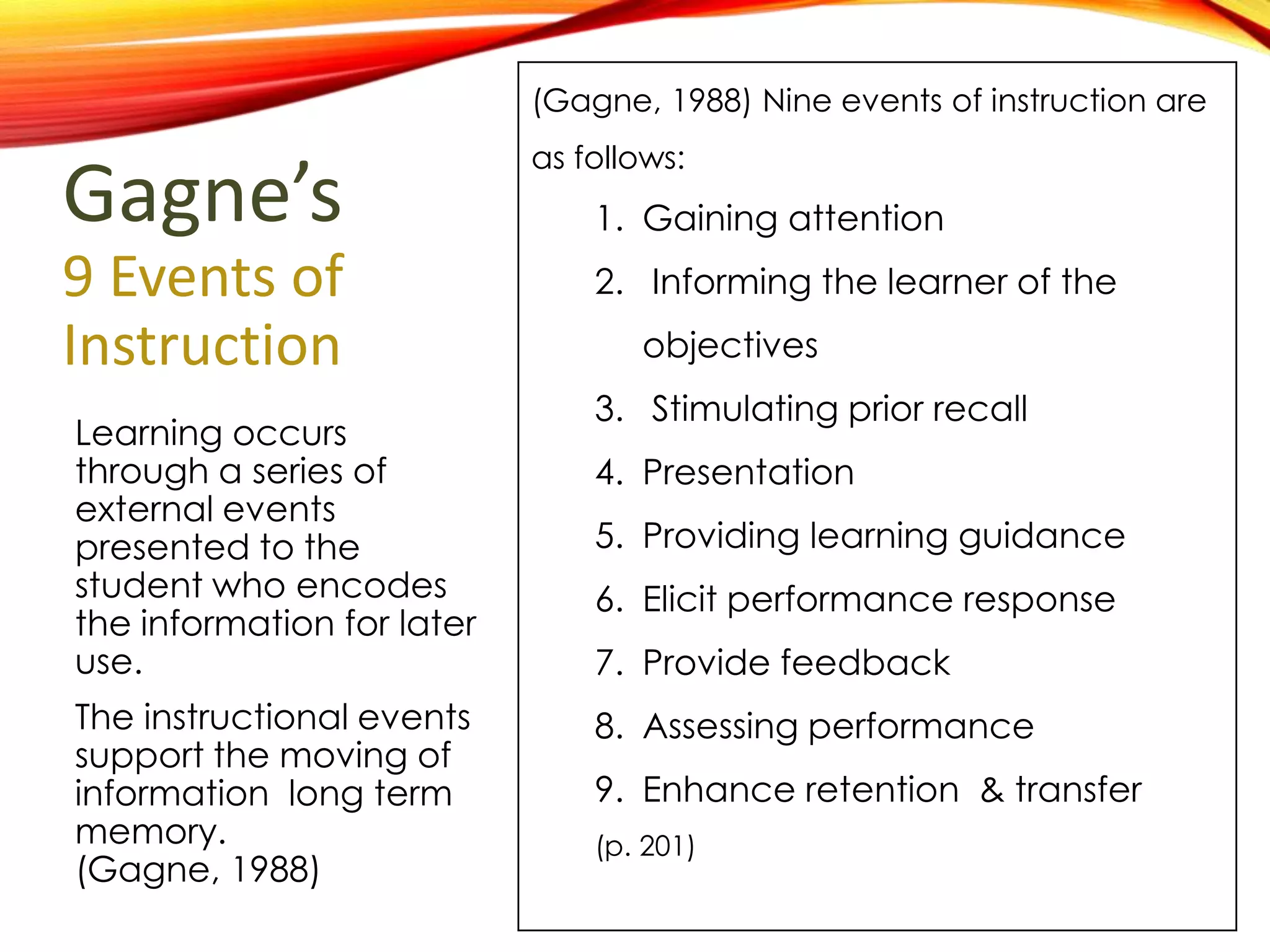
Gagne’s
9 Events of
Instruction
Learning occurs
through a series of
external events
presented to the
student who encodes
the information for
later use.
The instructional events
support the moving of
information long term
memory. (Gagne,
1988)
(Gagne, 1988) Nine events of instruction are
as follows:
1. Gaining attention
2. Informing the learner of the
objectives
3. Stimulating prior recall
4. Presentation
5. Providing learning guidance
6. Elicit performance response
7. Provide feedback
8. Assessing performance
9. Enhance retention & transfer
(p. 201)
Gagne’s
9 Events of
Instruction
Strengths Weaknesses
• States learning
goals
• Builds on prior
knowledge
• Emphasis on
engaging the
learners
attention
• Verifies
understanding
before final
assessment with
feedback
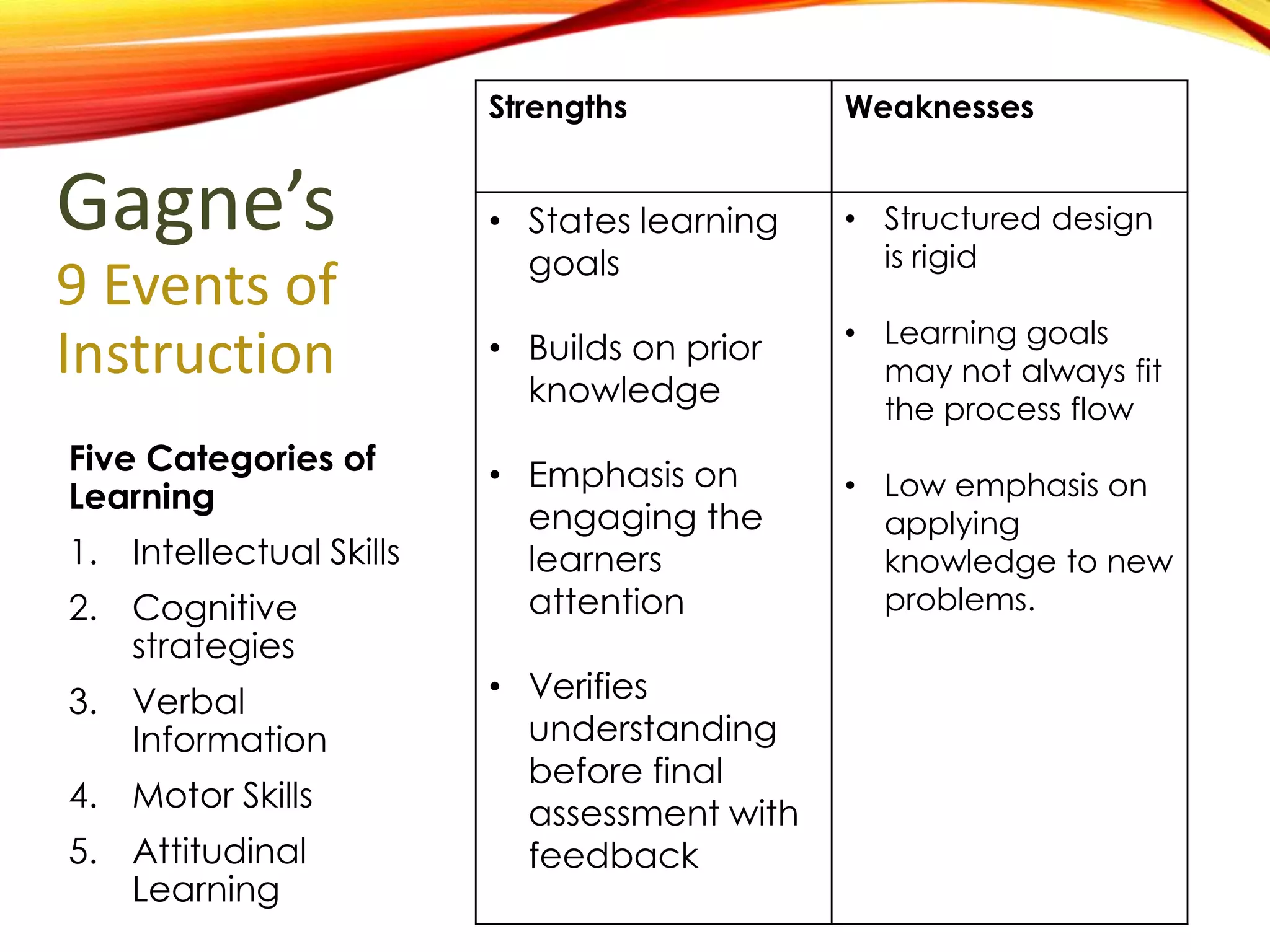
• Structured design
is rigid
• Learning goals
may not always fit
the process flow
• Low emphasis on
applying
knowledge to new
problems.
Five Categories of
Learning
1.Intellectual Skills
2.Cognitive
strategies
3.Verbal Information
4.Motor Skills
5.Attitudinal Learning
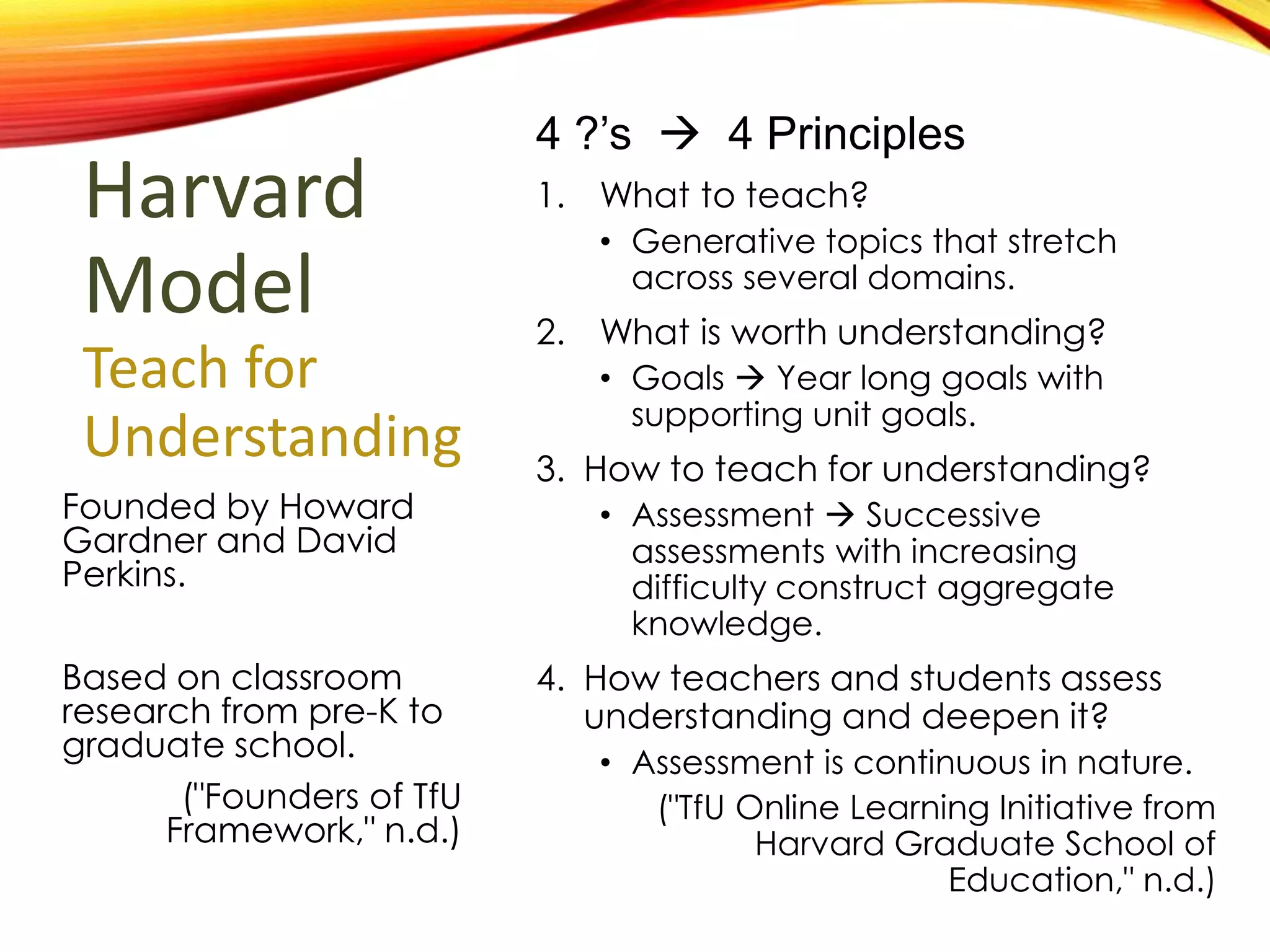
Harvard
Model
Teach for
Understanding
Founded by Howard
Gardner and David
Perkins.
Based on classroom
research from pre-K to
graduate school.
("Founders of TfU
Framework," n.d.)
4 ?’s  4 Principles
1.What to teach?
• Generative topics that stretch
across several domains.
1.What is worth understanding?
• Goals  Year long goals with
supporting unit goals.
1.How to teach for understanding?
• Assessment  Successive
assessments with increasing
difficulty construct aggregate
knowledge.
1.How teachers and students assess
understanding and deepen it?
• Assessment is continuous in nature.
("TfU Online Learning Initiative from
Harvard Graduate School of
Education," n.d.)
Harvard
Model
Teach for
Understanding
Strengths Weaknesses
• Creates
meaningful
learning.
• Encourages
active
thinking
• Supports
collaboratio
n and
diversity of
thought.
• Requires a
long time fully
see results.
• Does not
account for
contingency
of transient
learners. (Jobs
change,
people move)
• Learners are
tethered to
ideas and
subjects they
may not
enjoy.
What is understanding?
The ability to think
and apply earned
knowledge in a
innovative ways to
solve new
problems.
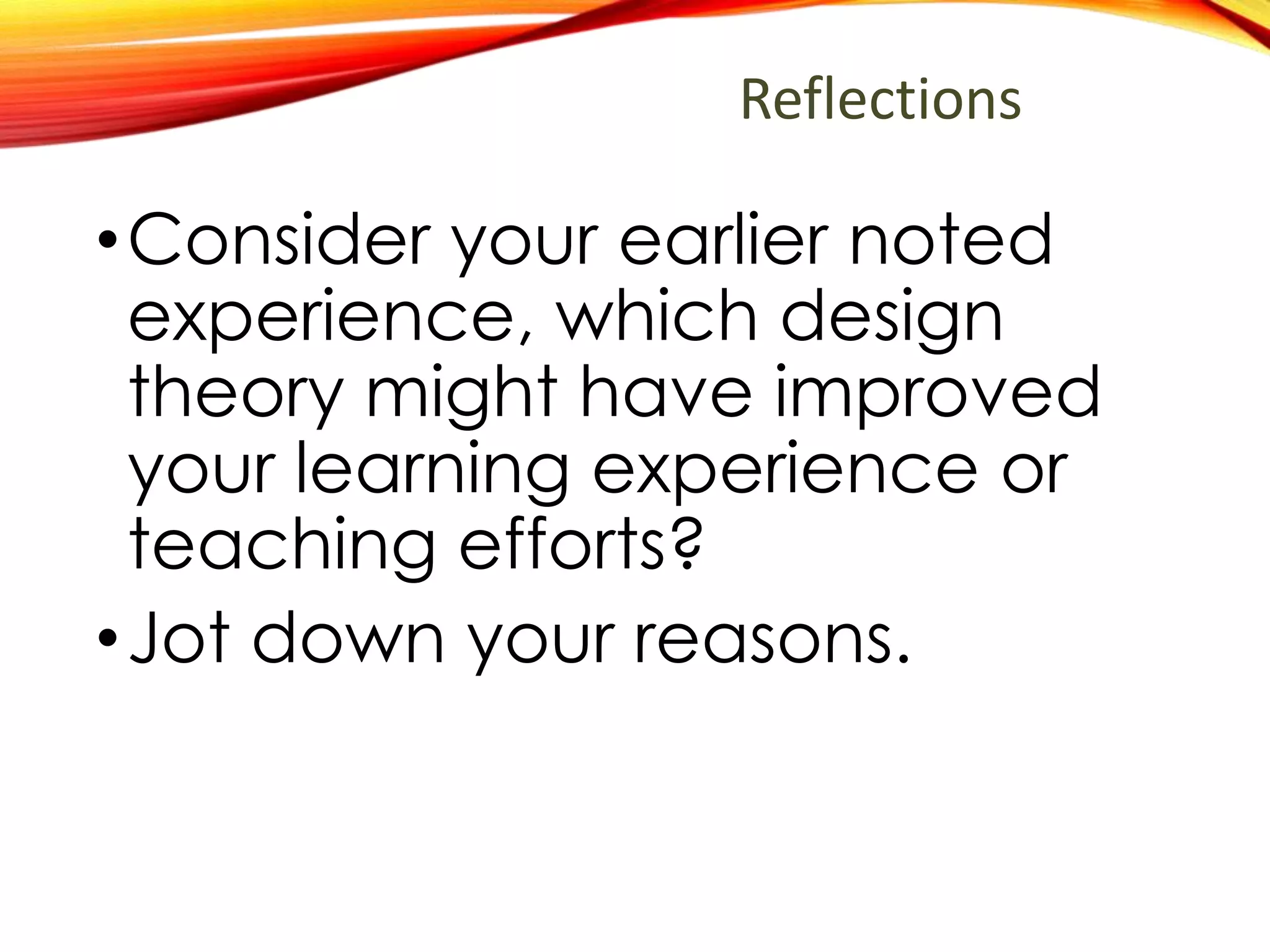
Reflections
•Consider your earlier noted
experience.
•Which design theory might
have improved your learning
experience or teaching
efforts?
•Jot down your reasons.
Learning Plan
Most suitable
model.
 Strengths and
weakness of each
design theory.
 Theories of design
and effective
instruction.
Most Suitable Design
Process
Task G
Teaching for
Understanding(TfU) in my
instructional setting.
• TfU best fits my instructional setting for these
reasons.
• The COOP purpose is to provide supporting
activities that promote understanding of concepts
taught at home.
• Several interim assessments are not possible
parents and parents are unlikely to deliver them.
• Each week, a new idea can be added to the prior
topic.
• Parents support extension activities like research,
field trips, and application outside the classroom.
What theory of design
was used to create these
presentations?
Wiggins Backwards
Design
However, I also employed several
of Gagne’s instructional events, too.
Congratulations
Most suitable
model.
 Strengths and
weakness of each
design theory.
 Theories of design
and effective
instruction.
• Bigge, M. L. (1999). Learning Theories for Teachers (6th ed.).
1999: Addison Wesley Longman, Inc.
• Ertmer, P., & Newby, T. (1999, July 24). Behaviorism, Cognitivism,
Constructivism: Comparing Critical Features from an
Instructional Design Perspective. Performance Improvement
Quarterly, 6(4), 50-72. http://dx.doi.org/Retrieved from
• Gagne, R. (1988). The Events of Instruction. In Principles of
Instructional Design (pp. 185-204). 1988: Harcourt Brace
Jovanovich College Publishers.
• Origins of a framework for effective practice. (n.d.). Retrieved
from http://www.uknow.gse.harvard.edu/learning/LD2-9.html
• Skinner, B. F. (1965). Science and Human Behavior (1st ed.). New
York, New York: The Free Press.
• Teaching for understanding Putting Understanding Up Front.
(n.d.). Retrieved from
http://learnweb.harvard.edu/alps/tfu/index.cfm
• Wiggins, G., & McTighe, J. (2011). The Understanding by Design
Guide to Creating High-Quality Units. Alexandria, VA: ASCD.
References

Learning Theories UbD, TfU, Gagne

  • 1.
    JOT2 – LEARNING THEORIES Student:Doni Dorak ID: 000307557 Mentor: Sarah Black
  • 2.
    Dear Principal Skinner, Ireceived your observation notes on my classroom. It is true; I vary my lessons to fit different learners and different objectives. Per your request, I have created a brief tutorial to share with other teachers, and an example of one of my one lesson units delivered according to three of the major learning theories. The end goals are as follows: 1. Teachers can explain the three learning theories. 2. Teachers can identify these theories and adapt a lesson to the one that best meets their instructional setting and goals. Sincerely, Doni Dorak
  • 3.
    Essential Questions • Whatare the three major learning theories and how to identify one in a lesson plan? • What types of objectives and learners best align to the three theories? • How can a lesson plan be adapted to a learning theory?
  • 4.
    Learning Plan Justify aninstructional theory used in a specific lesson plan. Adapt the lesson plan for the other theories. Analyze a lesson plan and find the theory used. Distinguishing learning theories.  Define the benefits of a theory for a learner.  Definitions and characteristics
  • 5.
  • 6.
    Behaviorism • Keyword –Drill and kill • Purpose- elicit the correct answer from the student by presenting the learner with a correct stimulus. (Ertmer, 2008) • Fathers – Pavlov, Skinner, Thorndike (Bigge, 1999, table 1.1) • Example: Memorizing multiplication tables. 1x1= 1 and 1x2 = 2 Remember Pavlov’s dog? Pavlov elicited the salivation of a dog by associating the sound of a bell with feeding time. Later, B.F Skinner later fathered the Law of Effect which states that reinforced behavior continues and behavior that is ignored is extinguished (Skinner, 1965).
  • 7.
    Cognitivism • Keyword –Patterns and Insights • Purpose- To help students construct mental models that improve retention and facilitate transference. • Fathers – Herbart, Gestalt psychology (Bigge, 1999, table 1.1) • Example: If any number times 1 equals itself, then dog(1)=dog. (Bigge, 1999, p.84) Have you ever used a pattern to solve a problem? Cognitivism is based on the concept of apperception or mental insights; and evolved into Gestalt, a German theory of psychology. The word Gestalt roughly translates to the English word, “pattern”. (Bigge, 1999)
  • 8.
    Constructivism • Keyword –Scaffolding and applications • Purpose- to strengthen competency through application of knowledge. • Fathers – Vygotsky, Piaget, Bruner (Bigge, 1999, table 1.1) • Example: There are 22 students in class, and each has 1 pencil. How many pencils do the students have altogether? Do you use project based learning? Constructivism emphasizes the role of environment, psychological scaffolding, and authentic learning through knowledge application (Bigge, 1999).
  • 9.
    Rote memorization and recall. Buildmental models that support insight and patterns to solve problems. Transfer of knowledge in a scaffold approach, then the learners applies the information in projects. QUIZ Type the theory name that best applies in the textbox. Word Bank Behaviorism, Cognitivism, Constructivism Instructions: Type the theory name that best applies to the follow phrases. SubmitReset
  • 10.
    Learning Plan Justify aninstructional theory used in a specific lesson plan. Adapt the lesson plan for the other theories. Analyze a lesson plan and find the theory used. Distinguishing learning theories.  Define the benefits of a theory  Definitions and characteristics
  • 11.
    When Behaviorism is Beneficialfor Learners • Guidelines • When cognition is low or is not required. • When speed and repetition improve performance. • When facts are static. • When the knowledge is procedural or arbitrary. • Examples: Handwriting. Counting. Time sheets. Checking out a book from the library. Staying seated in class.
  • 12.
    When Cognitivism is Beneficialfor Learners • When theories, rules, or natural laws have a broad application. • When a student is first learning or defining a process or concept. • When the information being taught has categories or patterns that can be chunked together for better recall. • Examples: Story Maps, T-Charts, Webbing, Schemas Circle Plots and Life Cycles Design Patterns Unified Model Language (UML) Mathematical theories
  • 13.
    When is Constructivism Beneficialfor Learners • When the information is being learned is has a strong cultural context. • When the information being learned supports decision processes. • When the information is scientific and requires deductive reasoning to support inferred ideas or hypothesis. • Examples Authentic learning – How MLK changed your town? Big6 Literacy Skills -- Research skills and cooperative learning Web Quests KWL Charts Field Trips
  • 14.
    How to loginto a school library and renew a book? Text to text comparison of two circle plot stories. Web Quest on the impact of Civil Rights Act of 1964. QUIZ Type the theory name that best applies in the textbox. Word Bank Behaviorism, Cognitivism, Constructivism Instructions: Type the theory name that best applies to the follow learning tasks. SubmitReset
  • 15.
    Learning Plan Justify aninstructional theory used in a specific lesson plan. Adapt the lesson plan for the other theories. Analyze a lesson plan and find the theory used. Distinguishing learning theories  Define the benefits of a theory  Definitions and characteristics
  • 16.
    How to Distinguish LearningTheories Five questions to distinguish learning theories 1. How does the learning occur? 2. Which factors influence learning? 3. What is the role of memory? 4. How does transfer occur? 5. What types of learning are best explained by the theory? (p. 53) (Ertmer & Newby, 1993) states the following:
  • 17.
    Behaviorism 1. Learning isa function of cues or stimulus and referenced responses. 2. Observable performance is must be evident. 3. Control and manipulations of the environment is critical to the instructional setting. 4. Memory occurs in two phases • Information is learned placed in short-term memory. • Practice causes the knowledge to placed in long-term memory. 1. Transfer occurs when the learner applies the knowledge to problem with common elements. 2. Types of learning that are best supported: • Procedural • Static facts
  • 18.
    Cognitivism 1. Learning isprocess of organizing information into conceptualized models. 2. Learning is influenced by goal setting, mental planning, and practice. 3. Memory is support by the organization of the material. 4. Transfer is evident when knowledge is applied to a similarly constructed problem. 5. Types of learning that are best supported: • Analogies, metaphors • Literary Patterns • Mathematical theorems • Broad concepts that can be reapplied
  • 19.
    Constructivism 1. Learning isan extension of personal experience, culture, and prior knowledge. 2. Learning occurs through interaction with environment and other people. 3. Three Factors: practice, concepts, and culture (Ertmer & Newby, 1993, p.63) 4. Learning occurs through meaningful interactions and authentic learning tasks. 5. What types of learning are best explained by the theory? • Ill structured problems • Scientific inquiry
  • 20.
    Learning Plan Justify aninstructional theory used in a specific lesson plan. Adapt the lesson plan for the other theories. Analyze a lesson plan and find Distinguishing learning theories  Define the benefits of a theory  Definitions and characteristics
  • 21.
    Learning Theory Usedin Lesson Plan Task B
  • 22.
    Overview of theLesson PlanGoal: Improve reading comprehension using curriculum designated story, the Mexican folktale, Half-Chicken. • Objectives ( Starting at page 42 in the document) • Learner activates the SQR3 method of study. • Learner uses word mapping to insure he understands the vocabulary of the story. • Learner recognizes “Cause and Effect” in different texts. • Learner can summarize and retell the story in his own words.
  • 23.
    How does the learningoccur in this plan? • The learning occurs by teaching conceptualized models using graphical organizers and mnemonics. • The student uses word maps to insure he fully understands the vocabulary words in the context of the introductory story, The Mouse and the Lion. The vocabulary overlaps the two stories. • The student uses a SQR3 response sheet to guide the process. • The student creates a cause and effect chart for both stories, but the teacher models the first. • The student uses a graphical organizer to summarize and rewrite the story.
  • 24.
    What factors influence learningin this plan? • The factors influencing learning are teacher demonstrations and the organization of the information. • Tasks are centered on improving comprehension through the use of models and patterns. • Graphical organization and Mnemonics • Strengthen vocabulary • Recognize Cause and Effect • Teach comprehension study skills • Demonstration followed by application
  • 25.
    What is therole of memory in this plan? •Organization is central to signaling the information from the learner. •Use of graphical organizers. •Use of mnemonics to teach an approach to study.
  • 26.
    How does transfer occurin this plan? •Knowledge and application of cause and effect are evident one context and applied to another. • Using the story, The Mouse and Lion, the teacher demonstrates key concepts using models; afterwards, the students apply the ideas to the story, Half Chicken.
  • 27.
    What type oflearning is happening in this plan? •Recognition of literary patterns, use of mnemonics to teach a concept, use organizers to strength word understanding. • This plan is teaching information processing by applying standard graphical organizers, recognized study methods, and vocabulary strengthening exercises.
  • 28.
    What is thelearning theory in this lesson plan? Cognitivism Defining patterns and structures that can be transferred to similar problems with mental insight.
  • 29.
    Learning Plan Justify aninstructional theory used in a specific lesson plan. Adapt the lesson plan for the o Analyze a lesson plan and find Distinguishing learning theories  Define the benefits of a theory  Definitions and characteristics
  • 30.
  • 31.
    Adapting the lesson forbehaviorism 1. Replace word mapping activities with flash cards. 2. Ask the students to memorize the meaning of SQR3? 3. Using page 46, ask the students write the definitions of the each vocabulary word. 4. Give a star for correct responses. 5. Drill the correct responses for cause and effect using the story, The Lion and the Mouse. 6. After teaching the vocabulary and cause and effect, test the students using the story, Half Chicken.
  • 32.
    Adapting the lesson forconstructivism 1. Use the cards in the lesson to play vocabulary dominoes. 2. After modeling cause and effect, have students fill in the cause and effect chart without the cut and paste answers. 3. Using page 46, ask the students to construct sentences using the vocabulary words. 4. Replace the “Make a Movie” activity with a create a script activity. Instruct the children to act-out the story as a readers’ theater. 5. Have the children retell the story and change the setting, animals, and elements to reflect their own cultural heritage and context.
  • 33.
    Learning Plan Justify aninstructional theory u Adapt the lesson plan for the o Analyze a lesson plan and find Distinguishing learning theories  Define the benefits of a theory  Definitions and characteristics
  • 34.
  • 35.
    Instructional Setting & theLearning Theory Selected • Context - Private coop ELA class. Group learning occurs only once a week. Lessons are completed at home with the parents. • Learners • 1st ~ 3rd graders all reading above grade level. The majority are writing on the level, only one of the younger learners needs extra help. • Goals • All students need improve reading comprehension skills. • Cognitivism
  • 36.
    Justification for using cognitivism •Whyuse cognitivism? 1. Cause and effect is a common literary technique that can be easily applied to other texts. 2. SQR3 teaches the process of asking questions before, during, and after reading which improves comprehension. 3. Word mapping provides multiple opportunities for the learner to create a deep understanding of new words. 4. Modeling and demonstrations allow the younger learners opportunities to successfully participate. They generally only complete the introductory story.
  • 37.
    Justification for using cognitivism •Whynot use behaviorism? 1. Drill and practice exercises is difficult to apply strategies. 2. Vocabulary taught with drill and practice is quickly forgotten when not used. 3. Memorizing the causes and effects of these two stories is of little value outside the stories.
  • 38.
    Justification for using cognitivism •Whynot use constructivism? 1. Constructivism was strong option for this unit; however, it cognitivism better aligned to the CCSS stated goals for grade 2. 2. Writing a performing readers theater may overwhelm some of the younger learners.
  • 39.
    Congratulations ! Justify aninstructional theory used in a specific lesson plan. Adapt the lesson plan to each of the three theories. Analyze a lesson plan by each of the theories. Distinguishing learning theories.  Define the benefits of a theory for a learner.  Definitions and characteristics of the 3 major learning theories.
  • 40.
    Dear Principal Skinner, Thankyou for allowing me to explain how I use learning theories in my lessons. I am flattered that you have asked me to present, again, at in-service. This month’s topic is the use of the theories of design. The goals for this month’s topic are as follows: 1. To understand how theories of design can support lesson plan creation. 2. To know the strengths and weakness of three primary design theories. Sincerely, Doni Dorak
  • 41.
    Essential Questions • Howdo theories of design help in developing effective instruction? • What are the attributes, strengths, and weaknesses of the following: • Wiggins UbD, Understanding by Design • Gagne’s 9 Events of Instruction • Harvard’s TfU, Teach for Understanding
  • 42.
    Learning Plan Justify theuse of the design theory used in the lesson plan.  Strengths and weakness of each design theory.  Theories of design for effective instruction.
  • 43.
    Effective Instruction Through theUse of Design Theories Task E
  • 44.
    The What, Why,and Who of Design Theories What? Design theories are methods or concept models that help instructors align tasks to stated goals. Why? 1. Creates a cohesive learning plan. 2. Improves performance outcomes. 3. Facilitates meaningful learning. Who? 1. Grant Wiggins • Understanding by Design, UbD 1. Robert Gagne • 9 Events of Instruction 1. Harvard Model • Teach for Understanding, TfU
  • 45.
    “ ” Have you everworked very hard on a lesson unit and been frustrated with end result, or endured a class and quickly forgot the material? Please jot down a brief narrative on this experience.
  • 46.
    Learning Plan Most suitable model. Strengths and weakness of each design theory.  Theories of design and effective instruction.
  • 47.
  • 48.
    Wiggins Understanding by Design (UbD) BackwardDesign Process in three stages. 1.Desired Results 2.Evidence 3.Learning Plan (Wiggins & McTighe, 2011) Overview UbD Framework 2.0 1.Goals • Transfer • Meaning • Acquisition 1.Assessments • Validate evidence • Verify alignment to goals 1.Learning Plan • Learning tasks are tied to the above goals definitions of transfer, meaning, and acquisition.
  • 49.
    Wiggins Understanding by Design (UbD) StrengthsWeaknesses • Conveys main ideas to transfer learning. • Stimulates authentic performance. • Develops instructors as learning coaches. • Performance goals directed. • Requires several interim assessment activities. • Requires a significant time to design, implement, and manage the assessment process.
  • 50.
    Gagne’s 9 Events of Instruction Learningoccurs through a series of external events presented to the student who encodes the information for later use. The instructional events support the moving of information long term memory. (Gagne, 1988) (Gagne, 1988) Nine events of instruction are as follows: 1. Gaining attention 2. Informing the learner of the objectives 3. Stimulating prior recall 4. Presentation 5. Providing learning guidance 6. Elicit performance response 7. Provide feedback 8. Assessing performance 9. Enhance retention & transfer (p. 201)
  • 51.
    Gagne’s 9 Events of Instruction StrengthsWeaknesses • States learning goals • Builds on prior knowledge • Emphasis on engaging the learners attention • Verifies understanding before final assessment with feedback • Structured design is rigid • Learning goals may not always fit the process flow • Low emphasis on applying knowledge to new problems. Five Categories of Learning 1.Intellectual Skills 2.Cognitive strategies 3.Verbal Information 4.Motor Skills 5.Attitudinal Learning
  • 52.
    Harvard Model Teach for Understanding Founded byHoward Gardner and David Perkins. Based on classroom research from pre-K to graduate school. ("Founders of TfU Framework," n.d.) 4 ?’s  4 Principles 1.What to teach? • Generative topics that stretch across several domains. 1.What is worth understanding? • Goals  Year long goals with supporting unit goals. 1.How to teach for understanding? • Assessment  Successive assessments with increasing difficulty construct aggregate knowledge. 1.How teachers and students assess understanding and deepen it? • Assessment is continuous in nature. ("TfU Online Learning Initiative from Harvard Graduate School of Education," n.d.)
  • 53.
    Harvard Model Teach for Understanding Strengths Weaknesses •Creates meaningful learning. • Encourages active thinking • Supports collaboratio n and diversity of thought. • Requires a long time fully see results. • Does not account for contingency of transient learners. (Jobs change, people move) • Learners are tethered to ideas and subjects they may not enjoy. What is understanding? The ability to think and apply earned knowledge in a innovative ways to solve new problems.
  • 54.
    Reflections •Consider your earliernoted experience. •Which design theory might have improved your learning experience or teaching efforts? •Jot down your reasons.
  • 55.
    Learning Plan Most suitable model. Strengths and weakness of each design theory.  Theories of design and effective instruction.
  • 56.
  • 57.
    Teaching for Understanding(TfU) inmy instructional setting. • TfU best fits my instructional setting for these reasons. • The COOP purpose is to provide supporting activities that promote understanding of concepts taught at home. • Several interim assessments are not possible parents and parents are unlikely to deliver them. • Each week, a new idea can be added to the prior topic. • Parents support extension activities like research, field trips, and application outside the classroom.
  • 58.
    What theory ofdesign was used to create these presentations? Wiggins Backwards Design However, I also employed several of Gagne’s instructional events, too.
  • 59.
    Congratulations Most suitable model.  Strengthsand weakness of each design theory.  Theories of design and effective instruction.
  • 60.
    • Bigge, M.L. (1999). Learning Theories for Teachers (6th ed.). 1999: Addison Wesley Longman, Inc. • Ertmer, P., & Newby, T. (1999, July 24). Behaviorism, Cognitivism, Constructivism: Comparing Critical Features from an Instructional Design Perspective. Performance Improvement Quarterly, 6(4), 50-72. http://dx.doi.org/Retrieved from • Gagne, R. (1988). The Events of Instruction. In Principles of Instructional Design (pp. 185-204). 1988: Harcourt Brace Jovanovich College Publishers. • Origins of a framework for effective practice. (n.d.). Retrieved from http://www.uknow.gse.harvard.edu/learning/LD2-9.html • Skinner, B. F. (1965). Science and Human Behavior (1st ed.). New York, New York: The Free Press. • Teaching for understanding Putting Understanding Up Front. (n.d.). Retrieved from http://learnweb.harvard.edu/alps/tfu/index.cfm • Wiggins, G., & McTighe, J. (2011). The Understanding by Design Guide to Creating High-Quality Units. Alexandria, VA: ASCD. References