Reservoir Rocks
By
Tausif Ahmad
“The rock, which is porous and permeable, contains oil and gas becomes a
reservoir rock.”
OR
“Permeable subsurface rock that contains petroleum”
 It can be different from source rock with respect to grain size and pore
spaces.
 Nearly all rocks are reservoir and can be classified accordingly as
i. Clastic Rocks
ii. Carbonate Rocks
iii. Igneous/Metamorphic Rocks
i. Clastic Rocks
 Aggregates of a particle, fragments of older rocks
 Range in size from fine clay to boulder size forming various clastic rocks,
including claystone, shale, siltstone, sandstone, conglomerates.
 Most important reservoir rocks in this category are sandstone and sometimes
conglomerate due to porosity and permeability. The fractured shale reservoir is
also possible but uncommon in nature.
ii. Carbonate Rocks
 Formed by chemical precipitation or biological precipitation.
 The most important reservoir in this category are limestone and dolomite.
Reservoir Rocks Properties
There are two main properties on the basis of which reservoir quality of rocks
is controlled.
i. Porosity
ii. Permeability
i. Porosity
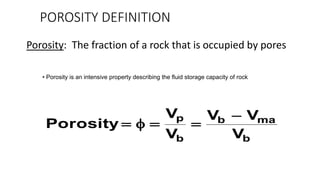
“It is the ratio of pore spaces volume to the total volume (bulk volume)
of a reservoir rock.”
 It is expressed in %age.
 Mathematically: Porosity (ϕ) = Pore volume/Bulk volume x 100
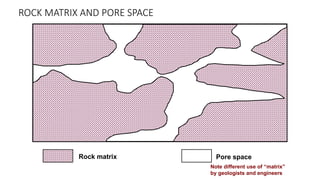
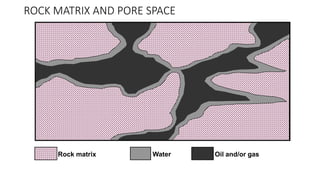
ROCK MATRIX AND PORE SPACE
Rock matrix Pore space
Note different use of “matrix”
by geologists and engineers
Porosity: The fraction of a rock that is occupied by pores
b
ma
b
b
p
V
V
V
V
V
Porosity





POROSITY DEFINITION
• Porosity is an intensive property describing the fluid storage capacity of rock
ROCK MATRIX AND PORE SPACE
Rock matrix Water Oil and/or gas
iii. Igneous/Metamorphic Rocks
 These are rare comparatively to clastic and carbonate reservoir
rocks, from which commercial oil and gas are produced.
 e.g., there are number of volcanic oil fields, which contains oil and
gas includes: Columbia Plateaue of Washington and Oregon, the
Mexico-Arizona Volcanic field, the Deccan Traps of India and
volcanic of pacific.
Porosity on the basis of origin
i. Primary Porosity
ii. Secondary Porosity
i. Primary Porosity
 Porosity which developed at time of deposition.
 Depends upon; size, shape and pattern of arrangement of grains
 e.g., uniform grain size higher the porosity, perfectly rounded shape higher the porosity. In
last when packing is cubic of same size grain higher the porosity (47.6%) rather than
rhombohedral grains (25.9%).
ii. Secondary Porosity
 Porosity which is developed after the sedimentation process due to physical and chemical
effects.
 The physical and chemical effects includes
i. Compaction
ii. Fracturing
iii. Dissolution
iv. Cementation
v. Recrystallization
vi. Dolomitization
Porosity based on the pore space connectivity
Both primary and secondary porosity could be:
i. Absolute Porosity
ii. Effective Porosity
i. Absolute Porosity
 The ratio of total volume of pore spaces to total volume of rock
ii. Effective Porosity
 The ratio of the volume of interconnected pore spaces to thetotal volume of the rock.
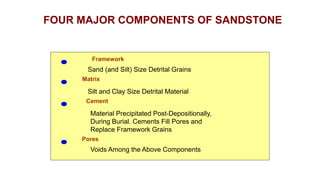
Framework
Matrix
Cement
Pores
Sand (and Silt) Size Detrital Grains
Silt and Clay Size Detrital Material
Material Precipitated Post-Depositionally,
During Burial. Cements Fill Pores and
Replace Framework Grains
Voids Among the Above Components
FOUR MAJOR COMPONENTS OF SANDSTONE
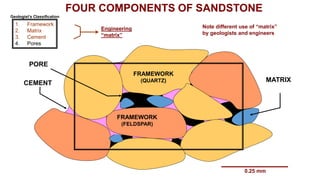
FOUR COMPONENTS OF SANDSTONE
MATRIX
FRAMEWORK
(QUARTZ)
FRAMEWORK
(FELDSPAR)
CEMENT
PORE
Note different use of “matrix”
by geologists and engineers
0.25 mm
1. Framework
2. Matrix
3. Cement
4. Pores
Engineering
“matrix”
Geologist’s Classification
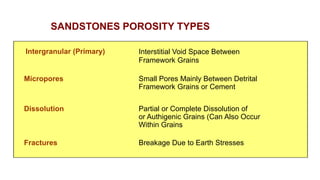
SANDSTONES POROSITY TYPES
Intergranular (Primary)
Dissolution
Micropores
Fractures
Interstitial Void Space Between
Framework Grains
Partial or Complete Dissolution of
Framework Grains or Cement
Small Pores Mainly Between Detrital
or Authigenic Grains (Can Also Occur
Within Grains
Breakage Due to Earth Stresses
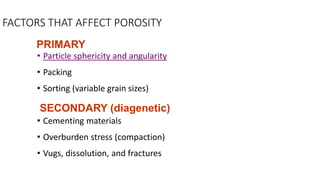
FACTORS THAT AFFECT POROSITY
• Particle sphericity and angularity
• Packing
• Sorting (variable grain sizes)
• Cementing materials
• Overburden stress (compaction)
• Vugs, dissolution, and fractures
PRIMARY
SECONDARY (diagenetic)
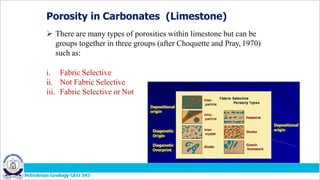
Porosity in Carbonates (Limestone)
 There are many types of porosities within limestone but can be
groups together in three groups (after Choquette and Pray, 1970)
such as:
i. Fabric Selective
ii. Not Fabric Selective
iii. Fabric Selective or Not
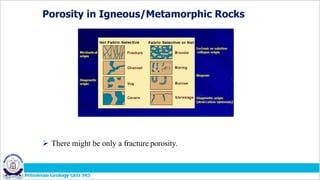
Porosity in Igneous/Metamorphic Rocks
 There might be only a fracture porosity.
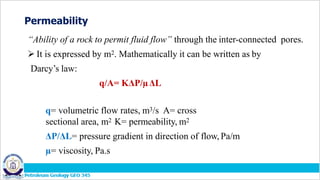
Permeability
“Ability of a rock to permit fluid flow” through the inter-connected pores.
 It is expressed by m2. Mathematically it can be written as by
Darcy’s law:
q/A= KΔP/µΔL
q= volumetric flow rates, m3/s A= cross
sectional area, m2 K= permeability, m2
ΔP/ΔL= pressure gradient in direction of flow, Pa/m
µ= viscosity, Pa.s
Types of Permeability
Absolute Permeability
When only one fluid saturate the effective pore spaces and can pass through
effective pores.
Effective Permeability
When only one fluid can pass through effective pores in presence of other
fluid.
Relative Permeability
The ratio of effective permeability to the absolute permeability
How to Determine the Porosity and Permeability
A. Porosity
It can be measured in lab as well as in the field.
Lab Measurement
It includes variety of methods but few are most important:
1. Thin Section
 In thin section it can either be measured visible estimation of pore spaces or point
counting under the microscope, can be inaccurate.
2. Volumetric Method (core/plugs)
 In this method two volume out of three (bulk volume, pore volume and matrix
volume) is required to determine porosity.
 Pore volume can be calculated by saturating the core sample with water/liquid.
The bulk volume can be calculated easily from the dimensions of the core
sample, if irregular water displacement technique is applied.
 If the pore space volume and bulk volume is known then apply direct
method, use the formula.
 The matrix volume is calculated when the density of mineral in a rock is
know along with the weight of sample. Then subtract the matrix volume
from bulk volume.
3. Helium Method/Ideal gas Method
 The most accurate method of measuring porosity is the helium
expansion method.
 A dried sample is placed in a chamber of known volume and the pressure
is measured with and without the sample, keeping the volume of gas
constant. The difference in pressure is the pore volume
Field Measurements
 The field measurements include the interpretation of various petrophysical logs,
which are obtained within the field.
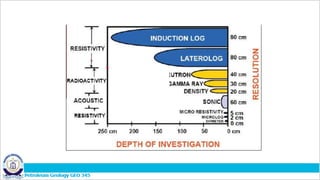
 There are various types of geophysical logs but most important which are used
in formation evaluation w.r.t porosity are as: Sonic Logs, Neutron Logs and
Density Logs.
 None of these logs measure porosity directly (some calculation involved).
1. Sonic Logs
 A log that measures interval transit time (Δt) of a sound wave travelling
through the formation along the axis of the borehole
 The acoustic pulse from a transmitter s detected at two or more receivers. The
time of the first detection of the transmitted pulse at each receiver is processed to
produceΔt.
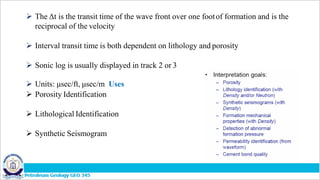
 The Δt is the transit time of the wave front over one footof formation and is the
reciprocal of the velocity
 Interval transit time is both dependent on lithology and porosity
 Sonic log is usually displayed in track 2 or 3
 Units: μsec/ft, μsec/m Uses
 Porosity Identification
 Lithological Identification
 Synthetic Seismogram
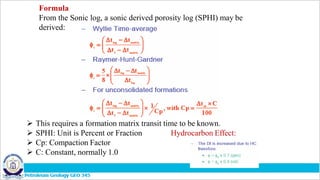
Formula
From the Sonic log, a sonic derived porosity log (SPHI) may be
derived:
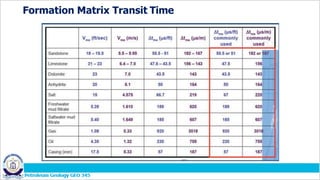
 This requires a formation matrix transit time to be known.
 SPHI: Unit is Percent or Fraction Hydrocarbon Effect:
 Cp: Compaction Factor
 C: Constant, normally 1.0
Formation Matrix Transit Time
Unconventional Oil (Reservoir)
 Unconventional oil is produced or extracted using techniques other than the
conventional method (oil well).
 Oil industries and governments across the globe are investing in unconventional
oil sources due to the increasing scarcity of conventional oil reverses.
Sources of Unconventional Oil
 The following are the sources of unconventional oil:
1. Oil Shales
2. Oil Sands
3. Coal-based liquid supplies (Coal Liquification)
4. Biomass-based liquid supplies
5. Liquid arising from chemical processing of natural gas
1. Oil Shale/Kerogen Shale
“The organic rich sedimentary rock, belongs to the group
of sapropelic fuel, which can generate oil on pyrolysis on commercial scale”
 It is the rock, which can catch fire.
 It does not have a definite geological definition nor a specific chemical
formula, and its seams do not always have discrete boundaries.
 Oil shales vary considerably in their mineral content, chemical composition, age,
type of kerogen, and depositional history.
 Not all oil shales would necessarily be classified as shales (may be clay, argillites,
marl or even carbonates).
Composition of Oil Shales
 Kerogen is the most abundant organic rich matter, having some un-
extractable bitumen
 Kerogen composed of algal remains and amorphous organic matter (sapropelic;
such as pollen, spores, degraded part of plants material)
 The ratio between organic carbon in shale to inorganic content is 0.15-0.3.
 O/C, H/C ratios in Oil Shales: The ratios are H/C 1.25-1.75, O/C 0.02-0.2.
Mostly type 1 and 2.
 Geologists can classify oil shales on the basis of their composition as carbonate-
rich shales, siliceous shales, or cannel shales.
 Another classification, known as the van Krevelen diagram, assigns kerogen types.
 Adrian C. Hutton, 1987, 1991 classify oil shales on petrographic terms from
coal terminology. This classification designates oil shales as terrestrial,
lacustrine or ocean (based on initial biomass deposits).
 Hutton's classification scheme has proven useful in estimating the yield and
composition of the extracted oil.
Classification of Oil Shales
Yield of Oil on Pyrolysis
 To extract oil from oil shale, it is heated upto 500oC.
 This means 250 calories of heat per gram of rock, then kerogen has the ability to
produce 10,000 calorie per gram.
 If a rock conatains 2.5% by weight, kerogen this is economical most suitable is
5%.
Note: Not to confuse oil shale with shale oil.
2. Oil Sand/Bituminous Sands/Tar Sands
 The oil sands are loose sand or partially consolidated sandstone
containing naturally water saturated with bitumen.
3. Coal Liquification
 The process of producing liquid fuels from Coal by reagent like hydrogen. The
technologies can be controversial since they often generate large volumes of waste.

CH-8 Reservoir Rocks (1).pptx

  • 1.
  • 2.
    “The rock, whichis porous and permeable, contains oil and gas becomes a reservoir rock.” OR “Permeable subsurface rock that contains petroleum”  It can be different from source rock with respect to grain size and pore spaces.  Nearly all rocks are reservoir and can be classified accordingly as i. Clastic Rocks ii. Carbonate Rocks iii. Igneous/Metamorphic Rocks
  • 3.
    i. Clastic Rocks Aggregates of a particle, fragments of older rocks  Range in size from fine clay to boulder size forming various clastic rocks, including claystone, shale, siltstone, sandstone, conglomerates.  Most important reservoir rocks in this category are sandstone and sometimes conglomerate due to porosity and permeability. The fractured shale reservoir is also possible but uncommon in nature. ii. Carbonate Rocks  Formed by chemical precipitation or biological precipitation.  The most important reservoir in this category are limestone and dolomite.
  • 4.
    Reservoir Rocks Properties Thereare two main properties on the basis of which reservoir quality of rocks is controlled. i. Porosity ii. Permeability i. Porosity “It is the ratio of pore spaces volume to the total volume (bulk volume) of a reservoir rock.”  It is expressed in %age.  Mathematically: Porosity (ϕ) = Pore volume/Bulk volume x 100
  • 5.
    ROCK MATRIX ANDPORE SPACE Rock matrix Pore space Note different use of “matrix” by geologists and engineers
  • 6.
    Porosity: The fractionof a rock that is occupied by pores b ma b b p V V V V V Porosity      POROSITY DEFINITION • Porosity is an intensive property describing the fluid storage capacity of rock
  • 7.
    ROCK MATRIX ANDPORE SPACE Rock matrix Water Oil and/or gas
  • 8.
    iii. Igneous/Metamorphic Rocks These are rare comparatively to clastic and carbonate reservoir rocks, from which commercial oil and gas are produced.  e.g., there are number of volcanic oil fields, which contains oil and gas includes: Columbia Plateaue of Washington and Oregon, the Mexico-Arizona Volcanic field, the Deccan Traps of India and volcanic of pacific.
  • 9.
    Porosity on thebasis of origin i. Primary Porosity ii. Secondary Porosity i. Primary Porosity  Porosity which developed at time of deposition.  Depends upon; size, shape and pattern of arrangement of grains  e.g., uniform grain size higher the porosity, perfectly rounded shape higher the porosity. In last when packing is cubic of same size grain higher the porosity (47.6%) rather than rhombohedral grains (25.9%). ii. Secondary Porosity  Porosity which is developed after the sedimentation process due to physical and chemical effects.
  • 10.
     The physicaland chemical effects includes i. Compaction ii. Fracturing iii. Dissolution iv. Cementation v. Recrystallization vi. Dolomitization Porosity based on the pore space connectivity Both primary and secondary porosity could be: i. Absolute Porosity ii. Effective Porosity i. Absolute Porosity  The ratio of total volume of pore spaces to total volume of rock ii. Effective Porosity  The ratio of the volume of interconnected pore spaces to thetotal volume of the rock.
  • 11.
    Framework Matrix Cement Pores Sand (and Silt)Size Detrital Grains Silt and Clay Size Detrital Material Material Precipitated Post-Depositionally, During Burial. Cements Fill Pores and Replace Framework Grains Voids Among the Above Components FOUR MAJOR COMPONENTS OF SANDSTONE
  • 12.
    FOUR COMPONENTS OFSANDSTONE MATRIX FRAMEWORK (QUARTZ) FRAMEWORK (FELDSPAR) CEMENT PORE Note different use of “matrix” by geologists and engineers 0.25 mm 1. Framework 2. Matrix 3. Cement 4. Pores Engineering “matrix” Geologist’s Classification
  • 13.
    SANDSTONES POROSITY TYPES Intergranular(Primary) Dissolution Micropores Fractures Interstitial Void Space Between Framework Grains Partial or Complete Dissolution of Framework Grains or Cement Small Pores Mainly Between Detrital or Authigenic Grains (Can Also Occur Within Grains Breakage Due to Earth Stresses
  • 14.
    FACTORS THAT AFFECTPOROSITY • Particle sphericity and angularity • Packing • Sorting (variable grain sizes) • Cementing materials • Overburden stress (compaction) • Vugs, dissolution, and fractures PRIMARY SECONDARY (diagenetic)
  • 15.
    Porosity in Carbonates(Limestone)  There are many types of porosities within limestone but can be groups together in three groups (after Choquette and Pray, 1970) such as: i. Fabric Selective ii. Not Fabric Selective iii. Fabric Selective or Not
  • 16.
    Porosity in Igneous/MetamorphicRocks  There might be only a fracture porosity.
  • 17.
    Permeability “Ability of arock to permit fluid flow” through the inter-connected pores.  It is expressed by m2. Mathematically it can be written as by Darcy’s law: q/A= KΔP/µΔL q= volumetric flow rates, m3/s A= cross sectional area, m2 K= permeability, m2 ΔP/ΔL= pressure gradient in direction of flow, Pa/m µ= viscosity, Pa.s
  • 18.
    Types of Permeability AbsolutePermeability When only one fluid saturate the effective pore spaces and can pass through effective pores. Effective Permeability When only one fluid can pass through effective pores in presence of other fluid. Relative Permeability The ratio of effective permeability to the absolute permeability
  • 19.
    How to Determinethe Porosity and Permeability A. Porosity It can be measured in lab as well as in the field. Lab Measurement It includes variety of methods but few are most important: 1. Thin Section  In thin section it can either be measured visible estimation of pore spaces or point counting under the microscope, can be inaccurate. 2. Volumetric Method (core/plugs)  In this method two volume out of three (bulk volume, pore volume and matrix volume) is required to determine porosity.  Pore volume can be calculated by saturating the core sample with water/liquid.
  • 20.
    The bulk volumecan be calculated easily from the dimensions of the core sample, if irregular water displacement technique is applied.  If the pore space volume and bulk volume is known then apply direct method, use the formula.  The matrix volume is calculated when the density of mineral in a rock is know along with the weight of sample. Then subtract the matrix volume from bulk volume. 3. Helium Method/Ideal gas Method  The most accurate method of measuring porosity is the helium expansion method.  A dried sample is placed in a chamber of known volume and the pressure is measured with and without the sample, keeping the volume of gas constant. The difference in pressure is the pore volume
  • 21.
    Field Measurements  Thefield measurements include the interpretation of various petrophysical logs, which are obtained within the field.  There are various types of geophysical logs but most important which are used in formation evaluation w.r.t porosity are as: Sonic Logs, Neutron Logs and Density Logs.  None of these logs measure porosity directly (some calculation involved). 1. Sonic Logs  A log that measures interval transit time (Δt) of a sound wave travelling through the formation along the axis of the borehole  The acoustic pulse from a transmitter s detected at two or more receivers. The time of the first detection of the transmitted pulse at each receiver is processed to produceΔt.
  • 23.
     The Δtis the transit time of the wave front over one footof formation and is the reciprocal of the velocity  Interval transit time is both dependent on lithology and porosity  Sonic log is usually displayed in track 2 or 3  Units: μsec/ft, μsec/m Uses  Porosity Identification  Lithological Identification  Synthetic Seismogram
  • 24.
    Formula From the Soniclog, a sonic derived porosity log (SPHI) may be derived:  This requires a formation matrix transit time to be known.  SPHI: Unit is Percent or Fraction Hydrocarbon Effect:  Cp: Compaction Factor  C: Constant, normally 1.0
  • 25.
  • 26.
    Unconventional Oil (Reservoir) Unconventional oil is produced or extracted using techniques other than the conventional method (oil well).  Oil industries and governments across the globe are investing in unconventional oil sources due to the increasing scarcity of conventional oil reverses. Sources of Unconventional Oil  The following are the sources of unconventional oil: 1. Oil Shales 2. Oil Sands 3. Coal-based liquid supplies (Coal Liquification) 4. Biomass-based liquid supplies 5. Liquid arising from chemical processing of natural gas
  • 27.
    1. Oil Shale/KerogenShale “The organic rich sedimentary rock, belongs to the group of sapropelic fuel, which can generate oil on pyrolysis on commercial scale”  It is the rock, which can catch fire.  It does not have a definite geological definition nor a specific chemical formula, and its seams do not always have discrete boundaries.  Oil shales vary considerably in their mineral content, chemical composition, age, type of kerogen, and depositional history.  Not all oil shales would necessarily be classified as shales (may be clay, argillites, marl or even carbonates).
  • 28.
    Composition of OilShales  Kerogen is the most abundant organic rich matter, having some un- extractable bitumen  Kerogen composed of algal remains and amorphous organic matter (sapropelic; such as pollen, spores, degraded part of plants material)  The ratio between organic carbon in shale to inorganic content is 0.15-0.3.  O/C, H/C ratios in Oil Shales: The ratios are H/C 1.25-1.75, O/C 0.02-0.2. Mostly type 1 and 2.
  • 29.
     Geologists canclassify oil shales on the basis of their composition as carbonate- rich shales, siliceous shales, or cannel shales.  Another classification, known as the van Krevelen diagram, assigns kerogen types.  Adrian C. Hutton, 1987, 1991 classify oil shales on petrographic terms from coal terminology. This classification designates oil shales as terrestrial, lacustrine or ocean (based on initial biomass deposits).  Hutton's classification scheme has proven useful in estimating the yield and composition of the extracted oil. Classification of Oil Shales
  • 30.
    Yield of Oilon Pyrolysis  To extract oil from oil shale, it is heated upto 500oC.  This means 250 calories of heat per gram of rock, then kerogen has the ability to produce 10,000 calorie per gram.  If a rock conatains 2.5% by weight, kerogen this is economical most suitable is 5%. Note: Not to confuse oil shale with shale oil. 2. Oil Sand/Bituminous Sands/Tar Sands  The oil sands are loose sand or partially consolidated sandstone containing naturally water saturated with bitumen. 3. Coal Liquification  The process of producing liquid fuels from Coal by reagent like hydrogen. The technologies can be controversial since they often generate large volumes of waste.