LIMESTONE
Name: Mahesh Narendra Uke
M.Sc. 1st
Year Petroleum Technology
Nawrosjee Wadia college Pune
CONTENTS
1) what is sedimentary rock.
2) Introduction of Carbonates.
3) Types of grains.
4) Duhem’s and folks classification.
5) Distribution and Occurrence.
6) Uses of limestone.
7) References.
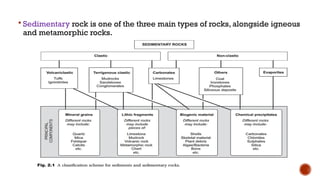
 Sedimentary rock is one of the three main types of rocks, alongside igneous
and metamorphic rocks.
What are the carbonates ?
 In the context of geology, carbonates refer to sedimentary rocks
primarily composed of carbonate minerals, most commonly
calcite (CaCO ) and
₃ dolomite (CaMg(CO ) ).
₃ ₂
 These rocks are formed mainly from the accumulation of
biological debris, such as shells, coral, and other marine
organisms, over millions of years.
 Limestone: Primarily composed of calcite. It forms in shallow,
warm marine environments and most, carbonate rock are not
simple crystalline precipitates. Instade they are composed in part
of aggregate particles or grains.
 Allochems: Any grains of calcium carbonate that, after formation, are
transported and deposited as clasts. E.g. Ooids and Bioclasts
 Orthochems:These are not transported and deposited as clasts.
Orthochems are found precisely where they formed or have been moved
only a short distance.
The Orthochems are further classified as :
1) Micrite: Microcrystalline calcite matrix, or micrite, its fine- graine.
(finer than 4 microns in diameter)
2) Spar: Microcrystalline sparry cement, or spar, is relatively clear
interlocking crystals of calcium carbonate, analogous to cement in
arenite sandstone. 0.01 to 0.10 mm in size.
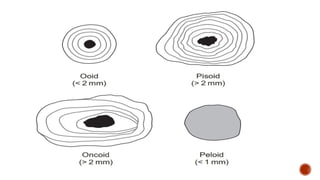
 Ooids ( non skeletal allochems ): Small, spherical, concentrically
layered sedimentary grains, typically composed of calcium carbonate,
that form in warm, shallow marine environments.
 Peloids ( non skeletal allochems ): Small, rounded grains of
microcrystalline carbonate, often formed by the aggregation of fine
particles, typically found in carbonate sedimentary rocks like limestone.
 Skeletal (allochems) particles are the rigid, structural elements in
a rock or sediment that provide its framework or support, typically
made up of minerals or fossil fragments.
TYPE OF ALLOCHEMS
 Type of limestone clast or grains are as follows,
 1) Extraclast: A type of clast (fragment of rock) in sedimentary rock that
originates outside the depositional basin and is transported into it.
 2) Intraclast: A clast that is derived from within the depositional basin
itself, typically formed by the breaking and reworking of semi-lithified
sediments within the same depositional environment.
 Aggregate grains are irregularly shaped carbonate grains that consist
of two or more carbonate fragments (pellets, ooids, fossil fragments)
joined together by a carbon- ate-mud matrix that is generally dark
colored and rich in organic matter
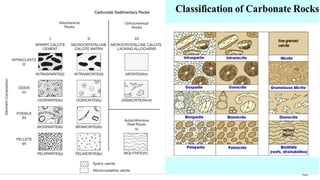
DUHEM'S CLASSIFICATION OF LIMESTONE:
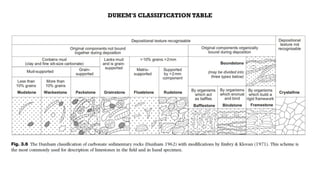
 Pierre Duhem’s classification focuses on the origin and characteristics
of rocks, including limestone. For limestone, the classification is generally
concerned with,
1) Origin
2) Texture and Structure
DUHEM'S CLASSIFICATION TABLE
FOLK CLASSIFICATION OF LIMESTONE
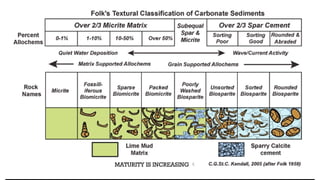
 Robert L. Folk’s classification focuses on the texture and composition
of limestone and includes,
1) Texture-Based Classification
2) Subcategories ( Dolomite and limestone )
MATURITY IS INCREASING 
 Distribution: Limestone is widely distributed across various regions
globally, found in sedimentary basins, mountain ranges, and coastal
areas. Major deposits are located in the United States (e.g., the
Appalachian Mountains), Europe (e.g., the Alps), and Asia (e.g., the
Himalayas).
 Occurrence: Limestone commonly occurs in sedimentary environments
such as shallow marine settings, lagoons, and coral reefs. It can also be
found in caves as stalactites and stalagmites.
 Formation Age: Limestone can form during a range of geological
periods, from the Cambrian (around 541 million years ago) to the
present. Its formation depends on the accumulation of calcium carbonate
from biological processes or chemical precipitation.
USES OF LIMESTONE
1) Construction: Aggregates for concrete and road base.
2) Building Material: Dimension stone for buildings and monuments.
3) Agriculture: Soil conditioner to reduce acidity.
4) Water Treatment: Purification and softening.
5) Industrial: Manufacture of lime and cement.
6) They act as reservoir rocks for more than one-third of the world’s
petroleum reserves
REFERENCE
Books:
1. Boggs, S. (2006). Principles of sedimentology and stratigraphy (4th
ed.).
Pearson.
2. Nicolas, G., & Price, R. (1997). Petroleum geology and geophysics (2nd
ed.).Wiley-Blackwell.
3. Pettijohn, F. J., Potter, P. E., & Siever, R. (2002). Sand and sandstone (2nd
ed.). Springer.
Links:
4. http://www.sepmstrata.org/page.aspx?pageid=89
5. https://www.slideshare.net/slideshow/carbonates-overview/11245673
6. https://www.quora.com/What-are-some-uses-of-limestone
Introduction And Classification Of Limestone.pptx

Introduction And Classification Of Limestone.pptx

  • 1.
    LIMESTONE Name: Mahesh NarendraUke M.Sc. 1st Year Petroleum Technology Nawrosjee Wadia college Pune
  • 2.
    CONTENTS 1) what issedimentary rock. 2) Introduction of Carbonates. 3) Types of grains. 4) Duhem’s and folks classification. 5) Distribution and Occurrence. 6) Uses of limestone. 7) References.
  • 3.
     Sedimentary rockis one of the three main types of rocks, alongside igneous and metamorphic rocks.
  • 4.
    What are thecarbonates ?  In the context of geology, carbonates refer to sedimentary rocks primarily composed of carbonate minerals, most commonly calcite (CaCO ) and ₃ dolomite (CaMg(CO ) ). ₃ ₂  These rocks are formed mainly from the accumulation of biological debris, such as shells, coral, and other marine organisms, over millions of years.  Limestone: Primarily composed of calcite. It forms in shallow, warm marine environments and most, carbonate rock are not simple crystalline precipitates. Instade they are composed in part of aggregate particles or grains.
  • 5.
     Allochems: Anygrains of calcium carbonate that, after formation, are transported and deposited as clasts. E.g. Ooids and Bioclasts  Orthochems:These are not transported and deposited as clasts. Orthochems are found precisely where they formed or have been moved only a short distance. The Orthochems are further classified as : 1) Micrite: Microcrystalline calcite matrix, or micrite, its fine- graine. (finer than 4 microns in diameter) 2) Spar: Microcrystalline sparry cement, or spar, is relatively clear interlocking crystals of calcium carbonate, analogous to cement in arenite sandstone. 0.01 to 0.10 mm in size.
  • 6.
     Ooids (non skeletal allochems ): Small, spherical, concentrically layered sedimentary grains, typically composed of calcium carbonate, that form in warm, shallow marine environments.  Peloids ( non skeletal allochems ): Small, rounded grains of microcrystalline carbonate, often formed by the aggregation of fine particles, typically found in carbonate sedimentary rocks like limestone.  Skeletal (allochems) particles are the rigid, structural elements in a rock or sediment that provide its framework or support, typically made up of minerals or fossil fragments. TYPE OF ALLOCHEMS
  • 8.
     Type oflimestone clast or grains are as follows,  1) Extraclast: A type of clast (fragment of rock) in sedimentary rock that originates outside the depositional basin and is transported into it.  2) Intraclast: A clast that is derived from within the depositional basin itself, typically formed by the breaking and reworking of semi-lithified sediments within the same depositional environment.  Aggregate grains are irregularly shaped carbonate grains that consist of two or more carbonate fragments (pellets, ooids, fossil fragments) joined together by a carbon- ate-mud matrix that is generally dark colored and rich in organic matter
  • 9.
    DUHEM'S CLASSIFICATION OFLIMESTONE:  Pierre Duhem’s classification focuses on the origin and characteristics of rocks, including limestone. For limestone, the classification is generally concerned with, 1) Origin 2) Texture and Structure
  • 10.
  • 11.
    FOLK CLASSIFICATION OFLIMESTONE  Robert L. Folk’s classification focuses on the texture and composition of limestone and includes, 1) Texture-Based Classification 2) Subcategories ( Dolomite and limestone )
  • 12.
  • 14.
     Distribution: Limestoneis widely distributed across various regions globally, found in sedimentary basins, mountain ranges, and coastal areas. Major deposits are located in the United States (e.g., the Appalachian Mountains), Europe (e.g., the Alps), and Asia (e.g., the Himalayas).  Occurrence: Limestone commonly occurs in sedimentary environments such as shallow marine settings, lagoons, and coral reefs. It can also be found in caves as stalactites and stalagmites.  Formation Age: Limestone can form during a range of geological periods, from the Cambrian (around 541 million years ago) to the present. Its formation depends on the accumulation of calcium carbonate from biological processes or chemical precipitation.
  • 15.
    USES OF LIMESTONE 1)Construction: Aggregates for concrete and road base. 2) Building Material: Dimension stone for buildings and monuments. 3) Agriculture: Soil conditioner to reduce acidity. 4) Water Treatment: Purification and softening. 5) Industrial: Manufacture of lime and cement. 6) They act as reservoir rocks for more than one-third of the world’s petroleum reserves
  • 16.
    REFERENCE Books: 1. Boggs, S.(2006). Principles of sedimentology and stratigraphy (4th ed.). Pearson. 2. Nicolas, G., & Price, R. (1997). Petroleum geology and geophysics (2nd ed.).Wiley-Blackwell. 3. Pettijohn, F. J., Potter, P. E., & Siever, R. (2002). Sand and sandstone (2nd ed.). Springer. Links: 4. http://www.sepmstrata.org/page.aspx?pageid=89 5. https://www.slideshare.net/slideshow/carbonates-overview/11245673 6. https://www.quora.com/What-are-some-uses-of-limestone