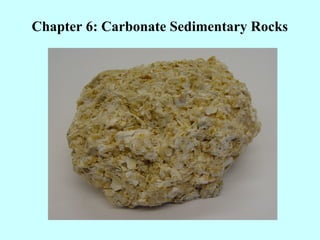
Chapter 6: Carbonate Sedimentary Rocks
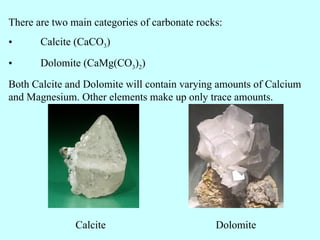
There are two main categories of carbonate rocks:
• Calcite (CaCO3)
• Dolomite (CaMg(CO3)2)
Both Calcite and Dolomite will contain varying amounts of Calcium
and Magnesium. Other elements make up only trace amounts.
Calcite Dolomite
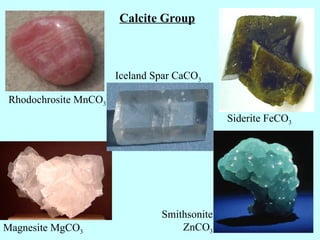
Calcite Group
Iceland Spar CaCO3
Rhodochrosite MnCO3
Magnesite MgCO3
Siderite FeCO3
Smithsonite
ZnCO3
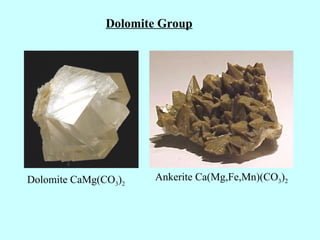
Dolomite Group
Dolomite CaMg(CO3)2
Ankerite Ca(Mg,Fe,Mn)(CO3)2
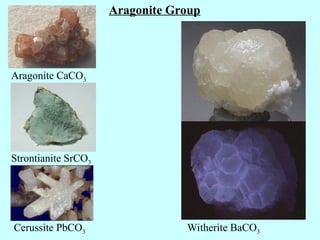
Aragonite Group
Aragonite CaCO3
Strontianite SrCO3
Cerussite PbCO3 Witherite BaCO3
Limestone (composed of primarily CaCO3) textures
Carbonate Grains
• Carbonate clasts (extraclasts & intraclasts--Lithoclasts)
•Extraclast: derived from older limestone located outside the depositional
environment.
•Intraclast: derived from seafloor, adjacent tidal flats or a carbonate beach
•Lithclast: a nonspecific term used when the distinction between extra &
intraclast cannot be made.
• Skeletal particles
• Ooids
• Peloids
• Aggregate Grains
Matrix cements: either sparry calcite or micrite
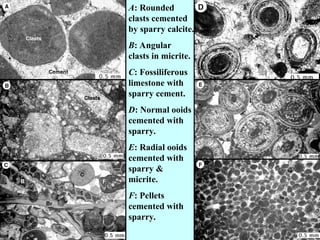
A: Rounded
clasts cemented
by sparry calcite.
B: Angular
clasts in micrite.
C: Fossiliferous
limestone with
sparry cement.
D: Normal ooids
cemented with
sparry.
E: Radial ooids
cemented with
sparry &
micrite.
F: Pellets
cemented with
sparry.
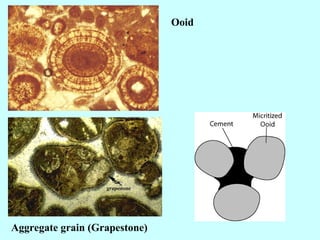
Ooid
Aggregate grain (Grapestone)
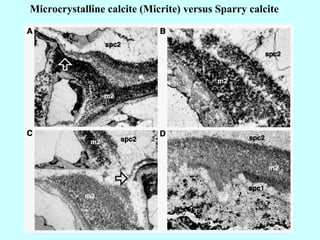
Microcrystalline calcite (Micrite) versus Sparry calcite
Classification of Carbonate Rocks
Limestone classification based on textures
Origin of Carbonate Rocks
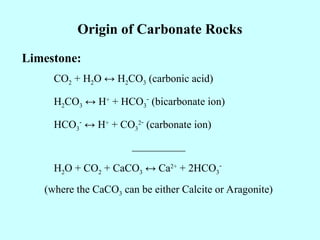
Limestone:
CO2 + H2O ↔ H2CO3 (carbonic acid)
H2CO3 ↔ H+
+ HCO3
-
(bicarbonate ion)
HCO3
-
↔ H+
+ CO3
2-
(carbonate ion)
__________
H2O + CO2 + CaCO3 ↔ Ca2+
+ 2HCO3
-
(where the CaCO3 can be either Calcite or Aragonite)
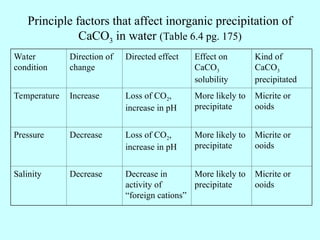
Water
condition
Direction of
change
Directed effect Effect on
CaCO3
solubility
Kind of
CaCO3
precipitated
Temperature Increase Loss of CO2,
increase in pH
More likely to
precipitate
Micrite or
ooids
Pressure Decrease Loss of CO2,
increase in pH
More likely to
precipitate
Micrite or
ooids
Salinity Decrease Decrease in
activity of
“foreign cations”
More likely to
precipitate
Micrite or
ooids
Principle factors that affect inorganic precipitation of
CaCO3 in water (Table 6.4 pg. 175)
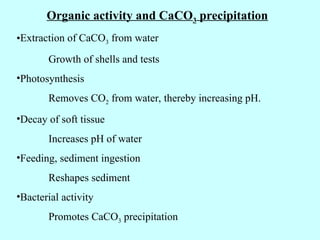
Organic activity and CaCO3 precipitation
•Extraction of CaCO3 from water
Growth of shells and tests
•Photosynthesis
Removes CO2 from water, thereby increasing pH.
•Decay of soft tissue
Increases pH of water
•Feeding, sediment ingestion
Reshapes sediment
•Bacterial activity
Promotes CaCO3 precipitation
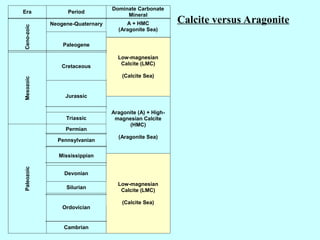
Calcite versus Aragonite
Era Period
Dominate Carbonate
Mineral
Neogene-Quaternary A + HMC
(Aragonite Sea)
Ceno-zoic
Paleogene
Cretaceous
Low-magnesian
Calcite (LMC)
(Calcite Sea)
Jurassic
Mesozoic
Triassic
Permian
Pennsylvanian
Aragonite (A) + High-
magnesian Calcite
(HMC)
(Aragonite Sea)
Mississippian
Devonian
Silurian
Ordovician
Paleozoic
Cambrian
Low-magnesian
Calcite (LMC)
(Calcite Sea)
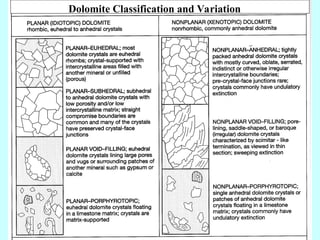
Dolomite Classification and Variation
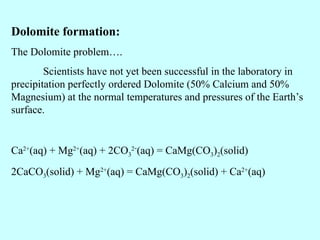
Dolomite formation:
The Dolomite problem….
Scientists have not yet been successful in the laboratory in
precipitation perfectly ordered Dolomite (50% Calcium and 50%
Magnesium) at the normal temperatures and pressures of the Earth’s
surface.
Ca2+
(aq) + Mg2+
(aq) + 2CO3
2-
(aq) = CaMg(CO3)2(solid)
2CaCO3(solid) + Mg2+
(aq) = CaMg(CO3)2(solid) + Ca2+
(aq)
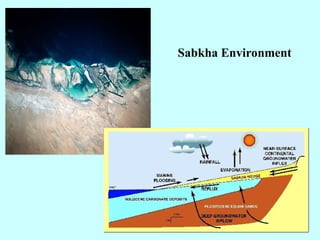
Sabkha Environment
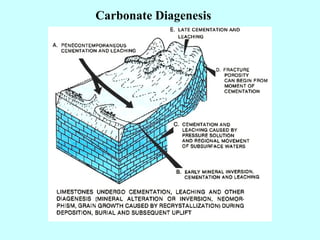
Carbonate Diagenesis
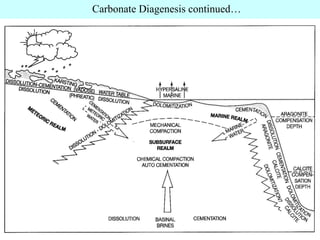
Carbonate Diagenesis continued…
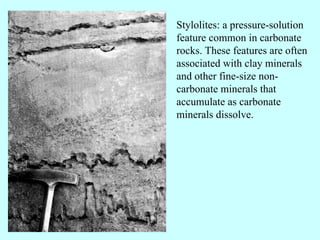
Stylolites: a pressure-solution
feature common in carbonate
rocks. These features are often
associated with clay minerals
and other fine-size non-
carbonate minerals that
accumulate as carbonate
minerals dissolve.

carbonate sedimentary rocks analysis.ppt

  • 1.
    Chapter 6: CarbonateSedimentary Rocks
  • 2.
    There are twomain categories of carbonate rocks: • Calcite (CaCO3) • Dolomite (CaMg(CO3)2) Both Calcite and Dolomite will contain varying amounts of Calcium and Magnesium. Other elements make up only trace amounts. Calcite Dolomite
  • 4.
    Calcite Group Iceland SparCaCO3 Rhodochrosite MnCO3 Magnesite MgCO3 Siderite FeCO3 Smithsonite ZnCO3
  • 5.
  • 6.
    Aragonite Group Aragonite CaCO3 StrontianiteSrCO3 Cerussite PbCO3 Witherite BaCO3
  • 7.
    Limestone (composed ofprimarily CaCO3) textures Carbonate Grains • Carbonate clasts (extraclasts & intraclasts--Lithoclasts) •Extraclast: derived from older limestone located outside the depositional environment. •Intraclast: derived from seafloor, adjacent tidal flats or a carbonate beach •Lithclast: a nonspecific term used when the distinction between extra & intraclast cannot be made. • Skeletal particles • Ooids • Peloids • Aggregate Grains Matrix cements: either sparry calcite or micrite
  • 8.
    A: Rounded clasts cemented bysparry calcite. B: Angular clasts in micrite. C: Fossiliferous limestone with sparry cement. D: Normal ooids cemented with sparry. E: Radial ooids cemented with sparry & micrite. F: Pellets cemented with sparry.
  • 9.
  • 10.
  • 11.
  • 12.
  • 13.
    Origin of CarbonateRocks Limestone: CO2 + H2O ↔ H2CO3 (carbonic acid) H2CO3 ↔ H+ + HCO3 - (bicarbonate ion) HCO3 - ↔ H+ + CO3 2- (carbonate ion) __________ H2O + CO2 + CaCO3 ↔ Ca2+ + 2HCO3 - (where the CaCO3 can be either Calcite or Aragonite)
  • 14.
    Water condition Direction of change Directed effectEffect on CaCO3 solubility Kind of CaCO3 precipitated Temperature Increase Loss of CO2, increase in pH More likely to precipitate Micrite or ooids Pressure Decrease Loss of CO2, increase in pH More likely to precipitate Micrite or ooids Salinity Decrease Decrease in activity of “foreign cations” More likely to precipitate Micrite or ooids Principle factors that affect inorganic precipitation of CaCO3 in water (Table 6.4 pg. 175)
  • 16.
    Organic activity andCaCO3 precipitation •Extraction of CaCO3 from water Growth of shells and tests •Photosynthesis Removes CO2 from water, thereby increasing pH. •Decay of soft tissue Increases pH of water •Feeding, sediment ingestion Reshapes sediment •Bacterial activity Promotes CaCO3 precipitation
  • 17.
    Calcite versus Aragonite EraPeriod Dominate Carbonate Mineral Neogene-Quaternary A + HMC (Aragonite Sea) Ceno-zoic Paleogene Cretaceous Low-magnesian Calcite (LMC) (Calcite Sea) Jurassic Mesozoic Triassic Permian Pennsylvanian Aragonite (A) + High- magnesian Calcite (HMC) (Aragonite Sea) Mississippian Devonian Silurian Ordovician Paleozoic Cambrian Low-magnesian Calcite (LMC) (Calcite Sea)
  • 18.
  • 19.
    Dolomite formation: The Dolomiteproblem…. Scientists have not yet been successful in the laboratory in precipitation perfectly ordered Dolomite (50% Calcium and 50% Magnesium) at the normal temperatures and pressures of the Earth’s surface. Ca2+ (aq) + Mg2+ (aq) + 2CO3 2- (aq) = CaMg(CO3)2(solid) 2CaCO3(solid) + Mg2+ (aq) = CaMg(CO3)2(solid) + Ca2+ (aq)
  • 20.
  • 21.
  • 22.
  • 24.
    Stylolites: a pressure-solution featurecommon in carbonate rocks. These features are often associated with clay minerals and other fine-size non- carbonate minerals that accumulate as carbonate minerals dissolve.