Classification:
Eukaryotes
ppt. by Robin D. Seamon
Protists- eukaryotic microscopic organisms;
Kingdom Protista
• Most are single-celled, though some are
multi-celled; some are colonial
• Some are more related to plant metabolism
(autotrophic), others more related to
heterotrophs (fungi/animal)
• Asexual reproduction: mitosis
• Transport: through membrane
KINGDOM PROTISTA
PROTIST
EXAMPLES
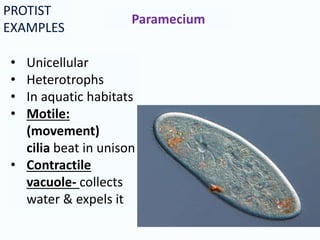
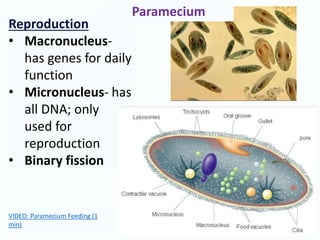
Paramecium
• Unicellular
• Heterotrophs
• In aquatic habitats
• Motile:
(movement)
cilia beat in unison
• Contractile
vacuole- collects
water & expels it
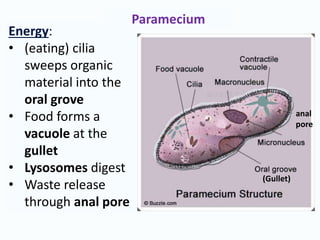
Energy:
• (eating) cilia
sweeps organic
material into the
oral grove
• Food forms a
vacuole at the
gullet
• Lysosomes digest
• Waste release
through anal pore
(Gullet)
anal
pore
Paramecium
Reproduction
• Macronucleus-
has genes for daily
function
• Micronucleus- has
all DNA; only
used for
reproduction
• Binary fission
Paramecium
VIDEO: Paramecium Feeding (1
min)
PROTIST
EXAMPLES
Amoeba
• Unicellular
• Heterotrophs
• In aquatic habitats
• Motile:
(movement)
cytoplasm forms
pseudopods to
direct movement
Pseudo- false
Pod- foot
PROTIST
EXAMPLES
Amoeba
Energy-
• predator- eats small organisms
• Surrounds food with pseudopodia
• Digests with
lysosomes
• Contractile
vacuoles
remove
excess water
Reproduction
• Binary fission
Amoeba
VIDEO: Amoeba vs. Paramecium (2:30)
PROTIST
EXAMPLES
Euglena
• Unicellular
• Autotrophs OR
Heterotrophs
• In aquatic habitats
• Motile:
(movement)
one or more
flagella whip to
move
Euglena- Flagellum movement phase (1 min)
PROTIST
EXAMPLES
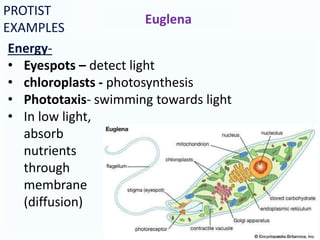
Euglena
Energy-
• Eyespots – detect light
• chloroplasts - photosynthesis
• Phototaxis- swimming towards light
• In low light,
absorb
nutrients
through
membrane
(diffusion)
• Contractile
vacuole-
Removes
excess
water
Reproduction
• Binary fission
Euglena
VIDEO: Protists- Amoeba, Euglena, Paramecium (3:45)
PROTIST
EXAMPLES
Volvox Algae
Energy-
• Photosynthetic
• Live in colonies
PROTIST
EXAMPLES
Malaria
Energy-
• Infects humans
through mosquito
bite
• Humans are part of
its reproductive cycle
Molds
Yeast
Mushrooms
• Most are unicellular
• Some are multicellular
• Heterotrophic
Absorbs nutrients
• Transport through
membrane
KINGDOM FUNGI
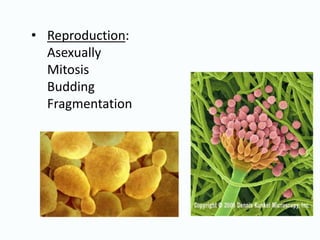
• Reproduction:
Asexually
Mitosis
Budding
Fragmentation
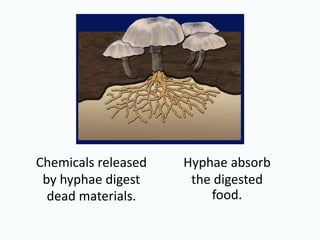
Chemicals released
by hyphae digest
dead materials.
Hyphae absorb
the digested
food.
• Multicellular
• Autotrophic
• Photosynthesis
• Have chloroplasts
KINGDOM PLANTAE
Examples:
• Non-vascular – ferns and
mosses
• Vascular Gymnosperms –
conifers
• Vascular Angiosperms –
flowering plants and trees
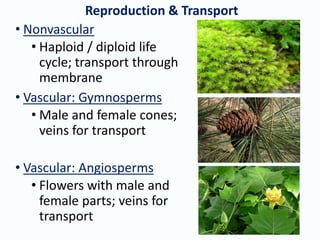
• Nonvascular
• Haploid / diploid life
cycle; transport through
membrane
• Vascular: Gymnosperms
• Male and female cones;
veins for transport
• Vascular: Angiosperms
• Flowers with male and
female parts; veins for
transport
Reproduction & Transport
Vascular plants have veins
Xylem moves water up Phloem moves sugar down
• Multicellular
• Heterotrophic
• Mostly sexual reproduction
• Move about their environment
Nutrition
Digestive system
Transport
Circulatory system
Excretion
Urinary system
KINGDOM ANIMALIA
Examples: Humans, cats,
dogs, worms, seashells
Phylum Arthropoda
Class Insecta
Class Arachnida
Phylum Chortdata
Class Osteicthyes- bony fish
Class Amphibia
Class Reptilia
Class Aves
Class Mammalia
SOME ANIMAL EXAMPLES
Mammals
Glands
Diaphragm Heart
Teeth
Mammary
glandsHair

Classification Eukaryotes