The Dewey Decimal
Classification System
 The informational books in our library
are organized according to the Dewey
Decimal Classification System (DDC.)
 This system of classifying books is
named after its founder, Melvil Dewey.
 The system is based on ten basic
divisions
The 10 basic divisions
000 General Works
 What is it?
◦ Lots of information in one book or set of
books.
 What do I find here?
◦ General reference works, computer
books, codes, and oddities.
000 General Works
 000 Computers, Loch Ness, Bigfoot,
UFOs, aliens
 020 Libraries
 030 Books of facts
◦ Encyclopedias & World record books
(Reference area)
 050 Magazines, journals & serials
(Magazine area)
 060 Associations, organizations &
museums
 070 Newspapers, media, journalism &
publishing
100 Philosophy and
Psychology
 What is it?
◦ What and How we think!
 What do I find here?
◦ Optical illusions, brain research, questions
and answer books.
100 Philosophy and
Psychology
 130 Ghosts, witches & the
supernatural
 150 Optical illusions, feelings
 170 Emotions, values, animal rights
200 Religion and Mythology
 What is it?
◦ The creator of our world.
 What do I find here?
◦ Bible stories, religions of the world, Greek
myths.
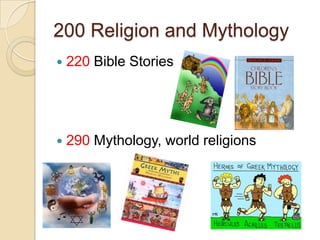
200 Religion and Mythology
 220 Bible Stories
 290 Mythology, world religions
300 Social Science
 What is it?
◦ Ways we communicate and get along with
other people.
 What do I find here?
◦ Communication, education, law,
sociology, transportation, etiquette,
folklore and fairy tales.
300 Social Science
 300 Social issues: world cultures, racism
 310 Almanacs (Reference area)
 320 Government
 330 Money, working
 340 Court system, famous trials
 350 Armed forces: army, navy, air force
 360 Drugs, environment issues, Titanic,
police
 370 Schools
 380 Transportation
 390 Holidays, folktales, fairy tales
400 Languages
 What is it?
◦ Languages that we use.
 What do I find here?
◦ Grammar books, sign language.
400 Languages
 410 Sign language
 420 Dictionaries (Reference area,)
readers (Reader area)
 430 German language
 440 French langauge
 450 Italian language
 460 Spanish language
 490 Hieroglyphics, Japanese
language
500 Science and Math
 What is it?
◦ Everything that is in this world around us.
 What do I find here?
◦ Experiments, mathematics, astronomy,
chemistry, physics, geology, biology, and
DINOSAURS!
◦ Books on specific animals are also found
here.
500 Science and Math
 500 Science experiments/sets
 510 Mathematics
 520 Stars, planets, astronomy, space
 530 Force & motion, electricity, magnetism,
light
 540 Chemistry, atoms, rocks and minerals
 550 Volcanoes, earthquakes, weather,
hurricanes, tornadoes
 560 Dinosaurs (567.9,) prehistoric animals,
fossils
 570 Forests, rainforests, desserts,
mountains, oceans evolution
 580 plants, flowers & trees
590 Animals & Insects
 591 Specific topics in natural history of
animals
 592 Worms, invertebrates
 593 Corals, sea invertebrates
 594 Seashells, snails, octopus
 595 insects, spiders
 597 Fish, frogs, toads, reptiles,
amphibians, snakes
 598 Birds
 599 Mammals, whales
600 People using
Science and Technology
 What is it?
◦ How we make nature work for us.
 What do I find here?
◦ Human body, medicine, airplanes, space
travel, cookbook
◦ Domesticated animals such as dogs, cats,
and horses.
600 People using
Science and Technology
 600 Inventions
 610 Human body, health
 620 Rockets, trains, cars, trucks
 630 Farming, farm animals, cats, dogs,
pets, horses
 640 Cookbooks, sewing
 650 Secret codes
 660 How food is made
 670 Paper making
 680 Woodworking
 690 Building
700 Arts and Recreation
 What is it?
◦ Things we do for fun and creativity.
 What do I find here?
◦ Art, artists, how-to-draw book, crafts,
origami, music, joke & riddle books, chess
& sports.
700 Arts and Recreation
 710 Art appreciation, history of art
 720 Houses, buildings
 730 Origami, paper carfts
 740 Drawing, crafts
 750 Painting
 760 Printing
 770 Photography
 780 Music
 790 Sports, games, magic, I Spy,
camping
800 Literature
 What is it?
◦ We act and read poetry.
 What do I find here?
◦ Poetry, plays and classic literature.
800 Literature
 810 Poetry, plays, jokes & riddles
 820 Shakespeare
900 Geography and History
 What is it?
◦ Places we live.
 What do I find here?
◦ History, geography & travel, atlases,
explorers, and multiple biographies.
900 Geography and History
 910 Explorers, atlas
 920 Flags, people (biography)
 930 Archeology, ancient civilizations
◦ Egypt 932,Rome 937, Greece 938
 940 Knights, castles, World War I & II, European
countries
 950 Asian & Middle Eastern countries
 960 African countries
 970 North & Central American countries, Native
American tribes, American history, USA
 980 South American countries
 990 Pacific islands, Australia, Hawaii, Arctic,
Antarctica

Ddc slide (en)

  • 1.
  • 2.
     The informationalbooks in our library are organized according to the Dewey Decimal Classification System (DDC.)  This system of classifying books is named after its founder, Melvil Dewey.  The system is based on ten basic divisions
  • 3.
    The 10 basicdivisions
  • 4.
    000 General Works What is it? ◦ Lots of information in one book or set of books.  What do I find here? ◦ General reference works, computer books, codes, and oddities.
  • 5.
    000 General Works 000 Computers, Loch Ness, Bigfoot, UFOs, aliens  020 Libraries  030 Books of facts ◦ Encyclopedias & World record books (Reference area)  050 Magazines, journals & serials (Magazine area)  060 Associations, organizations & museums  070 Newspapers, media, journalism & publishing
  • 6.
    100 Philosophy and Psychology What is it? ◦ What and How we think!  What do I find here? ◦ Optical illusions, brain research, questions and answer books.
  • 7.
    100 Philosophy and Psychology 130 Ghosts, witches & the supernatural  150 Optical illusions, feelings  170 Emotions, values, animal rights
  • 8.
    200 Religion andMythology  What is it? ◦ The creator of our world.  What do I find here? ◦ Bible stories, religions of the world, Greek myths.
  • 9.
    200 Religion andMythology  220 Bible Stories  290 Mythology, world religions
  • 10.
    300 Social Science What is it? ◦ Ways we communicate and get along with other people.  What do I find here? ◦ Communication, education, law, sociology, transportation, etiquette, folklore and fairy tales.
  • 11.
    300 Social Science 300 Social issues: world cultures, racism  310 Almanacs (Reference area)  320 Government  330 Money, working  340 Court system, famous trials  350 Armed forces: army, navy, air force  360 Drugs, environment issues, Titanic, police  370 Schools  380 Transportation  390 Holidays, folktales, fairy tales
  • 12.
    400 Languages  Whatis it? ◦ Languages that we use.  What do I find here? ◦ Grammar books, sign language.
  • 13.
    400 Languages  410Sign language  420 Dictionaries (Reference area,) readers (Reader area)  430 German language  440 French langauge  450 Italian language  460 Spanish language  490 Hieroglyphics, Japanese language
  • 14.
    500 Science andMath  What is it? ◦ Everything that is in this world around us.  What do I find here? ◦ Experiments, mathematics, astronomy, chemistry, physics, geology, biology, and DINOSAURS! ◦ Books on specific animals are also found here.
  • 15.
    500 Science andMath  500 Science experiments/sets  510 Mathematics  520 Stars, planets, astronomy, space  530 Force & motion, electricity, magnetism, light  540 Chemistry, atoms, rocks and minerals  550 Volcanoes, earthquakes, weather, hurricanes, tornadoes  560 Dinosaurs (567.9,) prehistoric animals, fossils  570 Forests, rainforests, desserts, mountains, oceans evolution  580 plants, flowers & trees
  • 16.
    590 Animals &Insects  591 Specific topics in natural history of animals  592 Worms, invertebrates  593 Corals, sea invertebrates  594 Seashells, snails, octopus  595 insects, spiders  597 Fish, frogs, toads, reptiles, amphibians, snakes  598 Birds  599 Mammals, whales
  • 17.
    600 People using Scienceand Technology  What is it? ◦ How we make nature work for us.  What do I find here? ◦ Human body, medicine, airplanes, space travel, cookbook ◦ Domesticated animals such as dogs, cats, and horses.
  • 18.
    600 People using Scienceand Technology  600 Inventions  610 Human body, health  620 Rockets, trains, cars, trucks  630 Farming, farm animals, cats, dogs, pets, horses  640 Cookbooks, sewing  650 Secret codes  660 How food is made  670 Paper making  680 Woodworking  690 Building
  • 19.
    700 Arts andRecreation  What is it? ◦ Things we do for fun and creativity.  What do I find here? ◦ Art, artists, how-to-draw book, crafts, origami, music, joke & riddle books, chess & sports.
  • 20.
    700 Arts andRecreation  710 Art appreciation, history of art  720 Houses, buildings  730 Origami, paper carfts  740 Drawing, crafts  750 Painting  760 Printing  770 Photography  780 Music  790 Sports, games, magic, I Spy, camping
  • 21.
    800 Literature  Whatis it? ◦ We act and read poetry.  What do I find here? ◦ Poetry, plays and classic literature.
  • 22.
    800 Literature  810Poetry, plays, jokes & riddles  820 Shakespeare
  • 23.
    900 Geography andHistory  What is it? ◦ Places we live.  What do I find here? ◦ History, geography & travel, atlases, explorers, and multiple biographies.
  • 24.
    900 Geography andHistory  910 Explorers, atlas  920 Flags, people (biography)  930 Archeology, ancient civilizations ◦ Egypt 932,Rome 937, Greece 938  940 Knights, castles, World War I & II, European countries  950 Asian & Middle Eastern countries  960 African countries  970 North & Central American countries, Native American tribes, American history, USA  980 South American countries  990 Pacific islands, Australia, Hawaii, Arctic, Antarctica