Dewey Decimal
Classification System
Library Media Class
Melvil Dewey
 Created Dewey
Decimal system, a
library classification
system
 Copyrighted the
system in 1876
Who created the Dewey Decimal
Classification System?
 Melvil Dewey was born on December 10, 1851
 Melvil Dewey created the number order system
for library books when he was 21 years old.
 Melvil Dewey started the first school for
librarians.
Ten Main Classifications in
Dewey’s System
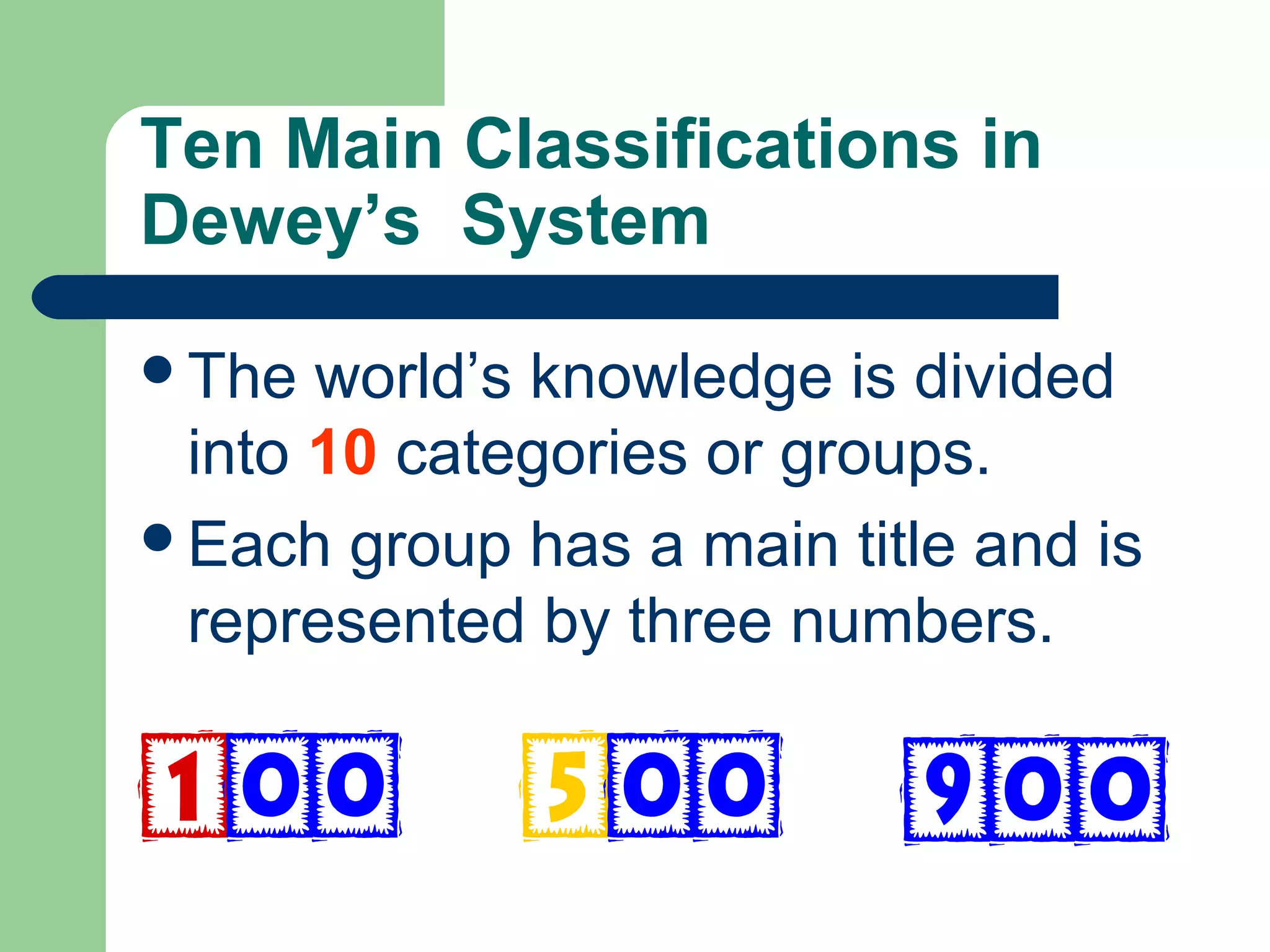
The world’s knowledge is divided
into 10 categories or groups.
Each group has a main title and is
represented by three numbers.
The Big Ten!
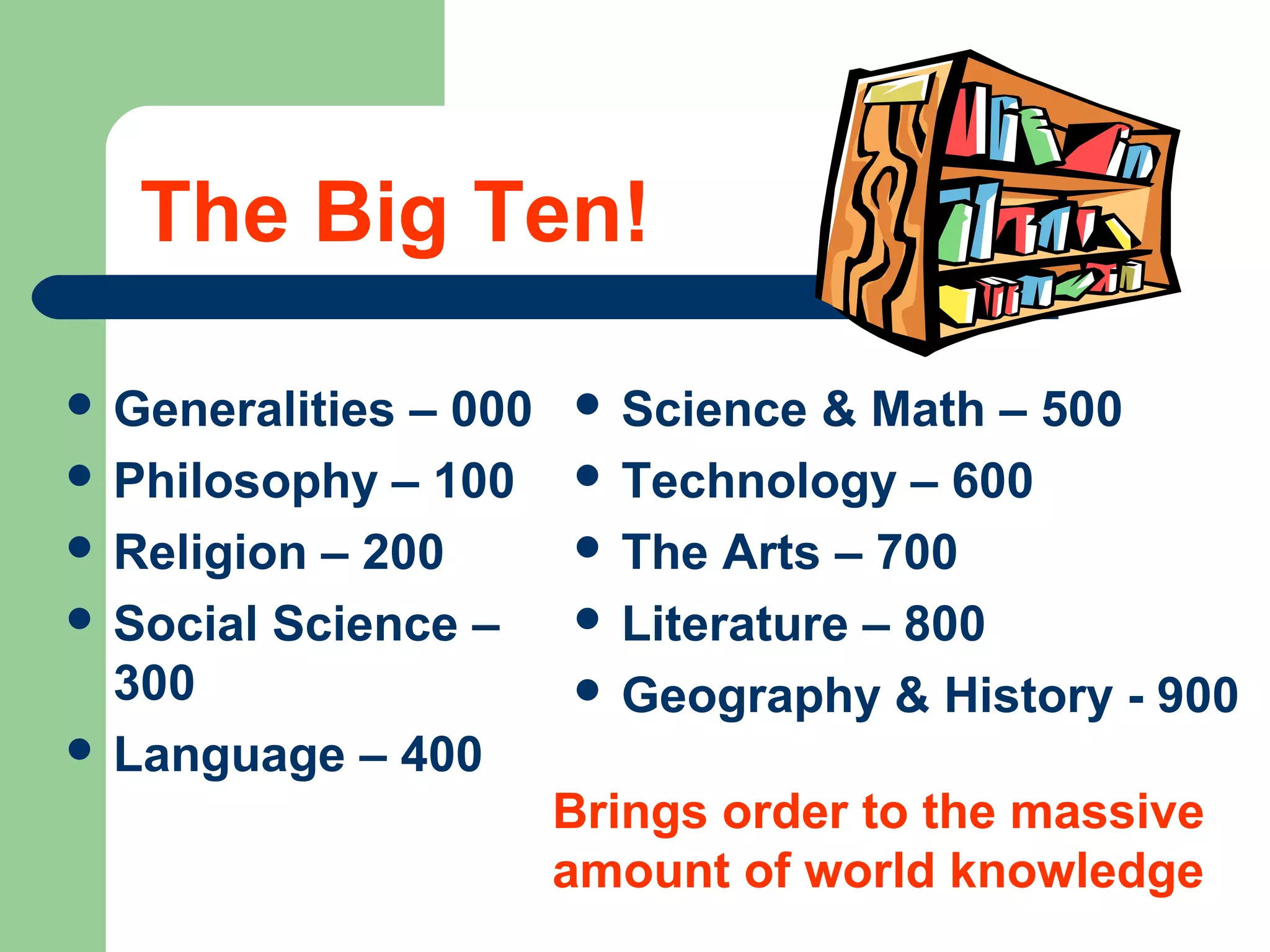
 Generalities – 000
 Philosophy – 100
 Religion – 200
 Social Science –
300
 Language – 400
 Science & Math – 500
 Technology – 600
 The Arts – 700
 Literature – 800
 Geography & History - 900
Brings order to the massive
amount of world knowledge
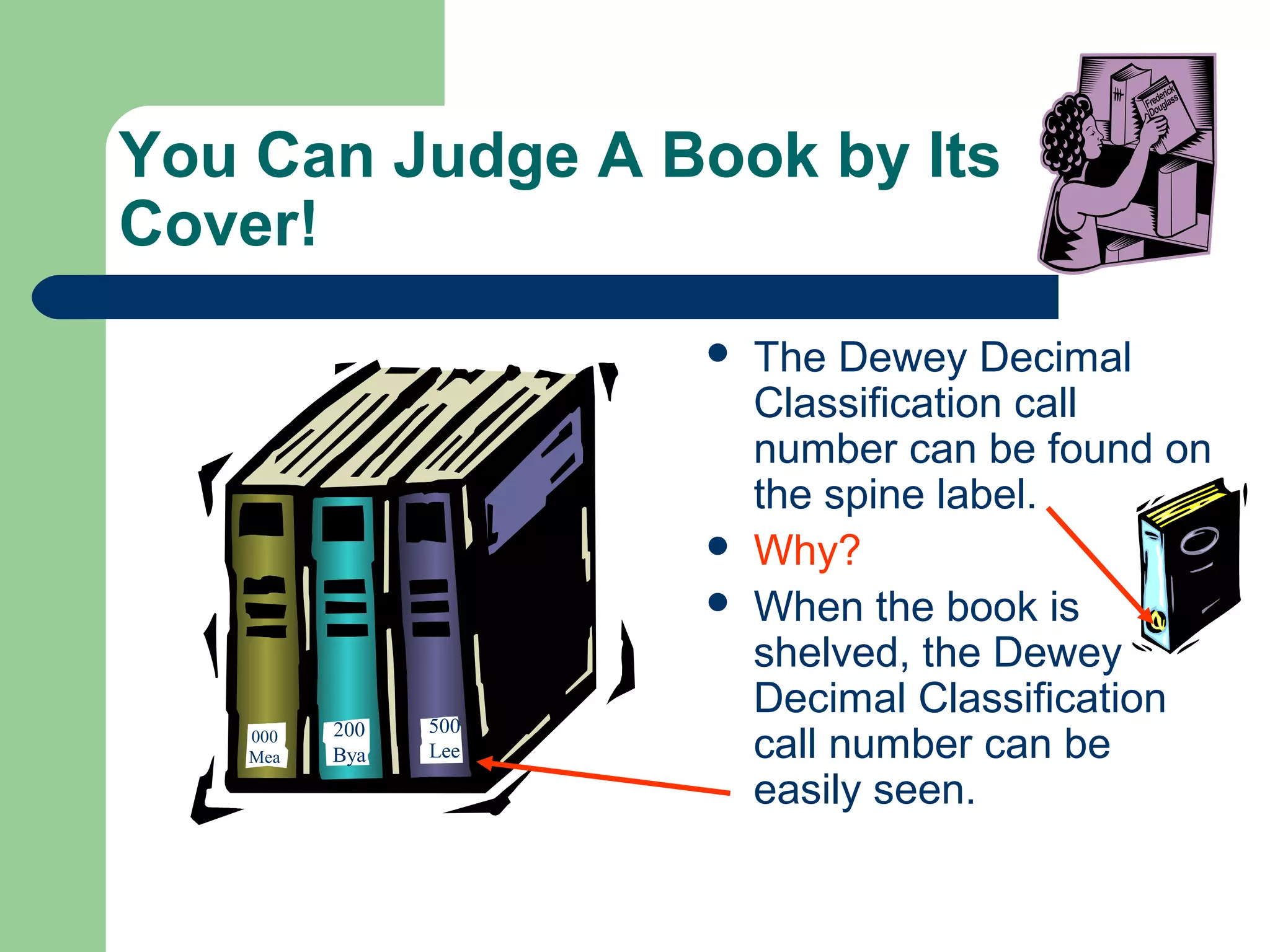
You Can Judge A Book by Its
Cover!
 The Dewey Decimal
Classification call
number can be found on
the spine label.
 Why?
 When the book is
shelved, the Dewey
Decimal Classification
call number can be
easily seen.
500
Lee
200
Bya
000
Mea
 Call # is what you
see on the spine of
the book
 It tells you where the
book is found
 It’s the book address
 In early libraries,
closed stacks were
used
 Patrons had to
request or “call for”
the book using that
number
Call Number
Generalities - 000
Encyclopedias
News media
Rare Books
Encyclopedias, References
Philosophy - 100
Paranormal phenomena
Psychology
Logic
Man thinks
Religion - 200
Bible
History of Christianity
Other Religions
About God
Social Science - 300
Law
Education
Folklore
About man’s neighbors
Language - 400
English
Spanish
Other Languages
Man talks with other men
Natural Science
& Math - 500
Mathematics
Earth sciences
Plants
Animals
Man discovers
all that is
around him
Technology – 600
Medicine
Agriculture
Family living
Man makes useful
things
The Arts - 700
Drawing
Music
Recreational & performing
arts
Man makes
beautiful things
Literature - 800
American Literature
Old English Literature
Literatures of Other Languages
Man writes
Geography
& History - 900
Geography
Biographies
Ancient History
Man writes about
travel, people, and
events
Flashback!
What Do You Remember?
Who created the Dewey Decimal
Classification System?
What does the DDCS do for our
library?
How many main classifications are
there?
Where do you find the DDCS number
on a library book?
Resources Used…
All clipart taken from the Microsoft Clipart web site:
Information on the Dewey Decimal Classification taken from:
Weisburg, H. & Toor, R. Teacher’s Portfolio of Library Skills
Lessons & Activities (1985). The Center for Applied Research in
Education, Inc.
http://office.microsoft.com/clipart/default.aspx?lc=en-us&cag=1

5th dewey decimal classification system

  • 1.
  • 2.
    Melvil Dewey  CreatedDewey Decimal system, a library classification system  Copyrighted the system in 1876
  • 3.
    Who created theDewey Decimal Classification System?  Melvil Dewey was born on December 10, 1851  Melvil Dewey created the number order system for library books when he was 21 years old.  Melvil Dewey started the first school for librarians.
  • 4.
    Ten Main Classificationsin Dewey’s System The world’s knowledge is divided into 10 categories or groups. Each group has a main title and is represented by three numbers.
  • 5.
    The Big Ten! Generalities – 000  Philosophy – 100  Religion – 200  Social Science – 300  Language – 400  Science & Math – 500  Technology – 600  The Arts – 700  Literature – 800  Geography & History - 900 Brings order to the massive amount of world knowledge
  • 6.
    You Can JudgeA Book by Its Cover!  The Dewey Decimal Classification call number can be found on the spine label.  Why?  When the book is shelved, the Dewey Decimal Classification call number can be easily seen. 500 Lee 200 Bya 000 Mea
  • 7.
     Call #is what you see on the spine of the book  It tells you where the book is found  It’s the book address  In early libraries, closed stacks were used  Patrons had to request or “call for” the book using that number Call Number
  • 8.
    Generalities - 000 Encyclopedias Newsmedia Rare Books Encyclopedias, References
  • 9.
    Philosophy - 100 Paranormalphenomena Psychology Logic Man thinks
  • 10.
    Religion - 200 Bible Historyof Christianity Other Religions About God
  • 11.
    Social Science -300 Law Education Folklore About man’s neighbors
  • 12.
    Language - 400 English Spanish OtherLanguages Man talks with other men
  • 13.
    Natural Science & Math- 500 Mathematics Earth sciences Plants Animals Man discovers all that is around him
  • 14.
  • 15.
    The Arts -700 Drawing Music Recreational & performing arts Man makes beautiful things
  • 16.
    Literature - 800 AmericanLiterature Old English Literature Literatures of Other Languages Man writes
  • 17.
    Geography & History -900 Geography Biographies Ancient History Man writes about travel, people, and events
  • 18.
    Flashback! What Do YouRemember? Who created the Dewey Decimal Classification System? What does the DDCS do for our library? How many main classifications are there? Where do you find the DDCS number on a library book?
  • 19.
    Resources Used… All cliparttaken from the Microsoft Clipart web site: Information on the Dewey Decimal Classification taken from: Weisburg, H. & Toor, R. Teacher’s Portfolio of Library Skills Lessons & Activities (1985). The Center for Applied Research in Education, Inc. http://office.microsoft.com/clipart/default.aspx?lc=en-us&cag=1