1Challenges and Emerging Practices for Knowledge  Organization in the E-Environment.Anil Kumar MishraLIO, NCHRC, NIHFWNew DelhiEmail: anilmlis@gmail.com
There is huge volume of information available on the Internet2Yahoo alone claims to have indexed 20 billion documents.Search Engine Exalead indexed about 7 billion documents.There are one million  videos on YoutubeAbout 7 lack electronic books  and niche titles are published every year.Web is growing at the @300 percent every year.
Internet usage statistics (June 30, 2010)3With the sprawling Internet and growing volume of web content, its usage is also increasing.
In the North America, the percentage of the Internet  penetration in population is 77.4%,whereas users are  13.5% of population.
In the European region, percentage of its penetration in population is 58.4 percent, whereas users are 24.2% of population.
In the Asian region, percentage of its penetration in population is just 21.5%, whereas percentage of users  are 42.0%.In view of huge volume of electronic information, the challenge is 4How to evaluate and quality filter the information?How to index and bibliographically control this information?How to timely access the worthwhile information?How to compactly store and quickly retrieve the worthwhile information?How to bring the useful information to the notice of users and put it to productive use?
Incessant flow of information and Individual user5Increasing number of documents are being digitized and made accessible on the internet.
Enormous volume of information is available, whereas an individual information user has a limited time and capacity to make use of such information resources.
The challenge for individual user is to make choices of documents to use in a given time constraint.
The challenge for the information technologists is to provide fastest access to precise information.Challenges for the Information professionals are6To evaluate and analyze information for quality and reliability.To proactively link information resources with the users information requirements.To innovatively design and develop services that offer more value and convenience to information users.To promptly link information with information to create knowledge mashups for problem solving.To develop state of the art knowledge management tools for just in time retrieval of desired information.To present information in a way that may make the process of information use interesting, amusing and engaging.
This requires categorization and organization of worthwhile hypermedia according to some order or schema.7Hypermedia offers an exciting new method of linking and searching information.It promptly facilitates spatial search of collateral sources of information cited or linked with a document.Any further effort for hypermedia documents’ organization has to be pursued keeping in view and keeping intact this intrinsic feature of hypermedia.As the Internet is now increasingly concentrating on personal space, any hypermedia organization schema should also offer an information prescription to an end user’s information problem.It must meet the ultimate objective of customized and personalized dissemination of information.
Hypermedia and Different subject areas8In certain subject areas hypermedia documents can offer a way to create information chains for better understanding of past developments for facilitating future course of action. For instance.In the subject area of law, latest case decisions can be hyperlinked with previous judgments of other courts and relevant legislations.In the subject field of history, latest development and contemporary situations can be hyperlinked with the past happenings that may themselves be organized in the chronological order.In chemistry, documents reporting new compounds can be hyperlinked with the related past research to provide comprehensive information for better understanding of development of new compounds.Patent documents in a specific area may be linked to trace the course of inventions  and study technology history.
Fluid information environment9The present fluid information environment offers, a fertile field for knowledge organization and information architecture research.Focus is desired to develop knowledge organization tools and practices that may facilitate instant packaging and repackaging of information content giving due credit to authorship and respect to copyright laws.Efforts are also desired for standardization of  such tools and practices at the international level in the interest of  information processing global information communication.
Next Generation of Hypermedia organization technologies10The next generation of  hypermedia organization technologies and tools may
Go for application of artificial intelligence methods involving decomposition and coordination of information content for multi-tasking, complex multi-objective systems and supporting mission oriented work.
They may also integrate the functionality of even eliminating content to a defunct warehouse after meeting the fixed shelf life or replacement with more appropriate hypermedia documents.Information professionals approach11Informational professionals have tried organization of web documents using their standard classification schemes.     An advantage of using classification schemes is that they are already practices for organizing print documents and  their applications have potential to improve access to web-documents.Hypermedia organization with the help of standard classification systems helps to improve precision in retrieval and considerably reduces the probability of getting irrelevant web documents in any search process.Such an arrangement of web documents also provides users, an overview of organized information and thus leads to search of additional information that users desperately need but are not aware of .
Some examples where classification schemes are used for organizing  hypermedia documents are:12BUBL LINK uses Dewey Decimal Classification (DDC).

Challenges and emerging practices for knowledge organization in the electronic information environment anil mishra

  • 1.
    1Challenges and EmergingPractices for Knowledge Organization in the E-Environment.Anil Kumar MishraLIO, NCHRC, NIHFWNew DelhiEmail: anilmlis@gmail.com
  • 2.
    There is hugevolume of information available on the Internet2Yahoo alone claims to have indexed 20 billion documents.Search Engine Exalead indexed about 7 billion documents.There are one million videos on YoutubeAbout 7 lack electronic books and niche titles are published every year.Web is growing at the @300 percent every year.
  • 3.
    Internet usage statistics(June 30, 2010)3With the sprawling Internet and growing volume of web content, its usage is also increasing.
  • 4.
    In the NorthAmerica, the percentage of the Internet penetration in population is 77.4%,whereas users are 13.5% of population.
  • 5.
    In the Europeanregion, percentage of its penetration in population is 58.4 percent, whereas users are 24.2% of population.
  • 6.
    In the Asianregion, percentage of its penetration in population is just 21.5%, whereas percentage of users are 42.0%.In view of huge volume of electronic information, the challenge is 4How to evaluate and quality filter the information?How to index and bibliographically control this information?How to timely access the worthwhile information?How to compactly store and quickly retrieve the worthwhile information?How to bring the useful information to the notice of users and put it to productive use?
  • 7.
    Incessant flow ofinformation and Individual user5Increasing number of documents are being digitized and made accessible on the internet.
  • 8.
    Enormous volume ofinformation is available, whereas an individual information user has a limited time and capacity to make use of such information resources.
  • 9.
    The challenge forindividual user is to make choices of documents to use in a given time constraint.
  • 10.
    The challenge forthe information technologists is to provide fastest access to precise information.Challenges for the Information professionals are6To evaluate and analyze information for quality and reliability.To proactively link information resources with the users information requirements.To innovatively design and develop services that offer more value and convenience to information users.To promptly link information with information to create knowledge mashups for problem solving.To develop state of the art knowledge management tools for just in time retrieval of desired information.To present information in a way that may make the process of information use interesting, amusing and engaging.
  • 11.
    This requires categorizationand organization of worthwhile hypermedia according to some order or schema.7Hypermedia offers an exciting new method of linking and searching information.It promptly facilitates spatial search of collateral sources of information cited or linked with a document.Any further effort for hypermedia documents’ organization has to be pursued keeping in view and keeping intact this intrinsic feature of hypermedia.As the Internet is now increasingly concentrating on personal space, any hypermedia organization schema should also offer an information prescription to an end user’s information problem.It must meet the ultimate objective of customized and personalized dissemination of information.
  • 12.
    Hypermedia and Differentsubject areas8In certain subject areas hypermedia documents can offer a way to create information chains for better understanding of past developments for facilitating future course of action. For instance.In the subject area of law, latest case decisions can be hyperlinked with previous judgments of other courts and relevant legislations.In the subject field of history, latest development and contemporary situations can be hyperlinked with the past happenings that may themselves be organized in the chronological order.In chemistry, documents reporting new compounds can be hyperlinked with the related past research to provide comprehensive information for better understanding of development of new compounds.Patent documents in a specific area may be linked to trace the course of inventions and study technology history.
  • 13.
    Fluid information environment9Thepresent fluid information environment offers, a fertile field for knowledge organization and information architecture research.Focus is desired to develop knowledge organization tools and practices that may facilitate instant packaging and repackaging of information content giving due credit to authorship and respect to copyright laws.Efforts are also desired for standardization of such tools and practices at the international level in the interest of information processing global information communication.
  • 14.
    Next Generation ofHypermedia organization technologies10The next generation of hypermedia organization technologies and tools may
  • 15.
    Go for applicationof artificial intelligence methods involving decomposition and coordination of information content for multi-tasking, complex multi-objective systems and supporting mission oriented work.
  • 16.
    They may alsointegrate the functionality of even eliminating content to a defunct warehouse after meeting the fixed shelf life or replacement with more appropriate hypermedia documents.Information professionals approach11Informational professionals have tried organization of web documents using their standard classification schemes. An advantage of using classification schemes is that they are already practices for organizing print documents and their applications have potential to improve access to web-documents.Hypermedia organization with the help of standard classification systems helps to improve precision in retrieval and considerably reduces the probability of getting irrelevant web documents in any search process.Such an arrangement of web documents also provides users, an overview of organized information and thus leads to search of additional information that users desperately need but are not aware of .
  • 17.
    Some examples whereclassification schemes are used for organizing hypermedia documents are:12BUBL LINK uses Dewey Decimal Classification (DDC).
  • 18.
    OCLC’s Net Firstdatabase has been using an adapted version of DDC.
  • 19.
    Canadian information bysubject at the National Library of Canada, Net sites by numbers at the Tempe Public Library, Arizona also use DDC.
  • 20.
    Social Science InformationGateways (SOSIG) and GERHARD- The German Academic Web Index used Universal Decimal Scheme (UDC) for organization of web documents.
  • 21.
    Engineering Information, Inc’s subject scheme is used for organization of EELS documents.
  • 22.
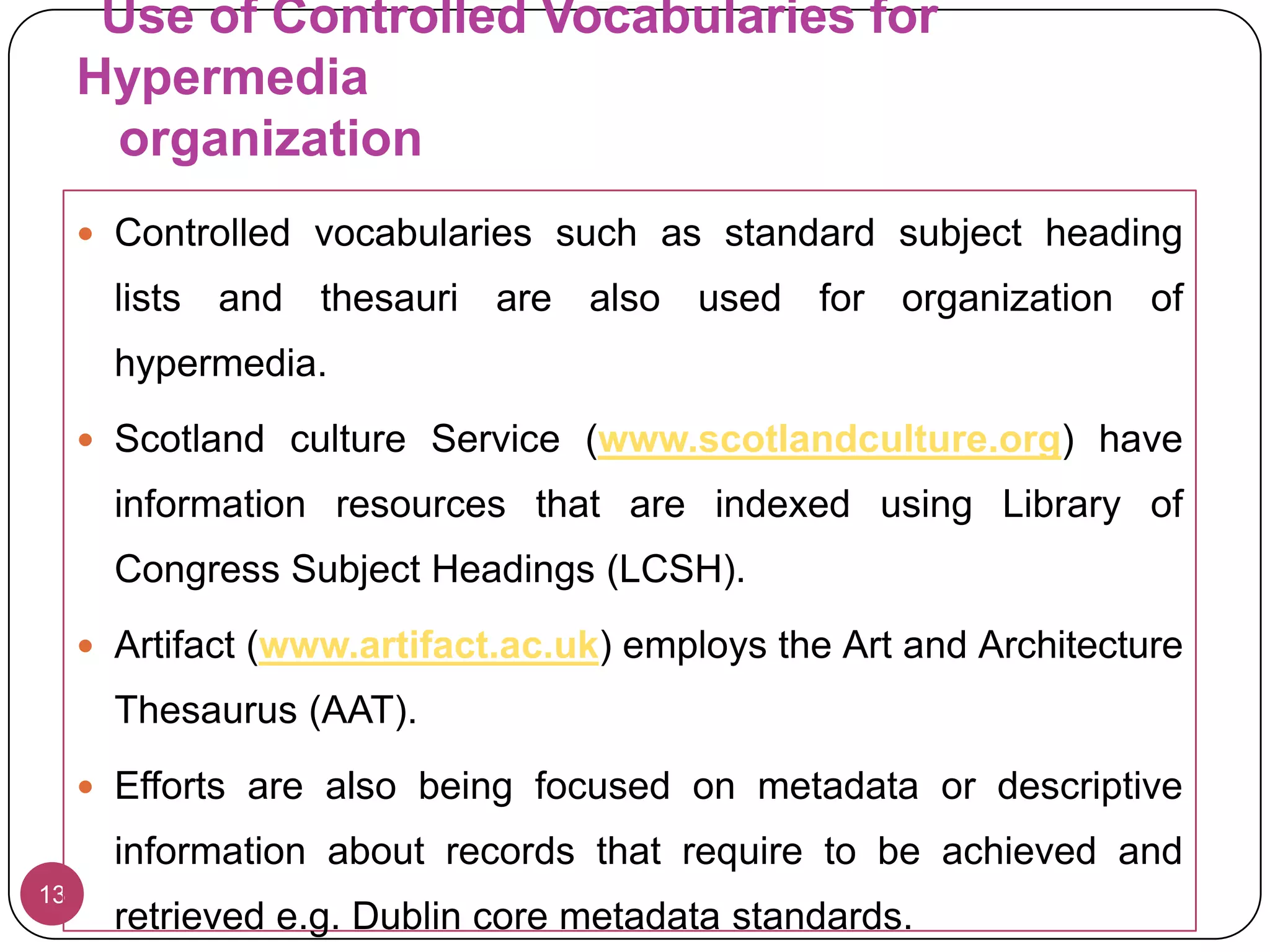
    Link Larder isa quality filtered information source that uses Swedish Scheme namely SAB.Use of Controlled Vocabularies for Hypermedia organization13Controlled vocabularies such as standard subject heading lists and thesauri are also used for organization of hypermedia.
  • 23.
    Scotland culture Service(www.scotlandculture.org) have information resources that are indexed using Library of Congress Subject Headings (LCSH).
  • 24.
    Artifact (www.artifact.ac.uk) employsthe Art and Architecture Thesaurus (AAT).
  • 25.
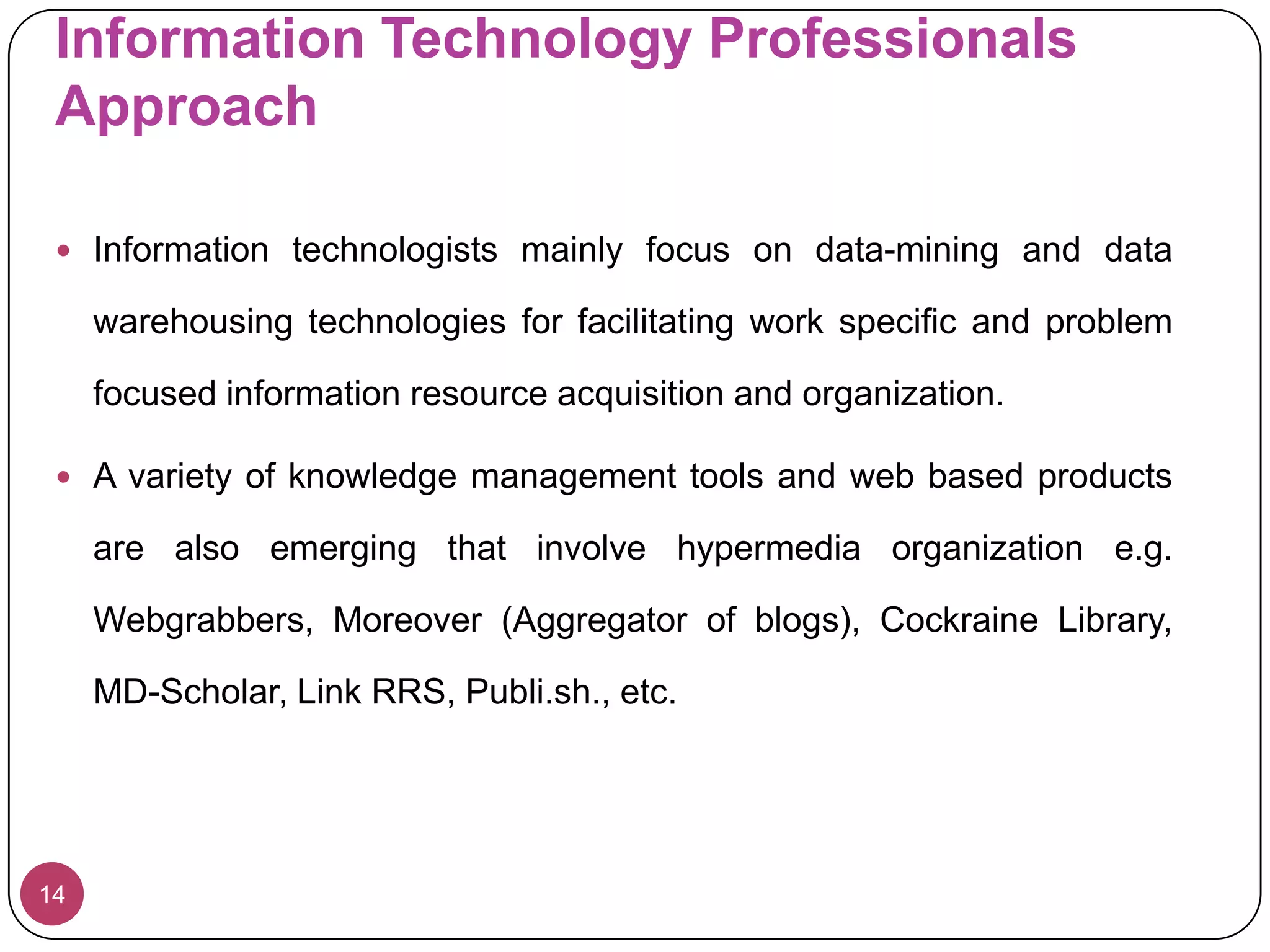
    Efforts are alsobeing focused on metadata or descriptive information about records that require to be achieved and retrieved e.g. Dublin core metadata standards. Information Technology Professionals Approach14Information technologists mainly focus on data-mining and data warehousing technologies for facilitating work specific and problem focused information resource acquisition and organization.A variety of knowledge management tools and web based products are also emerging that involve hypermedia organization e.g. Webgrabbers, Moreover (Aggregator of blogs), Cockraine Library, MD-Scholar, Link RRS, Publi.sh., etc.
  • 26.
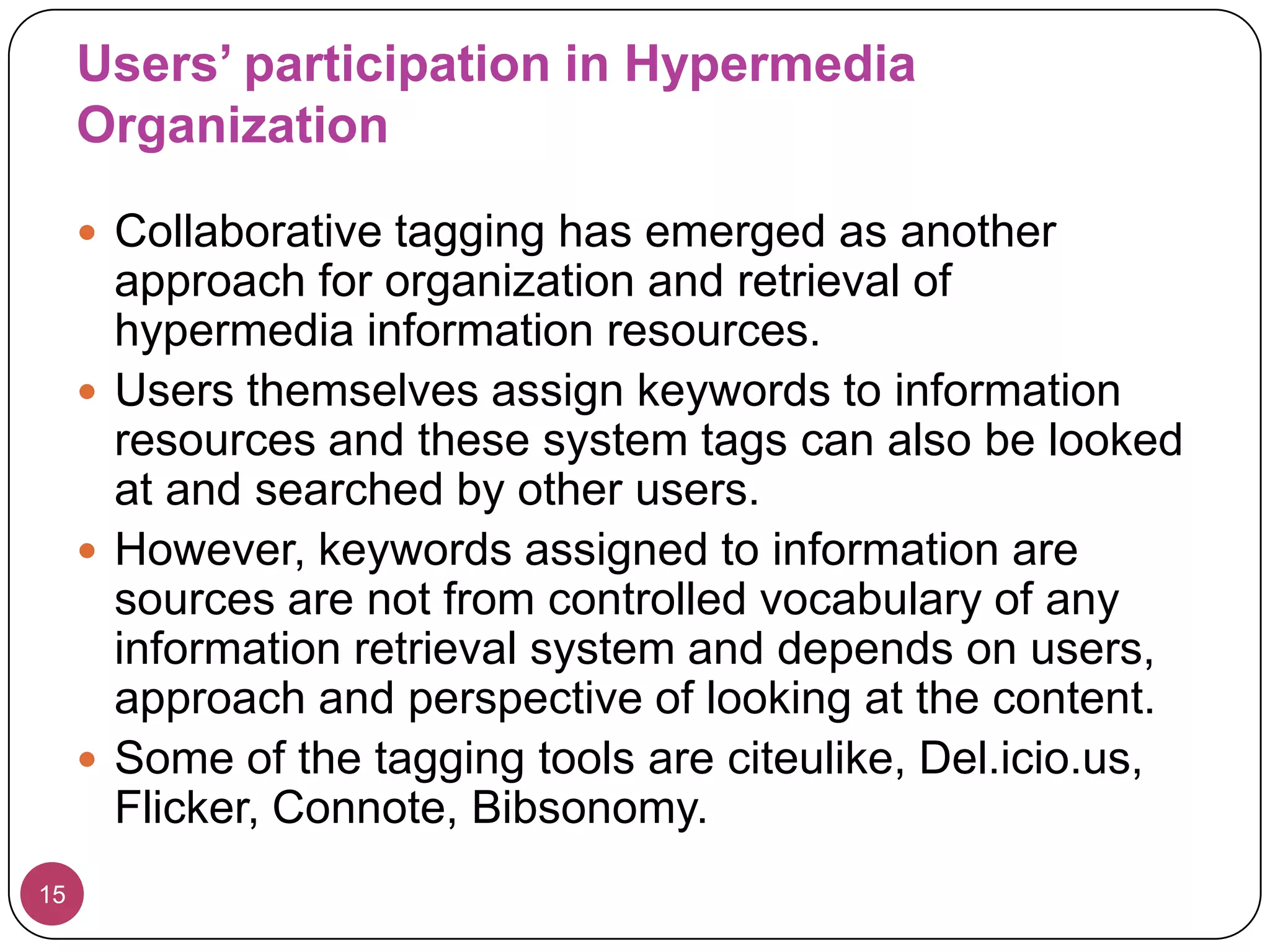
    Users’ participation inHypermedia Organization15Collaborative tagging has emerged as another approach for organization and retrieval of hypermedia information resources.
  • 27.
    Users themselves assignkeywords to information resources and these system tags can also be looked at and searched by other users.
  • 28.
    However, keywords assignedto information are sources are not from controlled vocabulary of any information retrieval system and depends on users, approach and perspective of looking at the content.
  • 29.
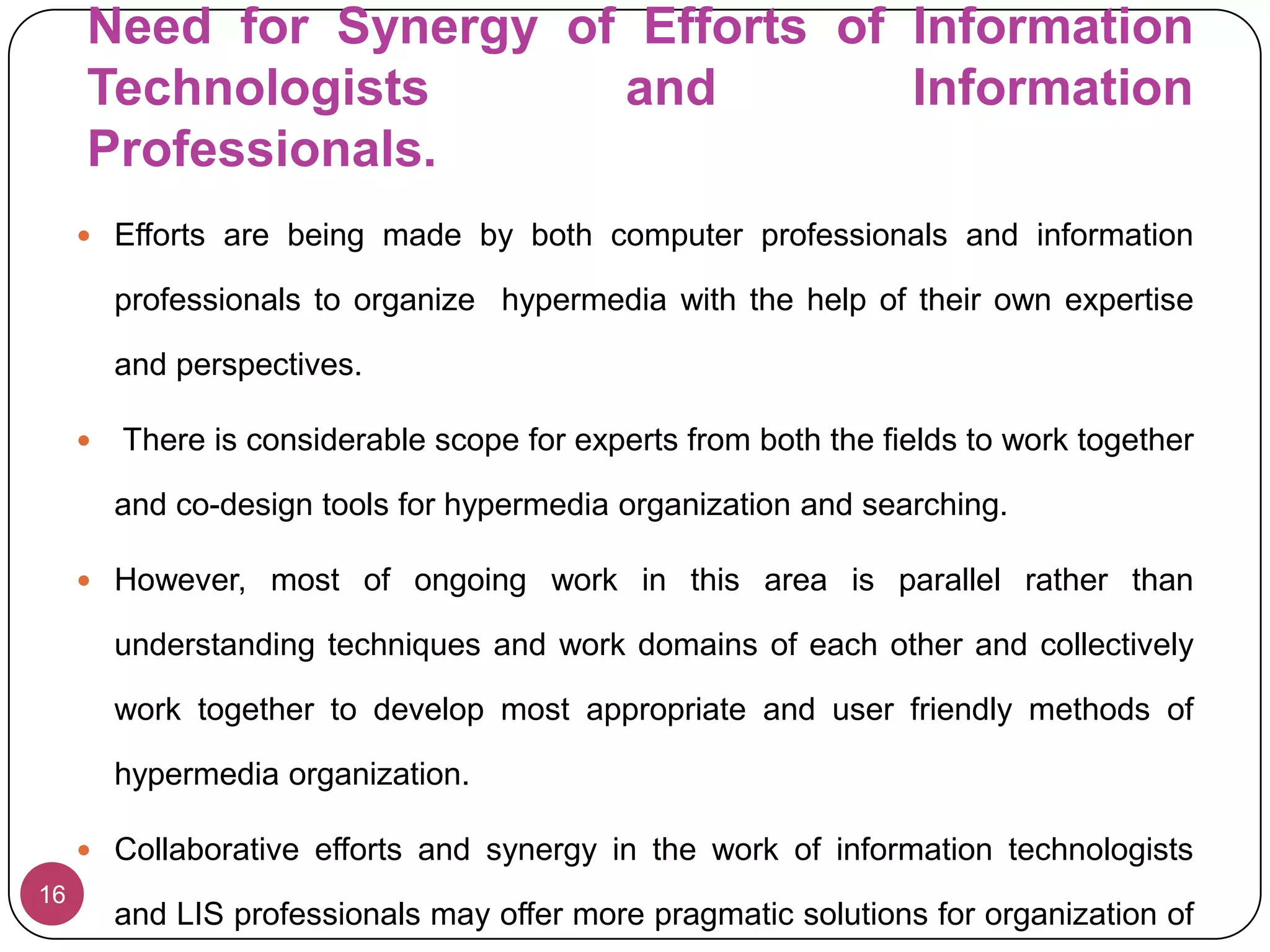
    Some of thetagging tools are citeulike, Del.icio.us, Flicker, Connote, Bibsonomy. Need for Synergy of Efforts of Information Technologists and Information Professionals.16Efforts are being made by both computer professionals and information professionals to organize hypermedia with the help of their own expertise and perspectives.
  • 30.
    There isconsiderable scope for experts from both the fields to work together and co-design tools for hypermedia organization and searching.
  • 31.
    However, most ofongoing work in this area is parallel rather than understanding techniques and work domains of each other and collectively work together to develop most appropriate and user friendly methods of hypermedia organization.
  • 32.
    Collaborative efforts andsynergy in the work of information technologists and LIS professionals may offer more pragmatic solutions for organization of increasingly unbundled hypermedia documents.17Thank youTwitter: anilkmishra