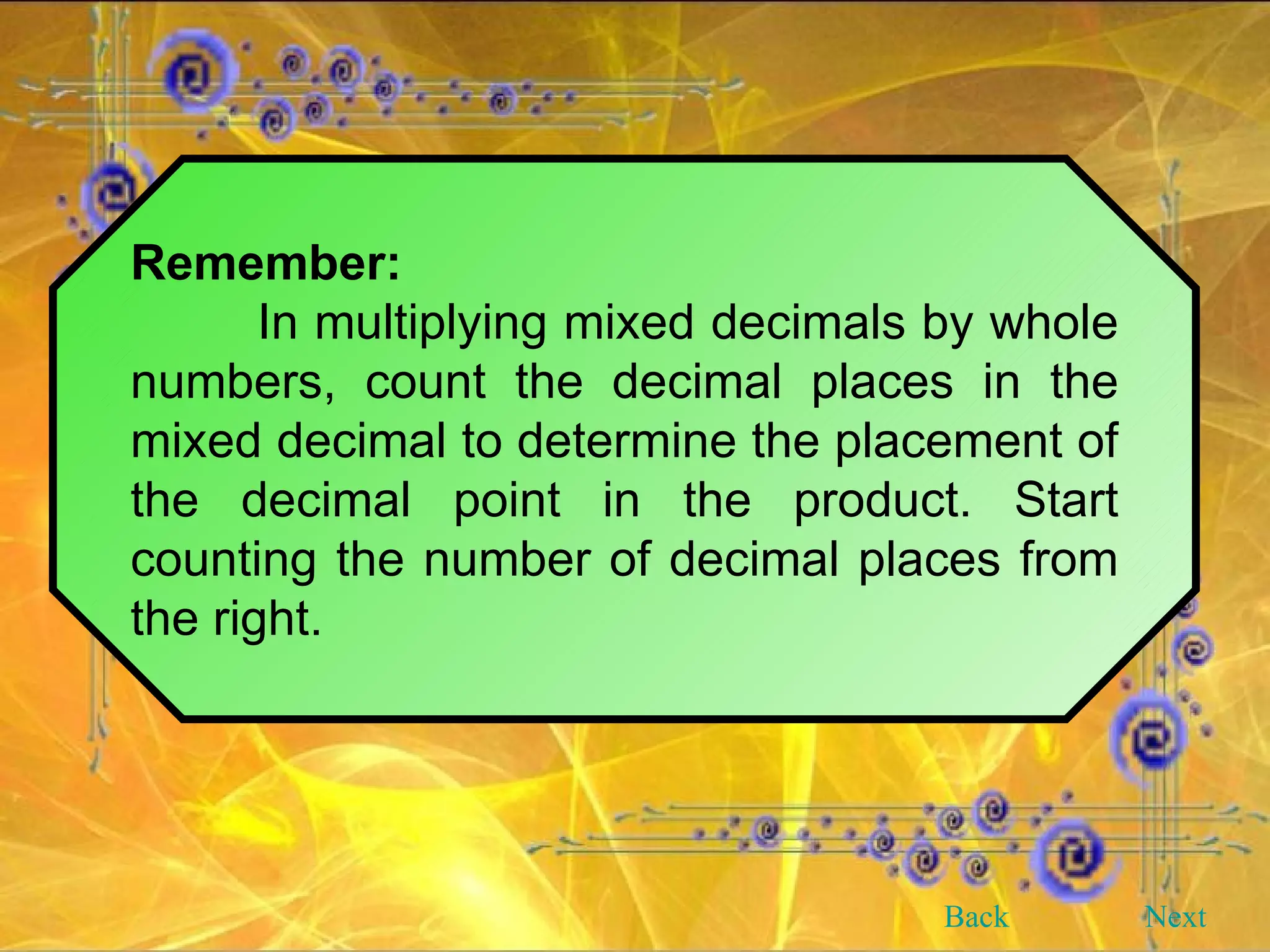
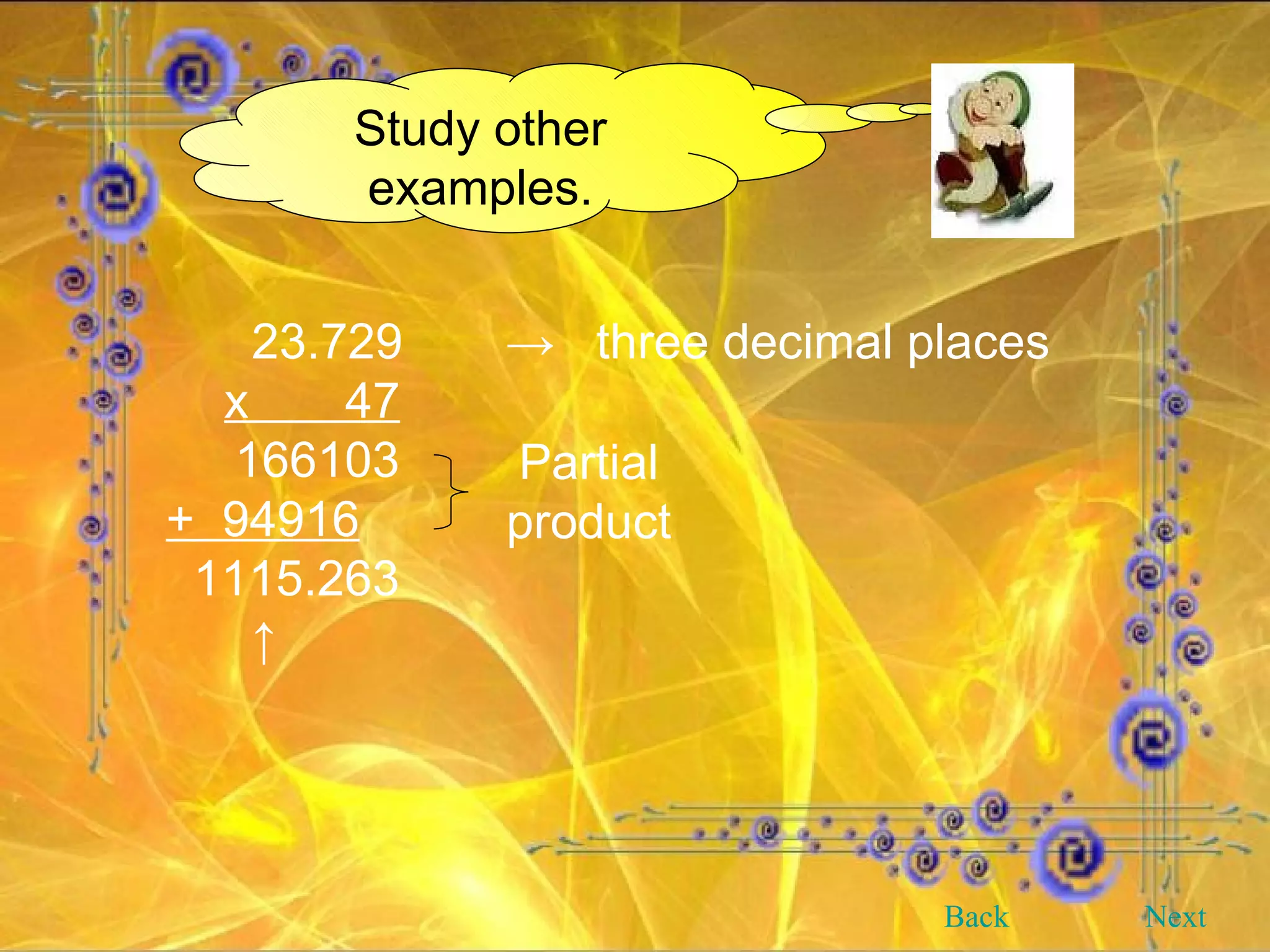
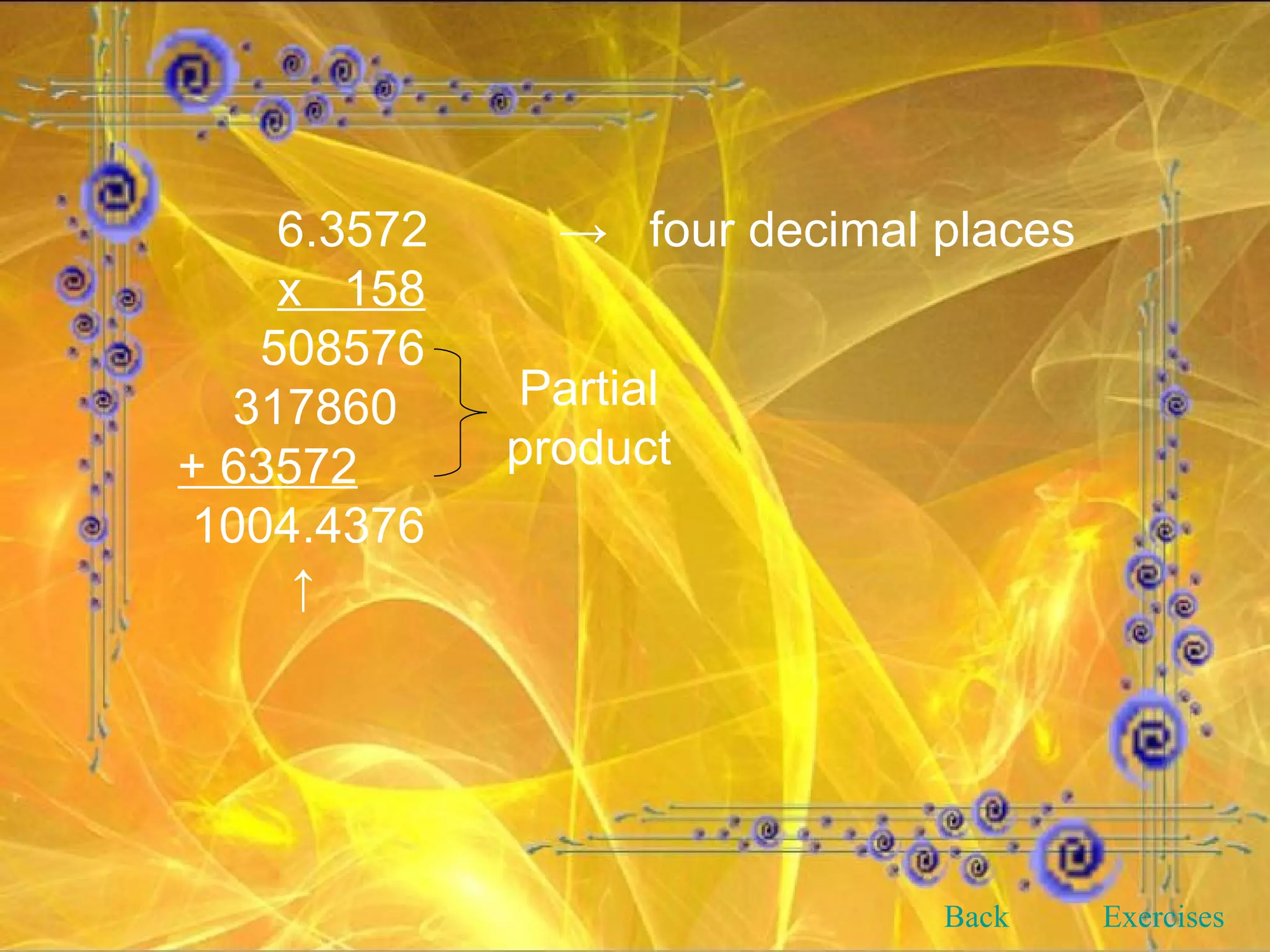
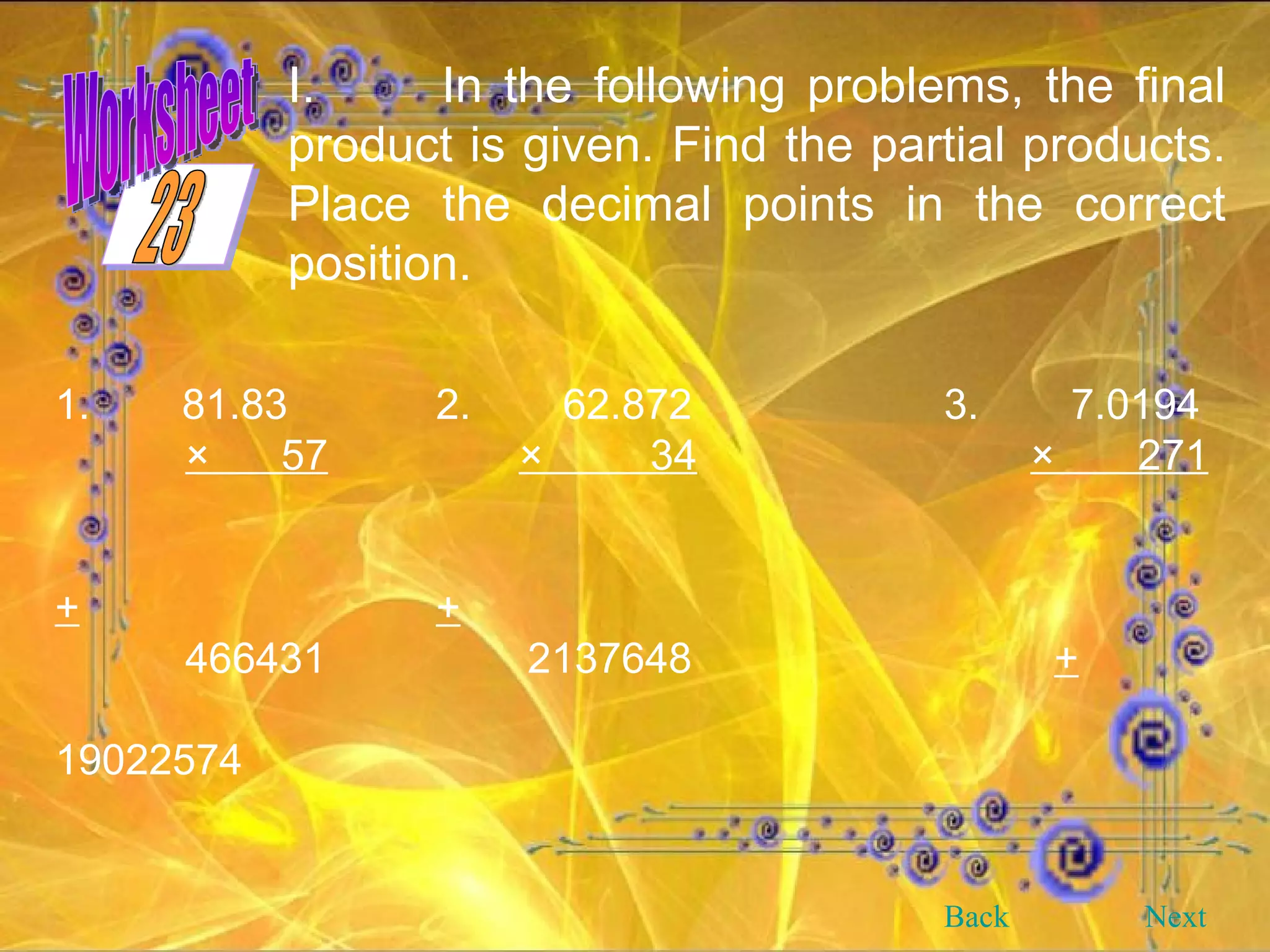
Learning to Solve DECIMAL NUMBERS (Modular Workbook for Grade VI) Student Researchers/ Authors: PAMN FAYE HAZEL M. VALIN RON ANGELO A. DRONA ASST. PROF. BEATRIZ P. RAYMUNDO Module Consultant MR. FOR – IAN V. SANDOVAL Module Adviser Contents 7 8 1 04 3 6 90 5
L aguna u p s tate olytechnic niversity VMGOs Content Next
A premier university in CALABARZON, offering academic programs and related services designed to respond to the requirements of the Philippines and the global economy, particularly, Asian countries.   Vision Next Back
The University shall primarily provide advanced education, professional, technological and vocational instruction in agriculture, fisheries, forestry, science, engineering, industrial technologies, teacher education, medicine, law, arts and sciences, information technology and other related fields. It shall also undertake research and extension services, and provide a progressive leadership in its areas of specialization.  Mission Next Back
In pursuit of college mission/vision the college of education is committed to develop the full potential of the individuals and equip them with knowledge, skills and attitudes in teacher education allied fields effectively responds to the increasing demands, challenge and opportunities of changing time for global competitiveness. Goals of College of Education Next Back
Objectives of Bachelor of Elementary Education 1. Produce graduates who can demonstrate and practice the professional and ethical requirements for the Bachelor of Elementary Education such as:  2. Acquire basic and major trainings in Bachelor of Elementary Education focusing on General Education and Pre - School Education.  3. Produce mentors who are knowledgeable and skilled in teaching pre - school learners and elementary grades and with desirable values and attitudes or efficiency and effectiveness.  4. Conduct research and development in teacher education and other related fields.  5. Extend services and other related activities for the advancement of community life.  Content Back
Foreword Content Next
This Teacher’s Guide Module entitled “Learning to Solve Decimal Numbers (Modular Workbook for Grade VI)” is part of the requirements in Educational Technology 2 under the revised curriculum for Bachelor in Secondary Education based on CHED Memorandum Order (CMO)-30, Series of 2004. Educational Technology 2 is a three (3)-unit course designed to introduce both traditional and innovative technologies to facilitate and foster meaningful and effective learning where students are expected to demonstrate a sound understanding of the nature, application and production of the various types of educational technologies.   Next Back
The students are provided with guidance and assistance of selected faculty members of the university through the selection, production and utilization of appropriate technology tools in developing technology-based teacher support materials. Through the role and functions of computers especially the Internet, the student researchers and the advisers are able to design and develop various types of alternative delivery systems.  These kind of activities offer a remarkable learning experience for the education students as future mentors especially in the preparation of instructional materials. Next Back
The output of the group’s effort may serve as an educational research of the institution in providing effective and quality education. The lessons and evaluations presented in this module may also function as a supplementary reference for secondary teachers and students. Back Next
FOR-IAN V. SANDOVAL   Computer Instructor / Adviser   Educational Technology 2   BEATRIZ P. RAYMUNDO   Assistant Professor II /    Consultant   LYDIA R. CHAVEZ   Dean College of Education Content Back
Preface Content Next
This instructional modular workbook entitled “Learning to Solve Decimal Numbers (Modular Workbook for Grade VI)”, which geared toward the objective of making quality education available to all and offers you a very interesting and helpful friend in your journey to the world of decimal numbers. Dear Learners, Back Next
This modular workbook offers you many experiences in learning decimal numbers. This time, you will study how to read, write, and name decimal numbers and how to compare order and round off decimal numbers. Of course you will also express the equivalent fractions and decimals.  Back Next
You will also experience the four (4) fundamental operations (Addition, Subtraction, Multiplication and Division) dealing with decimal numbers. Lastly, you will also solve more difficult problems involving the four (4) fundamental operations using decimal numbers. Learning decimal content is much more skillful in drilling with the application of FUN WITH MATH which designed to achieve with outmost skill and convenience. Back Next
The authors feel that you can benefit much from this modular workbook if you follow the   direction carefully. Be mindful as you lead yourselves to challenge the situation and circumstances and as you faces in every living as well as for the near future. If you do these, you will realize that indeed this modular workbook can be a very interesting and helpful companion. The Authors Back Content
Acknowledgement Next Content
We would like to express our sincerest gratitude for the following whom in are ways or another help us making this modular workbook become possible: To  Prof. Corazon N. San Agustin , for her kindness and understanding to this modular workbook. Next Back
To  Mr. For – Ian V. Sandoval , our instructor and adviser in Educational Technology 2, for giving sufficient technical trainings, suggestions, constructive criticism and unending support in our every needs. To  Assistant Professor Beatriz P. Raymundo , our Module Consultant, for making her available most of the time for comments, suggestions and revision of the modular workbook. Next Back
To  Professor Lydia R. Chavez , our Dean, College of Education, for inspiring advises and encouragement.  To our  classmates and friends  for their never ending support. Next Back
To our  beloved families , for unconditional love, emotional, spiritual and financial support all the way to used and for the filling up our duties in our home. And most importantly to  Almighty God , for rendering abilities, wisdom, good health, strength, courage, source of enlightenment and inspiration to pursue doing this piece of material. The Authors Content Back
Table of Contents
VMGO’s FOREWORD PREFACE ACKNOWLEDGEMENT TABLE OF CONTENTS
UNIT I Decimal Numbers Lesson 1  What is Decimal? Lesson 2  Reading and Writing Decimal Numbers Lesson 3  Reading and Writing Mixed Decimal 	    	      Numbers Lesson 4  Reading and Writing Decimal Numbers Used 	      in Technical and Science Work Lesson 5  Place Value Lesson 6  Comparing Decimal Numbers Lesson 7  Ordering Decimal Numbers Lesson 8  How to Round Decimal Numbers? Lesson 9  The Self-Replicating Gene
UNIT II Equivalent Fractions and Decimals Lesson 10  Expressing Fractions to Decimals Lesson 11  Expressing Mixed Fractional  	  	        Numbers to Mixed Decimals Lesson 12  Expressing Decimals to Fractions Lesson 13  Expressing Mixed Decimals Numbers 	       to Mixed Numbers (Fractions)
UNIT III Addition and Subtraction of Decimal 				Numbers Lesson 14  Meaning of Addition and Subtraction of 	  	        Decimal Numbers Lesson 15  Addition and Subtraction of Decimal Numbers 	        without Regrouping Lesson 16  Addition and Subtraction of Decimal Numbers 	       with Regrouping Lesson 17  Adding and Subtracting Mixed Decimals Lesson 18  Estimating Sum and Difference of Whole 	  	       Numbers and Decimals Lesson 19  Minuend with Two Zeros Lesson 20  Problem Solving Involving Addition and 	 	       Subtraction of Decimal Numbers
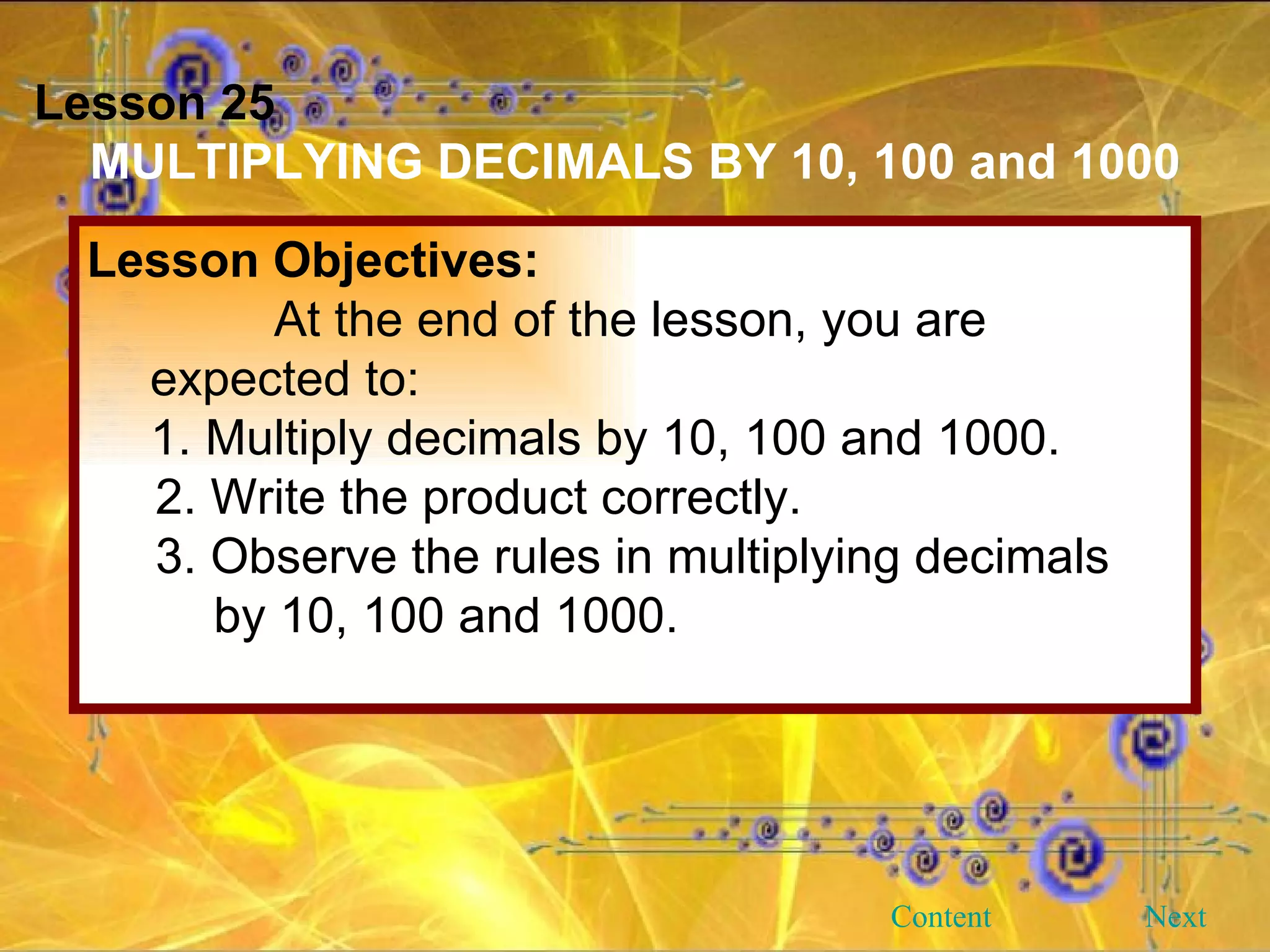
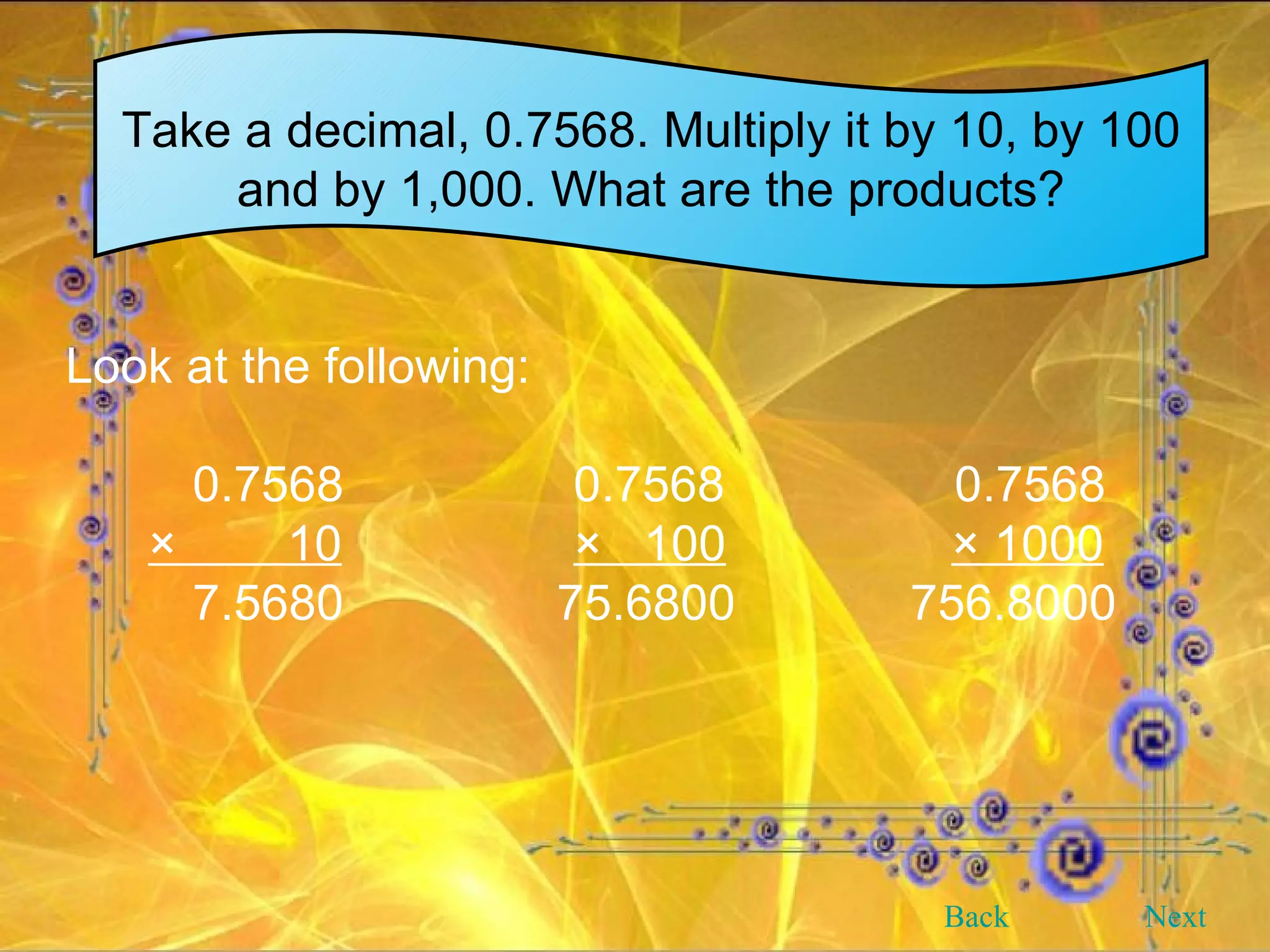
UNIT IV   Multiplication of Decimals Lesson 21  Meaning of Multiplication of Decimals Lesson 22  Multiplying Decimals Lesson 23  Multiplying Mixed Decimals by Whole 	 	 	        Numbers Lesson 24  Multiplication of Mixed Decimals by Whole 		       Numbers Lesson 25  Multiplying Decimals by 10, 100 and 1000 Lesson 26  Estimating Products of Decimal Numbers Lesson 27  Problem Solving Involving Multiplication of 		        Decimal Numbers
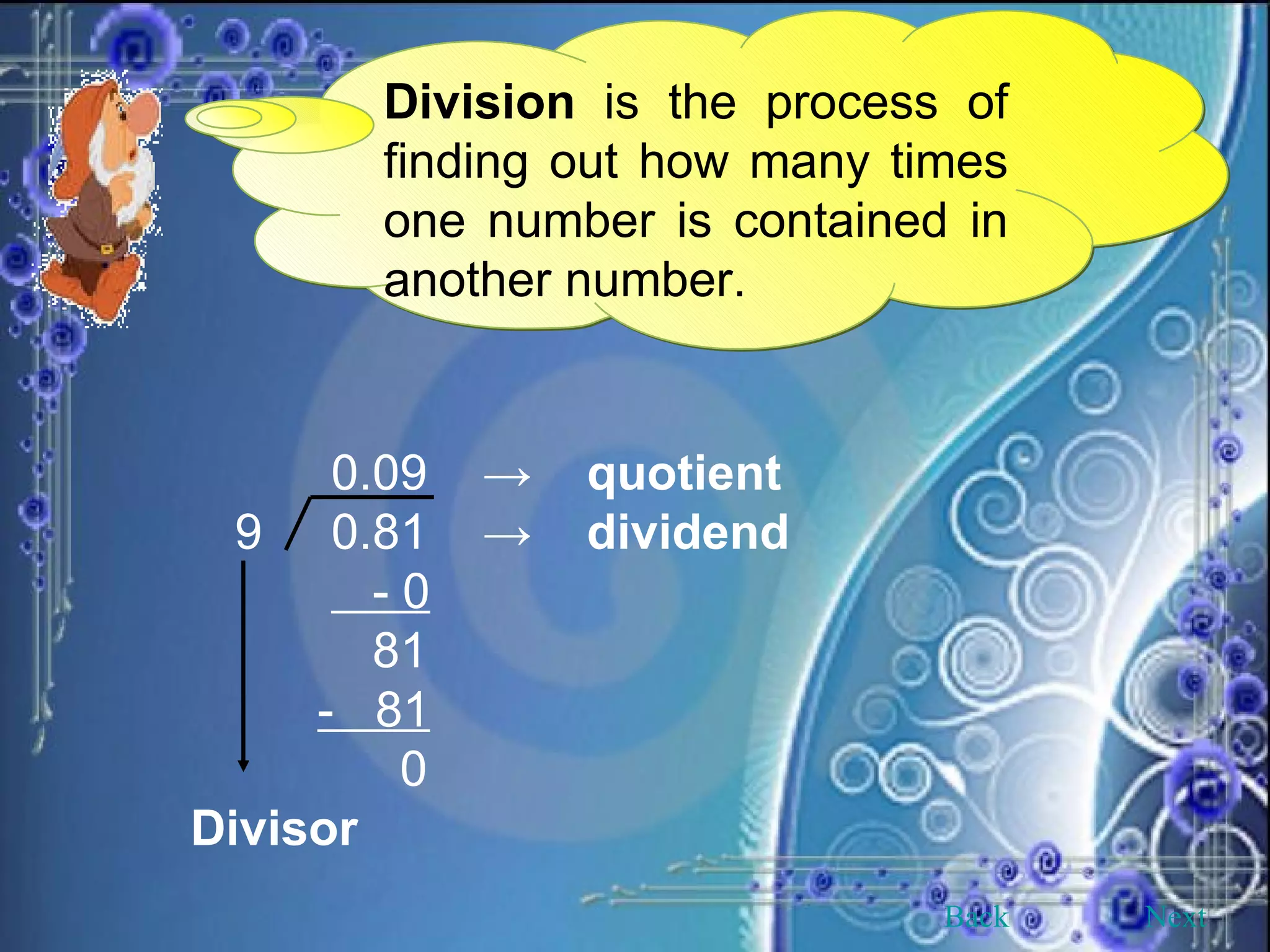
UNIT V Division of Decimal Numbers Lesson 28  Meaning of Division of Decimals Lesson 29  Dividing Decimals by Whole Numbers Lesson 30  Dividing Mixed Decimals by Whole 		        Numbers Lesson 31  Dividing Whole Numbers by Decimals Lesson 32  Dividing Whole Numbers by Mixed 		        Decimals Lesson 33  Dividing Decimals by Decimals Lesson 34  Dividing Mixed Decimals by Mixed 	 	       Decimals
CURRICULUM VITAE REFERENCES
UNIT I DECIMAL NUMBERS Content Next
OVERVIEW OF THE MODULAR WORKBOOK In this modular workbook, you will understand the concept of the language of decimal numbers. This modular workbook, will help you to read, write, and name decimal numbers for a given models, standard, mixed and technical and science work form. It provides the knowledge about place value, with the aid of a place - value chart. It also provides information on how to compare and order decimal numbers and also how to round off decimal numbers. This module will provide you a more difficult work in mathematics. Exercises will help the learners evaluate themselves to understand decimal numbers.  Back Next
OBJECTIVES OF THE MODULAR WORKBOOK After completing this modular workbook, you expected to: 1. Know the language of decimal numbers. 2. Read, write, and name decimal numbers in    different forms. 3. Read and write decimal numbers with the    aids of place - value chart. 4. Compare and order decimal numbers. 5. Rounding off decimal numbers by following    its rule. Back Next
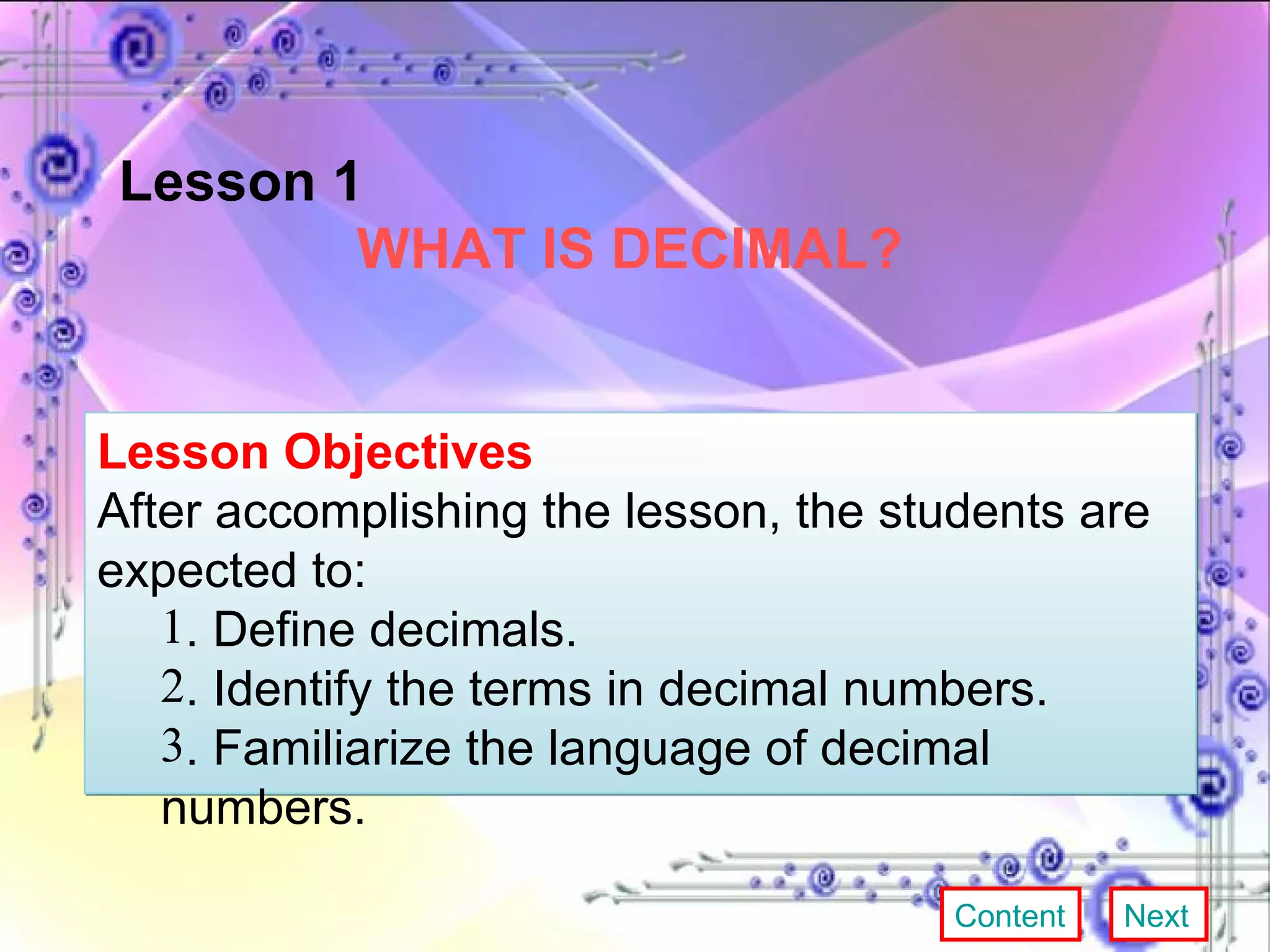
Lesson 1  WHAT IS DECIMAL? Lesson Objectives After accomplishing the lesson, the students are expected to:  . Define decimals. . Identify the terms in decimal numbers. . Familiarize the language of decimal numbers. Content Next
One important feature of our number system is the decimal. It involved many computational operations. It is very useful in the measurement of very thin sheets and in the computation involving in exact amount. But what is decimal? Look at the following examples: Back Next
.3 =  3  .03 =   3    10  100 .003 =   3  .0003 =  3    1000  10000 b. .5 =  5  .05 =   5  10  100 .005 =   5  .0005 =  5   1000    10000  Back Next
From the example given above, a “ decimal ” may be defined as a fraction whose denominator is in the power of 10. Back Next
Numbers in the power of 10 are 10, 100, 1000, 1000, etc. The dot before a digit in a decimal is called “ decimal point ” which is an indicator that the number is a decimal. The place on the position occupied by a digit at the right of the decimal point is called a “ decimal place ”. Back Exercises
I. Give the meaning and explain the use of the following. 1. What are decimals? 2. What is decimal point? 3. What is decimal place? 4. Give some examples of decimal numbers. Back Next 1 Worksheet
Decimals ____________________________________________________________________________________ 2. Decimal Point ____________________________________________________________________________________ 3. Decimal Place ____________________________________________________________________________________ 4. Examples  ____________________________________________________________________________________ Back Next
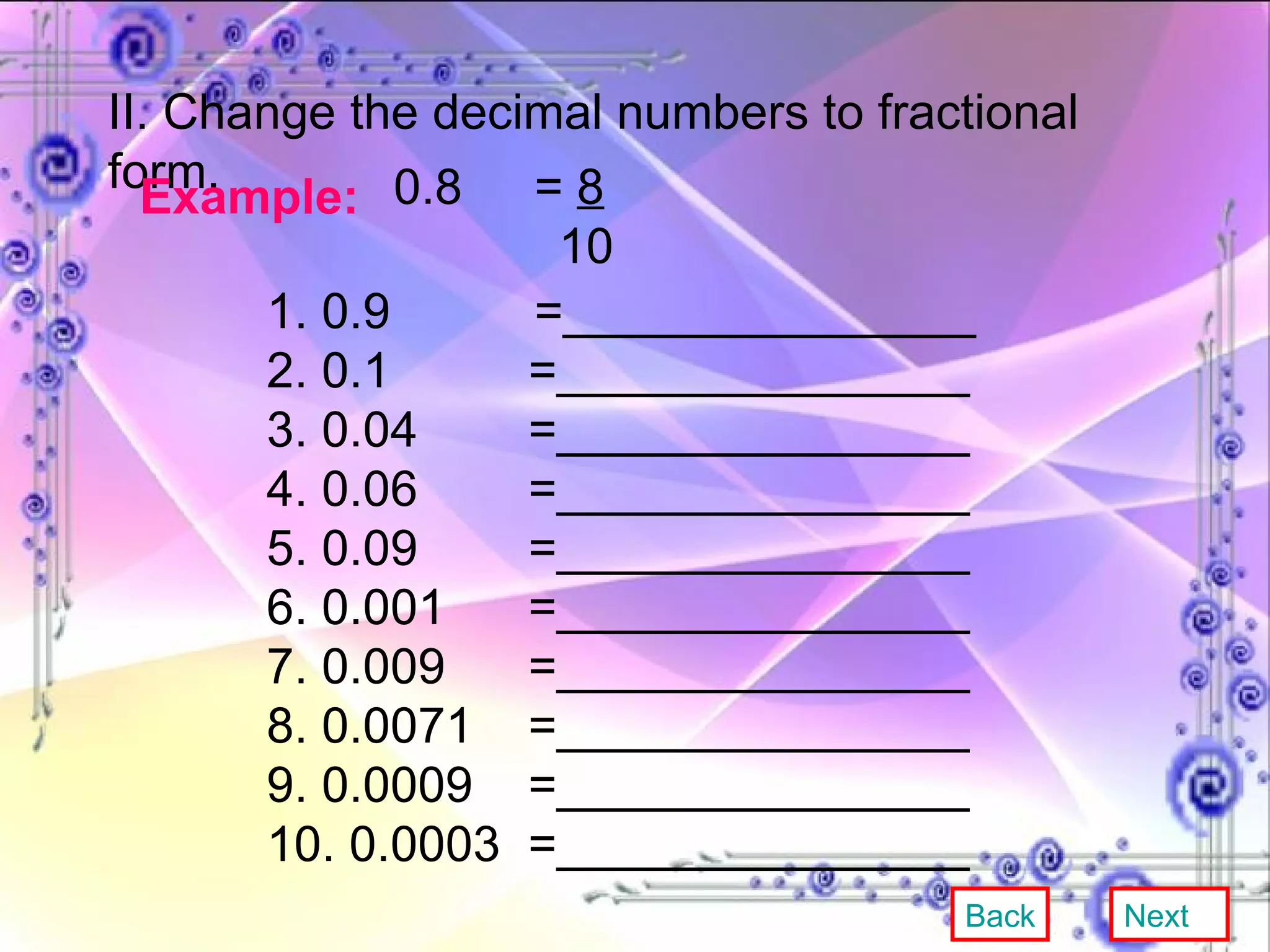
II. Change the decimal numbers to fractional form. Example:   0.8  =  8 10 1. 0.9   =_______________ 2. 0.1  =_______________ 3. 0.04  =_______________ 4. 0.06  =_______________ 5. 0.09  =_______________ 6. 0.001  =_______________ 7. 0.009  =_______________ 8. 0.0071  =_______________ 9. 0.0009  =_______________ 10. 0.0003  =_______________ Back Next
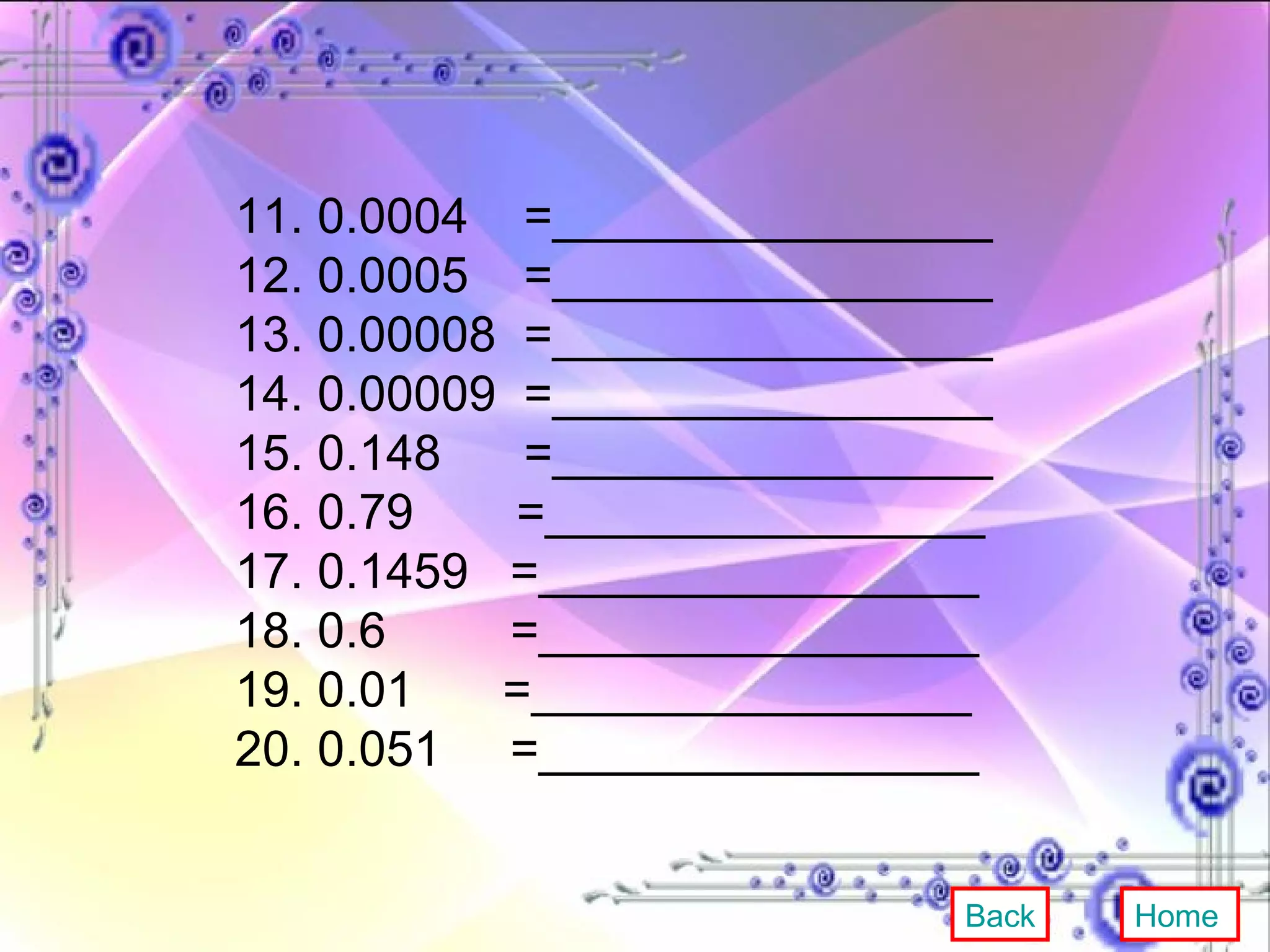
11. 0.0004  =________________ 12. 0.0005  =________________ 13. 0.00008  =________________ 14. 0.00009  =________________ 15. 0.148  =________________ 16. 0.79   =________________ 17. 0.1459  =________________ 18. 0.6  =________________ 19. 0.01  =________________ 20. 0.051  =________________ Back Home
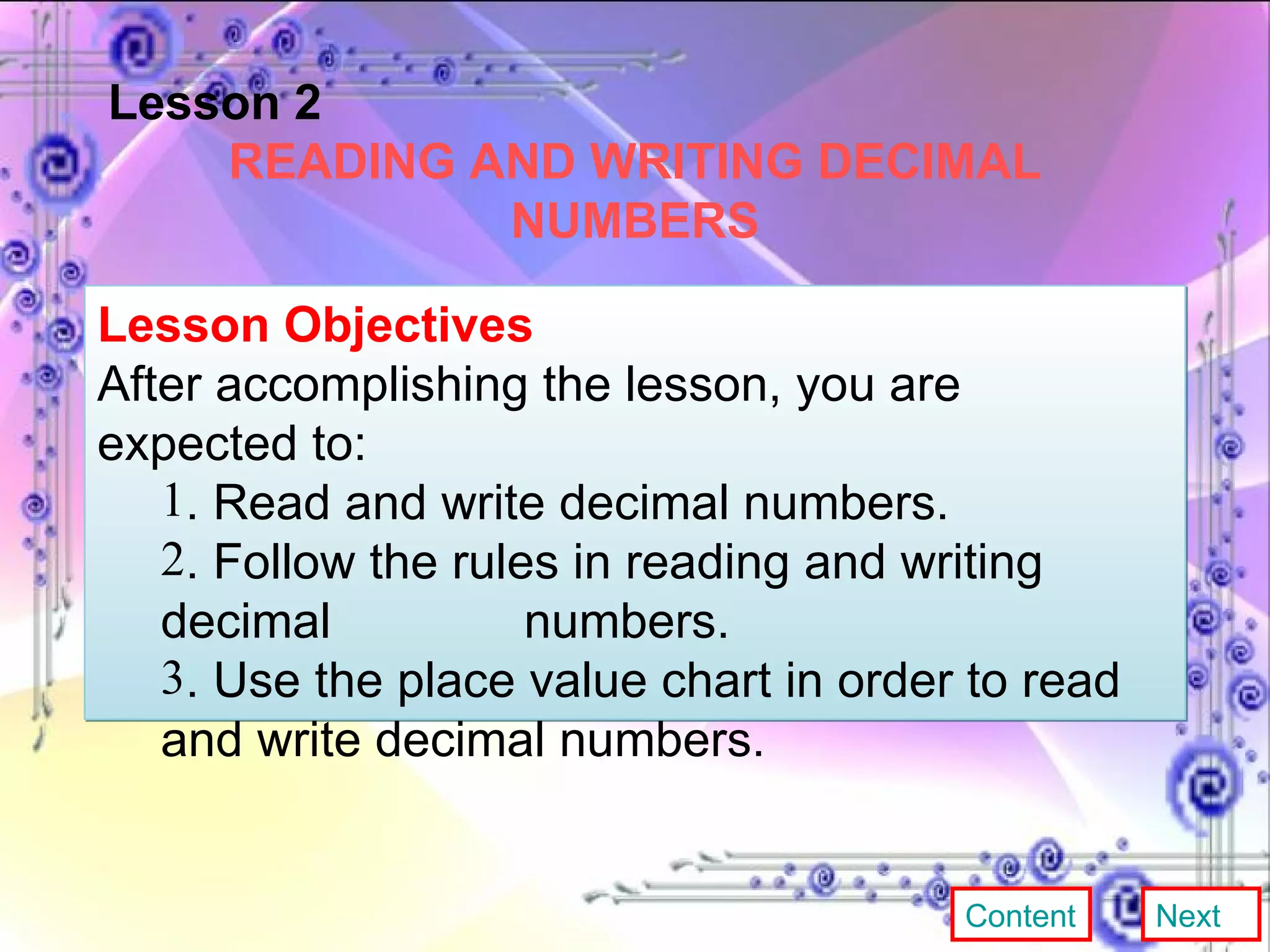
Lesson 2 READING AND WRITING DECIMAL NUMBERS Lesson Objectives After accomplishing the lesson, you are expected to:  . Read and write decimal numbers. . Follow the rules in reading and writing decimal  numbers. . Use the place value chart in order to read and write decimal  numbers. Content Next
How to read and write decimals or decimal numbers? A decimal is read and write according to the number of decimal place it has. Here are the rules in reading and writing decimal numbers. Back Next
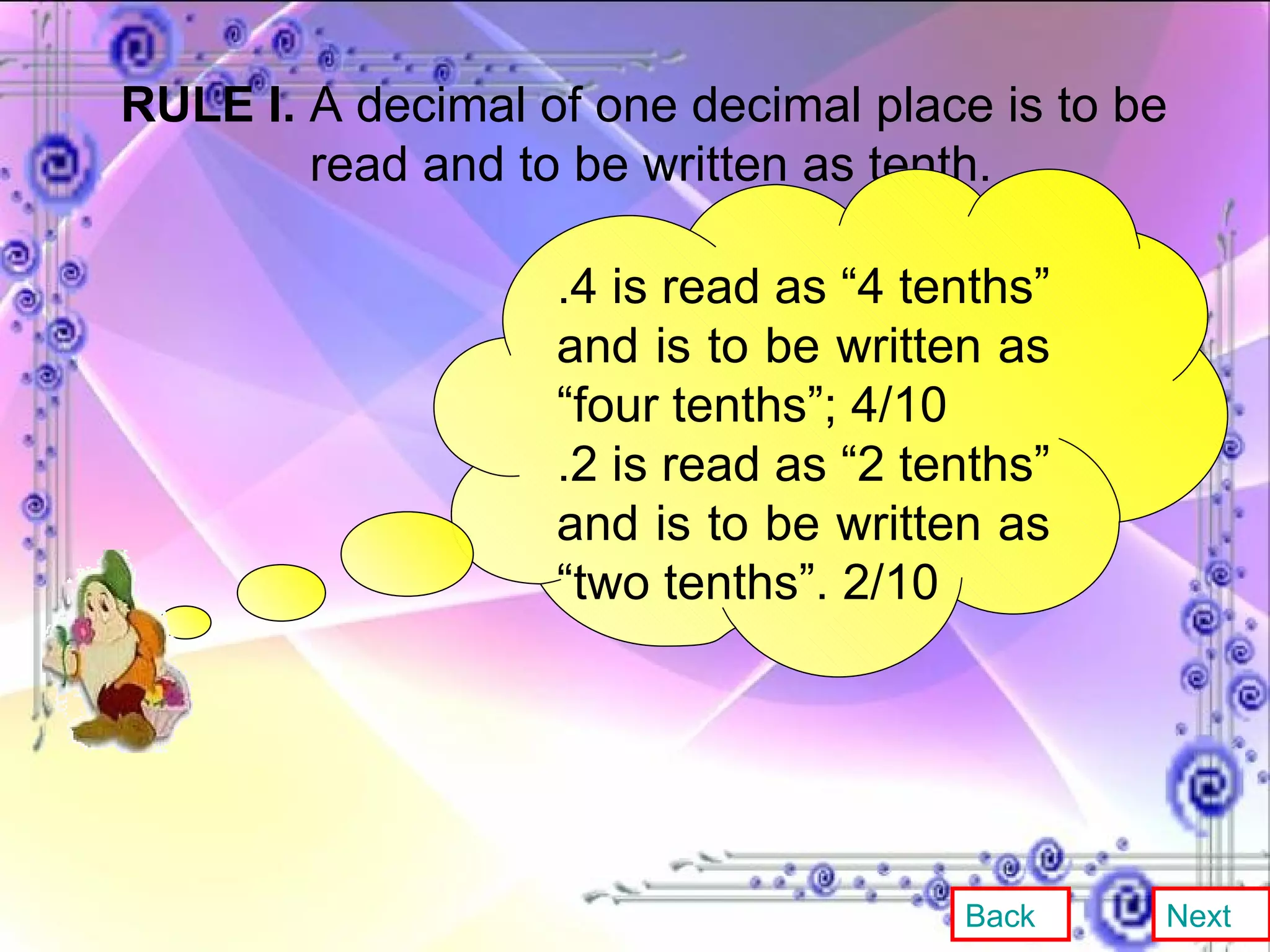
RULE I.  A decimal of one decimal place is to be  read and to be written as tenth. .4 is read as “4 tenths” and is to be written as “four tenths”; 4/10 .2 is read as “2 tenths” and is to be written as “two tenths”. 2/10 Back Next
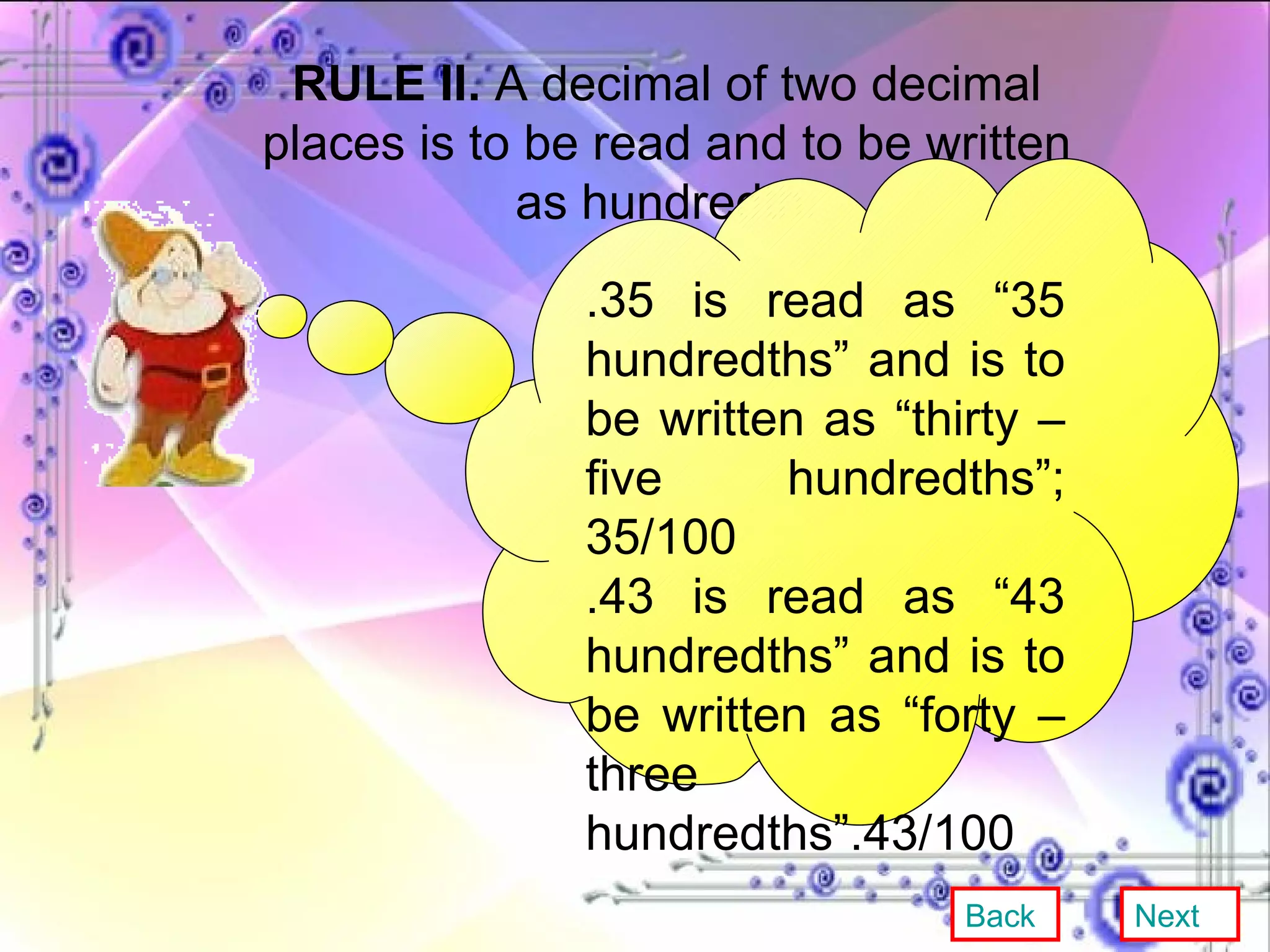
RULE II.  A decimal of two decimal places is to be read and to be written as hundredth. .35 is read as “35 hundredths” and is to be written as “thirty – five hundredths”; 35/100 .43 is read as “43 hundredths” and is to be written as “forty – three hundredths”.43/100 Back Next
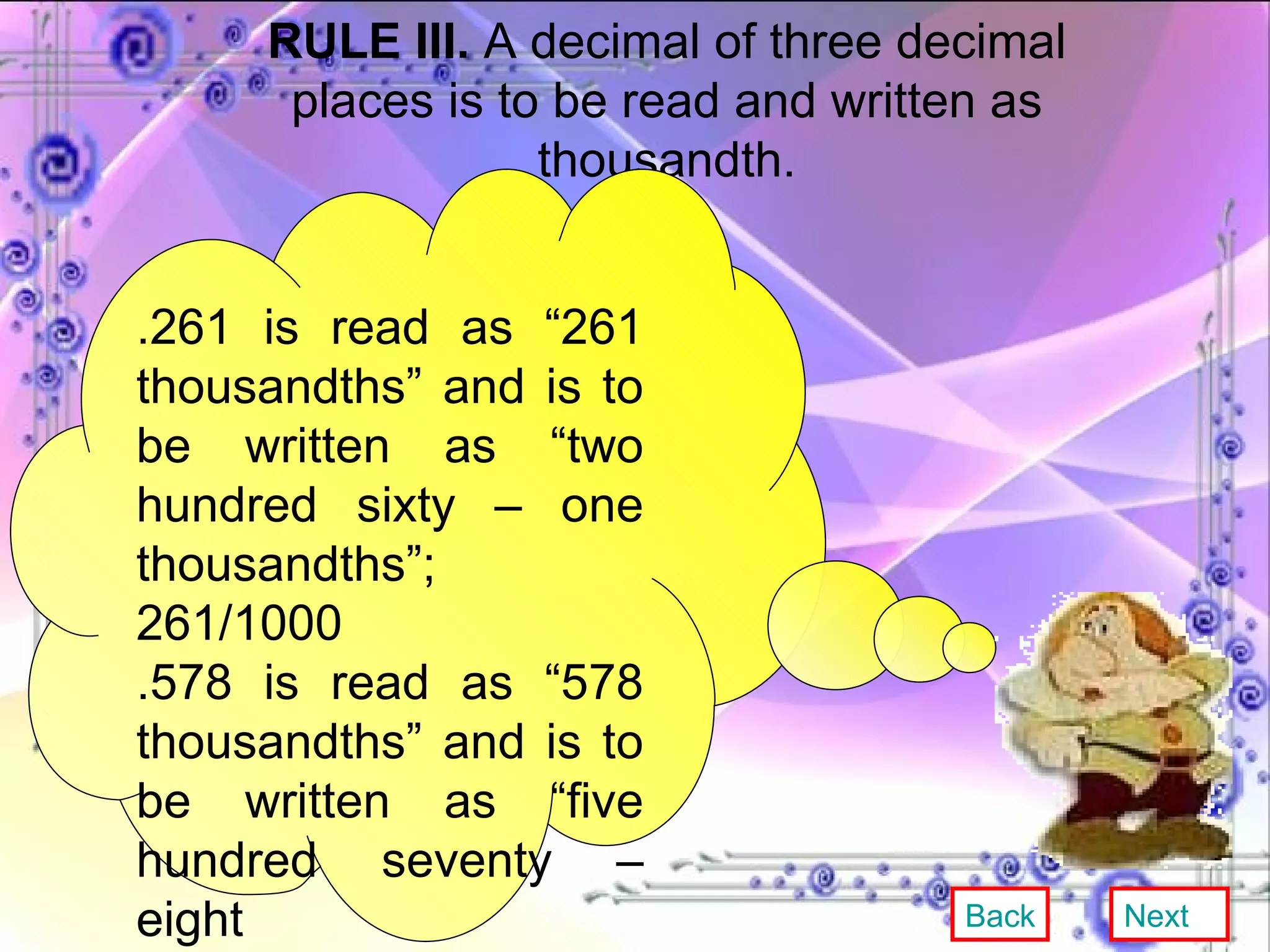
RULE III.  A decimal of three decimal places is to be read and written as thousandth. .261 is read as “261 thousandths” and is to be written as “two hundred sixty – one thousandths”; 261/1000 .578 is read as “578 thousandths” and is to be written as “five hundred seventy – eight thousandths”.578/1000 Back Next
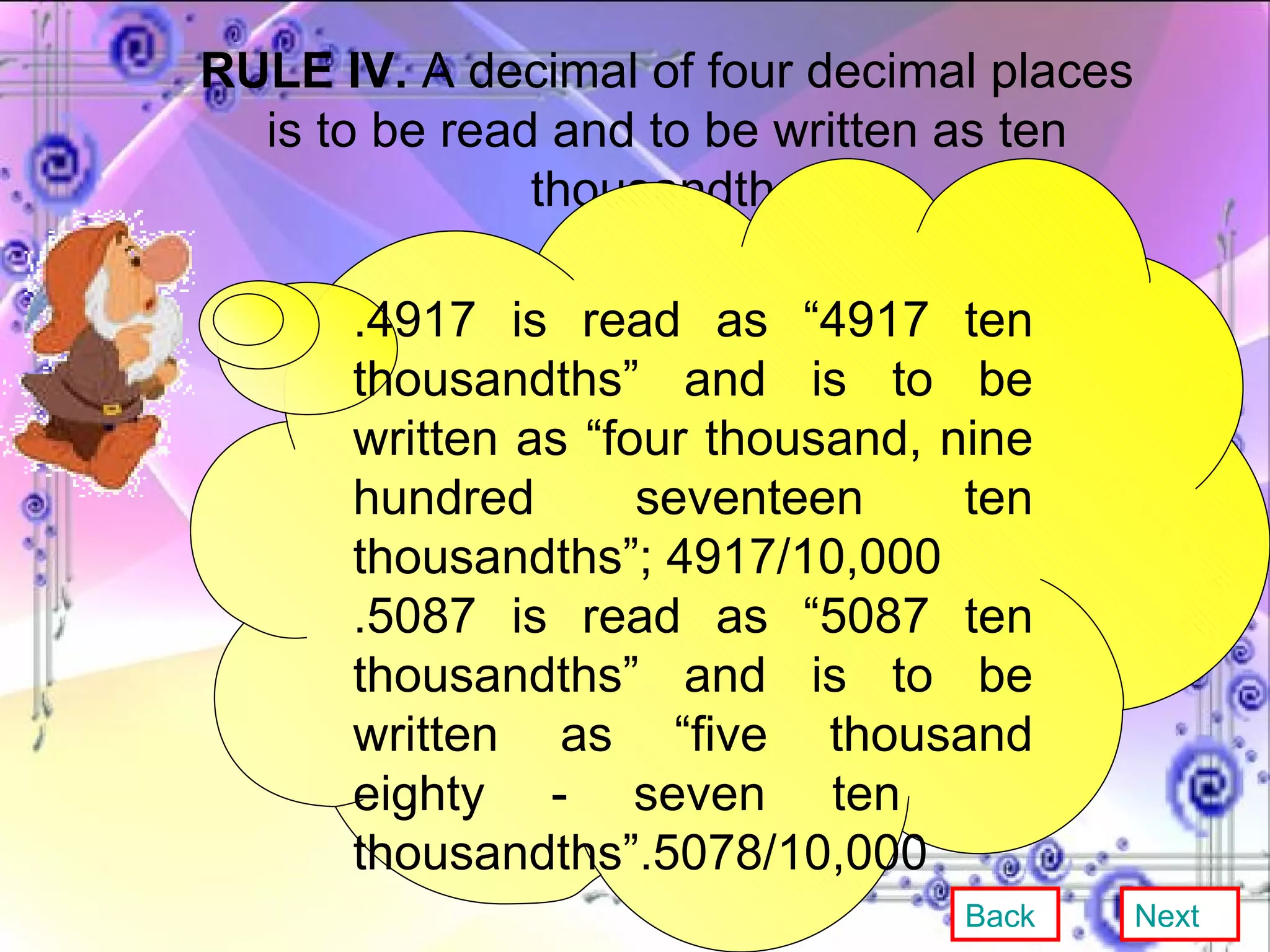
RULE IV.  A decimal of four decimal places is to be read and to be written as ten thousandth.  .4917 is read as “4917 ten thousandths” and is to be written as “four thousand, nine hundred seventeen ten thousandths”; 4917/10,000 .5087 is read as “5087 ten thousandths” and is to be written as “five thousand eighty - seven ten  thousandths”.5078/10,000 Back Next
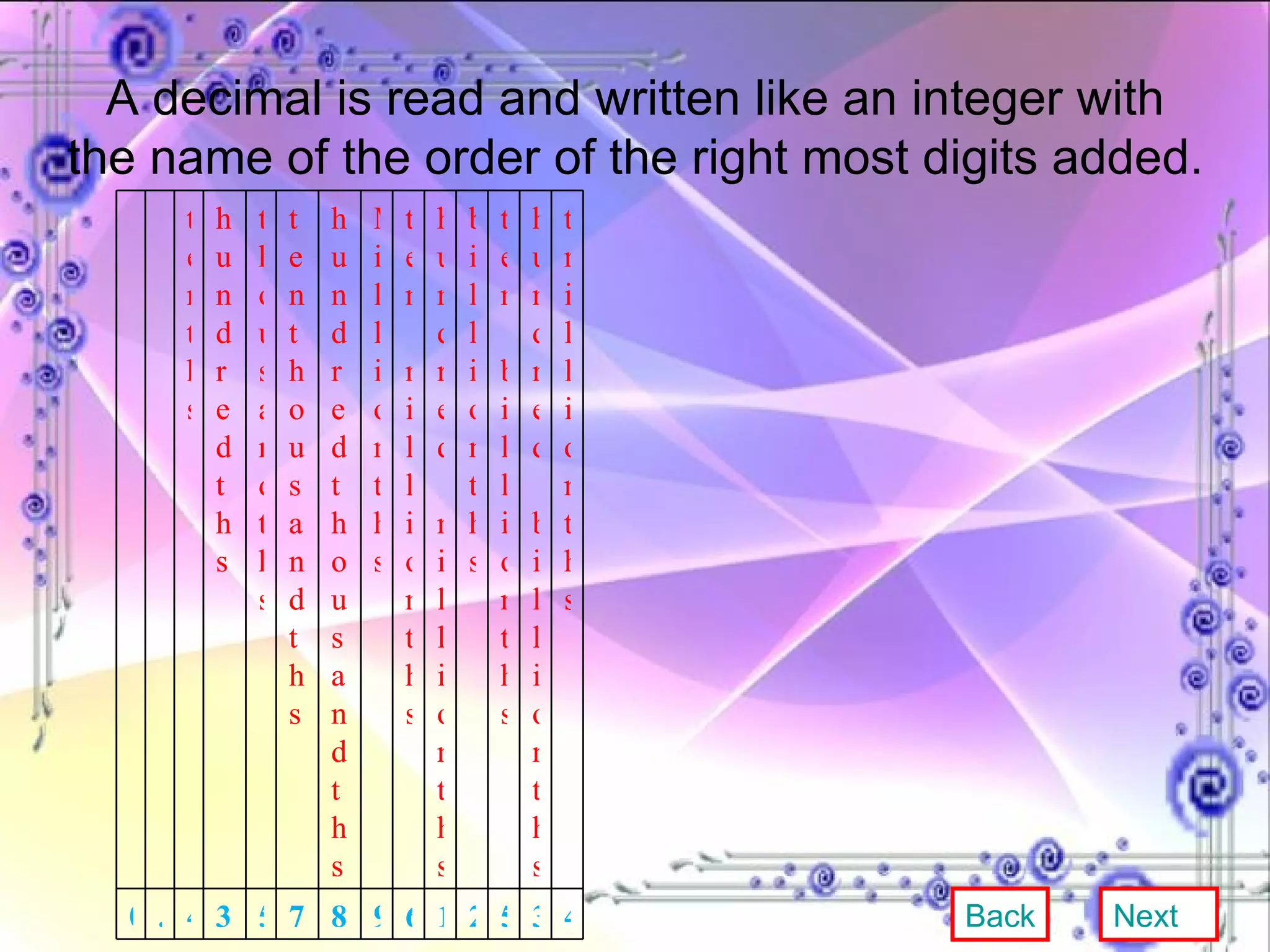
A decimal is read and written like an integer with the name of the order of the right most digits added. Back Next tenths hundredths thousandths ten thousandths hundred thousandths Millionths ten millionths hundred millionths billionths ten billionths hundred billionths trillionths 0 . 4 3 5 7 8 9 6 1 2 5 3 4
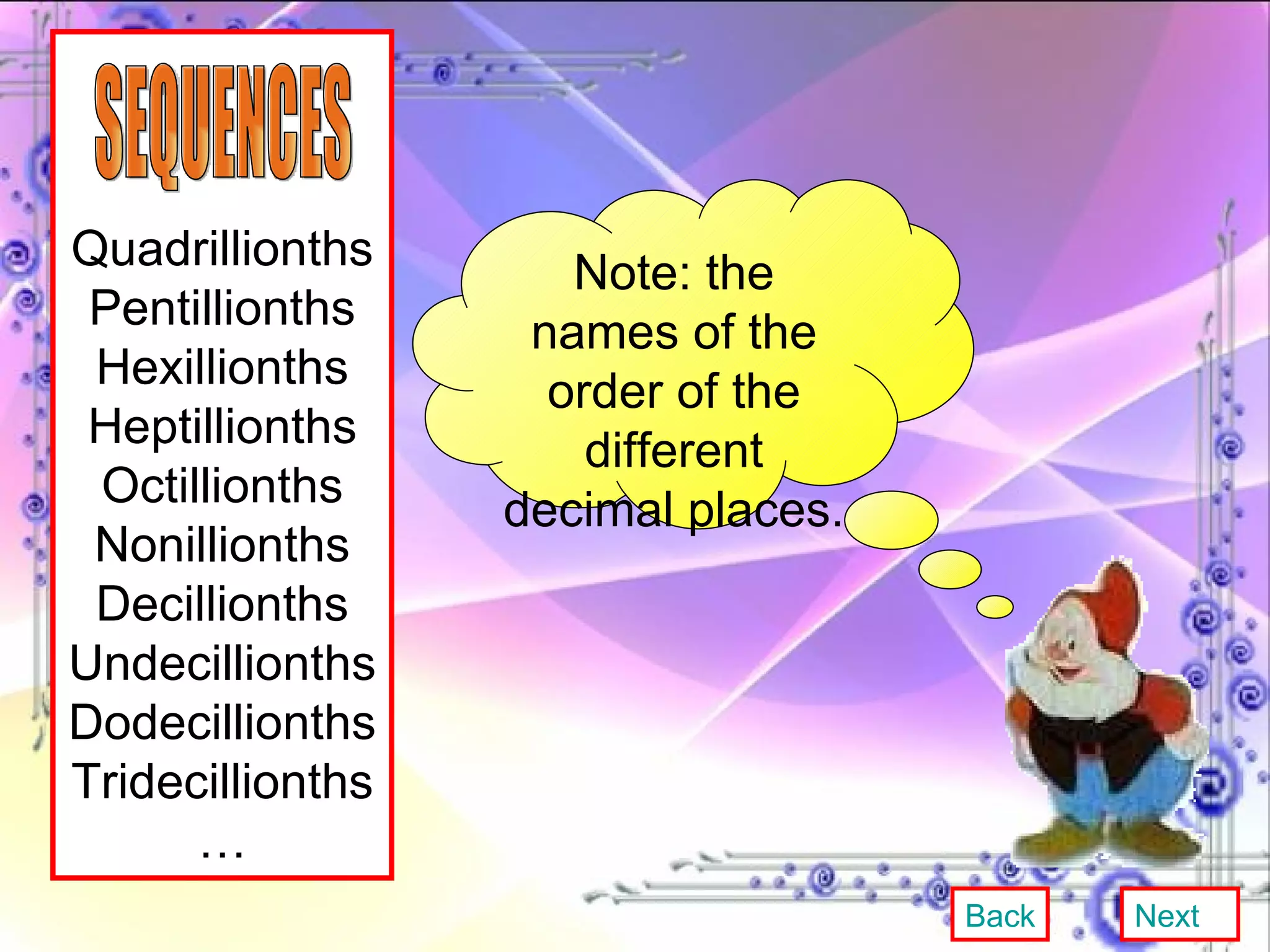
Note: the names of the order of the different decimal places. Quadrillionths Pentillionths Hexillionths Heptillionths Octillionths Nonillionths Decillionths Undecillionths Dodecillionths Tridecillionths… SEQUENCES Back Next
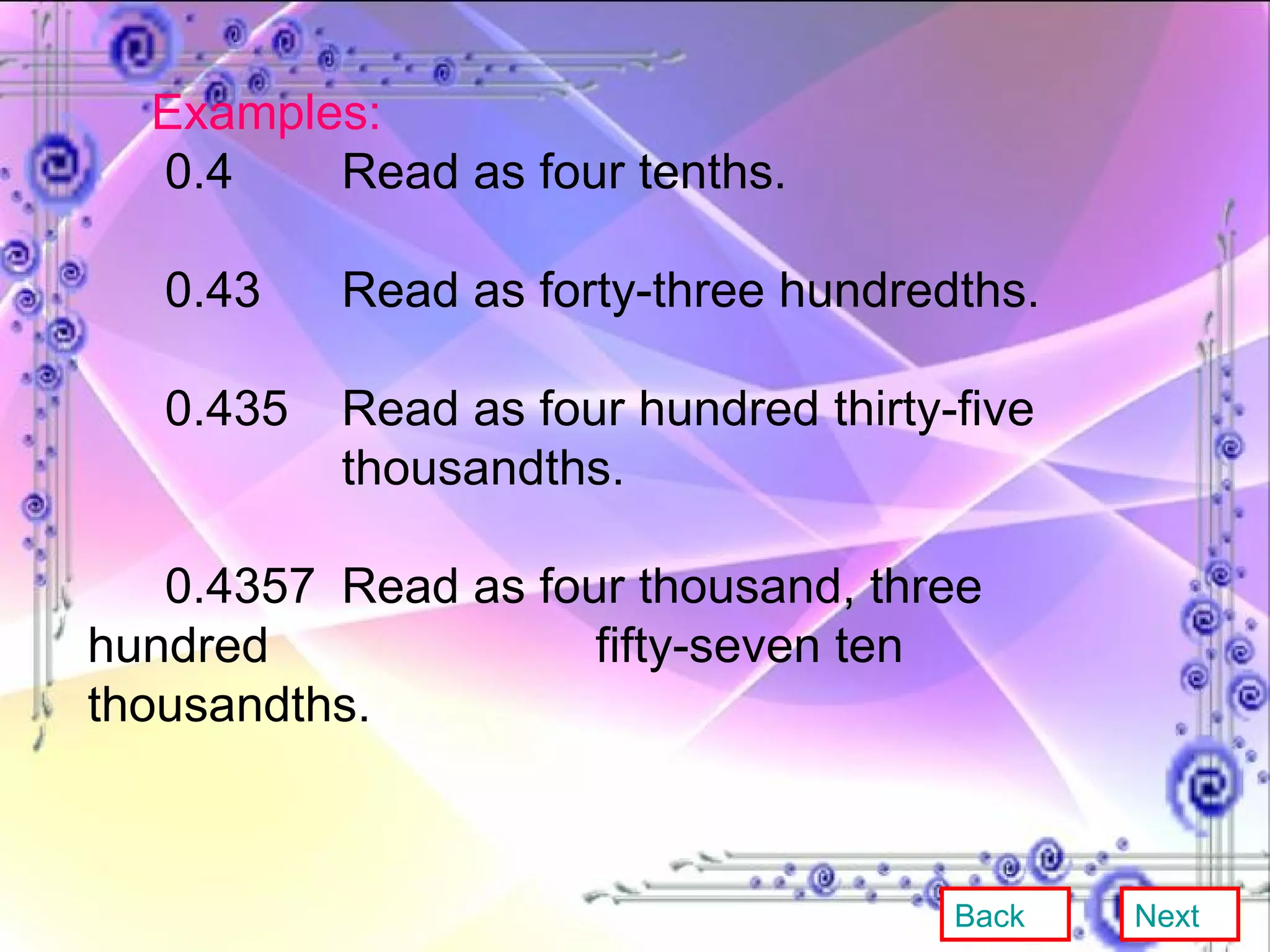
Examples: 0.4 Read as four tenths. 0.43 Read as forty-three hundredths. 0.435 Read as four hundred thirty-five  thousandths. 0.4357  Read as four thousand, three hundred  fifty-seven ten thousandths. Back Next
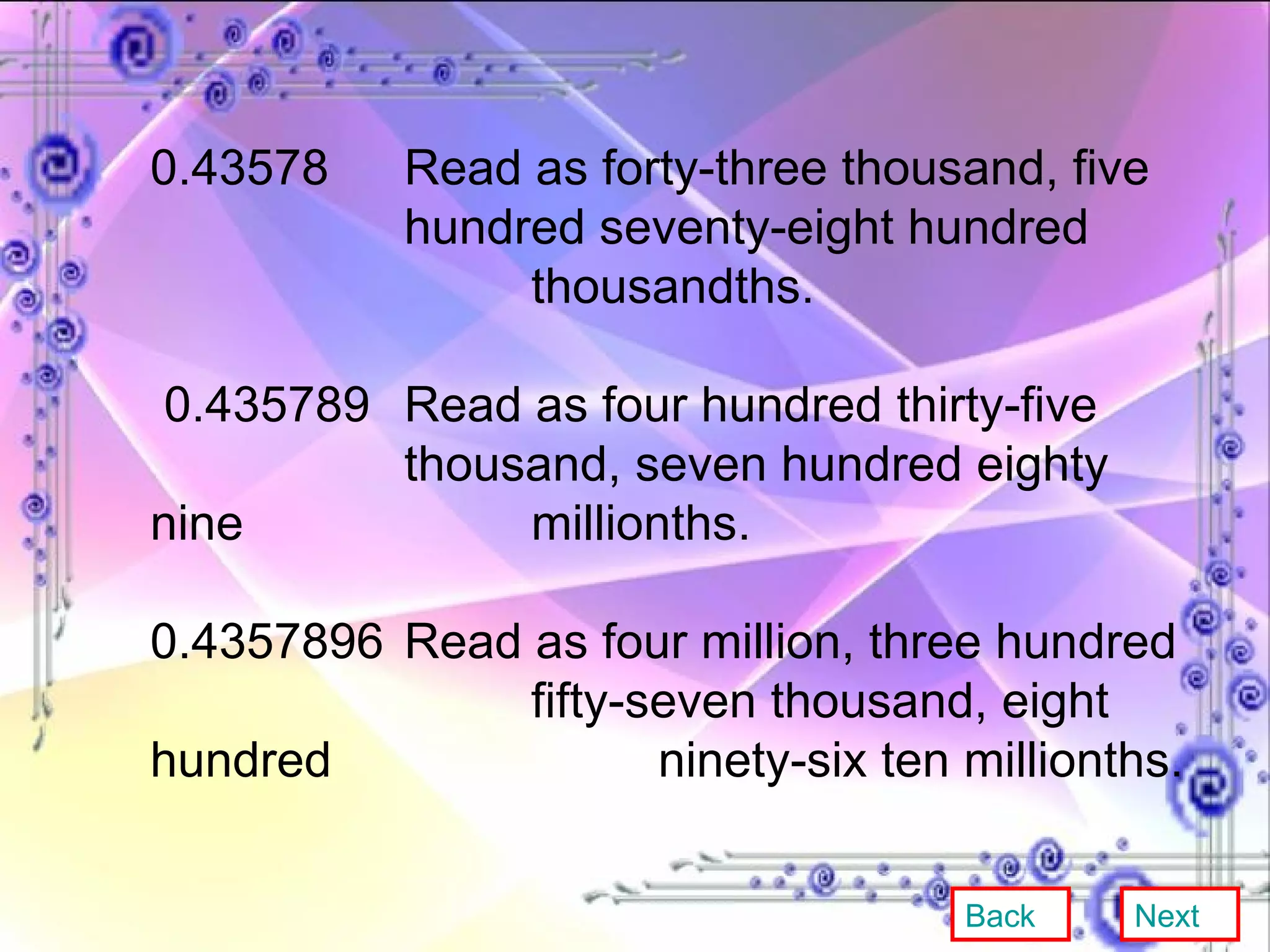
0.43578  Read as forty-three thousand, five  hundred seventy-eight hundred  thousandths. 0.435789  Read as four hundred thirty-five  thousand, seven hundred eighty nine  millionths. 0.4357896 Read as four million, three hundred  fifty-seven thousand, eight hundred  ninety-six ten millionths. Back Next
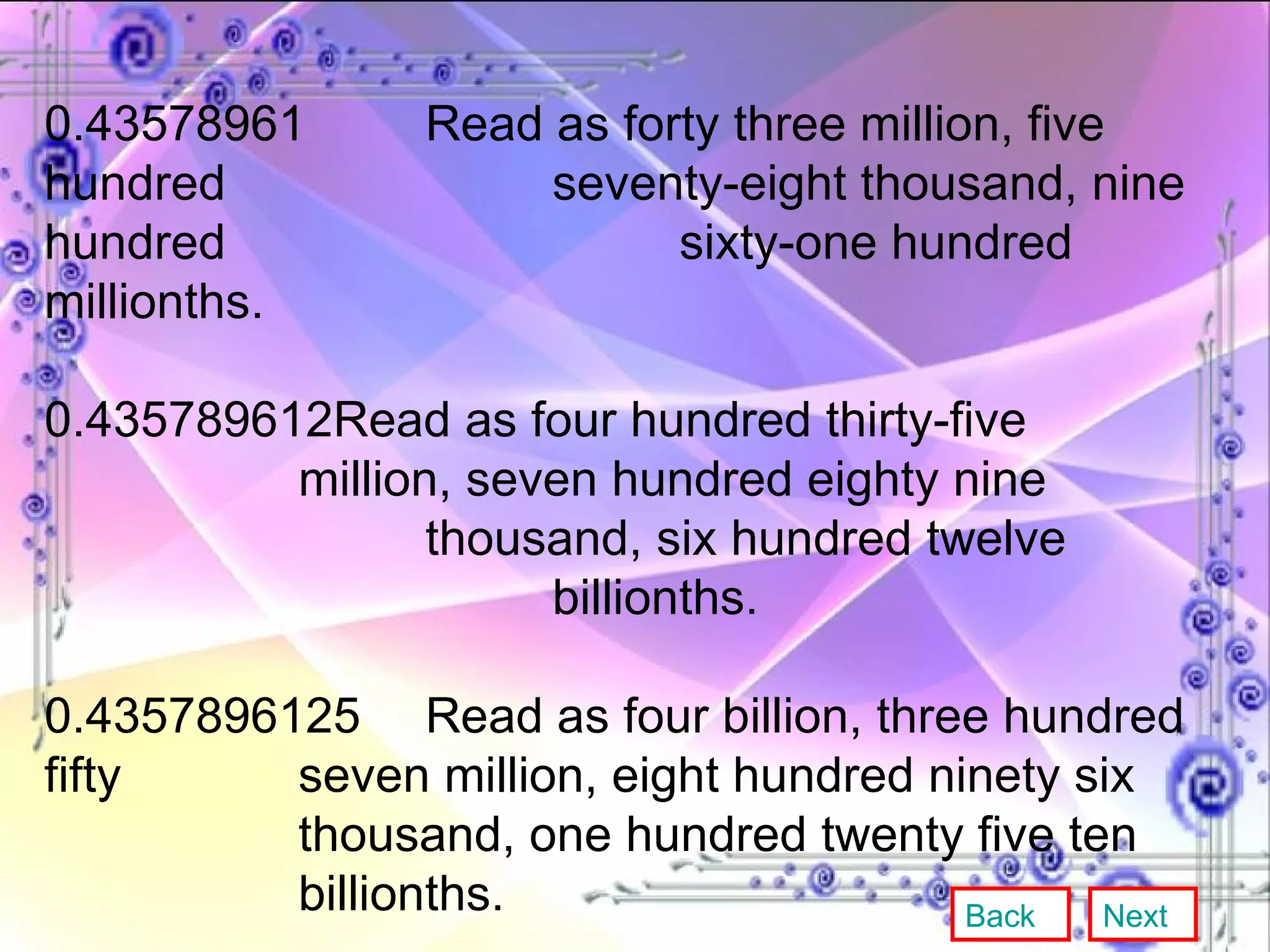
0.43578961 Read as forty three million, five hundred  seventy-eight thousand, nine hundred  sixty-one hundred millionths. 0.435789612Read as four hundred thirty-five  million, seven hundred eighty nine  thousand, six hundred twelve  billionths. 0.4357896125 Read as four billion, three hundred fifty  seven million, eight hundred ninety six  thousand, one hundred twenty five ten  billionths. Back Next
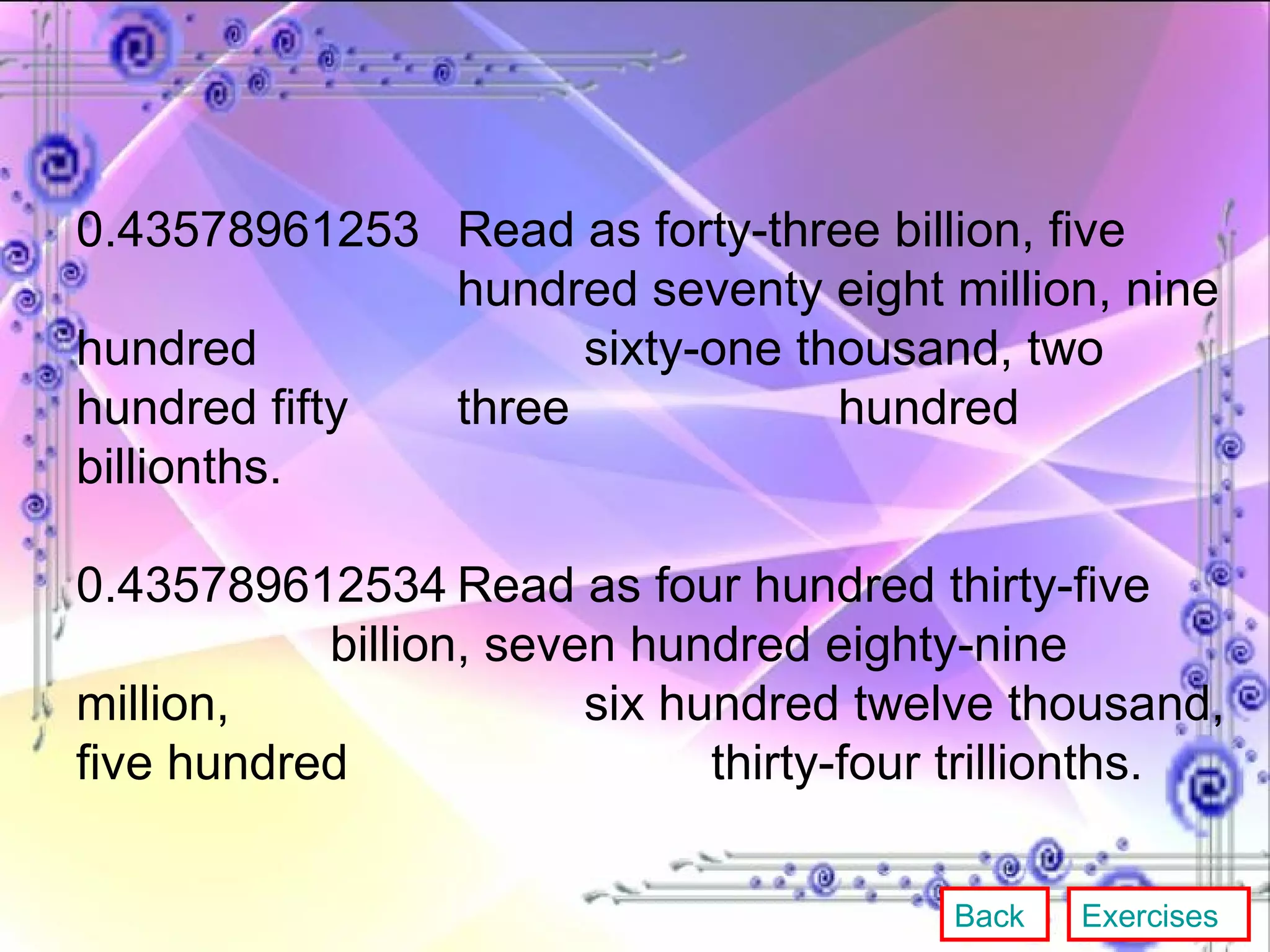
0.43578961253 Read as forty-three billion, five  hundred seventy eight million, nine hundred  sixty-one thousand, two hundred fifty  three  hundred billionths. 0.435789612534 Read as four hundred thirty-five  billion, seven hundred eighty-nine million,  six hundred twelve thousand, five hundred  thirty-four trillionths. Back Exercises
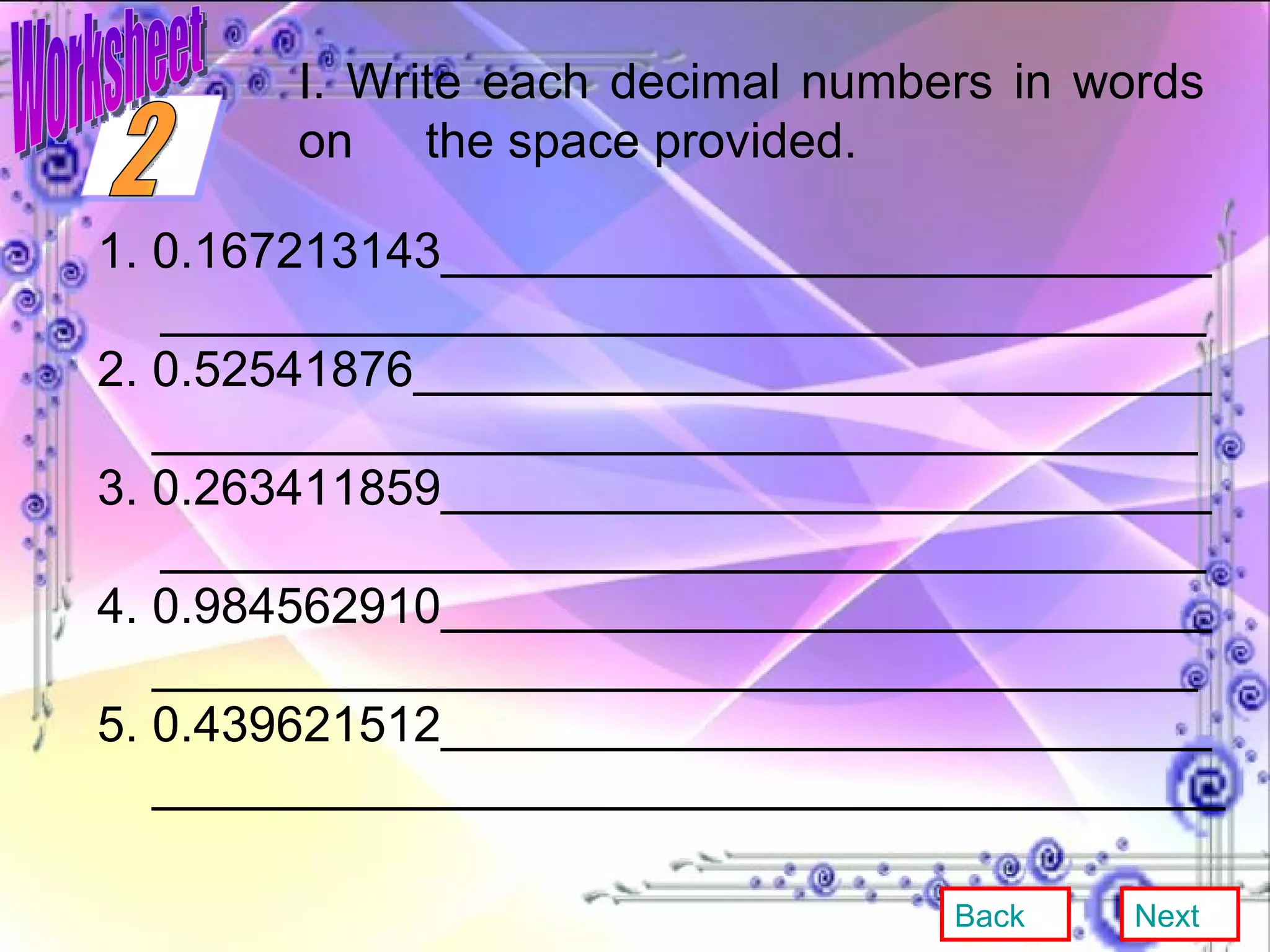
I. Write each decimal numbers in words on  the space provided. 1. 0.167213143____________________________ ______________________________________ 2. 0.52541876_____________________________ ______________________________________ 3. 0.263411859____________________________ ______________________________________ 4. 0.984562910____________________________ ______________________________________ 5. 0.439621512____________________________ _______________________________________ Back Next 2 Worksheet
II. Write the decimal number in standard form. 1. Nine tenths ______________________________________________ 2. Four hundredths ______________________________________________  3. Two thousand, two hundred and two hundred thousandths ____________________________________________ 4. Four hundred seventy – six millionths ________________________________________________ 5. Forty thousand, one hundred forty – one millionths ________________________________________________ Back Home
Lesson 3 READING AND WRITING MIXED DECIMAL NUMBERS Lesson Objectives At the end of the lesson, the students were expected to:  . Read mixed decimal numbers. . Follow the rules in reading and writing mixed decimal numbers. . Write mixed decimal numbers. Content Next
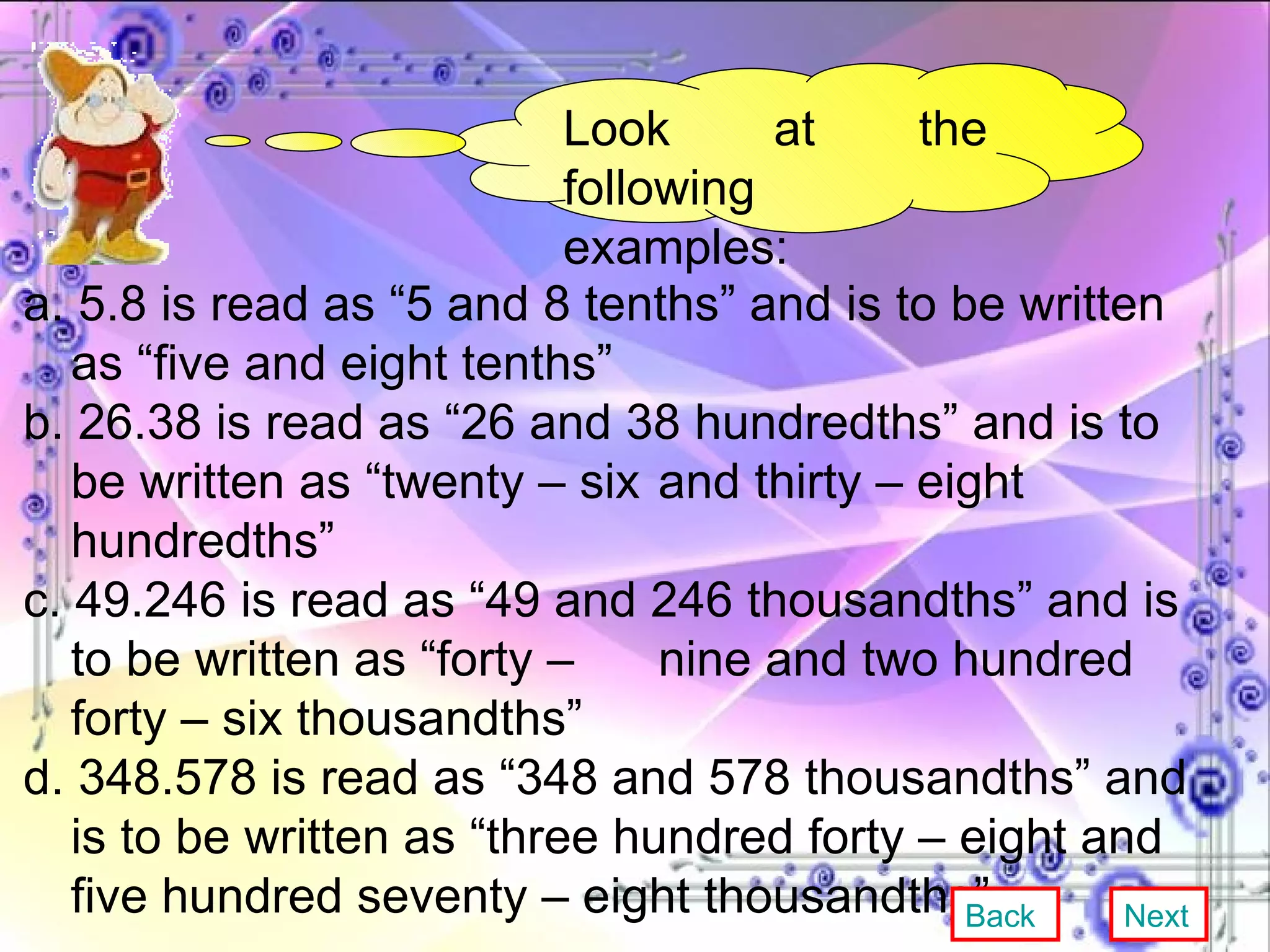
Look at the following examples: a. 5.8 is read as “5 and 8 tenths” and is to be written as “five and eight tenths” b. 26.38 is read as “26 and 38 hundredths” and is to be written as “twenty – six  and thirty – eight hundredths” c. 49.246 is read as “49 and 246 thousandths” and is to be written as “forty –  nine and two hundred forty – six thousandths” d. 348.578 is read as “348 and 578 thousandths” and is to be written as “three hundred forty – eight and five hundred seventy – eight thousandths” Back Next
It is seen that the following rule has been followed in the above examples. RULE: In reading a mixed decimal numbers, read the integral part as usual “and” in place of the decimal point, the decimal point is read as usual also. Back Exercises
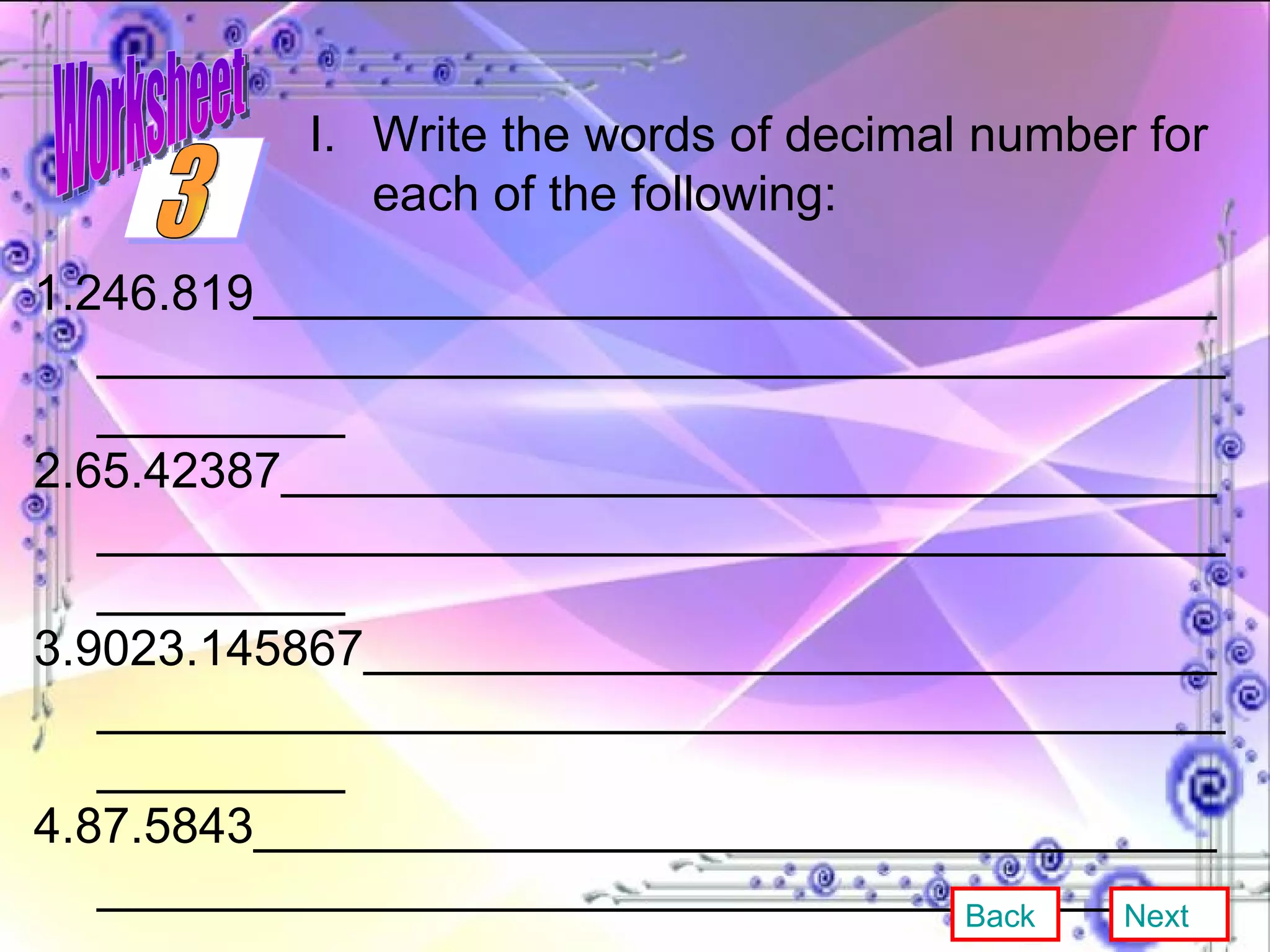
1.246.819_____________________________________________________________________________________ 2.65.42387____________________________________________________________________________________ 3.9023.145867_________________________________________________________________________________ 4.87.5843_____________________________________________________________________________________ 5.48.0089_____________________________________________________________________________________  Write the words of decimal number for each of the following: Back Next 3 Worksheet
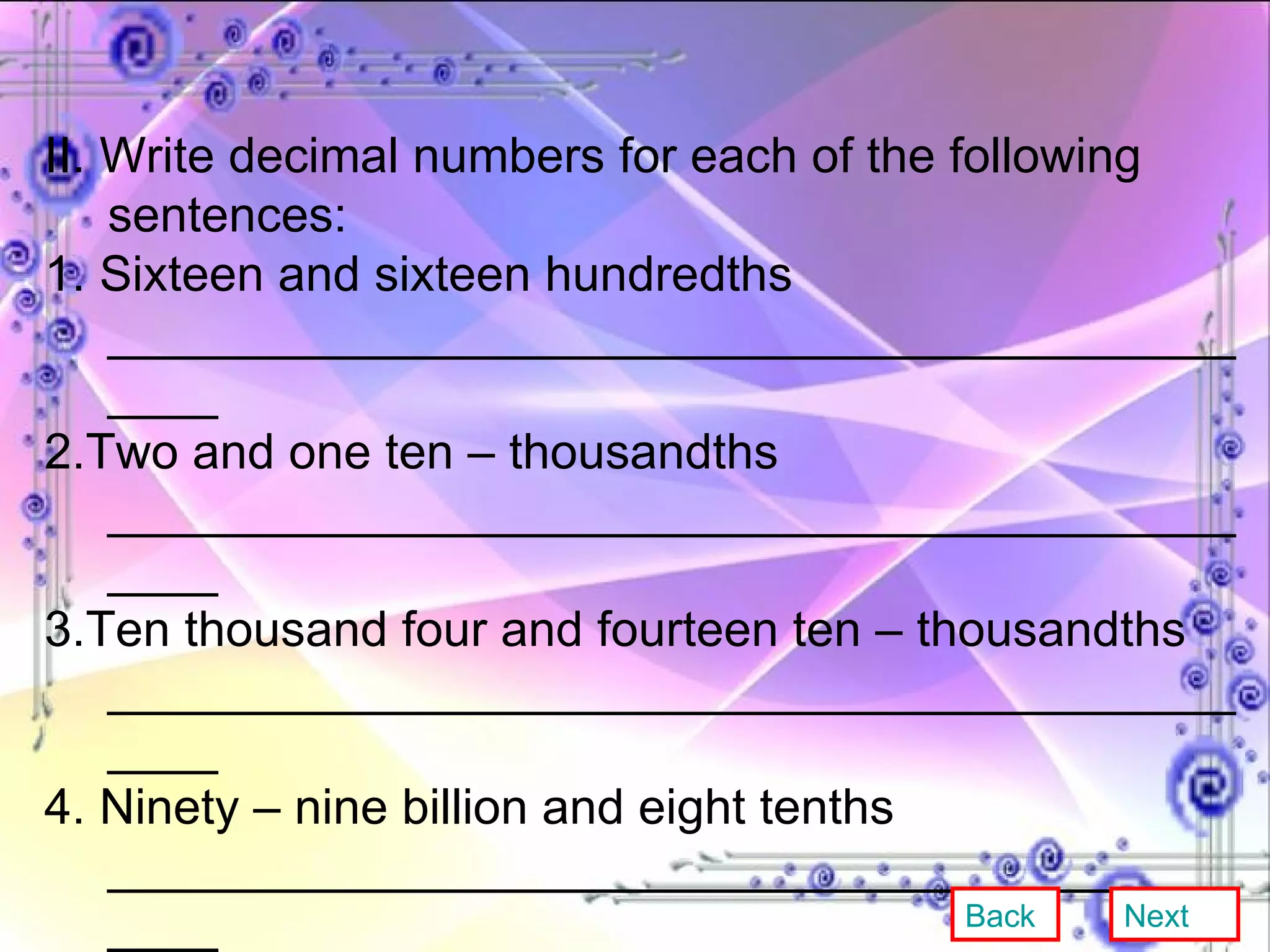
II. Write decimal numbers for each of the following sentences: 1. Sixteen and sixteen hundredths _____________________________________________ 2.Two and one ten – thousandths _____________________________________________ 3.Ten thousand four and fourteen ten – thousandths _____________________________________________ 4. Ninety – nine billion and eight tenths _____________________________________________ 5. Twelve hundred two and seven millionths _____________________________________________ Back Next
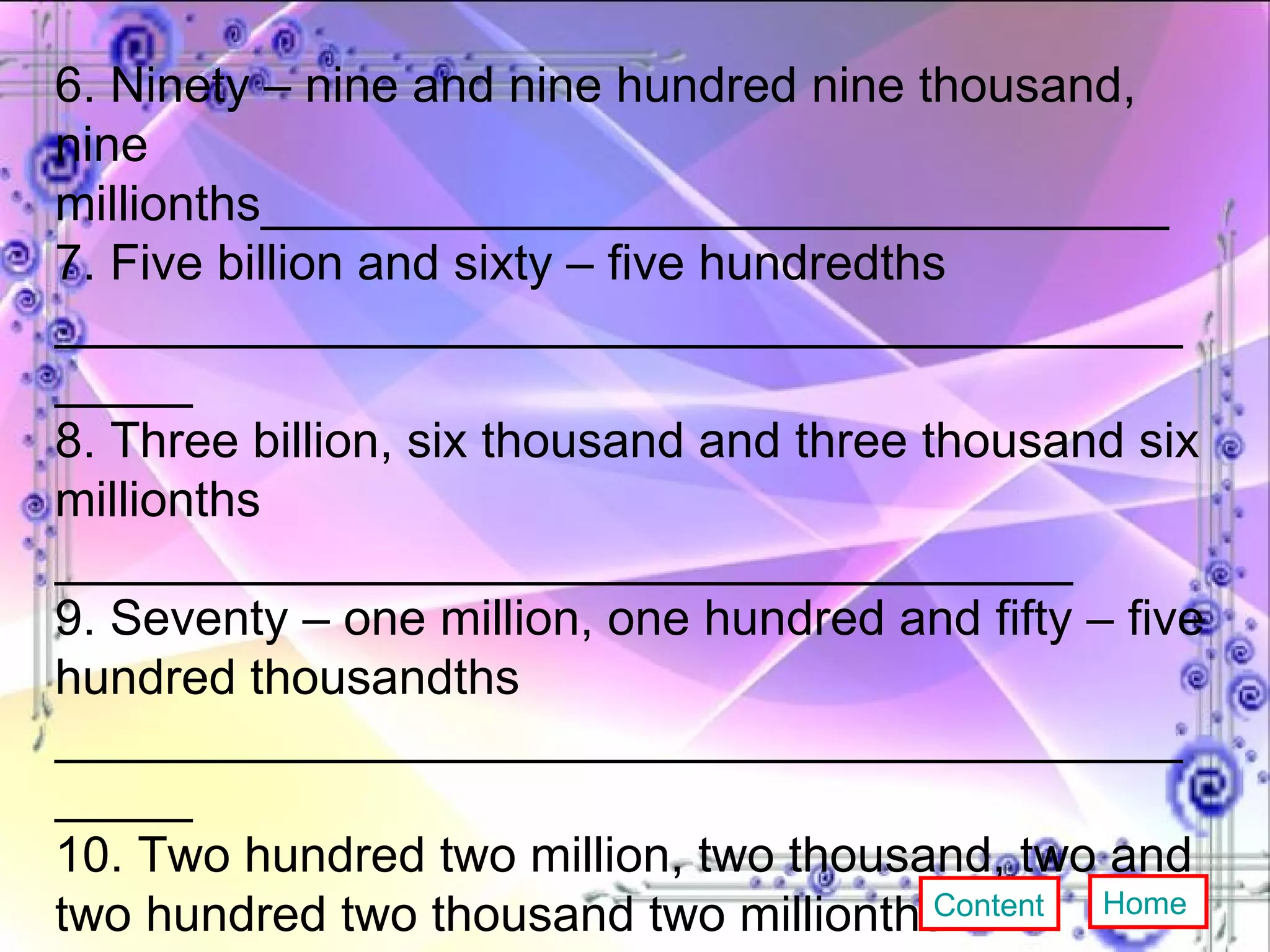
6. Ninety – nine and nine hundred nine thousand, nine  millionths_________________________________ 7. Five billion and sixty – five hundredths ______________________________________________ 8. Three billion, six thousand and three thousand six millionths _____________________________________ 9. Seventy – one million, one hundred and fifty – five hundred thousandths ______________________________________________ 10. Two hundred two million, two thousand, two and two hundred two thousand two millionths ______________________________________________ Content Home
Lesson 4 READING AND WRITING DECIMALS USED IN TECHNICAL AND SCIENCE WORK Lesson Objectives At the end of the lesson, the pupil should be able to:  . Read and write decimals used in technical and  science work. . Follow the rules in reading and writing decimals  used in technical and  science work. . Know the simple way of reading and writing  decimals that can be  used in technical and  science  work. Content Next
This method of reading decimals and mixed decimals is often used by people engaged in technical and science work. But this can be used by lay people especially if the part of the number has many digits. Observe the following examples: Back Next
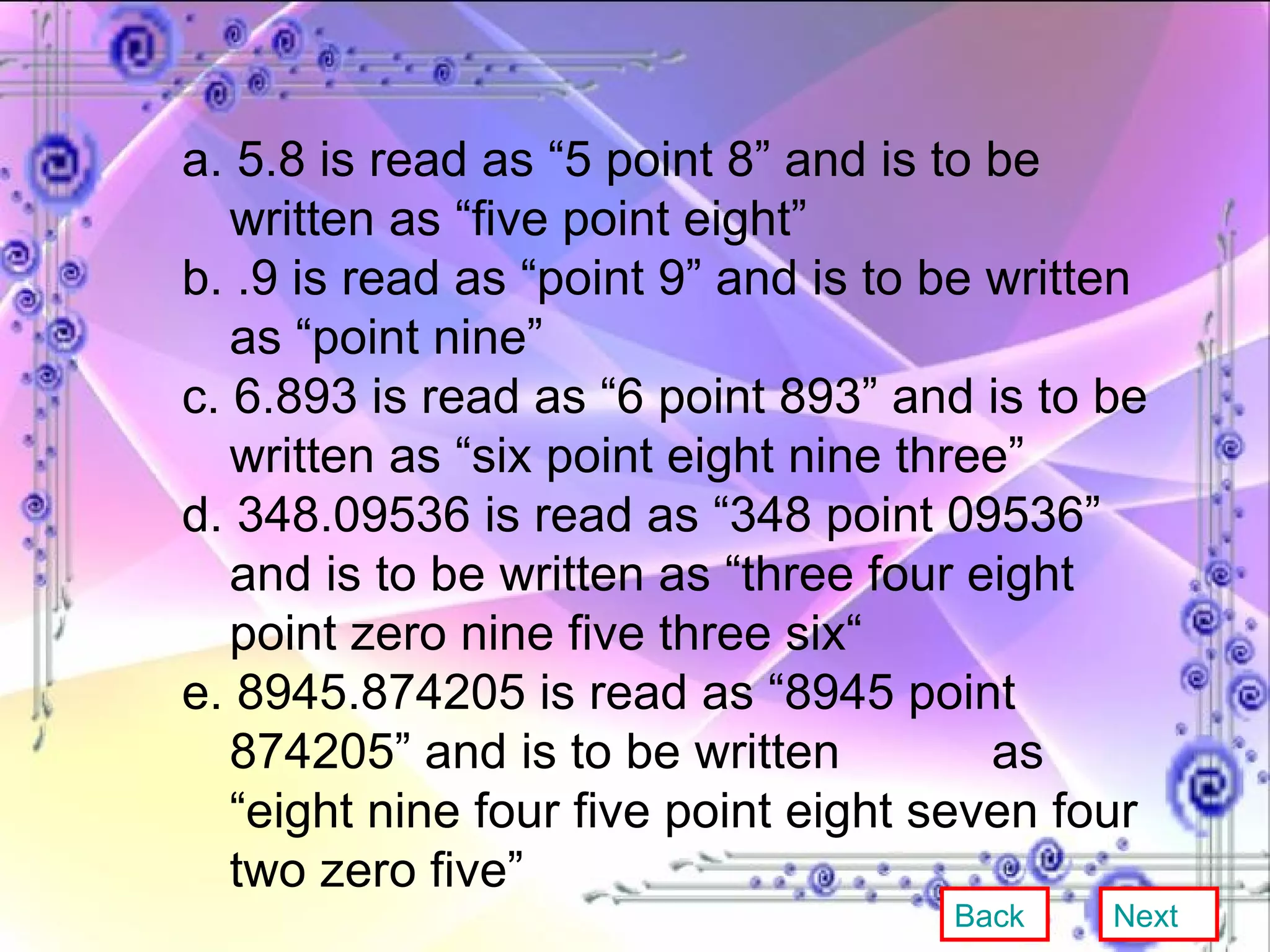
a. 5.8 is read as “5 point 8” and is to be written as “five point eight” b. .9 is read as “point 9” and is to be written as “point nine” c. 6.893 is read as “6 point 893” and is to be written as “six point eight nine three” d. 348.09536 is read as “348 point 09536” and is to be written as “three four eight point zero nine five three six“ e. 8945.874205 is read as “8945 point 874205” and is to be written  as “eight nine four five point eight seven four two zero five” Back Next
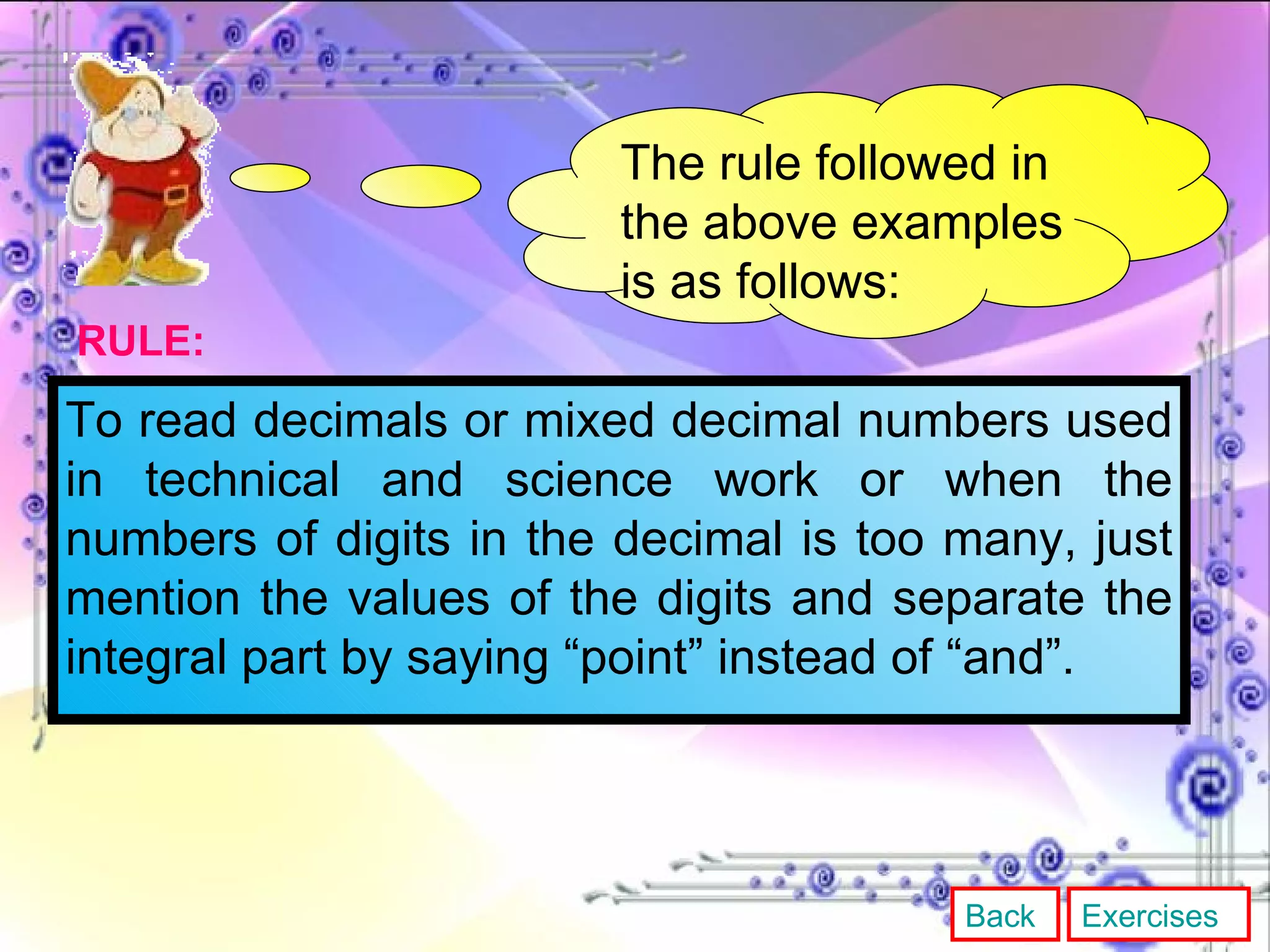
The rule followed in the above examples is as follows: To read decimals or mixed decimal numbers used in technical and science work or when the numbers of digits in the decimal is too many, just mention the values of the digits and separate the integral part by saying “point” instead of “and”. RULE: Back Exercises
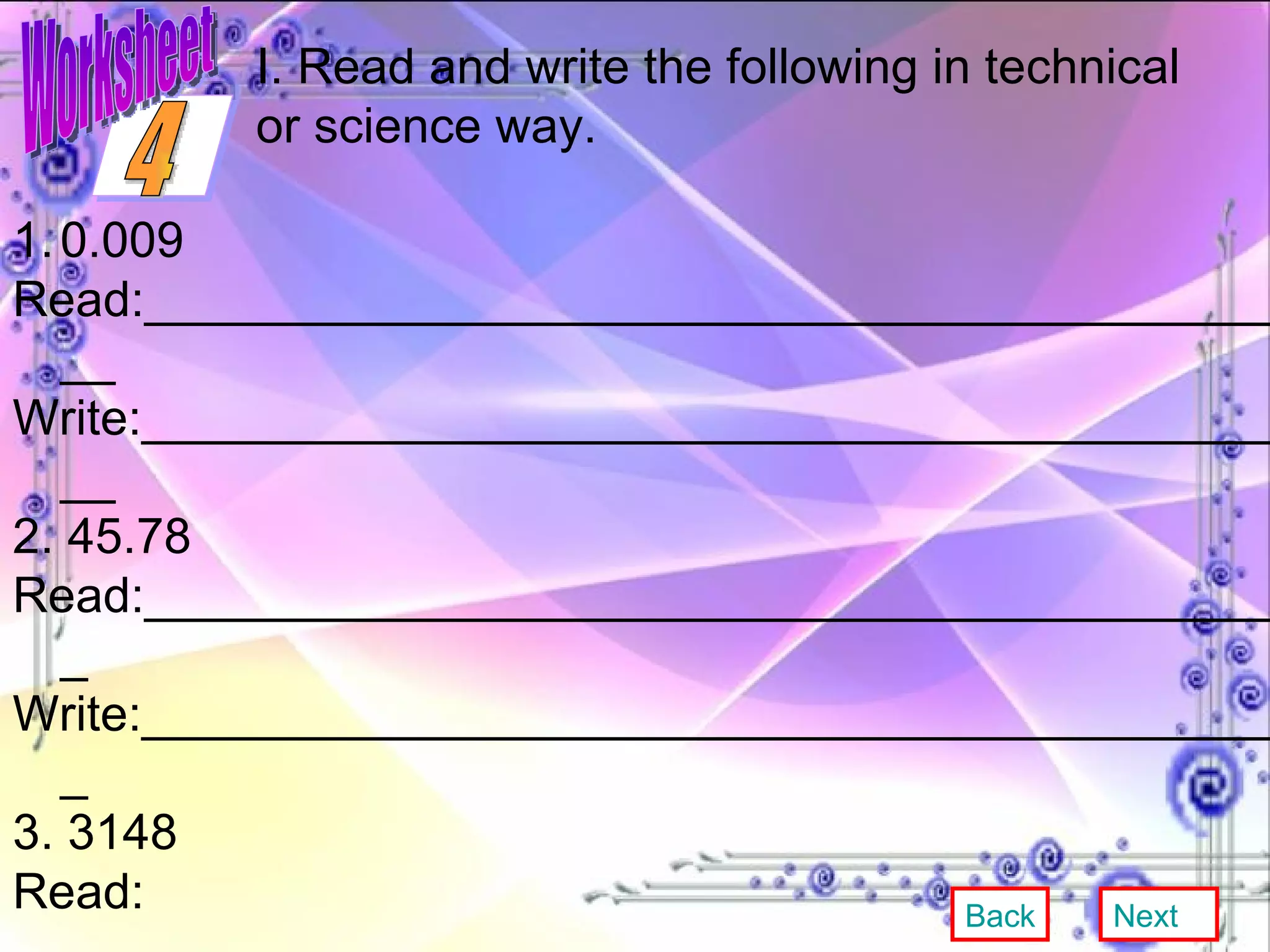
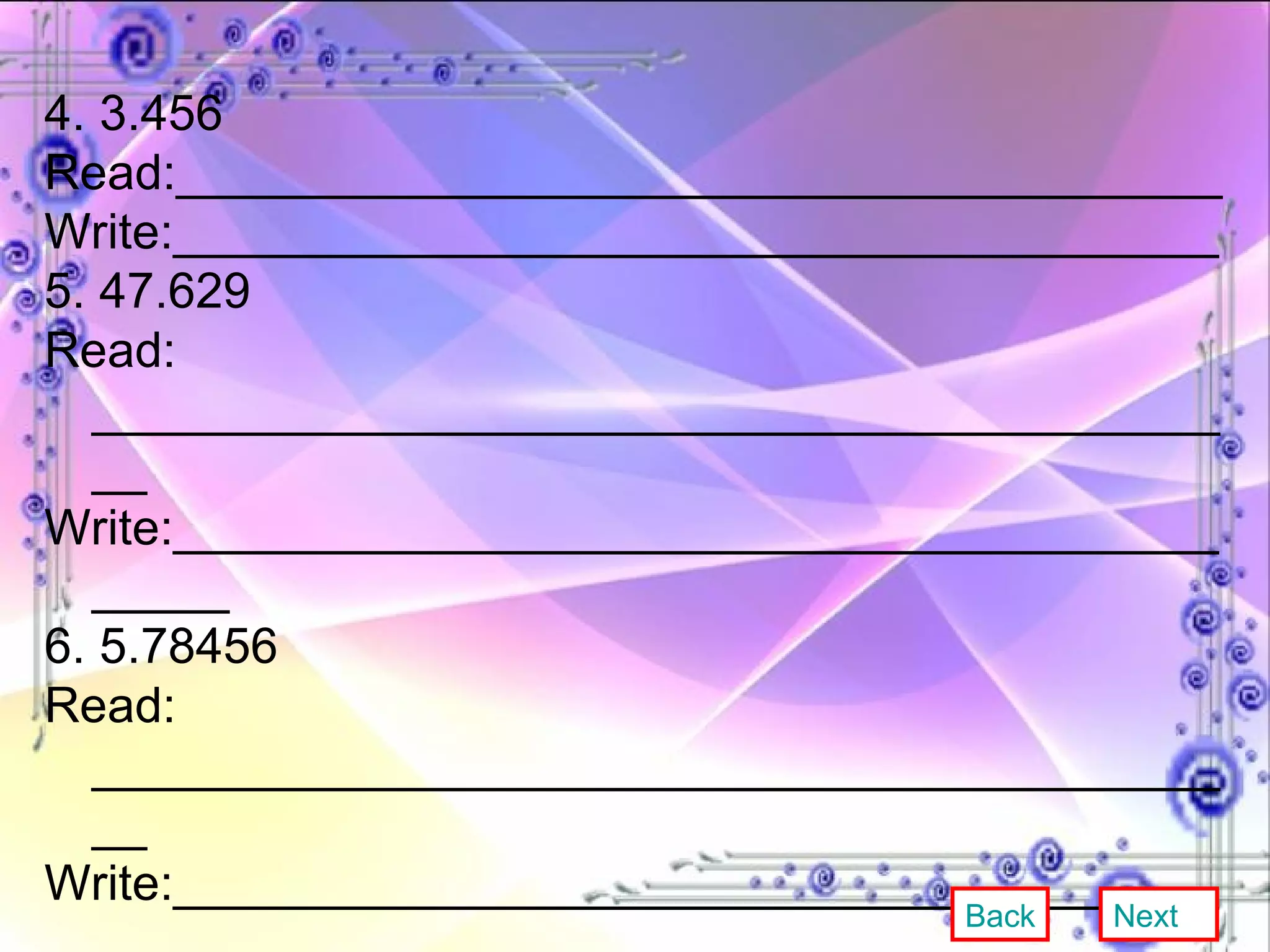
0.009 Read:___________________________________________ Write:___________________________________________ 2. 45.78 Read:__________________________________________ Write:__________________________________________ 3. 3148 Read: ___________________________________________ Write:___________________________________________ 4. 3.456 Read:___________________________________________ Write:__________________________________________ I. Read and write the following in technical or science way. Back Next 4 Worksheet
4. 3.456 Read:______________________________________ Write:______________________________________ 5. 47.629 Read: ___________________________________________ Write:___________________________________________ 6. 5.78456 Read: ___________________________________________ Write:___________________________________________ 7. 0.491 Read:___________________________________________ Write:__________________________________________ Back Next
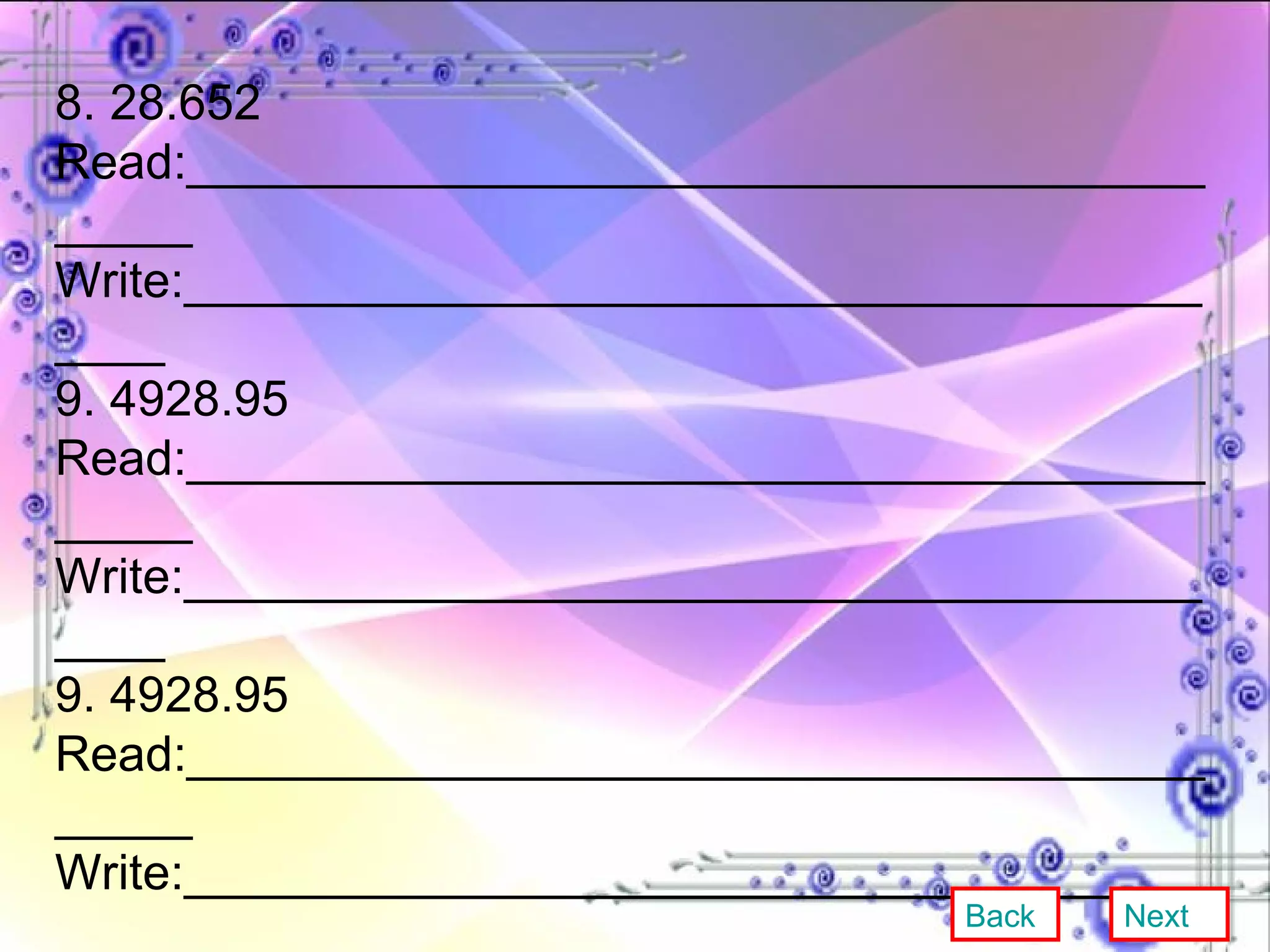
8. 28.652 Read:__________________________________________ Write:_________________________________________ 9. 4928.95 Read:__________________________________________ Write:_________________________________________ 9. 4928.95 Read:__________________________________________ Write:_________________________________________ 10. 376.732 Read:__________________________________________ Write:_________________________________________ Back Next
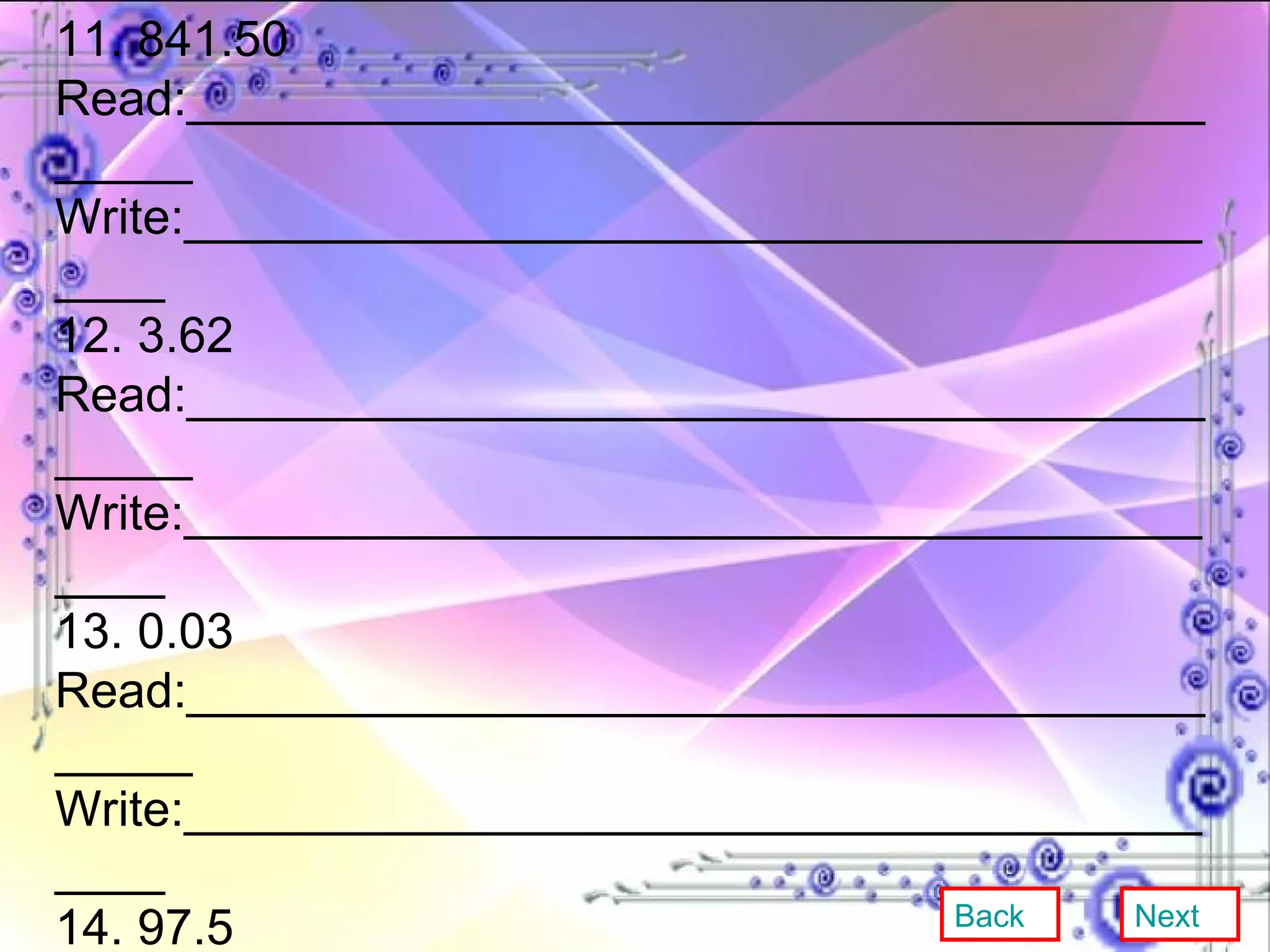
11. 841.50 Read:__________________________________________ Write:_________________________________________ 12. 3.62 Read:__________________________________________ Write:_________________________________________ 13. 0.03 Read:__________________________________________ Write:_________________________________________ 14. 97.5 Read:__________________________________________ Write:________________________________________ 15. 2.3148 Read:_________________________________________ Write:________________________________________ Back Next
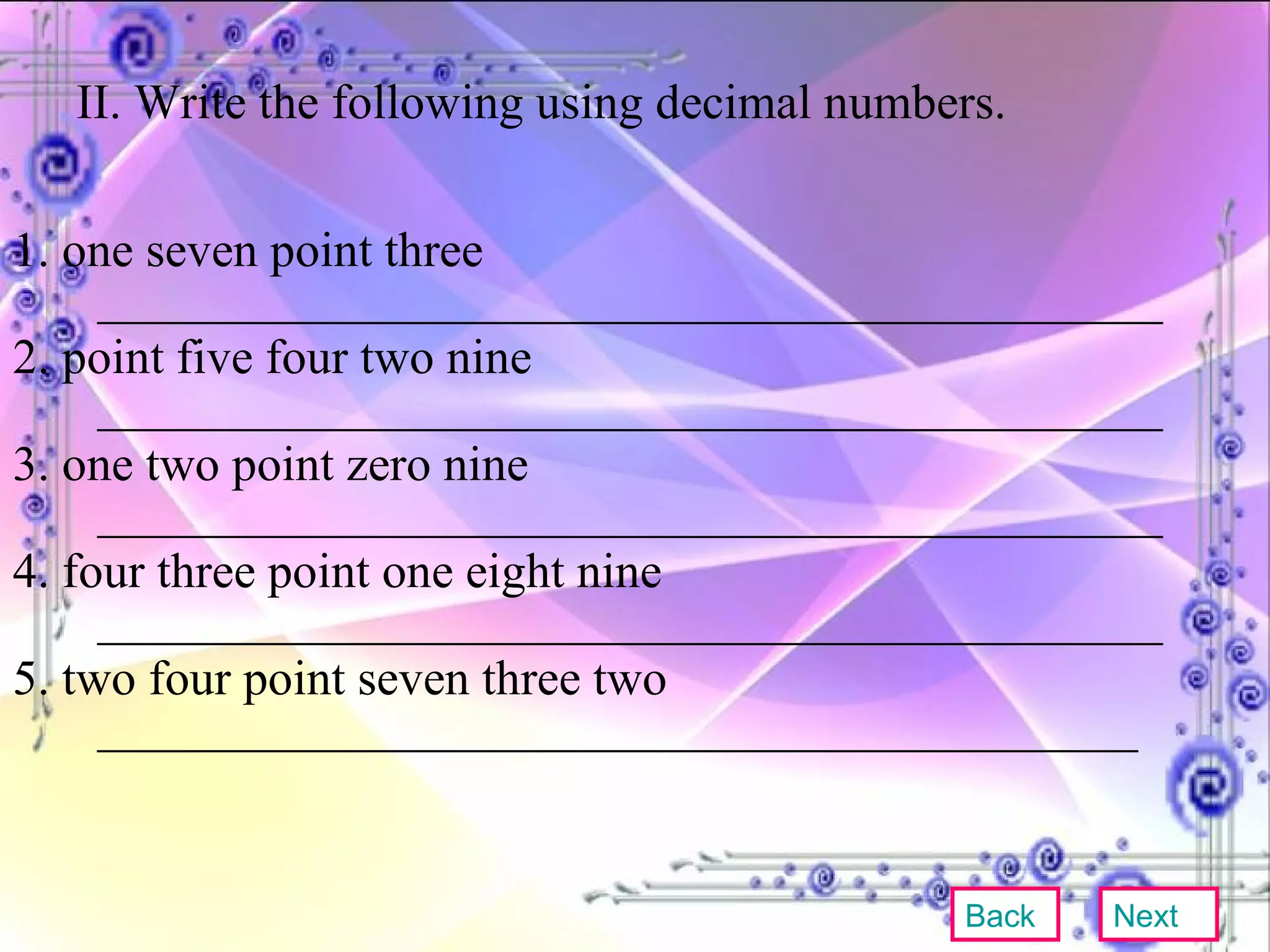
II. Write the following using decimal numbers. 1. one seven point three ___________________________________________ 2. point five four two nine ___________________________________________ 3. one two point zero nine ___________________________________________ 4. four three point one eight nine ___________________________________________ 5. two four point seven three two  __________________________________________ Back Next
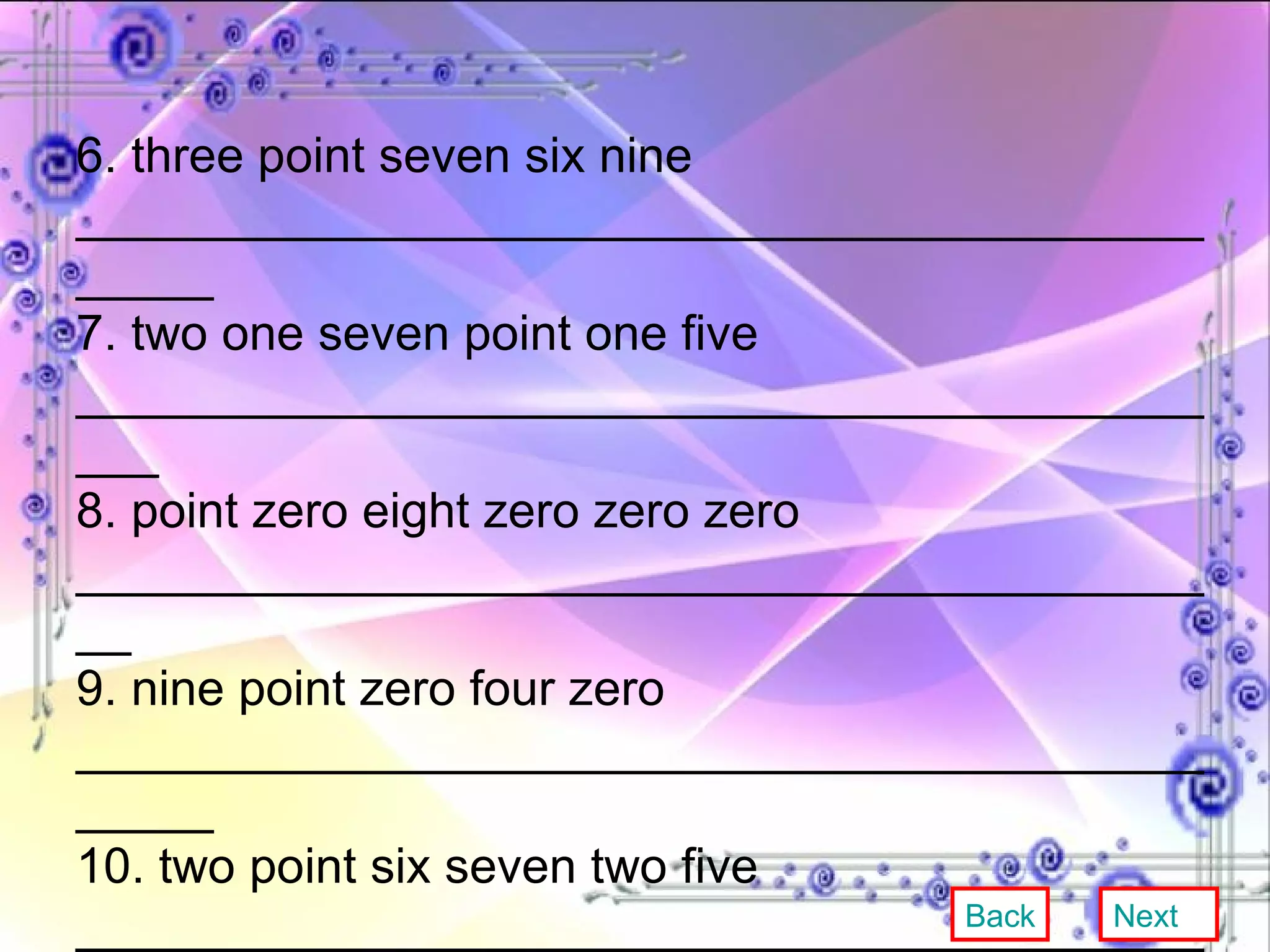
6. three point seven six nine ______________________________________________ 7. two one seven point one five ____________________________________________ 8. point zero eight zero zero zero ___________________________________________ 9. nine point zero four zero ______________________________________________ 10. two point six seven two five ____________________________________________ 11. zero point nine eight nine ______________________________________________ Back Next
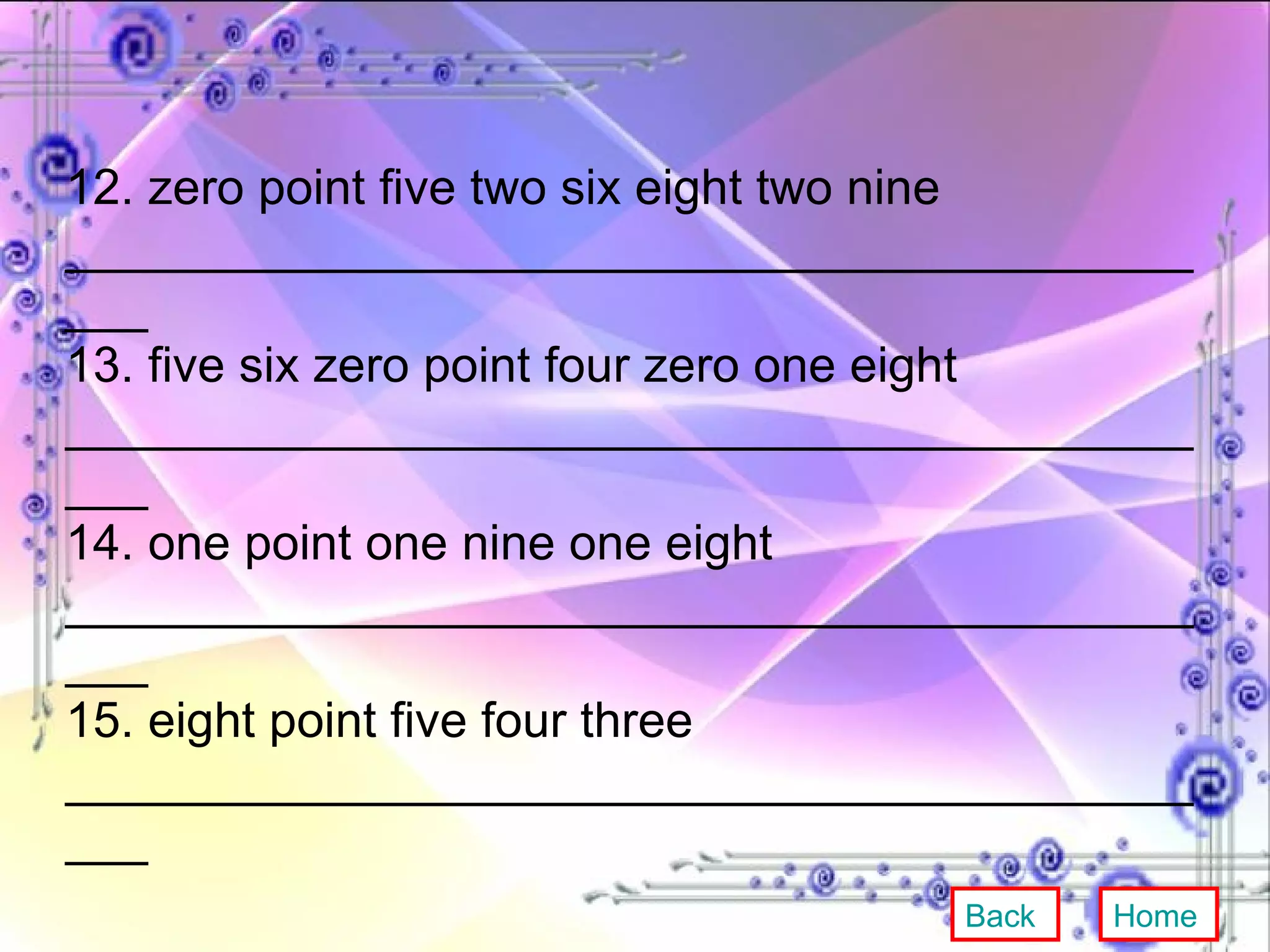
12. zero point five two six eight two nine ____________________________________________ 13. five six zero point four zero one eight ____________________________________________ 14. one point one nine one eight ____________________________________________ 15. eight point five four three ____________________________________________ Back Home
Lesson 5   PLACE VALUE Lesson Objectives In this lesson, the pupils are expected to:  . Distinguish the relationship of place value in  its place. . Write common fractions in decimal forms. . Give the place value for every digit. Content Next
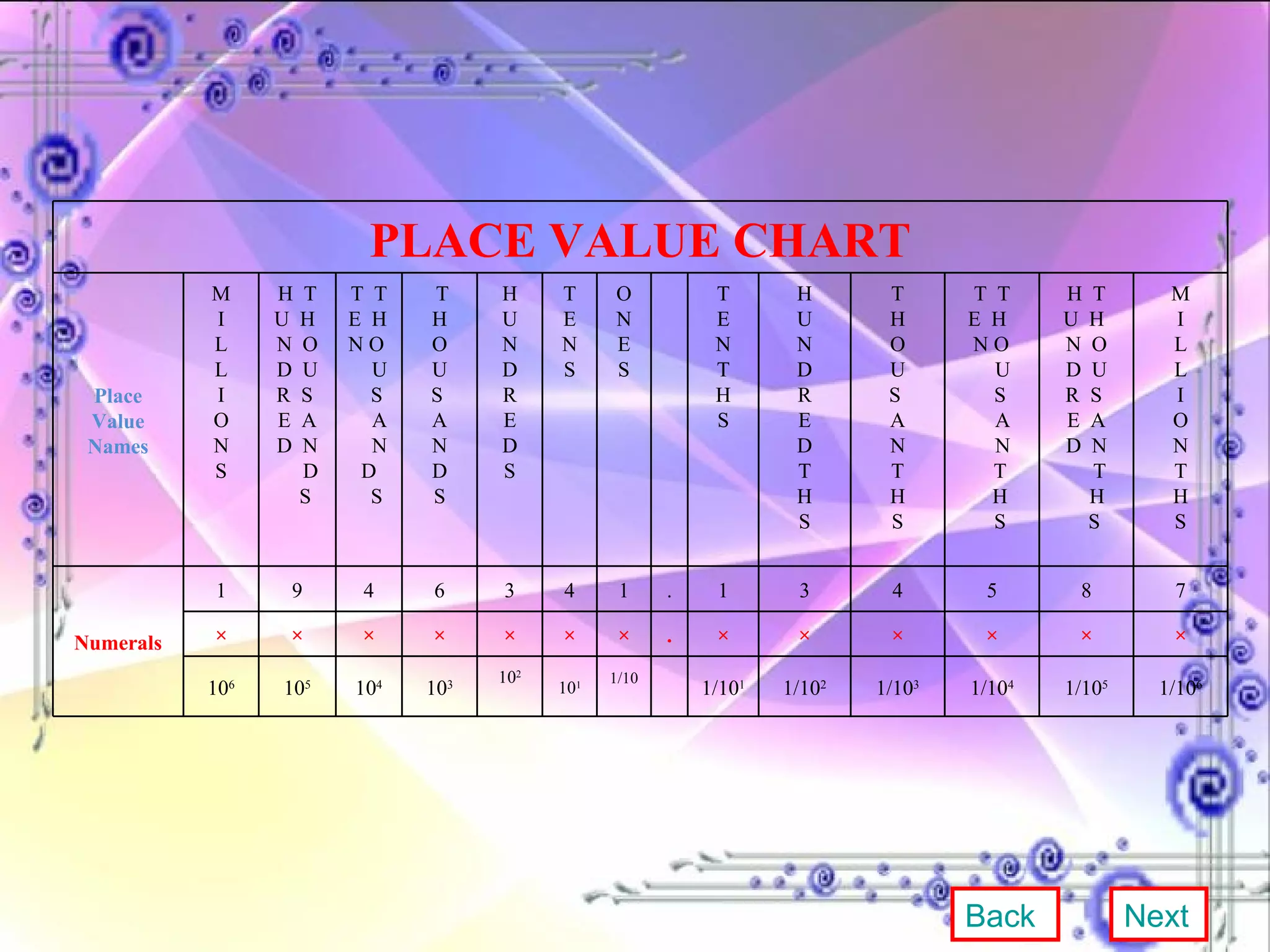
Back Next PLACE VALUE CHART Place Value Names M I L L I O N S H  T U  H  N  O D  U R  S  E  A D  N D S T  T E  H N O U S  A N D S T H O U S  A N D S H U N D R E D S T E N S O N E S T E N T H S H U N D R E D T H S T H O U S  A N T H S T  T E  H N O U S  A N T H S H  T U  H  N  O D  U R  S  E  A D  N T H S M I L L I O N T H S Numerals 1 9 4 6 3 4 1 . 1 3 4 5 8 7 × × × × × × × . × × × × × × 10 6 10 5 10 4 10 3 10 2 10 1 1/10 0 1/10 1 1/10 2 1/10 3 1/10 4 1/10 5 1/10 6
What relationship exists in the diagram? What does the 1 in the tenths place mean? What does the 3 in the hundreds place represent? How about the 3 in the hundredths place? Back Next
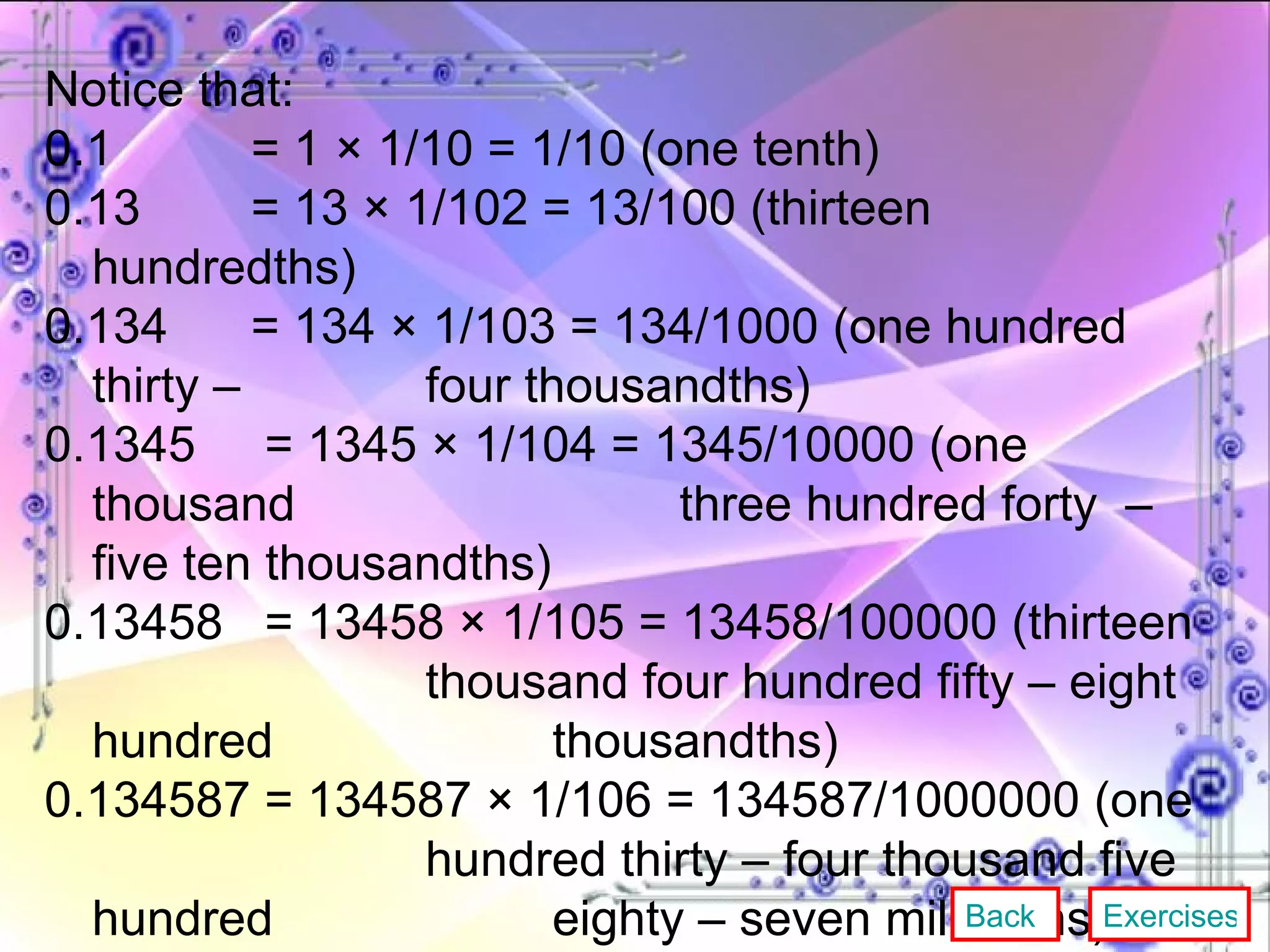
Notice that: 0.1  = 1 × 1/10 = 1/10 (one tenth) 0.13  = 13 × 1/102 = 13/100 (thirteen hundredths) 0.134  = 134 × 1/103 = 134/1000 (one hundred thirty –  four thousandths)  0.1345  = 1345 × 1/104 = 1345/10000 (one thousand  three hundred forty  – five ten thousandths) 0.13458  = 13458 × 1/105 = 13458/100000 (thirteen  thousand four hundred fifty – eight hundred  thousandths) 0.134587 = 134587 × 1/106 = 134587/1000000 (one  hundred thirty – four thousand five hundred  eighty – seven millionths) Back Exercises
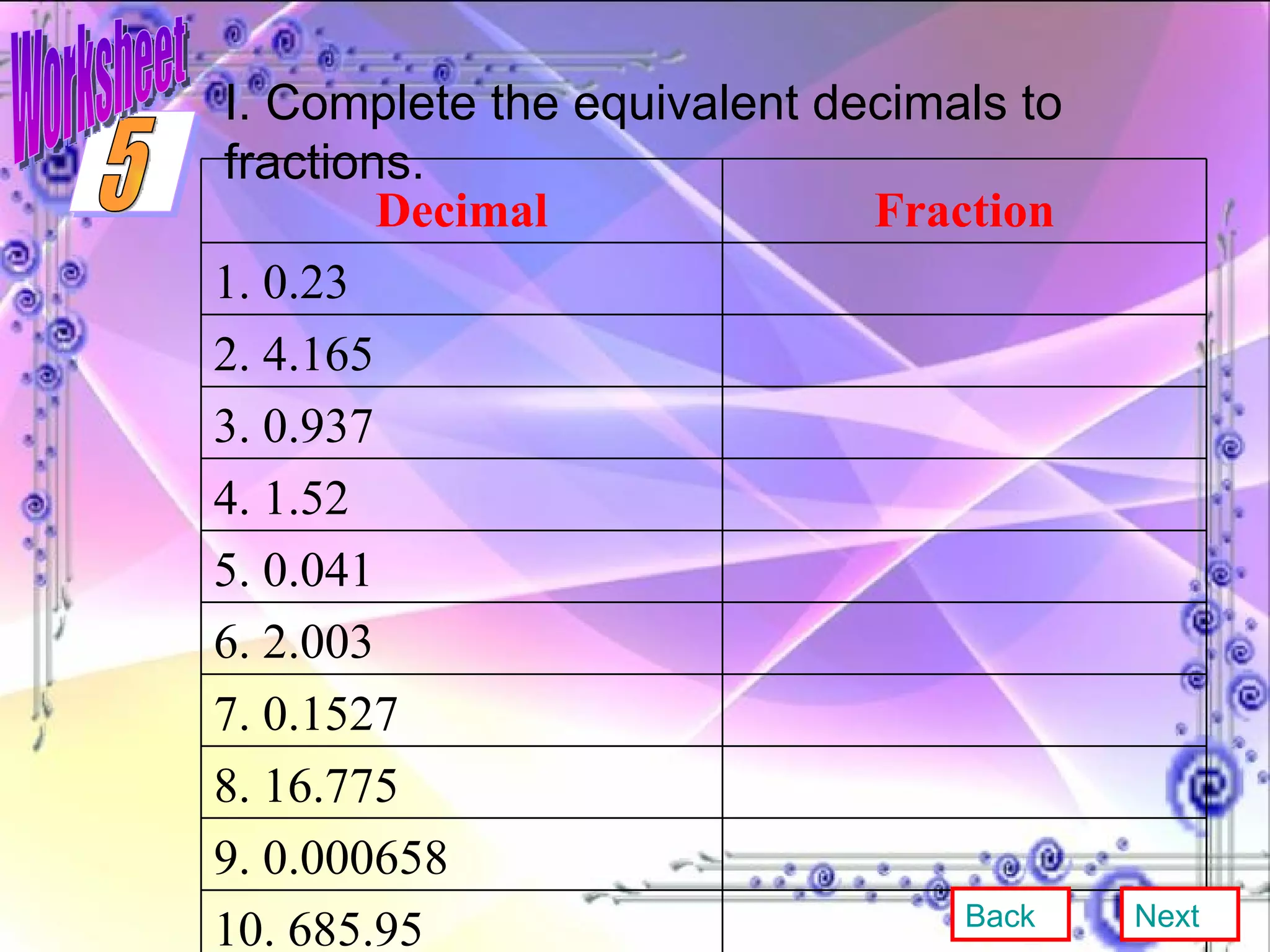
Worksheet I. Complete the equivalent decimals to fractions. Back Next 5 Decimal Fraction 1. 0.23   2. 4.165   3. 0.937   4. 1.52   5. 0.041   6. 2.003   7. 0.1527 8. 16.775   9. 0.000658   10. 685.95  
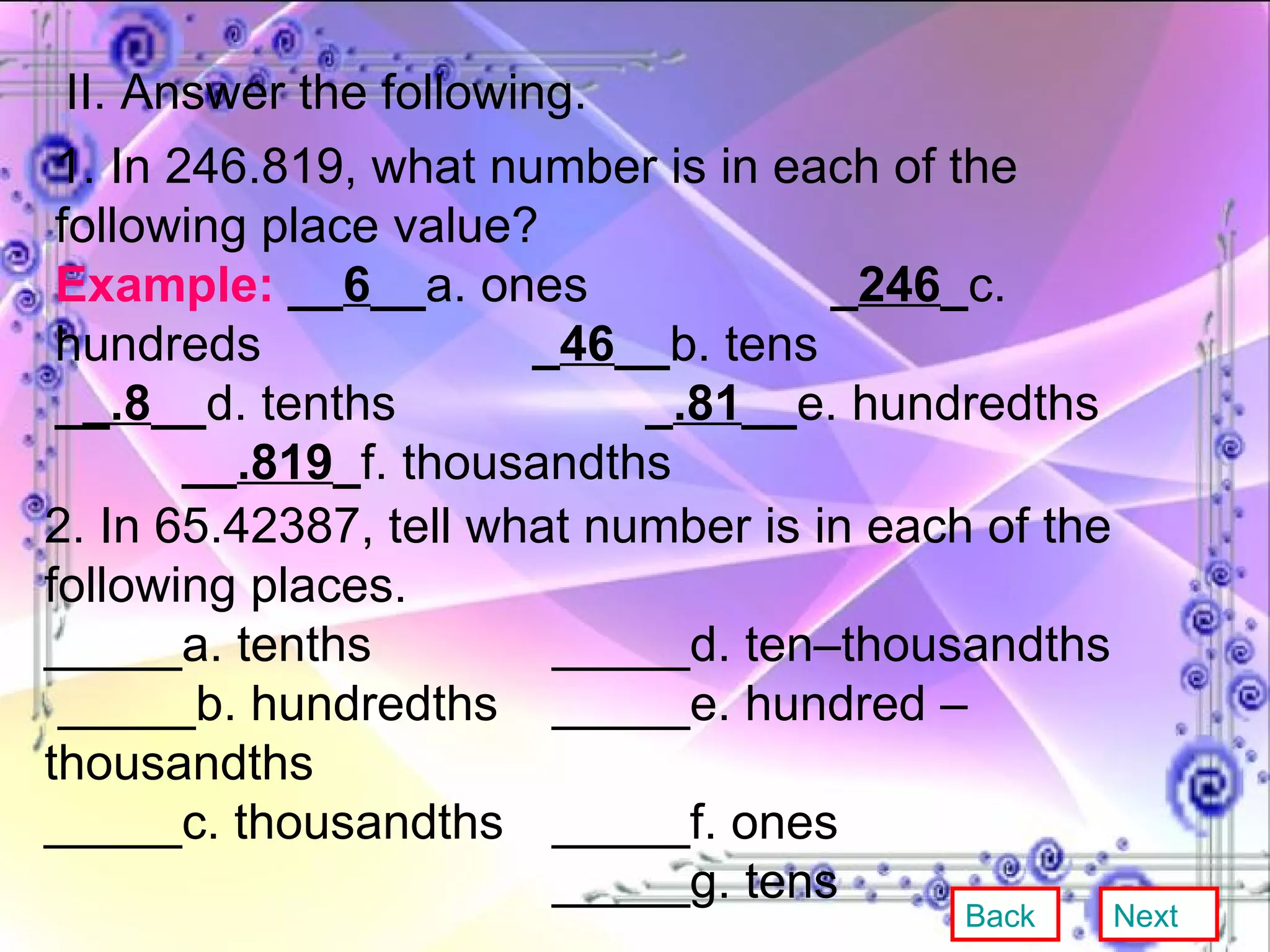
II. Answer the following. 1. In 246.819, what number is in each of the following place value? Example:   __ 6 __ a. ones   _ 246 _ c. hundreds    _ 46 __ b. tens _ _.8 __ d. tenths    _ .81 __ e. hundredths  __ .819 _ f. thousandths 2. In 65.42387, tell what number is in each of the following places. _____a. tenths _____d. ten–thousandths  _____b. hundredths _____e. hundred – thousandths _____c. thousandths _____f. ones _____g. tens Back Next
3. In 9023.45867, tell what number is in each of the following places. _____a. ones _____e. hundredths _____b. tens _____f. thousandths _____c. tenths _____g. thousands _____d. hundreds _____h. ten – thousandths _____i. hundred–thousandths _____j. millionths Back Home
Lesson 6 COMPARING DECIMAL NUMBERS Lesson Objectives At the end of the lesson, the pupils are expected to: . Compare decimal numbers. . Use fractional number to compare decimals. . Know the sign in comparing decimal numbers. Content Next
If there are two decimal numbers we can compare them. One number is either greater than (>), less than (<) or equal to (=) the other number. Back Next
A decimal number is just a fractional number. Comparing 0.7 and 0.07 is clearer if we compared 7/10 to 7/100. The fraction 7/10 is equivalent to 70/100 which is clearly larger than 7/1000. Back Next
Therefore, when decimals are compared start with tenths place and then hundredths place, etc. If one decimal has a higher number in the tenths place then it is larger than a decimal with fewer tenths. If the tenths are equal, compare the hundredths, then the thousandths, etc. Until one decimal is larger or there are no more places to compare. If each decimal place value is the same then the decimals are equal. Back Exercises
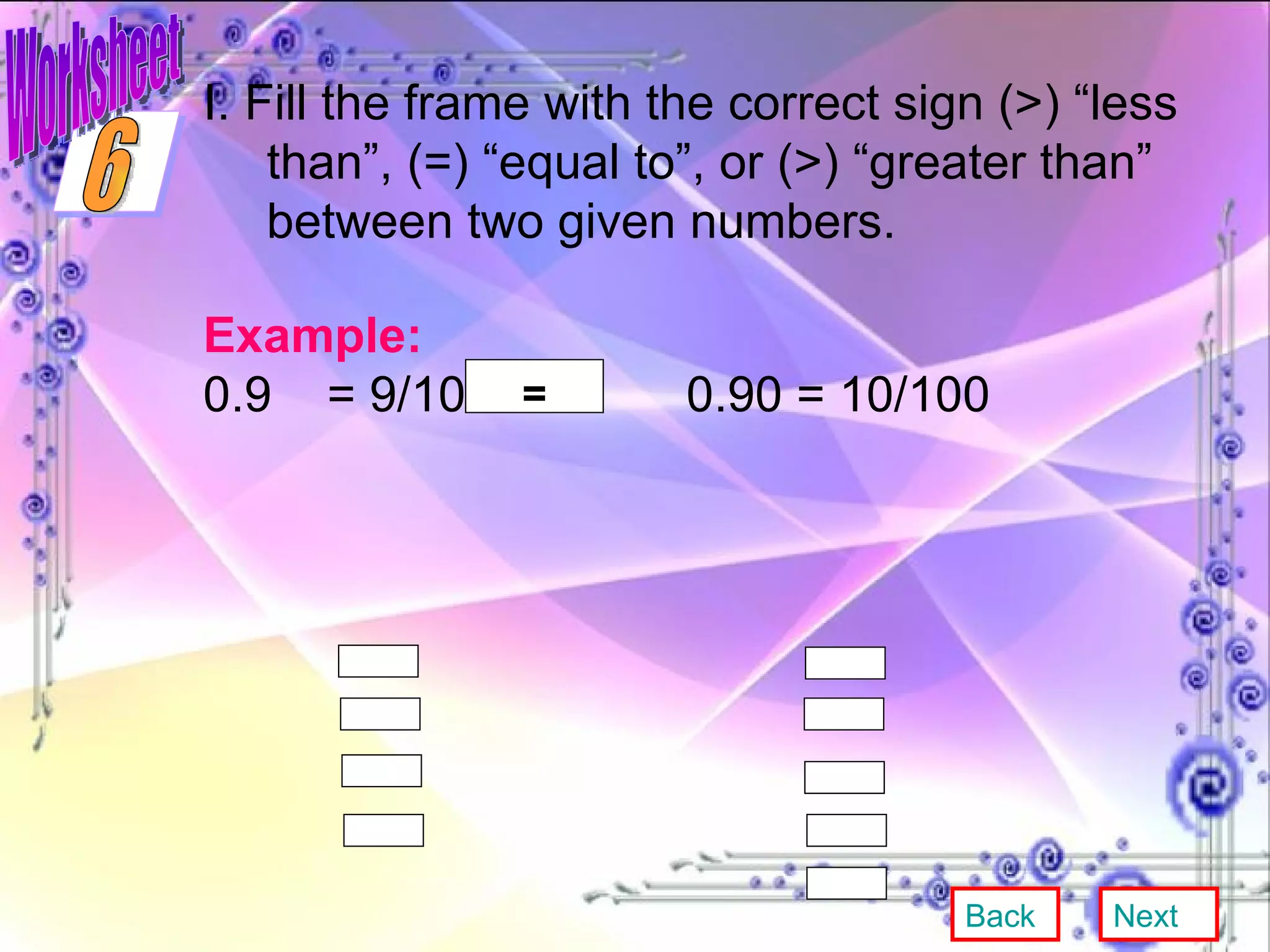
Worksheet I. Fill the frame with the correct sign (>) “less than”, (=) “equal to”, or (>) “greater than” between two given numbers. Example: 0.9  = 9/10  0.90 = 10/100   = Back Next 6
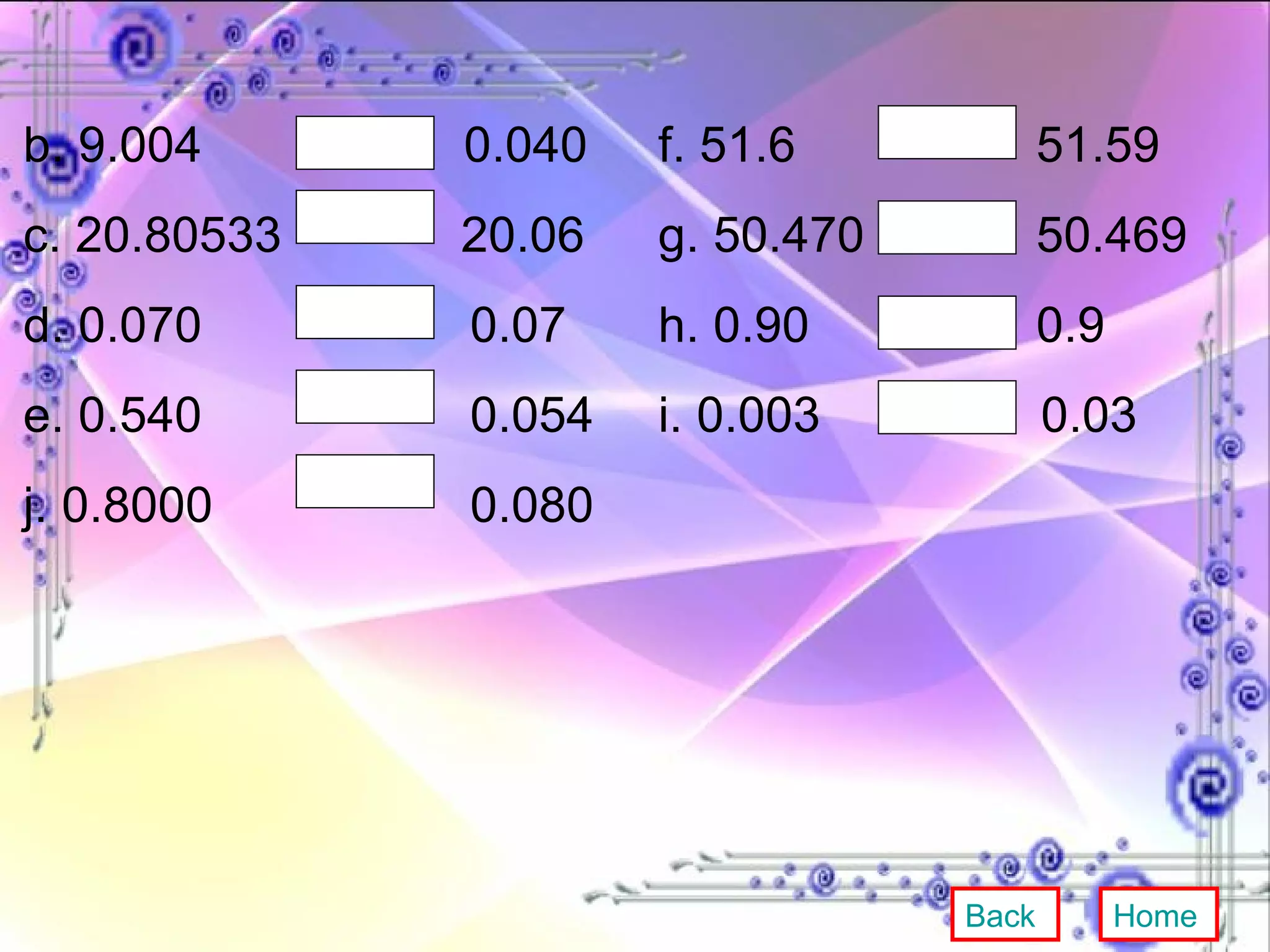
b. 9.004  0.040  f. 51.6   51.59  c. 20.80533  20.06 g. 50.470   50.469  d. 0.070   0.07  h. 0.90   0.9  e. 0.540   0.054  i. 0.003  0.03 j. 0.8000   0.080  Back Home
Lesson 7 ORDERING DECIMAL NUMBERS Lesson Objectives After accomplishing the lesson, the pupils are expected to: Order decimal numbers. Know the terms in arranging decimal numbers. Understand how to arrange decimal numbers. Content Next
Numbers have an order or arrangement. The number two is between one and three. Three or more numbers can be placed in order. A number may come before the other numbers or it may come between them or after them. Back Next
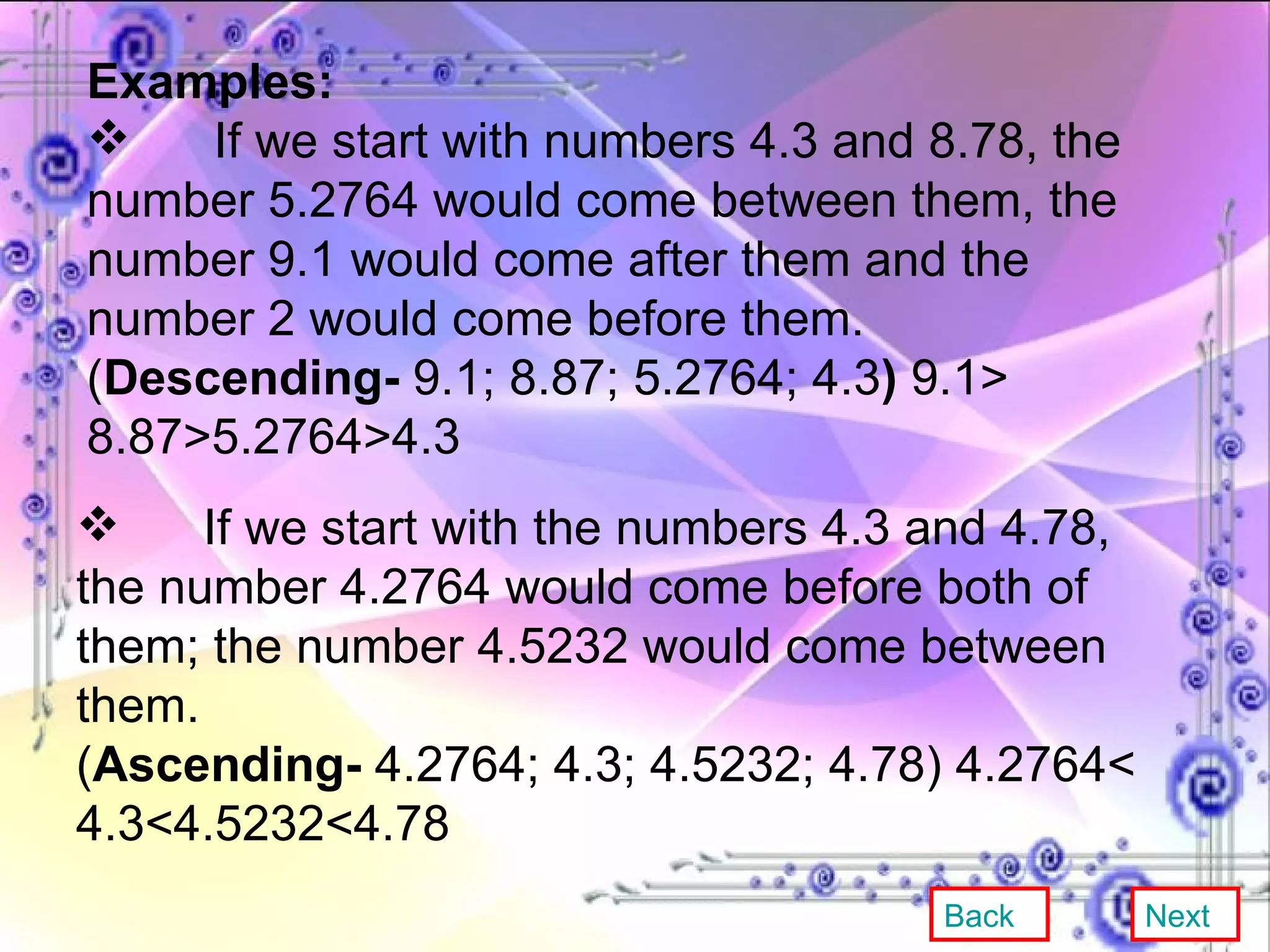
Examples: If we start with numbers 4.3 and 8.78, the number 5.2764 would come between them, the number 9.1 would come after them and the number 2 would come before them. ( Descending-  9.1; 8.87; 5.2764; 4.3 )  9.1> 8.87>5.2764>4.3 If we start with the numbers 4.3 and 4.78, the number 4.2764 would come before both of them; the number 4.5232 would come between them. ( Ascending-  4.2764; 4.3; 4.5232; 4.78) 4.2764< 4.3<4.5232<4.78 Back Next
REMEMBER: The order may be  ascending  (getting larger in value) or  descending  (becoming smaller in value). Back Exercises
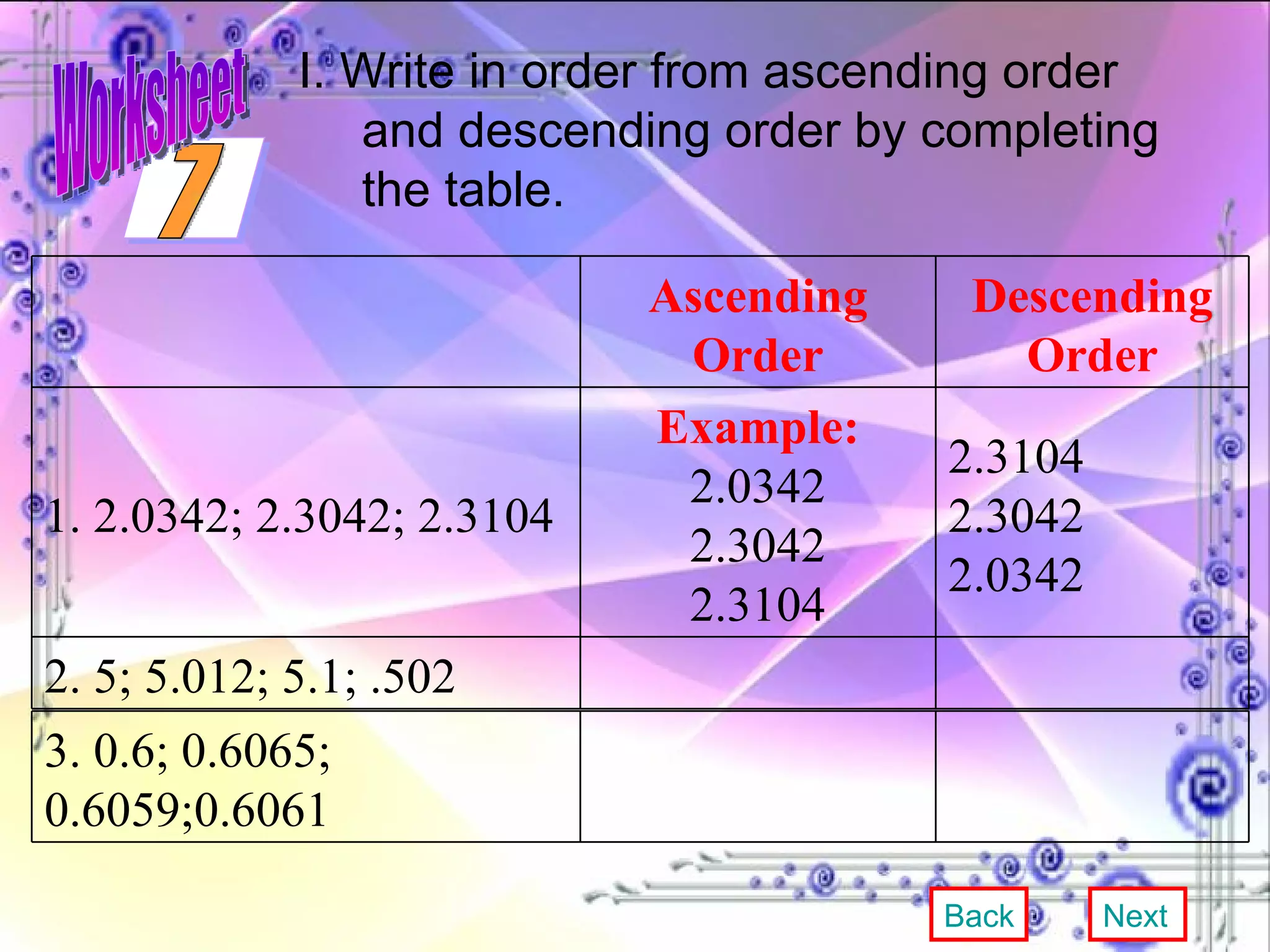
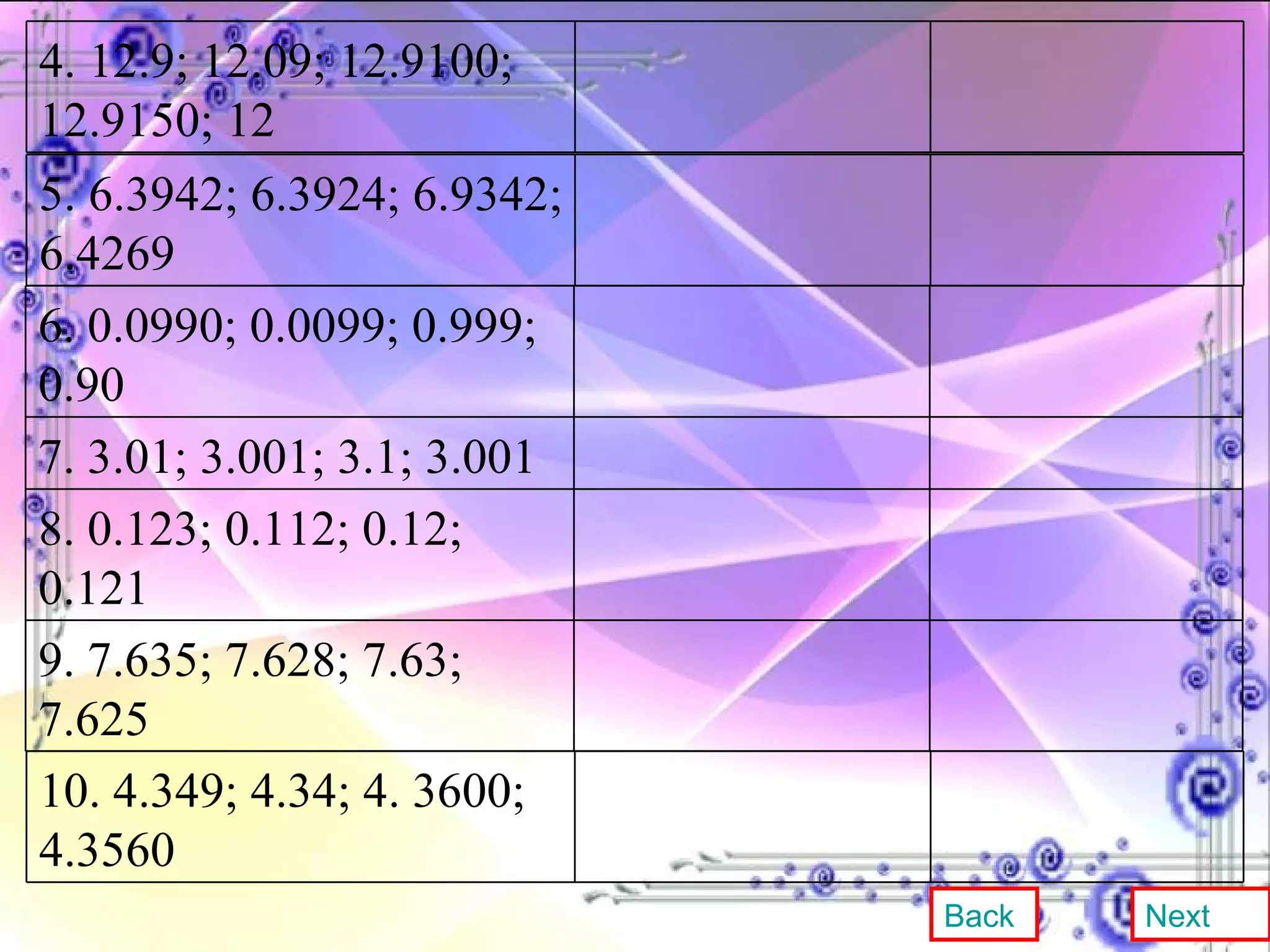
I. Write in order from ascending order and descending order by completing the table. Back Next 7 Worksheet Ascending Order Descending Order 1. 2.0342; 2.3042; 2.3104 Example: 2.0342 2.3042 2.3104 2.3104 2.3042 2.0342 2. 5; 5.012; 5.1; .502 3. 0.6; 0.6065; 0.6059;0.6061
Back Next 5. 6.3942; 6.3924; 6.9342; 6.4269 6. 0.0990; 0.0099; 0.999; 0.90 7. 3.01; 3.001; 3.1; 3.001 8. 0.123; 0.112; 0.12; 0.121 9. 7.635; 7.628; 7.63; 7.625 4. 12.9; 12.09; 12.9100; 12.9150; 12 10. 4.349; 4.34; 4. 3600; 4.3560
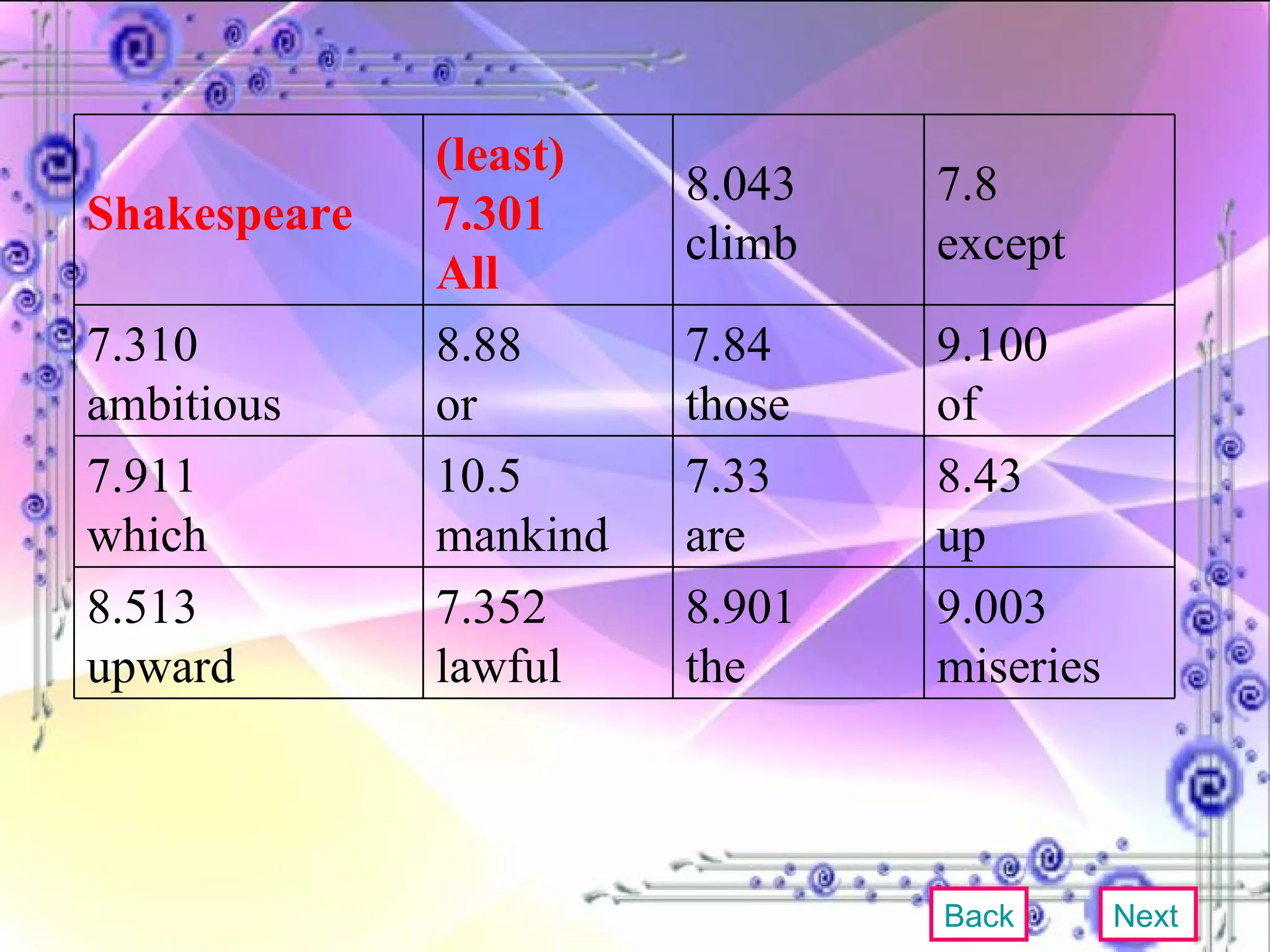
FUN WITH MATH!!! Arrange the given decimal numbers from the least to greatest and you will find a famous quotation by Shakespeare.  Back Next
Back Next Shakespeare (least) 7.301 All 8.043 climb 7.8 except 7.310 ambitious 8.88 or 7.84 those 9.100 of 7.911 which 10.5 mankind 7.33 are 8.43 up 8.513 upward 7.352 lawful 8.901 the 9.003 miseries
All ___  _______  ________  ________  ________  ________ 7.301  _______  ________  ________  ________  ________ _______  ________  ________  ________  ________  ________ _______  ________  ________  ________  ________  ________ _______  ________  ________ _______  ________  ________ . - Shakespeare   II. Answer the following.  a. The list below is the memory recall time of 5 personal computers. Which model has the fastest memory recall? Back Next
Answer: ___________________________________________ ___________________________________________ Back Next Model Recall Time Sterling PC 0.0195 sec.  XQR 2000 0.01936 sec. Redi-mate 0.02045 sec. Vision 0.1897 sec. Sal 970 0.019 sec.
b. Arrange the memory recall time of computers in number 1 in ascending order. Answer: __________________________________________________________________________________ c. A carpenter uses different sizes of drill bits in boring holes. The sizes are in fractional form and their equivalent decimals. Arrange the decimal equivalent in descending order. 1/16 = 0.0625 ¼ = 0.25 1/8 = 0.125 5/6 = 0.3125 Back Next
Answer: ___________________________________________ ___________________________________________ d. Which has the smallest decimal equivalent among the drill bits in item C? Answer: ________________________________________ ________________________________________ Back Next
e. Which has the greatest decimal equivalent the drill bits in item C? Answer:  ________________________________________ ________________________________________ Back Home
Lesson 8 ROUNDING OFF DECIMALS Lesson Objectives  After accomplishing the lesson, the pupils are expected to: 1. Round decimals. 2. Tabulate data in the chart. 3. Show rules in rounding decimal numbers. Content Next
To round decimal numbers means to drop off the digits to the right of the place-value indicated and replace them by zeros. The accuracy of the place-value needed must be stated and it depends on the purpose for which rounding is done. We give rounded decimal numbers when we do not need the exact value or number. Instead, we are after an estimated value or measure that will serve our purpose. These are many instances in daily life when rounded numbers are what we need to use.  Back Next
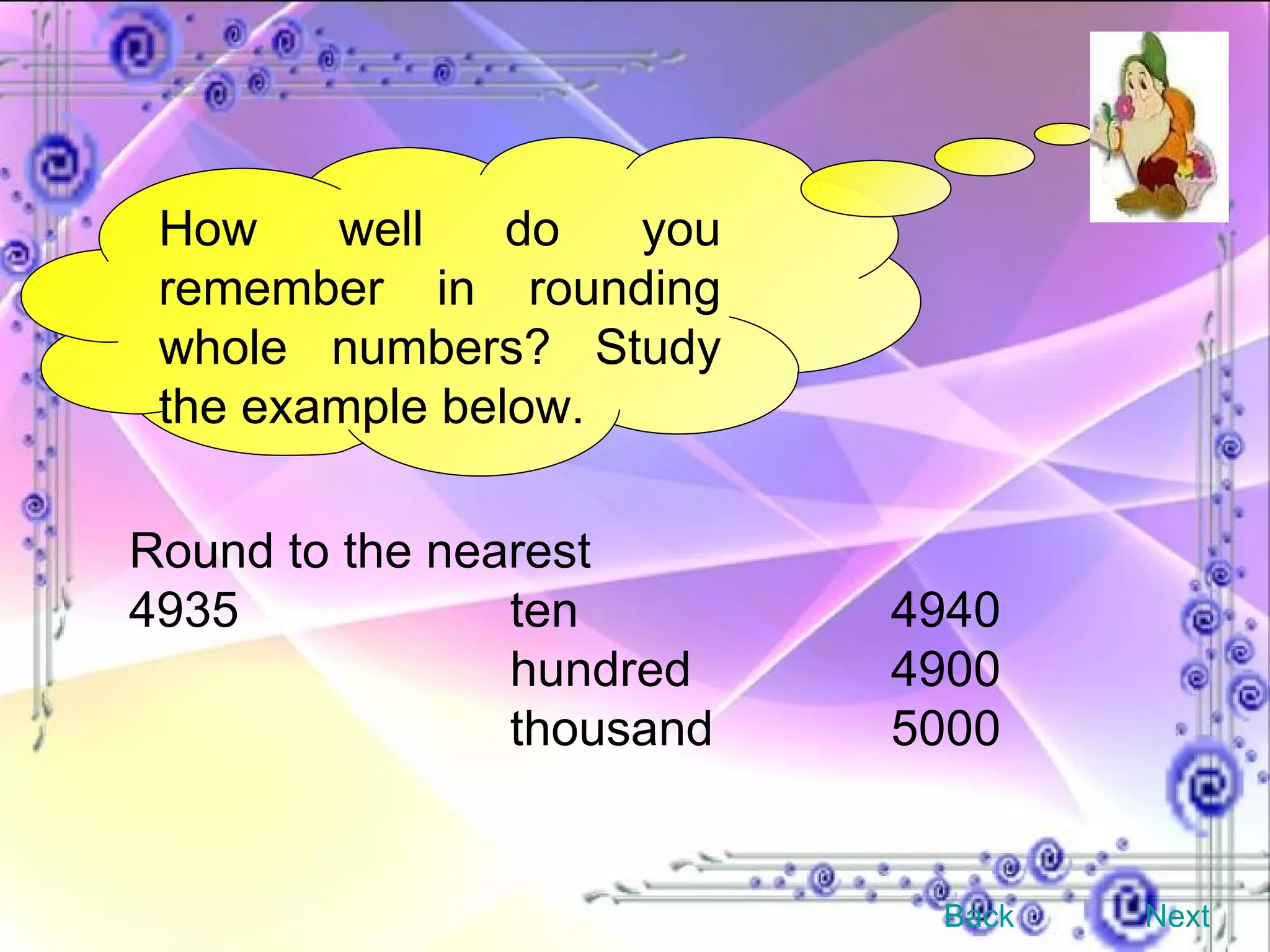
How well do you remember in rounding whole numbers? Study the example below. Round to the nearest 4935 ten 4940 hundred 4900 thousand 5000 Back Next
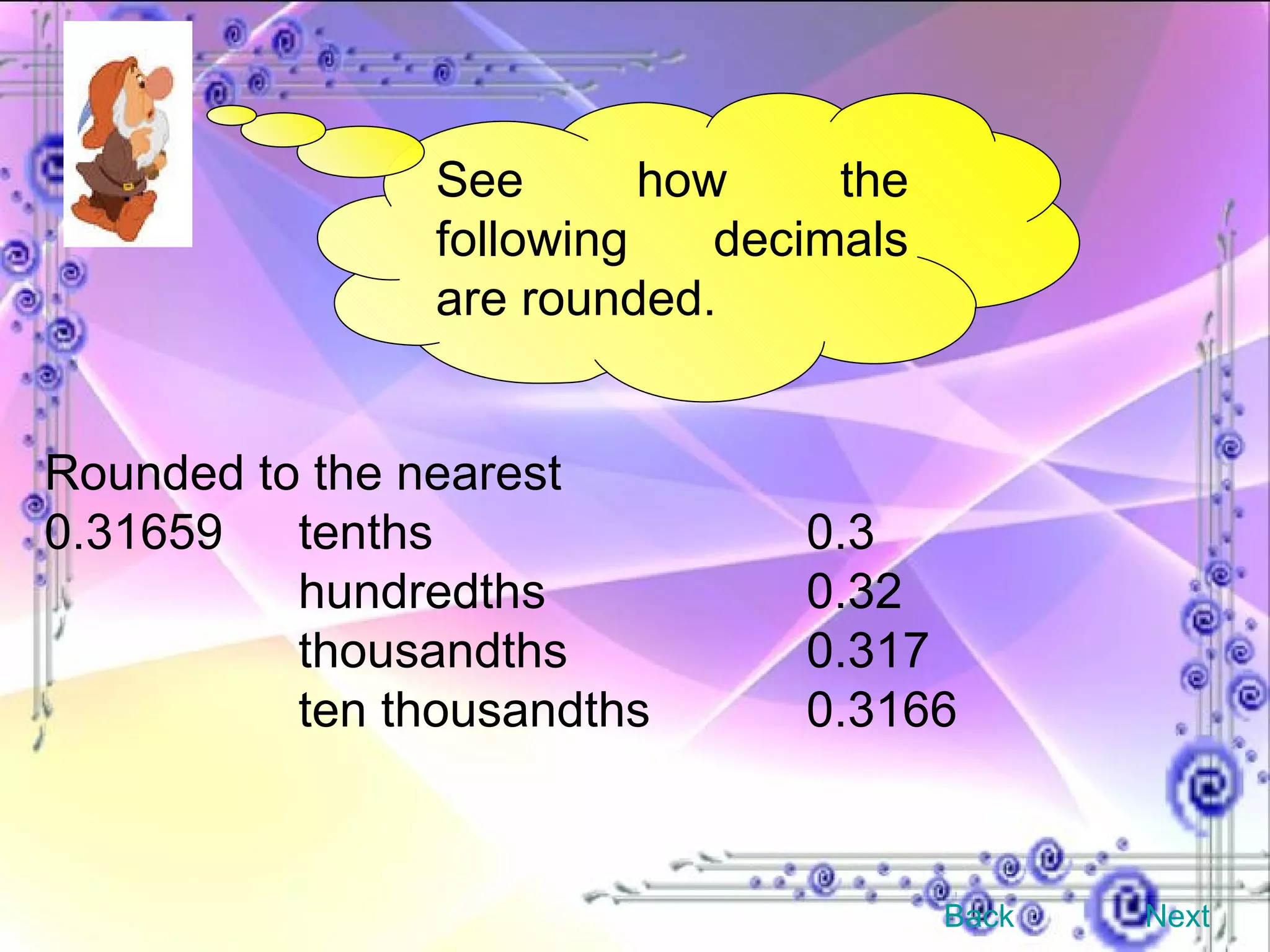
See how the following decimals are rounded. Rounded to the nearest 0.31659 tenths 0.3 hundredths 0.32 thousandths 0.317 ten thousandths 0.3166 Back Next
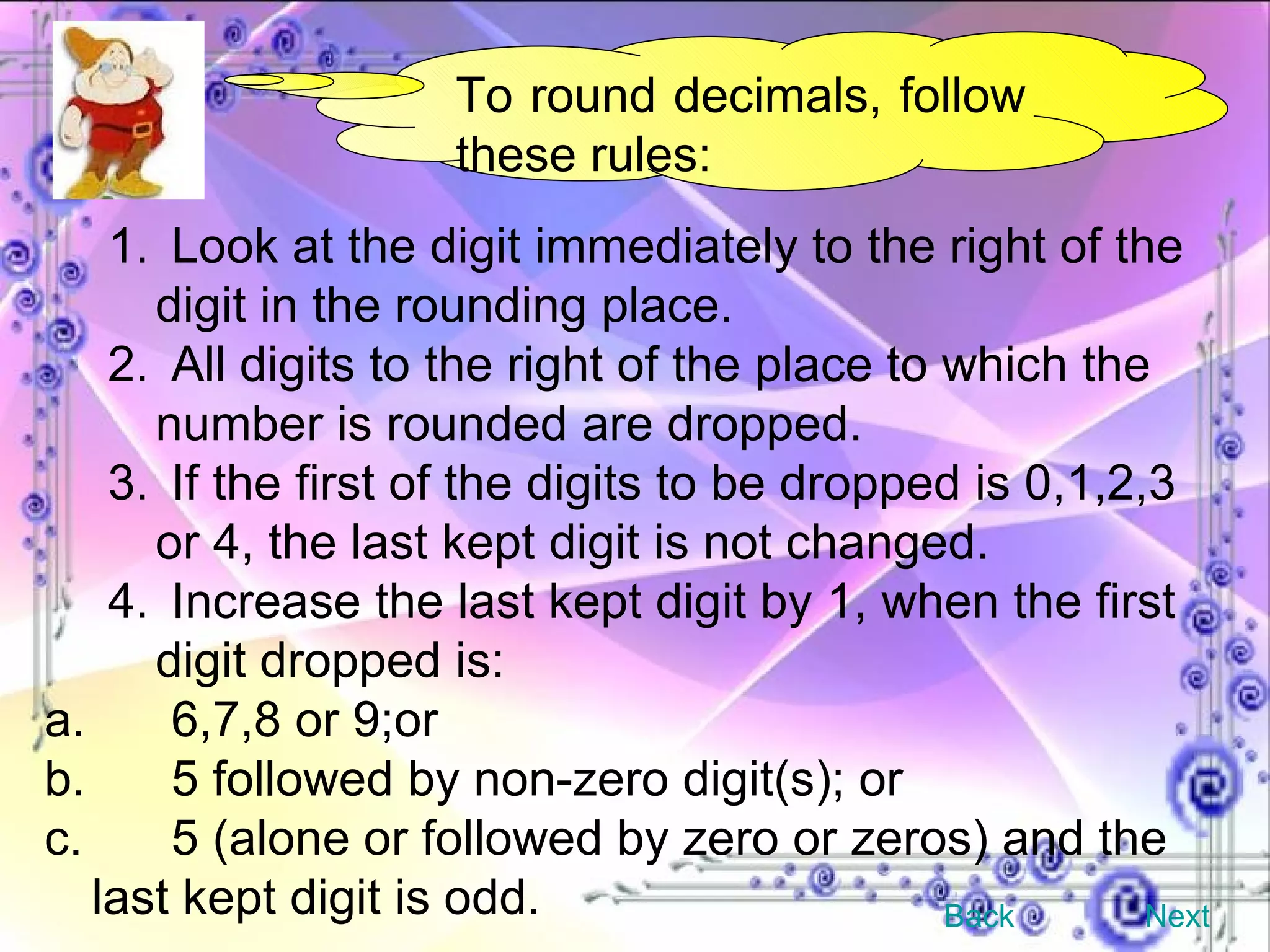
To round decimals, follow these rules: 1.  Look at the digit immediately to the right of the digit in the rounding place. 2.  All digits to the right of the place to which the number is rounded are dropped. 3.  If the first of the digits to be dropped is 0,1,2,3 or 4, the last kept digit is not changed. 4.  Increase the last kept digit by 1, when the first digit dropped is: a.  6,7,8 or 9;or b.  5 followed by non-zero digit(s); or c.  5 (alone or followed by zero or zeros) and the last kept digit is odd. Back Next
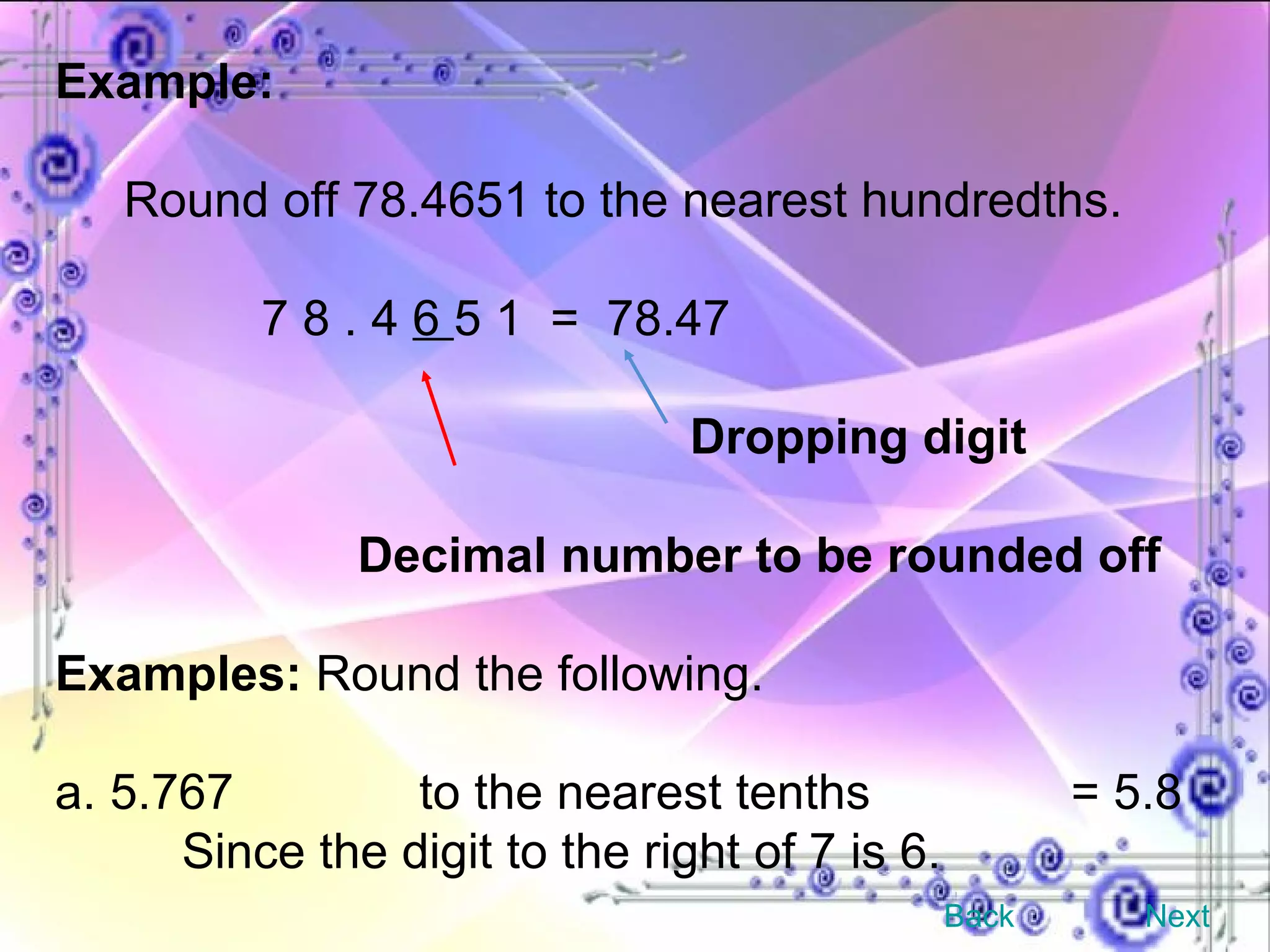
Example: Round off 78.4651 to the nearest hundredths. 7 8 . 4  6  5 1  =  78.47 Dropping digit  Decimal number to be rounded off Examples:  Round the following. a. 5.767   to the nearest tenths   = 5.8 Since the digit to the right of 7 is 6. Back Next
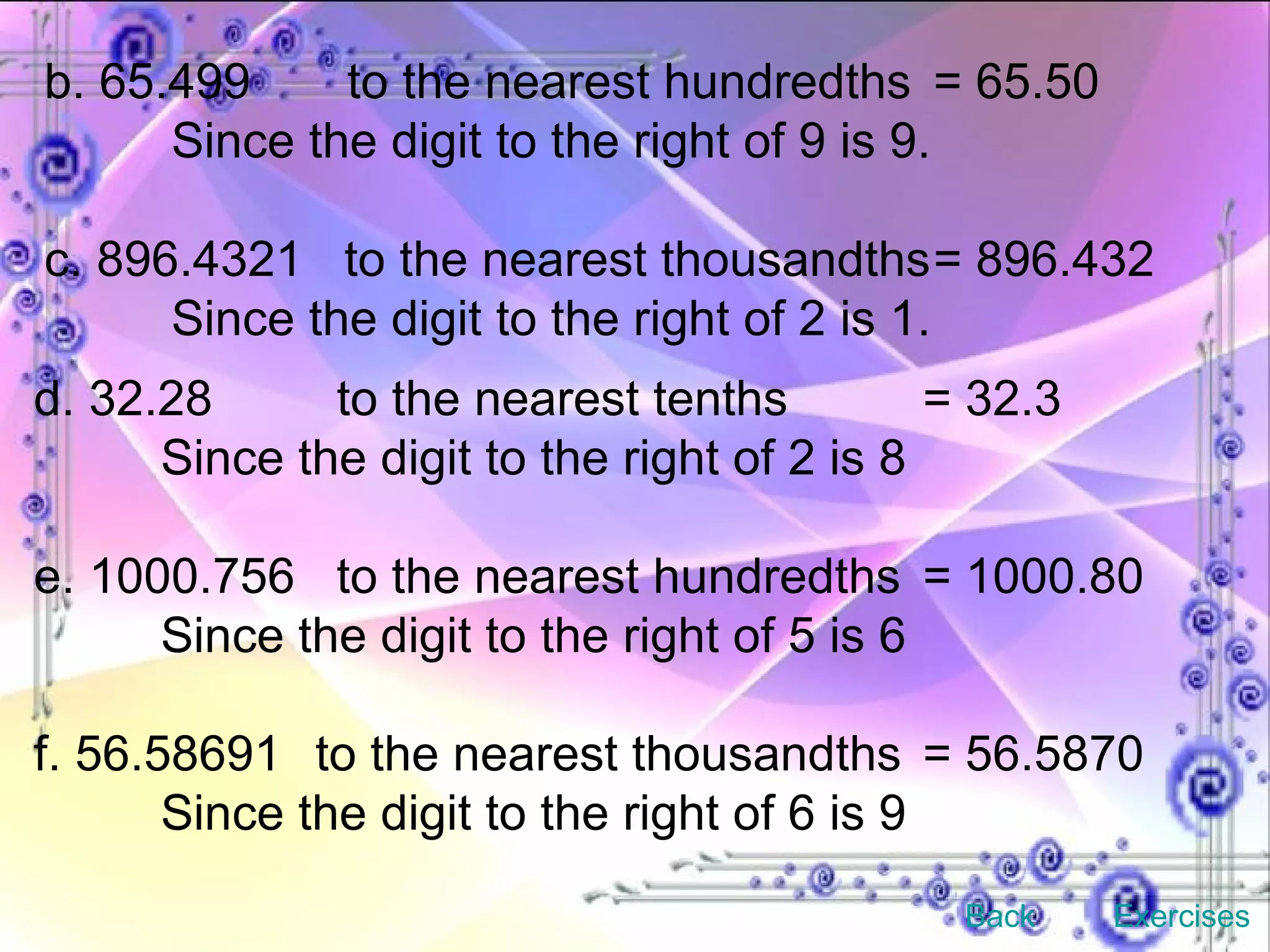
b. 65.499  to the nearest hundredths = 65.50 Since the digit to the right of 9 is 9. c. 896.4321  to the nearest thousandths = 896.432 Since the digit to the right of 2 is 1. d. 32.28  to the nearest tenths = 32.3 Since the digit to the right of 2 is 8 e. 1000.756  to the nearest hundredths  = 1000.80 Since the digit to the right of 5 is 6 f. 56.58691   to the nearest thousandths = 56.5870 Since the digit to the right of 6 is 9 Back Exercises
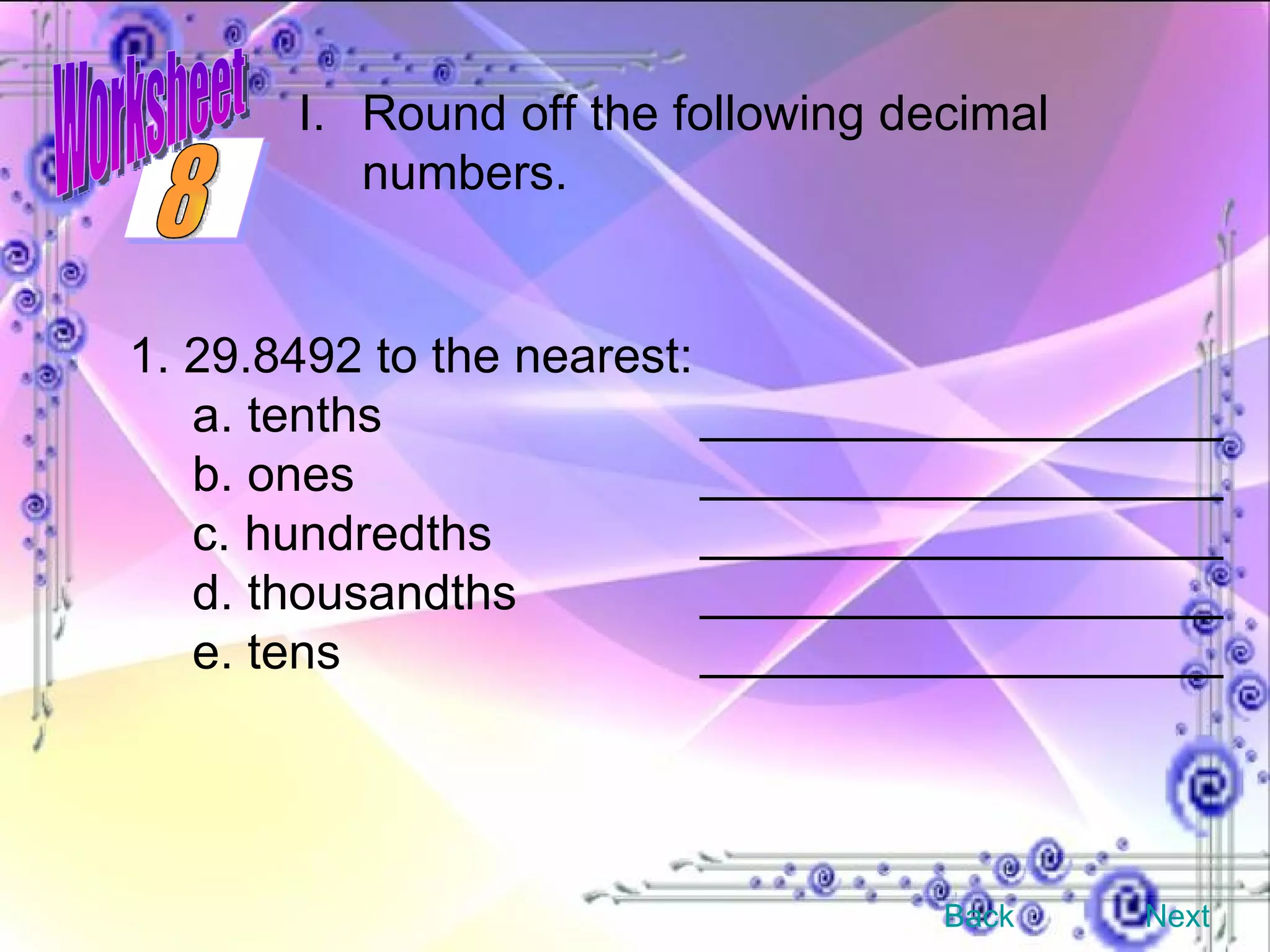
1. 29.8492 to the nearest: a. tenths ___________________ b. ones ___________________ c. hundredths ___________________ d. thousandths ___________________ e. tens ___________________ Round off the following decimal numbers. Back Next 8 Worksheet
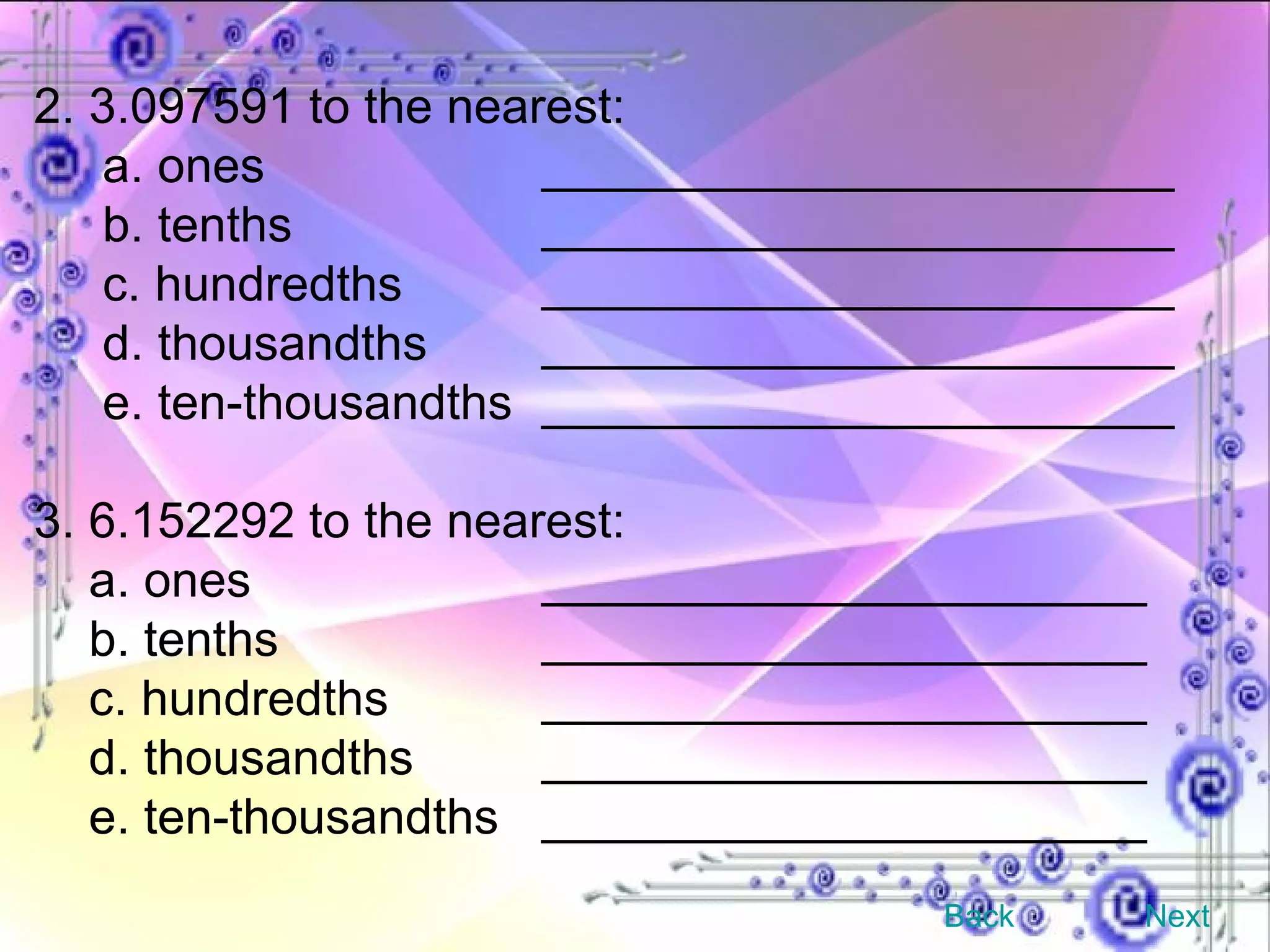
2. 3.097591 to the nearest: a. ones _______________________ b. tenths _______________________ c. hundredths _______________________ d. thousandths _______________________ e. ten-thousandths _______________________ 3. 6.152292 to the nearest: a. ones ______________________ b. tenths ______________________ c. hundredths ______________________ d. thousandths ______________________ e. ten-thousandths ______________________ Back Next
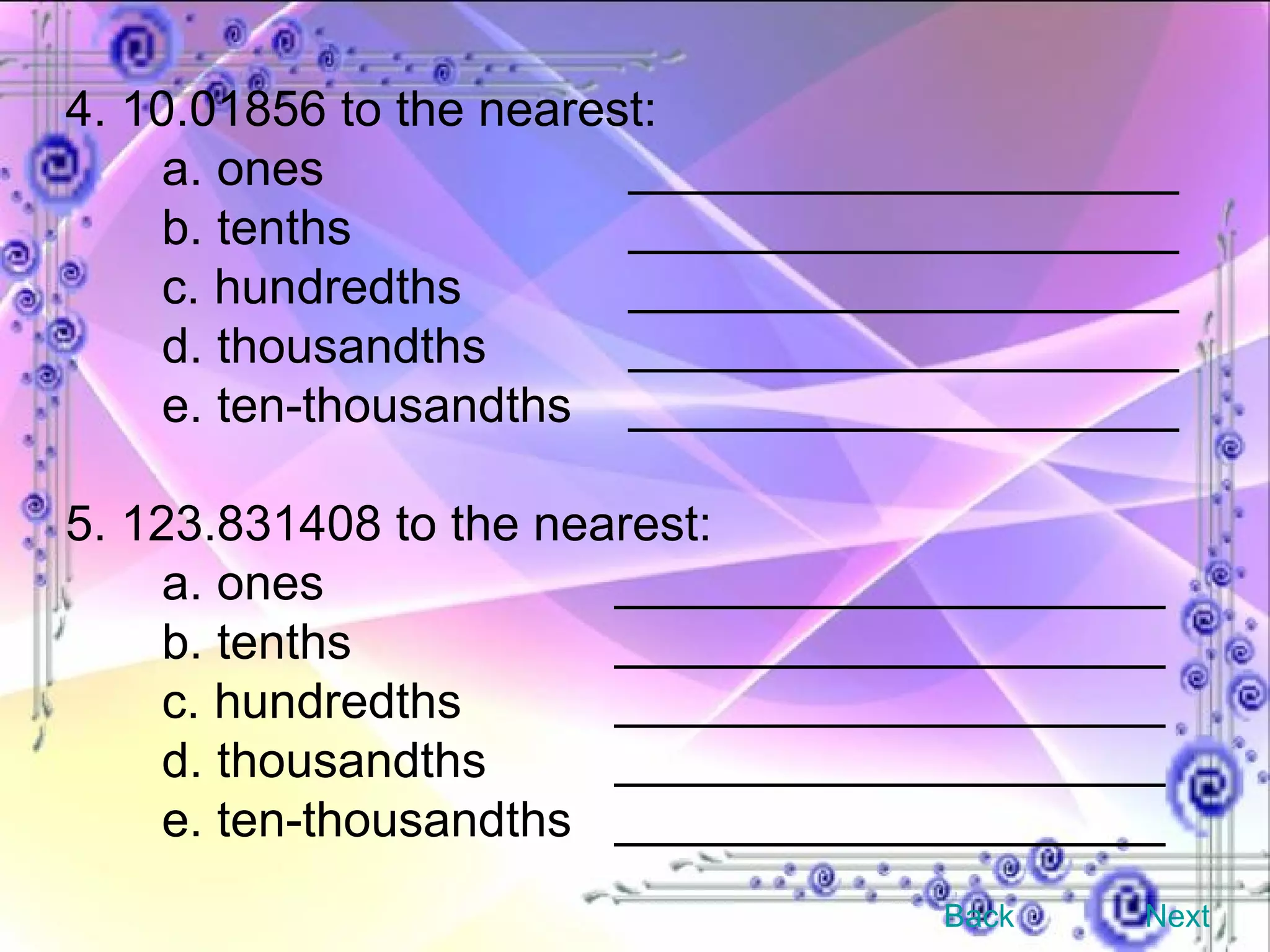
4. 10.01856 to the nearest: a. ones   ____________________ b. tenths   ____________________ c. hundredths   ____________________ d. thousandths   ____________________ e. ten-thousandths   ____________________ 5. 123.831408 to the nearest: a. ones   ____________________ b. tenths   ____________________ c. hundredths   ____________________ d. thousandths   ____________________ e. ten-thousandths   ____________________ Back Next
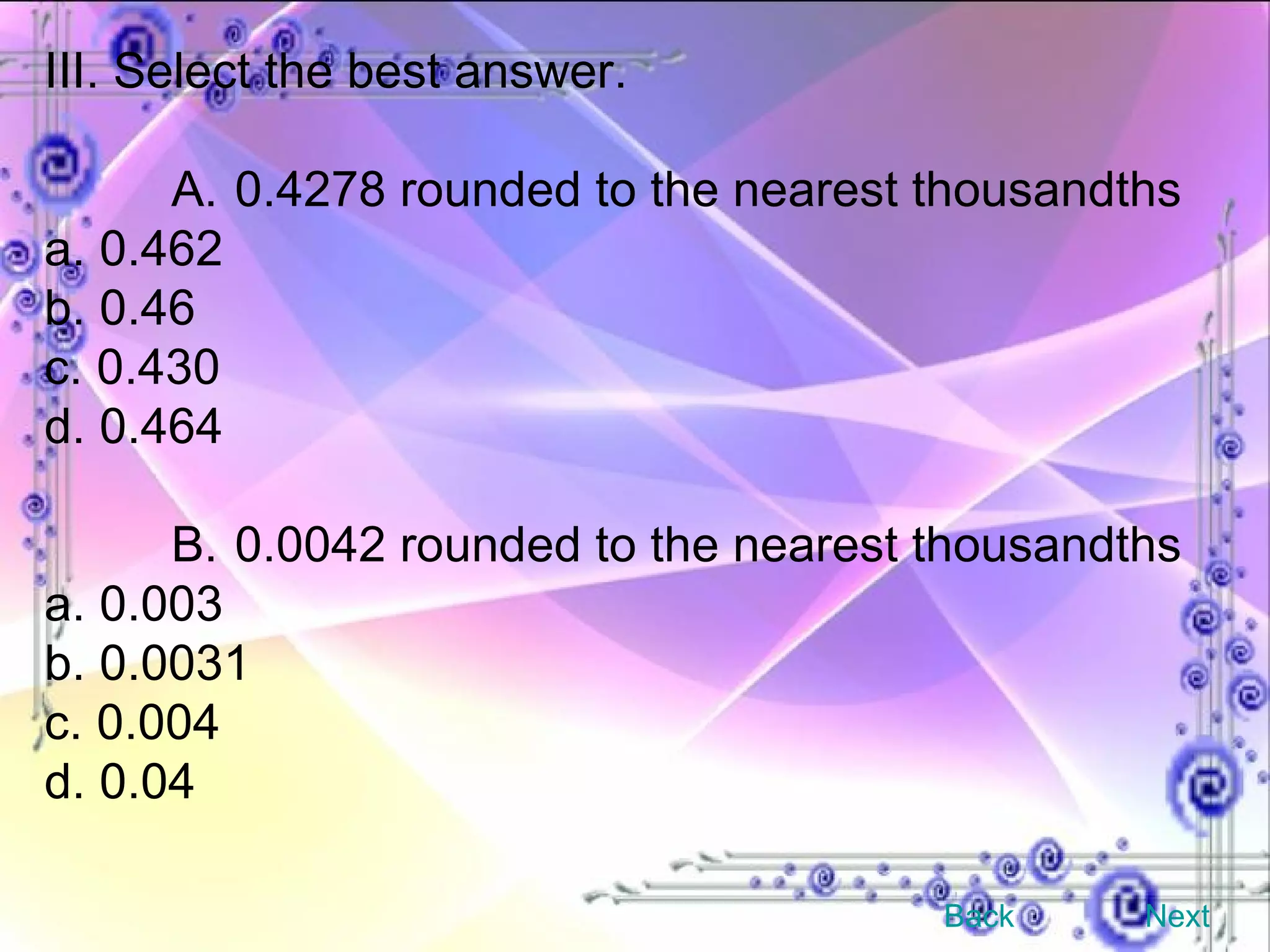
III. Select the best answer. A. 0.4278 rounded to the nearest thousandths a. 0.462 b. 0.46 c. 0.430 d. 0.464 B. 0.0042 rounded to the nearest thousandths a. 0.003 b. 0.0031 c. 0.004 d. 0.04 Back Next
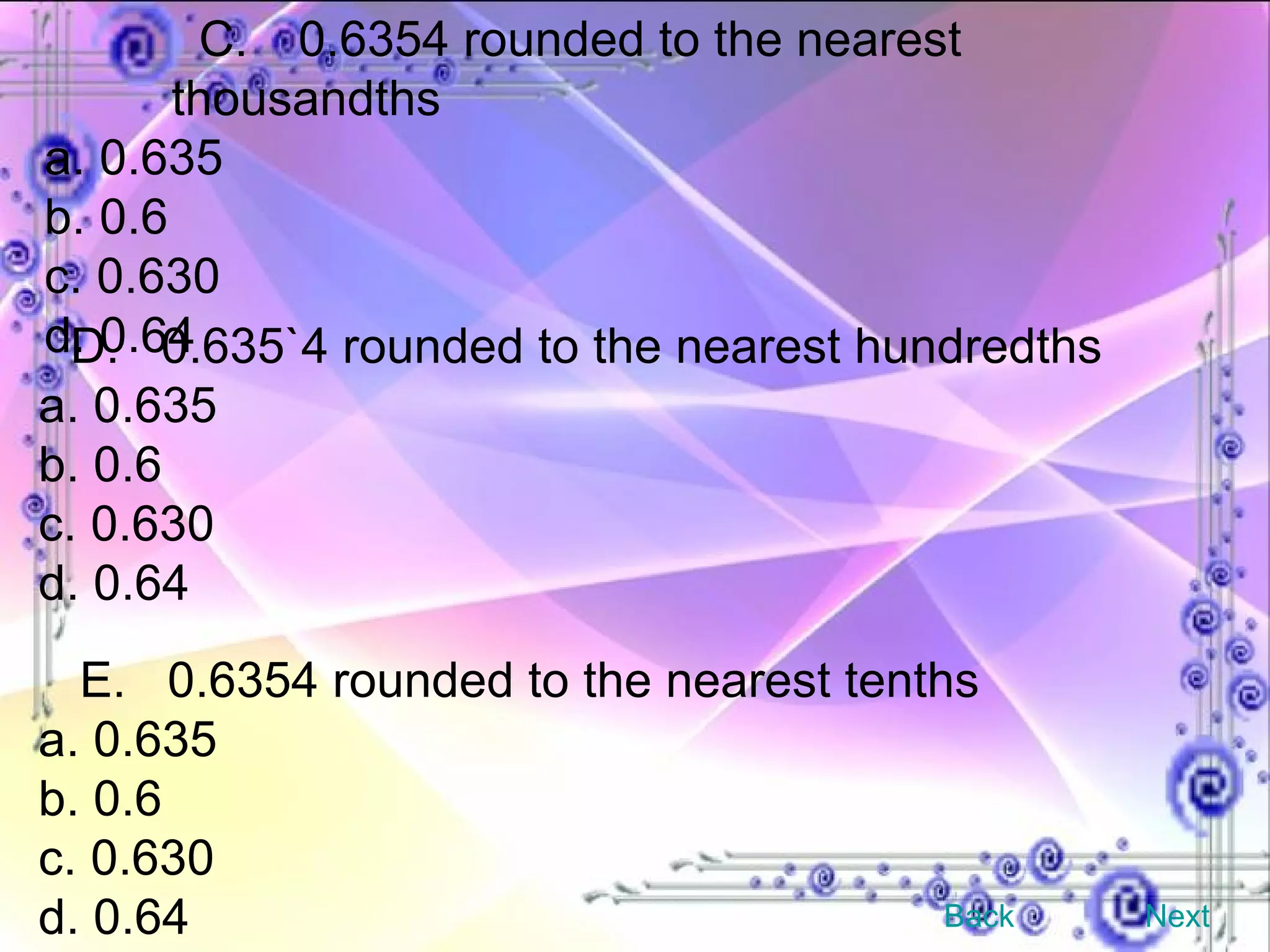
C. 0.6354 rounded to the nearest thousandths a. 0.635 b. 0.6 c. 0.630 d. 0.64 D.  0.635`4 rounded to the nearest hundredths a. 0.635 b. 0.6 c. 0.630 d. 0.64 E.  0.6354 rounded to the nearest tenths a. 0.635 b. 0.6 c. 0.630 d. 0.64 Back Next
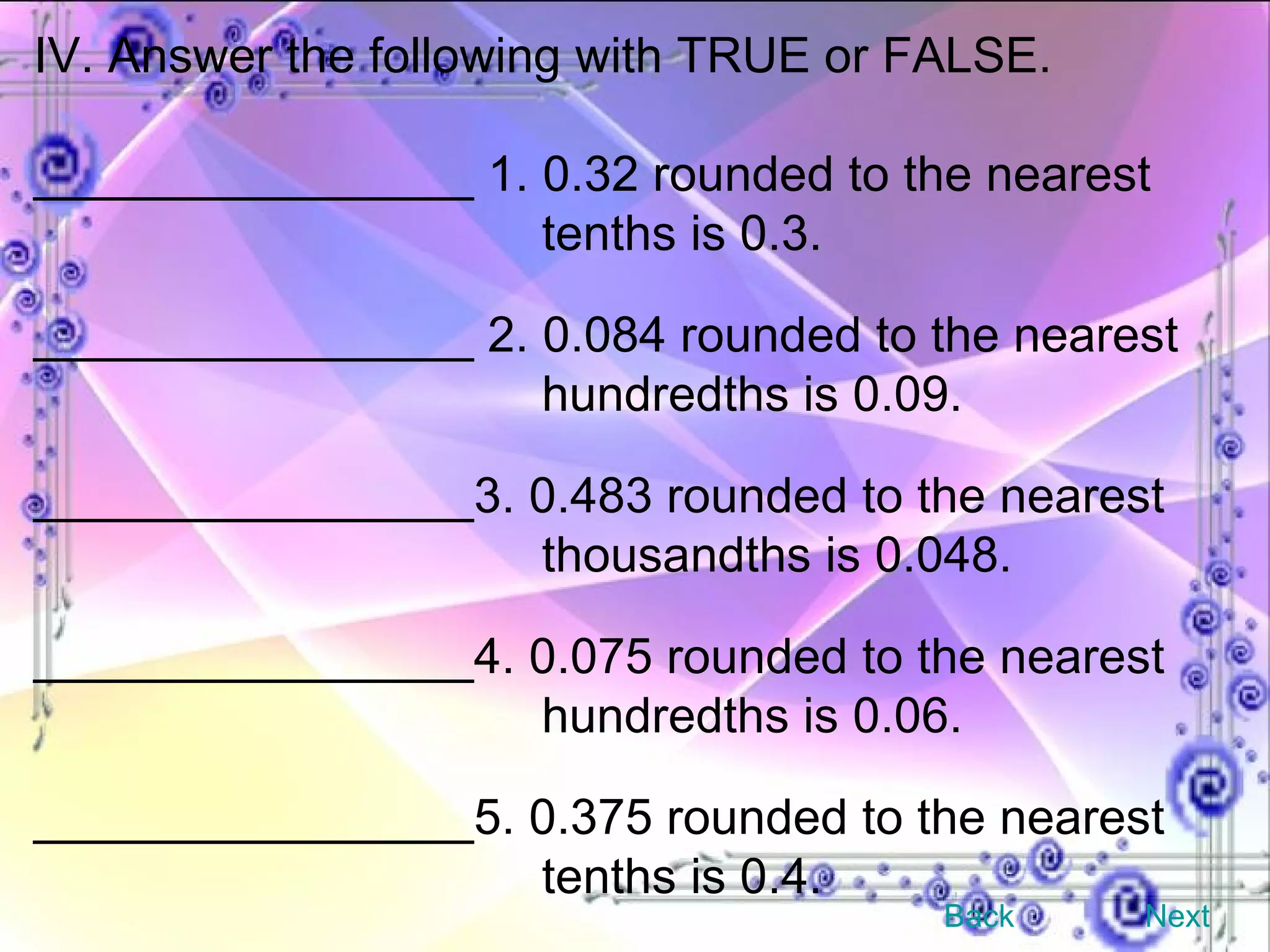
IV. Answer the following with TRUE or FALSE. ________________ 1. 0.32 rounded to the nearest  tenths is 0.3. ________________ 2. 0.084 rounded to the nearest  hundredths is 0.09. ________________3. 0.483 rounded to the nearest  thousandths is 0.048. ________________4. 0.075 rounded to the nearest  hundredths is 0.06. ________________5. 0.375 rounded to the nearest  tenths is 0.4. Back Next
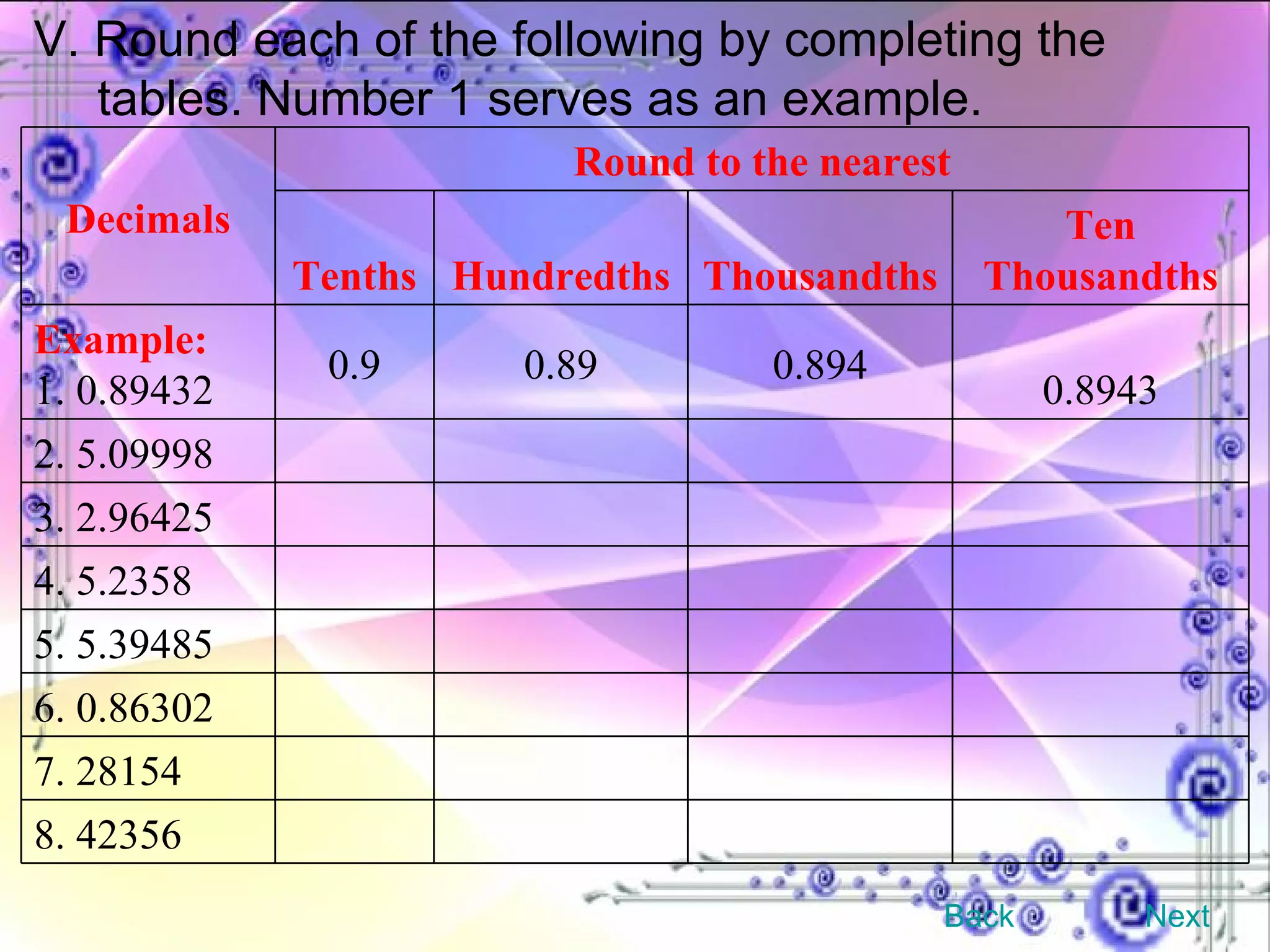
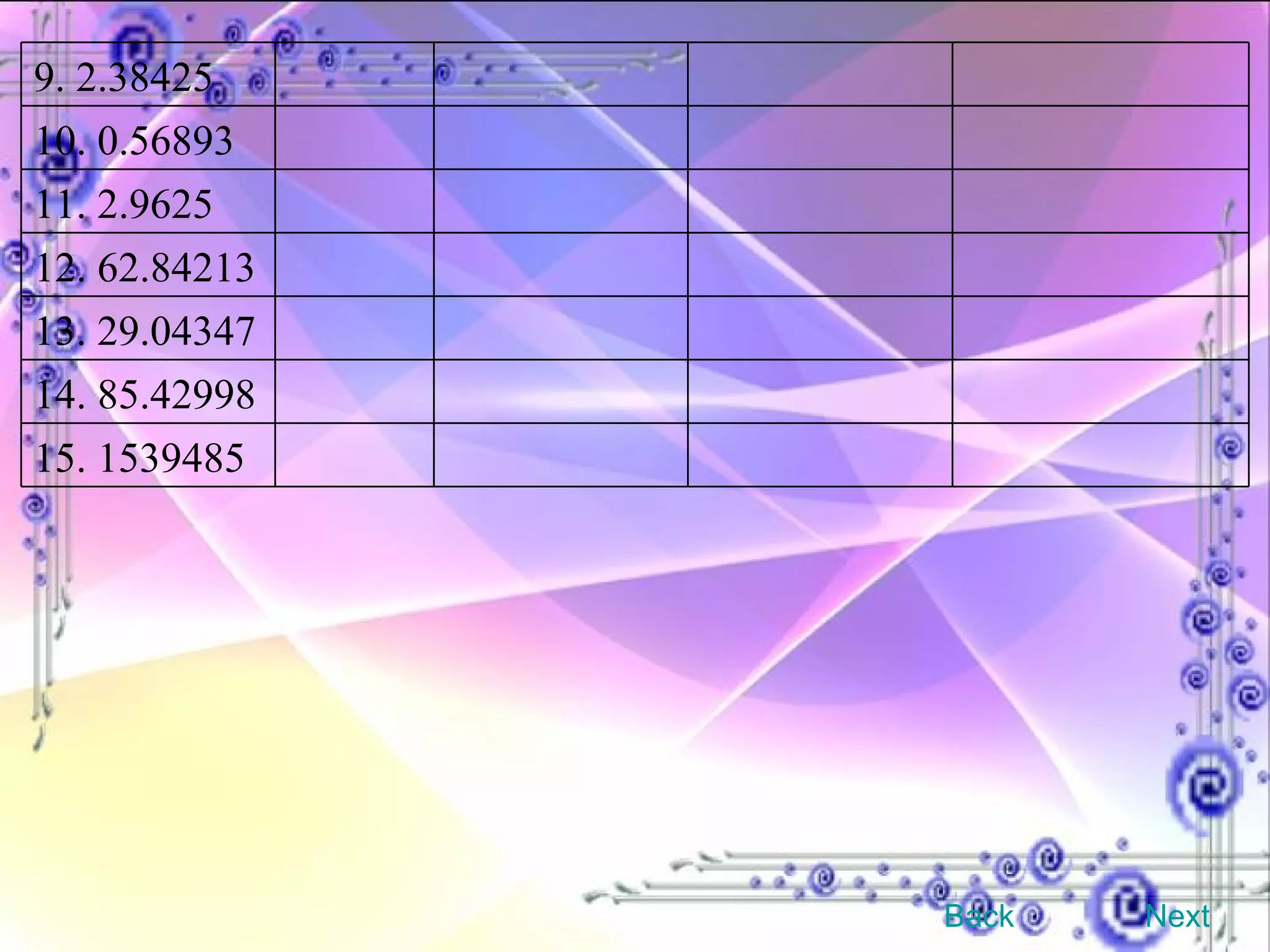
V. Round each of the following by completing the tables. Number 1 serves as an example.   Back Next Decimals Round to the nearest Tenths Hundredths Thousandths Ten Thousandths Example: 1. 0.89432 0.9 0.89 0.894 0.8943 2. 5.09998         3. 2.96425         4. 5.2358         5. 5.39485         6. 0.86302         7. 28154       8. 42356        
Back Next 9. 2.38425         10. 0.56893         11. 2.9625         12. 62.84213         13. 29.04347         14. 85.42998         15. 1539485        
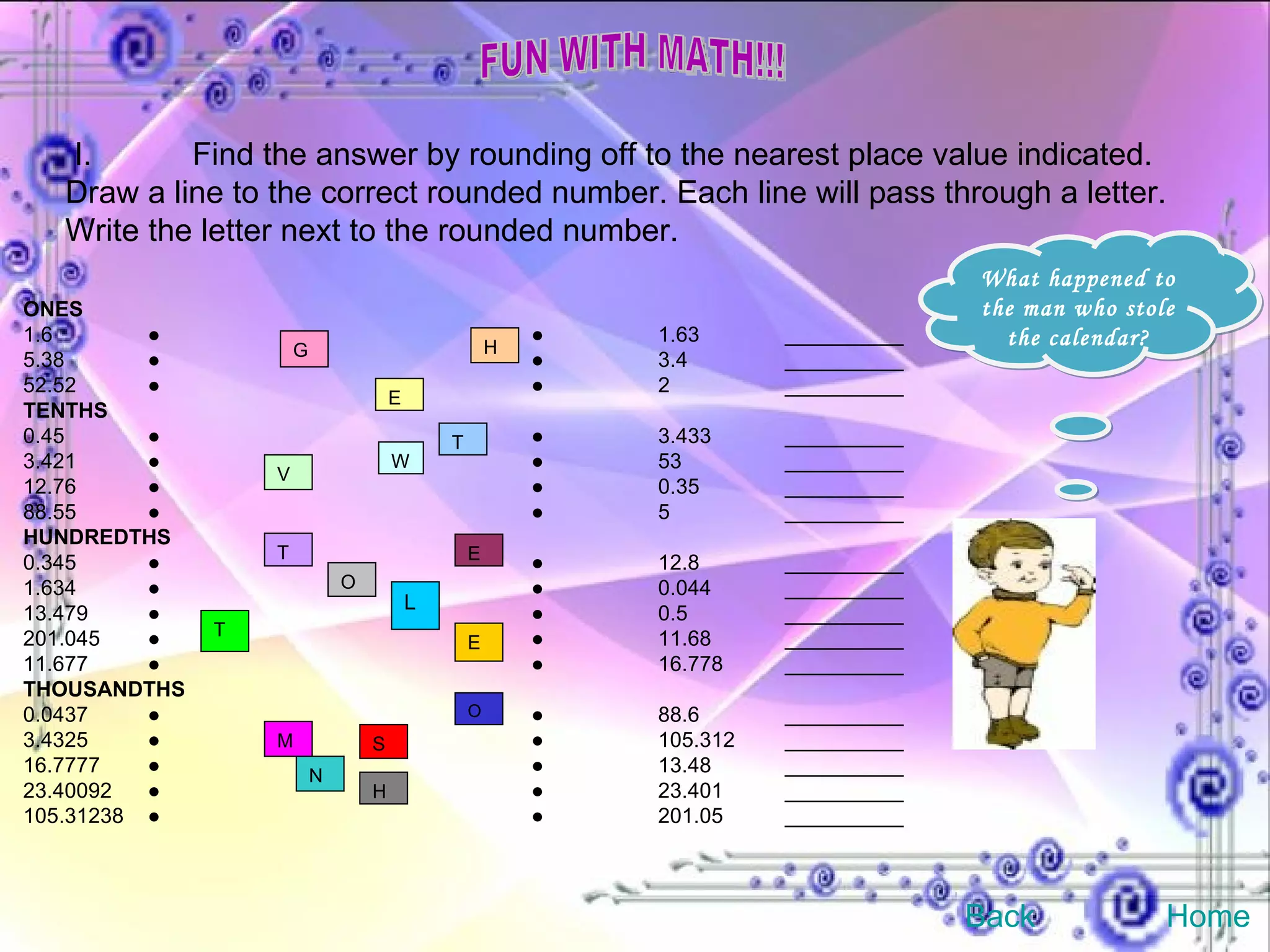
FUN WITH MATH!!! I. Find the answer by rounding off to the nearest place value indicated. Draw a line to the correct rounded number. Each line will pass through a letter. Write the letter next to the rounded number. ONES 1.6  ● ● 1.63 __________ 5.38  ● ● 3.4 __________ 52.52  ● ● 2 __________ TENTHS 0.45  ● ● 3.433 __________ 3.421  ● ● 53 __________ 12.76  ● ● 0.35 __________ 88.55  ● ● 5 __________ HUNDREDTHS 0.345  ● ● 12.8 __________ 1.634  ● ● 0.044 __________ 13.479  ● ● 0.5 __________ 201.045  ● ● 11.68 __________ 11.677  ● ● 16.778 __________ THOUSANDTHS 0.0437  ● ● 88.6 __________ 3.4325  ● ● 105.312 __________ 16.7777  ● ● 13.48 __________ 23.40092  ● ● 23.401 __________ 105.31238  ● ● 201.05 __________ T V E H W G E N T O O L H M S E T What happened to the man who stole the calendar? Back Home
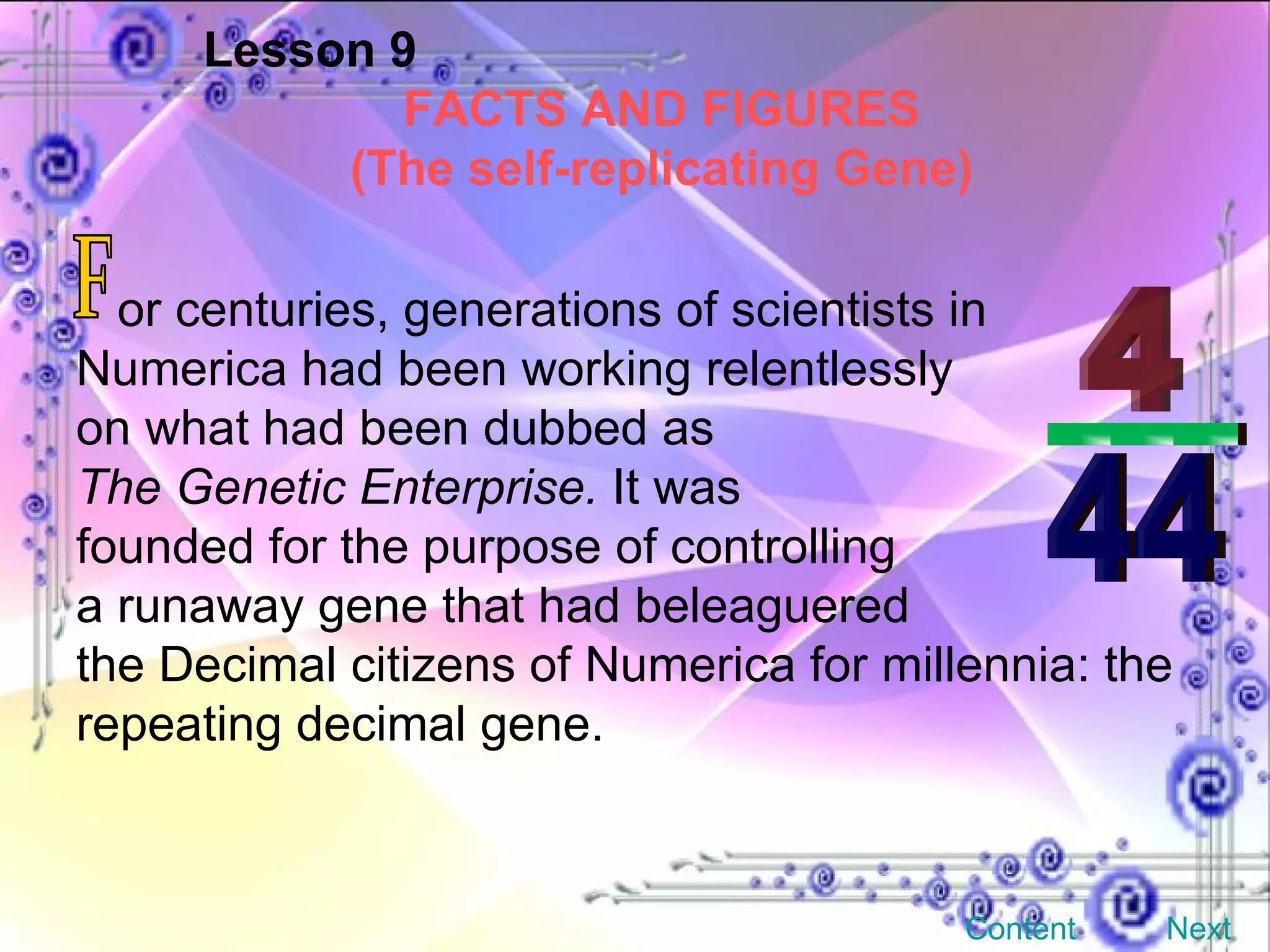
Lesson 9 FACTS AND FIGURES (The self-replicating Gene) or centuries, generations of scientists in Numerica had been working relentlessly  on what had been dubbed as  The Genetic Enterprise.  It was  founded for the purpose of controlling  a runaway gene that had beleaguered  the Decimal citizens of Numerica for millennia: the repeating decimal gene. F Content Next 4 ___ 44
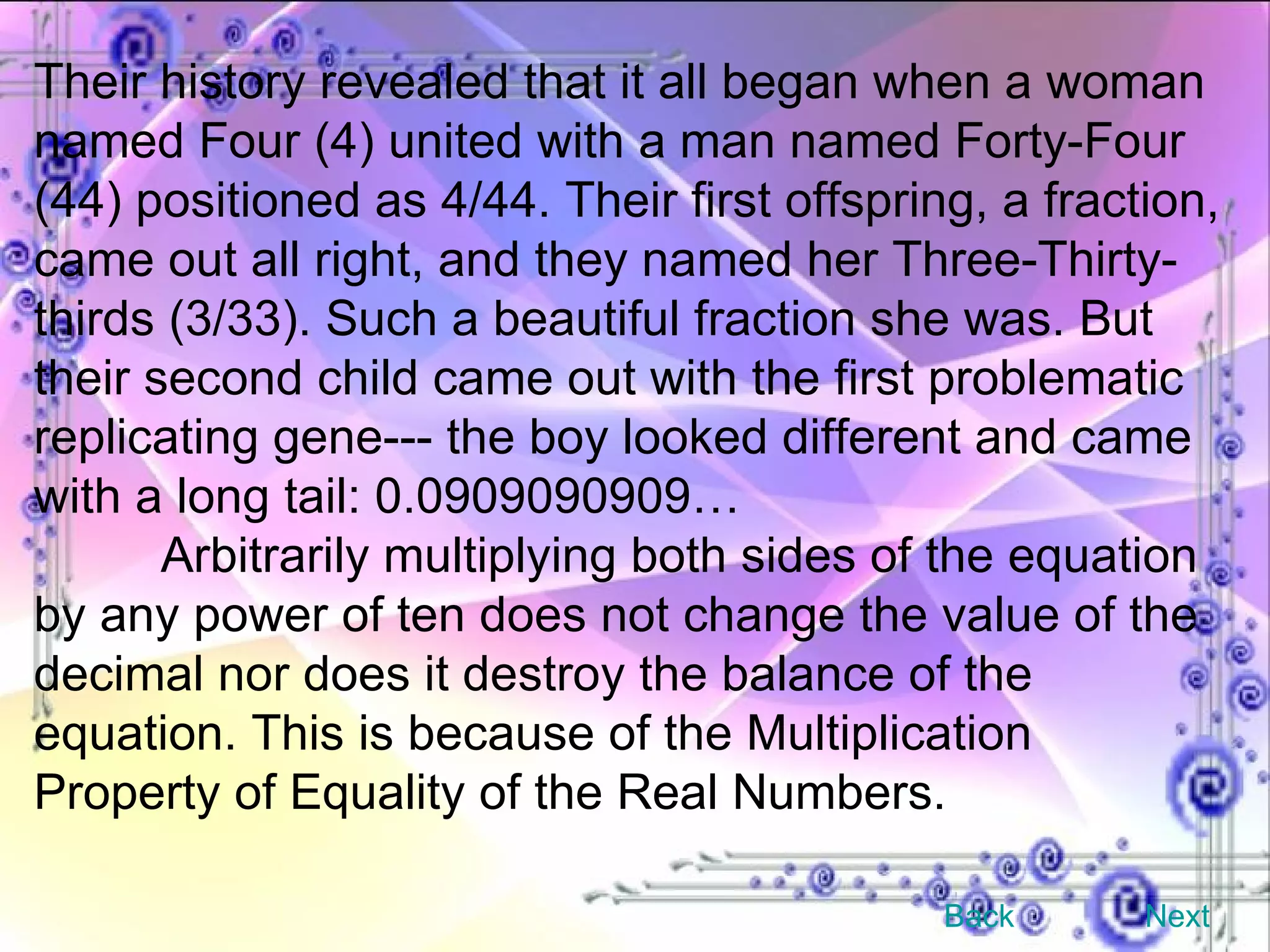
Their history revealed that it all began when a woman named Four (4) united with a man named Forty-Four (44) positioned as 4/44. Their first offspring, a fraction, came out all right, and they named her Three-Thirty-thirds (3/33). Such a beautiful fraction she was. But their second child came out with the first problematic replicating gene--- the boy looked different and came with a long tail: 0.0909090909… Arbitrarily multiplying both sides of the equation by any power of ten does not change the value of the decimal nor does it destroy the balance of the equation. This is because of the Multiplication Property of Equality of the Real Numbers. Back Next
That wasn’t the end of it. Every week, the boy’s tail added a new  segment of 09, and it just never ended! It wasn’t so much the unusual appearance of the boy that worried every one, as the difficulty of naming him.  Point-Zero-Nine-Zero-Nine-Zero-Nine- Zero -Nine-Zero-Nine, going on forever, was just too long a name! There were many others in the community whose tails also continuously and regularly increased. Despite their peculiar form, though, those trouble with the repeating gene were never shunned, were treated equally with love, respect, and total acceptance. Still, the continually growing tail proved cumbersome for the Decimals, and they prayed to be changed to regular forms. Back Next
Arbitrarily multiplying both sides of the equation by any power of ten does not change the value of the decimal nor does it destroy the balance of the equation. This is because of the Multiplication Property of Equality of the Real Numbers. Back Next Remember
One fateful day, the newspaper headlines screamed: “The Genetic Enterprise: Finally Success!” All of Numerica was thrilled! At the state conference the next day, every citizen was present, especially those with continuously growing tails. “ And now, I must ask for a volunteer,” said Doctor One Half (½), head scientist of the project, over the microphone. Immediately, 0.33333…, friend of Point-Zero-Nine-Zero-Nine…, was up the stage. “ O-Point-Three-Three-Three…” One Half began, “do not be afraid. Go into that glass capsule to your left, for we must first clone you.” Back Next
The crowd was aghast. One Half reassured every one immediately. “Do not worry, it is only temporary.”  When 0.33333… came out, his clone came out from the other capsule. The doctor spoke again. “I will run you all through the process as we proceed. First, we shall designate the clone as Ex = 0.33333… “ Now, 0.33333…, go back into the capsule---we will introduce a new gene into you. This gene is called Tenn (10), and this will change your appearance, so that we will temporarily call you Tennexx (10x). Do not be alarmed!” One Half added quickly at every one’s reaction. Back Next
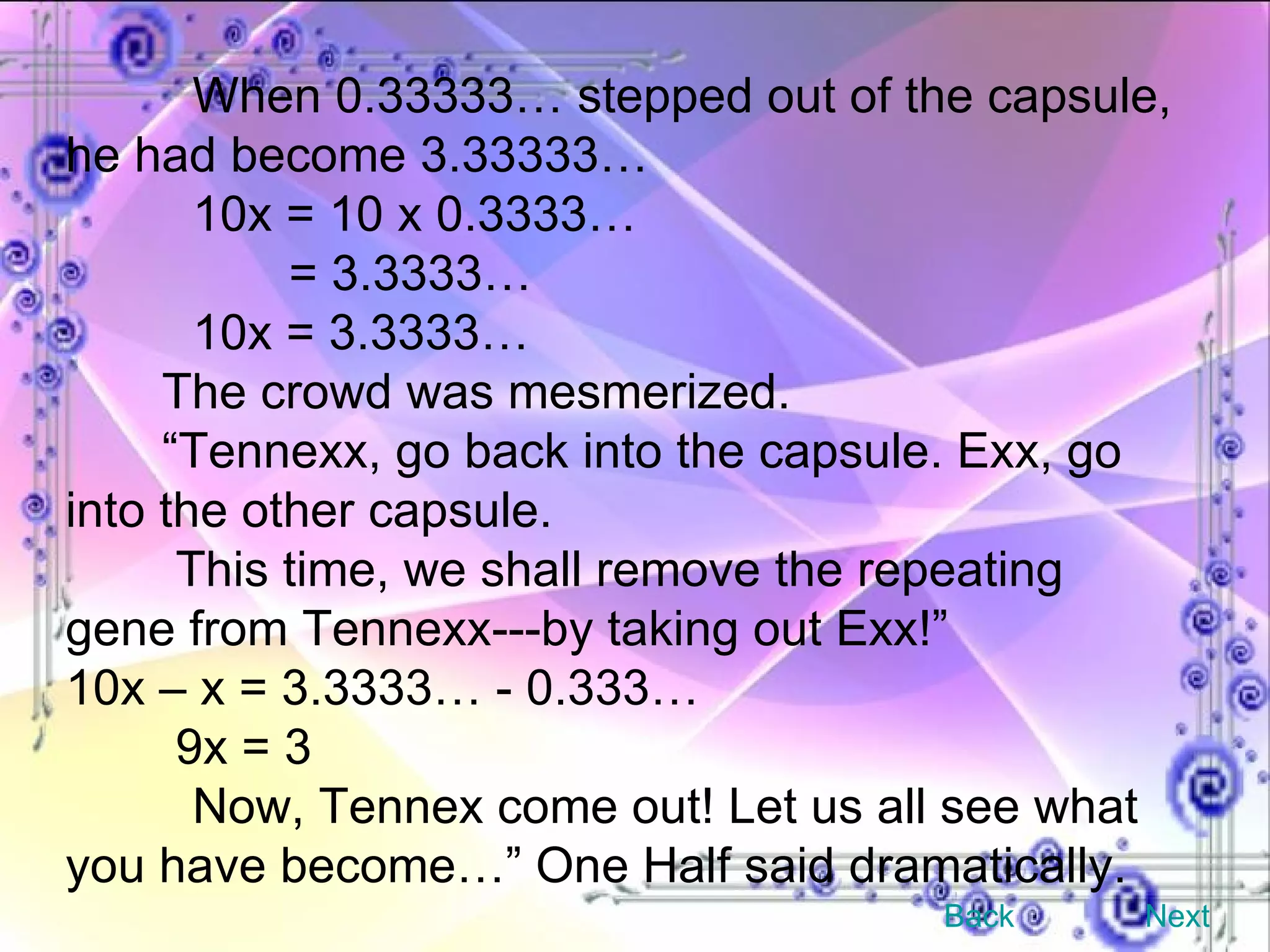
When 0.33333… stepped out of the capsule, he had become 3.33333… 10x = 10 x 0.3333…   = 3.3333… 10x = 3.3333… The crowd was mesmerized. “ Tennexx, go back into the capsule. Exx, go into the other capsule. This time, we shall remove the repeating gene from Tennexx---by taking out Exx!” 10x – x = 3.3333… - 0.333… 9x = 3 Now, Tennex come out! Let us all see what you have become…” One Half said dramatically. Back Next
The purpose of assigning a variable and multiplying both sides of the equation by 10 is to come up with whole numbers on both sides of the equation (on one side, with the variable, and on the other side of the equation, with just an integer). From this form we obtain a fraction equal to the original decimal. Note when finally making a subtraction, the digits in the decimal parts MUST be the same in order for the difference to be an integer. FACT BYTES Back Next
When Tennex came out, he had become 1/3. 9x = 3 x = 3/9 or 1/3 The applause was thunderous! 1/3 spoke on the microphone, tears of joy poring down his cheeks. “Once! Was Zero-point-Three- -Three-Three-Three-Three… now I am One-Third. Thank you, Doctor One Half!” he said. Back Next
LESSON LEARNED In the article, we see that there is still hope for repeating Decimal genes like Point O Nine O Nine O Nine and O Point Three-Three-Three. It is all about representing them using any variable, say, x, and taking away their never-ending tail.  Any repeating decimal represents a geometric series 0.3333…  is 0.3 + 0.03+ 0.03 +… The common ratio is 0.1, that is, the next term is obtained by multiplying the previous term by 0.1. The formula S= a1/1-r may be used if (r) < 1. S = a1/1-r S = 0.3/1-0.1   = 0.3/0.9 or 1/3  FACT BYTES Back Next 1 __ 3
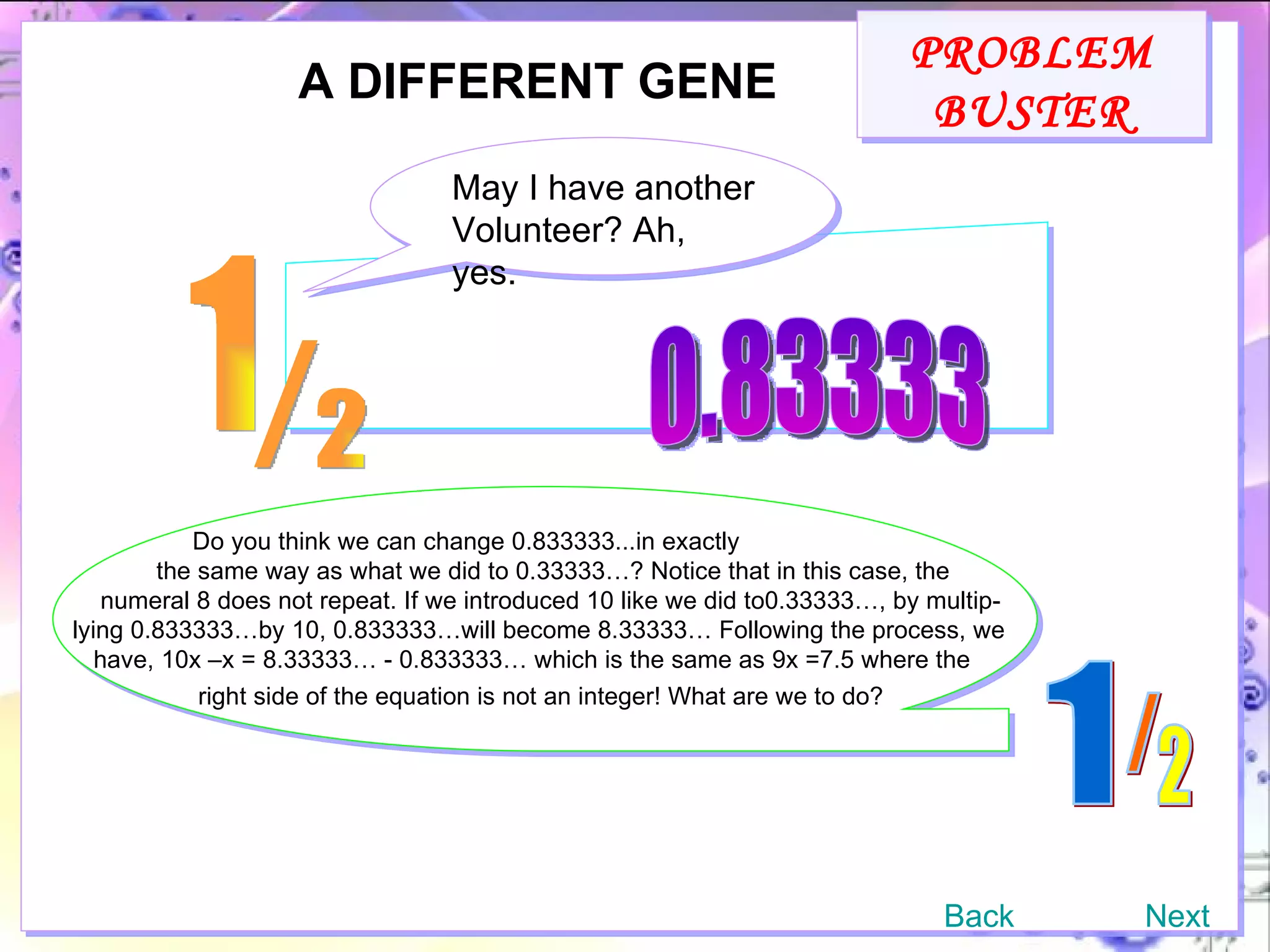
PROBLEM BUSTER A DIFFERENT GENE May I have another Volunteer? Ah, yes. 0.83333 Do you think we can change 0.833333...in exactly the same way as what we did to 0.33333…? Notice that in this case, the numeral 8 does not repeat. If we introduced 10 like we did to0.33333…, by multip- lying 0.833333…by 10, 0.833333…will become 8.33333… Following the process, we have, 10x –x = 8.33333… - 0.833333… which is the same as 9x =7.5 where the right side of the equation is not an integer! What are we to do?   Back Next 1 / 2 1 / 2
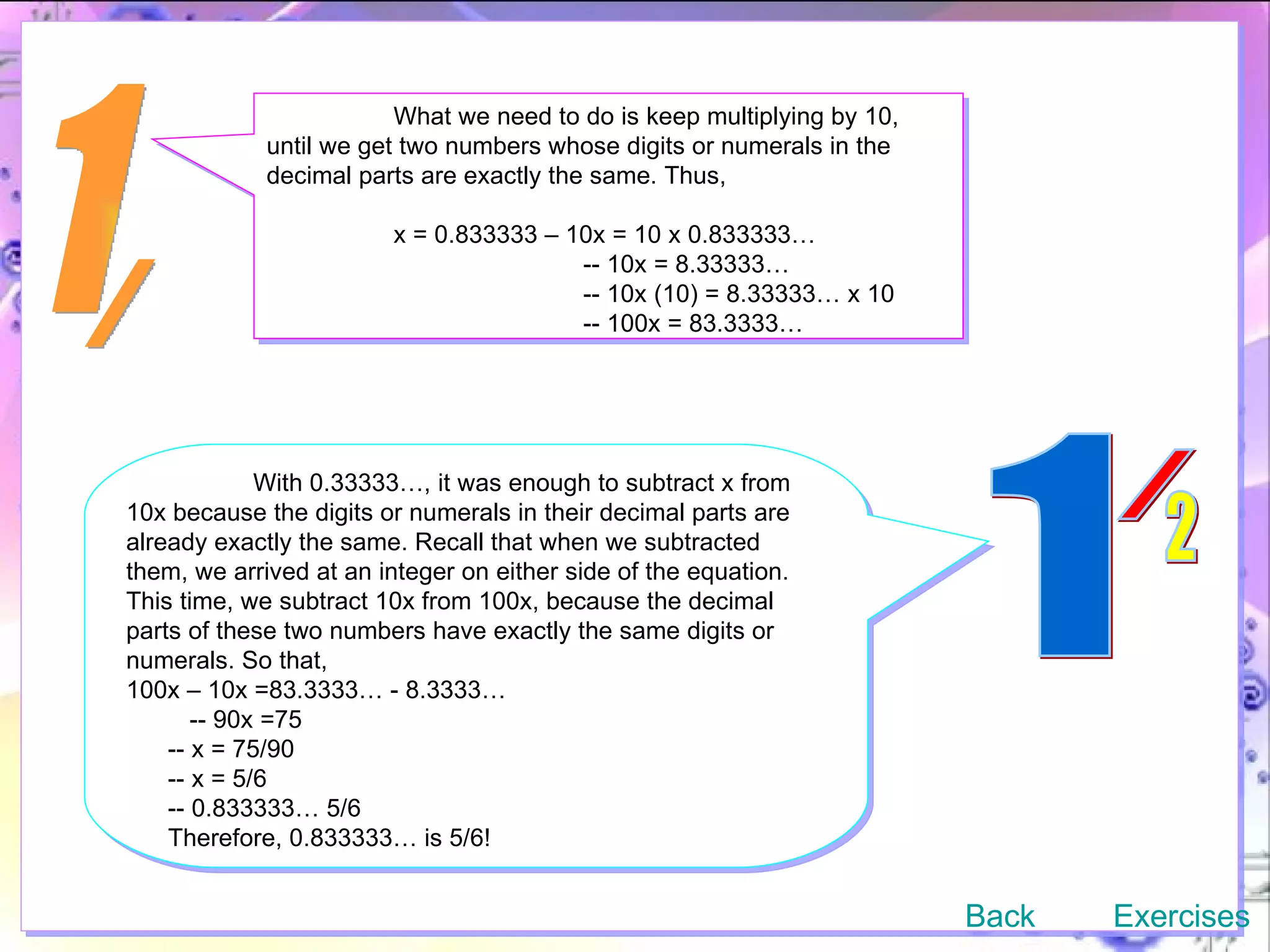
1 / What we need to do is keep multiplying by 10, until we get two numbers whose digits or numerals in the decimal parts are exactly the same. Thus,  x = 0.833333 – 10x = 10 x 0.833333…   -- 10x = 8.33333…   -- 10x (10) = 8.33333… x 10   -- 100x = 83.3333… With 0.33333…, it was enough to subtract x from 10x because the digits or numerals in their decimal parts are already exactly the same. Recall that when we subtracted them, we arrived at an integer on either side of the equation. This time, we subtract 10x from 100x, because the decimal parts of these two numbers have exactly the same digits or numerals. So that, 100x – 10x =83.3333… - 8.3333… -- 90x =75 -- x = 75/90 -- x = 5/6 -- 0.833333… 5/6 Therefore, 0.833333… is 5/6! Back Exercises 1 / 2
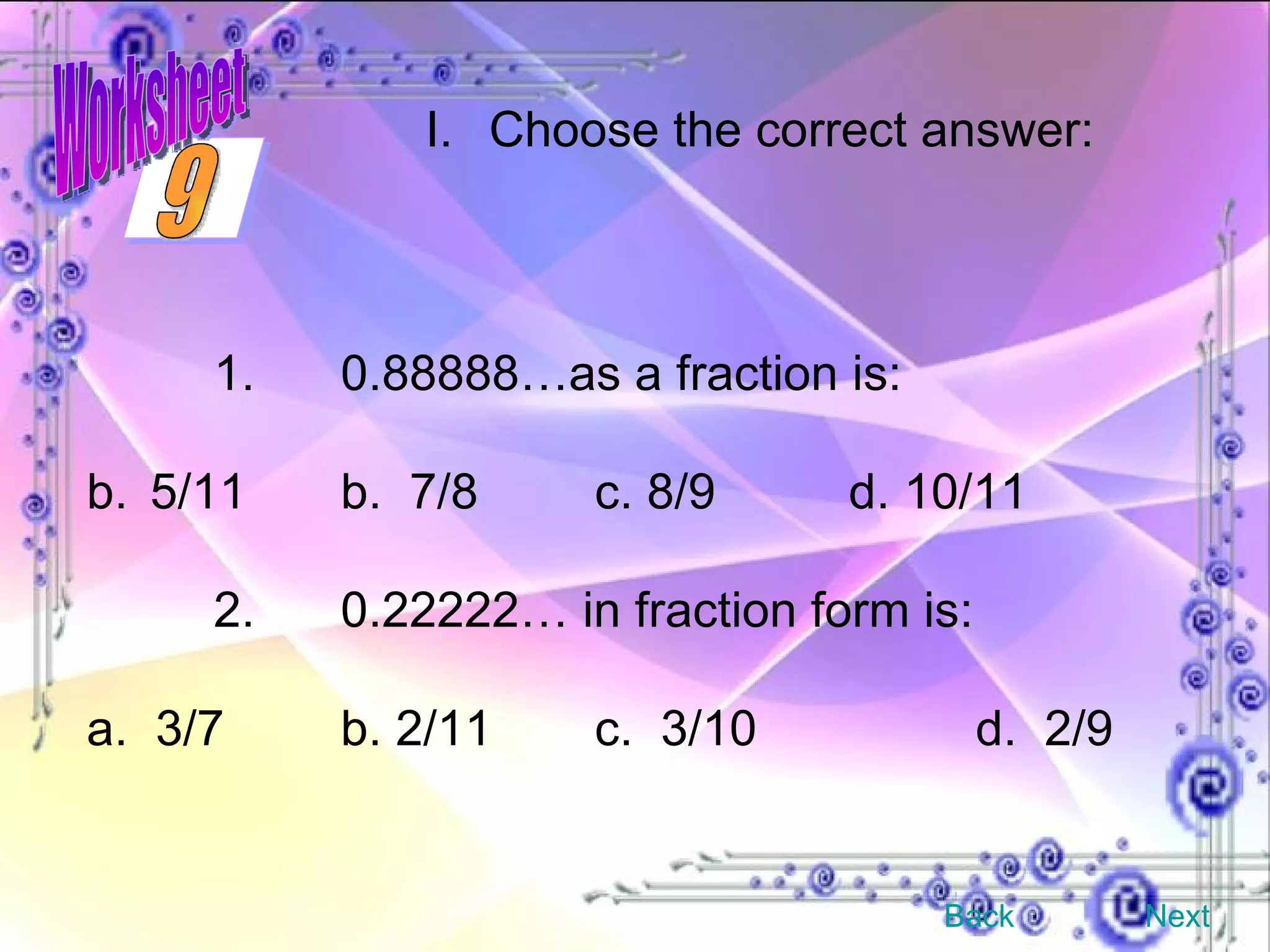
1. 0.88888…as a fraction is: 5/11 b.  7/8 c. 8/9 d. 10/11 2. 0.22222… in fraction form is: a.  3/7 b. 2/11 c.  3/10 d.  2/9 Choose the correct answer: Back Next 9 Worksheet
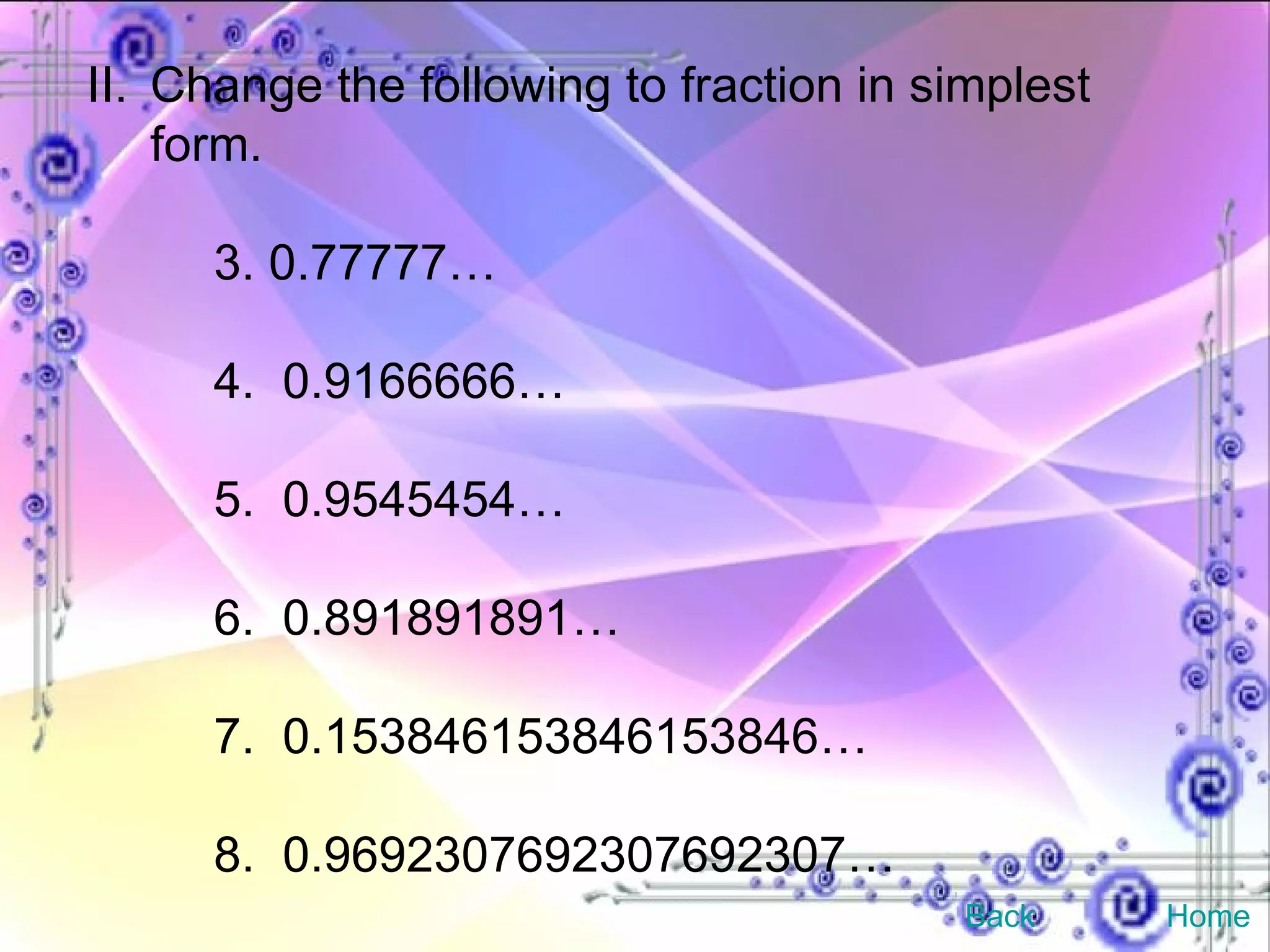
II. Change the following to fraction in simplest form. 3. 0.77777… 4.  0.9166666… 5.  0.9545454… 6.  0.891891891… 7.  0.153846153846153846… 8.  0.9692307692307692307…  Back Home
Unit II EQUIVALENT FRACTIONS AND DECIMALS Content Next
This modular workbook provides knowledge about different form or ways of computing fractions to decimals and decimals to fraction. This will help you to understand better what equivalent fraction and decimal is and you can use it in your everyday life. OVERVIEW OF THE MODULAR WORKBOOK Back Next
After completing this Unit, you are expected to: 1. Transform fraction/mixed fractional    numbers to decimals/mixed decimal. 2. Change decimal/mixed decimal to fraction    /mixed numbers (fractions). 3. Follow the rules in expressing equivalent    fractions and decimals. OBJECTIVES OF THE MODULAR WORKBOOK Back Next
Lesson 10 EXPRESSING FRACTIONS TO DECIMALS Lesson Objectives After accomplishing the lesson, you are expected to:  . Change fractions to decimals. . Know the rules in changing fractions to decimals. . Understand the equivalent fractions and decimals. Content Next
Decimals are a type of fractional number. Let us now study how to write fractions to decimal form. Back Next
We will apply the principle of equality of fractions that is, if  a/b =c/d  then  ad = bc . Back Next
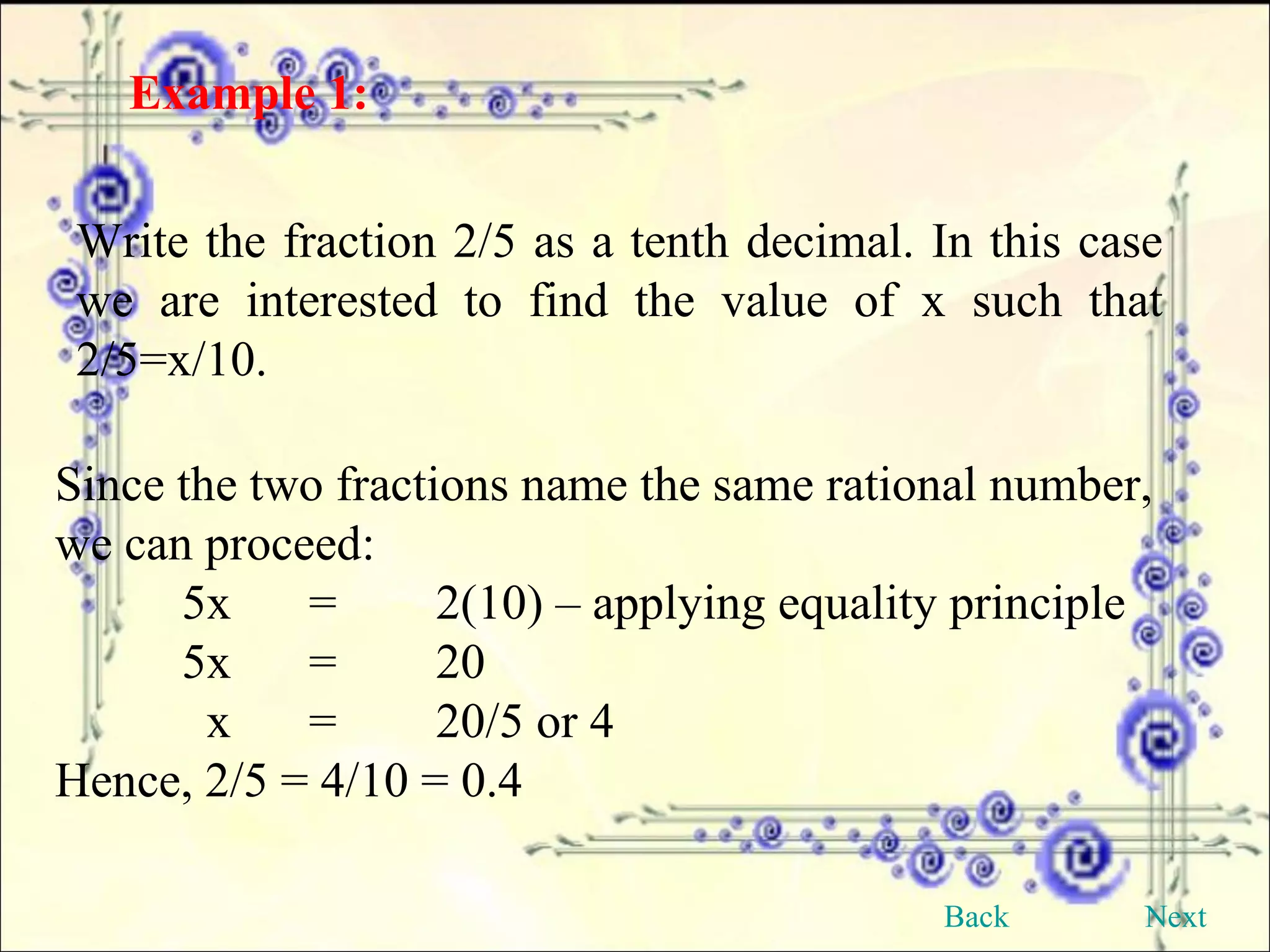
Example 1:   Write the fraction 2/5 as a tenth decimal. In this case we are interested to find the value of x such that 2/5=x/10. Since the two fractions name the same rational number, we can proceed: 5x = 2(10) – applying equality principle 5x = 20   x =  20/5 or 4 Hence, 2/5 = 4/10 = 0.4 Back Next
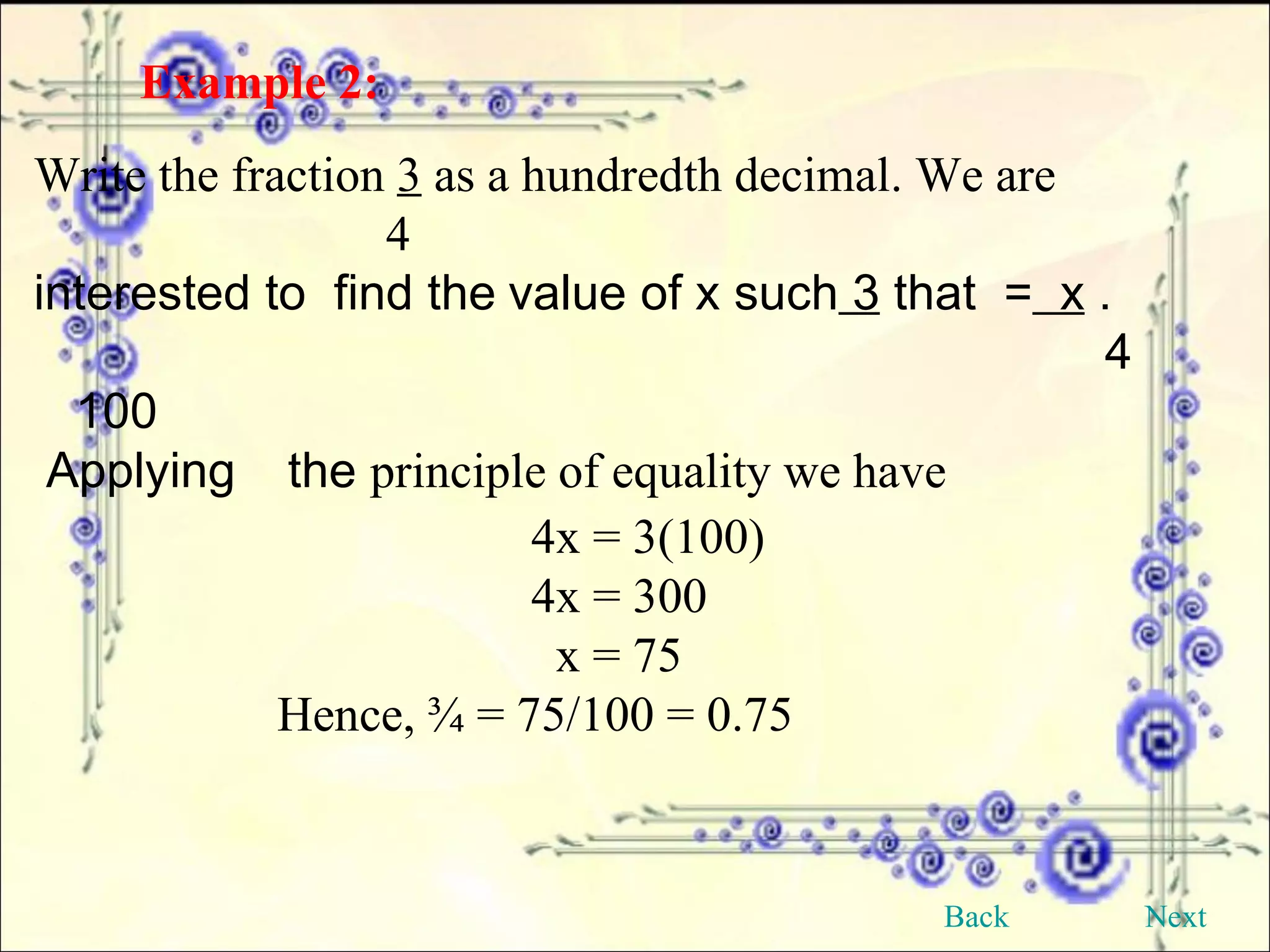
Example 2:   Write the fraction  3  as a hundredth decimal. We are      4 interested to  find the   value of x such  3  that  =   x  .      4  100 Applying  the  principle of equality we have 4x = 3(100) 4x = 300   x = 75 Hence, ¾ = 75/100 = 0.75 Back Next
On the other hand, fractions can also be expressed as a decimal without using the equality principle. Instead we have to think of a fraction as a quotient of two integers that is a/b=a = a  b. Example 3:   Express 2/5 as a decimal. Expressing 2/5 as quotient of 2 and 5 we have 2/5 = 0.4 Back Next
RULE To change a fraction to decimal, divide the numerator by the denominator up to the desired number of decimal places. Back Exercises
I. Give the meaning and explain the use of the following  1. How to change fractions to decimal? 2. What are the rules in changing fractions to decimals? 3. What is decimal? 4. Give some examples of fractions to decimals. Back Next 10 Worksheet
Change fractions to decimal __________________________________________ 2. Rules in changing fractions to decimals __________________________________________ 3. Decimal __________________________________________ 4. Examples of fractions to decimals __________________________________________ Back Next
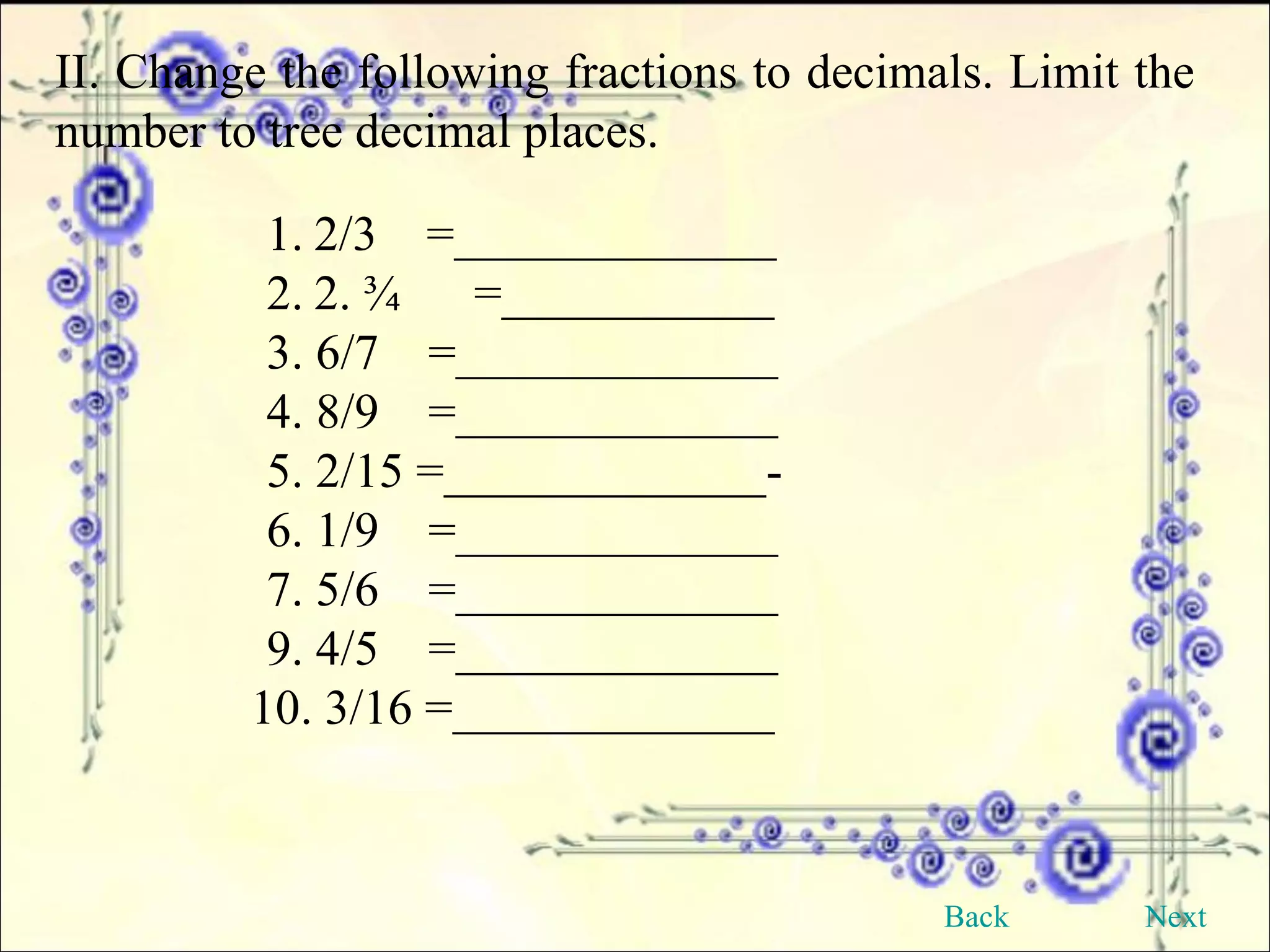
II. Change the following fractions to decimals. Limit the number to tree decimal places. 2/3  =_____________ 2. ¾  =___________ 3. 6/7  =_____________ 4. 8/9  =_____________ 5. 2/15 =_____________- 6. 1/9  =_____________ 7. 5/6  =_____________ 9. 4/5  =_____________ 10. 3/16 =_____________ Back Next
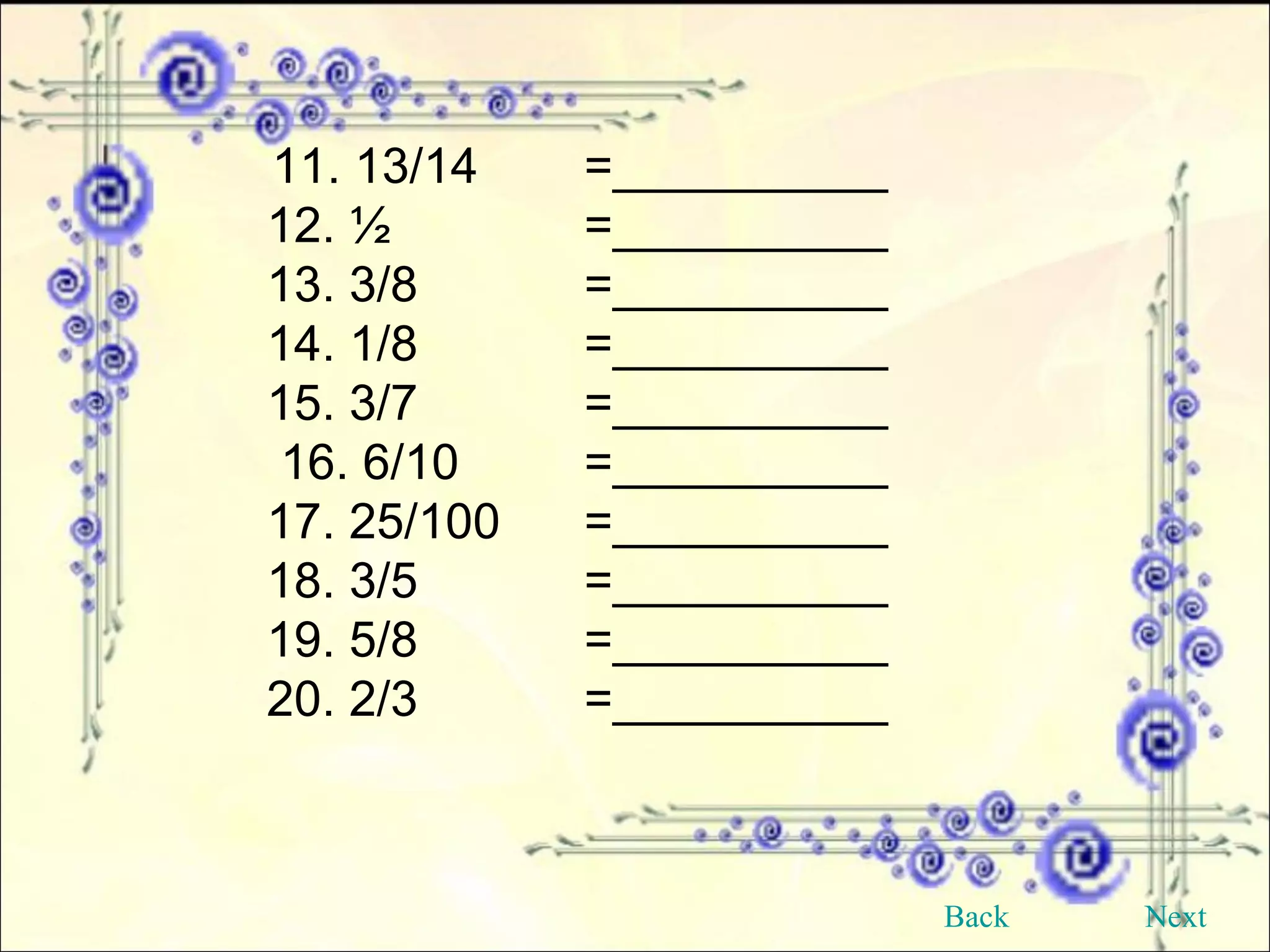
11. 13/14 =__________ 12. ½   =__________  13. 3/8   =__________  14. 1/8 =__________  15. 3/7   =__________ 16. 6/10  =__________  17. 25/100  =__________ 18. 3/5  =__________ 19. 5/8  =__________  20. 2/3  =__________  Back Next
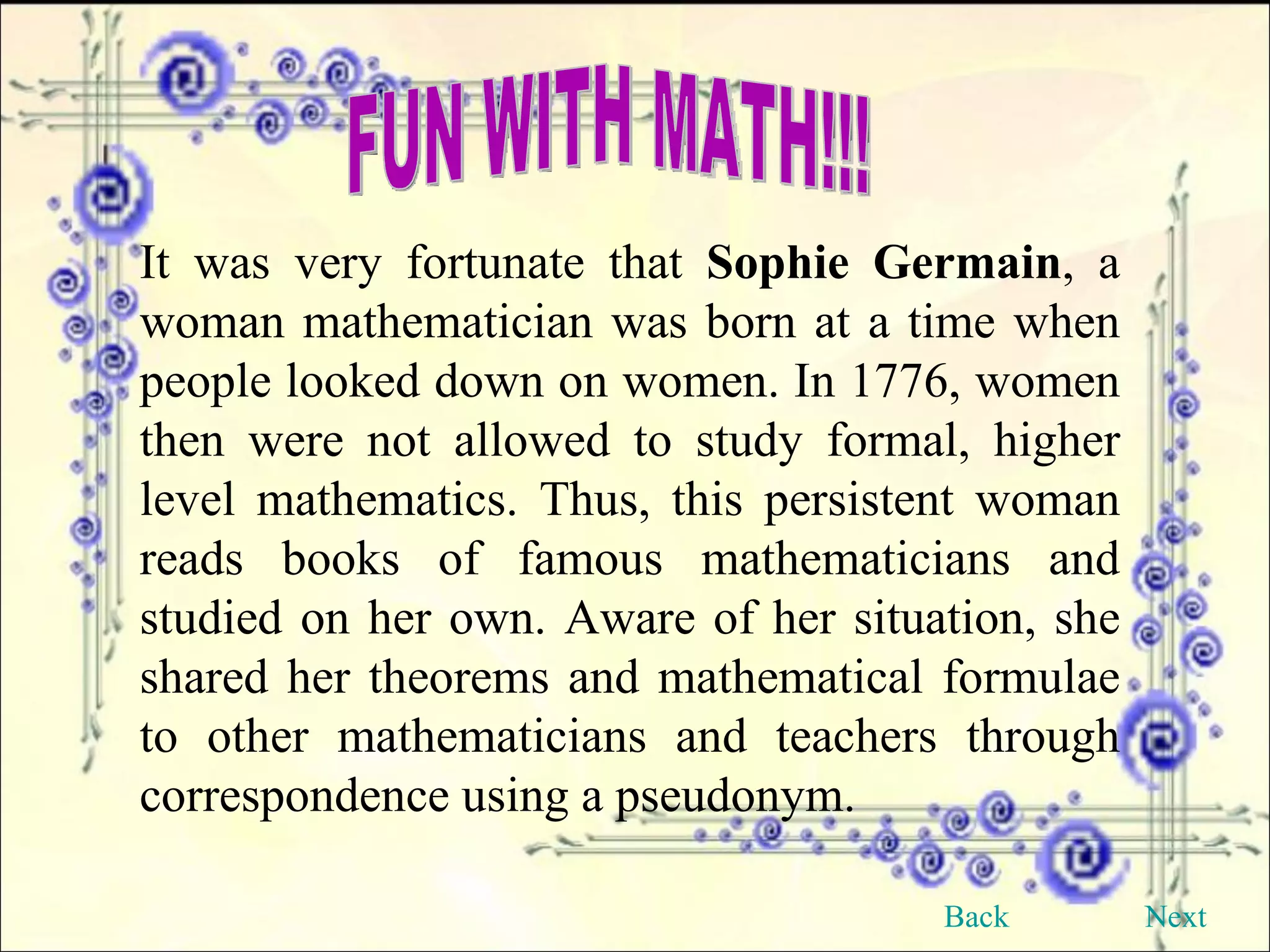
FUN WITH MATH!!! It was very fortunate that  Sophie Germain , a woman mathematician was born at a time when people looked down on women. In 1776, women then were not allowed to study formal, higher level mathematics. Thus, this persistent woman reads books of famous mathematicians and studied on her own. Aware of her situation, she shared her theorems and mathematical formulae to other mathematicians and teachers through correspondence using a pseudonym. Back Next
Can you guess the pseudonym that she used? Yes, you can. Simply follow the instruction. Back Next
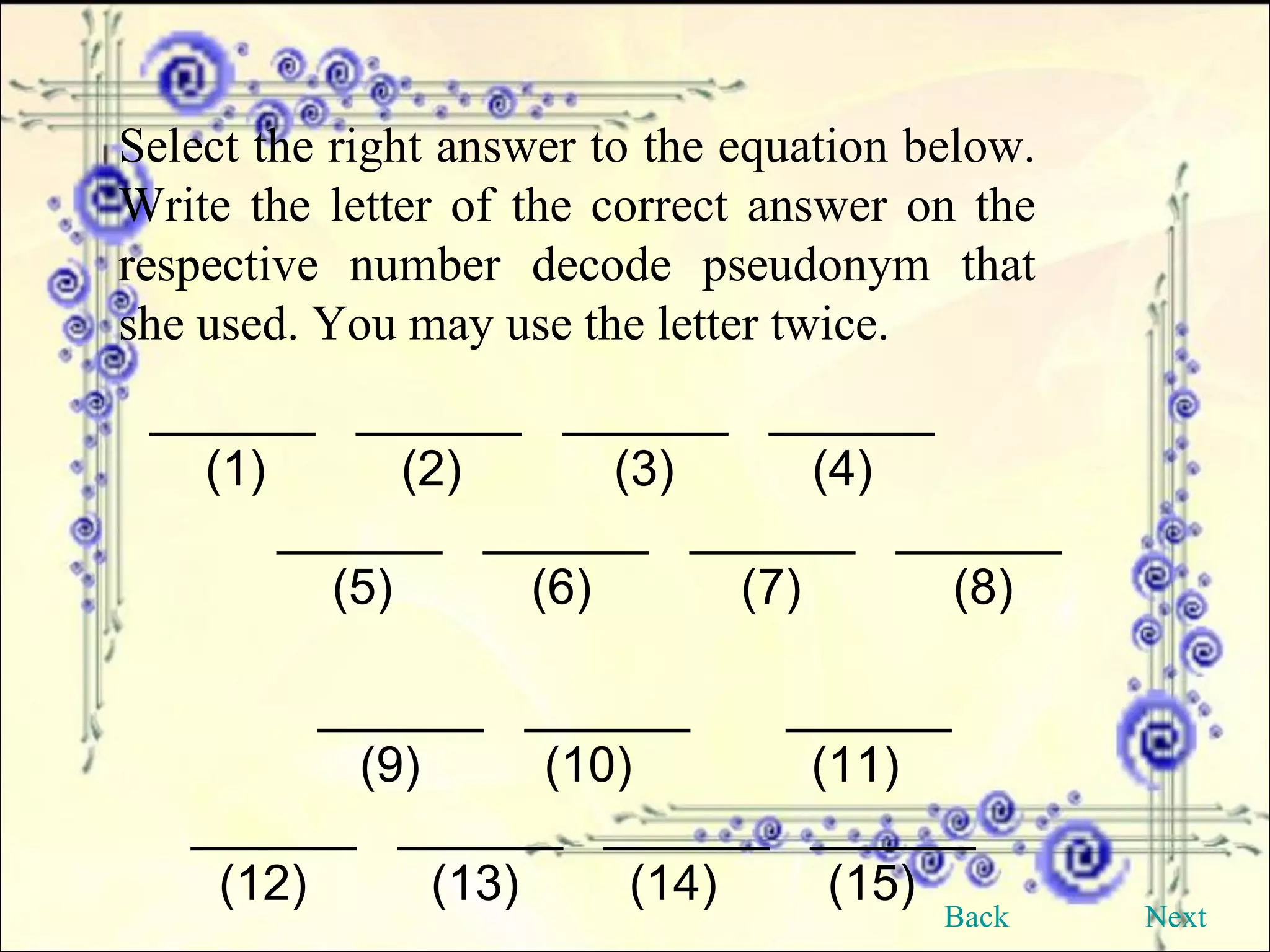
Select the right answer to the equation below. Write the letter of the correct answer on the respective number decode pseudonym that she used. You may use the letter twice. ______  ______  ______  ______  (1)   (2)   (3)  (4)   ______  ______  ______  ______    (5)  (6)   (7)  (8)   ______  ______  ______   (9)  (10)  (11) ______  ______  ______  ______ (12)  (13)  (14)  (15) Back Next
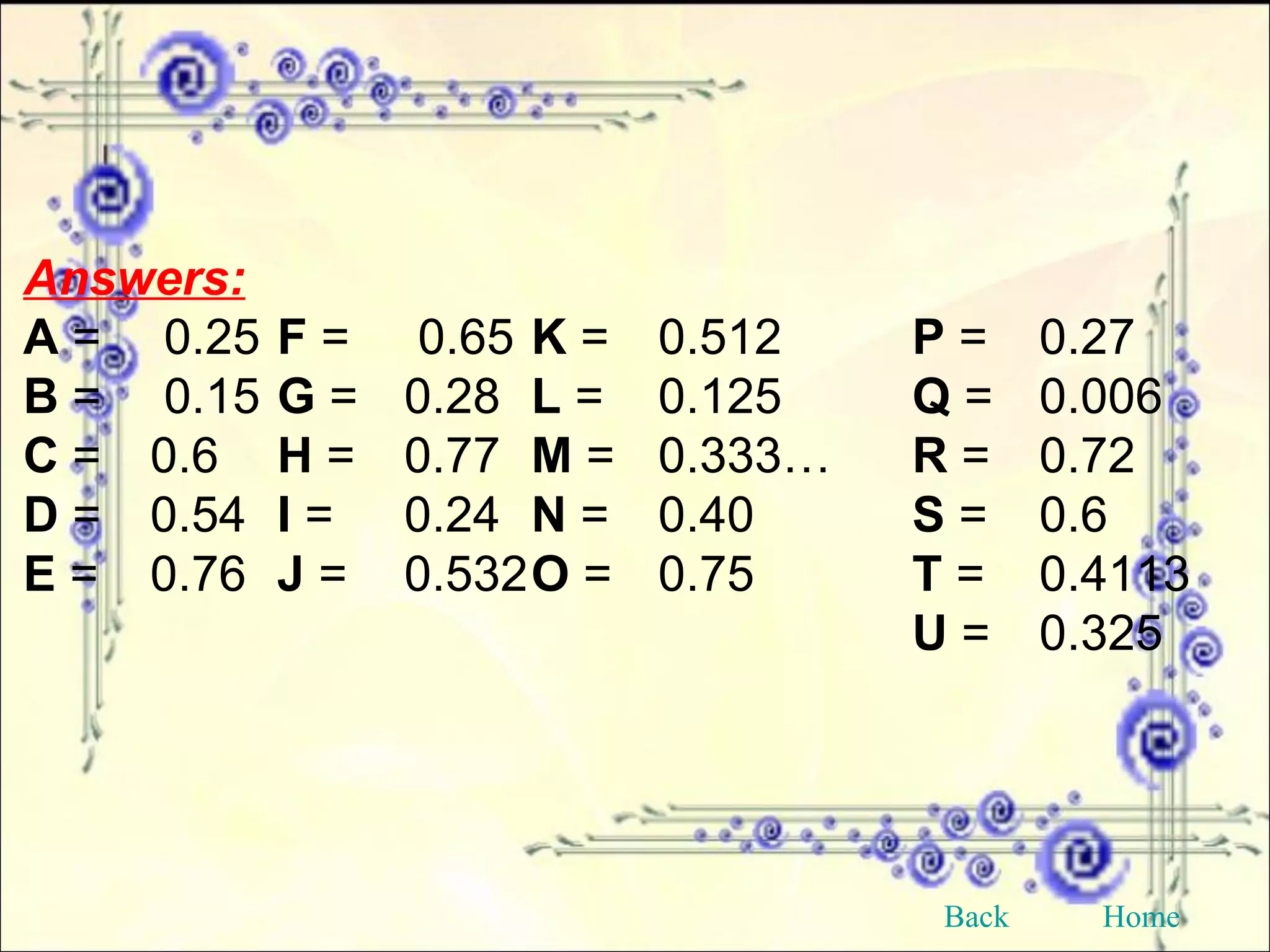
Answers: A  =  0.25 F  =  0.65 K  = 0.512 P  =  0.27 B  =  0.15 G  =  0.28 L  =  0.125 Q  = 0.006 C  =  0.6 H  =  0.77 M  =  0.333… R  =  0.72 D  =  0.54 I  =  0.24 N  =  0.40 S  =  0.6 E  =  0.76 J  =  0.532 O  =  0.75 T  =  0.4113 U  =  0.325 Back Home
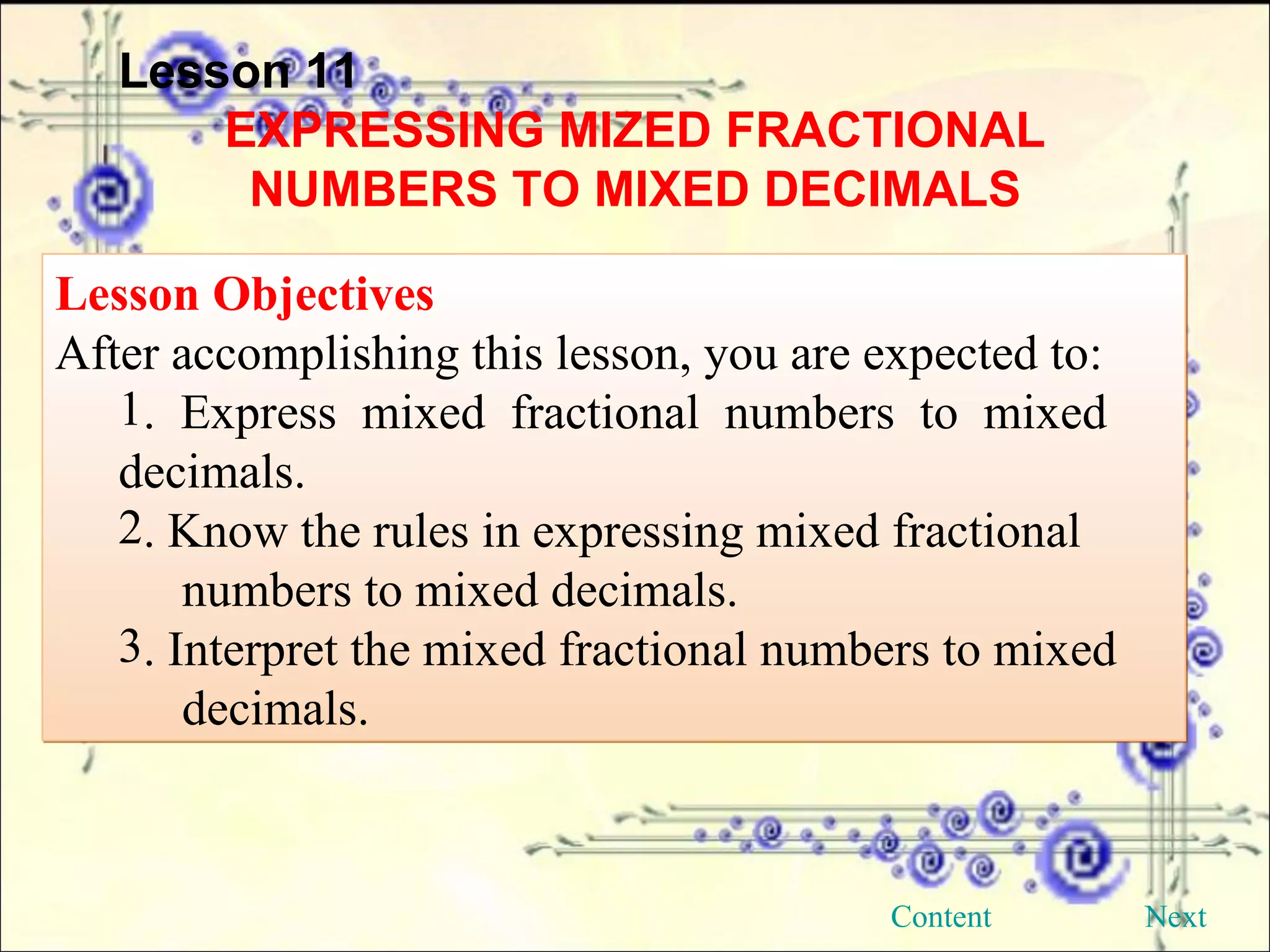
Lesson 11 EXPRESSING MIZED FRACTIONAL NUMBERS TO MIXED DECIMALS Lesson Objectives After accomplishing this lesson, you are expected to: . Express mixed fractional numbers to mixed  decimals. . Know the rules in expressing mixed fractional  numbers to mixed decimals. . Interpret the mixed fractional numbers to mixed  decimals. Next Content
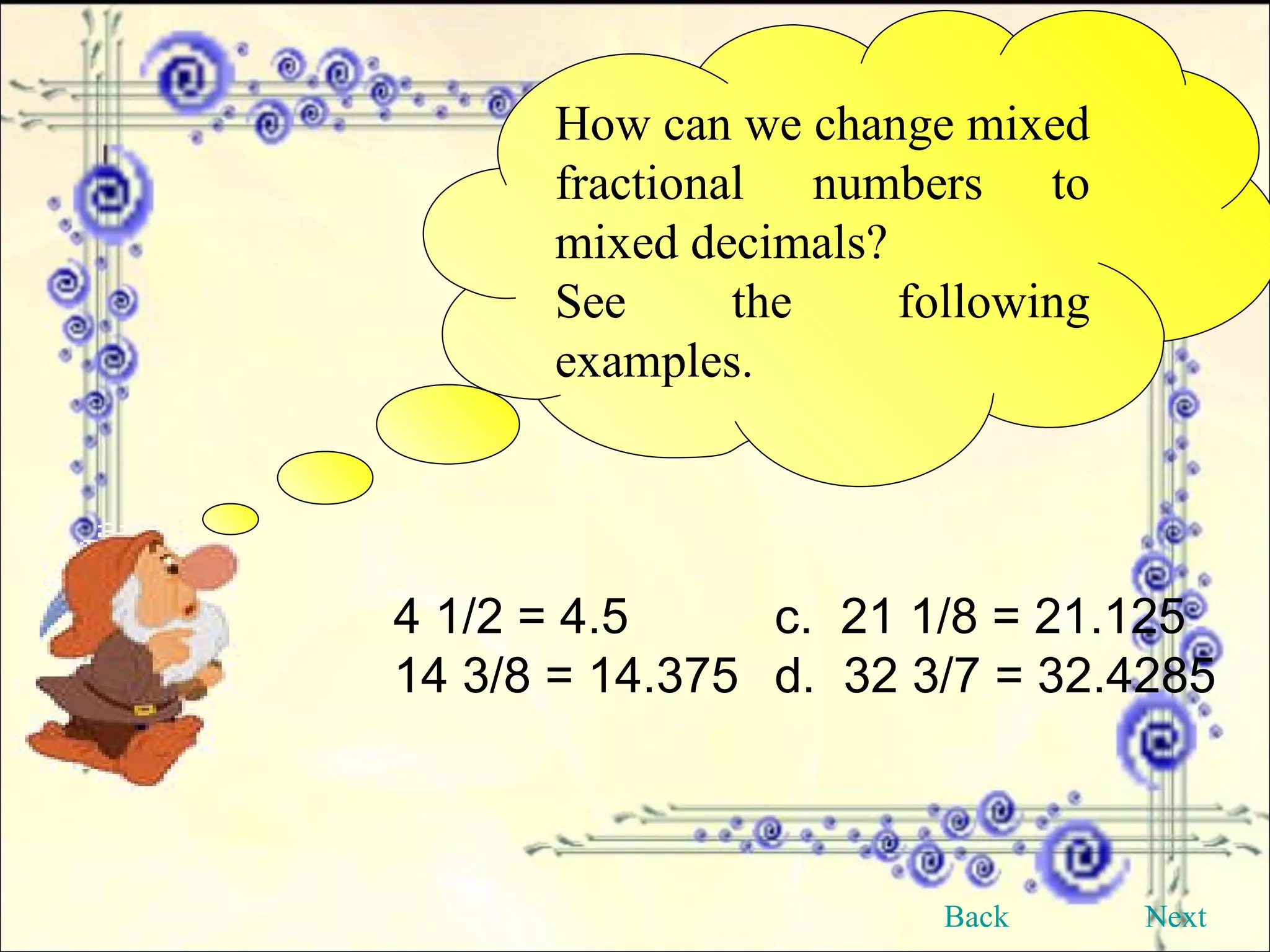
How can we change mixed fractional numbers to mixed decimals? See the following examples. 4 1/2 = 4.5 c.  21 1/8 = 21.125 14 3/8 = 14.375 d.  32 3/7 = 32.4285 Back Next
From the examples given above, it can be seen that the rule in changing a mixed fractional number to mixed decimal is: Back Next
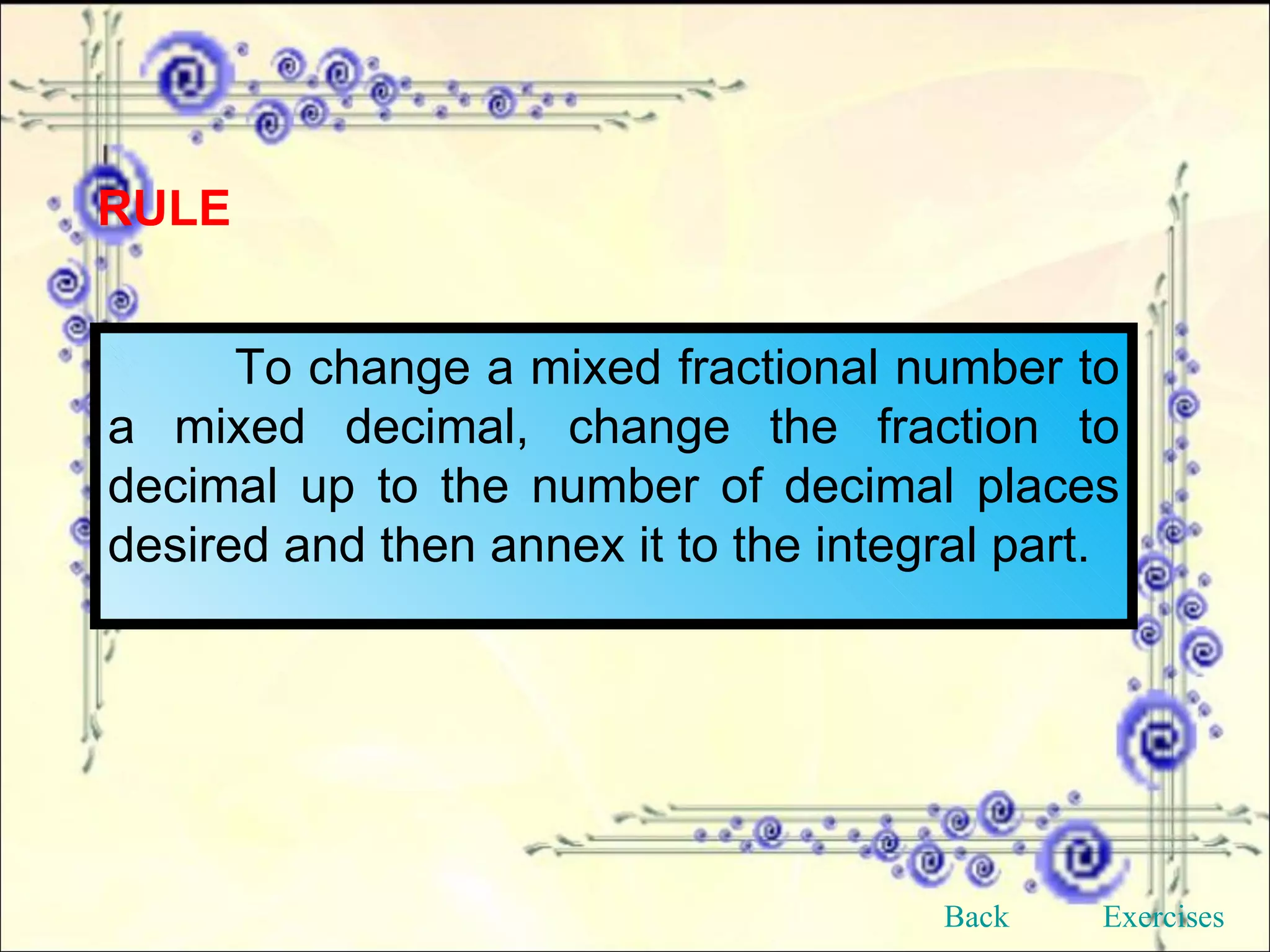
RULE To change a mixed fractional number to a mixed decimal, change the fraction to decimal up to the number of decimal places desired and then annex it to the integral part. Back Exercises
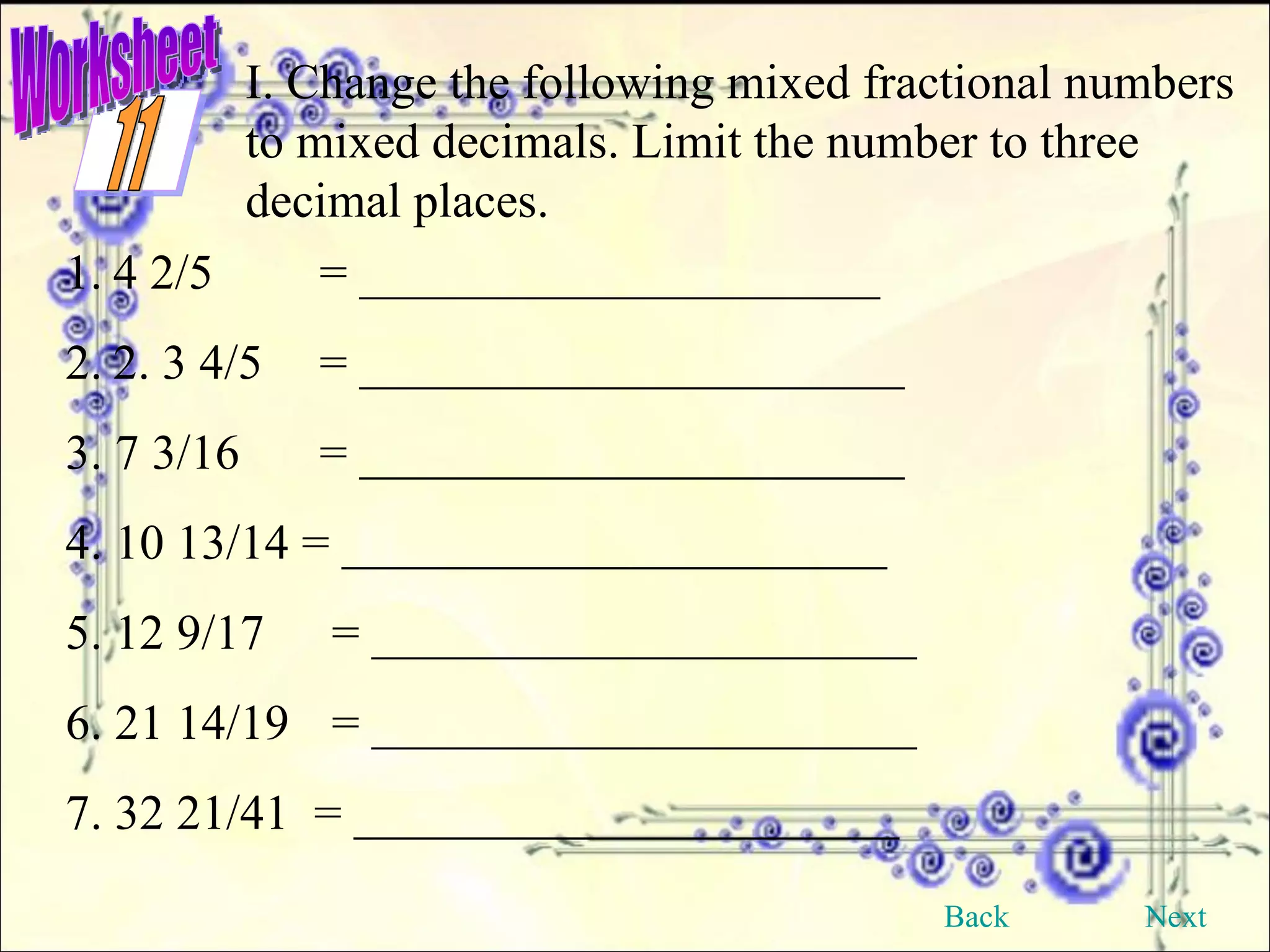
Worksheet I. Change the following mixed fractional numbers to mixed decimals. Limit the number to three decimal places. 4 2/5 = _____________________ 2. 3 4/5 = ______________________ 3. 7 3/16 = ______________________ 4. 10 13/14 = ______________________  5. 12 9/17  = ______________________  6. 21 14/19  = ______________________  7. 32 21/41  = ______________________    Back Next 11
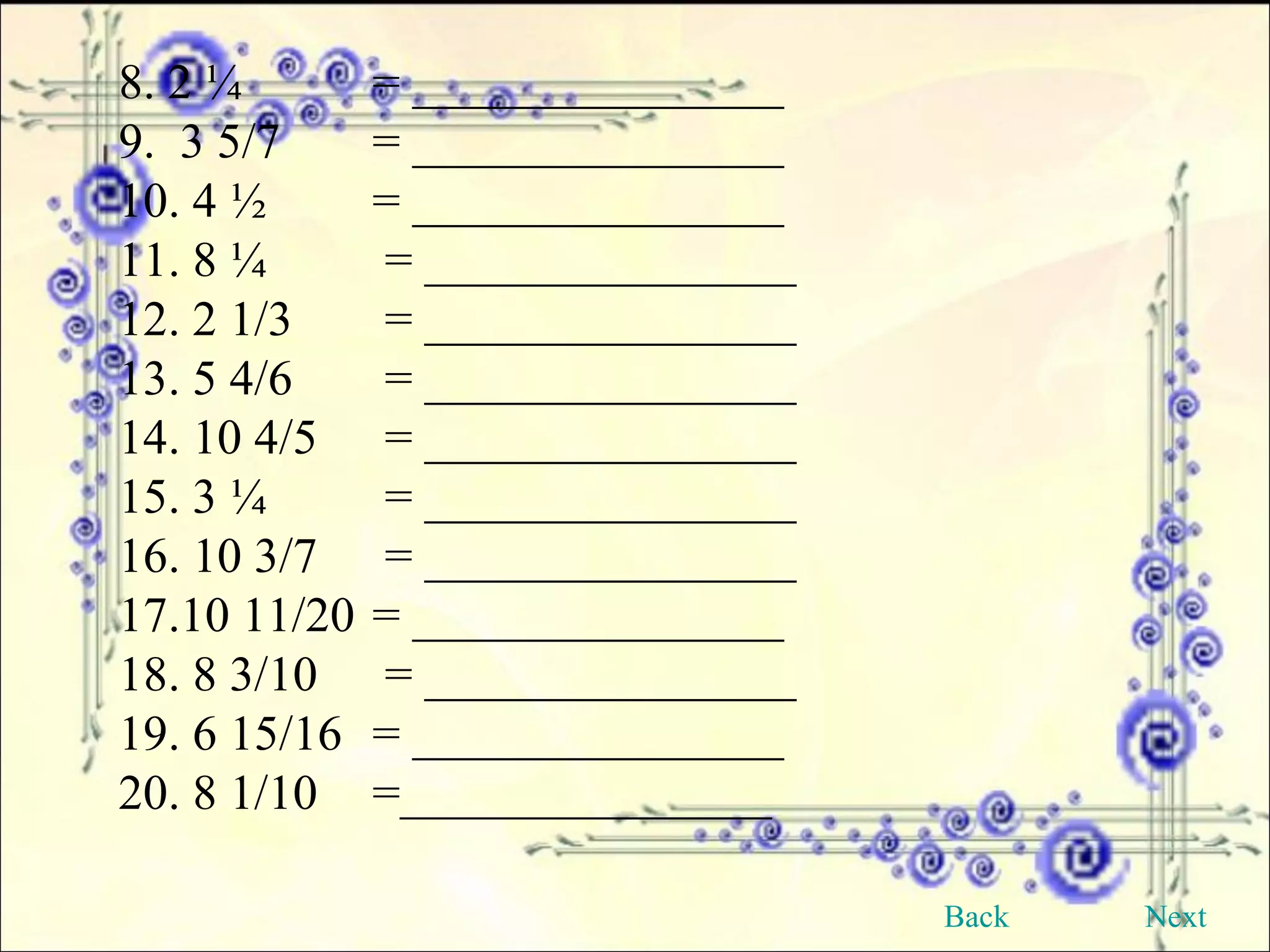
8. 2 ¼ = _______________ 9.  3 5/7 = _______________   10. 4 ½ = _______________ 11. 8 ¼   = _______________  12. 2 1/3  = _______________ 13. 5 4/6  = _______________ 14. 10 4/5  = _______________ 15. 3 ¼  = _______________ 16. 10 3/7  = _______________  17.10 11/20  = _______________ 18. 8 3/10  = _______________ 19. 6 15/16 = _______________ 20. 8 1/10 =_______________ Back Next
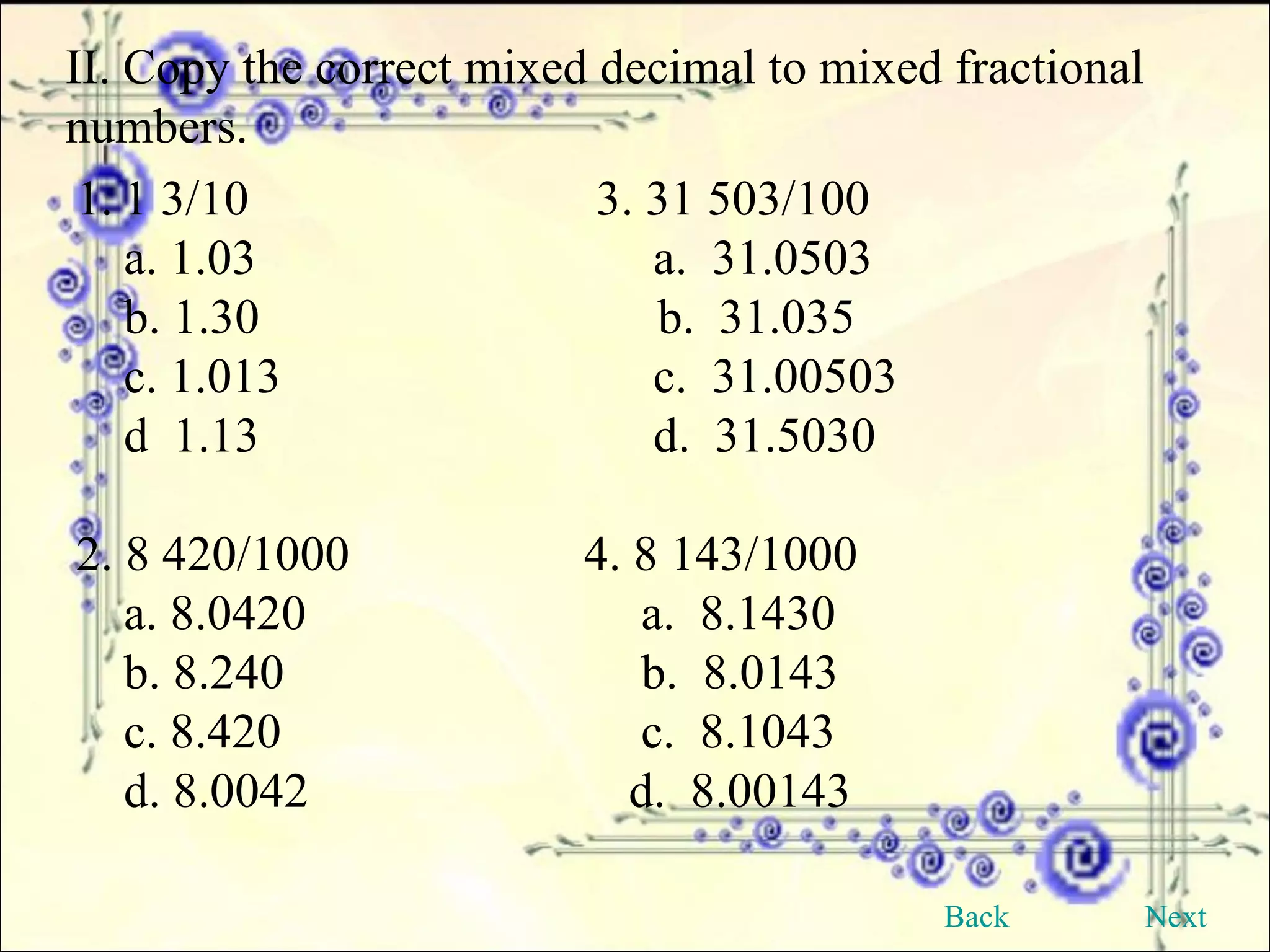
II. Copy the correct mixed decimal to mixed fractional numbers. 1 3/10  3. 31 503/100 a. 1.03     a.  31.0503 b. 1.30   b.  31.035 c. 1.013   c.  31.00503 d  1.13   d.  31.5030 2. 8 420/1000  4. 8 143/1000 a. 8.0420   a.  8.1430 b. 8.240   b.  8.0143 c. 8.420   c.  8.1043 d. 8.0042   d.  8.00143 Back Next
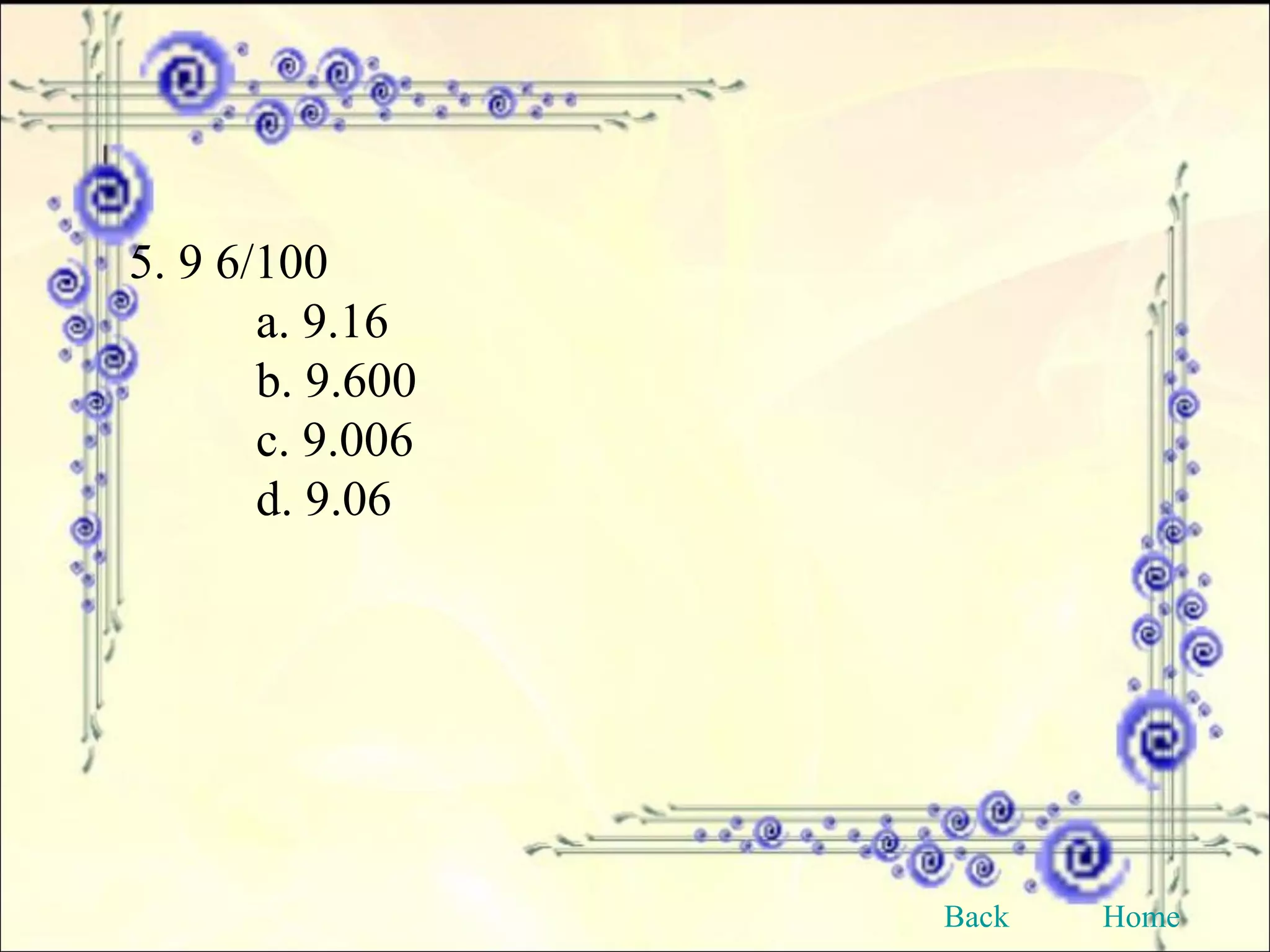
5. 9 6/100 a. 9.16 b. 9.600 c. 9.006 d. 9.06 Back Home
Lesson 12 EXPRESSING DECIMALS TO FRACTIONS Lesson Objectives At the end of the lesson, the students are expected to: . Change the decimals to fractions. . Follow the rule in expressing decimals to  fractions. . Understand the equivalent decimals and  fractions.  Next Content
As what we have learned earlier, decimals are common fractions written in different way. Back Next
There are certain instances when it becomes necessary to change decimal into fraction. Hence, it is necessary to acquire skill in changing a decimal to faction.  Now we will study how to write decimals in fractions. Back Next
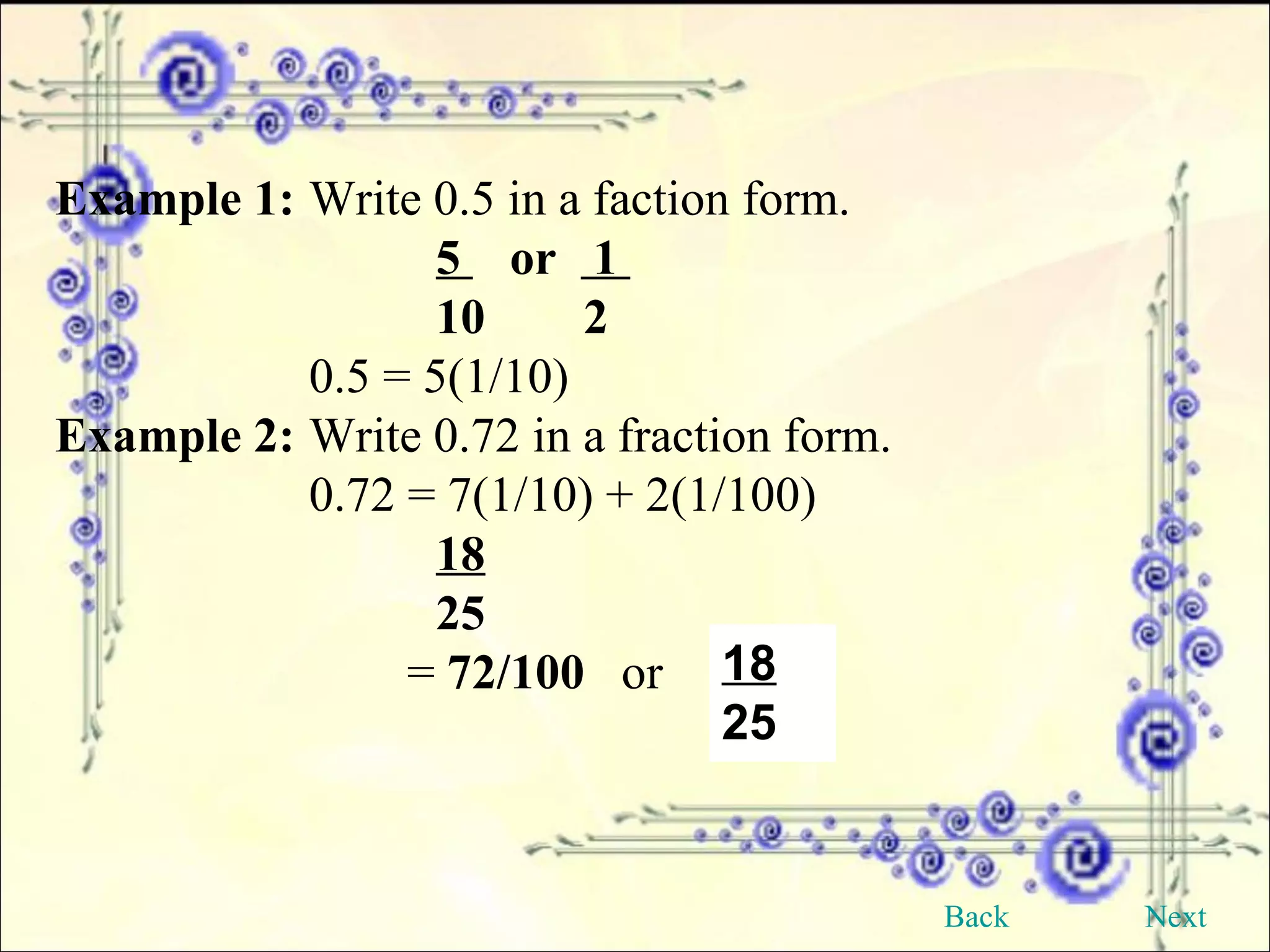
Example 1: Write 0.5 in a faction form. 5  or  1  10  2 0.5 = 5(1/10)  Example 2: Write 0.72 in a fraction form. 0.72 = 7(1/10) + 2(1/100) 18 25   =  72/100   or  18 25 Back Next
On the other hand, a simple way of expressing decimal to factions is possible without writing the numeral in expanded form. What we need is only to determine the place value of the last digit as we read if from left to right. Back Next
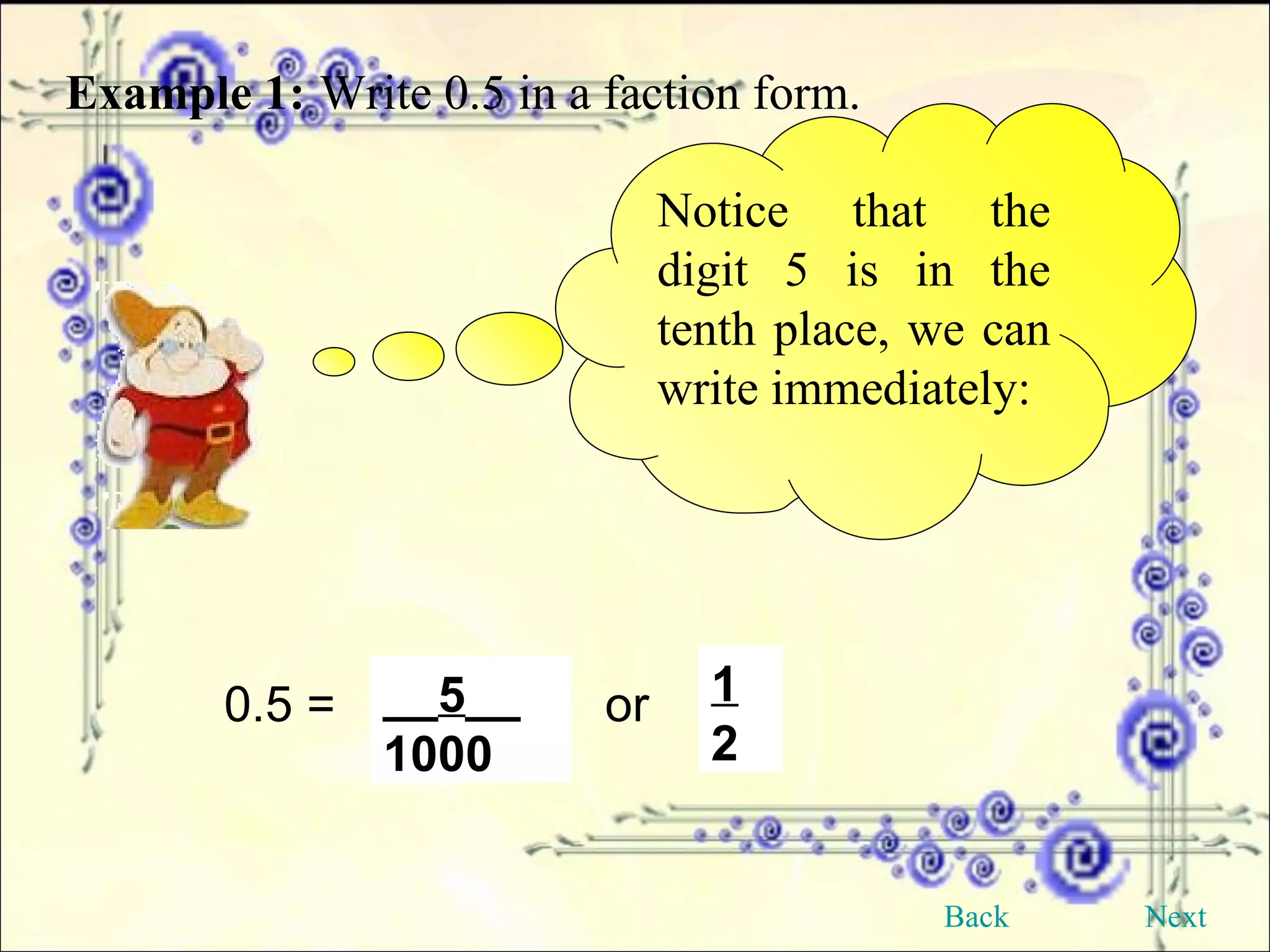
Example 1:   Write 0.5 in a faction form. Notice that the digit 5 is in the tenth place, we can write immediately: 0.5 =  or 1 2 __ 5 __ 1000 Back Next
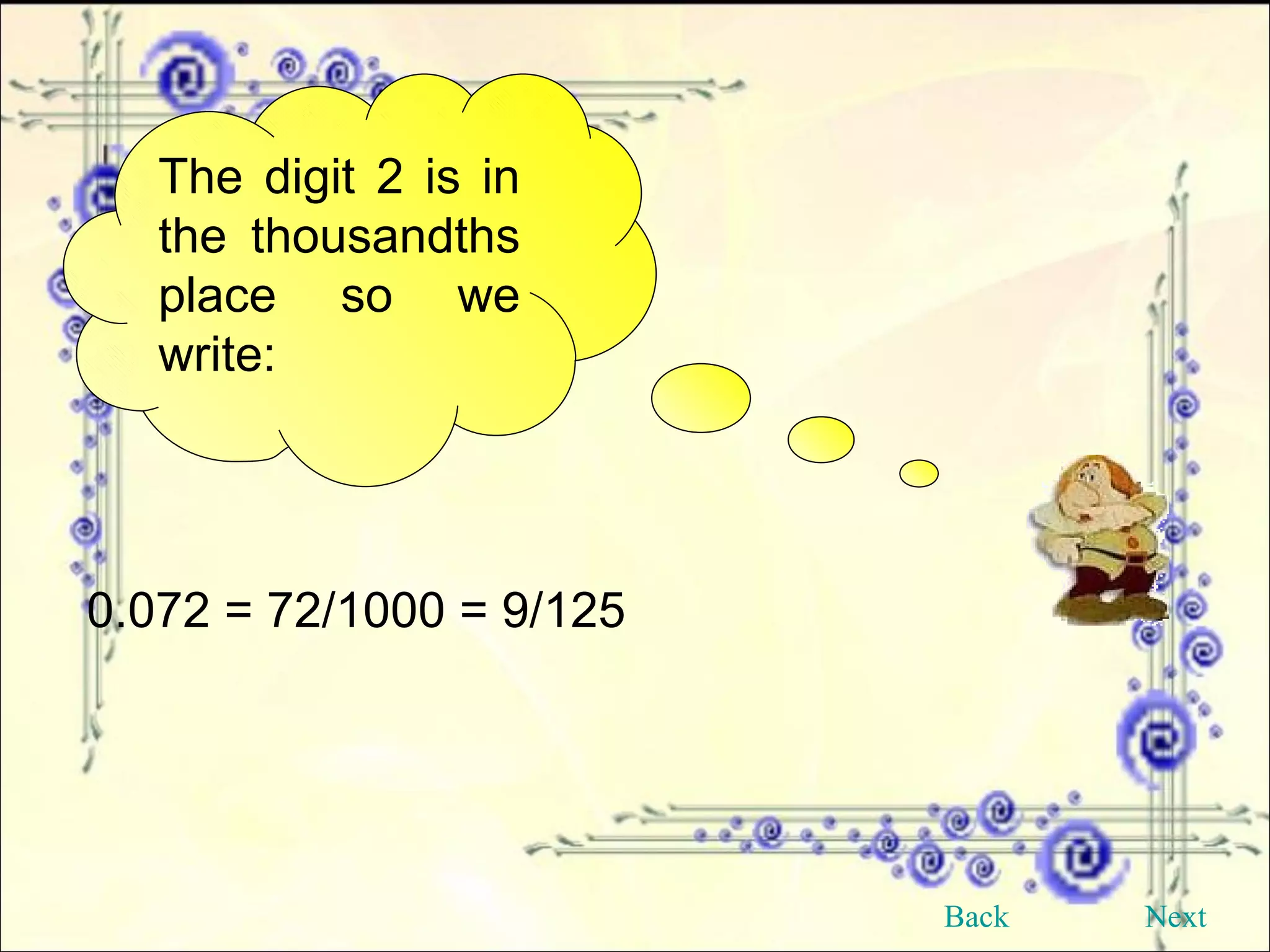
The digit 2 is in the thousandths place so we write: 0.072 = 72/1000 = 9/125  Back Next
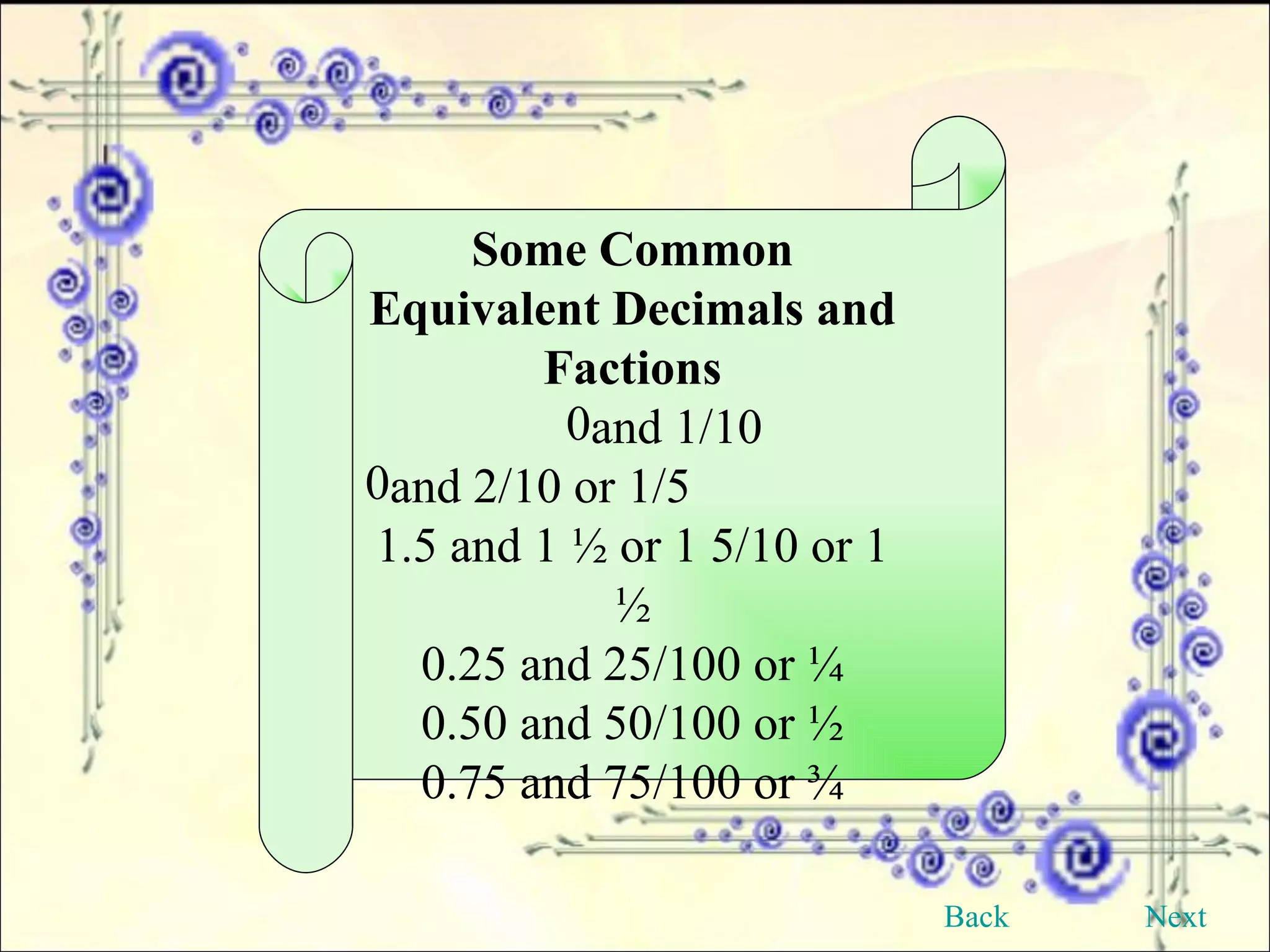
Some Common Equivalent Decimals and Factions and 1/10 and 2/10 or 1/5 1.5 and 1 ½ or 1 5/10 or 1 ½ 0.25 and 25/100 or ¼ 0.50 and 50/100 or ½ 0.75 and 75/100 or ¾ Back Next
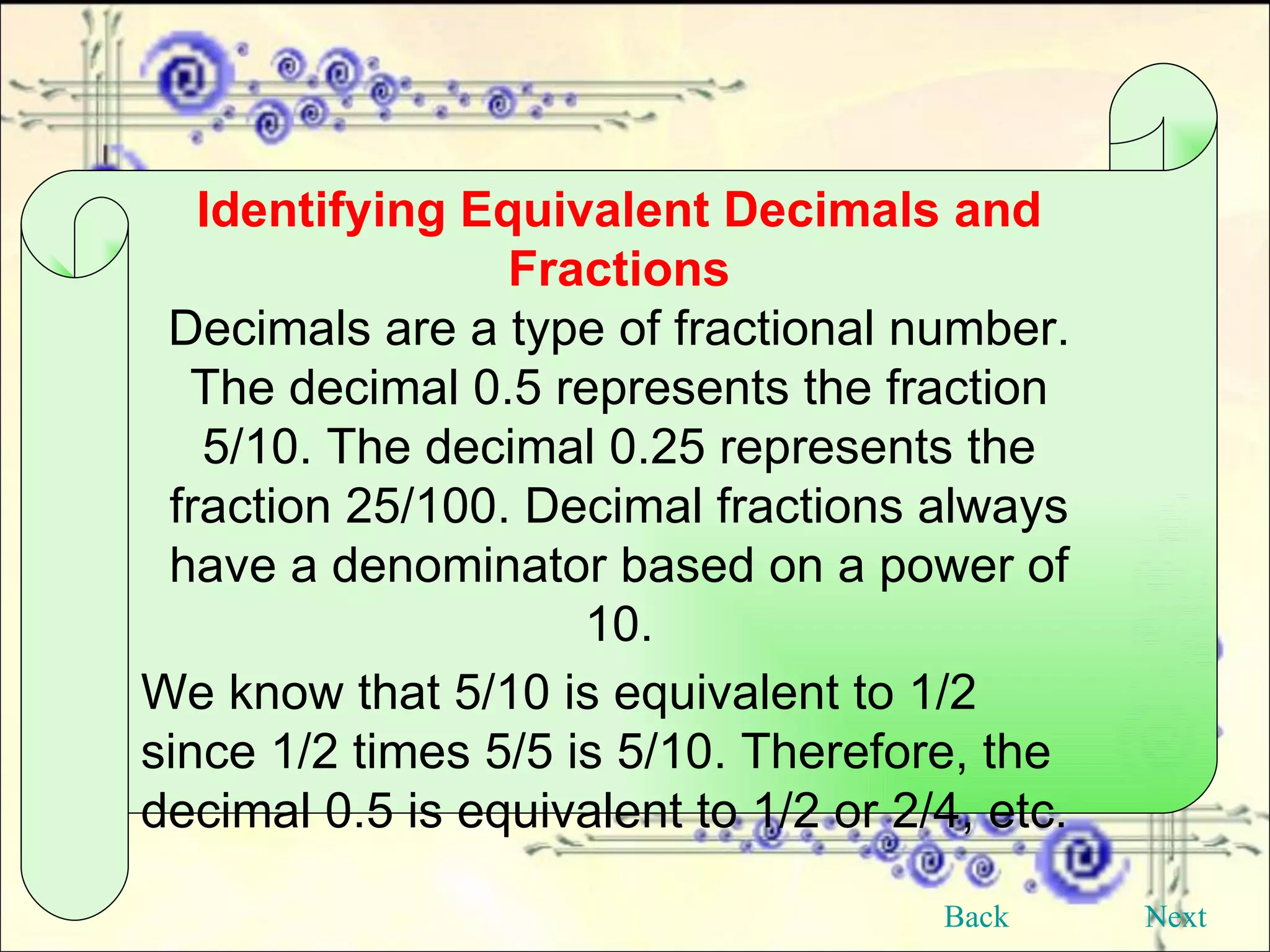
Identifying Equivalent Decimals and Fractions Decimals are a type of fractional number. The decimal 0.5 represents the fraction 5/10. The decimal 0.25 represents the fraction 25/100. Decimal fractions always have a denominator based on a power of 10. We know that 5/10 is equivalent to 1/2 since 1/2 times 5/5 is 5/10. Therefore, the decimal 0.5 is equivalent to 1/2 or 2/4, etc.  Back Next
It can be seen from the examples above the rule in changing a decimal to fraction is as follows: Back Next
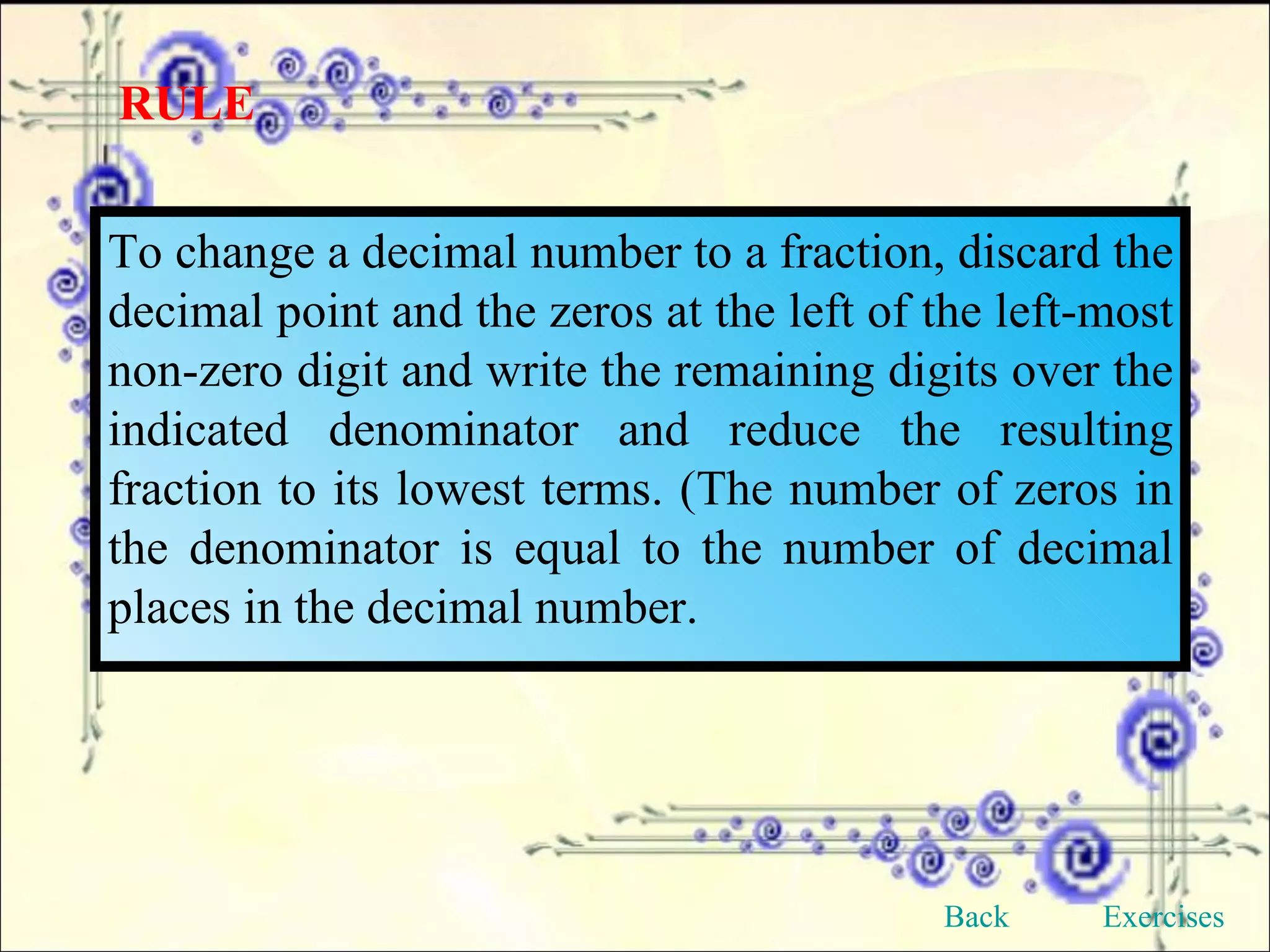
RULE To change a decimal number to a fraction, discard the decimal point and the zeros at the left of the left-most non-zero digit and write the remaining digits over the indicated denominator and reduce the resulting fraction to its lowest terms. (The number of zeros in the denominator is equal to the number of decimal places in the decimal number. Back Exercises
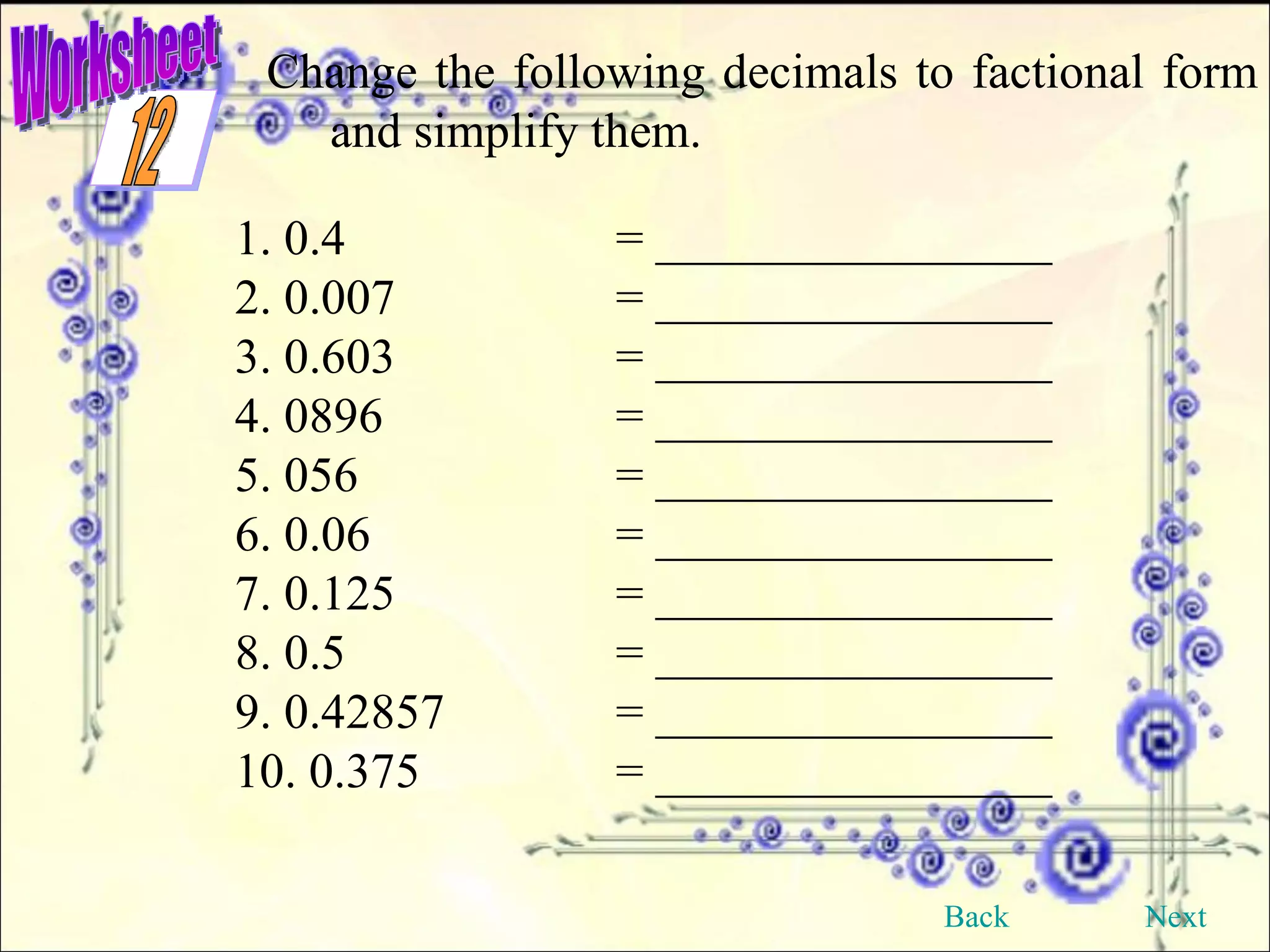
Worksheet Change the following decimals to factional form and simplify them. 1. 0.4 = ________________ 2. 0.007 = ________________ 3. 0.603 = ________________ 4. 0896 = ________________ 5. 056 = ________________ 6. 0.06 = ________________ 7. 0.125 = ________________ 8. 0.5 = ________________ 9. 0.42857 = ________________ 10. 0.375 = ________________ Back Next 12
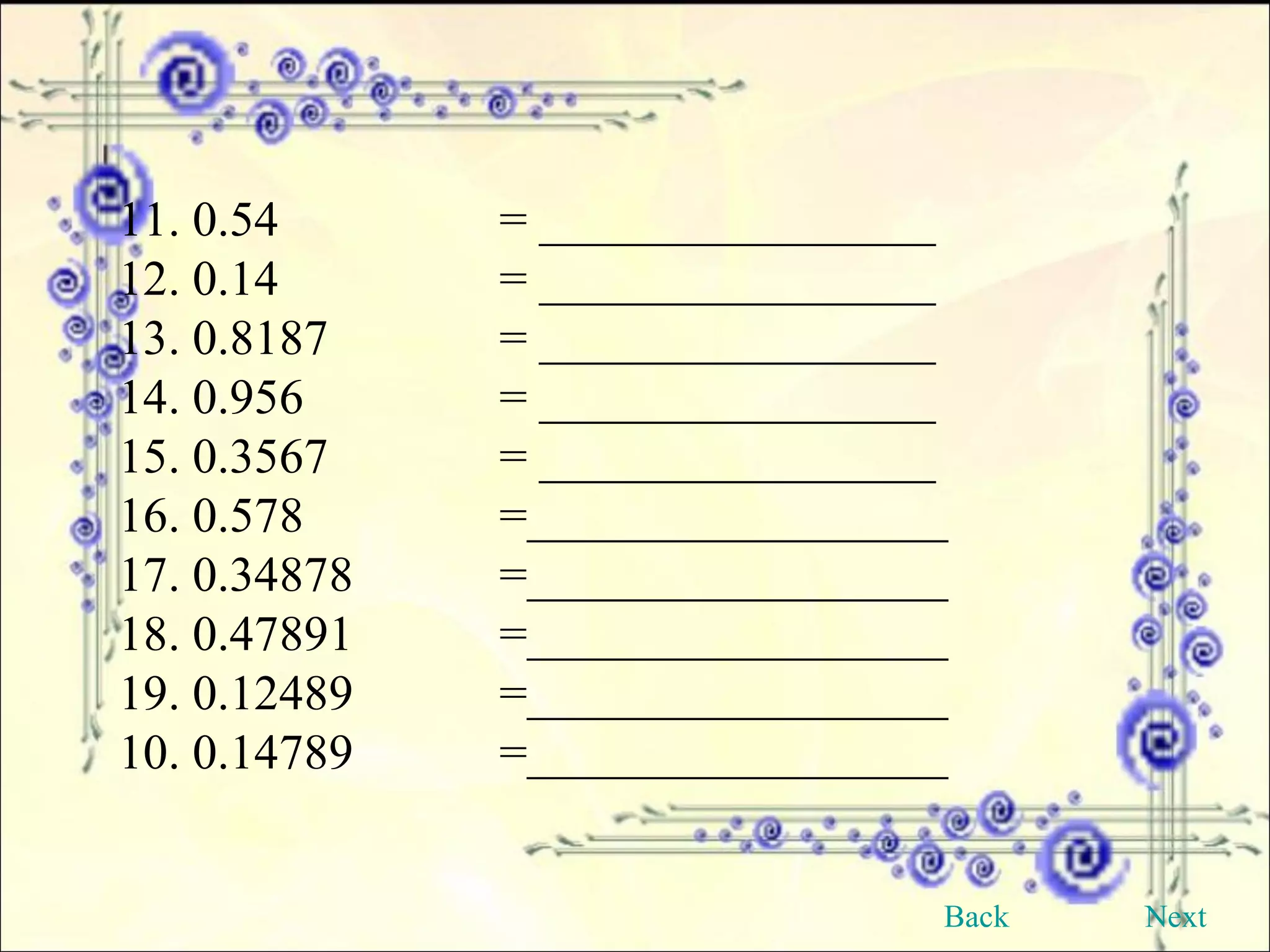
11. 0.54 = ________________ 12. 0.14 = ________________ 13. 0.8187 = ________________ 14. 0.956 = ________________ 15. 0.3567 = ________________ 16. 0.578 =_________________ 17. 0.34878 =_________________ 18. 0.47891 =_________________ 19. 0.12489 =_________________ 10. 0.14789 =_________________ Back Next
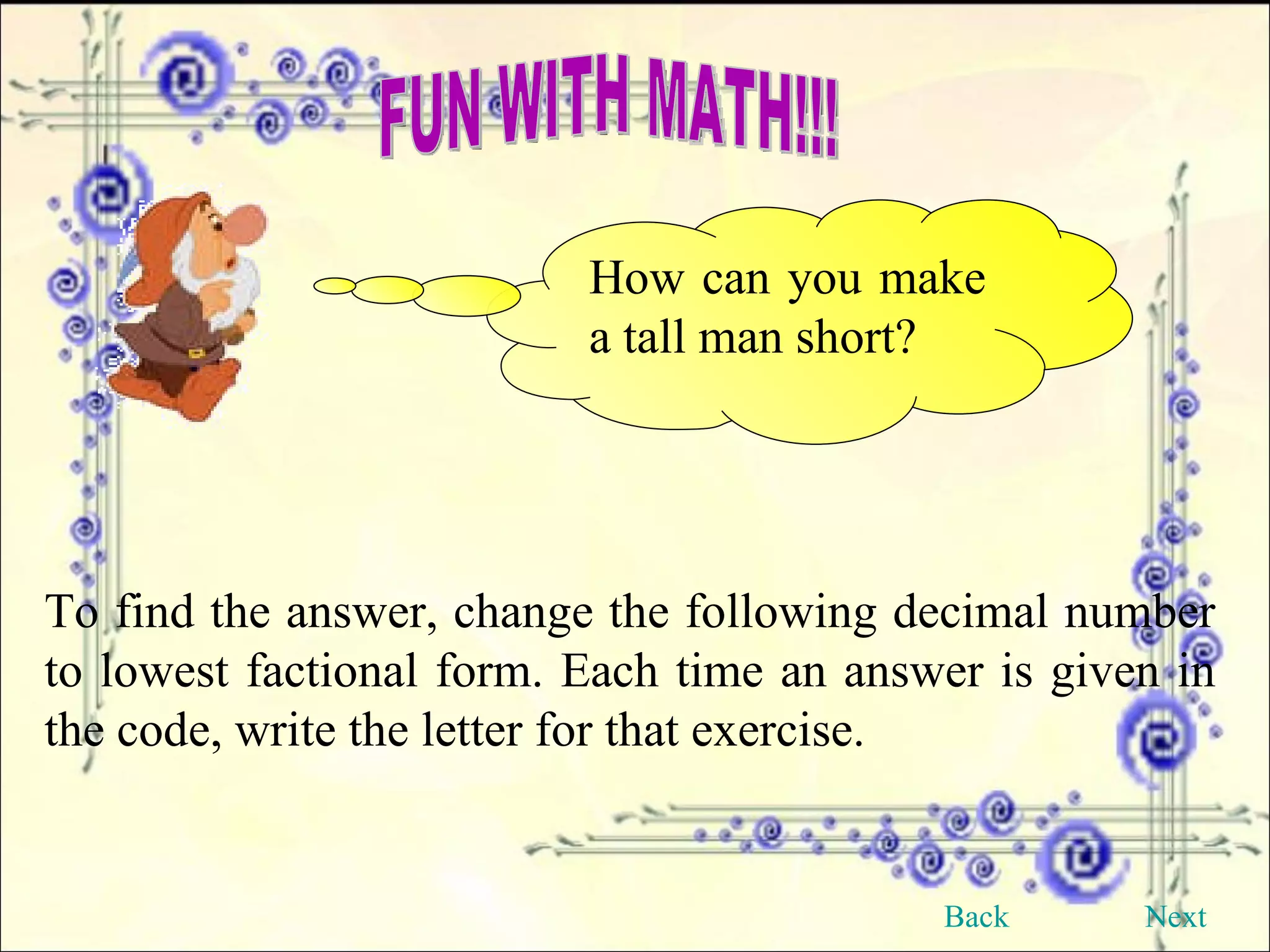
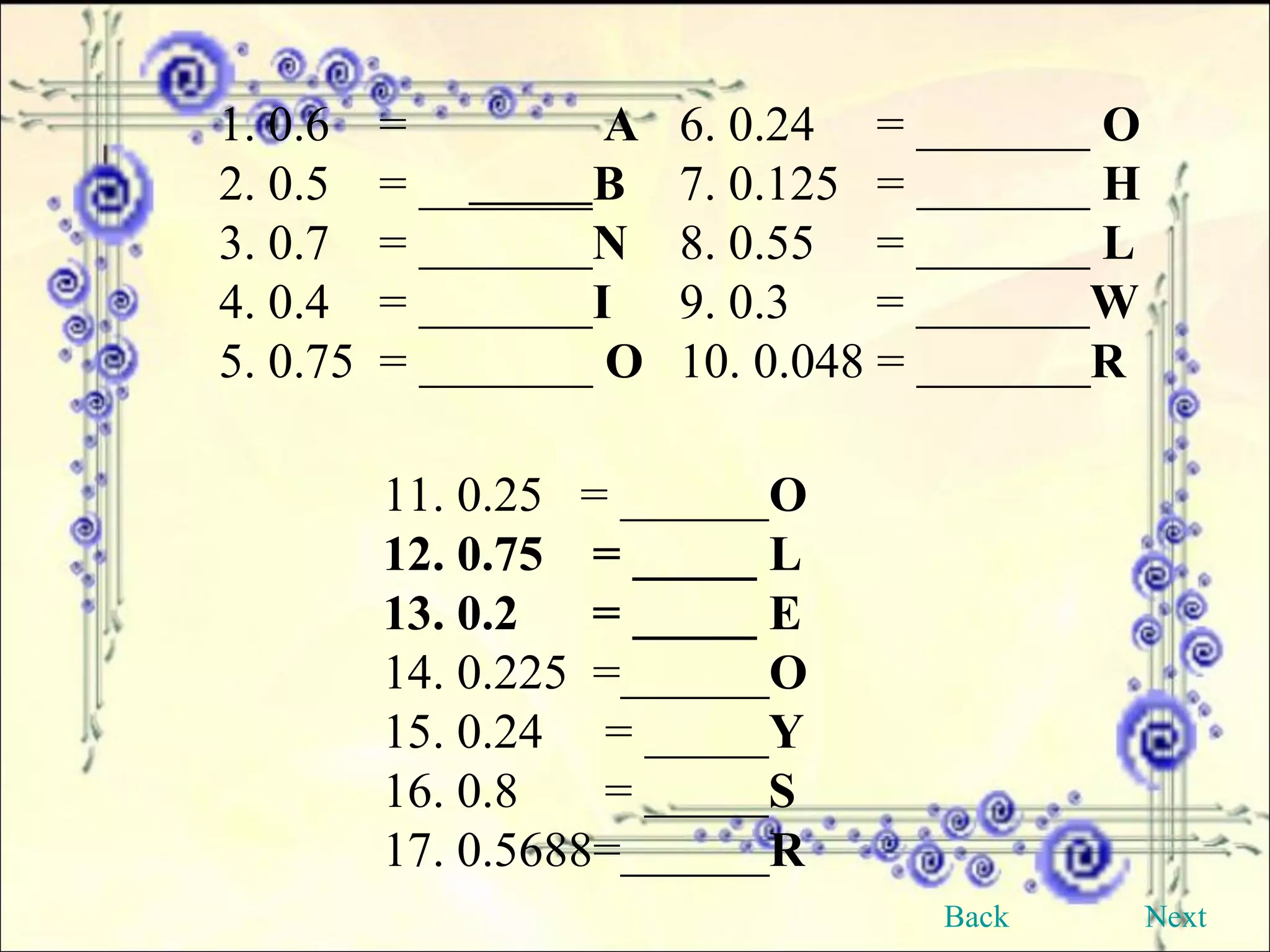
FUN WITH MATH!!! How can you make a tall man short? To find the answer, change the following decimal number to lowest factional form. Each time an answer is given in the code, write the letter for that exercise. Back Next
1. 0.6  =  A 6. 0.24  = _______  O   2. 0.5  = __ _____ B 7. 0.125  = _______  H  3. 0.7  = _______ N 8. 0.55  = _______  L  4. 0.4  = _______ I 9. 0.3  = _______ W  5. 0.75  = _______  O 10. 0.048 = _______ R   11. 0.25  = ______ O 12. 0.75  = _____ L 13. 0.2  = _____ E   14. 0.225  =______ O   15. 0.24  = _____ Y 16. 0.8  = _____ S 17. 0.5688=______ R Back Next
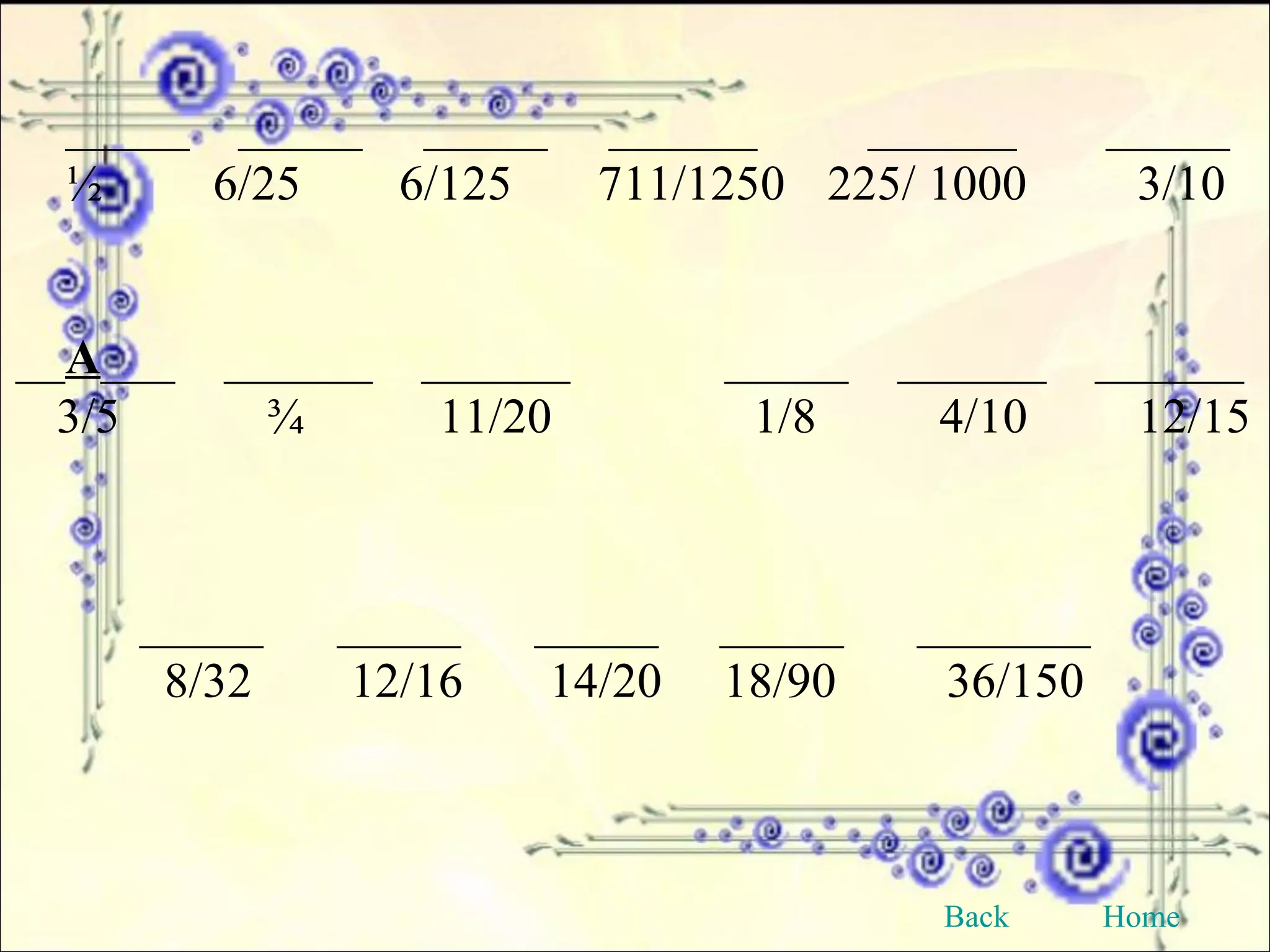
_____  _____  _____  ______  ______    _____  ½  6/25  6/125  711/1250 225/ 1000  3/10 __ A ___  ______  ______   3/5  ¾  11/20   _____  ______  ______  1/8  4/10  12/15   _____  _____  _____  _____  _______   8/32  12/16  14/20  18/90  36/150 Back Home
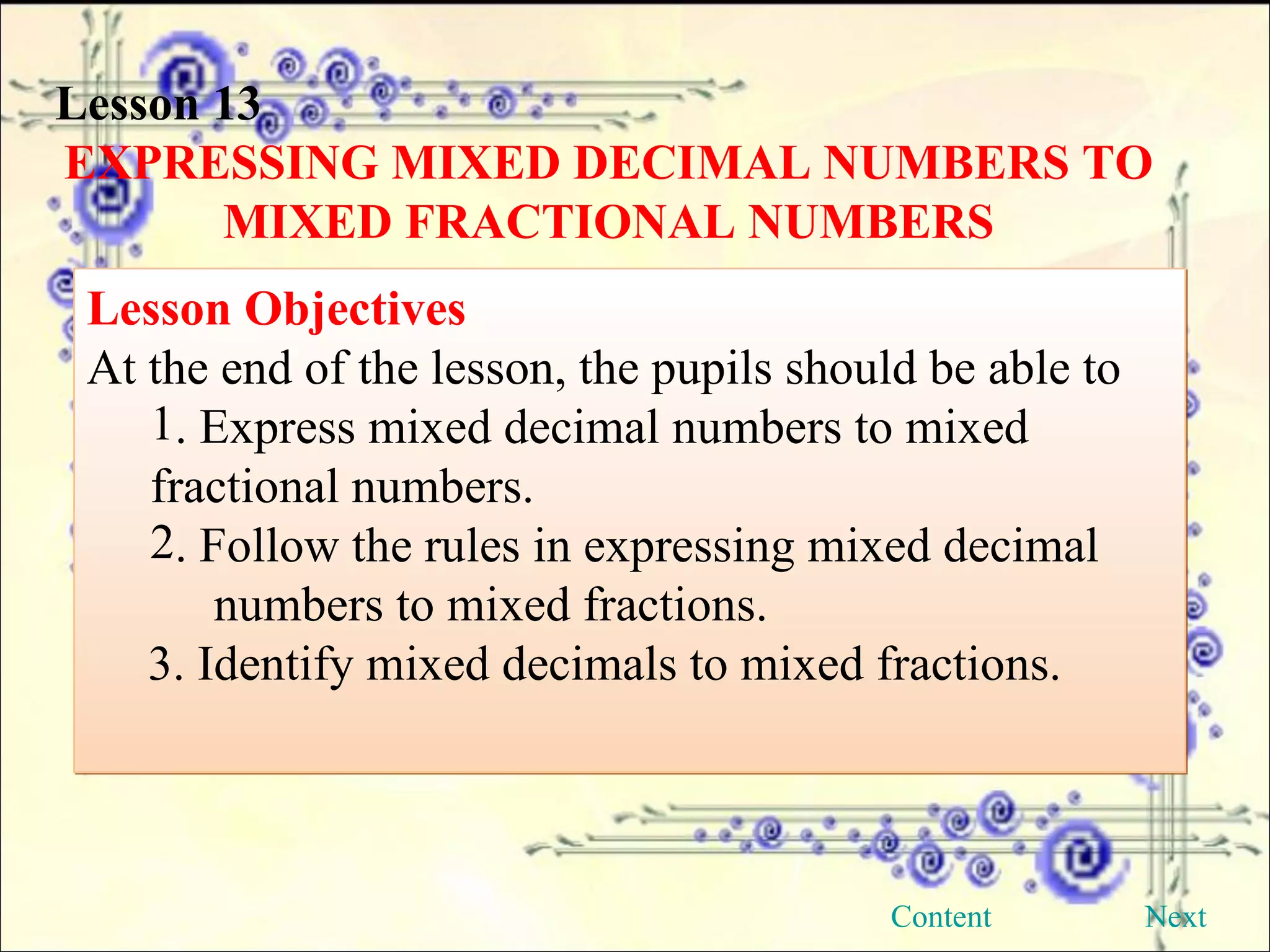
Lesson 13 EXPRESSING MIXED DECIMAL NUMBERS TO MIXED FRACTIONAL NUMBERS Lesson Objectives  At the end of the lesson, the pupils should be able to . Express mixed decimal numbers to mixed  fractional numbers. . Follow the rules in expressing mixed decimal  numbers to mixed fractions. 3. Identify mixed decimals to mixed fractions. Next Content
How can we change mixed decimals to mixed fractions? Study the following examples: Back Next
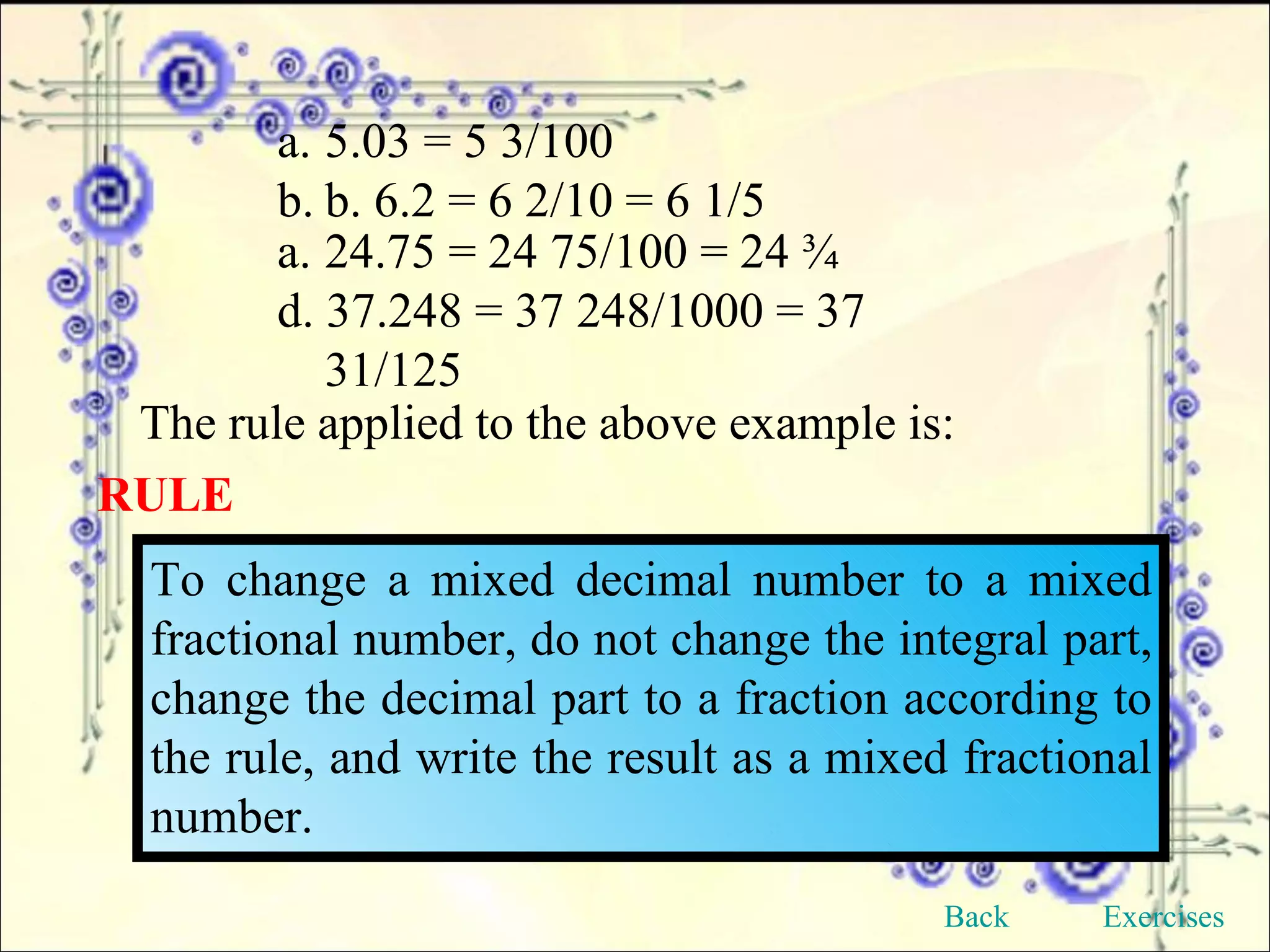
5.03 = 5 3/100 b. 6.2 = 6 2/10 = 6 1/5 24.75 = 24 75/100 = 24 ¾ d. 37.248 = 37 248/1000 = 37 31/125 The rule applied to the above example is: RULE To change a mixed decimal number to a mixed fractional number, do not change the integral part, change the decimal part to a fraction according to the rule, and write the result as a mixed fractional number. Back Exercises
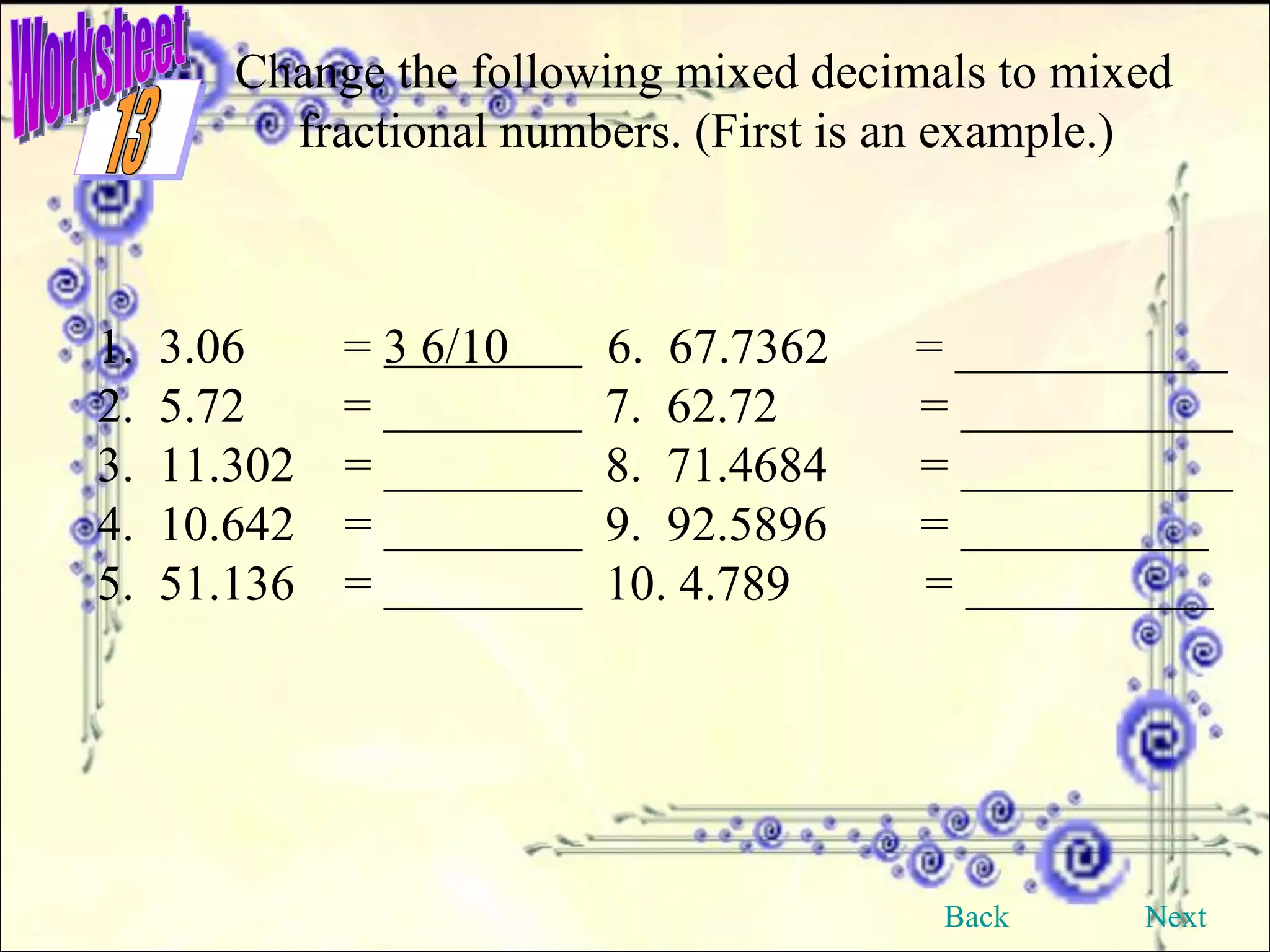
Worksheet Change the following mixed decimals to mixed fractional numbers. (First is an example.) 1.  3.06  =  3 6/10  6.  67.7362  = ___________ 2.  5.72  = ________ 7.  62.72   = ___________ 3.  11.302  = ________ 8.  71.4684   = ___________ 4.  10.642  = ________ 9.  92.5896   = __________ 5.  51.136  = ________ 10. 4.789  = __________ Back Next 13
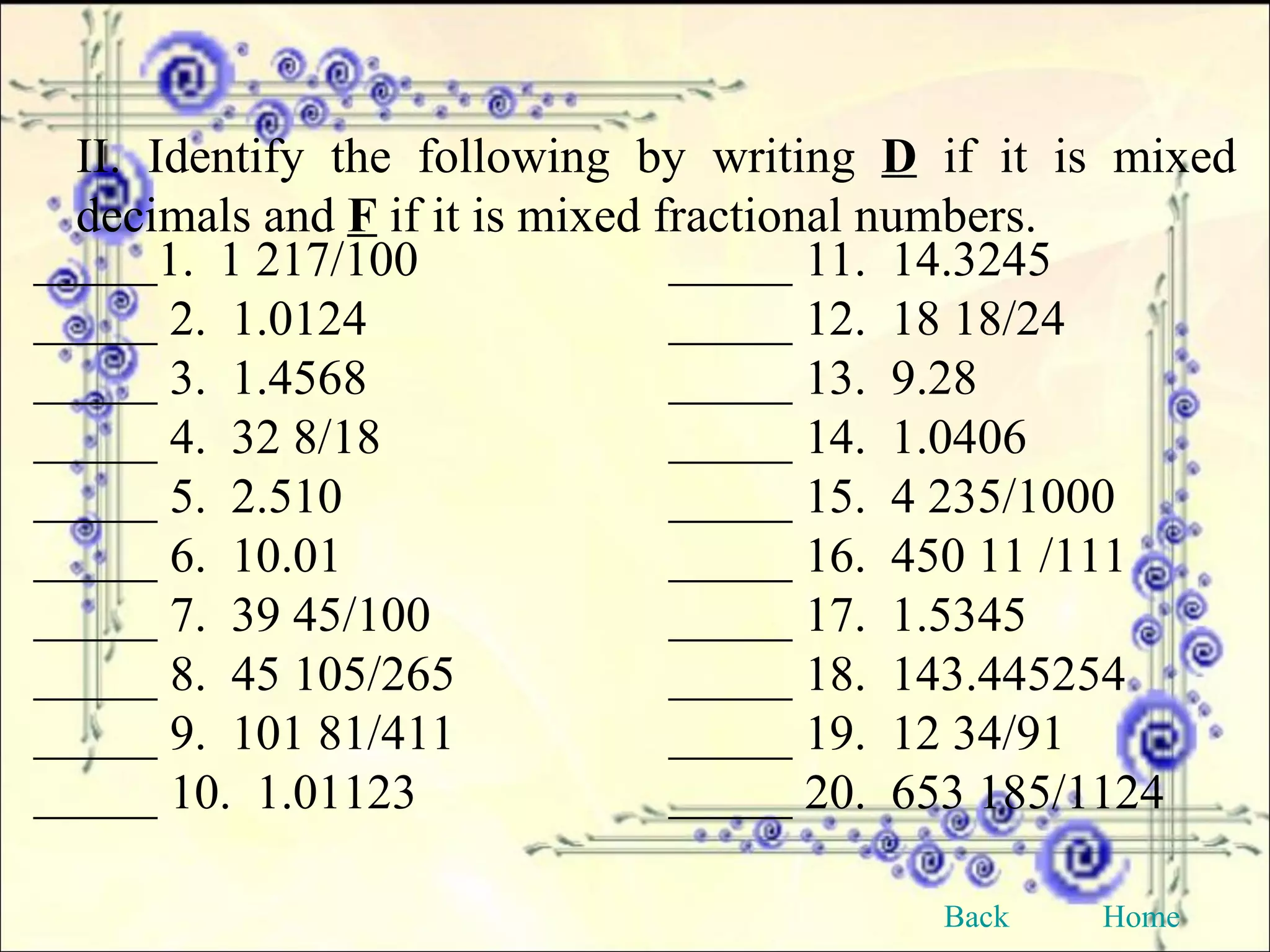
II. Identify the following by writing  D  if it is mixed decimals and  F  if it is mixed fractional numbers. _____1.  1 217/100 _____ 11.  14.3245 _____ 2.  1.0124 _____ 12.  18 18/24 _____ 3.  1.4568 _____ 13.  9.28 _____ 4.  32 8/18 _____ 14.  1.0406 _____ 5.  2.510 _____ 15.  4 235/1000 _____ 6.  10.01 _____ 16.  450 11 /111 _____ 7.  39 45/100 _____ 17.  1.5345 _____ 8.  45 105/265 _____ 18.  143.445254 _____ 9.  101 81/411 _____ 19.  12 34/91 _____ 10.  1.01123 _____ 20.  653 185/1124 Back Home
Unit III ADDITION AND SUBTRACTION  OF DECIMALS NUMBERS Content Next
OVERVIEW OF THE MODULAR WORKBOOK This modular workbook provides you greater understanding in all aspects of addition and subtraction of decimal numbers. It enables you to perform the operation correctly and critically. It includes all the needed information about the addition and subtraction of decimal numbers, its terminologists to remember, how to add and how to subtract decimals with or without regrouping, how to estimate sum and differences, and subtracting decimal numbers involving zeros in minuends. This modular work will help you to enhance your minds and ability in answering problems deeper understanding and analysis regarding all aspects of adding and subtracting decimal numbers. Back Next
OBJECTIVES OF THE MODULAR WORKBOOK After completing this Unit, you are expected to: 1. Familiarize the language in addition and subtraction. 2. Learn how to add and subtract decimal numbers with    or without regrouping. 3. Know how to check the answers. 4. Estimate the sum and differences and how it is done. 5. Know how to subtract decimal numbers with zeros in    the minuend. 6. Develop speed in adding and subtracting decimal    numbers. 7. Analyze problems critically.   Back Next
Lesson 14 MEANING OF ADDITION AND SUBTRACTION OF DECIMAL NUMBERS Lesson Objectives: After accomplishing this lesson, you are expected to: . Define addition and Subtraction. 2. Identify the parts of addition and subtraction. 3. Familiarize the language in addition and      subtraction. Next Content
Addition  is the process of combining together two or more decimal numbers. It is putting together two groups or sets of thing or people. Back Next
Example:  0.5  +  0.3  =  0.8   Addends   Sum or Total Addends  are the decimal numbers that are added.  Sum  is the answer in addition. The symbol used for addition is the plus sign (+). Back Next
The process of taking one number or quantity from another is called  Subtraction . It is undoing process or inverse operation of addition. It is an operation of taking away a part of a set or group of things or people. Note:  Decimal points is arrange in one column like in addition of decimals. Back Next
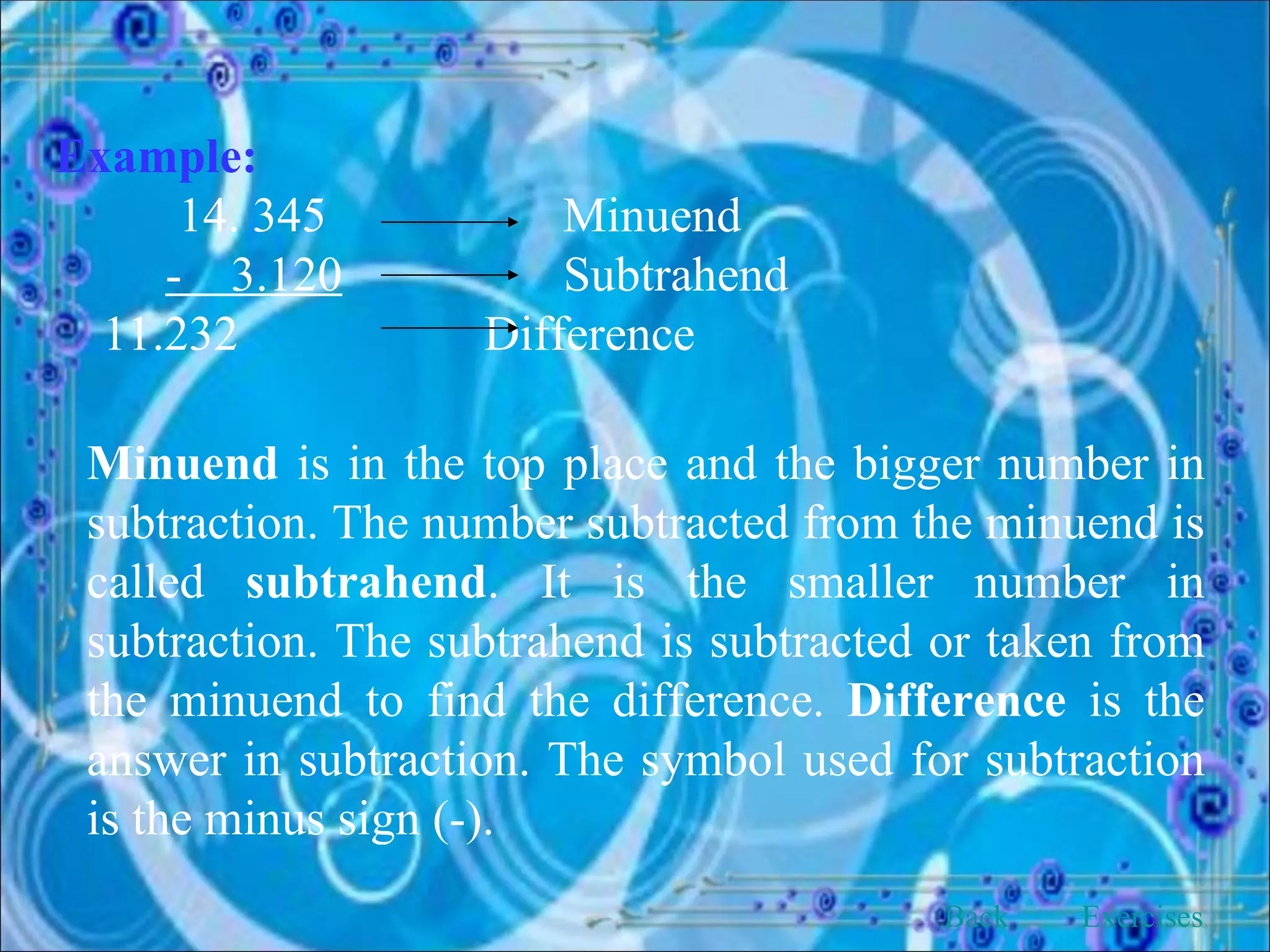
Example:   14. 345 Minuend -  3.120   Subtrahend 11.232  Difference Minuend  is in the top place and the bigger number in subtraction. The number subtracted from the minuend is called  subtrahend . It is the smaller number in subtraction. The subtrahend is subtracted or taken from the minuend to find the difference.  Difference  is the answer in subtraction. The symbol used for subtraction is the minus sign (-). Back Exercises
Worksheet I. Give the meaning and explain the use of the following. 1. What is addition? 2. What is subtraction? 3. What are the parts of addition? 4. What are the parts of subtraction? Back Next 14
1. Addition ______________________________________________ 2 Subtraction ______________________________________________ 3. Parts of addition ______________________________________________ 4. Parts of subtraction ______________________________________________ Back Next
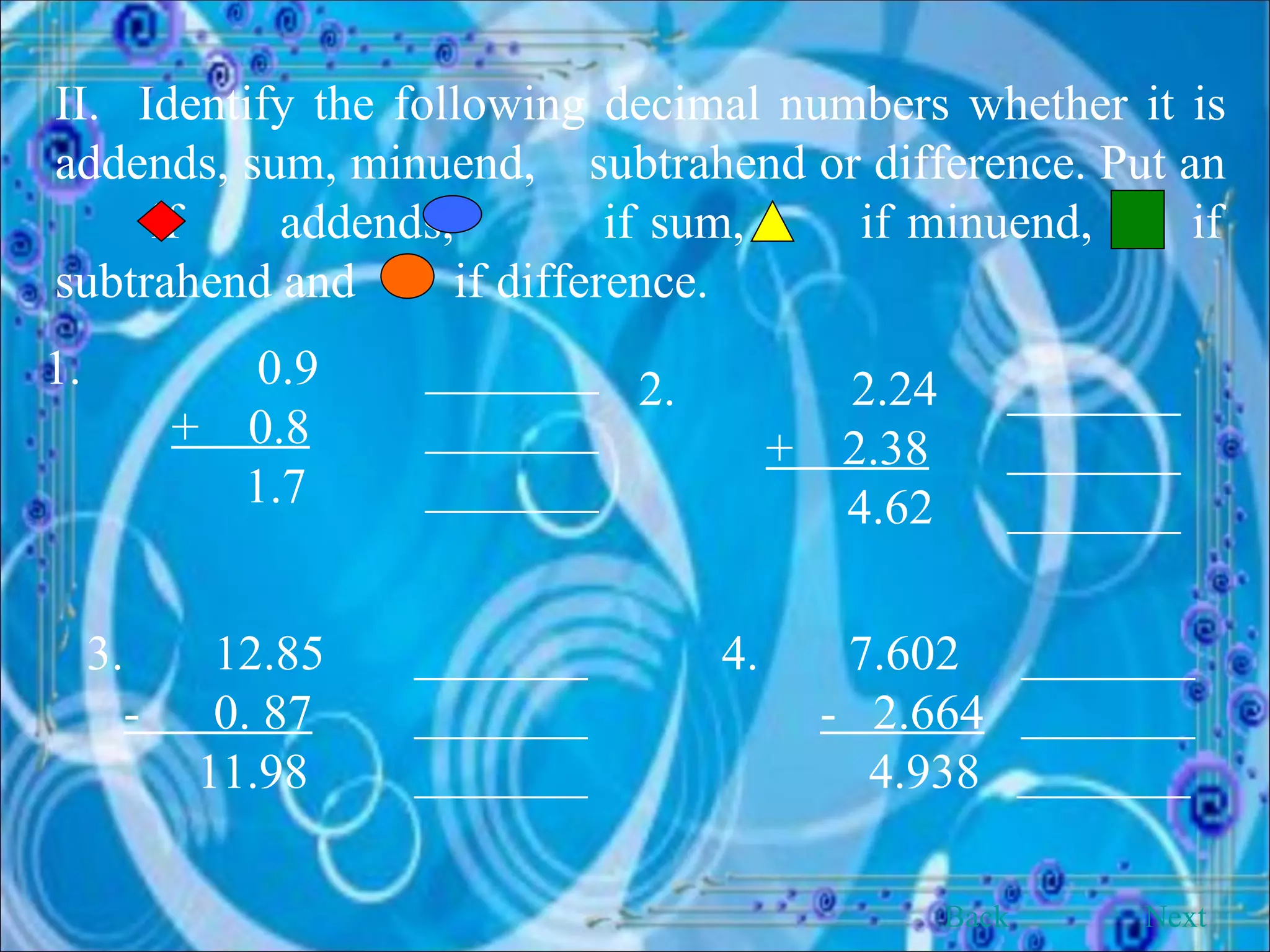
II.  Identify the following decimal numbers whether it is addends, sum, minuend,  subtrahend or difference. Put an  if  addends,  if sum,  if minuend,  if subtrahend and  if difference. 1.   0.9  _______ +  0.8   _______   1.7  _______ 2.   2.24  _______   +  2.38   _______ 4.62  _______ 3.  12.85    _______ -  0. 87     _______ 11.98    _______ 4.  7.602  _______ -  2.664   _______ 4.938  _______ Back Next
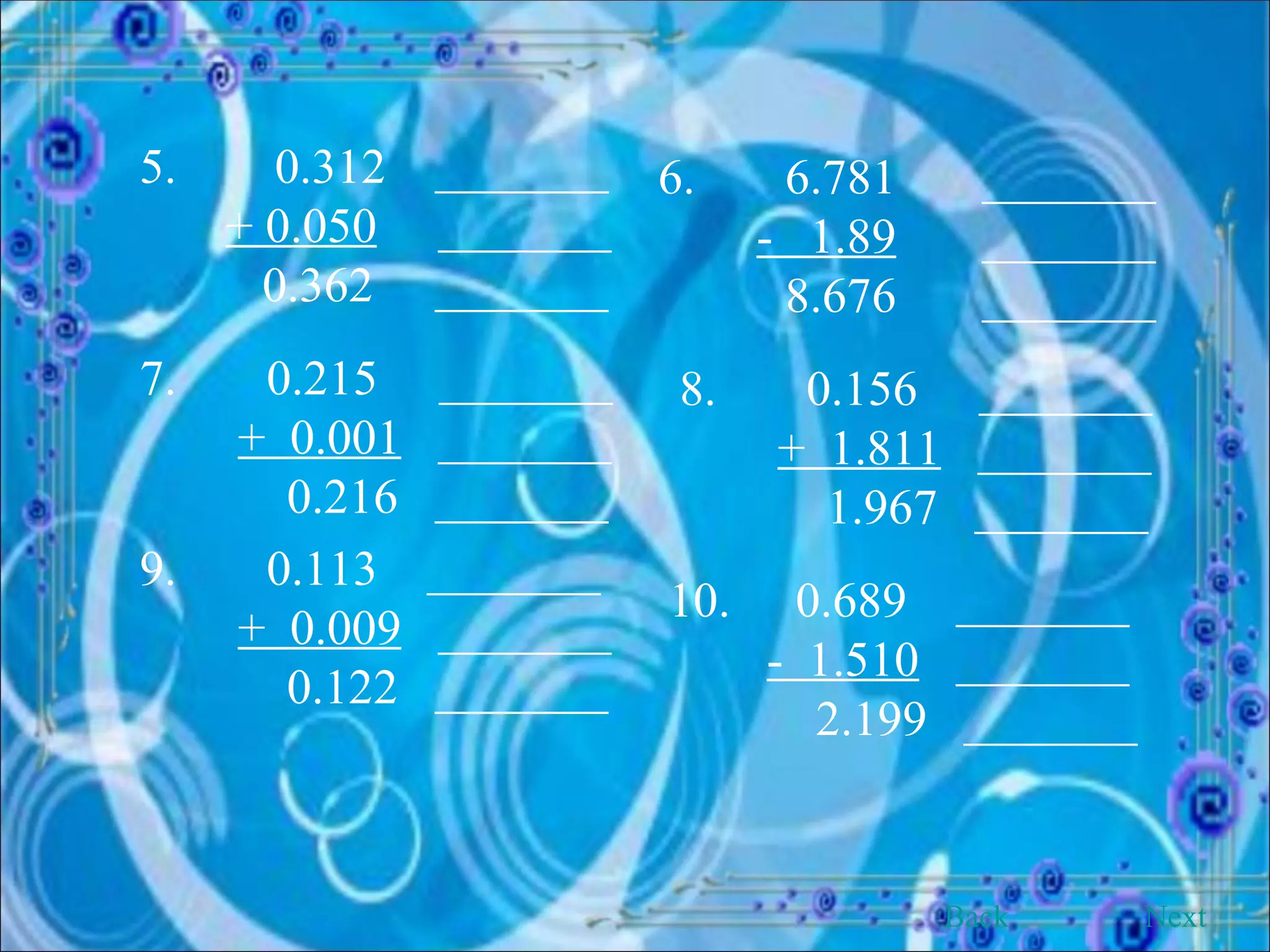
5.  0.312  _______ + 0.050   _______ 0.362  _______ 6.  6.781  _______ -  1.89   _______ 8.676  _______ 7.  0.215  _______ +  0.001   _______ 0.216  _______ 8.  0.156  _______ +  1.811   _______ 1.967  _______ 9. 0.113  _______ +  0.009   _______ 0.122  _______ 10.  0.689  _______ -  1.510   _______ 2.199  _______ Back Next
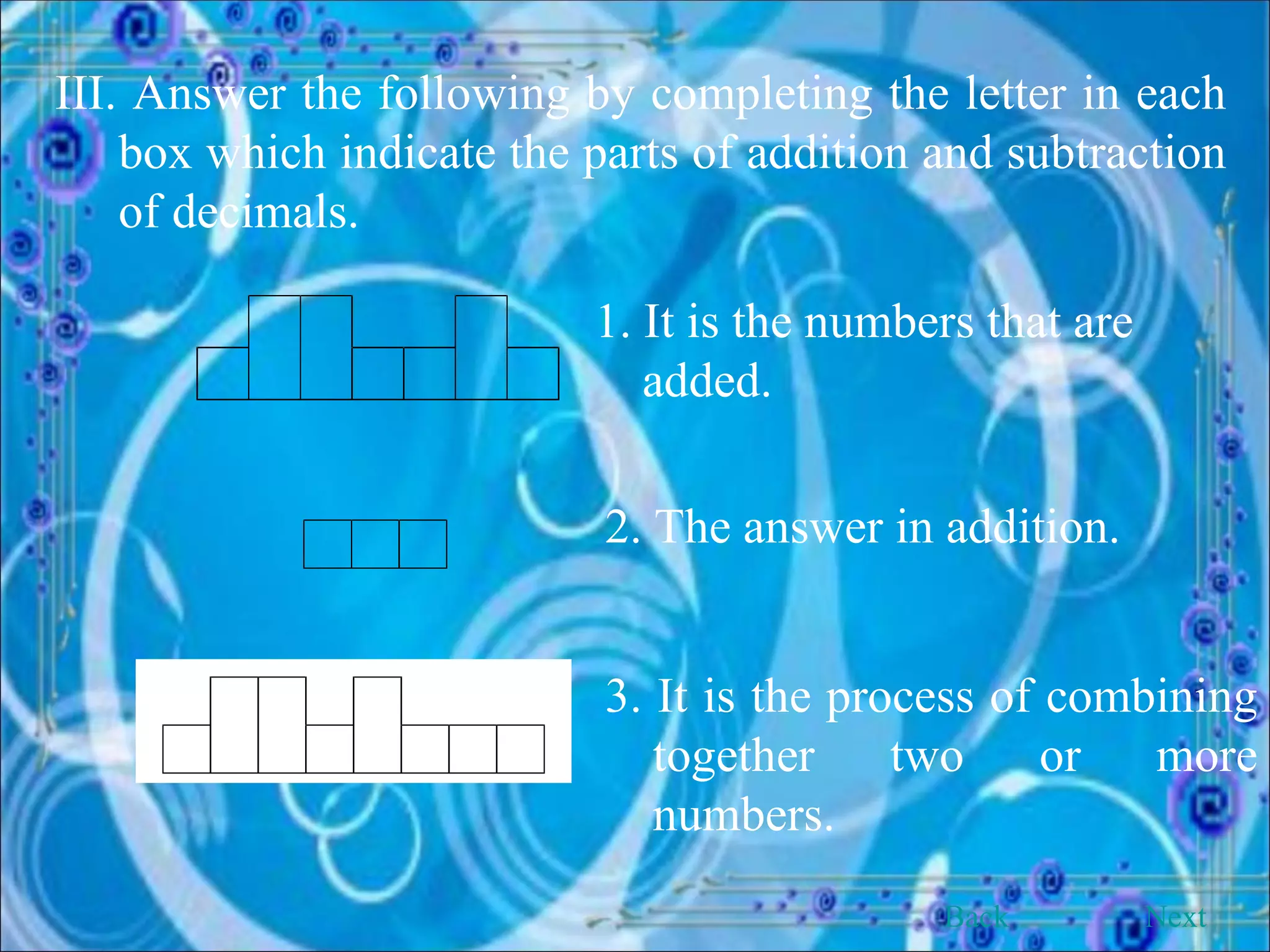
III. Answer the following by completing the letter in each box which indicate the parts of addition and subtraction of decimals. 1. It is the numbers that are added.   2. The answer in addition. 3. It is the process of combining together two or more numbers. Back Next
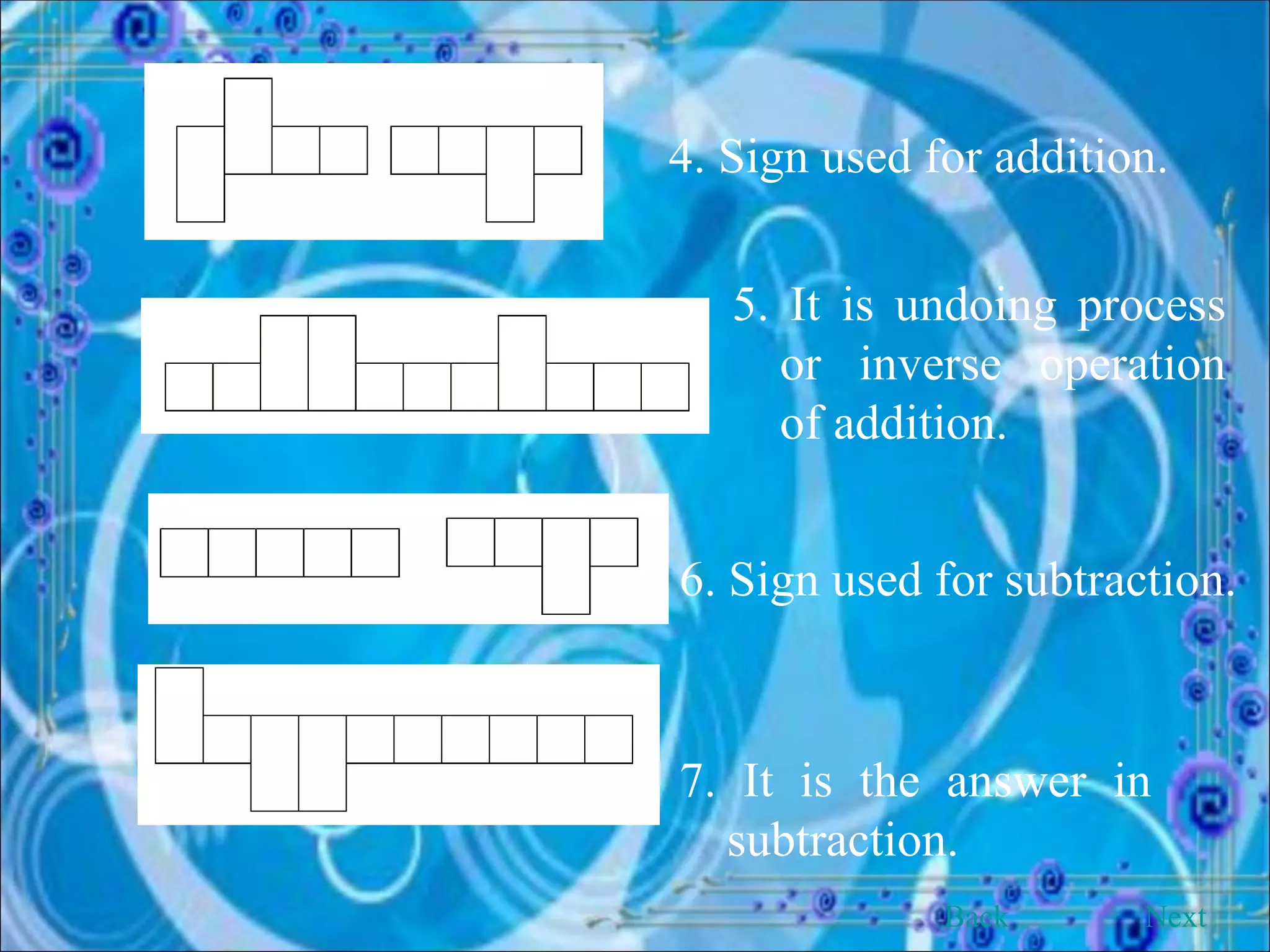
4. Sign used for addition. 5. It is undoing process or inverse operation of addition.  6. Sign used for subtraction. 7. It is the answer in  subtraction. Back Next
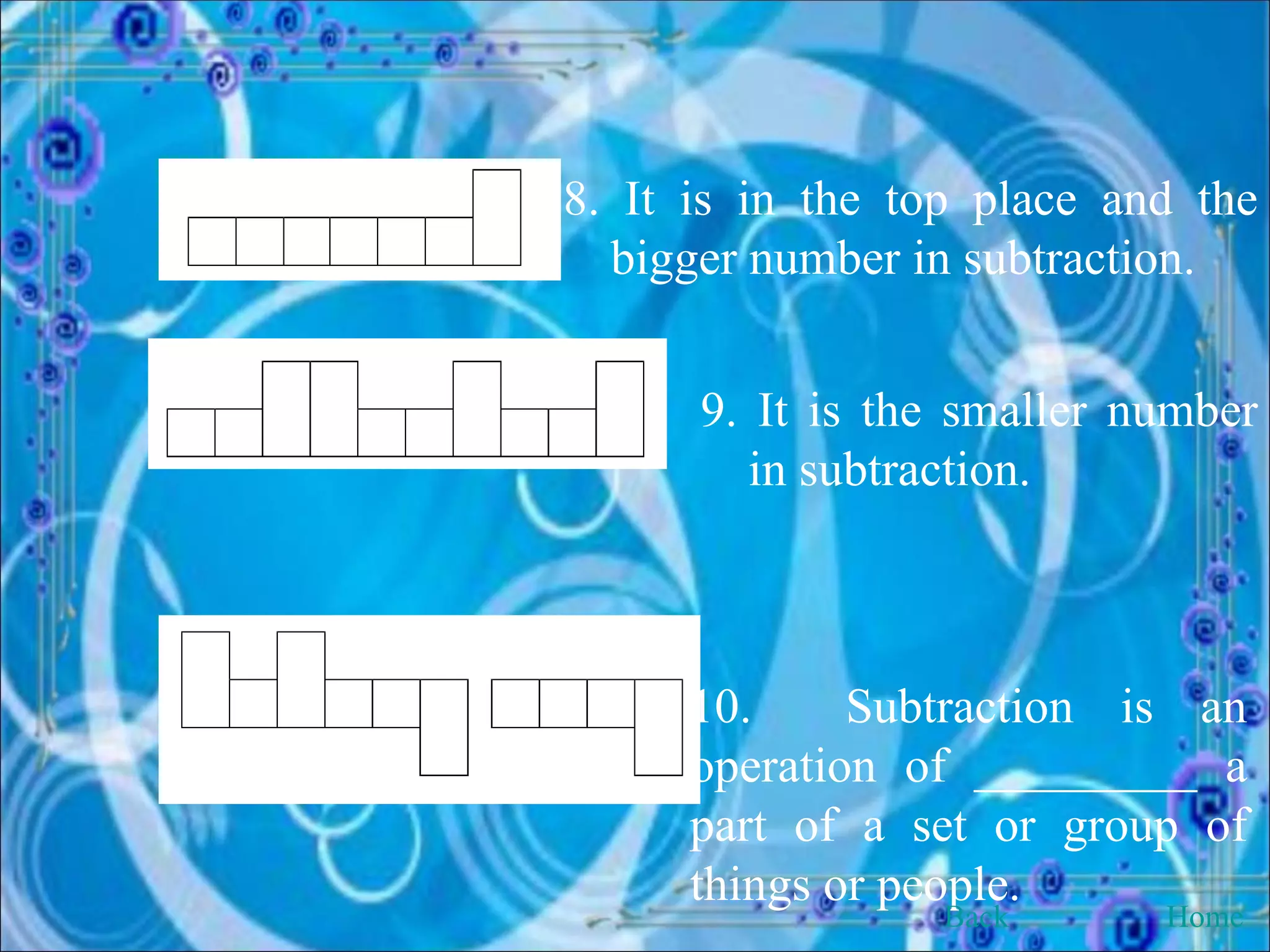
8. It is in the top place and the bigger number in subtraction. 9. It is the smaller number in subtraction. 10.  Subtraction is an operation of _________ a part of a set or group of things or people.  Back Home
Lesson 15 ADDITION AND SUBTRACTION OF DECIMAL NUMBERS WITHOUT REGROUPING Lesson Objectives: After finishing the lesson, the students are expected to: . Know how to add and subtract decimal  numbers without regrouping. 2.  Develop speed in adding and subtracting  decimal number. 3.  Follow the steps in adding and subtracting  decimal numbers. Next Content
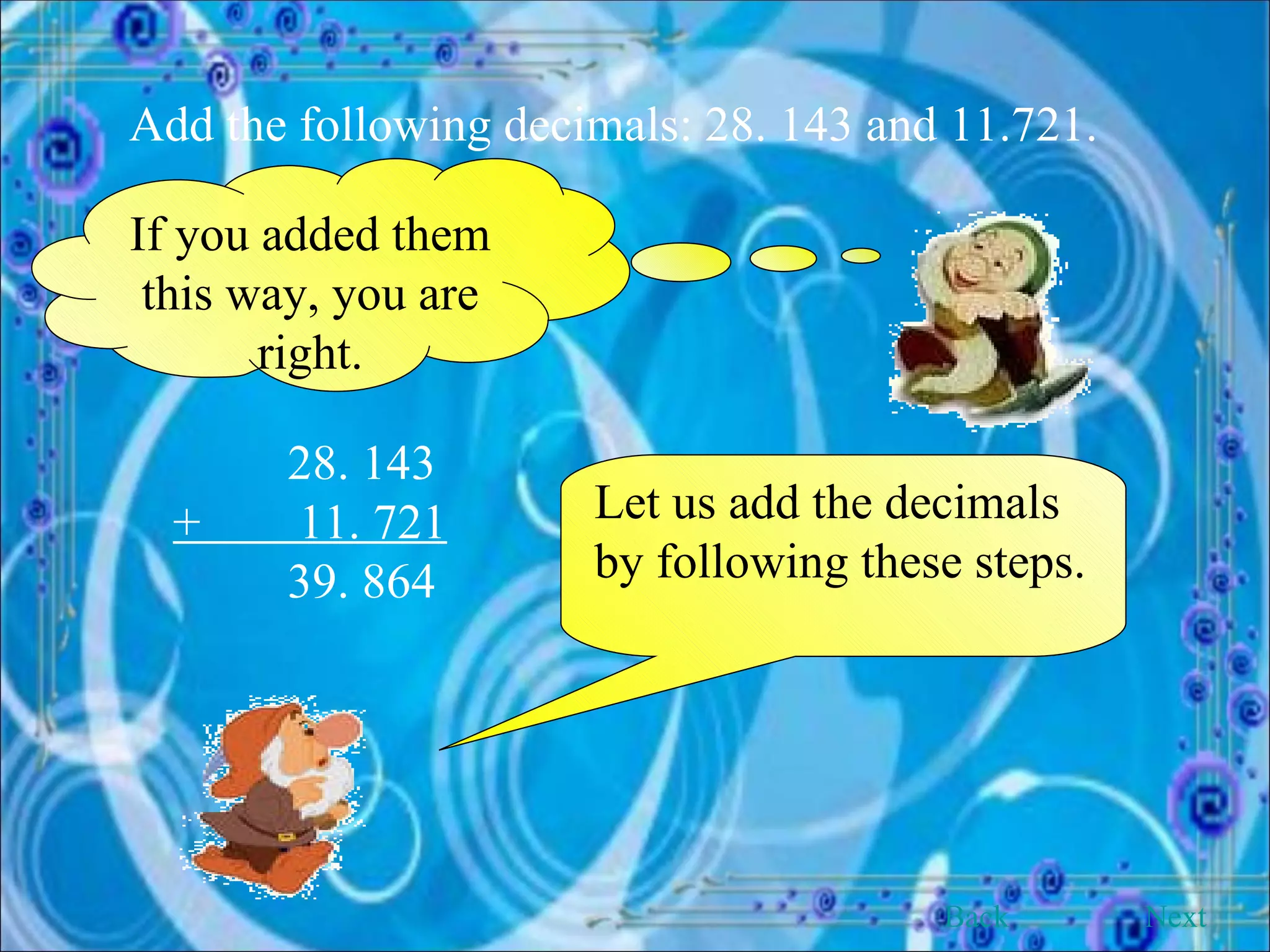
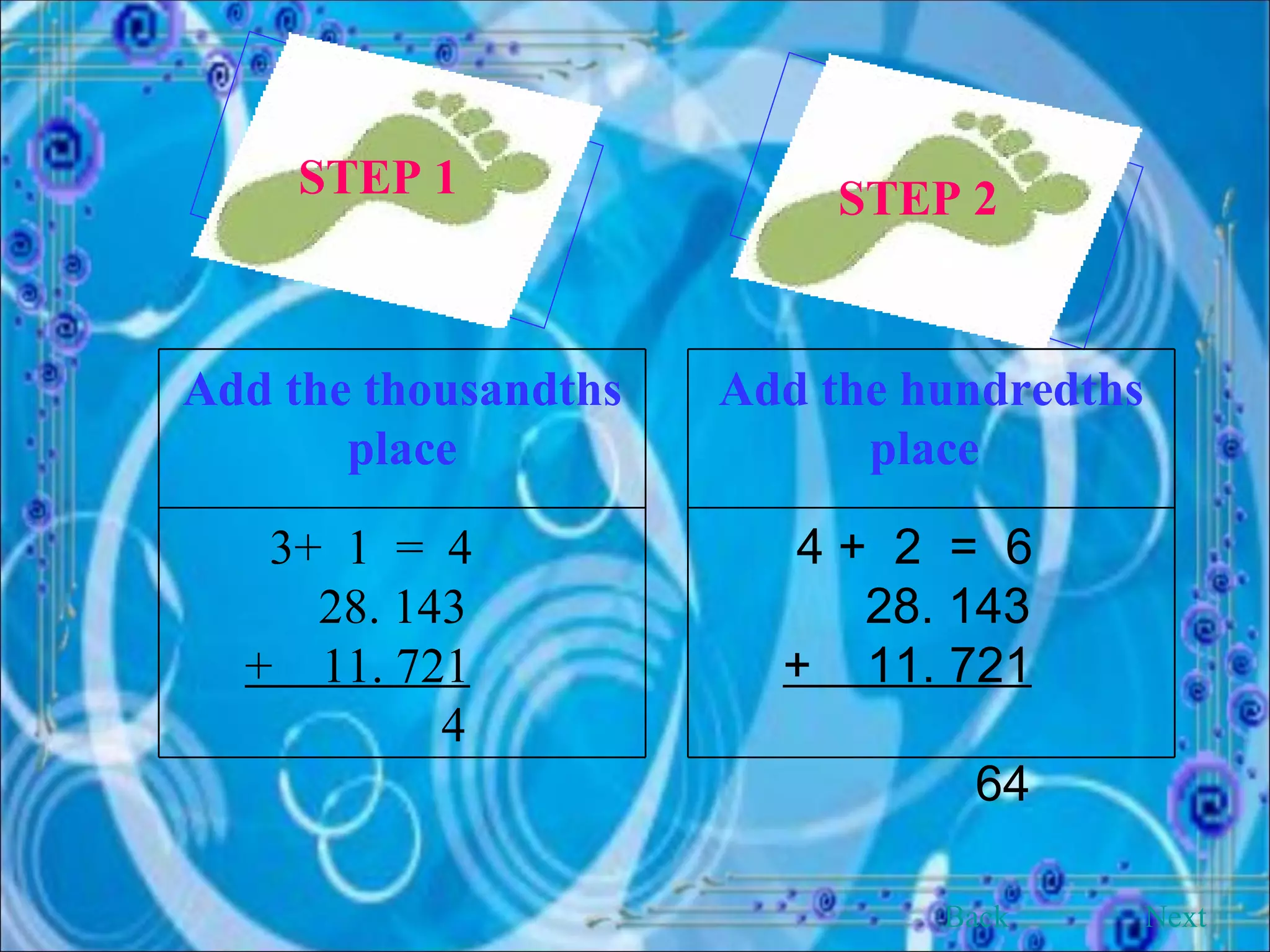
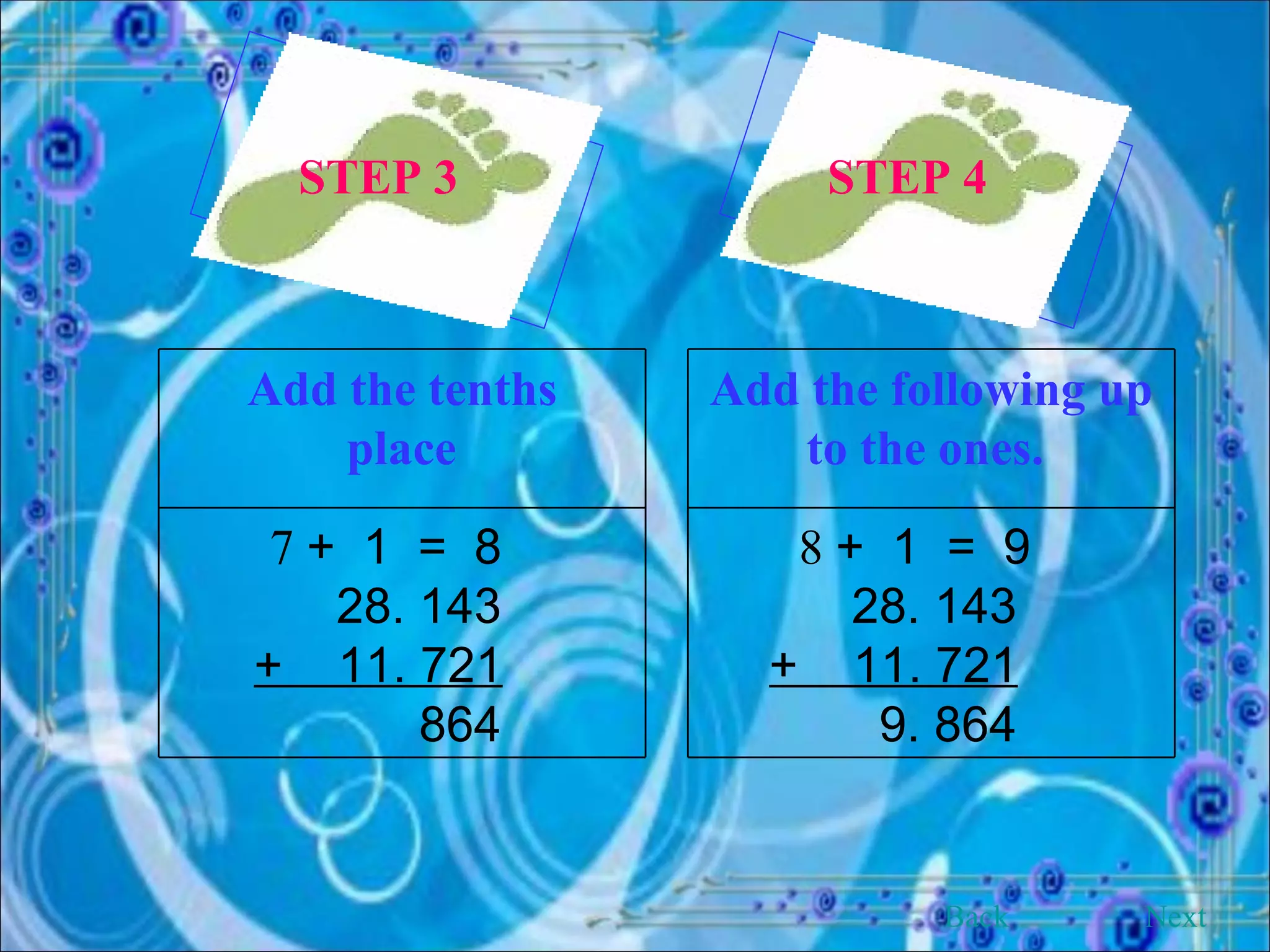
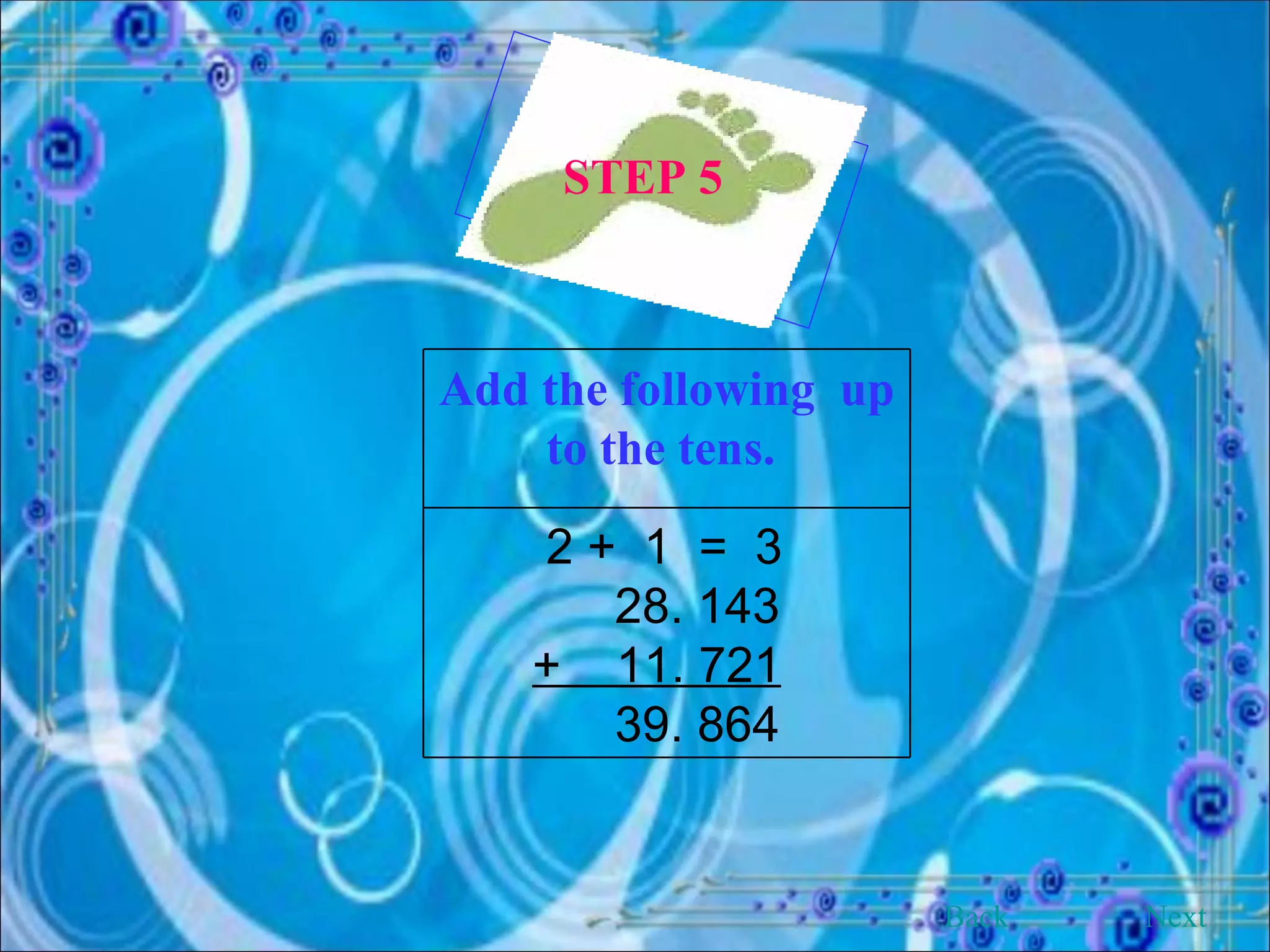
Add the following decimals: 28. 143 and 11.721. If you added them this way, you are right. 28. 143 +  11. 721 39. 864 Let us add the decimals by following these steps. Back Next
STEP 1   STEP 2   Back Next Add the thousandths place 3+  1  =  4  28. 143  +  11. 721   4  Add the hundredths place   4 +  2  =  6  28. 143  +  11. 721   64
STEP 3 STEP 4   Back Next Add the tenths place   7  +  1  =  8 28. 143 +  11. 721 864  Add the following up to the ones.   8  +  1  =  9  28. 143  +  11. 721   9. 864
STEP 5   Back Next Add the following  up to the tens.   2 +  1  =  3  28. 143  +  11. 721   39. 864
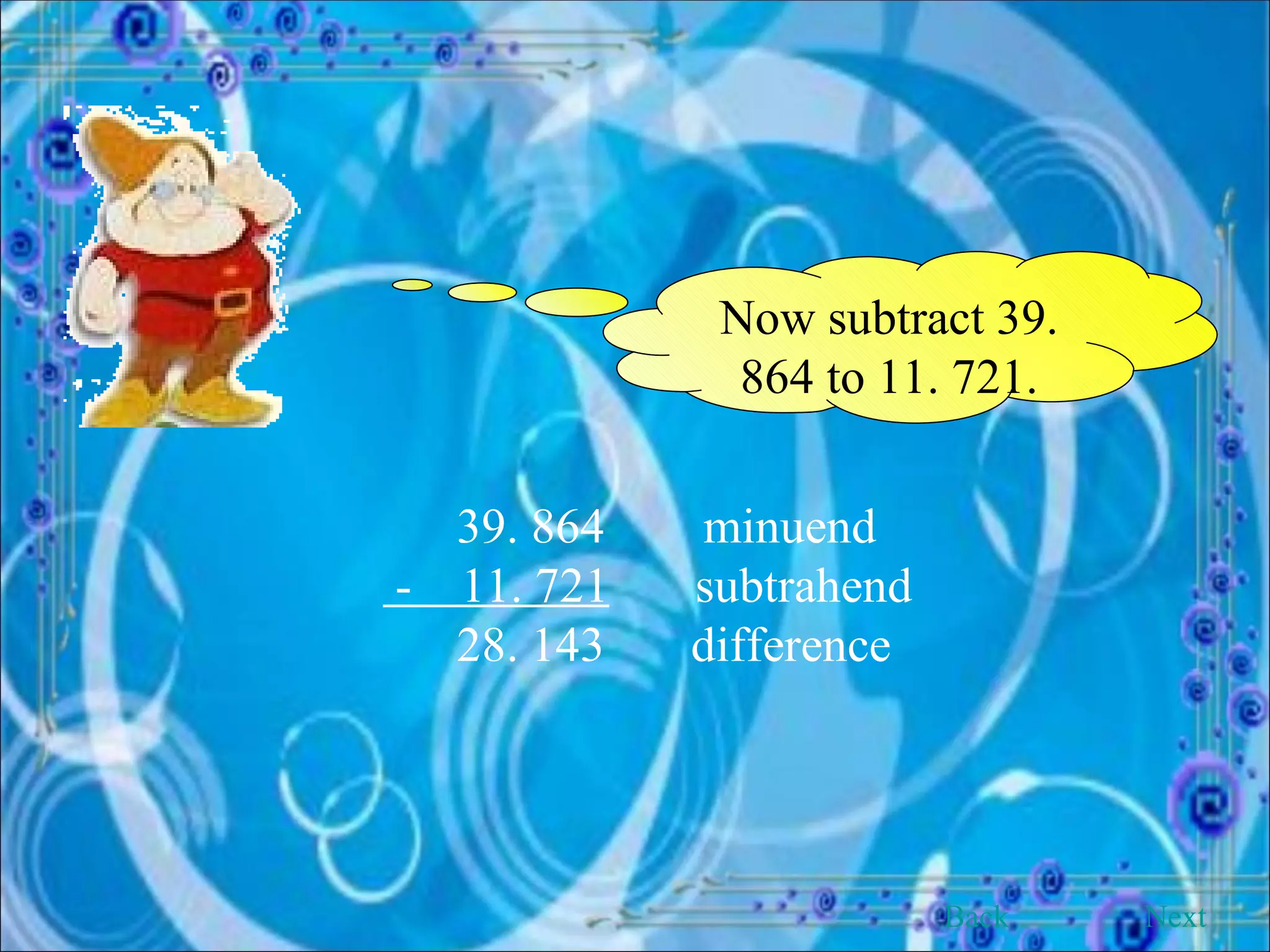
Now subtract 39. 864 to 11. 721.   39. 864  minuend   -  11. 721   subtrahend   28. 143  difference Back Next
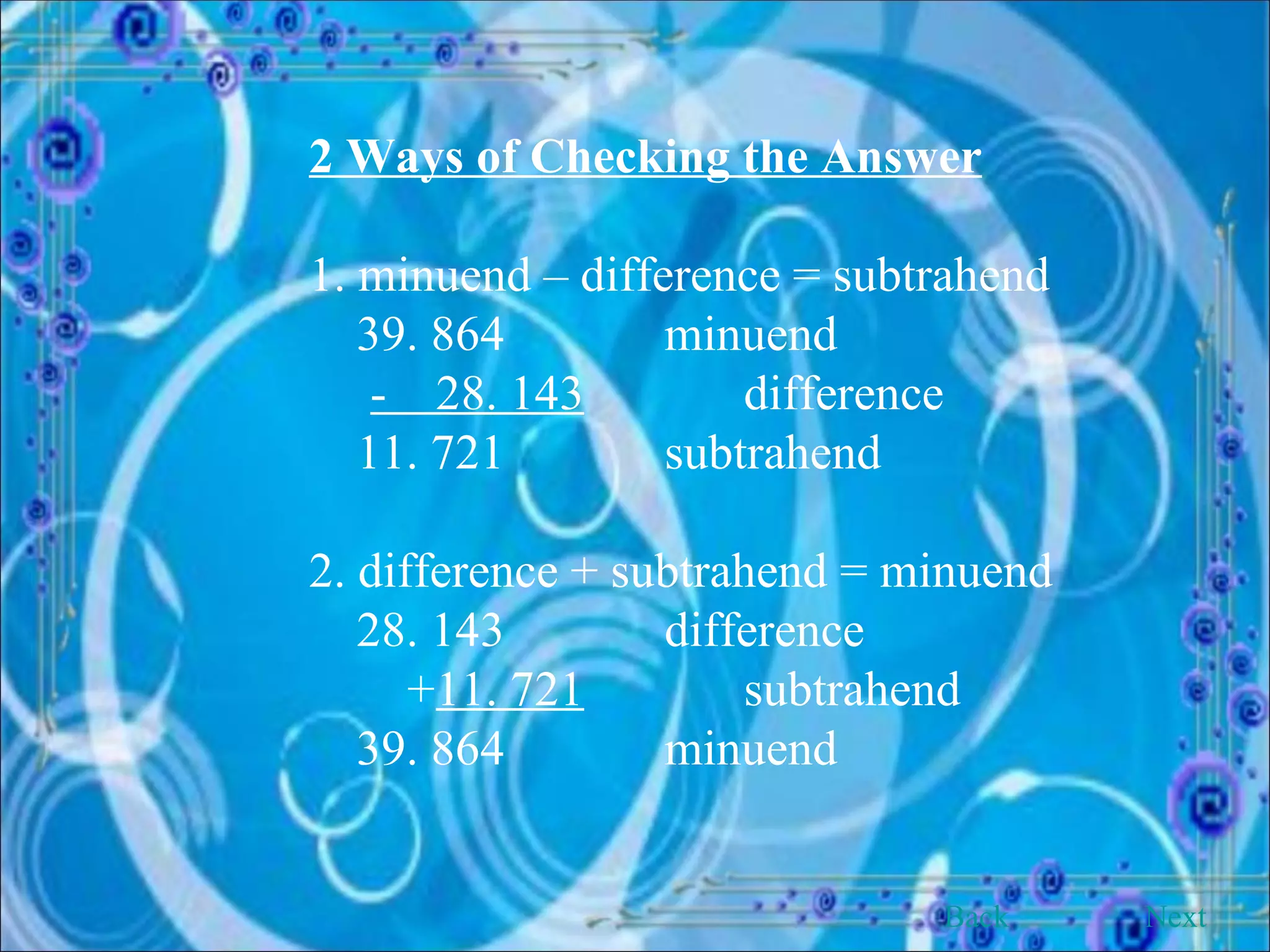
2 Ways of Checking the Answer 1. minuend – difference = subtrahend 39. 864  minuend -  28. 143   difference 11. 721  subtrahend 2. difference + subtrahend = minuend 28. 143  difference + 11. 721   subtrahend 39. 864  minuend Back Next
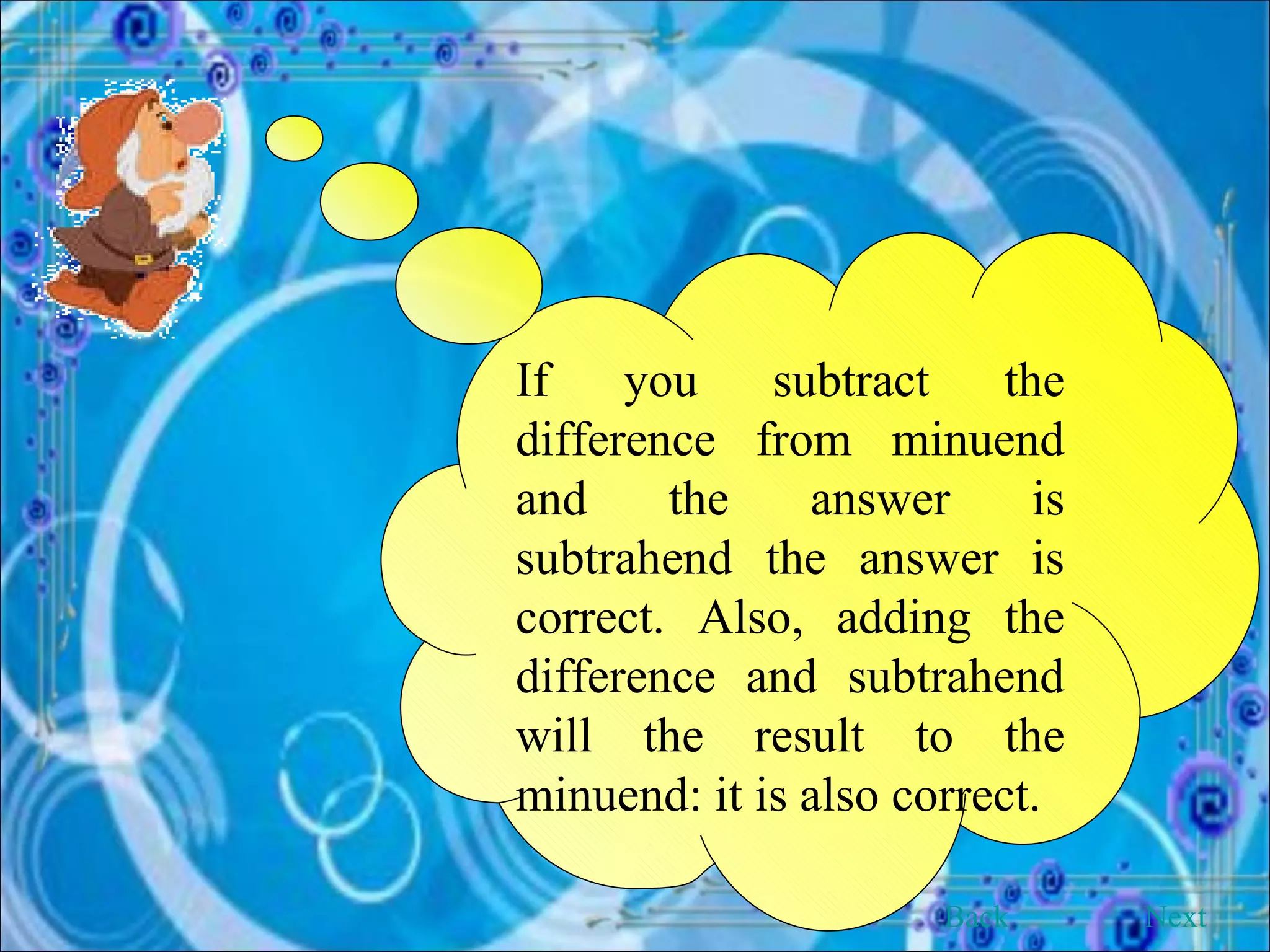
If you subtract the difference from minuend and the answer is subtrahend the answer is correct. Also, adding the difference and subtrahend will the result to the minuend: it is also correct. Back Next
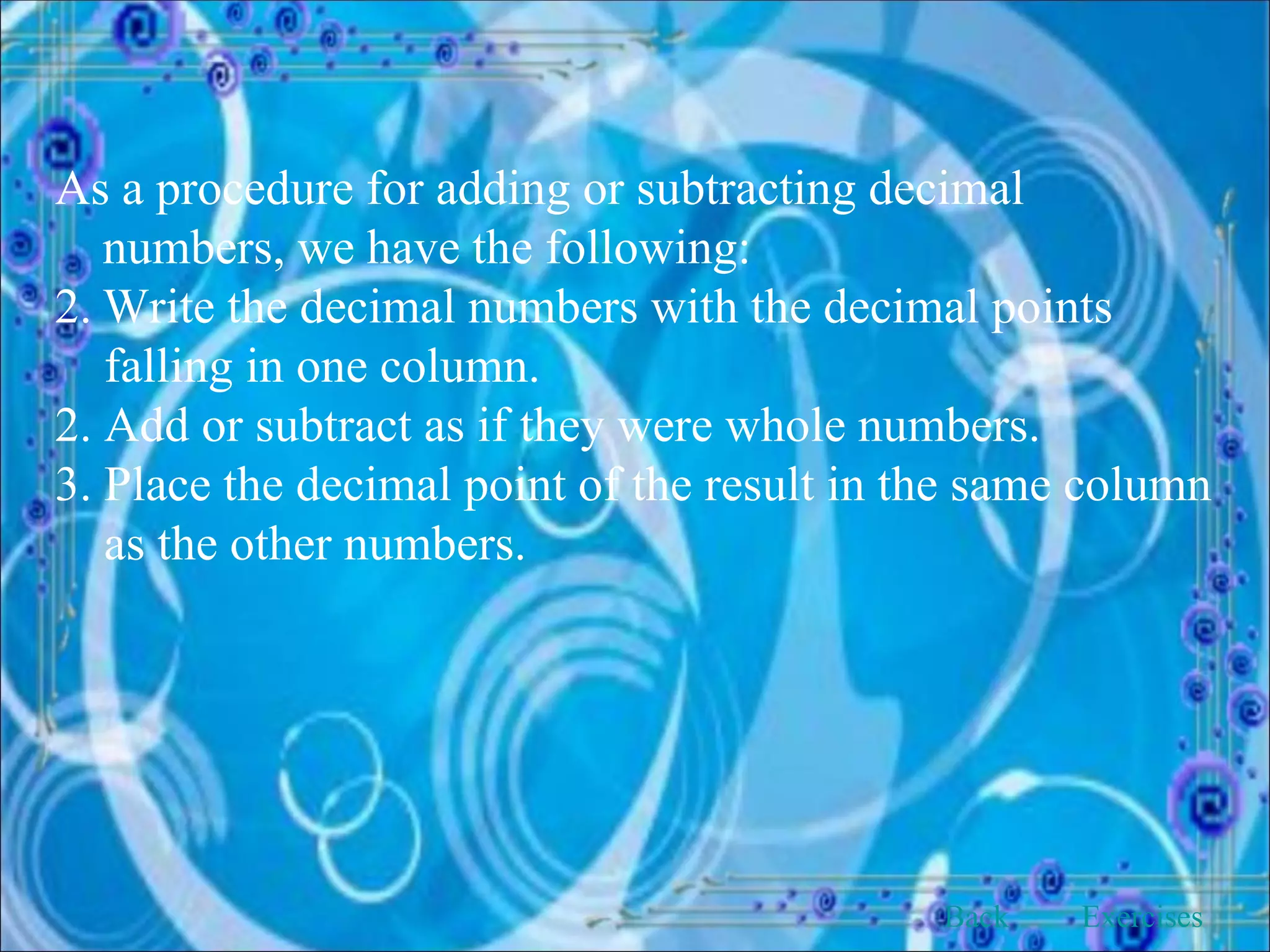
As a procedure for adding or subtracting decimal numbers, we have the following: Write the decimal numbers with the decimal points  falling in one column. 2. Add or subtract as if they were whole numbers. 3. Place the decimal point of the result in the same column as the other numbers. Back Exercises
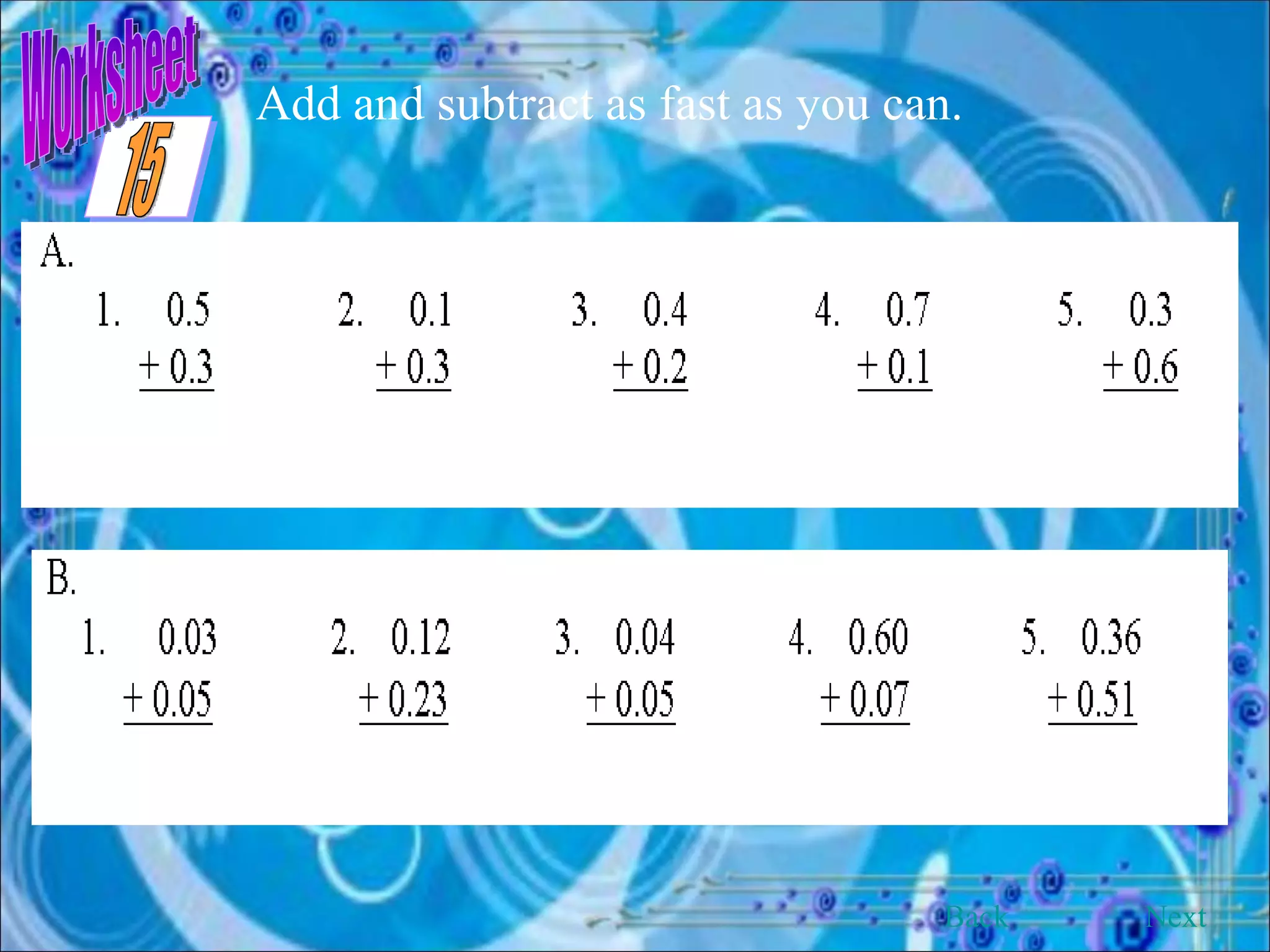
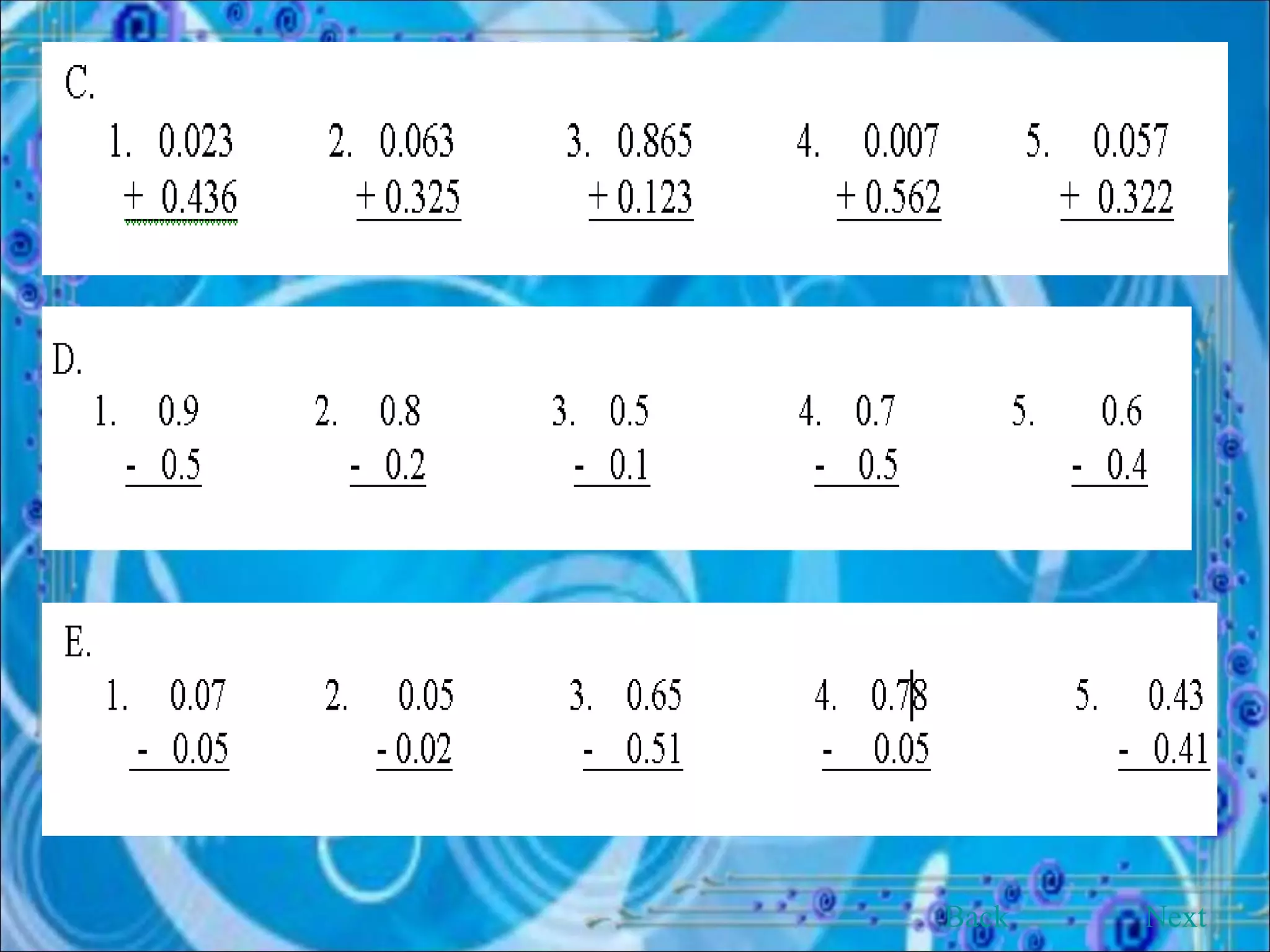
Worksheet Add and subtract as fast as you can. Back Next 15
Back Next
FUN WITH MATH!!! Add and subtract the following to find the mystery words and write the letter of each answer in the code below. This appears twice in the Bible (In Matthew VI and Luke II). Back Next
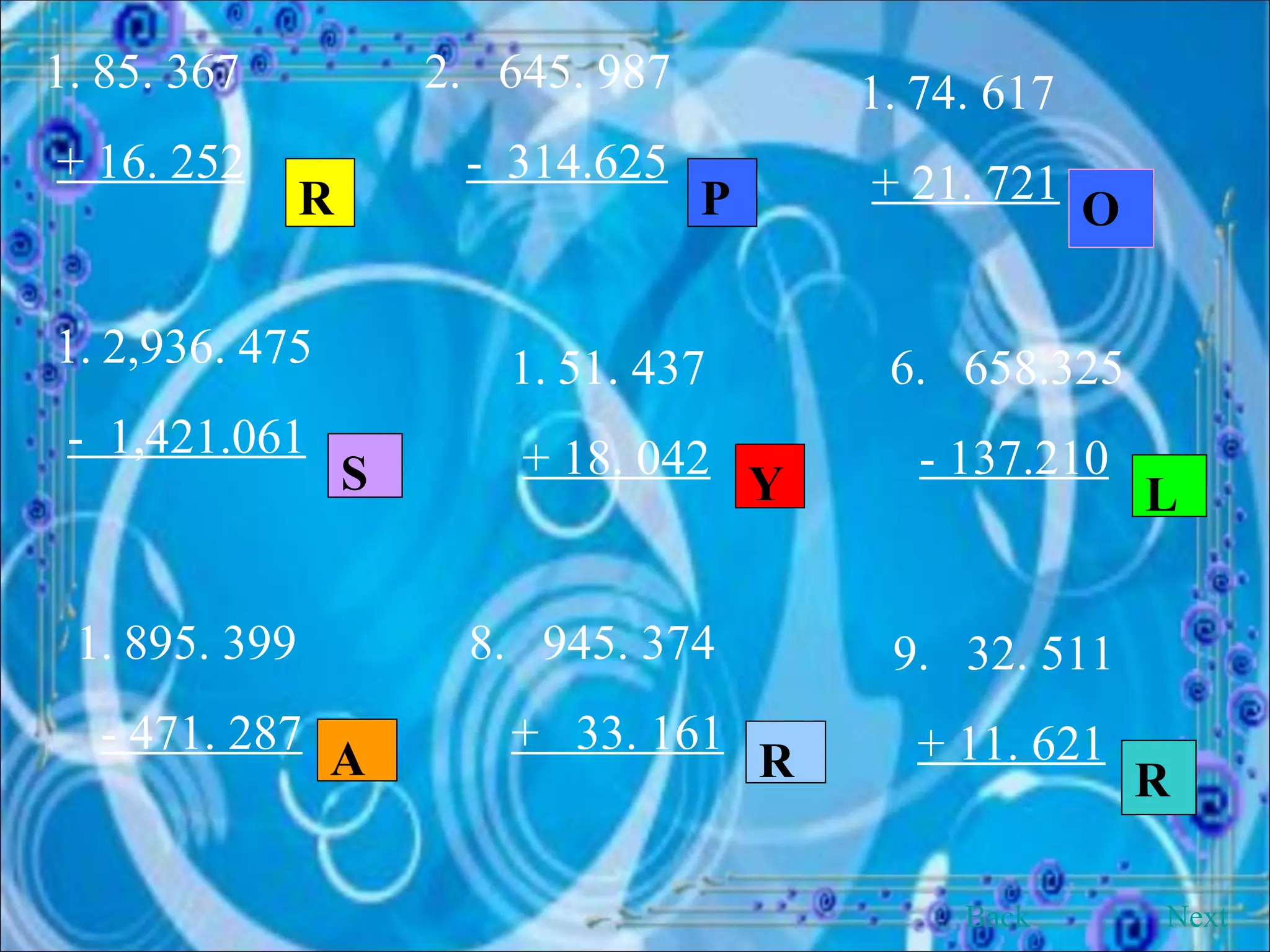
85. 367  2.  645. 987 + 16. 252   -  314.625   R P 74. 617 + 21. 721   O 2,936. 475  -  1,421.061   S 51. 437  6.  658.325  + 18. 042   - 137.210   Y L 895. 399  8.  945. 374 - 471. 287   +  33. 161   A R 9.  32. 511  + 11. 621   R Back Next
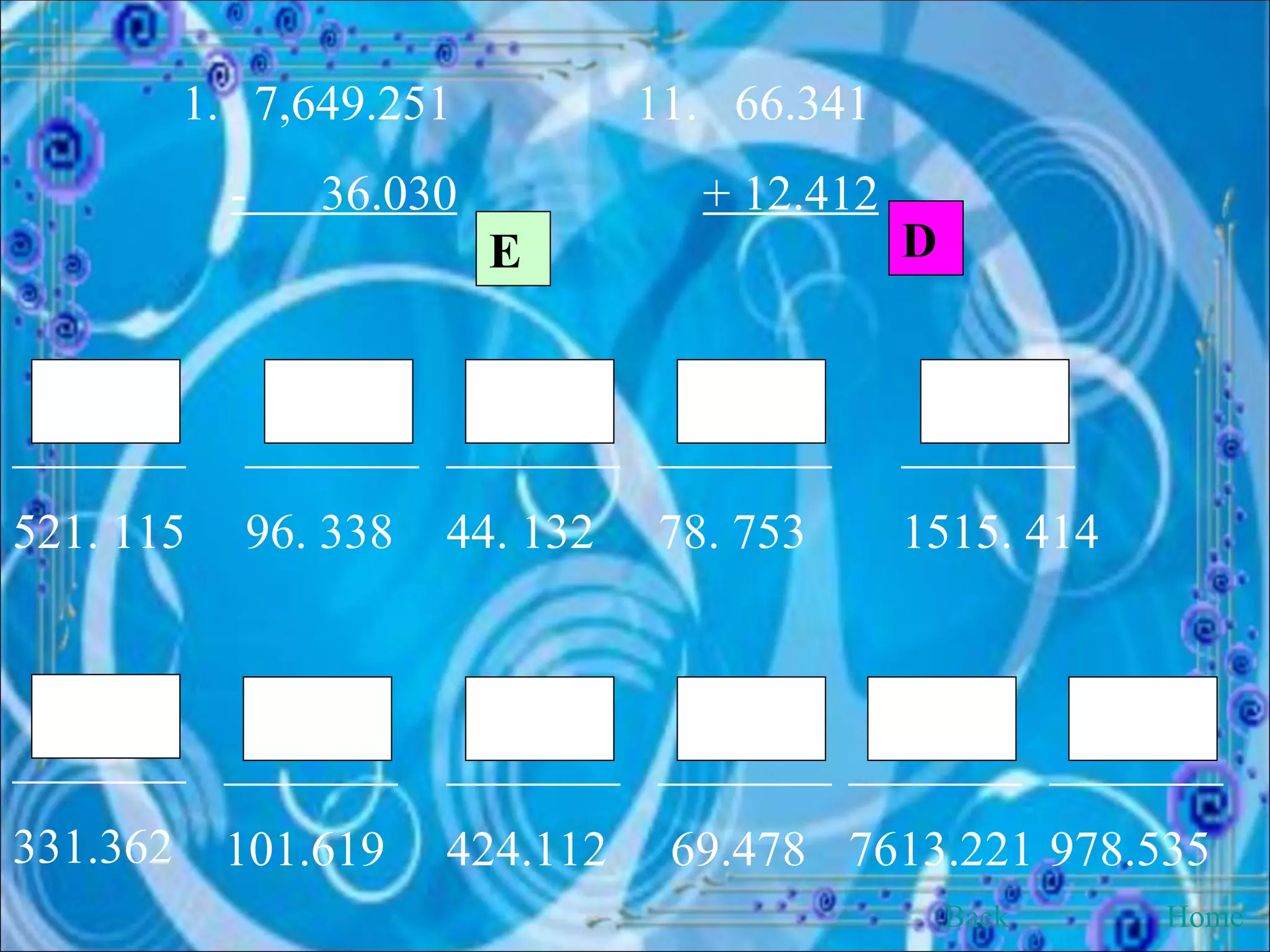
7,649.251  11.  66.341  -  36.030   + 12.412   E D _______ 521. 115  _______ 96. 338  _______ 44. 132  _______ 78. 753  _______ 1515. 414  _______ 331.362  _______ 101.619  _______ 424.112  _______ 69.478  _______ 7613.221  _______ 978.535  Back Home
Lesson 16 ADDITION AND SUBTRACTION OF DECIMAL NUMBERS WITH REGROUPING   Lesson Objectives: After accomplishing the lesson, the students are expected to be able to: 1. Define regrouping. 2. Learn how to add and subtract decimal  numbers with regrouping. 3. Answer and perform the operation critically  and correctly. Next Content
In the past lesson, you’ve learned how to add and subtract decimal numbers without regrouping. The only difference in this lesson is that it involves regrouping and borrowing. It is easy to add and subtract decimal numbers without regrouping.  Back Next
Regrouping  is a process of putting numbers in their proper place values in our number system to make it easier to add and subtract. Here’s how to add decimal numbers with regrouping. Back Next
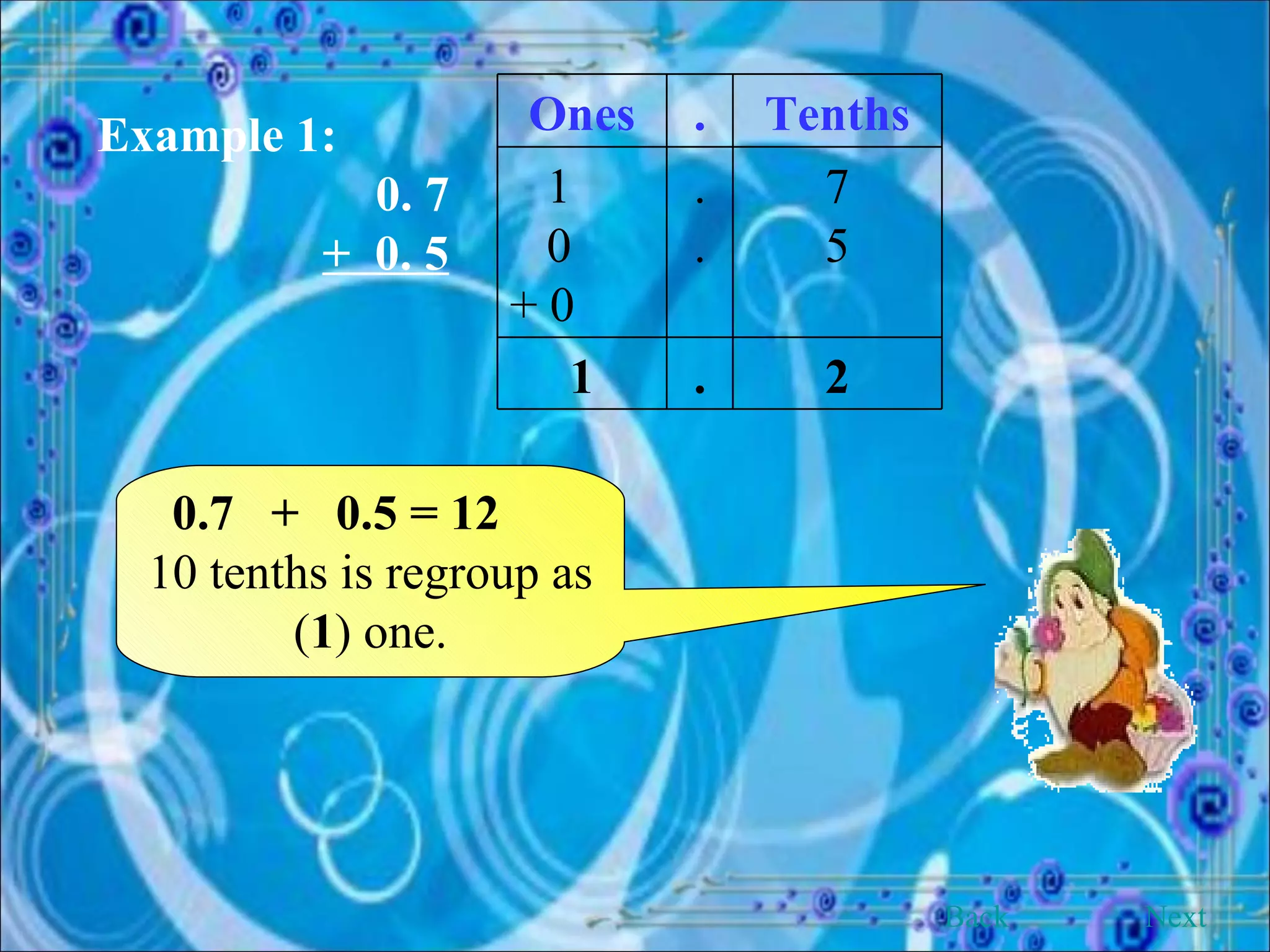
Example 1:     0. 7   +  0. 5 0.7  +  0.5 = 12 10 tenths is regroup as ( 1 ) one. Back Next Ones . Tenths 1 0 + 0 . . 7 5 1 . 2
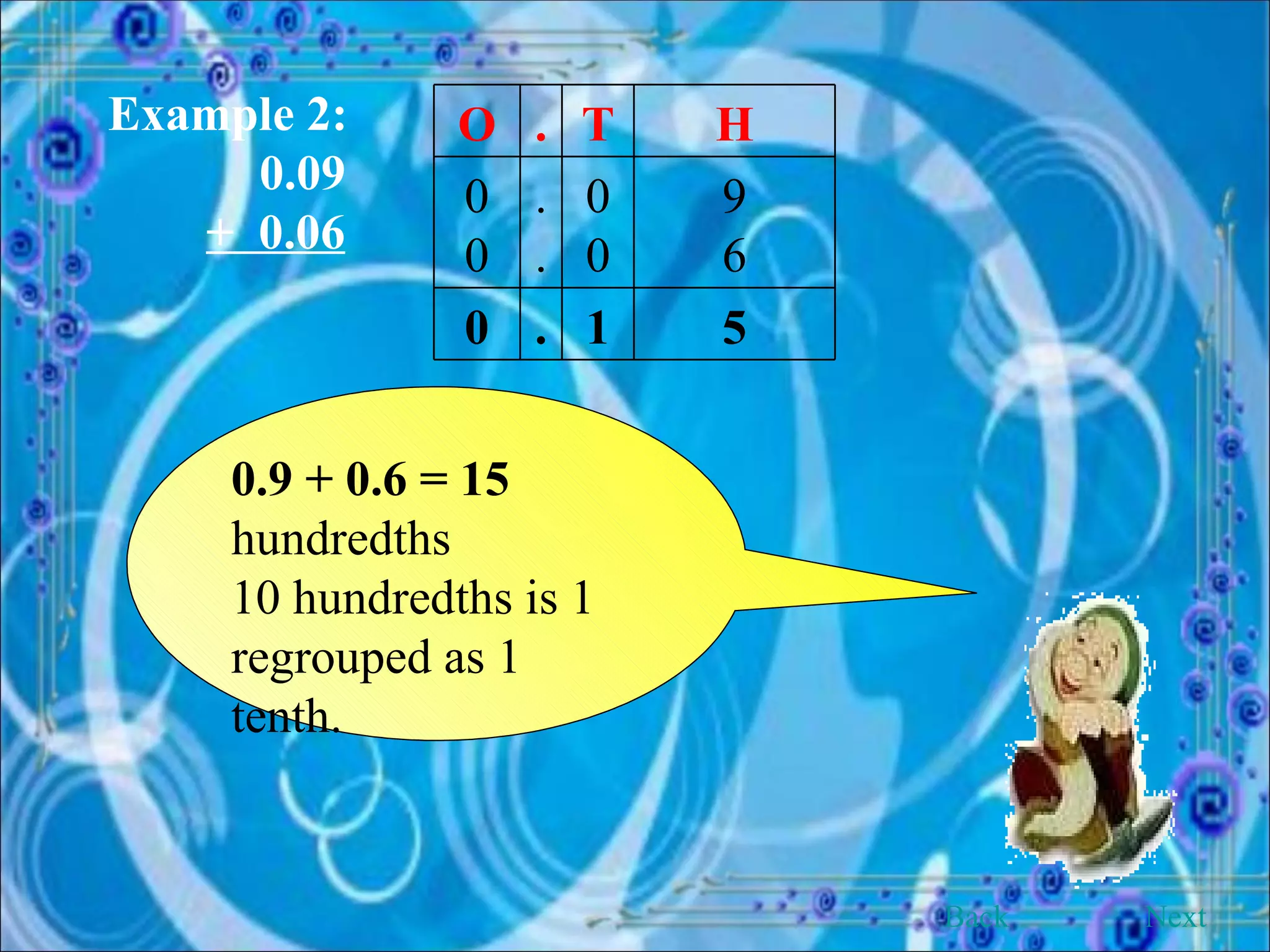
Example 2:   0.09 +  0.06 0.9 + 0.6 = 15  hundredths 10 hundredths is 1 regrouped as 1 tenth. Back Next O . T H 0 0 . . 0 0 9 6 0 . 1 5
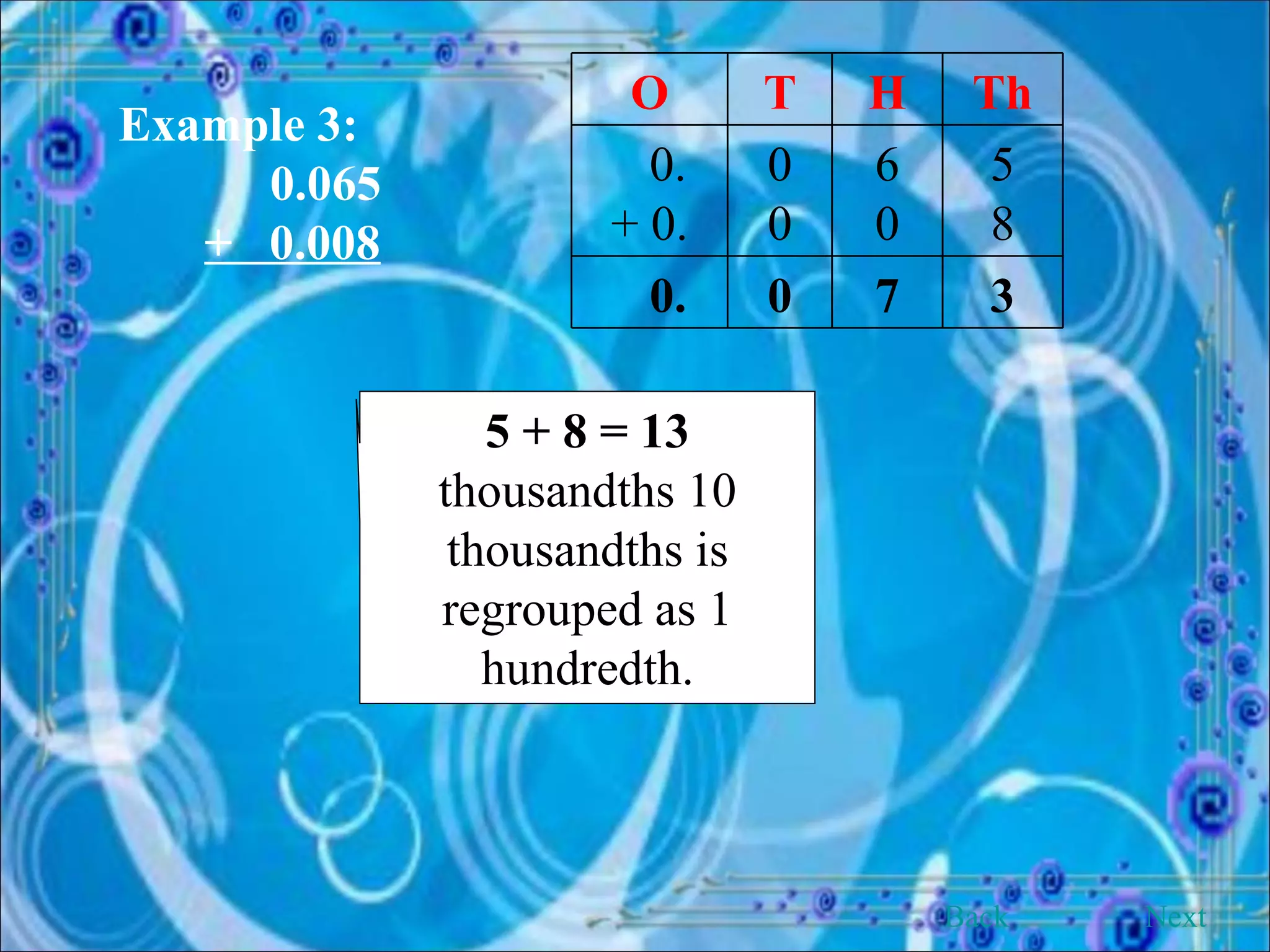
Example 3:   0.065 +  0.008 5 + 8 = 13  thousandths 10 thousandths is regrouped as 1 hundredth. Back Next O T H Th 0. + 0. 0 0 6 0 5 8 0. 0 7 3
Subtract decimals like you were subtracting whole numbers. Back Next
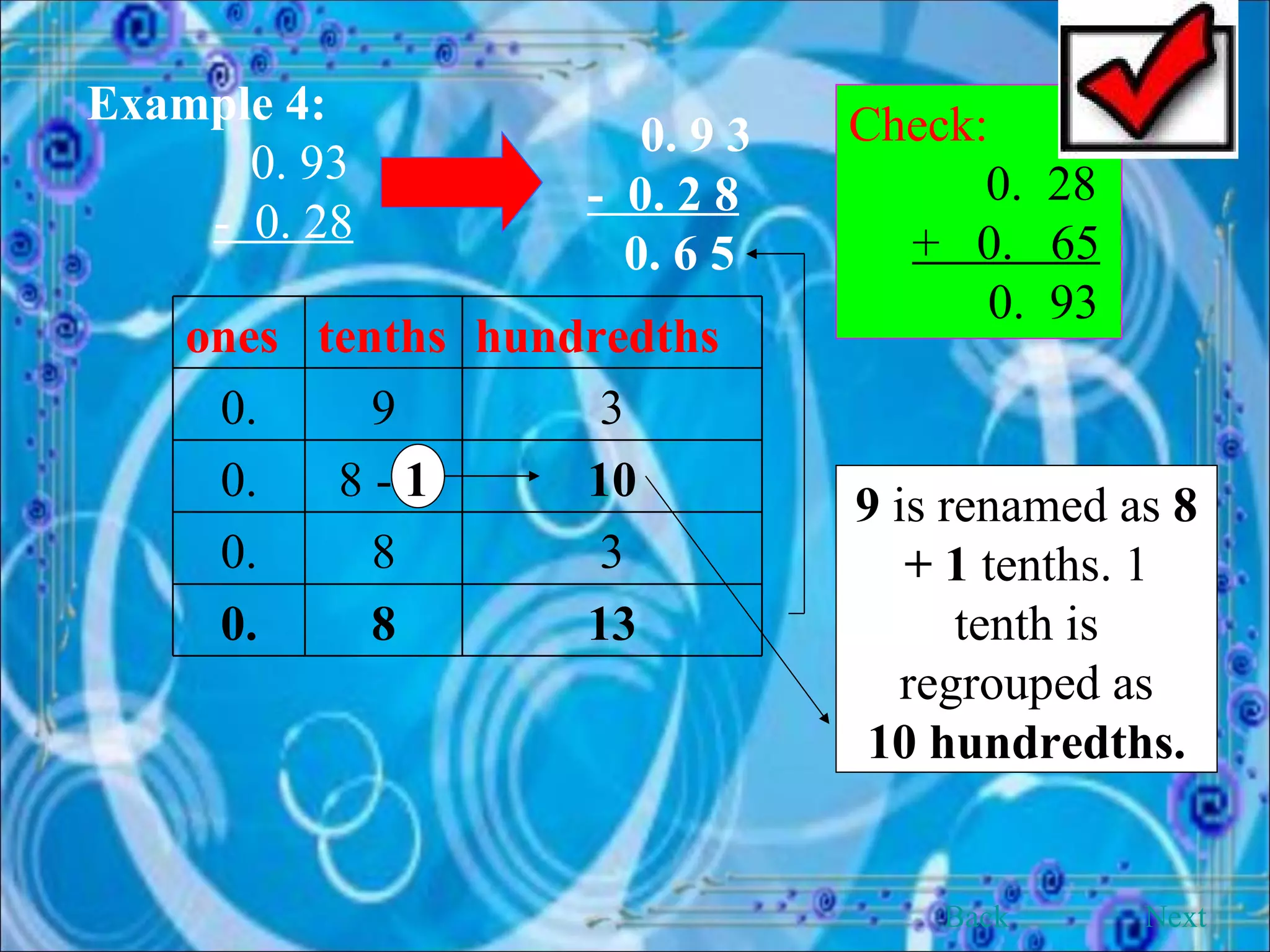
Example 4:   0. 93 -  0. 28   9  is renamed as  8 + 1  tenths. 1 tenth is regrouped as 10 hundredths.   0. 9 3 -  0. 2 8 0. 6 5   Check:  0.  28 +  0.  65   0.  93 Back Next ones tenths hundredths 0. 9 3 0. 8 -  1 10 0. 8 3 0. 8 13
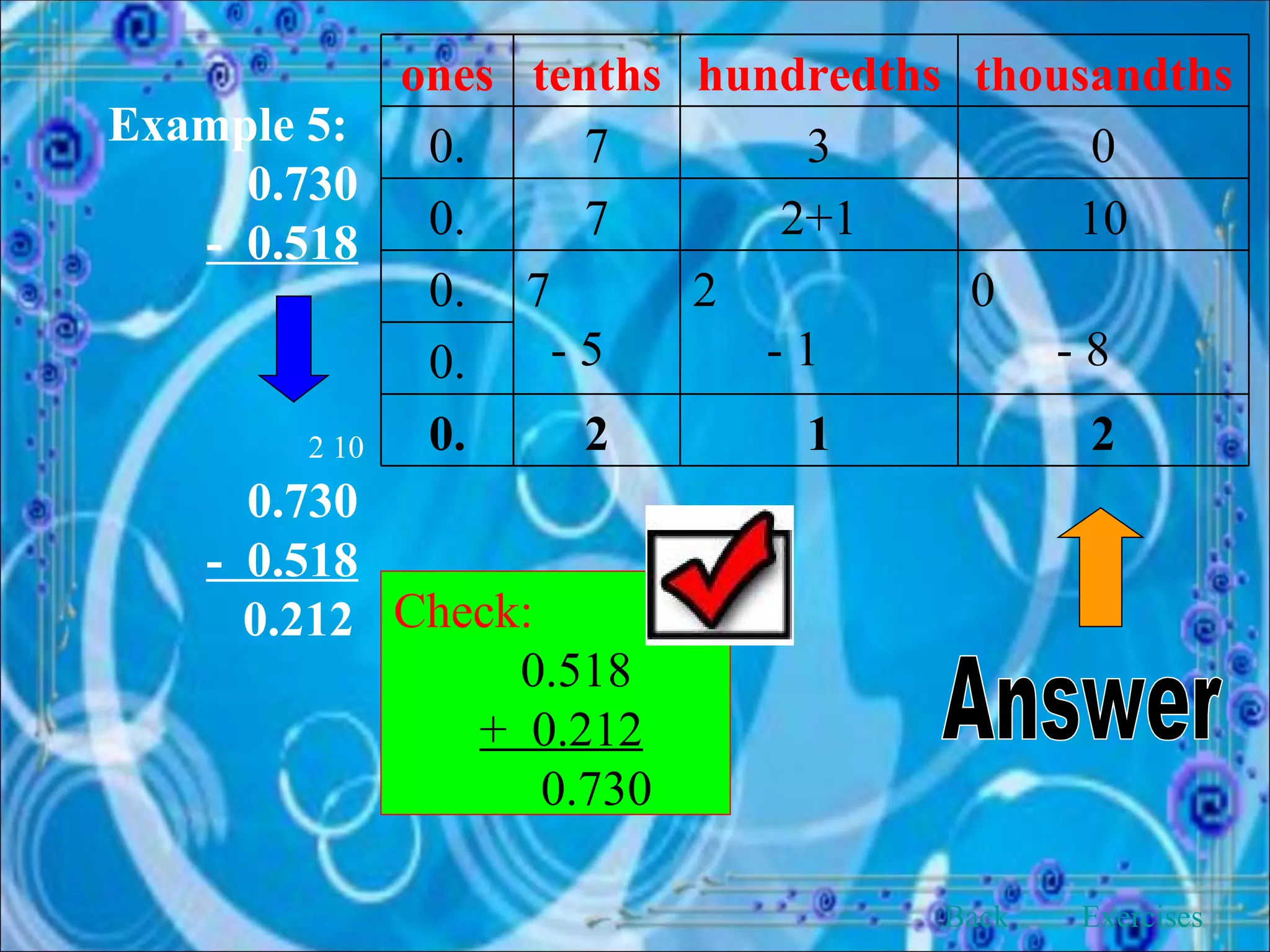
Example 5:     0.730 -  0.518   2 10   0.730 -  0.518 0.212 Check:  0.518 +  0.212 0.730 Answer Back Exercises ones tenths hundredths thousandths 0. 7 3 0 0. 7 2+1 10 0. 7 - 5 2 - 1 0 - 8 0. 0. 2 1 2
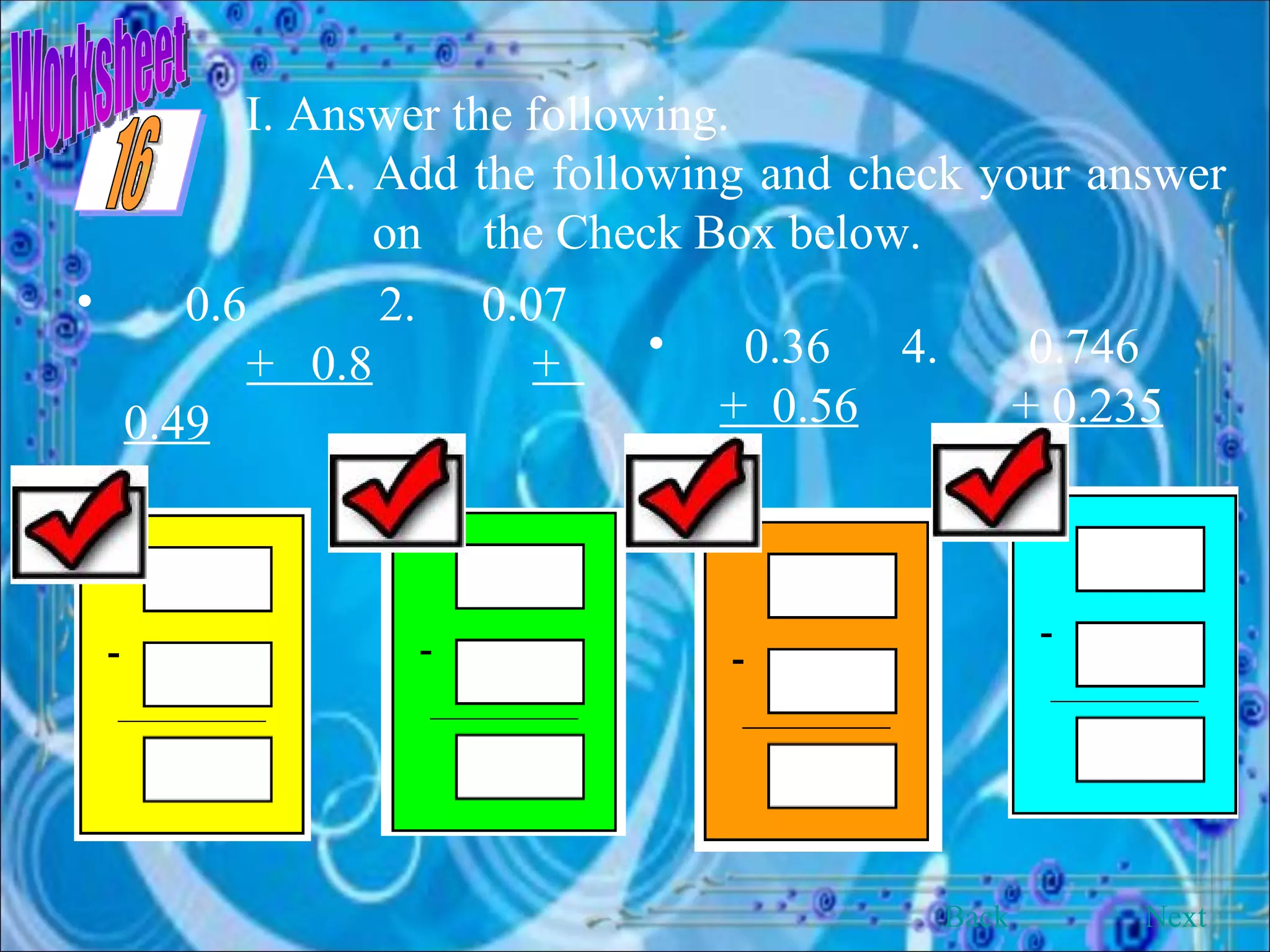
Worksheet I. Answer the following. A. Add the following and check your answer on  the Check Box below.  0.6   2.   0.07  +  0.8   +  0.49   0.36 4. 0.746  +  0.56   + 0.235 Back Next 16
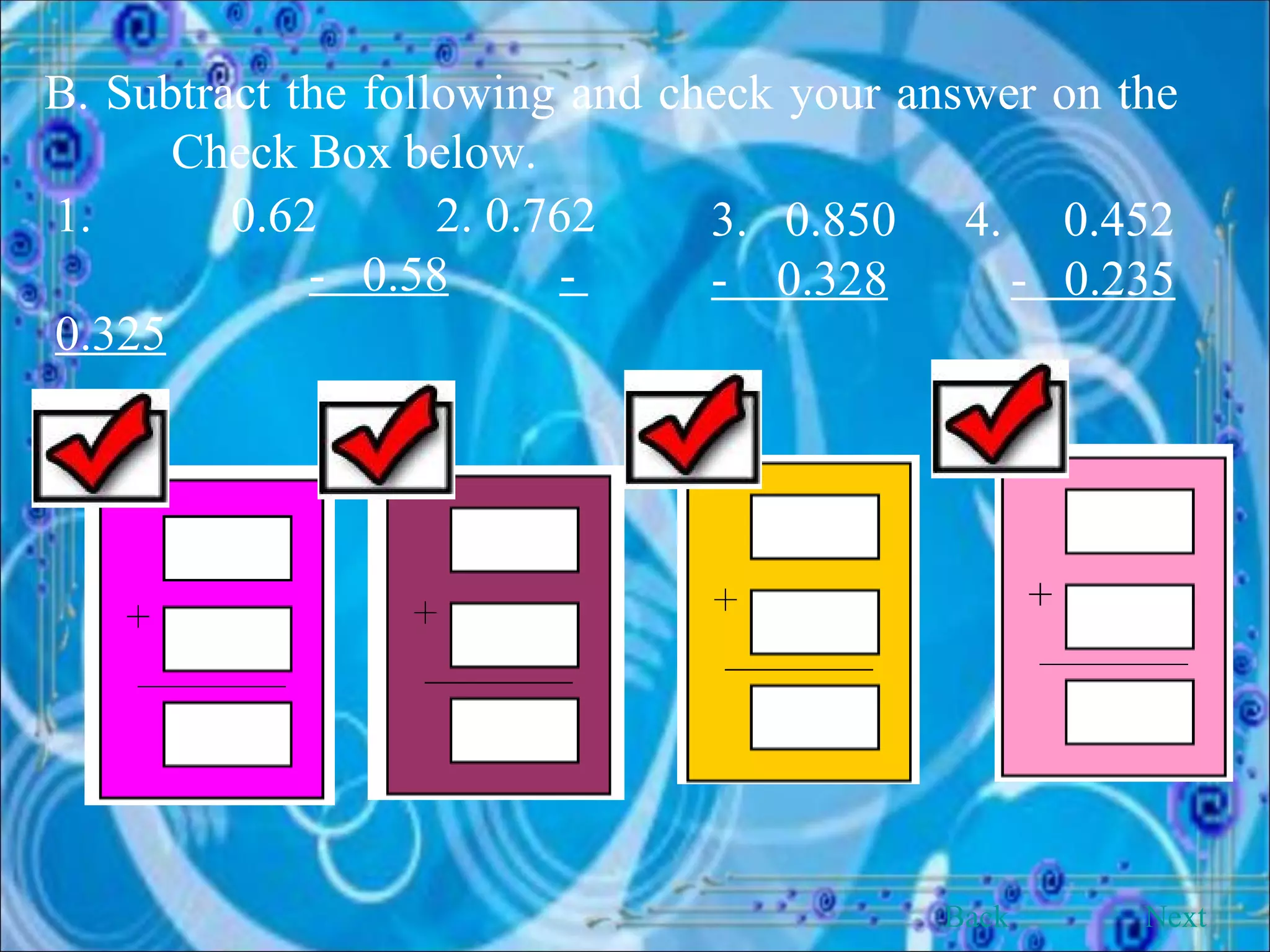
B. Subtract the following and check your answer on the  Check Box below. 1.   0.62 2. 0.762  -  0.58   -  0.325   3.  0.850 4.  0.452  -  0.328   -  0.235   Back Next
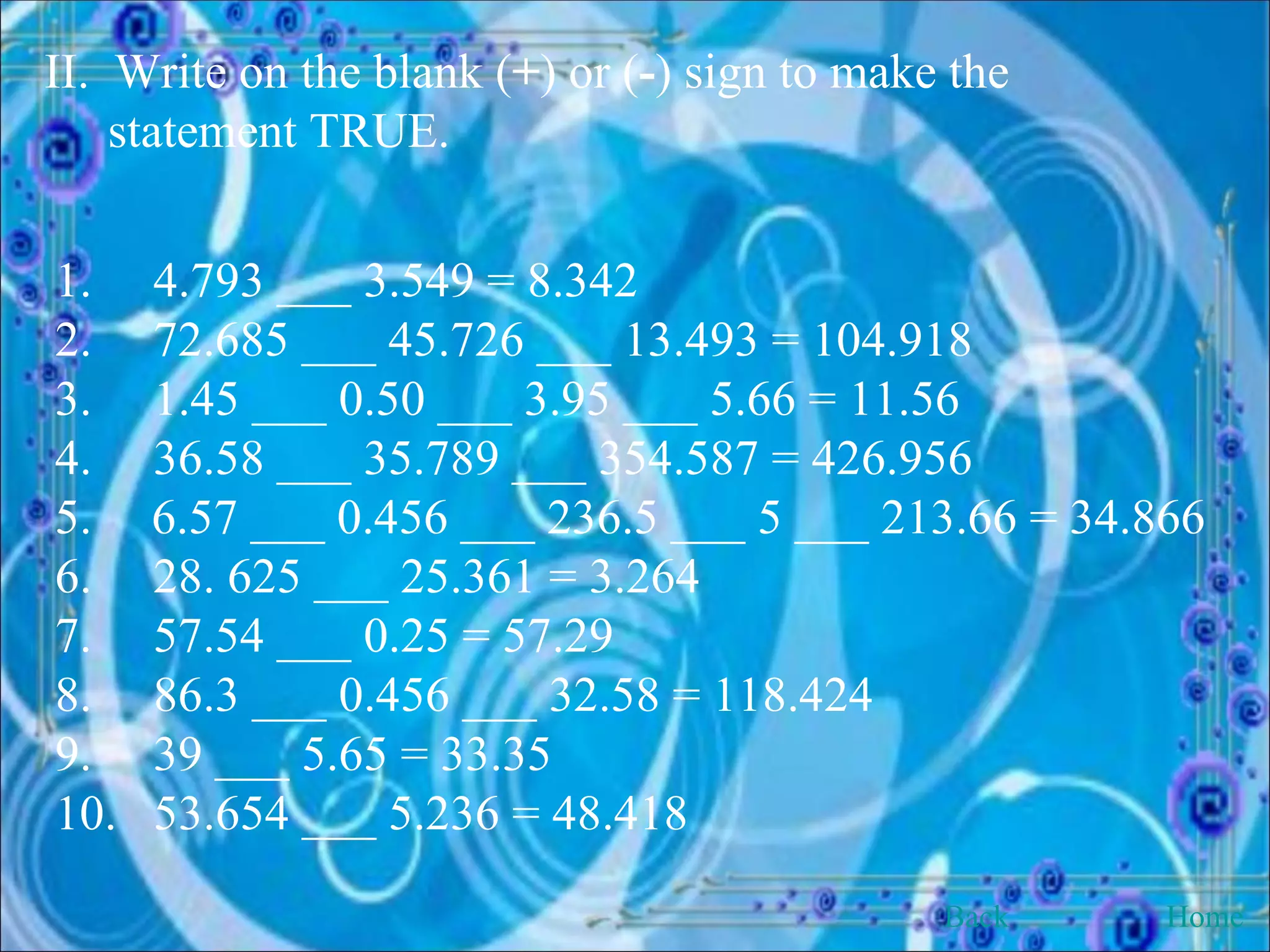
II.  Write on the blank ( + ) or ( - ) sign to make the statement TRUE. 1.  4.793 ___ 3.549 = 8.342 2.  72.685 ___ 45.726 ___ 13.493 = 104.918 3.  1.45 ___ 0.50 ___ 3.95 ___ 5.66 = 11.56 4.  36.58 ___ 35.789 ___ 354.587 = 426.956 6.57 ___ 0.456 ___ 236.5 ___ 5 ___ 213.66 = 34.866 6.  28. 625 ___ 25.361 = 3.264 7.  57.54 ___ 0.25 = 57.29 8.  86.3 ___ 0.456 ___ 32.58 = 118.424 9.  39 ___ 5.65 = 33.35 10.  53.654 ___ 5.236 = 48.418 Back Home
Lesson 17 ADDING AND SUBTRACTING MIXED DECIMALS Lesson Objectives: After finishing the lesson, the students are expected to: 1. Understand and know how to add and subtract  mixed decimal numbers. 2. Follow the rules in adding and subtracting  mixed decimal numbers.  3. Perform the operation correctly.  Next Content
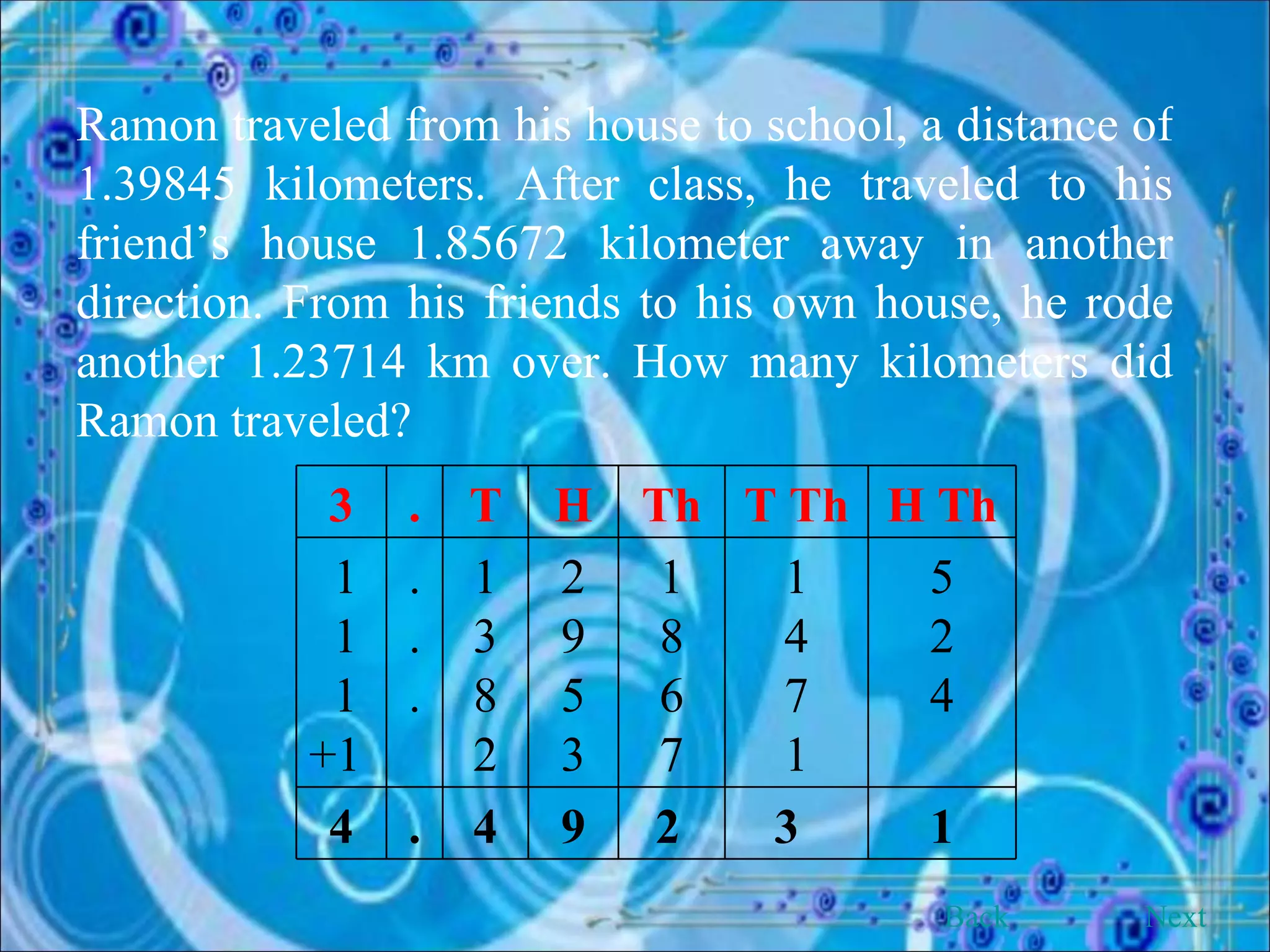
Ramon traveled from his house to school, a distance of 1.39845 kilometers. After class, he traveled to his friend’s house 1.85672 kilometer away in another direction. From his friends to his own house, he rode another 1.23714 km over. How many kilometers did Ramon traveled? Back Next 3 . T H Th T Th H Th 1 1 1 +1 . . . 1 3 8 2 2 9 5 3 1 8 6 7 1 4 7 1 5 2 4 4 . 4 9 2 3 1
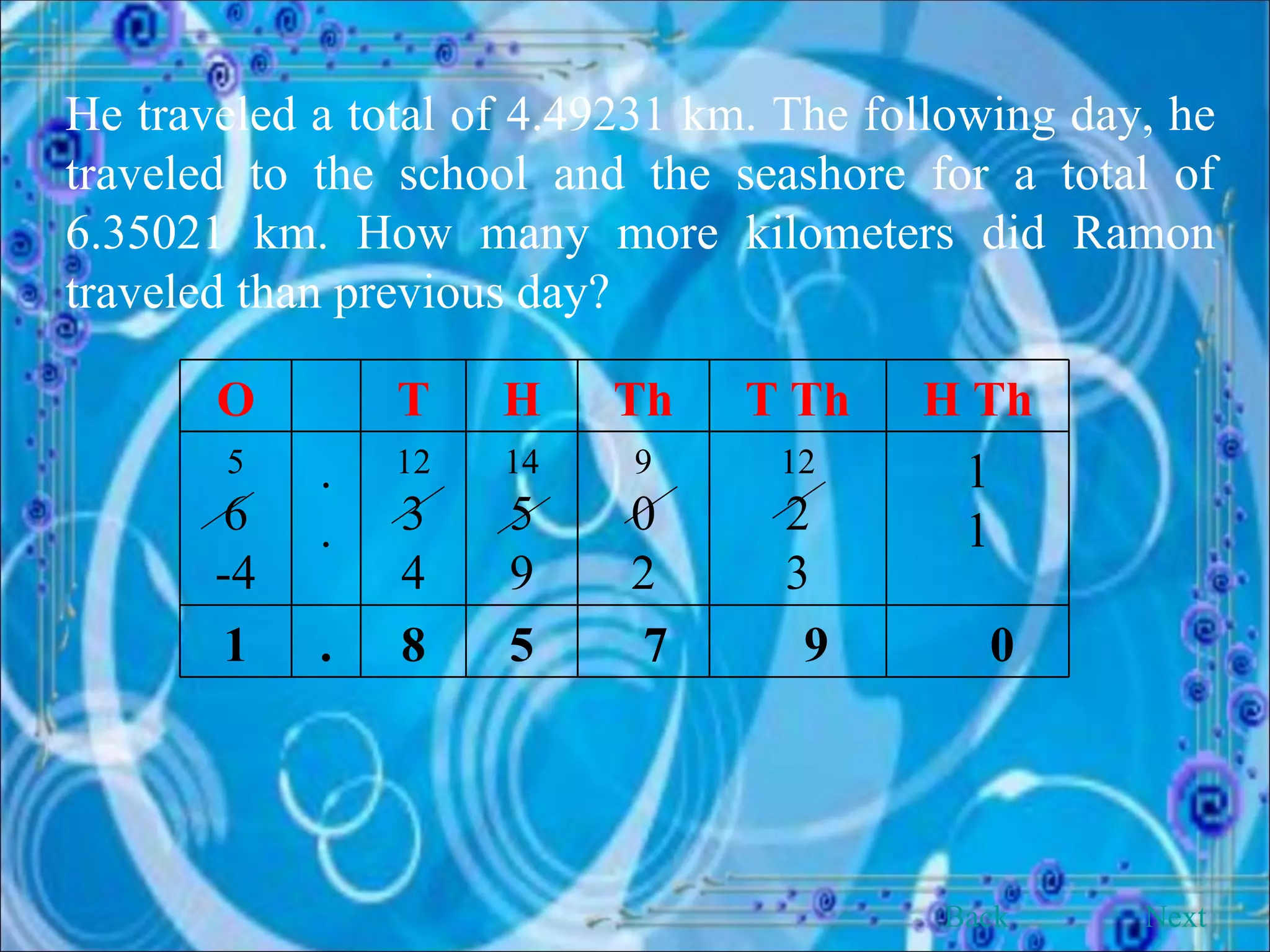
He traveled a total of 4.49231 km. The following day, he traveled to the school and the seashore for a total of 6.35021 km. How many more kilometers did Ramon traveled than previous day? Back Next O T H Th T Th H Th 5 6 -4 . . 12 3 4 14 5 9 9 0 2 12 2 3 1 1 1 . 8 5 7 9 0
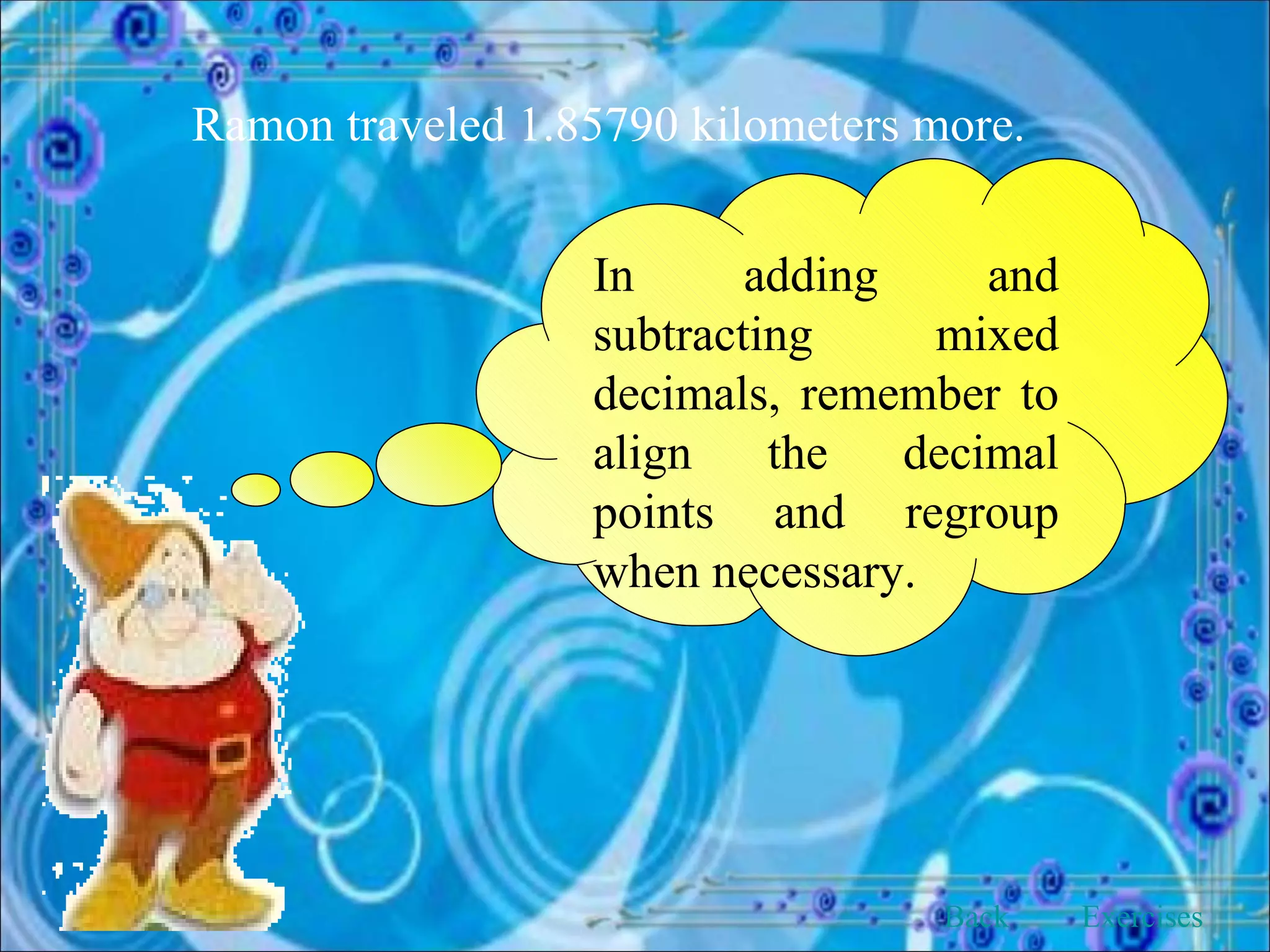
Ramon traveled 1.85790 kilometers more. In adding and subtracting mixed decimals, remember to align the decimal points and regroup when necessary. Back Exercises
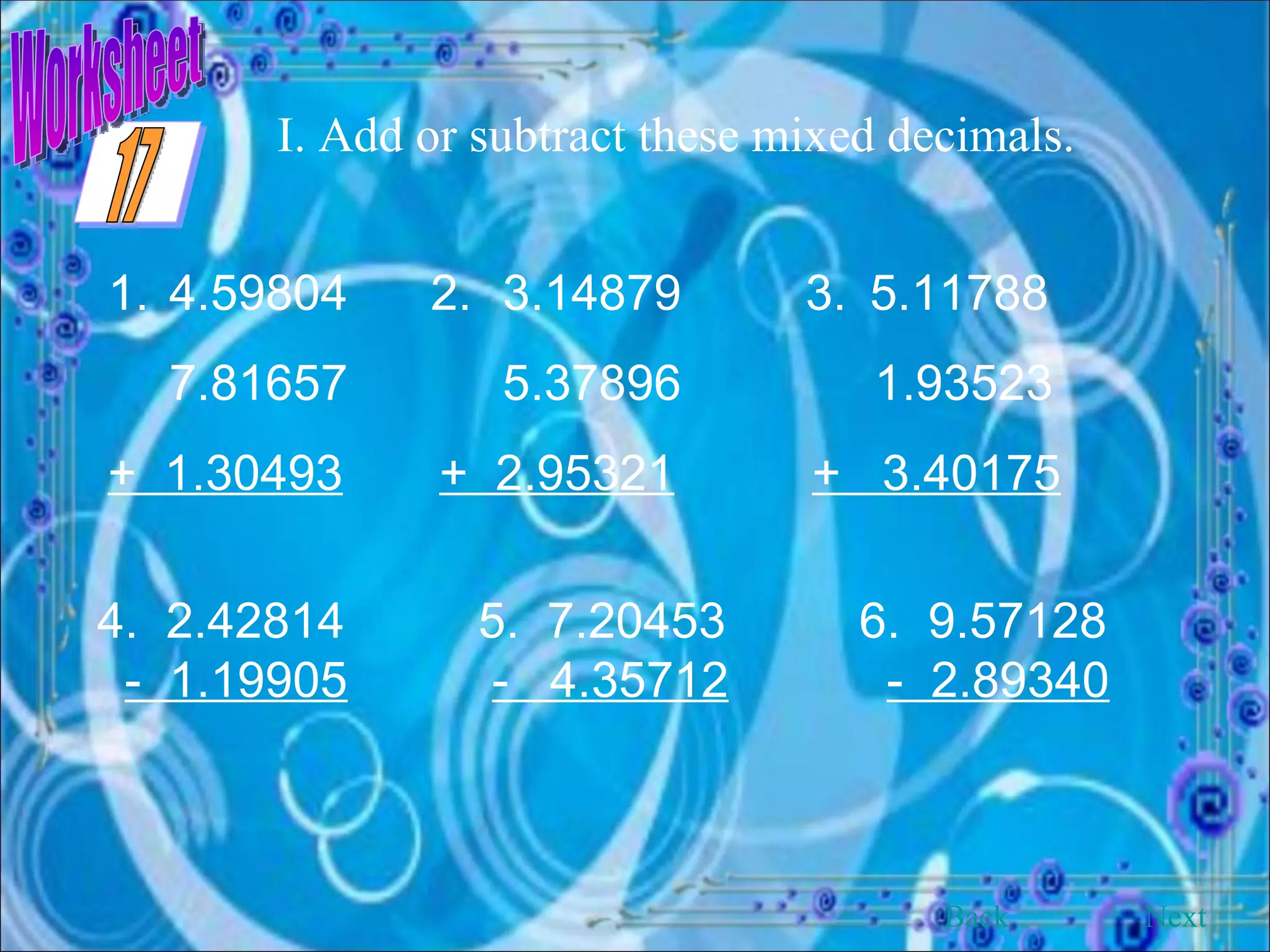
Worksheet I. Add or subtract these mixed decimals. 4.59804   2.  3.14879  3. 5.11788    7.81657  5.37896  1.93523  +  1.30493   +  2.95321   +  3.40175 4.  2.42814 5.  7.20453 6.  9.57128 -  1.19905   -  4.35712   -  2.89340 Back Next 17
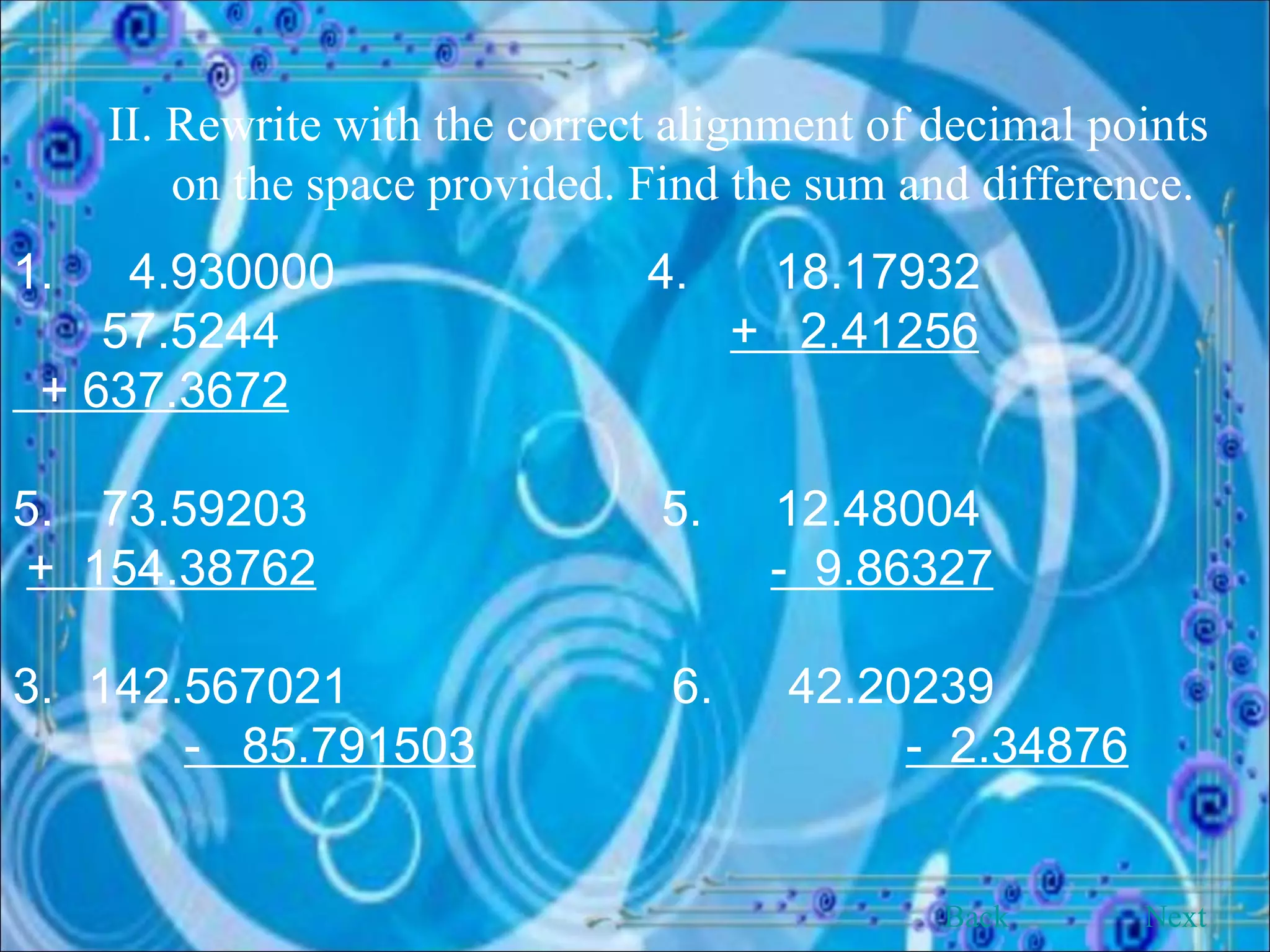
II. Rewrite with the correct alignment of decimal points on the space provided. Find the sum and difference. 1.   4.930000 4. 18.17932   57.5244    +  2.41256 + 637.3672 73.59203  5. 12.48004 +  154.38762   -  9.86327   3.   142.567021   6.  42.20239   -  85.791503   -  2.34876 Back Next
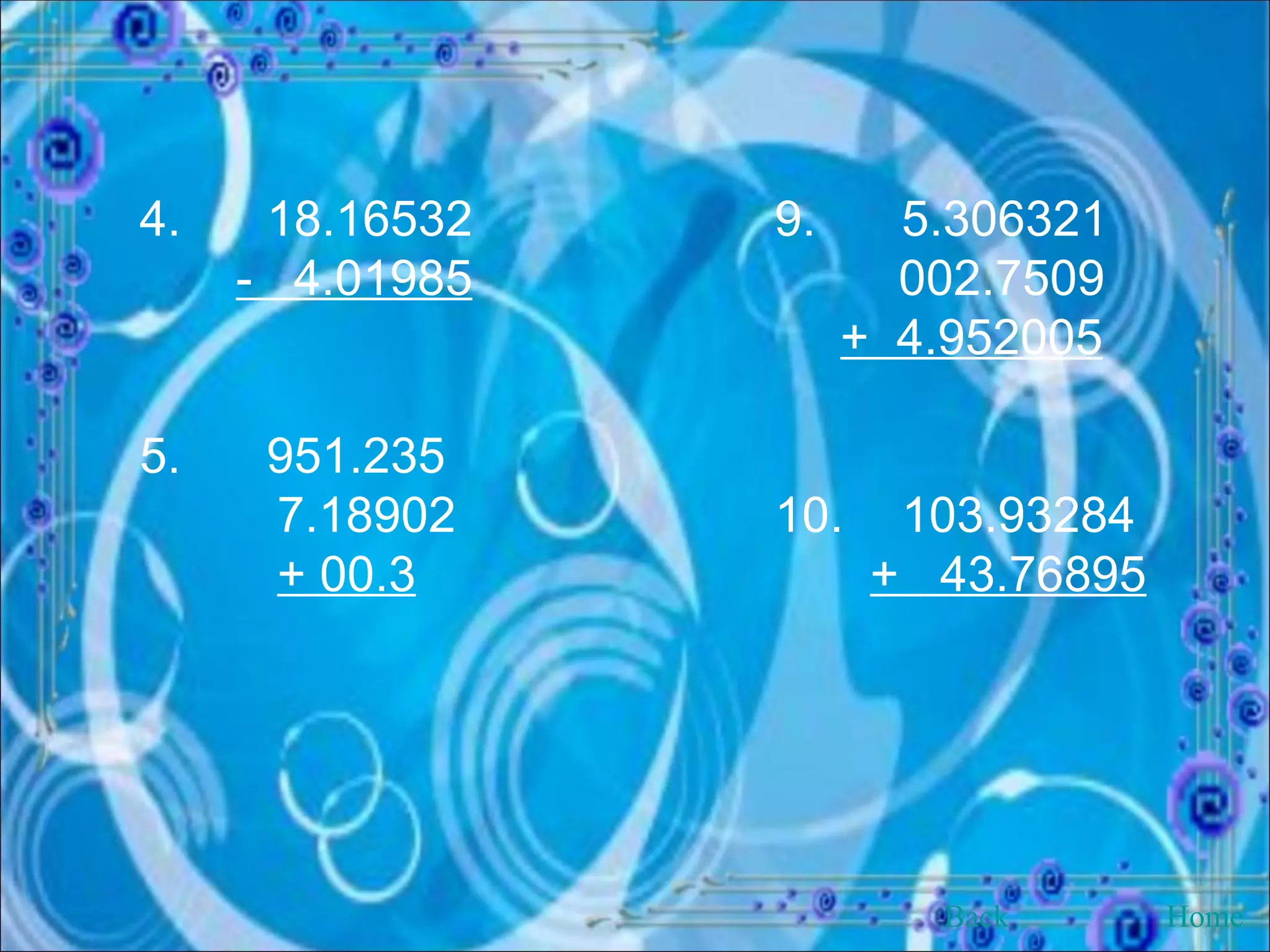
4. 18.16532 9. 5.306321 -  4.01985     002.7509     +  4.952005 5. 951.235 7.18902 10. 103.93284 + 00.3   +  43.76895 Back Home
Lesson 18 ESTIMATING SUM AND DIFFERENCE OF WHOLE NUMBERS AND DECIMALS Lesson Objectives: After understanding the lesson, you must be able to: . Define estimation. 2. Know the two methods in making estimates. 3. Learn how to estimate sum and difference and  how it is done. Next Content
Estimation  is a way of answering a problem which does not require an exact answer. An estimate is all that is needed when an exact value is not possible. Estimation is easy to use and or to compute. Rounding is one way of making estimation. Each decimal number is rounding to some place value, usually to the greatest value and the necessary operation is performance on the rounded decimal numbers. Back Next
Two methods are used in making estimation, the rounding off the desired digit one and finding the sum of the first digit only. We have learned how to round decimal numbers in this section, first only the front digits are used. If an improved or refined estimate is desired, the next digits are used. Back Next
When large decimal numbers are involved, it is wise to estimate before computing the exact and user is expected to be about or close to the estimate. Method 1: Sum of the First Digit only Estimate in Addition 3.455 + 2.672 + 5.135  Back Next
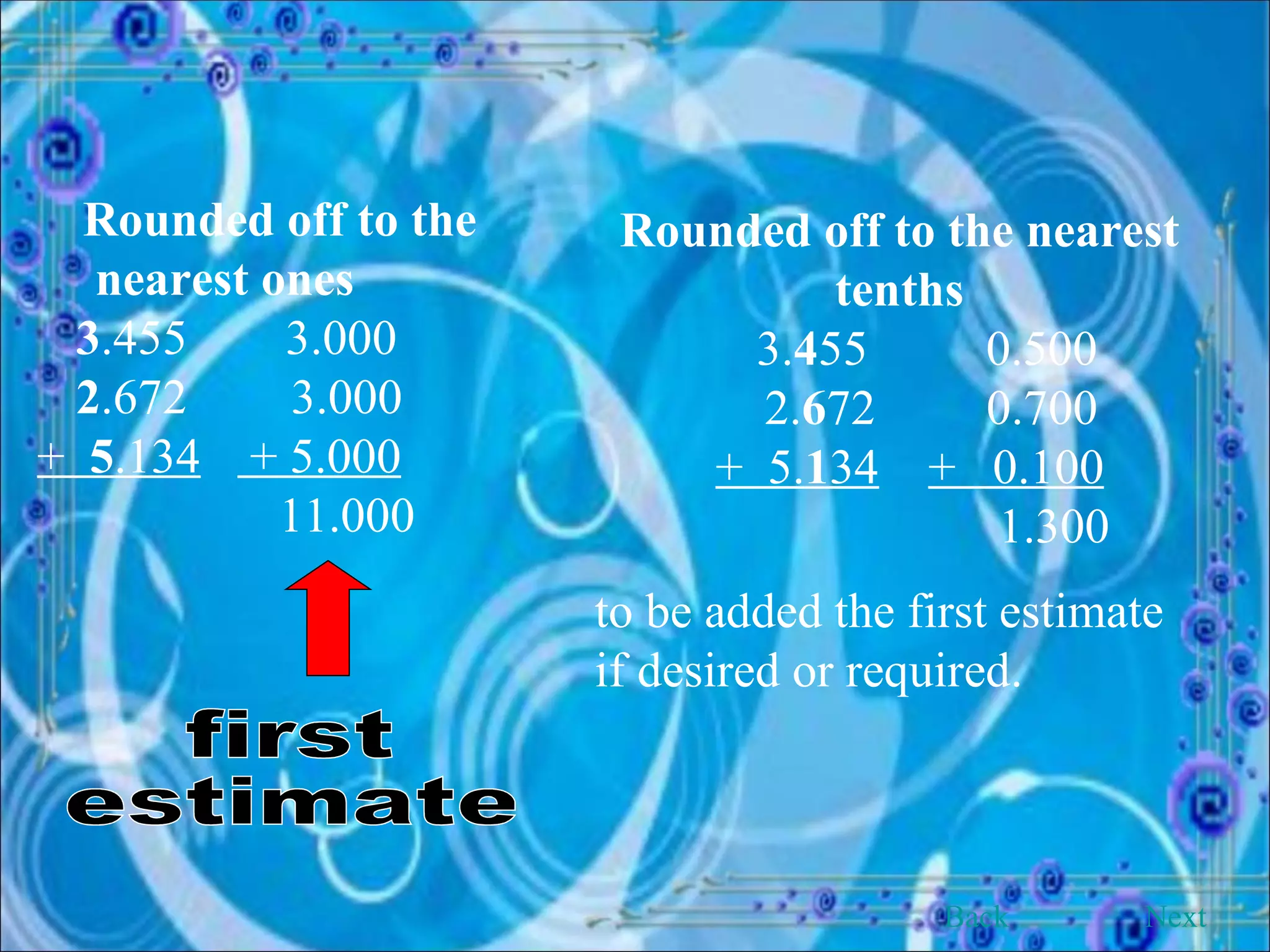
Rounded off to the  nearest ones 3 .455  3.000 2 .672   3.000 +  5 .134   + 5.000   11.000 first  estimate Rounded off to the nearest tenths   3. 4 55  0.500 2. 6 72  0.700 +  5. 1 34   +  0.100   1.300 to be added the first estimate if desired or required. Back Next
Thus the sum 3.455 + 2.672 + 5.134 can be roughly estimated by 11.000. If a better estimate is required or desired, then add 1.300 to get 11.300. Back Next
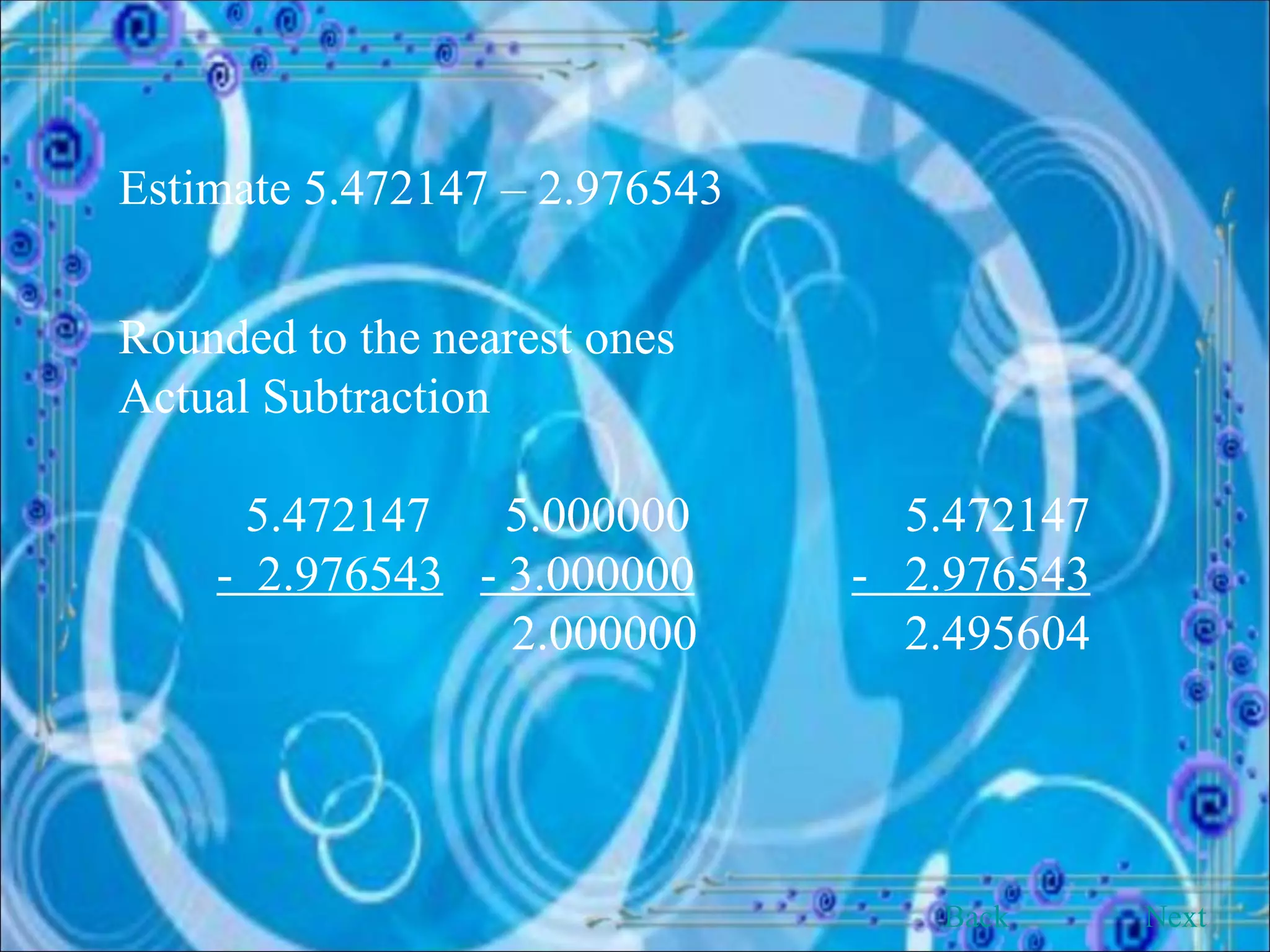
Estimate 5.472147 – 2.976543 Rounded to the nearest ones Actual Subtraction 5.472147  5.000000   5.472147 -  2.976543   - 3.000000   -  2.976543   2.000000   2.495604 Back Next
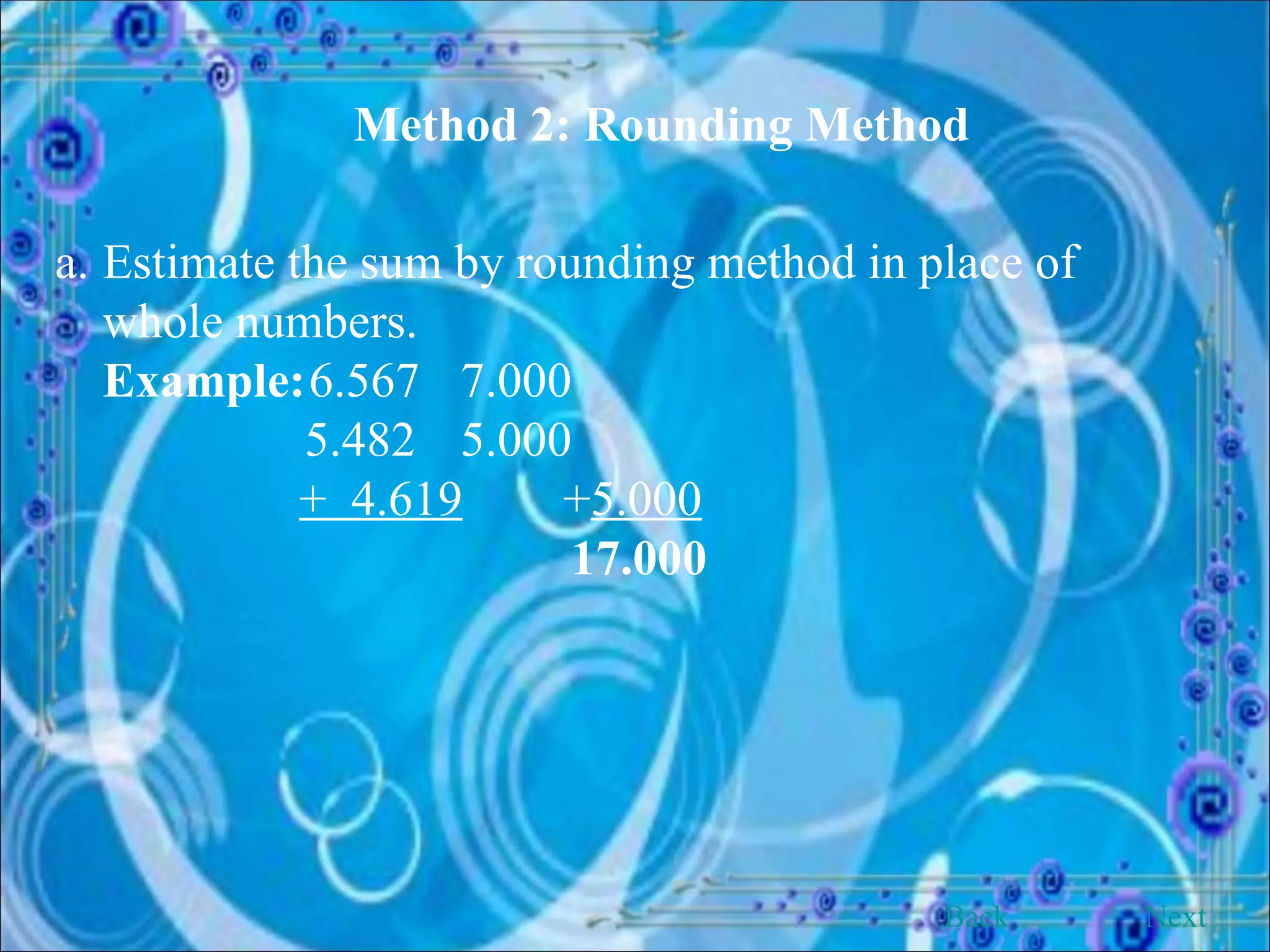
Method 2: Rounding Method Estimate the sum by rounding method in place of whole numbers. Example: 6.567   7.000   5.482   5.000     +  4.619 + 5.000       17.000 Back Next
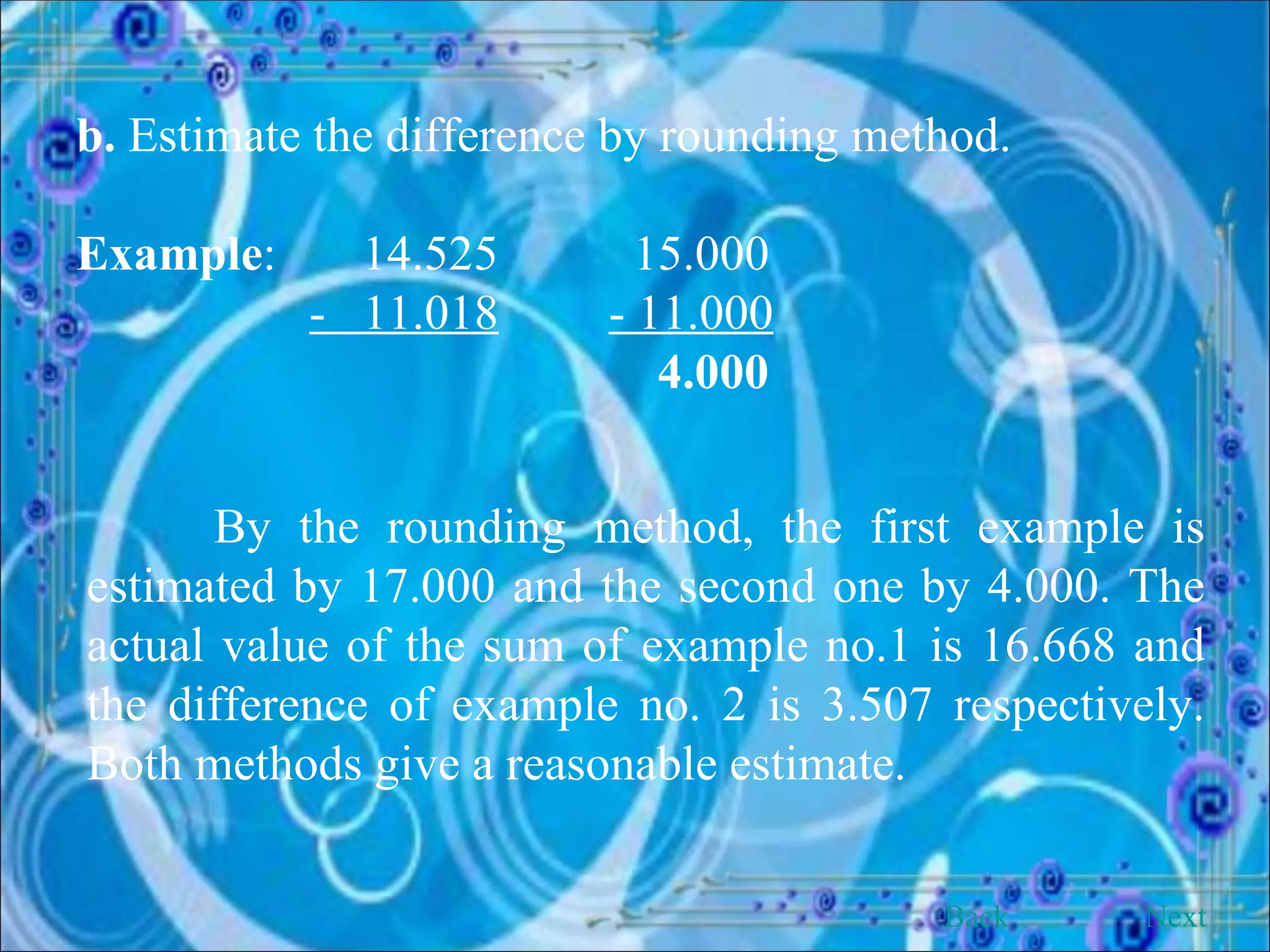
b.  Estimate the difference by rounding method. Example :  14.525   15.000 -  11.018   - 11.000   4.000 By the rounding method, the first example is estimated by 17.000 and the second one by 4.000. The actual value of the sum of example no.1 is 16.668 and the difference of example no. 2 is 3.507 respectively. Both methods give a reasonable estimate. Back Next
Remember: In estimating the sums, first round each addend to its greatest place value position. Then add. If the estimate is close to the exact sum, it is a good estimate. Estimating helps you expect the exact answer to be about a little less or a little more than the estimate. However, in estimating difference, first round the decimal number to the nearest place value asked for. Then subtract the rounded decimal numbers. Check the result by actual subtraction. Back Exercises
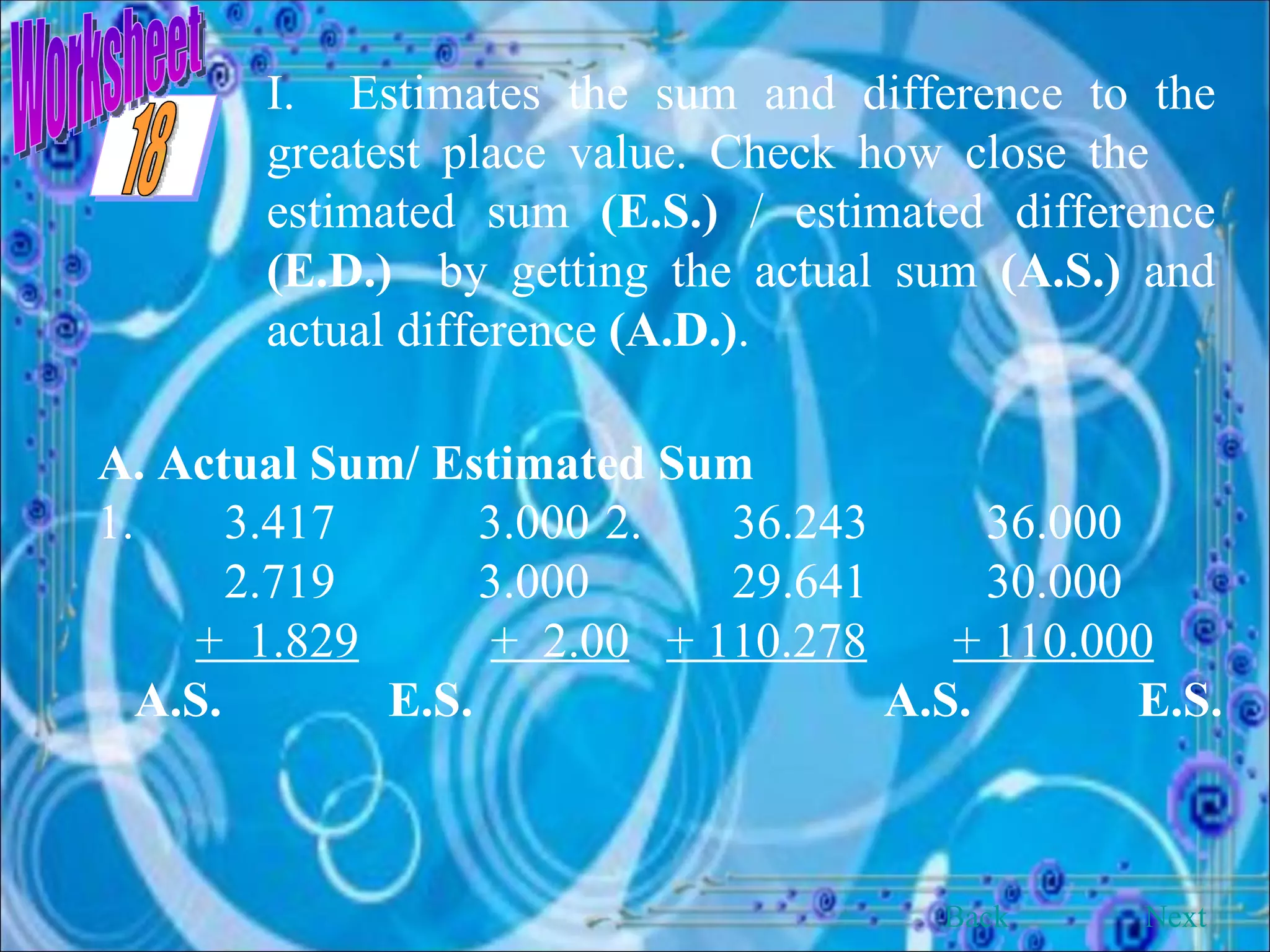
Worksheet I.  Estimates the sum and difference to the greatest place value. Check how close the  estimated sum  (E.S.)  / estimated difference  (E.D.)   by getting the actual sum  (A.S.)  and actual difference  (A.D.) . A. Actual Sum/ Estimated Sum 1. 3.417 3.000 2. 36.243 36.000 2.719 3.000 29.641 30.000 +  1.829   +  2.00   + 110.278   + 110.000 A.S.   E.S.   A.S.   E.S. Back Next 18
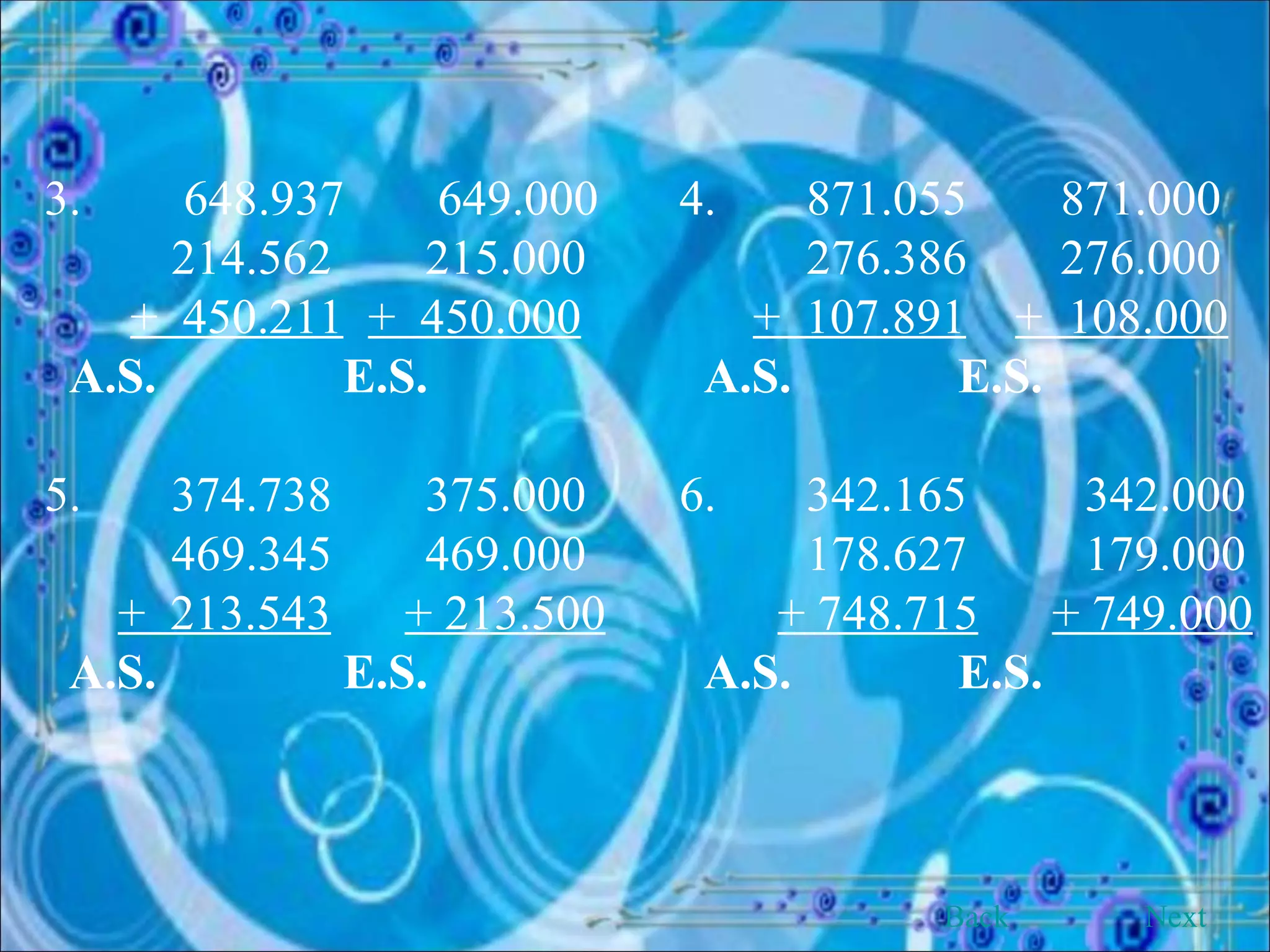
3.  648.937  649.000 4. 871.055 871.000 214.562 215.000 276.386 276.000 +  450.211   +  450.000   +  107.891   +  108.000 A.S.   E.S.   A.S.   E.S. 5. 374.738 375.000 6. 342.165   342.000 469.345 469.000 178.627   179.000 +  213.543   + 213.500   + 748.715   + 749.000 A.S.   E.S.   A.S.   E.S. Back Next
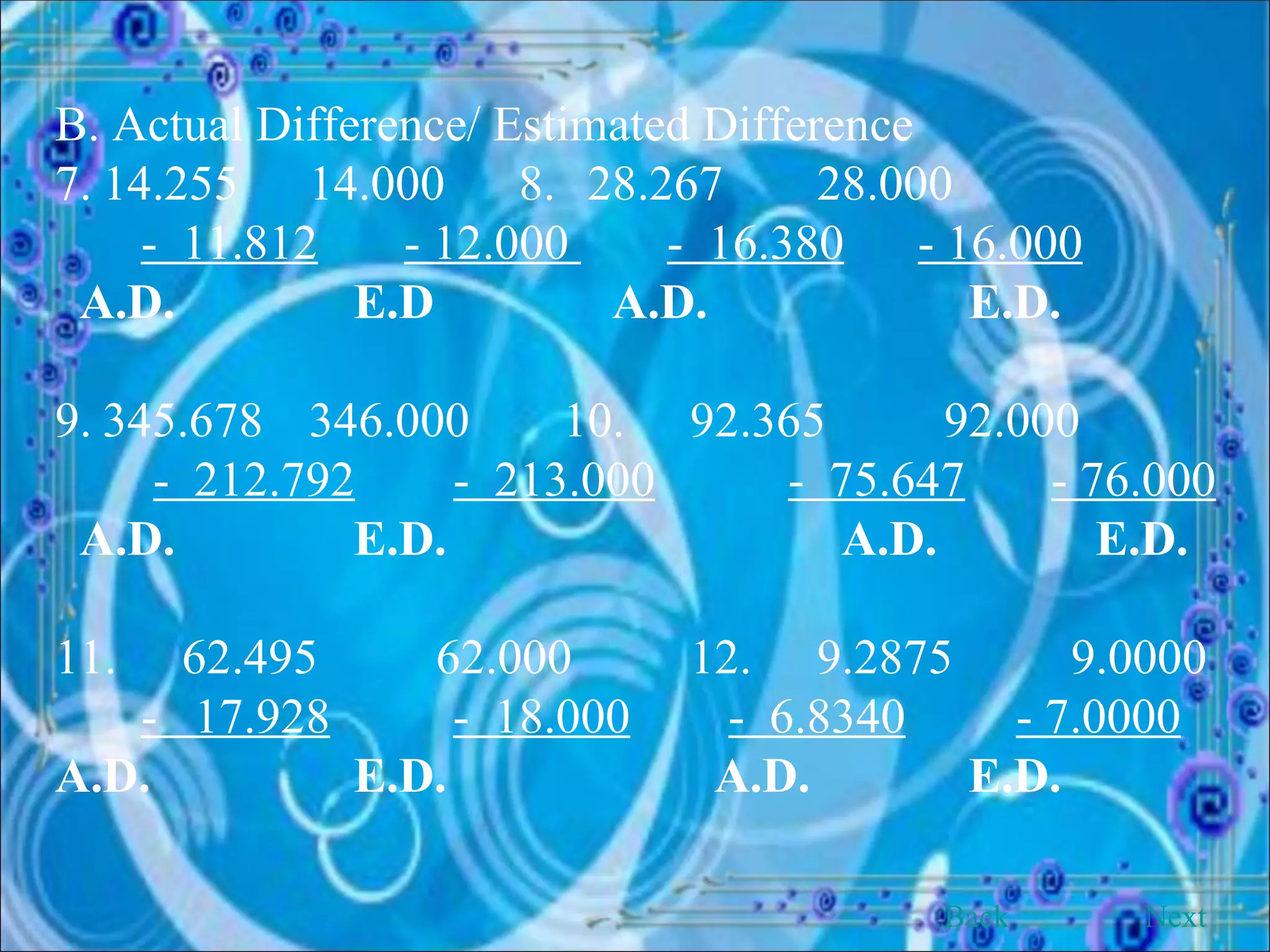
B. Actual Difference/ Estimated Difference 7. 14.255 14.000  8.   28.267 28.000 -  11.812   - 12.000  -  16.380   - 16.000 A.D.   E.D   A.D.   E.D. 9. 345.678 346.000 10. 92.365 92.000 -  212.792   -  213.000   -  75.647   - 76.000 A.D.   E.D.   A.D.   E.D. 11. 62.495 62.000 12. 9.2875 9.0000 -  17.928   -  18.000   -  6.8340   - 7.0000 A.D.   E.D.   A.D.   E.D. Back Next
FUN WITH MATH!!! Match a given decimals with the correct estimated sum / difference to the greatest place – value. The shortest verse in the Bible consists of two words. Back Next
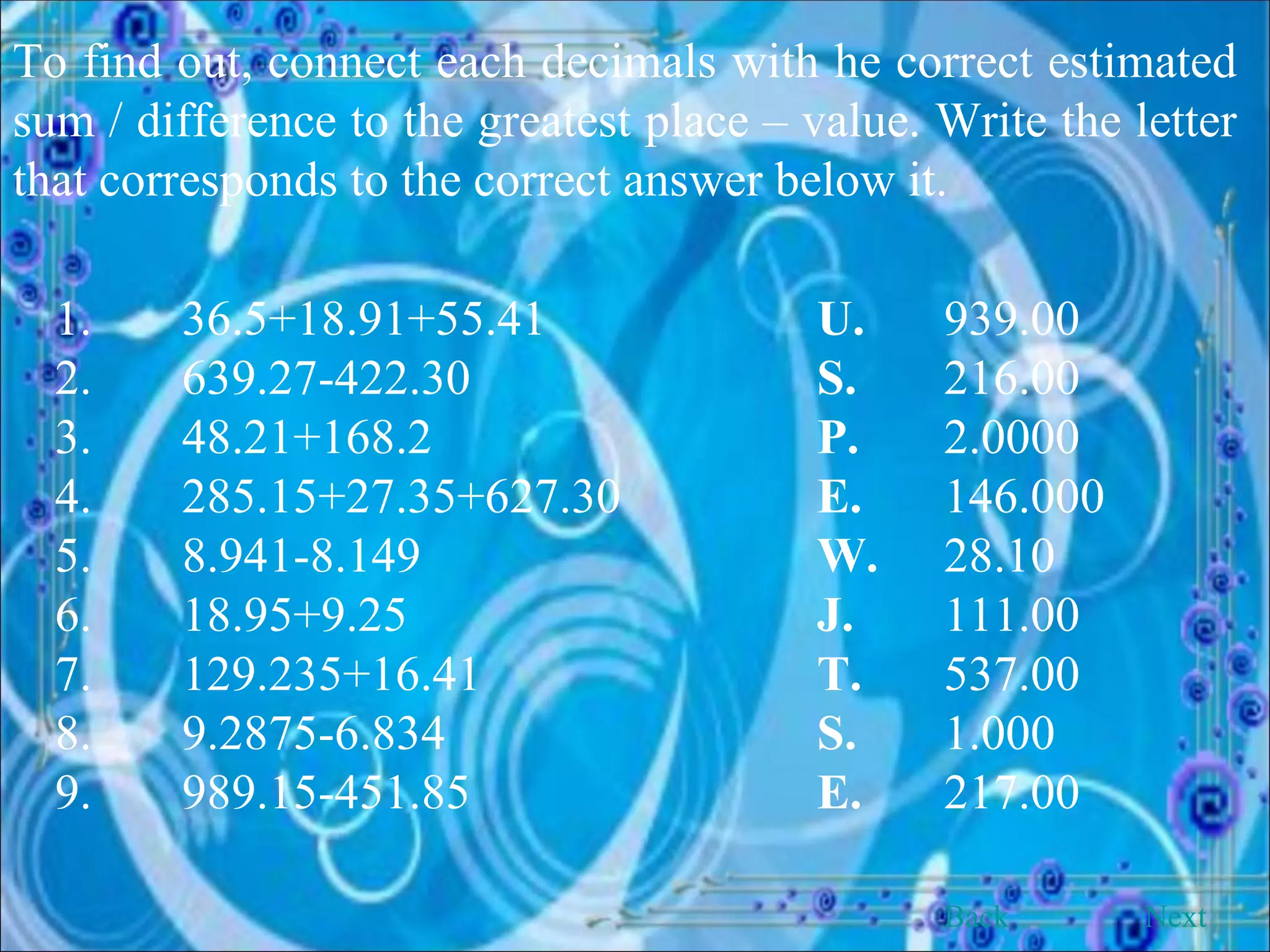
To find out, connect each decimals with he correct estimated sum / difference to the greatest place – value. Write the letter that corresponds to the correct answer below it. 1. 36.5+18.91+55.41 U. 939.00 2. 639.27-422.30 S. 216.00 3. 48.21+168.2 P. 2.0000 4. 285.15+27.35+627.30 E. 146.000 5. 8.941-8.149 W. 28.10 6. 18.95+9.25 J. 111.00 7. 129.235+16.41 T. 537.00 8. 9.2875-6.834 S. 1.000 9. 989.15-451.85 E. 217.00 Back Next
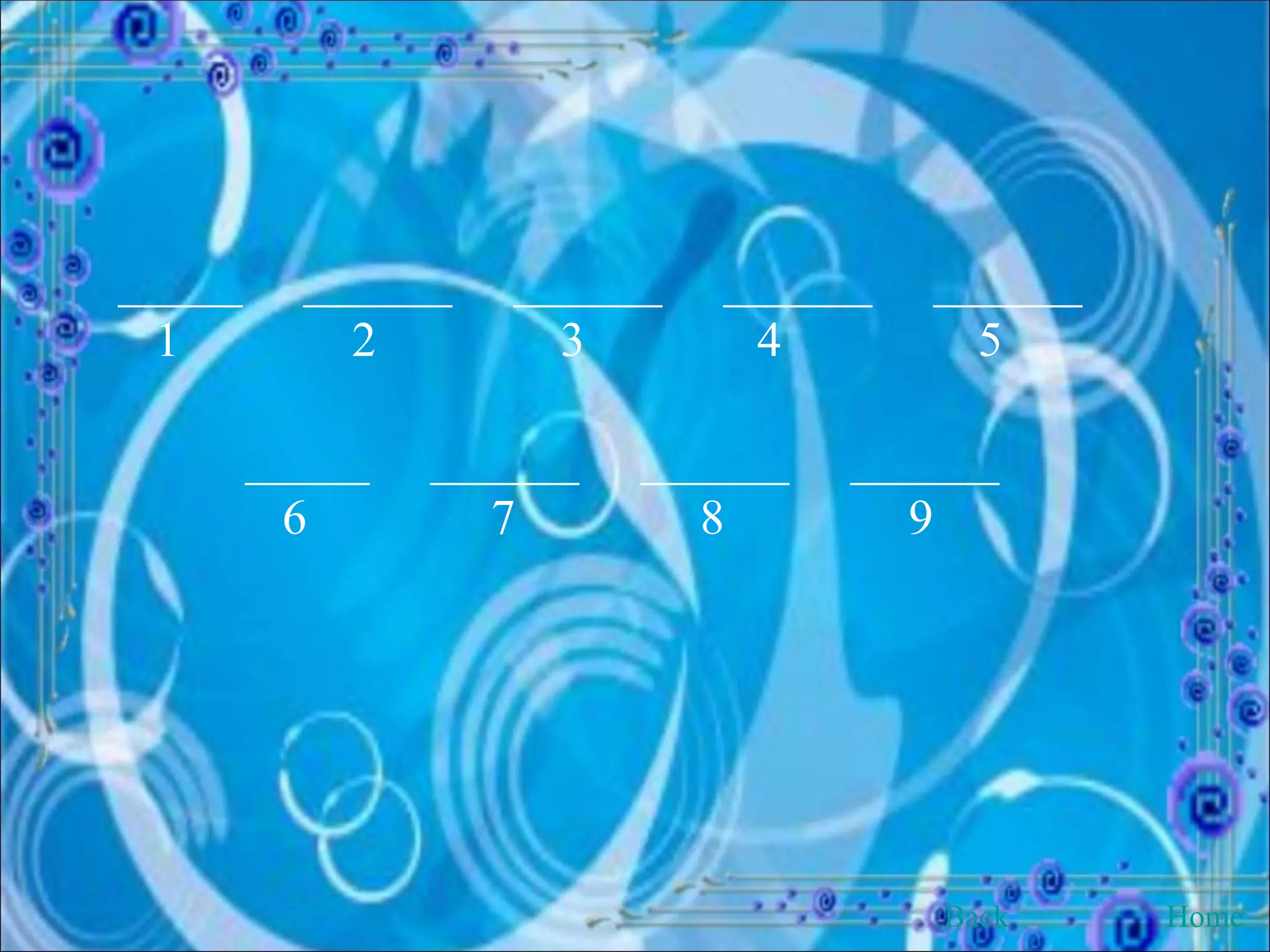
_____  ______  ______  ______  ______  1  2  3  4  5  _____  ______  ______  ______   6  7  8  9 Back Home
Lesson 19 MINUEND WITH TWO ZEROS Lesson Objectives: After accomplishing the lesson, the students are expected to be able to: . Know how to subtract decimal numbers with  two zeros in minuend. 2. Follow the steps in subtraction of numbers  involving zeros. 3. Check the answer and perform the operation  correctly. Next Content
You always have to regroup in subtracting decimal numbers with zeros. You will have to regroup from one place to the next until all successive zeros are renamed and ready for subtraction. Back Next
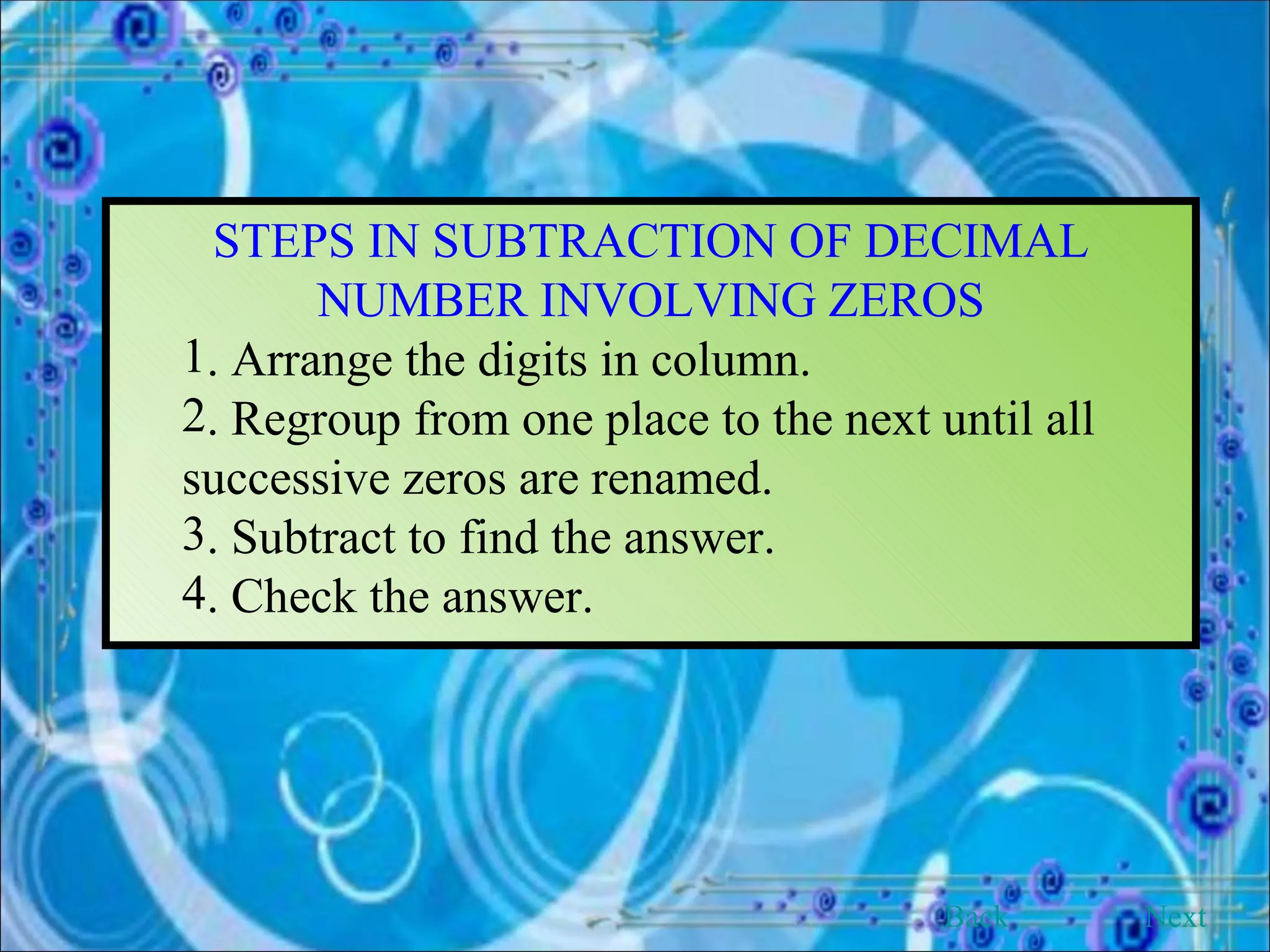
STEPS IN SUBTRACTION OF DECIMAL NUMBER INVOLVING ZEROS . Arrange the digits in column. . Regroup from one place to the next until all  successive zeros are renamed. . Subtract to find the answer. . Check the answer. Back Next
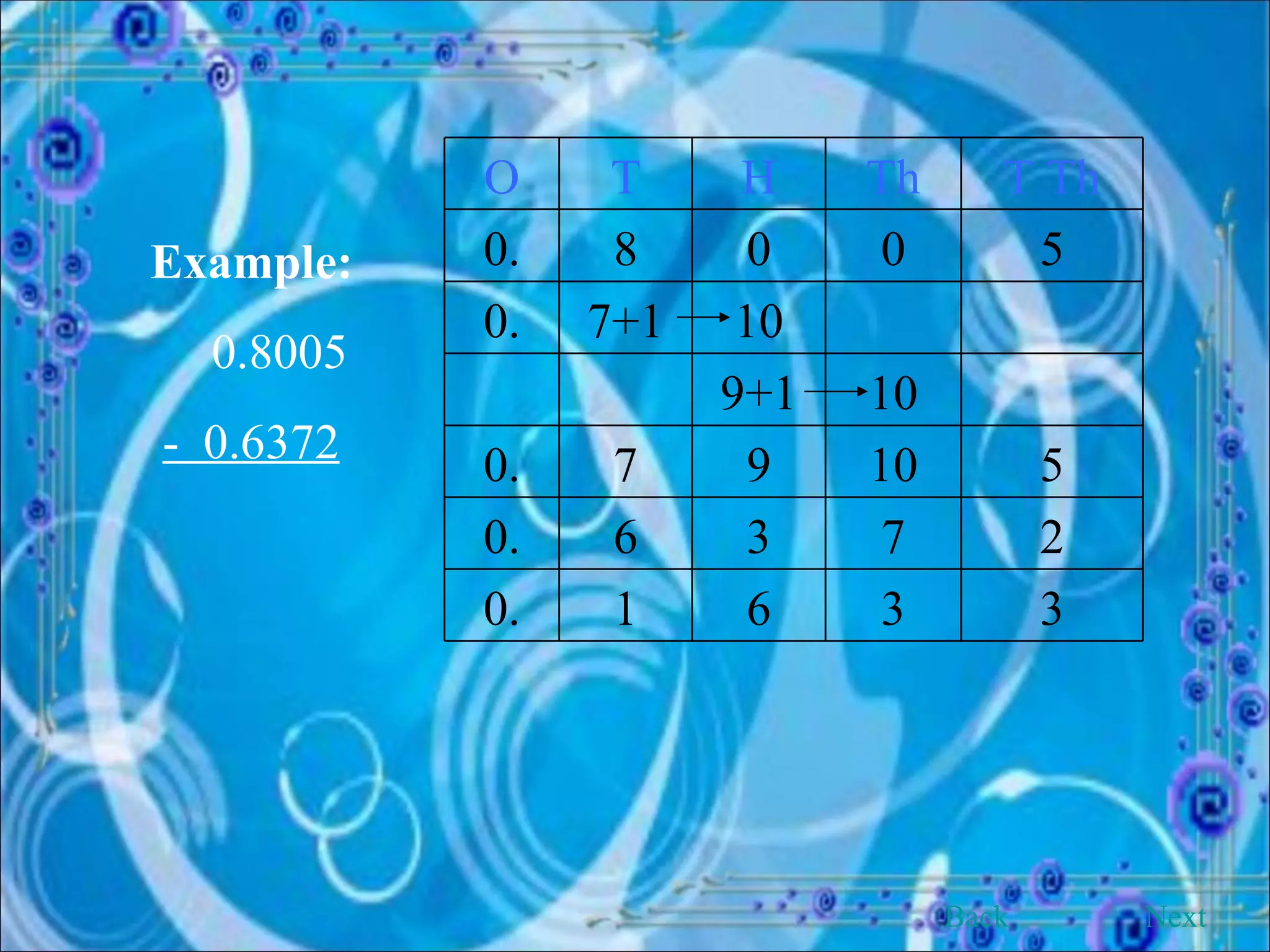
Example: 0.8005  -  0.6372 Back Next O T H Th T Th 0. 8 0 0 5 0. 7+1 10 9+1 10 0. 7 9 10 5 0. 6 3 7 2 0. 1 6 3 3
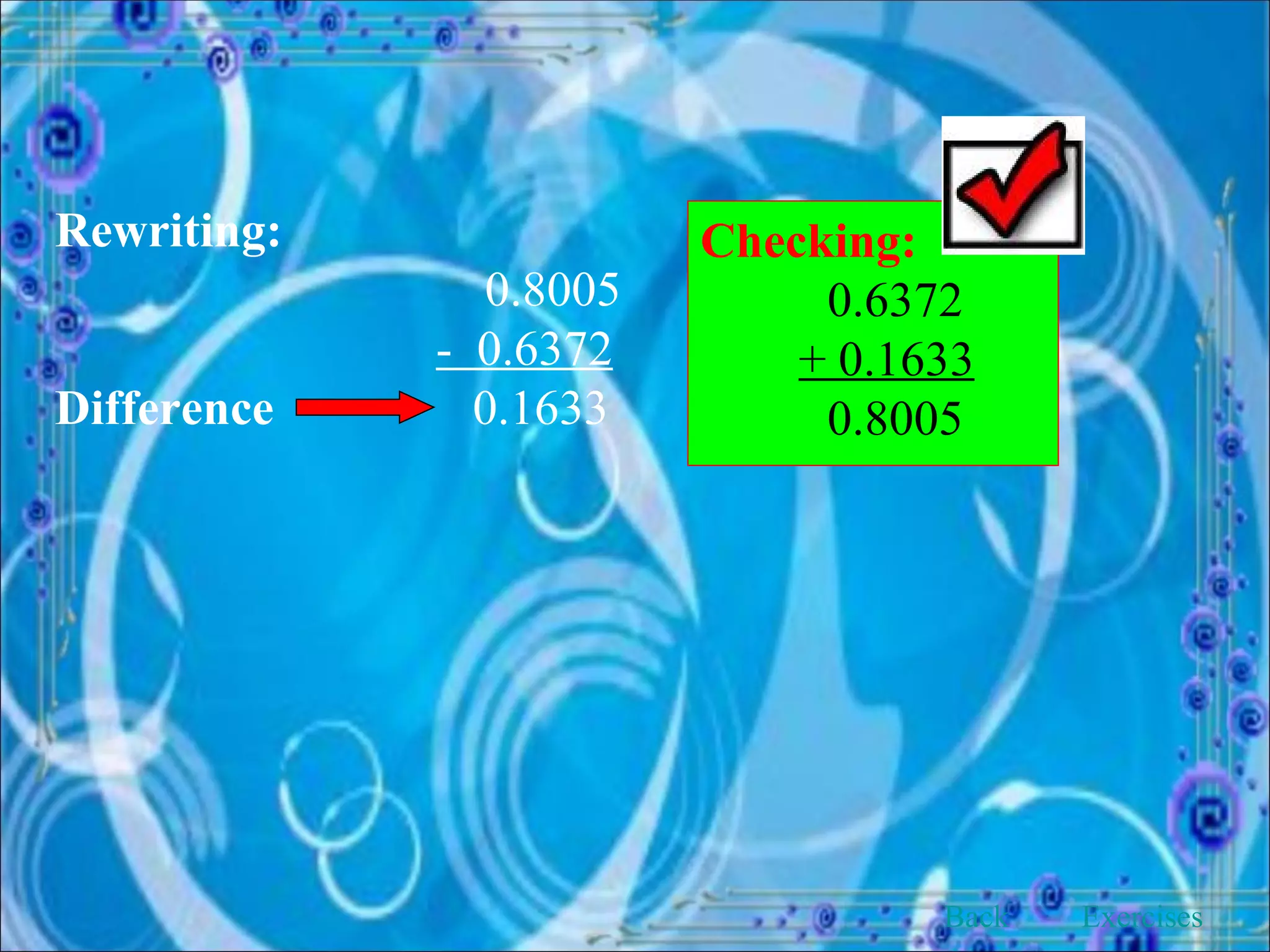
Rewriting:   0.8005 -  0.6372 Difference    0.1633   Checking: 0.6372 + 0.1633 0.8005 Back Exercises
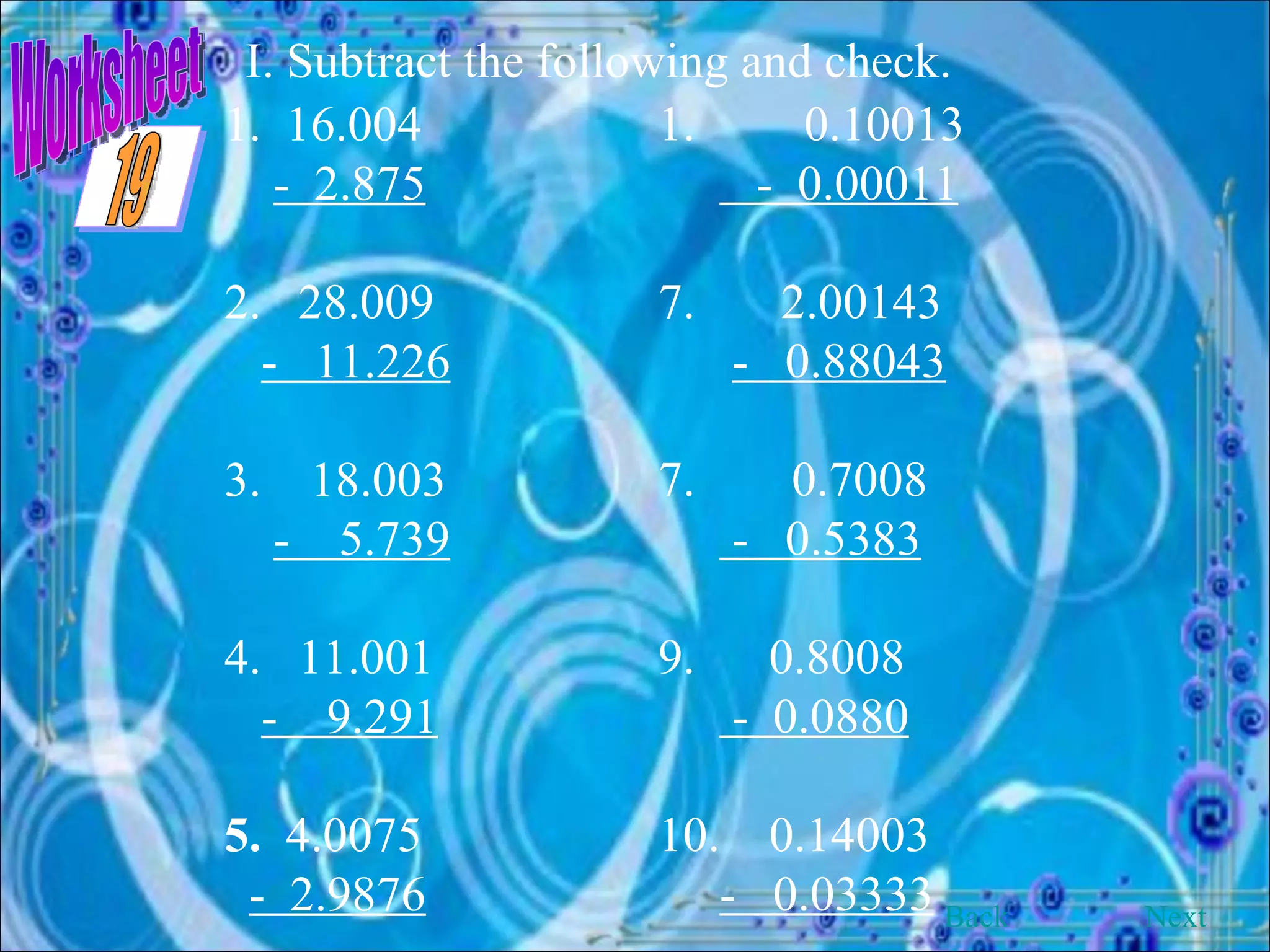
Worksheet I. Subtract the following and check. 1.  16.004 -  2.875 2.  28.009 -  11.226 3.  18.003 -  5.739 4.  11.001 -  9.291 5.  4.0075 -  2.9876 0.10013 -  0.00011 7.  2.00143 -  0.88043 0.7008 -  0.5383 9.  0.8008 -  0.0880 10.  0.14003 -  0.03333 Back Next 19
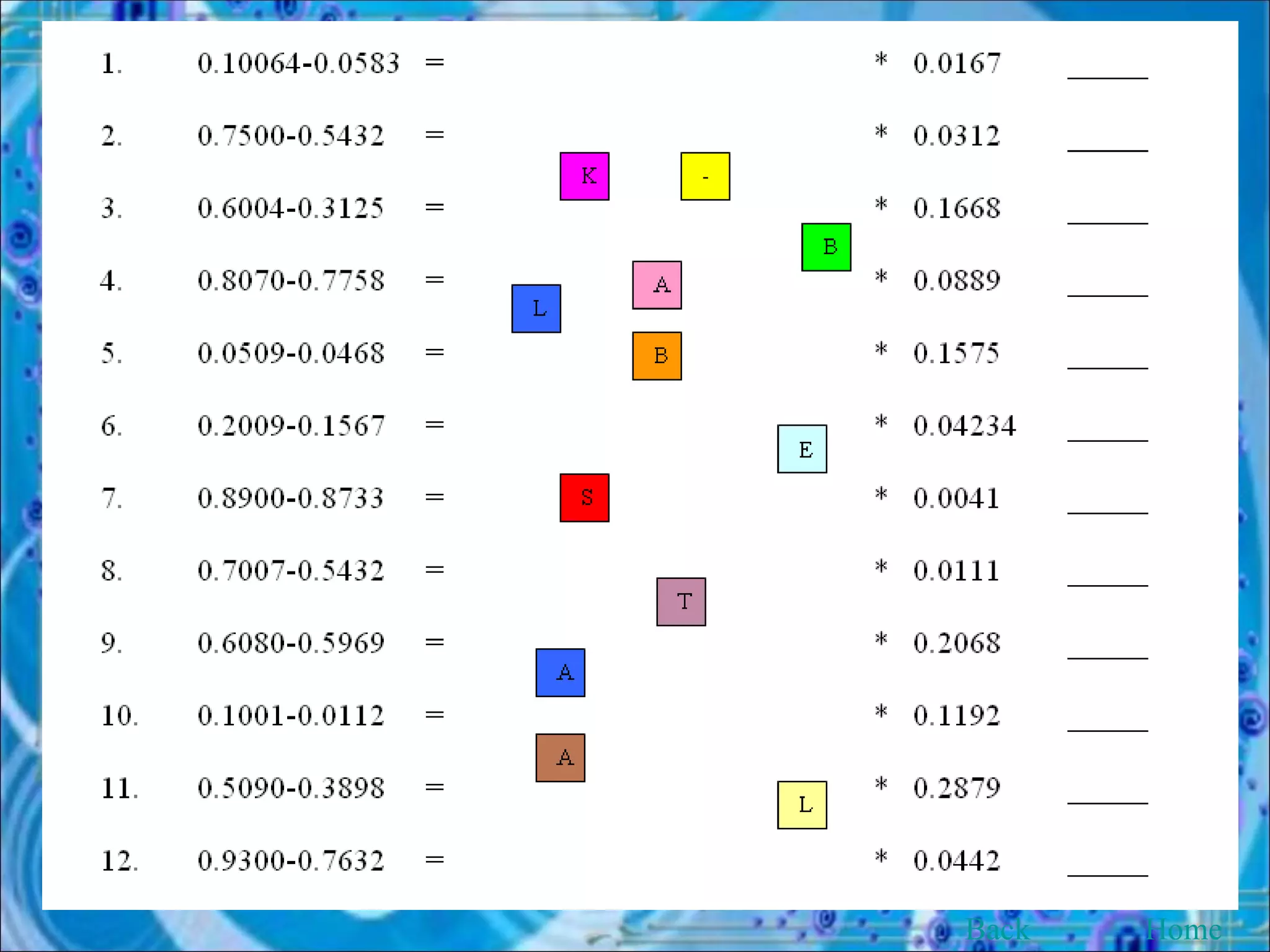
FUN WITH MATH!!! Answer the following to find the mystery words. In what type of ball can you carry? To find the answer, draw a line connecting each decimal number with its equal difference. The lines pass through a box with a letter on it. Write what is in the box on the blank next to the answer. Back Next
Back Home
Lesson 20 PROBLEM SOLVING INVOLVING ADDITION AND SUBTRACTION OF DECIMALS Lesson Objectives: After accomplishing the lesson, the students are expected to be able to: . Follow the step of solving problem. 2. Analyze the problem critically. 3. Develop interest in solving word problem.  Next Content
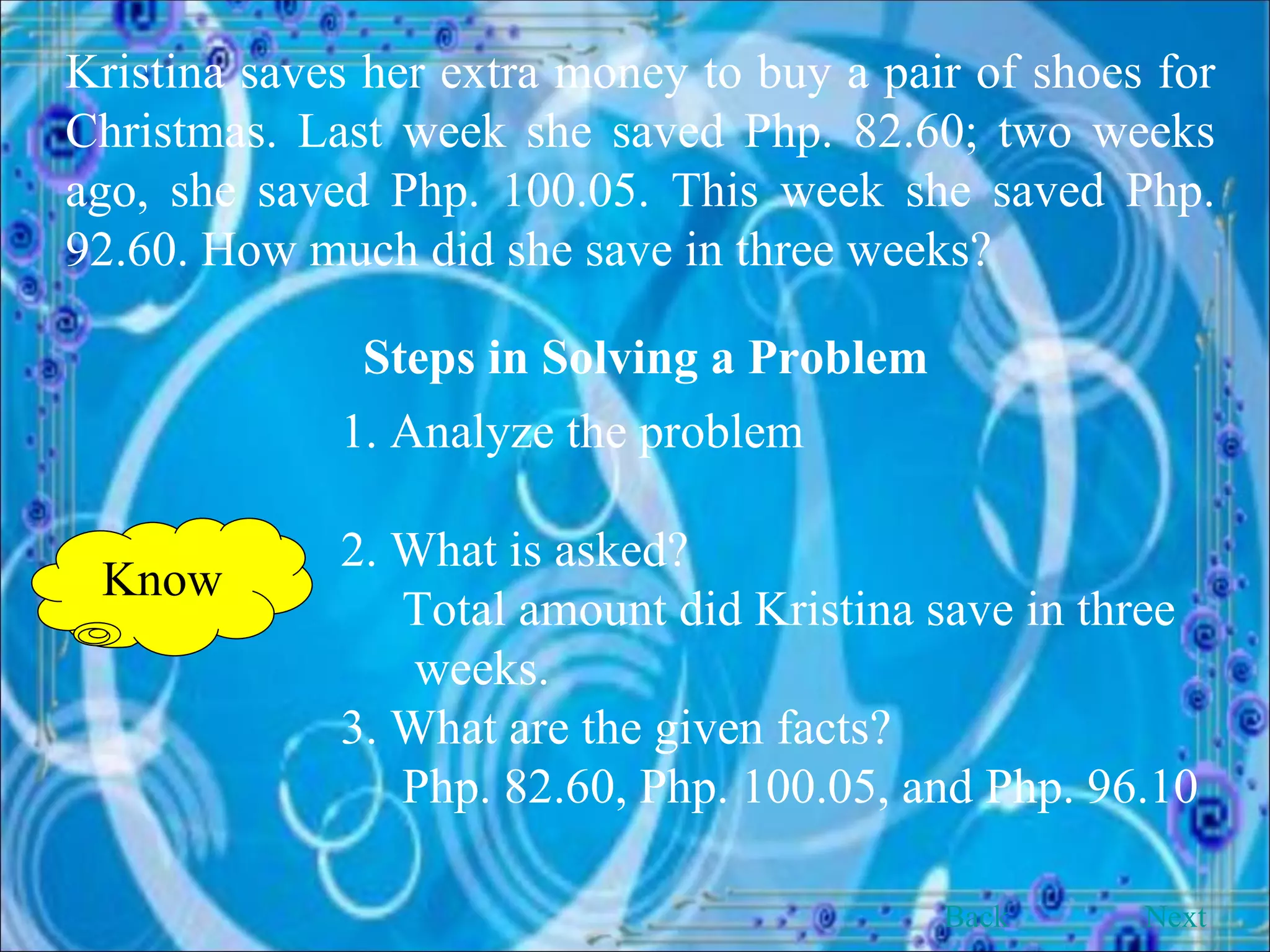
Kristina saves her extra money to buy a pair of shoes for Christmas. Last week she saved Php. 82.60; two weeks ago, she saved Php. 100.05. This week she saved Php. 92.60. How much did she save in three weeks? Steps in Solving a Problem 1. Analyze the problem 2. What is asked?   Total amount did Kristina save in three      weeks. 3. What are the given facts?   Php. 82.60, Php. 100.05, and Php. 96.10 Know Back Next
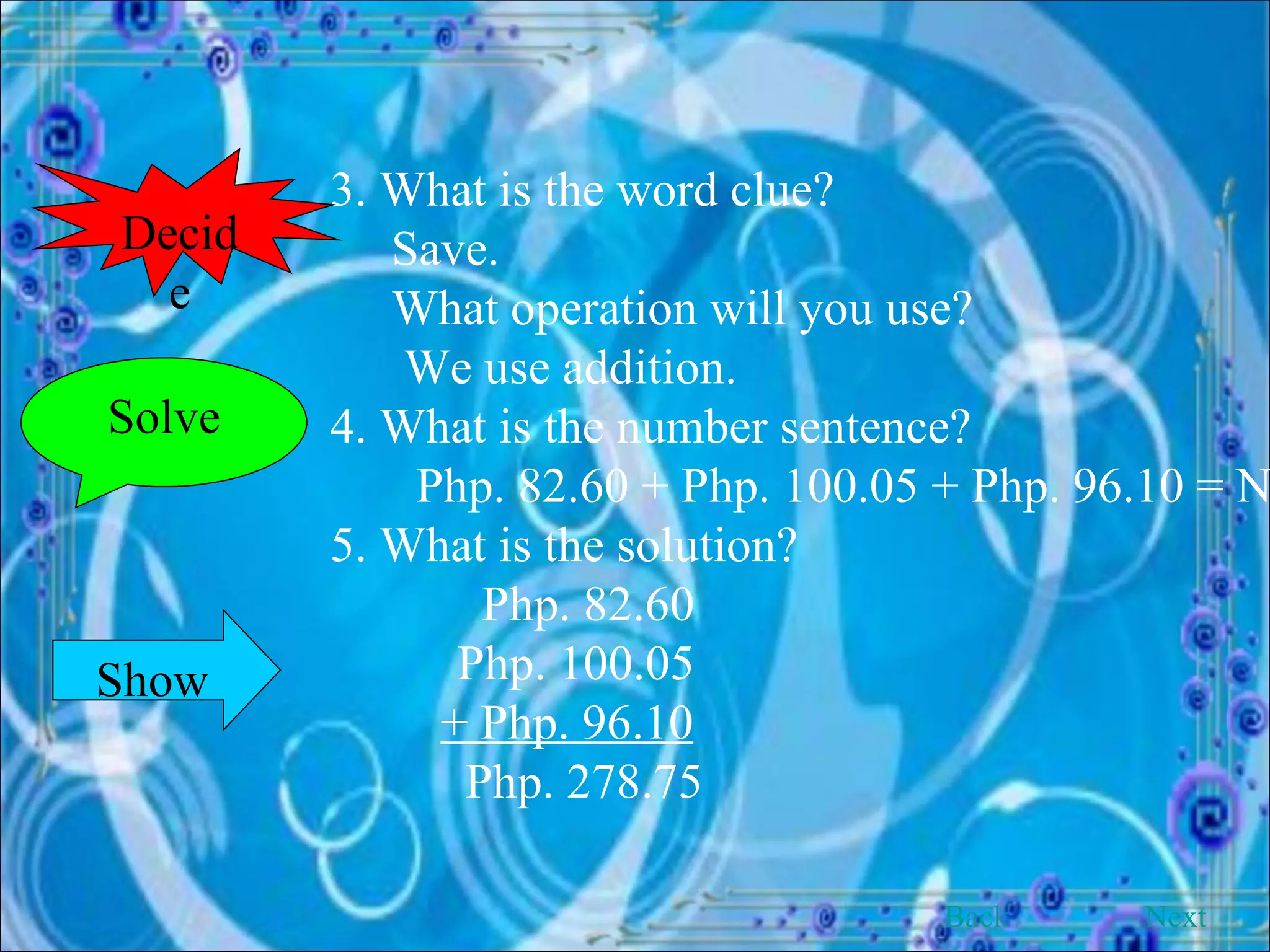
3. What is the word clue?   Save.   What operation will you use?    We use addition. 4. What is the number sentence?   Php. 82.60 + Php. 100.05 + Php. 96.10 = N 5. What is the solution?      Php. 82.60 Php. 100.05   + Php. 96.10   Php. 278.75 Solve Decide Show Back Next
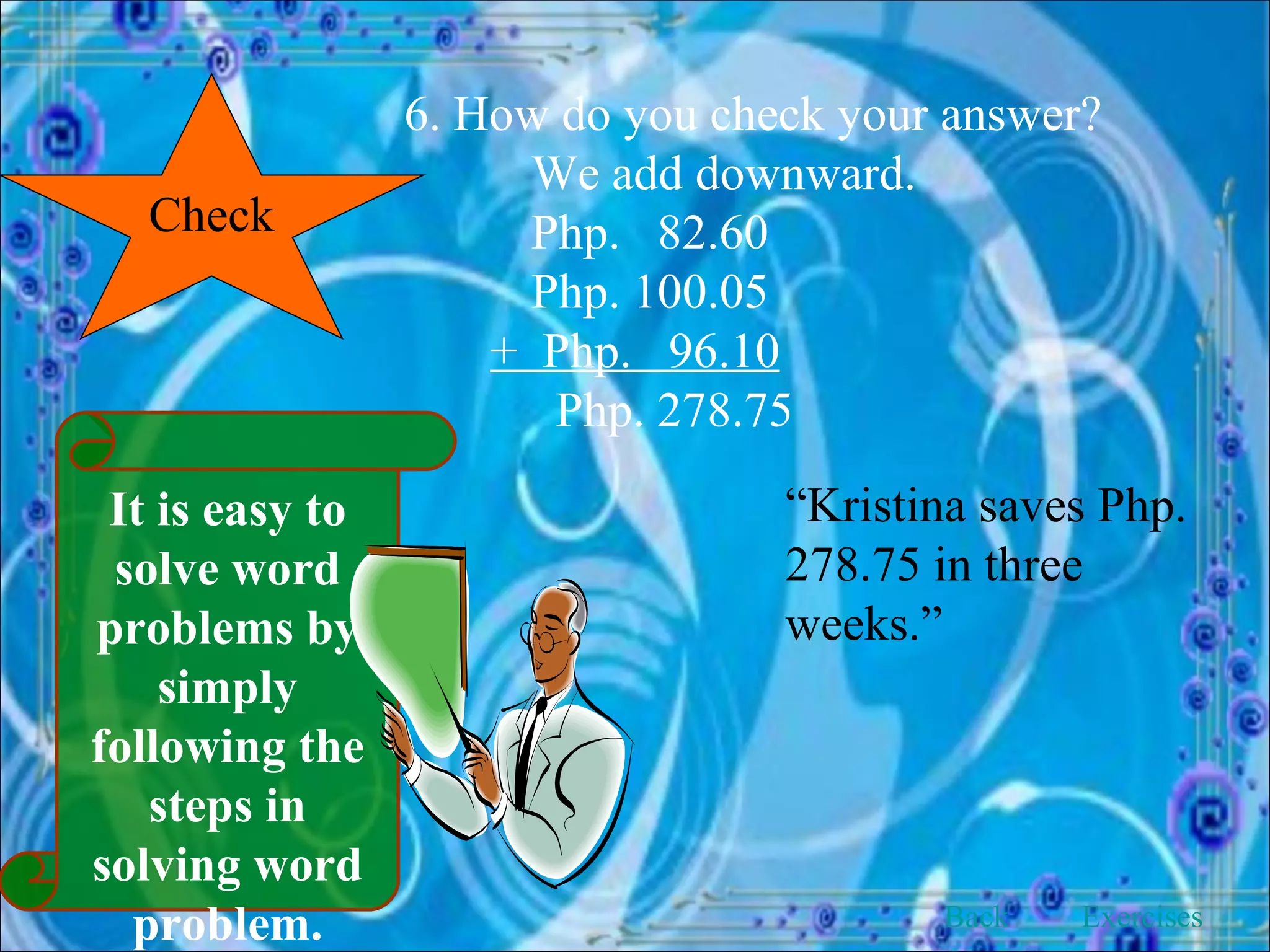
Check 6. How do you check your answer? We add downward. Php.  82.60 Php. 100.05 +  Php.  96.10   Php. 278.75 “ Kristina saves Php. 278.75 in three weeks.” Back Exercises It is easy to solve word problems by simply following the steps in solving word problem.
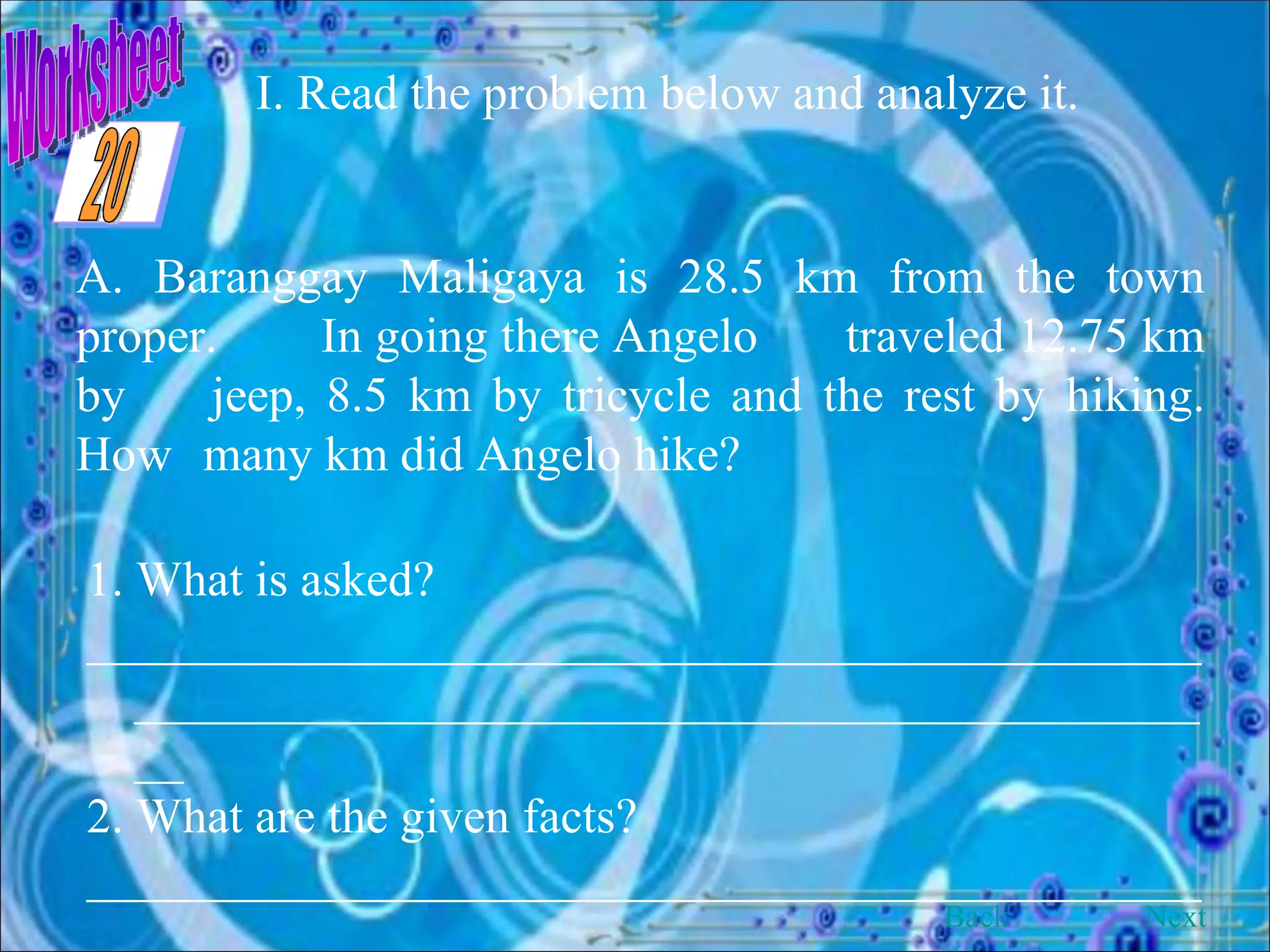
Worksheet I. Read the problem below and analyze it. A. Baranggay Maligaya is 28.5 km from the town proper.  In going there Angelo  traveled 12.75 km by  jeep, 8.5 km by tricycle and the rest by hiking. How  many km did Angelo hike? 1. What is asked? __________________________________________________________________________________________ 2. What are the given facts? __________________________________________________________________________________________ Back Next 20
3. What is the process to be used? ______________________________________________________________________________________________ 4. What is the mathematical sentence? ______________________________________________________________________________________________ 5. How the solution is done? 6. What is the answer? ______________________________________________________________________________________________ Back Next
7. How do you check the answer? B. Faye filled the basin with 2.95 liters of water. Her brother used 0.21 liter when he washed his hands and her sister used 0.8 liter when she washed her face. How much water was left in the basin? Back Next
1. What is asked? __________________________________________________________________________________________ 2. What are the given facts? __________________________________________________________________________________________ 3. What is the process to be used? __________________________________________________________________________________________ 4. What is the mathematical sentence? __________________________________________________________________________________________ 5. How the solution is done? Back Next
6. What is the answer? __________________________________________________________________________________________ 7. How do you check the answer? Back Next
C. Ron cut four pieces of bamboo. The first piece was 0.75 meter; the second was 2.278 meters; the third was 6.11 meters and the fourth was 6.72 meters. How much longer were the third and fourth pieces put together than the first and second pieces put together? 1. What is asked? __________________________________________________________________________________________ 2. What are the given facts? __________________________________________________________________________________________ Back Next
3. What is the process to be used? ______________________________________________________________________________________________ 4. What is the mathematical sentence? ______________________________________________________________________________________________ 5. How the solution is done? 6. What is the answer? ______________________________________________________________________________________________ Back Next
7. How do you check the answer? D. Pamn and Hazel went to a book fair. Pamn found 2 good books which cost Php. 45.00 and Php. 67.50. She only had Php.85.00 in her purse but she wanted to buy the books. Hazel offered to give her money. How much did Hazel share to Pamn? Back Next
1. What is asked? __________________________________________________________________________________________ 2. What are the given facts? __________________________________________________________________________________________ 3. What is the process to be used? __________________________________________________________________________________________ 4. What is the mathematical sentence? __________________________________________________________________________________________ 5. How the solution is done? Back Next
6. What is the answer? __________________________________________________________________________________________ 7. How do you check the answer? Back Next
E. Marlene wants to buy a bag that cost Php. 375.95. If she has saved Php. 148.50 for it, how much more does she need? 1. What is asked? __________________________________________________________________________________________ 2. What are the given facts? __________________________________________________________________________________________ 3. What is the process to be used? __________________________________________________________________________________________ Back Next
4. What is the mathematical sentence? ______________________________________________________________________________________________ 5. How the solution is done? 6. What is the answer? ______________________________________________________________________________________________ 7. How do you check the answer? Back Home
UNIT IV MULTIPLICATION OF DECIMALS Content Next
OVERVIEW OF THE MODULAR WORKBOOK This modular workbook provides you with the understanding of the meaning of multiplication of decimals, multiply decimals in different form and how to estimate products. It will develop the ability of the students in multiplying decimal numbers. This modular workbook will help you to solve problems accurately and systematically. Back Next
OBJECTIVES OF THE MODULAR WORKBOOK After completing this Unit, you are expected to: 1. Define multiplication, multiplicand, multiplier, products and factors. 2. Know the ways of multiplying decimal numbers. 3. Learn the ways of multiplying decimal numbers involving zeros. 4. Learn how to make an estimate and know the ways of making estimates. Back Next
Lesson 21 MEANING OF MULTIPLICATION OF DECIMAL NUMBERS Lesson Objectives: After learning this lesson, you are expected to: Define multiplication. 2. Locate where the multiplicand, multiplier and product are. 3. Familiarize the terms in multiplication. Next Content
Multiplication  is a short cut for repeated addition. It is a short way of adding the same decimal number. It is the inverse if division. Back Next .4 + .4 + .4 + .4 + .4 + .4 = 2.4 In multiplication, it is written as: .4  ->  multiplicand  x  6  ->  multiplier 2.4  ->  product  (answer in multiplication) factors
The decimal numbers we multiply are called  multiplicand  and  multiplier  is the decimal number that multiplies. The answer in the multiplication is the  product . The decimal numbers multiplied together are  factors . Another examples:   9 0.08 1.24 0.007 x  0.5   x  3  x  2  x   4 4.5   0.24   2.48   0.028 Back Exercises
1. What is multiplication? 2. What are factors? 3. What are products? 4. Give some examples of multiplication decimals. I. Give the meaning and explain the use of the following. Back Next 21 Worksheet
multiplication ________________________________________________________________________________ 2. factors ________________________________________________________________________________ 3. products ________________________________________________________________________________ 4. Examples of multiplication decimals ________________________________________________________________________________ Back Next
Identify the words by looping  vertically  ,horizontally  and  diagonally directions. (Word – Puzzle)   Back Next
____________ 1. The number we if multiply. ____________ 2. The numbers multiplied  together. ____________ 3. The number that multiplies. ____________ 4. It is a short way of adding the  same number of number  times. ____________ 5. Multiplication is the inverse of  _____________   Back Next
Complete the following that corresponds to the missing answer. 1.  0.42  - ______ 6.  0.183 - ______ x 0.34  - ______   x 0.141 - ______ _____  - product     _____ - product 2.  0.12 - ______ 7.  12.55 - ______ x  ____  - multiplier   x 21.45 - ______ 0.0132  - ______   _____ - product 3. ____  - multiplicand 8.  ____  - multiplicand x  4.62  - _______   x  0.96 - _______ 0.1848 - _______   0.1848 - _______ Back Next
4.  56.08 - ______ 9.  1.45   - ______ x  31.901 - ______   x  6.56   - ______ _______  - product   ______   - product 5. 8.08  - multiplicand 10.  8.145  - multiplicand x  8.14   - multiplier     x  6.001  - multiplier _____  -________   _____ -________ Back Home
Lesson 22 MULTIPLYING DECIMALS Lesson Objectives: After finishing the lesson, the students are expected to: 1. Learn how to multiply decimal numbers. . Follow the steps in multiplying decimal numbers. . Know how to place the decimal point in the product. Next Content
Study these examples. Where do you place the decimal point in the product?   0.432   0.614   ×  0.15   ×  0.37   2160   4298   +  432   +  1842_   0.06480   0.22718 Back Next
Remember: In multiplying decimals, the placement of the decimal point in the product is determined by the total number of decimal places in the factors. Count the number of decimal places from the right. To check, divide the product by either factors.  Back Next
6480 four digits 22718 five digits Add a zero to make Additional zeros is five decimal places in the product. not needed. 0.06480 0.2271 Additional Zero Add the decimal places in the factors. Then see how many decimal places the product has.  Back Next 0.432 × 0.15 Five decimal places 0.614 × 0.37 Five decimal places
PRACTICE: Find the product by fill in the boxes for the correct answer. Back Next 0.3 0.2 0.4 0.1 0.5 0.6 0.4 0.7 0.3 0.5 0.4 0.3 0.7 0.6 0.8 0.4 0.2 0.1 0.5 0.4 0.3 0.7 0.6 0.8 0.4 0.2 0.1
Back Exercises 1.9 1.5 1.8 2.5 3.5 2.0 3.5 3.8 3.1 0.1 0.44 0.87 0.54 0.53 0.09 0.9 0.76 0.36 1.90 1.2 2.9 1.8 2.2 2.99 1.66 0.8 1.5 2.2 1.4 1.9 1.4 1.7 1.9 1.7 2.0 2.7 1.6 1.8 1.7 1.89 1.89 1.7 2.7 2.6 2.9
Put the decimal point on the product for the correct places.   1.   0.192 x  0.428 1536 384 +  768__  82176 2.   0.342 x  0.153   1026 1710 +  342  52326 3.   0.208 x  0.274   832 1456 +  416  56992 Back Next 22 Worksheet
4.   0.263 x  0.29   2367 +  526  7627 5.   0.1594 x  0.37   11158 +  47852  58978 Multiply the following decimal numbers and put the decimal point. 1.   0.987 x  0. 270 2.  0.158 x  0.258 3.  0.4789 x 0.1247 Back Next
4.  0.2547 x 0.2479 5.  0.3647 x 0.1248 Back Next
What did the big flower say about the little flower? FUN WITH MATH!!! To find the answer, write each of the following products in multiplying decimals.   Back Next
__________   ___________  ___________   __________  0. 7537344  0.0132   0.0003  0.08537832 ___________   ___________ 0.001445   0.290523 _________  __________  _________  ________  ________ 0.0000195  0.0044902  0.000492  0.05626725  0.0006 Back Home
Lesson 23 MULTIPLYING MIXED DECIMALS BY WHOLE NUMBERS Lesson Objectives: After finishing the lesson, the students are expected to: 1. Multiply mixed decimals by whole numbers. 2. Find the partial products. 3.Understand the rules in multiplying mixed decimals by whole numbers. Next Content
Christopher can save Php. 18.65 in one month. How much money can he save in four months? 18.6 -> two decimal places x  4 74.60 Decimals are multiplied the same way as whole number. Back Next
Remember: In multiplying mixed decimals by whole numbers, count the decimal places in the mixed decimal to determine the placement of the decimal point in the product. Start counting the number of decimal places from the right. Back Next
Study other examples.   23.729   ->  three decimal places x  47 166103 +  94916 1115.263   ↑ Partial product Back Next
6.3572   ->  four decimal places x  158 508576 317860 + 63572 1004.4376  ↑ Partial product Back Exercises
In the following problems, the final product is given. Find the partial products. Place the decimal points in the correct position. 1. 81.83 2. 62.872 3. 7.0194 ×  57   ×  34   ×  271 + + 466431  2137648   +   19022574 Back Next 23 Worksheet
4. 17.59 5. 48.723 6. 8.0035 ×  83   ×  52   ×  179 +   + 145997    2533596 +   14326265 Back Next
II. Find the product. 7. 934.04 8. 282.5601   9.   37.5852 ×   251   x  49   ×  784   10.  51.207   11. 4672.397   12.   693.3521 ×  490   ×  268 ×  922   Back Next
13.  75.373   14.  149.1811   15.  10.1496 x  44   x  1012   x  189 Back Home
Lesson 24 MULTIPLICATION OF MIXED DECIMALS BY MIXED DECIMALS Lesson Objectives: After accomplishing this lesson, you are expected to: 1. Multiplying mixed decimals by mixed  decimals. 2. Perform the operation correctly. 3. Understand the rules in multiplying mixed  decimals by mixed decimals. Next Content
What is the area of Ariel’s backyard if it is 12.932 m long and 8.45 m wide? NOTE: Area = length x width = 12.93m x 8.45m = 109.27540 sq.m² = m x m = m² 12.932 -> three decimal places   ×  8.45 -> two decimal places     64660   51728 + 103456 109.27540 -> five decimal places The backyard is 109.27540 square meters. Back Next
NOTE: Area = length x width = 12.93m x 8.45m = 109.27540 sq.m² = m x m = m² When multiplying mixed decimals by mixed decimals, the decimal point of the product is determined in this manner. Back Next
Decimal   Decimal   Decimal Places of first Places of second   Places of  Factor Factor the product  Back Exercises
Worksheet I.  Rewrite and arrange the partial products properly. Find the product and place the decimal points in the correct position. 1.   4.9526 2. 9.18234 ×  3.215   ×  75.68 247630   7345872   49526   5509404   99052   451170 +  148578   +  6427638 Back Next 25
3. 57.6012 4. 2.01938 ×  4.765   ×  36.24 2880060  807752 3456072  403876 4032084   1211628 +  2304048   +  605814 Back Next
Find the product. 5. 15.6027 6. 92.46355 7. 8.932682 ×   8.306   ×  1.728     ×  9.1865 8. 743.9516 9. 268.924 10. 5.1367 ×  4.321   ×  4.321   ×  9.824   Back Home
Lesson 25 MULTIPLYING DECIMALS BY 10, 100 and 1000 Lesson Objectives: At the end of the lesson, you are expected to: 1. Multiply decimals by 10, 100 and 1000. 2. Write the product correctly. 3. Observe the rules in multiplying decimals by 10, 100 and 1000. Next Content
Take a decimal, 0.7568. Multiply it by 10, by 100 and by 1,000. What are the products? Look at the following: 0.7568 0.7568 0.7568 ×  10 ×  100   × 1000 7.5680   75.6800   756.8000 Back Next
You see that the number of zeros contained in the factors 10, 100 and 1,000 tells how many places the decimal point in the other factor must be moved to the right to get the product. Examples: 10 × 0.75 = _______ 100 × 0.75 = _______ 1,000 × 0.75 = _______ Back Next
Observe: Move 1 place to the right. Move 2 place to the right. Move 3 place to the right. Back Exercises 750. 75. 7.5 0. 750 0. 75 0.75 0.750 0.75 0.75 0.75 × 1,000 × 100 × 10 Decimal
Worksheet Complete the following equations.   1. 3.67 × 10 = ______ 2. 100 × _____ = 4521 3. 1000 × _____ = 0.0049 4. _____ × 100 = 854.8 5. 2.918 × _____ = 2918 6. 35.66 × _____ = 35660 7. 0.0074 × _____ = 7.4 8. _____ × 10 = 0.163 9. 0.089 × 10 = _____ 10. _____ × 100 = 100.78 Back Next 25
II.  Complete the table by multiplying each factor by 10, 100 and 1,000. Back Next
III. Multiply the following. Write your answers in the blanks provided: 1. 0.386 × 10 = ________ 2. 0.86 × 100  = ________ 3. 0.36 × 1000  = ________ 4. 0.473 × 1000  = ________ 5. 0.496 × 10  = ________ 6. 0.85 × 1000  = ________ 7. 0.7 × 1000  = ________ 8. 0.512 × 100  = ________ 9. 0.93 × 100  = ________ 10. 0.603 × 10  = ________ Back Home
Lesson 26 ESTIMATING PRODUCTS OF DECIMAL NUMBERS Lesson Objectives: After understanding the lesson, you must able to: 1. Learn how to estimate the products correctly. 2. Learn how to make an estimates product in fastest way. 3. Follow the steps in estimating products.  Next Content
The fastest way of solving problem is to estimate. In estimating the products: Round the given decimal numbers to the highest place value. Estimate and multiply. Compute the exact answer. Products can be estimated in the same way as sum and difference. Back Next
1. Rounding Method 4.52 ×  6 27.12 Actual Value Rounded Value 5.00 ×  6 30.00 2. Front End Method 4 .56   4.00   4. 5 2   .50   450 ×  6 ×  6   ×  6   ×  6   ×  6   24.00   +   3.00  =  27.00 Back Next
The front – end method with adjustment is usually closer to the actual value. Back Exercises
Worksheet Estimate the product using rounding and front-end with adjustment. 1. 3.754 2. 48.263 3. 28.169 ×  8   ×  5   ×  7 Back Next 26
4. 38.721   5.   28.765 6. 75.814 ×  3   ×  9 ×  13 7. 96.250   8.   18.263   9.   927.231 ×  42   ×  41   ×  507 Back Next
10. 36.287   11.   76.298 12. 28.183 ×  206 ×  304   ×  543 Back Home
Lesson 27 PROBLEM SOLVING INVOLVING MULTIPLICATION OF DECIMAL NUMBERS Lesson Objectives: After understanding the lesson, you must able to: Solve word problem involving multiplication of decimals. Write the numbers sentence. Solve word problems correctly and accurately. Next Content
Example 1:   A cone of ice cream costs Php. 16.25, how much in all did the 6 children spend for ice cream? Back Next
Example 2: What is the area of a rectangle with a length of 9.72 cm and width of 6.34 cm? Back Exercises
Worksheet Read, analyze and translate these problems to number sentence then solve.  1. Mrs. Hernandez baked 1,000 pineapple pies for a party of her daughter  Kiana. If each pie costs Php. 17.85, how much did the 1,000 pies cost? Back Next 27
2. If a car travels 55.6 km an hour, how far will it travel in 8 hours? Back Next
3. Mang Freddie sold 46 cotton candies at Php. 2.15 each. How much altogether is the cost of the cotton candies? Back Next
4. A rope measures 4.63 m. How long is it in centimeters? Back Next
5. If 1 meter of cloth costs Php. 72.95, how would 6.5 meters cost? Back Next
6. Mang John, a balot vendor bought 120 new duck eggs at Php. 3.85 each. How much did he pay all the eggs? Back Next
7. A can of powdered milk has a mass of 0.345 kilogram. What is the mass of 12 cans of milk? Back Next
8. Mr. Gelo Drona bought a residential lot with an area of 180.75 m at Php. 650.00 per square meter. How much did he pay for the lot? Back Next
9. Niña works 40 hours a week. If his hourly rate is Php. 640.25, how much is she paid a week? Back Next
10. The rental for a Tamaraw FX is Php. 3,500 a day. What will it cost you to rent it in 3.5 days? Back Home
Unit V DIVISION OF DECIMALS Content Next
OVERVIEW OF THE MODULAR WORKBOOK This modular workbook provides you’re the language of division of decimal numbers and how to divide decimals in different ways. OBJECTIVES OF THE MODULAR WORKBOOK After finishing this unit, you are expected to: 1. Understand the language of division of decimals. 2. Know how to divide decimal numbers. 3. Follow the steps in division of decimal numbers. 4. Participate actively in division of decimal numbers. 5. Learn the different form of dividing decimal numbers. Back Next
Lesson 28 MEANING OF DIVISION OF DECIMAL NUMBERS Lesson Objectives: After accomplishing this lesson, you are expected to: 1. Define division. 2. Understand the language in division of decimals. 3. Know the parts in dividing decimal numbers. Next Content
Division  is the process of finding out how many times one number is contained in another number.   0.09  ->  quotient 9  0.81  ->  dividend   - 0   81   -  81   0 Divisor Back Next
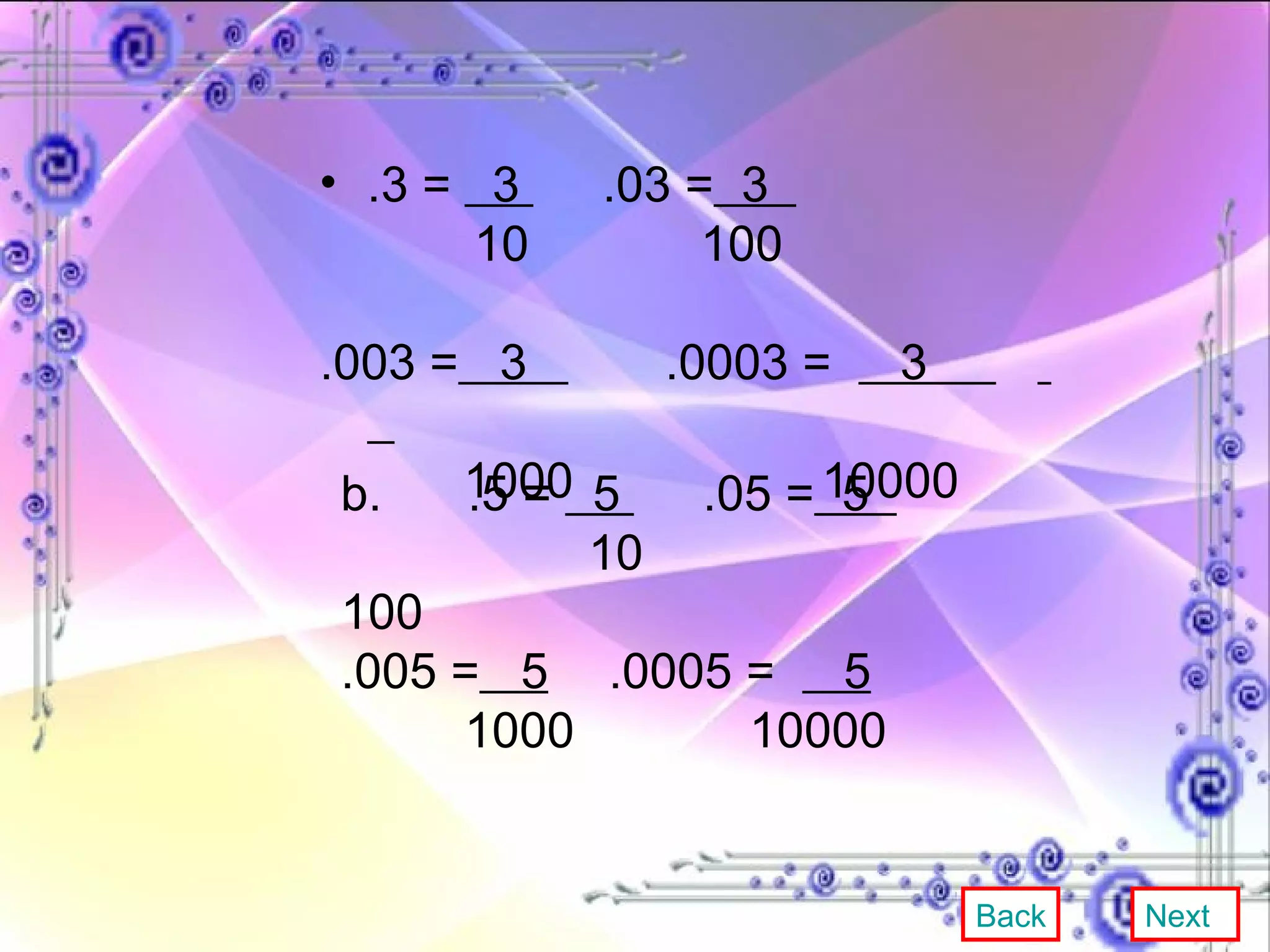
The number that contains another number a number of times is called the  dividend . The number that is contained in another number a number of times is called the  divisor . The number that indicated how many times a number contained in another number is called the  quotient . Division may also be defined as the process of separating a number into as many equal parts as indicated by another number. The symbol for division ( ÷ ), which is read as “divided by”. Thus, 0.81 ÷ 9 = 0.09 is read as “eight-one hundredths divided by nine equals nine thousandths.”  Back Next
Another symbol is a line written over and above the dividend and a slanting line connecting it at the left of the dividend and at the right of the divisor. Another symbol is a line over which the dividend is written and the divisor below. 0.81 9 Back Exercises
Worksheet I. Give the meaning and explain the use of the following: 5points each. What is division? What is divisor? What is dividend? What is quotient? Back Next 28
1. Division ____________________________________________________________________________________ 2. Divisor ____________________________________________________________________________________ 3. Dividend ____________________________________________________________________________________ 4. Quotient ____________________________________________________________________________________ Back Next
II. Enumeration… A. What are the parts of division? B. What symbols that can be used in dividing numbers? A._____________________________________________________________________________________________________________________________ B._____________________________________________________________________________________________________________________________ Back Home
Lesson 29 DIVIDING DECIMAL BY WHOLE NUMBERS Lesson Objectives: After accomplishing this lesson, you are expected to: 1. Divide decimals by whole numbers. 2. Follow the rules in dividing decimals by whole numbers. 3. Find the quotient correctly. 4. Using two methods in dividing decimals. Next Content
Dividing decimals by a whole number is the same as dividing a whole number by another whole number. Observe the following examples. Back Next 0.15 0.05 4  0.60   9 0.45 -  4   -  0 20   45 -  20   - 45 0   0
To check the answer, multiply the quotient by the divisor:   0.15 x  4   0.60   0.05 x  9   0.45 In dividing decimals by whole numbers, the number of decimal places in the quotient equals the number of decimal in the dividend. Back Next
Look at the other examples: Example 1: 0.6 ÷ 3 = _____ We used 2 methods in dividing decimals by whole numbers. Back Next
1.  Using a region 0.6   A whole is divided into 10 equal parts. Each part is called 1/10 or 0.1. 6/10 or 0.6 are shaded.0.6 is divided into 3 groups. How many tenths are in each group? Back Next 0.1 0.1 0.1 0.1 0.1 0.1 0.1 0.1 0.1 0.1 0.2 0.2 0.2 0.2 0.2
2. Using computations 6   ÷  3  =  6   ÷  3   =  2 10  1  10  ÷  1 =  10   0.2 3  0.6 6 0 Let us check by using reciprocals. Fractional Division: 6  ÷  2  =  6   x  3  =  6 x 3 =  18 10  3  10  2  10 x 2   20 Back Next
6   ÷  3 =  6   ×  1  =  6  =  1  = 0.2  and  1 10  10  3  30  5  5 is equivalent to 0.2 Why? Explain.  6  ÷  6   =  1   30  6  5 0.2 5  1.0 1.0 0 Back Next
Let us divide hundredths by a whole number. Example 2:   6  0.18 1  2  3  4  5  6  7  8  9  10 1 2 3 4 5 6 7 8 9 10   1. Using a region  A whole is divided into 100 equal pairs. Each part is called 1/100. Eighteen parts are called 18/100 or 0.18. We divide 0.18 in 6 groups. Back Next
How many hundredths are in each group? Using computation 18   ÷  6   =  18  ÷  6   =  3 100  1  100  ÷  1  100 to get the tenths place.   0.03  ->  Quotient 6  0.18   -  18 0 Check:   6 ×  0.03   0.18 Back Exercises
Worksheet Find the quotient by using region and computations. 3  0.12 2. 5  0.35 3. 7  0.14 4. 3  0.42 5. 8  0.64 6. 4  0.56 Back Next 29
7. 2  0.6 8. 9  0.81 9. 4  0.424 Find the quotients. Answer the question that follows. 1. 6  0.732 2. 4  0.524 3. 2  0.236 4. 5  0.655 5. 4  0.435 6. 7  0.851 Back Next
How many decimal places are in the dividends of 1 to  6? ________________________________________________________________________________ How many decimal places should there be in the quotient? ________________________________________________________________________________ How many we use zero in the quotient? ________________________________________________________________________________ Back Home
Lesson 30 DIVIDING MIXED DECIMAL BY WHOLE NUMBERS Lesson Objectives: After accomplishing this lesson, you are expected to: Divide mixed decimals by whole numbers. 2. Understand the rule in dividing mixed decimals by whole numbers. 3. Answer the operation correctly. Next Content
Divide mixed decimals in the same way as in dividing whole numbers. To check, multiply the quotient by the divisor. Long method of division: To check, multiply the quotient by the divisor. 1.5734 x  5 7.8670 Back Next 1.5734   5  7.8670 - 5 28 -  25 36 -  35 17 -  15 20 -  20 0
Remember that zeros added to a number to the right of the decimal point does not affect the value of the number. 7.8670 = 7.867 When dividing mixed decimals by whole numbers. The number of decimal places in the quotient is equal to the number of decimal places in the dividend. Align the decimal points of the quotient with that of the dividend. Back Next
Do another division. To check, multiply… Answer (quotient by division) 5.1268 x  14 205072 51268 71.7752   5.1268 14 71.1152 - 70 17 - 14   37   - 28   95   - 85   112   - 112   0 Back Exercises
Worksheet Find the quotient. Check by multiplication.   CHECKING:   48.102 ÷ 21 = 56.381 ÷ 87 = Back Next 30
3. 140.722 ÷ 9 = 4. 28.6134 ÷ 5 = 5. 189.526 ÷ 32= Back Next
II. Solve for the quotient and check by long multiplication method.   CHECKING:   83.7169 ÷ 21 =   2.   92.0314 ÷ 37 = Back Next
3.  152.51 ÷ 28 = 4.  293.763 ÷ 48 = 5.    451.306 ÷ 89 = Back Home
Lesson 31 DIVIDING WHOLE NUMBERS BY DECIMALS Lesson Objectives: After accomplishing the lesson, the students are expected to: 1. Divide whole numbers by decimals. 2. State the rule for dividing a whole number by a decimal. 3. Find the quotient correctly.  Next Content
Let us divide whole numbers by decimals in tenths. Example 1: 0.8  72 Here are the steps in dividing whole numbers by decimals... STEP 1   Before we divide, we must change the divisor to a whole number. We multiply 0.8 by 10. We have 8. Back Next
STEP 2 We multiply the dividends by 10  also. 10 x 72 = 720, we have 720  as dividend.  STEP 3 Then we begin to divide.   90 ->  quotient 8  720 - 72 0 We check: 90   × 0.8     72.0 Back Next STEP 4
How we divide a whole number by a decimal in the hundredths? Follow this step to find the quotient. Back Next
Example 2: 0.14  588 STEP 1 Make the divisor a whole number. Multiply it by 100. 0.14 x 100 = 14  0.14  588 STEP 2 Multiply the dividend by 100.   14  588.00 Back Next
STEP 3   Then divide as if dividing whole  numbers. 4200 14  58800 -56 28 - 28 0 STEP 4 We check: 4200 x  0.14 16800 4200 58000 Back Exercises
Worksheet I. Find the quotient and check.   0.3 ÷ 936 = 2. 0.8 ÷ 856 = CHECKING: Back Next 31
0.9 ÷ 756 = 0.5 ÷ 485 =  0.4 ÷ 348 =   Back Next
6. 0.6 ÷ 911 = 7. 0.2 ÷ 613 = 8. 0.7 ÷ 518 =   Back Next
9. 0.2 ÷ 434 =  10. 0.5 ÷ 775 =  11. 0.7 ÷ 434 =  Back Next
12. 0.7 ÷ 714 = 13. 0.8 ÷ 872 =  14. 0.6 ÷ 846 =  15. 0.5   ÷ 305 = Back Home
Lesson 32 DIVIDING WHOLE NUMBERS BY MIXED DECIMALS Lesson Objectives: At the end of the lesson, the students are expected to: 1. Divide whole numbers by mixed decimals 2. Follow the rule in dividing whole numbers by mixed decimals. 3. Study division where the quotient is found to the ten thousandths place. Next Content
Let us observe the rule in dividing whole numbers by mixed decimals. Example 1: Move the decimal point in the divisor to make it a whole number. The number of places the decimal has been moved to the right in the divisor is the same as the number of places the decimal point is to be moved in the dividend. Add the appropriate zeros to the dividend. Align the decimal point of the dividend. Back Next
In dividing decimals always try to divide to the last digit. When there are too many digits to divide, you can stop at the division by multiplying the quotient by the divisor.  Divide 84 by 1.25. 67.2 1.25  84.00.0 - 750 900 -  875 250 -  250 0 67.2 x  1.25 33.60 13.44 + 67.2 84.000 Back Next
Check the divisor by multiplying the quotient by the divisor. Study another division where the quotient is found to the ten thousandths place. Back Next
Example 2:   16.0516 5.42  87.00.0000 -  542 3280 -  3252 280 -  000 2800 -  2710 900 -  542 3580 -  3252 328 To check:   16.0516 ×  5.42 0.321032 6.42064 80.2580 86.999672 +  0.000328 87.000000 Back Exercises
Worksheet I. Find the quotient to the ten thousandths place then check. CHECKING: 15 ÷ 4.7 =  2. 9 ÷ 5.28 =  3. 86 ÷ 7.245 =   Back Next 32
4. 16. ÷ 7.32 =  5. 23 ÷ 8.16 =  6. 43 ÷ 15.8 =   Back Next
7. 8 ÷ 1.43 =  8. 15 ÷ 3.786 =  9. 74 ÷ 16.37 = 10. 22 ÷ 5.61 =   Back Home
Lesson 33 DIVIDING DECIMAL BY DECIMALS Lesson Objectives: At the end of the lesson, the students are expected to: 1. Divide decimals by decimals. . Follow the step in dividing decimals by decimals . Use fraction in checking the division of decimals. Next Content
How is division done with decimals? What do we do with the decimal points? Let’s observe the following example . Example: 0.5  0.75 Back Next STEP 1 STEP 2 STEP 3 0.5  0.75 5  0.7.5 1.5 5  7.5 - 5 25 -  25 0 Multiply 0.5 by 10 to make it a whole number. Multiply 0.75 by 10 also. What we do with the divisor, we do to the dividend. Divide just like whole numbers. The quotient has the same number of decimal places as the dividend.
Let us check by using fractions. 75   ÷  5  =  75  ÷  5  =  15   or  1  5  or 1.5 100  10  100 ÷ 10  10  10   Back Exercises
Worksheet I. Divide the following and check it by using fractions. 0.72 ÷ 0.3 = 2. 0.96 ÷ 0.4 =  3. 0.387 ÷ 0.09 =  CHECKING: Back Next 33
4. 0.516 ÷ 0.6 = 5. 0.81 ÷ 0.9 =  6. 0.96 ÷ 0.8 = Back Next
7. 0.441 ÷ 0.7 = 8. 0.558 ÷ 0.06 =  9. 0.36 ÷ 0.3 =  10. 0.72 ÷ 0.8 =  Back Next
II. Try to analyze. Check your answer. 0.56 ÷ 0.008 =  2. 0.90 ÷ 0.090 = CHECKING : Back Next
3. 0.72 ÷ 0.4 = 4. 0.26 ÷ 0.2 = 5. 0.9015 ÷ 0.5 = Back Home
Lesson 34 Dividing Mixed Decimals by Mixed Decimals Lesson Objectives: At the end of the lesson, the students are expected to: Divide mixed decimals by mixed decimals.   2. Observe the rule in dividing mixed decimals by mixed decimals. 3. Perform the operation correctly. Next Content
A full-grown Philippine eagle can grow to length of 102.6 cm including its tail. The tail can reach 49. 8 cm. When one of its wings is spread out, it can reach 63.2 cm. The length of its tail is what part of its whole length? Divide 102.6 cm (total length) by 49.8 cm (tail) to the hundredths place. Back Next
Move the decimal point one place to the right. The number of decimal places point has been moved in the divisor determines the number of decimal places it is moved in the dividend. 2. 06 49.8.  102. 6.  00 -  996 300 -  000 3000 -  2988   12 To check, multiply it. 49.8 x  2.06   2.9 88 0.00 99.6 __ 102.5 88 +  0.0 12 102.6 00 remainder In the case like this, when the remainder is added, the sum is equal to the dividend. Back Next
Mixed Decimals  are divided in the same way as whole numbers. In dividing mixed decimals by mixed decimals, remember that the decimal point in the divisor is moved to the right to make it a whole number. Back Exercises
Worksheet I. Find the quotient to the tenths place. Check it through multiplication. 8.376 ÷ 1.942 = 2. 7.801 ÷ 2.334 = 3. 9.482 ÷ 4.7636 = CHECKING: Back Next 34
4. 10.857 ÷ 6.135 = 5. 23.154 ÷ 5.719 = 6. 41.028 ÷ 12.149 =  Back Next
7. 183.945 ÷ 20.132 = 8. 151.932 ÷ 46.741 = 9. 273.921 ÷ 87.553 = 10. 491.72 ÷ 78.521 = Back Home
Curriculum Vitae of the Authors and Module  Content Next
PAMN FAYE HAZEL M. VALIN Brgy Bagong Pook Sta. Maria, Laguna January 8, 1991 E-mail Address : herzelle_0108@yahoo.com Back Next
EDUCATIONAL ATTAINMENT Elementary Santa Maria Elementary School Secondary Santa Maria National High School Tertiary Laguna State Polytechnic University  (Formerly LSPC)  Siniloan  Host  Campus Course Bachelor of Elementary Education Major General Education Back Next
RON ANGELO A. DRONA Patricio Street, Brgy. San Jose Pangil, Laguna June 04, 1991 E-mail Address : [email_address] Back Next
EDUCATIONAL ATTAINMENT Elementary Pangil Elementary School Secondary Laguna State Polytechnic University  (Formerly LSPC) Siniloan Host Campus Tertiary Laguna State Polytechnic University  (Formerly LSPC) Siniloan Host Campus Course Bachelor of Elementary Education Major General Education Back Next
BEATRIZ P. RAYMUNDO Brgy Bagong Pook Sta. Maria, Laguna April 21, 1951 E-mail Address : [email_address] Back Next
EDUCATIONAL ATTAINMENT Elementary Santa Maria Elementary School Secondary Santa Maria Academy Tertiary Immaculate Conception College Course Bachelor of Secondary Education Back Next
Major M athematics Minor English Master’s Degree MA Teaching (National Teacher’s College,  Manila) Teacher in Values Education and Filipino Back Next
FOR-IAN V. SANDOVAL Siniloan, Laguna April 5, 1979 E-mail Address : [email_address] Back Next
EDUCATIONAL ATTAINMENT Elementary Palasan Elementary School Secondary Union College of Laguna Tertiary Far Eastern University Course Bachelor of Science in Mathematics Bachelor of Secondary Education  (Unit Earner) Back Next
Major Computer Science Master’s Degree Master of Arts in Education Major in  Educational Management (with units) Back Home
References
Books Benigno, Gloria D. Basic Mathematics for College Students. Manila: REX Bookstore. 1993. Calderon, Jose F. Basic Mathematics I. Quezon City: Great Books Trading. 1994. Del Fiero, Jong. Power in Numbers 6. Manila: Saint Mary’s Publishing Corporation. 1999. Department of Education Culture and Sports. Mathematics in Everyday Life (textbook for Grade V) Revised edition. Manila: Cacho Hermanos Inc., 1993.
Department of Education. Lesson Guides in Elementary (Mathematics for Grade VI). Bureau of Elementary Education in coordination with Ateneo de Manila University., 2003 Ibe, Milagros D. et. al. Highschool Mathematics-Concept and Operation, 3rd edition, First Year. Manila: DIWA Learning Systems Inc., 1999. Jovero, Natividad V. Power in Numbers IV (Teachers Manual, Mathematics  4). Manila: Saint Mary’s Publishing Corporation. 1999. Llanes, Estrelita M. and Li, Bernardino Q. Living with Math VI. Revised Edition. Quezon City: FNB Educational Inc. 1988.
Lopez, Kelli L., The Self-replicating Gene. Tatsulok. Vol. 14 No. 2 1st year. Pp 4-6,15. Mendoza, Marilyn O. Workbook in Mathematics. Manila: Gintong Aral Publication. 1997. Roxas, Mia P. and Zara, Evelyn F. Elementary Algebra. High School Mathematics. (Worktext I).  EFEREZA Pulbication House. 2003. http://www.321know.com http://whyslopes.com
Photo Credits http://www.ask.com/pictures http://images.google.com.ph http://images.search.yahoo.com http://photobucket.com/images

Decimal Numbers

  • 1.
    Learning to SolveDECIMAL NUMBERS (Modular Workbook for Grade VI) Student Researchers/ Authors: PAMN FAYE HAZEL M. VALIN RON ANGELO A. DRONA ASST. PROF. BEATRIZ P. RAYMUNDO Module Consultant MR. FOR – IAN V. SANDOVAL Module Adviser Contents 7 8 1 04 3 6 90 5
  • 2.
    L aguna up s tate olytechnic niversity VMGOs Content Next
  • 3.
    A premier universityin CALABARZON, offering academic programs and related services designed to respond to the requirements of the Philippines and the global economy, particularly, Asian countries. Vision Next Back
  • 4.
    The University shallprimarily provide advanced education, professional, technological and vocational instruction in agriculture, fisheries, forestry, science, engineering, industrial technologies, teacher education, medicine, law, arts and sciences, information technology and other related fields. It shall also undertake research and extension services, and provide a progressive leadership in its areas of specialization. Mission Next Back
  • 5.
    In pursuit ofcollege mission/vision the college of education is committed to develop the full potential of the individuals and equip them with knowledge, skills and attitudes in teacher education allied fields effectively responds to the increasing demands, challenge and opportunities of changing time for global competitiveness. Goals of College of Education Next Back
  • 6.
    Objectives of Bachelorof Elementary Education 1. Produce graduates who can demonstrate and practice the professional and ethical requirements for the Bachelor of Elementary Education such as: 2. Acquire basic and major trainings in Bachelor of Elementary Education focusing on General Education and Pre - School Education. 3. Produce mentors who are knowledgeable and skilled in teaching pre - school learners and elementary grades and with desirable values and attitudes or efficiency and effectiveness. 4. Conduct research and development in teacher education and other related fields. 5. Extend services and other related activities for the advancement of community life. Content Back
  • 7.
  • 8.
    This Teacher’s GuideModule entitled “Learning to Solve Decimal Numbers (Modular Workbook for Grade VI)” is part of the requirements in Educational Technology 2 under the revised curriculum for Bachelor in Secondary Education based on CHED Memorandum Order (CMO)-30, Series of 2004. Educational Technology 2 is a three (3)-unit course designed to introduce both traditional and innovative technologies to facilitate and foster meaningful and effective learning where students are expected to demonstrate a sound understanding of the nature, application and production of the various types of educational technologies. Next Back
  • 9.
    The students areprovided with guidance and assistance of selected faculty members of the university through the selection, production and utilization of appropriate technology tools in developing technology-based teacher support materials. Through the role and functions of computers especially the Internet, the student researchers and the advisers are able to design and develop various types of alternative delivery systems. These kind of activities offer a remarkable learning experience for the education students as future mentors especially in the preparation of instructional materials. Next Back
  • 10.
    The output ofthe group’s effort may serve as an educational research of the institution in providing effective and quality education. The lessons and evaluations presented in this module may also function as a supplementary reference for secondary teachers and students. Back Next
  • 11.
    FOR-IAN V. SANDOVAL Computer Instructor / Adviser Educational Technology 2 BEATRIZ P. RAYMUNDO Assistant Professor II / Consultant LYDIA R. CHAVEZ Dean College of Education Content Back
  • 12.
  • 13.
    This instructional modularworkbook entitled “Learning to Solve Decimal Numbers (Modular Workbook for Grade VI)”, which geared toward the objective of making quality education available to all and offers you a very interesting and helpful friend in your journey to the world of decimal numbers. Dear Learners, Back Next
  • 14.
    This modular workbookoffers you many experiences in learning decimal numbers. This time, you will study how to read, write, and name decimal numbers and how to compare order and round off decimal numbers. Of course you will also express the equivalent fractions and decimals. Back Next
  • 15.
    You will alsoexperience the four (4) fundamental operations (Addition, Subtraction, Multiplication and Division) dealing with decimal numbers. Lastly, you will also solve more difficult problems involving the four (4) fundamental operations using decimal numbers. Learning decimal content is much more skillful in drilling with the application of FUN WITH MATH which designed to achieve with outmost skill and convenience. Back Next
  • 16.
    The authors feelthat you can benefit much from this modular workbook if you follow the direction carefully. Be mindful as you lead yourselves to challenge the situation and circumstances and as you faces in every living as well as for the near future. If you do these, you will realize that indeed this modular workbook can be a very interesting and helpful companion. The Authors Back Content
  • 17.
  • 18.
    We would liketo express our sincerest gratitude for the following whom in are ways or another help us making this modular workbook become possible: To Prof. Corazon N. San Agustin , for her kindness and understanding to this modular workbook. Next Back
  • 19.
    To Mr.For – Ian V. Sandoval , our instructor and adviser in Educational Technology 2, for giving sufficient technical trainings, suggestions, constructive criticism and unending support in our every needs. To Assistant Professor Beatriz P. Raymundo , our Module Consultant, for making her available most of the time for comments, suggestions and revision of the modular workbook. Next Back
  • 20.
    To ProfessorLydia R. Chavez , our Dean, College of Education, for inspiring advises and encouragement. To our classmates and friends for their never ending support. Next Back
  • 21.
    To our beloved families , for unconditional love, emotional, spiritual and financial support all the way to used and for the filling up our duties in our home. And most importantly to Almighty God , for rendering abilities, wisdom, good health, strength, courage, source of enlightenment and inspiration to pursue doing this piece of material. The Authors Content Back
  • 22.
  • 23.
    VMGO’s FOREWORD PREFACEACKNOWLEDGEMENT TABLE OF CONTENTS
  • 24.
    UNIT I DecimalNumbers Lesson 1 What is Decimal? Lesson 2 Reading and Writing Decimal Numbers Lesson 3 Reading and Writing Mixed Decimal Numbers Lesson 4 Reading and Writing Decimal Numbers Used in Technical and Science Work Lesson 5 Place Value Lesson 6 Comparing Decimal Numbers Lesson 7 Ordering Decimal Numbers Lesson 8 How to Round Decimal Numbers? Lesson 9 The Self-Replicating Gene
  • 25.
    UNIT II EquivalentFractions and Decimals Lesson 10 Expressing Fractions to Decimals Lesson 11 Expressing Mixed Fractional Numbers to Mixed Decimals Lesson 12 Expressing Decimals to Fractions Lesson 13 Expressing Mixed Decimals Numbers to Mixed Numbers (Fractions)
  • 26.
    UNIT III Additionand Subtraction of Decimal Numbers Lesson 14 Meaning of Addition and Subtraction of Decimal Numbers Lesson 15 Addition and Subtraction of Decimal Numbers without Regrouping Lesson 16 Addition and Subtraction of Decimal Numbers with Regrouping Lesson 17 Adding and Subtracting Mixed Decimals Lesson 18 Estimating Sum and Difference of Whole Numbers and Decimals Lesson 19 Minuend with Two Zeros Lesson 20 Problem Solving Involving Addition and Subtraction of Decimal Numbers
  • 27.
    UNIT IV Multiplication of Decimals Lesson 21 Meaning of Multiplication of Decimals Lesson 22 Multiplying Decimals Lesson 23 Multiplying Mixed Decimals by Whole Numbers Lesson 24 Multiplication of Mixed Decimals by Whole Numbers Lesson 25 Multiplying Decimals by 10, 100 and 1000 Lesson 26 Estimating Products of Decimal Numbers Lesson 27 Problem Solving Involving Multiplication of Decimal Numbers
  • 28.
    UNIT V Divisionof Decimal Numbers Lesson 28 Meaning of Division of Decimals Lesson 29 Dividing Decimals by Whole Numbers Lesson 30 Dividing Mixed Decimals by Whole Numbers Lesson 31 Dividing Whole Numbers by Decimals Lesson 32 Dividing Whole Numbers by Mixed Decimals Lesson 33 Dividing Decimals by Decimals Lesson 34 Dividing Mixed Decimals by Mixed Decimals
  • 29.
  • 30.
    UNIT I DECIMALNUMBERS Content Next
  • 31.
    OVERVIEW OF THEMODULAR WORKBOOK In this modular workbook, you will understand the concept of the language of decimal numbers. This modular workbook, will help you to read, write, and name decimal numbers for a given models, standard, mixed and technical and science work form. It provides the knowledge about place value, with the aid of a place - value chart. It also provides information on how to compare and order decimal numbers and also how to round off decimal numbers. This module will provide you a more difficult work in mathematics. Exercises will help the learners evaluate themselves to understand decimal numbers. Back Next
  • 32.
    OBJECTIVES OF THEMODULAR WORKBOOK After completing this modular workbook, you expected to: 1. Know the language of decimal numbers. 2. Read, write, and name decimal numbers in different forms. 3. Read and write decimal numbers with the aids of place - value chart. 4. Compare and order decimal numbers. 5. Rounding off decimal numbers by following its rule. Back Next
  • 33.
    Lesson 1 WHAT IS DECIMAL? Lesson Objectives After accomplishing the lesson, the students are expected to: . Define decimals. . Identify the terms in decimal numbers. . Familiarize the language of decimal numbers. Content Next
  • 34.
    One important featureof our number system is the decimal. It involved many computational operations. It is very useful in the measurement of very thin sheets and in the computation involving in exact amount. But what is decimal? Look at the following examples: Back Next
  • 35.
    .3 = 3 .03 = 3 10 100 .003 = 3 .0003 = 3 1000 10000 b. .5 = 5 .05 = 5 10 100 .005 = 5 .0005 = 5 1000 10000 Back Next
  • 36.
    From the examplegiven above, a “ decimal ” may be defined as a fraction whose denominator is in the power of 10. Back Next
  • 37.
    Numbers in thepower of 10 are 10, 100, 1000, 1000, etc. The dot before a digit in a decimal is called “ decimal point ” which is an indicator that the number is a decimal. The place on the position occupied by a digit at the right of the decimal point is called a “ decimal place ”. Back Exercises
  • 38.
    I. Give themeaning and explain the use of the following. 1. What are decimals? 2. What is decimal point? 3. What is decimal place? 4. Give some examples of decimal numbers. Back Next 1 Worksheet
  • 39.
    Decimals ____________________________________________________________________________________ 2.Decimal Point ____________________________________________________________________________________ 3. Decimal Place ____________________________________________________________________________________ 4. Examples ____________________________________________________________________________________ Back Next
  • 40.
    II. Change thedecimal numbers to fractional form. Example: 0.8 = 8 10 1. 0.9 =_______________ 2. 0.1 =_______________ 3. 0.04 =_______________ 4. 0.06 =_______________ 5. 0.09 =_______________ 6. 0.001 =_______________ 7. 0.009 =_______________ 8. 0.0071 =_______________ 9. 0.0009 =_______________ 10. 0.0003 =_______________ Back Next
  • 41.
    11. 0.0004 =________________ 12. 0.0005 =________________ 13. 0.00008 =________________ 14. 0.00009 =________________ 15. 0.148 =________________ 16. 0.79 =________________ 17. 0.1459 =________________ 18. 0.6 =________________ 19. 0.01 =________________ 20. 0.051 =________________ Back Home
  • 42.
    Lesson 2 READINGAND WRITING DECIMAL NUMBERS Lesson Objectives After accomplishing the lesson, you are expected to: . Read and write decimal numbers. . Follow the rules in reading and writing decimal numbers. . Use the place value chart in order to read and write decimal numbers. Content Next
  • 43.
    How to readand write decimals or decimal numbers? A decimal is read and write according to the number of decimal place it has. Here are the rules in reading and writing decimal numbers. Back Next
  • 44.
    RULE I. A decimal of one decimal place is to be read and to be written as tenth. .4 is read as “4 tenths” and is to be written as “four tenths”; 4/10 .2 is read as “2 tenths” and is to be written as “two tenths”. 2/10 Back Next
  • 45.
    RULE II. A decimal of two decimal places is to be read and to be written as hundredth. .35 is read as “35 hundredths” and is to be written as “thirty – five hundredths”; 35/100 .43 is read as “43 hundredths” and is to be written as “forty – three hundredths”.43/100 Back Next
  • 46.
    RULE III. A decimal of three decimal places is to be read and written as thousandth. .261 is read as “261 thousandths” and is to be written as “two hundred sixty – one thousandths”; 261/1000 .578 is read as “578 thousandths” and is to be written as “five hundred seventy – eight thousandths”.578/1000 Back Next
  • 47.
    RULE IV. A decimal of four decimal places is to be read and to be written as ten thousandth. .4917 is read as “4917 ten thousandths” and is to be written as “four thousand, nine hundred seventeen ten thousandths”; 4917/10,000 .5087 is read as “5087 ten thousandths” and is to be written as “five thousand eighty - seven ten thousandths”.5078/10,000 Back Next
  • 48.
    A decimal isread and written like an integer with the name of the order of the right most digits added. Back Next tenths hundredths thousandths ten thousandths hundred thousandths Millionths ten millionths hundred millionths billionths ten billionths hundred billionths trillionths 0 . 4 3 5 7 8 9 6 1 2 5 3 4
  • 49.
    Note: the namesof the order of the different decimal places. Quadrillionths Pentillionths Hexillionths Heptillionths Octillionths Nonillionths Decillionths Undecillionths Dodecillionths Tridecillionths… SEQUENCES Back Next
  • 50.
    Examples: 0.4 Readas four tenths. 0.43 Read as forty-three hundredths. 0.435 Read as four hundred thirty-five thousandths. 0.4357 Read as four thousand, three hundred fifty-seven ten thousandths. Back Next
  • 51.
    0.43578 Readas forty-three thousand, five hundred seventy-eight hundred thousandths. 0.435789 Read as four hundred thirty-five thousand, seven hundred eighty nine millionths. 0.4357896 Read as four million, three hundred fifty-seven thousand, eight hundred ninety-six ten millionths. Back Next
  • 52.
    0.43578961 Read asforty three million, five hundred seventy-eight thousand, nine hundred sixty-one hundred millionths. 0.435789612Read as four hundred thirty-five million, seven hundred eighty nine thousand, six hundred twelve billionths. 0.4357896125 Read as four billion, three hundred fifty seven million, eight hundred ninety six thousand, one hundred twenty five ten billionths. Back Next
  • 53.
    0.43578961253 Read asforty-three billion, five hundred seventy eight million, nine hundred sixty-one thousand, two hundred fifty three hundred billionths. 0.435789612534 Read as four hundred thirty-five billion, seven hundred eighty-nine million, six hundred twelve thousand, five hundred thirty-four trillionths. Back Exercises
  • 54.
    I. Write eachdecimal numbers in words on the space provided. 1. 0.167213143____________________________ ______________________________________ 2. 0.52541876_____________________________ ______________________________________ 3. 0.263411859____________________________ ______________________________________ 4. 0.984562910____________________________ ______________________________________ 5. 0.439621512____________________________ _______________________________________ Back Next 2 Worksheet
  • 55.
    II. Write thedecimal number in standard form. 1. Nine tenths ______________________________________________ 2. Four hundredths ______________________________________________ 3. Two thousand, two hundred and two hundred thousandths ____________________________________________ 4. Four hundred seventy – six millionths ________________________________________________ 5. Forty thousand, one hundred forty – one millionths ________________________________________________ Back Home
  • 56.
    Lesson 3 READINGAND WRITING MIXED DECIMAL NUMBERS Lesson Objectives At the end of the lesson, the students were expected to: . Read mixed decimal numbers. . Follow the rules in reading and writing mixed decimal numbers. . Write mixed decimal numbers. Content Next
  • 57.
    Look at thefollowing examples: a. 5.8 is read as “5 and 8 tenths” and is to be written as “five and eight tenths” b. 26.38 is read as “26 and 38 hundredths” and is to be written as “twenty – six and thirty – eight hundredths” c. 49.246 is read as “49 and 246 thousandths” and is to be written as “forty – nine and two hundred forty – six thousandths” d. 348.578 is read as “348 and 578 thousandths” and is to be written as “three hundred forty – eight and five hundred seventy – eight thousandths” Back Next
  • 58.
    It is seenthat the following rule has been followed in the above examples. RULE: In reading a mixed decimal numbers, read the integral part as usual “and” in place of the decimal point, the decimal point is read as usual also. Back Exercises
  • 59.
    1.246.819_____________________________________________________________________________________ 2.65.42387____________________________________________________________________________________ 3.9023.145867_________________________________________________________________________________4.87.5843_____________________________________________________________________________________ 5.48.0089_____________________________________________________________________________________ Write the words of decimal number for each of the following: Back Next 3 Worksheet
  • 60.
    II. Write decimalnumbers for each of the following sentences: 1. Sixteen and sixteen hundredths _____________________________________________ 2.Two and one ten – thousandths _____________________________________________ 3.Ten thousand four and fourteen ten – thousandths _____________________________________________ 4. Ninety – nine billion and eight tenths _____________________________________________ 5. Twelve hundred two and seven millionths _____________________________________________ Back Next
  • 61.
    6. Ninety –nine and nine hundred nine thousand, nine millionths_________________________________ 7. Five billion and sixty – five hundredths ______________________________________________ 8. Three billion, six thousand and three thousand six millionths _____________________________________ 9. Seventy – one million, one hundred and fifty – five hundred thousandths ______________________________________________ 10. Two hundred two million, two thousand, two and two hundred two thousand two millionths ______________________________________________ Content Home
  • 62.
    Lesson 4 READINGAND WRITING DECIMALS USED IN TECHNICAL AND SCIENCE WORK Lesson Objectives At the end of the lesson, the pupil should be able to: . Read and write decimals used in technical and science work. . Follow the rules in reading and writing decimals used in technical and science work. . Know the simple way of reading and writing decimals that can be used in technical and science work. Content Next
  • 63.
    This method ofreading decimals and mixed decimals is often used by people engaged in technical and science work. But this can be used by lay people especially if the part of the number has many digits. Observe the following examples: Back Next
  • 64.
    a. 5.8 isread as “5 point 8” and is to be written as “five point eight” b. .9 is read as “point 9” and is to be written as “point nine” c. 6.893 is read as “6 point 893” and is to be written as “six point eight nine three” d. 348.09536 is read as “348 point 09536” and is to be written as “three four eight point zero nine five three six“ e. 8945.874205 is read as “8945 point 874205” and is to be written as “eight nine four five point eight seven four two zero five” Back Next
  • 65.
    The rule followedin the above examples is as follows: To read decimals or mixed decimal numbers used in technical and science work or when the numbers of digits in the decimal is too many, just mention the values of the digits and separate the integral part by saying “point” instead of “and”. RULE: Back Exercises
  • 66.
    0.009 Read:___________________________________________ Write:___________________________________________2. 45.78 Read:__________________________________________ Write:__________________________________________ 3. 3148 Read: ___________________________________________ Write:___________________________________________ 4. 3.456 Read:___________________________________________ Write:__________________________________________ I. Read and write the following in technical or science way. Back Next 4 Worksheet
  • 67.
    4. 3.456 Read:______________________________________Write:______________________________________ 5. 47.629 Read: ___________________________________________ Write:___________________________________________ 6. 5.78456 Read: ___________________________________________ Write:___________________________________________ 7. 0.491 Read:___________________________________________ Write:__________________________________________ Back Next
  • 68.
    8. 28.652 Read:__________________________________________Write:_________________________________________ 9. 4928.95 Read:__________________________________________ Write:_________________________________________ 9. 4928.95 Read:__________________________________________ Write:_________________________________________ 10. 376.732 Read:__________________________________________ Write:_________________________________________ Back Next
  • 69.
    11. 841.50 Read:__________________________________________Write:_________________________________________ 12. 3.62 Read:__________________________________________ Write:_________________________________________ 13. 0.03 Read:__________________________________________ Write:_________________________________________ 14. 97.5 Read:__________________________________________ Write:________________________________________ 15. 2.3148 Read:_________________________________________ Write:________________________________________ Back Next
  • 70.
    II. Write thefollowing using decimal numbers. 1. one seven point three ___________________________________________ 2. point five four two nine ___________________________________________ 3. one two point zero nine ___________________________________________ 4. four three point one eight nine ___________________________________________ 5. two four point seven three two __________________________________________ Back Next
  • 71.
    6. three pointseven six nine ______________________________________________ 7. two one seven point one five ____________________________________________ 8. point zero eight zero zero zero ___________________________________________ 9. nine point zero four zero ______________________________________________ 10. two point six seven two five ____________________________________________ 11. zero point nine eight nine ______________________________________________ Back Next
  • 72.
    12. zero pointfive two six eight two nine ____________________________________________ 13. five six zero point four zero one eight ____________________________________________ 14. one point one nine one eight ____________________________________________ 15. eight point five four three ____________________________________________ Back Home
  • 73.
    Lesson 5 PLACE VALUE Lesson Objectives In this lesson, the pupils are expected to: . Distinguish the relationship of place value in its place. . Write common fractions in decimal forms. . Give the place value for every digit. Content Next
  • 74.
    Back Next PLACEVALUE CHART Place Value Names M I L L I O N S H T U H N O D U R S E A D N D S T T E H N O U S A N D S T H O U S A N D S H U N D R E D S T E N S O N E S T E N T H S H U N D R E D T H S T H O U S A N T H S T T E H N O U S A N T H S H T U H N O D U R S E A D N T H S M I L L I O N T H S Numerals 1 9 4 6 3 4 1 . 1 3 4 5 8 7 × × × × × × × . × × × × × × 10 6 10 5 10 4 10 3 10 2 10 1 1/10 0 1/10 1 1/10 2 1/10 3 1/10 4 1/10 5 1/10 6
  • 75.
    What relationship existsin the diagram? What does the 1 in the tenths place mean? What does the 3 in the hundreds place represent? How about the 3 in the hundredths place? Back Next
  • 76.
    Notice that: 0.1 = 1 × 1/10 = 1/10 (one tenth) 0.13 = 13 × 1/102 = 13/100 (thirteen hundredths) 0.134 = 134 × 1/103 = 134/1000 (one hundred thirty – four thousandths) 0.1345 = 1345 × 1/104 = 1345/10000 (one thousand three hundred forty – five ten thousandths) 0.13458 = 13458 × 1/105 = 13458/100000 (thirteen thousand four hundred fifty – eight hundred thousandths) 0.134587 = 134587 × 1/106 = 134587/1000000 (one hundred thirty – four thousand five hundred eighty – seven millionths) Back Exercises
  • 77.
    Worksheet I. Completethe equivalent decimals to fractions. Back Next 5 Decimal Fraction 1. 0.23   2. 4.165   3. 0.937   4. 1.52   5. 0.041   6. 2.003   7. 0.1527 8. 16.775   9. 0.000658   10. 685.95  
  • 78.
    II. Answer thefollowing. 1. In 246.819, what number is in each of the following place value? Example: __ 6 __ a. ones _ 246 _ c. hundreds _ 46 __ b. tens _ _.8 __ d. tenths _ .81 __ e. hundredths __ .819 _ f. thousandths 2. In 65.42387, tell what number is in each of the following places. _____a. tenths _____d. ten–thousandths _____b. hundredths _____e. hundred – thousandths _____c. thousandths _____f. ones _____g. tens Back Next
  • 79.
    3. In 9023.45867,tell what number is in each of the following places. _____a. ones _____e. hundredths _____b. tens _____f. thousandths _____c. tenths _____g. thousands _____d. hundreds _____h. ten – thousandths _____i. hundred–thousandths _____j. millionths Back Home
  • 80.
    Lesson 6 COMPARINGDECIMAL NUMBERS Lesson Objectives At the end of the lesson, the pupils are expected to: . Compare decimal numbers. . Use fractional number to compare decimals. . Know the sign in comparing decimal numbers. Content Next
  • 81.
    If there aretwo decimal numbers we can compare them. One number is either greater than (>), less than (<) or equal to (=) the other number. Back Next
  • 82.
    A decimal numberis just a fractional number. Comparing 0.7 and 0.07 is clearer if we compared 7/10 to 7/100. The fraction 7/10 is equivalent to 70/100 which is clearly larger than 7/1000. Back Next
  • 83.
    Therefore, when decimalsare compared start with tenths place and then hundredths place, etc. If one decimal has a higher number in the tenths place then it is larger than a decimal with fewer tenths. If the tenths are equal, compare the hundredths, then the thousandths, etc. Until one decimal is larger or there are no more places to compare. If each decimal place value is the same then the decimals are equal. Back Exercises
  • 84.
    Worksheet I. Fillthe frame with the correct sign (>) “less than”, (=) “equal to”, or (>) “greater than” between two given numbers. Example: 0.9 = 9/10 0.90 = 10/100 = Back Next 6
  • 85.
    b. 9.004 0.040 f. 51.6 51.59 c. 20.80533 20.06 g. 50.470 50.469 d. 0.070 0.07 h. 0.90 0.9 e. 0.540 0.054 i. 0.003 0.03 j. 0.8000 0.080 Back Home
  • 86.
    Lesson 7 ORDERINGDECIMAL NUMBERS Lesson Objectives After accomplishing the lesson, the pupils are expected to: Order decimal numbers. Know the terms in arranging decimal numbers. Understand how to arrange decimal numbers. Content Next
  • 87.
    Numbers have anorder or arrangement. The number two is between one and three. Three or more numbers can be placed in order. A number may come before the other numbers or it may come between them or after them. Back Next
  • 88.
    Examples: If westart with numbers 4.3 and 8.78, the number 5.2764 would come between them, the number 9.1 would come after them and the number 2 would come before them. ( Descending- 9.1; 8.87; 5.2764; 4.3 ) 9.1> 8.87>5.2764>4.3 If we start with the numbers 4.3 and 4.78, the number 4.2764 would come before both of them; the number 4.5232 would come between them. ( Ascending- 4.2764; 4.3; 4.5232; 4.78) 4.2764< 4.3<4.5232<4.78 Back Next
  • 89.
    REMEMBER: The ordermay be ascending (getting larger in value) or descending (becoming smaller in value). Back Exercises
  • 90.
    I. Write inorder from ascending order and descending order by completing the table. Back Next 7 Worksheet Ascending Order Descending Order 1. 2.0342; 2.3042; 2.3104 Example: 2.0342 2.3042 2.3104 2.3104 2.3042 2.0342 2. 5; 5.012; 5.1; .502 3. 0.6; 0.6065; 0.6059;0.6061
  • 91.
    Back Next 5.6.3942; 6.3924; 6.9342; 6.4269 6. 0.0990; 0.0099; 0.999; 0.90 7. 3.01; 3.001; 3.1; 3.001 8. 0.123; 0.112; 0.12; 0.121 9. 7.635; 7.628; 7.63; 7.625 4. 12.9; 12.09; 12.9100; 12.9150; 12 10. 4.349; 4.34; 4. 3600; 4.3560
  • 92.
    FUN WITH MATH!!!Arrange the given decimal numbers from the least to greatest and you will find a famous quotation by Shakespeare. Back Next
  • 93.
    Back Next Shakespeare(least) 7.301 All 8.043 climb 7.8 except 7.310 ambitious 8.88 or 7.84 those 9.100 of 7.911 which 10.5 mankind 7.33 are 8.43 up 8.513 upward 7.352 lawful 8.901 the 9.003 miseries
  • 94.
    All ___ _______ ________ ________ ________ ________ 7.301 _______ ________ ________ ________ ________ _______ ________ ________ ________ ________ ________ _______ ________ ________ ________ ________ ________ _______ ________ ________ _______ ________ ________ . - Shakespeare II. Answer the following. a. The list below is the memory recall time of 5 personal computers. Which model has the fastest memory recall? Back Next
  • 95.
    Answer: ___________________________________________ ___________________________________________Back Next Model Recall Time Sterling PC 0.0195 sec. XQR 2000 0.01936 sec. Redi-mate 0.02045 sec. Vision 0.1897 sec. Sal 970 0.019 sec.
  • 96.
    b. Arrange thememory recall time of computers in number 1 in ascending order. Answer: __________________________________________________________________________________ c. A carpenter uses different sizes of drill bits in boring holes. The sizes are in fractional form and their equivalent decimals. Arrange the decimal equivalent in descending order. 1/16 = 0.0625 ¼ = 0.25 1/8 = 0.125 5/6 = 0.3125 Back Next
  • 97.
    Answer: ___________________________________________ ___________________________________________d. Which has the smallest decimal equivalent among the drill bits in item C? Answer: ________________________________________ ________________________________________ Back Next
  • 98.
    e. Which hasthe greatest decimal equivalent the drill bits in item C? Answer: ________________________________________ ________________________________________ Back Home
  • 99.
    Lesson 8 ROUNDINGOFF DECIMALS Lesson Objectives After accomplishing the lesson, the pupils are expected to: 1. Round decimals. 2. Tabulate data in the chart. 3. Show rules in rounding decimal numbers. Content Next
  • 100.
    To round decimalnumbers means to drop off the digits to the right of the place-value indicated and replace them by zeros. The accuracy of the place-value needed must be stated and it depends on the purpose for which rounding is done. We give rounded decimal numbers when we do not need the exact value or number. Instead, we are after an estimated value or measure that will serve our purpose. These are many instances in daily life when rounded numbers are what we need to use. Back Next
  • 101.
    How well doyou remember in rounding whole numbers? Study the example below. Round to the nearest 4935 ten 4940 hundred 4900 thousand 5000 Back Next
  • 102.
    See how thefollowing decimals are rounded. Rounded to the nearest 0.31659 tenths 0.3 hundredths 0.32 thousandths 0.317 ten thousandths 0.3166 Back Next
  • 103.
    To round decimals,follow these rules: 1. Look at the digit immediately to the right of the digit in the rounding place. 2. All digits to the right of the place to which the number is rounded are dropped. 3. If the first of the digits to be dropped is 0,1,2,3 or 4, the last kept digit is not changed. 4. Increase the last kept digit by 1, when the first digit dropped is: a. 6,7,8 or 9;or b. 5 followed by non-zero digit(s); or c. 5 (alone or followed by zero or zeros) and the last kept digit is odd. Back Next
  • 104.
    Example: Round off78.4651 to the nearest hundredths. 7 8 . 4 6 5 1 = 78.47 Dropping digit Decimal number to be rounded off Examples: Round the following. a. 5.767 to the nearest tenths = 5.8 Since the digit to the right of 7 is 6. Back Next
  • 105.
    b. 65.499 to the nearest hundredths = 65.50 Since the digit to the right of 9 is 9. c. 896.4321 to the nearest thousandths = 896.432 Since the digit to the right of 2 is 1. d. 32.28 to the nearest tenths = 32.3 Since the digit to the right of 2 is 8 e. 1000.756 to the nearest hundredths = 1000.80 Since the digit to the right of 5 is 6 f. 56.58691 to the nearest thousandths = 56.5870 Since the digit to the right of 6 is 9 Back Exercises
  • 106.
    1. 29.8492 tothe nearest: a. tenths ___________________ b. ones ___________________ c. hundredths ___________________ d. thousandths ___________________ e. tens ___________________ Round off the following decimal numbers. Back Next 8 Worksheet
  • 107.
    2. 3.097591 tothe nearest: a. ones _______________________ b. tenths _______________________ c. hundredths _______________________ d. thousandths _______________________ e. ten-thousandths _______________________ 3. 6.152292 to the nearest: a. ones ______________________ b. tenths ______________________ c. hundredths ______________________ d. thousandths ______________________ e. ten-thousandths ______________________ Back Next
  • 108.
    4. 10.01856 tothe nearest: a. ones ____________________ b. tenths ____________________ c. hundredths ____________________ d. thousandths ____________________ e. ten-thousandths ____________________ 5. 123.831408 to the nearest: a. ones ____________________ b. tenths ____________________ c. hundredths ____________________ d. thousandths ____________________ e. ten-thousandths ____________________ Back Next
  • 109.
    III. Select thebest answer. A. 0.4278 rounded to the nearest thousandths a. 0.462 b. 0.46 c. 0.430 d. 0.464 B. 0.0042 rounded to the nearest thousandths a. 0.003 b. 0.0031 c. 0.004 d. 0.04 Back Next
  • 110.
    C. 0.6354 roundedto the nearest thousandths a. 0.635 b. 0.6 c. 0.630 d. 0.64 D. 0.635`4 rounded to the nearest hundredths a. 0.635 b. 0.6 c. 0.630 d. 0.64 E. 0.6354 rounded to the nearest tenths a. 0.635 b. 0.6 c. 0.630 d. 0.64 Back Next
  • 111.
    IV. Answer thefollowing with TRUE or FALSE. ________________ 1. 0.32 rounded to the nearest tenths is 0.3. ________________ 2. 0.084 rounded to the nearest hundredths is 0.09. ________________3. 0.483 rounded to the nearest thousandths is 0.048. ________________4. 0.075 rounded to the nearest hundredths is 0.06. ________________5. 0.375 rounded to the nearest tenths is 0.4. Back Next
  • 112.
    V. Round eachof the following by completing the tables. Number 1 serves as an example. Back Next Decimals Round to the nearest Tenths Hundredths Thousandths Ten Thousandths Example: 1. 0.89432 0.9 0.89 0.894 0.8943 2. 5.09998         3. 2.96425         4. 5.2358         5. 5.39485         6. 0.86302         7. 28154       8. 42356        
  • 113.
    Back Next 9.2.38425         10. 0.56893         11. 2.9625         12. 62.84213         13. 29.04347         14. 85.42998         15. 1539485        
  • 114.
    FUN WITH MATH!!!I. Find the answer by rounding off to the nearest place value indicated. Draw a line to the correct rounded number. Each line will pass through a letter. Write the letter next to the rounded number. ONES 1.6 ● ● 1.63 __________ 5.38 ● ● 3.4 __________ 52.52 ● ● 2 __________ TENTHS 0.45 ● ● 3.433 __________ 3.421 ● ● 53 __________ 12.76 ● ● 0.35 __________ 88.55 ● ● 5 __________ HUNDREDTHS 0.345 ● ● 12.8 __________ 1.634 ● ● 0.044 __________ 13.479 ● ● 0.5 __________ 201.045 ● ● 11.68 __________ 11.677 ● ● 16.778 __________ THOUSANDTHS 0.0437 ● ● 88.6 __________ 3.4325 ● ● 105.312 __________ 16.7777 ● ● 13.48 __________ 23.40092 ● ● 23.401 __________ 105.31238 ● ● 201.05 __________ T V E H W G E N T O O L H M S E T What happened to the man who stole the calendar? Back Home
  • 115.
    Lesson 9 FACTSAND FIGURES (The self-replicating Gene) or centuries, generations of scientists in Numerica had been working relentlessly on what had been dubbed as The Genetic Enterprise. It was founded for the purpose of controlling a runaway gene that had beleaguered the Decimal citizens of Numerica for millennia: the repeating decimal gene. F Content Next 4 ___ 44
  • 116.
    Their history revealedthat it all began when a woman named Four (4) united with a man named Forty-Four (44) positioned as 4/44. Their first offspring, a fraction, came out all right, and they named her Three-Thirty-thirds (3/33). Such a beautiful fraction she was. But their second child came out with the first problematic replicating gene--- the boy looked different and came with a long tail: 0.0909090909… Arbitrarily multiplying both sides of the equation by any power of ten does not change the value of the decimal nor does it destroy the balance of the equation. This is because of the Multiplication Property of Equality of the Real Numbers. Back Next
  • 117.
    That wasn’t theend of it. Every week, the boy’s tail added a new segment of 09, and it just never ended! It wasn’t so much the unusual appearance of the boy that worried every one, as the difficulty of naming him. Point-Zero-Nine-Zero-Nine-Zero-Nine- Zero -Nine-Zero-Nine, going on forever, was just too long a name! There were many others in the community whose tails also continuously and regularly increased. Despite their peculiar form, though, those trouble with the repeating gene were never shunned, were treated equally with love, respect, and total acceptance. Still, the continually growing tail proved cumbersome for the Decimals, and they prayed to be changed to regular forms. Back Next
  • 118.
    Arbitrarily multiplying bothsides of the equation by any power of ten does not change the value of the decimal nor does it destroy the balance of the equation. This is because of the Multiplication Property of Equality of the Real Numbers. Back Next Remember
  • 119.
    One fateful day,the newspaper headlines screamed: “The Genetic Enterprise: Finally Success!” All of Numerica was thrilled! At the state conference the next day, every citizen was present, especially those with continuously growing tails. “ And now, I must ask for a volunteer,” said Doctor One Half (½), head scientist of the project, over the microphone. Immediately, 0.33333…, friend of Point-Zero-Nine-Zero-Nine…, was up the stage. “ O-Point-Three-Three-Three…” One Half began, “do not be afraid. Go into that glass capsule to your left, for we must first clone you.” Back Next
  • 120.
    The crowd wasaghast. One Half reassured every one immediately. “Do not worry, it is only temporary.” When 0.33333… came out, his clone came out from the other capsule. The doctor spoke again. “I will run you all through the process as we proceed. First, we shall designate the clone as Ex = 0.33333… “ Now, 0.33333…, go back into the capsule---we will introduce a new gene into you. This gene is called Tenn (10), and this will change your appearance, so that we will temporarily call you Tennexx (10x). Do not be alarmed!” One Half added quickly at every one’s reaction. Back Next
  • 121.
    When 0.33333… steppedout of the capsule, he had become 3.33333… 10x = 10 x 0.3333… = 3.3333… 10x = 3.3333… The crowd was mesmerized. “ Tennexx, go back into the capsule. Exx, go into the other capsule. This time, we shall remove the repeating gene from Tennexx---by taking out Exx!” 10x – x = 3.3333… - 0.333… 9x = 3 Now, Tennex come out! Let us all see what you have become…” One Half said dramatically. Back Next
  • 122.
    The purpose ofassigning a variable and multiplying both sides of the equation by 10 is to come up with whole numbers on both sides of the equation (on one side, with the variable, and on the other side of the equation, with just an integer). From this form we obtain a fraction equal to the original decimal. Note when finally making a subtraction, the digits in the decimal parts MUST be the same in order for the difference to be an integer. FACT BYTES Back Next
  • 123.
    When Tennex cameout, he had become 1/3. 9x = 3 x = 3/9 or 1/3 The applause was thunderous! 1/3 spoke on the microphone, tears of joy poring down his cheeks. “Once! Was Zero-point-Three- -Three-Three-Three-Three… now I am One-Third. Thank you, Doctor One Half!” he said. Back Next
  • 124.
    LESSON LEARNED Inthe article, we see that there is still hope for repeating Decimal genes like Point O Nine O Nine O Nine and O Point Three-Three-Three. It is all about representing them using any variable, say, x, and taking away their never-ending tail. Any repeating decimal represents a geometric series 0.3333… is 0.3 + 0.03+ 0.03 +… The common ratio is 0.1, that is, the next term is obtained by multiplying the previous term by 0.1. The formula S= a1/1-r may be used if (r) < 1. S = a1/1-r S = 0.3/1-0.1 = 0.3/0.9 or 1/3 FACT BYTES Back Next 1 __ 3
  • 125.
    PROBLEM BUSTER ADIFFERENT GENE May I have another Volunteer? Ah, yes. 0.83333 Do you think we can change 0.833333...in exactly the same way as what we did to 0.33333…? Notice that in this case, the numeral 8 does not repeat. If we introduced 10 like we did to0.33333…, by multip- lying 0.833333…by 10, 0.833333…will become 8.33333… Following the process, we have, 10x –x = 8.33333… - 0.833333… which is the same as 9x =7.5 where the right side of the equation is not an integer! What are we to do? Back Next 1 / 2 1 / 2
  • 126.
    1 / Whatwe need to do is keep multiplying by 10, until we get two numbers whose digits or numerals in the decimal parts are exactly the same. Thus, x = 0.833333 – 10x = 10 x 0.833333… -- 10x = 8.33333… -- 10x (10) = 8.33333… x 10 -- 100x = 83.3333… With 0.33333…, it was enough to subtract x from 10x because the digits or numerals in their decimal parts are already exactly the same. Recall that when we subtracted them, we arrived at an integer on either side of the equation. This time, we subtract 10x from 100x, because the decimal parts of these two numbers have exactly the same digits or numerals. So that, 100x – 10x =83.3333… - 8.3333… -- 90x =75 -- x = 75/90 -- x = 5/6 -- 0.833333… 5/6 Therefore, 0.833333… is 5/6! Back Exercises 1 / 2
  • 127.
    1. 0.88888…as afraction is: 5/11 b. 7/8 c. 8/9 d. 10/11 2. 0.22222… in fraction form is: a. 3/7 b. 2/11 c. 3/10 d. 2/9 Choose the correct answer: Back Next 9 Worksheet
  • 128.
    II. Change thefollowing to fraction in simplest form. 3. 0.77777… 4. 0.9166666… 5. 0.9545454… 6. 0.891891891… 7. 0.153846153846153846… 8. 0.9692307692307692307… Back Home
  • 129.
    Unit II EQUIVALENTFRACTIONS AND DECIMALS Content Next
  • 130.
    This modular workbookprovides knowledge about different form or ways of computing fractions to decimals and decimals to fraction. This will help you to understand better what equivalent fraction and decimal is and you can use it in your everyday life. OVERVIEW OF THE MODULAR WORKBOOK Back Next
  • 131.
    After completing thisUnit, you are expected to: 1. Transform fraction/mixed fractional numbers to decimals/mixed decimal. 2. Change decimal/mixed decimal to fraction /mixed numbers (fractions). 3. Follow the rules in expressing equivalent fractions and decimals. OBJECTIVES OF THE MODULAR WORKBOOK Back Next
  • 132.
    Lesson 10 EXPRESSINGFRACTIONS TO DECIMALS Lesson Objectives After accomplishing the lesson, you are expected to: . Change fractions to decimals. . Know the rules in changing fractions to decimals. . Understand the equivalent fractions and decimals. Content Next
  • 133.
    Decimals are atype of fractional number. Let us now study how to write fractions to decimal form. Back Next
  • 134.
    We will applythe principle of equality of fractions that is, if a/b =c/d then ad = bc . Back Next
  • 135.
    Example 1: Write the fraction 2/5 as a tenth decimal. In this case we are interested to find the value of x such that 2/5=x/10. Since the two fractions name the same rational number, we can proceed: 5x = 2(10) – applying equality principle 5x = 20 x = 20/5 or 4 Hence, 2/5 = 4/10 = 0.4 Back Next
  • 136.
    Example 2: Write the fraction 3 as a hundredth decimal. We are 4 interested to find the value of x such 3 that = x . 4 100 Applying the principle of equality we have 4x = 3(100) 4x = 300 x = 75 Hence, ¾ = 75/100 = 0.75 Back Next
  • 137.
    On the otherhand, fractions can also be expressed as a decimal without using the equality principle. Instead we have to think of a fraction as a quotient of two integers that is a/b=a = a b. Example 3: Express 2/5 as a decimal. Expressing 2/5 as quotient of 2 and 5 we have 2/5 = 0.4 Back Next
  • 138.
    RULE To changea fraction to decimal, divide the numerator by the denominator up to the desired number of decimal places. Back Exercises
  • 139.
    I. Give themeaning and explain the use of the following 1. How to change fractions to decimal? 2. What are the rules in changing fractions to decimals? 3. What is decimal? 4. Give some examples of fractions to decimals. Back Next 10 Worksheet
  • 140.
    Change fractions todecimal __________________________________________ 2. Rules in changing fractions to decimals __________________________________________ 3. Decimal __________________________________________ 4. Examples of fractions to decimals __________________________________________ Back Next
  • 141.
    II. Change thefollowing fractions to decimals. Limit the number to tree decimal places. 2/3 =_____________ 2. ¾ =___________ 3. 6/7 =_____________ 4. 8/9 =_____________ 5. 2/15 =_____________- 6. 1/9 =_____________ 7. 5/6 =_____________ 9. 4/5 =_____________ 10. 3/16 =_____________ Back Next
  • 142.
    11. 13/14 =__________12. ½ =__________ 13. 3/8 =__________ 14. 1/8 =__________ 15. 3/7 =__________ 16. 6/10 =__________ 17. 25/100 =__________ 18. 3/5 =__________ 19. 5/8 =__________ 20. 2/3 =__________ Back Next
  • 143.
    FUN WITH MATH!!!It was very fortunate that Sophie Germain , a woman mathematician was born at a time when people looked down on women. In 1776, women then were not allowed to study formal, higher level mathematics. Thus, this persistent woman reads books of famous mathematicians and studied on her own. Aware of her situation, she shared her theorems and mathematical formulae to other mathematicians and teachers through correspondence using a pseudonym. Back Next
  • 144.
    Can you guessthe pseudonym that she used? Yes, you can. Simply follow the instruction. Back Next
  • 145.
    Select the rightanswer to the equation below. Write the letter of the correct answer on the respective number decode pseudonym that she used. You may use the letter twice. ______ ______ ______ ______ (1) (2) (3) (4) ______ ______ ______ ______ (5) (6) (7) (8) ______ ______ ______ (9) (10) (11) ______ ______ ______ ______ (12) (13) (14) (15) Back Next
  • 146.
    Answers: A = 0.25 F = 0.65 K = 0.512 P = 0.27 B = 0.15 G = 0.28 L = 0.125 Q = 0.006 C = 0.6 H = 0.77 M = 0.333… R = 0.72 D = 0.54 I = 0.24 N = 0.40 S = 0.6 E = 0.76 J = 0.532 O = 0.75 T = 0.4113 U = 0.325 Back Home
  • 147.
    Lesson 11 EXPRESSINGMIZED FRACTIONAL NUMBERS TO MIXED DECIMALS Lesson Objectives After accomplishing this lesson, you are expected to: . Express mixed fractional numbers to mixed decimals. . Know the rules in expressing mixed fractional numbers to mixed decimals. . Interpret the mixed fractional numbers to mixed decimals. Next Content
  • 148.
    How can wechange mixed fractional numbers to mixed decimals? See the following examples. 4 1/2 = 4.5 c. 21 1/8 = 21.125 14 3/8 = 14.375 d. 32 3/7 = 32.4285 Back Next
  • 149.
    From the examplesgiven above, it can be seen that the rule in changing a mixed fractional number to mixed decimal is: Back Next
  • 150.
    RULE To changea mixed fractional number to a mixed decimal, change the fraction to decimal up to the number of decimal places desired and then annex it to the integral part. Back Exercises
  • 151.
    Worksheet I. Changethe following mixed fractional numbers to mixed decimals. Limit the number to three decimal places. 4 2/5 = _____________________ 2. 3 4/5 = ______________________ 3. 7 3/16 = ______________________ 4. 10 13/14 = ______________________ 5. 12 9/17 = ______________________ 6. 21 14/19 = ______________________ 7. 32 21/41 = ______________________ Back Next 11
  • 152.
    8. 2 ¼= _______________ 9. 3 5/7 = _______________ 10. 4 ½ = _______________ 11. 8 ¼ = _______________ 12. 2 1/3 = _______________ 13. 5 4/6 = _______________ 14. 10 4/5 = _______________ 15. 3 ¼ = _______________ 16. 10 3/7 = _______________ 17.10 11/20 = _______________ 18. 8 3/10 = _______________ 19. 6 15/16 = _______________ 20. 8 1/10 =_______________ Back Next
  • 153.
    II. Copy thecorrect mixed decimal to mixed fractional numbers. 1 3/10 3. 31 503/100 a. 1.03 a. 31.0503 b. 1.30 b. 31.035 c. 1.013 c. 31.00503 d 1.13 d. 31.5030 2. 8 420/1000 4. 8 143/1000 a. 8.0420 a. 8.1430 b. 8.240 b. 8.0143 c. 8.420 c. 8.1043 d. 8.0042 d. 8.00143 Back Next
  • 154.
    5. 9 6/100a. 9.16 b. 9.600 c. 9.006 d. 9.06 Back Home
  • 155.
    Lesson 12 EXPRESSINGDECIMALS TO FRACTIONS Lesson Objectives At the end of the lesson, the students are expected to: . Change the decimals to fractions. . Follow the rule in expressing decimals to fractions. . Understand the equivalent decimals and fractions. Next Content
  • 156.
    As what wehave learned earlier, decimals are common fractions written in different way. Back Next
  • 157.
    There are certaininstances when it becomes necessary to change decimal into fraction. Hence, it is necessary to acquire skill in changing a decimal to faction. Now we will study how to write decimals in fractions. Back Next
  • 158.
    Example 1: Write0.5 in a faction form. 5 or 1 10 2 0.5 = 5(1/10) Example 2: Write 0.72 in a fraction form. 0.72 = 7(1/10) + 2(1/100) 18 25 = 72/100 or 18 25 Back Next
  • 159.
    On the otherhand, a simple way of expressing decimal to factions is possible without writing the numeral in expanded form. What we need is only to determine the place value of the last digit as we read if from left to right. Back Next
  • 160.
    Example 1: Write 0.5 in a faction form. Notice that the digit 5 is in the tenth place, we can write immediately: 0.5 = or 1 2 __ 5 __ 1000 Back Next
  • 161.
    The digit 2is in the thousandths place so we write: 0.072 = 72/1000 = 9/125 Back Next
  • 162.
    Some Common EquivalentDecimals and Factions and 1/10 and 2/10 or 1/5 1.5 and 1 ½ or 1 5/10 or 1 ½ 0.25 and 25/100 or ¼ 0.50 and 50/100 or ½ 0.75 and 75/100 or ¾ Back Next
  • 163.
    Identifying Equivalent Decimalsand Fractions Decimals are a type of fractional number. The decimal 0.5 represents the fraction 5/10. The decimal 0.25 represents the fraction 25/100. Decimal fractions always have a denominator based on a power of 10. We know that 5/10 is equivalent to 1/2 since 1/2 times 5/5 is 5/10. Therefore, the decimal 0.5 is equivalent to 1/2 or 2/4, etc. Back Next
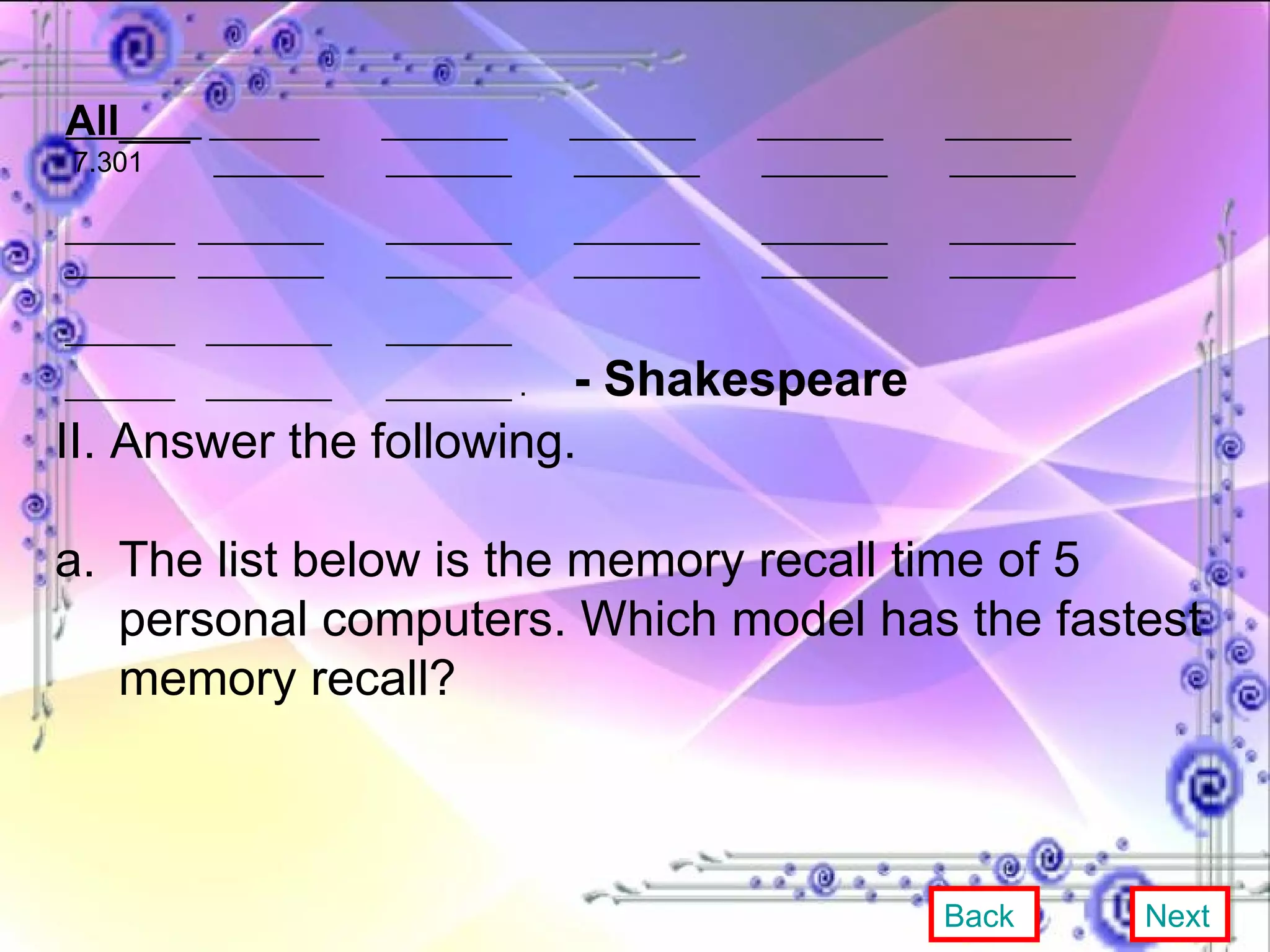
  • 164.
    It can beseen from the examples above the rule in changing a decimal to fraction is as follows: Back Next
  • 165.
    RULE To changea decimal number to a fraction, discard the decimal point and the zeros at the left of the left-most non-zero digit and write the remaining digits over the indicated denominator and reduce the resulting fraction to its lowest terms. (The number of zeros in the denominator is equal to the number of decimal places in the decimal number. Back Exercises
  • 166.
    Worksheet Change thefollowing decimals to factional form and simplify them. 1. 0.4 = ________________ 2. 0.007 = ________________ 3. 0.603 = ________________ 4. 0896 = ________________ 5. 056 = ________________ 6. 0.06 = ________________ 7. 0.125 = ________________ 8. 0.5 = ________________ 9. 0.42857 = ________________ 10. 0.375 = ________________ Back Next 12
  • 167.
    11. 0.54 =________________ 12. 0.14 = ________________ 13. 0.8187 = ________________ 14. 0.956 = ________________ 15. 0.3567 = ________________ 16. 0.578 =_________________ 17. 0.34878 =_________________ 18. 0.47891 =_________________ 19. 0.12489 =_________________ 10. 0.14789 =_________________ Back Next
  • 168.
    FUN WITH MATH!!!How can you make a tall man short? To find the answer, change the following decimal number to lowest factional form. Each time an answer is given in the code, write the letter for that exercise. Back Next
  • 169.
    1. 0.6 = A 6. 0.24 = _______ O 2. 0.5 = __ _____ B 7. 0.125 = _______ H 3. 0.7 = _______ N 8. 0.55 = _______ L 4. 0.4 = _______ I 9. 0.3 = _______ W 5. 0.75 = _______ O 10. 0.048 = _______ R 11. 0.25 = ______ O 12. 0.75 = _____ L 13. 0.2 = _____ E 14. 0.225 =______ O 15. 0.24 = _____ Y 16. 0.8 = _____ S 17. 0.5688=______ R Back Next
  • 170.
    _____ _____ _____ ______ ______ _____ ½ 6/25 6/125 711/1250 225/ 1000 3/10 __ A ___ ______ ______ 3/5 ¾ 11/20 _____ ______ ______ 1/8 4/10 12/15 _____ _____ _____ _____ _______ 8/32 12/16 14/20 18/90 36/150 Back Home
  • 171.
    Lesson 13 EXPRESSINGMIXED DECIMAL NUMBERS TO MIXED FRACTIONAL NUMBERS Lesson Objectives At the end of the lesson, the pupils should be able to . Express mixed decimal numbers to mixed fractional numbers. . Follow the rules in expressing mixed decimal numbers to mixed fractions. 3. Identify mixed decimals to mixed fractions. Next Content
  • 172.
    How can wechange mixed decimals to mixed fractions? Study the following examples: Back Next
  • 173.
    5.03 = 53/100 b. 6.2 = 6 2/10 = 6 1/5 24.75 = 24 75/100 = 24 ¾ d. 37.248 = 37 248/1000 = 37 31/125 The rule applied to the above example is: RULE To change a mixed decimal number to a mixed fractional number, do not change the integral part, change the decimal part to a fraction according to the rule, and write the result as a mixed fractional number. Back Exercises
  • 174.
    Worksheet Change thefollowing mixed decimals to mixed fractional numbers. (First is an example.) 1. 3.06 = 3 6/10 6. 67.7362 = ___________ 2. 5.72 = ________ 7. 62.72 = ___________ 3. 11.302 = ________ 8. 71.4684 = ___________ 4. 10.642 = ________ 9. 92.5896 = __________ 5. 51.136 = ________ 10. 4.789 = __________ Back Next 13
  • 175.
    II. Identify thefollowing by writing D if it is mixed decimals and F if it is mixed fractional numbers. _____1. 1 217/100 _____ 11. 14.3245 _____ 2. 1.0124 _____ 12. 18 18/24 _____ 3. 1.4568 _____ 13. 9.28 _____ 4. 32 8/18 _____ 14. 1.0406 _____ 5. 2.510 _____ 15. 4 235/1000 _____ 6. 10.01 _____ 16. 450 11 /111 _____ 7. 39 45/100 _____ 17. 1.5345 _____ 8. 45 105/265 _____ 18. 143.445254 _____ 9. 101 81/411 _____ 19. 12 34/91 _____ 10. 1.01123 _____ 20. 653 185/1124 Back Home
  • 176.
    Unit III ADDITIONAND SUBTRACTION OF DECIMALS NUMBERS Content Next
  • 177.
    OVERVIEW OF THEMODULAR WORKBOOK This modular workbook provides you greater understanding in all aspects of addition and subtraction of decimal numbers. It enables you to perform the operation correctly and critically. It includes all the needed information about the addition and subtraction of decimal numbers, its terminologists to remember, how to add and how to subtract decimals with or without regrouping, how to estimate sum and differences, and subtracting decimal numbers involving zeros in minuends. This modular work will help you to enhance your minds and ability in answering problems deeper understanding and analysis regarding all aspects of adding and subtracting decimal numbers. Back Next
  • 178.
    OBJECTIVES OF THEMODULAR WORKBOOK After completing this Unit, you are expected to: 1. Familiarize the language in addition and subtraction. 2. Learn how to add and subtract decimal numbers with or without regrouping. 3. Know how to check the answers. 4. Estimate the sum and differences and how it is done. 5. Know how to subtract decimal numbers with zeros in the minuend. 6. Develop speed in adding and subtracting decimal numbers. 7. Analyze problems critically. Back Next
  • 179.
    Lesson 14 MEANINGOF ADDITION AND SUBTRACTION OF DECIMAL NUMBERS Lesson Objectives: After accomplishing this lesson, you are expected to: . Define addition and Subtraction. 2. Identify the parts of addition and subtraction. 3. Familiarize the language in addition and subtraction. Next Content
  • 180.
    Addition isthe process of combining together two or more decimal numbers. It is putting together two groups or sets of thing or people. Back Next
  • 181.
    Example: 0.5 + 0.3 = 0.8 Addends Sum or Total Addends are the decimal numbers that are added. Sum is the answer in addition. The symbol used for addition is the plus sign (+). Back Next
  • 182.
    The process oftaking one number or quantity from another is called Subtraction . It is undoing process or inverse operation of addition. It is an operation of taking away a part of a set or group of things or people. Note: Decimal points is arrange in one column like in addition of decimals. Back Next
  • 183.
    Example: 14. 345 Minuend - 3.120 Subtrahend 11.232 Difference Minuend is in the top place and the bigger number in subtraction. The number subtracted from the minuend is called subtrahend . It is the smaller number in subtraction. The subtrahend is subtracted or taken from the minuend to find the difference. Difference is the answer in subtraction. The symbol used for subtraction is the minus sign (-). Back Exercises
  • 184.
    Worksheet I. Givethe meaning and explain the use of the following. 1. What is addition? 2. What is subtraction? 3. What are the parts of addition? 4. What are the parts of subtraction? Back Next 14
  • 185.
    1. Addition ______________________________________________2 Subtraction ______________________________________________ 3. Parts of addition ______________________________________________ 4. Parts of subtraction ______________________________________________ Back Next
  • 186.
    II. Identifythe following decimal numbers whether it is addends, sum, minuend, subtrahend or difference. Put an if addends, if sum, if minuend, if subtrahend and if difference. 1. 0.9 _______ + 0.8 _______ 1.7 _______ 2. 2.24 _______ + 2.38 _______ 4.62 _______ 3. 12.85 _______ - 0. 87 _______ 11.98 _______ 4. 7.602 _______ - 2.664 _______ 4.938 _______ Back Next
  • 187.
    5. 0.312 _______ + 0.050 _______ 0.362 _______ 6. 6.781 _______ - 1.89 _______ 8.676 _______ 7. 0.215 _______ + 0.001 _______ 0.216 _______ 8. 0.156 _______ + 1.811 _______ 1.967 _______ 9. 0.113 _______ + 0.009 _______ 0.122 _______ 10. 0.689 _______ - 1.510 _______ 2.199 _______ Back Next
  • 188.
    III. Answer thefollowing by completing the letter in each box which indicate the parts of addition and subtraction of decimals. 1. It is the numbers that are added. 2. The answer in addition. 3. It is the process of combining together two or more numbers. Back Next
  • 189.
    4. Sign usedfor addition. 5. It is undoing process or inverse operation of addition. 6. Sign used for subtraction. 7. It is the answer in subtraction. Back Next
  • 190.
    8. It isin the top place and the bigger number in subtraction. 9. It is the smaller number in subtraction. 10. Subtraction is an operation of _________ a part of a set or group of things or people. Back Home
  • 191.
    Lesson 15 ADDITIONAND SUBTRACTION OF DECIMAL NUMBERS WITHOUT REGROUPING Lesson Objectives: After finishing the lesson, the students are expected to: . Know how to add and subtract decimal numbers without regrouping. 2. Develop speed in adding and subtracting decimal number. 3. Follow the steps in adding and subtracting decimal numbers. Next Content
  • 192.
    Add the followingdecimals: 28. 143 and 11.721. If you added them this way, you are right. 28. 143 + 11. 721 39. 864 Let us add the decimals by following these steps. Back Next
  • 193.
    STEP 1 STEP 2 Back Next Add the thousandths place 3+ 1 = 4 28. 143 + 11. 721 4 Add the hundredths place 4 + 2 = 6 28. 143 + 11. 721 64
  • 194.
    STEP 3 STEP4 Back Next Add the tenths place 7 + 1 = 8 28. 143 + 11. 721 864 Add the following up to the ones. 8 + 1 = 9 28. 143 + 11. 721 9. 864
  • 195.
    STEP 5 Back Next Add the following up to the tens. 2 + 1 = 3 28. 143 + 11. 721 39. 864
  • 196.
    Now subtract 39.864 to 11. 721. 39. 864 minuend - 11. 721 subtrahend 28. 143 difference Back Next
  • 197.
    2 Ways ofChecking the Answer 1. minuend – difference = subtrahend 39. 864 minuend - 28. 143 difference 11. 721 subtrahend 2. difference + subtrahend = minuend 28. 143 difference + 11. 721 subtrahend 39. 864 minuend Back Next
  • 198.
    If you subtractthe difference from minuend and the answer is subtrahend the answer is correct. Also, adding the difference and subtrahend will the result to the minuend: it is also correct. Back Next
  • 199.
    As a procedurefor adding or subtracting decimal numbers, we have the following: Write the decimal numbers with the decimal points falling in one column. 2. Add or subtract as if they were whole numbers. 3. Place the decimal point of the result in the same column as the other numbers. Back Exercises
  • 200.
    Worksheet Add andsubtract as fast as you can. Back Next 15
  • 201.
  • 202.
    FUN WITH MATH!!!Add and subtract the following to find the mystery words and write the letter of each answer in the code below. This appears twice in the Bible (In Matthew VI and Luke II). Back Next
  • 203.
    85. 367 2. 645. 987 + 16. 252 - 314.625 R P 74. 617 + 21. 721 O 2,936. 475 - 1,421.061 S 51. 437 6. 658.325 + 18. 042 - 137.210 Y L 895. 399 8. 945. 374 - 471. 287 + 33. 161 A R 9. 32. 511 + 11. 621 R Back Next
  • 204.
    7,649.251 11. 66.341 - 36.030 + 12.412 E D _______ 521. 115 _______ 96. 338 _______ 44. 132 _______ 78. 753 _______ 1515. 414 _______ 331.362 _______ 101.619 _______ 424.112 _______ 69.478 _______ 7613.221 _______ 978.535 Back Home
  • 205.
    Lesson 16 ADDITIONAND SUBTRACTION OF DECIMAL NUMBERS WITH REGROUPING Lesson Objectives: After accomplishing the lesson, the students are expected to be able to: 1. Define regrouping. 2. Learn how to add and subtract decimal numbers with regrouping. 3. Answer and perform the operation critically and correctly. Next Content
  • 206.
    In the pastlesson, you’ve learned how to add and subtract decimal numbers without regrouping. The only difference in this lesson is that it involves regrouping and borrowing. It is easy to add and subtract decimal numbers without regrouping. Back Next
  • 207.
    Regrouping isa process of putting numbers in their proper place values in our number system to make it easier to add and subtract. Here’s how to add decimal numbers with regrouping. Back Next
  • 208.
    Example 1: 0. 7 + 0. 5 0.7 + 0.5 = 12 10 tenths is regroup as ( 1 ) one. Back Next Ones . Tenths 1 0 + 0 . . 7 5 1 . 2
  • 209.
    Example 2: 0.09 + 0.06 0.9 + 0.6 = 15 hundredths 10 hundredths is 1 regrouped as 1 tenth. Back Next O . T H 0 0 . . 0 0 9 6 0 . 1 5
  • 210.
    Example 3: 0.065 + 0.008 5 + 8 = 13 thousandths 10 thousandths is regrouped as 1 hundredth. Back Next O T H Th 0. + 0. 0 0 6 0 5 8 0. 0 7 3
  • 211.
    Subtract decimals likeyou were subtracting whole numbers. Back Next
  • 212.
    Example 4: 0. 93 - 0. 28 9 is renamed as 8 + 1 tenths. 1 tenth is regrouped as 10 hundredths. 0. 9 3 - 0. 2 8 0. 6 5 Check: 0. 28 + 0. 65 0. 93 Back Next ones tenths hundredths 0. 9 3 0. 8 - 1 10 0. 8 3 0. 8 13
  • 213.
    Example 5: 0.730 - 0.518 2 10 0.730 - 0.518 0.212 Check: 0.518 + 0.212 0.730 Answer Back Exercises ones tenths hundredths thousandths 0. 7 3 0 0. 7 2+1 10 0. 7 - 5 2 - 1 0 - 8 0. 0. 2 1 2
  • 214.
    Worksheet I. Answerthe following. A. Add the following and check your answer on the Check Box below. 0.6 2. 0.07 + 0.8 + 0.49 0.36 4. 0.746 + 0.56 + 0.235 Back Next 16
  • 215.
    B. Subtract thefollowing and check your answer on the Check Box below. 1. 0.62 2. 0.762 - 0.58 - 0.325 3. 0.850 4. 0.452 - 0.328 - 0.235 Back Next
  • 216.
    II. Writeon the blank ( + ) or ( - ) sign to make the statement TRUE. 1. 4.793 ___ 3.549 = 8.342 2. 72.685 ___ 45.726 ___ 13.493 = 104.918 3. 1.45 ___ 0.50 ___ 3.95 ___ 5.66 = 11.56 4. 36.58 ___ 35.789 ___ 354.587 = 426.956 6.57 ___ 0.456 ___ 236.5 ___ 5 ___ 213.66 = 34.866 6. 28. 625 ___ 25.361 = 3.264 7. 57.54 ___ 0.25 = 57.29 8. 86.3 ___ 0.456 ___ 32.58 = 118.424 9. 39 ___ 5.65 = 33.35 10. 53.654 ___ 5.236 = 48.418 Back Home
  • 217.
    Lesson 17 ADDINGAND SUBTRACTING MIXED DECIMALS Lesson Objectives: After finishing the lesson, the students are expected to: 1. Understand and know how to add and subtract mixed decimal numbers. 2. Follow the rules in adding and subtracting mixed decimal numbers. 3. Perform the operation correctly. Next Content
  • 218.
    Ramon traveled fromhis house to school, a distance of 1.39845 kilometers. After class, he traveled to his friend’s house 1.85672 kilometer away in another direction. From his friends to his own house, he rode another 1.23714 km over. How many kilometers did Ramon traveled? Back Next 3 . T H Th T Th H Th 1 1 1 +1 . . . 1 3 8 2 2 9 5 3 1 8 6 7 1 4 7 1 5 2 4 4 . 4 9 2 3 1
  • 219.
    He traveled atotal of 4.49231 km. The following day, he traveled to the school and the seashore for a total of 6.35021 km. How many more kilometers did Ramon traveled than previous day? Back Next O T H Th T Th H Th 5 6 -4 . . 12 3 4 14 5 9 9 0 2 12 2 3 1 1 1 . 8 5 7 9 0
  • 220.
    Ramon traveled 1.85790kilometers more. In adding and subtracting mixed decimals, remember to align the decimal points and regroup when necessary. Back Exercises
  • 221.
    Worksheet I. Addor subtract these mixed decimals. 4.59804 2. 3.14879 3. 5.11788 7.81657 5.37896 1.93523 + 1.30493 + 2.95321 + 3.40175 4. 2.42814 5. 7.20453 6. 9.57128 - 1.19905 - 4.35712 - 2.89340 Back Next 17
  • 222.
    II. Rewrite withthe correct alignment of decimal points on the space provided. Find the sum and difference. 1. 4.930000 4. 18.17932 57.5244 + 2.41256 + 637.3672 73.59203 5. 12.48004 + 154.38762 - 9.86327 3. 142.567021 6. 42.20239 - 85.791503 - 2.34876 Back Next
  • 223.
    4. 18.16532 9.5.306321 - 4.01985 002.7509 + 4.952005 5. 951.235 7.18902 10. 103.93284 + 00.3 + 43.76895 Back Home
  • 224.
    Lesson 18 ESTIMATINGSUM AND DIFFERENCE OF WHOLE NUMBERS AND DECIMALS Lesson Objectives: After understanding the lesson, you must be able to: . Define estimation. 2. Know the two methods in making estimates. 3. Learn how to estimate sum and difference and how it is done. Next Content
  • 225.
    Estimation isa way of answering a problem which does not require an exact answer. An estimate is all that is needed when an exact value is not possible. Estimation is easy to use and or to compute. Rounding is one way of making estimation. Each decimal number is rounding to some place value, usually to the greatest value and the necessary operation is performance on the rounded decimal numbers. Back Next
  • 226.
    Two methods areused in making estimation, the rounding off the desired digit one and finding the sum of the first digit only. We have learned how to round decimal numbers in this section, first only the front digits are used. If an improved or refined estimate is desired, the next digits are used. Back Next
  • 227.
    When large decimalnumbers are involved, it is wise to estimate before computing the exact and user is expected to be about or close to the estimate. Method 1: Sum of the First Digit only Estimate in Addition 3.455 + 2.672 + 5.135 Back Next
  • 228.
    Rounded off tothe nearest ones 3 .455 3.000 2 .672 3.000 + 5 .134 + 5.000 11.000 first estimate Rounded off to the nearest tenths 3. 4 55 0.500 2. 6 72 0.700 + 5. 1 34 + 0.100 1.300 to be added the first estimate if desired or required. Back Next
  • 229.
    Thus the sum3.455 + 2.672 + 5.134 can be roughly estimated by 11.000. If a better estimate is required or desired, then add 1.300 to get 11.300. Back Next
  • 230.
    Estimate 5.472147 –2.976543 Rounded to the nearest ones Actual Subtraction 5.472147 5.000000 5.472147 - 2.976543 - 3.000000 - 2.976543 2.000000 2.495604 Back Next
  • 231.
    Method 2: RoundingMethod Estimate the sum by rounding method in place of whole numbers. Example: 6.567 7.000 5.482 5.000 + 4.619 + 5.000 17.000 Back Next
  • 232.
    b. Estimatethe difference by rounding method. Example : 14.525 15.000 - 11.018 - 11.000 4.000 By the rounding method, the first example is estimated by 17.000 and the second one by 4.000. The actual value of the sum of example no.1 is 16.668 and the difference of example no. 2 is 3.507 respectively. Both methods give a reasonable estimate. Back Next
  • 233.
    Remember: In estimatingthe sums, first round each addend to its greatest place value position. Then add. If the estimate is close to the exact sum, it is a good estimate. Estimating helps you expect the exact answer to be about a little less or a little more than the estimate. However, in estimating difference, first round the decimal number to the nearest place value asked for. Then subtract the rounded decimal numbers. Check the result by actual subtraction. Back Exercises
  • 234.
    Worksheet I. Estimates the sum and difference to the greatest place value. Check how close the estimated sum (E.S.) / estimated difference (E.D.) by getting the actual sum (A.S.) and actual difference (A.D.) . A. Actual Sum/ Estimated Sum 1. 3.417 3.000 2. 36.243 36.000 2.719 3.000 29.641 30.000 + 1.829 + 2.00 + 110.278 + 110.000 A.S. E.S. A.S. E.S. Back Next 18
  • 235.
    3. 648.937 649.000 4. 871.055 871.000 214.562 215.000 276.386 276.000 + 450.211 + 450.000 + 107.891 + 108.000 A.S. E.S. A.S. E.S. 5. 374.738 375.000 6. 342.165 342.000 469.345 469.000 178.627 179.000 + 213.543 + 213.500 + 748.715 + 749.000 A.S. E.S. A.S. E.S. Back Next
  • 236.
    B. Actual Difference/Estimated Difference 7. 14.255 14.000 8. 28.267 28.000 - 11.812 - 12.000 - 16.380 - 16.000 A.D. E.D A.D. E.D. 9. 345.678 346.000 10. 92.365 92.000 - 212.792 - 213.000 - 75.647 - 76.000 A.D. E.D. A.D. E.D. 11. 62.495 62.000 12. 9.2875 9.0000 - 17.928 - 18.000 - 6.8340 - 7.0000 A.D. E.D. A.D. E.D. Back Next
  • 237.
    FUN WITH MATH!!!Match a given decimals with the correct estimated sum / difference to the greatest place – value. The shortest verse in the Bible consists of two words. Back Next
  • 238.
    To find out,connect each decimals with he correct estimated sum / difference to the greatest place – value. Write the letter that corresponds to the correct answer below it. 1. 36.5+18.91+55.41 U. 939.00 2. 639.27-422.30 S. 216.00 3. 48.21+168.2 P. 2.0000 4. 285.15+27.35+627.30 E. 146.000 5. 8.941-8.149 W. 28.10 6. 18.95+9.25 J. 111.00 7. 129.235+16.41 T. 537.00 8. 9.2875-6.834 S. 1.000 9. 989.15-451.85 E. 217.00 Back Next
  • 239.
    _____ ______ ______ ______ ______ 1 2 3 4 5 _____ ______ ______ ______ 6 7 8 9 Back Home
  • 240.
    Lesson 19 MINUENDWITH TWO ZEROS Lesson Objectives: After accomplishing the lesson, the students are expected to be able to: . Know how to subtract decimal numbers with two zeros in minuend. 2. Follow the steps in subtraction of numbers involving zeros. 3. Check the answer and perform the operation correctly. Next Content
  • 241.
    You always haveto regroup in subtracting decimal numbers with zeros. You will have to regroup from one place to the next until all successive zeros are renamed and ready for subtraction. Back Next
  • 242.
    STEPS IN SUBTRACTIONOF DECIMAL NUMBER INVOLVING ZEROS . Arrange the digits in column. . Regroup from one place to the next until all successive zeros are renamed. . Subtract to find the answer. . Check the answer. Back Next
  • 243.
    Example: 0.8005 - 0.6372 Back Next O T H Th T Th 0. 8 0 0 5 0. 7+1 10 9+1 10 0. 7 9 10 5 0. 6 3 7 2 0. 1 6 3 3
  • 244.
    Rewriting: 0.8005 - 0.6372 Difference 0.1633 Checking: 0.6372 + 0.1633 0.8005 Back Exercises
  • 245.
    Worksheet I. Subtractthe following and check. 1. 16.004 - 2.875 2. 28.009 - 11.226 3. 18.003 - 5.739 4. 11.001 - 9.291 5. 4.0075 - 2.9876 0.10013 - 0.00011 7. 2.00143 - 0.88043 0.7008 - 0.5383 9. 0.8008 - 0.0880 10. 0.14003 - 0.03333 Back Next 19
  • 246.
    FUN WITH MATH!!!Answer the following to find the mystery words. In what type of ball can you carry? To find the answer, draw a line connecting each decimal number with its equal difference. The lines pass through a box with a letter on it. Write what is in the box on the blank next to the answer. Back Next
  • 247.
  • 248.
    Lesson 20 PROBLEMSOLVING INVOLVING ADDITION AND SUBTRACTION OF DECIMALS Lesson Objectives: After accomplishing the lesson, the students are expected to be able to: . Follow the step of solving problem. 2. Analyze the problem critically. 3. Develop interest in solving word problem. Next Content
  • 249.
    Kristina saves herextra money to buy a pair of shoes for Christmas. Last week she saved Php. 82.60; two weeks ago, she saved Php. 100.05. This week she saved Php. 92.60. How much did she save in three weeks? Steps in Solving a Problem 1. Analyze the problem 2. What is asked? Total amount did Kristina save in three weeks. 3. What are the given facts? Php. 82.60, Php. 100.05, and Php. 96.10 Know Back Next
  • 250.
    3. What isthe word clue? Save. What operation will you use? We use addition. 4. What is the number sentence? Php. 82.60 + Php. 100.05 + Php. 96.10 = N 5. What is the solution? Php. 82.60 Php. 100.05 + Php. 96.10 Php. 278.75 Solve Decide Show Back Next
  • 251.
    Check 6. Howdo you check your answer? We add downward. Php. 82.60 Php. 100.05 + Php. 96.10 Php. 278.75 “ Kristina saves Php. 278.75 in three weeks.” Back Exercises It is easy to solve word problems by simply following the steps in solving word problem.
  • 252.
    Worksheet I. Readthe problem below and analyze it. A. Baranggay Maligaya is 28.5 km from the town proper. In going there Angelo traveled 12.75 km by jeep, 8.5 km by tricycle and the rest by hiking. How many km did Angelo hike? 1. What is asked? __________________________________________________________________________________________ 2. What are the given facts? __________________________________________________________________________________________ Back Next 20
  • 253.
    3. What isthe process to be used? ______________________________________________________________________________________________ 4. What is the mathematical sentence? ______________________________________________________________________________________________ 5. How the solution is done? 6. What is the answer? ______________________________________________________________________________________________ Back Next
  • 254.
    7. How doyou check the answer? B. Faye filled the basin with 2.95 liters of water. Her brother used 0.21 liter when he washed his hands and her sister used 0.8 liter when she washed her face. How much water was left in the basin? Back Next
  • 255.
    1. What isasked? __________________________________________________________________________________________ 2. What are the given facts? __________________________________________________________________________________________ 3. What is the process to be used? __________________________________________________________________________________________ 4. What is the mathematical sentence? __________________________________________________________________________________________ 5. How the solution is done? Back Next
  • 256.
    6. What isthe answer? __________________________________________________________________________________________ 7. How do you check the answer? Back Next
  • 257.
    C. Ron cutfour pieces of bamboo. The first piece was 0.75 meter; the second was 2.278 meters; the third was 6.11 meters and the fourth was 6.72 meters. How much longer were the third and fourth pieces put together than the first and second pieces put together? 1. What is asked? __________________________________________________________________________________________ 2. What are the given facts? __________________________________________________________________________________________ Back Next
  • 258.
    3. What isthe process to be used? ______________________________________________________________________________________________ 4. What is the mathematical sentence? ______________________________________________________________________________________________ 5. How the solution is done? 6. What is the answer? ______________________________________________________________________________________________ Back Next
  • 259.
    7. How doyou check the answer? D. Pamn and Hazel went to a book fair. Pamn found 2 good books which cost Php. 45.00 and Php. 67.50. She only had Php.85.00 in her purse but she wanted to buy the books. Hazel offered to give her money. How much did Hazel share to Pamn? Back Next
  • 260.
    1. What isasked? __________________________________________________________________________________________ 2. What are the given facts? __________________________________________________________________________________________ 3. What is the process to be used? __________________________________________________________________________________________ 4. What is the mathematical sentence? __________________________________________________________________________________________ 5. How the solution is done? Back Next
  • 261.
    6. What isthe answer? __________________________________________________________________________________________ 7. How do you check the answer? Back Next
  • 262.
    E. Marlene wantsto buy a bag that cost Php. 375.95. If she has saved Php. 148.50 for it, how much more does she need? 1. What is asked? __________________________________________________________________________________________ 2. What are the given facts? __________________________________________________________________________________________ 3. What is the process to be used? __________________________________________________________________________________________ Back Next
  • 263.
    4. What isthe mathematical sentence? ______________________________________________________________________________________________ 5. How the solution is done? 6. What is the answer? ______________________________________________________________________________________________ 7. How do you check the answer? Back Home
  • 264.
    UNIT IV MULTIPLICATIONOF DECIMALS Content Next
  • 265.
    OVERVIEW OF THEMODULAR WORKBOOK This modular workbook provides you with the understanding of the meaning of multiplication of decimals, multiply decimals in different form and how to estimate products. It will develop the ability of the students in multiplying decimal numbers. This modular workbook will help you to solve problems accurately and systematically. Back Next
  • 266.
    OBJECTIVES OF THEMODULAR WORKBOOK After completing this Unit, you are expected to: 1. Define multiplication, multiplicand, multiplier, products and factors. 2. Know the ways of multiplying decimal numbers. 3. Learn the ways of multiplying decimal numbers involving zeros. 4. Learn how to make an estimate and know the ways of making estimates. Back Next
  • 267.
    Lesson 21 MEANINGOF MULTIPLICATION OF DECIMAL NUMBERS Lesson Objectives: After learning this lesson, you are expected to: Define multiplication. 2. Locate where the multiplicand, multiplier and product are. 3. Familiarize the terms in multiplication. Next Content
  • 268.
    Multiplication isa short cut for repeated addition. It is a short way of adding the same decimal number. It is the inverse if division. Back Next .4 + .4 + .4 + .4 + .4 + .4 = 2.4 In multiplication, it is written as: .4 -> multiplicand x 6 -> multiplier 2.4 -> product (answer in multiplication) factors
  • 269.
    The decimal numberswe multiply are called multiplicand and multiplier is the decimal number that multiplies. The answer in the multiplication is the product . The decimal numbers multiplied together are factors . Another examples: 9 0.08 1.24 0.007 x 0.5 x 3 x 2 x 4 4.5 0.24 2.48 0.028 Back Exercises
  • 270.
    1. What ismultiplication? 2. What are factors? 3. What are products? 4. Give some examples of multiplication decimals. I. Give the meaning and explain the use of the following. Back Next 21 Worksheet
  • 271.
    multiplication ________________________________________________________________________________ 2.factors ________________________________________________________________________________ 3. products ________________________________________________________________________________ 4. Examples of multiplication decimals ________________________________________________________________________________ Back Next
  • 272.
    Identify the wordsby looping vertically ,horizontally and diagonally directions. (Word – Puzzle) Back Next
  • 273.
    ____________ 1. Thenumber we if multiply. ____________ 2. The numbers multiplied together. ____________ 3. The number that multiplies. ____________ 4. It is a short way of adding the same number of number times. ____________ 5. Multiplication is the inverse of _____________ Back Next
  • 274.
    Complete the followingthat corresponds to the missing answer. 1. 0.42 - ______ 6. 0.183 - ______ x 0.34 - ______ x 0.141 - ______ _____ - product _____ - product 2. 0.12 - ______ 7. 12.55 - ______ x ____ - multiplier x 21.45 - ______ 0.0132 - ______ _____ - product 3. ____ - multiplicand 8. ____ - multiplicand x 4.62 - _______ x 0.96 - _______ 0.1848 - _______ 0.1848 - _______ Back Next
  • 275.
    4. 56.08- ______ 9. 1.45 - ______ x 31.901 - ______ x 6.56 - ______ _______ - product ______ - product 5. 8.08 - multiplicand 10. 8.145 - multiplicand x 8.14 - multiplier x 6.001 - multiplier _____ -________ _____ -________ Back Home
  • 276.
    Lesson 22 MULTIPLYINGDECIMALS Lesson Objectives: After finishing the lesson, the students are expected to: 1. Learn how to multiply decimal numbers. . Follow the steps in multiplying decimal numbers. . Know how to place the decimal point in the product. Next Content
  • 277.
    Study these examples.Where do you place the decimal point in the product? 0.432 0.614 × 0.15 × 0.37 2160 4298 + 432 + 1842_ 0.06480 0.22718 Back Next
  • 278.
    Remember: In multiplyingdecimals, the placement of the decimal point in the product is determined by the total number of decimal places in the factors. Count the number of decimal places from the right. To check, divide the product by either factors. Back Next
  • 279.
    6480 four digits22718 five digits Add a zero to make Additional zeros is five decimal places in the product. not needed. 0.06480 0.2271 Additional Zero Add the decimal places in the factors. Then see how many decimal places the product has. Back Next 0.432 × 0.15 Five decimal places 0.614 × 0.37 Five decimal places
  • 280.
    PRACTICE: Find theproduct by fill in the boxes for the correct answer. Back Next 0.3 0.2 0.4 0.1 0.5 0.6 0.4 0.7 0.3 0.5 0.4 0.3 0.7 0.6 0.8 0.4 0.2 0.1 0.5 0.4 0.3 0.7 0.6 0.8 0.4 0.2 0.1
  • 281.
    Back Exercises 1.91.5 1.8 2.5 3.5 2.0 3.5 3.8 3.1 0.1 0.44 0.87 0.54 0.53 0.09 0.9 0.76 0.36 1.90 1.2 2.9 1.8 2.2 2.99 1.66 0.8 1.5 2.2 1.4 1.9 1.4 1.7 1.9 1.7 2.0 2.7 1.6 1.8 1.7 1.89 1.89 1.7 2.7 2.6 2.9
  • 282.
    Put the decimalpoint on the product for the correct places. 1. 0.192 x 0.428 1536 384 + 768__ 82176 2. 0.342 x 0.153 1026 1710 + 342 52326 3. 0.208 x 0.274 832 1456 + 416 56992 Back Next 22 Worksheet
  • 283.
    4. 0.263 x 0.29 2367 + 526 7627 5. 0.1594 x 0.37 11158 + 47852 58978 Multiply the following decimal numbers and put the decimal point. 1. 0.987 x 0. 270 2. 0.158 x 0.258 3. 0.4789 x 0.1247 Back Next
  • 284.
    4. 0.2547x 0.2479 5. 0.3647 x 0.1248 Back Next
  • 285.
    What did thebig flower say about the little flower? FUN WITH MATH!!! To find the answer, write each of the following products in multiplying decimals. Back Next
  • 286.
    __________ ___________ ___________ __________ 0. 7537344 0.0132 0.0003 0.08537832 ___________ ___________ 0.001445 0.290523 _________ __________ _________ ________ ________ 0.0000195 0.0044902 0.000492 0.05626725 0.0006 Back Home
  • 287.
    Lesson 23 MULTIPLYINGMIXED DECIMALS BY WHOLE NUMBERS Lesson Objectives: After finishing the lesson, the students are expected to: 1. Multiply mixed decimals by whole numbers. 2. Find the partial products. 3.Understand the rules in multiplying mixed decimals by whole numbers. Next Content
  • 288.
    Christopher can savePhp. 18.65 in one month. How much money can he save in four months? 18.6 -> two decimal places x 4 74.60 Decimals are multiplied the same way as whole number. Back Next
  • 289.
    Remember: In multiplyingmixed decimals by whole numbers, count the decimal places in the mixed decimal to determine the placement of the decimal point in the product. Start counting the number of decimal places from the right. Back Next
  • 290.
    Study other examples. 23.729 -> three decimal places x 47 166103 + 94916 1115.263 ↑ Partial product Back Next
  • 291.
    6.3572 -> four decimal places x 158 508576 317860 + 63572 1004.4376 ↑ Partial product Back Exercises
  • 292.
    In the followingproblems, the final product is given. Find the partial products. Place the decimal points in the correct position. 1. 81.83 2. 62.872 3. 7.0194 × 57 × 34 × 271 + + 466431 2137648 + 19022574 Back Next 23 Worksheet
  • 293.
    4. 17.59 5.48.723 6. 8.0035 × 83 × 52 × 179 + + 145997 2533596 + 14326265 Back Next
  • 294.
    II. Find theproduct. 7. 934.04 8. 282.5601 9. 37.5852 × 251 x 49 × 784 10. 51.207 11. 4672.397 12. 693.3521 × 490 × 268 × 922 Back Next
  • 295.
    13. 75.373 14. 149.1811 15. 10.1496 x 44 x 1012 x 189 Back Home
  • 296.
    Lesson 24 MULTIPLICATIONOF MIXED DECIMALS BY MIXED DECIMALS Lesson Objectives: After accomplishing this lesson, you are expected to: 1. Multiplying mixed decimals by mixed decimals. 2. Perform the operation correctly. 3. Understand the rules in multiplying mixed decimals by mixed decimals. Next Content
  • 297.
    What is thearea of Ariel’s backyard if it is 12.932 m long and 8.45 m wide? NOTE: Area = length x width = 12.93m x 8.45m = 109.27540 sq.m² = m x m = m² 12.932 -> three decimal places × 8.45 -> two decimal places 64660 51728 + 103456 109.27540 -> five decimal places The backyard is 109.27540 square meters. Back Next
  • 298.
    NOTE: Area =length x width = 12.93m x 8.45m = 109.27540 sq.m² = m x m = m² When multiplying mixed decimals by mixed decimals, the decimal point of the product is determined in this manner. Back Next
  • 299.
    Decimal Decimal Decimal Places of first Places of second Places of Factor Factor the product Back Exercises
  • 300.
    Worksheet I. Rewrite and arrange the partial products properly. Find the product and place the decimal points in the correct position. 1. 4.9526 2. 9.18234 × 3.215 × 75.68 247630 7345872 49526 5509404 99052 451170 + 148578 + 6427638 Back Next 25
  • 301.
    3. 57.6012 4.2.01938 × 4.765 × 36.24 2880060 807752 3456072 403876 4032084 1211628 + 2304048 + 605814 Back Next
  • 302.
    Find the product.5. 15.6027 6. 92.46355 7. 8.932682 × 8.306 × 1.728 × 9.1865 8. 743.9516 9. 268.924 10. 5.1367 × 4.321 × 4.321 × 9.824 Back Home
  • 303.
    Lesson 25 MULTIPLYINGDECIMALS BY 10, 100 and 1000 Lesson Objectives: At the end of the lesson, you are expected to: 1. Multiply decimals by 10, 100 and 1000. 2. Write the product correctly. 3. Observe the rules in multiplying decimals by 10, 100 and 1000. Next Content
  • 304.
    Take a decimal,0.7568. Multiply it by 10, by 100 and by 1,000. What are the products? Look at the following: 0.7568 0.7568 0.7568 × 10 × 100 × 1000 7.5680 75.6800 756.8000 Back Next
  • 305.
    You see thatthe number of zeros contained in the factors 10, 100 and 1,000 tells how many places the decimal point in the other factor must be moved to the right to get the product. Examples: 10 × 0.75 = _______ 100 × 0.75 = _______ 1,000 × 0.75 = _______ Back Next
  • 306.
    Observe: Move 1place to the right. Move 2 place to the right. Move 3 place to the right. Back Exercises 750. 75. 7.5 0. 750 0. 75 0.75 0.750 0.75 0.75 0.75 × 1,000 × 100 × 10 Decimal
  • 307.
    Worksheet Complete thefollowing equations. 1. 3.67 × 10 = ______ 2. 100 × _____ = 4521 3. 1000 × _____ = 0.0049 4. _____ × 100 = 854.8 5. 2.918 × _____ = 2918 6. 35.66 × _____ = 35660 7. 0.0074 × _____ = 7.4 8. _____ × 10 = 0.163 9. 0.089 × 10 = _____ 10. _____ × 100 = 100.78 Back Next 25
  • 308.
    II. Completethe table by multiplying each factor by 10, 100 and 1,000. Back Next
  • 309.
    III. Multiply thefollowing. Write your answers in the blanks provided: 1. 0.386 × 10 = ________ 2. 0.86 × 100 = ________ 3. 0.36 × 1000 = ________ 4. 0.473 × 1000 = ________ 5. 0.496 × 10 = ________ 6. 0.85 × 1000 = ________ 7. 0.7 × 1000 = ________ 8. 0.512 × 100 = ________ 9. 0.93 × 100 = ________ 10. 0.603 × 10 = ________ Back Home
  • 310.
    Lesson 26 ESTIMATINGPRODUCTS OF DECIMAL NUMBERS Lesson Objectives: After understanding the lesson, you must able to: 1. Learn how to estimate the products correctly. 2. Learn how to make an estimates product in fastest way. 3. Follow the steps in estimating products. Next Content
  • 311.
    The fastest wayof solving problem is to estimate. In estimating the products: Round the given decimal numbers to the highest place value. Estimate and multiply. Compute the exact answer. Products can be estimated in the same way as sum and difference. Back Next
  • 312.
    1. Rounding Method4.52 × 6 27.12 Actual Value Rounded Value 5.00 × 6 30.00 2. Front End Method 4 .56 4.00 4. 5 2 .50 450 × 6 × 6 × 6 × 6 × 6 24.00 + 3.00 = 27.00 Back Next
  • 313.
    The front –end method with adjustment is usually closer to the actual value. Back Exercises
  • 314.
    Worksheet Estimate theproduct using rounding and front-end with adjustment. 1. 3.754 2. 48.263 3. 28.169 × 8 × 5 × 7 Back Next 26
  • 315.
    4. 38.721 5. 28.765 6. 75.814 × 3 × 9 × 13 7. 96.250 8. 18.263 9. 927.231 × 42 × 41 × 507 Back Next
  • 316.
    10. 36.287 11. 76.298 12. 28.183 × 206 × 304 × 543 Back Home
  • 317.
    Lesson 27 PROBLEMSOLVING INVOLVING MULTIPLICATION OF DECIMAL NUMBERS Lesson Objectives: After understanding the lesson, you must able to: Solve word problem involving multiplication of decimals. Write the numbers sentence. Solve word problems correctly and accurately. Next Content
  • 318.
    Example 1: A cone of ice cream costs Php. 16.25, how much in all did the 6 children spend for ice cream? Back Next
  • 319.
    Example 2: Whatis the area of a rectangle with a length of 9.72 cm and width of 6.34 cm? Back Exercises
  • 320.
    Worksheet Read, analyzeand translate these problems to number sentence then solve. 1. Mrs. Hernandez baked 1,000 pineapple pies for a party of her daughter Kiana. If each pie costs Php. 17.85, how much did the 1,000 pies cost? Back Next 27
  • 321.
    2. If acar travels 55.6 km an hour, how far will it travel in 8 hours? Back Next
  • 322.
    3. Mang Freddiesold 46 cotton candies at Php. 2.15 each. How much altogether is the cost of the cotton candies? Back Next
  • 323.
    4. A ropemeasures 4.63 m. How long is it in centimeters? Back Next
  • 324.
    5. If 1meter of cloth costs Php. 72.95, how would 6.5 meters cost? Back Next
  • 325.
    6. Mang John,a balot vendor bought 120 new duck eggs at Php. 3.85 each. How much did he pay all the eggs? Back Next
  • 326.
    7. A canof powdered milk has a mass of 0.345 kilogram. What is the mass of 12 cans of milk? Back Next
  • 327.
    8. Mr. GeloDrona bought a residential lot with an area of 180.75 m at Php. 650.00 per square meter. How much did he pay for the lot? Back Next
  • 328.
    9. Niña works40 hours a week. If his hourly rate is Php. 640.25, how much is she paid a week? Back Next
  • 329.
    10. The rentalfor a Tamaraw FX is Php. 3,500 a day. What will it cost you to rent it in 3.5 days? Back Home
  • 330.
    Unit V DIVISIONOF DECIMALS Content Next
  • 331.
    OVERVIEW OF THEMODULAR WORKBOOK This modular workbook provides you’re the language of division of decimal numbers and how to divide decimals in different ways. OBJECTIVES OF THE MODULAR WORKBOOK After finishing this unit, you are expected to: 1. Understand the language of division of decimals. 2. Know how to divide decimal numbers. 3. Follow the steps in division of decimal numbers. 4. Participate actively in division of decimal numbers. 5. Learn the different form of dividing decimal numbers. Back Next
  • 332.
    Lesson 28 MEANINGOF DIVISION OF DECIMAL NUMBERS Lesson Objectives: After accomplishing this lesson, you are expected to: 1. Define division. 2. Understand the language in division of decimals. 3. Know the parts in dividing decimal numbers. Next Content
  • 333.
    Division isthe process of finding out how many times one number is contained in another number. 0.09 -> quotient 9 0.81 -> dividend - 0 81 - 81 0 Divisor Back Next
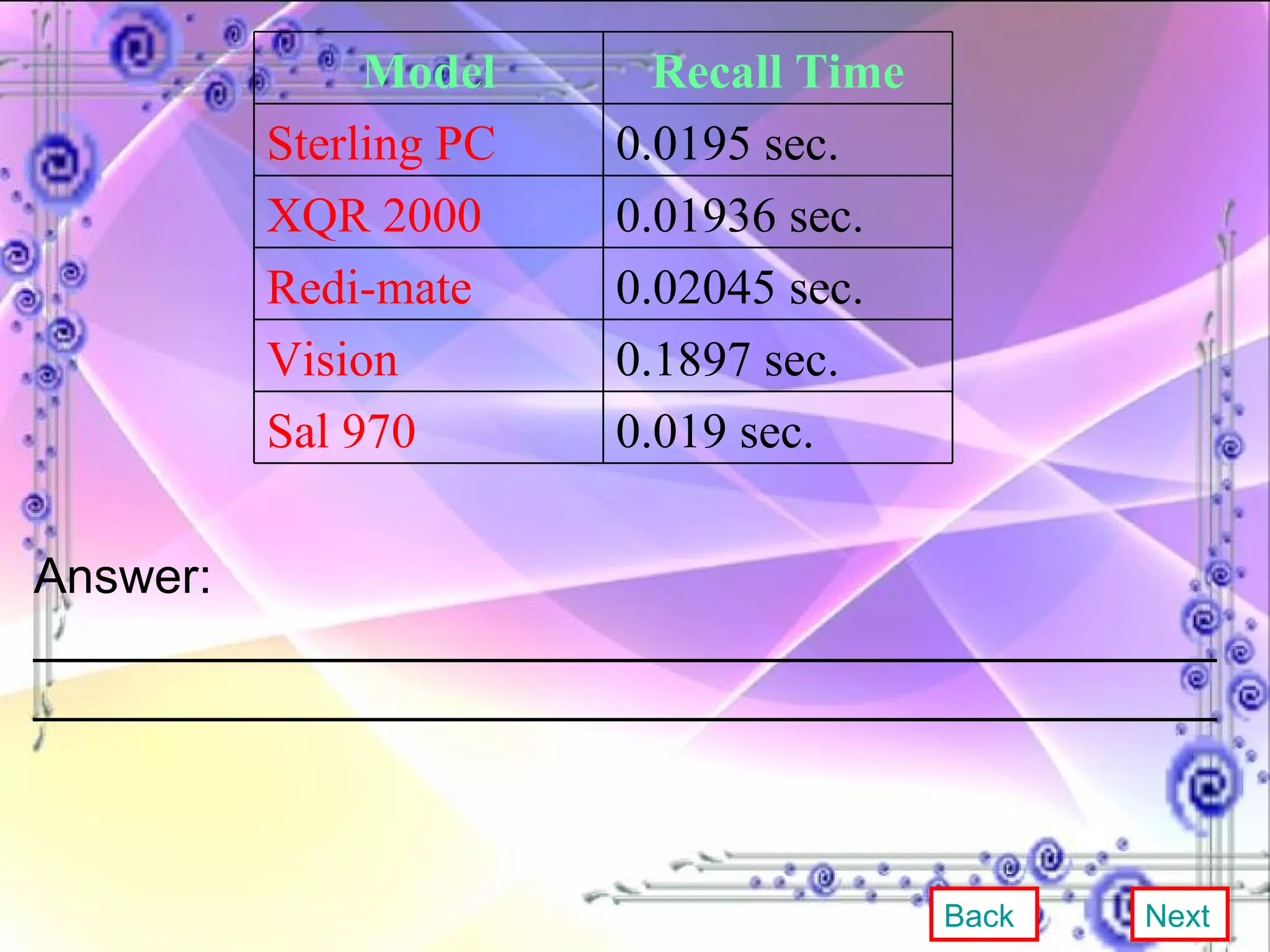
  • 334.
    The number thatcontains another number a number of times is called the dividend . The number that is contained in another number a number of times is called the divisor . The number that indicated how many times a number contained in another number is called the quotient . Division may also be defined as the process of separating a number into as many equal parts as indicated by another number. The symbol for division ( ÷ ), which is read as “divided by”. Thus, 0.81 ÷ 9 = 0.09 is read as “eight-one hundredths divided by nine equals nine thousandths.” Back Next
  • 335.
    Another symbol isa line written over and above the dividend and a slanting line connecting it at the left of the dividend and at the right of the divisor. Another symbol is a line over which the dividend is written and the divisor below. 0.81 9 Back Exercises
  • 336.
    Worksheet I. Givethe meaning and explain the use of the following: 5points each. What is division? What is divisor? What is dividend? What is quotient? Back Next 28
  • 337.
    1. Division ____________________________________________________________________________________2. Divisor ____________________________________________________________________________________ 3. Dividend ____________________________________________________________________________________ 4. Quotient ____________________________________________________________________________________ Back Next
  • 338.
    II. Enumeration… A.What are the parts of division? B. What symbols that can be used in dividing numbers? A._____________________________________________________________________________________________________________________________ B._____________________________________________________________________________________________________________________________ Back Home
  • 339.
    Lesson 29 DIVIDINGDECIMAL BY WHOLE NUMBERS Lesson Objectives: After accomplishing this lesson, you are expected to: 1. Divide decimals by whole numbers. 2. Follow the rules in dividing decimals by whole numbers. 3. Find the quotient correctly. 4. Using two methods in dividing decimals. Next Content
  • 340.
    Dividing decimals bya whole number is the same as dividing a whole number by another whole number. Observe the following examples. Back Next 0.15 0.05 4 0.60 9 0.45 - 4 - 0 20 45 - 20 - 45 0 0
  • 341.
    To check theanswer, multiply the quotient by the divisor: 0.15 x 4 0.60 0.05 x 9 0.45 In dividing decimals by whole numbers, the number of decimal places in the quotient equals the number of decimal in the dividend. Back Next
  • 342.
    Look at theother examples: Example 1: 0.6 ÷ 3 = _____ We used 2 methods in dividing decimals by whole numbers. Back Next
  • 343.
    1. Usinga region 0.6 A whole is divided into 10 equal parts. Each part is called 1/10 or 0.1. 6/10 or 0.6 are shaded.0.6 is divided into 3 groups. How many tenths are in each group? Back Next 0.1 0.1 0.1 0.1 0.1 0.1 0.1 0.1 0.1 0.1 0.2 0.2 0.2 0.2 0.2
  • 344.
    2. Using computations6 ÷ 3 = 6 ÷ 3 = 2 10 1 10 ÷ 1 = 10 0.2 3 0.6 6 0 Let us check by using reciprocals. Fractional Division: 6 ÷ 2 = 6 x 3 = 6 x 3 = 18 10 3 10 2 10 x 2 20 Back Next
  • 345.
    6 ÷ 3 = 6 × 1 = 6 = 1 = 0.2 and 1 10 10 3 30 5 5 is equivalent to 0.2 Why? Explain. 6 ÷ 6 = 1 30 6 5 0.2 5 1.0 1.0 0 Back Next
  • 346.
    Let us dividehundredths by a whole number. Example 2: 6 0.18 1 2 3 4 5 6 7 8 9 10 1 2 3 4 5 6 7 8 9 10 1. Using a region A whole is divided into 100 equal pairs. Each part is called 1/100. Eighteen parts are called 18/100 or 0.18. We divide 0.18 in 6 groups. Back Next
  • 347.
    How many hundredthsare in each group? Using computation 18 ÷ 6 = 18 ÷ 6 = 3 100 1 100 ÷ 1 100 to get the tenths place. 0.03 -> Quotient 6 0.18 - 18 0 Check: 6 × 0.03 0.18 Back Exercises
  • 348.
    Worksheet Find thequotient by using region and computations. 3 0.12 2. 5 0.35 3. 7 0.14 4. 3 0.42 5. 8 0.64 6. 4 0.56 Back Next 29
  • 349.
    7. 2 0.6 8. 9 0.81 9. 4 0.424 Find the quotients. Answer the question that follows. 1. 6 0.732 2. 4 0.524 3. 2 0.236 4. 5 0.655 5. 4 0.435 6. 7 0.851 Back Next
  • 350.
    How many decimalplaces are in the dividends of 1 to 6? ________________________________________________________________________________ How many decimal places should there be in the quotient? ________________________________________________________________________________ How many we use zero in the quotient? ________________________________________________________________________________ Back Home
  • 351.
    Lesson 30 DIVIDINGMIXED DECIMAL BY WHOLE NUMBERS Lesson Objectives: After accomplishing this lesson, you are expected to: Divide mixed decimals by whole numbers. 2. Understand the rule in dividing mixed decimals by whole numbers. 3. Answer the operation correctly. Next Content
  • 352.
    Divide mixed decimalsin the same way as in dividing whole numbers. To check, multiply the quotient by the divisor. Long method of division: To check, multiply the quotient by the divisor. 1.5734 x 5 7.8670 Back Next 1.5734 5 7.8670 - 5 28 - 25 36 - 35 17 - 15 20 - 20 0
  • 353.
    Remember that zerosadded to a number to the right of the decimal point does not affect the value of the number. 7.8670 = 7.867 When dividing mixed decimals by whole numbers. The number of decimal places in the quotient is equal to the number of decimal places in the dividend. Align the decimal points of the quotient with that of the dividend. Back Next
  • 354.
    Do another division.To check, multiply… Answer (quotient by division) 5.1268 x 14 205072 51268 71.7752 5.1268 14 71.1152 - 70 17 - 14 37 - 28 95 - 85 112 - 112 0 Back Exercises
  • 355.
    Worksheet Find thequotient. Check by multiplication. CHECKING: 48.102 ÷ 21 = 56.381 ÷ 87 = Back Next 30
  • 356.
    3. 140.722 ÷9 = 4. 28.6134 ÷ 5 = 5. 189.526 ÷ 32= Back Next
  • 357.
    II. Solve forthe quotient and check by long multiplication method. CHECKING: 83.7169 ÷ 21 = 2. 92.0314 ÷ 37 = Back Next
  • 358.
    3. 152.51÷ 28 = 4. 293.763 ÷ 48 = 5. 451.306 ÷ 89 = Back Home
  • 359.
    Lesson 31 DIVIDINGWHOLE NUMBERS BY DECIMALS Lesson Objectives: After accomplishing the lesson, the students are expected to: 1. Divide whole numbers by decimals. 2. State the rule for dividing a whole number by a decimal. 3. Find the quotient correctly. Next Content
  • 360.
    Let us dividewhole numbers by decimals in tenths. Example 1: 0.8 72 Here are the steps in dividing whole numbers by decimals... STEP 1 Before we divide, we must change the divisor to a whole number. We multiply 0.8 by 10. We have 8. Back Next
  • 361.
    STEP 2 Wemultiply the dividends by 10 also. 10 x 72 = 720, we have 720 as dividend. STEP 3 Then we begin to divide. 90 -> quotient 8 720 - 72 0 We check: 90 × 0.8 72.0 Back Next STEP 4
  • 362.
    How we dividea whole number by a decimal in the hundredths? Follow this step to find the quotient. Back Next
  • 363.
    Example 2: 0.14 588 STEP 1 Make the divisor a whole number. Multiply it by 100. 0.14 x 100 = 14 0.14 588 STEP 2 Multiply the dividend by 100. 14 588.00 Back Next
  • 364.
    STEP 3 Then divide as if dividing whole numbers. 4200 14 58800 -56 28 - 28 0 STEP 4 We check: 4200 x 0.14 16800 4200 58000 Back Exercises
  • 365.
    Worksheet I. Findthe quotient and check. 0.3 ÷ 936 = 2. 0.8 ÷ 856 = CHECKING: Back Next 31
  • 366.
    0.9 ÷ 756= 0.5 ÷ 485 = 0.4 ÷ 348 = Back Next
  • 367.
    6. 0.6 ÷911 = 7. 0.2 ÷ 613 = 8. 0.7 ÷ 518 = Back Next
  • 368.
    9. 0.2 ÷434 = 10. 0.5 ÷ 775 = 11. 0.7 ÷ 434 = Back Next
  • 369.
    12. 0.7 ÷714 = 13. 0.8 ÷ 872 = 14. 0.6 ÷ 846 = 15. 0.5 ÷ 305 = Back Home
  • 370.
    Lesson 32 DIVIDINGWHOLE NUMBERS BY MIXED DECIMALS Lesson Objectives: At the end of the lesson, the students are expected to: 1. Divide whole numbers by mixed decimals 2. Follow the rule in dividing whole numbers by mixed decimals. 3. Study division where the quotient is found to the ten thousandths place. Next Content
  • 371.
    Let us observethe rule in dividing whole numbers by mixed decimals. Example 1: Move the decimal point in the divisor to make it a whole number. The number of places the decimal has been moved to the right in the divisor is the same as the number of places the decimal point is to be moved in the dividend. Add the appropriate zeros to the dividend. Align the decimal point of the dividend. Back Next
  • 372.
    In dividing decimalsalways try to divide to the last digit. When there are too many digits to divide, you can stop at the division by multiplying the quotient by the divisor. Divide 84 by 1.25. 67.2 1.25 84.00.0 - 750 900 - 875 250 - 250 0 67.2 x 1.25 33.60 13.44 + 67.2 84.000 Back Next
  • 373.
    Check the divisorby multiplying the quotient by the divisor. Study another division where the quotient is found to the ten thousandths place. Back Next
  • 374.
    Example 2: 16.0516 5.42 87.00.0000 - 542 3280 - 3252 280 - 000 2800 - 2710 900 - 542 3580 - 3252 328 To check: 16.0516 × 5.42 0.321032 6.42064 80.2580 86.999672 + 0.000328 87.000000 Back Exercises
  • 375.
    Worksheet I. Findthe quotient to the ten thousandths place then check. CHECKING: 15 ÷ 4.7 = 2. 9 ÷ 5.28 = 3. 86 ÷ 7.245 = Back Next 32
  • 376.
    4. 16. ÷7.32 = 5. 23 ÷ 8.16 = 6. 43 ÷ 15.8 = Back Next
  • 377.
    7. 8 ÷1.43 = 8. 15 ÷ 3.786 = 9. 74 ÷ 16.37 = 10. 22 ÷ 5.61 = Back Home
  • 378.
    Lesson 33 DIVIDINGDECIMAL BY DECIMALS Lesson Objectives: At the end of the lesson, the students are expected to: 1. Divide decimals by decimals. . Follow the step in dividing decimals by decimals . Use fraction in checking the division of decimals. Next Content
  • 379.
    How is divisiondone with decimals? What do we do with the decimal points? Let’s observe the following example . Example: 0.5 0.75 Back Next STEP 1 STEP 2 STEP 3 0.5 0.75 5 0.7.5 1.5 5 7.5 - 5 25 - 25 0 Multiply 0.5 by 10 to make it a whole number. Multiply 0.75 by 10 also. What we do with the divisor, we do to the dividend. Divide just like whole numbers. The quotient has the same number of decimal places as the dividend.
  • 380.
    Let us checkby using fractions. 75 ÷ 5 = 75 ÷ 5 = 15 or 1 5 or 1.5 100 10 100 ÷ 10 10 10 Back Exercises
  • 381.
    Worksheet I. Dividethe following and check it by using fractions. 0.72 ÷ 0.3 = 2. 0.96 ÷ 0.4 = 3. 0.387 ÷ 0.09 = CHECKING: Back Next 33
  • 382.
    4. 0.516 ÷0.6 = 5. 0.81 ÷ 0.9 = 6. 0.96 ÷ 0.8 = Back Next
  • 383.
    7. 0.441 ÷0.7 = 8. 0.558 ÷ 0.06 = 9. 0.36 ÷ 0.3 = 10. 0.72 ÷ 0.8 = Back Next
  • 384.
    II. Try toanalyze. Check your answer. 0.56 ÷ 0.008 = 2. 0.90 ÷ 0.090 = CHECKING : Back Next
  • 385.
    3. 0.72 ÷0.4 = 4. 0.26 ÷ 0.2 = 5. 0.9015 ÷ 0.5 = Back Home
  • 386.
    Lesson 34 DividingMixed Decimals by Mixed Decimals Lesson Objectives: At the end of the lesson, the students are expected to: Divide mixed decimals by mixed decimals. 2. Observe the rule in dividing mixed decimals by mixed decimals. 3. Perform the operation correctly. Next Content
  • 387.
    A full-grown Philippineeagle can grow to length of 102.6 cm including its tail. The tail can reach 49. 8 cm. When one of its wings is spread out, it can reach 63.2 cm. The length of its tail is what part of its whole length? Divide 102.6 cm (total length) by 49.8 cm (tail) to the hundredths place. Back Next
  • 388.
    Move the decimalpoint one place to the right. The number of decimal places point has been moved in the divisor determines the number of decimal places it is moved in the dividend. 2. 06 49.8. 102. 6. 00 - 996 300 - 000 3000 - 2988 12 To check, multiply it. 49.8 x 2.06 2.9 88 0.00 99.6 __ 102.5 88 + 0.0 12 102.6 00 remainder In the case like this, when the remainder is added, the sum is equal to the dividend. Back Next
  • 389.
    Mixed Decimals are divided in the same way as whole numbers. In dividing mixed decimals by mixed decimals, remember that the decimal point in the divisor is moved to the right to make it a whole number. Back Exercises
  • 390.
    Worksheet I. Findthe quotient to the tenths place. Check it through multiplication. 8.376 ÷ 1.942 = 2. 7.801 ÷ 2.334 = 3. 9.482 ÷ 4.7636 = CHECKING: Back Next 34
  • 391.
    4. 10.857 ÷6.135 = 5. 23.154 ÷ 5.719 = 6. 41.028 ÷ 12.149 = Back Next
  • 392.
    7. 183.945 ÷20.132 = 8. 151.932 ÷ 46.741 = 9. 273.921 ÷ 87.553 = 10. 491.72 ÷ 78.521 = Back Home
  • 393.
    Curriculum Vitae ofthe Authors and Module Content Next
  • 394.
    PAMN FAYE HAZELM. VALIN Brgy Bagong Pook Sta. Maria, Laguna January 8, 1991 E-mail Address : herzelle_0108@yahoo.com Back Next
  • 395.
    EDUCATIONAL ATTAINMENT ElementarySanta Maria Elementary School Secondary Santa Maria National High School Tertiary Laguna State Polytechnic University (Formerly LSPC) Siniloan Host Campus Course Bachelor of Elementary Education Major General Education Back Next
  • 396.
    RON ANGELO A.DRONA Patricio Street, Brgy. San Jose Pangil, Laguna June 04, 1991 E-mail Address : [email_address] Back Next
  • 397.
    EDUCATIONAL ATTAINMENT ElementaryPangil Elementary School Secondary Laguna State Polytechnic University (Formerly LSPC) Siniloan Host Campus Tertiary Laguna State Polytechnic University (Formerly LSPC) Siniloan Host Campus Course Bachelor of Elementary Education Major General Education Back Next
  • 398.
    BEATRIZ P. RAYMUNDOBrgy Bagong Pook Sta. Maria, Laguna April 21, 1951 E-mail Address : [email_address] Back Next
  • 399.
    EDUCATIONAL ATTAINMENT ElementarySanta Maria Elementary School Secondary Santa Maria Academy Tertiary Immaculate Conception College Course Bachelor of Secondary Education Back Next
  • 400.
    Major M athematicsMinor English Master’s Degree MA Teaching (National Teacher’s College, Manila) Teacher in Values Education and Filipino Back Next
  • 401.
    FOR-IAN V. SANDOVALSiniloan, Laguna April 5, 1979 E-mail Address : [email_address] Back Next
  • 402.
    EDUCATIONAL ATTAINMENT ElementaryPalasan Elementary School Secondary Union College of Laguna Tertiary Far Eastern University Course Bachelor of Science in Mathematics Bachelor of Secondary Education (Unit Earner) Back Next
  • 403.
    Major Computer ScienceMaster’s Degree Master of Arts in Education Major in Educational Management (with units) Back Home
  • 404.
  • 405.
    Books Benigno, GloriaD. Basic Mathematics for College Students. Manila: REX Bookstore. 1993. Calderon, Jose F. Basic Mathematics I. Quezon City: Great Books Trading. 1994. Del Fiero, Jong. Power in Numbers 6. Manila: Saint Mary’s Publishing Corporation. 1999. Department of Education Culture and Sports. Mathematics in Everyday Life (textbook for Grade V) Revised edition. Manila: Cacho Hermanos Inc., 1993.
  • 406.
    Department of Education.Lesson Guides in Elementary (Mathematics for Grade VI). Bureau of Elementary Education in coordination with Ateneo de Manila University., 2003 Ibe, Milagros D. et. al. Highschool Mathematics-Concept and Operation, 3rd edition, First Year. Manila: DIWA Learning Systems Inc., 1999. Jovero, Natividad V. Power in Numbers IV (Teachers Manual, Mathematics 4). Manila: Saint Mary’s Publishing Corporation. 1999. Llanes, Estrelita M. and Li, Bernardino Q. Living with Math VI. Revised Edition. Quezon City: FNB Educational Inc. 1988.
  • 407.
    Lopez, Kelli L.,The Self-replicating Gene. Tatsulok. Vol. 14 No. 2 1st year. Pp 4-6,15. Mendoza, Marilyn O. Workbook in Mathematics. Manila: Gintong Aral Publication. 1997. Roxas, Mia P. and Zara, Evelyn F. Elementary Algebra. High School Mathematics. (Worktext I). EFEREZA Pulbication House. 2003. http://www.321know.com http://whyslopes.com
  • 408.
    Photo Credits http://www.ask.com/pictureshttp://images.google.com.ph http://images.search.yahoo.com http://photobucket.com/images