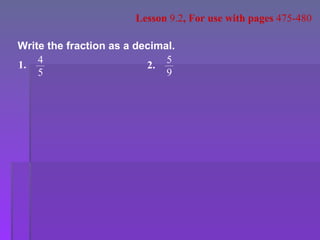
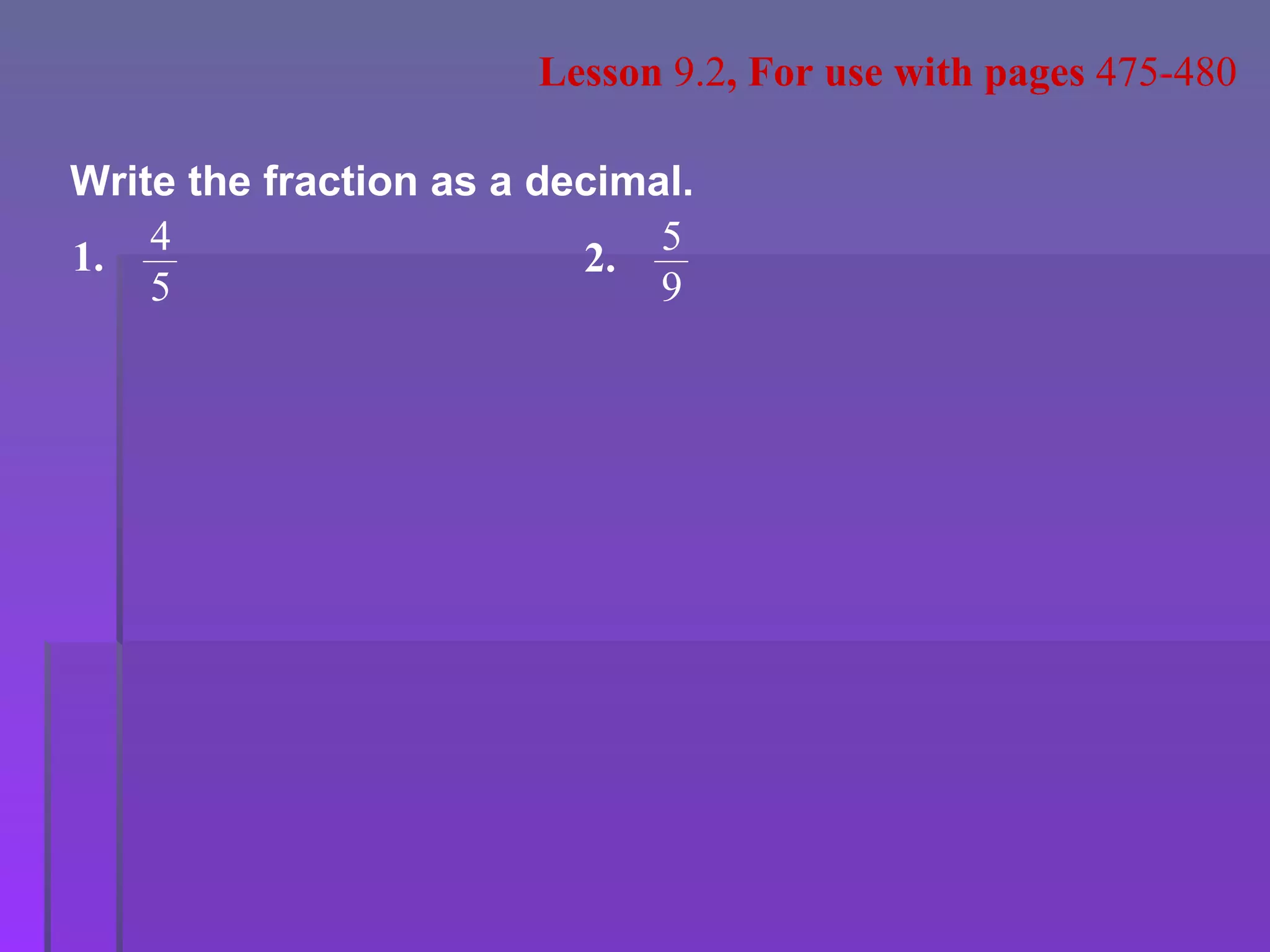
Write the fraction as a decimal. Lesson  9.2 , For use with pages  475-480 1. 4 5 2. 5 9
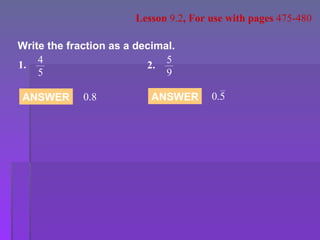
Write the fraction as a decimal. Lesson  9.2 , For use with pages  475-480 ANSWER 0.8 1. 4 5 2. 5 9 ANSWER 0.5
RATIONAL and IRRATIONAL NUMBERS 9.2
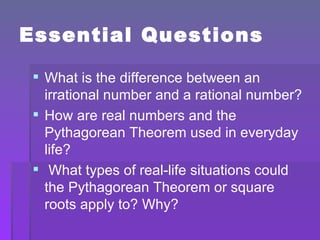
Essential Questions What is the difference between an irrational number and a rational number? How are real numbers and the Pythagorean Theorem used in everyday life? What types of real-life situations could the Pythagorean Theorem or square roots apply to? Why?
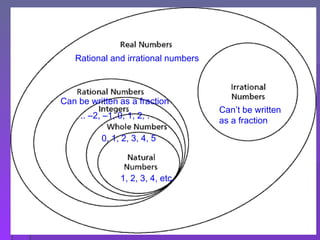
Rational Numbers Rational numbers are simply numbers that can be written as fractions or ratios   The hierarchy of real numbers looks something like this:
1, 2, 3, 4, etc. 0, 1, 2, 3, 4, 5 .. –2, –1, 0, 1, 2, .  Rational and irrational numbers Can be written as a fraction Can’t be written as a fraction
Rational Numbers : Any number that can be written in fraction form is a  rational number .  This includes integers, terminating decimals, and repeating decimals as well as fractions.
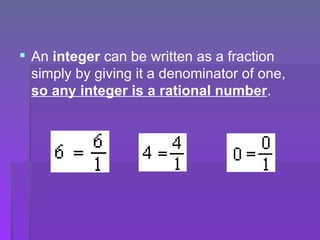
An  integer  can be written as a fraction simply by giving it a denominator of one,  so any integer is a rational number .
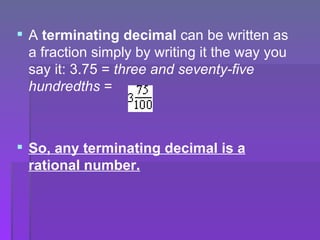
A  terminating decimal  can be written as a fraction simply by writing it the way you say it: 3.75 =  three and seventy-five hundredths  =  So, any terminating decimal is a rational number.
A  repeating decimal  can be written as a fraction using algebraic methods,  so any repeating decimal is a rational number.
Irrational Numbers A number that  cannot  be expressed as a repeating or terminating decimal. An integer that is not a perfect square has an irrational root. REALS (the real numbers) The rational and irrational numbers.
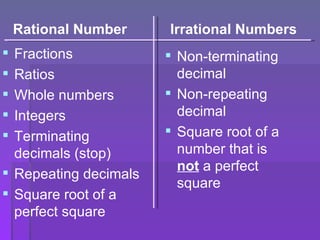
Rational Number Fractions Ratios Whole numbers Integers Terminating  decimals (stop) Repeating decimals Square root of a  perfect square Irrational Numbers Non-terminating  decimal Non-repeating  decimal Square root of a  number that is  not  a perfect  square
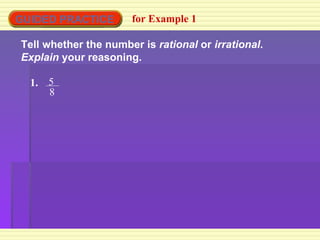
GUIDED PRACTICE for Example 1 Tell whether the number is  rational  or  irrational .  Explain  your reasoning. 5  8 1.
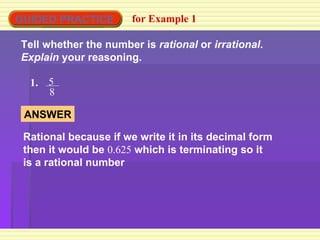
GUIDED PRACTICE for Example 1 Tell whether the number is  rational  or  irrational .  Explain  your reasoning. 5  8 1.  Rational because if we write it in its decimal form then it would be  0.625  which is terminating so it is a rational number  ANSWER
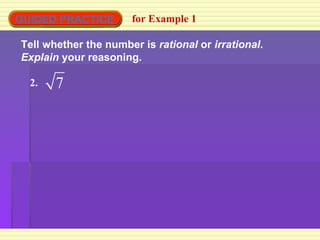
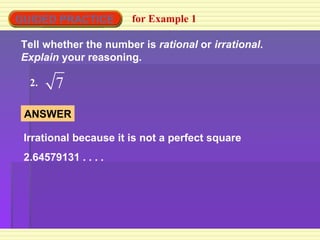
GUIDED PRACTICE for Example 1 Tell whether the number is  rational  or  irrational .  Explain  your reasoning. 2.
GUIDED PRACTICE for Example 1 Tell whether the number is  rational  or  irrational .  Explain  your reasoning. 2. ANSWER Irrational because it is not a perfect square 2.64579131 . . . .
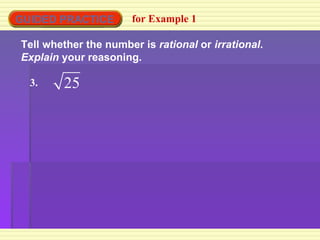
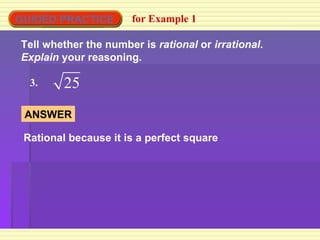
GUIDED PRACTICE for Example 1 Tell whether the number is  rational  or  irrational .  Explain  your reasoning. 3.
GUIDED PRACTICE for Example 1 Tell whether the number is  rational  or  irrational .  Explain  your reasoning. 3. ANSWER Rational because it is a perfect square
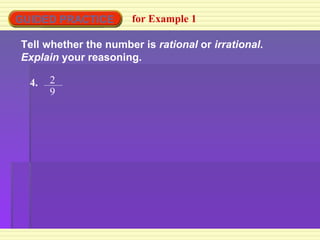
GUIDED PRACTICE for Example 1 Tell whether the number is  rational  or  irrational .  Explain  your reasoning. 4. 2 9
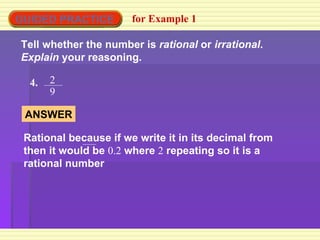
GUIDED PRACTICE for Example 1 Tell whether the number is  rational  or  irrational .  Explain  your reasoning. 4. 2 9 ANSWER Rational because if we write it in its decimal from then it would be  0.2  where  2  repeating so it is a rational number
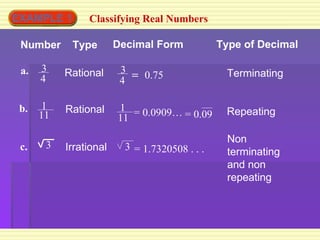
EXAMPLE 1 Number Rational Rational Irrational Terminating  Repeating Non terminating  and non repeating Classifying Real Numbers Type Decimal Form Type of Decimal a. 3  4 b. 1 11 c. 3 11 1 = 0.0909… = 0.09 3 = 1.7320508 . . . 3 4 =  0.75 3
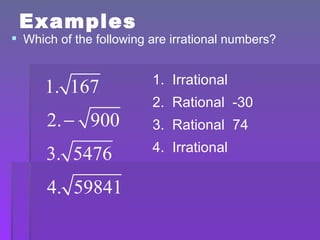
Examples Which of the following are irrational numbers? 1.  Irrational 2.  Rational  -30 3.  Rational  74 4.  Irrational
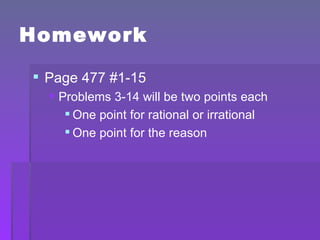
Homework Page 477 #1-15 Problems 3-14 will be two points each One point for rational or irrational One point for the reason

9.2 rational and irrational numbers day 1

  • 1.
    Write the fractionas a decimal. Lesson 9.2 , For use with pages 475-480 1. 4 5 2. 5 9
  • 2.
    Write the fractionas a decimal. Lesson 9.2 , For use with pages 475-480 ANSWER 0.8 1. 4 5 2. 5 9 ANSWER 0.5
  • 3.
  • 4.
    Essential Questions Whatis the difference between an irrational number and a rational number? How are real numbers and the Pythagorean Theorem used in everyday life? What types of real-life situations could the Pythagorean Theorem or square roots apply to? Why?
  • 5.
    Rational Numbers Rationalnumbers are simply numbers that can be written as fractions or ratios The hierarchy of real numbers looks something like this:
  • 6.
    1, 2, 3,4, etc. 0, 1, 2, 3, 4, 5 .. –2, –1, 0, 1, 2, . Rational and irrational numbers Can be written as a fraction Can’t be written as a fraction
  • 7.
    Rational Numbers :Any number that can be written in fraction form is a rational number . This includes integers, terminating decimals, and repeating decimals as well as fractions.
  • 8.
    An integer can be written as a fraction simply by giving it a denominator of one, so any integer is a rational number .
  • 9.
    A terminatingdecimal can be written as a fraction simply by writing it the way you say it: 3.75 = three and seventy-five hundredths = So, any terminating decimal is a rational number.
  • 10.
    A repeatingdecimal can be written as a fraction using algebraic methods, so any repeating decimal is a rational number.
  • 11.
    Irrational Numbers Anumber that cannot be expressed as a repeating or terminating decimal. An integer that is not a perfect square has an irrational root. REALS (the real numbers) The rational and irrational numbers.
  • 12.
    Rational Number FractionsRatios Whole numbers Integers Terminating decimals (stop) Repeating decimals Square root of a perfect square Irrational Numbers Non-terminating decimal Non-repeating decimal Square root of a number that is not a perfect square
  • 13.
    GUIDED PRACTICE forExample 1 Tell whether the number is rational or irrational . Explain your reasoning. 5 8 1.
  • 14.
    GUIDED PRACTICE forExample 1 Tell whether the number is rational or irrational . Explain your reasoning. 5 8 1. Rational because if we write it in its decimal form then it would be 0.625 which is terminating so it is a rational number ANSWER
  • 15.
    GUIDED PRACTICE forExample 1 Tell whether the number is rational or irrational . Explain your reasoning. 2.
  • 16.
    GUIDED PRACTICE forExample 1 Tell whether the number is rational or irrational . Explain your reasoning. 2. ANSWER Irrational because it is not a perfect square 2.64579131 . . . .
  • 17.
    GUIDED PRACTICE forExample 1 Tell whether the number is rational or irrational . Explain your reasoning. 3.
  • 18.
    GUIDED PRACTICE forExample 1 Tell whether the number is rational or irrational . Explain your reasoning. 3. ANSWER Rational because it is a perfect square
  • 19.
    GUIDED PRACTICE forExample 1 Tell whether the number is rational or irrational . Explain your reasoning. 4. 2 9
  • 20.
    GUIDED PRACTICE forExample 1 Tell whether the number is rational or irrational . Explain your reasoning. 4. 2 9 ANSWER Rational because if we write it in its decimal from then it would be 0.2 where 2 repeating so it is a rational number
  • 21.
    EXAMPLE 1 NumberRational Rational Irrational Terminating Repeating Non terminating and non repeating Classifying Real Numbers Type Decimal Form Type of Decimal a. 3 4 b. 1 11 c. 3 11 1 = 0.0909… = 0.09 3 = 1.7320508 . . . 3 4 = 0.75 3
  • 22.
    Examples Which ofthe following are irrational numbers? 1. Irrational 2. Rational -30 3. Rational 74 4. Irrational
  • 23.
    Homework Page 477#1-15 Problems 3-14 will be two points each One point for rational or irrational One point for the reason