Rational numbers
 Natural Number
 Whole Numbers
 Integers
 Numbers starting from 1 and so on
 They are also called counting numbers.
 The smallest natural number is 1.
 There is no greatest natural number. The
next natural number can be found by adding
1 to the current natural number or you can
say that each number has its successor.
 When ‘0’ is added to the collection of natural
numbers it becomes collection of whole
numbers
 The smallest whole no.is 0
 There in no greatest whole number.
 All natural no. are whole numbers but the
inverse is not true always.
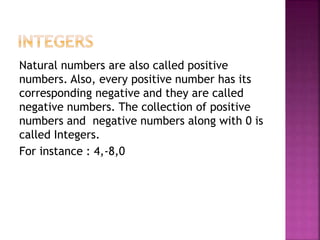
Natural numbers are also called positive
numbers. Also, every positive number has its
corresponding negative and they are called
negative numbers. The collection of positive
numbers and negative numbers along with 0 is
called Integers.
For instance : 4,-8,0
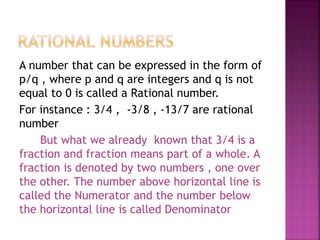
A number that can be expressed in the form of
p/q , where p and q are integers and q is not
equal to 0 is called a Rational number.
For instance : 3/4 , -3/8 , -13/7 are rational
number
But what we already known that 3/4 is a
fraction and fraction means part of a whole. A
fraction is denoted by two numbers , one over
the other. The number above horizontal line is
called the Numerator and the number below
the horizontal line is called Denominator
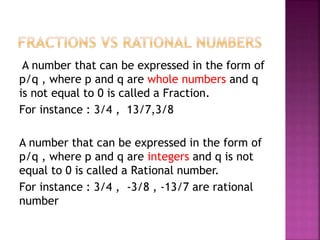
A number that can be expressed in the form of
p/q , where p and q are whole numbers and q
is not equal to 0 is called a Fraction.
For instance : 3/4 , 13/7,3/8
A number that can be expressed in the form of
p/q , where p and q are integers and q is not
equal to 0 is called a Rational number.
For instance : 3/4 , -3/8 , -13/7 are rational
number
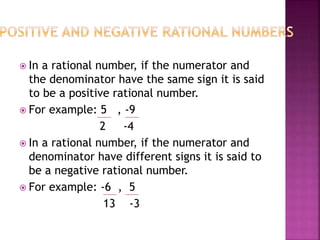
 In a rational number, if the numerator and
the denominator have the same sign it is said
to be a positive rational number.
 For example: 5 , -9
2 -4
 In a rational number, if the numerator and
denominator have different signs it is said to
be a negative rational number.
 For example: -6 , 5
13 -3
 The numerical value of a number with no
regards to its sign.
 The absolute value of a number is never
negative.
 It means to remove any negative sign in
front of a number
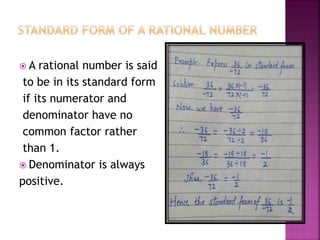
 A rational number is said
to be in its standard form
if its numerator and
denominator have no
common factor rather
than 1.
 Denominator is always
positive.
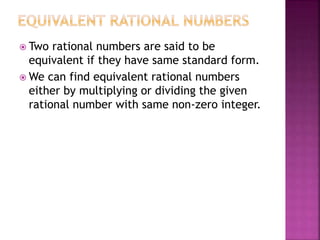
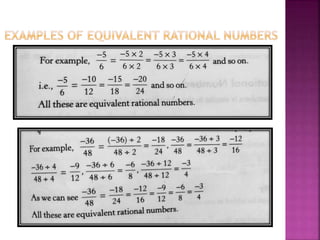
 Two rational numbers are said to be
equivalent if they have same standard form.
 We can find equivalent rational numbers
either by multiplying or dividing the given
rational number with same non-zero integer.
Mathematics class 8

Mathematics class 8

  • 1.
  • 2.
     Natural Number Whole Numbers  Integers
  • 3.
     Numbers startingfrom 1 and so on  They are also called counting numbers.  The smallest natural number is 1.  There is no greatest natural number. The next natural number can be found by adding 1 to the current natural number or you can say that each number has its successor.
  • 4.
     When ‘0’is added to the collection of natural numbers it becomes collection of whole numbers  The smallest whole no.is 0  There in no greatest whole number.  All natural no. are whole numbers but the inverse is not true always.
  • 5.
    Natural numbers arealso called positive numbers. Also, every positive number has its corresponding negative and they are called negative numbers. The collection of positive numbers and negative numbers along with 0 is called Integers. For instance : 4,-8,0
  • 6.
    A number thatcan be expressed in the form of p/q , where p and q are integers and q is not equal to 0 is called a Rational number. For instance : 3/4 , -3/8 , -13/7 are rational number But what we already known that 3/4 is a fraction and fraction means part of a whole. A fraction is denoted by two numbers , one over the other. The number above horizontal line is called the Numerator and the number below the horizontal line is called Denominator
  • 7.
    A number thatcan be expressed in the form of p/q , where p and q are whole numbers and q is not equal to 0 is called a Fraction. For instance : 3/4 , 13/7,3/8 A number that can be expressed in the form of p/q , where p and q are integers and q is not equal to 0 is called a Rational number. For instance : 3/4 , -3/8 , -13/7 are rational number
  • 8.
     In arational number, if the numerator and the denominator have the same sign it is said to be a positive rational number.  For example: 5 , -9 2 -4  In a rational number, if the numerator and denominator have different signs it is said to be a negative rational number.  For example: -6 , 5 13 -3
  • 9.
     The numericalvalue of a number with no regards to its sign.  The absolute value of a number is never negative.  It means to remove any negative sign in front of a number
  • 10.
     A rationalnumber is said to be in its standard form if its numerator and denominator have no common factor rather than 1.  Denominator is always positive.
  • 11.
     Two rationalnumbers are said to be equivalent if they have same standard form.  We can find equivalent rational numbers either by multiplying or dividing the given rational number with same non-zero integer.