Types of
numbers
Global Context: Identities and
relationships
Statement of Inquiry: The forms of a
system's models and representations influence our
understanding of the relationships that define our
identities.
Learning Target
• Identify and differentiate between different types of
numbers (naturals, integers, rational, and real numbers).
• Apply knowledge of number types to solve problems and
represent them on a number line.
Types of
numbers
It is time for your secret detective
classification skills to come out! This lesson
needs help in determining what type of
number a number truly is.
Are you up to the challenge?
While you may think of a number as just a
plain old number, it is so much more.
Numbers are classified into different types
of numbers based on various things like:
Is it positive or negative?
Is it a fraction or a decimal?
Do they repeat?
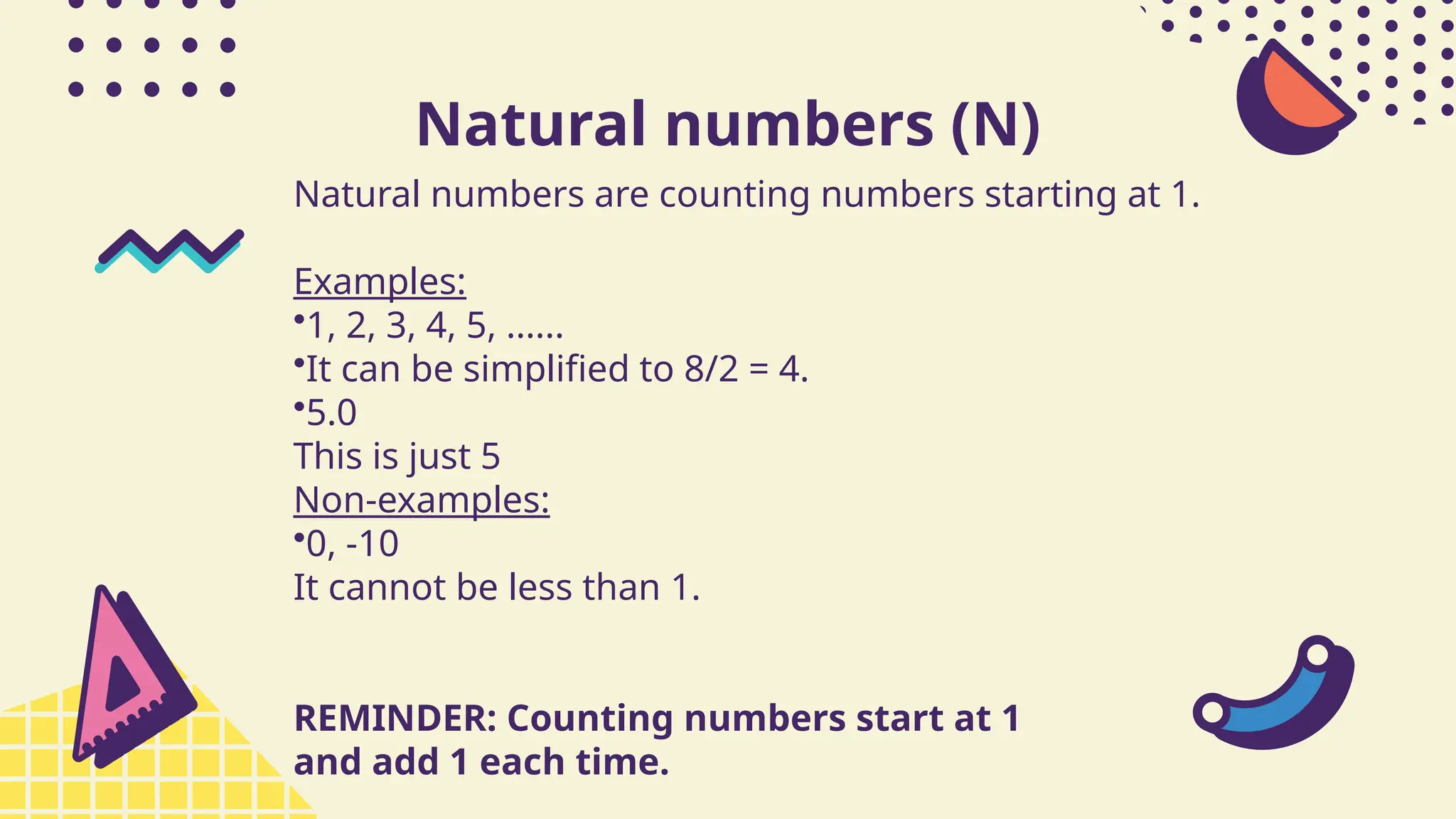
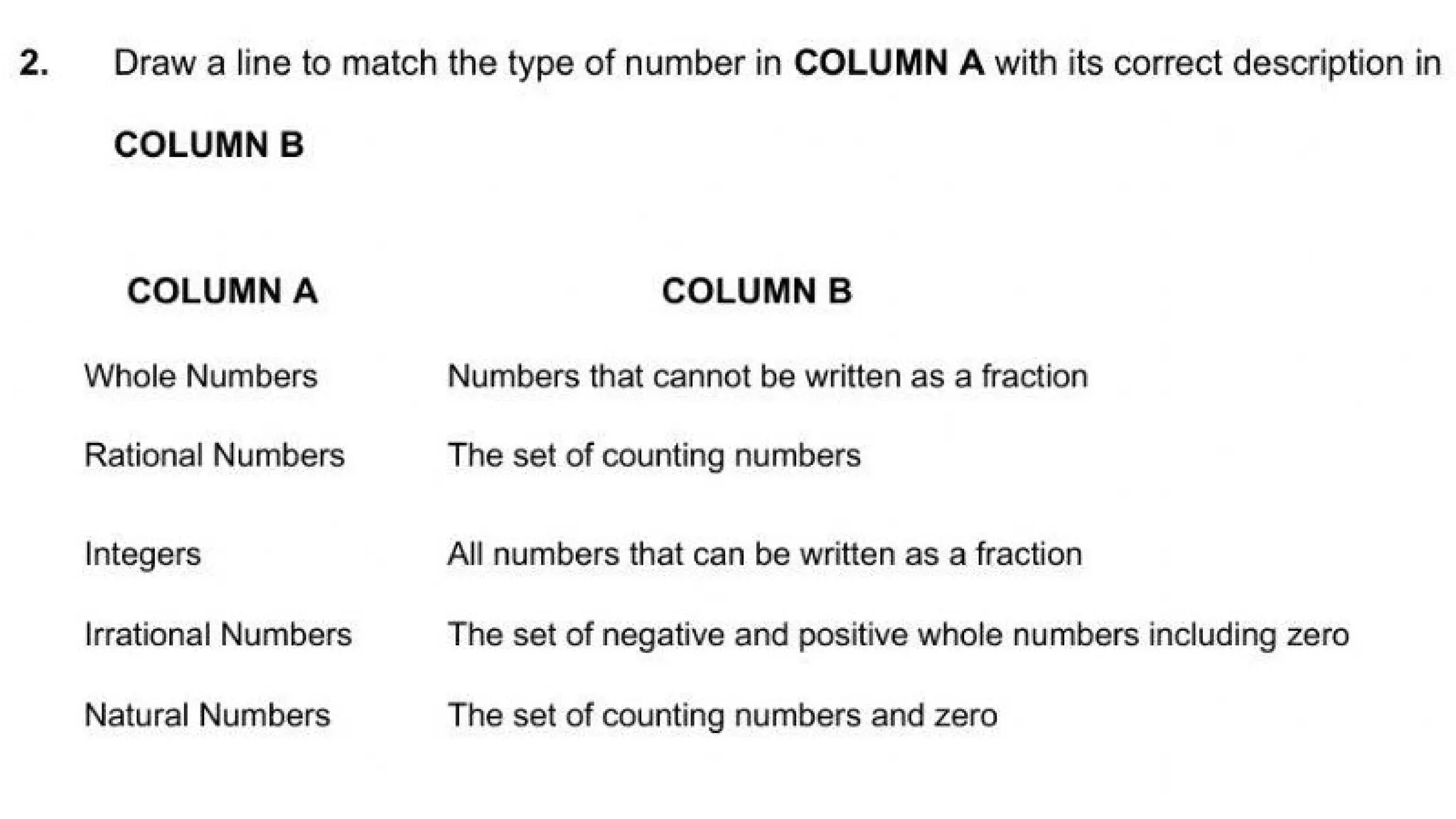
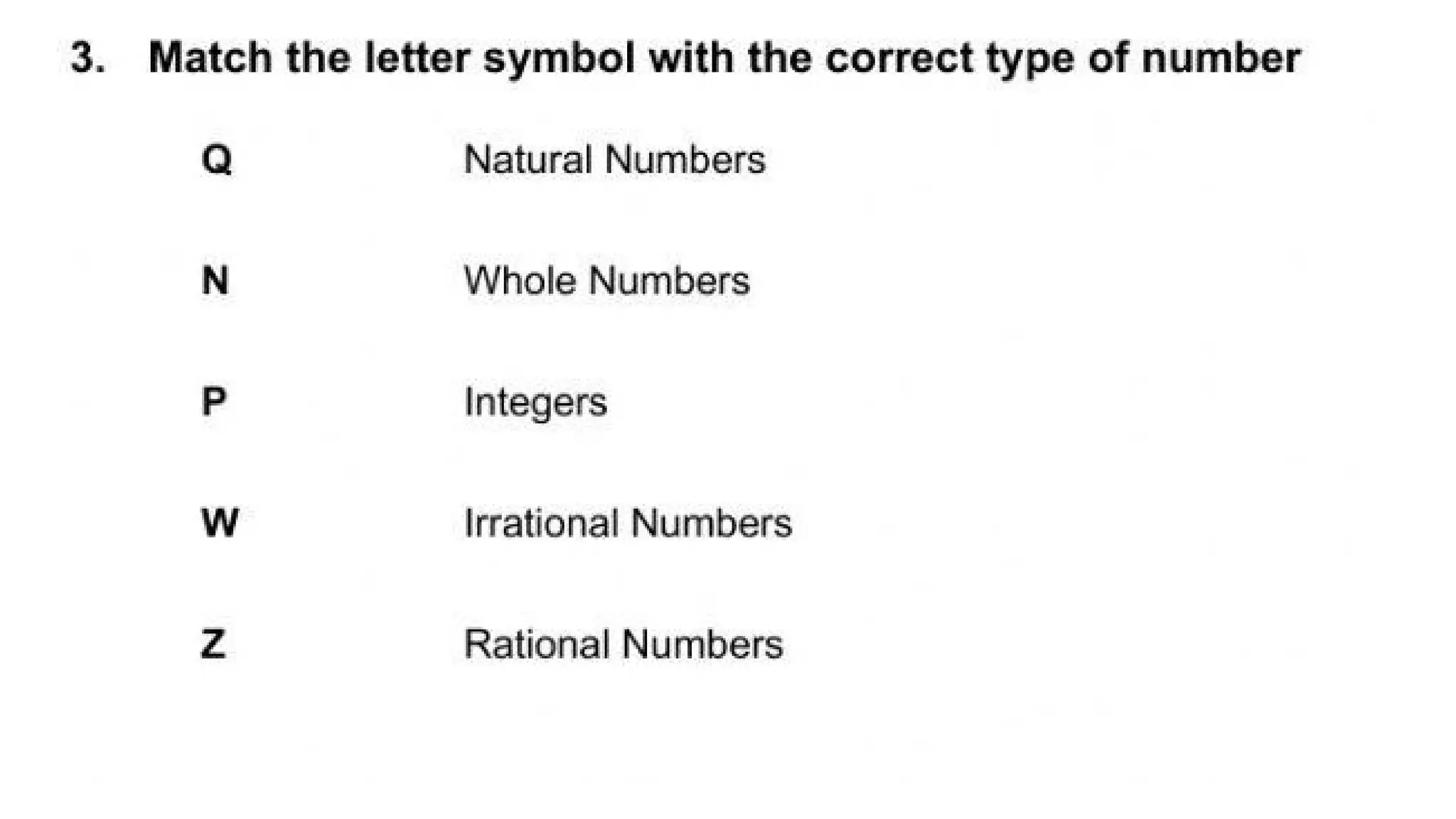
Natural numbers (N)
Natural numbers are counting numbers starting at 1.
Examples:
•1, 2, 3, 4, 5, ......
•It can be simplified to 8/2 = 4.
•5.0
This is just 5
Non-examples:
•0, -10
It cannot be less than 1.
REMINDER: Counting numbers start at 1
and add 1 each time.
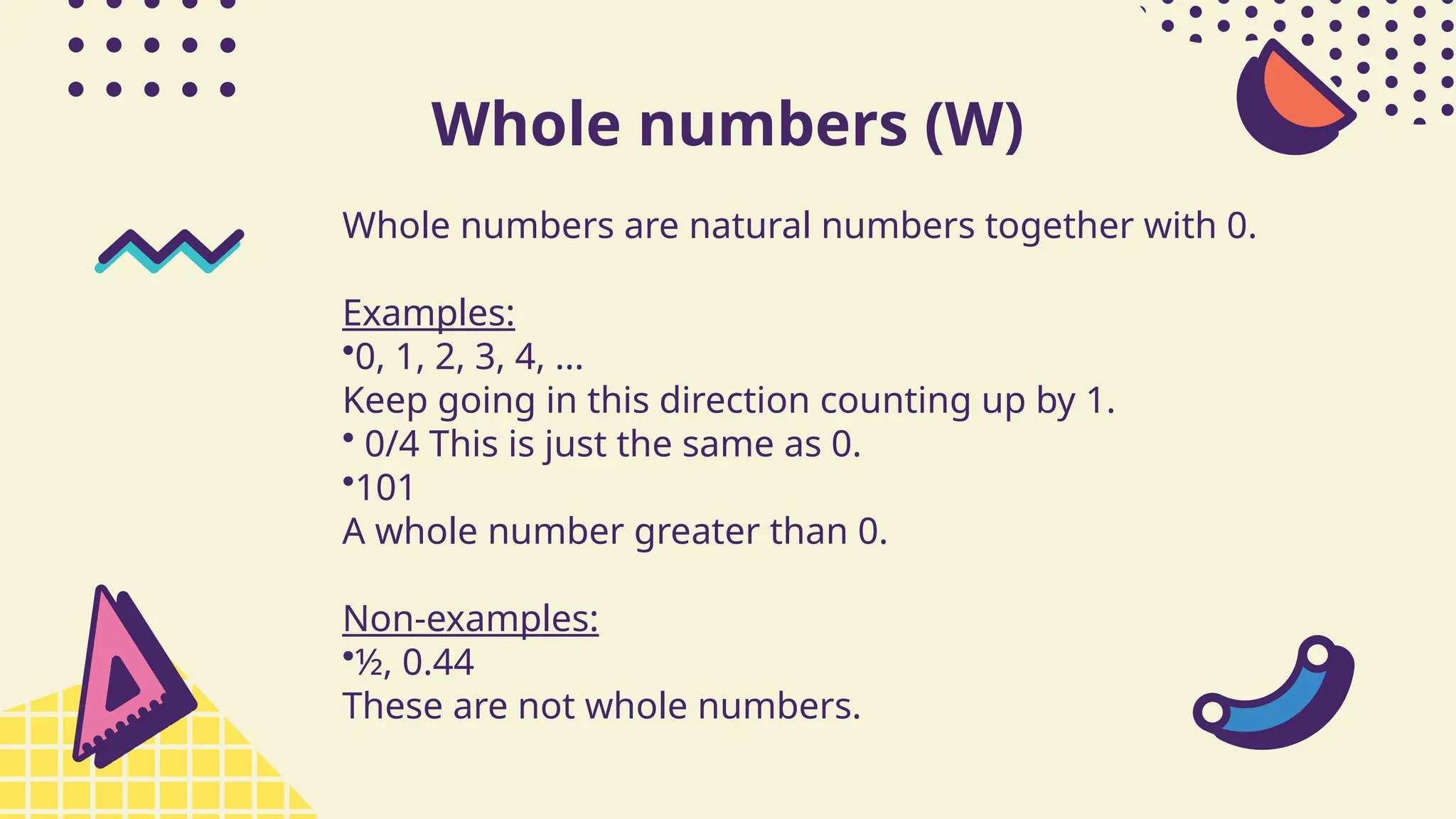
Whole numbers (W)
Whole numbers are natural numbers together with 0.
Examples:
•0, 1, 2, 3, 4, ...
Keep going in this direction counting up by 1.
• 0/4 This is just the same as 0.
•101
A whole number greater than 0.
Non-examples:
•½, 0.44
These are not whole numbers.
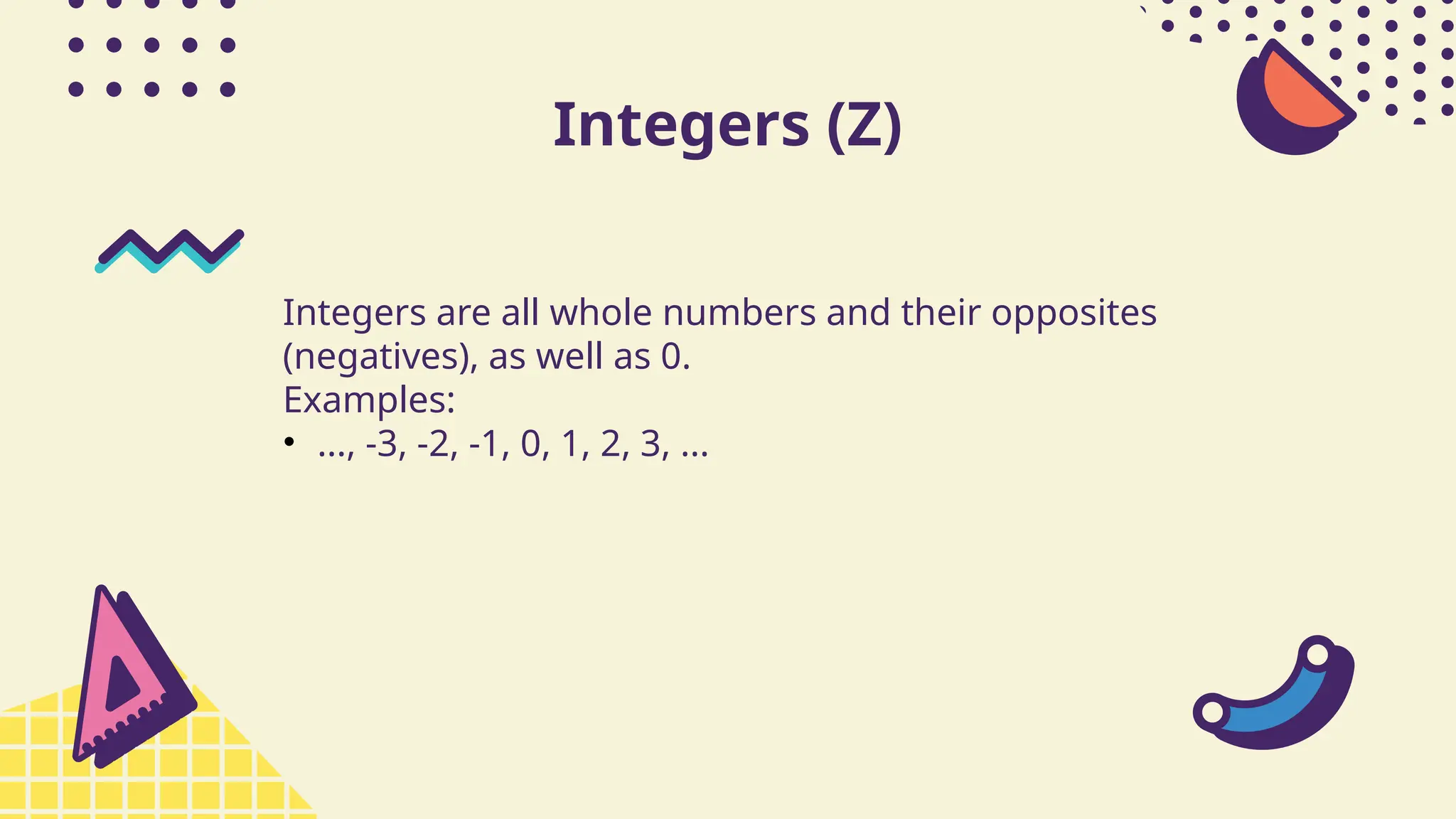
Integers (Z)
Integers are all whole numbers and their opposites
(negatives), as well as 0.
Examples:
• ..., -3, -2, -1, 0, 1, 2, 3, ...
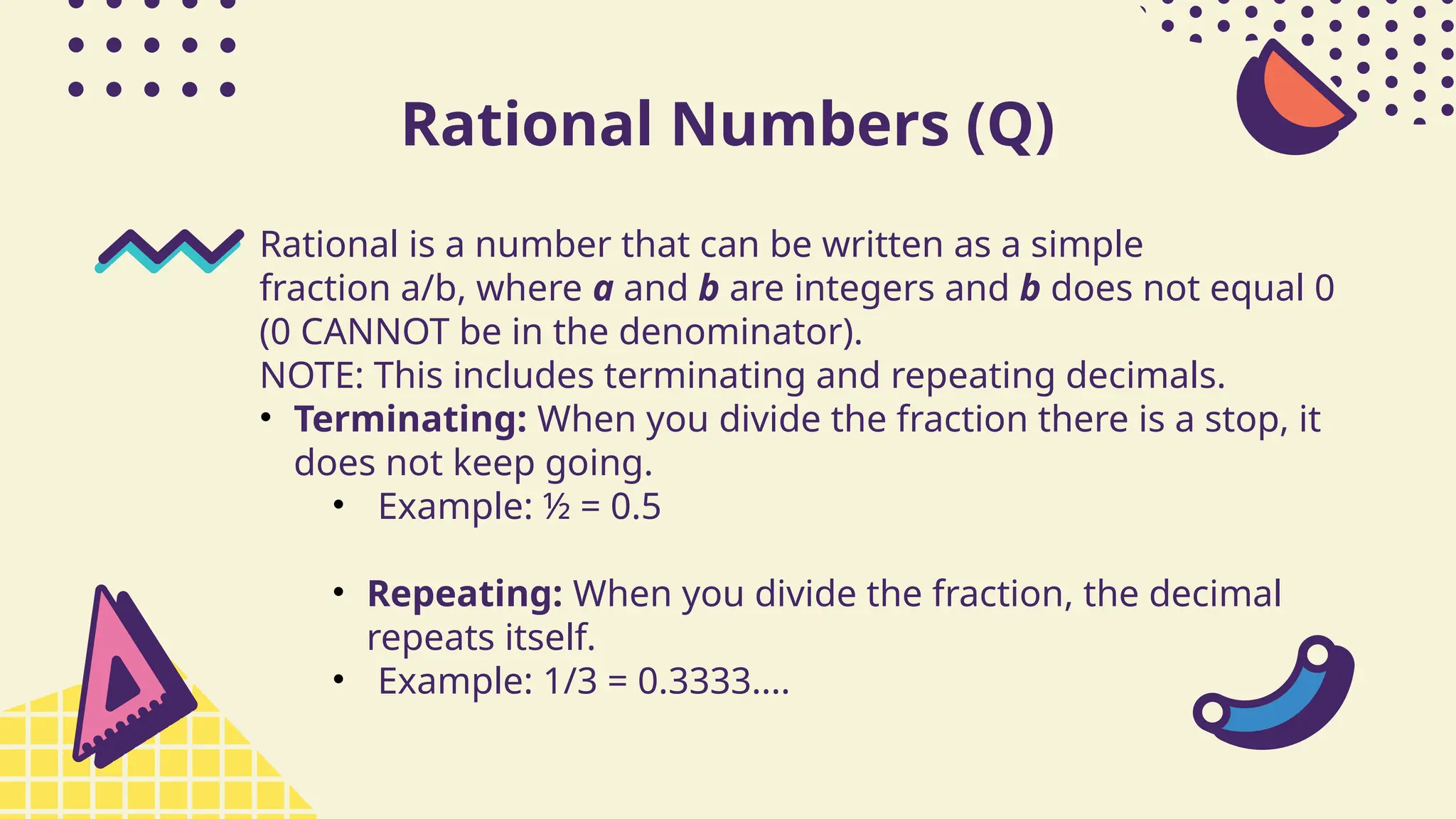
Rational Numbers (Q)
Rational is a number that can be written as a simple
fraction a/b, where a and b are integers and b does not equal 0
(0 CANNOT be in the denominator).
NOTE: This includes terminating and repeating decimals.
• Terminating: When you divide the fraction there is a stop, it
does not keep going.
• Example: ½ = 0.5
• Repeating: When you divide the fraction, the decimal
repeats itself.
• Example: 1/3 = 0.3333....
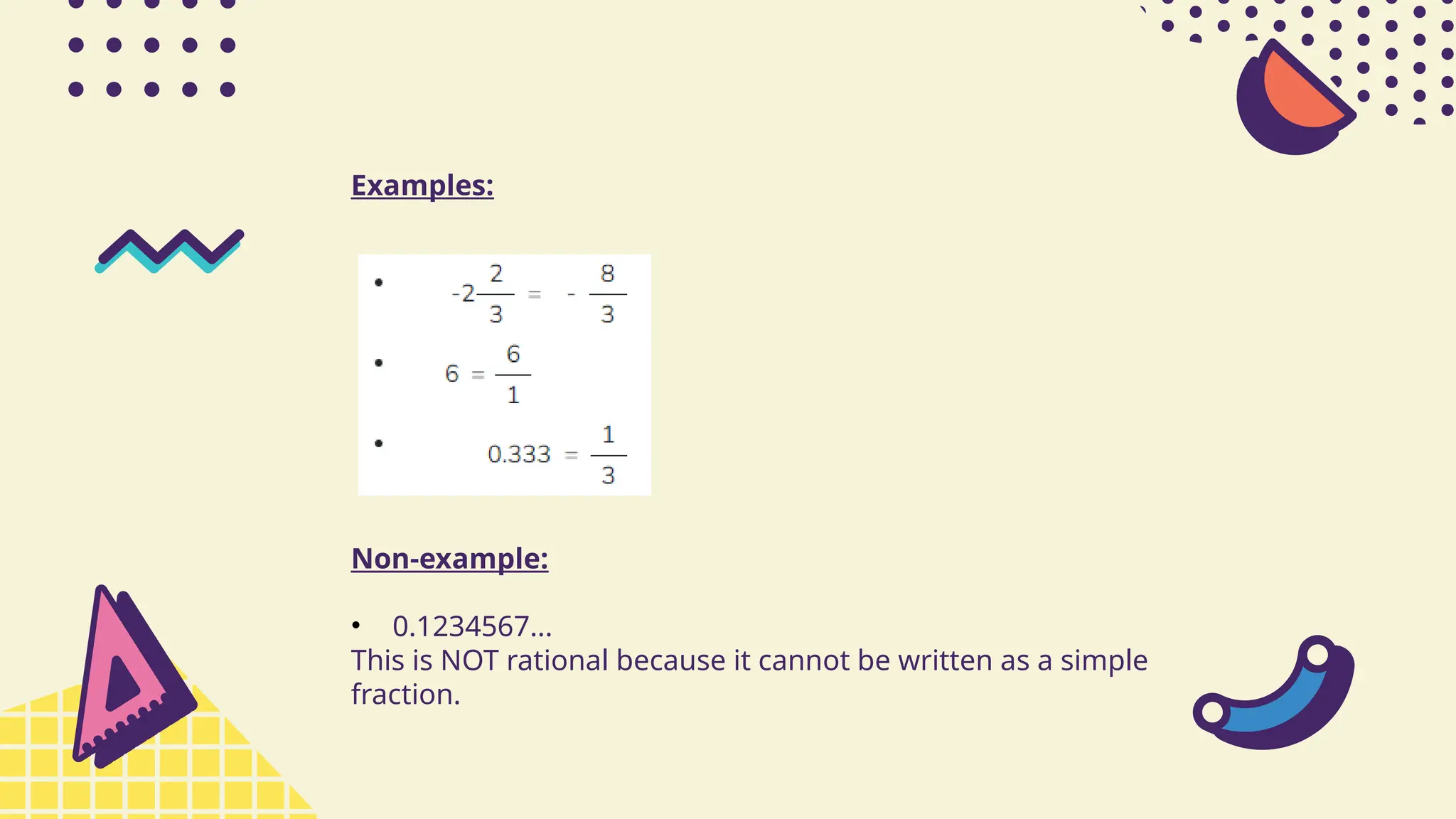
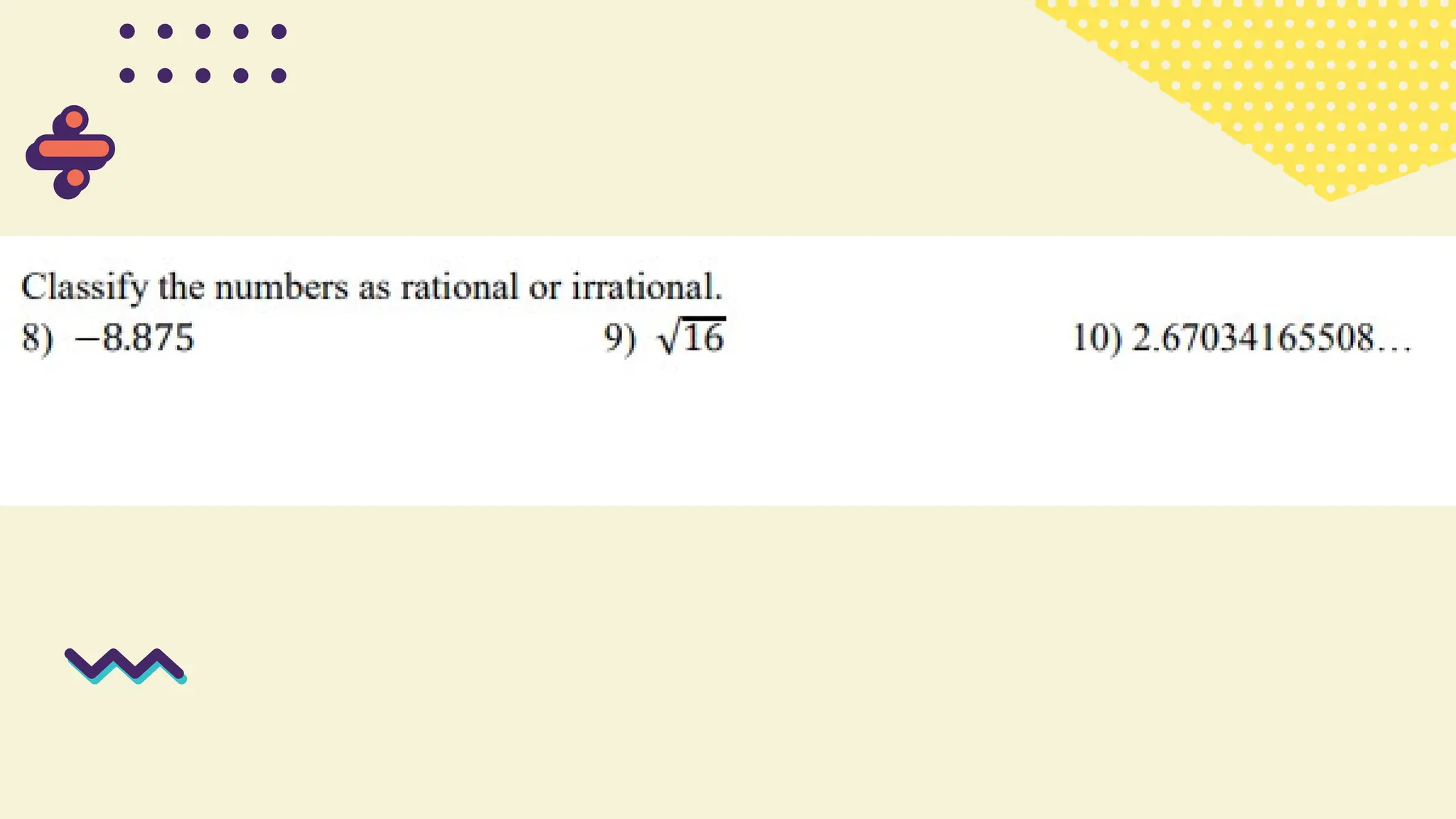
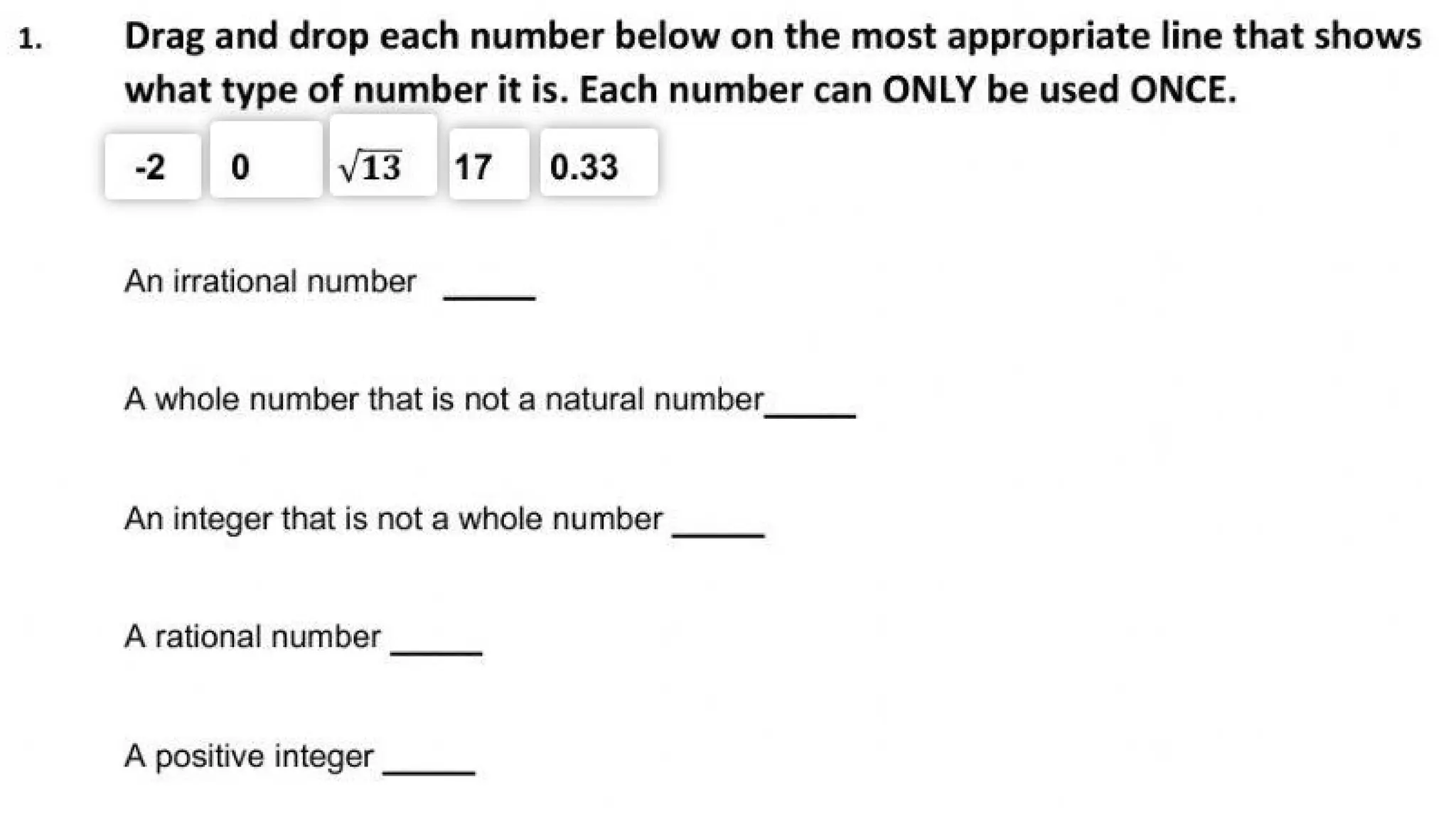
Examples:
Non-example:
• 0.1234567...
This is NOT rational because it cannot be written as a simple
fraction.
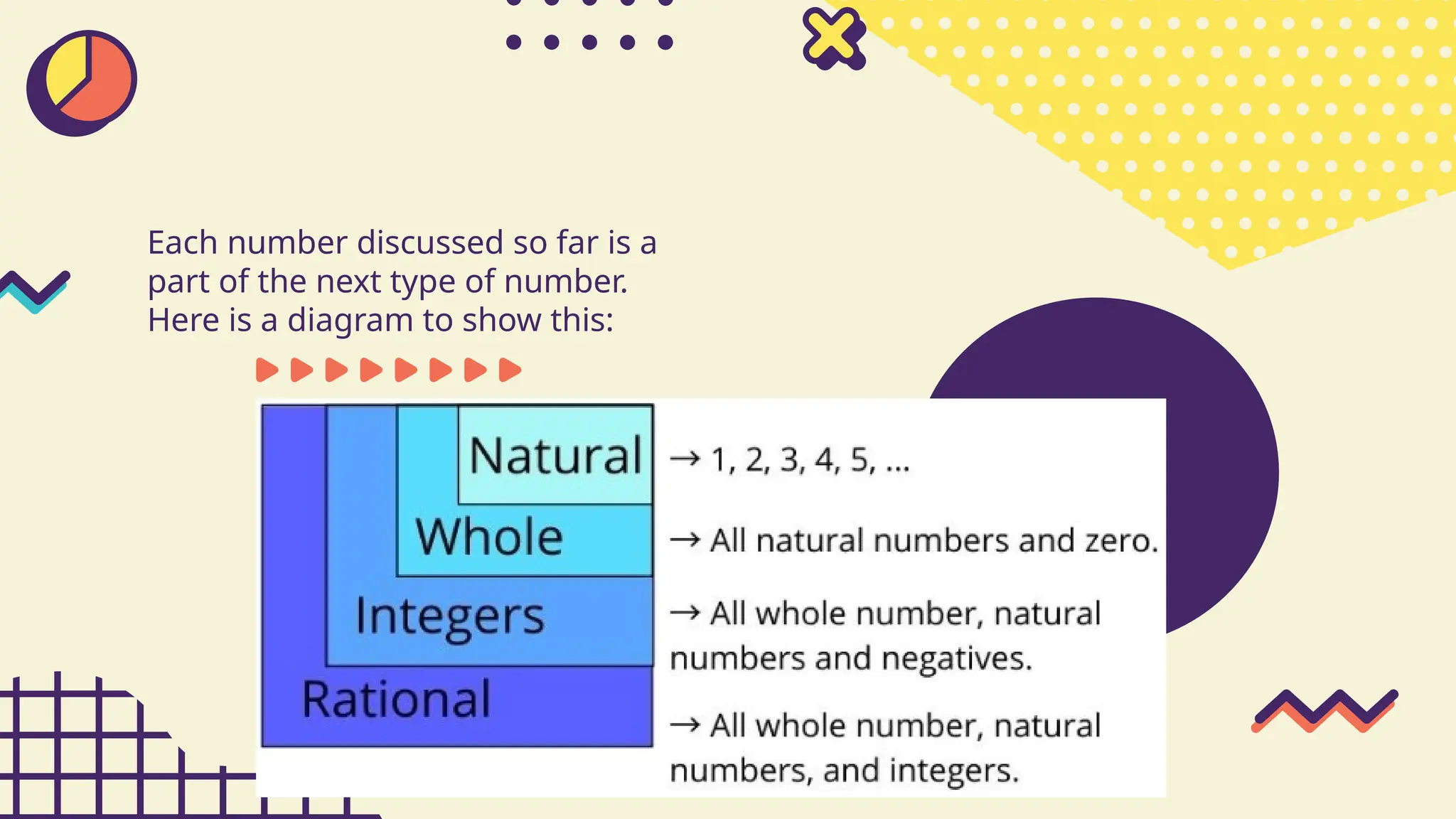
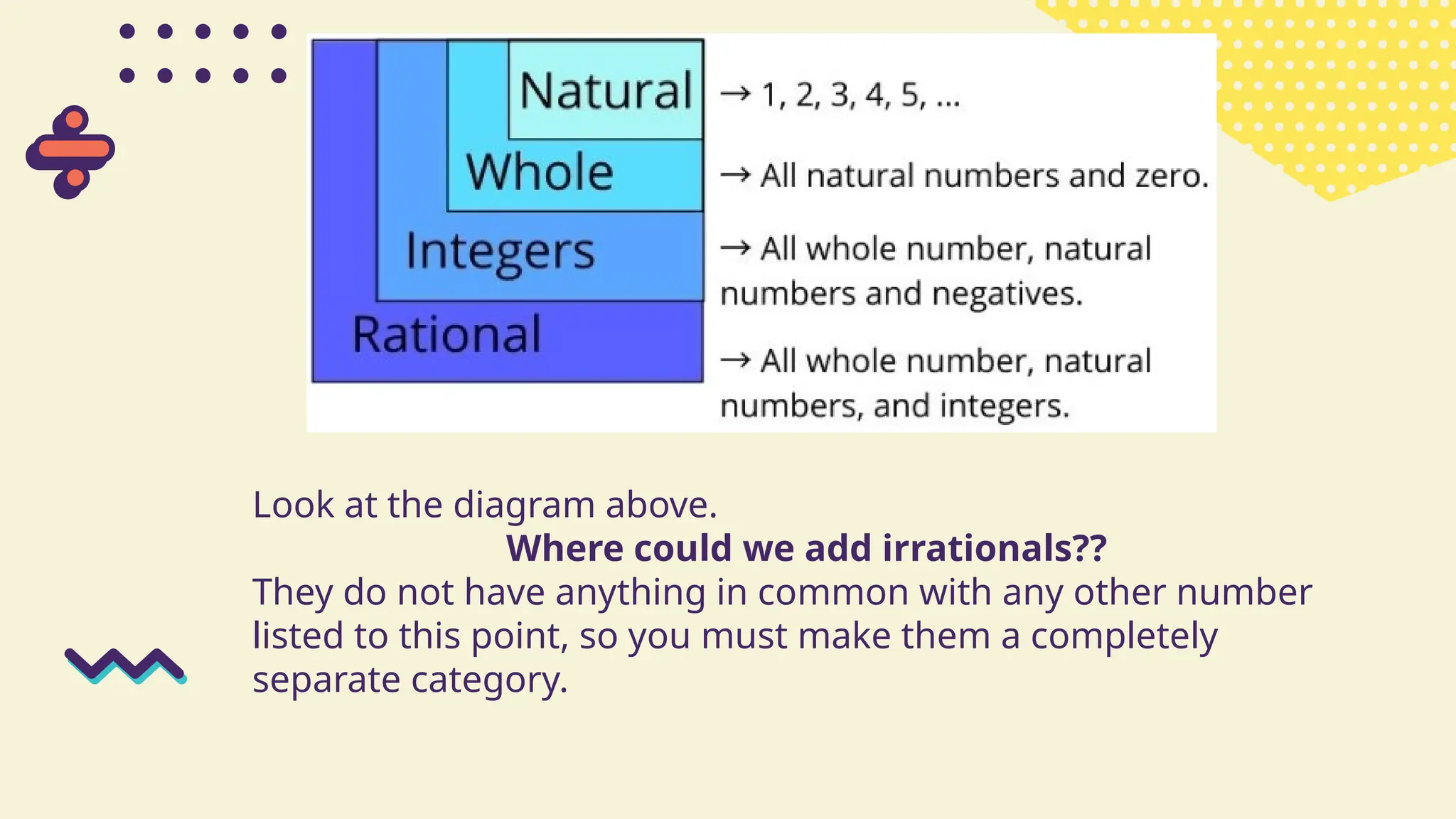
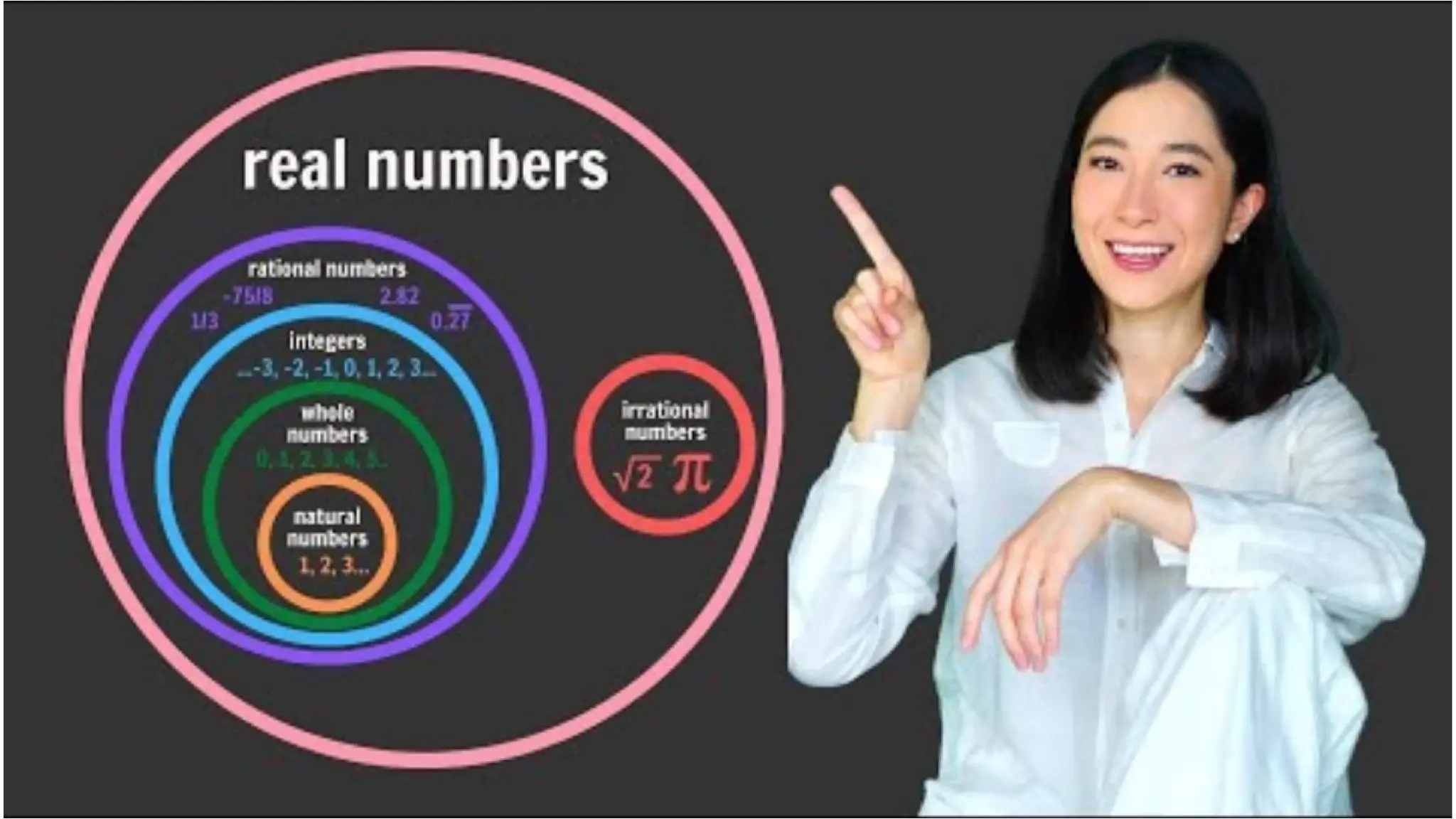
Each number discussed so far is a
part of the next type of number.
Here is a diagram to show this:
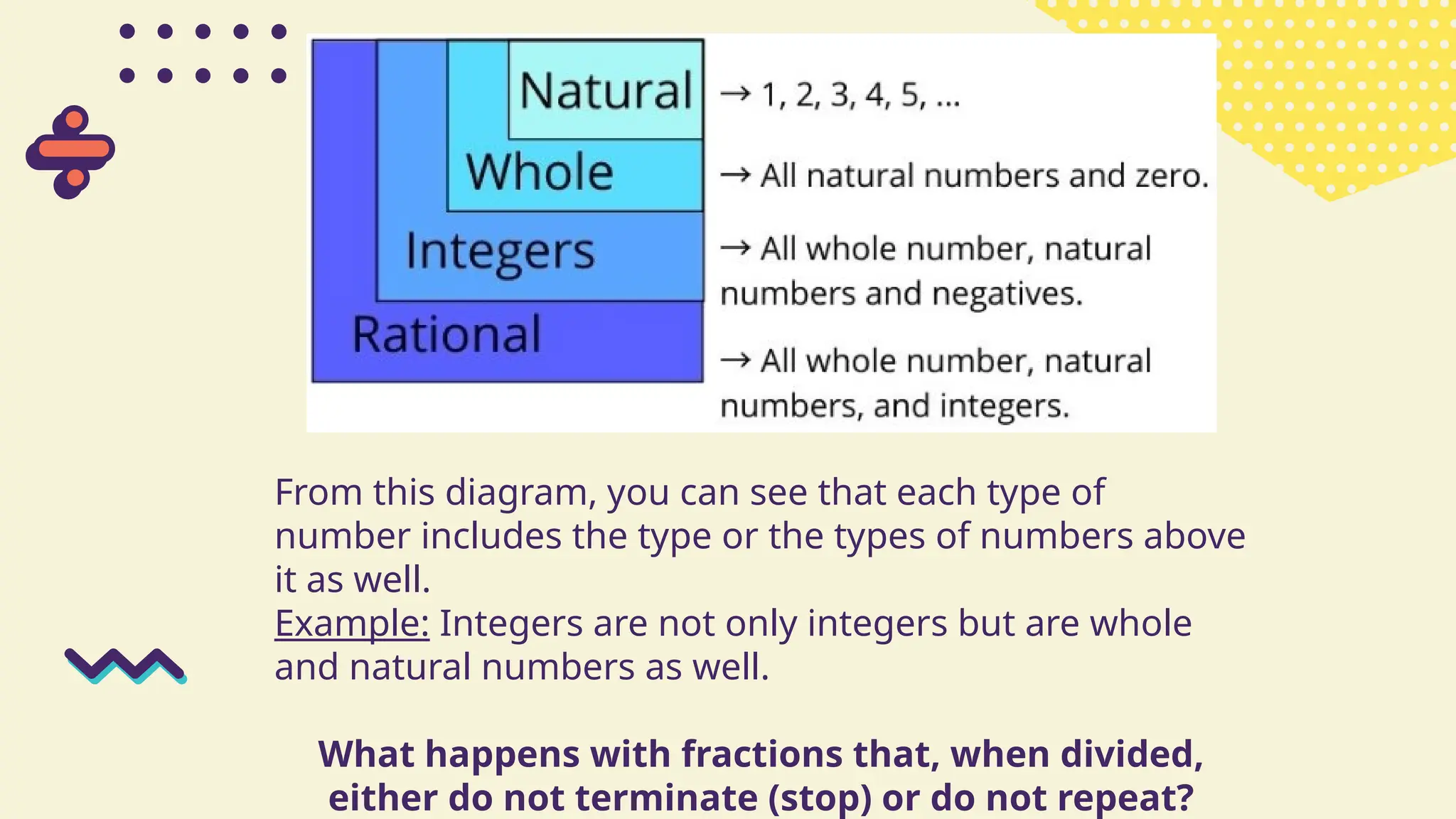
From this diagram, you can see that each type of
number includes the type or the types of numbers above
it as well.
Example: Integers are not only integers but are whole
and natural numbers as well.
What happens with fractions that, when divided,
either do not terminate (stop) or do not repeat?
Irrational Numbers (P)
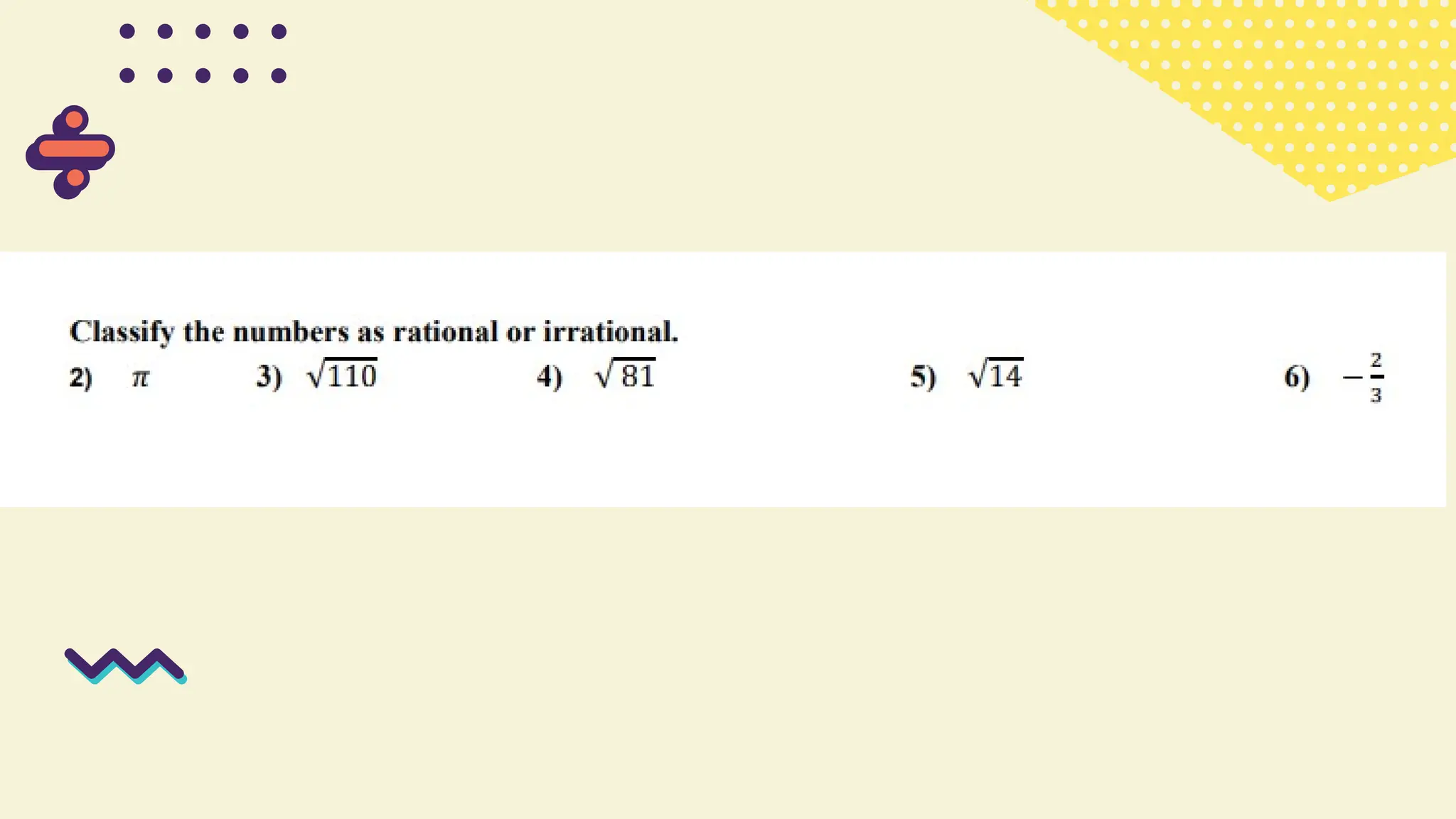
Irrational numbers are all numbers that cannot be written as a
simple fraction; they are written as non-repeating, non-
terminating decimals.
Examples:
• Π Pi
This is equal to 3.14159265359...
• √2
This is equal to 1.4142135....
• 123.4587621356
NOTE: If a number in a square root is not a perfect square, it
is most likely irrational.
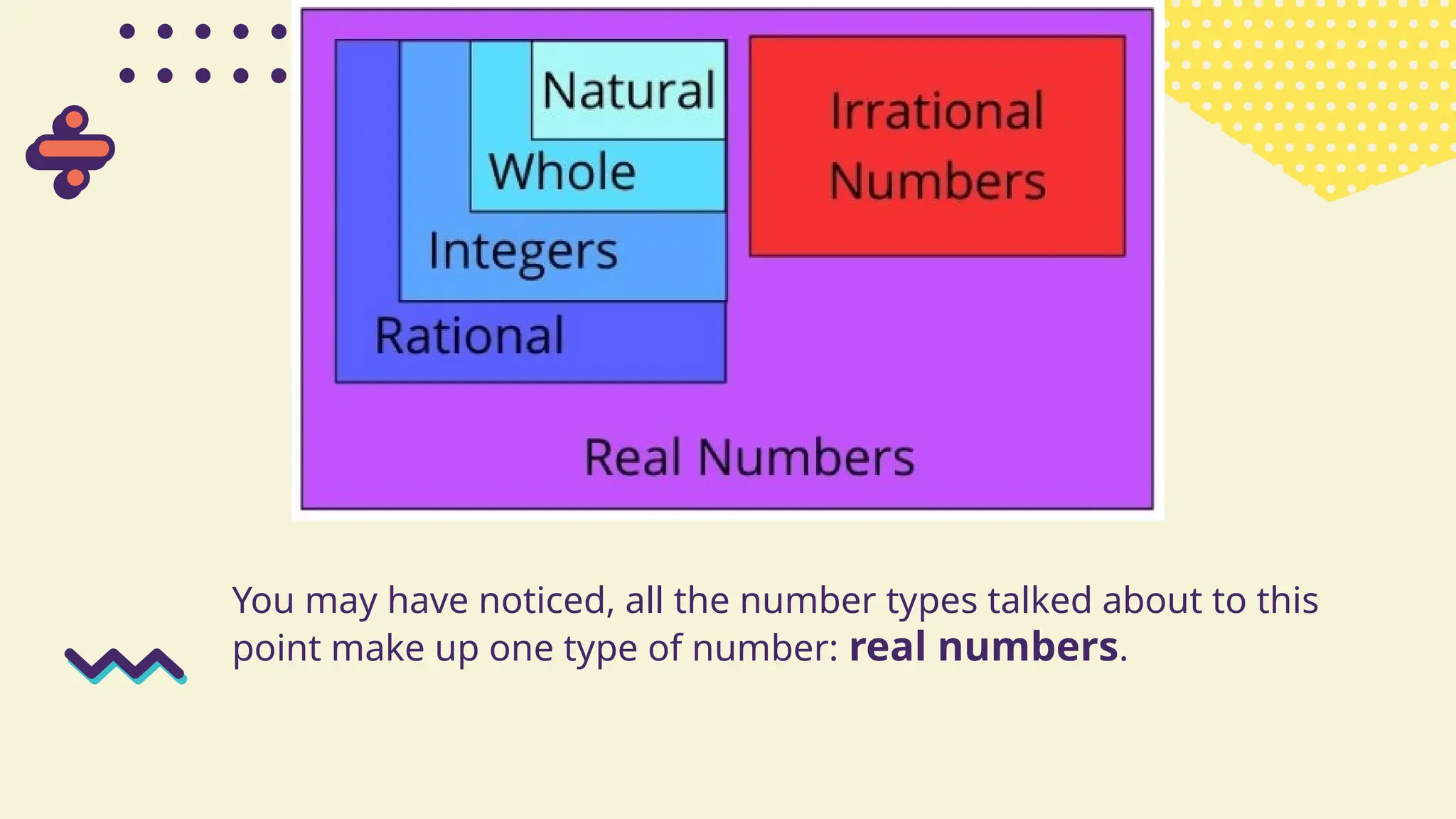
Look at the diagram above.
Where could we add irrationals??
They do not have anything in common with any other number
listed to this point, so you must make them a completely
separate category.
You may have noticed, all the number types talked about to this
point make up one type of number: real numbers.
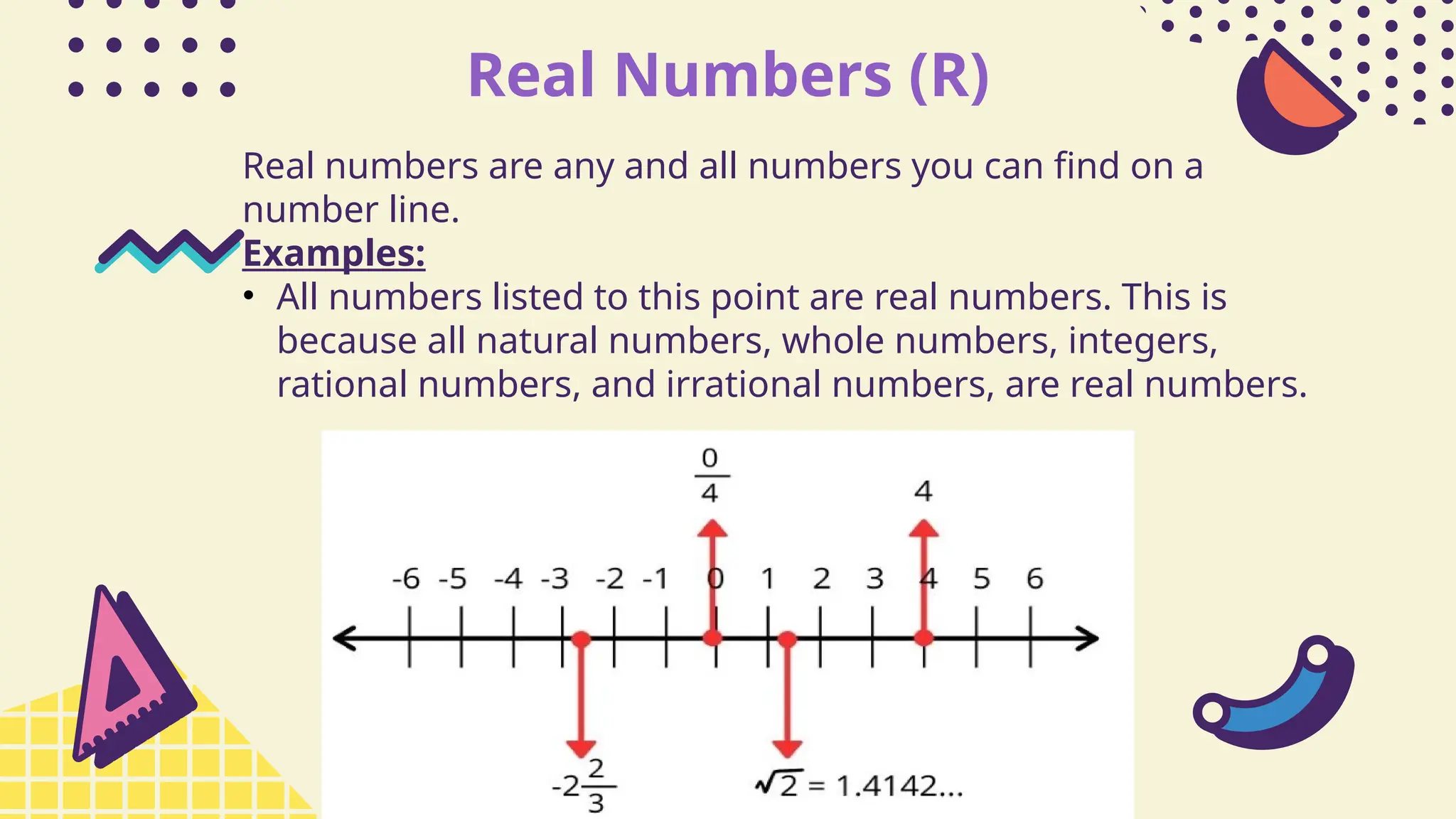
Real Numbers (R)
Real numbers are any and all numbers you can find on a
number line.
Examples:
• All numbers listed to this point are real numbers. This is
because all natural numbers, whole numbers, integers,
rational numbers, and irrational numbers, are real numbers.
Types of numbers (real numbers and history of numbers).pptx

Types of numbers (real numbers and history of numbers).pptx

  • 1.
  • 2.
    Global Context: Identitiesand relationships Statement of Inquiry: The forms of a system's models and representations influence our understanding of the relationships that define our identities.
  • 3.
    Learning Target • Identifyand differentiate between different types of numbers (naturals, integers, rational, and real numbers). • Apply knowledge of number types to solve problems and represent them on a number line.
  • 33.
  • 34.
    It is timefor your secret detective classification skills to come out! This lesson needs help in determining what type of number a number truly is. Are you up to the challenge?
  • 35.
    While you maythink of a number as just a plain old number, it is so much more. Numbers are classified into different types of numbers based on various things like: Is it positive or negative? Is it a fraction or a decimal? Do they repeat?
  • 36.
    Natural numbers (N) Naturalnumbers are counting numbers starting at 1. Examples: •1, 2, 3, 4, 5, ...... •It can be simplified to 8/2 = 4. •5.0 This is just 5 Non-examples: •0, -10 It cannot be less than 1. REMINDER: Counting numbers start at 1 and add 1 each time.
  • 37.
    Whole numbers (W) Wholenumbers are natural numbers together with 0. Examples: •0, 1, 2, 3, 4, ... Keep going in this direction counting up by 1. • 0/4 This is just the same as 0. •101 A whole number greater than 0. Non-examples: •½, 0.44 These are not whole numbers.
  • 38.
    Integers (Z) Integers areall whole numbers and their opposites (negatives), as well as 0. Examples: • ..., -3, -2, -1, 0, 1, 2, 3, ...
  • 39.
    Rational Numbers (Q) Rationalis a number that can be written as a simple fraction a/b, where a and b are integers and b does not equal 0 (0 CANNOT be in the denominator). NOTE: This includes terminating and repeating decimals. • Terminating: When you divide the fraction there is a stop, it does not keep going. • Example: ½ = 0.5 • Repeating: When you divide the fraction, the decimal repeats itself. • Example: 1/3 = 0.3333....
  • 40.
    Examples: Non-example: • 0.1234567... This isNOT rational because it cannot be written as a simple fraction.
  • 41.
    Each number discussedso far is a part of the next type of number. Here is a diagram to show this:
  • 42.
    From this diagram,you can see that each type of number includes the type or the types of numbers above it as well. Example: Integers are not only integers but are whole and natural numbers as well. What happens with fractions that, when divided, either do not terminate (stop) or do not repeat?
  • 43.
    Irrational Numbers (P) Irrationalnumbers are all numbers that cannot be written as a simple fraction; they are written as non-repeating, non- terminating decimals. Examples: • Π Pi This is equal to 3.14159265359... • √2 This is equal to 1.4142135.... • 123.4587621356 NOTE: If a number in a square root is not a perfect square, it is most likely irrational.
  • 44.
    Look at thediagram above. Where could we add irrationals?? They do not have anything in common with any other number listed to this point, so you must make them a completely separate category.
  • 45.
    You may havenoticed, all the number types talked about to this point make up one type of number: real numbers.
  • 46.
    Real Numbers (R) Realnumbers are any and all numbers you can find on a number line. Examples: • All numbers listed to this point are real numbers. This is because all natural numbers, whole numbers, integers, rational numbers, and irrational numbers, are real numbers.