Closure Properties of
Regular Languages

 This is the partial material
 from Section 4.1, 3.1 & 3.2


                                1
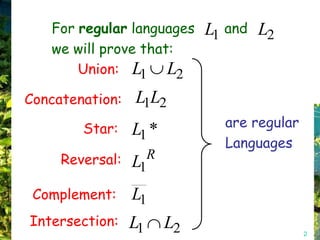
For regular languages     L1 and L2
   we will prove that:
       Union: L1 L2

Concatenation:   L1L2
        Star:                  are regular
                 L1 *
                               Languages
     Reversal:   L1R

 Complement:     L1
Intersection:    L1     L2                   2
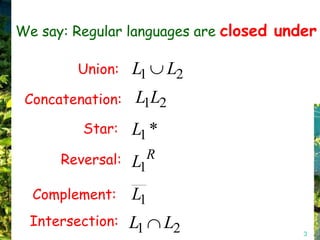
We say: Regular languages are closed under

         Union:   L1     L2
 Concatenation:   L1L2
         Star:    L1 *
      Reversal:   L1R

  Complement:     L1
  Intersection:   L1     L2             3
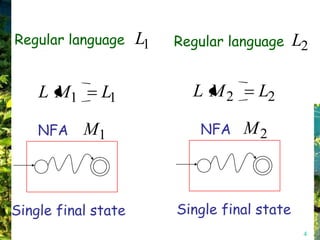
Regular language     L1   Regular language     L2

    L M1      L1            L M2      L2

    NFA    M1                NFA    M2


Single final state        Single final state
                                                4
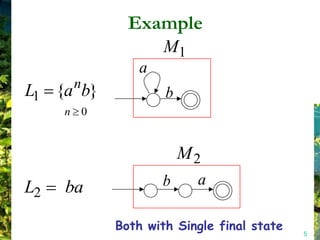
Example
                   M1
               a
      n
L1 {a b}           b
     n 0


                       M2
L2   ba            b    a

           Both with Single final state   5
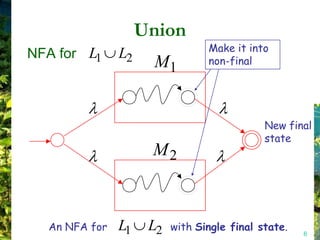
Union
                                 Make it into
NFA for L1     L2                non-final
                     M1


                                             New final
                                             state
                     M2


  An NFA for   L1    L2   with Single final state.
                                                     6
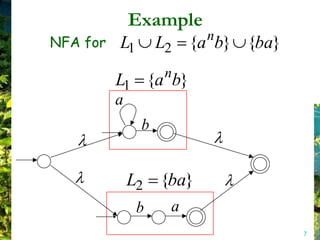
Example
                        n
NFA for   L1       L2 {a b} {ba}
                   n
          L1 {a b}
          a
               b


              L2 {ba}
               b    a
                                   7
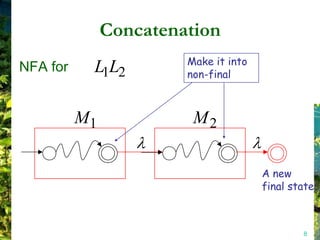
Concatenation
                        Make it into
NFA for    L1L2         non-final


          M1             M2


                                       A new
                                       final state


                                               8
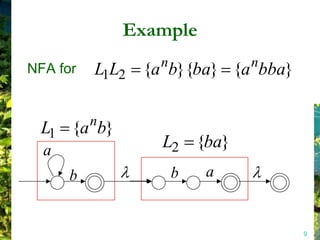
Example
                 n           n
NFA for   L1L2 {a b}{ba} {a bba}

          n
 L1 {a b}
  a              L2 {ba}
      b              b   a


                                   9
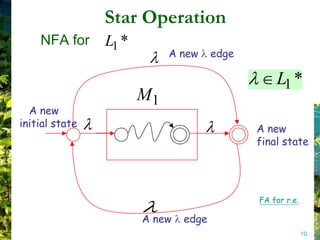
Star Operation
    NFA for     L1 *
                            A new     edge

                                                 L1 *
                       M1
  A new
initial state                                A new
                                             final state


                                             FA for r.e.

                       A new   edge
                                                           10
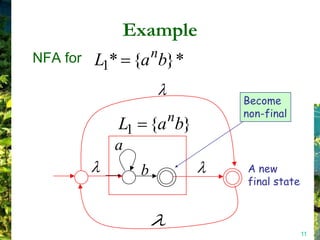
Example
NFA for             n
          L1* {a b} *

                            Become
                        n   non-final
            L1 {a b}
            a
                b           A new
                            final state


                                          11
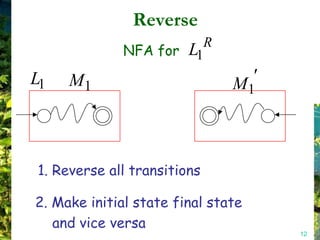
Reverse
                        R
              NFA for L1

L1   M1                        M1


 1. Reverse all transitions

2. Make initial state final state
   and vice versa
                                    12
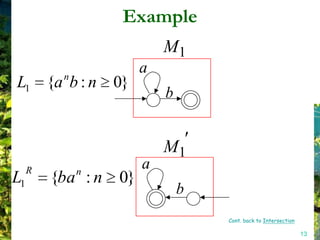
Example
                           M1
          n
                       a
L1 {a b : n       0}
                           b


                           M1
     R        n
                       a
L1       {ba : n 0}
                               b
                                   Cont. back to Intersection

                                                                13
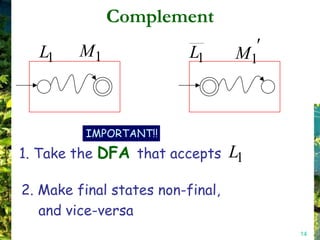
Complement
  L1     M1               L1      M1


          IMPORTANT!!
1. Take the DFA that accepts      L1

2. Make final states non-final,
   and vice-versa
                                       14
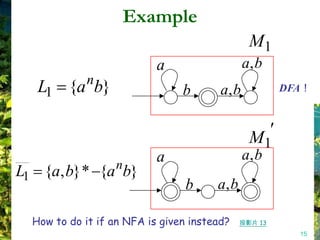
Example
                                                M1
                           a                   a, b
             n
   L1 {a b}                     b       a, b           DFA!


                                                M1
                           a                   a, b
                  n
L1 {a, b} * {a b}
                                 b     a, b

  How to do it if an NFA is given instead?    投影片 13
                                                         15
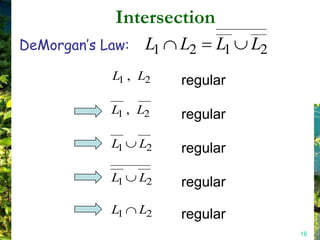
Intersection
DeMorgan’s Law:   L1   L2   L1   L2
            L1 , L2    regular

            L1 , L2    regular

            L1    L2   regular

            L1    L2   regular
            L1    L2   regular
                                      16
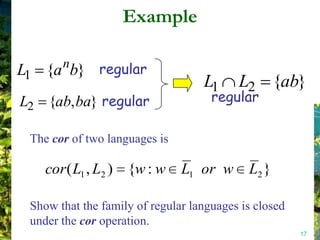
Example

L1 {a b} regular
       n
                                   L1     L2 {ab}
L2 {ab, ba} regular                  regular

 The cor of two languages is

    cor ( L1 , L2 ) {w : w     L1 or w      L2 }

 Show that the family of regular languages is closed
 under the cor operation.
                                                       17
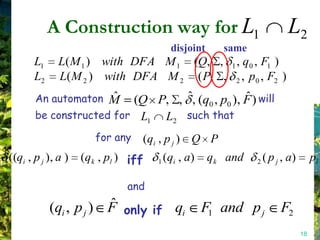
A Construction way for L1                                      L2
                                          disjoint      same
      L1    L( M 1 ) with DFA M 1 (Q, , 1 , q0 , F1 )
      L2    L( M 2 ) with DFA M 2 ( P, , 2 , p0 , F2 )
                    ˆ
       An automaton M    (Q P, , ˆ, (q0 , p0 ), F ) will
                                                ˆ
       be constructed for L1 L2 such that

                     for any    ( qi , p j ) Q P
ˆ((q , p ), a )   (q k , pl ) iff       ( qi , a )   q k and       ( p j , a)        pl
    i   j                           1                          2


                             and
                       ˆ
           (qi , p j ) F only if qi                  F1 and p j         F2
                                                                                18
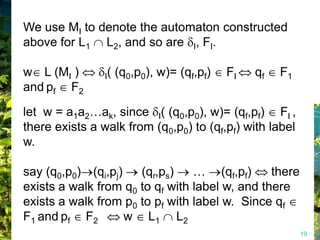
We use MI to denote the automaton constructed
above for L1 L2, and so are I, FI.

w L (MI )       I(   (q0,p0), w)= (qf,pf)   FI   qf   F1
and pf F2

let w = a1a2…ak, since I( (q0,p0), w)= (qf,pf) FI ,
there exists a walk from (q0,p0) to (qf,pf) with label
w.

say (q0,p0) (qi,pj)   (qr,ps)    … (qf,pf)      there
exists a walk from q0 to qf with label w, and there
exists a walk from p0 to pf with label w. Since qf
F1 and pf F2        w L1 L 2
                                                           19
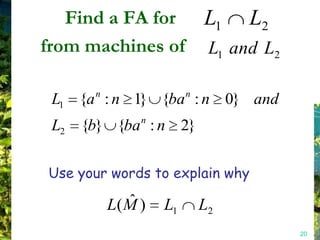
Find a FA for L1 L2
from machines of L1 and L2

       n                 n
 L1 {a : n 1} {ba : n 0} and
                n
 L2   {b} {ba : n 2}

Use your words to explain why
              ˆ
           L( M )   L1       L2
                                  20
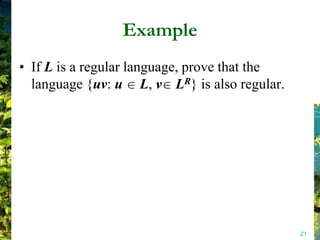
Example
• If L is a regular language, prove that the
  language {uv: u L, v LR} is also regular.


                                               21
Regular Expressions


                      22
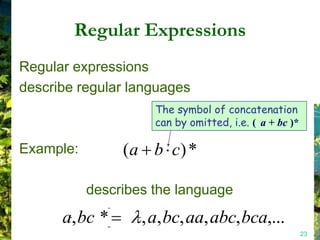
Regular Expressions
Regular expressions
describe regular languages
                     The symbol of concatenation
                     can by omitted, i.e. ( a + bc )*

Example:        (a b c) *

           describes the language
      a, bc *      , a, bc, aa, abc, bca,...
                                                        23
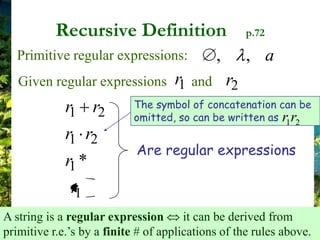
Recursive Definition                       p.72

  Primitive regular expressions:             ,        , a
   Given regular expressions r and
                              1                  r2
             r1 r2          The symbol of concatenation can be
                            omitted, so can be written as r1 r2
             r1 r2
                            Are regular expressions
             r1 *
              r1
A string is a regular expression       it can be derived from
primitive r.e.’s by a finite # of applications of the rules above.
                                                                24
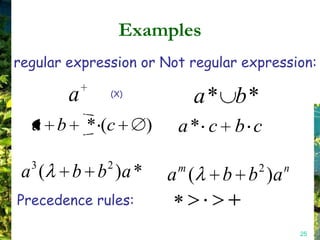
Examples
regular expression or Not regular expression:

        a      (X)
                              a* b*
  a b       * (c     )    a* c b c
  3           2           m         2    n
 a (    b b )a *         a (    b b )a
Precedence rules:

                                             25
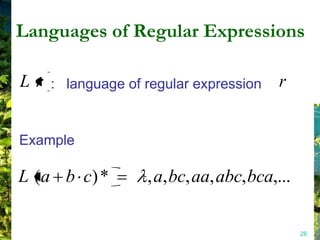
Languages of Regular Expressions

Lr   : language of regular expression    r


Example

L ( a b c) *       , a, bc, aa, abc, bca,...


                                               26
Definition
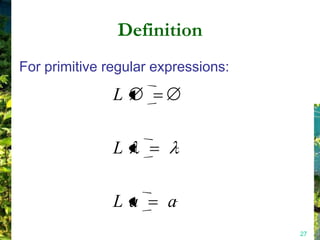
For primitive regular expressions:

               L

               L

               La       a
                                     27
Definition (continued)
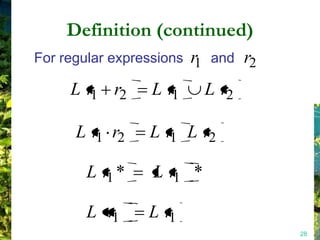
For regular expressions r and
                         1       r2
     L r1 r2     L r1     L r2

      L r1 r2   L r1 L r2

       L r1 *    L r1 *

       L r1     L r1
                                      28
Example of Language L(r)

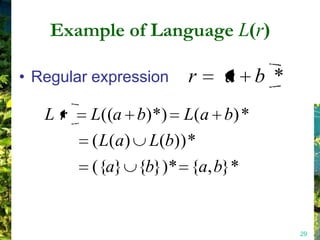
• Regular expression   r   a b *
   Lr    L((a b)*) L(a b) *
         ( L(a) L(b)) *
         ({a} {b})* {a, b}*


                                   29
Example
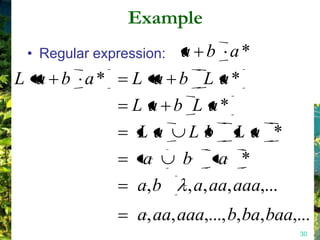
 • Regular expression:   a b a*
L a b a*        L a b L a*
                L a b L a*
                 La Lb La *
                  a   b a *
                 a, b , a, aa, aaa,...
                 a, aa, aaa,..., b, ba, baa,...
                                             30
Example

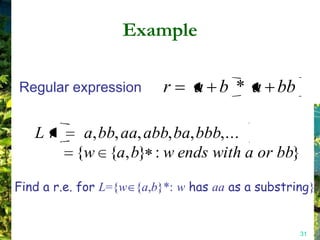
Regular expression        r    a b * a bb

   Lr      a, bb, aa, abb, ba, bbb,...
          {w {a, b} : w ends with a or bb}

Find a r.e. for L={w {a,b}*: w has aa as a substring}


                                                  31
Example
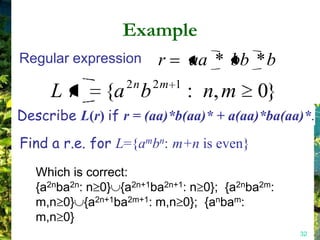
Regular expression       r     aa * bb * b
                   2n   2m 1
     Lr        {a b            : n, m      0}
Describe L(r) if r = (aa)*b(aa)* + a(aa)*ba(aa)*.
Find a r.e. for L={ambn: m+n is even}
   Which is correct:
   {a2nba2n: n 0} {a2n+1ba2n+1: n 0}; {a2nba2m:
   m,n 0} {a2n+1ba2m+1: m,n 0}; {anbam:
   m,n 0}
                                                  32
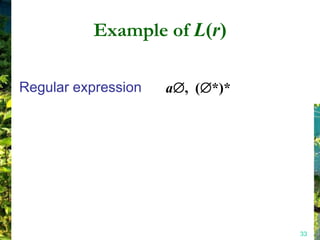
Example of L(r)

Regular expression   a , ( *)*


                                 33
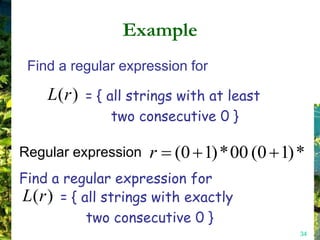
Example
 Find a regular expression for

    L(r ) = { all strings with at least
              two consecutive 0 }

Regular expression   r   (0 1) * 00 (0 1) *
Find a regular expression for
L(r ) = { all strings with exactly
           two consecutive 0 }
                                          34
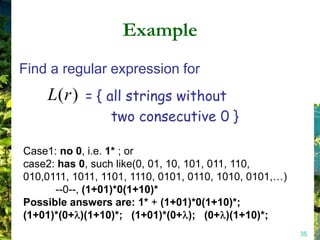
Example
Find a regular expression for
    L(r ) = { all strings without
                 two consecutive 0 }

Case1: no 0, i.e. 1* ; or
case2: has 0, such like(0, 01, 10, 101, 011, 110,
010,0111, 1011, 1101, 1110, 0101, 0110, 1010, 0101,…)
      --0--, (1+01)*0(1+10)*
Possible answers are: 1* + (1+01)*0(1+10)*;
(1+01)*(0+ )(1+10)*; (1+01)*(0+ ); (0+ )(1+10)*;
                                                        35
Example
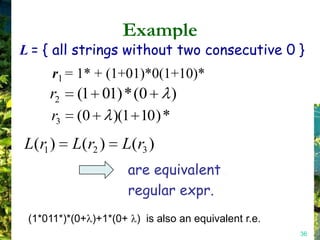
L = { all strings without two consecutive 0 }
      r1 = 1* + (1+01)*0(1+10)*
     r2    (1 01) * (0    )
     r3    (0  )(1 10 ) *
L(r1 )    L(r2 )    L(r3 )
                      are equivalent
                        r1     ,     r2                   r


                      regular expr.
 (1*011*)*(0+ )+1*(0+ ) is also an equivalent r.e.
                                                     36
Equivalent Regular Expressions

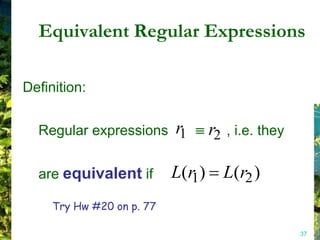
Definition:


  Regular expressions r1           r2   , i.e. they


  are equivalent if        L(r1)        L(r2 )
     Try Hw #20 on p. 77

                                                      37
Example

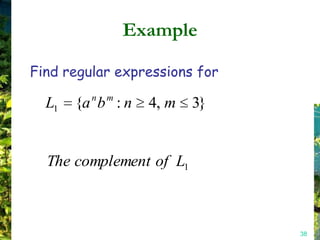
Find regular expressions for
         n   m
  L1   {a b : n    4, m   3}


  The complement of L1


                               38
Example
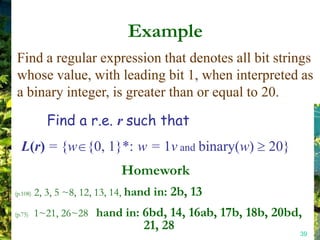
 Find a regular expression that denotes all bit strings
 whose value, with leading bit 1, when interpreted as
 a binary integer, is greater than or equal to 20.

            Find a r.e. r such that
  L(r) = {w {0, 1}*: w = 1v and binary(w)                 20}
                              Homework
(p.108)   2, 3, 5 ~8, 12, 13, 14, hand in: 2b,   13
(p.75)    1~21, 26~28 hand in: 6bd,     14, 16ab, 17b, 18b, 20bd,
                                   21, 28
                                                                39
Regular Expressions
        and
Regular Languages


                      40
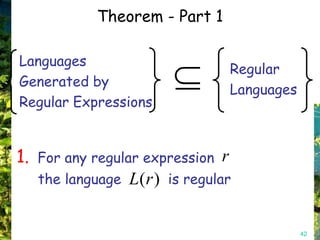
Theorem

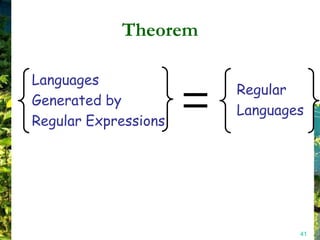
Languages
                      Regular
Generated by
                      Languages
Regular Expressions


                              41
Theorem - Part 1

Languages
                               Regular
Generated by
                               Languages
Regular Expressions


1. For any regular expression r
   the language L(r ) is regular


                                           42
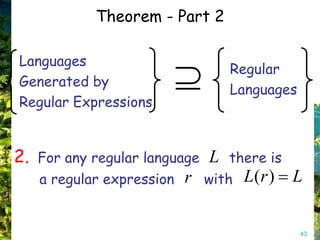
Theorem - Part 2

Languages
                              Regular
Generated by
                              Languages
Regular Expressions


2. For any regular language L there is
   a regular expression r with L( r ) L


                                          43
Proof - Part 1
1. For any regular expression r
   the language L(r ) is regular


  Proof by induction on the size of   r


                                          44
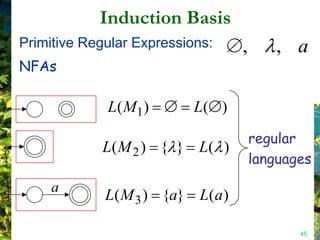
Induction Basis
Primitive Regular Expressions:    ,      , a
NFAs

             L ( M1 )      L( )
                                      regular
            L( M 2 ) { } L( )
                                      languages
    a
             L( M 3 ) {a} L(a )

                                             45
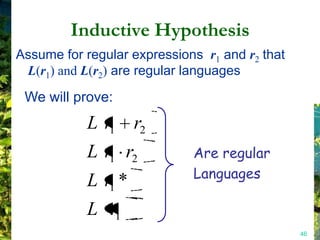
Inductive Hypothesis
Assume for regular expressions r1 and r2 that
 L(r1) and L(r2) are regular languages

 We will prove:
           L r1 r2
           L r1 r2           Are regular
                             Languages
           L r1 *
           L r1
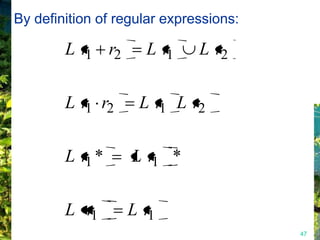
                                                46
By definition of regular expressions:

        L r1 r2      L r1     L r2


        L r1 r2     L r1 L r2


        L r1 *     L r1 *


        L r1      L r1
                                        47
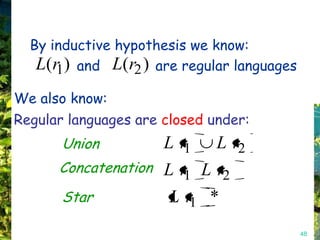
By inductive hypothesis we know:
   L(r1) and L(r2 ) are regular languages
We also know:
Regular languages are closed under:
       Union          L r1    L r2
      Concatenation L r L r2
                       1
      Star           L r1 *
                                            48
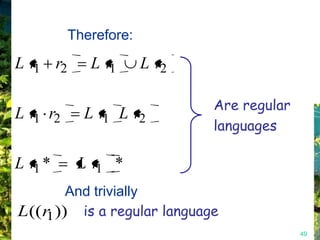
Therefore:

L r1 r2      L r1      L r2

                              Are regular
L r1 r2     L r1 L r2
                              languages

L r1 *     L r1 *
       And trivially
L((r )) is a regular language
    1
                                            49
Example
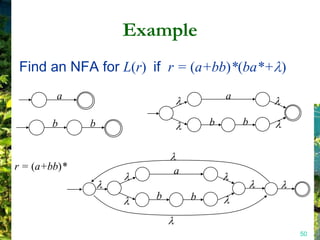
Find an NFA for L(r) if r = (a+bb)*(ba*+ )
        a                            a

       b      b                  b       b


r = (a+bb)*              a

                     b       b


                                             50
Example (Cont’d)
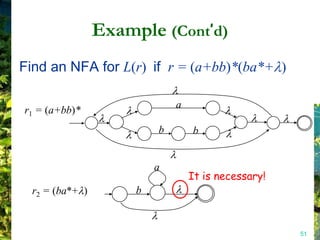
Find an NFA for L(r) if r = (a+bb)*(ba*+ )

                              a
r1 = (a+bb)*
                          b       b


                          a
                                  It is necessary!
  r2 = (ba*+ )        b


                                                     51
Example
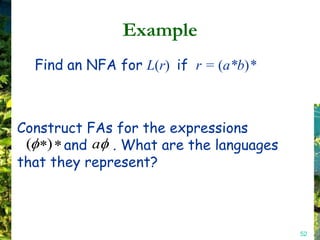
  Find an NFA for L(r) if r = (a*b)*


Construct FAs for the expressions
 ( ) and a . What are the languages
that they represent?


                                       52
Proof – Part 2
2. For any regular language L there is
   a regular expression r with L( r ) L


Proof by construction of regular expression


                                          53
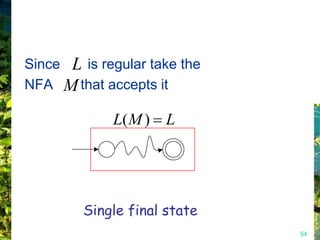
Since L is regular take the
NFA M that accepts it

             L( M )   L


         Single final state
                              54
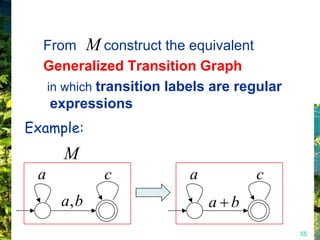
From M construct the equivalent
  Generalized Transition Graph
  in which transition labels are regular
   expressions
Example:
     M
 a          c            a         c
     a, b                    a b
                                           55
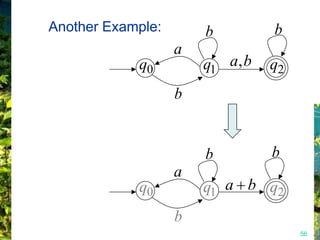
Another Example:       b         b
                   a
            q0         q1 a, b   q2
                   b


                       b         b
                   a
            q0         q1 a b q2
                   b
                                      56
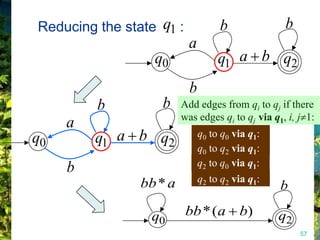
Reducing the state q1 :             b              b
                           a
                  q0                q1 a b q2
                           b
         b         b     Add edges from qi to qj if there
                         was edges qi to qj via q1, i, j 1:
     a
q0       q1 a b q2             q0 to q0 via q1:
                               q0 to q2 via q1:
                               q2 to q0 via q1:
     b
                bb * a         q2 to q2 via q1:
                                                  b

                 q0       bb * (a        b)       q2
                                                       57
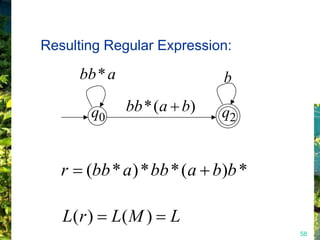
Resulting Regular Expression:

       bb* a                b

        q0     bb * (a b)   q2


   r   (bb * a ) * bb * (a b)b *

   L(r )     L( M )   L
                                   58
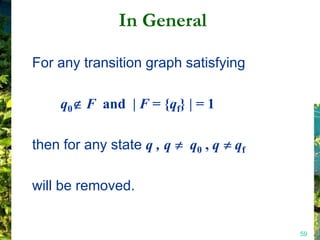
In General

For any transition graph satisfying

    q0 F and | F = {qf} | = 1

then for any state q , q   q0 , q   qf

will be removed.


                                         59
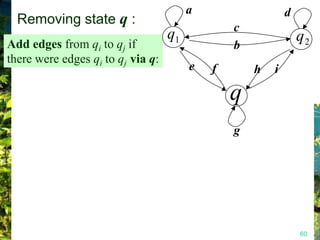
a                   d
  Removing state q :
                                                c
                                   q1                           q2
Add edges from qi to qj if                      b
there were edges qi to qj via q:
                                        e   f       h   i

                                                q
                                                g


                                                                60
a
                                 a                   d
                                                     d
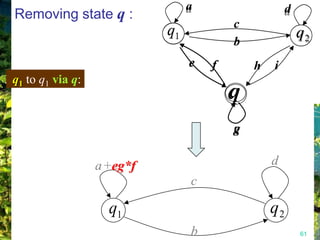
Removing state q :
                                         c
                            q1                           q2
                                         b
                                 e   f       h   i
q1 to q1 via q:
                                         q
                                         g

                  a +eg*f                        d
                                 c

                    q1                           q2
                                 b                       61
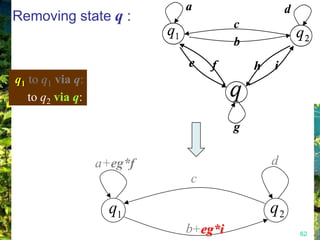
a                    d
Removing state q :                       c
                           q1                            q2
                                         b
                                e   f        h   i
q1 to q1 via q:
   to q2 via q:                          q
                                         g

                  a+eg*f                         d
                                c

                    q1                           q2
                                b+eg*i                   62
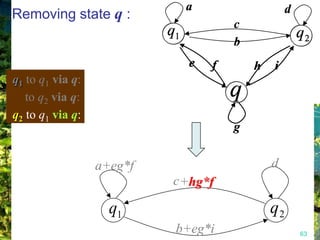
a                   d
Removing state q :
                                        c
                           q1                           q2
                                        b
                                e   f       h   i
q1 to q1 via q:
   to q2 via q:                         q
q2 to q1 via q:
                                        g


                  a+eg*f                        d
                           c+hg*f

                    q1                          q2
                            b+eg*i                      63
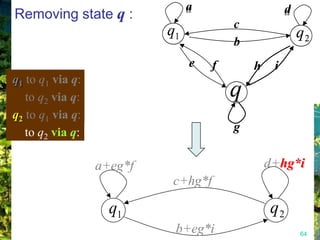
a                    d
Removing state q :
                                        c
                           q1                            q2
                                        b
                                e   f       h    i
q1 to q1 via q:
   to q2 via q:                         q
q2 to q1 via q:
   to q2 via q:                         g


                  a+eg*f                        d+hg*i
                           c+hg*f

                    q1                          q2
                            b+eg*i                       64
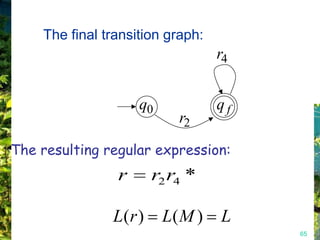
The final transition graph:
                                  r4


                    q0            qf
                           r2

The resulting regular expression:
                r      r2 r4 *

               L(r )     L( M )   L
                                       65
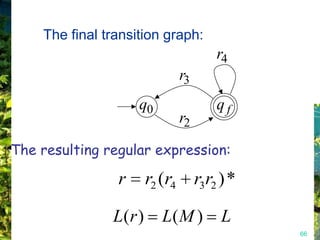
The final transition graph:
                                         r4
                                r3
                    q0                   qf
                                r2

The resulting regular expression:

                r      r2 (r4        r3r2 ) *

               L(r )      L( M )          L
                                                66
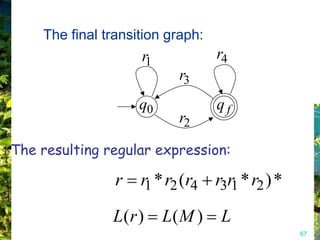
The final transition graph:
                    r1            r4
                           r3
                    q0            qf
                           r2

The resulting regular expression:

                r   r1 * r2 (r4 r3r1 * r2 ) *

               L(r )     L( M )   L
                                                67
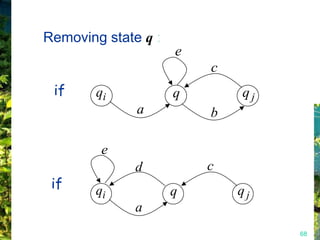
Removing state q :
                     e
                         c
 if     qi           q       qj
              a          b

         e
              d          c
 if     qi           q       qj
              a
                                  68
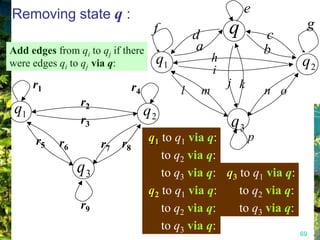
Removing state q :                                         e
                                     f                 q                   g
                                              d                c
Add edges from qi to qj if there               a               b
were edges qi to qj via q:           q1            h                  q2
                                                   i
      r1                       r4                      j k
                                          l    m               n o
                r2
 q1                                 q2
                r3                                     q3
      r5                            q1 to q1 via q:      p
           r6        r7   r8
                                       to q2 via q:
                q3                     to q3 via q: q3 to q1 via q:
                                    q2 to q1 via q:    to q2 via q:
                r9                     to q2 via q:    to q3 via q:
                                       to q3 via q:
                                                                      69
Last Words about
  Conversion from NFA to Reg. Exp.

• Remove any inaccessible states (from q0).

• If the initial state is also a final state…

• If there is more than one final states…
   Hw for 3.2   (p.87):   1 ~13, 18.

                                                70
L is regular
          a reg. exp. r L=L(r)
          a FA M L=L(M)
Show L is regular by finding its regular
  expression:
L = {w {a,b}*: na(w) is even, nb(w) is odd}


 It is difficult to find its reg. exp. directly.
 Use FA with states:
  eo representing so far it has even # of as and
        odd # of bs being read, etc..

                                                   71
Closure Properties of
Regular Languages

 Remaining material of
     Section 4.1

                         72
Closure Properties
• Closure Properties of Regular Languages
  – Closure under Simple Set Operations


     •   union, intersection, concatenation,
         complementary, star-closure, reversal

   – Closure under Other Operations
     • Homomorphism (Def. 4.1, p.103) skip
     • Right Quotient (Def. 4.2, p. 104)
                                                 73
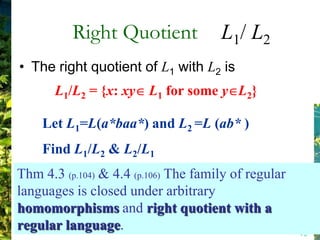
Right Quotient                  L1/ L2
• The right quotient of L1 with L2 is

      L1/L2 = {x: xy L1 for some y L2}

   L1={ab, abb, abbb}, L2 ={bman: m > n}
   L1 / L2 = ?

Thm 4.4 (p.106) The family of regular languages
is closed under right quotient with a regular
language.
                                                    74
Right Quotient              L1/ L2
• The right quotient of L1 with L2 is
       L1/L2 = {x: xy L1 for some y L2}

    Let L1=L(a*baa*) and L2 =L (ab* )
    Find L1/L2 & L2/L1
Thm 4.3 (p.104) & 4.4 (p.106) The family of regular
languages is closed under arbitrary
homomorphisms and right quotient with a
regular language.                                     75
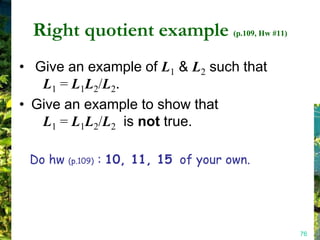
Right quotient example (p.109, Hw #11)
• Give an example of L1 & L2 such that
   L1 = L1L2/L2.
• Give an example to show that
   L1 = L1L2/L2 is not true.

 Do hw (p.109) : 10, 11, 15 of your own.


                                           76

Class4

  • 1.
    Closure Properties of RegularLanguages This is the partial material from Section 4.1, 3.1 & 3.2 1
  • 2.
    For regular languages L1 and L2 we will prove that: Union: L1 L2 Concatenation: L1L2 Star: are regular L1 * Languages Reversal: L1R Complement: L1 Intersection: L1 L2 2
  • 3.
    We say: Regularlanguages are closed under Union: L1 L2 Concatenation: L1L2 Star: L1 * Reversal: L1R Complement: L1 Intersection: L1 L2 3
  • 4.
    Regular language L1 Regular language L2 L M1 L1 L M2 L2 NFA M1 NFA M2 Single final state Single final state 4
  • 5.
    Example M1 a n L1 {a b} b n 0 M2 L2 ba b a Both with Single final state 5
  • 6.
    Union Make it into NFA for L1 L2 non-final M1 New final state M2 An NFA for L1 L2 with Single final state. 6
  • 7.
    Example n NFA for L1 L2 {a b} {ba} n L1 {a b} a b L2 {ba} b a 7
  • 8.
    Concatenation Make it into NFA for L1L2 non-final M1 M2 A new final state 8
  • 9.
    Example n n NFA for L1L2 {a b}{ba} {a bba} n L1 {a b} a L2 {ba} b b a 9
  • 10.
    Star Operation NFA for L1 * A new edge L1 * M1 A new initial state A new final state FA for r.e. A new edge 10
  • 11.
    Example NFA for n L1* {a b} * Become n non-final L1 {a b} a b A new final state 11
  • 12.
    Reverse R NFA for L1 L1 M1 M1 1. Reverse all transitions 2. Make initial state final state and vice versa 12
  • 13.
    Example M1 n a L1 {a b : n 0} b M1 R n a L1 {ba : n 0} b Cont. back to Intersection 13
  • 14.
    Complement L1 M1 L1 M1 IMPORTANT!! 1. Take the DFA that accepts L1 2. Make final states non-final, and vice-versa 14
  • 15.
    Example M1 a a, b n L1 {a b} b a, b DFA! M1 a a, b n L1 {a, b} * {a b} b a, b How to do it if an NFA is given instead? 投影片 13 15
  • 16.
    Intersection DeMorgan’s Law: L1 L2 L1 L2 L1 , L2 regular L1 , L2 regular L1 L2 regular L1 L2 regular L1 L2 regular 16
  • 17.
    Example L1 {a b}regular n L1 L2 {ab} L2 {ab, ba} regular regular The cor of two languages is cor ( L1 , L2 ) {w : w L1 or w L2 } Show that the family of regular languages is closed under the cor operation. 17
  • 18.
    A Construction wayfor L1 L2 disjoint same L1 L( M 1 ) with DFA M 1 (Q, , 1 , q0 , F1 ) L2 L( M 2 ) with DFA M 2 ( P, , 2 , p0 , F2 ) ˆ An automaton M (Q P, , ˆ, (q0 , p0 ), F ) will ˆ be constructed for L1 L2 such that for any ( qi , p j ) Q P ˆ((q , p ), a ) (q k , pl ) iff ( qi , a ) q k and ( p j , a) pl i j 1 2 and ˆ (qi , p j ) F only if qi F1 and p j F2 18
  • 19.
    We use MIto denote the automaton constructed above for L1 L2, and so are I, FI. w L (MI ) I( (q0,p0), w)= (qf,pf) FI qf F1 and pf F2 let w = a1a2…ak, since I( (q0,p0), w)= (qf,pf) FI , there exists a walk from (q0,p0) to (qf,pf) with label w. say (q0,p0) (qi,pj) (qr,ps) … (qf,pf) there exists a walk from q0 to qf with label w, and there exists a walk from p0 to pf with label w. Since qf F1 and pf F2 w L1 L 2 19
  • 20.
    Find a FAfor L1 L2 from machines of L1 and L2 n n L1 {a : n 1} {ba : n 0} and n L2 {b} {ba : n 2} Use your words to explain why ˆ L( M ) L1 L2 20
  • 21.
    Example • If Lis a regular language, prove that the language {uv: u L, v LR} is also regular. 21
  • 22.
  • 23.
    Regular Expressions Regular expressions describeregular languages The symbol of concatenation can by omitted, i.e. ( a + bc )* Example: (a b c) * describes the language a, bc * , a, bc, aa, abc, bca,... 23
  • 24.
    Recursive Definition p.72 Primitive regular expressions: , , a Given regular expressions r and 1 r2 r1 r2 The symbol of concatenation can be omitted, so can be written as r1 r2 r1 r2 Are regular expressions r1 * r1 A string is a regular expression it can be derived from primitive r.e.’s by a finite # of applications of the rules above. 24
  • 25.
    Examples regular expression orNot regular expression: a (X) a* b* a b * (c ) a* c b c 3 2 m 2 n a ( b b )a * a ( b b )a Precedence rules: 25
  • 26.
    Languages of RegularExpressions Lr : language of regular expression r Example L ( a b c) * , a, bc, aa, abc, bca,... 26
  • 27.
    Definition For primitive regularexpressions: L L La a 27
  • 28.
    Definition (continued) For regularexpressions r and 1 r2 L r1 r2 L r1 L r2 L r1 r2 L r1 L r2 L r1 * L r1 * L r1 L r1 28
  • 29.
    Example of LanguageL(r) • Regular expression r a b * Lr L((a b)*) L(a b) * ( L(a) L(b)) * ({a} {b})* {a, b}* 29
  • 30.
    Example • Regularexpression: a b a* L a b a* L a b L a* L a b L a* La Lb La * a b a * a, b , a, aa, aaa,... a, aa, aaa,..., b, ba, baa,... 30
  • 31.
    Example Regular expression r a b * a bb Lr a, bb, aa, abb, ba, bbb,... {w {a, b} : w ends with a or bb} Find a r.e. for L={w {a,b}*: w has aa as a substring} 31
  • 32.
    Example Regular expression r aa * bb * b 2n 2m 1 Lr {a b : n, m 0} Describe L(r) if r = (aa)*b(aa)* + a(aa)*ba(aa)*. Find a r.e. for L={ambn: m+n is even} Which is correct: {a2nba2n: n 0} {a2n+1ba2n+1: n 0}; {a2nba2m: m,n 0} {a2n+1ba2m+1: m,n 0}; {anbam: m,n 0} 32
  • 33.
    Example of L(r) Regularexpression a , ( *)* 33
  • 34.
    Example Find aregular expression for L(r ) = { all strings with at least two consecutive 0 } Regular expression r (0 1) * 00 (0 1) * Find a regular expression for L(r ) = { all strings with exactly two consecutive 0 } 34
  • 35.
    Example Find a regularexpression for L(r ) = { all strings without two consecutive 0 } Case1: no 0, i.e. 1* ; or case2: has 0, such like(0, 01, 10, 101, 011, 110, 010,0111, 1011, 1101, 1110, 0101, 0110, 1010, 0101,…) --0--, (1+01)*0(1+10)* Possible answers are: 1* + (1+01)*0(1+10)*; (1+01)*(0+ )(1+10)*; (1+01)*(0+ ); (0+ )(1+10)*; 35
  • 36.
    Example L = {all strings without two consecutive 0 } r1 = 1* + (1+01)*0(1+10)* r2 (1 01) * (0 ) r3 (0 )(1 10 ) * L(r1 ) L(r2 ) L(r3 ) are equivalent r1 , r2 r regular expr. (1*011*)*(0+ )+1*(0+ ) is also an equivalent r.e. 36
  • 37.
    Equivalent Regular Expressions Definition: Regular expressions r1 r2 , i.e. they are equivalent if L(r1) L(r2 ) Try Hw #20 on p. 77 37
  • 38.
    Example Find regular expressionsfor n m L1 {a b : n 4, m 3} The complement of L1 38
  • 39.
    Example Find aregular expression that denotes all bit strings whose value, with leading bit 1, when interpreted as a binary integer, is greater than or equal to 20. Find a r.e. r such that L(r) = {w {0, 1}*: w = 1v and binary(w) 20} Homework (p.108) 2, 3, 5 ~8, 12, 13, 14, hand in: 2b, 13 (p.75) 1~21, 26~28 hand in: 6bd, 14, 16ab, 17b, 18b, 20bd, 21, 28 39
  • 40.
    Regular Expressions and Regular Languages 40
  • 41.
    Theorem Languages Regular Generated by Languages Regular Expressions 41
  • 42.
    Theorem - Part1 Languages Regular Generated by Languages Regular Expressions 1. For any regular expression r the language L(r ) is regular 42
  • 43.
    Theorem - Part2 Languages Regular Generated by Languages Regular Expressions 2. For any regular language L there is a regular expression r with L( r ) L 43
  • 44.
    Proof - Part1 1. For any regular expression r the language L(r ) is regular Proof by induction on the size of r 44
  • 45.
    Induction Basis Primitive RegularExpressions: , , a NFAs L ( M1 ) L( ) regular L( M 2 ) { } L( ) languages a L( M 3 ) {a} L(a ) 45
  • 46.
    Inductive Hypothesis Assume forregular expressions r1 and r2 that L(r1) and L(r2) are regular languages We will prove: L r1 r2 L r1 r2 Are regular Languages L r1 * L r1 46
  • 47.
    By definition ofregular expressions: L r1 r2 L r1 L r2 L r1 r2 L r1 L r2 L r1 * L r1 * L r1 L r1 47
  • 48.
    By inductive hypothesiswe know: L(r1) and L(r2 ) are regular languages We also know: Regular languages are closed under: Union L r1 L r2 Concatenation L r L r2 1 Star L r1 * 48
  • 49.
    Therefore: L r1 r2 L r1 L r2 Are regular L r1 r2 L r1 L r2 languages L r1 * L r1 * And trivially L((r )) is a regular language 1 49
  • 50.
    Example Find an NFAfor L(r) if r = (a+bb)*(ba*+ ) a a b b b b r = (a+bb)* a b b 50
  • 51.
    Example (Cont’d) Find anNFA for L(r) if r = (a+bb)*(ba*+ ) a r1 = (a+bb)* b b a It is necessary! r2 = (ba*+ ) b 51
  • 52.
    Example Findan NFA for L(r) if r = (a*b)* Construct FAs for the expressions ( ) and a . What are the languages that they represent? 52
  • 53.
    Proof – Part2 2. For any regular language L there is a regular expression r with L( r ) L Proof by construction of regular expression 53
  • 54.
    Since L isregular take the NFA M that accepts it L( M ) L Single final state 54
  • 55.
    From M constructthe equivalent Generalized Transition Graph in which transition labels are regular expressions Example: M a c a c a, b a b 55
  • 56.
    Another Example: b b a q0 q1 a, b q2 b b b a q0 q1 a b q2 b 56
  • 57.
    Reducing the stateq1 : b b a q0 q1 a b q2 b b b Add edges from qi to qj if there was edges qi to qj via q1, i, j 1: a q0 q1 a b q2 q0 to q0 via q1: q0 to q2 via q1: q2 to q0 via q1: b bb * a q2 to q2 via q1: b q0 bb * (a b) q2 57
  • 58.
    Resulting Regular Expression: bb* a b q0 bb * (a b) q2 r (bb * a ) * bb * (a b)b * L(r ) L( M ) L 58
  • 59.
    In General For anytransition graph satisfying q0 F and | F = {qf} | = 1 then for any state q , q q0 , q qf will be removed. 59
  • 60.
    a d Removing state q : c q1 q2 Add edges from qi to qj if b there were edges qi to qj via q: e f h i q g 60
  • 61.
    a a d d Removing state q : c q1 q2 b e f h i q1 to q1 via q: q g a +eg*f d c q1 q2 b 61
  • 62.
    a d Removing state q : c q1 q2 b e f h i q1 to q1 via q: to q2 via q: q g a+eg*f d c q1 q2 b+eg*i 62
  • 63.
    a d Removing state q : c q1 q2 b e f h i q1 to q1 via q: to q2 via q: q q2 to q1 via q: g a+eg*f d c+hg*f q1 q2 b+eg*i 63
  • 64.
    a d Removing state q : c q1 q2 b e f h i q1 to q1 via q: to q2 via q: q q2 to q1 via q: to q2 via q: g a+eg*f d+hg*i c+hg*f q1 q2 b+eg*i 64
  • 65.
    The final transitiongraph: r4 q0 qf r2 The resulting regular expression: r r2 r4 * L(r ) L( M ) L 65
  • 66.
    The final transitiongraph: r4 r3 q0 qf r2 The resulting regular expression: r r2 (r4 r3r2 ) * L(r ) L( M ) L 66
  • 67.
    The final transitiongraph: r1 r4 r3 q0 qf r2 The resulting regular expression: r r1 * r2 (r4 r3r1 * r2 ) * L(r ) L( M ) L 67
  • 68.
    Removing state q: e c if qi q qj a b e d c if qi q qj a 68
  • 69.
    Removing state q: e f q g d c Add edges from qi to qj if there a b were edges qi to qj via q: q1 h q2 i r1 r4 j k l m n o r2 q1 q2 r3 q3 r5 q1 to q1 via q: p r6 r7 r8 to q2 via q: q3 to q3 via q: q3 to q1 via q: q2 to q1 via q: to q2 via q: r9 to q2 via q: to q3 via q: to q3 via q: 69
  • 70.
    Last Words about Conversion from NFA to Reg. Exp. • Remove any inaccessible states (from q0). • If the initial state is also a final state… • If there is more than one final states… Hw for 3.2 (p.87): 1 ~13, 18. 70
  • 71.
    L is regular a reg. exp. r L=L(r) a FA M L=L(M) Show L is regular by finding its regular expression: L = {w {a,b}*: na(w) is even, nb(w) is odd} It is difficult to find its reg. exp. directly. Use FA with states: eo representing so far it has even # of as and odd # of bs being read, etc.. 71
  • 72.
    Closure Properties of RegularLanguages Remaining material of Section 4.1 72
  • 73.
    Closure Properties • ClosureProperties of Regular Languages – Closure under Simple Set Operations • union, intersection, concatenation, complementary, star-closure, reversal – Closure under Other Operations • Homomorphism (Def. 4.1, p.103) skip • Right Quotient (Def. 4.2, p. 104) 73
  • 74.
    Right Quotient L1/ L2 • The right quotient of L1 with L2 is L1/L2 = {x: xy L1 for some y L2} L1={ab, abb, abbb}, L2 ={bman: m > n} L1 / L2 = ? Thm 4.4 (p.106) The family of regular languages is closed under right quotient with a regular language. 74
  • 75.
    Right Quotient L1/ L2 • The right quotient of L1 with L2 is L1/L2 = {x: xy L1 for some y L2} Let L1=L(a*baa*) and L2 =L (ab* ) Find L1/L2 & L2/L1 Thm 4.3 (p.104) & 4.4 (p.106) The family of regular languages is closed under arbitrary homomorphisms and right quotient with a regular language. 75
  • 76.
    Right quotient example(p.109, Hw #11) • Give an example of L1 & L2 such that L1 = L1L2/L2. • Give an example to show that L1 = L1L2/L2 is not true. Do hw (p.109) : 10, 11, 15 of your own. 76