INSTRUCTION SET 8051
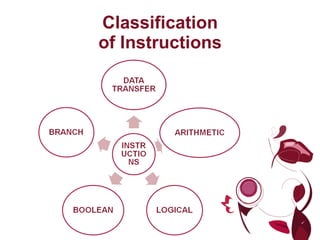
Classification of Instructions
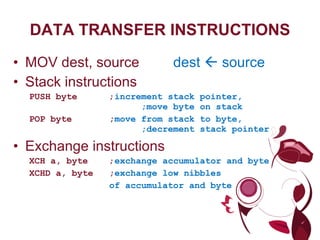
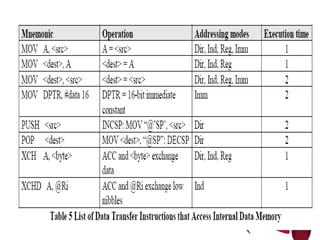
DATA TRANSFER INSTRUCTIONS MOV dest, source dest    source Stack instructions PUSH byte ; increment stack pointer,    ;move byte on stack POP byte   ; move from stack to byte,      ;decrement stack pointer Exchange instructions XCH a, byte ; exchange accumulator and byte XCHD a, byte ; exchange low nibbles of accumulator and byte
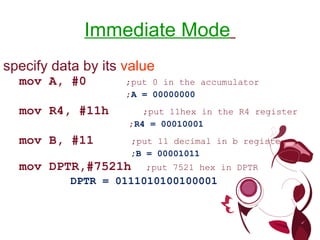
Immediate Mode   specify data by its  value mov A, #0   ;put 0 in the accumulator   ; A = 00000000 mov R4, #11h  ;put 11hex in the R4 register   ; R4 = 00010001 mov B, #11   ;put 11 decimal in b register   ;B = 00001011 mov DPTR,#7521h  ;put 7521 hex in DPTR DPTR = 0111010100100001
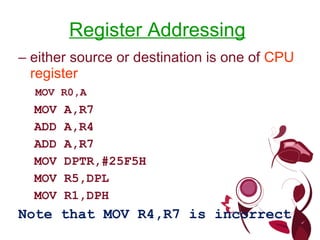
Register Addressing   – either source or destination is one of  CPU register MOV R0,A MOV A,R7 ADD A,R4 ADD A,R7 MOV DPTR,#25F5H MOV R5,DPL MOV R1,DPH Note that MOV R4,R7 is incorrect
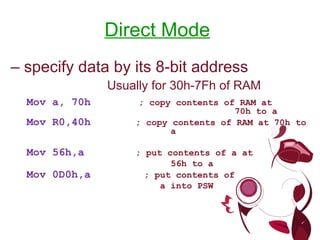
Direct Mode   –  specify data by its 8-bit address Usually for 30h-7Fh of RAM Mov a, 70h  ; copy contents of RAM at  70h to a Mov R0,40h  ; copy contents of RAM at 70h to  a Mov 56h,a  ; put contents of a at  56h to a Mov 0D0h,a   ; put contents of    a into PSW
Register Indirect   –  the address of the source or destination is specified in registers Uses registers R0 or R1 for  8-bit  address: mov psw, #0 ; use register bank 0 mov r0, #0x3C mov @r0, #3 ; memory at 3C gets #3 ; M[3C]    3 Uses DPTR register for  16-bit  addresses: mov dptr, #0x9000 ; dptr    9000h movx a, @dptr ; a    M[9000] Note that 9000 is an address in external memory
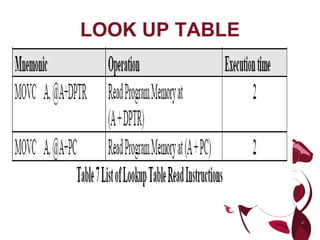
Register Indexed Mode   –  source or destination address is the sum of the  base address  and the accumulator(Index) Base address can be  DPTR  or PC mov dptr, #4000h mov a, #5 movc a, @a + dptr  ; a    M[4005]
 
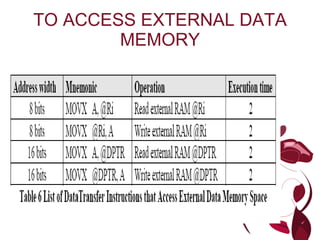
TO ACCESS EXTERNAL DATA MEMORY
LOOK UP TABLE

mup

  • 1.
  • 2.
  • 3.
    DATA TRANSFER INSTRUCTIONSMOV dest, source dest  source Stack instructions PUSH byte ; increment stack pointer, ;move byte on stack POP byte ; move from stack to byte, ;decrement stack pointer Exchange instructions XCH a, byte ; exchange accumulator and byte XCHD a, byte ; exchange low nibbles of accumulator and byte
  • 4.
    Immediate Mode specify data by its value mov A, #0 ;put 0 in the accumulator ; A = 00000000 mov R4, #11h ;put 11hex in the R4 register ; R4 = 00010001 mov B, #11 ;put 11 decimal in b register ;B = 00001011 mov DPTR,#7521h ;put 7521 hex in DPTR DPTR = 0111010100100001
  • 5.
    Register Addressing – either source or destination is one of CPU register MOV R0,A MOV A,R7 ADD A,R4 ADD A,R7 MOV DPTR,#25F5H MOV R5,DPL MOV R1,DPH Note that MOV R4,R7 is incorrect
  • 6.
    Direct Mode – specify data by its 8-bit address Usually for 30h-7Fh of RAM Mov a, 70h ; copy contents of RAM at 70h to a Mov R0,40h ; copy contents of RAM at 70h to a Mov 56h,a ; put contents of a at 56h to a Mov 0D0h,a ; put contents of a into PSW
  • 7.
    Register Indirect – the address of the source or destination is specified in registers Uses registers R0 or R1 for 8-bit address: mov psw, #0 ; use register bank 0 mov r0, #0x3C mov @r0, #3 ; memory at 3C gets #3 ; M[3C]  3 Uses DPTR register for 16-bit addresses: mov dptr, #0x9000 ; dptr  9000h movx a, @dptr ; a  M[9000] Note that 9000 is an address in external memory
  • 8.
    Register Indexed Mode – source or destination address is the sum of the base address and the accumulator(Index) Base address can be DPTR or PC mov dptr, #4000h mov a, #5 movc a, @a + dptr ; a  M[4005]
  • 9.
  • 10.
    TO ACCESS EXTERNALDATA MEMORY
  • 11.