
TOPIC 2 : AIR POLUTION ENGINEERING
Outline of topic 2:
AIR EMISSIONS MODELLING AND SAMPLING
AIR POLLUTION ABATEMENT EQUIPMENTS
Introduction
WHAT IS YOUR UNDERSTANDING?
• Who are you ?
• What is your role?
• We have any ISSUES for these?
• Are you important for this ISSUES…….?
INTRODUCTION
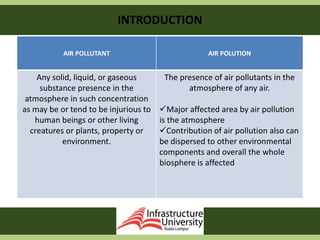
AIR POLLUTANT AIR POLUTION
Any solid, liquid, or gaseous
substance presence in the
atmosphere in such concentration
as may be or tend to be injurious to
human beings or other living
creatures or plants, property or
environment.
The presence of air pollutants in the
atmosphere of any air.
Major affected area by air pollution
is the atmosphere
Contribution of air pollution also can
be dispersed to other environmental
components and overall the whole
biosphere is affected
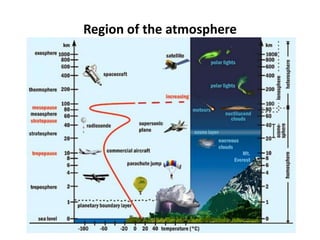
Region of the atmosphere
Region concern: Troposphere
• main concern for air pollution
• this is the region where we live
• The region of stratosphere also need to be concerned for the
– transportation of pollution
– particularly the debris of above ground (atomic bomb tests
or nuclear disaster)
– and volcanic eruption
• Ozone layer is also located at the stratosphere
CLASSIFICATION OF AIR POLLUTANT
A) Primary pollutant
It is a direct emission from the source
Are SOx , CO , NOx , Pb , hydrocarbon (PAH)
Example:
 SO2 from chimney or stack
 CO, NOx and hydrocarbons emitted by motor vehicles
Primary pollutant can react with the other substances in
atmosphere and produce secondary pollutant
Example:
Primary pollutant react with water vapour in the presence
of sunlight to form new set of pollutants
B) Secondary pollutant
 It is formed by complex reaction between primary pollutants
by thermal, chemical or photochemical reactions with
radical molecules
 Generally are sulfuric acid (H2SO4), ozone (O3),
formaldehydes and peroxy-acyl-nitrate (PAN), etc.
Example: By thermal action
 SO2 can be oxidised to SO3 which, dissolved in water,
gives rise to the formation of H2SO4mist (with the
assistance of catalyst reaction by manganese and iron
oxides)
C) Organic pollutant
– Are those of biological origin
– Such as Pollen, Bacteria, Organic compounds-Polycyclic
aromatic hydrocarbon (PAH)
D) Non-organic pollutant
– Gaseous pollutant - priority gaseous which have been
identified to be toxic or carcinogenic or nuisance)
– Such as CO2, CO, SO2, O3
– Non-gaseous pollutant - occupy the atmosphere with a
wide variety of suspended particulate matter (SPM), which
can take form of both solid and liquid, ranging in size from
a few nanometres (nm) to 0.5 mm.
– Such as dust, fume, mist, smoke, spray
AIR SAMPLING AND MODELING
Measuring and Estimating Levels of Air Pollution
Air samples are collected usually to find out:
 what pollutants are in the air
 What are the levels (or concentration) of the pollutants found
Note: i) To determine whether levels of pollution in the air that people breathe could
be harmful to their health
ii) Illness can result depending on the level of contamination, duration of
exposure or pre-existing health condition
Measuring Devices
No single device can measure every air pollutant because each air
pollutant is different:
 Some pollutants are particles
 Some are gases
 Some pollutants break down in sunlight
 Some do not break down in sunlight
 Some pollutants react very quickly when they land on surfaces
 Some are very stable
Most common approaches to measuring air pollution
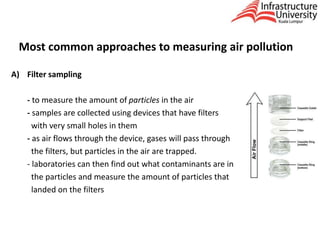
A) Filter sampling
- to measure the amount of particles in the air
- samples are collected using devices that have filters
with very small holes in them
- as air flows through the device, gases will pass through
the filters, but particles in the air are trapped.
- laboratories can then find out what contaminants are in
the particles and measure the amount of particles that
landed on the filters
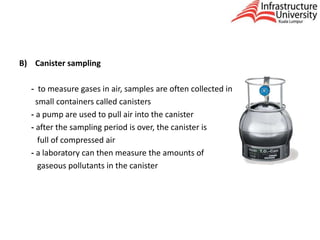
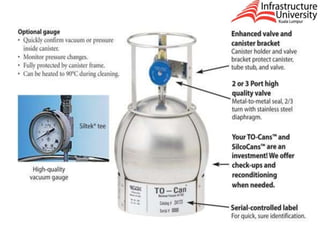
B) Canister sampling
- to measure gases in air, samples are often collected in
small containers called canisters
- a pump are used to pull air into the canister
- after the sampling period is over, the canister is
full of compressed air
- a laboratory can then measure the amounts of
gaseous pollutants in the canister
Air Modeling
 An air modeling is a mathematical tool that use to understand how
contaminants move in the air
 In order to use an air model, relevant data related to area of study
are needed
 Scientifically, sound modeling can result in a better understanding of
the overall exposure to specific contaminants
Note: Because extensive sampling data are not available for many sites,
air models are the best tools available for estimating exposure to air
pollution.
Air Models
• can be used to estimate a substance’s concentration over different time
frames, such as a given day or an entire year.
• can be used to estimate the level of multiple substances in the air as a result
of emissions from a single source or multiple sources.
• can estimate a substance’s concentration at a wide range of locations.
• can be used to estimate levels of air pollution in residential areas.
• can offer insights into where contaminants deposit in greatest quantities.
• can help identify areas where air sampling should take place.
Note: Even though a model may be used to measure a source-specific contaminant,
there may be other sources of air pollution (such as motor vehicle traffic, airports,
wind-blown dust and burning) that may be affect the result.
Example:
Air modeling is used to estimate the amount of contaminants in the air that people breathe, and the
amount of contaminants that might have been deposited in the residential areas.
Models inputs: source of contamination and local weather conditions.
Models output: estimations levels of air pollution and the amount of air
contaminations that might land on the ground
Analysis: analysis is to first run the models, then critically review the results and finally document the
findings.
Note: i) Though many models are quite advanced, none are perfect. Outputs from
models should be viewed simply as estimates of actual conditions.
ii) Even though a model may be used to measure a source-specific
contaminants, there may be other sources of air pollution (such as motor
vehicle traffic, airports, wind-blown dust and burning) that may affect the
result.
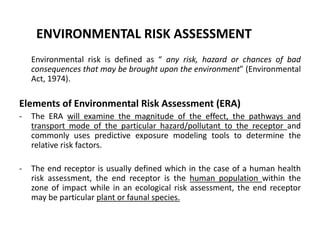
ENVIRONMENTAL RISK ASSESSMENT
Environmental risk is defined as “ any risk, hazard or chances of bad
consequences that may be brought upon the environment” (Environmental
Act, 1974).
Elements of Environmental Risk Assessment (ERA)
- The ERA will examine the magnitude of the effect, the pathways and
transport mode of the particular hazard/pollutant to the receptor and
commonly uses predictive exposure modeling tools to determine the
relative risk factors.
- The end receptor is usually defined which in the case of a human health
risk assessment, the end receptor is the human population within the
zone of impact while in an ecological risk assessment, the end receptor
may be particular plant or faunal species.
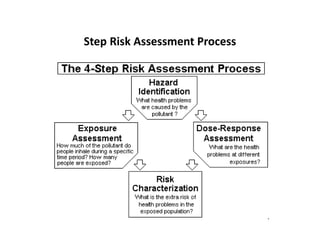
Step Risk Assessment Process
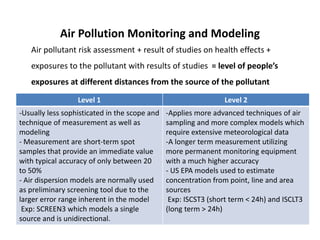
Air Pollution Monitoring and Modeling
Air pollutant risk assessment + result of studies on health effects +
exposures to the pollutant with results of studies = level of people’s
exposures at different distances from the source of the pollutant
Level 1 Level 2
-Usually less sophisticated in the scope and
technique of measurement as well as
modeling
- Measurement are short-term spot
samples that provide an immediate value
with typical accuracy of only between 20
to 50%
- Air dispersion models are normally used
as preliminary screening tool due to the
larger error range inherent in the model
Exp: SCREEN3 which models a single
source and is unidirectional.
-Applies more advanced techniques of air
sampling and more complex models which
require extensive meteorological data
-A longer term measurement utilizing
more permanent monitoring equipment
with a much higher accuracy
- US EPA models used to estimate
concentration from point, line and area
sources
Exp: ISCST3 (short term < 24h) and ISCLT3
(long term > 24h)
Air Pollution Abatement
Equipments
PREVENTING AND MINIMIZING AIR POLLUTION
Considerations for controlling pollutants without the addition
of specific treatment devices:
– Eliminate leaks or vents of the pollutant
– Change raw materials, fuels, or processing step to reduce
or eliminate the pollutant
– Reduce the quantity of pollutant released or the quantity
of carrier gas to be treated
– Use equipment for dual purposes
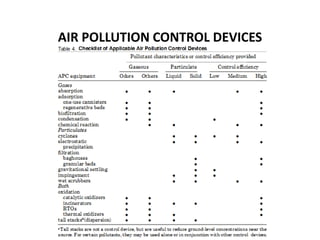
AIR POLLUTION CONTROL DEVICES
PARTICULATES
• Control techniques for particles focus on capturing the
particles emitted by a pollution source
• Characteristics of the particulate exhaust stream affect the
choice of the control device
• Characteristics include:
– the range of particle sizes
– the exhaust flow rate
– the temperature
– the moisture content
– various chemical properties (explosiveness, acidity,
alkalinity, and flammability)
Objectives of using control devices:
 Prevention of nuisance
 Prevention of physical damage to property
 Elimination of health hazards to plant personnel and
to the general population
 Recovery of valuable waste products
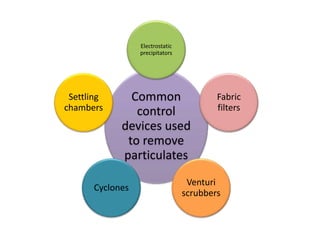
Common
control
devices used
to remove
particulates
Electrostatic
precipitators
Fabric
filters
Venturi
scrubbers
Cyclones
Settling
chambers
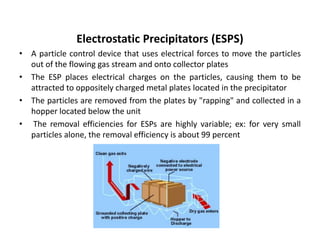
Electrostatic Precipitators (ESPS)
• A particle control device that uses electrical forces to move the particles
out of the flowing gas stream and onto collector plates
• The ESP places electrical charges on the particles, causing them to be
attracted to oppositely charged metal plates located in the precipitator
• The particles are removed from the plates by "rapping" and collected in a
hopper located below the unit
• The removal efficiencies for ESPs are highly variable; ex: for very small
particles alone, the removal efficiency is about 99 percent
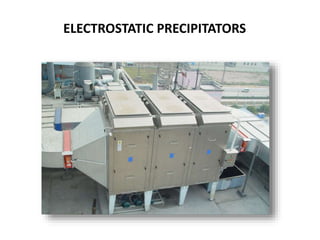
ELECTROSTATIC PRECIPITATORS
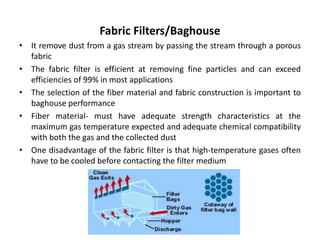
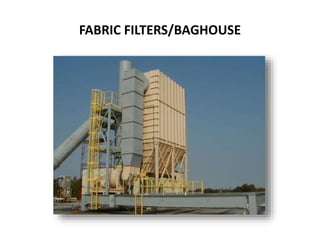
Fabric Filters/Baghouse
• It remove dust from a gas stream by passing the stream through a porous
fabric
• The fabric filter is efficient at removing fine particles and can exceed
efficiencies of 99% in most applications
• The selection of the fiber material and fabric construction is important to
baghouse performance
• Fiber material- must have adequate strength characteristics at the
maximum gas temperature expected and adequate chemical compatibility
with both the gas and the collected dust
• One disadvantage of the fabric filter is that high-temperature gases often
have to be cooled before contacting the filter medium
FABRIC FILTERS/BAGHOUSE
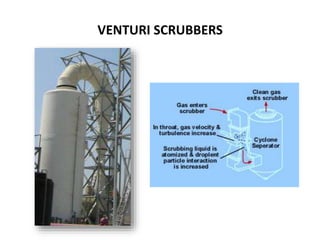
Venturi Scrubbers
• Use a liquid stream to remove solid particles
• Gas laden with particulate matter passes through a short tube with flared
ends and a constricted middle
• This constriction causes the gas stream to speed up when the pressure is
increased
• A water spray is directed into the gas stream either prior to or at the
constriction in the tube
• The difference in velocity and pressure resulting from the constriction
causes the particles and water to mix and combine
• The reduced velocity at the expanded section of the throat allows the
droplets of water containing the particles to drop out of the gas stream
• Effective in removing small particles (removal efficiencies of up to 99%)
• One drawback of this device-production of wastewater
VENTURI SCRUBBERS
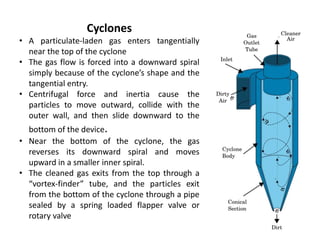
Cyclones
• A particulate-laden gas enters tangentially
near the top of the cyclone
• The gas flow is forced into a downward spiral
simply because of the cyclone’s shape and the
tangential entry.
• Centrifugal force and inertia cause the
particles to move outward, collide with the
outer wall, and then slide downward to the
bottom of the device.
• Near the bottom of the cyclone, the gas
reverses its downward spiral and moves
upward in a smaller inner spiral.
• The cleaned gas exits from the top through a
“vortex-finder” tube, and the particles exit
from the bottom of the cyclone through a pipe
sealed by a spring loaded flapper valve or
rotary valve
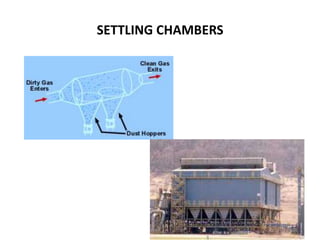
Settling Chambers
• Settling chambers use the force of gravity to remove solid
particles
• The gas stream enters a chamber where the velocity of the
gas is reduced
• Large particles drop out of the gas and are recollected in
hoppers
• Because settling chambers are effective in removing only
larger particles, they are used in conjunction with a more
efficient control device
SETTLING CHAMBERS
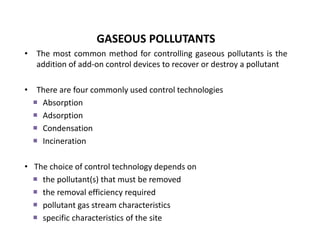
GASEOUS POLLUTANTS
• The most common method for controlling gaseous pollutants is the
addition of add-on control devices to recover or destroy a pollutant
• There are four commonly used control technologies
 Absorption
 Adsorption
 Condensation
 Incineration
• The choice of control technology depends on
 the pollutant(s) that must be removed
 the removal efficiency required
 pollutant gas stream characteristics
 specific characteristics of the site
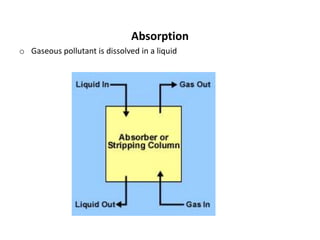
Absorption
o Gaseous pollutant is dissolved in a liquid
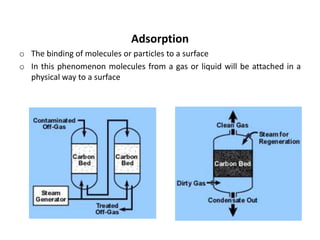
Adsorption
o The binding of molecules or particles to a surface
o In this phenomenon molecules from a gas or liquid will be attached in a
physical way to a surface
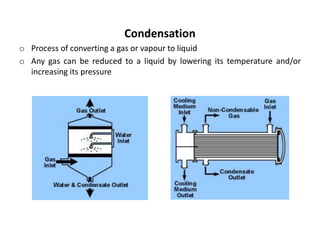
Condensation
o Process of converting a gas or vapour to liquid
o Any gas can be reduced to a liquid by lowering its temperature and/or
increasing its pressure
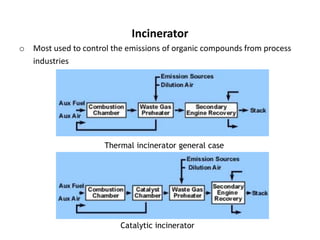
Incinerator
o Most used to control the emissions of organic compounds from process
industries
Thermal incinerator general case
Catalytic incinerator
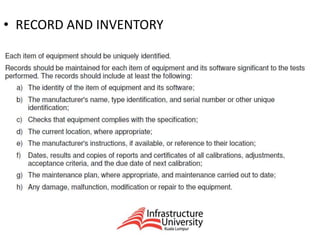
• RECORD AND INVENTORY

Class notes topic 2

  • 1.
    TOPIC 2 :AIR POLUTION ENGINEERING Outline of topic 2: AIR EMISSIONS MODELLING AND SAMPLING AIR POLLUTION ABATEMENT EQUIPMENTS
  • 2.
    Introduction WHAT IS YOURUNDERSTANDING? • Who are you ? • What is your role? • We have any ISSUES for these? • Are you important for this ISSUES…….?
  • 3.
    INTRODUCTION AIR POLLUTANT AIRPOLUTION Any solid, liquid, or gaseous substance presence in the atmosphere in such concentration as may be or tend to be injurious to human beings or other living creatures or plants, property or environment. The presence of air pollutants in the atmosphere of any air. Major affected area by air pollution is the atmosphere Contribution of air pollution also can be dispersed to other environmental components and overall the whole biosphere is affected
  • 4.
    Region of theatmosphere
  • 5.
    Region concern: Troposphere •main concern for air pollution • this is the region where we live • The region of stratosphere also need to be concerned for the – transportation of pollution – particularly the debris of above ground (atomic bomb tests or nuclear disaster) – and volcanic eruption • Ozone layer is also located at the stratosphere
  • 6.
    CLASSIFICATION OF AIRPOLLUTANT A) Primary pollutant It is a direct emission from the source Are SOx , CO , NOx , Pb , hydrocarbon (PAH) Example:  SO2 from chimney or stack  CO, NOx and hydrocarbons emitted by motor vehicles Primary pollutant can react with the other substances in atmosphere and produce secondary pollutant Example: Primary pollutant react with water vapour in the presence of sunlight to form new set of pollutants
  • 7.
    B) Secondary pollutant It is formed by complex reaction between primary pollutants by thermal, chemical or photochemical reactions with radical molecules  Generally are sulfuric acid (H2SO4), ozone (O3), formaldehydes and peroxy-acyl-nitrate (PAN), etc. Example: By thermal action  SO2 can be oxidised to SO3 which, dissolved in water, gives rise to the formation of H2SO4mist (with the assistance of catalyst reaction by manganese and iron oxides)
  • 8.
    C) Organic pollutant –Are those of biological origin – Such as Pollen, Bacteria, Organic compounds-Polycyclic aromatic hydrocarbon (PAH) D) Non-organic pollutant – Gaseous pollutant - priority gaseous which have been identified to be toxic or carcinogenic or nuisance) – Such as CO2, CO, SO2, O3 – Non-gaseous pollutant - occupy the atmosphere with a wide variety of suspended particulate matter (SPM), which can take form of both solid and liquid, ranging in size from a few nanometres (nm) to 0.5 mm. – Such as dust, fume, mist, smoke, spray
  • 9.
    AIR SAMPLING ANDMODELING Measuring and Estimating Levels of Air Pollution Air samples are collected usually to find out:  what pollutants are in the air  What are the levels (or concentration) of the pollutants found Note: i) To determine whether levels of pollution in the air that people breathe could be harmful to their health ii) Illness can result depending on the level of contamination, duration of exposure or pre-existing health condition
  • 10.
    Measuring Devices No singledevice can measure every air pollutant because each air pollutant is different:  Some pollutants are particles  Some are gases  Some pollutants break down in sunlight  Some do not break down in sunlight  Some pollutants react very quickly when they land on surfaces  Some are very stable
  • 11.
    Most common approachesto measuring air pollution A) Filter sampling - to measure the amount of particles in the air - samples are collected using devices that have filters with very small holes in them - as air flows through the device, gases will pass through the filters, but particles in the air are trapped. - laboratories can then find out what contaminants are in the particles and measure the amount of particles that landed on the filters
  • 12.
    B) Canister sampling -to measure gases in air, samples are often collected in small containers called canisters - a pump are used to pull air into the canister - after the sampling period is over, the canister is full of compressed air - a laboratory can then measure the amounts of gaseous pollutants in the canister
  • 14.
    Air Modeling  Anair modeling is a mathematical tool that use to understand how contaminants move in the air  In order to use an air model, relevant data related to area of study are needed  Scientifically, sound modeling can result in a better understanding of the overall exposure to specific contaminants Note: Because extensive sampling data are not available for many sites, air models are the best tools available for estimating exposure to air pollution.
  • 15.
    Air Models • canbe used to estimate a substance’s concentration over different time frames, such as a given day or an entire year. • can be used to estimate the level of multiple substances in the air as a result of emissions from a single source or multiple sources. • can estimate a substance’s concentration at a wide range of locations. • can be used to estimate levels of air pollution in residential areas. • can offer insights into where contaminants deposit in greatest quantities. • can help identify areas where air sampling should take place. Note: Even though a model may be used to measure a source-specific contaminant, there may be other sources of air pollution (such as motor vehicle traffic, airports, wind-blown dust and burning) that may be affect the result.
  • 16.
    Example: Air modeling isused to estimate the amount of contaminants in the air that people breathe, and the amount of contaminants that might have been deposited in the residential areas. Models inputs: source of contamination and local weather conditions. Models output: estimations levels of air pollution and the amount of air contaminations that might land on the ground Analysis: analysis is to first run the models, then critically review the results and finally document the findings. Note: i) Though many models are quite advanced, none are perfect. Outputs from models should be viewed simply as estimates of actual conditions. ii) Even though a model may be used to measure a source-specific contaminants, there may be other sources of air pollution (such as motor vehicle traffic, airports, wind-blown dust and burning) that may affect the result.
  • 17.
    ENVIRONMENTAL RISK ASSESSMENT Environmentalrisk is defined as “ any risk, hazard or chances of bad consequences that may be brought upon the environment” (Environmental Act, 1974). Elements of Environmental Risk Assessment (ERA) - The ERA will examine the magnitude of the effect, the pathways and transport mode of the particular hazard/pollutant to the receptor and commonly uses predictive exposure modeling tools to determine the relative risk factors. - The end receptor is usually defined which in the case of a human health risk assessment, the end receptor is the human population within the zone of impact while in an ecological risk assessment, the end receptor may be particular plant or faunal species.
  • 18.
  • 19.
    Air Pollution Monitoringand Modeling Air pollutant risk assessment + result of studies on health effects + exposures to the pollutant with results of studies = level of people’s exposures at different distances from the source of the pollutant Level 1 Level 2 -Usually less sophisticated in the scope and technique of measurement as well as modeling - Measurement are short-term spot samples that provide an immediate value with typical accuracy of only between 20 to 50% - Air dispersion models are normally used as preliminary screening tool due to the larger error range inherent in the model Exp: SCREEN3 which models a single source and is unidirectional. -Applies more advanced techniques of air sampling and more complex models which require extensive meteorological data -A longer term measurement utilizing more permanent monitoring equipment with a much higher accuracy - US EPA models used to estimate concentration from point, line and area sources Exp: ISCST3 (short term < 24h) and ISCLT3 (long term > 24h)
  • 20.
  • 21.
    PREVENTING AND MINIMIZINGAIR POLLUTION Considerations for controlling pollutants without the addition of specific treatment devices: – Eliminate leaks or vents of the pollutant – Change raw materials, fuels, or processing step to reduce or eliminate the pollutant – Reduce the quantity of pollutant released or the quantity of carrier gas to be treated – Use equipment for dual purposes
  • 22.
  • 23.
    PARTICULATES • Control techniquesfor particles focus on capturing the particles emitted by a pollution source • Characteristics of the particulate exhaust stream affect the choice of the control device • Characteristics include: – the range of particle sizes – the exhaust flow rate – the temperature – the moisture content – various chemical properties (explosiveness, acidity, alkalinity, and flammability)
  • 24.
    Objectives of usingcontrol devices:  Prevention of nuisance  Prevention of physical damage to property  Elimination of health hazards to plant personnel and to the general population  Recovery of valuable waste products
  • 25.
  • 26.
    Electrostatic Precipitators (ESPS) •A particle control device that uses electrical forces to move the particles out of the flowing gas stream and onto collector plates • The ESP places electrical charges on the particles, causing them to be attracted to oppositely charged metal plates located in the precipitator • The particles are removed from the plates by "rapping" and collected in a hopper located below the unit • The removal efficiencies for ESPs are highly variable; ex: for very small particles alone, the removal efficiency is about 99 percent
  • 27.
  • 28.
    Fabric Filters/Baghouse • Itremove dust from a gas stream by passing the stream through a porous fabric • The fabric filter is efficient at removing fine particles and can exceed efficiencies of 99% in most applications • The selection of the fiber material and fabric construction is important to baghouse performance • Fiber material- must have adequate strength characteristics at the maximum gas temperature expected and adequate chemical compatibility with both the gas and the collected dust • One disadvantage of the fabric filter is that high-temperature gases often have to be cooled before contacting the filter medium
  • 29.
  • 30.
    Venturi Scrubbers • Usea liquid stream to remove solid particles • Gas laden with particulate matter passes through a short tube with flared ends and a constricted middle • This constriction causes the gas stream to speed up when the pressure is increased • A water spray is directed into the gas stream either prior to or at the constriction in the tube • The difference in velocity and pressure resulting from the constriction causes the particles and water to mix and combine • The reduced velocity at the expanded section of the throat allows the droplets of water containing the particles to drop out of the gas stream • Effective in removing small particles (removal efficiencies of up to 99%) • One drawback of this device-production of wastewater
  • 31.
  • 32.
    Cyclones • A particulate-ladengas enters tangentially near the top of the cyclone • The gas flow is forced into a downward spiral simply because of the cyclone’s shape and the tangential entry. • Centrifugal force and inertia cause the particles to move outward, collide with the outer wall, and then slide downward to the bottom of the device. • Near the bottom of the cyclone, the gas reverses its downward spiral and moves upward in a smaller inner spiral. • The cleaned gas exits from the top through a “vortex-finder” tube, and the particles exit from the bottom of the cyclone through a pipe sealed by a spring loaded flapper valve or rotary valve
  • 33.
    Settling Chambers • Settlingchambers use the force of gravity to remove solid particles • The gas stream enters a chamber where the velocity of the gas is reduced • Large particles drop out of the gas and are recollected in hoppers • Because settling chambers are effective in removing only larger particles, they are used in conjunction with a more efficient control device
  • 34.
  • 35.
    GASEOUS POLLUTANTS • Themost common method for controlling gaseous pollutants is the addition of add-on control devices to recover or destroy a pollutant • There are four commonly used control technologies  Absorption  Adsorption  Condensation  Incineration • The choice of control technology depends on  the pollutant(s) that must be removed  the removal efficiency required  pollutant gas stream characteristics  specific characteristics of the site
  • 36.
    Absorption o Gaseous pollutantis dissolved in a liquid
  • 37.
    Adsorption o The bindingof molecules or particles to a surface o In this phenomenon molecules from a gas or liquid will be attached in a physical way to a surface
  • 38.
    Condensation o Process ofconverting a gas or vapour to liquid o Any gas can be reduced to a liquid by lowering its temperature and/or increasing its pressure
  • 39.
    Incinerator o Most usedto control the emissions of organic compounds from process industries Thermal incinerator general case Catalytic incinerator
  • 40.
    • RECORD ANDINVENTORY